Article

Mind the Motion: Feasibility and Effects of a Qigong Intervention on Interoception and Well-Being in Young Adults


1
Department of Surgical, Medical, Molecular Pathology and Critical Care Medicine, University of Pisa, 56126 Pisa, Italy
2
School of Advanced Studies, University of Camerino, 62032 Camerino, Italy
3
Department of Civilizations and Forms of Knowledge, University of Pisa, 56126 Pisa, Italy
*
Author to whom correspondence should be addressed.
These authors contributed equally to this work.
Healthcare 2026, 14(2), 202; https://doi.org/10.3390/healthcare14020202
Submission received: 21 November 2025 / Revised: 27 December 2025 / Accepted: 5 January 2026 / Published: 13 January 2026

Highlights

What are the main findings?
  • A 12-week Qigong program significantly improved multiple dimensions of interoceptive awareness (e.g., Body Listening, Trusting, Self-Regulation, Emotional Awareness) and enhanced emotion regulation, mindfulness, and psychological well-being among university students.
  • Participants with lower baseline interoceptive ability or higher trait anxiety benefited the most, showing greater emotional awareness and self-regulatory capacity.
What are the implications of the main findings?
  • Qigong, by integrating both top-down and bottom-up processes, may represent an effective, low-cost, and replicable mind–body intervention for promoting mental health and resilience in academic settings.
  • The results support the inclusion of interoceptive and movement-based practices in preventive psychological programs, emphasizing their role in enhancing emotional regulation and stress adaptation among young adults.

Abstract

Background/Objectives: The present exploratory study evaluates the feasibility and psychological effects of a structured Qigong intervention implemented in an Italian university setting. Qigong is a traditional Chinese mind–body practice combining gentle movements, breathwork, and mindful attention, aimed at enhancing mind–body integration and interoceptive awareness. Methods: A total of 332 undergraduate students voluntarily enrolled in a 12-week Qigong program. The intervention was based on Neidan Qigong and integrated both static and dynamic exercises. Psychological functioning was assessed through several self-report measures evaluating a range of constructs, including mindfulness (FFMQ), interoceptive ability (MAIA), perceived stress (PSS), depression, anxiety, and stress (BDI; DASS-21; STAI Y), emotion regulation (DERS), alexithymia (TAS), and sleep quality (PSQI). Results: A total of 114 students completed the intervention. The protocol was well received by participants and demonstrated high feasibility in the academic context, with good attendance rates and overall engagement. Preliminary findings indicate consistent improvements across several psychological domains. Conclusions: The results suggest that Qigong may be associated with improvements in mental health and well-being in young adults and may represent a promising, low-cost intervention. The findings should be interpreted as preliminary. Further research using controlled and methodologically rigorous designs is needed to assess the stability of these effects over time, incorporate physiological measures, and clarify the specific therapeutic contribution of spontaneous movement within Qigong practice.

1. Introduction

1.1. Qigong: Characteristics and Practice

Qigong is an umbrella term referring to a group of traditional Chinese mind–body practices rooted in Taoist philosophy and Traditional Chinese Medicine [1]. Historically consolidated within the Neidan (Internal Elixir) tradition, these practices emphasized internal regulation of bodily and mental processes rather than external or chemical alchemy [1]. During the twentieth century, particularly in the context of modernization reforms in China, Qigong practices were reframed within medical and scientific discourse and formally integrated into healthcare settings as preventive and therapeutic interventions [2]. Despite the heterogeneity of styles and schools, Qigong is characterized by the systematic integration of static and dynamic exercises, combining gentle, repetitive movements, postural regulation, breath control, and focused attention [3]. It is therefore commonly described as a movement-based embodied contemplative practice [3]. From a psychophysiological perspective, Qigong engages both voluntary, attention-driven processes and more spontaneous, involuntary bodily responses, which have been conceptualized as interacting top-down and bottom-up regulatory pathways [4]. The Neidan Qigong approach adopted in the present study explicitly integrates these dimensions. Participants are guided to cultivate awareness of bodily sensations through structured contemplative practices (e.g., body scanning, breath-focused attention), while also being encouraged to allow spontaneous movements to emerge without deliberate control [5]. Through this combination of intentional attention and embodied responsiveness, Qigong is hypothesized to influence psychological functioning by modulating proprioceptive and interoceptive processes. Proprioception refers to the perception of musculoskeletal position and movement [6] and is stimulated through balance, coordination, and postural training, which have been shown to influence mood and well-being [7]. Interoception, in contrast, involves the perception and integration of internal physiological signals into conscious experience [8], a capacity that may be enhanced through mind–body practices such as Qigong [9]. Additional historical and conceptual details on Qigong are provided in the Supplementary Materials.

1.2. Mental Health and Well-Being in University Students

University students represent a population at risk for psychological distress due to academic demands, performance pressure, social transitions, and uncertainty about the future [10]. Elevated levels of perceived stress, anxiety, depressive symptoms, and sleep disturbances are widely documented in this group and may interfere with both academic functioning and long-term mental health [10,11]. Difficulties in emotion regulation are particularly relevant, as they contribute to maladaptive stress responses and vulnerability to psychopathology [12,13,14,15].
Emotion regulation refers to the processes through which individuals monitor, evaluate, and modify emotional reactions in order to adapt to situational demands [12]. Deficits in these processes are transdiagnostic features of many psychological disorders and are closely linked to dysregulation of autonomic and neuroendocrine stress systems [16,17,18,19,20]. Conversely, effective emotion regulation is associated with resilience, psychological flexibility, and adaptive coping [14,15]. Among students, emotion regulation capacities have been shown to predict academic performance, stress tolerance, and overall well-being [21,22,23,24].
Interoceptive awareness plays a central role in emotion regulation, as the ability to perceive and interpret bodily signals supports emotional recognition and modulation [25,26,27,28]. Impairments in interoceptive processing have been associated with heightened anxiety, stress reactivity, alexithymia, and difficulties in adaptive coping [29,30,31,32]. Interventions that foster embodied awareness and self-regulation may therefore be particularly relevant in academic contexts, where psychological demands are high and preventive approaches are needed.

1.3. Evidence on Qigong Practice and Psychological Outcomes

A growing body of literature supports the psychophysical benefits of Qigong practice across different populations. Systematic reviews and meta-analyses of randomized controlled trials reported improvements in physical functioning, immune parameters, and psychological outcomes, including reductions in stress, anxiety, and depressive symptoms after a qigong-based intervention [33,34,35,36]. These effects have been observed using both self-report measures (e.g., DASS-21, STAI, PSS) and physiological markers such as cortisol and adrenocorticotropic hormone [37,38,39,40]. Qigong practice has also been shown to influence autonomic nervous system activity and hypothalamic–pituitary–adrenal axis functioning, with a particular promotion of parasympathetic activation and stress recovery [39,41,42]. These mechanisms are closely linked to emotion regulation and affective stability [16,17,18]. Improvements in emotional functioning have been reported not only in clinical populations (e.g., chronic illness, substance use disorders, trauma exposure) [43,44,45,46,47,48,49], but also in non-clinical samples, including college students [11,50,51,52].
Importantly, Qigong appears to be associated with enhanced interoceptive awareness, a process considered central to emotion regulation and psychological well-being [9,53,54]. Preliminary evidence indicates that Qigong practice is linked to increased bodily awareness, greater emotional clarity, and reduced alexithymic traits. Improvements in interoceptive awareness have, in turn, been associated with greater use of adaptive emotion regulation strategies, such as cognitive reappraisal, and with reduced stress reactivity [7,27,28,55,56]. In this context, it is important to distinguish interoceptive awareness from interoceptive accuracy: while the latter is typically assessed through objective performance-based tasks (e.g., heartbeat detection), interoceptive awareness refers to the subjective perception, appraisal, and regulatory use of bodily signals. Accordingly, the present study focuses specifically on interoceptive awareness, as conceptualized within multidimensional self-report frameworks [57].
Although these mechanisms have been extensively examined within other contemplative-based interventions such as, for example, mindfulness programs, their role in Qigong practice and efficacy remains comparatively underexplored, particularly in young, non-clinical populations [9].

1.4. Aims of the Present Study

Despite increasing interest in Qigong as a mind–body intervention, several gaps remain. First, few studies have systematically examined interoceptive awareness and emotion regulation as primary outcomes of Qigong practice, especially using multidimensional measures. Second, evidence in university student populations is still limited, despite their vulnerability to stress-related difficulties. Third, the specific contribution of practices integrating both voluntary attention and spontaneous movement has rarely been addressed.
The present study should be framed as an exploratory and feasibility-oriented investigation aimed at examining the psychological effects of a structured Qigong intervention implemented in a university setting. Analyses focused primarily on changes in interoceptive awareness, emotion regulation, mindfulness, perceived stress, and anxiety. Additional psychological domains, including depressive symptoms and related outcomes, were assessed to provide a broader dimensional characterization of change over time. In addition, the study explored whether baseline individual characteristics were associated with differential responsiveness to the intervention and evaluated the feasibility and acceptability of delivering Qigong within an academic context.

2. Materials and Methods

2.1. Participants and Study Design

The present study involved Italian university students from the University of Pisa (Department of Civilizations and Forms of Knowledge) who voluntarily chose to participate in a Qigong protocol offered as a workshop, presented as an optional component of the General Psychology course. Students received an additional point on their exam score (one out of thirty) for their participation. A total of 331 students completed the pre-intervention assessment. Of these, 199 completed the post-intervention assessment, and 114 completed both assessments and were therefore included in the final analysis. No specific inclusion or exclusion criteria were applied beyond voluntary participation. Attendance and home practice were recorded descriptively but were not used as exclusion criteria.

2.2. Procedure

Participants took part in a 3-month Qigong workshop, which included twelve in-person guided intervention sessions and a requested daily home practice. The in-person sessions took place in a university classroom and were led by author AL, with support from a second facilitator. Each session lasted one hour, while the home practice was expected to last 15 min per day.
The workshop followed a structured protocol based on Neidan Qigong practices (see Table S1, Supplementary Materials). General information about the protocol was provided at the beginning of the first session. Each session was designed to integrate both static and dynamic exercises, as well as top-down and bottom-up approaches. At least one exercise from each category was selected weekly for the home practice. Due to classroom space limitations, exercises were performed in either seated or standing positions. Each session concluded with a brief group discussion during which facilitators elicited participants’ feedback on the practice.
All in-person sessions followed a similar structure, divided into three main phases:
  • Opening Phase: Mindfulness awareness, body scanning with a focus on sensations, breathwork, and sound emission.
  • Central Phase (Repetitive Movements): Gentle, repetitive motions that open energy channels and joints including rolling shoulders forward and backward, turning the head in all directions, circling the wrists, lifting the heels while engaging the whole body, shaking arms and legs, body brushing, rotating the waist, stretching the knees and ankles, balanced oscillations, spiraling movements, body shaking, body swinging; Movements repeated for at least 10 min including body bouncing, jumping, and spontaneous movements.
  • Closing Phase: Standing meditation (Zhan Zhuang) and sitting meditation.

2.3. Measures

Participants provided demographic information (e.g., age, gender, marital status). They also reported their previous experience with meditation and Qi Gong, including the type of practice and frequency. At post-intervention, students evaluated their attendance, frequency of home practice, and overall interest in the course, and provided qualitative feedback through a brief set of open-ended questions exploring their subjective experience of the Qigong practice, including perceived benefits, difficulties encountered during the exercises, and suggestions for improvement. These questions were designed to capture experiential and process-related aspects not fully addressed by standardized questionnaires. The full list of questions is reported in the Supplementary Materials (Table S2).
Moreover, the assessment battery comprised the following questionnaires. As already stated, and in line with the exploratory design of the study and the extensive assessment battery, not all administered measures were entered into the primary quantitative analyses. Selected instruments were included for descriptive or exploratory aims and are accordingly reported in the Supplementary Materials or used in targeted analyses (e.g., dropout comparisons).
  • Five Facet Mindfulness Questionnaire (FFMQ) [58,59]: A 39-item self-report measure assessing five mindfulness facets: observing, describing, acting with awareness, non-judging of inner experience, and non-reactivity to inner experience.
  • Perceived Stress Scale (PSS) [60,61]: A 10-item questionnaire evaluating the degree to which situations in one’s life are appraised as stressful over the past month.
  • Multidimensional Assessment of Interoceptive Awareness (MAIA) [62,63]: A 32-item scale measuring eight dimensions of interoceptive body awareness, including noticing, attention regulation, and trusting body sensations.
  • Interpersonal Accuracy Scale (IAS)* [64]: A performance-based tool assessing the ability to accurately infer others’ emotional states from nonverbal cues.
  • Interpersonal Competence Questionnaire (ICQ)* [65,66]: A 40-item self-report instrument evaluating five domains of social competence: initiation, negative assertion, disclosure, emotional support, and conflict management.
  • Difficulties in Emotion Regulation Scale (DERS) [67,68]: A 36-item measure capturing six facets of emotion regulation difficulties: non-acceptance, goals, impulse, awareness, strategies, and clarity.
  • Depression Anxiety Stress Scales—short form (DASS-21) [69,70]: A 21-item short version assessing severity of depression, anxiety, and stress symptoms over the past week.
  • Toronto Alexithymia Scale (TAS) [71,72]: A 20-item scale evaluating three core features of alexithymia: difficulty identifying feelings, difficulty describing feelings, and externally oriented thinking.
  • Pittsburgh Sleep Quality Index (PSQI)* [73,74]: A 19-item self-rated questionnaire assessing sleep quality and disturbances over the past month across seven components.
  • Resilience Scale (RS)* [75,76]: A 25-item measure of psychological resilience, focusing on personal competence, acceptance of self and life, and adaptability.
  • Self-Compassion Scale (SCS)* [77,78]: A 26-item scale assessing six components of self-compassion: self-kindness, self-judgment, common humanity, isolation, mindfulness, and over-identification.
  • State-Trait Anxiety Inventory (STAI) [79,80]: A 40-item inventory distinguishing transient state anxiety (20 items) from stable trait anxiety (20 items).
  • Beck Depression Inventory–II (BDI-II) [81,82]: A 21-item self-report questionnaire assessing the severity of depressive symptoms over the past two weeks. Higher scores indicate greater depressive symptomatology.
  • Positive and Negative Affect Schedule (PANAS)* [83,84]: A self-report measure assessing positive and negative affective states through two independent subscales. Participants indicate the extent to which they experienced each affective state during the reference period.
* Measures marked with an asterisk were included for descriptive or exploratory purposes and were not entered into the primary quantitative analyses.
Adverse events were not systematically monitored through a predefined reporting protocol; however, facilitators continuously observed participants during sessions, and subjective experiences, including discomfort or anxiety, were collected through post-intervention open-ended feedback.

2.4. Dropout Rate

A total of 331 participants were initially enrolled in the study. Between the pre- and post-intervention assessments, there was a dropout rate of 65.66%, resulting in 114 participants who completed both assessments.

2.5. Ethical Considerations

Participation in the study was voluntary, and all participants provided informed consent. The study was approved by Pisa’s University Bioethics Committee [deliberates n.54/2024 on 27 September 2024, n. 63/2025 on 29 September 2025] and conducted in accordance with the Declaration of Helsinki.

2.6. Statistical Analyses

Analyses were performed using JASP (Version 0.19.3.0; JASP Team, Amsterdam, The Netherlands). Descriptive statistics were computed for all variables, and normality was assessed using the Shapiro–Wilk test. Paired samples t-tests were performed for normally distributed variables, while Wilcoxon signed-rank tests were used for non-normally distributed variables. Effect sizes were reported using Cohen’s d and rank-biserial correlation, respectively. Correlations between pre–post difference scores were computed to explore associations between improvements in different psychological domains. Pearson’s r was used for normally distributed difference scores, and Spearman’s ρ for non-normally distributed ones. Linear regression analyses were conducted to examine whether baseline measures predicted post-intervention change scores. Feasibility and acceptability were assessed through analysis of dropout rates and session attendance. Despite the reduced final sample size due to attrition, the statistical power was sufficient for the analysis.

3. Results

Consistent with the exploratory design, results are presented following a hierarchical analytic approach. Analyses focused primarily on a set of core outcomes—namely mindfulness, interoceptive awareness, emotion regulation, perceived stress, and anxiety—which constituted the focus of within-subject comparisons, correlational analyses, and graphical representations. Additional measures assessing related psychological domains (e.g., depressive symptoms, alexithymia, sleep quality) were treated as secondary outcomes and were included to provide a broader dimensional characterization of changes following the intervention; these variables were examined through pre–post comparisons but were not included in the correlational analyses. Finally, several further measures were administered for exploratory or descriptive purposes, allowing a preliminary evaluation of their appropriateness and descriptive value in this context, and were therefore not included in the primary quantitative analyses, as they were not central to the study objectives.

3.1. Feasibility, Sociodemographic Characteristics, and Qualitative Feedback

The final sample consisted of 114 students who completed both pre- and post-intervention evaluations. Participants had a mean age of 20.97 years (SD = 4.76; range = 18–62), and the majority identified as female (75.4%), followed by male students (22.8%), with a small proportion identifying outside the binary gender categories (1.75%). Only 29.8% reported prior meditation experience, and 2.6% had previously practiced Qigong, indicating that most participants were novices to contemplative movement-based practices.
The intervention demonstrated good feasibility and acceptability. Students reported a mean attendance of 79.1% (SD = 16.6), rated their interest at 7.35/10, and practiced at home mainly 1–3 times per week or a few times per month, with a smaller group engaging in daily practice.
A thematic qualitative analysis was conducted on 64 open-ended responses collected at post-intervention. The full set of answers is available upon request. Three overarching themes emerged: (a) Perceived benefits, (b) Reported challenges, and (c) Suggestions for improvement.
  • Perceived benefits were the most frequently reported and included stress reduction, improved emotional regulation, greater interoceptive awareness, and a stronger body–mind connection. Students described the laboratory as “relaxing,” “therapeutic,” and “the only moment of the day where I could breathe without tension.” Many highlighted learning to recognize bodily sensations and release muscular tension through breath regulation, emphasizing the value of embodied emotional self-regulation.
  • Reported challenges included difficulty with breath-focused practices among students with anxiety, initial resistance in entering a meditative state, and discomfort related to practicing in a crowded classroom, although this was reported by a small minority of participants (4). These experiences were described as occasional and often linked to pre-existing anxiety or trauma-related difficulties, particularly during the initial sessions. Importantly, such responses were generally reported as temporary and, in some cases, as improving over time with continued practice. Several students noted that repetitive breathing practices initially increased anxiety before eventually becoming more manageable. Distractions related to noise, movement, or disengaged peers were perceived as limiting concentration.
  • Suggestions for improvement focused on increasing exercise variety, expanding available space or reducing group size, and incorporating additional interactive practices (e.g., dyadic or group sensory activities). Some students expressed interest in further exploration of communication, perception, and sensory-based exercises as complements to Qigong.
  • Qualitative findings are reported descriptively to illustrate recurrent experiential themes and to identify practical elements relevant for intervention refinement, without aiming to provide a comprehensive interpretative qualitative analysis.

3.2. Baseline Comparison Between Completers and Dropouts

Given the high attrition rate, baseline characteristics were compared between participants who completed the study (n = 114) and those who dropped out after the pre-assessment (n = 217) to assess the potential presence of attrition bias (Table S3). No significant differences were observed between completers and dropouts across nearly all sociodemographic and psychological variables. The only exception was the Interpersonal Accuracy Scale (IAS), for which dropouts exhibited slightly higher baseline scores than completers (median [IQR]: 83 [75,76,77,78,79,80,81,82,83,84,85,86,87,88,89,90,91] vs. 81 [72.25–87.50]). The ICQ, DERS, and FFMQ total scores, as well as the PANAS Positive Affect score, were normally distributed and did not differ between groups (all ps > 0.05). For the remaining continuous variables, Mann–Whitney U tests were applied due to clear or borderline deviations from normality, with no statistically significant differences emerging (all ps > 0.05). Likewise, no group differences were found for categorical variables, including age, gender, and previous meditation experience (χ2(7) = 5.93, p = 0.548; χ2(1) = 1.64, p = 0.200).

3.3. Descriptive Statistics and Normality Tests

Descriptive statistics were computed for all variables, assessed through psychometric questionnaires, and normality was assessed using the Shapiro–Wilk test. Some measures followed a normal distribution (p > 0.05), while others deviated significantly from normality (p < 0.05), warranting the use of non-parametric tests (Wilcoxon signed rank).

3.4. Within-Subjects Analysis

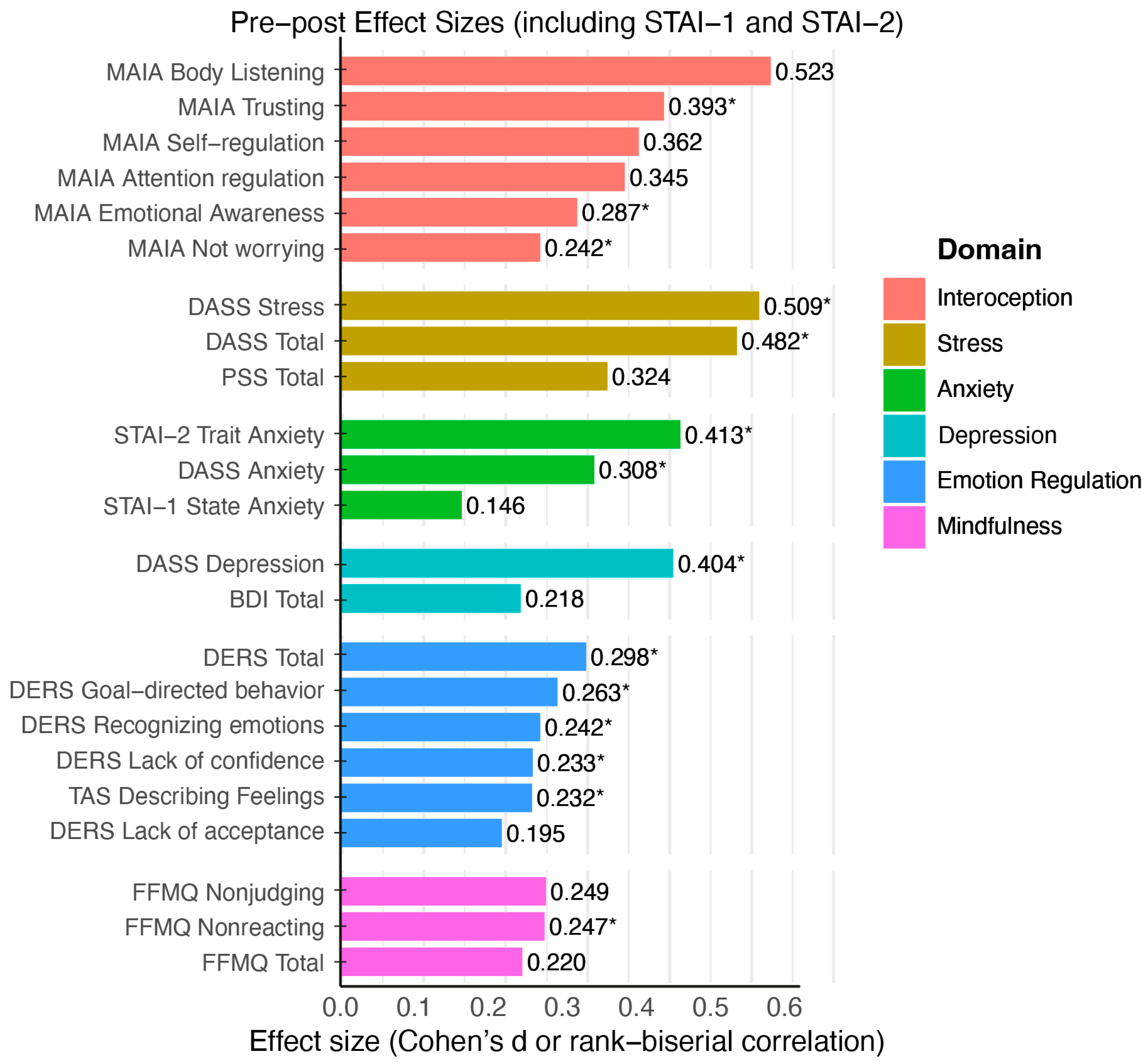
Paired t-tests were conducted to assess differences between pre- and post-intervention scores. Figure 1 displays the results for this analysis.
No significant pre–post changes were observed for the following variables and subscales: DERS–Lack of Awareness; FFMQ–Acting with Awareness, Describing, and Observing; MAIA–Not Distracting; PANAS–Negative Affect and Positive Affect; PSQI; RS; STAI–I; and TAS–Difficulty Identifying Feelings and total score. Full descriptive and inferential statistics for all non-significant results are reported in the Supplementary Materials (Table S4).

3.5. Correlations

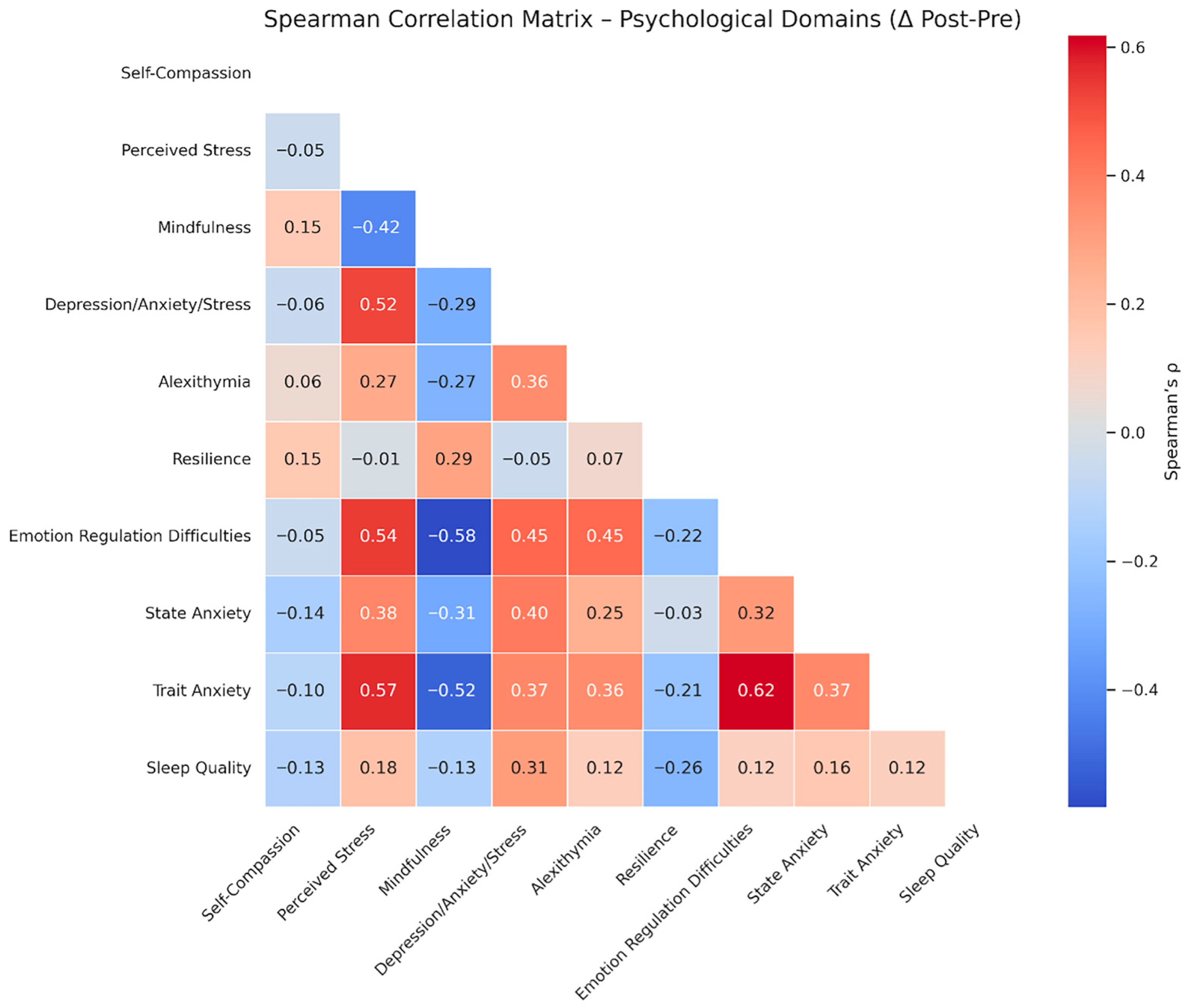
Spearman’s rank correlation was used to examine the associations between pre–post change scores (Δ) across some of the psychological variables. Only correlations with |ρ| > 0.30 are reported below. Correlation results are displayed in Figure 2. Correlation analyses were conducted on change scores of variables showing significant pre–post variation, as well as on additional variables of conceptual relevance included for exploratory purposes. Measures that were either non-significant, secondary, or conceptually redundant with core domains were excluded.
Positive correlations:
Perceived Stress (PSS) correlated positively with Trait Anxiety (STAI-2) (ρ = 0.57), Emotion Regulation Difficulties (DERS) (ρ = 0.54), and Depression, Anxiety, and Stress (DASS) (ρ = 0.52).
DASS correlated positively with PSS (ρ = 0.52), DERS (ρ = 0.45), State Anxiety (STAI-1) (ρ = 0.40), and Trait Anxiety (STAI-2) (ρ = 0.37).
DERS showed strong positive correlations with Trait Anxiety (STAI-2) (ρ = 0.62), PSS (ρ = 0.54), DASS (ρ = 0.45), and Alexithymia (TAS) (ρ = 0.45).
Alexithymia (TAS) was positively correlated with DASS (ρ = 0.36), Trait Anxiety (STAI-2) (ρ = 0.36), and DERS (ρ = 0.45).
State Anxiety (STAI-1) correlated positively with DASS (ρ = 0.40), PSS (ρ = 0.38), and DERS (ρ = 0.32).
Sleep Quality (PSQI) showed a moderate positive correlation with DASS (ρ = 0.31).
Negative correlations:
Mindfulness (FFMQ) was negatively correlated with Trait Anxiety (STAI-2) (ρ = −0.52), Emotion Regulation Difficulties (DERS) (ρ = −0.58), State Anxiety (STAI-1) (ρ = −0.31), and Perceived Stress (PSS) (ρ = −0.42).

3.6. Regression Analyses

To explore whether baseline psychological traits and sociodemographic factors predicted improvements in psychological functioning following the intervention, a series of linear regression analyses were conducted using baseline scores as predictors and the change scores (Δ) of specific psychological variables as outcome measures.
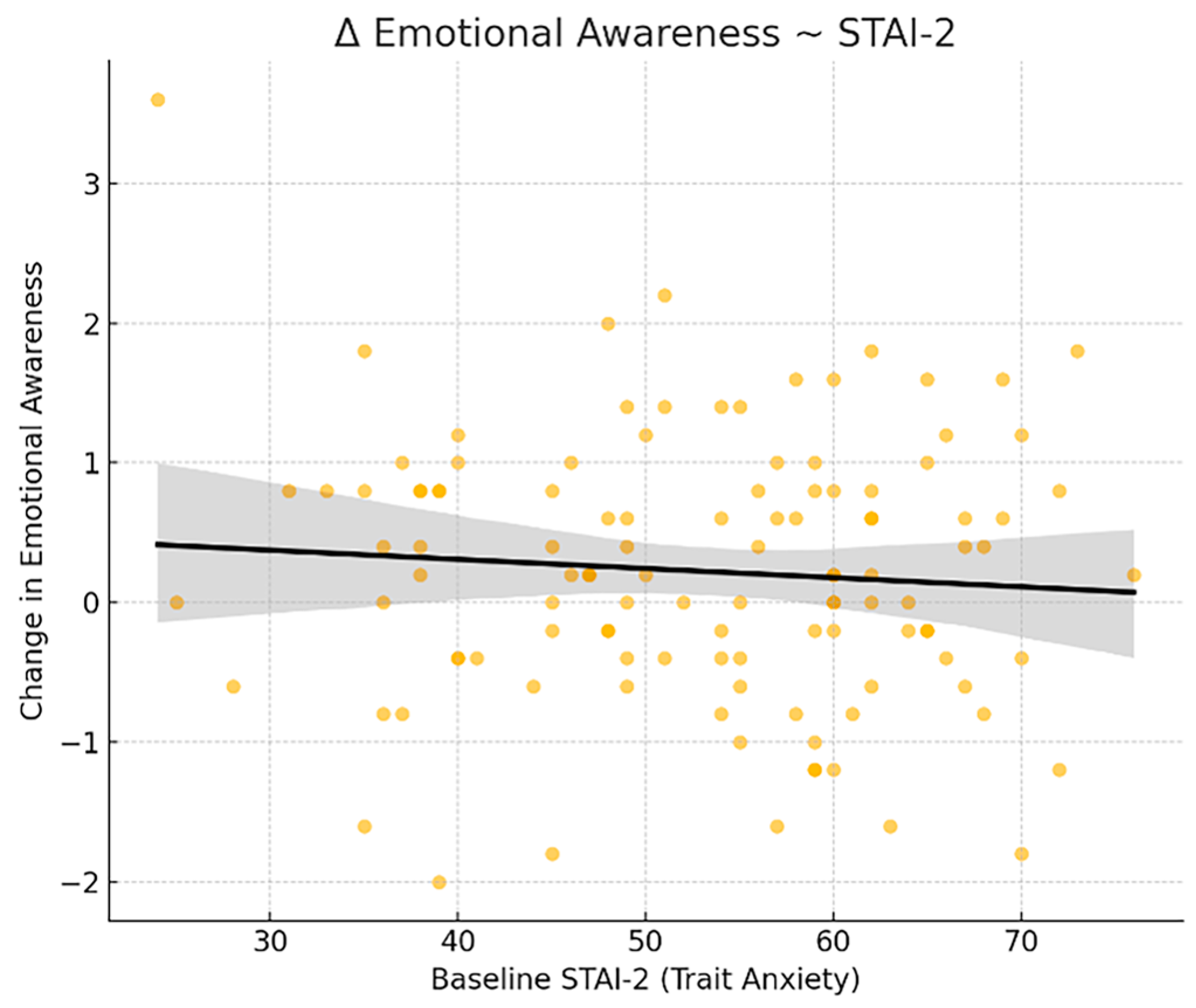
One regression model revealed that both trait anxiety (STAI-2; Figure 3) and mindfulness (FFMQ) significantly predicted improvement in the MAIA subscale Emotional Awareness. Specifically, higher baseline trait anxiety and lower baseline mindfulness were associated with greater post-intervention improvement in this domain. Trait anxiety negatively predicted the change score (β = −0.295, p = 0.028), and similarly, baseline mindfulness also negatively predicted improvement (β = −0.299, p = 0.026).
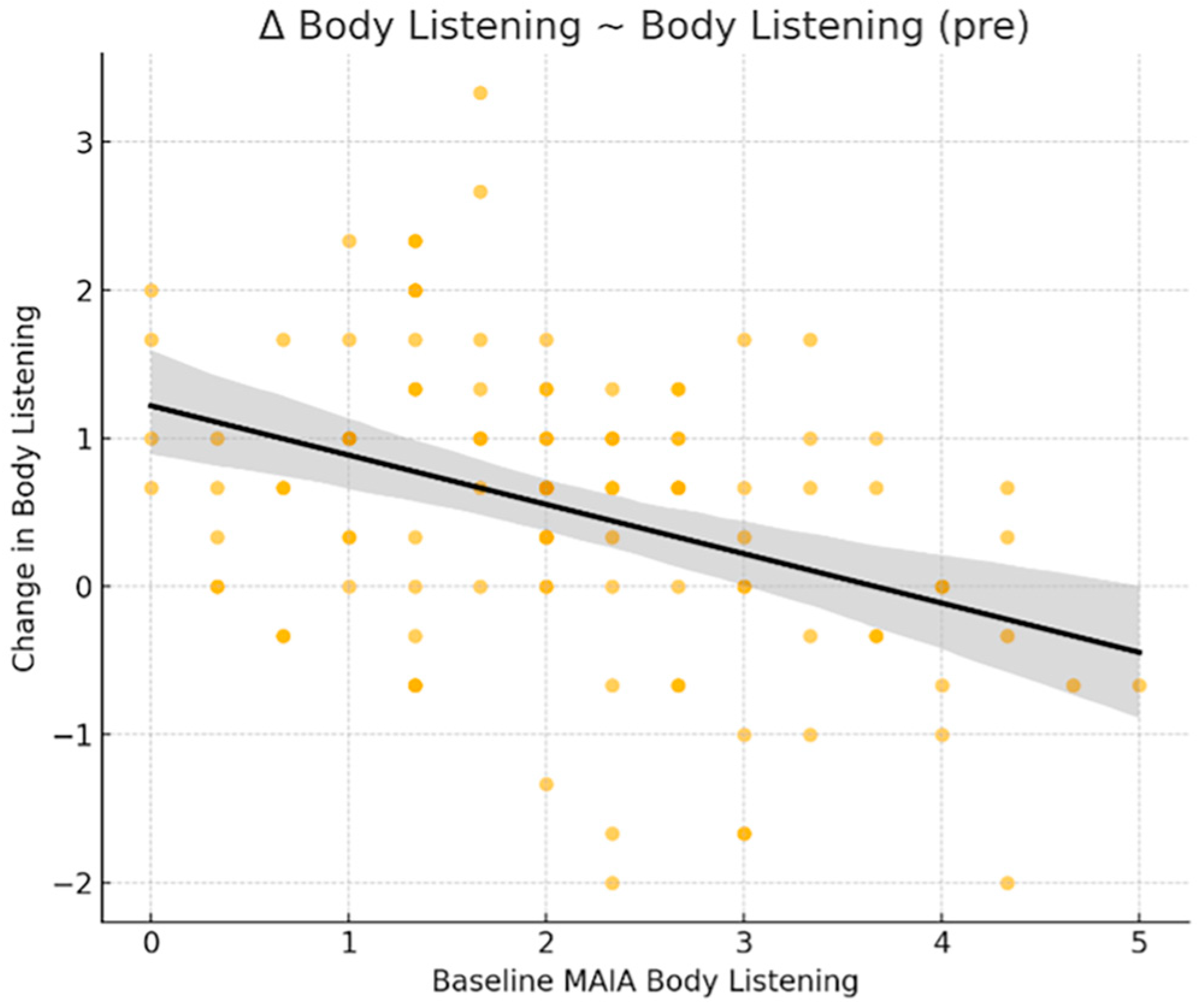
Another regression model identified the MAIA subscale Body Listening (Figure 4) as a significant predictor of improvement in the same domain. Lower baseline scores on Body Listening were associated with greater post-intervention gains (β = −0.376, p < 0.001).
Sociodemographic variables were also tested as predictors. A significant effect was found for gender, where women showed greater improvement in emotion regulation (DERS) compared to men (β = −0.199, p = 0.043).

4. Discussion

The present study should be interpreted within the framework of a feasibility and exploratory investigation, aimed at examining the potential psychological effects of a structured Qigong intervention in a university setting. Given the feasibility-oriented design, the assessment of multiple psychological variables, and the absence of predefined primary outcomes or corrections for multiple comparisons, the findings should be considered preliminary rather than confirmatory. In this context, differential improvements observed in participants with lower baseline scores (e.g., Body Listening) may also reflect regression to the mean and therefore require cautious interpretation. Moreover, the high drop-out rate observed in this study warrants careful consideration. Although participation was voluntary, many students were likely unfamiliar with Qigong and may have found the experiential demands of the practice more challenging than initially expected. Embodied exercises involving spontaneous movement, sound emission, and breath-focused attention can elicit discomfort or embarrassment when performed within a large-group setting. In addition, the optional nature of the workshop and competing academic demands may have contributed to reduced adherence over time. We will discuss this point further in Section 4.2.
Turning to the quantitative findings, the present study revealed significant improvements across several key dimensions of interoceptive awareness, as assessed by the MAIA. Participants reported increased Body Listening, reflecting a greater tendency to attend to bodily cues as sources of guidance and information, as well as higher Trusting, indicating a strengthened perception of the body as a safe and reliable reference. Improvements were also observed in Self-Regulation, Attention Regulation, and Emotional Awareness, together with reductions in Not Worrying, suggesting a decreased tendency to experience distress in response to bodily sensations. Overall, these changes point to a more adaptive and functional relationship with bodily experience. Such findings are concordant with previous evidence indicating that mind–body practices enhance interoceptive functioning and extend recent work in this area (e.g., Chang et al. [55]). As no control condition was included, these results should be interpreted cautiously.
From a mechanistic perspective, improvements across interoceptive subcomponents are particularly relevant because interoceptive awareness is increasingly conceptualized as a foundation for emotional functioning and self-regulation. Enhanced body listening, trust in bodily sensations, and the regulatory use of interoceptive cues have been identified as key pathways through which contemplative and body-based interventions may reduce stress vulnerability and promote psychological well-being. In the present study, gains in interoceptive awareness were accompanied by parallel improvements in emotion regulation, as reflected in reductions across multiple DERS dimensions, including difficulties in goal-directed behavior, emotional awareness, non-acceptance of emotional responses, and limited access to regulation strategies.
Qigong, as a movement-based contemplative practice, has been associated with a state of relaxed alertness and increased vagal tone, reflecting a dynamic balance between parasympathetic and sympathetic activity. In line with models emphasizing the interaction between top-down and bottom-up regulatory pathways [9], the integration of voluntary and spontaneous movements in the present protocol may support complementary mechanisms of emotion regulation. Specifically, voluntary movements and sustained attentional engagement may recruit top-down cognitive control processes, whereas spontaneous movements may enhance bottom-up proprioceptive and interoceptive signaling, fostering more embodied and sensory-driven forms of regulation [85]. Given the overlap between neural substrates involved in visceral perception, affective awareness, and regulatory processes [86,87], as well as the established links between bodily awareness, emotional processing, and psychopathology [3,26,54], enhanced interoceptive capacity may represent one pathway through which Qigong contributes to changes in emotional functioning.
In line with this interpretation, although total alexithymia scores did not show significant changes, specific components related to externally oriented thinking and difficulties in describing feelings improved over time. This pattern suggests a selective effect on aspects of emotional awareness and symbolic elaboration, rather than on global alexithymic traits, and may be linked with the observed changes in interoceptive awareness and emotion regulation.
The correlational analyses support a systemic view of the observed changes. As shown in Figure 2, moderate-to-strong positive associations emerged among reductions in perceived stress, trait anxiety, emotion regulation difficulties, and depressive symptoms (e.g., ρ = 0.57 between PSS and STAI-II; ρ = 0.54 between PSS and DERS; ρ = 0.62 between DERS and STAI-II), suggesting that improvements across these domains co-occurred within a coherent pattern of psychological change. Notably, the reduction observed in trait anxiety, in the absence of significant changes in state anxiety, indicates that the intervention may have preferentially influenced more stable dispositional patterns rather than transient affective states. This finding aligns with the characteristics of Qigong practice, which may foster changes in more enduring regulatory processes.
In contrast, increases in mindfulness were negatively associated with perceived stress, trait anxiety, and emotion regulation difficulties, highlighting its potential protective role within this broader network of changes. Associations involving alexithymia and emotion regulation difficulties are also compatible with previous research linking personality traits, distress proneness, and regulatory vulnerabilities across clinical and non-clinical populations [37,49,87,88,89,90,91,92,93].
At the same time, several assessed variables did not show significant pre–post changes, including facets of dispositional mindfulness primarily related to attentional monitoring (e.g., Observing, Describing, Acting with Awareness), general affective states (PANAS), and the MAIA subscale Not Distracting. The absence of changes in positive and negative affect supports the interpretation that the intervention primarily targeted interoceptive and regulatory processes, rather than producing generalized shifts in mood. Taken together, this pattern suggests that the intervention may have preferentially influenced embodied, bottom-up regulatory and relational processes—such as the capacity to attend to bodily signals, regulate internal states, and experience the body as a trustworthy source of information—rather than top-down attentional control or trait-like affective dispositions. In a non-clinical sample, these latter dimensions may be relatively stable and less responsive to short-term interventions, or may require longer practice duration to show measurable change.
Baseline individual differences further moderate outcomes. Participants with higher trait anxiety and lower baseline mindfulness showed greater gains in Emotional Awareness, whereas those with lower initial Body Listening exhibited the largest improvements in this domain. A modest gender effect was also observed, with females showing greater improvements in emotion regulation. These findings suggest that individuals with greater initial interoceptive difficulties or emotional vulnerability may particularly benefit from Qigong practice, potentially because it targets regulatory processes that are more compromised at baseline. While this pattern suggests greater responsiveness among participants with lower baseline levels, regression to the mean cannot be excluded as an alternative explanation.
Qualitative findings complemented the quantitative results. Most participants, despite having little or no prior experience with meditation or Qigong, described the intervention as relaxing and helpful for increasing awareness of bodily tension and breathing patterns. However, a little part of the students, particularly those with higher anxiety—reported initial difficulties with breath-focused practices, and others noted discomfort related to practicing in a crowded classroom. These observations suggest that engagement in Qigong may depend on how safely and comfortably individuals can attend to bodily sensations, especially when interoceptive awareness is initially limited.
From a clinical perspective, Qigong appears promising as a low-cost intervention for university students experiencing elevated stress, emotion regulation difficulties, interoceptive impairments, or subthreshold symptoms of anxiety, depression, and alexithymia. Improvements in Trusting and Not Worrying may foster a more compassionate bodily self-relation, which is considered central in trauma-informed approaches [57,63]. More broadly, these findings align with models conceptualizing interoceptive dysfunction as a transdiagnostic marker [94] and emotion regulation as a key resilience factor [15]. The integration of top-down and bottom-up techniques may therefore be particularly suitable for academic mental health programs. Interpretation of these findings requires consideration of several methodological limitations, discussed in the following section.

4.1. Limitations

Several limitations should be acknowledged. First, the study did not include a control group; therefore, causal inferences regarding the effects of the Qigong intervention cannot be drawn, and observed changes may partly reflect nonspecific factors such as group participation, the academic context, or regression to the mean. Second, the high dropout rate between pre- and post-assessment (approximately 65%) substantially reduced the final sample size and represents a relevant source of potential bias. Although baseline comparisons between completers and dropouts showed comparable sociodemographic and psychological characteristics, the possibility of bias related to unmeasured or latent factors (e.g., motivation, distress tolerance, or attitudes toward body-focused practices) cannot be excluded. Third, classroom constraints limited the range of movements and restricted the exploration of spontaneous movement, which may elicit emotionally salient responses requiring appropriate containment. Moreover, the use of self-report measures means that results pertain specifically to interoceptive awareness, as a subjective and appraisal-based construct, and not to interoceptive accuracy or objective physiological indices.
Finally, the absence of follow-up assessments prevents conclusions regarding the durability of the observed effects over time. Despite these limitations, the study provides preliminary evidence from a large non-clinical sample and represents one of the few evaluations of Qigong with spontaneous movement conducted in a university setting.

4.2. Lessons Learned and Implications for Future Research

As this Qigong program was implemented for the first time within an Italian university setting, several methodological lessons can be drawn to inform the design of a more definitive trial.
First, the physical setting of the intervention should be reconsidered in light of the difficulties reported by participants. In-person sessions could be conducted in larger spaces such as sports halls or outdoor environments, in order to reduce crowding and minimize discomfort, particularly among students with elevated anxiety or attentional difficulties. In addition, the use of digital communication tools (e.g., group chats or dedicated online platforms) may facilitate real-time support and clarification regarding daily home practice, thereby enhancing engagement and adherence.
Second, given that Qigong is still relatively unfamiliar to most Italian students, future studies would benefit from the inclusion of preliminary educational sessions prior to the start of the intervention. Providing clear information about the nature of Qigong practice, including the presence of both voluntary and spontaneous movements, may help align participants’ expectations and reduce early dropout. In the present study, some attrition may have been related to discomfort or embarrassment associated with spontaneous movements in a large-group context; preparatory meetings could foster a more informed and receptive attitude toward the practice.
Third, a more definitive trial should rely on a structured and adequately resourced intervention framework. The management of large groups practicing embodied and emotionally salient exercises requires the presence of trained facilitators capable of providing containment, guidance, and individual support when needed. Such an organizational structure may allow participants to engage more deeply with Qigong-related mind–body states and to integrate these experiences into daily life.
With regard to outcomes, future studies may extend assessment beyond psychological well-being to include longer-term indicators of academic functioning, such as perceived academic stress, concentration, engagement, or academic performance. These outcomes may be particularly relevant once sustained practice allows for more stable integration of self-regulatory skills.
Finally, a definitive trial should include an appropriate control condition. A credible control group could be drawn from the same student population to ensure comparable baseline characteristics. From an ethical perspective, a waitlist control design may be particularly suitable in a university context, although its implementation may present practical challenges. Alternative active control conditions could also be considered in order to better isolate the specific contribution of Qigong practice.

5. Conclusions

This study provides preliminary evidence suggesting that a structured Qigong program may be associated with improvements in interoceptive awareness, emotion regulation, and psychological well-being in university students. These effects may result from the combined use of static and dynamic exercises that engage both top-down and bottom-up processes. Benefits were particularly pronounced in students with lower baseline interoceptive ability or higher trait anxiety. Given its affordability, ease of implementation, and broad psychological benefits, Qigong represents a promising preventive tool to support mental health and resilience in educational settings. Further research using controlled and methodologically rigorous designs is needed to assess the stability of these effects over time, incorporate physiological measures, and clarify the specific therapeutic contribution of spontaneous movement within Qigong practice.

Supplementary Materials

The following supporting information can be downloaded at: https://www.mdpi.com/article/10.3390/healthcare14020202/s1, Table S1: Program of the twelve intervention sessions for the Qigong workshop. Table S2: Demographic variables collected prior to the intervention. Table S3: Baseline characteristics of completers and dropouts. Table S4: Results of paired-sample tests evaluating pre–post changes across all variables.

Author Contributions

Conceptualization, R.C., A.L., C.C. and A.G.; methodology, R.C. and F.S.; software, R.C. and F.S.; formal analysis, R.C., F.S. and G.O.; resources, A.L., C.C. and A.G.; data curation, G.P. and A.V.; writing—original draft preparation, R.C., A.L., G.P. and A.V.; writing—review and editing, R.C., A.L., G.P. and A.V.; supervision, C.C. and A.G.; project administration, R.C. and A.L. All authors have read and agreed to the published version of the manuscript.

Funding

This research received no external funding.

Institutional Review Board Statement

The study was approved by Pisa’s University Bioethics Committee [deliberates n.54/2024 on 27 September 2024, n. 63/2025 on 29 September 2025], and conducted in accordance with the Declaration of Helsinki.

Informed Consent Statement

Informed consent was obtained from all subjects involved in the study.

Data Availability Statement

The data supporting the findings of this study are not publicly available due to privacy restrictions but can be provided by the corresponding author upon reasonable request.

Acknowledgments

We are grateful to Gianluca Tessa and Monica Di Cuonzo for the help given in the course arrangements.

Conflicts of Interest

The authors declare no conflict of interest.

References

  1. Pregadio, F. The Encyclopedia of Taoism; Routledge: New York, NY, USA, 2008; Volume 1. [Google Scholar]
  2. Palmer, D. Qigong Fever: Body, Science, and Utopia in China; Columbia University Press: New York, NY, USA, 2007. [Google Scholar]
  3. Schmalzl, L.; Crane-Godreau, M.A.; Payne, P. Movement-Based Embodied Contemplative Practices: Definitions and Paradigms. Front. Hum. Neurosci. 2014, 8, 205. [Google Scholar] [CrossRef] [PubMed]
  4. Taylor, A.G.; Goehler, L.E.; Galper, D.I.; Innes, K.E.; Bourguignon, C. Top-Down and Bottom-Up Mechanisms in Mind-Body Medicine: Development of an Integrative Framework for Psychophysiological Research. Explore 2010, 6, 29–41. [Google Scholar] [CrossRef]
  5. Lazzarelli, A. A Cultural Phenomenology of Qigong: Qi Experience and the Learning of a Somatic Mode of Attention. Anthr. Conscious 2022, 34, 97–129. [Google Scholar] [CrossRef]
  6. Stillman, B.C. Making Sense of Proprioception: The Meaning of Proprioception, Kinaesthesia and Related Terms. Physiotherapy 2002, 88, 667–676. [Google Scholar] [CrossRef]
  7. Osypiuk, K.; Thompson, E.; Wayne, P.M. Can Tai Chi and Qigong Postures Shape Our Mood? Toward an Embodied Cognition Framework for Mind-Body Research. Front. Hum. Neurosci. 2018, 12, 174. [Google Scholar] [CrossRef] [PubMed]
  8. Ceunen, E.; Vlaeyen, J.W.S.; Van Diest, I. On the Origin of Interoception. Front. Psychol. 2016, 7, 743. [Google Scholar] [CrossRef]
  9. Lazzarelli, A.; Scafuto, F.; Crescentini, C.; Matiz, A.; Orrù, G.; Ciacchini, R.; Alfì, G.; Gemignani, A.; Conversano, C. Interoceptive Ability and Emotion Regulation in Mind–Body Interventions: An Integrative Review. Behav. Sci. 2024, 14, 1107. [Google Scholar] [CrossRef]
  10. Storrie, K.; Ahern, K.; Tuckett, A. A Systematic Review: Students with Mental Health Problems—A Growing Problem. Int. J. Nurs. Pract. 2010, 16, 1–6. [Google Scholar] [CrossRef]
  11. Lin, J.; Gao, Y.F.; Guo, Y.; Li, M.; Zhu, Y.; You, R.; Chen, S.; Wang, S. Effects of Qigong Exercise on the Physical and Mental Health of College Students: A Systematic Review and Meta-Analysis. BMC Complement. Med. Ther. 2022, 22, 1–13. [Google Scholar] [CrossRef]
  12. Gross, J.J. Emotion Regulation: Affective, Cognitive, and Social Consequences. Psychophysiology 2002, 39, 281–291. [Google Scholar] [CrossRef]
  13. Beauchaine, T.P. Respiratory Sinus Arrhythmia: A Transdiagnostic Biomarker of Emotion Dysregulation and Psychopathology. Curr. Opin. Psychol. 2015, 3, 43–47. [Google Scholar] [CrossRef]
  14. Di Giuseppe, M.; Orrù, G.; Gemignani, A.; Ciacchini, R.; Miniati, M.; Conversano, C. Mindfulness and Defense Mechanisms as Explicit and Implicit Emotion Regulation Strategies against Psychological Distress during Massive Catastrophic Events. Int. J. Environ. Res. Public Health 2022, 19, 12690. [Google Scholar] [CrossRef]
  15. Southwick, S.M.; Litz, B.T.; Charney, D.; Friedman, M.J. Resilience and Mental Health: Challenges Across the Lifespan; Cambridge University Press: Cambridge, UK, 2011. [Google Scholar]
  16. De Kloet, E.R.; Joëls, M.; Holsboer, F. Stress and the Brain: From Adaptation to Disease. Nat. Rev. Neurosci. 2005, 6, 463–475. [Google Scholar] [CrossRef] [PubMed]
  17. Gunnar, M.R.; Cheatham, C.L. Brain and Behavior Interface: Stress and the Developing Brain. Infant Ment. Health J. 2003, 24, 195–211. [Google Scholar] [CrossRef]
  18. Stansbury, K.; Gunnar, M.R. Adrenocortical Activity and Emotion Regulation. Monogr. Soc. Res. Child Dev. 1994, 59, 108–134. [Google Scholar] [CrossRef] [PubMed]
  19. Burke, H.M.; Davis, M.C.; Otte, C.; Mohr, D.C. Depression and Cortisol Responses to Psychological Stress: A Meta-Analysis. Psychoneuroendocrinology 2005, 30, 846–856. [Google Scholar] [CrossRef]
  20. Lupien, S.J.; McEwen, B.S.; Gunnar, M.R.; Heim, C. Effects of Stress throughout the Lifespan on the Brain, Behaviour and Cognition. Nat. Rev. Neurosci. 2009, 10, 434–445. [Google Scholar] [CrossRef]
  21. Nadeem, A.; Umer, F.; Anwar, M.J. Emotion Regulation as Predictor of Academic Performance in University Students. J. Prof. Appl. Psychol. 2023, 4, 20–33. [Google Scholar] [CrossRef]
  22. Thomas, C.; Zolkoski, S. Preventing Stress among Undergraduate Learners: The Importance of Emotional Intelligence, Resilience, and Emotion Regulation. Front. Educ. 2020, 5, 94. [Google Scholar] [CrossRef]
  23. Supervía, P.U.; Robres, A.Q. Emotional Regulation and Academic Performance in the Academic Context: The Mediating Role of Self-Efficacy in Secondary Education Students. Int. J. Environ. Res. Public Health 2021, 18, 5715. [Google Scholar] [CrossRef]
  24. Sohail, N. Stress and Academic Performance Among Medical Students. J. Coll Physicians Surg. Pak. 2013, 23, 67–71. [Google Scholar]
  25. Herbert, B.M.; Pollatos, O. The Body in the Mind: On the Relationship Between Interoception and Embodiment. Top. Cogn. Sci. 2012, 4, 692–704. [Google Scholar] [CrossRef] [PubMed]
  26. Cole, A.R.; Wijarnpreecha, K.; Chattipakorn, S.C.; Chattipakorn, N. Effects of Tai Chi Exercise on Heart Rate Variability. Complement. Ther. Clin. Pract. 2016, 23, 59–63. [Google Scholar] [CrossRef] [PubMed]
  27. Füstös, J.; Gramann, K.; Herbert, B.M.; Pollatos, O. On the Embodiment of Emotion Regulation: Interoceptive Awareness Facilitates Reappraisal. Soc. Cogn. Affect. Neurosci. 2013, 8, 911–917. [Google Scholar] [CrossRef]
  28. Lazarus, R.S.; Folkman, S. Stress, Appraisal, and Coping; Springer Publishing Company: Berlin/Heidelberg, Germany, 1984. [Google Scholar]
  29. Luminet, O.; Zamariola, G. Emotion Knowledge and Emotion Regulation in Alexithymia. Alexithymia 2018, 49–77. [Google Scholar] [CrossRef]
  30. Brewer, R.; Cook, R.; Bird, G. Alexithymia: A General Deficit of Interoception. R. Soc. Open Sci. 2016, 3, 150664. [Google Scholar] [CrossRef]
  31. Herbert, B.M.; Herbert, C.; Pollatos, O. On the Relationship Between Interoceptive Awareness and Alexithymia: Is Interoceptive Awareness Related to Emotional Awareness? J. Personal. 2011, 79, 1149–1175. [Google Scholar] [CrossRef]
  32. Preece, D.A.; Mehta, A.; Petrova, K.; Sikka, P.; Bjureberg, J.; Becerra, R.; Gross, J.J. Alexithymia and Emotion Regulation. J. Affect. Disord. 2023, 324, 232–238. [Google Scholar] [CrossRef] [PubMed]
  33. Jahnke, R.; Larkey, L.; Rogers, C.; Etnier, J.; Lin, F. A Comprehensive Review of Health Benefits of Qigong and Tai Chi. Am. J. Health Promot. 2010, 24, e1–e25. [Google Scholar] [CrossRef]
  34. Lee, S.H.; Jeon, Y.; Huang, C.-W.; Cheon, C.; Ko, S.-G. Qigong and Tai Chi on Human Health: An Overview of Systematic Reviews. Am. J. Chin. Med. 2022, 50, 1995–2010. [Google Scholar] [CrossRef]
  35. Ng, B.; Tsang, H. Psychophysiological Outcomes of Health Qigong for Chronic Conditions: A Systematic Review. Psychophysiology 2009, 46, 257–269. [Google Scholar] [CrossRef] [PubMed]
  36. Vera, F.M.; Manzaneque, J.M.; Rodríguez, F.M.; Vadillo, M.; Navajas, F.; Heiniger, A.I.; Pérez, V.; Blanca, M.J. Assessment of Hormonal Parameters and Psychological Well-Being in Healthy Subjects after a Taoist Qigong Program: An Exploratory Study. Scand. J. Psychol. 2018, 60, 43–49. [Google Scholar] [CrossRef] [PubMed]
  37. Chow, Y.; Dorcas, A.; Siu, A. The Effects of Qigong on Reducing Stress and Anxiety and Enhancing Body–Mind Well-Being. Mindfulness 2012, 3, 51–59. [Google Scholar] [CrossRef]
  38. Johansson, M.; Hassmén, P.; Jouper, J. Acute Effects of Qigong Exercise on Mood and Anxiety. Sport Exerc. Perform. Psychol. 2011, 1, 60–65. [Google Scholar] [CrossRef]
  39. Lee, M.S.; Kang, C.-W.; Lim, H.-J.; Lee, M.-S. Effects of Qi-Training on Anxiety and Plasma Concentrations of Cortisol, ACTH, and Aldosterone: A Randomized Placebo-Controlled Pilot Study. Stress Health 2004, 20, 243–248. [Google Scholar] [CrossRef]
  40. Ponzio, E.; Sotte, L.; D’errico, M.M.; Berti, S.; Barbadoro, P.; Prospero, E.; Minelli, A. Qi-Gong Training Reduces Basal and Stress-Elicited Cortisol Secretion in Healthy Older Adults. Eur. J. Integr. Med. 2015, 7, 194–201. [Google Scholar] [CrossRef]
  41. Kim, M.N.; Lee, M.S. Phenomenological Study on the Meditation Experience of Qigong Practitioners. Cuest. De Fisioter. 2024, 53, 145–157. [Google Scholar]
  42. Tsang, H.W.; Fung, K.M. A Review on Neurobiological and Psychological Mechanisms Underlying the Anti-Depressive Effect of Qigong Exercise. J. Health Psychol. 2008, 13, 857–863. [Google Scholar] [CrossRef]
  43. Jiang, W.; Liao, S.; Chen, X.; Lundborg, C.S.; Marrone, G.; Wen, Z.; Lu, W. TaiChi and Qigong for Depressive Symptoms in Patients with Chronic Heart Failure: A Systematic Review with Meta-Analysis. Evid. Based Complement. Altern. Med. 2021, 2021, 1–12. [Google Scholar] [CrossRef]
  44. So, W.W.Y.; Cai, S.; Yau, S.Y.; Tsang, H.W.H. The Neurophysiological and Psychological Mechanisms of Qigong as a Treatment for Depression: A Systematic Review and Meta-Analysis. Front. Psychiatry 2019, 10, 820. [Google Scholar] [CrossRef]
  45. Tsang, H.W.; Tsang, W.W.; Jones, A.Y.; Fung, K.M.; Chan, A.H.; Chan, E.P.; Au, D.W. Psycho-Physical and Neurophysiological Effects of Qigong on Depressed Elders with Chronic Illness. Aging Ment. Health 2013, 17, 336–348. [Google Scholar] [CrossRef]
  46. Zhang, P.; Li, Z.; Yang, Q.; Zhou, J.; Ma, X. Effects of Taijiquan and Qigong Exercises on Depression and Anxiety Levels in Patients with Substance Use Disorders: A Systematic Review and Meta-Analysis. Sports Med. Health Sci. 2022, 4, 85–94. [Google Scholar] [CrossRef]
  47. Sun, C.; Yang, S.; Wang, X.; Shao, Y.; Huang, X.; Qi, H.; Zhang, Z.; Su, G. Embodied Cognition Driven Qigong: A Cross-Sectional Study and a Pilot Randomized Controlled Trial on Managing Depression and Preventing Relapse in Substance Dependence. Front. Public Health 2024, 12, 1388887. [Google Scholar] [CrossRef] [PubMed]
  48. Leung, K.; Yang, Y.; Hui, S.; Woo, J. Mind-Body Health Benefits of Traditional Chinese Qigong on Women: A Systematic Review of Randomized Controlled Trials. Evid. Based Complement. Altern. Med. 2021, 2021, 7443498. [Google Scholar] [CrossRef]
  49. Veltri, A.; Scarpellini, P.; Piccinni, A.; Conversano, C.; Giacomelli, C.; Bombardieri, S.; Bazzichi, L.; Dell’Osso, L. Methodological Approach to Depressive Symptoms in Fibromyalgia Patients. Clin. Exp. Rheumatol. 2012, 30, 136–142. [Google Scholar]
  50. Hu, Q.; Chen, K.; Zhang, J.; Shao, X.; Wei, Y. Emotional Processing Changes of Qigong on College Students: A Pilot ERP Study of a Randomized Controlled Trial. J. Tradit. Chin. Med. Sci. 2021, 8, 27–33. [Google Scholar] [CrossRef]
  51. Zhang, Y.; Jiang, X. The Effect of Baduanjin Exercise on the Physical and Mental Health of College Students: A Randomized Controlled Trial. Medicine 2023, 102, e34897. [Google Scholar] [CrossRef] [PubMed]
  52. Gonçalves, M.; Duarte, L.; Rodrigues, J.; Greten, H.; Machado, J. Can Qigong Be a Tool to Assist Students in Handling COVID-19’s Resulting Academic Stress? Healthcare 2023, 11, 307. [Google Scholar] [CrossRef] [PubMed]
  53. Payne, P.; Crane-Godreau, M.A. Meditative Movement for Depression and Anxiety. Front. Psychiatry 2013, 4, 52671. [Google Scholar] [CrossRef]
  54. Yeung, A.; Chan, J.S.M.; Cheung, J.C.; Zou, L. Qigong and Tai-Chi for Mood Regulation. FOC 2018, 16, 40–47. [Google Scholar] [CrossRef] [PubMed]
  55. Chang, C.-I.; Yeh, M.-L.; Liao, J. Chan-Chuang Qigong with Breathing Meditation Improves Quality of Life and Interoceptive Awareness in Patients with Breast Cancer: A Randomised Controlled Trial. Support. Care Cancer 2023, 31, 140. [Google Scholar] [CrossRef]
  56. Carlson, J.M.; Dikecligil, G.N.; Greenberg, T.; Mujica-Parodi, L.R. Trait Reappraisal Is Associated with Resilience to Acute Psychological Stress. J. Res. Personal. 2012, 46, 609–613. [Google Scholar] [CrossRef]
  57. Bornemann, B.; Singer, T. Taking Time to Feel Our Body: Steady Increases in Heartbeat Perception Accuracy and Decreases in Alexithymia over 9 Months of Contemplative Mental Training. Psychophysiology 2016, 54, 469–482. [Google Scholar] [CrossRef] [PubMed]
  58. Giovannini, C.; Giromini, L.; Bonalume, L.; Tagini, A.; Lang, M.; Amadei, G. The Italian Five Facet Mindfulness Questionnaire: A Contribution to Its Validity and Reliability. J. Psychopathol. Behav. Assess. 2014, 36, 415–423. [Google Scholar] [CrossRef]
  59. Baer, R.A.; Smith, G.T.; Hopkins, J.; Krietemeyer, J.; Toney, L. Using Self-Report Assessment Methods to Explore Facets of Mindfulness. Assessment 2006, 13, 27–45. [Google Scholar] [CrossRef]
  60. Cohen, S.; Kamarck, T.; Mermelstein, R. A Global Measure of Perceived Stress. J. Health Soc. Behav. 1983, 24, 385–396. [Google Scholar] [CrossRef] [PubMed]
  61. Mondo, M.; Sechi, C.; Cabras, C. Psychometric Evaluation of Three Versions of the Italian Perceived Stress Scale. Curr. Psychol. 2021, 40, 1884–1892. [Google Scholar] [CrossRef]
  62. Calì, G.; Ambrosini, E.; Picconi, L.; Mehling, W.; Committeri, G. Investigating the Relationship between Interoceptive Accuracy, Interoceptive Awareness, and Emotional Susceptibility. Front. Psychol. 2015, 6, 1202. [Google Scholar] [CrossRef]
  63. Mehling, W.E.; Acree, M.; Stewart, A.; Silas, J.; Jones, A. The Multidimensional Assessment of Interoceptive Awareness, Version 2 (MAIA-2). PLoS ONE 2018, 13, e0208034. [Google Scholar] [CrossRef]
  64. Murphy, J.; Brewer, R.; Plans, D.; Khalsa, S.S.; Catmur, C.; Bird, G. Validation of the Interoceptive Accuracy Scale (IAS) Supports Distinction between Self-Reported Interoceptive Accuracy and Awareness. PsyArXiv Preprints 2018. [Google Scholar] [CrossRef]
  65. Buhrmester, D.; Wittenberg, M.T.; Reis, H.T. Five Domains of Interpersonal Competence in Peer Relationships. J. Personal. Soc. Psychol. 1988, 55, 991. [Google Scholar] [CrossRef] [PubMed]
  66. Giromini, L.; de Campora, G.; Brusadelli, E.; D’Onofrio, E.; Zennaro, A.; Zavattini, G.C.; Lang, M. Validity and Reliability of the Interpersonal Competence Questionnaire: Empirical Evidence from an Italian Study. J. Psychopathol. Behav. Assess. 2015, 38, 113–123. [Google Scholar] [CrossRef]
  67. Gratz, K.L.; Roemer, L. Multidimensional Assessment of Emotion Regulation and Dysregulation: Development, Factor Structure, and Initial Validation of the Difficulties in Emotion Regulation Scale. J. Psychopathol. Behav. Assess. 2004, 26, 41–54. [Google Scholar] [CrossRef]
  68. Sighinolfi, C.; Norcini Pala, A.; Chiri, L.R.; Marchetti, I.; Sica, C. Difficulties in emotion regulation scale (DERS): The italian translation and adaptation. Psicoter. Cogn. Comport. 2010, 16, 141–170. [Google Scholar]
  69. Bottesi, G.; Ghisi, M.; Altoè, G.; Conforti, E.; Melli, G.; Sica, C. The Italian Version of the Depression Anxiety Stress Scales-21: Factor Structure and Psychometric Properties on Community and Clinical Samples. Compr. Psychiatry 2015, 60, 170–181. [Google Scholar] [CrossRef]
  70. Henry, J.D.; Crawford, J.R. The Short-Form Version of the Depression Anxiety Stress Scales (DASS-21): Construct Validity and Normative Data in a Large Non-Clinical Sample. Br. J. Clin. Psychol. 2005, 44, 227–239. [Google Scholar] [CrossRef]
  71. Bagby, R.M.; Parker, J.D.A.; Taylor, G.J. The Twenty-Item Toronto Alexithymia Scale—I. Item selection and cross-validation of the factor structure. J. Psychosom. Res. 1994, 38, 23–32. [Google Scholar] [CrossRef] [PubMed]
  72. Bressi, C.; Taylor, G.; Parker, J.; Bressi, S.; Brambilla, V.; Aguglia, E.; Allegranti, I.; Bongiorno, A.; Giberti, F.; Bucca, M.; et al. Cross Validation of the Factor Structure of the 20-Item Toronto Alexithymia Scale: An Italian Multicenter Study. J. Psychosom. Res. 1996, 41, 551–559. [Google Scholar] [CrossRef]
  73. Buysse, D.J.; Reynolds, C.F.; Monk, T.H.; Berman, S.R.; Kupfer, D.J. The Pittsburgh Sleep Quality Index: A New Instrument for Psychiatric Practice and Research. Psychiatry Res. 1989, 28, 193–213. [Google Scholar] [CrossRef]
  74. Curcio, G.; Tempesta, D.; Scarlata, S.; Marzano, C.; Moroni, F.; Rossini, P.M.; Ferrara, M.; De Gennaro, L. Validity of the Italian Version of the Pittsburgh Sleep Quality Index (PSQI). Neurol. Sci. 2013, 34, 511–519. [Google Scholar] [CrossRef]
  75. Cuoco, S.; Carotenuto, I.; Cappiello, A.; Bisogno, R.; Picillo, M.; Pellecchia, M.T.; Barone, P.; Erro, R. Reliability and Validity of the Novel Italian Version of the 14-Item Resilience Scale (RS-14) in Adults. Neurol. Sci. 2022, 43, 3079–3087. [Google Scholar] [CrossRef]
  76. Wagnild, G.M.; Young, H.M. Development and Psychometric. J. Nurs. Meas. 1993, 1, 165–17847. [Google Scholar]
  77. Petrocchi, N.; Ottaviani, C.; Couyoumdjian, A. Dimensionality of Self-Compassion: Translation and Construct Validation of the Self-Compassion Scale in an Italian Sample. J. Ment. Health 2014, 23, 72–77. [Google Scholar] [CrossRef]
  78. Neff, K.D. The Development and Validation of a Scale to Measure Self-Compassion. Self Identity 2003, 2, 223–250. [Google Scholar] [CrossRef]
  79. Spielberger, C.D.; Gonzalez-Reigosa, F.; Martinez-Urrutia, A.; Natalicio, L.F.; Natalicio, D.S. The State-Trait Anxiety Inventory. Rev. Interam. De Psicol./Interam. J. Psychol. 1971, 5, 145–158. [Google Scholar]
  80. Pedrabissi, L.; Santinello, M. Verifica Della Validità Dello STAI Forma Y Di Spielberger. [Verification of the Validity of the STAI, Form Y, by Spielberger.]. Giunti Organ. Spec. 1989, 191–192, 11–14. [Google Scholar]
  81. Beck, A.T.; Steer, R.A.; Brown, G.K. Manual for the Beck Depression Inventory-II; Psychological Corporation: San Antonio, TX, USA, 1996. [Google Scholar]
  82. Sica, C.; Ghisi, M. The Italian Versions of the Beck Anxiety Inventory and the Beck Depression Inventory-II: Psychometric Properties and Discriminant Power. In Leading-Edge Psychological Tests and Testing Research; Nova Science Publishers, Inc.: New York, NY, USA, 2007; pp. 27–50. [Google Scholar]
  83. Watson, D.; Clark, L.A.; Tellegen, A. Development and Validation of Brief Measures of Positive and Negative Affect: The PANAS Scales. J. Personal. Soc. Psychol. 1988, 54, 1063–1070. [Google Scholar] [CrossRef]
  84. Crawford, J.R.; Henry, J.D. The Positive and Negative Affect Schedule (PANAS): Construct Validity, Measurement Properties and Normative Data in a Large Non-Clinical Sample. Br. J. Clin. Psychol. 2004, 43, 245–265. [Google Scholar] [CrossRef] [PubMed]
  85. Grecucci, A.; Messina, I.; Amodeo, L.; Lapomarda, G.; Crescentini, C.; Dadomo, H.; Panzeri, M.; Theuninck, A.; Frederickson, J. A Dual Route Model for Regulating Emotions: Comparing Models, Techniques and Biological Mechanisms. Front. Psychol. 2020, 11, 930. [Google Scholar] [CrossRef] [PubMed]
  86. Pollatos, O.; Kirsch, W.; Schandry, R. On the Relationship between Interoceptive Awareness, Emotional Experience, and Brain Processes. Cogn. Brain Res. 2005, 25, 948–962. [Google Scholar] [CrossRef]
  87. Conversano, C.; Marchi, L.; Ciacchini, R.; Carmassi, C.; Contena, B.; Bazzichi, L.M.; Gemignani, A. Personality Traits in Fibromyalgia (FM): Does FM Personality Exist? A Systematic Review. Clin. Pract. Epidemiol. Ment. Health 2018, 14, 223–232. [Google Scholar] [CrossRef]
  88. Di Giuseppe, M.; Ciacchini, R.; Piarulli, A.; Nepa, G.; Conversano, C. Mindfulness Dispositions and Defense Style as Positive Responses to Psychological Distress in Oncology Professionals. Eur. J. Oncol. Nurs. 2019, 40, 104–110. [Google Scholar] [CrossRef] [PubMed]
  89. Conversano, C.; Carmassi, C.; Bertelloni, C.A.; Marchi, L.; Micheloni, T.; Carbone, M.G.; Pagni, G.; Tagliarini, C.; Massimetti, G.; Bazzichi, L.M.; et al. Potentially Traumatic Events, Post-Traumatic Stress Disorder and Post-Traumatic Stress Spectrum in Patients with Fibromyalgia. Clin. Exp. Rheumatol. 2019, 37, 39–43. [Google Scholar]
  90. Leung, Y.; Singhal, A. An Examination of the Relationship between Qigong Meditation and Personality. Soc. Behav. Personal. 2004, 32, 313–320. [Google Scholar] [CrossRef]
  91. Dell’Osso, L.; Carmassi, C.; Rucci, P.; Ciapparelli, A.; Conversano, C.; Marazziti, D. Complicated Grief and Suicidality: The Impact of Subthreshold Mood Symptoms. CNS Spectr. 2011, 16, 1–6. [Google Scholar] [CrossRef]
  92. Prout, T.A.; Di Giuseppe, M.; Zilcha-Mano, S.; Perry, J.C.; Conversano, C. Psychometric Properties of the Defense Mechanisms Rating Scales-Self-Report-30 (DMRS-SR-30): Internal Consistency, Validity and Factor Structure. J. Personal. Assess. 2022, 104, 833–843. [Google Scholar] [CrossRef]
  93. Conversano, C.; Poli, A.; Ciacchini, R.; Hitchcott, P.; Bazzichi, L.; Gemignani, A. A Psychoeducational Intervention Is a Treatment for Fibromyalgia Syndrome. Clin. Exp. Rheumatol. 2019, 37, 98–104. [Google Scholar] [PubMed]
  94. Khalsa, S.S.; Adolphs, R.; Cameron, O.G.; Critchley, H.D.; Davenport, P.W.; Feinstein, J.S.; Feusner, J.D.; Garfinkel, S.N.; Lane, R.D.; Mehling, W.E.; et al. Interoception and Mental Health: A Roadmap. Biol. Psychiatry Cogn. Neurosci. Neuroimaging 2018, 3, 501–513. [Google Scholar] [CrossRef]
Figure 1. Significant improvements following the intervention: effect sizes (Cohen’s d or rank-biserial correlations) for pre–post changes across psychological variables. Bars are color-coded by psychological domain (interoception, stress, anxiety, depression, emotion regulation, and mindfulness). Effect sizes reflect the magnitude of change following the Qigong-based intervention, with improvements observed in interoception (MAIA), stress (DASS, PSS), depressive symptoms (DASS, BDI), anxiety (STAI-1, STAI-2), and emotion regulation (DERS). Variables are ordered by descending effect size. An asterisk (*) indicates variables analyzed with Wilcoxon signed-rank tests; variables without an asterisk were analyzed using paired-samples t-tests.
Healthcare 14 00202 g001
Figure 2. Spearman correlation matrix showing associations between pre–post change scores (Δ) across psychological domains: moderate to strong correlations were observed between changes in mindfulness, perceived stress, anxiety, emotional regulation difficulties, and depressive symptoms. Only post–pre differences (Δ) were used, and domains are labeled for interpretability. Warmer colors indicate stronger positive correlations, while cooler colors indicate negative associations.
Healthcare 14 00202 g002
Figure 3. Trait anxiety predicting change in Emotional Awareness: scatterplot showing the relationship between baseline trait anxiety (STAI-2) and changes in the MAIA subscale Emotional Awareness following the intervention. Higher baseline anxiety was associated with greater improvement (β = −0.295, p = 0.028).
Healthcare 14 00202 g003
Figure 4. Body Listening predicts its own improvement: scatterplot showing the relationship between baseline scores on the MAIA Body Listening subscale and change scores on the same subscale. Lower initial levels were associated with greater improvements following the intervention (β = −0.376, p < 0.001).
Healthcare 14 00202 g004
Disclaimer/Publisher’s Note: The statements, opinions and data contained in all publications are solely those of the individual author(s) and contributor(s) and not of MDPI and/or the editor(s). MDPI and/or the editor(s) disclaim responsibility for any injury to people or property resulting from any ideas, methods, instructions or products referred to in the content.