1. Introduction
Traditional East Asian medicine (TEAM), which encompasses traditional Korean medicine (TKM), traditional Chinese medicine (TCM), and Japanese Kampo medicine (Kampo), is an established part of routine health care across East Asia [
1]. TEAM care involves several distinct kinds of clinical object: interventions such as acupuncture points (acupoints) and compound herbal medicines; clinical findings such as symptoms; and diagnostic constructs such as traditional-medicine disorders and patterns, each a holistic classification of the patient’s overall systemic state [
2]. Its place in mainstream practice was formally recognized in 2019, when the World Health Assembly adopted the eleventh revision of the International Classification of Diseases (ICD-11) with a dedicated chapter for traditional medicine, bringing TEAM concepts into a global health statistical classification for the first time [
3]. TEAM clinical activity is increasingly recorded in electronic health records (EHRs) and research datasets and has become a subject of real-world data and artificial intelligence research [
4,
5]. For these data to support reproducible research, interdisciplinary collaboration, and integration with conventional care, they need to be represented in forms that can be shared and exchanged across systems rather than held in isolated repositories [
6]. Representing TEAM data within these mainstream standards is therefore a precondition for sharing it across systems and using it alongside conventional care; the aim is to make the data interoperable, which complements rather than replaces traditional medicine’s own terminologies and frameworks.
Achieving this kind of shared, exchangeable representation depends on interoperability, the capacity of different information systems to exchange data and to use the information that has been exchanged [
7]. In health care, interoperability standards can be organized into three functional categories: terminologies, classifications, and ontologies that establish shared clinical meaning; information or data models that structure clinical content for storage and analysis; and exchange standards that format and transmit data between systems [
8]. Each of these is served by established standards. Clinical meaning is carried by terminologies and classifications such as Systematized Nomenclature of Medicine Clinical Terms (SNOMED CT) [
9,
10], the International Classification of Diseases 11th Revision (ICD-11) [
2], the Unified Medical Language System (UMLS), Medical Subject Headings (MeSH), RxNorm (a standardized nomenclature for clinical drugs), and Logical Observation Identifiers Names and Codes (LOINC); structure is provided by common data models such as the Observational Medical Outcomes Partnership (OMOP) Common Data Model (CDM) [
11]; and exchange is handled by messaging standards such as Health Level Seven Fast Healthcare Interoperability Resources (HL7 FHIR) [
12,
13]. Representing TEAM in an interoperable form therefore requires more than assigning a code to a concept; it involves expressing TEAM content coherently across all three categories.
Beyond expressing TEAM across these categories, a more fundamental difficulty arises: TEAM and biomedical standards rest on different conceptual foundations. Biomedical terminologies and classifications are built to represent well-defined clinical entities such as diseases, findings, and medications, whereas TEAM reasoning is organized around pattern differentiation, compound herbal medicines, and functional or relational constructs that do not correspond to single biomedical entities [
14]. This conceptual distance adds to the difficulties that attend cross-terminology mapping even between biomedical vocabularies [
15]. The ICD-11 traditional medicine chapter (Chapter 26, the Traditional Medicine Module I [TM1]) was itself a landmark, since traditional medicine had historically been excluded from the ICD [
16]. Yet, this chapter represents only part of TEAM clinical practice [
3], and the tension with the biomedical frame is visible in its design: its conditions are termed “disorders” rather than “diseases” because many TEAM entities are defined by clusters of signs and symptoms and not by a defined etiology [
2,
17]. How fully TEAM can be represented therefore varies with the type of clinical object at issue, from those that resemble biomedical entities to those that do not.
Prior reviews have approached the digitization of traditional medicine from several angles, but none has examined how TEAM clinical objects are represented in mainstream biomedical interoperability standards. Mirzaeian et al. [
18] reviewed the progress and challenges of traditional medicine information systems, and Shojaee-Mend et al. [
19] surveyed the methods used to develop and evaluate traditional medicine ontologies. More recently, Wang et al. [
20] mapped the development of international standards and good practice guidelines specific to traditional, complementary, and integrative medicine, and Song et al. [
21] described the state of TCM-specific terminology standards. These reviews share a focus on traditional medicine’s own systems, ontologies, and dedicated standards; that focus documents the internal digitization of traditional medicine but leaves open whether, and how, TEAM concepts can be carried by the mainstream standards that actually govern data exchange across health care. What remains unexamined is therefore how TEAM concepts fit into those mainstream biomedical standards, such as SNOMED CT, ICD-11, the OMOP CDM, and HL7 FHIR, and how that fit varies across the functional categories and the types of clinical object involved.
To address this gap, this scoping review examines how the concepts of traditional East Asian medicine have been mapped or modeled into international health informatics standards and with what methods, coverage, and outcomes. Its contribution beyond these prior reviews, which described traditional medicine’s own systems, is a cross-category map of TEAM representation in the mainstream standards: organizing a dispersed body of work by the functional categories engaged and the clinical object types addressed, it characterizes which TEAM clinical objects existing standards can represent, which they cannot, and how the field has responded where representation falls short.
2. Methods
2.1. Protocol and Registration
This scoping review followed the JBI methodology for scoping reviews [
22] and is reported in accordance with the PRISMA extension for Scoping Reviews (PRISMA-ScR) [
23] (
File S1). It was further informed by the frameworks of Arksey and O’Malley [
24] and Levac et al. [
25]. The protocol was registered on the Open Science Framework (OSF) as an Open-Ended Registration on 25 May 2026 (registration ID: j2n75). The registration is currently under embargo and will be made publicly available, with a DOI assigned, upon publication. At the time of registration, the database searches, deduplication, and first-pass title and abstract screening had been completed, whereas the inter-rater reliability verification, the dual independent full-text screening, citation searching, and data charting were carried out after registration. Refinements made after registration, comprising additions to the data-charting form and changes to the planned analysis (the organization of outcomes by clinical object type, the axis of the coverage cross-tabulation, and the descriptive summary of validation approaches), are documented in a Registration Update on the same OSF project. This retrospective registration, and the subsequent update, are disclosed here and in the Limitations.
2.2. Eligibility Criteria
Eligibility was structured using the JBI Population, Concept, and Context (PCC) framework, adapted for a methodological scoping review of research artifacts. The population was data from TEAM, comprising the diagnostic and therapeutic paradigms of TKM, TCM, and Kampo, corresponding to the scope of WHO ICD-11 Chapter 26, Module I. The concept was mapping or modeling work whose primary contribution was the representation of TEAM data within or across international health informatics standards. The context was the health informatics and international standardization environment in which TEAM data are integrated into global health terminology and implementation standards. The full inclusion and exclusion criteria are presented in
Box 1.
Box 1. Inclusion and exclusion criteria
Inclusion criteria
- ▯
Addressed the traditional East Asian medicine (TEAM) paradigms defined above, regardless of the location of the institution conducting the work.
- ▯
Mapped, modeled, developed an ontology for, or integrated TEAM data into international health content and implementation standards (for example, ICD-10 or ICD-11, the OMOP CDM, SNOMED CT, RxNorm, or HL7 FHIR), where this was the primary contribution and an explicit deliverable, such as a mapping table, mapping rules, an integration model, or an ontology artifact, was presented.
- ▯
Were peer-reviewed original articles or full papers in the regular proceedings of major medical informatics or biomedical venues, such as IEEE, AMIA, or MEDINFO.
- ▯
Were published between 1 January 2016 and 31 March 2026.
- ▯
Were written in English.
Exclusion criteria
- ▯
Addressed other traditional medicine systems outside the scope of ICD-11 Chapter 26, such as Ayurveda, Unani, or Siddha.
- ▯
Did not present mapping, modeling, or integration as the primary contribution, including simple comparative analyses, system implementation reports without a mapping methodology, standard-conformance work, and incidental mentions of a standard.
- ▯
Had as their primary work the alignment of TEAM concepts with an upper or foundational ontology, such as the Basic Formal Ontology or the General Formal Ontology.
- ▯
Were conference abstracts without a full paper, protocols, editorials, letters, or news items, or commentaries or perspectives without a methods section.
- ▯
Addressed a broad complementary and integrative health category in which results specific to TEAM data were not reported separately.
The eligibility criteria were operationalized and refined during first-pass title and abstract screening, consistent with the iterative nature of scoping review methodology [
22,
25], and were finalized before the inter-rater reliability verification. The English-language restriction reflected the review team’s language capacity and the focus on work disseminated to the international informatics community, and its implications are addressed in the Limitations.
2.3. Information Sources
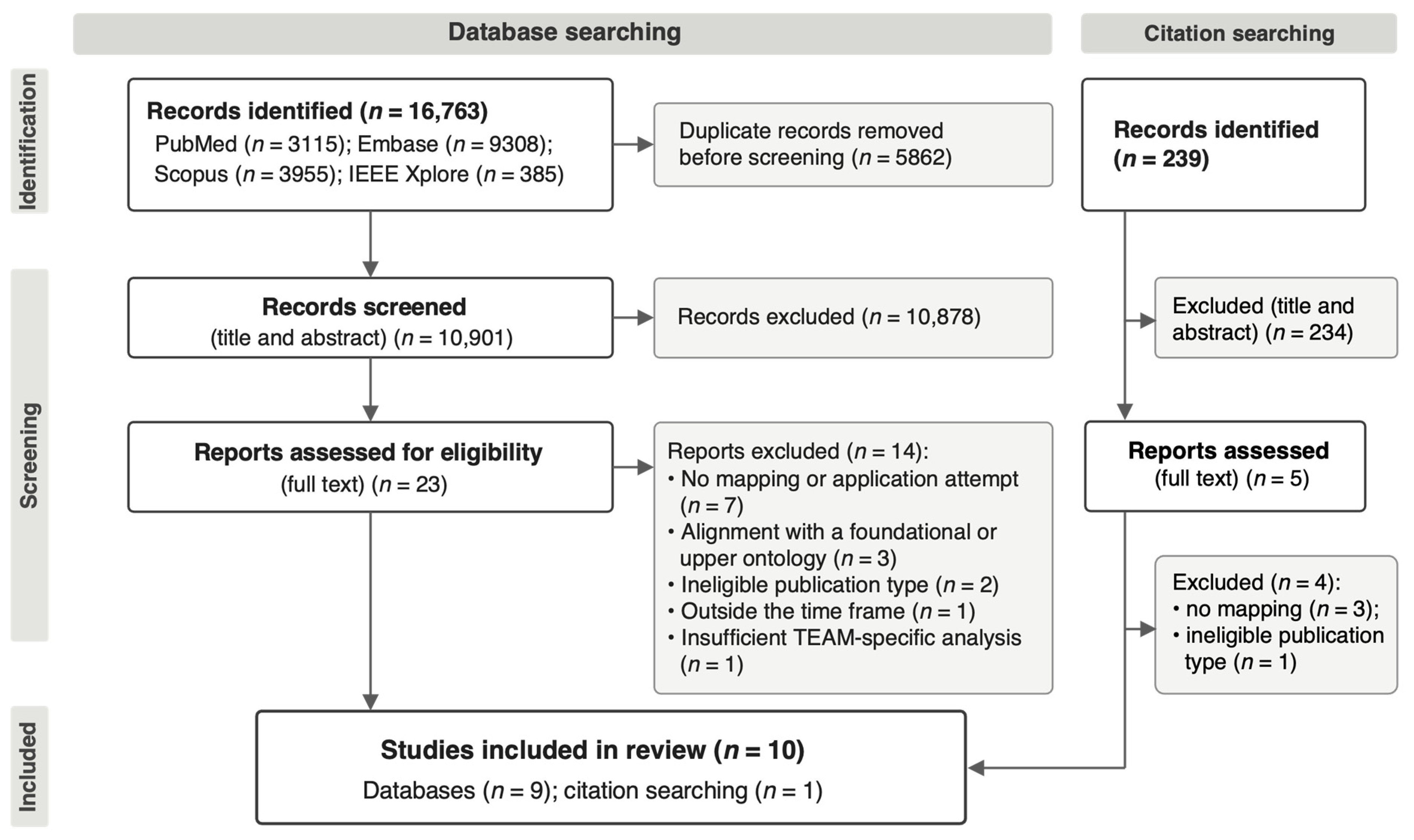
Four bibliographic databases were searched: PubMed, Embase, Scopus, and IEEE Xplore. IEEE Xplore was included to capture medical informatics conference proceedings. The Cochrane Library was considered but not used as a source because it returned no native records of an eligible type, and the 223 records retrieved were trial records duplicated from the other databases. The searches were conducted in April 2026 and were limited to records published between 1 January 2016 and 31 March 2026. This window covers the most recent decade, during which the international data-model and exchange standards relevant to this review became established alongside the ICD-11 Chapter 26. In a confirmatory check performed during revision, we re-ran the PubMed strategy with the lower date limit removed (records dated 2015 or earlier, n = 1553) and screened the results against the same eligibility criteria; no eligible study was identified. For PubMed and Embase, the date limit was applied as an exact range; for Scopus and IEEE Xplore, it was applied at the year level, and records outside the range were removed during screening under the label Out of Timeframe.
A structured gray literature search was also carried out in May 2026 to confirm that coverage of governance bodies and institutional outputs was complete. Three categories of source were searched: international standards and governance bodies (for example, WHO IRIS, ISO Technical Committee 249, OHDSI, SNOMED International, HL7, and the National Library of Medicine), national and regional institutional repositories (for example, the Korea Institute of Oriental Medicine (KIOM), the National Institute for Korean Medicine Development, and the China Academy of Chinese Medical Sciences), and dissertation databases (ProQuest Dissertations and Theses Global). A small number of governance and institutional outputs were retained as background for the Discussion.
In addition to database searching, both backward and forward citation searching was performed on each study included after full-text screening to identify further eligible reports.
2.4. Search Strategy
The search strategy combined two concept blocks with the Boolean operator AND: terms for Traditional East Asian Medicine and terms for health informatics standardization and interoperability. The standardization block was built around broad concepts, such as interoperability, terminology, controlled vocabulary, ontology, data model, and mapping, together with named standards that were included to increase sensitivity. The full database-specific search strategies, including all search terms, field tags, and the date each database was searched, are provided in
File S2. Standards not named in the search, such as UMLS, RxNorm, LOINC, and MeSH, were captured through the general concept terms; conversely, terms included only to increase sensitivity, such as ISO standards and the International Organization for Standardization, did not by themselves confer eligibility. Work whose primary contribution was the development of a traditional-medicine standard in its own right, including ISO Technical Committee 249 deliverables, fell outside this review’s concept, which concerned the mapping or modeling of TEAM data into mainstream international health informatics standards; accordingly, standard documents or conformance work without a mapping deliverable were not eligible. Consistent with this, the gray literature search of ISO Technical Committee 249 returned no records meeting the eligibility criteria.
2.5. Selection of Sources of Evidence
Records were imported into Rayyan [
26] and deduplicated by algorithmic detection followed by manual checking. Before formal screening began, the primary reviewer and the senior reviewer screened a small set of records together to calibrate their application of the eligibility criteria and the hierarchical labeling scheme; this calibration exercise led to minor refinements of the label definitions before full screening started. Title and abstract screening was then conducted by the primary reviewer. To avoid contaminating the subsequent blinded reliability check, case-by-case consultation with the senior reviewer was not used during screening; where eligibility could not be determined from the title and abstract, a record was conservatively labeled Maybe rather than excluded and was carried forward to full-text assessment. At the title and abstract stage, excluded records were assigned a label in the following priority order: Wrong Language, Out of Timeframe, Wrong Publication Type, and Out of Scope. Full-text assessment was performed independently by 2 reviewers, and disagreements were resolved by consensus. Reports identified through citation searching were screened at full text independently by the same 2 reviewers against the same criteria.
This selection model represents a deliberate, resource-based deviation from the JBI recommendation of two or more independent reviewers at both stages [
22]; PRISMA-ScR recognizes a single reviewer with a second verifier as an alternative to fully duplicate screening [
23]. The deviation was compensated for by the retrospective inter-rater reliability verification described below and by dual independent full-text screening. The conservative carry-forward of uncertain records as Maybe was intended to reduce the risk of false-negative exclusions.
2.6. Inter-Rater Reliability Verification
After registration, inter-rater reliability for title and abstract screening was verified on a single random 10% sample of the full set of screened records, not stratified by screening category, generated with the Rayyan data-sampling function. Records used in the calibration exercise were excluded from this sampling frame, so no previously discussed record could inflate the observed agreement. The senior reviewer re-screened the sample independently in Rayyan blind mode, and agreement was computed outside Rayyan across the three screening categories. Because the proportion of included records was very low, Cohen’s kappa can be downwardly biased under skewed marginal distributions [
27]. We therefore report the raw percent agreement and the number and direction of disagreements alongside Cohen’s kappa, together with the prevalence-adjusted bias-adjusted kappa (PABAK) [
28] and Gwet’s AC1 [
29], and we base the assessment of agreement primarily on the percent agreement and on the number of false-negative exclusions recovered rather than on kappa alone. Where the Landis and Koch [
30] interpretive bands are referenced, they are read with this prevalence caveat in mind [
31,
32]. The paired screening decisions were compiled in Excel, and the contingency table and the agreement statistics (raw percent agreement, Cohen’s kappa, PABAK, and Gwet’s AC1) were computed in Python (version 3.13). The protocol specified reporting Cohen’s kappa with a 95% confidence interval; because the sample contained a single disagreement under an extreme prevalence imbalance, a confidence interval for kappa was not estimable under the large-sample normal approximation, and the coefficients are reported as point estimates. The full agreement contingency table and the corresponding computations are provided in
Table 1 and
Table S1.
2.7. Data Charting and Data Items
A standardized data charting form was used, following the JBI 2024 [
22] recommended extraction items and adapted to the review topic. Charting was performed by the primary reviewer, and the charted data were verified against the source reports by the senior reviewer, consistent with the single-reviewer-with-verification model supported by JBI 2024 [
22]. In line with JBI guidance, charting was treated as an iterative process: the form was piloted on a small set of included records and refined as the review proceeded. The data charting form is provided in
Table S2.
The registered form captured twelve fields: record identifier; author and year; country; publication venue; tradition; study type; source data; target standard or standards; mapping or modeling methodology; primary contribution; key quantitative outcomes; and whether code or data were available in an open repository. Three further fields were added during charting: standardization level, disease or domain scope, and tools, software, or platforms. Consistent with the iterative charting expected in scoping reviews, these additions are documented in the Registration Update described above.
Two charted variables were defined operationally. The standardization level classified each study as terminology-level or information-model-level work, following the terminology and information-model distinction in health informatics interoperability [
9]. The level of automation of the mapping or modeling process was classified as manual, semi-automatic, or automatic according to the degree of human involvement [
15,
33].
Although the protocol specified the online publication date for determining publication year, the journal volume year was used for 1 study ([
34]; online 2018, volume 2019) to align with citation and indexing conventions. This affected only the temporal placement of a single study and no eligibility decision.
2.8. Critical Appraisal
Consistent with scoping review methodology, the methodological quality and risk of bias of the included sources were not appraised, because the aim was to map the extent and nature of existing work and to identify gaps rather than to assess quality [
22,
23]. For the same reason, neither the publication format nor the journal indexing status of a source was used as an eligibility or quality criterion. The included sources span journal articles and peer-reviewed conference proceedings, and because the search used four databases together with citation searching, eligibility did not depend on indexing in any single database; full citation details for all ten studies are provided in
Table 2 and the reference list so that each can be located.
2.9. Synthesis of Results
The charted data were synthesized descriptively, following JBI 2024 [
22]; no formal, meta-analytic, or thematic synthesis was undertaken. Frequency analyses were performed by publication year, country, tradition, target standard, and automation level; validation approaches were summarized descriptively rather than counted, given their heterogeneity. The standards addressed by each study were organized into three functional categories, namely terminology or semantic, data model or content, and exchange or transport, consistent with the ONC ISA, and were summarized in a coverage matrix that cross-tabulated studies by standard and by tradition. In addition, the studies’ reported mapping outcomes were organized by the type of clinical object represented (acupoints, symptoms, disorders, compound herbal medicines, and pattern) to characterize how representability varied across object types; because the studies used heterogeneous and not directly comparable metrics, this dimension was summarized descriptively rather than pooled. This organization was introduced during analysis and, like the charting-form refinements, is documented in the Registration Update. The distribution of studies by publication year and tradition was also summarized graphically.
4. Discussion
4.1. Principal Findings
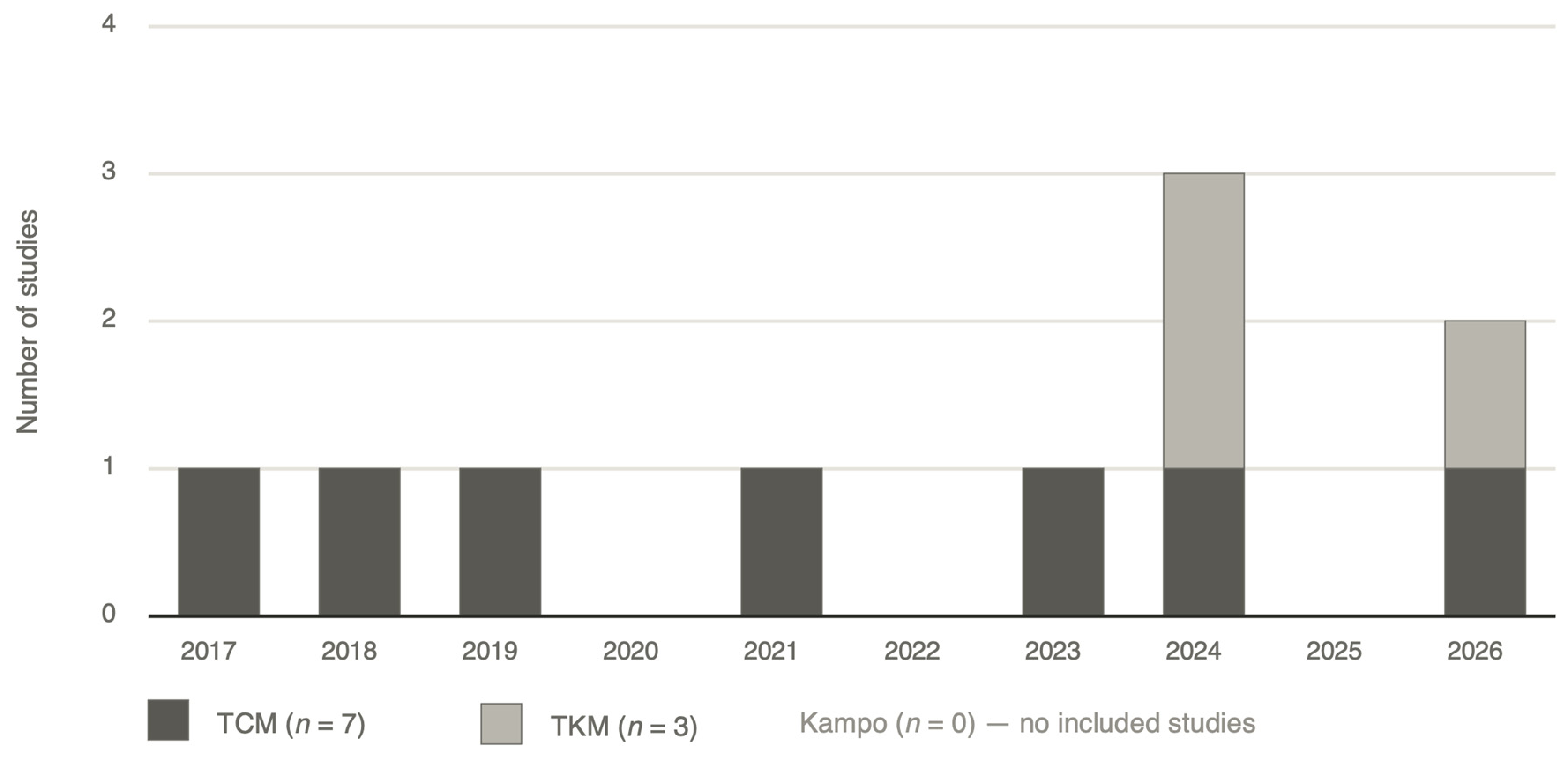
This review examined how the concepts of traditional East Asian medicine have been mapped or modeled into international health informatics standards and with what methods, coverage, and outcomes. The ten studies published between 2017 and 2026 met the inclusion criteria. The included studies were concentrated in TCM and TKM and centered on China and the Republic of Korea, with no study addressing Kampo or originating from Japan.
Three findings organize the discussion that follows. First, the studies engaged the three functional categories of interoperability standards unevenly, concentrating on the representation of shared meaning in terminologies, classifications, and ontologies while leaving the exchange category untouched. Second, the degree to which the standards accommodated traditional medicine concepts varied with the type of clinical object, an observed ordering that ran from acupoints, which mapped readily, to pattern, which existing standards could barely represent; we interpret this ordering as a representability gradient in the section below. Third, in response to these gaps, most of the studies converged on a common strategy, supplementing the standards locally through standalone resources, extensions, and proposals that remained outside the standards themselves.
4.2. Uneven Coverage Across Functional Categories
Health information standards fall into distinct functional categories. Terminologies, classifications, and ontologies establish shared meaning for clinical concepts; common data models specify how that information is structured for storage and analysis; and exchange standards govern how data move between systems [
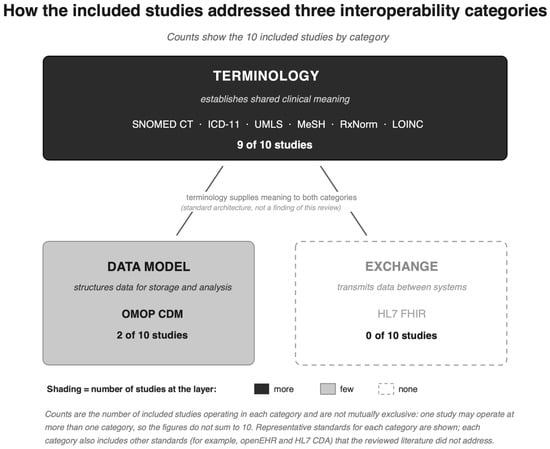
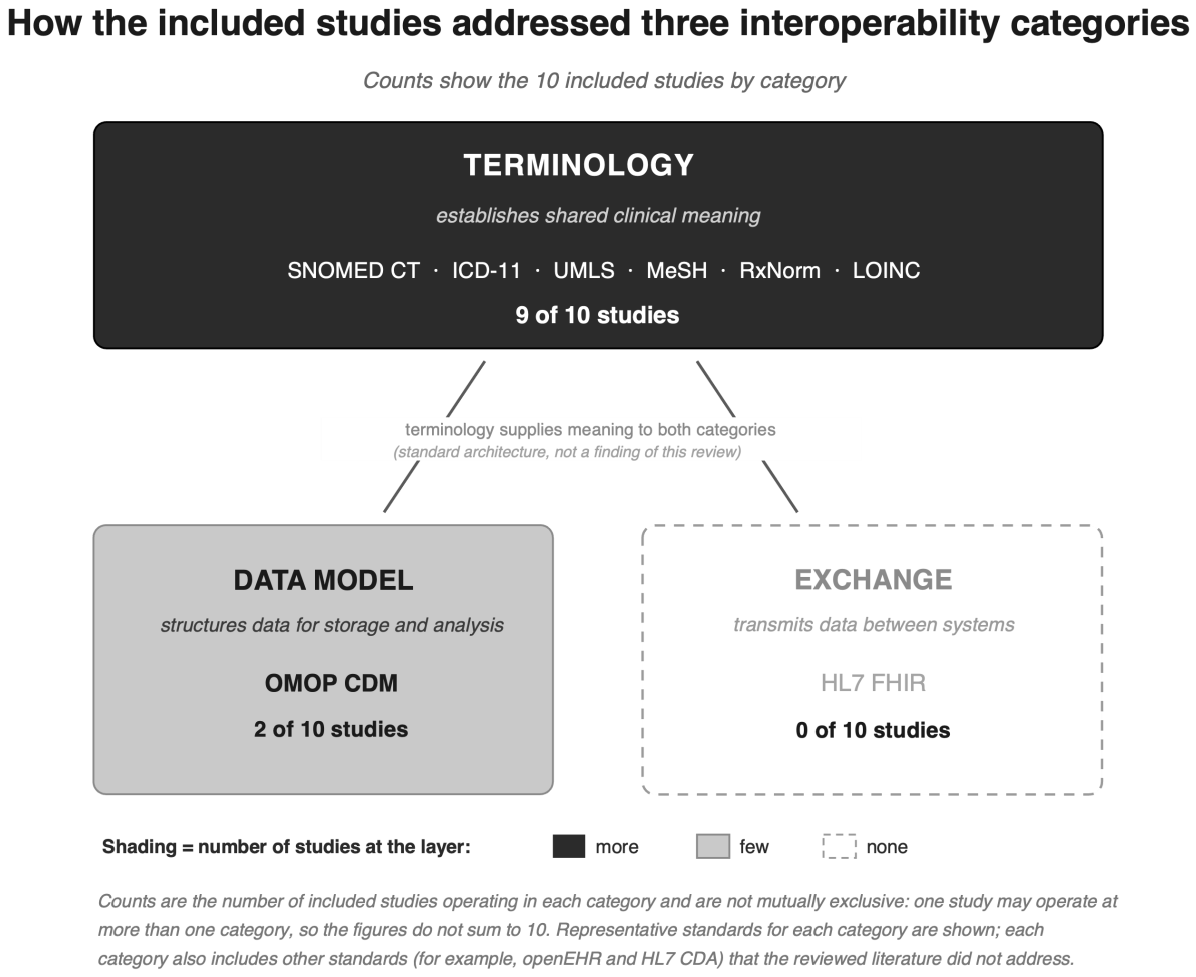
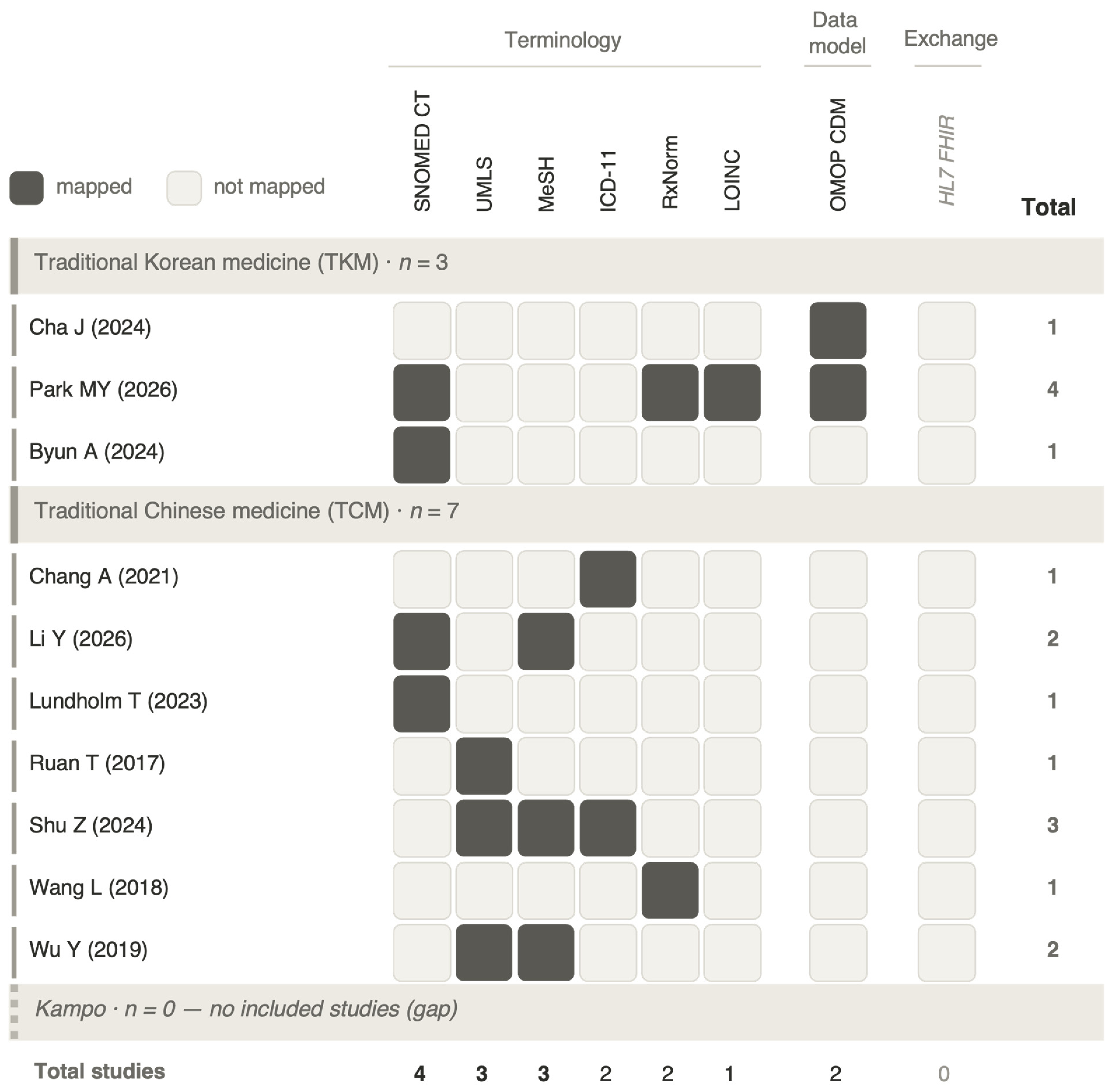
8]. Across the ten included studies, mapping and modeling activity was concentrated in certain categories and absent from others. Most studies targeted terminologies, classifications, and ontologies, anchoring TEAM concepts to standards such as SNOMED CT, the UMLS, ICD-11, MeSH, and RxNorm (
Figure 3). Work on common data models was sparse and confined to a single common data model, the OMOP CDM, which was addressed by two studies [
37,
41]. No included study addressed exchange or messaging standards, and none used HL7 FHIR or an equivalent messaging standard (
Figure 3).
This distribution indicates that the work captured here has concentrated on representational groundwork rather than on the mechanisms that enable data to move between systems. Anchoring a TEAM concept to a terminology or classification establishes what the concept means and makes it computable, but it does not by itself allow that concept to be exchanged between systems in a clinically usable message. Exchange standards such as HL7 FHIR provide that capability [
7,
12]. Their absence from the included literature suggests that the interoperability demonstrated in these studies remained at the level of concept representation rather than realized data exchange. The single common data model engaged, the OMOP CDM, supports structured storage and observational analysis but is not itself an exchange standard [
11].
This pattern contrasts with mainstream health information interoperability research, in which exchange and messaging standards are routinely engaged alongside terminologies and data models. In a systematic review of semantic interoperability in electronic health records, content and exchange standards such as openEHR, HL7 FHIR, and the HL7 Clinical Document Architecture were each among the standards used by the analyzed studies [
45], and a dedicated review of FHIR-based interoperability documented an extensive body of such work [
46]. Relative to that broader field, these TEAM studies occupied a narrower range of functional categories, concentrating on establishing shared meaning without yet extending to the standards that move meaning between systems. A plausible interpretation is that this narrower range reflects an early developmental stage: because TEAM concepts depart substantially from the biomedical entity model, establishing shared meaning may be a prerequisite that is addressed before data models and exchange standards. This interpretation is not one that the included studies tested directly.
4.3. A Representability Gradient Across TEAM Clinical Objects
As the object-level results showed (
Table 4), representability varied along this gradient, from acupoints at one end to patterns at the other. Each object type was represented by only a few studies, in some cases a single one, and the underlying metrics rest on different denominators and definitions (
Table 4); the ordering should therefore be read as a hypothesis-generating interpretation of how far existing standards can hold each object type, not as a quantitative ranking or a comparison of the studies against one another.
At one end, acupoints were well anchored, although the evidence here comes from a single study. Li et al. [
38] constructed an acupuncture knowledge graph on the WHO Standard Acupuncture Point Locations and linked points to SNOMED CT, MeSH, and UBERON. A dedicated international standard for the object made anchoring to mainstream terminologies achievable, although Li et al. [
38] noted that terminologies such as SNOMED CT include acupoints only with limited information.
Symptoms and disorders occupied an intermediate position, where mapping was extensive but the fit was only partial (
Table 4). The shortfall was conceptual as much as numerical. Over half of the TCM symptom–UMLS links reported by Ruan et al. [
39] resolved to semantic types other than Sign, Symptom, or Finding, which the authors attributed to the broader scope of “symptom” in TCM than in biomedicine. Shu et al. [
40], evaluating the symptom terms held in MeSH, found the same boundary mismatch within the standard itself: a notable share of terms carried non-symptom semantic types such as disease, syndrome, or pathology, a mismatch located inside MeSH rather than arising only when TEAM terms were mapped to it. For disorders, Lundholm and Bonacina [
36] found only a minority of the ICD-11 Chapter 26 disorders fully representable in SNOMED CT (
Table 4).
At the other end were compositional and inferential objects that biomedical standards could not hold natively. Compound herbal medicines required extension or decomposition rather than direct mapping. Wang et al. [
43] extended the RxNorm information model to represent Chinese patent (herbal) drugs, which RxNorm could not accommodate natively, and Cha et al. [
41] found that herbal medicine formulas could not be fitted into existing OMOP CDM fields, requiring supplementary fields to capture details such as herb composition. Park et al. [
37] decomposed multi-herb prescriptions into individual herb components before mapping them to RxNorm, whose model represents single pharmaceutical ingredients rather than the herb combinations from which TKM decoctions derive their effect. In TEAM, the herbs in a formula are selected to balance and modify one another, so its intended action arises from their interaction and not from any single component [
47], and a representation built from independent ingredients captures the parts but not this relational design. Across these studies, the reported coverage shows what a purpose-built local extension could capture, not what an international standard supports natively. It therefore demonstrates feasibility in principle rather than an established standard representation for compound herbal medicines.
Pattern differentiation sat at the extreme. In the same comparison, Lundholm and Bonacina [
36] found that almost none of the ICD-11 Chapter 26 patterns had an equivalent SNOMED CT concept (
Table 4), and Byun et al. [
35] could map traditional-medicine pattern concepts only by drawing on the SNOMED CT Traditional Medicine Community Content, which the International edition alone did not provide. The ICD-11 Chapter 26 defines a pattern as a relatively temporary clinical picture that reflects the patient’s systemic response and brings together specific and non-specific manifestations [
2], a composite construct that does not correspond to a single biomedical concept. A pattern is defined less by any individual finding than by the relationships among findings, the way symptoms, signs, and constitutional features co-occur and qualify one another, which is what makes it resist representation as a discrete entity. This resistance also points to where a solution might lie. Because a pattern is defined by the relations among findings, it may be expressed more effectively through compositional means, such as SNOMED CT post-coordination or ontology axioms that state the constituent findings and their relations, rather than as a single discrete code.
This gradient is consistent with how far each object departs from the entity-based, disease-centered assumptions on which biomedical standards are built. The designers of the ICD-11 Chapter 26 chose the term “disorder” rather than “disease” because many TEAM entities are defined by clusters of signs and symptoms instead of a defined etiology, which places them conceptually closer to symptom and finding categories than to diseases [
2,
17]. Objects closer to the biomedical frame, such as acupoints, which already have a dedicated international standard, and in part symptoms, correspond to the locations and findings these standards were designed to hold, whereas compositional objects such as herbal formulas and inferential constructs such as patterns do not. This aligns with longstanding observations that TEAM operates on a diagnostic paradigm distinct from the reductionist assumptions of biomedicine [
14]. We therefore interpret conceptual distance from the biomedical paradigm as a plausible organizing explanation for this ordering, relating both to how readily an object maps and to whether it can be folded into mainstream standards or instead requires a parallel traditional-medicine resource; this is an interpretation of the assembled studies rather than a relationship those studies tested directly. Pattern differentiation, then, is not an incidental omission but the point at which the two paradigms diverge most sharply, which is also why the studies that addressed it relied on dedicated traditional-medicine extensions instead of direct mapping.
4.4. A Convergent Response: Local Supplementation Without Upstreaming
The included studies converged on a common response to these representational gaps. As the form of their outputs showed, most studies placed their TEAM-specific content outside the released standards, adding it as standalone resources, model extensions, or proposals rather than within the standards themselves. The strategy was consistent despite the heterogeneity of the artifacts: each study addressed the gaps it encountered by building alongside the standard rather than within it, and none reported that its additions had been incorporated into a released standard.
Because these additions remained external, the same representational gaps were met repeatedly rather than resolved once within the standards. Park et al. [
37] noted that their terminology extension had not been externally certified or integrated, and the additions of Byun et al. [
35] were proposals rather than adopted content; in each case, the work that closed a gap for one project did not become available within the standard for others. The consequence is duplicated effort, in which each project rebuilds representations that another has already produced, with no route for them to accumulate in the shared standards.
The artifacts were also produced by varied methods and validated against non-comparable reference points, with no shared benchmark across the studies. Taken together with their external character, this heterogeneity points to a field still at an early and fragmented stage, in which TEAM content is repeatedly re-represented in local artifacts rather than consolidated within the international standards themselves.
4.5. Implications and a Research and Standardization Agenda
The most consistent implication of these findings concerns the relationship between local supplementation and the international standards. Several studies produced extensions or mappings that addressed real representational gaps but remained outside the standards they extended. Park et al. [
37] and Byun et al. [
35] proposed terminology and SNOMED CT extensions, and Cha et al. [
41] identified specific OMOP CDM fields that TEAM data would require. A priority for future work would be to carry such proposals through the formal change processes of the relevant standards. For SNOMED CT, for example, candidate TEAM content can be submitted through the Content Request Service or maintained within a dedicated extension namespace so that recurring requirements are met within the international standards rather than re-created locally by each project [
48].
The studies that engaged the objects least amenable to direct mapping, particularly patterns, relied on dedicated traditional medicine content, whether the ICD-11 Chapter 26 or the SNOMED CT Traditional Medicine Community Content. The continued development of this dedicated content is therefore central to representing the parts of TEAM that general biomedical concepts cannot hold. Commentary from within the field has similarly argued that the traditional medicine content of ICD-11 captures only part of clinical practice and will need to be supplemented and upgraded [
3], and the governance structures now in place for the ICD-11 Chapter 26 provide a route through which such expansion can occur [
17].
Two further gaps follow from the earlier sections. No included study addressed the exchange category, so encoding TEAM concepts in exchange and messaging standards such as HL7 FHIR remains an open area for work directed at operational data sharing rather than representation alone. A concrete step would be the development of a FHIR Implementation Guide for TEAM data, defining the profiles, extensions, and value sets required to exchange TEAM concepts between systems [
13]. The outputs also varied in how openly they were shared and how well they were maintained, and some repositories are already unreachable. This unevenness points to a need for stable, openly accessible deposit, without which extensions and mappings cannot be reused or built upon cumulatively. The case for data sharing in this research area has been made on the same grounds of reproducibility and cumulative progress [
6].
A further direction concerns the methods by which TEAM content is mapped. The included studies already varied in automation: most mappings were produced by hand, but four combined algorithmic candidate generation with expert review, one used a predominantly automatic pipeline [
39], and one constructed an acupuncture knowledge graph linked to mainstream terminologies [
38]. This points to a role for artificial intelligence, including large language models, in future semantic mapping [
4,
5]. It could propose candidate correspondences at scale, surface the compositional and relational structure of constructs such as herbal formulas and patterns that resist direct one-to-one mapping, and extend coverage across the multi-lingual literature that a single-language search cannot reach. Such approaches would not remove the need for expert adjudication or for submission through the formal change processes of the standards. Their outputs would still require validation, which reinforces the need for shared validation benchmarks, such as agreed reference mapping sets and common evaluation metrics, that the heterogeneous validation practices observed here currently lack. Used in this way, artificial intelligence would accelerate the production of candidate representations rather than replace the human and governance work required to incorporate them.
Finally, the evidence base is uneven across the three traditions within this review’s scope. The TEAM frame follows the population definition of ICD-11 Chapter 26, which spans the practices of China, Japan, and the Republic of Korea [
2]; the included studies, however, addressed only TCM and TKM, with no work on Kampo and none originating from Japan. This imbalance is better read as a finding about the field than as a reason to narrow the frame: standardization work directed at mainstream international standards has so far come almost entirely from Chinese and Korean settings, leaving Kampo recognized within ICD-11 Chapter 26 yet absent from the international standardization literature captured here. Kampo work was reached by the search but did not enter the included set: two Kampo studies were retrieved through the main database search and excluded, one as an ineligible publication type and one for making no mapping or modeling attempt, under the same criteria applied to all traditions. A concrete priority is therefore to develop mapping and modeling studies for Kampo, whose pattern and formula concepts are already recognized within ICD-11 Chapter 26 but have not yet been represented in the wider standards, in collaboration with Japanese research communities and national databases; extending such work to under-represented traditions would give a fuller account of how TEAM can be represented in international standards.
Taken together, these directions form a research and standardization agenda in which each priority addresses a specific gap identified here rather than a general aspiration. They are also interdependent: establishing shared meaning, structuring it in data models, and carrying it into exchange standards are stages of a single path toward operational interoperability, and each depends on the content produced at the earlier stages being consolidated within the international standards rather than rebuilt locally by each project.
4.6. Strengths and Limitations
This review has several strengths. It provides a focused synthesis of how traditional East Asian medicine concepts have been mapped or modeled into international health informatics standards, an intersection that prior reviews have not examined in this specific form. It also organizes a dispersed body of work into a structured account of where existing standards accommodate TEAM clinical objects, where representation breaks down, and how the field has compensated. Methodologically, it followed an established scoping review approach [
22] and was reported in accordance with PRISMA-ScR [
23], with a registered protocol on the OSF. The search covered four bibliographic databases, including IEEE Xplore to capture medical informatics conference proceedings, and was supplemented by citation searching and a structured gray literature search. Inter-rater reliability for title and abstract screening was assessed with several complementary agreement statistics rather than a single coefficient, an approach suited to the very low proportion of included records, under which chance-corrected measures such as Cohen’s kappa become unstable [
27,
28,
29]. Full-text screening was conducted independently by two reviewers, who reached agreement on all eligibility decisions.
It also has limitations. The protocol was registered after the database searches, deduplication, and first-pass title and abstract screening had been completed, so the registration was in part retrospective; this is disclosed here and in the Methods. First-pass title and abstract screening was performed by a single reviewer, which departs from the dual-reviewer model recommended by JBI, although PRISMA-ScR recognizes a single reviewer with a second verifier as an acceptable alternative [
22,
23]. This deviation was mitigated in several ways: ambiguous records were retained as uncertain and carried forward to full-text screening rather than excluded at the title and abstract stage, inter-rater reliability was verified on a random 10% sample of screened records, and the full-text screening was conducted in duplicate. Because included records were almost absent from the reliability sample, the verification has limited power to detect a low rate of missed eligible studies among the roughly 90% of records that were not re-screened; the high agreement therefore reflects consistency on the sampled records rather than assurance that no eligible studies were missed elsewhere. The evidence base was also small and uneven: only 10 studies met the criteria, and several object types were represented by a single study, so the cross-object comparison is exploratory rather than confirmatory.
The search was also bounded. It was limited to reports written in English, which excludes the substantial traditional-medicine informatics literature published in Chinese, Korean, and Japanese and indexed in national databases such as CNKI (China), RISS and KMbase (Republic of Korea), and CiNii (Japan). Much TEAM work is conducted and published within these national research communities. The included literature characterized here is therefore best understood as the subset of standardization activity that has entered the international, English-language peer-reviewed literature, rather than the full global output. This visibility gap echoes a finding of the review itself, that TEAM standardization work tends to remain within local and national settings instead of being consolidated into the international standards. The included studies should therefore be read as a bounded, internationally visible sample, not a complete census, and the absences noted here, such as the lack of work on Kampo or on exchange-category standards, are observations about this sample rather than firm evidence that no such work exists. In particular, our eligibility criterion required the representation of TEAM concepts to be a study’s primary contribution, which may have excluded implementation or systems-integration work that used an exchange standard such as HL7 FHIR while addressing TEAM terminology only as one component.
A further bound concerned the search dates: the lower limit was not tested at the search stage. A confirmatory check performed during revision, in which the PubMed strategy was re-run without the lower date limit, identified no eligible study published before 2016, which indicates that the date window is unlikely to have excluded relevant work in that database. Because this check was confined to a single database, we cannot fully exclude the possibility of earlier eligible studies indexed elsewhere, although studies representing TEAM concepts in international standards appear predominantly in the informatics literature that PubMed indexes.
5. Conclusions
This review mapped how traditional East Asian medicine concepts have been represented in international health informatics standards, and within the internationally visible literature it identified a body of work still centered on establishing shared meaning. This work has clustered in terminologies and classifications, engaged the OMOP Common Data Model only occasionally, and did not extend to exchange standards such as HL7 FHIR. What a standard could represent depended on the type of clinical object at issue: objects close to the biomedical frame, such as acupuncture points, anchored readily to existing terminologies, whereas pattern differentiation, which sits furthest from that frame, remained largely out of reach. In response to these gaps, most studies built alongside the standards rather than within them, adding standalone resources, model extensions, or proposals that were never incorporated into a released standard. Because this content stays external, the same gaps are repeated by each new project instead of being resolved once. Progress is therefore likely to depend less on further local mapping than on carrying TEAM content through the formal change processes of the international standards. Alongside this, the field needs to develop dedicated content for the constructs that general biomedical terminologies cannot hold and to encode TEAM concepts in exchange standards so that representation can support operational data sharing.