Impact of Polyphenol Supplementation on Energy Expenditure Measured by Indirect Calorimetry in Adolescents with Metabolic Dysfunction-Associated Steatotic Liver Disease: A Pilot Randomized Study

 , , , and
Abstract
1. Introduction
2. Methods
2.1. Study Design and Participants
2.2. Indirect Calorimetry
2.3. Assessment of Caloric Intake
2.4. Analysis
3. Results
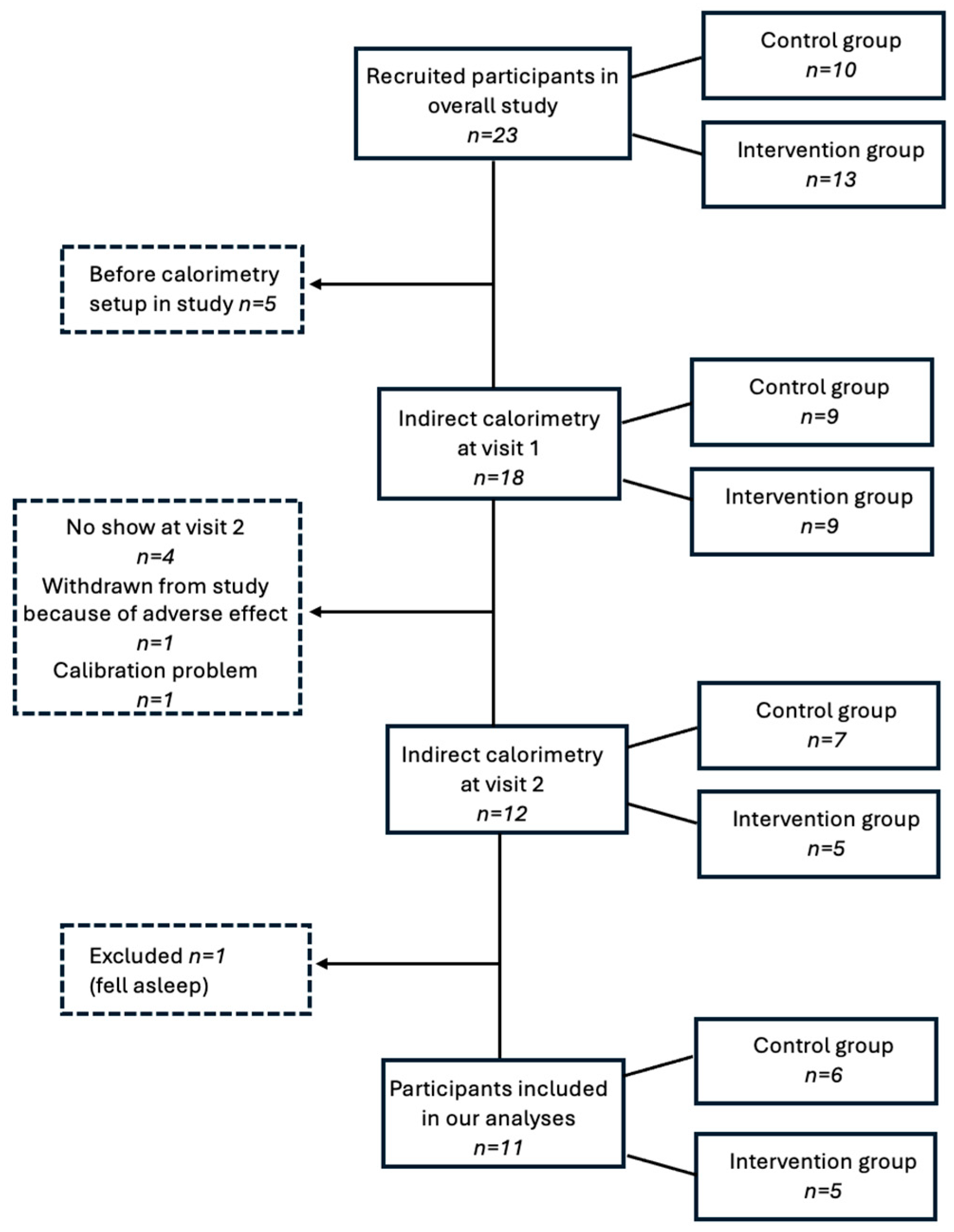
3.1. Study Flowchart and Characteristic of Cohort
3.2. Relation Between mREE and Energy Intake
3.3. Comparison of Participants’ mREE Between Visits in the Control and Intervention Groups
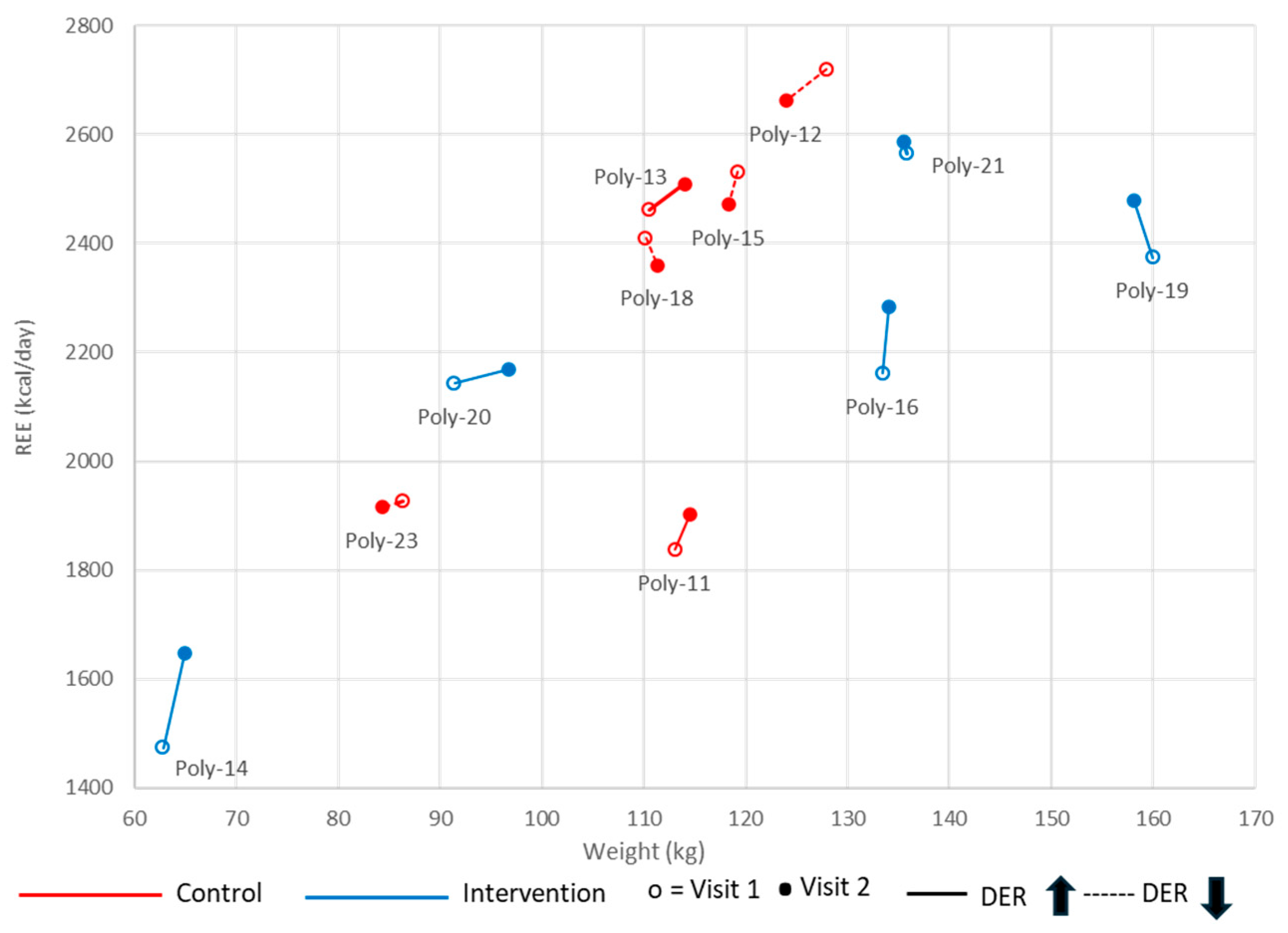
3.4. Variation in mREE Between Visits in the Control and Intervention Groups
3.5. Comparison of mREE with pREE
4. Discussion
5. Conclusions
Supplementary Materials
Author Contributions
Funding
Institutional Review Board Statement
Informed Consent Statement
Data Availability Statement
Conflicts of Interest
References
- Chalasani, N.; Younossi, Z.; Lavine, J.E.; Charlton, M.; Cusi, K.; Rinella, M.; Harrison, S.A.; Brunt, E.M.; Sanyal, A.J. The diagnosis and management of nonalcoholic fatty liver disease: Practice guidance from the American Association for the Study of Liver Diseases. Hepatology 2018, 67, 328–357. [Google Scholar] [CrossRef]
- Gofton, C.; Upendran, Y.; Zheng, M.H.; George, J. MAFLD: How is it different from NAFLD? Clin. Mol. Hepatol. 2023, 29, S17–S31. [Google Scholar] [CrossRef]
- Chan, W.K.; Chuah, K.H.; Rajaram, R.B.; Lim, L.L.; Ratnasingam, J.; Vethakkan, S.R. Metabolic Dysfunction-Associated Steatotic Liver Disease (MASLD): A State-of-the-Art Review. J. Obes. Metab. Syndr. 2023, 32, 197–213. [Google Scholar] [CrossRef] [PubMed]
- Riazi, K.; Azhari, H.; Charette, J.H.; Underwood, F.E.; King, J.A.; Afshar, E.E.; Swain, M.G.; Congly, S.E.; Kaplan, G.G.; Shaheen, A.A. The prevalence and incidence of NAFLD worldwide: A systematic review and meta-analysis. Lancet Gastroenterol. Hepatol. 2022, 7, 851–861. [Google Scholar] [CrossRef] [PubMed]
- Wharton, S.; Lau, D.C.W.; Vallis, M.; Sharma, A.M.; Biertho, L.; Campbell-Scherer, D.; Adamo, K.; Alberga, A.; Bell, R.; Boule, N.; et al. L’obésité chez l’adulte: Ligne directrice de pratique clinique. CMAJ 2020, 192, E1757–E1775. [Google Scholar] [CrossRef]
- Jebeile, H.; Kelly, A.S.; O’Malley, G.; Baur, L.A. Obesity in children and adolescents: Epidemiology, causes, assessment, and management. Lancet Diabetes Endocrinol. 2022, 10, 351–365. [Google Scholar] [CrossRef]
- Weihrauch-Bluher, S.; Schwarz, P.; Klusmann, J.H. Childhood obesity: Increased risk for cardiometabolic disease and cancer in adulthood. Metabolism 2019, 92, 147–152. [Google Scholar] [CrossRef]
- Sagar, R.; Gupta, T. Psychological Aspects of Obesity in Children and Adolescents. Indian. J. Pediatr. 2018, 85, 554–559. [Google Scholar] [CrossRef] [PubMed]
- Drozdz, D.; Alvarez-Pitti, J.; Wojcik, M.; Borghi, C.; Gabbianelli, R.; Mazur, A.; Herceg-Cavrak, V.; Lopez-Valcarcel, B.G.; Brzezinski, M.; Lurbe, E.; et al. Obesity and Cardiometabolic Risk Factors: From Childhood to Adulthood. Nutrients 2021, 13, 4176. [Google Scholar] [CrossRef]
- Simmonds, M.; Llewellyn, A.; Owen, C.G.; Woolacott, N. Predicting adult obesity from childhood obesity: A systematic review and meta-analysis. Obes. Rev. 2016, 17, 95–107. [Google Scholar] [CrossRef]
- Targher, G.; Byrne, C.D.; Lonardo, A.; Zoppini, G.; Barbui, C. Non-alcoholic fatty liver disease and risk of incident cardiovascular disease: A meta-analysis. J. Hepatol. 2016, 65, 589–600. [Google Scholar] [CrossRef]
- Hartmann, P.; Zhang, X.; Loomba, R.; Schnabl, B. Global and national prevalence of nonalcoholic fatty liver disease in adolescents: An analysis of the global burden of disease study 2019. Hepatology 2023, 78, 1168–1181. [Google Scholar] [CrossRef]
- Assuncao, S.N.F.; Sorte, N.C.B.; Alves, C.D.; Mendes, P.S.A.; Alves, C.R.B.; Silva, L.R. Nonalcoholic fatty liver disease (NAFLD) pathophysiology in obese children and adolescents: Update. Nutr. Hosp. 2017, 34, 727–730. [Google Scholar] [CrossRef]
- Mann, J.P.; Valenti, L.; Scorletti, E.; Byrne, C.D.; Nobili, V. Nonalcoholic Fatty Liver Disease in Children. Semin. Liver Dis. 2018, 38, 1–13. [Google Scholar] [CrossRef]
- Turchinovich, A.; Baranova, A.; Drapkina, O.; Tonevitsky, A. Cell-Free Circulating Nucleic Acids as Early Biomarkers for NAFLD and NAFLD-Associated Disorders. Front. Physiol. 2018, 9, 1256. [Google Scholar] [CrossRef]
- Wasuwanich, P.; So, J.M.; Sadek, M.; Jarasvaraparn, C.; Rajborirug, S.; Quiros-Tejeira, R.E.; Karnsakul, W. Pediatric Non-Alcoholic Fatty Liver Disease (NAFLD): Trends, Mortality, and Socioeconomic Disparities in the U.S., 1998–2020. Children 2025, 12, 71. [Google Scholar] [CrossRef] [PubMed]
- Alkhouri, N.; Tincopa, M.; Loomba, R.; Harrison, S.A. What Does the Future Hold for Patients With Nonalcoholic Steatohepatitis: Diagnostic Strategies and Treatment Options in 2021 and Beyond? Hepatol. Commun. 2021, 5, 1810–1823. [Google Scholar] [CrossRef] [PubMed]
- Rafiei, H.; Omidian, K.; Bandy, B. Dietary Polyphenols Protect Against Oleic Acid-Induced Steatosis in an in Vitro Model of NAFLD by Modulating Lipid Metabolism and Improving Mitochondrial Function. Nutrients 2019, 11, 541. [Google Scholar] [CrossRef] [PubMed]
- Vilar-Gomez, E.; Martinez-Perez, Y.; Calzadilla-Bertot, L.; Torres-Gonzalez, A.; Gra-Oramas, B.; Gonzalez-Fabian, L.; Friedman, S.L.; Diago, M.; Romero-Gomez, M. Weight Loss Through Lifestyle Modification Significantly Reduces Features of Nonalcoholic Steatohepatitis. Gastroenterology 2015, 149, 367–378.e5; quiz e314–365. [Google Scholar] [CrossRef]
- Sanyal, A.J.; Chalasani, N.; Kowdley, K.V.; McCullough, A.; Diehl, A.M.; Bass, N.M.; Neuschwander-Tetri, B.A.; Lavine, J.E.; Tonascia, J.; Unalp, A.; et al. Pioglitazone, vitamin E, or placebo for nonalcoholic steatohepatitis. N. Engl. J. Med. 2010, 362, 1675–1685. [Google Scholar] [CrossRef]
- Nassir, F. NAFLD: Mechanisms, Treatments, and Biomarkers. Biomolecules 2022, 12, 824. [Google Scholar] [CrossRef]
- Rupasinghe, K.; Hind, J.; Hegarty, R. Updates in Metabolic Dysfunction-Associated Fatty Liver Disease (MAFLD) in Children. J. Pediatr. Gastroenterol. Nutr. 2023, 77, 583–591. [Google Scholar] [CrossRef]
- Singla, R.K.; Dubey, A.K.; Garg, A.; Sharma, R.K.; Fiorino, M.; Ameen, S.M.; Haddad, M.A.; Al-Hiary, M. Natural Polyphenols: Chemical Classification, Definition of Classes, Subcategories, and Structures. J. AOAC Int. 2019, 102, 1397–1400. [Google Scholar] [CrossRef] [PubMed]
- Di Lorenzo, C.; Colombo, F.; Biella, S.; Stockley, C.; Restani, P. Polyphenols and Human Health: The Role of Bioavailability. Nutrients 2021, 13, 273. [Google Scholar] [CrossRef]
- Khan, N.; Mukhtar, H. Tea Polyphenols in Promotion of Human Health. Nutrients 2018, 11, 39. [Google Scholar] [CrossRef]
- Ren, B.; Kwah, M.X.; Liu, C.; Ma, Z.; Shanmugam, M.K.; Ding, L.; Xiang, X.; Ho, P.C.; Wang, L.; Ong, P.S.; et al. Resveratrol for cancer therapy: Challenges and future perspectives. Cancer Lett. 2021, 515, 63–72. [Google Scholar] [CrossRef]
- Wahab, A.; Gao, K.; Jia, C.; Zhang, F.; Tian, G.; Murtaza, G.; Chen, J. Significance of Resveratrol in Clinical Management of Chronic Diseases. Molecules 2017, 22, 1329. [Google Scholar] [CrossRef] [PubMed]
- Cardona, F.; Andres-Lacueva, C.; Tulipani, S.; Tinahones, F.J.; Queipo-Ortuno, M.I. Benefits of polyphenols on gut microbiota and implications in human health. J. Nutr. Biochem. 2013, 24, 1415–1422. [Google Scholar] [CrossRef] [PubMed]
- Plamada, D.; Vodnar, D.C. Polyphenols-Gut Microbiota Interrelationship: A Transition to a New Generation of Prebiotics. Nutrients 2021, 14, 137. [Google Scholar] [CrossRef]
- Bhardwaj, M.; Yadav, P.; Vashishth, D.; Sharma, K.; Kumar, A.; Chahal, J.; Dalal, S.; Kataria, S.K. A Review on Obesity Management through Natural Compounds and a Green Nanomedicine-Based Approach. Molecules 2021, 26, 3278. [Google Scholar] [CrossRef]
- Izdebska, M.; Piatkowska-Chmiel, I.; Korolczuk, A.; Herbet, M.; Gawronska-Grzywacz, M.; Gieroba, R.; Sysa, M.; Czajkowska-Bania, K.; Cygal, M.; Korga, A.; et al. The beneficial effects of resveratrol on steatosis and mitochondrial oxidative stress in HepG2 cells. Can. J. Physiol. Pharmacol. 2017, 95, 1442–1453. [Google Scholar] [CrossRef]
- Bacil, G.P.; Cogliati, B.; Cardoso, D.R.; Barbisan, L.F.; Romualdo, G.R. Are isothiocyanates and polyphenols from Brassicaceae vegetables emerging as preventive/therapeutic strategies for NAFLD? The landscape of recent preclinical findings. Food Funct. 2022, 13, 8348–8362. [Google Scholar] [CrossRef]
- Shabalala, S.C.; Dludla, P.V.; Mabasa, L.; Kappo, A.P.; Basson, A.K.; Pheiffer, C.; Johnson, R. The effect of adiponectin in the pathogenesis of non-alcoholic fatty liver disease (NAFLD) and the potential role of polyphenols in the modulation of adiponectin signaling. Biomed. Pharmacother. 2020, 131, 110785. [Google Scholar] [CrossRef]
- Rahmani, S.; Asgary, S.; Askari, G.; Keshvari, M.; Hatamipour, M.; Feizi, A.; Sahebkar, A. Treatment of Non-alcoholic Fatty Liver Disease with Curcumin: A Randomized Placebo-controlled Trial. Phytother. Res. 2016, 30, 1540–1548. [Google Scholar] [CrossRef]
- Panahi, Y.; Kianpour, P.; Mohtashami, R.; Jafari, R.; Simental-Mendia, L.E.; Sahebkar, A. Efficacy and Safety of Phytosomal Curcumin in Non-Alcoholic Fatty Liver Disease: A Randomized Controlled Trial. Drug Res. 2017, 67, 244–251. [Google Scholar] [CrossRef]
- Mirhafez, S.R.; Azimi-Nezhad, M.; Dehabeh, M.; Hariri, M.; Naderan, R.D.; Movahedi, A.; Abdalla, M.; Sathyapalan, T.; Sahebkar, A. The Effect of Curcumin Phytosome on the Treatment of Patients with Non-alcoholic Fatty Liver Disease: A Double-Blind, Randomized, Placebo-Controlled Trial. Adv. Exp. Med. Biol. 2021, 1308, 25–35. [Google Scholar] [CrossRef] [PubMed]
- Saadati, S.; Sadeghi, A.; Mansour, A.; Yari, Z.; Poustchi, H.; Hedayati, M.; Hatami, B.; Hekmatdoost, A. Curcumin and inflammation in non-alcoholic fatty liver disease: A randomized, placebo controlled clinical trial. BMC Gastroenterol. 2019, 19, 133. [Google Scholar] [CrossRef] [PubMed]
- Rivera-Espinoza, Y.; Muriel, P. Pharmacological actions of curcumin in liver diseases or damage. Liver Int. 2009, 29, 1457–1466. [Google Scholar] [CrossRef]
- Ismail, J.; Bansal, A.; Jayashree, M.; Nallasamy, K.; Attri, S.V. Energy Balance in Critically Ill Children With Severe Sepsis Using Indirect Calorimetry: A Prospective Cohort Study. J. Pediatr. Gastroenterol. Nutr. 2019, 68, 868–873. [Google Scholar] [CrossRef]
- Hursel, R.; Viechtbauer, W.; Dulloo, A.G.; Tremblay, A.; Tappy, L.; Rumpler, W.; Westerterp-Plantenga, M.S. The effects of catechin rich teas and caffeine on energy expenditure and fat oxidation: A meta-analysis. Obes. Rev. 2011, 12, e573–e581. [Google Scholar] [CrossRef] [PubMed]
- Outlaw, J.; Wilborn, C.; Smith, A.; Urbina, S.; Hayward, S.; Foster, C.; Wells, S.; Wildman, R.; Taylor, L. Effects of ingestion of a commercially available thermogenic dietary supplement on resting energy expenditure, mood state and cardiovascular measures. J. Int. Soc. Sports Nutr. 2013, 10, 25. [Google Scholar] [CrossRef]
- Dulloo, A.G.; Duret, C.; Rohrer, D.; Girardier, L.; Mensi, N.; Fathi, M.; Chantre, P.; Vandermander, J. Efficacy of a green tea extract rich in catechin polyphenols and caffeine in increasing 24-h energy expenditure and fat oxidation in humans. Am. J. Clin. Nutr. 1999, 70, 1040–1045. [Google Scholar] [CrossRef] [PubMed]
- Solverson, P.M.; Rumpler, W.V.; Leger, J.L.; Redan, B.W.; Ferruzzi, M.G.; Baer, D.J.; Castonguay, T.W.; Novotny, J.A. Blackberry Feeding Increases Fat Oxidation and Improves Insulin Sensitivity in Overweight and Obese Males. Nutrients 2018, 10, 1048. [Google Scholar] [CrossRef] [PubMed]
- Vlavcheski, F.; Den Hartogh, D.J.; Giacca, A.; Tsiani, E. Amelioration of High-Insulin-Induced Skeletal Muscle Cell Insulin Resistance by Resveratrol Is Linked to Activation of AMPK and Restoration of GLUT4 Translocation. Nutrients 2020, 12, 914. [Google Scholar] [CrossRef] [PubMed]
- Janssens, P.L.; Hursel, R.; Westerterp-Plantenga, M.S. Long-term green tea extract supplementation does not affect fat absorption, resting energy expenditure, and body composition in adults. J. Nutr. 2015, 145, 864–870. [Google Scholar] [CrossRef]
- Zhang, S.; Takano, J.; Murayama, N.; Tominaga, M.; Abe, T.; Park, I.; Seol, J.; Ishihara, A.; Tanaka, Y.; Yajima, K.; et al. Subacute Ingestion of Caffeine and Oolong Tea Increases Fat Oxidation without Affecting Energy Expenditure and Sleep Architecture: A Randomized, Placebo-Controlled, Double-Blinded Cross-Over Trial. Nutrients 2020, 12, 3671. [Google Scholar] [CrossRef]
- Rondanelli, M.; Riva, A.; Petrangolini, G.; Allegrini, P.; Perna, S.; Faliva, M.A.; Peroni, G.; Naso, M.; Nichetti, M.; Perdoni, F.; et al. Effect of Acute and Chronic Dietary Supplementation with Green Tea Catechins on Resting Metabolic Rate, Energy Expenditure and Respiratory Quotient: A Systematic Review. Nutrients 2021, 13, 644. [Google Scholar] [CrossRef]
- Rodriguez, G.; Moreno, L.A.; Sarria, A.; Fleta, J.; Bueno, M. Resting energy expenditure in children and adolescents: Agreement between calorimetry and prediction equations. Clin. Nutr. 2002, 21, 255–260. [Google Scholar] [CrossRef]
- Acar-Tek, N.; Agagunduz, D.; Celik, B.; Bozbulut, R. Estimation of Resting Energy Expenditure: Validation of Previous and New Predictive Equations in Obese Children and Adolescents. J. Am. Coll. Nutr. 2017, 36, 470–480. [Google Scholar] [CrossRef]
- Achamrah, N.; Delsoglio, M.; De Waele, E.; Berger, M.M.; Pichard, C. Indirect calorimetry: The 6 main issues. Clin. Nutr. 2021, 40, 4–14. [Google Scholar] [CrossRef]
- Henry, C.J.; Dyer, S.; Ghusain-Choueiri, A. New equations to estimate basal metabolic rate in children aged 10–15 years. Eur. J. Clin. Nutr. 1999, 53, 134–142. [Google Scholar] [CrossRef]
- Tverskaya, R.; Rising, R.; Brown, D.; Lifshitz, F. Comparison of several equations and derivation of a new equation for calculating basal metabolic rate in obese children. J. Am. Coll. Nutr. 1998, 17, 333–336. [Google Scholar] [CrossRef]
- Mole, P.A. Impact of energy intake and exercise on resting metabolic rate. Sports Med. 1990, 10, 72–87. [Google Scholar] [CrossRef]
- Busetto, L.; Bettini, S.; Makaronidis, J.; Roberts, C.A.; Halford, J.C.G.; Batterham, R.L. Mechanisms of weight regain. Eur. J. Intern. Med. 2021, 93, 3–7. [Google Scholar] [CrossRef] [PubMed]
- Moretti, J.B.; Drouin, A.; Truong, C.; Youn, E.; Cloutier, A.; Alvarez, F.; Paganelli, M.; Grzywacz, K.; Jantchou, P.; Dubois, J.; et al. Effects of polyphenol supplementation on hepatic steatosis, intima-media thickness and non-invasive vascular elastography in obese adolescents: A pilot study protocol. BMJ Open 2024, 14, e074882. [Google Scholar] [CrossRef] [PubMed]
- Most, J.; Goossens, G.H.; Jocken, J.W.; Blaak, E.E. Short-term supplementation with a specific combination of dietary polyphenols increases energy expenditure and alters substrate metabolism in overweight subjects. Int. J. Obes. 2014, 38, 698–706. [Google Scholar] [CrossRef] [PubMed]
- Timmers, S.; Konings, E.; Bilet, L.; Houtkooper, R.H.; van de Weijer, T.; Goossens, G.H.; Hoeks, J.; van der Krieken, S.; Ryu, D.; Kersten, S.; et al. Calorie restriction-like effects of 30 days of resveratrol supplementation on energy metabolism and metabolic profile in obese humans. Cell Metab. 2011, 14, 612–622. [Google Scholar] [CrossRef]
- Haddad, F.; Li, X.; Perelman, D.; Santana, E.J.; Kuznetsova, T.; Cauwenberghs, N.; Busque, V.; Contrepois, K.; Snyder, M.P.; Leonard, M.B.; et al. Challenging obesity and sex based differences in resting energy expenditure using allometric modeling, a sub-study of the DIETFITS clinical trial. Clin. Nutr. ESPEN 2023, 53, 43–52. [Google Scholar] [CrossRef]
- Jimenez Jaime, T.; Leiva Balich, L.; Barrera Acevedo, G.; de la Maza Cave, M.P.; Hirsch Birn, S.; Henriquez Parada, S.; Rodriguez Silva, J.; Bunout Barnett, D. Effect of calorie restriction on energy expenditure in overweight and obese adult women. Nutr. Hosp. 2015, 31, 2428–2436. [Google Scholar] [CrossRef]
- Foster, E.; Lee, C.; Imamura, F.; Hollidge, S.E.; Westgate, K.L.; Venables, M.C.; Poliakov, I.; Rowland, M.K.; Osadchiy, T.; Bradley, J.C.; et al. Erratum: Validity and reliability of an online self-report 24-hour dietary recall method (Intake24): A doubly-labelled water study and repeated measures analysis—CORRIGENDUM. J. Nutr. Sci. 2019, 8, e41. [Google Scholar] [CrossRef]
- Sorout, J.; Kacker, S.; Saboo, N.; Soni, H.; Kaur, K.; Saini, R. A correlation of per day calorie intake with resting energy expenditure in healthy young adults. Int. J. Med. Sci. Public Health 2020, 9, 214–218. [Google Scholar] [CrossRef]
- Lazzer, S.; Agosti, F.; De Col, A.; Mornati, D.; Sartorio, A. Comparison of predictive equations for resting energy expenditure in severely obese Caucasian children and adolescents. J. Endocrinol. Investig. 2007, 30, 313–317. [Google Scholar] [CrossRef] [PubMed]
- Fuentes-Servin, J.; Avila-Nava, A.; Gonzalez-Salazar, L.E.; Perez-Gonzalez, O.A.; Servin-Rodas, M.D.C.; Serralde-Zuniga, A.E.; Medina-Vera, I.; Guevara-Cruz, M. Resting Energy Expenditure Prediction Equations in the Pediatric Population: A Systematic Review. Front. Pediatr. 2021, 9, 795364. [Google Scholar] [CrossRef]
- Tamini, S.; Caroli, D.; Bondesan, A.; Abbruzzese, L.; Sartorio, A. Measured vs estimated resting energy expenditure in children and adolescents with obesity. Sci. Rep. 2023, 13, 13178. [Google Scholar] [CrossRef] [PubMed]



| Caracteristics | Visit 1 | Visit 2 | ||
|---|---|---|---|---|
| Control | Intervention | Control | Intervention | |
| Male/female, n | 4/2 | 4/1 | — | — |
| Age (y), mean ± SD | 15.3 ± 1.6 | 14.2 ± 1.6 | 15.5 ± 1.6 *** | 14.4 ± 1.6 ** |
| Weight (kg), mean ± SD | 111.2 ± 13.9 | 116.7 ± 38.9 | 111.1 ± 13.8 | 117.9 ± 36.9 |
| Height (cm), mean ± SD | 173.4 ± 9.8 | 175.1 ± 10.6 | 173.7 ± 9.7 | 175.5 ±10.5 * |
| BMI (kg/m2), mean ± SD | 37.1 ± 5.2 | 37.3 ± 9.5 | 37.0 ± 5.4 | 37.5 ± 8.7 |
| Caloric intake (kcal/day), mean ± SD | 1837 ± 250 | 2189 ± 377 | 1990 ± 425 | 2752 ± 990 |
| Characteristics | Visit 1 | Visit 2 | ||
|---|---|---|---|---|
| Control | Intervention | Control | Intervention | |
| Indirect calorimetry assessment | ||||
| Total duration (min.), mean ± SD | 57.8 ± 5.2 | 57.8 ± 5.6 | 59.2 ± 4.8 | 60.4 ± 1.9 |
| Edited duration (min.), mean ± SD | 33.2 ± 8.1 | 27.6 ± 3.6 | 29.0 ± 10.8 | 32.6 ± 6.0 |
| CV (%), mean ± SD | 3.6 ± 1.2 | 4.4 ± 1.1 | 3.9 ± 0.5 | 3.8 ± 1.0 |
| Measured resting energy expenditure | ||||
| mREE (kcal/day), mean ± SD | 2314 ± 352 | 2143 ± 412 | 2304 ± 321 | 2233 ± 366 * |
| Weight-adjusted mREE (kcal/kg/day), mean ± SD | 21.0 ± 2.3 | 19.4 ± 4.0 | 20.8 ± 2.2 | 19.9 ± 4.0 |
| Indirect Calorimetry Assessment | Groups | |||||
|---|---|---|---|---|---|---|
| n | Control | n | Intervention | Mean Differences ΔmREE (kcal/d) ± SD | p Value | |
| Δ mREE (kcal/d), mean (min-max) | 6 | −10.83 (−60–64) | 5 | 89.60 (23–174) | 100.43 ± 71.0 | 0.021 |
| Δ Weight-adjusted mREE (kcal/kg/d), mean (min-max) | 6 | −0.05 (−0.68–0.41) | 5 | 0.55 (−1.33–1.88) | 0.60 ± 0.42 | 0.238 |
| WHO | Schofield | |||
|---|---|---|---|---|
| V1 | V2 | V1 | V2 | |
| % mREE/pREE (mean ± SD) n = 11 | 88.1 ± 9.5 | 89.4 ± 9.2 | 90.3 ± 9.9 | 91.7 ± 10.1 |
| Mean (%) | 88.8 | 91.0 | ||
| Corresponding interval, n (%) | ||||
| 61–70 | 1 (9) | 0 (0) | 1 (9) | 0 (0) |
| 71–80 | 1 (9) | 2 (18) | 1 (9) | 2 (18) |
| 81–90 | 3 (27) | 5 (46) | 2 (18) | 3 (27) |
| 91–100 | 6 (55) | 3 (27) | 6 (55) | 5 (46) |
| 101–110 | 0 (0) | 1 (9) | 1 (9) | 1 (9) |
Disclaimer/Publisher’s Note: The statements, opinions and data contained in all publications are solely those of the individual author(s) and contributor(s) and not of MDPI and/or the editor(s). MDPI and/or the editor(s) disclaim responsibility for any injury to people or property resulting from any ideas, methods, instructions or products referred to in the content. |
© 2025 by the authors. Licensee MDPI, Basel, Switzerland. This article is an open access article distributed under the terms and conditions of the Creative Commons Attribution (CC BY) license (https://creativecommons.org/licenses/by/4.0/).
Share and Cite
Haïkal, C.; Turcotte, M.-C.; Bélanger, V.; Morel, S.; Cloutier, A.; Levy, E.; Marcil, V.; El-Jalbout, R.; Groleau, V. Impact of Polyphenol Supplementation on Energy Expenditure Measured by Indirect Calorimetry in Adolescents with Metabolic Dysfunction-Associated Steatotic Liver Disease: A Pilot Randomized Study. Healthcare 2025, 13, 3215. https://doi.org/10.3390/healthcare13243215
Haïkal C, Turcotte M-C, Bélanger V, Morel S, Cloutier A, Levy E, Marcil V, El-Jalbout R, Groleau V. Impact of Polyphenol Supplementation on Energy Expenditure Measured by Indirect Calorimetry in Adolescents with Metabolic Dysfunction-Associated Steatotic Liver Disease: A Pilot Randomized Study. Healthcare. 2025; 13(24):3215. https://doi.org/10.3390/healthcare13243215
Chicago/Turabian StyleHaïkal, Christine, Marie-Catherine Turcotte, Véronique Bélanger, Sophia Morel, Anik Cloutier, Emile Levy, Valérie Marcil, Ramy El-Jalbout, and Véronique Groleau. 2025. "Impact of Polyphenol Supplementation on Energy Expenditure Measured by Indirect Calorimetry in Adolescents with Metabolic Dysfunction-Associated Steatotic Liver Disease: A Pilot Randomized Study" Healthcare 13, no. 24: 3215. https://doi.org/10.3390/healthcare13243215
APA StyleHaïkal, C., Turcotte, M.-C., Bélanger, V., Morel, S., Cloutier, A., Levy, E., Marcil, V., El-Jalbout, R., & Groleau, V. (2025). Impact of Polyphenol Supplementation on Energy Expenditure Measured by Indirect Calorimetry in Adolescents with Metabolic Dysfunction-Associated Steatotic Liver Disease: A Pilot Randomized Study. Healthcare, 13(24), 3215. https://doi.org/10.3390/healthcare13243215