


Monitoring Redeployment-Associated Burnout in Healthcare Workers: A Real-Time Approach Using Ecological Momentary Assessment

 , , , , ,
Highlights
- What are the main findings?
- Ecological momentary assessment (EMA) methods can capture dynamic trends in clinician burnout during a prolonged hospital crisis.
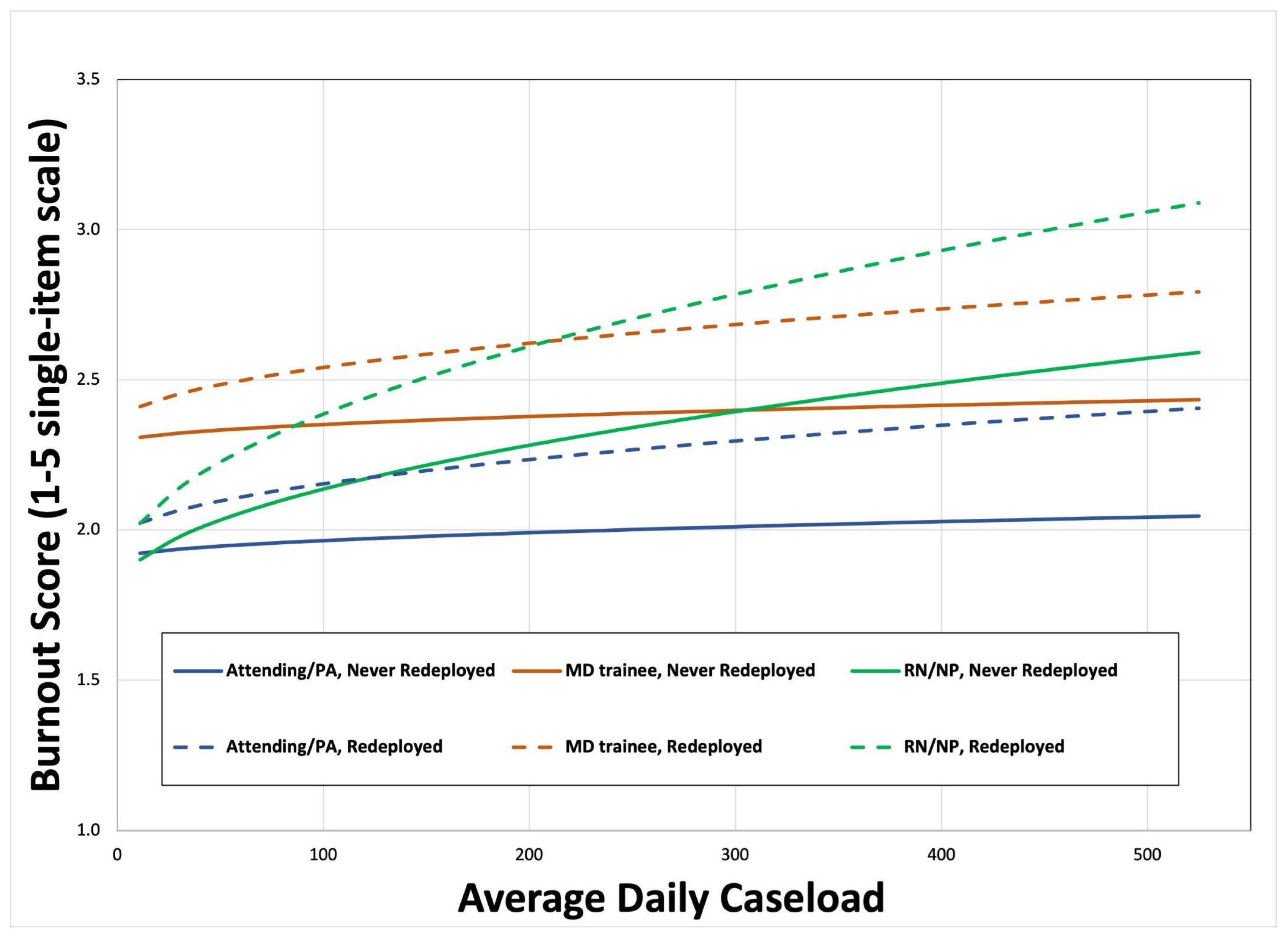
- Redeployment and higher caseloads increased burnout, with effects persisting after return to usual roles.
- What are the implications of the main findings?
- Redeployment is a commonly used strategy to handle increased needs for personnel during prolonged hospital crises. However, the data suggest that redeployment presents risks for persistent burnout under some conditions and for some personnel. Preventative efforts to reduce these risks are needed.
- This novel application of EMA used a low-intensity high-frequency surveillance approach to obtain information in real time about variations in the intensity of workplace demands and their association with employee burnout. This approach can be used to guide the deployment of burnout-mitigation efforts to high-risk groups during periods of high demands.
Abstract
1. Introduction
2. Materials and Methods
2.1. Study Design
2.1.1. Data Collection and Survey
2.1.2. Redeployment Status
2.1.3. Burnout
2.1.4. Caseload and Case Severity
2.1.5. Participant Comments
2.2. Data Analysis-Quantitative Survey Data
2.3. Data Analysis-Comments
3. Results
3.1. Characteristics of the Sample
3.2. Redeployment
3.3. Inferential Analyses of Workplace Predictors of Burnout
3.3.1. Role-Specific Burnout Trends
3.3.2. Interactions of Caseload and Redeployment
3.3.3. Long-Term Associations of Redeployment to Burnout
3.4. Analysis of Comments
- Being reassigned to unfamiliar roles with minimal notice.
- Insufficient training for redeployed responsibilities.
- Lack of guidance regarding policies and procedures on new units.
- Concerns about personal safety in less familiar environments.

| Theme | Percent of Comments (%) |
|---|---|
| Increased stress | 27.35% |
| Lack of support | 24.63% |
| Poor staffing | 20.87% |
| Discontent with redeployment | 17.75% |
| Feelings of burnout | 13.57% |
4. Discussion
5. Limitations
6. Conclusions
- Adopt Real-Time Monitoring: Implement EMA or similar tools to continuously track staff well-being and burnout during emergencies. These tools enable the early identification of at-risk individuals and allow for dynamic, data-driven interventions tailored to evolving conditions.
- Develop Redeployment Protocols: Establish structured protocols that include preemptive training, clear role-specific guidance, and organized hand-off processes to reduce the stress of sudden redeployment, allowing for dynamic caseload adjustments during surges.
- Integrate Mental Health and Peer Support Programs: Provide accessible mental health resources and establish peer support networks to specifically address the emotional challenges associated with redeployment and high workloads. These programs should be sustained beyond crises to support long-term workforce well-being.
- Enhance Organizational Communication: Maintain consistent and transparent communication channels to disseminate updates on policies, expectations, and available resources. Clear communication fosters trust and reduces uncertainty during crises.
- Expand Professional Development Opportunities: Offer cross-training and professional development programs to prepare staff for redeployment scenarios. Building skills across roles can ease transitions during emergencies and reduce stress by fostering confidence in diverse responsibilities.
Author Contributions
Funding
Institutional Review Board Statement
Informed Consent Statement
Data Availability Statement
Acknowledgments
Conflicts of Interest
Abbreviations
| EMA | Ecological Momentary Assessment |
| MMLM | Multilevel mixed-effects model |
| REDCap | Research Electronic Data Capture |
| SAS | Statistical Analysis System |
Appendix A
| Effect | Estimate | Standard Error | DF | t-Value | Pr > |t| | Lower | Upper |
|---|---|---|---|---|---|---|---|
| Intercept | 2.01 | 1.11 | 1253 | 1.81 | 0.07 | −0.1739 | 4.1986 |
| Caseloads × 100 | −0.007 | 0.13 | 1539 | −0.06 | 0.96 | −0.2526 | 0.2385 |
| Trainee (Resident/Fellow) vs. Attending Physicians | 0.38 | 0.13 | 368.5 | 2.87 | 0.0043 * | 0.1205 | 0.6445 |
| Nurse/NP vs. Attending Physicians | −0.19 | 0.14 | 291.9 | −1.33 | 0.17 | −0.4676 | 0.09122 |
| Caseloads × 100 * Nurse/NP vs. all others | 0.36 | 0.075 | 228.2 | 4.82 | <0.0001 * | 0.2122 | 0.5061 |
| Sex (Women vs. Men) | 0.26 | 0.10 | 351.8 | 2.54 | 0.01 | 0.05794 | 0.4564 |
| Redeployment Status (Out of role at the time of survey completion) | −0.099 | 0.063 | 3837 | −1.56 | 0.12 | −0.2227 | 0.02529 |
| Caseloads × 100 * Redeployment Status | 0.17 | 0.049 | 3317 | 3.45 | 0.0006 * | 0.07285 | 0.2653 |
| History of redeployment: Pre vs. post periods of redeployment | 0.13 | 0.049 | 2223 | 2.56 | 0.0104 * | 0.02944 | 0.2208 |
References
- Tawfik, D.S.; Scheid, A.; Profit, J.; Shanafelt, T.; Trockel, M.; Adair, K.C.; Sexton, J.B.; Ioannidis, J.P.A. Evidence relating health care provider burnout and quality of care: A systematic review and meta-analysis. Ann. Intern. Med. 2019, 171, 555–567. [Google Scholar] [CrossRef] [PubMed]
- Montgomery, A.P.; Azuero, A.; Baernholdt, M.; Loan, L.A.; Miltner, R.S.; Qu, H.; Raju, D.; Patrician, P.A. Nurse burnout predicts self-reported medication administration errors in acute care hospitals. J. Healthcare Qual. 2021, 43, 13–23. [Google Scholar] [CrossRef] [PubMed]
- Denning, M.; Goh, E.T.; Tan, B.; Kanneganti, A.; Almonte, M.; Scott, A.; Martin, G.; Clarke, J.; Sounderajah, V.; Markar, S.; et al. Determinants of burnout and other aspects of psychological well-being in healthcare workers during the COVID-19 pandemic: A multinational cross-sectional study. PLoS ONE 2021, 16, e0238666. [Google Scholar] [CrossRef] [PubMed]
- Ferry, A.V.; Wereski, R.; Strachan, F.E.; Mills, N.L. Predictors of UK healthcare worker burnout during the COVID-19 pandemic. QJM 2021, 114, 374–380. [Google Scholar] [CrossRef]
- Piercy, H.; Kelly, S.; Wills, M.; Croston, M. Psychological impact of caring during the COVID-19 pandemic on HIV nurses. Br. J. Nurs. 2022, 31, S10–S15. [Google Scholar] [CrossRef]
- Kissel, K.A.; Filipek, C.; Folz, E.; Jenkins, J. The impact of a three-tiered model of nursing redeployment during the COVID-19 pandemic: A cross-sectional study. Intensive Crit. Care Nurs. 2023, 77, 103431. [Google Scholar] [CrossRef]
- Shanafelt, T.D.; Hasan, O.; Dyrbye, L.N.; Sinsky, C.; Satele, D.; Sloan, J.; West, C.P. Changes in burnout and satisfaction with work-life balance in physicians and the general US working population between 2011 and 2014. Mayo Clin. Proc. 2015, 90, 1600–1613. [Google Scholar] [CrossRef]
- Dionisi, T.; Sestito, L.; Tarli, C.; Antonelli, M.; Tosoni, A.; D’Addio, S.; Mirijello, A.; Vassallo, G.A.; Leggio, L.; Gasbarrini, A.; et al. Risk of burnout and stress in physicians working in a COVID team: A longitudinal survey. Int. J. Clin. Pract. 2021, 75, e14755. [Google Scholar] [CrossRef]
- Shanafelt, T.D.; Noseworthy, J.H. Executive leadership and physician well-being: Nine organizational strategies to promote engagement and reduce burnout. Mayo Clin. Proc. 2017, 92, 129–146. [Google Scholar] [CrossRef]
- Moldovan, F.; Moldovan, L.; Bataga, T. Assessment of labor practices in healthcare using an innovatory framework for sustainability. Medicina 2023, 59, 796. [Google Scholar] [CrossRef]
- Demerouti, E.; Bakker, A.B.; Nachreiner, F.; Schaufeli, W.B. The job demands–resources model of burnout. J. Appl. Psychol. 2001, 86, 499–512. [Google Scholar] [CrossRef]
- Siegrist, J. Adverse health effects of high-effort/low-reward conditions at work. J. Occup. Health Psychol. 1996, 1, 27–41. [Google Scholar] [CrossRef] [PubMed]
- Abate, S.M.; Ahmed Ali, S.; Mantfardo, B.; Basu, B. Rate of intensive care unit admission and outcomes among patients with coronavirus: A systematic review and meta-analysis. PLoS ONE 2020, 15, e0235653. [Google Scholar] [CrossRef] [PubMed]
- Satomi, E.; Souza, P.M.R.D.; Thomé, B.D.C.; Reingenheim, C.; Werebe, E.; Troster, E.J.; Scarin, F.C.D.L.C.; Bacha, H.A.; Grunspun, H.; Ferraz, L.J.R.; et al. Fair allocation of scarce medical resources during COVID-19 pandemic: Ethical considerations. Einstein 2020, 18, eAE5775. [Google Scholar] [CrossRef] [PubMed]
- Singh, V.; Young, J.Q.; Malhotra, P.; McCann-Pineo, M.; Rasul, R.; Corley, S.S.; Yacht, A.C.; Friedman, K.; Barone, S.; Schwartz, R.M. Evaluating burnout during the COVID-19 pandemic among physicians in a large health system in New York. Arch. Environ. Occup. Health 2022, 77, 819–827. [Google Scholar] [CrossRef]
- Coughlan, C.; Nafde, C.; Khodatars, S.; Jeanes, A.L.; Habib, S.; Donaldson, E.; Besi, C.; Kooner, G.K. COVID-19: Lessons for junior doctors redeployed to critical care. Postgrad. Med. J. 2021, 97, 188–191. [Google Scholar] [CrossRef]
- Emanuel, E.J.; Persad, G.; Upshur, R.; Thome, B.; Parker, M.; Glickman, A.; Zhang, C.; Boyle, C.; Smith, M.; Phillips, J.P. Fair allocation of scarce medical resources in the time of COVID-19. N. Engl. J. Med. 2020, 382, 2049–2055. [Google Scholar] [CrossRef]
- San Juan, N.V.; Clark, S.E.; Camilleri, M.; Jeans, J.P.; Monkhouse, A.; Chisnall, G.; Vindrola-Padros, C. Training and redeployment of healthcare workers to intensive care units during the COVID-19 pandemic: A systematic review. BMJ Open 2022, 12, e050038. [Google Scholar] [CrossRef]
- Doherty, K.; Balaskas, A.; Doherty, G. The design of ecological momentary assessment technologies. Interact. Comput. 2020, 32, 257–278. [Google Scholar] [CrossRef]
- Shiffman, S.; Stone, A.A.; Hufford, M.R. Ecological momentary assessment. Annu. Rev. Clin. Psychol. 2008, 4, 1–32. [Google Scholar] [CrossRef]
- Pan, C.X.; Crupi, R.; August, P.; Sundaram, V.; Norful, A.A.; Schwartz, J.E.; Miele, A.S.; Simons, R.R.; Mikrut, E.E.; Brondolo, E. An intensive longitudinal assessment approach to surveilling trajectories of burnout over the first year of the COVID pandemic. Int. J. Environ. Res. Public Health 2023, 20, 2930. [Google Scholar] [CrossRef] [PubMed]
- Shea, J.A.; Bellini, L.M.; Desai, S.V.; Barg, F.K.; Eriksen, W.; Wietlisbach, L.E.; Yakubu, A.R.; Asch, D.A. Exploring residents’ well-being and burnout via qualitative ecological momentary assessment. Acad. Med. 2022, 97, 414–419. [Google Scholar] [CrossRef] [PubMed]
- Mengelkoch, S.; Moriarity, D.P.; Novak, A.M.; Snyder, M.P.; Slavich, G.M.; Lev-Ari, S. Using ecological momentary assessments to study how daily fluctuations in psychological states impact stress, well-being, and health. J. Clin. Med. 2023, 13, 24. [Google Scholar] [CrossRef] [PubMed]
- Versluis, A.; Verkuil, B.; Spinhoven, P.; Van Der Ploeg, M.M.; Brosschot, J.F. Changing mental health and positive psychological well-being using ecological momentary interventions: A systematic review and meta-analysis. J. Med. Internet Res. 2016, 18, e152. [Google Scholar] [CrossRef]
- Luceño-Moreno, L.; Talavera-Velasco, B.; Vázquez-Estévez, D.; Martín-García, J. Mental health, burnout, and resilience in healthcare professionals after the first wave of COVID-19 pandemic in Spain: A longitudinal study. J. Occup. Environ. Med. 2022, 64, e114–e123. [Google Scholar] [CrossRef]
- Ju, T.R.; Mikrut, E.E.; Spinelli, A.; Romain, A.M.; Brondolo, E.; Sundaram, V.; Pan, C.X. Factors associated with burnout among resident physicians responding to the COVID-19 pandemic: A 2-month longitudinal observation study. Int. J. Environ. Res. Public Health 2022, 19, 9714. [Google Scholar] [CrossRef]
- Dolan, E.D.; Mohr, D.; Lempa, M.; Joos, S.; Fihn, S.D.; Nelson, K.M.; Helfrich, C.D. Using a single item to measure burnout in primary care staff: A psychometric evaluation. J. Gen. Intern. Med. 2015, 30, 582–587. [Google Scholar] [CrossRef]
- Helfrich, C.D.; Simonetti, J.A.; Clinton, W.L.; Wood, G.B.; Taylor, L.; Schectman, G.; Stark, R.; Rubenstein, L.V.; Fihn, S.D.; Nelson, K.M. The association of team-specific workload and staffing with odds of burnout among VA primary care team members. J. Gen. Intern. Med. 2017, 32, 760–766. [Google Scholar] [CrossRef]
- Begay, R.L.; Roland, M.J.; Blair, I.V.; Brondolo, E. Discrimination among American Indian and Alaska Native people: Implications for public health communication. Front. Public Health 2024, 12, 1384608. [Google Scholar] [CrossRef]
- Boussat, B.; Kamalanavin, K.; François, P. The contribution of open comments to understanding the results from the Hospital Survey on Patient Safety Culture (HSOPS): A qualitative study. PLoS ONE 2018, 13, e0196089. [Google Scholar] [CrossRef]
- Schroeder, K.; Norful, A.A.; Travers, J.; Aliyu, S. Nursing perspectives on care delivery during the early stages of the COVID-19 pandemic: A qualitative study. Int. J. Nurs. Stud. Adv. 2020, 2, 100006. [Google Scholar] [CrossRef]
- Norful, A.A.; Rosenfeld, A.; Schroeder, K.; Travers, J.L.; Aliyu, S. Primary drivers and psychological manifestations of stress in frontline healthcare workforce during the initial COVID-19 outbreak in the United States. Gen. Hosp. Psychiatry 2021, 69, 20–26. [Google Scholar] [CrossRef]
- Aiken, L.H.; Lasater, K.B.; Sloane, D.M.; Pogue, C.A.; Rosenbaum, K.E.F.; Muir, K.J.; McHugh, M.D.; Cleary, M.; Ley, C.; Borchardt, C.J.; et al. Physician and nurse well-being and preferred interventions to address burnout in hospital practice: Factors associated with turnover, outcomes, and patient safety. JAMA Health Forum 2023, 4, e231809. [Google Scholar] [CrossRef]
Disclaimer/Publisher’s Note: The statements, opinions and data contained in all publications are solely those of the individual author(s) and contributor(s) and not of MDPI and/or the editor(s). MDPI and/or the editor(s) disclaim responsibility for any injury to people or property resulting from any ideas, methods, instructions or products referred to in the content. |
© 2025 by the authors. Licensee MDPI, Basel, Switzerland. This article is an open access article distributed under the terms and conditions of the Creative Commons Attribution (CC BY) license (https://creativecommons.org/licenses/by/4.0/).
Share and Cite
Alkattan, A.; Norful, A.A.; Pan, C.X.; August, P.; Crupi, R.S.; Schwartz, J.E.; Miele, A.; Brondolo, E. Monitoring Redeployment-Associated Burnout in Healthcare Workers: A Real-Time Approach Using Ecological Momentary Assessment. Healthcare 2025, 13, 3217. https://doi.org/10.3390/healthcare13243217
Alkattan A, Norful AA, Pan CX, August P, Crupi RS, Schwartz JE, Miele A, Brondolo E. Monitoring Redeployment-Associated Burnout in Healthcare Workers: A Real-Time Approach Using Ecological Momentary Assessment. Healthcare. 2025; 13(24):3217. https://doi.org/10.3390/healthcare13243217
Chicago/Turabian StyleAlkattan, Abdulaziz, Allison A. Norful, Cynthia X. Pan, Phyllis August, Robert S. Crupi, Joseph E. Schwartz, Andrew Miele, and Elizabeth Brondolo. 2025. "Monitoring Redeployment-Associated Burnout in Healthcare Workers: A Real-Time Approach Using Ecological Momentary Assessment" Healthcare 13, no. 24: 3217. https://doi.org/10.3390/healthcare13243217
APA StyleAlkattan, A., Norful, A. A., Pan, C. X., August, P., Crupi, R. S., Schwartz, J. E., Miele, A., & Brondolo, E. (2025). Monitoring Redeployment-Associated Burnout in Healthcare Workers: A Real-Time Approach Using Ecological Momentary Assessment. Healthcare, 13(24), 3217. https://doi.org/10.3390/healthcare13243217

