Article

Slices of the Anomalous Phase Cube Depict Regions of Sub- and Super-Diffusion in the Fractional Diffusion Equation


1
Department of Bioengineering, University of Illinois at Chicago, Chicago, IL 60607, USA
2
Departamento de Física, Universidade Estadual de Ponta Grossa, Ponta Grossa 84030-900, PR, Brazil
*
Author to whom correspondence should be addressed.
Mathematics 2021, 9(13), 1481; https://doi.org/10.3390/math9131481
Submission received: 18 May 2021 / Revised: 17 June 2021 / Accepted: 18 June 2021 / Published: 24 June 2021
(This article belongs to the Special Issue Fractional Calculus in Magnetic Resonance)

Abstract

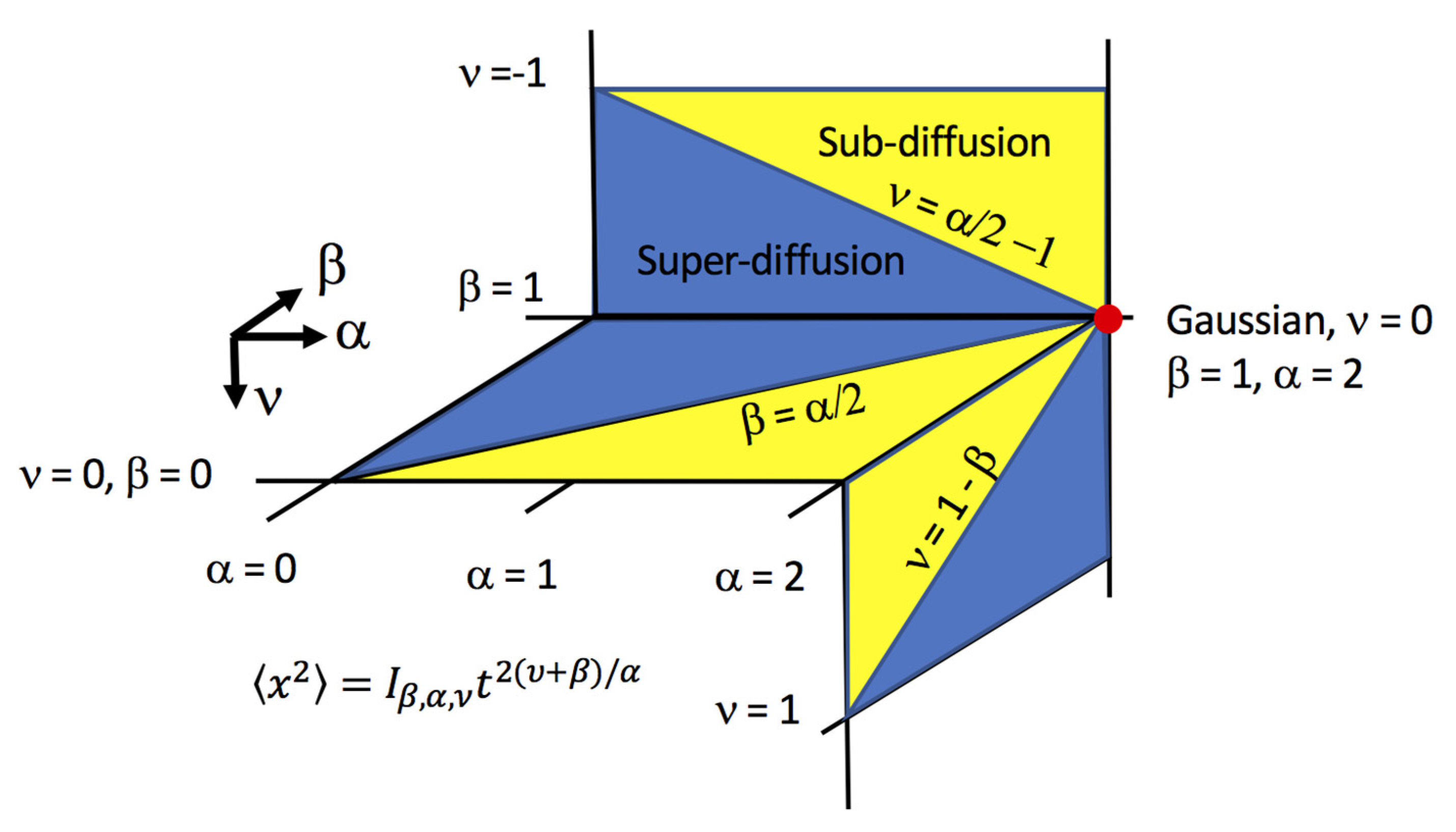
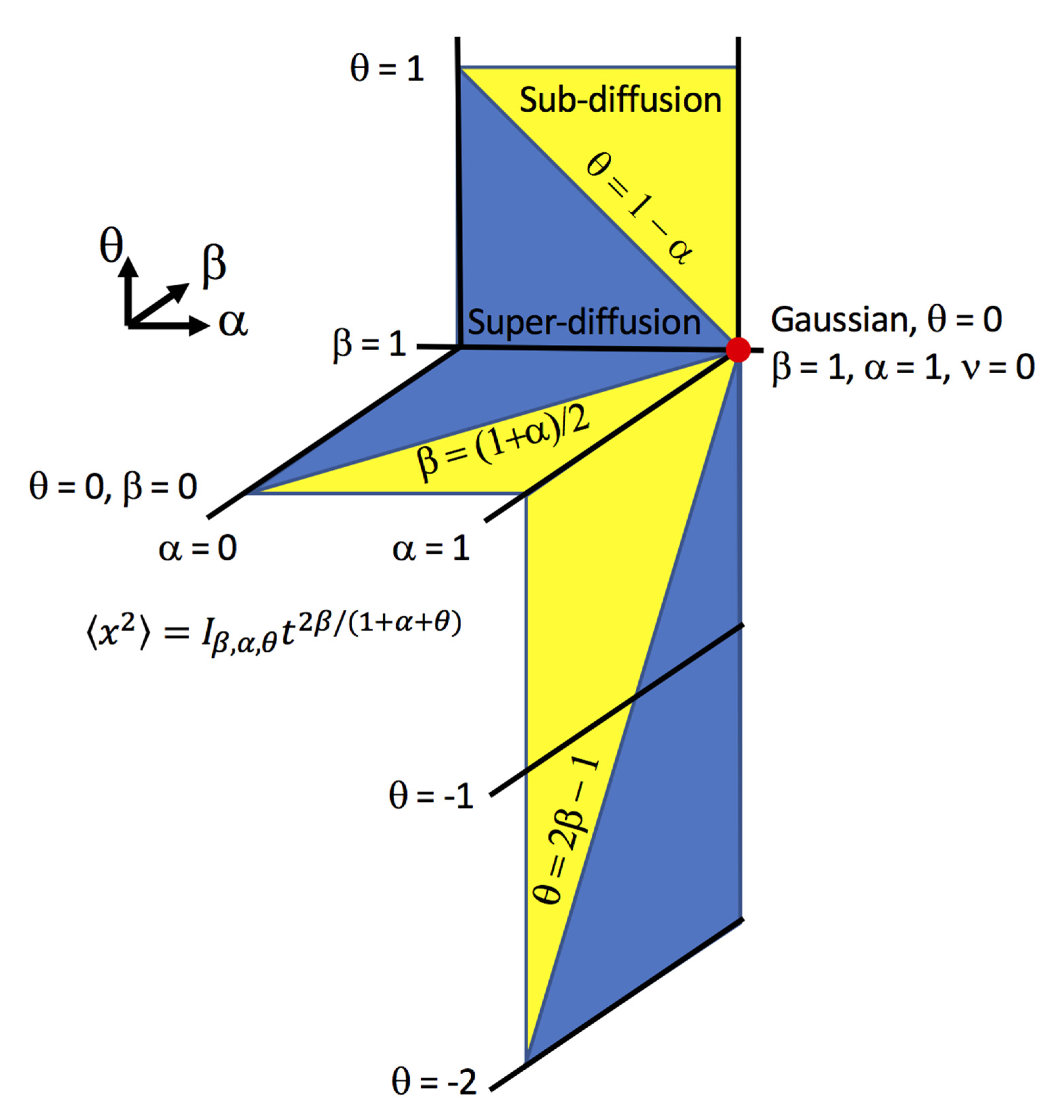
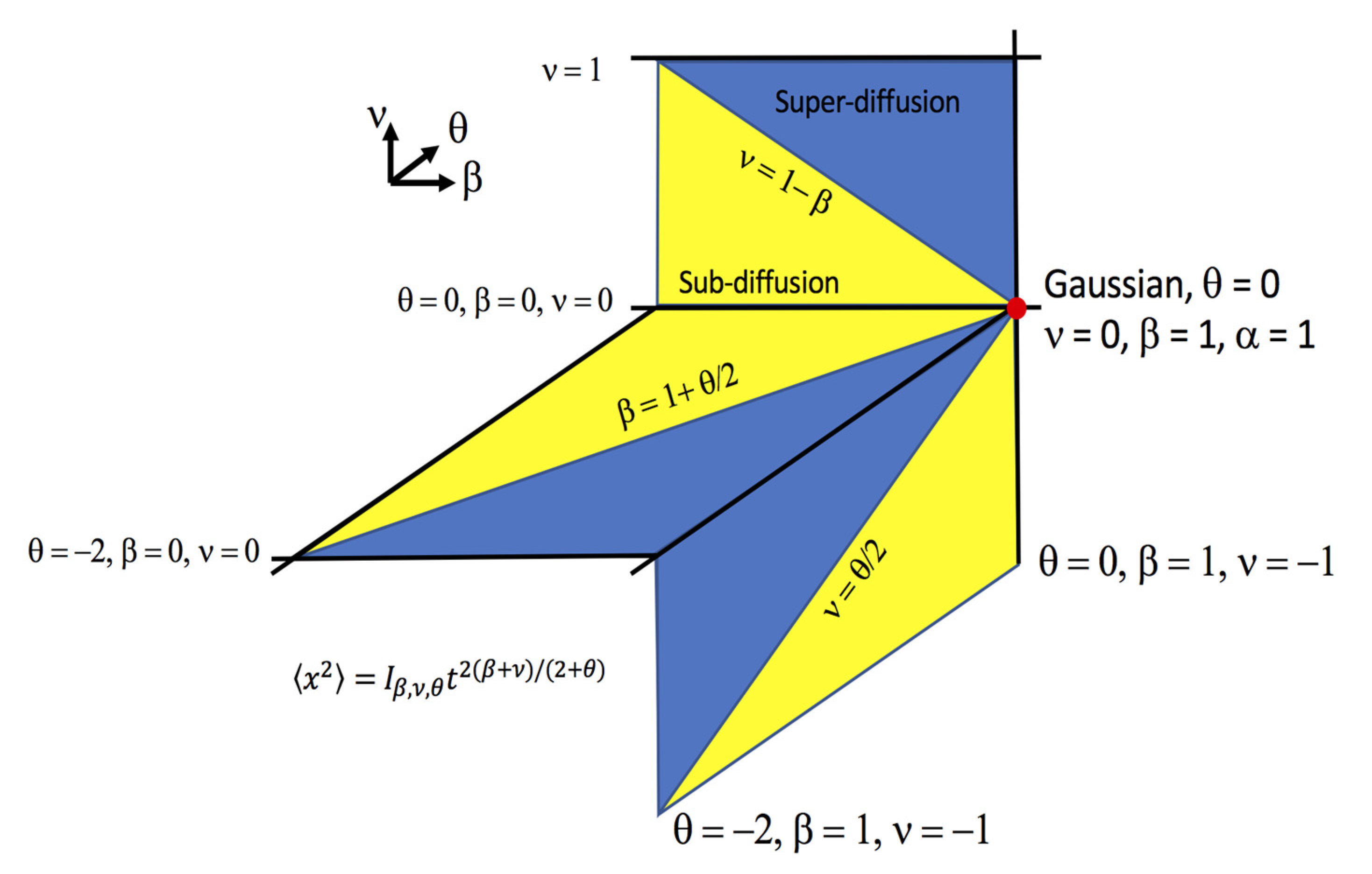
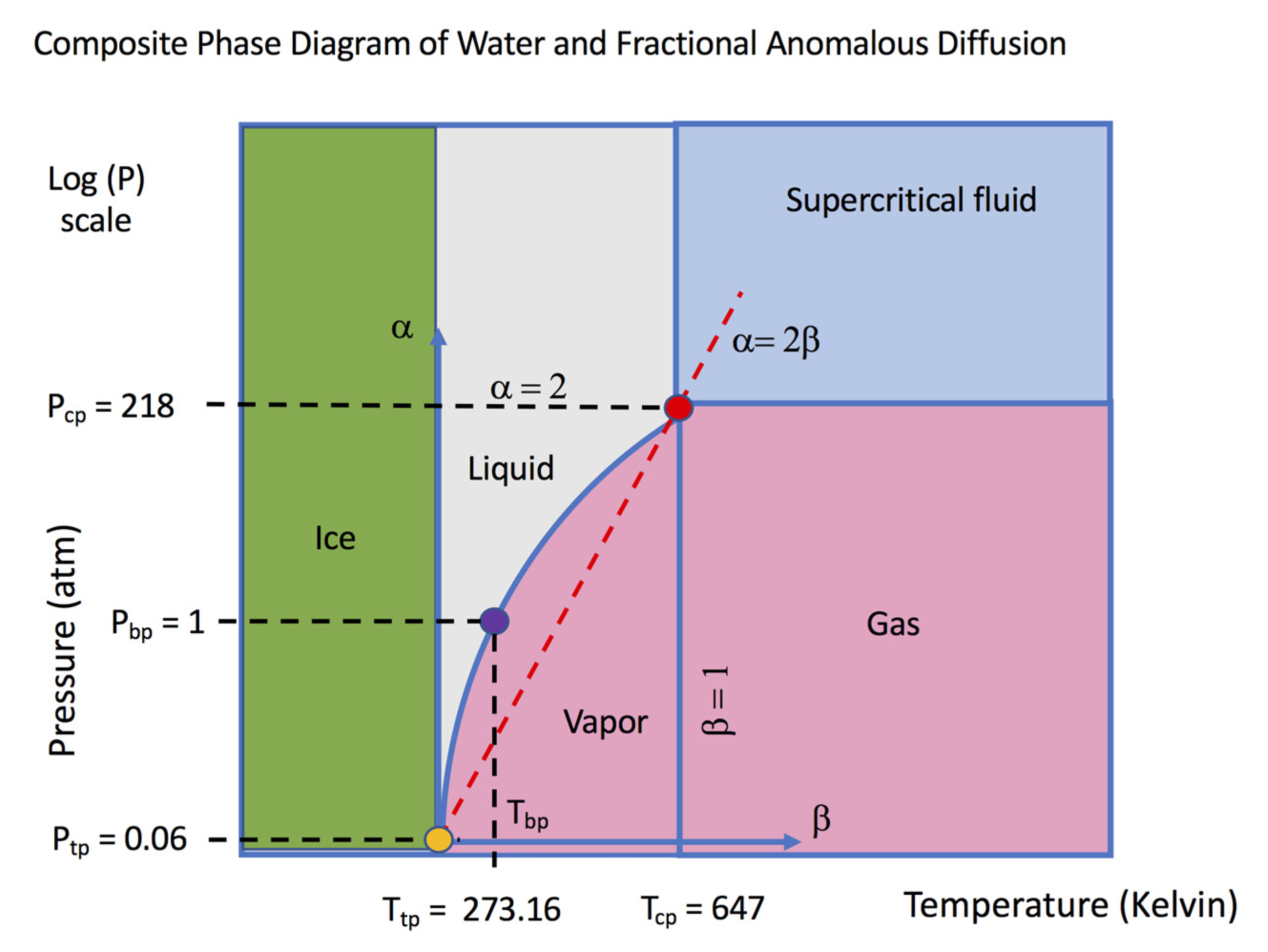
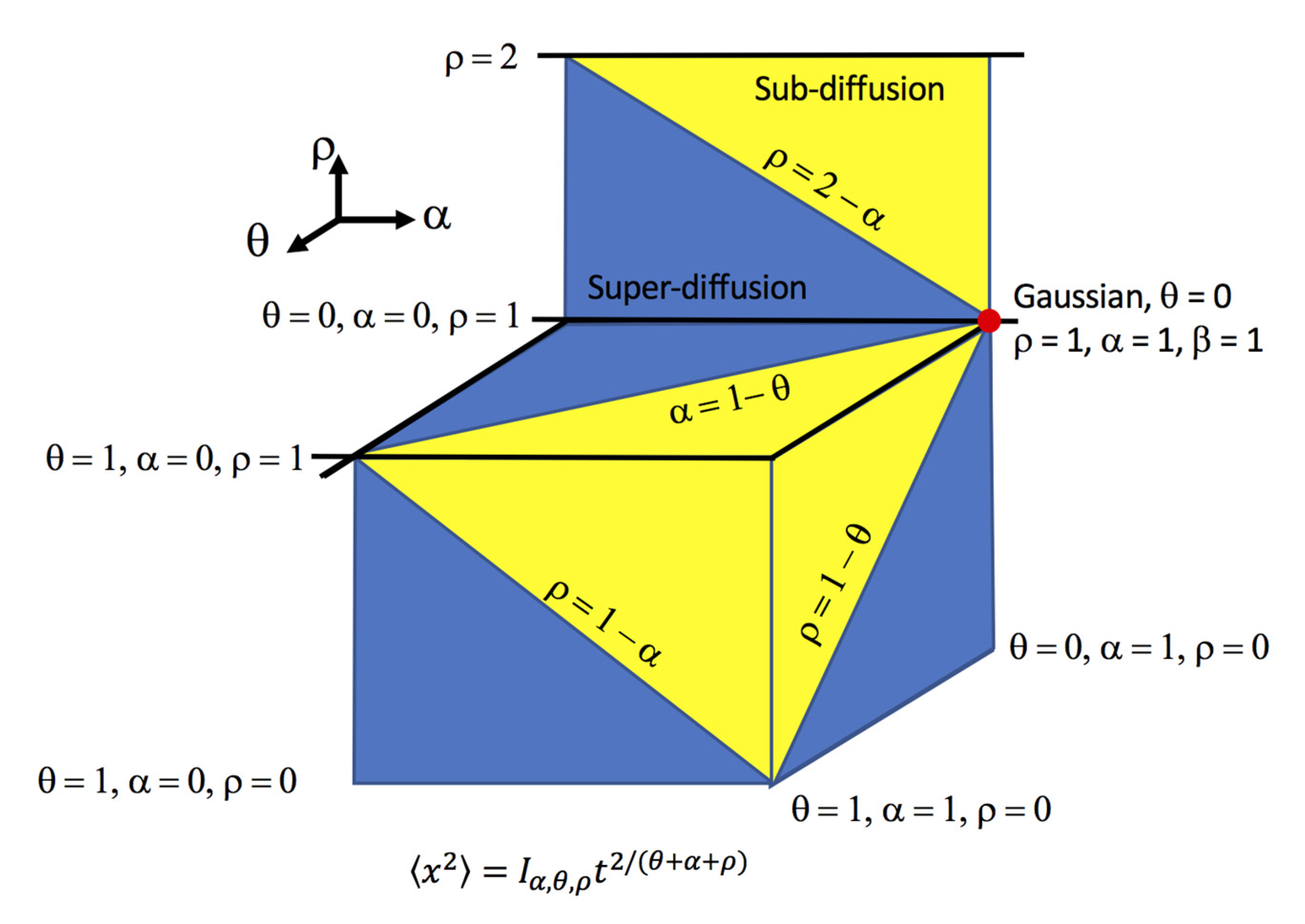
Fractional-order time and space derivatives are one way to augment the classical diffusion equation so that it accounts for the non-Gaussian processes often observed in heterogeneous materials. Two-dimensional phase diagrams—plots whose axes represent the fractional derivative order—typically display: (i) points corresponding to distinct diffusion propagators (Gaussian, Cauchy), (ii) lines along which specific stochastic models apply (Lévy process, subordinated Brownian motion), and (iii) regions of super- and sub-diffusion where the mean squared displacement grows faster or slower than a linear function of diffusion time (i.e., anomalous diffusion). Three-dimensional phase cubes are a convenient way to classify models of anomalous diffusion (continuous time random walk, fractional motion, fractal derivative). Specifically, each type of fractional derivative when combined with an assumed power law behavior in the diffusion coefficient renders a characteristic picture of the underlying particle motion. The corresponding phase diagrams, like pages in a sketch book, provide a portfolio of representations of anomalous diffusion. The anomalous diffusion phase cube employs lines of super-diffusion (Lévy process), sub-diffusion (subordinated Brownian motion), and quasi-Gaussian behavior to stitch together equivalent regions.
Keywords: anomalous diffusion; Brownian motion; complexity; fractal; fractional derivative; fractal derivative; mean squared displacement; sub-diffusion; super-diffusion anomalous diffusion; Brownian motion; complexity; fractal; fractional derivative; fractal derivative; mean squared displacement; sub-diffusion; super-diffusion