Article

A Two-Regime Markov-Switching GARCH Active Trading Algorithm for Coffee, Cocoa, and Sugar Futures


by
Oscar V. De la Torre-Torres
1,
Dora Aguilasocho-Montoya
1,* and
María de la Cruz del Río-Rama
2
1
Faculty of Accounting and Management, Saint Nicholas and Hidalgo Michoacán State University (UMSNH), 58030 Morelia, Mexico
2
Business Management and Marketing Department, Faculty of Business Sciences and Tourism, University of Vigo, 32004 Ourense, Spain
*
Author to whom correspondence should be addressed.
Mathematics 2020, 8(6), 1001; https://doi.org/10.3390/math8061001
Submission received: 21 May 2020 / Revised: 11 June 2020 / Accepted: 12 June 2020 / Published: 18 June 2020
(This article belongs to the Special Issue Mathematical Modeling of Socio-Economic Systems)

Abstract

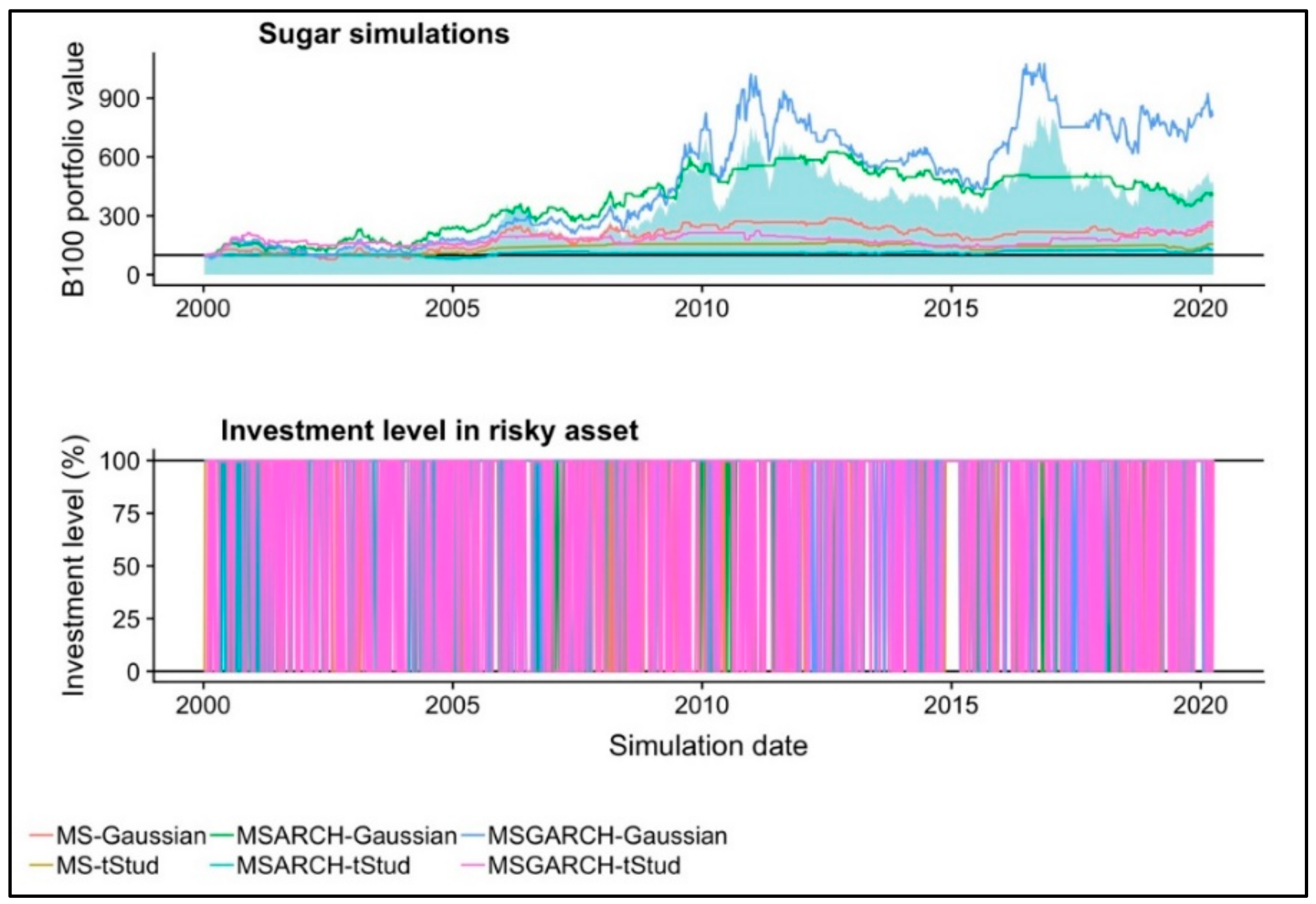
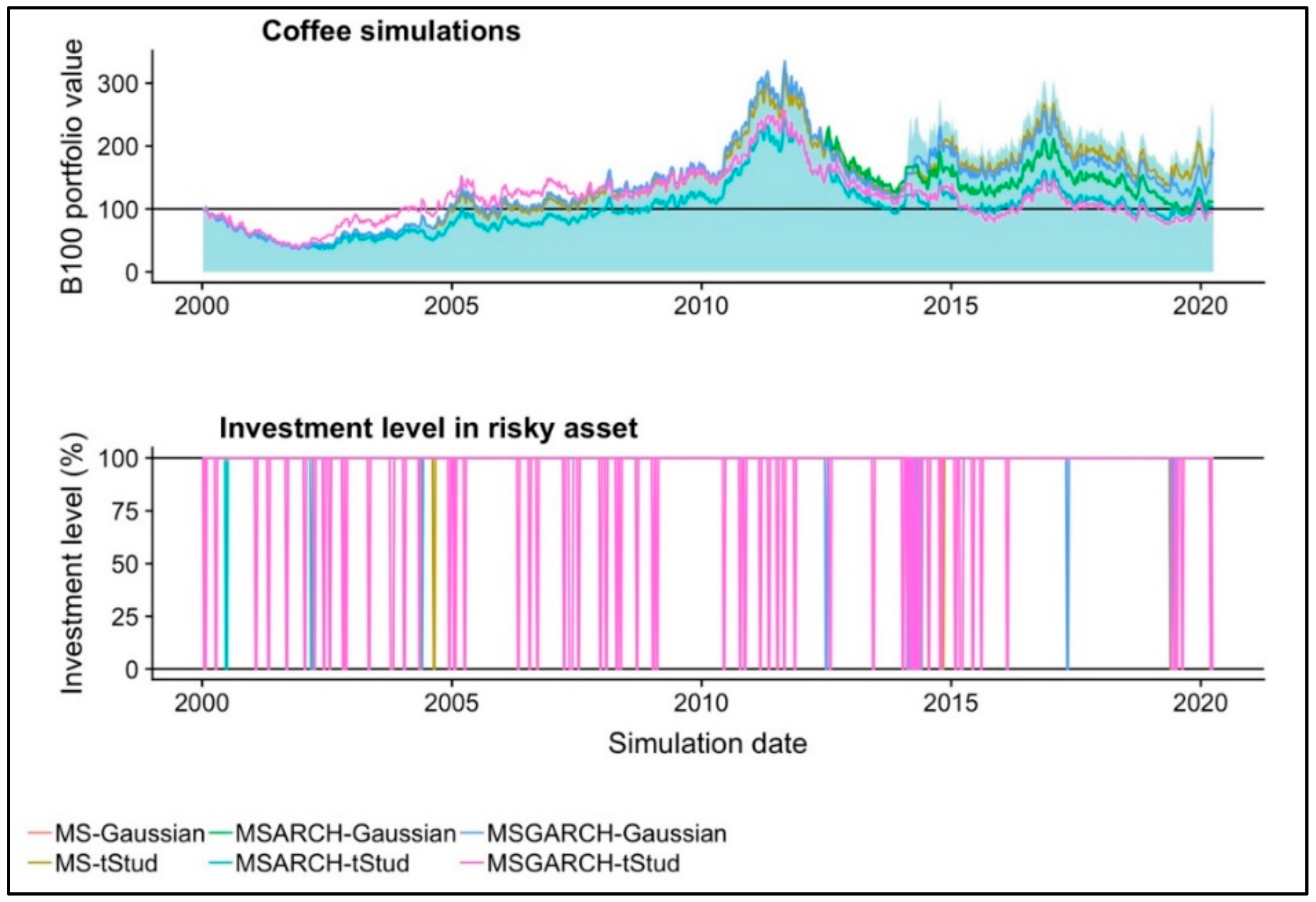
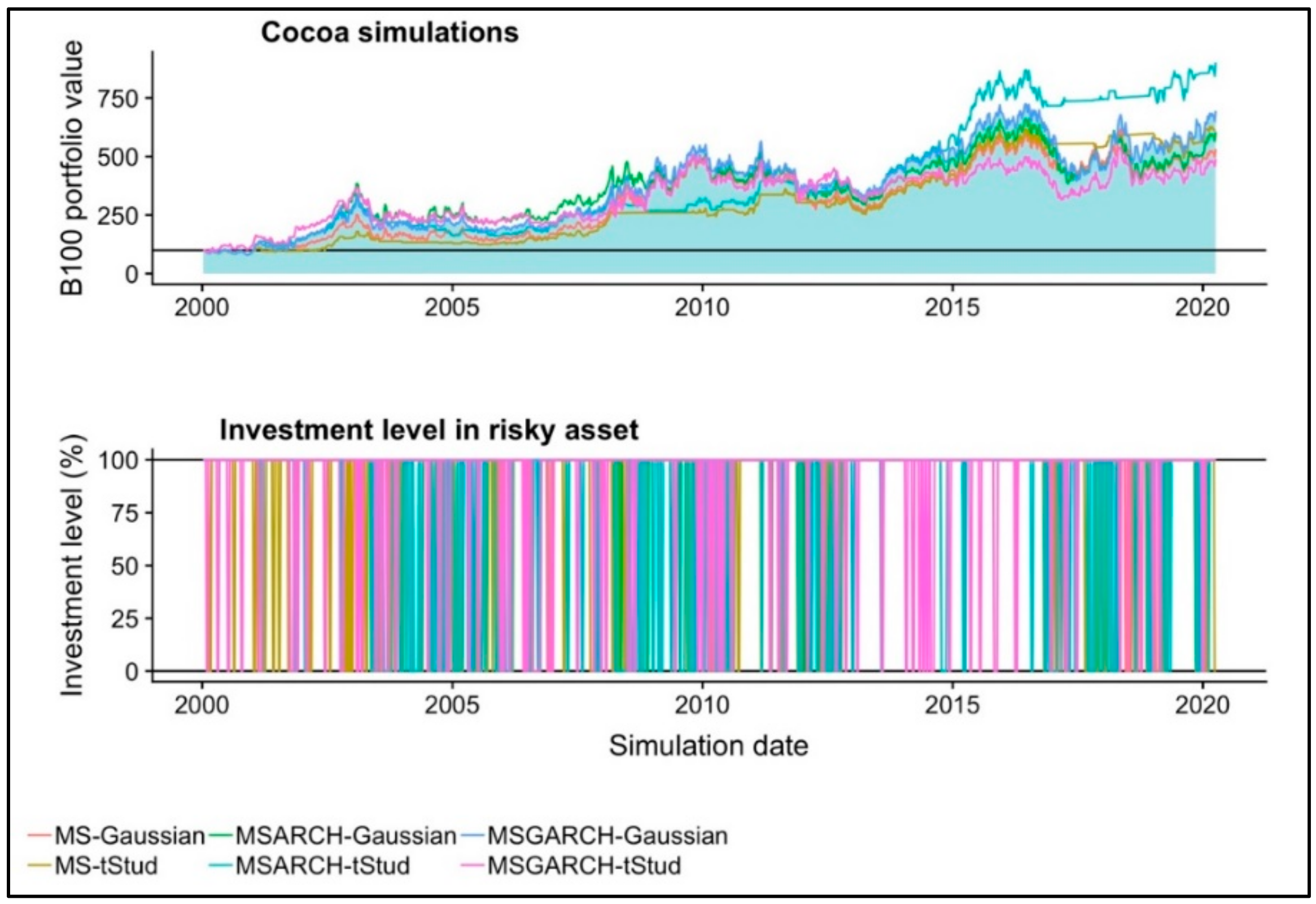
In the present paper we tested the use of Markov-switching Generalized AutoRegressive Conditional Heteroscedasticity (MS-GARCH) models and their not generalized (MS-ARCH) version. This, for active trading decisions in the coffee, cocoa, and sugar future markets. With weekly data from 7 January 2000 to 3 April 2020, we simulated the performance that a futures’ trader would have had, had she used the next trading algorithm: To invest in the security if the probability of being in a distress regime is less or equal to 50% or to invest in the U.S. three-month Treasury bill otherwise. Our results suggest that the use of t-student Markov Switching Component ARCH Model (MS-ARCH) models is appropriate for active trading in the cocoa futures and the Gaussian MS-GARCH is appropriate for sugar. For the specific case of the coffee market, we did not find evidence in favor of the use of MS-GARCH models. This is so by the fact that the trading algorithm led to inaccurate trading signs. Our results are of potential use for futures’ position traders or portfolio managers who want a quantitative trading algorithm for active trading in these commodity futures.
Keywords: Markov-switching GARCH; Markov chain Monte Carlo; soft commodities; computational finance; financial market distress prediction; commodity futures’ trading; active future trading Markov-switching GARCH; Markov chain Monte Carlo; soft commodities; computational finance; financial market distress prediction; commodity futures’ trading; active future trading