1. Introduction
Let
be the sequence of Fibonacci numbers given by recurrence relation
, for
, with initial conditions
and
. These numbers possess many interesting and amazing properties (see [
1,
2] together with its very extensive annotated bibliography for additional references and history). For example, it is well-known that, for the Fibonacci numbers hold the following
Binet’s formula,
where
and
are the roots of the characteristic equation
The connection between the Fibonacci numbers and the Golden ratio
is similarly famous,
which follows from Binet’s formula and the relation
between the roots of characteristic polynomial
. This limit was probably firstly studied by Johannes Kepler in 1619 (see English translation [
3]) as he formulated there the approximation of the golden ratio
by the proportions of consecutive Fibonacci numbers.
There are many types of generalizations of the Fibonacci numbers (see [
4,
5,
6,
7,
8,
9,
10,
11,
12,
13]); e.g., changing their recurrence to the form
, for
, with initial conditions
we get Padovan numbers, which are named after R. Padovan, but in 1991 he attributed their discovery to Dutch architect Hans van der Laan and the sequences with the same recurrence were studied in 1899 by R. Perrin and in 1924 by Cordonnier (see [
14,
15,
16]).
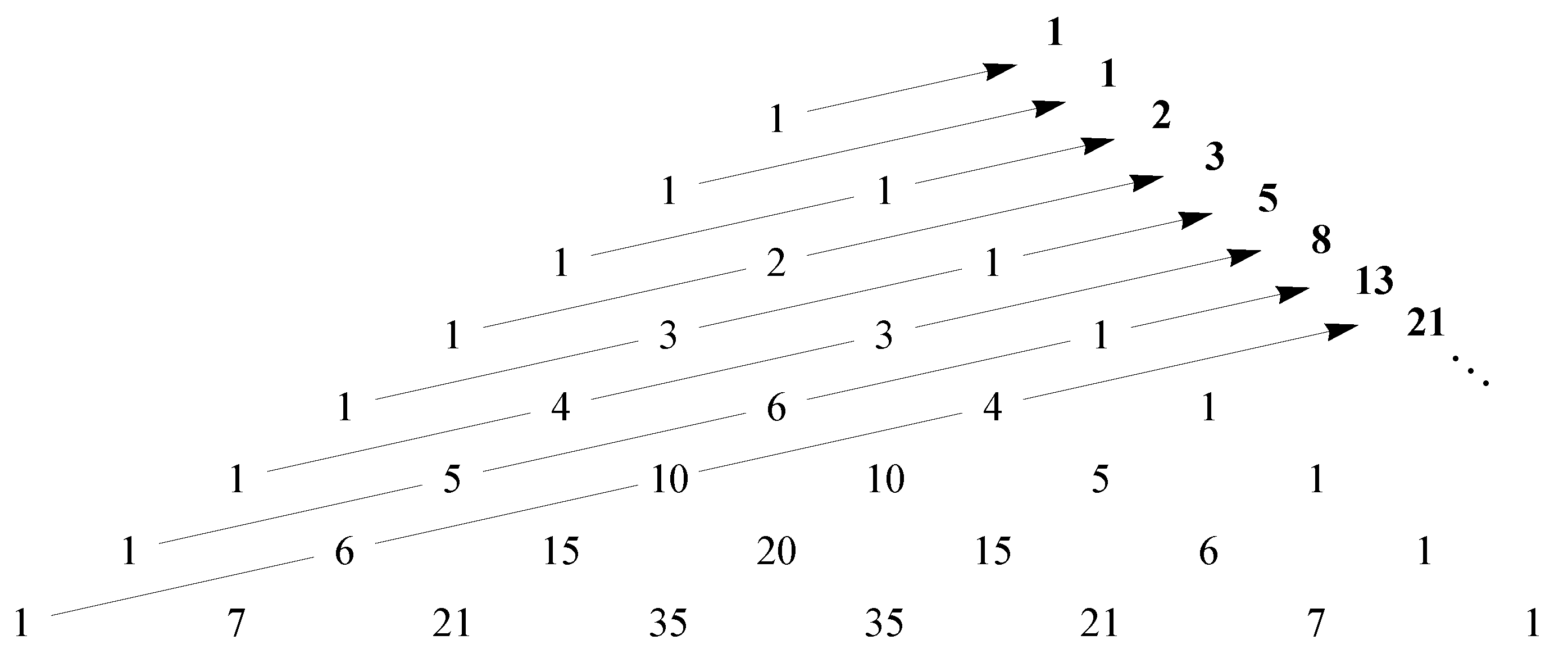
In 1876, Lucas realized that Fibonacci numbers appear as the sums of the northeast diagonals in Pascal’s triangle (see
Figure 1), thus the following identity holds for any non-negative integer
nIn 1989, Stakhov [
17] considered reformatted Pascal’s triangle (see
Table 1), where the sum of all numbers in the
jth column,
, is equal to the Fibonacci number
.
He introduced, for any non-negative
p, Fibonacci
p-numbers, as sums of columns in a transformed Pascal’s triangle (he denoted these triangles as Pascal’s
p-triangles), which is creating from Pascal’s triangle by shifting all numbers in each row such way, that the first number in the
ith row,
, is in the
th column. Stakhov showed that these Fibonacci
p-numbers
are given by the following recurrence relation
On the fourth annual meeting of the Pacific Northwest Section of the Mathematical Association of America in 1950, Brenner [
18] gave a lecture “Lucas’ matrices” in which he presented usage of Fibonacci’s matrix and Lucas’ matrix
and showed that their
nth power are
respectively, where
is a non-degenerate Lucas sequence of the first kind (clearly
), defined, for any
, by the recurrence relation
, with
,
and
. Its characteristic equation
has discriminant
and roots
,
, thus, for any
, the following generalized Binet formula holds
The first matrix in (
5) is usually called Fibonacci “
Q-matrix”, as King in his master’s thesis [
19] originated this notation (more on the history and some applications of
Q-matrices can be found in [
20,
21]).
In 1999, Stakhov [
22] introduced a new class of square matrices
of the order
, where
p is a non-negative integer, which are a generalization of Fibonacci
Q-matrix
He defined the Fibonacci
p-numbers for integers
by the different way then in (
4), thus these Fibonacci
p-numbers
are defined for positive integer
p and any integer
n by the following way
Then, he showed that elements of
-matrices are connected to Fibonacci
p-numbers by the following way
In 2006, Stakhov [
23] developed a theory of the
-Fibonacci matrices and he introduced a generalization of Cassini formula based on these matrices for any non-negative integers
p,
, as he proved that:
For the
nth power of matrix
holds:
For the determinant of matrix
holds:
For the inverse of
the following extremely interesting identity holds:
He also describes the original Fibonacci coding/decoding method based on the
Fibonacci matrix. Stakhov’s discovery attracted much attention, and so many scientists have tried to more generalize this result. In 2009, Kocer et al. [
24] generalized the Fibonacci
p-numbers
by introducing a new parameter
m and defined the
m-extension of Fibonacci
p-numbers,
, by the following way
where
m is any positive real number. In 2009, Basu and Prasad [
25] defined the matrix
as a generalization of the matrix
, but there is a mistake in this paper, so we write the right form here, by the following way
Furthermore, they noted that
can be written using
m-extension of Fibonacci
p-numbers
, when we replace
by
in the matrix
in (
8). Then, they showed that
and that analogous identities as (
9) and (
10) hold for
after replacing
by
. In 2011, Tuglu et al. [
26] and Basu et al. [
27] (independently and in different notation) generalized
m-extension of Fibonacci
p-numbers to
-extension of Fibonacci numbers by the following way
where
m and
t are any positive real numbers. They introduced the matrix
as a generalization of the matrix
by the following way
which is again the matrix in the form (
6), when we imagine
replaced by
. Recently, many other papers that modify Stakhov’s method in some way have been published (see, e.g., [
28,
29,
30,
31,
32,
33]).
We showed that much effort was devoted to a different generalization of (
4) by introducing some new coefficients in the Fibonacci
p-numbers recurrence for the purpose to design a coding/decoding system in the last ten years. In this paper we will continue in the described direction of research aimed at possible generalizations of recurrence (
4) for use in information security. In our generalization, we were motivated by the paper of Włoch et al. [
34], which dealt with the combinatorial properties of the terms of the sequence
, where
and
are any integers, defined by the following recurrence
with initial conditions
for
. The authors called this sequence as the sequence of
-distance Fibonacci numbers. Clearly, Stakhov’s
p-Fibonacci numbers
can be recalled as
-distance Fibonacci numbers in this terminology. Probably independently, but four years later, the sequence with the recurrence (
13) was studied in Deveci and Karaduman [
35]. They called this sequence as Padovan
p-sequence, as clearly it is generalization of Padovan sequence
, considered
in (
13); denoted this sequence as
; and used the initial conditions
for
and
,
.
In this paper, to construct a new coding/decoding process, we first prove that the sequence has the Kepler limit for any odd integer (we prove the existence of dominant root of the characteristic polynomial of this sequence and we set a new criterion for test of “non-omitted root summand” in Binet-like formulas). Then, we construct the generating matrix of the sequence in a different way than it was defined in the already mentioned Włoch’s paper to be suitable for constructing a coding method. Further, we derive the relations among the code matrix elements, but our method is new and much simpler than the method introduced by Stakhov (the authors of all subsequent papers only took over his approach). Next, we discuss the correction ability of our encoding method and we show an example of concrete construction of coding/decoding system based on -distance Fibonacci numbers.
3. The Generalized Kepler Limit of
In this section, we prove that the sequence
has the Kepler limit for any odd integer
. It is well known that the existence of the Kepler limit is related to the existence of a dominant root between the roots
of the characteristic polynomial of
(namely that there exists a root
such that
for every
) (see, e.g., [
46,
47]). It is less known that the existence of a dominant root is not a sufficient condition for the existence of the Kepler limit. Fiorenza and Vincenzi [
48,
49] addressed this problem and formulated a number of examples of problematic initial conditions, but they have not found any criteria, which we will do here.
For this purpose, we need to show two facts:
the characteristic polynomial of the sequence has a dominant root ; and
the summand, containing the power of the dominant root , is actually occurred among the summands in the Binet-like formula of -distance Fibonacci numbers.
Theorem 1. Let be any integer. Let denote the characteristic polynomial of the sequence , thus . Then,
- (i)
does not have multiple roots; and
- (ii)
has a dominant root for all positive odd integers .
Proof. Case
was proved in [
35], thus we prove Case
only.
By the Descartes’ sign rule, we have the existence of only one positive real root of . In fact, , since and . Note that, we also have , for all . Let z be a complex root of with . Then, and so . On the other hand, by the triangle inequality, we have and so . Thus, and become to the same ray. This implies that there exists a real number such that . Since , we deduce that and also that is a real number and so is . It follows that is also a real number and moreover, and are both positive (because the relation together with the fact that ). Now, since , then z is a nonzero real number. However, z is not negative, since in this case would be also negative (since q is odd). Thus, z is a positive real number which is a root of which yields that (since is the only positive real root of ). This completes the proof. □
Remark 1. In Theorem 1, we have proved that the dominant root exists for odd q. It is easy to realize that for even q, due to the same parity of numbers q and , the characteristic polynomial cannot have a dominant root, because if α is its root, then its root is also .
Now, we formulate the general criterion for “non omitted root summand” in Binet-like formula of the sequence .
Theorem 2. Let q be any positive integer, . Let the sequence be defined by a linear recurrence of order q by (
15)
, whose characteristic polynomial has distinct non-zero roots , , ⋯, . If determinant of the following matrix is non-zero, then all , , in (
16)
are non-zero. Proof. Using Binet-like form for the linear recurrence
, given by (
16), we can write the matrix
as
and using additive property of determinants with only one distinct column we can write determinant
as sum of
determinants, but
determinants is clearly zero as they have at least two columns created by powers of the same root
,
. Thus,
where
is the symmetric group on elements
. Then, we can write
where
are Vandermonde determinants. □
By Theorems 1, 2, and 3
and Corollary 1, we can write a
-distance Fibonacci sequence
in its asymptotic form
where
is the dominant root of the sequence
,
is a nonzero constant and
is a function which tends to 0 as
. Hence the following holds
Corollary 2. Let q be any odd integer, , let ℓ be any positive integer. Then, there is a so-called generalized Kepler limitwhere is the dominant root of the sequence . 4. Generating Matrices of
We showed that
Q-matrix, which generates the Fibonacci sequence, was already constructed for many kinds of generalized Fibonacci sequences. Now, we would like to note that these generating matrices can be created in slightly different forms (usually based on certain rearrangements of the indices of the studied sequence), e.g., we can find more than ten forms of generating matrices of Padovan sequence in papers [
50,
51,
52,
53,
54]. Similarly, in [
34,
35], the authors constructed generating matrices of the sequence
and
, respectively, but, to apply the extended sequence
for encoding and decoding, we consider another form of generating matrix, we denote it by
, whose
nth power, denoted by
, corresponds to the form of the matrix obtained by Stakhov in (
9).
Definition 2. Let q be any positive integer, , and let n be any integer. Let , wherethus, is equal to Example 1. Let us consider and (see Table 2). Then, the matrix has the following special form Lemma 3. Let q be any positive integer, . The matrix , has the following special formthus, Proof. By (
20)
is equal to
and using Lemma 2 and with respect to Example 1 we get the assertion. □
Lemma 4. Let a be any positive integer. Let denote a matrix such thatthus Then,
- (i)
is a Toeplitz matrix (thus, a diagonal-constant matrix).
- (ii)
Every element on the main diagonal of is 1 and all adjacent diagonals have opposite signs.
- (iii)
The addition of the ith row to the th row is equal to the zero vector.
- (iv)
The addition of the first row and the last row is equal to the zero vector.
Proof. The proof is trivial by the definition of matrix . □
Theorem 3. Let q be any positive integer, , and let n be any integer. Then, the following hold
- (i)
where , withthus - (ii)
- (iii)
, with - (iv)
, with thus is equal to
Proof. Proof of . We compute the product of matrices
R and
, thus
for
.
- Case 1
- Case 2
Let
. Then,
- Case 3
Thus, we show that for any integer n.
Proof of . By item
, we have
for any positive integer
(similarly it holds
, for any positive integer
n, but the matrix
is not as simple as matrix
).
We calculate the determinant of the matrix
with the help of identity (
22), i.e., firstly we find the determinant of the matrix
R and then the determinant of the matrix
.
- Determinant of the matrix
We use the Laplace theorem. We expand the determinant of matrix
R along the first column, thus
where we use the fact that the resulting matrix is an upper triangular matrix.
- Determinant of the matrix
We again use the Laplace theorem and we expand it along the last row, thus
where we use the fact that the last two resulting matrices are triangular matrices with the main diagonal containing only ones.
Finally, using well-known formula for determinant of product of matrices, we have by (
22)
Proof of Let us denote by
a matrix such that
Thus, we wish to prove that
. To avoid unnecessary repetition, we prove only that
. Thus, we must prove for
that
We split the proof of into the following cases
- Case 1
- Case 2
- Case 3
Thus, coincides with the inverse matrix of the matrix R.
Proof of . Assuming that
q is even (thus, let
, where
is any integer), the proof is analogous for odd
k. We show that the matrix
defined by (
21), with
, is the inverse matrix to the matrix
. We have that
, with
thus
It is clear that the matrix arises from the matrix , defined in Lemma 4, on the basis of change the element in the position to 2 and the “triangle of elements in the center part” to 0. The matrix is a Toeplitz matrix (thus, diagonal-constant matrix) with the main diagonal with the plus signs and side by side diagonals with opposite signs. Hence, the addition of any side by side rows leads to the zero vector.
Therefore, we have to prove that
. To avoid unnecessary repetitions, here we only provide the proof that
. Thus, we have to prove for
that
We split the proof of (
25) to the following cases
- Case 1
Let
. By Lemma 4 (c) and as
for
we have
- Case 2
Let
. Then,
- Case 3
- Case 4
5. Coding/Decoding System Based on -Distance Fibonacci Numbers
Let us consider that we have a message M (represented by a string of digits), which we want to secretly send to a certain unique recipient through a communication channel. There are various methods for this secret transmission of a message M, but, in this paper, we deal with only one of these methods based on matrix multiplication. For this reason we rewrite the original message M by grouping of its digits to elements of a matrix of order q, is an integer (in this step, we have many possibilities, so we use such grouping to be matrix a non-singular matrix), which we want to transform into a code matrix (this transformation is called coding process) and send it to the recipient. We can use an invertible matrix as a coding matrix and its inverse as a decoding matrix, thus we get the code matrix with coded original message M (if we rewrite elements of matrix as the string of digits, we get the coded message E). Then, we can decode by using the inverse matrix , thus (this transformation is called decoding process).
To design a fully functional coding/decoding process based on matrix multiplication Stakhov [
23] defined the matrix
on the base of terms of the sequence
(defined in (
7)), we set
(see identity (
9)) and propose the following requirements:
- (i)
There is the Kepler limit for the sequence of Fibonacci p-numbers , which allows an error detection and correction.
- (ii)
Determinant of the matrix needs to be , as we want all entries of the inverse matrix to be integers. Further, determinant plays a role of the ‘‘checking element’’ in the coding process, as it is sent immediately after the coded message through the transmission channel.
In previous sections, we construct the sequence of the matrices based on the -distance Fibonacci numbers and now we show that matrices can be used effectively in coding/decoding process. Clearly, our sequence of -distance Fibonacci numbers , with an odd value of , fulfills the previous Stakhov’s Requirements (i) and (ii), as, by Corollary 2 we know, that the sequence satisfies the generalized Kepler limit with the dominant root , for any odd , and by Theorem 3 determinant of the matrix is equal to 1, respectively.
Hence, we can use matrix as a coding matrix and its inverse as a decoding matrix and we get the code matrix with coded original message M. Then, we can decode E by using the inverse matrix , thus . With respect to Theorem 3, we can use in decoding process these facts:
For an odd , we have , thus the “checking element” if an error occurs during transmission in coding process is very suitable as must be satisfied.
For finding the message matrix
from the code matrix
, we have the following computationally much faster way
5.1. Relation among Code Matrix Elements and Code Rate of This Method
When a message is transmitted from a sender to a recipient, the message may be distorted in the communication channel. Hence, some errors can occur in the code matrix E and we must be able to identify these errors and subsequently correct them. We show that the basis of an error detection as well as its correction is the value of the determinant and the following relation among elements of code matrix .
Lemma 5. Let q be any integer, , let ℓ, k be any positive integers, and , . Let be the strict dominant root of the sequence . Then, for elements of the matrix holds Proof. With respect to defining identity (
20) of the matrix
the following statements immediately hold:
- (a)
All elements , , of the matrix are in the form with .
- (b)
If , and , then .
- (c)
The
jth column
,
, of
consists of elements of the set
, has as its first element
and the others are arranged in descending order according to the index in round brackets. Thus, it has the form
As
, we get elements of the code matrix
with respect to the previous Statements (b) and (c) by the following way
Now, we prove the case for .
When we denote
,
, thus
,
, we obtain
and with respect to Corollary 2
Cases for .
Using proved identity (
27), we clearly get the assertion with respect to the following trivial identity
□
Let us consider that we send by the communication channel the code matrix and right after the determinant of the message matrix . As already mentioned, determinants of the message matrix and the code matrix are equal in our case; thus, clearly, by comparing the determinant of the matrix obtained by the recipient from the communication channel with the value of determinant , the recipient can decide whether the code matrix is damaged or not, but he cannot determine which element of the code message is damaged. To find the damaged element (or more elements), the recipient necessarily needs both the value of the determinant and the approximation properties among elements of code matrix , which we found in Lemma 5.
It is possible to show, the same way as done, e.g., in [
23,
55], that by these properties can be corrected all cases except for the case with all error elements of the code matrix
, namely
cases with one error element,
cases with any two error elements,
cases with any three error elements, ⋯,
cases with
error elements. Thus, the correction ability
of this coding/decoding method is done by the formula
5.2. Example of Coding/Decoding by Matrix Based on -Distance FIBONACCI Numbers
Now, we consider the special case of our method for
(the case for
, thus based on the sequence of Padovan numbers
, is separately discussed, e.g., in [
54], and for
our sequence
does not have the dominant root, with respect to Theorem 1). Therefore, we represent the initial message
M by the matrix
, thus
and we use for coding matrix
for which with respect to (
22) holds
where
Using the previous identity, we get easily the following two identities (for simplification of notation, we write
in the rest of the text). For the code matrix
, thus
we have
and for any integer
We easily can show that the previous identity for
holds for any integer
n, thus we can write
for any integer
n. Hence,
where
If we denote
we get by (
28) and (
30) the following very computationally effective form of the decoding matrix
In this case, we get the following form of relation among code matrix elements and code rate of this coding/decoding method by Lemma 5.
Corollary 3. Let be dominant root of the sequence . Then, for elements of the code matrix the following asymptotic properties (the asymptotic values of all fractions in the table body are in the table header) hold | | | | | | | | | |
| | | | | | | | | |
| | | | | | | | | |
| | | | | | | | | |
and for the correction ability holds 6. Conclusions
In this paper, we are interested in construction of a new coding/decoding system based on the sequence
, which is the extension of
-distance Fibonacci numbers introduced by Włoch et al. [
34]. We show that the coding/decoding process can be based on sequences of a higher type than
-distance Fibonacci numbers, which was used in all previous papers, which immediately leads to the conclusion that our method significantly expands the group of currently used methods. Our proposal thus reduces the probability of an error due to noise or intentional modification of the message by a person who would enter the transmission channel without permission. Our research was motivated by Stakhov [
23], who introduced the construction of so-called Fibonacci coding method. His paper aroused great interest among many mathematicians who have designed their own encoding systems, mostly constructed on the basis of certain generalizations by introducing new additional coefficients into
order linear recurrence of Stakhov’s Fibonacci
p-numbers. All of these papers contain the full construction of the coding system based on matrix multiplication, but they contain one very significant gap, as their authors only assumed the existence of the dominant root of the generalized Fibonacci
p-numbers and polynomials, but did not prove their existence. Therefore, we first prove that our sequence
has a dominant root for every odd integers
and that the criterion for “non omitted root summand” in Binet-like formula, what is used for the proof of existence of the generalized Kepler limit. Then, we construct a new type of generating matrix of the sequence
by a new way to be more suitable for constructing of the coding/decoding method. We find the general relations among the code matrix elements
, which are analogous with the relations founded in previous papers, but our method is new and much simpler than the method introduced by Stakhov and replicated by his followers (see, e.g., [
55]). Finally, we discuss the correction ability of our coding/decoding method and we construct an example of concrete coding/decoding system based on
-distance Fibonacci numbers
.