1. Introduction
In diverse areas of science and engineering, there is an ample number of important problems such as partial differential equations, initial value problems, integral equations, etc. [
1,
2,
3,
4,
5,
6] that can be written in the form of
Here, is a continuous operator whose differentiability is not assumed. Often, the solution of Equation (1) cannot be found in the closed form. In this case, the iterative method is adopted to get an approximate solution.
An illustrious iterative method, namely Newton’s method, cannot be imposed to resolve Equation (1) as the operator
£ is not differentiable. Hence, in this situation, the Chord method can be chosen. There are a plethora of studies on higher order methods since it plays an important role where quick convergence is required, like applications where the stiff system of equations is involved. Moreover, many authors have studied the convergence analysis of various types of single-step iterations, multi-step iterations for Equation (1). In this manner, a well-known two-step King–Werner-type method having order
has been studied in the Refs. [
7,
8,
9,
10]. Initially, Werner in [
7,
8] studied a method proposed by King in the article [
9], which is defined as:
Given
, let
for each
and
, where
n is a whole number. In this continuation, McDougall et al. in [
11] had discussed the following method:
For
,
for each
and
. On analyzing Equations (2) and (3), one can notice that the method (3) is simply the King–Werner-type method on replicating the initial points. Method (3) was also shown to be of order
in Ref. [
11]. The study related to the convergence of the iterative methods can be categorized as local and semi-local, which uses the details provided at the solution and at the initial point, respectively. Generally, the local and semilocal study of the methods looks for the root that is closest to the initial approximation. On the contrary, the global study of the methods looks for all the possible roots in the given domain. For differentiable systems, Hanniel and Elber in [
1] and Barto
in [
2] give a guarantee for isolation of a single root. Here, we analyze the semi-local convergence of the two-step Chord-type method that is more generalized and derivative-free. Thus, for
, let
where
and
are initial points, and
. Here,
is a notation for a divided difference having order one for operator
£ which satisfies
for each
with
. For method (4), the study of local and semi-local convergence have been already established under various continuity conditions by using majorizing techniques which can be seen in Refs. [
3,
4,
5,
6,
12,
13].
The interest in introducing the method (4) is: it has an order of convergence similar to method (2), it is an appropriate substitute for method (2), and calculating may be very expensive and hence method (2) will be of no use. Hence, for all the above-mentioned statements, the aptness of method (2) is extended through method (4) and under weaker assumptions. Let designate an open ball around with radius and be its closure.
In this article, we have two goals: first, to assume a multi-parametric family of iterative methods which is derivative free. The next one is to get semi-local convergence results for the nonlinear non-differentiable operators. Therefore, the following conditions are to be assumed:
where
,
are continuous and non-decreasing functions in both arguments with
and
.
In the succeeding section, we will corroborate the convergence theorem for the considered method (4) for non-differentiable operators under weak continuity conditions.
Theorem 1. Let be a nonlinear operator defined on a nonempty open convex domain Δ with two Banach spaces A and B. Let the assumptions be fulfilled and the following equation holds:where . The above equation has at least one positive root, say ρ, which is also the smallest positive root of (5)
. If , and , then the sequence and produced by two-step Chord-type method (4)
converges to a unique solution of . In this addition, belongs to , and is unique in . Proof. Initially, by the virtue of mathematical induction, we prove that the iterative sequence given in method (4) is well defined, that is, the iterative procedure is justifiable if the operator
is invertible and the point
lies in
at each step. From the initial hypotheses, it seems that
is well defined and
Clearly,
. After that, we observe
and
Therefore,
. From the second sub-step of the considered method (4), we have
Furthermore, we will show that
exists and, for this, we have
Hence, by using the Banach Lemma [
5,
6], it follows that the operator
exists and
Again, the approximation
is well defined and
If we now suppose that
is invertible and
, then
By induction hypotheses, we obtain
Thus,
. Subsequently,
Besides this, we will show that
:
. Hence, the mathematical induction is true for all
. Eventually, we will show that the sequence
is a Cauchy sequence. For this, let
,
Since , hence is a Cauchy sequence. Similarly, we can say that the sequence is a Cauchy sequence. Thus, sequences and are convergent and converge to .
To claim uniqueness of the solution, let ∃ be another solution
of
in
such that
Consider the operator,
and, if
T is invertible, then
. Now, let
Hence, the operator exists by Banach lemma and □
Remark 1. In the literature, stronger conditions than and are used in Refs. [3,4,13]: ,
where is a continuous and non-decreasing function in both arguments with . By , and , we haveand Clearly, the results using only are obtained if we set in Theorem 1. Otherwise, i.e., if Equations (6) or (7) hold as strict inequalities, then our results extend the applicability of the old ones with the following advantages:
Wider convergence region and weaker sufficient convergence criteria ( always implies the existence of but not necessarily vice versa).
Tighter error bounds (since ).
More specific information about the location of the solution.
implies and but not vice versa.
The advantages are obtained under the same computational cost since the computation of
generally requires that of
and
as special cases. The same procedure can be used to extend the applicability of the other methods using inverses of divided differences. Examples where Equations (6) or (7) hold as strict inequalities can be found in Refs. [
5,
6].
2. Numerical Example
Example 1. Let . Consider an operator on Δ
bywhere and we use infinity norm here. For , we take as Thus, we can take
. Clearly, here the conditions assumed in [
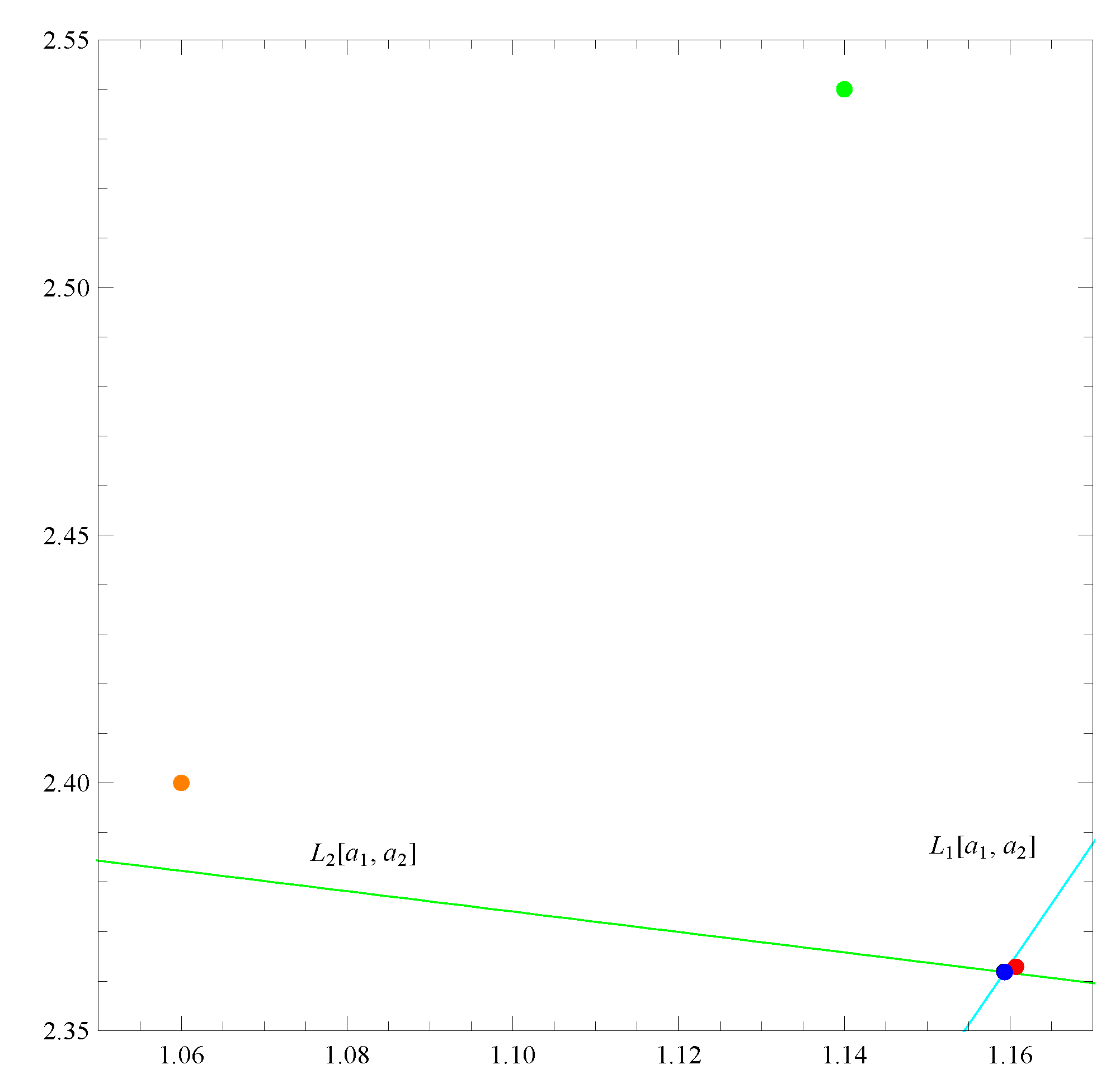
4] fail as the function is non-differentiable. Moreover, we have included a figure that shows the iterations of the algorithm.
Now, we choose
which is represented as orange and green dots, respectively, in
Figure 1. For Equation (5) in Theorem 1, we can obtain the following parameters:
. In addition,
are represented as red and black dots, respectively, in
Figure 1. Since all the iterations are not visible in
Figure 1, hence, we have magnified the graph to represent the approximate root of Equation (5) in
Figure 2. In
Figure 2, the blue dot represents the approximate root of Equation (5). In this case, the solution of Equation (5) is satisfied, which confirms that the unique solution of
exists in
. As a solution of Equation (1), we acquire the vector
after the second iteration.