Abstract
In this paper, we introduce a new class of Bregman generalized -nonexpansive mappings in terms of the Bregman distance. We establish several weak and strong convergence theorems of the Ishikawa and Noor iterative schemes for Bregman generalized -nonexpansive mappings in Banach spaces. A numerical example is given to illustrate the main results of fixed point approximation using Halpern’s algorithm.
Keywords:
fixed point; Bregman distance; Bregman function; Bregman–Opial property; generalized α-nonexpansive mapping MSC:
47H09; 47H10; 58C30
1. Introduction
In 1967, Bregman [1] discovered an effective technique using the so-called Bregman distance function in the process of designing and analyzing feasibility and optimization algorithms. This opened a growing area of research in which Bregman’s technique was applied in various ways in order to design and analyze some algorithms for solving not only feasibility and optimization problems, but also algorithms for solving variational inequality problems, equilibrium problems, and fixed point problems for nonlinear mappings (see [2,3,4]).
In recent years, several authors have been constructing algorithms for finding fixed points of nonlinear mappings by using the Bregman distance and the Bregman projection (see [5,6] and the reference therein). In 2003, Bauschke et al. [7,8] first introduced the class of Bregman firmly nonexpansive mappings which is a generalization of the classical firmly nonexpansive mappings. A few years ago, Reich [9] studied the class of Bregman strongly nonexpansive mappings and showed the existence of their common fixed points.
Motivated by the aforementioned results, we investigate the new class of Bregman generalized -nonexpansive mappings. We prove the existence of fixed points for such mappings under some conditions, and establish weak and strong convergence theorems regarding those fixed points. This is achieved by utilizing the Ishikawa and Noor iterative schemes, as well as Halpern’s algorithm to generate a convergent sequence with desired properties.
Throughout this paper, we assume that E is a real Banach space with the norm and the dual space . We denote the value of at by If is a sequence in we denote the strong convergence and the weak convergence of to a point by and respectively.
Let C be a nonempty subset of E and be a mapping. Then, a point is called a fixed point of T if and the set of all fixed points of T is denoted by A mapping is said to be:
- nonexpansive if
- quasi-nonexpansive if and
- Suzuki-type generalized nonexpansive [10] if
- α-nonexpansive, where , if
- generalized α-nonexpansive [11], where , if
Let C be a nonempty subset of a Banach space E and be a nonexpansive mapping. For any ,
- The Ishikawa iteration [12] is given bywhere and are sequences in with some appropriate conditions.
- The Noor iteration [13] is given bywhere , and are the sequences in with some appropriate conditions.
A Banach space E is said to satisfy Opial’s property if, for any sequence in E that converges weakly to we have
Opial’s property is a powerful tool that can be utilized to derive a weak or strong convergence of some iterative sequences [14]. In fact, since every weakly convergent sequence is necessarily bounded, we have and are finite.
Note that Opial’s property is satisfied in Banach spaces for , but not in spaces for and .
Next, we recall the definition of a Bregman distance which is not a distance in the usual sense. Let E be a Banach space and be a strictly convex and Gâteaux differentiable function. Let be defined by
Then, we define The Bregman distance [15] between x and y to be . In general, is not symmetric and does not satisfy the triangle inequality. Clearly, we have , but may not imply , for instance, when f is a linear function on Moreover, since f is convex, it is clear that for all
Let be a strictly convex and Gâteaux differentiable function and be nonempty. A mapping is said to be:
- Bregman nonexpansive if
- Bregman quasi-nonexpansive if and
- Bregman skew quasi-nonexpansive if and
- Bregman nonspreading if
Working with a Bregman distance with respect to f, the following Opial-like inequality holds [16]: for any Banach space E and sequence in E, we have
whenever (see Lemma 4 for details). This is called the Bregman–Opial property.
Inspired by the property, we propose a new class of Bregman generalized α-nonexpansive mappings by using the Bregman distance as follows:
For any , a mapping is said to be Bregman generalized α-nonexpansive if
Let us give an example of a Bregman generalized -nonexpansive mapping where .
Example 1.
Let be a mapping defined by The associated Bregman distance is given by
Now, we define a mapping by
It is easy to verify that . While T is not a generalized α-nonexpansive mapping, it is indeed a Bregman generalized α-nonexpansive mapping with respect to in the sense of the equation (5). Indeed, define a mapping by
where
Then, we have
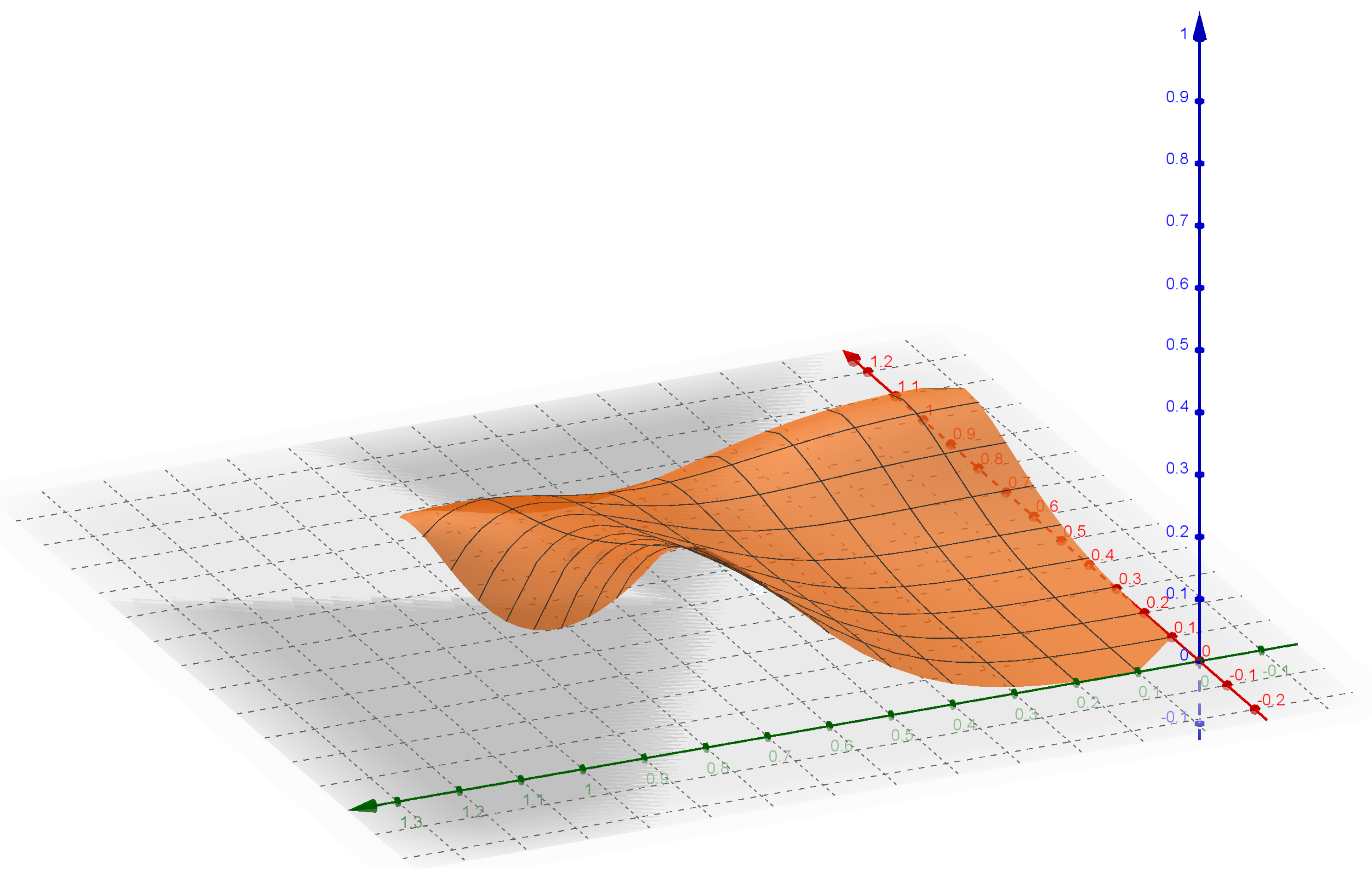
If we take , then we can verify that for all as shown in Figure 1. Hence, T is a Bregman generalized α-nonexpansive mapping.
Figure 1.
Plotting of for all and .
Our paper is organized as follows: in Section 2, we state several definitions and known results about Banach space and Bregman distance. In Section 3, we apply the Bregman–Opial property to present some fixed point theorems and we prove some weak and strong convergence theorems for Bregman generalized -nonexpansive mappings in Banach spaces. In Section 4, we give some numerical examples to illustrate the main results, which extend and generalize the results of Suzuki [10], Pant et al. [11] and Naraghirad et al. [17].
2. Preliminaries
In this section, we introduce necessary definitions and results to be used later on.
Let .
- A Banach space E is said to be strictly convex if whenever and .
- The space E is also said to be uniformly convex if, for all there exists such that and imply .
- A Banach space E is said to be smooth ifexists for all .
Note that the following are well known:
- (1)
- Every uniformly convex Banach space is strictly convex and reflexive.
- (2)
- A Banach space E is uniformly convex if and only if is uniformly smooth.
- (3)
- If E is reflexive, then E is strictly convex if and only if is smooth (see, for instance, Takahashi [18] for more details).
Let E be a smooth Banach space and let for all . Then, it follows that for all , where J is the normalized duality mapping from E into Hence, ([19]), where is defined as follows:
If E is a Hilbert space, the Equation (7) reduces to
A function is said to be proper if the It is also said to be lower semi-continuous if the set is closed for all The function f is said to be convex if
It is also said to be strictly convex if the strict inequality holds in the inequality (8) for all with and
In the sequel, we shall denote by the class of proper lower semi-continuous convex functions on E.
For each , the subdifferential of f is defined by
Rockafellar’s theorem [20,21] ensures that is maximal monotone. If and is a continuous convex function, then For each , the (Fenchel) conjugate function of f is defined by
It is well known that
and is equivalent to
We also know that, if , then be a proper lower semi-continuous convex function (see Phelps [22] for more details on convex analysis).
In the sequel, we shall denote by the class of proper lower semi-continuous convex function on .
Let be a convex function.
- For any the gradient of f is defined to be the linear functional in such that
- The function f is said to be Gâteaux differentiable at x if for all . In this case, we denote by .
- The function f is also said to be Fréchet differentiable at x if, for all there exists such that implies (see [6])
- A convex function is said to be Gâteaux differentiable on E (Fréchet differentiable on E, respectively) if it is Gâteaux differentiable everywhere (Fréchet differentiable everywhere, respectively).
We know that, if a continuous convex function is Gâteaux differentiable on E, then is norm-to- continuous on E. We also know that, if f is Fréchet differentiable on E, then is norm-to-norm continuous on E (see Butnariu and Iusem [15]).
Let be the closed unit sphere with the radius centered at in a Banach space
- A function is said to be strongly coercive if, for any sequence such that converges to ∞, we have
- It is also said to be bounded on bounded sets if is bounded for each Let be the unit sphere of
- A function is said to be uniformly convex on bounded sets [23] (pp. 203, 221) if for all , where is called the uniform convexity of f defined by
It is known that is a nondecreasing function. The function f is also said to be locally uniformly smooth on bounded sets ([23], pp. 207, 221) if the function defined by
satisfies
If is uniformly convex on bounded sets of E, then we have
for all in and
Let E be a Banach space and be a strictly convex and Gteaux differentiable function. By the Equation (3), the Bregman distance satisfies [24]
In particular, we have
The following definition is slightly different from that in Butnariu and Iusem [15] (p. 65) and Koshsaka [6]:
Definition 1.
Let E be a Banach space. Then, a function is said to be a Bregman function if the following conditions are satisfied:
- (a)
- f is continuous, strictly convex and Gâteaux differentiable;
- (b)
- the set is bounded for all and
The following lemma follows from Butnariu and Iusem [15] and Zǎlinscu [23]:
Lemma 1.
Let E be a reflexive Banach space and let be a strongly coercive Bregman function. Then, we have the following:
- 1.
- is one-to-one, onto and norm-to- continuous.
- 2.
- if and only if
- 3.
- is bounded for all y in E and
- 4.
- dom is Gâteaux differentiable function and
Let C be a nonempty closed convex subset of a reflexive Banach space Let be a strictly convex and Gâteaux differentiable function. Then, it follows from [25] that, for any and we have
The Bregman projection from E onto C is defined by for all It is well known that if and only if
It is also known that from E onto C has the following property:
For more details on Bregman projection , see Butnariu and Iusem [15].
Now, we have the following propositions (see Zǎlinscu [23] (pp. 222, 224)):
Proposition 1.
Let be convex. Consider the following statements:
- 1.
- f is bounded and uniformly smooth on bounded sets;
- 2.
- f is Fréchet differentiable on dom f and is uniformly continuous on bounded sets;
- 3.
- is strongly coercive and uniformly convex on bounded sets.
Then, we have Moreover, if f is strongly coercive, then we also have . In this case, is reflexive (also E is reflexive if E is a Banach space).
Proposition 2.
Let . Consider the following statements:
- 1.
- f is strongly coercive and uniformly convex on bounded sets;
- 2.
- is bounded and uniformly smooth on bounded sets;
- 3.
- is Fréchet differentiable on dom and is uniformly continuous on bounded sets.
Then, we have Moreover, if f is bounded on bounded sets then . In this case is reflexive (also E is reflexive if E is a Banach space).
The following result was first proved in Kohsaka and Takahashi [6] (see Lemma 3.1, p. 511):
Lemma 2.
Let E be a Banach space and let be a Gâteaux differentiable function, which is uniformly convex on bounded sets. Let and be bounded sequences in E and then we have
The following lemma is slightly different from that in Kohsaka and Takahashi [6] (see Lemmas 3.2 and 3.3, pp. 511, 512):
Lemma 3.
Let E be a reflexive Banach space, let be a strongly coercive Bregman function and V be the function defined by
The following assertions hold:
- 1.
- for all and
- 2.
- for all and
It also follows from the definition that V is convex in the second variable and
The following result was proved by Huang [16]:
Lemma 4.
Let E be a Banach space and be a strictly convex and Gâteaux differentiable function. Suppose that is a sequence in E such that for some Then,
for all y in the interior of with
Let C be a nonempty closed convex subset of a reflexive Banach space E. Let be a bounded sequence in E and be Gâteaux differentiable function. For any we set
- The Bregman asymptotic radius of relative to C is defined by
- The Bregman asymptotic center of relative to C is defined by
The following result was proved by Naraghirad [17]:
Proposition 3.
Let E be a reflexive Banach space and be strictly convex, Gâteaux differentiable function, bounded on bounded sets. Let C be a nonempty closed convex subset of If is a bounded sequence of C, then is a singleton.
Proof.
In view of the definition of Bregman asymptotic radius, we may assume that converges weakly to By Lemma 4, we conclude that □
Let S be a nonempty set and be the Banach space of all bounded real-valued functions on S with the supremum norm. Let E be a subspace of and be an element of Then, we denote by the value of at If for all sometimes will be denoted by When E contains constants, a linear functional on E is called a mean on E if (see, for instance, Takahashi [18] for more details).
Theorem 1.
Let E be a subspace of containing constants and let μ be a linear functional on Then, the following conditions are equivalent:
- 1.
- i.e., μ is a mean on
- 2.
- The inequalitieshold for each
Let be the Banach lattice of bounded real sequences with the supremum norm and be a linear continuous functional on . Let be a sequence in Then, sometimes we denote by the value
Theorem 2.
(The existence of Banach limit) There exists a linear continuous functional μ on such that and for each
Note that
- If and for each then
- If for each , then
Such a functional is called a Banach limit and the value of at is denoted by (see, for example [18].)
The following lemmas were proved by Reich and Sabach [26]:
Lemma 5.
Let E be a reflexive Banach space and let be strictly convex, continuous, strongly coercive, Gteaux differentiable function, and bounded on bounded sets. Let C be a nonempty, closed and convex subset of Let be a Bregman quasi-nonexpansive mapping. Then, is closed and convex.
The following result was proved by Mainge [27]:
Lemma 6.
Let be a sequence in with a subsequence such that for each Then, there exists another subsequence such that, for all (sufficiently large) number k, we have
In fact, we can set
Lemma 7. ([28])
Let be a sequence of nonnegative real numbers satisfying
where and satisfy the following conditions:
- (a)
- and or, equivalently,
- (b)
- or
Then, we have
3. The Main Results
3.1. Approximating Fixed Points
In this section, we obtain some fixed point theorem for a generalized -nonexpansive mapping with respect to the Bregman–Opial property.
Lemma 8.
Let be a strictly convex and Gâteaux differentiable function. Let C be a nonempty closed convex subset of a reflexive Banach space Let be a Bregman generalized α-nonexpansive mapping. Then, we have
Proof.
Proposition 4.
(Demiclosedness Principle) Let be a strictly convex, Gâteaux differentiable function and bounded on bounded sets function. Let C be a nonempty subset of a reflexive Banach space E and be a Bregman generalized α-nonexpansive mapping. If in C and , then we have Tz = z.
Proof.
Since converges weakly to z and both the sequences and are bounded. Since is uniformly norm-to-norm continuous on bounded subsets of E (see, for instance, [23]), we arrive at
In view of Lemma 2, we deduce that . Set
By Lemma 8, it follows that, for all ,
which implies that
Therefore, it follows from the Bregman–Opial-like property that This completes the proof. □
By Theorem 2, we can derive the following result, in which examples of the mapping T satisfying all the conditions can be found in Hussain [5].
Theorem 3.
Let be a strictly convex, continuous, strongly coercive, Gâteaux differentiable function, bounded on bounded sets and uniformly convex on bounded sets of Let C be a nonempty closed convex subset of a reflexive Banach space E and be a mapping. Let be a bounded sequence of C and μ be a mean on Suppose that
Then, T has a fixed point in
Corollary 1.
Let and T be given as above. If C is also bounded and is a Bregman generalized α-nonexpansive mapping, then T has a fixed point.
Proof.
Let be a Banach limit on and be such that is bounded. For each , we have
This implies that
Thus, we have
Therefore, it follows from Theorem 3 that . This completes the proof. □
3.2. Weak and Strong Convergence Theorems for Bregman Generalized -Nonexpansive Mappings
In this section, we prove some weak and strong convergence theorems concerning Bregman generalized -nonexpansive mappings in a reflexive Banach space. Naraghirad [17] proves the following lemma.
Lemma 9.
Let be a strictly convex and Gâteaux differentiable function. Let C be a nonempty closed convex subset of a reflexive Banach space E and be a Bregman skew quasi-nonexpansive mapping with Let and be the sequences defined by the Ishikawa iteration:
where and satisfy the following control conditions:
- (a)
- for all
- (b)
- (c)
Then, the following assertions hold:
- 1.
- for all and
- 2.
- exists for any
Proof.
2. Since for each is a bounded and nonincreasing sequence for all Thus, we have exists for any This completes the proof. □
Theorem 4.
Let be a strictly convex, Gâteaux differentiable function, bounded on bounded sets and uniformly convex on bounded sets of Let C be a nonempty closed convex subset of a reflexive Banach space E and be a Bregman generalized α-nonexpansive and Bregman skew quasi-nonexpansive mapping. Let and be the sequences in and be the sequence defined by the Ishikawa iteration with . Assume that Then, we have the following:
- 1.
- If is bounded and then
- 2.
- If , then is bounded.
Proof.
1. By Corollary 1, we see that the fixed point set of T is nonempty. Assume that is bounded and Consequently, there is a bounded subsequence of such that Since is uniformly norm-to-norm continuous on bounded sets of E (see, for example, [23]), we have
In view of Proposition 3, we conclude that for some z in Let
It follows from Lemma 4 that
for each This implies
From the Bregman–Opial-like property, we obtain .
2. Let and let . It follows from Lemma 9 that exists and hence is bounded. This implies that the sequence is bounded too. This completes the proof. □
Theorem 5.
Let be a uniformly convex, Gâteaux differentiable function and bounded subset on bounded sets of Let C be a nonempty closed convex subset of a reflexive Banach space Let be a Bregman generalized α-nonexpansive and Bregman skew quasi-nonexpansive mapping with Let and be the sequences in and be the sequence with defined by the Ishikawa iteration. Then, the sequence converges weakly to a fixed point of
Proof.
By Corollary 1, we see that the fixed point set of T is nonempty. It follows from Theorem 4 that is bounded and Since E is reflexive, there exists a subsequence of such that as By Proposition 4, we have
Now, we claim that as If not, then there exists a subsequence of such that converges weakly to a point with In view of Proposition 4 again, we conclude that By Lemma 9, exists for all Thus, it follows from the Bregman–Opial-like property that
which is a contradiction. Thus, we have and the desired assertion follows. This completes the proof. □
Theorem 6.
Let be a uniformly convex, Gâteaux differentiable function bounded subset on bounded sets of Let C be a nonempty closed convex subset of a reflexive Banach space Let the Bregman generalized α-nonexpansive and Bregman skew quasi-nonexpansive mapping. Let , be the sequences in and be the sequence with defined by the Ishikawa iteration. Then, the sequence converges strongly to a fixed point z of
Proof.
By Corollary 1, we see that the fixed point set of T is nonempty. In view of Theorem 4, it follows that is bounded and By the compactness of C, there exists a subsequence of such that converges strongly to a point . In view of Lemma 2, we deduce that .
Now, we assume that and, in particular, is bounded. Since is uniformly norm-to-norm continuous on bounded sets of E (see, for example, [23]), we have
Let
In view of Lemma 8, we obtain
for all . It follows that , and thus we have In view of Lemmas 2 and 9, we conclude that Therefore, z is the strong limit of the sequence This completes the proof. □
3.3. Bregman Noor’s Type Iteration for Bregman Generalized -Nonexpansive Mappings
In this section, we propose the following Bregman Noor type iteration for Bregman generalized -nonexpansive mappings.
Let E be a reflexive Banach space and C be a nonempty closed convex subset of Let be a strictly convex and Gâteaux differentiable function. Let be a Bregman generalized -nonexpansive mapping with the fixed point set . Let and be three sequences defined by
where , and are the sequences in
Lemma 10.
Let be a strongly coercive Bregman function. Let C be a nonempty closed convex subset of a reflexive Banach space Let be the Bregman quasi-nonexpansive mapping. Let , and be the sequences defined by the equation (16) and , and be the sequences in Then, the following assertions hold:
- 1.
- for all and .
- 2.
- exists for any
Proof.
Theorem 7.
Let be a strongly coercive Bregman function that is bounded on bounded sets and locally uniformly convex and locally uniformly smooth on Let C be a nonempty, closed and convex subset of a reflexive Banach space Let be the Bregman generalized α-nonexpansive mapping. Let and be the sequences in satisfying the following control condition:
Then, the following are equivalent:
- 1.
- There exists a bounded sequence generated by equations (16) such that
- 2.
- The fixed point set
Proof.
The implication follows similarly as in the first part of the proof of Theorem 4.
For the implication , we assume that . The boundedness of the sequences , and follows from Lemma 10 and Definition 1. Since T is a Bregman quasi-nonexpansive mapping, it follows that, for any , we have
This, together with Definition 1 and the boundedness of implies that is bounded. The function f is bounded on bounded sets of E and so is also bounded on bounded sets of (see, for example, [[15], Proposition 1.1.11] for more details). This implies that the sequences , and are bounded in In view of Proposition 1, it follows that and is strongly coercive and uniformly convex on bounded sets of Let and let be the gauge of uniform convexity of the (Fenchel) conjugate function
Claim. For any and we have
Let For each it follows from the definition of the Bregman distance (3), Lemma 3, the inequality (10) and the equation (16) that
In view of Lemma 3 and the inequality (18), we obtain
Thus, it follows from Lemma 3 and the inequality (18) that
and so
Since converges, together with the control condition in equation (17), we have
Since is uniformly norm-to-norm continuous on bounded sets of (see [23]), we arrive at
This completes the proof. □
Theorem 8.
Let be a strongly coercive Bregman function which is bounded on bounded sets, locally uniformly convex and locally uniformly smooth on Let C be a nonempty closed convex subset of a reflexive Banach space Let be the Bregman generalized α-nonexpansive mapping with Let and be the sequences in satisfying the following control condition:
Let be iteratively generated by the Equation (16). Then, there exists a subsequence of which converges weakly to a fixed point of T.
Proof.
It follows from Theorem 7 that is bounded and Since E is reflexive, then there exists a subsequence of such that as Thus, in view of Proposition 4, we conclude that and the desired conclusion follows. This completes the proof. □
The construction of fixed points of nonexpansive mappings via Halpern’s algorithm [29] has been extensively investigated recently in the current literature (see, for example, [30] and the references therein). Numerous results have been proved on Halpern’s iterations for nonexpansive mappings in Hilbert and Banach spaces (see, for example, [10,31,32]).
Theorem 9.
Let be a strongly coercive Bregman function which is bounded on bounded sets, locally uniformly convex and locally uniformly smooth on Let C be a nonempty closed convex subset of a reflexive Banach space Let be the Bregman generalized α-nonexpansive mapping with Let and be the sequences in satisfying the following control conditions:
- (a)
- (b)
- (c)
Let be chosen arbitrarily and let be the sequence generated by
Then, converges strongly to .
Proof.
We divide the proof into three steps. In view of Lemma 5, we conclude that is closed and convex. Set
Step 1. Now, we prove that , and are the bounded sequences in In fact, we first show that is bounded. Let be fixed. In view of Lemma 3 and the Equation (21), we have
In addition, we have
This, together with the Equation (16), implies that
Thus, by induction, we obtain
This implies that the sequence is bounded:
In view of Definition 1, we deduce that the sequence is bounded. Since T is the Bregman quasi-nonexpansive mapping from C into itself, we conclude that
This, together with Definition 1 and the boundedness of , implies that is bounded. The function f is bounded on bounded sets of E and so is also bounded on bounded sets of (see, for example, [[15], Proposition 1.1.11] for more details). This, together with Step 1, implies that the sequences , , and are bounded in . In view of Proposition 1, it follows that and is strongly coercive and uniformly convex on bounded sets of Let and be the gauge of the uniform convexity of the (Fenchel) conjugate function
Step 2. Next, we prove that
For each , in view of the definition of the Bregman distance (3), Lemma 3 and Lemma (10), we obtain
In addition, we have
In view of Lemma 3 and the inequality (25), we obtain
Let
It follows from the inequality (26) that
Let
Then, for each In view of Lemma 3 and the inequality (25), we obtain
Step 3. Next, we show that as
Case 1. If there exists such that is nonincreasing, then is convergent. Thus, we have as . This, together with the inequality (27) and the conditions (a) and (c), implies that
Therefore, from the property of , it follows that
Since (Lemma 1) is uniformly norm-to-norm continuous on bounded sets of (see, for example, [23]), we arrive at
On the other hand, we have
This, together with Lemma 2 and the Equation (30), implies that
Similarly, we have
as . In view of Lemma 2 and the Equation (30), we conclude that
Since is bounded, together with the inequality (13), we can assume that there exists a subsequence of such that (Proposition 4) and
Thus, it follows that
The desired result follows from Lemmas 2 and 7 and the inequality (28).
Case 2. Suppose that there exists a subsequence of such that
By Lemma 6, there exists a non-decreasing sequence of positive integers with such that
This, together with the inequality (27), implies that
Then, by the conditions (a) and (c), we get
By the same argument as in Case 1, we arrive at
It follows from the inequality (28) that
Since it follows that
In particular, since we obtain
In view of the inequality (31), we deduce that
This, together with the inequality (32), implies
On the other hand, we have
This ensures that as by Lemma 2. This completes the proof. □
4. Numerical Examples
In this section, we illustrate a direct application of Theorem 9 on a typical example on a real line.
Example 2.
Let the mappings f and T be given in Example 1 and set
Consider the following:
Let initial values and Then, we use iteration from the Equation (21) to generate the sequences and as follows:
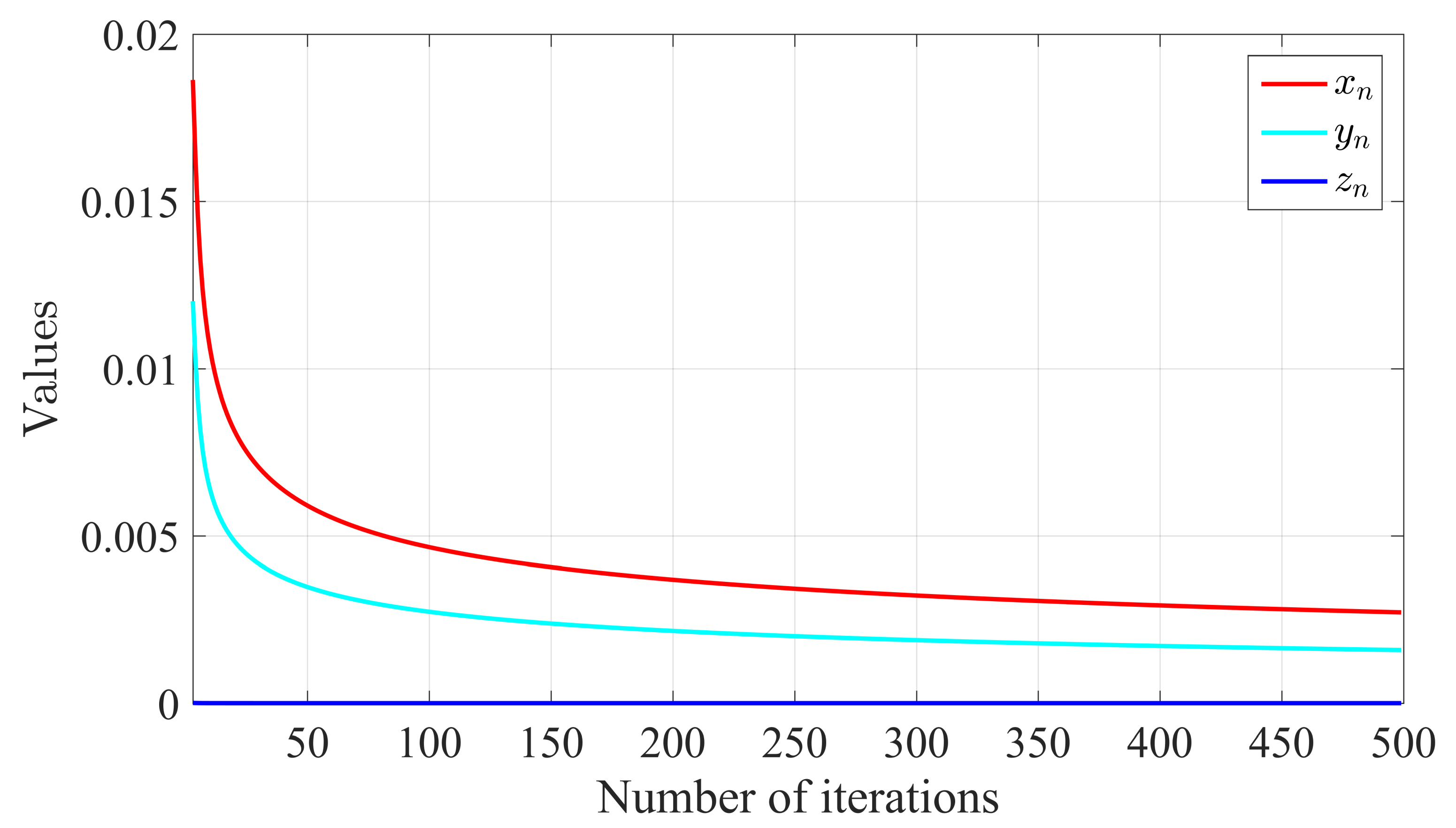
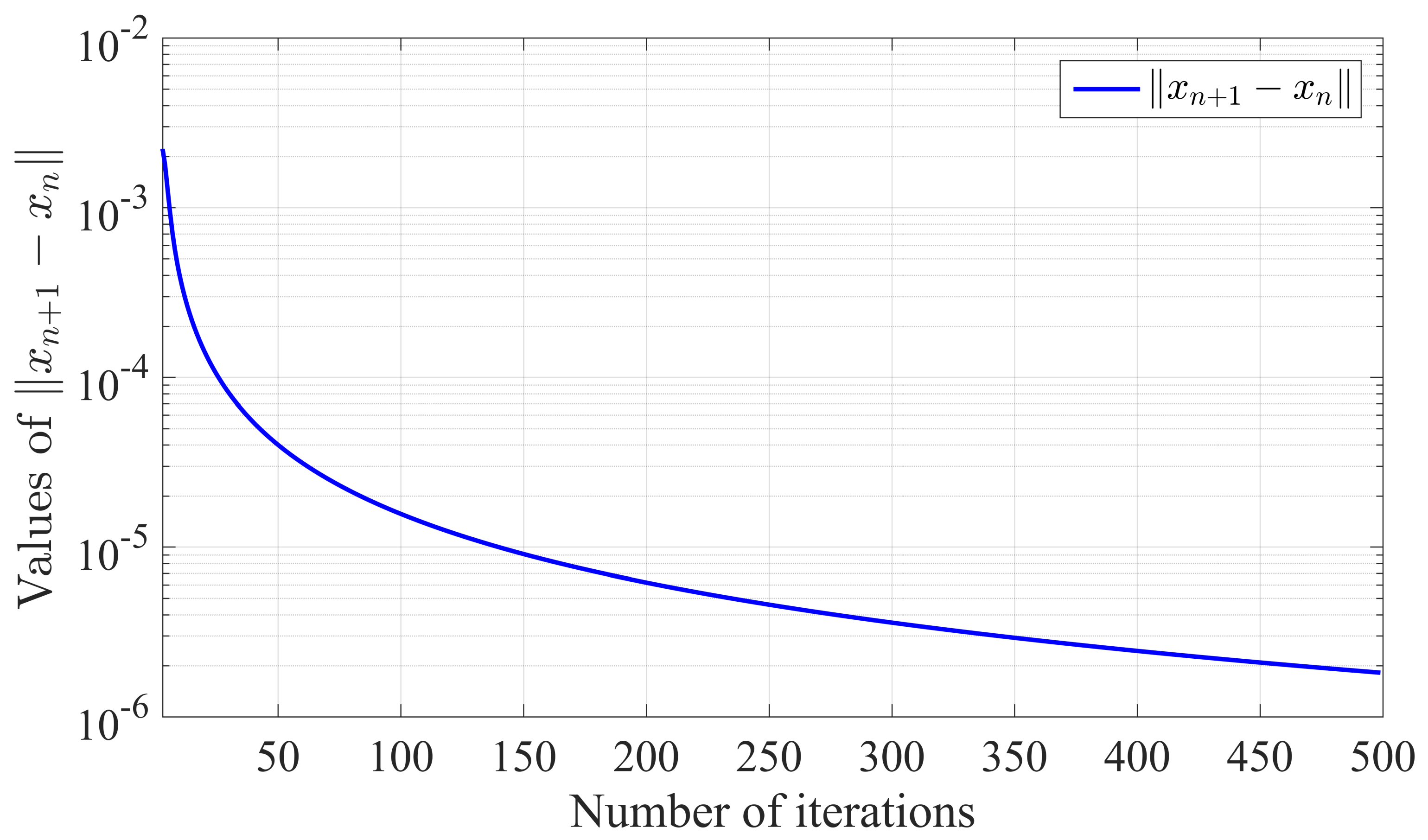
We have the following Table 1 and Figure 2 and Figure 3 which show that and converge to .
Table 1.
Values of , and .
Figure 2.
Plotting of and converging to 0 as .
Figure 3.
Plotting of .
5. Conclusions
First, we have established the new class of Bregman generalized -nonexpansive mappings. Second, we have obtained new theorems on fixed points and weak and strong convergence using multi-step iterations and Bregman generalized -nonexpansive mappings. Finally, we have analysed computational procedures based on Ishikawa and Noor iterations with a numerical simulation to support the results.
Author Contributions
Conceptualization, K.M. and P.K.; methodology, K.M. and P.K.; validation, K.M., Y.J.C. and S.D.; formal analysis, K.M. and Y.J.C.; investigation, K.M.; resources, K.M.; data curation, K.M.; writing—original draft preparation, K.M.; writing—review and editing, K.M., Y.J.C.and S.E.; supervision, P.K. and Y.J.C.
Funding
This research was funded by Rajamangala University of Technology Phra Nakhon (RMUTP) Research Scholarship.
Acknowledgments
The authors would appreciatively like to thank the two reviewers for their careful readings and suggestions which led to improving this research. The authors acknowledge the financial support provided by the Center of Excellence in Theoretical and Computational Science (TaCS-CoE), KMUTT. Moreover, the first author was supported by Rajamangala University of Technology Phra Nakhon (RMUTP) Research Scholarship.
Conflicts of Interest
The authors declare no conflict of interest.
References
- Bregman, L.M. The relaxation method of finding the common point of convex sets and its application to the solution of problems in convex programming. USSR Comput. Math. Math. Phys. 1967, 7, 200–217. [Google Scholar] [CrossRef]
- Bauschke, H.; Borwein, J. Legendre functions and the method of random Bregman projections. J. Convex Anal. 1997, 4, 27–67. [Google Scholar]
- Butnariu, D.; Resmerita, E. Bregman distances, totally convex functions and a method for solving operator equations in Banach spaces. Abstr. Appl. Anal. 2006, 2006, 1–39. [Google Scholar] [CrossRef]
- Suantai, S.; Cho, Y.; Cholamjiak, P. Halpern’s iteration for Bregman strongly nonexpansive mappings in reflexive Banach spaces. Comput. Math. Appl. 2012, 64, 489–499. [Google Scholar] [CrossRef]
- Hussain, N.; Naraghirad, E.; Alotaibi, A. Existence of common fixed points using Bregman nonexpansive retracts and Bregman functions in Banach spaces. Fixed Point Theory Appl. 2013, 113, 1–19. [Google Scholar] [CrossRef]
- Kohsaka, F.; Takahashi, W. Proximal point algorithms with Bregman functions in Banach spaces. J. Nonlinear Convex Anal. 2005, 6, 505–523. [Google Scholar]
- Bauschke, H.; Borwein, J.; Combettes, P. Bregman monotone optimization algorithms. SIAM J. Control Optim. 2003, 42, 596–636. [Google Scholar] [CrossRef]
- Bauschke, H.; Combettes, P. Construction of best Bregman approximations in reflexive Banach spaces. Proc. Am. Math. Soc. 2003, 131, 3757–3766. [Google Scholar] [CrossRef]
- Reich, S.; Sabach, S. Two strong convergence theorems for Bregman strongly nonexpansive operators in reflexive Banach spaces. Nonlinear Anal. 2010, 73, 122–135. [Google Scholar] [CrossRef]
- Suzuki, T. Fixed point theorems and convergence theorems for some generalized nonexpansive mappings. J. Math. Anal. Appl. 2008, 340, 1088–1095. [Google Scholar] [CrossRef]
- Pant, R.; Shukla, R. Approximating fixed points of generalized α-nonexpansive mapping in Banach space. Numer. Funct. Anal. Optim. 2017, 38, 248–266. [Google Scholar] [CrossRef]
- Ishikawa, S. Fixed points and iteration of a nonexpansive mapping in a Banach space. Proc. Am. Math. Soc. 1976, 59, 65–71. [Google Scholar] [CrossRef]
- Noor, M.A. New approximation schemes for general variational inequalities. J. Math. Anal. Appl. 2000, 251, 217–229. [Google Scholar] [CrossRef]
- Opial, Z. Weak convergence of the sequence of successive approximations for nonexpansive mappings. Bull. Am. Math. Soc. 1967, 73, 595–597. [Google Scholar] [CrossRef]
- Butnariu, D.; Iusem, A.N. Totally Convex Functions for Fixed Points Computation and Infinite Dimensional Optimization; Pardalos, P.M., Hearn, D., Eds.; Springer Science+Business Media: Dordrecht, The Netherlands, 2000. [Google Scholar]
- Huang, Y.Y.; Jeng, J.C.; Kuo, T.V.; Hong, C.C. Fixed point and weak convergence theorems for point-dependent λ-hybrid mappings in Banach spaces. Fixed Point Theory Appl. 2011, 2011, 105. [Google Scholar] [CrossRef]
- Naraghirad, E.; Wong, N.C.; Yao, J. Applications of Bregman–Opial property to Bregman nonspreading mappings in Banach spaces. Abstr. Appl. Anal. 2014, 1, 1–14. [Google Scholar] [CrossRef]
- Takahashi, W. Nonlinear Functional Analysis, Fixed Point Theory and its Applications; Yokahama Publishers: Yokahama, Japan, 2000. [Google Scholar]
- Pang, C.; Naraghirad, E.; Wen, C. Weak convergence theorems for Bregman relatively nonexpansive mappings in Banach Spaces. J. Appl. Math. 2014, 2014, 1–9. [Google Scholar] [CrossRef]
- Rockafellar, R.T. Characterization of subdifferentials of convex functions. Pac. J. Math. 1966, 17, 497–510. [Google Scholar] [CrossRef]
- Rockafellar, R.T. On the maximal monotonicity of subdifferential mappings. Pac. J. Math. 1970, 33, 209–216. [Google Scholar] [CrossRef]
- Phelps, R. Convex Functions, Monotone Operators, and Differentiability, 2nd ed.; Springer: Berlin, Germany, 1993; Volume 1364. [Google Scholar]
- Zǎlinescu, C. Convex Analysis in General Vector Spaces; World Scientific Publishing Co. Inc.: River Edge, NJ, USA, 2002. [Google Scholar]
- Chen, G.; Teboulle, M. Convergence analysis of a proximal-like minimization algorithm using Bregman functions. SIAM J. Control Optim. 1993, 3, 538–543. [Google Scholar] [CrossRef]
- Naraghirad, E.; Yao, J. Bregman weak relatively nonexpansive mappings in Banach spaces. Fixed Point Theory Appl. 2013, 141, 1–43. [Google Scholar] [CrossRef]
- Reich, S.; Sabach, S. Existence and approximation of fixed points of Bregman firmly nonexpansive mappings in reflexive Banach spaces. In Fixed-Point Algorithms for Inverse Problems in Science and Engineering; Springer: New York, NY, USA, 2010; pp. 299–314. [Google Scholar]
- Maingé, P.E. Strong convergence of projected subgradient methods for nonsmooth and nonstrictly convex minimization. Set-Valued Anal. 2008, 16, 899–912. [Google Scholar] [CrossRef]
- Xu, H.K.; Kim, T.K. Convergence of hybrid steepest-descent methods for variational inequalities. J. Optim. Theory Appl. 2003, 119, 185–201. [Google Scholar] [CrossRef]
- Halpern, B. Fixed points of non-expanding maps. Bull. Am. Math. Soc. 1993, 73, 957–961. [Google Scholar] [CrossRef]
- Reich, S. Weak convergence theorems for nonexpansive mappings in Banch spaces. J. Math. Anal. Appl. 1979, 67, 274–276. [Google Scholar] [CrossRef]
- Takahashi, W.; Kim, G.E. Approximating fixed points of nonexpansive mappings in Banach spaces. Math. Jpn. 1998, 48, 1–9. [Google Scholar]
- Nilsrakoo, W.; Saejung, S. Strong convergence theorems by Halpern-Mann iterations for relatively nonexpansive mappings in Banach spaces. Appl. Math. Comput. 2011, 217, 6577–6586. [Google Scholar] [CrossRef]
© 2019 by the authors. Licensee MDPI, Basel, Switzerland. This article is an open access article distributed under the terms and conditions of the Creative Commons Attribution (CC BY) license (http://creativecommons.org/licenses/by/4.0/).