Article

The Strong Chromatic Index of Complete Halin Graphs

Department of Mathematics, China Jiliang University, Hangzhou 310018, China
*
Author to whom correspondence should be addressed.
Mathematics 2026, 14(9), 1562; https://doi.org/10.3390/math14091562
Submission received: 2 April 2026 / Revised: 26 April 2026 / Accepted: 30 April 2026 / Published: 6 May 2026

Abstract

The strong edge coloring of a graph G is an assignment of colors to the edges of G such that two distinct edges are colored differently if they are incident to a common edge or share an endpoint. The strong chromatic index of a graph G, denoted by χ s ( G ) , is the minimum number of colors needed for a strong edge coloring of G. In this paper, we prove the following two theorems: (1) If G = T C is a complete Halin graph with Δ = 4 that contains adjacent vertices of maximum degree, then χ s ( G ) χ s ( T ) + 1 = 2 Δ . In particular, when T is a regular tree, χ s ( G ) = χ s ( T ) + 1 = 2 Δ . (2) If G = T C is a complete Halin graph with Δ 5 and G W n , then χ s ( G ) = χ s ( T ) = 2 Δ 1 when T is a regular tree. We extend the strong edge coloring results for complete cubic regular Halin graphs studied by W.C. Shiu and W.K. Tam, and improve the upper bound on the strong chromatic index of general Halin graphs established by Wei Yang and Baoyindureng Wu.

1. Introduction

All graphs discussed in this work are assumed to be simple and finite. We use Δ to represent the maximum degree of a graph G. Undefined terms follow the conventions in [1].
Let k = { 1 , 2 , , k } for a positive integer k. A strong k-edge coloring of a graph G = ( V , E ) is a function c : E k where any two edges sharing a vertex or adjacent to the same edge receive different colors. We denote the strong chromatic index of G by χ s ( G ) , which is the smallest k such that a strong k-edge coloring exists.
Strong edge coloring was first introduced by Fouquet and Jolivet [2]. In 1988, Erdös and Nesětřil [3] proposed the following conjecture.
Conjecture 1 ([3]). For any simple graph G,
χ s ( G ) 5 4 Δ 2 if Δ is even 5 4 Δ 2 1 2 Δ + 1 4 if Δ is odd
The above conjecture is still open. For each edge u v in G, we define σ ( u v ) = d ( u ) + d ( v ) 1 and let σ ( G ) be the maximum of σ ( e ) over all e E ( G ) . It is known and easy to verify that for a tree, we have χ s ( T ) = σ ( T ) . It is easy to see that σ ( G ) χ s ( G ) 2 Δ 2 2 Δ + 1 in [4]. Hence, Conjecture 1 holds for Δ 2 . Conjecture 1 was proved to be true for Δ = 3 by Andersen [5] and, independently, by Horák et al. [6]. Very recently, this was strengthened by Chen, Huang, Yu, Zhou [7]. They proved that χ s ( T ) 10 for any graph with d ( u ) + d ( v ) 6 for each edge u v E ( G ) .
For Δ = 4 , while Conjecture 1 asserts that χ s ( G ) 20 , Horák [8] showed that χ s ( G ) 23 and Cranston [9] proved that χ s ( G ) 22 and recently Huang, Santana and Yu [10] improved this to 21. As an extension of the previous results, Chen, Chen, Zhao, and Zhou [11] proved that χ s ( G ) 21 for any graph G with d ( u ) + d ( v ) 8 for each edge u v E ( G ) .
For graphs with large enough Δ , Molloy and Reed in [12] using probabilistic techniques proved that χ s ( G ) 1.998 Δ 2 , which was improved to 1.93 Δ 2 by Bruhn and Joos [13], and further improved to 1.772 Δ 2 by Hurley, de Joannis de Verclos and Kang [14].
A Halin graph is a plane graph G constructed as follows. Let T be a tree with at least four vertices, called a characteristic tree of G. All vertices of T are either of degree 1, called leaves, or of degree at least 3. We draw T on the plane. Let C be a cycle, called an adjoint cycle of G, connecting all leaves of T in such a way that C forms the boundary of the unbound face. We usually write G = T C to reveal the characteristic tree. If all its leaves are at the same distance from the root vertex, we call the Halin graph G l = T C a complete Halin graph, where l represents the distance from the leaf vertex to the root vertex. If all internal vertices of T have the same degree, we call T a regular tree. In this case, we refer to T as a complete regular tree and call the Halin graph G l = T C a complete regular Halin graph. In particular, if l = 1 , it is called a wheel graph that has only one internal vertex u. A wheel graph with d ( u ) = n is denoted as W n .
Let G l = T C be a complete Halin graph consisting of a complete regular tree T of height l and maximum degree Δ , and a cycle C connecting all its leaves. We label the vertices of T as follows: the root is denoted by u; its Δ children are labeled u i ( 1 i Δ ); and for any vertex at depth k ( 1 k < h ) labeled u i 1 , i 2 , , i k , its Δ 1 children are labeled u i 1 , i 2 , , i k , j ( 1 j Δ 1 ). Finally, all leaf nodes at depth l are connected sequentially to form the outer cycle C.
For each e E ( G ) , let L ( e ) be the list of available colors of e, let L = { L ( e ) : e E ( G ) } , and let ϕ be a partial coloring of G. For e E ( G ) , let C ϕ ( e ) denote the set of colors seen by e, and let A ϕ ( e ) = L ( e ) C ϕ ( e ) denote the set of available colors.
In 2012, Hsin-Hao Lai et al. [15] proved the following conclusion.
Theorem 1
([15]). If a Halin graph G = T C is different from a certain necklace N e 2 and any wheel W n , n 0 ( mod 3 ) , then χ s ( G ) χ s ( T ) + 3 .
Theorem 2
([15]). For the wheel W n , we have
χ s ( W n ) = n + 3 if n 0 ( mod 3 ) n + 5 if n = 5 n + 4 otherwise
Theorem 3
([15]). Let the characteristic tree T of a Halin graph G = T C be a double star and x , y be the two non-leaves of T. Suppose that d ( y ) max { d ( x ) , 4 } ; then
χ s ( G ) = χ s ( T ) + 2 if d ( x ) = 3 χ s ( T ) + 1 if d ( x ) 4
For a cubic Halin graph, Lih and Liu [16] improved the above bound as follows.
Theorem 4
([16]). If a cubic Halin graph G = T C is different from N e 2 and N e 4 , then χ s ( G ) 7 .
The exact values of χ s ( G ) for special families of cubic Halin graphs were determined by Shiu and Tam [17] and by Chang and Liu [18]. In [19], Hu, Lih and Liu established a result similar to Theorem for Halin graphs of maximum degree 4.
Theorem 5
([19]). Let G = T C be a Halin graph with maximum degree Δ = 4 , and let G W n ; then χ s ( G ) χ s ( T ) + 2 .
By Theorems 4 and 5, for a Halin graph G = T C with maximum degree at most 4 and G { W n , N e 2 , N e 4 } , we have χ s ( G ) χ s ( T ) + 2 . In 2021, Yang and Wu [20] extended Theorem 5 and provided the following theorem.
Theorem 6
([20]). If G = T C is a Halin graph other than a wheel W n , N e 2 , or N e 4 , then χ s ( G ) χ s ( T ) + 2 .
In 2009, W.C. Shiu and W.K. Tam [17] studied a complete cubic Halin graph and provided the following conclusions.
Theorem 7
([17]). If G l = T C is a complete cubic Halin graph, then
χ s ( G l ) = 7 if l = 2 6 otherwise
For h 1 , a cubic Halin graph N e h , called a necklace, was introduced in [21]. The characteristic tree T consists of the path v 0 , v 1 , , v h , v h + 1 and leaves v 1 , v 2 , , v h such that the unique neighbor of v i in T is v i for 1 i h and vertices v 0 , v 1 , v 2 , , v h , v h + 1 are connected in this order to form the adjoint cycle C h + 2 .
Theorem 8
([21]). If N e h is a necklace graph, suppose h 1 .
χ s ( N e h ) = 6 if h is odd 7 if h 6 and is even 8 if h = 4 9 if h = 2
In 2024, Yuan and Huang [22] conducted an in-depth investigation into the strong edge coloring of planar graphs with large girth, establishing the following results.
Theorem 9
([22]). If G is a planar graph with g 7 and Δ 5 , then χ s ( G ) 3 Δ 1 .
Theorem 10
([22]). If G is a planar graph without adjacent 7-cycles, with g 7 and Δ 4 , then χ s ( G ) 3 Δ 1 .
In this paper, we determine the exact strong chromatic index of complete Halin graphs with maximum degree Δ 4 when T is a regular tree. We demonstrate that this value is significantly lower than the general upper bound in Conjecture 1.

2. Preliminaries and Notation

Lemma 1
([23]). Let A 1 , , A n be n subsets of a set U. Then there is a set { a 1 , , a n } of distinct elements in U with a i A i for each i [ n ] if and only if for any integer k with 1 k n and every subcollection { A i 1 , , A i k } of subsets, we have | A i 1 A i k | k .
Lemma 2.
If G = T C is a complete Halin graph with Δ = 4 , where T is a regular tree, then χ s ( G ) χ s ( T ) + 1 = 2 Δ .
Proof. 
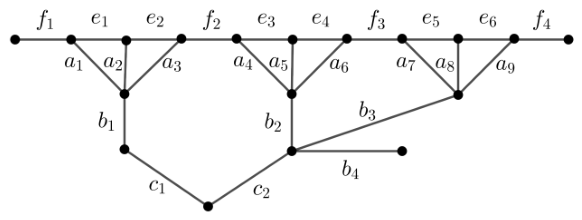
Through observation, it is easy to find that there exists a substructure H in G, as shown in Figure 1. The color set is defined as 7 . Let ϕ be a mapping from the color set 7 to E ( H ) . Now, we use seven colors to strongly edge color H.
Case 1: | { ϕ ( a 4 ) , ϕ ( a 5 ) , ϕ ( a 6 ) } { ϕ ( a 7 ) , ϕ ( a 8 ) , ϕ ( a 9 ) } | 2 .
In this case, | { ϕ ( a 4 ) , ϕ ( a 5 ) , ϕ ( a 6 ) } { ϕ ( a 7 ) , ϕ ( a 8 ) , ϕ ( a 9 ) } | 4 , so at most three colors remain available for coloring b 2 , b 3 , b 4 , and c 2 , which is a contradiction.
Case 2: | { ϕ ( a 4 ) , ϕ ( a 5 ) , ϕ ( a 6 ) } { ϕ ( a 7 ) , ϕ ( a 8 ) , ϕ ( a 9 ) } | = 3 .
In this case, the remaining four colors can be assigned to b 2 , b 3 , b 4 , and c 2 .
Case 2.1: If ϕ ( f 2 ) ϕ ( c 2 ) or ϕ ( f 3 ) ϕ ( c 2 ) , then at least one of the edges e 3 and e 4 cannot be colored, which is a contradiction.
Case 2.2: If ϕ ( f 2 ) = ϕ ( f 3 ) = ϕ ( c 2 ) , then by analogy with Case 2.1, the edges e 1 and e 2 can be colored only if ϕ ( f 1 ) = ϕ ( f 2 ) = ϕ ( c 1 ) . This implies ϕ ( f 2 ) = ϕ ( c 1 ) = ϕ ( c 2 ) , which contradicts ϕ ( c 1 ) ϕ ( c 2 ) .
From the above analysis, it follows that G cannot be strongly edge-colored with seven colors. This completes the proof. □

3. Main Lemmas and Results

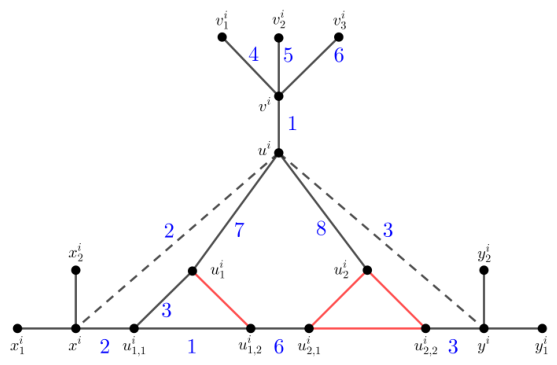
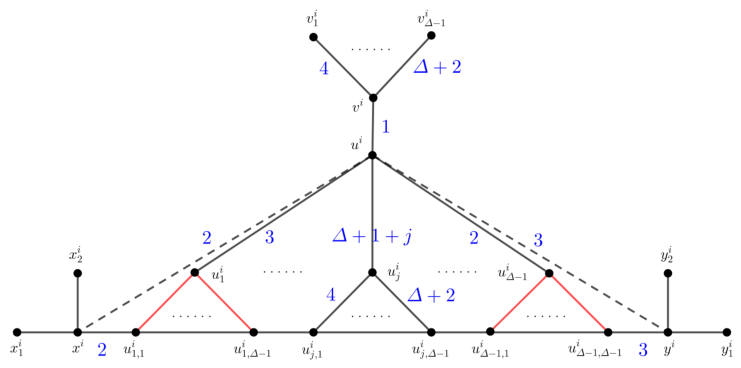
The index i represents the iteration level in the recursive generation of the graph sequence. Let T 0 i denote a complete regular tree of height 2, where the root is u i , the first-level vertices are u j i for j [ 1 , Δ 1 ] , and the second-level vertices are u j , k i for k [ 1 , Δ 1 ] , these are all leaves. Define F i as the graph obtained by connecting the leaves of T 0 i in sequence. For i 0 , let G i = T i C i be a complete Halin graph. For a vertex u i C i , let v i , x i , y i be its neighbors, where v i T i and x i , y i C i . First, delete the two edges u i x i and u i y i from G i . Then, attach F i to v i at u i , setting u 0 i = u i . Finally, add two new edges u 1 , 1 i x i and u Δ 1 , Δ 1 i y i to G i . The resulting graph after these three steps is denoted by G i + 1 . For better understanding, the red edges represent the temporarily uncolored edges in G i + 1 and the numbers indicate the assigned colors.
Lemma 3.
For i 0 , let G i be a complete Halin graph with maximum degree Δ = 4 , containing adjacent vertices of maximum degree. If χ s ( G i ) χ s ( T i ) + 1 = 2 Δ , then χ s ( G i + 1 ) χ s ( T i + 1 ) + 1 = 2 Δ .
Proof. 
By the induction hypothesis, we may assume there exists a strong edge coloring ϕ of the edge set E ( G i ) using the color set 8 . Without loss of generality, suppose ϕ ( u i v i ) = 1 , ϕ ( u i x i ) = 2 , ϕ ( u i y i ) = 3 , ϕ ( v i u 1 i ) = 4 , ϕ ( v i u 2 i ) = 5 , and ϕ ( v i u 3 i ) = 6 .
We now extend ϕ to the remaining edges of G i + 1 , thereby obtaining a strong edge coloring of G i + 1 using eight colors. First, assign ϕ ( x i u 1 , 1 i ) = ϕ ( u i x i ) = 2 and ϕ ( u 3 , 3 i y i ) = ϕ ( u 3 , 2 i y i ) = ϕ ( u 2 , 3 i y i ) = ϕ ( u 2 , 2 i y i ) = ϕ ( u i y i ) = 3 .
The following cases are all based on the assumption that d ( v i ) = 4 .
Case 1: d ( u i ) = 4
Case 1.1: d ( u 1 i ) = d ( u 2 i ) = d ( u 3 i ) = 4
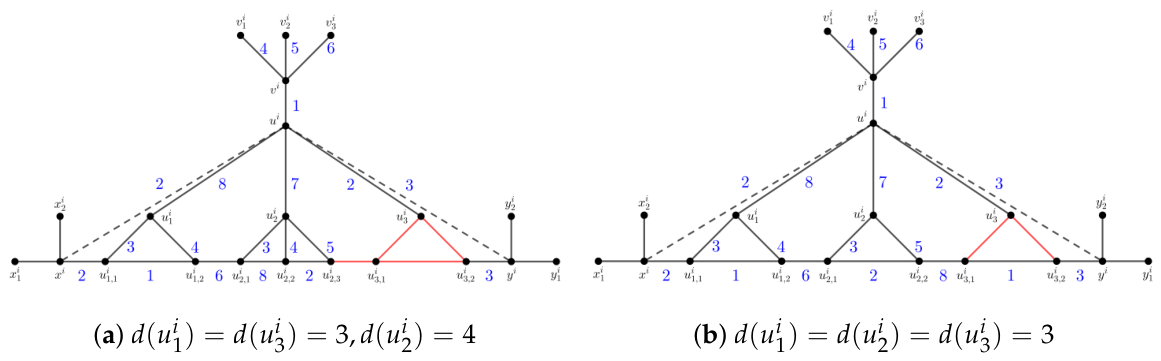
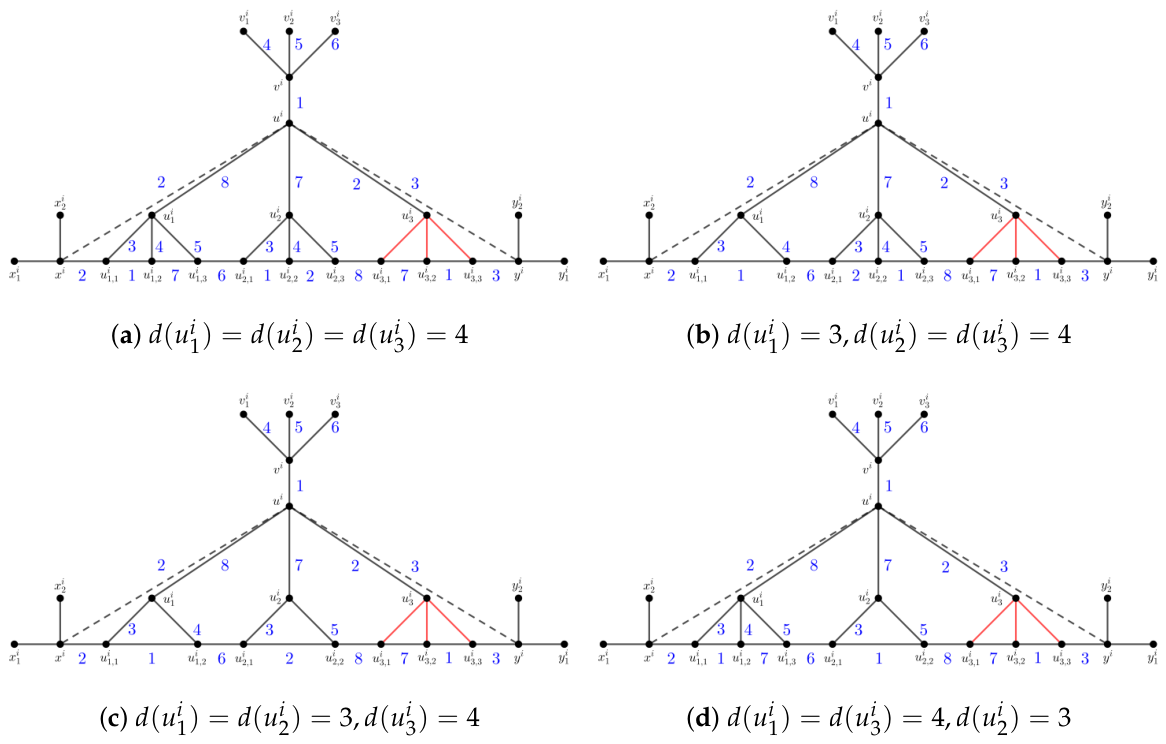
These are shown in Figure 2a. Without loss of generality, assume that ϕ ( u i u 1 i ) = ϕ ( u 2 , 3 i u 3 , 1 i ) = 8 , ϕ ( u i u 2 i ) = ϕ ( u 1 , 2 i u 1 , 3 i ) = ϕ ( u 3 , 1 i u 3 , 2 i ) = 7 , ϕ ( u 1 , 1 i u 1 , 2 i ) = ϕ ( u 2 , 1 i u 2 , 2 i ) = ϕ ( u 3 , 2 i u 3 , 3 i ) = 1 , ϕ ( u i u 3 i ) = ϕ ( u 2 , 2 i u 2 , 3 i ) = 2 , ϕ ( u 1 i u 1 , 1 i ) = ϕ ( u 2 i u 2 , 1 i ) = 3 , ϕ ( u 1 i u 1 , 2 i ) = ϕ ( u 2 i u 2 , 2 i ) = 4 , ϕ ( u 1 i u 1 , 3 i ) = ϕ ( u 2 i u 2 , 3 i ) = 5 , and ϕ ( u 1 , 3 i u 2 , 1 i ) = 6 . The coloring scheme for the remaining uncolored edges is presented in Table 1.
Case 1.2: d ( u 1 i ) = 3 , d ( u 2 i ) = d ( u 3 i ) = 4
This is shown in Figure 2b. Without loss of generality, assume that ϕ ( u i u 1 i ) = ϕ ( u 2 , 3 i u 3 , 1 i ) = 8 , ϕ ( u i u 2 i ) = ϕ ( u 3 , 1 i u 3 , 2 i ) = 7 , ϕ ( u 1 , 1 i u 1 , 2 i ) = ϕ ( u 2 , 2 i u 2 , 3 i ) = ϕ ( u 3 , 2 i u 3 , 3 i ) = 1 , ϕ ( u i u 3 i ) = ϕ ( u 2 , 1 i u 2 , 2 i ) = 2 , ϕ ( u 1 i u 1 , 1 i ) = ϕ ( u 2 i u 2 , 1 i ) = 3 , ϕ ( u 1 i u 1 , 2 i ) = ϕ ( u 2 i u 2 , 2 i ) = 4 , ϕ ( u 2 i u 2 , 3 i ) = 5 , and ϕ ( u 1 , 2 i u 2 , 1 i ) = 6 . The coloring scheme for the remaining uncolored edges is presented in Table 1.
Case 1.3: d ( u 1 i ) = d ( u 2 i ) = 3 , d ( u 3 i ) = 4
This is shown in Figure 2c. Without loss of generality, assume that ϕ ( u i u 1 i ) = ϕ ( u 2 , 2 i u 3 , 1 i ) = 8 , ϕ ( u i u 2 i ) = ϕ ( u 3 , 1 i u 3 , 2 i ) = 7 , ϕ ( u 1 , 1 i u 1 , 2 i ) = ϕ ( u 3 , 2 i u 3 , 3 i ) = 1 , ϕ ( u i u 3 i ) = ϕ ( u 2 , 1 i u 2 , 2 i ) = 2 , ϕ ( u 1 i u 1 , 1 i ) = ϕ ( u 2 i u 2 , 1 i ) = 3 , ϕ ( u 1 i u 1 , 2 i ) = 4 , ϕ ( u 2 i u 2 , 2 i ) = 5 , and ϕ ( u 1 , 2 i u 2 , 1 i ) = 6 . The coloring scheme for the remaining uncolored edges is presented in Table 1.
Case 1.4: d ( u 1 i ) = d ( u 3 i ) = 4 , d ( u 2 i ) = 3
This is shown in Figure 2d. Without loss of generality, assume that ϕ ( u i u 1 i ) = ϕ ( u 2 , 2 i u 3 , 1 i ) = 8 , ϕ ( u i u 2 i ) = ϕ ( u 1 , 2 i u 1 , 3 i ) = ϕ ( u 3 , 1 i u 3 , 2 i ) = 7 , ϕ ( u 1 , 1 i u 1 , 2 i ) = ϕ ( u 2 , 1 i u 2 , 2 i ) = ϕ ( u 3 , 2 i u 3 , 3 i ) = 1 , ϕ ( u i u 3 i ) = 2 , ϕ ( u 1 i u 1 , 1 i ) = ϕ ( u 2 i u 2 , 1 i ) = 3 , ϕ ( u 1 i u 1 , 2 i ) = 4 , ϕ ( u 1 i u 1 , 3 i ) = ϕ ( u 2 i u 2 , 2 i ) = 5 , and ϕ ( u 1 , 3 i u 2 , 1 i ) = 6 . The coloring scheme for the remaining uncolored edges is presented in Table 1.
Case 1.5: d ( u 1 i ) = d ( u 3 i ) = 3 , d ( u 2 i ) = 4
This is shown in Figure 3a. Without loss of generality, assume that ϕ ( u i u 1 i ) = ϕ ( u 2 , 1 i u 2 , 2 i ) = 8 , ϕ ( u i u 2 i ) = 7 , ϕ ( u 1 , 1 i u 1 , 2 i ) = 1 , ϕ ( u i u 3 i ) = ϕ ( u 2 , 2 i u 2 , 3 i ) = 2 , ϕ ( u 1 i u 1 , 1 i ) = ϕ ( u 2 i u 2 , 1 i ) = 3 , ϕ ( u 1 i u 1 , 2 i ) = ϕ ( u 2 i u 2 , 2 i ) = 4 , ϕ ( u 2 i u 2 , 3 i ) = 5 , and ϕ ( u 1 , 2 i u 2 , 1 i ) = 6 . The coloring scheme for the remaining uncolored edges is presented in Table 2.
Case 1.6: d ( u 1 i ) = d ( u 2 i ) = d ( u 3 i ) = 3
This is shown in Figure 3b. Without loss of generality, assume that ϕ ( u i u 1 i ) = ϕ ( u 2 , 2 i u 3 , 1 i ) = 8 , ϕ ( u i u 2 i ) = 7 , ϕ ( u 1 , 1 i u 1 , 2 i ) = ϕ ( u 3 , 1 i u 3 , 2 i ) = 1 , ϕ ( u i u 3 i ) = ϕ ( u 2 , 1 i u 2 , 2 i ) = 2 , ϕ ( u 1 i u 1 , 1 i ) = ϕ ( u 2 i u 2 , 1 i ) = 3 , ϕ ( u 1 i u 1 , 2 i ) = 4 , ϕ ( u 2 i u 2 , 2 i ) = 5 , and ϕ ( u 1 , 2 i u 2 , 1 i ) = 6 . The coloring scheme for the remaining uncolored edges is presented in Table 2.
Case 2: d ( u i ) = 3
Case 2.1: d ( u 1 i ) = 4 , d ( u 2 i ) = 3
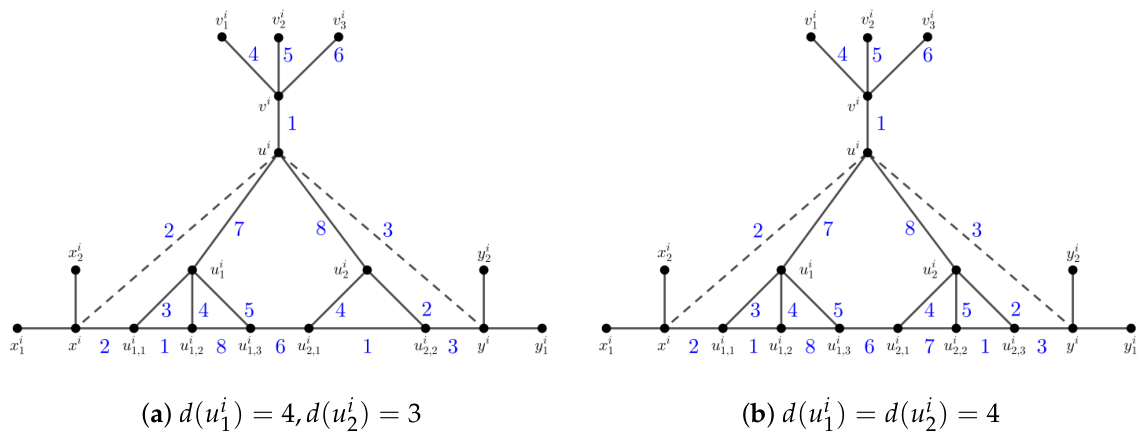
In this case, the coloring can be completed directly, as shown in Figure 4a.
Case 2.2: d ( u 1 i ) = d ( u 2 i ) = 4
In this case, the coloring can be completed directly, as shown in Figure 4b.
Case 2.3: d ( u 1 i ) = d ( u 2 i ) = 3
This is shown in Figure 5. Without loss of generality, assume that ϕ ( u i u 2 i ) = 8 , ϕ ( u i u 1 i ) = 7 , ϕ ( u 1 , 1 i u 1 , 2 i ) = 1 , ϕ ( u 1 i u 1 , 1 i ) = 3 , and ϕ ( u 1 , 2 i u 2 , 1 i ) = 6 . The coloring scheme for the remaining uncolored edges is presented in Table 3.
In summary, we have extended ϕ to the remaining edges of G i + 1 , thereby obtaining a strong edge coloring of G i + 1 using eight colors. □
Theorem 11.
If G = T C is a complete Halin graph with Δ = 4 containing adjacent vertices of maximum degree, then χ s ( G ) χ s ( T ) + 1 = 2 Δ . In particular, when T is a regular tree, χ s ( G ) = χ s ( T ) + 1 = 2 Δ .
Proof. 
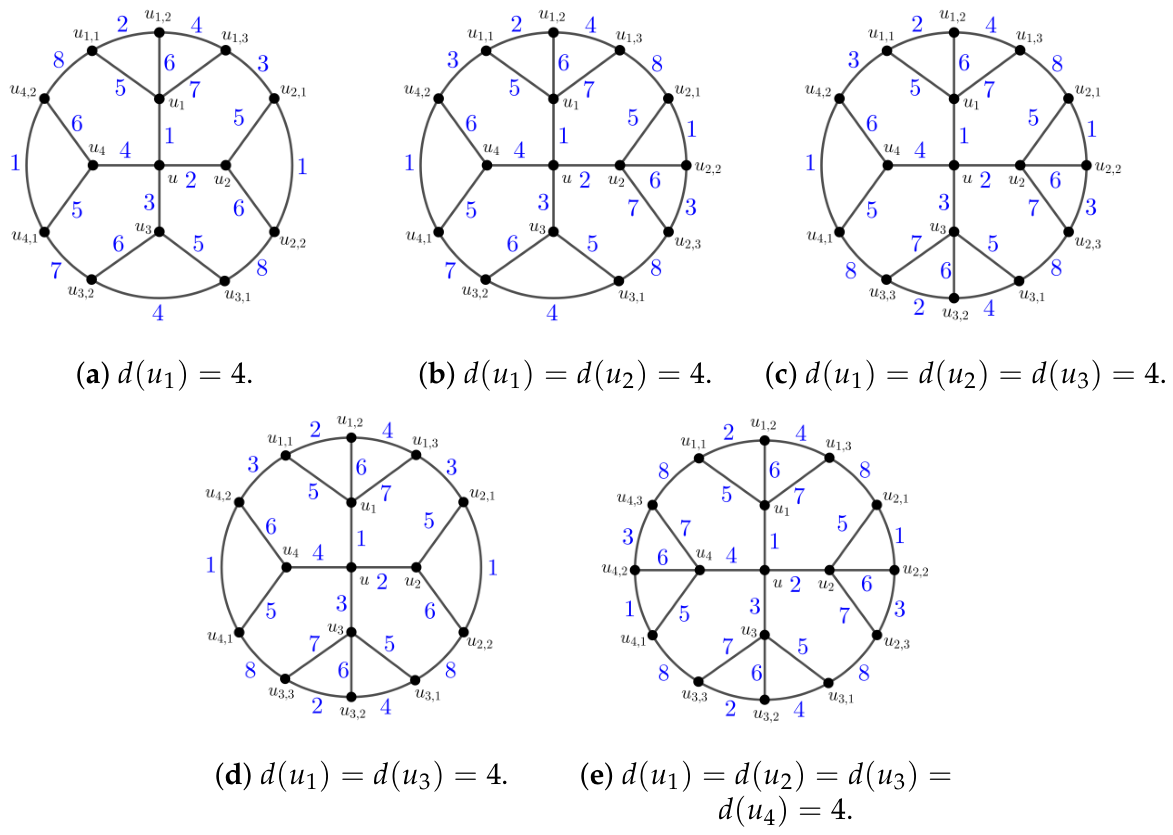
First, we prove that χ s ( G ) χ s ( T ) + 1 = 2 Δ . Let G = G l . If l = 1 , then G 1 is either W 3 or W 4 . By Theorem 2, we have χ s ( W 3 ) = 6 8 and χ s ( W 4 ) = 8 . If l = 2 . When G 2 contains adjacent vertices of maximum degree, as illustrated in Figure 6, it is straightforward to verify that χ s ( G 2 ) = 8 . When G 2 does not contain adjacent vertices of maximum degree, it follows from Theorem 6 that χ s ( G 2 ) 8 . Assume that the statement holds for any graph G l with number of layers l k . By repeatedly applying Lemma 3, we can directly prove that if l = k + 2 , then χ s ( G l ) 2 Δ . Then if G is a complete Halin graph with Δ = 4 where characteristic tree T is regular, then by Lemma 2, we have χ s ( G ) = χ s ( T ) + 1 = 2 Δ . □
Lemma 4.
For i 0 , let G i be a complete Halin graph with maximum degree Δ 5 and a regular characteristic tree T. If χ s ( G i ) χ s ( T i ) = 2 Δ 1 , then χ s ( G i + 1 ) χ s ( T i + 1 ) = 2 Δ 1 .
Proof. 
This is shown in Figure 7. By the induction hypothesis, we may assume that there exists a strong edge coloring ϕ of the edge set E ( G i ) using the color set 2 Δ 1 . Without loss of generality, let ϕ ( u i v i ) = 1 , ϕ ( u i x i ) = 2 , ϕ ( u i y i ) = 3 , and ϕ ( v i v j i ) = j + 3 for j [ 1 , Δ 1 ] . We now extend ϕ to the remaining edges of G i + 1 , thereby obtaining a strong edge coloring ϕ of G i + 1 using 2 Δ 1 colors.
Without loss of generality, let ϕ ( u i u 1 i ) = 3 , ϕ ( u i u Δ 1 i ) = 2 , ϕ ( u i u j i ) = Δ + 1 + j for j [ 2 , Δ 2 ] , and ϕ ( u i u j , k i ) = k + 3 for j [ 2 , Δ 2 ] ,   k [ 1 , Δ 1 ] . Furthermore, set ϕ ( x i u 1 , 1 i ) = ϕ ( u i x i ) = 2 , ϕ ( u Δ 1 , Δ 1 i y i ) = ϕ ( u i y i ) = 3 , and ϕ ( u 1 , 1 i u 1 , 2 i ) = ϕ ( u Δ 1 , Δ 2 i u Δ 1 , Δ 1 i ) = ϕ ( u j , Δ 1 i u j + 1 , 1 i ) = 1 for j [ 1 , Δ 2 ] .
The remaining edges e on the cycle are strongly edge-colored using the color set { 1 , 2 , 3 , Δ + 3 , Δ + 4 , , 2 Δ 1 } . Since { ϕ ( u 1 i ) ϕ ( u i u 1 i ) } = { ϕ ( u Δ 1 i ) ϕ ( u i u Δ 1 i ) } = { 4 , 5 , , Δ + 1 , Δ + 2 } , when Δ 5 , we have | A ϕ ( u 1 , 2 i u 1 , 3 i ) |   =   | A ϕ ( u Δ 1 , Δ 3 i u Δ 1 , Δ 2 i ) |   Δ 3 . Except for the edges u 1 , 1 i u 1 , 2 i , u 1 , 2 i u 1 , 3 i , u Δ 1 , Δ 2 i u Δ 1 , Δ 1 i , and u Δ 1 , Δ 3 i u Δ 1 , Δ 2 i , the remaining available color sets for other cycle edges satisfy | A ϕ ( e ) | Δ 2 . Therefore, we can sequentially color the edges from u 1 , 2 i u 1 , 3 i to u Δ 1 , Δ 3 i u Δ 1 , Δ 2 i in left-to-right order.
A ϕ ( u 1 i u 1 , Δ 1 i ) = { 5 , , Δ + 2 } , A ϕ ( u 1 i u 1 , j i ) = { 4 , 5 , , Δ + 2 } for [ 2 , Δ 2 ] , A ϕ ( u 1 i u 1 , 1 i ) = { 4 , 5 , , Δ + 2 } { ϕ ( x i x 1 i ) , ϕ ( x i x 2 i ) } .
Case 1: If | { ϕ ( x i x 1 i ) , ϕ ( x i x 2 i ) } { 4 , 5 , , Δ + 2 } |   = 2 , then | A ϕ ( u 1 i u 1 , 1 i ) | = Δ 3 . In this case, color the remaining edges of G i + 1 in the order u 1 i u 1 , 1 i , u 1 i u 1 , Δ 1 i , u 1 i u 1 , Δ 2 i , …, u 1 i u 1 , 2 i .
Case 2: If | { ϕ ( x i x 1 i ) , ϕ ( x i x 2 i ) } { 4 , 5 , , Δ + 2 } |   < 2 , then | A ϕ ( u 1 i u 1 , 1 i ) |   Δ 2 . In this case, color the remaining edges of G i + 1 in the order u 1 i u 1 , Δ 1 i , u 1 i u 1 , 1 i , u 1 i u 1 , 2 i , …, u 1 i u 1 , Δ 2 i .
A ϕ ( u Δ 1 i u Δ 1 , 1 i ) = { 4 , , Δ + 1 } , A ϕ ( u Δ 1 i u Δ 1 , j i ) = { 4 , 5 , , Δ + 2 } for j [ 2 , Δ 2 ] , A ϕ ( u Δ 1 i u Δ 1 , Δ 1 i ) = { 4 , 5 , , Δ + 2 } { ϕ ( y i y 1 i ) , ϕ ( y i y 2 i ) } .
Case 1: If | { ϕ ( y i y 1 i ) , ϕ ( y i y 2 i ) } { 4 , 5 , , Δ + 2 } |   = 2 , then | A ϕ ( u Δ 1 i u Δ 1 , Δ 1 i ) |   = Δ 3 . Color the remaining edges in the order u Δ 1 i u Δ 1 , Δ 1 i , u Δ 1 i u Δ 1 , 1 i , u Δ 1 i u Δ 1 , 2 i , …, u Δ 1 i u Δ 1 , Δ 2 i .
Case 2: If | { ϕ ( y i y 1 i ) , ϕ ( y i y 2 i ) } { 4 , 5 , , Δ + 2 } |   < 2 , then | A ϕ ( u Δ 1 i u Δ 1 , Δ 1 i ) |   Δ 2 . Color the remaining edges in the order u Δ 1 i u Δ 1 , 1 i , u Δ 1 i u Δ 1 , Δ 1 i , u Δ 1 i u Δ 1 , Δ 2 i , …, u Δ 1 i u Δ 1 , 2 i .
By Lemma 1, the remaining edges of G i + 1 admit a strong edge coloring. Thus, we obtain a strong ( 2 Δ 1 ) -edge coloring of G i + 1 . □
Theorem 12.
If G = T C is a complete Halin graph with Δ 5 and G W n , where T is a regular tree, then χ s ( G ) = χ s ( T ) = 2 Δ 1 .
Proof of Theorem 12.
Let G = G l . If l = 2 , let ϕ ( u u i ) = i for i ( 1 , Δ ) , and ϕ ( u i u i , j ) = j + Δ for i [ 1 , Δ ] , j [ 1 , Δ 1 ] . Under this coloring rule, the set of available colors for the edges e on the cycle satisfies | A ϕ ( e ) | 3 . By Lemma 1, the edges on the cycle can be properly colored.
If l = 3 , let ϕ ( u u i ) = i for i [ 1 , Δ ] , ϕ ( u i u i , j ) = j + Δ for i [ 1 , Δ ] , j [ 1 , Δ 1 ] , and ϕ ( u i , j u i , j , k ) = k ( mod Δ ) + i for i [ 1 , Δ ] , j [ 1 , Δ 1 ] , k [ 1 , Δ 1 ] . Under this coloring rule, we observe that ϕ ( u i u i , j ) = ϕ ( u i + 1 u i + 1 , j ) , where i [ 1 , Δ ] , j [ 1 , Δ 1 ] . We adjust the colors of ϕ ( u i u i , Δ 1 ) and ϕ ( u i + 1 u i + 1 , 1 ) , where i [ 1 , Δ ] , such that ϕ ( u i u i , Δ 1 ) = ϕ ( u i + 1 u i + 1 , 1 ) . Then, the set of available colors for the edges e on the cycle satisfies | A ϕ ( e ) | 3 . By Lemma 1, the edges on the cycle can be properly colored.
Assume that the conclusion holds for any graph G l with l k . By repeatedly applying Lemma 4, we can directly prove that if l = k + 2 , then χ s ( G l ) 2 Δ 1 . Furthermore, since χ s ( G l ) 2 Δ 1 , we conclude that if G is a complete Halin graph with Δ 5 and G W n , where T is a regular tree, then χ s ( G ) = χ s ( T ) = 2 Δ 1 . □

4. Conclusions

This paper presents a comprehensive investigation into the strong edge coloring of Halin graphs, a special class of planar graphs with rich structural properties. Our research makes two primary contributions to the field: First, we generalize and extend the foundational results established by W.C. Shiu and W.K. Tam [17] on the strong edge coloring of complete cubic Halin graphs to broader contexts. Second, by employing novel analytical techniques, we significantly improve upon the upper bounds and structural characterizations for the strong chromatic index of Halin graphs, refining the results obtained by Wei Yang and BaoYindureng [20].

Author Contributions

Formal analysis, Z.B.; writing—original draft, Z.B.; writing—review and editing, Y.T.; supervision, Y.T. All authors have read and agreed to the published version of the manuscript.

Funding

This research received no external funding.

Data Availability Statement

No new data were created or analyzed in this study.

Conflicts of Interest

The authors declare no conflict of interest.

References

  1. Bondy, J.A.; Murty, U.S.R. Graph Theory with Applications; Macmillan Ltd. Press: New York, NY, USA, 1976. [Google Scholar]
  2. Fouquet, J.L.; Jolivet, J.L. Strong edge-colorings of graphs and applications to multi k-gons. Ars Comb. 1983, 16, 141–150. [Google Scholar]
  3. Erdős, P. Problems and results in combinatorial analysis and graph theory. Discret. Math. 1988, 38, 81–92. [Google Scholar] [CrossRef]
  4. Faudree, R.J.; Schelp, R.H.; Gyárfás, A.; Tuza, Z. The strong chromatic index of graphs. Ars Comb. 1990, 29B, 205–211. [Google Scholar]
  5. Andersen, L.D. The strong chromatic index of a cubic graph is at most 10. Discret. Math. 1992, 108, 231–252. [Google Scholar] [CrossRef]
  6. Horák, P.; Qing, H.; Trotter, W.T. Induced matchings in cubic graphs. J. Graph Theory 1993, 17, 151–160. [Google Scholar] [CrossRef]
  7. Chen, L.; Huang, M.; Yu, G.; Zhou, X. The strong edge-coloring for graphs with small edge weight. Discret. Math. 2020, 343, 111779. [Google Scholar] [CrossRef]
  8. Horák, P. The strong chromatic index of graphs with maximum degree four. In Contemporary Methods in Graph Theory; Bodendiek, R., Wagner, K., Eds.; BI Wissenschaft-Verlag: Mannheim, Germany, 1990; pp. 399–403. [Google Scholar]
  9. Cranston, D.W. Strong edge-coloring of graphs with maximum degree 4 using 22 colors. Discret. Math. 2006, 306, 2772–2778. [Google Scholar] [CrossRef][Green Version]
  10. Huang, M.; Santana, M.; Yu, G. Strong chromatic index of graphs with maximum degree four. Electron. J. Comb. 2018, 25, 3.31. [Google Scholar] [CrossRef]
  11. Chen, L.; Chen, S.; Zhao, R.; Zhou, X. The strong chromatic index of graphs with edge weight eight. J. Comb. Optim. 2020, 40, 227–233. [Google Scholar] [CrossRef]
  12. Molloy, M.; Reed, B. A bound on the strong chromatic index of a graph. J. Comb. Theory Ser. B 1997, 69, 103–109. [Google Scholar] [CrossRef]
  13. Bruhn, H.; Joos, F. A stronger bound for the strong chromatic index. Electron. Notes Discret. Math. 2015, 49, 277–284. [Google Scholar] [CrossRef][Green Version]
  14. Hurley, E.; de Joannnis de Verclos, R.; Kang, R.J. An improved procedure for colouring graphs of bounded local density. arXiv 2020, arXiv:2007.07874. [Google Scholar]
  15. Lai, H.; Lih, K.; Tsai, P. The strong chromatic index of halin graphs. Discret. Math. 2012, 312, 1536–1541. [Google Scholar] [CrossRef]
  16. Lih, K.; Liu, D. On the strong chromatic index of cubic halin graphs. Appl. Math. Lett. 2012, 25, 898–901. [Google Scholar] [CrossRef]
  17. Shiu, W.C.; Tam, W.K. The strong chromatic index of complete cubic Halin graphs. Appl. Math. Lett. 2008, 22, 754–758. [Google Scholar] [CrossRef][Green Version]
  18. Chang, G.; Liu, D. Strong edge-coloring for cubic halin graphs. Discret. Math. 2012, 312, 1468–1475. [Google Scholar] [CrossRef]
  19. Hu, Z.; Lih, K.; Liu, D. Upper bound for the strong chromatic index of halin graphs. Discuss. Math. Graph Theory 2018, 38, 5–26. [Google Scholar] [CrossRef]
  20. Yang, W.; Wu, B. Proof of a conjecture on the strong chromatic index of Halin graphs. Discret. Appl. Math. 2021, 302, 92–102. [Google Scholar] [CrossRef]
  21. Shiu, W.C.; Lam, P.; Tam, W. On Strong Chromatic Index of Halin Graph. J. Comb. Math. Comb. Comput. 2006, 57, 211–222. [Google Scholar]
  22. Yuan, J.; Huang, M. Strong edge-coloring of planar graphs with girth at least seven. Ital. J. Pure Appl. Math. 2024, 51, 295–304. [Google Scholar]
  23. Hall, P. On representatives of subsets. J. Lond. Math. Soc. 1935, 10, 26–30. [Google Scholar] [CrossRef]
Figure 1. The substructure H in G.
Mathematics 14 01562 g001
Figure 2. d ( u i ) = 4 , d ( u 3 i ) = 4 .
Mathematics 14 01562 g002
Figure 3. d ( u i ) = 4 , d ( u 3 i ) = 3 .
Mathematics 14 01562 g003
Figure 4. d ( u i ) = 3 , d ( u 1 i ) = 4 .
Mathematics 14 01562 g004
Figure 5. d ( u 1 i ) = d ( u 2 i ) = 3 .
Mathematics 14 01562 g005
Figure 6. The five configurations of G 2 .
Mathematics 14 01562 g006
Figure 7. The structure of G i + 1 when Δ 5 .
Mathematics 14 01562 g007
Table 1. The coloring scheme when d ( u i ) = 4 , d ( u 3 i ) = 4 .
{ ϕ ( y i y 1 i ) , ϕ ( y i y 2 i ) } ϕ ( u 3 i u 3 , 1 i ) ϕ ( u 3 i u 3 , 2 i ) ϕ ( u 3 i u 3 , 3 i )
other456
{ 4 , 6 } 465
{ 5 , 6 } 654
{ 6 , 7 } 465
{ 6 , 8 } 465
Table 2. The coloring scheme when d ( u i ) = 4 , d ( u 3 i ) = 3 .
{ ϕ ( y i y 1 i ) , ϕ ( y i y 2 i ) } ϕ ( u 2 , 3 i u 3 , 1 i ) ϕ ( u 3 i u 3 , 1 i ) ϕ ( u 3 i u 3 , 2 i ) ϕ ( u 3 , 1 i u 3 , 2 i )
other6451
{ 4 , 5 } 1468
{ 5 , 6 } 1648
{ 5 , 7 } 1468
{ 5 , 8 } 1467
Table 3. The coloring scheme when d ( u 1 i ) = d ( u 2 i ) = 3 .
{ ϕ ( y i y 1 i ) , ϕ ( y i y 2 i ) } ϕ ( u 1 i u 1 , 2 i ) ϕ ( u 2 i u 2 , 1 i ) ϕ ( u 2 i u 2 , 2 i ) ϕ ( u 2 , 1 i u 2 , 2 i )
other4527
{ 4 , 7 } 5452
{ 5 , 7 } 4542
{ 6 , 7 } 4542
{ 7 , 8 } 4542
Disclaimer/Publisher’s Note: The statements, opinions and data contained in all publications are solely those of the individual author(s) and contributor(s) and not of MDPI and/or the editor(s). MDPI and/or the editor(s) disclaim responsibility for any injury to people or property resulting from any ideas, methods, instructions or products referred to in the content.