Article

Biquadratic SOS Rank and Augmented Zarankiewicz Number

1
Jiangsu Provincial Scientific Research Center of Applied Mathematics, Nanjing 211189, China
2
Department of Applied Mathematics, The Hong Kong Polytechnic University, Hung Hom, Hong Kong
3
School of Mathematical Sciences, Beihang University, Beijing 100191, China
4
School of Mathematics, Southeast University, Nanjing 211189, China
5
Nanjing Center for Applied Mathematics, Nanjing 211135, China
*
Author to whom correspondence should be addressed.
Mathematics 2026, 14(9), 1552; https://doi.org/10.3390/math14091552
Submission received: 7 April 2026 / Revised: 25 April 2026 / Accepted: 30 April 2026 / Published: 3 May 2026
(This article belongs to the Section D2: Operations Research and Fuzzy Decision Making)

Abstract

This paper introduces the concepts of the augmented Zarankiewicz number z A ( m , n ) and the limited augmented Zarankiewicz number z L ( m , n ) , which are natural combinatorial extensions of the classical Zarankiewicz number. These numbers arise from augmented bipartite graphs that may contain both standard edges (1-edges) and pairs of edges representing squares of binomials (2-edges). The main theoretical result establishes the inequality chain BSR ( m , n ) z A ( m , n ) z L ( m , n ) z ( m , n ) , linking the maximum biquadratic sum-of-squares (SOS) rank to these extremal graph parameters. We determine the exact values of z L ( m , n ) for the cases ( m , 2 ) , ( 3 , 3 ) , ( 4 , 3 ) , and ( 4 , 4 ) and provide new lower bounds for the cases ( 5 , 3 ) , ( 5 , 4 ) , and ( 5 , 5 ) . These results yield improved lower bounds for the maximum SOS rank of biquadratic forms, demonstrating that z L ( m , n ) can exceed the classical Zarankiewicz number, thereby offering a refined combinatorial perspective on the SOS rank problem.

1. Introduction

Denote { 1 , , m } as [ m ] . Assume that m n 2 . Let
P ( x , y ) = i , k = 1 m j , l = 1 n a i j k l x i x k y j y l .
We call P an m × n biquadratic form. Here a i j k l are real numbers. We assume that
a i j k l = a k j i l = a k l i j ,
for i ,   k [ m ] ,   j ,   l [ n ] . A PSD (positive semi-definite) biquadratic form is one for which P ( x , y ) 0 for all x , y . It is an SOS (sum of squares) if it can be written as a finite sum of squares of bilinear forms, i.e.,
P ( x , y ) = p = 1 r f p ( x , y ) 2 ,
where f p are m × n bilinear forms for p [ r ] . The smallest r such that (1) holds is called the SOS rank of P, denoted as sos ( P ) . In this case, we say that the sum-of-squares expression p = 1 r f p ( x , y ) 2 is irreducible. The maximum SOS rank of m × n SOS biquadratic forms is denoted as B S R ( m , n ) . It is known that B S R ( m , 2 ) = m + 1 and B S R ( 2 , n ) = n + 1 [1], B S R ( 3 , 3 ) = 6 [2] and B S R ( m , n ) m n 1 [3].
Recently, it was proved [4] that
B S R ( m , n ) z ( m , n ) ,
where z ( m , n ) is the Zarankiewicz number [5]. The Zarankiewicz problem, originating from [5], asks for the maximum number of edges in an m × n bipartite graph that contains no complete bipartite subgraph K 2 , 2 (i.e., no C 4 ). This classical extremal problem has been extensively studied; see [6,7,8] for surveys and fundamental bounds.
Inequality (2) is based upon the simple biquadratic forms introduced in [3]. A biquadratic form is a simple biquadratic form if it contains only distinct terms of the type x i 2 y j 2 . Then we may establish a one-to-one relation. Let G = ( S , T , E ) be a bipartite graph, where S = [ m ] and T = [ n ] are the vertex sets and E is the edge set. Then, uniquely, we have a simple biquadratic form
P G ( x , y ) = ( i , j ) E x i 2 y j 2 .
If G has no C 4 -cycles, then the simple biquadratic form P G is irreducible, i.e., sos ( P G ) = | E | . On the other hand, the Zarankiewicz number z ( m , n ) is defined as the largest number of edges such that the m × n bipartite graph G is C 4 -cycle-free [5,8]. Thus, we have (2).
Example 1
([9]). Define an eight-square 4 × 3 sos biquadratic form as
Q ( x , y ) = P 4 , 3 , 7 ( x , y ) + ( x 4 y 2 + x 1 y 3 ) 2 ,
where x = ( x 1 , x 2 , x 3 , x 4 ) R 4 , y = ( y 1 , y 2 , y 3 ) R 3 ,
P 4 , 3 , 7 ( x , y ) = x 1 2 y 1 2 + x 2 2 y 2 2 + x 3 2 y 3 2 + x 1 2 y 2 2 + x 2 2 y 3 2 + x 3 2 y 1 2 + x 4 2 y 1 2 .
It was proved that Q is irreducible, i.e., sos ( Q ) = 8 . In this way, it was established that
B S R ( 4 , 3 ) 8 > z ( 4 , 3 ) = 7 .
The concept of an augmented bipartite graph arises naturally from the observation that a square of the sum of two bilinear terms, ( x i y j + x k y l ) 2 , introduces both pure squares and a cross term. This cross term does not correspond to a single edge in the classical bipartite graph, but rather acts as a “super-edge” that couples two cells. To capture the combinatorial essence of such SOS representations, we augment the classical C 4 -free graph G 1 with these super-edges, leading to the notion of an augmented bipartite graph. This framework not only unifies known examples where B S R ( m , n ) > z ( m , n ) (e.g., ( 4 , 3 ) case), but also provides a systematic way to search for higher SOS ranks. Moreover, the generalized C 4 -cycle conditions (Definition 1) encode the precise combinatorial obstructions that force linear dependencies among the associated vectors, thereby controlling the irreducibility of the resulting biquadratic form. From an application perspective, understanding the maximum SOS rank is crucial for polynomial optimization and tensor decomposition; our augmented Zarankiewicz numbers offer new lower bounds that are provably better than classical ones.
This observation raises the question of why such a phenomenon occurs. What is its meaning in the theory of the Zarankiewicz number? Now, ( x 4 y 2 + x 1 y 3 ) 2 is not a single-term square. It does not correspond to an edge of the bipartite graph G. But can we interpret it as a super-edge of G? This question motivates this paper.
The remainder of this paper is organized as follows. Section 2 formally defines the augmented bipartite graph, the augmented Zarankiewicz number z A ( m , n ) , and the limited augmented Zarankiewicz number z L ( m , n ) , establishing the fundamental relationship BSR ( m , n ) z A ( m , n ) z L ( m , n ) z ( m , n ) . Section 3 and Section 4 determine the exact values of z L ( m , n ) for the cases ( m , 2 ) , ( 3 , 3 ) , ( 4 , 3 ) , and ( 4 , 4 ) . Section 5, Section 6 and Section 7 investigate and establish new lower bounds for z L ( m , n ) for the cases ( 5 , 3 ) , ( 5 , 4 ) , and ( 5 , 5 ) , respectively. Finally, Section 8 concludes the paper by summarizing the results and presenting several open problems for future research.

2. Augmented Zarankiewicz Number and Limited Augmented Zarankiewicz Number

Let G 1 = ( S , T , E 1 ) be an m × n bipartite graph, where S = [ m ] and T = [ n ] are its vertex sets. Assume that G 1 has no C 4 -cycles. Then we say that G 1 can be augmented to an augmented bipartite graph G = ( S , T , E ) , where the edge set E = E 1 E 2 . Here, we call any edge ( i , j ) of G 1 a 1-edge of G, while E 2 is the 2-edge set of G.
A 1-edge e in E 1 has the form e = ( i , j ) , where i S and j T . On the other hand, a 2-edge e in E 2 is formed ( i , j ; k , l ) , where i , k S and j , l T .
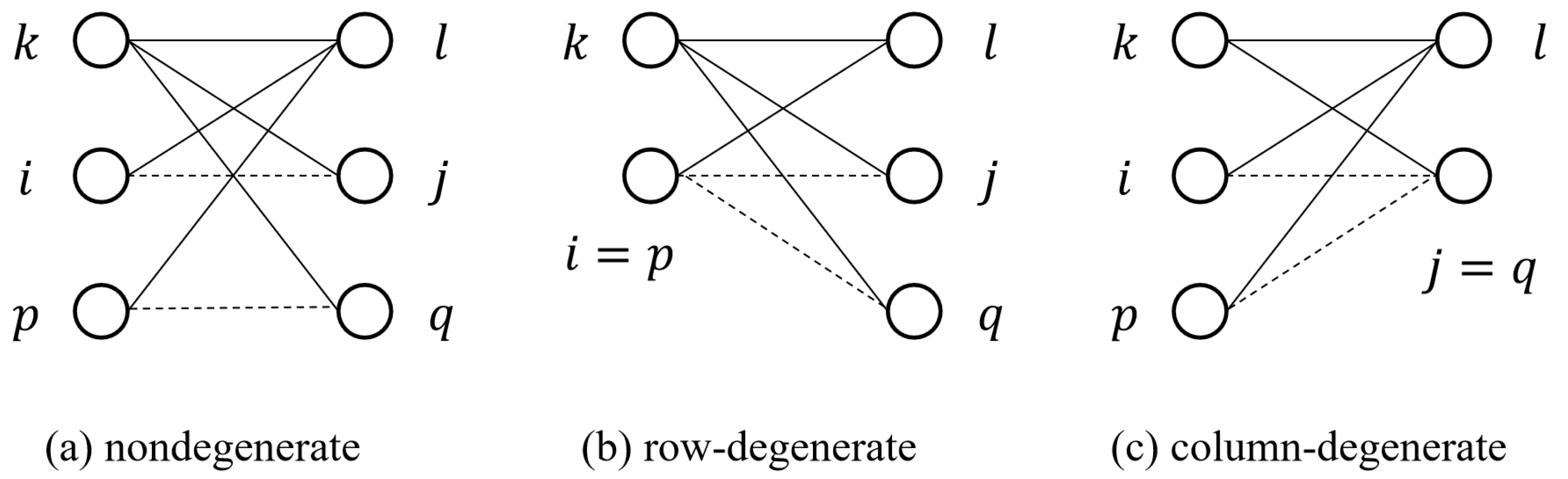
A 2-edge can be nondegenerate if i k and j l , row-degenerate if i = k and j l , or column-degenerate if i k and j = l . It cannot be i = k and j = l . Illustrations of nondegenerate, row-degenerate, and column-degenerate 2-edges are shown in Figure 1. Furthermore, we impose the following simplicity condition (S) on such an augmented bipartite graph G:
(S)
No 2-edge overlaps with any 1-edge or other 2-edge on a cell.
Here, we call ( i , j ) a cell for any i S and j T . If | E 1 | = z ( m , n ) , we say that G is a limited augmented bipartite graph.
Figure 1. Illustrations of the three types of 2-edges in an augmented bipartite graph. (a) Nondegenerate 2-edge ( i , j ; k , l ) with i k and j l . (b) Row-degenerate 2-edge where i = k (same row) and j l . (c) Column-degenerate 2-edge where j = l (same column) and i k . The two dotted lines represent the two halves of the 2-edge.
Mathematics 14 01552 g001
For such an augmented bipartite graph G, we associate it with an m × n sos biquadratic form P G , defined as
P G ( x , y ) = ( i , j ) E 1 x i 2 y j 2 + ( i , j ; k , l ) E 2 ( x i y j + x k y l ) 2 .
We call P G a doubly simple biquadratic form. If P G is irreducible, then the SOS rank of P G is | E | = | E 1 | + | E 2 | . For instance, Example 1 is a 4 × 3 irreducible doubly simple biquadratic form with
E 1 = { ( 1 , 1 ) , ( 2 , 2 ) , ( 3 , 3 ) , ( 1 , 2 ) , ( 2 , 3 ) , ( 3 , 1 ) , ( 4 , 1 ) } and E 2 = { ( 4 , 2 ; 1 , 3 ) } .
We wish to characterize the combinatorial feature of irreducible doubly simple biquadratic forms.
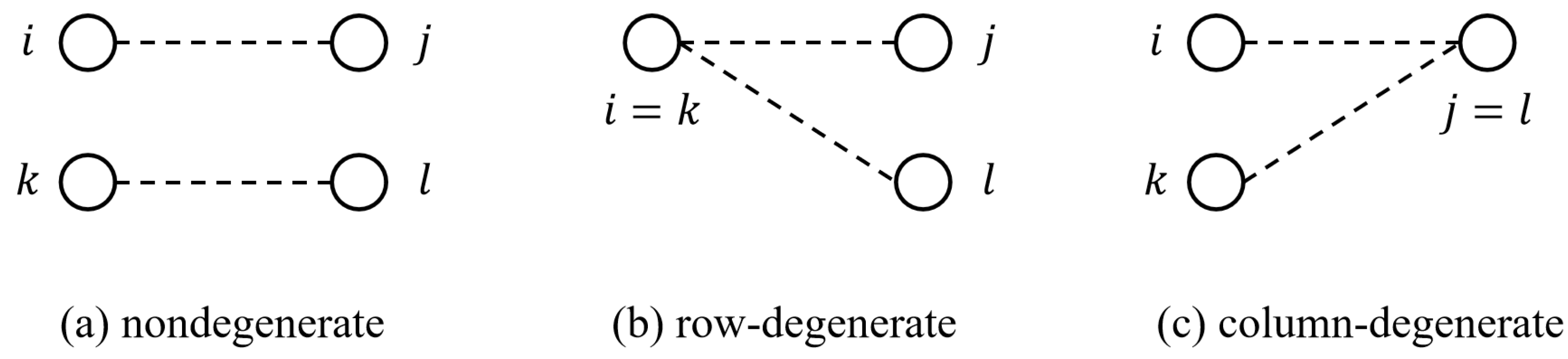
We now refine the notion of a C 4 -cycle to account for how the presence of 2-edges can lead to a drop in the SOS rank. Before presenting the formal definition of a generalized C 4 -cycle, we provide an intuitive explanation. In a classical C 4 -free bipartite graph, no four distinct cells form a rectangle (Condition 1). When we add a 2-edge ( i , j ; k , l ) , it introduces a potential dependency if the two opposite cells ( i , l ) and ( k , j ) are both occupied (Condition 2). Furthermore, if there exists another cell ( k , l ) that forms a rectangle with both halves of the 2-edge, the five cells involved may create a more complex obstruction (Condition 3). The generalization allows us to treat degenerate 2-edges (row- or column-degenerate) uniformly, where some cells may coincide.
Definition 1
(Generalized C 4 -Cycle, Augmented Zarankiewicz Number and Limited Augmented Zarankiewicz Number). Let G = ( S , T , E 1 E 2 ) be an m × n augmented bipartite graph with vertex sets S = [ m ] and T = [ n ] , augmented from a C 4 -cycle-free bipartite graph G 1 = ( S , T , E 1 ) . A cell ( i , j ) is called occupied if ( i , j ) E 1 or ( i , j ) is a half of some 2-edge in E 2 . We say that G contains a generalized C 4 -cycle if either
1. 
There exists a classical C 4 -cycle formed by 1-edges;
2. 
There exists a nondegenerate 2-edge ( i , j ; k , l ) E 2 such that both opposite cells ( i , l ) and ( k , j ) are occupied;
3. 
There exist a 2-edge ( i , j ; p , q ) (of any type) and a distinct cell ( k , l ) , with k i , k p , l j and l q , such that the five cells ( k , l ) , ( k , j ) , ( k , q ) , ( i , l ) and ( p , l ) are all occupied. Furthermore, if the 2-edge is nondegenerate, these five cells must be pairwise distinct.
The augmented Zarankiewicz number z A ( m , n ) is the maximum possible total number of edges | E 1 | + | E 2 | for which a generalized C 4 -cycle does not exist for such an augmented bipartite graph G.
The limited augmented Zarankiewicz number z L ( m , n ) is the maximum possible total number of edges | E 1 | + | E 2 | for which a generalized C 4 -cycle does not exist for a limited augmented bipartite graph G.
Remark 1.
Conditions 1 and 2 are natural and combinatorial. Condition 1 ensures that no classical C 4 appears. Condition 2 is necessary: if a nondegenerate 2-edge ( i , j ; k , l ) had both opposite cells ( i , l ) and ( k , j ) occupied, then the associated vectors may satisfy a linear dependence, lowering the SOS rank. For a limited augmented bipartite graph, because | E 1 | = z ( m , n ) , each half of a 2-edge would form a C 4 with some distinct occupied cells (otherwise more 1-edges could be added). Condition 3 then guarantees that the two lists of such cells, those completing a C 4 with the first half and those completing a C 4 with the second half, have no intersection. Figure 2 presents an example in which Condition 3 in Definition 1 is triggered, since both the first half ( i , j ) and the second half ( p , q ) complete a C 4 with ( k , l ) . Condition 3 handles more complex obstructions that arise when a 2-edge interacts with a distant cell; it applies uniformly to all 2-edge types (nondegenerate, row-degenerate, and column-degenerate).
Theorem 1.
Let m , n 2 and G = ( S , T , E 1 E 2 ) be an m × n augmented bipartite graph with vertex sets S = [ m ] and T = [ n ] satisfying the simplicity condition (S) in Section 2. Then, if G does not contain any generalized C 4 -cycle in the sense of Definition 1, then P G defined by (3) is irreducible. Namely, SOS ( P G ) = | E 1 | + | E 2 | .
Proof. 
We prove by contradiction. Assume SOS ( P G ) < | E 1 | + | E 2 | . Then there exists an SOS decomposition with r bilinear forms
p ( x , y ) = i = 1 m j = 1 n a i j ( p ) x i y j ( p = 1 , , r )
such that r < | E 1 | + | E 2 | and
P G ( x , y ) = p = 1 r p ( x , y ) 2 .
The proof is structured in three steps:
1.
Consequences of no generalized C 4 -cycle: Show that for any 2-edge, its two halves have equal vectors, and no such pair can lie in the minimal dependency support S .
2.
Orthogonality: Prove that any two distinct cells in S have orthogonal vectors, using Conditions 1–3.
3.
Contradiction: Orthogonal nonzero vectors are linearly independent, yet they satisfy a nontrivial linear relation—impossible.
We now proceed with the detailed proof.
For each pair ( i , j ) define the vector v i j = ( a i j ( 1 ) , , a i j ( r ) ) R r . Let H be the set of all cells that are either 1-edges or halves of 2-edges:
H = E 1 ( i , j ; k , l ) E 2 { ( i , j ) , ( k , l ) } .
In words, H consists of every cell that appears as a pure square x i 2 y j 2 or as part of a square ( x i y j + x k y l ) 2 in P G . If ( i , j ) H , then comparing coefficients shows v i j = 0 . By the simplicity condition (S), the 2 | E 2 | halves are all distinct and none belong to E 1 ; hence
| H | = | E 1 | + 2 | E 2 | | E 1 | + | E 2 | > r .
Thus, the vectors { v i j : ( i , j ) H } lie in R r and | H | > r , so they are linearly dependent. Choose a nontrivial linear relation
( i , j ) H α i j v i j = 0
with minimal support S = { ( i , j ) H : α i j 0 } . Minimality means that no proper nonempty subset of S yields a linear dependence among the vectors { v i j : ( i , j ) S } .
By minimality, all vectors { v i j : ( i , j ) S } are nonzero and pairwise distinct as vectors. Indeed, if two distinct cells ( i , j ) , ( k , l ) S had v i j = v k l , then we could replace α i j v i j + α k l v k l = ( α i j + α k l ) v i j , obtaining a relation with smaller support (unless α i j + α k l = 0 , in which case both terms cancel). The minimality ensures this does not happen.
Expanding the squares and comparing coefficients yields
(A1)
For every 1-edge ( i , j ) E 1 : v i j 2 = 1 .
(A2)
For every 2-edge ( i , j ; k , l ) E 2 :
(A2nd)
If nondegenerate ( i k , j l ): v i j 2 = v k l 2 = 1 and v i j · v k l + v i l · v k j = 1 .
(A2cd)
If column-degenerate ( i k , j = l ): v i j 2 = v k j 2 = 1 and v i j · v k j = 1 .
(A2rd)
If row-degenerate ( i = k , j l ): v i j 2 = v i l 2 = 1 and v i j · v i l = 1 .
(B)
For any two distinct pairs ( p , q ) and ( r , s ) that are not the two halves of the same 2-edge:
(B1)
If { p , q } { r , s } = : v p q · v r s + v p s · v r q = 0 .
(B2)
If p = r and q s : v p q · v p s = 0 , unless ( p , q ) and ( p , s ) are the two halves of a row-degenerate 2-edge (in which case (A2rd) applies instead).
(B3)
If q = s and p r : v p q · v r q = 0 , unless ( p , q ) and ( r , q ) are the two halves of a column-degenerate 2-edge (in which case (A2cd) applies instead).
(C)
For pairs sharing a row or column that are not covered by the exceptions above: v i j · v i l = 0 (same row, j l ) and v i j · v k j = 0 (same column, i k ).
  • Step 1. Consequences of the absence of a generalized C 4 -cycle. Take any 2-edge ( i , j ; k , l ) E 2 .
If it is nondegenerate: Since G has no generalized C 4 -cycle, Condition 2 of Definition 1 implies that at most one of the two opposite cells ( i , l ) and ( k , j ) is occupied. Hence, at least one of v i l , v k j is zero. From (A2nd) we then obtain v i j · v k l = 1 . Because v i j = v k l = 1 , Cauchy–Schwarz forces v i j = v k l .
If it is column-degenerate ( j = l ), then (A2cd) gives v i j · v k j = 1 , and with unit norms we get v i j = v k j .
If it is row-degenerate ( i = k ), then (A2rd) gives v i j · v i l = 1 , and with unit norms we get v i j = v i l .
Thus, every 2-edge contributes two equal vectors. Moreover, by the minimality observation, the two halves of a 2-edge cannot both belong to S ; if they did, they would be equal vectors and distinct cells, contradicting the pairwise distinctness of vectors in S .
  • Step 2. Orthogonality of distinct vectors in S . Let ( i , j ) and ( k , l ) be two distinct positions in the support S . We prove v i j · v k l = 0 .
Note that they cannot be the two halves of the same 2-edge by Step 1. We consider several cases.
Case A: The four indices { i , j , k , l } are all distinct. Then, the following Equation applies:
v i j · v k l + v i l · v k j = 0 .
Suppose, for contradiction, that v i j · v k l 0 . Then v i l · v k j 0 , so both ( i , l ) and ( k , j ) are occupied. Consequently the four cells ( i , j ) , ( k , l ) , ( i , l ) , a n d ( k , j ) are all in H.
If all four were 1-edges, they would form a classical C 4 , violating Condition 1 of Definition 1. Therefore, at least one of them is a half of a 2-edge. Without loss of generality, assume ( i , j ) is a half of a 2-edge e = ( i , j ; p , q ) . Then by Step 1, v i j = v p q and ( p , q ) is occupied. Moreover, since ( i , j ) S , the other half ( p , q ) cannot be in S (otherwise two equal vectors would appear in the support), but ( p , q ) H .
Now consider the pair ( p , q ) and ( k , l ) . Their dot product is v p q · v k l = v i j · v k l 0 . Apply (B1) to ( p , q ) and ( k , l ) :
v p q · v k l + v p l · v k q = 0 ,
so v p l · v k q 0 ; thus ( p , l ) and ( k , q ) are occupied.
We examine the possibilities for p and q relative to k and l.
  • If p = k , then ( p , l ) = ( k , l ) and ( p , q ) = ( k , q ) . But ( k , q ) and ( k , l ) share the same row, so by (B2) (they are not halves of a column-degenerate 2-edge because q l and p = k would force degeneracy only if q = l , which is not the case), we have v k q · v k l = 0 . Yet v k q = v p q = v i j and v i j · v k l 0 , a contradiction.
  • If q = l , then ( p , l ) and ( k , l ) share the same column, so (B3) gives v p l · v k l = 0 while v p l = v i j again contradicts v i j · v k l 0 .
Hence we must have p k and q l . In this situation, the five cells
( k , l ) , ( k , j ) , ( k , q ) , ( i , l ) , ( p , l )
are all distinct (because i k , j l , p k and q l ). They are all occupied, and ( i , j ; p , q ) is a 2-edge. Thus, the configuration satisfies Condition 3 of Definition 1, which is forbidden. This contradiction shows that our assumption v i j · v k l 0 is impossible. Therefore, v i j · v k l = 0 .
Case B: They share a row ( i = k and j l ). Then ( i , j ) and ( i , l ) are not the two halves of a column-degenerate 2-edge (otherwise, they would be equal by Step 1 and would not be distinct in S ). Hence (B2) applies and gives v i j · v i l = 0 .
Case C: They share a column ( j = l and i k ). Similarly, they are not halves of a row-degenerate 2-edge, so (B3) gives v i j · v k j = 0 .
Thus in all cases, for any two distinct positions ( i , j ) , ( k , l ) S , we have v i j · v k l = 0 .
  • Step 3. Contradiction. The vectors in S are nonzero (by (A1) and Step 1) and pairwise orthogonal, so they are linearly independent. But they satisfy the nontrivial linear relation (4), which is impossible. This contradiction shows that our assumption SOS ( P G ) < | E 1 | + | E 2 | was false. Hence SOS ( P G ) = | E 1 | + | E 2 | . □
Note that the absence of a generalized C 4 -cycle is a sufficient condition for the doubly simple biquadratic form to be irreducible, but it is not necessary. For instance, let m = n = 2 ; E 1 = ( 1 , 1 ) , ( 2 , 2 ) ; and E 2 = ( 1 , 2 ) , ( 2 , 1 ) . Then the augmented bipartite graph satisfies Condition 2 and therefore contains a generalized C 4 -cycle. Nevertheless, the corresponding doubly simple biquadratic form P G = ( x 1 y 1 + x 2 y 2 ) 2 + x 1 2 y 2 2 + x 2 2 y 1 2 is irreducible.
Theorem 2.
For all m , n 2 , we have
BSR ( m , n ) z A ( m , n ) z L ( m , n ) z ( m , n ) .
Proof. 
The inequality z L ( m , n ) z ( m , n ) is trivial by taking E 2 = . By definition, z A ( m , n ) z L ( m , n ) . Let G be an augmented bipartite graph that does not have a generalized C 4 -cycle. By Theorem 1, the corresponding SOS biquadratic form P G defined by (3) satisfies sos ( P G ) = | E 1 | + | E 2 | . Without loss of generality, suppose G is a graph that achieves z A ( m , n ) = | E 1 | + | E 2 | . Consequently, BSR ( m , n ) sos ( P G ) = z A ( m , n ) . □
Remark 2.
In the following, we only consider the limited augmented bipartite graph that does not have a generalized C 4 -cycle. We focus on such graphs because (i) all cases we have considered fall into this category; (ii) the upper bound of z L ( m , n ) is much simpler than that of z A ( m , n ) ; (iii) for all low-dimensional cases we have examined, z L ( m , n ) = z A ( m , n ) . Whether this equality always holds is an open question.

3. The Low-Dimensional Cases

In this section we determine the limited augmented Zarankiewicz number for three families: m × 2 , 3 × 3 , and 4 × 3 .
Theorem 3.
The limited augmented Zarankiewicz number satisfies
z L ( m , 2 ) = m + 1 for all m 2 , z L ( 3 , 3 ) = 6 , z L ( 4 , 3 ) = 8 .
Proof. 
We treat the three cases separately.
Case 1 (n = 2).
The classical Zarankiewicz number is z ( m , 2 ) = m + 1 (a complete bipartite graph K m , 2 has no C 4 because n = 2 ). By Theorem 2, we have z L ( m , 2 ) z ( m , 2 ) = m + 1 .
One can show directly that BSR ( m , 2 ) = m + 1 [1]. Since z L ( m , 2 ) BSR ( m , 2 ) by Theorem 2, we obtain z L ( m , 2 ) m + 1 . Hence, z L ( m , 2 ) = m + 1 .
Case 2 ((m, n) = (3, 3)).
The classical Zarankiewicz number is z ( 3 , 3 ) = 6 (e.g., the incidence graph of the affine plane of order 2). Theorem 2 gives z L ( 3 , 3 ) 6 .
For the upper bound, it is known that BSR ( 3 , 3 ) = 6 [2]. Again by Theorem 2, z L ( 3 , 3 ) BSR ( 3 , 3 ) = 6 . Thus, z L ( 3 , 3 ) = 6 .
Case 3 ((m, n) = (4, 3)).
We first establish the lower bound z L ( 4 , 3 ) 8 by constructing an explicit augmented bipartite graph with | E 1 | = z ( 4 , 3 ) = 7 and | E 2 | = 1 that contains no generalized C 4 -cycle.
Let
E 1 = { ( 1 , 1 ) , ( 2 , 2 ) , ( 3 , 3 ) , ( 1 , 2 ) , ( 2 , 3 ) , ( 3 , 1 ) , ( 4 , 1 ) } , E 2 = { ( 4 , 2 ; 1 , 3 ) } .
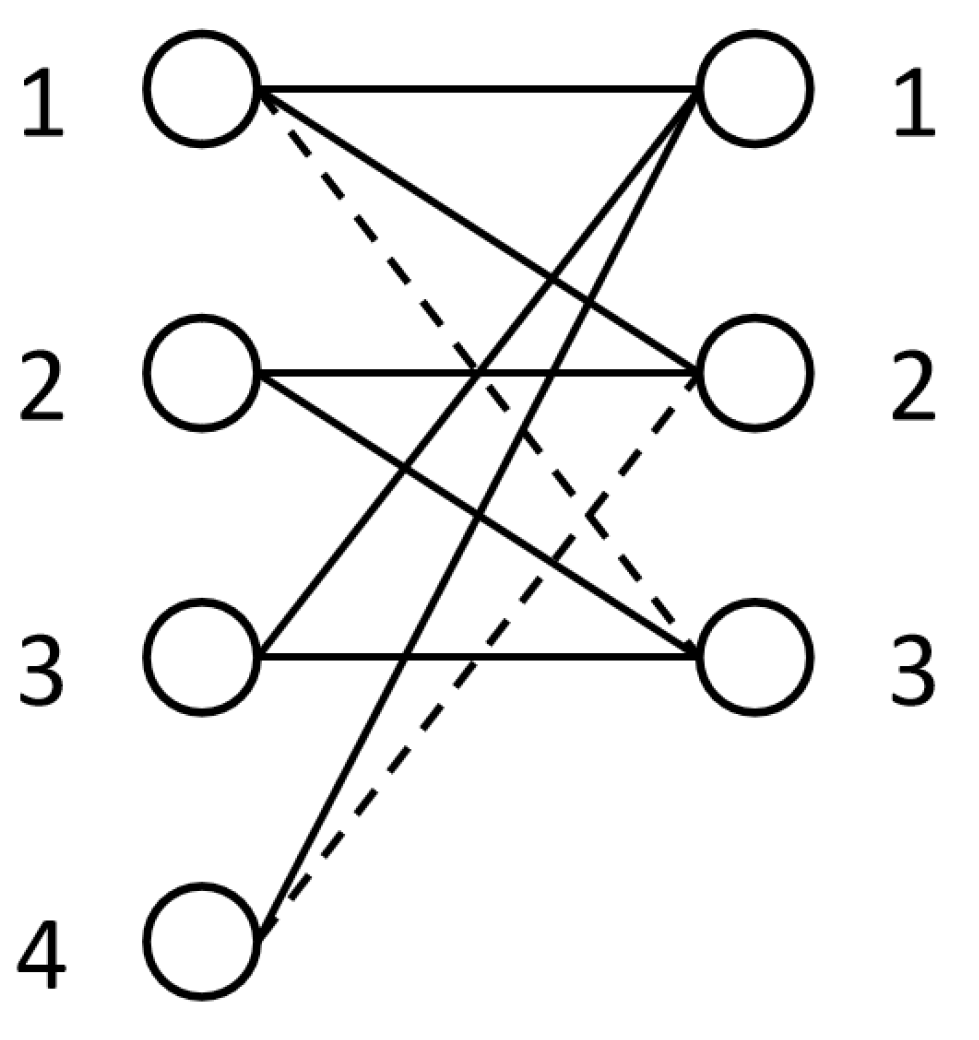
The 1-edges form a C 4 -free graph attaining z ( 4 , 3 ) = 7 (this is the standard extremal construction). An illustration is presented in Figure 3. We now verify Definition 1.
Condition 1.
The 1-edge subgraph is C 4 -free by construction.
Condition 2.
The unique 2-edge ( 4 , 2 ; 1 , 3 ) is nondegenerate. Its opposite cells are ( 4 , 3 ) and ( 1 , 2 ) . Here ( 1 , 2 ) E 1 but ( 4 , 3 ) is not occupied (it is not in E 1 and not a half of any 2-edge). Hence, Condition 2 is not triggered.
Condition 3.
We must show there is no cell ( k , l ) with k { 4 , 1 } and l { 2 , 3 } such that the five cells ( k , l ) , ( k , 2 ) , ( k , 3 ) , ( 4 , l ) , ( 1 , l ) are all occupied. Since k [ 4 ] and k { 4 , 1 } , we have k { 2 , 3 } . Since l [ 3 ] and l { 2 , 3 } , we have l = 1 . Thus the only candidates are ( k , l ) = ( 2 , 1 ) and ( 3 , 1 ) .
For ( k , l ) = ( 2 , 1 ) :
  • ( 2 , 1 ) : not in E 1 ; not a half of any 2-edge ⇒ not occupied.
For ( k , l ) = ( 3 , 1 ) :
  • ( 3 , 1 ) E 1 (occupied).
  • ( 3 , 2 ) : not in E 1 ; not a half of any 2-edge ⇒ not occupied.
Hence, no such ( k , l ) exists. Therefore, Condition 3 is not triggered.
Thus G contains no generalized C 4 -cycle. Consequently, the associated doubly simple biquadratic form
P G ( x , y ) = ( i , j ) E 1 x i 2 y j 2 + ( x 4 y 2 + x 1 y 3 ) 2
is irreducible (as shown in [9]) and satisfies SOS ( P G ) = | E 1 | + | E 2 | = 8 . Hence z L ( 4 , 3 ) 8 .
  • Upper bound. We now prove z L ( 4 , 3 ) 8 . Since z L ( 4 , 3 ) z ( 4 , 3 ) + | E 2 | by definition, it suffices to show that any limited augmented bipartite graph on 4 × 3 vertices with | E 2 | 2 necessarily contains a generalized C 4 -cycle.
It is known that z ( 4 , 3 ) = 7 , and the extremal C 4 -free graphs attaining this bound are all isomorphic [7,8]. Up to relabeling of the rows and columns, we may assume
E 1 = { ( 1 , 1 ) , ( 2 , 2 ) , ( 3 , 3 ) , ( 1 , 2 ) , ( 2 , 3 ) , ( 3 , 1 ) , ( 4 , 1 ) } .
The unoccupied cells are
U = { ( 1 , 3 ) , ( 2 , 1 ) , ( 3 , 2 ) , ( 4 , 2 ) , ( 4 , 3 ) } .
By the simplicity condition (S), the halves of any 2-edge must lie in U. Enumerating all possible 2-edges with halves in U that do not immediately violate Condition 2 yields exactly five candidates:
Nondegenerate : e 1 = ( 1 , 3 ; 4 , 2 ) , e 2 = ( 3 , 2 ; 4 , 3 ) , Row-degenerate : e 3 = ( 3 , 2 ; 4 , 2 ) , e 4 = ( 1 , 3 ; 4 , 3 ) , Column-degenerate : e 5 = ( 4 , 2 ; 4 , 3 ) .  
We now show that any two distinct candidates create a generalized C 4 -cycle. The verification is summarized in Table 1.
Since every pair of distinct 2-edges triggers either Condition 2 or Condition 3, we must have | E 2 | 1 for any limited augmented graph with no generalized C 4 -cycle. Consequently,
z L ( 4 , 3 ) z ( 4 , 3 ) + 1 = 7 + 1 = 8 .
Combining the lower and upper bounds, we obtain z L ( 4 , 3 ) = 8 . This completes the proof of Theorem 3. □

4. The 4 × 4 Case

We now determine the exact value of the limited augmented Zarankiewicz number for m = n = 4 .
Theorem 4.
z L ( 4 , 4 ) = 10 .
Proof. 
We prove the lower and upper bounds separately.
  • Lower bound z L ( 4 , 4 ) 10 . We construct a limited augmented bipartite graph G with | E 1 | = z ( 4 , 4 ) = 9 and | E 2 | = 1 that contains no generalized C 4 -cycle. Let
    E 1 = { ( 1 , 1 ) , ( 1 , 2 ) , ( 1 , 3 ) , ( 2 , 1 ) , ( 2 , 4 ) , ( 3 , 2 ) , ( 3 , 4 ) , ( 4 , 3 ) , ( 4 , 4 ) } ,
    and
    E 2 = { ( 2 , 3 ; 4 , 2 ) } .
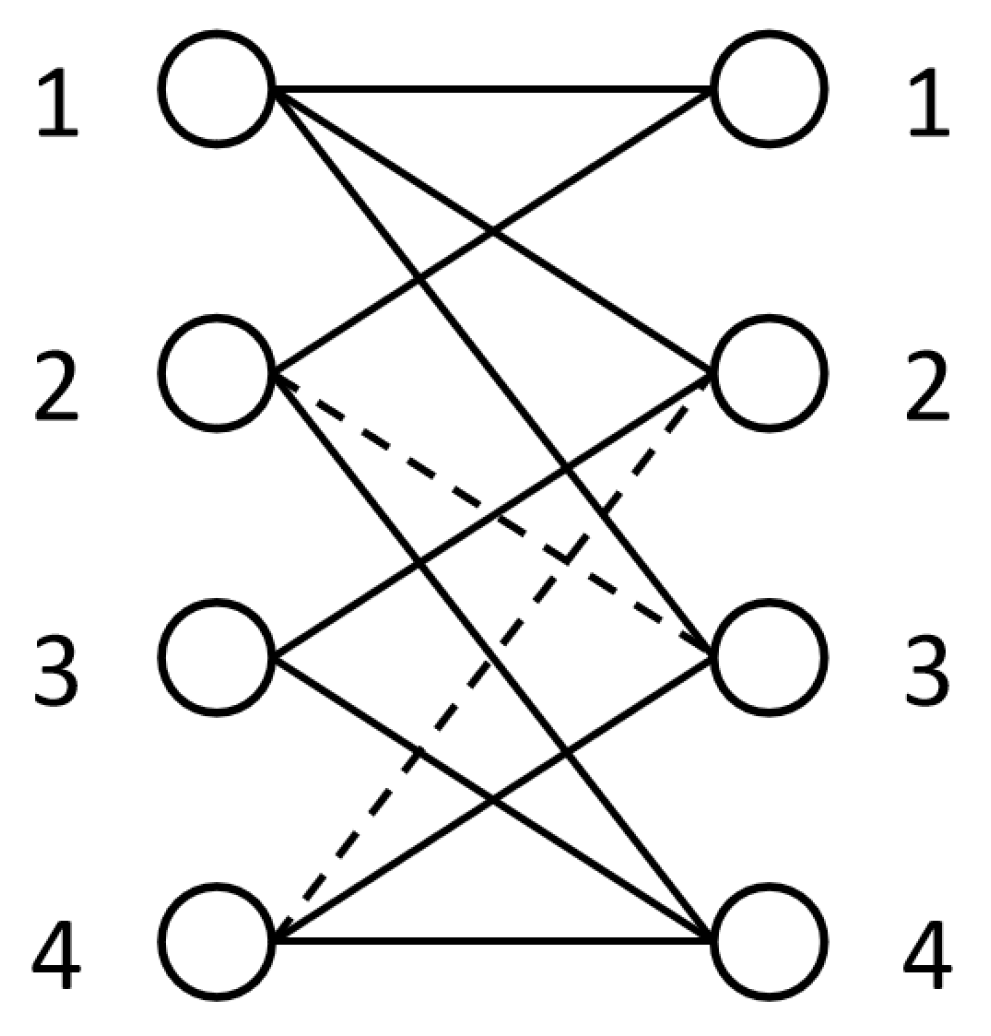
    An illustration is presented in Figure 4. It is straightforward to verify that condition (S) holds and that Conditions 1 and 2 in Definition 1 are not triggered. We now proceed to check Condition 3. For the 2-edge ( i , j ; p , q ) = ( 2 , 3 ; 4 , 2 ) , we need k { 2 , 4 } and l { 3 , 2 } , i.e., k { 1 , 3 } and l { 1 , 4 } . The candidates are ( 1 , 1 ) , ( 1 , 4 ) , ( 3 , 1 ) , ( 3 , 4 ) . In each case, at least one of the five cells ( k , l ) , ( k , 3 ) , ( k , 2 ) , ( 2 , l ) , ( 4 , l ) is unoccupied. Thus, Condition 3 is not triggered.
Since G contains no generalized C 4 -cycle, we have z L ( 4 , 4 ) | E 1 | + | E 2 | = 9 + 1 = 10 .
  • Upper Bound z L ( 4 , 4 ) 10
Let G = ( S , T , E 1 E 2 ) be any limited augmented bipartite graph with | S | = | T | = 4 , | E 1 | = z ( 4 , 4 ) = 9 , and no generalized C 4 -cycle. We must prove | E 2 | 1 , which yields z L ( 4 , 4 ) 9 + 1 = 10 .
  • Step 1: The extremal 1-edge graph for z ( 4 , 4 ) = 9 . The classical Zarankiewicz number z ( 4 , 4 ) = 9 is known [7,8]. Up to isomorphism, the extremal C 4 -free bipartite graph with four vertices on each side and nine edges is unique [7]. After suitable row and column permutations, we may assume its edge set is
    E 1 = { ( 1 , 1 ) , ( 1 , 2 ) , ( 1 , 3 ) , ( 2 , 1 ) , ( 2 , 4 ) , ( 3 , 2 ) , ( 3 , 4 ) , ( 4 , 3 ) , ( 4 , 4 ) } .
    The adjacency matrix (rows 1–4, columns 1–4) is
    1 1 1 0 1 0 0 1 0 1 0 1 0 0 1 1 .
The set of unoccupied cells (cells not in E 1 ) is
U = { ( 1 , 4 ) , ( 2 , 2 ) , ( 2 , 3 ) , ( 3 , 1 ) , ( 3 , 3 ) , ( 4 , 1 ) , ( 4 , 2 ) } .
  • Step 2: Constraints on 2-edges. By the simplicity condition (S), no half of a 2-edge can belong to E 1 , and all halves of 2-edges must be distinct. Therefore, for any 2-edge ( i , j ; k , l ) E 2 , we must have
    { ( i , j ) , ( k , l ) } U .
Additionally, Condition 2 of Definition 1 imposes restrictions: for a nondegenerate 2-edge ( i , j ; k , l ) (with i k and j l ), if both opposite cells ( i , l ) and ( k , j ) are occupied (i.e., belong to E 1 ), then a generalized C 4 -cycle exists. Thus, any admissible nondegenerate 2-edge must have at most one of its opposite cells occupied.
  • Step 3: Enumerate candidate 2-edges. We list all unordered pairs { ( i , j ) , ( k , l ) } U that could form a 2-edge.
Nondegenerate candidates ( i k and j l ):
( 1 , 4 ; 2 , 2 ) , ( 1 , 4 ; 2 , 3 ) , ( 1 , 4 ; 3 , 1 ) , ( 1 , 4 ; 3 , 3 ) , ( 1 , 4 ; 4 , 1 ) , ( 1 , 4 ; 4 , 2 ) , ( 2 , 2 ; 3 , 1 ) , ( 2 , 2 ; 3 , 3 ) , ( 2 , 2 ; 4 , 1 ) , ( 2 , 3 ; 3 , 1 ) , ( 2 , 3 ; 4 , 1 ) , ( 2 , 3 ; 4 , 2 ) , ( 3 , 1 ; 4 , 2 ) , ( 3 , 3 ; 4 , 1 ) , ( 3 , 3 ; 4 , 2 ) .
Row-degenerate candidates ( j = l and i k ):
( 3 , 1 ; 4 , 1 ) , ( 2 , 2 ; 4 , 2 ) .
Column-degenerate candidates ( i = k and j l ):
( 2 , 2 ; 2 , 3 ) , ( 3 , 1 ; 3 , 3 ) , ( 4 , 1 ; 4 , 2 ) .
  • Step 4: Apply Condition 2 to nondegenerate candidates. For each nondegenerate candidate, we check whether both opposite cells are in E 1 (occupied). Those with both opposite cells occupied are forbidden.
The verification yields the admissible nondegenerate 2-edges:
N = { ( 2 , 2 ; 3 , 3 ) , ( 2 , 2 ; 4 , 1 ) , ( 2 , 3 ; 3 , 1 ) , ( 2 , 3 ; 4 , 2 ) , ( 3 , 1 ; 4 , 2 ) , ( 3 , 3 ; 4 , 1 ) } .
  • Step 5: Condition 3 analysis. We now show that any two distinct 2-edges from the admissible set (including degenerate ones) create a generalized C 4 -cycle.
Let us denote
e 1 = ( 2 , 2 ; 3 , 3 ) , e 2 = ( 2 , 2 ; 4 , 1 ) , e 3 = ( 2 , 3 ; 3 , 1 ) , e 4 = ( 2 , 3 ; 4 , 2 ) , e 5 = ( 3 , 1 ; 4 , 2 ) , e 6 = ( 3 , 3 ; 4 , 1 ) .
Degenerate candidates:
d 1 = ( 3 , 1 ; 4 , 1 ) , d 2 = ( 2 , 2 ; 4 , 2 ) , c 1 = ( 2 , 2 ; 2 , 3 ) , c 2 = ( 3 , 1 ; 3 , 3 ) , c 3 = ( 4 , 1 ; 4 , 2 ) .
We verify representative pairs; a complete systematic enumeration confirms the result.
Example: e 1 and e 3 . Consider ( k , l ) = ( 4 , 3 ) E 1 . For e 1 = ( 2 , 2 ; 3 , 3 ) , the five cells are ( 4 , 3 ) , ( 4 , 2 ) , ( 4 , 3 ) , ( 2 , 3 ) , ( 3 , 3 ) . All are occupied: ( 4 , 3 ) E 1 , ( 4 , 2 ) U (half of e 4 ), ( 2 , 3 ) U (half of e 3 ), and ( 3 , 3 ) U (half of e 1 ). For e 3 = ( 2 , 3 ; 3 , 1 ) , the five cells are ( 4 , 3 ) , ( 4 , 1 ) , ( 4 , 3 ) , ( 2 , 1 ) , ( 3 , 1 ) . All are occupied: ( 4 , 1 ) U (half of e 2 ), ( 2 , 1 ) E 1 , and ( 3 , 1 ) U (half of e 3 ). Thus Condition 3 is triggered.
Example: e 1 and d 1 . For d 1 = ( 3 , 1 ; 4 , 1 ) , consider ( k , l ) = ( 2 , 3 ) U . The five cells are ( 2 , 3 ) , ( 2 , 1 ) , ( 2 , 1 ) , ( 3 , 3 ) , ( 4 , 3 ) . All are occupied: ( 2 , 3 ) U (half of e 3 ), ( 2 , 1 ) E 1 , ( 3 , 3 ) U (half of e 1 ), and ( 4 , 3 ) E 1 . Thus Condition 3 is triggered.
A complete check confirms that every pair of distinct admissible 2-edges triggers either Condition 2 or Condition 3. Therefore, we must have | E 2 | 1 .
  • Step 6: Conclusion. Since | E 2 | 1 , we have
    z L ( 4 , 4 ) | E 1 | + | E 2 | 9 + 1 = 10 .
Combined with the lower bound construction ( | E 1 | = 9 , | E 2 | = 1 with no generalized C 4 -cycle), we obtain z L ( 4 , 4 ) = 10 . □

5. The 5 × 3 Case

We now investigate the limited augmented Zarankiewicz number for parameters m = 5 and n = 3 . The classical Zarankiewicz number is z ( 5 , 3 ) = 8 (see [7,8]). We show that by introducing a single nondegenerate 2-edge, we can obtain a limited augmented bipartite graph with a total edge count of 9, thereby establishing a lower bound for z L ( 5 , 3 ) .
Theorem 5.
z L ( 5 , 3 ) 9 .
Proof. 
We construct an explicit limited augmented bipartite graph G = ( S , T , E 1 E 2 ) with vertex sets S = { 1 , 2 , 3 , 4 , 5 } and T = { 1 , 2 , 3 } , and edge sets
E 1 = { ( 1 , 1 ) , ( 1 , 2 ) , ( 2 , 1 ) , ( 2 , 3 ) , ( 3 , 2 ) , ( 3 , 3 ) , ( 4 , 1 ) , ( 5 , 2 ) } , E 2 = { ( 1 , 3 ; 4 , 2 ) } .
Then | E 1 | = 8 = z ( 5 , 3 ) and | E 2 | = 1 , so the total number of edges is | E 1 | + | E 2 | = 9 .
It is straightforward to verify that condition (S) holds and that Conditions 1 and 2 in Definition 1 are not triggered. We now proceed to check Condition 3. For the 2-edge ( i , j ; p , q ) = ( 1 , 3 ; 4 , 2 ) , we need k { 1 , 4 } and l { 3 , 2 } , i.e., k { 2 , 3 , 5 } and l { 1 } . Thus, the only candidates are ( k , l ) = ( 2 , 1 ) , ( 3 , 1 ) , ( 5 , 1 ) . The five cells to be checked are
( k , 1 ) , ( k , 3 ) , ( k , 2 ) , ( 1 , 1 ) , ( 4 , 1 ) .
  • ( k , l ) = ( 2 , 1 ) : cells ( 2 , 1 ) , ( 2 , 3 ) , ( 2 , 2 ) , ( 1 , 1 ) , and ( 4 , 1 ) . Here ( 2 , 2 ) is unoccupied.
  • ( k , l ) = ( 3 , 1 ) : cells ( 3 , 1 ) , ( 3 , 3 ) , ( 3 , 2 ) , ( 1 , 1 ) , and ( 4 , 1 ) . Here ( 3 , 1 ) is unoccupied.
  • ( k , l ) = ( 5 , 1 ) : cells ( 5 , 1 ) , ( 5 , 3 ) , ( 5 , 2 ) , ( 1 , 1 ) , and ( 4 , 1 ) . Here ( 5 , 3 ) is unoccupied.
In every case, at least one cell is unoccupied. Thus, Condition 3 is not triggered.
Since none of the three conditions are satisfied, G contains no generalized C 4 -cycle. Consequently, the associated doubly simple biquadratic form
P G ( x , y ) = ( i , j ) E 1 x i 2 y j 2 + ( x 1 y 3 + x 4 y 2 ) 2
is irreducible, and SOS ( P G ) = | E 1 | + | E 2 | = 9 . Hence z L ( 5 , 3 ) 9 . □
Remark 3.
The construction uses the nondegenerate 2-edge ( 1 , 3 ; 4 , 2 ) . The verification shows that no generalized C 4 -cycle appears, so the SOS rank equals the total number of edges. Whether z L ( 5 , 3 ) = 9 or can be larger remains open; an upper bound would require a separate argument showing that | E 2 | 1 for 5 × 3 as in the 4 × 3 case.

6. The 5 × 4 Case

We now investigate the limited augmented Zarankiewicz number for parameters m = 5 and n = 4 . The classical Zarankiewicz number is z ( 5 , 4 ) = 10 (see [7,8]). We show that by introducing two carefully chosen 2-edges, one nondegenerate and one column-degenerate, we can obtain a limited augmented bipartite graph with a total edge count of 12, thereby establishing a lower bound for z L ( 5 , 4 ) .
Theorem 6.
z L ( 5 , 4 ) 12 .
Proof. 
We construct an explicit limited augmented bipartite graph G = ( S , T , E 1 E 2 ) with vertex sets S = { 1 , 2 , 3 , 4 , 5 } and T = { 1 , 2 , 3 , 4 } , and edge sets
E 1 = { ( 1 , 1 ) , ( 1 , 2 ) , ( 1 , 3 ) , ( 2 , 1 ) , ( 2 , 4 ) , ( 3 , 2 ) , ( 3 , 4 ) , ( 4 , 3 ) , ( 4 , 4 ) , ( 5 , 1 ) } , E 2 = { ( 2 , 3 ; 5 , 4 ) , ( 4 , 2 ; 5 , 2 ) } .
Expanding the last term gives ( x 4 + x 5 ) 2 y 2 2 , which contributes the pure squares x 4 2 y 2 2 and x 5 2 y 2 2 as well as the cross term 2 x 4 x 5 y 2 2 . Thus the occupied cells are
H = E 1 { ( 2 , 3 ) , ( 5 , 4 ) , ( 4 , 2 ) , ( 5 , 2 ) } .
It is straightforward to verify that condition (S) holds and that Conditions 1 and 2 in Definition 1 are not triggered. We now proceed to check Condition 3. We verify that no cell ( k , l ) creates a generalized C 4 -cycle with either 2-edge.
  • For e a = ( 2 , 3 ; 5 , 4 ) (nondegenerate): We need k { 2 , 5 } and l { 3 , 4 } . Thus k { 1 , 3 , 4 } and l { 1 , 2 } . The candidates are ( 1 , 1 ) , ( 1 , 2 ) , ( 3 , 1 ) , ( 3 , 2 ) , ( 4 , 1 ) , ( 4 , 2 ) . For each candidate, we examine the five cells ( k , l ) , ( k , 3 ) , ( k , 4 ) , ( 2 , l ) , ( 5 , l ) :
  • ( 1 , 1 ) : cells ( 1 , 1 ) , ( 1 , 3 ) , ( 1 , 4 ) , ( 2 , 1 ) , ( 5 , 1 ) . Here ( 1 , 4 ) is unoccupied.
  • ( 1 , 2 ) : cells ( 1 , 2 ) , ( 1 , 3 ) , ( 1 , 4 ) , ( 2 , 2 ) , ( 5 , 2 ) . Here ( 1 , 4 ) and ( 2 , 2 ) are unoccupied.
  • ( 3 , 1 ) : cells ( 3 , 1 ) , ( 3 , 3 ) , ( 3 , 4 ) , ( 2 , 1 ) , ( 5 , 1 ) . Here ( 3 , 1 ) is unoccupied.
  • ( 3 , 2 ) : cells ( 3 , 2 ) , ( 3 , 3 ) , ( 3 , 4 ) , ( 2 , 2 ) , ( 5 , 2 ) . Here ( 2 , 2 ) is unoccupied.
  • ( 4 , 1 ) : cells ( 4 , 1 ) , ( 4 , 3 ) , ( 4 , 4 ) , ( 2 , 1 ) , ( 5 , 1 ) . Here ( 4 , 1 ) is unoccupied.
  • ( 4 , 2 ) : cells ( 4 , 2 ) , ( 4 , 3 ) , ( 4 , 4 ) , ( 2 , 2 ) , ( 5 , 2 ) . Here ( 2 , 2 ) is unoccupied.
In every case, at least one cell is unoccupied. Thus e a does not trigger Condition 3.
  • For e b = ( 4 , 2 ; 5 , 2 ) (column-degenerate): We need k { 4 , 5 } and l { 2 } . Thus k { 1 , 2 , 3 } and l { 1 , 3 , 4 } . The candidates are all cells in rows 1, 2, and 3 and columns 1, 3, and 4. For each candidate, we examine the five cells ( k , l ) , ( k , 2 ) , ( k , 2 ) , ( 4 , l ) , ( 5 , l ) . (Note that ( k , j ) = ( k , 2 ) and ( k , q ) = ( k , 2 ) are the same cell; the definition allows repetitions for degenerate 2-edges).
We verify the candidates systematically:
  • For l = 1 :
    ( k , l ) = ( 1 , 1 ) : cells ( 1 , 1 ) , ( 1 , 2 ) , ( 1 , 2 ) , ( 4 , 1 ) , ( 5 , 1 ) . Here ( 4 , 1 ) is unoccupied.
    ( k , l ) = ( 2 , 1 ) : cells ( 2 , 1 ) , ( 2 , 2 ) , ( 2 , 2 ) , ( 4 , 1 ) , ( 5 , 1 ) . Here ( 2 , 2 ) and ( 4 , 1 ) are unoccupied.
    ( k , l ) = ( 3 , 1 ) : cells ( 3 , 1 ) , ( 3 , 2 ) , ( 3 , 2 ) , ( 4 , 1 ) , ( 5 , 1 ) . Here ( 3 , 1 ) and ( 4 , 1 ) are unoccupied.
  • For l = 3 :
    ( k , l ) = ( 1 , 3 ) : cells ( 1 , 3 ) , ( 1 , 2 ) , ( 1 , 2 ) , ( 4 , 3 ) , ( 5 , 3 ) . Here ( 5 , 3 ) is unoccupied.
    ( k , l ) = ( 2 , 3 ) : cells ( 2 , 3 ) , ( 2 , 2 ) , ( 2 , 2 ) , ( 4 , 3 ) , ( 5 , 3 ) . Here ( 2 , 2 ) and ( 5 , 3 ) are unoccupied.
    ( k , l ) = ( 3 , 3 ) : cells ( 3 , 3 ) , ( 3 , 2 ) , ( 3 , 2 ) , ( 4 , 3 ) , ( 5 , 3 ) . Here ( 3 , 3 ) and ( 5 , 3 ) are unoccupied.
  • For l = 4 :
    ( k , l ) = ( 1 , 4 ) : cells ( 1 , 4 ) , ( 1 , 2 ) , ( 1 , 2 ) , ( 4 , 4 ) , ( 5 , 4 ) . Here ( 1 , 4 ) is unoccupied.
    ( k , l ) = ( 2 , 4 ) : cells ( 2 , 4 ) , ( 2 , 2 ) , ( 2 , 2 ) , ( 4 , 4 ) , ( 5 , 4 ) . Here ( 2 , 2 ) is unoccupied.
    ( k , l ) = ( 3 , 4 ) : cells ( 3 , 4 ) , ( 3 , 2 ) , ( 3 , 2 ) , ( 4 , 4 ) , ( 5 , 4 ) . Here ( 3 , 4 ) E 1 , ( 3 , 2 ) E 1 , ( 4 , 4 ) E 1 , and ( 5 , 4 ) H . All five cells are occupied. However, since e b is degenerate, the pairwise distinctness requirement does not apply. The definition only requires the five cells to be pairwise distinct when the 2-edge is nondegenerate. Thus this configuration does not constitute a generalized C 4 -cycle.
Therefore, e b does not trigger Condition 3.
Since none of the three conditions are satisfied, G contains no generalized C 4 -cycle. Consequently, the associated doubly simple biquadratic form P G is irreducible, and SOS ( P G ) = | E 1 | + | E 2 | = 10 + 2 = 12 . Hence z L ( 5 , 4 ) 12 . □
Remark 4.
The construction above uses one degenerate 2-edge ( 4 , 2 ; 5 , 2 ) , which corresponds to the square ( x 4 y 2 + x 5 y 2 ) 2 = ( x 4 + x 5 ) 2 y 2 2 . This introduces a cross term with identical y-indices. The corresponding doubly simple biquadratic form is
P G ( x , y ) = ( i , j ) E 1 x i 2 y j 2 + ( x 2 y 3 + x 5 y 4 ) 2 + ( x 4 y 2 + x 5 y 2 ) 2 .
Recently, it was verified by the orthogonality method that the SOS rank of P G is 12. The definition of a generalized C 4 -cycle explicitly relaxes the pairwise distinctness requirement for degenerate 2-edges, allowing such configurations to be admissible. Our study shows that if we do not allow degenerate 2-edges, the maximum edge number of a limited augmented 5 × 4 bipartite graph, which has no generalized C 4 cycles, can only reach 11. Note that this is the only place in this paper where a degenerate 2-edge is actually involved.

7. The 5 × 5 Case

We now investigate the limited augmented Zarankiewicz number for m = n = 5 . The classical Zarankiewicz number is z ( 5 , 5 ) = 12 . We show that by introducing two carefully chosen 2-edges, we can obtain a limited augmented bipartite graph with a total edge count of 14, thereby establishing a lower bound for z L ( 5 , 5 ) .
Theorem 7.
z L ( 5 , 5 ) 14 .
Proof. 
We construct an explicit limited augmented bipartite graph G = ( S , T , E 1 E 2 ) with vertex sets S = { 1 , 2 , 3 , 4 , 5 } and T = { 1 , 2 , 3 , 4 , 5 } , and edge sets
E 1 = { ( 1 , 1 ) , ( 1 , 2 ) , ( 1 , 3 ) , ( 2 , 1 ) , ( 2 , 4 ) , ( 3 , 2 ) , ( 3 , 4 ) , ( 3 , 5 ) , ( 4 , 3 ) , ( 4 , 5 ) , ( 5 , 1 ) , ( 5 , 5 ) } , E 2 = { ( 1 , 4 ; 5 , 2 ) , ( 2 , 3 ; 4 , 2 ) } .
Then | E 1 | = 12 (the classical Zarankiewicz number) and | E 2 | = 2 , so the total number of edges is | E 1 | + | E 2 | = 14 . It is straightforward to verify that condition (S) holds and that Conditions 1 and 2 in Definition 1 are not triggered. We now proceed to check Condition 3. We must check for each 2-edge that no cell ( k , l ) with the required disjointness makes all five listed cells occupied.
  • For e 1 = ( 1 , 4 ; 5 , 2 ) (nondegenerate): Here i = 1 , j = 4 , p = 5 , and q = 2 . We need k { 1 , 5 } and l { 4 , 2 } , i.e., k { 2 , 3 , 4 } and l { 1 , 3 , 5 } . The five cells are
    ( k , l ) , ( k , 4 ) , ( k , 2 ) , ( 1 , l ) , ( 5 , l ) .
We examine candidates:
  • l = 1 : ( 1 , 1 ) E 1 and ( 5 , 1 ) E 1 . We need ( k , 1 ) occupied for some k. ( 2 , 1 ) E 1 , but ( 2 , 4 ) E 1 and ( 2 , 2 ) is not occupied → fails. ( 3 , 1 ) is not occupied, and ( 4 , 1 ) is not occupied. So there is no violation.
  • l = 3 : ( 1 , 3 ) E 1 and ( 5 , 3 ) is not occupied → fails.
  • l = 5 : ( 1 , 5 ) is not occupied → fails.
Thus no ( k , l ) triggers Condition 3 for e 1 .
  • For e 2 = ( 2 , 3 ; 4 , 2 ) (nondegenerate): Here i = 2 , j = 3 , p = 4 , and q = 2 . We need k { 2 , 4 } and l { 3 , 2 } , i.e., k { 1 , 3 , 5 } and l { 1 , 4 , 5 } . The five cells are
    ( k , l ) , ( k , 3 ) , ( k , 2 ) , ( 2 , l ) , ( 4 , l ) .
We examine candidates:
  • l = 1 : ( 2 , 1 ) E 1 , and ( 4 , 1 ) is not occupied → fails.
  • l = 4 : ( 2 , 4 ) E 1 ,and ( 4 , 4 ) is not occupied → fails.
  • l = 5 : ( 2 , 5 ) is not occupied → fails.
Thus no ( k , l ) triggers Condition 3 for e 2 .
Since all three conditions are satisfied, G contains no generalized C 4 -cycle. Hence the associated doubly simple biquadratic form is irreducible, and
sos ( P G ) = | E 1 | + | E 2 | = 12 + 2 = 14 .
Therefore z L ( 5 , 5 ) 14 . □
Remark 5.
Unlike the 5 × 4 case, which required a degenerate 2-edge to achieve its lower bound, the 5 × 5 lower bound is attained using only nondegenerate 2-edges.

8. Conclusions and Open Problems

This paper introduced the augmented Zarankiewicz number z A ( m , n ) and the limited augmented Zarankiewicz number z L ( m , n ) as combinatorial extensions of the classical Zarankiewicz number. Each such graph G corresponds to a doubly simple biquadratic form P G , and the main theoretical result (Theorem 2) establishes the inequality chain
BSR ( m , n ) z A ( m , n ) z L ( m , n ) z ( m , n ) ,
linking the maximum biquadratic SOS rank to these new graph parameters.
Our main combinatorial results determine the exact values of the limited augmented Zarankiewicz number for all dimensions not exceeding four:
z L ( m , 2 ) = m + 1 ( m 2 ) , z L ( 3 , 3 ) = 6 , z L ( 4 , 3 ) = 8 , z L ( 4 , 4 ) = 10 .
For parameters involving five rows, we established new lower bounds that improve upon the classical Zarankiewicz numbers:
z L ( 5 , 3 ) 9 , z L ( 5 , 4 ) 12 , z L ( 5 , 5 ) 14 .
We summarize the lower bounds for BSR ( m , n ) of small m and n in Table 2. These findings demonstrate that the augmented Zarankiewicz framework captures combinatorial obstructions to higher SOS rank that are invisible to the classical theory, thereby providing improved lower bounds for BSR ( m , n ) . Note that our method is more efficient than the orthogonality method as m and n grow. For example, to check the irreducibility of the example in the proof of Theorem 7 by the orthogonality method, one needs to check 91 orthogonality relations. The work grows as m and n grow.
The work presented here lays the foundation for this new combinatorial approach. Several natural and challenging directions remain for future research.
1.
Complete the 5 × n cases: A key next step is to prove that the lower bounds obtained in this paper for the 5 × 3 , 5 × 4 , and 5 × 5 cases are sharp, i.e., that z L ( 5 , 3 ) = 9 , z L ( 5 , 4 ) = 12 , and z L ( 5 , 5 ) = 14 . Verifying these exact values requires a full case analysis over all non-isomorphic extremal graphs for the classical numbers z ( 5 , 3 ) = 8 , z ( 5 , 4 ) = 10 , and z ( 5 , 5 ) = 12 . The classification of extremal C 4 -free bipartite graphs for these parameters is known in the literature [7,8], and the number of non-isomorphic extremal graphs is finite and manageable. The increased number of distinct frames makes this a more extensive combinatorial project, which will be the subject of forthcoming work.
2.
Asymptotic behavior: The classical Zarankiewicz number satisfies the Kővári–Sós–Turán bound z ( m , n ) = O ( m n 1 / 2 + n ) . A fundamental open problem is to determine the asymptotic growth rate of z L ( m , n ) . Does the introduction of 2-edges lead to a strictly larger asymptotic order, or does the same O ( m n 1 / 2 ) upper bound persist?
3.
Gap between z L ( m , n ) and BSR ( m , n ) : Our construction shows that BSR ( m , n ) z L ( m , n ) . If a gap exists, several issues can be investigated. First, is z A ( m , n ) = z L ( m , n ) ? Second, should we relax the simplicity condition to allow two 2-edges to overlap? Third, should we consider more general SOS representations that involve squares of bilinear forms with more than two terms?
The problem investigated here lies at the intersection of algebraic geometry [1,2], extremal graph theory [5,6,7,8,10,11], and hypergraph theory. Recent developments in hypergraph Zarankiewicz-type problems [12,13] suggest that higher-order analogs of our construction may exist, where squares of multilinear forms correspond to edges in k-uniform hypergraphs. Such connections point to a rich interplay between SOS representations and extremal combinatorics that merits further exploration.
The results for dimensions m , n 5 obtained in this paper represent a significant first step toward understanding this deeper connection. We hope that the concepts of z A ( m , n ) and z L ( m , n ) will provide a productive framework for future investigations into both the combinatorial and algebraic aspects of the biquadratic SOS rank problem.


Author Contributions

Conceptualization, L.Q., C.C. and Y.X.; Methodology, L.Q., C.C. and Y.X.; Software, Y.X.; Validation, C.C. and Y.X.; Formal Analysis, L.Q. and Y.X.; Investigation, L.Q.; Writing—Original Draft, L.Q., C.C. and Y.X.; Writing—Review & Editing, L.Q., C.C. and Y.X.; Supervision, L.Q.; Project Administration, L.Q.; Funding Acquisition, L.Q., C.C. and Y.X. All authors have read and agreed to the published version of the manuscript.

Funding

This work was partially supported by the Research Center for Intelligent Operations Research, The Hong Kong Polytechnic University (4-ZZT8), the National Natural Science Foundation of China (Nos. 12471282 and 12131004), and the Jiangsu Provincial Scientific Research Center of Applied Mathematics (Grant No. BK20233002).

Data Availability Statement

The original contributions presented in this study are included in the article. Further inquiries can be directed to the corresponding author.

Acknowledgments

We would like to thank the editor and reviewers for their insightful comments, which have improved this paper.

Conflicts of Interest

The authors declare no conflicts of interest.

References

  1. Blekherman, G.; Plaumann, D.; Sinn, R.; Vinzant, C. Low-rank sum-of-squares representations on varieties of minimal degree. Int. Math. Res. Not. 2019, 2019, 33–54. [Google Scholar] [CrossRef] [Scilit]
  2. Blekherman, G.; Sinn, R.; Smith, G.; Velasco, M. Sums of squares and quadratic persistence on real projective varieties. J. Eur. Math. Soc. 2021, 24, 925–965. [Google Scholar] [CrossRef] [Scilit]
  3. Qi, L.; Cui, C.; Xu, Y. Sum of squares decompositions and rank bounds for biquadratic forms. Mathematics 2026, 14, 635. [Google Scholar] [CrossRef] [Scilit]
  4. Cui, C.; Qi, L.; Xu, Y. The Sum of squares rank of biquadratic forms and the Zarankiewicz number. arXiv 2026, arXiv:2602.07844v2. [Google Scholar]
  5. Zarankiewicz, K. Problem P 101. Colloq. Math. 1951, 2, 301. [Google Scholar]
  6. Bollobás, B. Extremal Graph Theory; Dover Publications: Mineola, NY, USA, 2004. [Google Scholar]
  7. Guy, R.K. A many-facetted problem of Zarankiewicz. In The Many Facets of Graph Theory; Chartrand, G., Kapoor, S.F., Eds.; Springer: Berlin/Heidelberg, Germany, 1969; pp. 129–141. [Google Scholar]
  8. Reiman, I. Über ein Problem von K. Zarankiewicz. Acta Math. Acad. Sci. Hung. 1958, 9, 269–273. [Google Scholar] [CrossRef] [Scilit]
  9. Xu, Y.; Cui, C.; Qi, L. Narrowing the Gap: SOS Ranks of 4 × 3 Biquadratic Forms and a Lower Bound of 8. arXiv 2026, arXiv:2602.21570v1. [Google Scholar]
  10. Chen, G.; Horsley, D.; Mammoliti, A. Zarankiewicz numbers near the triple system threshold. J. Comb. Des. 2024, 32, 556–576. [Google Scholar] [CrossRef] [Scilit]
  11. Kővári, T.; Sös, V.; Turán, P. On a problem of K. Zarankiewicz. Colloq. Math. 1954, 3, 50–57. [Google Scholar] [CrossRef] [Scilit]
  12. Hou, J.; Hu, C.; Li, H.; Liu, X.; Yang, C.; Zhang, Y. On the boundedness of degenerate hypergraphs. Acta Math.-Sin.-Engl. Ser. 2026, 42, 464–480. [Google Scholar] [CrossRef] [Scilit]
  13. Jiang, T.; Ma, J. Cycles of given lengths in hypergraphs. J. Comb. Theory Ser. B 2018, 133, 54–77. [Google Scholar] [CrossRef] [Scilit]
Figure 2. An example triggering Condition 3 in Definition 1 for nondegenerate (a), row-degenerate (b), and column-degenerate (c) 2-edges. The solid lines represent 1-edges or occupied cells, and the dotted lines represent the halves of the 2-edge. The cell ( k , l ) together with the 2-edge forms five occupied cells that create a linear dependency, forcing the SOS rank to drop.
Mathematics 14 01552 g002
Figure 3. The 4 × 3 augmented bipartite graph achieves z L ( 4 , 3 ) = 8 . Solid lines represent 1-edges (seven edges, attaining z ( 4 , 3 ) = 7 ). The two dotted lines together form the single 2-edge ( 4 , 2 ; 1 , 3 ) . This graph contains no generalized C 4 -cycle, and the corresponding doubly simple biquadratic form has an SOS rank of 8.
Mathematics 14 01552 g003
Figure 4. The 4 × 4 augmented bipartite graph achieves z L ( 4 , 4 ) = 10 . Solid lines represent 1-edges (nine edges, attaining z ( 4 , 4 ) = 9 ). The two dotted lines together form the single 2-edge ( 2 , 3 ; 4 , 2 ) . This graph contains no generalized C 4 -cycle, and the corresponding doubly simple biquadratic form has an SOS rank of 10.
Mathematics 14 01552 g004
Table 1. Enumeration of all distinct candidate 2-edge pairs for ( m , n ) = ( 4 , 3 ) . Each pair is found to trigger a generalized C 4 -cycle.
PairViolationWitness
e 1 , e 2 Cond. 3 e 1 with ( k , l ) = ( 3 , 3 ) : cells ( 3 , 3 ) , ( 3 , 2 ) , ( 1 , 3 ) , ( 4 , 3 ) all occupied.
e 1 , e 3 Cond. 3 e 3 with ( k , l ) = ( 1 , 1 ) : cells ( 1 , 1 ) , ( 1 , 2 ) , ( 3 , 1 ) , ( 4 , 1 ) all occupied.
e 1 , e 4 Cond. 3 e 4 with ( k , l ) = ( 2 , 2 ) : cells ( 2 , 2 ) , ( 2 , 3 ) , ( 1 , 2 ) , ( 4 , 2 ) all occupied.
e 1 , e 5 Cond. 3 e 5 with ( k , l ) = ( 1 , 1 ) : cells ( 1 , 1 ) , ( 1 , 2 ) , ( 1 , 3 ) , ( 4 , 1 ) all occupied.
e 2 , e 3 Cond. 3 e 3 with ( k , l ) = ( 1 , 1 ) : same as e 1 , e 3 case.
e 2 , e 4 Cond. 3 e 2 with ( k , l ) = ( 1 , 1 ) : cells ( 1 , 1 ) , ( 1 , 2 ) , ( 1 , 3 ) , ( 3 , 1 ) , ( 4 , 1 ) all occupied.
e 2 , e 5 Cond. 2For e 2 , opposite cells ( 3 , 3 ) and ( 4 , 2 ) are both occupied.
e 3 , e 4 Cond. 3 e 3 with ( k , l ) = ( 1 , 3 ) : cells ( 1 , 3 ) , ( 1 , 2 ) , ( 3 , 3 ) , ( 4 , 3 ) all occupied.
e 3 , e 5 Cond. 3 e 3 with ( k , l ) = ( 1 , 1 ) : same as e 1 , e 3 case.
e 4 , e 5 Cond. 3 e 4 with ( k , l ) = ( 2 , 2 ) : same as e 1 , e 4 case.
Table 2. Summary of lower bounds for BSR ( m , n ) of small m and n. The values printed in bold denote cases where the lower bound is known to be tight.
m n 2345
23456
34689
4581012
5691214
Disclaimer/Publisher’s Note: The statements, opinions and data contained in all publications are solely those of the individual author(s) and contributor(s) and not of MDPI and/or the editor(s). MDPI and/or the editor(s) disclaim responsibility for any injury to people or property resulting from any ideas, methods, instructions or products referred to in the content.