1. Introduction
The Mobile Cluster Sensing System (MCS) [
1] uses innovative terminal technology and mobile communications to analyze data collected by sensors through the cloud to monitor the real world efficiently. The system finds broad applicability in domains like environmental sensing [
2] and intelligent transportation services [
3]. Nonetheless, MCS faces challenges in real-world applications, including unstable sensor performance, incomplete data collection, background interference, and possible malicious tampering, which can lead to a lack of accuracy in sensor data submitted by individual users.
In response to the described problem, the truth discovery (TD) [
4,
5] technique has emerged, which has been applied to deal with scenarios containing noisy and conflicting data. Unlike the aforementioned basic method, the truth discovery mechanism adaptively assigns varying importance levels to user contributions according to their data reliability. This process proceeds iteratively, beginning with an assessment of data credibility for each participant, followed by the computation of a weighted aggregation for each statement as an estimation of the ground truth. As the iterations proceed, the system gradually adjusts the weights of the user data according to how close they are to the true situation so that those users who are closer to the truth receive greater influence. As a result, in subsequent iterations, data provided by highly weighted users are more likely to be recognized as the truth. This process continues until a stable estimate is reached, i.e., the estimated truthfulness converges.
In recent developments, privacy-preserving truth discovery (PPTD) [
6,
7,
8,
9,
10] has emerged as a key research focus and is centered on efficiently extracting valuable information while ensuring user privacy and security. This field not only covers everyday sensory data but also delves into the realm of highly sensitive private information, such as weight, for example. As a key indicator of the data provider’s credibility, data weight contains sensitive information that must be carefully safeguarded since it could be exploited to infer personal attributes such as educational background, capabilities, or even personality characteristics. For example, when discussing complex social issues, although we can gather wisdom from users’ opinions, the leakage of weighting information may inadvertently reveal users’ intelligence level and educational background. To address the above challenges, Zhang et al. [
11] proposed an optimized PPTD architecture that achieves both enhanced computational performance and strong protection of device-level privacy with minimal resource consumption. However, state-of-the-art schemes like this one still face challenges in practical deployment, especially relying on stable and frequent communication between users and cloud servers. In complex and changing network environments, factors such as network instability, human interference, and insufficient device power may cause data transmission to be blocked, thus affecting the smooth operation of the entire system. Therefore, future research needs to further explore how to enhance the robustness and adaptability of the system while safeguarding privacy and efficiency so as to better adapt to the needs of practical application scenarios.
Recently, efforts have been devoted to discovering a series of lightweight strategies aimed at alleviating system overload under resource constraints, especially optimized for user workload. These innovative approaches generally adopt a two-server architecture as their core design, effectively dispersing the heavy burden of user operations under the traditional single-server model to the cloud environment. However, there is still a significant challenge in the existing approaches: the raw or processed truth data is directly exposed to cloud service providers, which may become a high-risk point for privacy leakage and misuse. Therefore, preventing attacks by snooping-motivated cloud service providers is an essential part of protecting user privacy. To overcome these challenges, including overburdened users, uneven distribution of cloud resources, insufficient cloud attack defense capabilities, and dependence on third parties, this paper proposes a privacy-preserving truth discovery framework resistant to collusion and reputation fraud (TD-RCRF) scheme for multi-cloud systems. The core advantage of this scheme is that it can effectively reduce the workload of users and requesters while still providing strong privacy and accuracy guarantees. In addition, we introduce a generalized dual-cloud model that is compatible with various types of truth discovery algorithms and effectively defends against attacks launched by eavesdroppers by tampering with user-to-cloud sensory data transmissions. The main contributions of this paper are as follows:
We design a privacy-preserving truth discovery framework resistant to collusion and reputation fraud named TD-RCRF. This framework uses additive secret sharing technology to protect sensing data, weights, and true value privacy, and utilizes Pedersen commitment to protect reputation value privacy. Meanwhile, this framework can effectively screen out high-reputation mobile users and aggregate their data in a collusion-resilient manner, thereby improving the accuracy of the sensing task ground truths.
We design two protocols to address the challenges posed by conventional secret sharing techniques in division and logarithmic operations. By integrating the additive homomorphic properties of additive secret sharing with the multiplicative homomorphic properties of multiplicative secret sharing, the shares can perform arithmetic operations within the truth-finding algorithm via protocols in a collusion-resistant setting.
In order to screen out a group of high-reputation users that meet the requirements while resisting collusion and reputation fraud, we propose a reputation verification algorithm. By combining Pedersen commitment and zero-knowledge proof to verify the validity of user reputation values, we design a range verification algorithm to ensure that user reputation values meet the requirements of tasks.
Our security analysis verified the privacy of TD-RCRF, and experimental evaluations verified the feasibility of the scheme. Compared with other schemes, this scheme not only guarantees privacy and usability but also achieves high computational and communication efficiency.
This paper is structured as follows.
Section 2 outlines existing research and its constraints, whereas
Section 3 addresses preliminary work.
Section 4 then outlines the problem statement, followed by
Section 5 detailing the TD-RCRF scheme’s design.
Section 6 conducts the theoretical analysis,
Section 7 conducts the performance evaluation, and
Section 8 concludes this paper.
2. Related Work
According to the research and analysis of the related literature, many researchers have developed a variety of truth discovery methods for privacy preservation. However, the plaintext strategies adopted by these methods often fail to perform effectively in real-world mobile crowdsensing scenarios. Variations in device capabilities and economic limitations lead to uneven user engagement, posing challenges for certain schemes to accommodate such dynamic participation environments. To address this issue, Li et al. [
12] introduced an improved approach known as the confidence-enhanced truth discovery method. This algorithm can better adapt to scenarios with different user engagement levels and thus produce more accurate truth value results.
In recent years, truthful information extraction techniques, especially truthful value discovery methods, have demonstrated significant advantages in fusing multi-source data to obtain accurate information, attracting extensive attention from both academia and industry. Compared to traditional data aggregation means, such as averaging calculations and voting mechanisms, emerging truth discovery strategies, such as heterogeneous conflict resolution and its optimized version, significantly enhance the credibility of the results by incorporating device reliability considerations. Notably, many of the leading schemes operate without encryption, overlooking the critical need to safeguard participants’ privacy throughout data sharing and processing.
Meng et al. [
13] pioneered a truth discovery strategy under conflict data parsing, aiming to distill the true situation from contradictory information provided by multiple entities. However, previous truth discovery techniques have mostly focused on the explicit processing category, with insufficient consideration of participants’ privacy protection. To overcome this limitation, recent research has increasingly emphasized privacy-preserving truth discovery (PPTD), striving for efficient analysis while maintaining user privacy. Among them, Xu et al. [
14] proposed an efficient truth value discovery approach that integrates a carefully planned secure data processing framework [
15] with a super-incremental sequencing method [
16,
17]. This mechanism enables lightweight aggregation of private data by injecting user-specific random noise and employing a cloud-based error correction technique. However, in the face of the common data disruption problem in mobile crowdsourcing environments, where some users stop reporting data, the scheme faces the challenge of impaired accuracy of aggregation results due to missing noise values that cannot be compensated.
Similarly, Miao et al. [
18] contributed the L-PPTD and L2-PPTD protocols; although this is a breakthrough in privacy preservation, the former still requires workers to iteratively compute the weights, and the latter allows workers to be offline but sacrifices the weight privacy in the cloud. Zheng et al. [
6] further expanded the scope of privacy-aware truth discovery by designing, respectively, a single-server vs. multi-server environment. To accommodate different deployment models, mechanisms were developed for both centralized and distributed server settings. In the single-server case, fault tolerance was achieved through recalculating blinding factors, though this led to increased communication between participants. The multi-server design offloads part of the computation to servers; however, it still requires user interaction during iterative updates. Drawing inspiration from L2-PPTD, Zheng et al. [
19] introduced a secure truth discovery approach that integrates a garbled circuit (GC) and additive homomorphic encryption to minimize user-side involvement. However, the demand for GC generation leads to the rising computational cost of cloud platforms, which becomes a bottleneck for efficiency improvement. In pursuit of more efficient privacy protection schemes, current research trends favor the use of random noise mechanisms.
In the intersecting research fields of reliability assessment and privacy preservation, recent years have shown a technical trend in evolving from a single trust model to a privacy-enhanced framework. Hu et al. [
20] made significant progress in the area of fleet service recommendation for in-vehicle networks by proposing a trustworthy scheme based on trust that accurately identifies and recommends reliable fleet headers by calculating the trust value to ensure the high quality of the service. Ni et al. [
21] did not take privacy into account, although they utilized reputation thresholds to assess perceived data quality. In response to this challenge, Zhang et al. [
11] proposed a privacy-aware fleet recommendation approach tailored for in-vehicle networks, aiming to achieve a trade-off between data utility and privacy protection. To further enhance privacy protection, Liu et al. [
22] designed two privacy-protecting trust management approaches. These approaches both evaluate the credibility of sensory data and achieve the finite unlinkability of trust values, thus constructing a robust defense for users’ privacy. Cheng et al. [
23], on the other hand, focusing on the dual goals of efficiency enhancement and privacy preservation, proposed an in-car network, which is an efficient reputation management lightweight privacy protection scheme for in-vehicle networks, showing good application prospects. At the same time, Ma et al. [
24] proposed a pair of reputation control schemes with privacy protection features, specifically designed for edge computing scenarios. These mechanisms safeguard user privacy and efficiently address the issue of malicious participants. Yan et al. [
25] similarly leverage reputation metrics to enhance sensing accuracy; however, privacy exposure remains a potential issue. Notably, many of these approaches assume uniform reliability across selected participants, overlooking real-world variations in trustworthiness.
3. Preliminaries
3.1. Truth Discovery
Truth discovery technology can extract reliable and accurate information from multiple sensors. Its principle is that users who frequently provide valid information are given higher weights because their data is closer to the truth. The CRH data framework is extensively employed as an algorithm across numerous PPTDs. The conventional truth discovery framework comprises three key components: weight update, truth update, and truth convergence.
- (1)
Weighting Update
An initial base truth is randomly set at this stage,
. User
can determine their own weight based on the proximity of their perceived data
,
to the baseline truth. The principle of weight allocation is that the smaller the difference between user
’s perceived data
and the baseline truth
, the closer their data is to the baseline truth, and thus, the user will be assigned a higher weight. In general, the weighting formula for user
is shown below:
The distance function represents the gap between the perceived data and the base truth .
- (2)
Truth Update
When the weight
of each mobile user
is determined, after many iterations, the final truth
can be calculated based on the perceived data
,
. The specific calculation process is as follows:
This equation shows that mobile users having higher weights increases the likelihood of their sensing data being regarded as the reference standard.
- (3)
Truth Convergence
Here, symbolizes the gap between the baseline truth of two successive iterations, while signifies the iteration count.
3.2. Secret Sharing
Secret sharing is a technique proposed by Shamir for splitting secret data into multiple shared secrets, where data can only be recovered if a certain number of shared secrets are reached. Additive secret sharing (ASS) is defined over a group and employs an threshold scheme, where the secret is randomly partitioned into n shares and no secret can be recovered for any missing share. In this paper, we only consider the case .
Beaver triples are used for safe multiplication operations in ASS and contain
, satisfying
, where
a and
b are randomly generated and shared in the offline phase. Before the protocol execution, the data shares and the Beaver triad shares are sent to each server. In the online phase, the server calculates
and
and their interactions with each other, ultimately calculating
such that
. The detailed steps of this algorithm are shown in Algorithm 1.
| Algorithm 1 Secure Multiplication Protocol |
| Input: Shared secret and . Beaver triple: , , , Where . |
| Output: Shared secret such that . |
- 1:
computes . - 2:
computes . - 3:
and exchange the shares and . - 4:
computes . - 5:
computes . - 6:
Return.
|
Multiplicative secret sharing (MSS) is defined over the real number field . The secret is randomly divided into n shares, and the secret cannot be recovered without any of the shares. MSS also uses an threshold scheme. It should be noted that MSS is not applicable in certain fields such as , because if there is a zero share, participants may infer that the secret value is zero.
For convenience, let x denote the secret share set generated by ASS, and let denote the secret share set generated by MSS. Here, and denote the shares held by participants , respectively.
3.3. Pedersen Commitment
The Pedersen commitment scheme [
26] provides a cryptographic method to guarantee both data integrity and verifiability. It enables the sender to convince the verifier of the existence of a hidden value. This scheme offers perfect hiding and computational binding properties [
27], and its protocol consists of three main stages:
- (1)
Initialization: The trust center chooses a multiplicative group of order q. The values are the generating elements of .
- (2)
Commitment: Given a message , the committing party chooses a random number as the blinding factor, then computes the commitment and sends it to the verifier.
- (3)
Verification: After the promiser discloses , the verifier computes and determines whether it is equal to , so as to come to confirm whether the promiser really owns the message m or not.
The cryptographic hash function used in this protocol is SHA-256.
4. Problem Statement
4.1. System Architecture
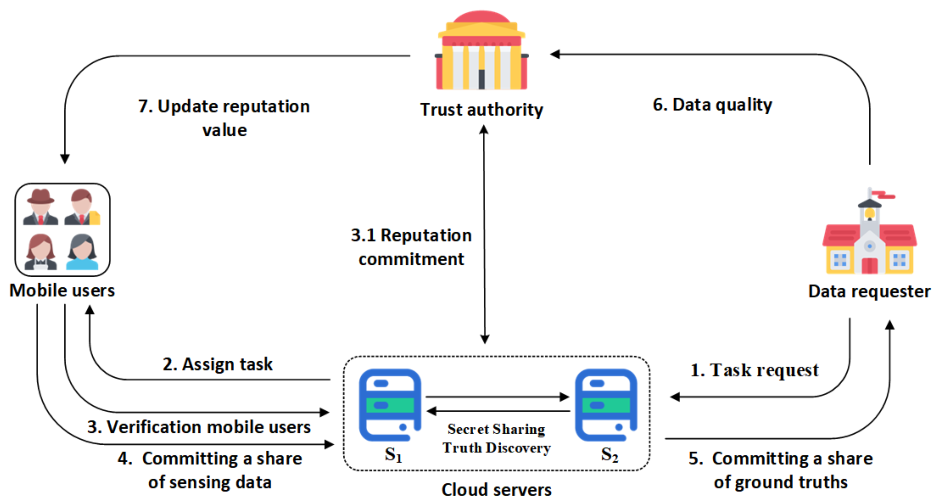
Figure 1 illustrates that the TD-RCRF system framework embraces four key entities: a trust authority (TA), a data requester, two cloud servers, and multiple mobile users. Specifically, the TA handles system initialization tasks, such as allocating reputation values to mobile users upon joining the MCS system.
The cloud server receives task requests from data requesters and subsequently distributes them to mobile users. Upon completing their assignments, users upload encrypted shares of their perceived data. To ensure data reliability, the server verifies whether users’ reputation values satisfy the task-specific credibility thresholds.
Proceeding further, the cloud servers compute the base truth shares based on the sensing data provided by users and continue iterating the process. Once the convergence condition is met, the truth shares are sent to the data requester, who uses it to assess the quality of the sensing data.
The trust authority updates the reputation values of the selected mobile users based on the data quality.
Specifically, the TD-RCRF framework includes the following steps:
Step 1 and 2. The data requester submits a task request, and the cloud server broadcasts the sensing task to mobile users.
Step 3. The cloud server verifies the mobile user’s reputation value. If it has not been tampered with and falls within the specified range, the user is selected; otherwise, they are not selected.
Step 4. Mobile users participating in the sensing task send sensing data to the cloud server.
Step 5. The cloud server collaboratively calculates the ground truth share of the sensing task. After meeting the iteration requirements, the cloud server sends the final ground truth share to the data requester.
Step 6. The data requester evaluates the quality of the mobile users’ sensing data and sends the results to a trust authority.
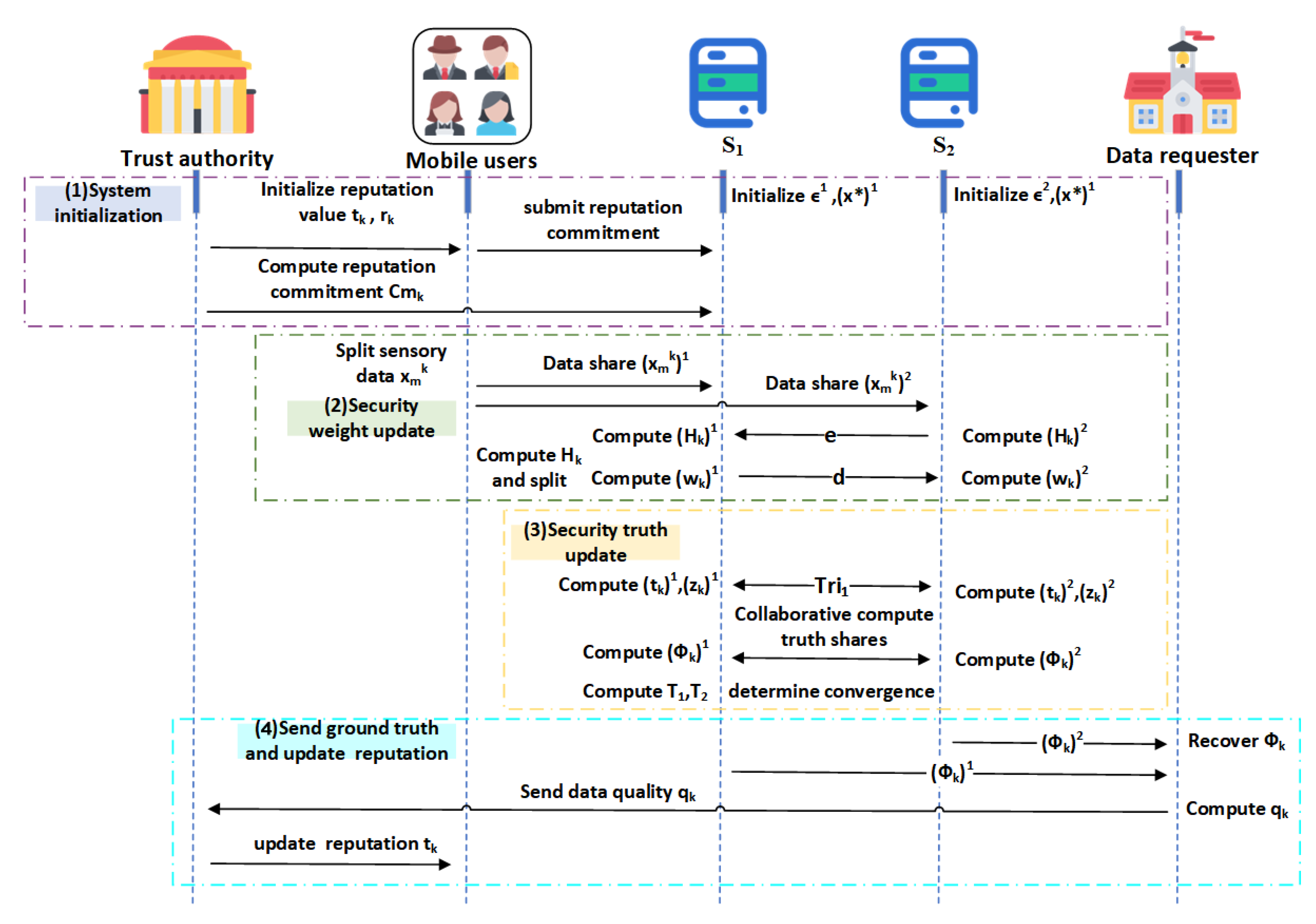
Step 7. The trust authority updates the reputation value based on the evaluation results, calculates the reputation commitment, and sends it to the user (see
Figure 2).
4.2. Security Model
The goal of privacy protection is to safeguard privacy throughout the entire process while meeting accuracy requirements. In our system, it is essential to maintain a high level of privacy for users’ perceptual data, reliability, and true estimate values. Additionally, the true values received by the query should fall within the small error margin specified by the accuracy requirements.
In practical applications, trust authorities are typically authoritative and trustworthy entities that do not collude with other entities, such as government agencies. Data requesters and cloud servers ( and ), acting as honest yet curious entities, strictly adhere to the protocol without colluding with each other or malicious entities. However, they may attempt to uncover private information related to sensing tasks and mobile users. For instance, cloud servers might try to infer users’ private data for additional benefits, deduce their identities from reputation values, or even disclose mobile users’ weight values during the truth discovery process.
Mobile users, acting as data providers, are responsible for gathering perception data. This paper posits that the majority of mobile users are honest, though a minority may resort to malicious actions. These malicious users may submit false reputation values for economic gain to meet the reputation requirements of the perception task, thereby carrying out reputation tampering attacks. Additionally, they might deduce the reputation values and perception data of other trustworthy users, thus resulting in privacy inference attacks. However, we posit that mobile users will not deliberately tamper with their perception data to undermine the system. This is because countering such threats requires user self-authentication, and current tech like zero-knowledge proof and bilinear pairings can efficiently resolve this.
4.3. Design Goals
- (1)
Privacy Goals
This study aims to construct a privacy-preserving truth discovery framework that ensures both high accuracy and stable convergence. The proposed TD-RCRF approach is expected to follow the following privacy protection objectives:
Sensing Data Privacy. The mobile user’s sensory data should not be disclosed to cloud servers and other staff, and the sensed data should not be accessible to any entity other than the mobile user themselves and the data requester.
Reputation Value Privacy. Reputation value privacy ensures that a user’s reputation cannot be exposed, deduced, or associated with their identity by untrusted entities or potential attackers.
Weighting Privacy. Weighting privacy means that adversaries do not have access to the weighting values of each mobile user.
Ground Truth Privacy. Baseline truth value privacy means that the baseline truth value information for each iteration of sensory data should not be disclosed to staff and unrelated cloud servers.
- (2)
Security Goals
The TD-RCRF scheme needs to protect the perceived data, real identity, and reputation values of mobile users by preventing inference attacks and reputation-linking attacks initiated by the data requester and the cloud server. Moreover, the TD-RCRF scheme should stop malicious users from altering their reputation values and guarantee their authenticity.
- (3)
Accuracy And Practicality
The TD-RCRF scheme generates a baseline truth value for the sensing task that should be more accurate than other existing TD frameworks. In addition, to ensure the scheme’s practical feasibility, mobile users’ communication and computational overhead needs to be minimized.
5. Design of Our Scheme
In this section, we first list the formal symbols used in the scheme. Then, we introduce the basic algorithm for constructing the TD-RCRF scheme and its main stages in order.
5.1. Basic Algorithm Construction
5.1.1. Reputation Value Verification Algorithm
To facilitate description and subsequent content,
Table 1 presents the formal symbols of the TD-RCRF scheme.
A zero-knowledge proof typically involves two participants: a prover and a verifier. The prover demonstrates to the verifier possession of knowledge regarding message n without disclosing additional details about it. This technique can be applied to verify the authenticity of a mobile user’s reputation value to determine if it has been tampered with.
Specifically in the TD-RCRF scenario, cloud server serves as the verifier, contrasting with the mobile user as the prover. The latter must demonstrate to the authenticity of their supplied reputation value , proving equivalence to , stored on . Throughout this process, the prover does not reveal the reputation value . Based on the above definitions, we construct the basic structure of the RVVA algorithm based on the DLP and DDH problems.
We let be the four security parameters, and let be a cyclic group of order p, where p is a large prime number and is an element in . Further, let be an element in the generating group , which will prevent the mobile user from getting the discrete logarithm with as the base, the discrete logarithm of with as the base, the discrete logarithm of with as the base, and the discrete logarithm of with as the base. We assume as the reputation value assigned to the mobile user by the reputation center, and as its counterpart submitted by the same user during verification. The implementation steps are shown as follows:
- (1)
A user who wants to participate in the sensing task will choose random integers , from , , and , respectively, and then compute the commitments and , and compute the hash function of the commitments.
- (2)
These mobile users will then calculate the commitment , , , , then send to the cloud server .
- (3)
When the server receives the sent by the mobile user, will match the reputation commitment belonging to the mobile user from the reputation commitments issued by the reputation center during the system establishment phase. Per prior conditions, constitutes the mobile user’s reputation value, .
- (4)
Finally, the cloud server can determine whether a mobile user’s reputation commitment has been tampered with by using the following equation:
If the equation holds, confirms that the mobile user’s reputation value has not been tampered with and subsequently executes the privacy-preserving reputation value range proof algorithm. Conversely, the mobile user will not be selected, and the user’s perceived data will be rejected. To simplify the subsequent discussion, this paper defines the reputation verification algorithm as RVVA, which is used to check whether the reputation value of a mobile user’s has been tampered with. We denote the reputation verification function by , where t and represent points in time, respectively, and K denotes the Kth mobile user. If the user’s reputation value is verified, the function RVVA (k, t, t′) returns a value of 1. Conversely, if the reputation value is not verified, the return value is 0.
5.1.2. Multiplicative Secret Resharing Algorithm
We introduce two novel algorithms, MSRA and ASRA, for switching sharing secrets between multiplicative secret sharing (MSS) and additive secret sharing (ASS). In this section, we specify the multiplicative secret resharing algorithm. We need to execute the truth discovery algorithm on two cloud servers, each of which owns only a partial share of the user-aware data. The execution of truth discovery algorithms requires secure addition, multiplication, division, and logarithmic operations. While additive secret-sharing algorithms enable secure addition and multiplication operations, division and logarithmic operations are difficult to perform, relying solely on additive secret-sharing techniques.
Multiplicative secret resharing is a method of converting shared secrets on MSS to shared secrets on ASS, much like the idea of multiplicative secret sharing, which is essentially arithmetic , where the input to each server is . Multiplicative secret resharing is essentially the computation , where the input to each server is . The outputs of these two parties are isomorphic, and in terms of the server’s inputs, can be thought of as , and as .
In this scenario, server , in this case, has and instead of and , and the assignment of Beaver triples needs to be adjusted. Specifically, the generated Beaver triples are , and c. The value c is assigned in the usual way in the offline phase through additive secret sharing. However, the values a and b will be assigned to and , respectively, instead of being shared.
For , the user holds and and wants to obtain and , i.e., has , a, and , and has , b, and . As shown in Algorithm 1, will first compute , which can be regarded as a in the ternary, and will compute . Then, the two servers interact with the values of d and e. computes and computes , which can be regarded as the triad . This step can be considered as in the triad.
5.1.3. Additive Secret Resharing Algorithm
The additive secret resharing algorithm can be considered as an inverse process of multiplicative secret resharing, where the Beaver triples are distributed in the same way as in Algorithm 1. As shown in Algorithm 2, firstly, cloud servers
and
compute
and we let server
compute so that e can be recovered by the equation
. When
receives e, sent by
, the share of
can be recovered by calculating
, and the other value can be recovered by
. Finally,
receives d and computes
.
| Algorithm 2 Multiplication Secret Resharing Protocol |
| Input: Shared secret over MSS. Beaver triple: , where . The value a is shared by ASS, meanwhile a is held by and b is held by . |
| Output: Shared secret over ASS such that . |
- 1:
computes . - 2:
computes . - 3:
sends d to . - 4:
sends e to . - 5:
computes . - 6:
computes . - 7:
Return.
|
5.2. Main Phases of TD-RCRF
System setup phase: Whenever a new user enters the system, the reputation center computes a reputation commitment. During system initialization, a reputation commitment is computed by the reputation center for each newly registered user , where the reputation value and a random number , and then the reputation center sends to over a secure channel to deliver the securely to the cloud server . The data requester initializes the truth discovery threshold , the reputation threshold , the number of mobile users K required to limit the tasks, and the baseline truth value . The truth discovery threshold , the baseline truth value , and the reputation threshold are divided into two shares, , respectively, using the additive secret sharing scheme . The shares are then submitted to the cloud server , respectively (we assume that all tasks have a reputation value of ).
The initial baseline truth is generated and provided by the data requester during system initialization. The data requester randomly determines the initial value, which is then split into two additive shares and and sent to cloud servers and , respectively. The truth discovery algorithm starts from this initial value and iterates until convergence.
- (1)
Task request submission and sensing task allocation
The data requester generates M sensing tasks with a unique identifier for each task and divides the tasks into shares via the secret sharing scheme . Then, the sets and are sent over a secure channel to cloud servers and , respectively, and is sent to the reputation center TA. Finally, the server broadcasts the share of the perceived task to the mobile user that wants to participate in the task.
- (2)
Verify and select mobile users
When these users receive the sensing task shares
, they can sum the corresponding shares to obtain
according to the nature of additive secret sharing. Firstly, mobile users need to compute
, and
, where
,
. Next, mobile user
computes
, where
. Finally,
will submit
to the server
. Then, the cloud server
can verify the commitment
via Equation (
4), where
is the reputation value submitted by the mobile user and
if the reputation value has not been tampered with.
For K users, when the reputation verification algorithm , it indicates that all users have passed the reputation verification. In this case, the cloud server will send a set containing the identifiers of all verified mobile users to the reputation center (TA). Next, the reputation center will send the corresponding user’s reputation value to the server in the form of a share. Upon receiving the reputation value share, the server can invoke the reputation value range comparison algorithm designed by MSRA and ASRA to verify that the user’s reputation value meets the range requirements of the sensing task. Specifically, Algorithm 3 shows in detail the process of reputation value tampering detection and range verification.
| Algorithm 3 Reputation tampering detection and range proofing |
| Input: , Shared secret , and . |
| Output: 1 if , 0 if . |
- 1:
Mobile user - 2:
for do - 3:
Select random integers and - 4:
Compute , and - 5:
Compute and - 6:
Send to - 7:
for do - 8:
Compute - 9:
for do - 10:
if then sends to the TA - 11:
TA: Obtains reputation value of K mobile users from the database - 12:
Splitting the user’s reputation value into two shares through - 13:
TA sends to - 14:
: computes - 16:
computes - 16:
and collaboratively compute , - 17:
and reveal the signs of and - 18:
if or then Return 0. - 19:
else if or then Return 0. - 20:
else Return 1. - 21:
end if
|
- (3)
Submission of sensing data
When the user passes the reputation value tampering and range verification, the user senses the data of the task and uploads the data. Each user also splits the sensed value into two copies via the additive secret sharing scheme . Each user , in addition to encrypting the sensed data, randomly generates two multiplicative triples and , divides them into two-part shares using , and divides into two-part shares. Finally, the user generates a random unique identifier , submits the share to the cloud server via a secure channel, and sends to the cloud server and to the cloud server , respectively.
- (4)
Perform truth discovery and send baseline truth values
- (1)
Security weight update on the cloud server side
Based on the initialized truth shares , each cloud server can now update the weights of each user accordingly. The cloud server first calculates the difference share of the user-perceived values , and then calculates the sum of the difference shares of all user-perceived values , after which invokes the secure division protocol shown in Algorithm 4 and secure logarithmic protocol shown in Algorithm 5.
| Algorithm 4 Secure division protocol |
| Input: Shared secrets and public integers 1,−1. |
| Output: Shared secret such that . |
- 1:
and collaboratively compute and . - 2:
computes . - 3:
computes . - 4:
and collaboratively compute . - 5:
Return.
|
| Algorithm 5 Secure logarithm protocol |
| Input: Shared secret and public base number e. |
| Output: Shared secret such that . |
- 1:
and collaboratively compute . - 2:
computes . - 3:
computes . - 4:
Return.
|
The cloud server finally gets the weight share with weight .
- (2)
Secure truth updates on the cloud server side
In the truth update phase, each cloud server
only has the weighted value share, i.e.,
, and the perceived value share, i.e.,
, for each user’s
. We need to invoke the triad M to compute the weighted value share of each user
:
. Based on the share of perceived values of all users
,
can compute the share of the weighted sum of the perceived values
as follows:
The two cloud servers will use the values submitted by each user as the operands in this multiplication operation. The cloud server will denote the share of the weight sum as and use the secure addition resharing protocol AddSecRes , the secure multiplication resharing protocol , and the secure division protocol to compute the baseline truth value , as shown in Algorithm 6 and Algorithm 7:
| Algorithm 6 Secure division protocol |
| Input: Shared secrets and public integers 1,−1. |
| Output: Shared secret such that . |
- 1:
and collaboratively compute and . - 2:
computes . - 3:
computes . - 4:
and collaboratively compute . - 5:
Return.
|
Cloud server finally gets the benchmark truth share , first cloud servers and compute , , respectively, and then the two servers run the comparison protocol SecCom , collaboratively. If the output is 1, then it is decided that , and the servers will send the shares and as well as and to the data requesters, respectively. If the output is 0, then it is decided that or . At this point, the servers will continue the iterative computation until the truth value converges. The truth shares can recover the baseline truth value .
| Algorithm 7 Secure comparison protocol |
| Input: Shared secrets and . |
| Output: If , return 1; if or , return 0. |
- 1:
computes . - 2:
computes . - 3:
and collaboratively compute . - 4:
and reveal the signs of and . - 5:
if or then - 6:
Return 1. - 7:
else - 8:
Return 0. - 9:
end if
|
- (5)
Assessment of data quality
The data requester receives
, obtains the final baseline truth value
, and evaluates the submitted sensed data
. The requester calculates the difference between
and
:
. Here,
is used to measure the similarity between the two data
and
, where a smaller
means that the two data are more similar, and then calculate the quality of the sensed data
[
28], as follows:
Here, serves as a tunable constant governing sensed data quality deviation, with the full evaluation logic formalized in Algorithm 8.
| Algorithm 8 Quality evaluation |
| Require: Input: , and . |
| Ensure: Output: Data quality set . |
- 1:
for do - 2:
for do - 3:
; - 4:
end for - 5:
; - 6:
end for - 7:
Return .
|
Finally, the data requester sends to the TA.
- (6)
Renewal of reputation value After the TA receives
, it updates the reputation value of the mobile user according to the reputation update algorithm, which has the process of updating [
29]
The reputation update algorithm takes . Then, . The detailed process of reputation update is shown in Algorithm 9. Finally, the TA sends the updated reputation value to the user .
| Algorithm 9 Reputation update |
| Require: Input: . |
| Ensure: Output: Reputation values . |
- 1:
Set initial reputation value as ; - 2:
for do - 3:
for do - 4:
; ; - 5:
end for - 6:
end for - 7:
Return .
|
6. Security Definition and Proof
This section proves the security and feasibility of the algorithms and protocols in the TD-RCRF scheme.
6.1. Privacy Analysis
6.1.1. Reputational Value Privacy
Theorem 1. As the reputation value is encapsulated through a commitment exchanged between user and the trusted authority (TA), the TD-RCRF framework ensures that this value remains confidential. That is, no probabilistic polynomial-time (PPT) adversary A is able to infer or extract user ’s reputation.
Proof. If any PPT adversary A attempts to reveal the reputation value of the mobile user through the reputation commitments and , A must make these commitments public. Further, we need to consider two different scenarios:
1. Once attacker A acquires the reputation commitment
, any
and a randomly and uniformly chosen
,
is uniformly distributed over the finite field
. When
is chosen by adversary A to uncommit
, and
, we can compute
Assuming that the attacker A has access to the reputation value , then theoretically, A will be able to compute . However, according to the analysis, in the framework of Pedersen’s commitment, A can neither know nor solve for . Based on this assertion, A is unable to derive from the reputation commitment when is not equal to . Similarly, if A has access to another reputation commitment , we can also conclude that A is similarly unable to expose the reputation value from .
2. Suppose that the attacker A has obtained the reputation commitments
and
and satisfies the condition
, but
. In this case, A can compute
. Considering that
is an element of the modulo
p multiplicative group
and that
are both elements of the
generating group, we can assume that
, where
and
are both elements in
, can then be computed as follows:
Define , and such that we have . Since r does not contain any information related to the reputation value , even if the attacker A knows r, they will not be able to obtain any information about from it. Furthermore, when A has r and wishes to derive t, they will need to solve the logarithmic problem . However, based on the literature, attacker A can neither determine nor solve the logarithmic problem in Pedersen’s commitment, i.e., . As a result, A is not able to resolve the reputation values and from the sum of the reputation commitments and . Similarly, A is not able to expose the reputation threshold value . □
6.1.2. Sensing Data Privacy and Weighting Privacy
In this scheme, the sensing data and weights of the mobile user are privacy-preserving.
Proof. For and , only a uniform random share of the sensory data can be obtained. Assuming that the participants are not colluding, the cloud server cannot restore the plaintext data. The calculation of weights depends on the sensory data shares, and each server only holds a portion of the user’s sensory data and cannot perform the calculation independently. In addition, the security and simulability of this scheme have been proven. Based on Lemma 1 and Definition 1, this scheme is secure. □
6.1.3. Secret Sharing of Privacy
In this section, we prove the security of the multiplicative secret resharing algorithm (MSRA) and the additive secret resharing algorithm (ASRA) in this scheme. Suppose the attacker is allowed to corrupt only one cloud server (
or
). Then, security can be guaranteed by simply proving that for given inputs and outputs, the corrupter’s view is simulatable [
30]. Specifically, this scheme uses the following definitions and theorems.
Definition 1. Suppose that for any real-world adversary A, there exists a probabilistic polynomial-time simulator S, S that is able to simulate an ideal world view that is indistinguishable from the real-world view; then, the protocol π is considered to be UC-safe, or, in other words, it implements an ideal functional function in the UC sense of the term F. The key point in proving the UC safety of the protocol is to show that for any party (including the adversary), the incoming views consisting of messages and outputs sent by any other party are indistinguishable.
Lemma 1. Let , and consider a uniformly random element that is independent of x. Under this condition, the value preserves the uniform distribution over and remains statistically independent from x [31]. Lemma 2. In the case where the nonzero element r is uniformly distributed and independent of x, for any nonzero element , the nonzero element is uniformly distributed and independent of x [32]. Proof. Suppose there exists a nonzero element that has the property of being uniformly distributed and independent of all the elements x in the set. Then, the product also has the property of being uniformly distributed. This is because the mapping function is a bilinear mapping of the group . □
To further enhance the security analysis of the proposed scheme, we provide explicit simulation-based proof sketches for its core components. The simulator construction formally demonstrates that each component does not disclose any private information beyond the final output, thereby ensuring the privacy and security of the entire protocol.
Simulator for MSRA: The simulator generates random shares that are computationally indistinguishable from real shares. Since all intermediate values are uniformly distributed and independent, no information about private inputs is leaked.
Simulator for ASRA: The simulator produces valid additive and multiplicative shares without accessing any private data. Due to the security of secret sharing, the view of the simulator is identical to that of the real protocol.
Simulator for Weight Update: The simulator computes weighted values using only public information. All internal values are randomized, so privacy is preserved.
Simulator for Truth Update: The simulator simulates aggregation operations under secret sharing. No private information is disclosed during the whole procedure.
6.1.4. Security of the Multiplicative Secret Resharing Algorithm
Algorithm 2 exhibits correctness in a model based on the honest-but-curious principle and ensures that it is UC-safe.
Proof. To verify its safety, given that the participants
or
in Algorithm 2 are equivalently symmetric, it suffices to argue that the view of
is simulatable.
receives an input
and produces an output
, where
, and
. Given that the values
b and
are both uniformly distributed and independent of any private input, it is perfectly feasible to construct a perfect simulator for
according to Lemma 1. Correctness is given by the following equation:
□
6.1.5. Security of the Additive Secret Resharing Algorithm
Algorithm 10 is correct and UC-safe in the honest-but-curious model.
| Algorithm 10 Additive secret resharing algorithm |
| Input: Additive secret over ASS. Beaver triple: , where . The value a is shared by ASS, meanwhile a is held by and b is held by . |
| Output: Shared secret over MSS such that . |
- 1:
computes . - 2:
sends to . - 3:
computes . - 4:
sends . - 5:
computes . - 6:
Return .
|
Proof. To prove the security of ASRA, we must show views of participants
and
can be modeled. For
, its incoming view is
and
. For
, its incoming view is
, where
. Since parameters
follow a uniform distribution and are independent of private inputs, according to Lemmas 1 and 2, the incoming views of both
and
can be simulated. Similarly, their output views can also be simulated. The correctness is verified by the following equation:
□
6.2. Security Analysis
Given that the reputation authority TA and the mobile user establish interactions with the cloud server through reputation commitment, attacker A can neither deduce the reputation value of in the TD-RCRF nor tamper with it. This shows that the TD-RCRF is resilient to reputation inference and tampering attacks.
Proof. The reputation value of user is embedded in the reputation commitments and , , and although adversary A is able to capture the commitments and by listening to the wireless channel, they are unable to extract any specific information about the reputation value from it according to Theorem 1. Therefore, TD-RCRF shows its effectiveness in defending against reputation inference attacks. In addition, if a malicious user manipulates the reputation value when calculating the reputation commitment , the cloud server will reject the sensing data submitted by them, as these data cannot pass the verification mechanism. This shows that TD-RCRF is effective in defending against reputation tampering attacks. □
6.3. Nature Analysis
In this section, we provide an exhaustive analysis of the accuracy, completeness, and zero-knowledge proof of the RVVA algorithm.
A mobile user can pass the reputation verification process only if the two reputation commitments and contain the same reputation value (i.e., is equal to ), which verifies the correctness of the RVVA algorithm.
Proof. In this algorithm, the user will calculate and later send it to the cloud server , where
The cloud server
can receive the
sent by the reputation center and then calculate and verify whether it is valid for both sides of Equation (
4). The specific verification process is shown in Equation (
13):
According to Equation (
13), we learn that
only if
is equal to
, thus allowing user
to successfully pass the reputation verification. This proves the accuracy of the RVVA algorithm.
□
In the reputation verification phase, the attacker A cannot learn anything about the reputation values and from the two reputation commitments and . This point proves that the RVVA algorithm has the zero-knowledge property.
Proof. Suppose that A is a potential attacker, is an element of large prime order in , and is an element in the generating group of . A is able to be informed of the commitments and of the reputation value ; however, according to Theorem 1, A is unable to derive any information about and from these two commitments. This shows that the RVVA algorithm achieves zero-knowledge verification. □
7. Performance Evaluation
In this section, we first introduce the experimental setup and parameter configuration. Then, we analyze and evaluate the performance of the algorithm in TD-RCRF, including computational and communication overhead. Finally, we assess the truth discovery and reputation update mechanisms, benchmarking them against state-of-the-art approaches.
All hash operations in the proposed scheme are implemented using the SHA-256 cryptographic hash function, which provides strong collision resistance for security. We empirically validate TD-RCRF’s efficacy through Python 3.8 experiments, benchmarking performance on an Intel(R) Core(TM) i5-8300H CPU @2.30GHz with 16.00 GB RAM. Experiments are run on 64-bit Windows 10. Secret sharing secures data exchanges among entities (e.g., cloud servers) and requesters. Execution times appear in
Table 2.
In TD-RCRF, the disclosure parameter p and the output of the hash function are both 64 bits in length, denoted by . Meanwhile, the sequence index m, ground truth , sensed value , and user identity are all fixed-size elements represented using 32-bit values, i.e., .
7.1. Performance of the RVVA Algorithm
In this section, we will analyze the computational cost and communication overhead of RVVA one by one.
7.1.1. Computation Overhead
To prevent reputation forgery by dishonest mobile users, TD-RCRF adopts the RVVA protocol, which ensures data integrity and filters valid contributors. Within this framework, when K users are involved, performs K hash checks, incurring a computational load of and a total runtime of 0.6 Kms. Meanwhile, each user completes a sequence of four exponentiations, two multiplications, and one hash operation, amounting to a cost of 4 + 2 + and a runtime of 42.03 ms. Accordingly, the time complexity of under RVVA is O(K).
7.1.2. Communication Overhead
Under the RVVA protocol, each user transmits to server , which checks the integrity of the user’s reputation value. This verification is performed for all K users. Once all users successfully pass the check, forwards the set to the TA. Based on this process, the message sizes are calculated as bits for and bits per .
7.2. TD-RCRF Performance
7.2.1. Computational Overhead
Initialization phase. Mobile user first computes a reputation commitment using two exponentiations and one multiplication, incurring a cost of 2 + . To assist the TA in verifying the integrity of its reputation value, then performs an additional four exponentiations, two multiplications, and one hash operation, contributing 4 + 2 + to the total. Following this, they apply secret sharing to divide sensing data and a multiplication triple into two parts, consuming approximately 0.1 ms. In total, ’s computational overhead in this phase is 4 + 2 + + 0.1 ms. Cloud server authenticates K users by executing K hash generations, with a total cost of . As does not participate in this phase, it incurs no computational load.
Truth discovery phase. For the mobile user , the user generates two multiplicative triples and divides the triples and the sensory data into two shares by means of the additive secret sharing scheme and sends them to the two servers, respectively, with a computational overhead of 1.6 ms.
For the cloud servers, due to the use of the additive secret sharing technique, the operations completed on the two servers are the same, so only computing one server’s computational overhead is sufficient. In the weight update phase, needs to call the AddSecRes algorithm three times and the MulSecRes algorithm once, and after one multiplication operation, the computational overhead is 3 + + . In the truth update phase, server needs to call the AddSecRes algorithm three times and MulSecRes once, and then perform one multiplication operation and one multiplication ternary operation, with a computational overhead of 3 + + + .
To enhance the credibility of the experimental results,
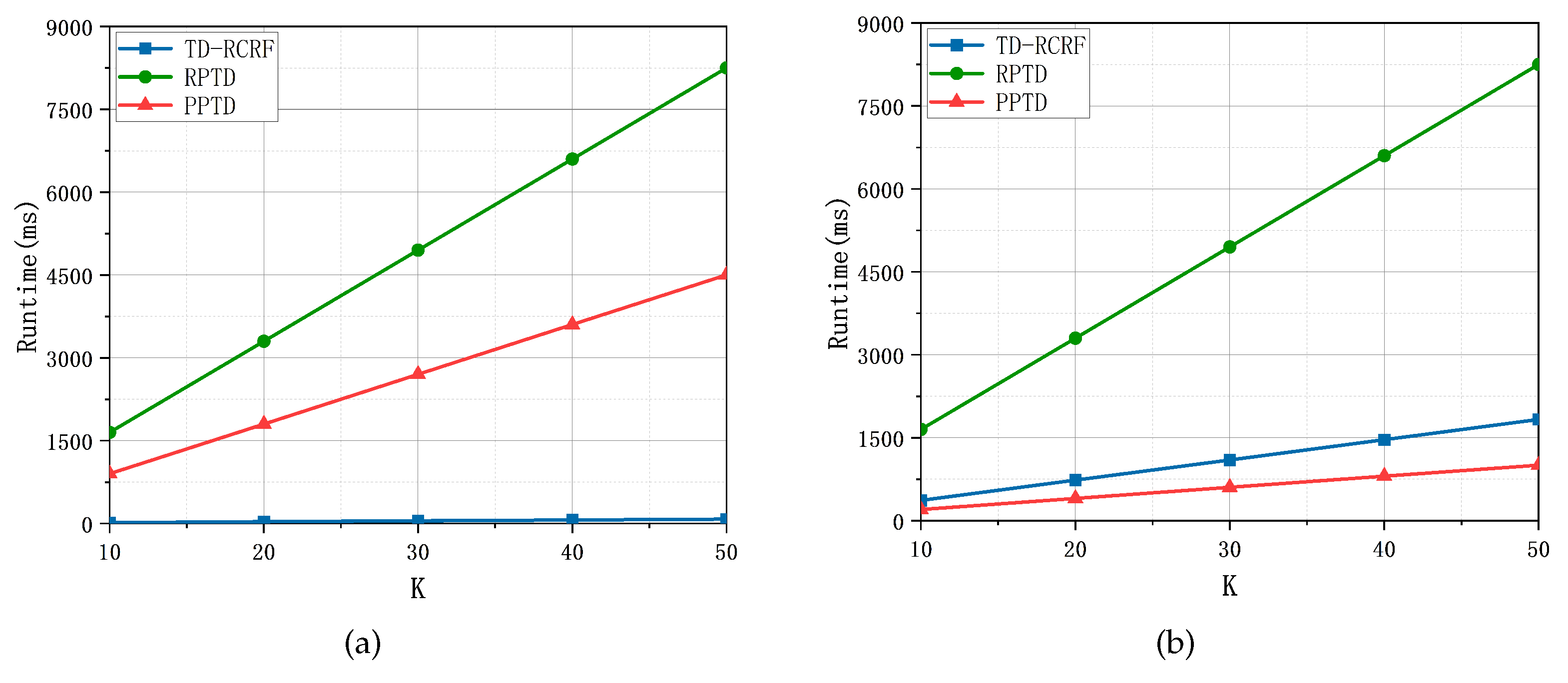
Figure 3 illustrates the runtime comparison for mobile user
and cloud servers (
,
) under TD-RCRF, PPTD, and RPTD. As shown, increasing
K leads to higher execution times for both users and servers. When
, the runtimes of
are 16 ms, 900.6 ms, and 1650.4 ms under TD-RCRF, PPTD, and RPTD, respectively, indicating TD-RCRF significantly reduces the user’s computational delay. For cloud servers, the corresponding runtimes are 366.2 ms (TD-RCRF), 200.9 ms (PPTD), and 1650.4 ms (RPTD). The improved efficiency of TD-RCRF stems from offloading more computation to the cloud, which typically has a greater processing capacity than mobile clients.
7.2.2. Communication Overhead
Initialization phase: Mobile user transmits the task set to , requiring bits. Subsequently, they submit the set , contributing an additional bits. Hence, the user’s total communication burden during this phase equals . As for cloud server , it first broadcasts to users, and then forwards relevant information to the TA, amounting to a total transmission load of . Server , which dispatches a duplicate share of , incurs a communication cost of in this stage.
Truth discovery phase. The mobile user transmits two multiplicative triples, and , to cloud servers and . Given that each element in a triple is 64 bits, the total size per triple is 192 bits, yielding a communication cost of 0.0469 KB for . During the weight update phase, the servers exchange aggregated values once, incurring 0.0624 KB of overhead. In the truth update phase, the servers perform four rounds of sum exchange and share and , resulting in a cost of 0.078 KB. Thus, the cumulative communication burden on and throughout the truth discovery stage amounts to 0.1404 KB.
To strengthen the credibility of our experimental findings,
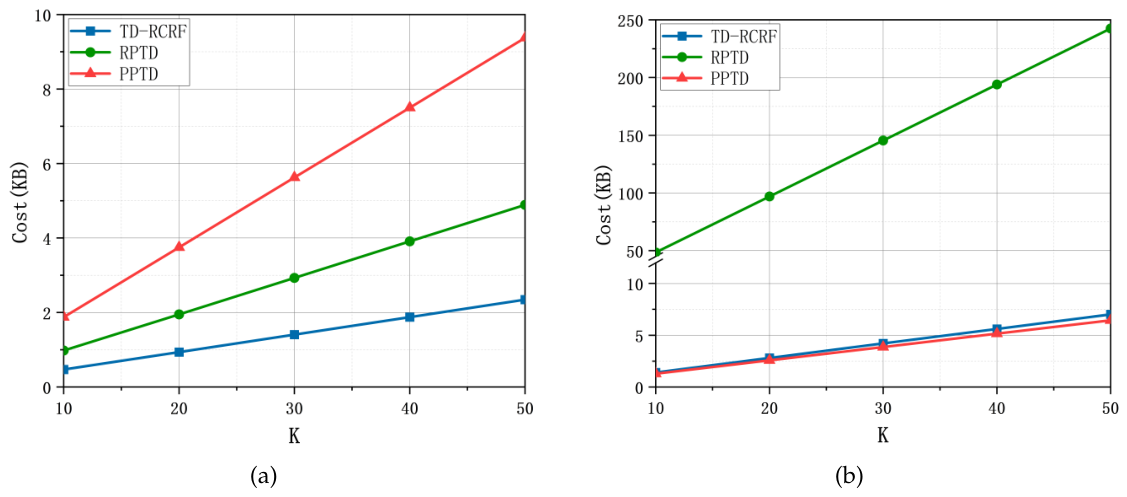
Figure 4 presents a comparative analysis of the communication costs incurred by mobile user
and cloud servers (
,
) across TD-RCRF, PPTD, and RPTD. As
K increases, both user-side and server-side overheads exhibit a rising trend. Notably, TD-RCRF shows a clear advantage in user communication cost compared to the other schemes. For instance, when
, the overhead for
in TD-RCRF, PPTD, and RPTD is 0.469 KB, 1.875 KB, and 0.98 KB, respectively. Similarly, the server communication costs for TD-RCRF, PPTD, and RPTD are 1.404 KB, 1.29 KB, and 48.5 KB, respectively. These results demonstrate that TD-RCRF achieves significantly lower communication overhead for both users and cloud entities compared to PPTD and RPTD.
7.3. Performance of Truth Discovery in TD-RCRF
7.3.1. Weighting of Mobile Users
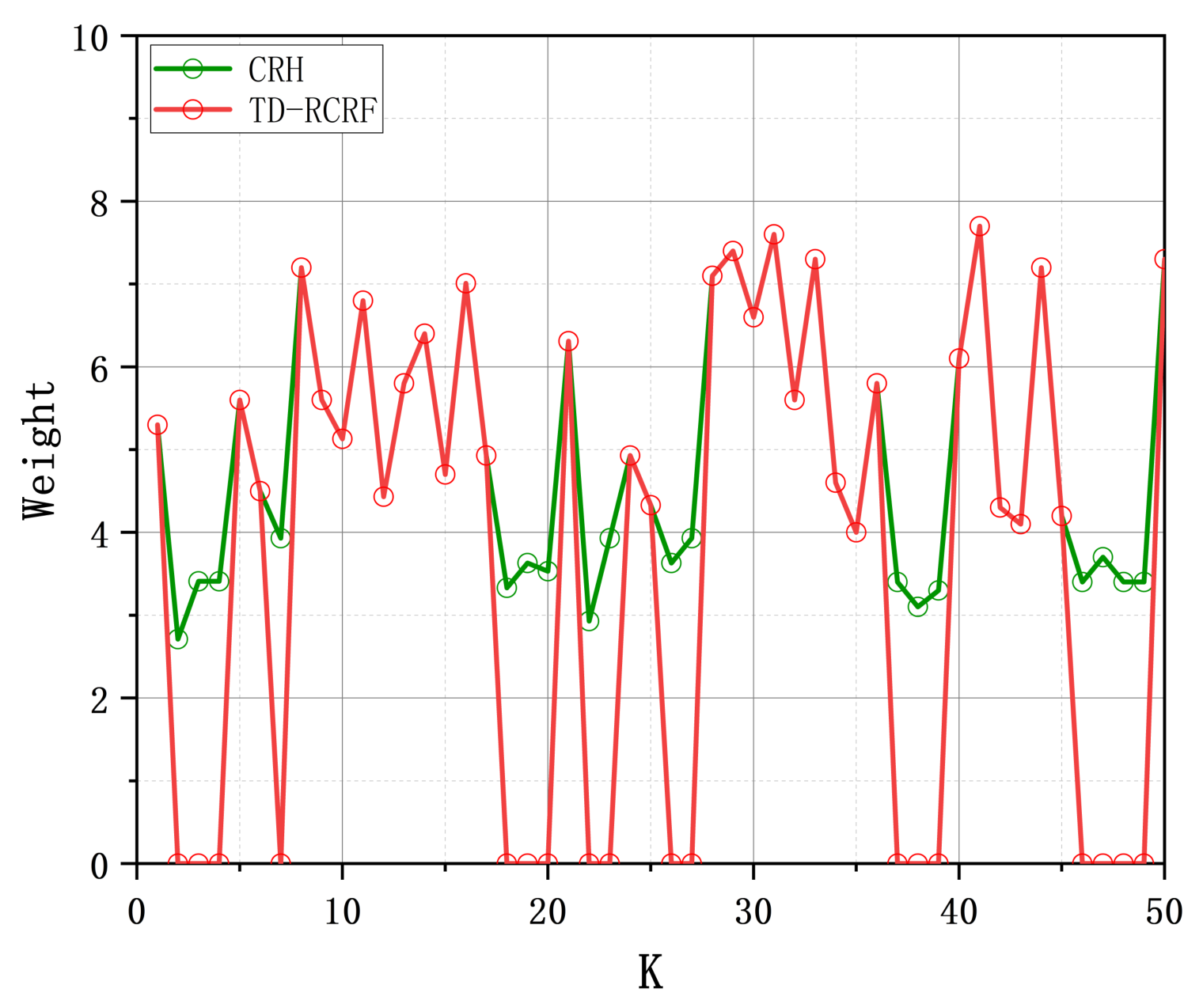
The TD-RCRF begins by selecting trustworthy workers through a reputation-based filtering mechanism, which enhances the precision of estimating the truth value in sensing tasks. In contrast, classical truth discovery approaches like CRH derive truth estimates directly from raw sensing inputs and user-assigned weights, where these weights are themselves inferred from the sensing data. Since both TD-RCRF and CRH perform truth estimation, we analyze and contrast their respective user weighting mechanisms. As illustrated in
Figure 5, when a participant fails to meet the predefined reputation threshold, their assigned weight in TD-RCRF is reduced to zero, and the user is excluded from further computation. Here,
.
7.3.2. Efficiency Assessment
This study utilizes synthetic datasets for experimentation. In particular, the sensing readings from clients follow a normal distribution. The parameters for the count of workers or sensing tasks are chosen to be comparable in scale to those used in CRH [
33] and previous research. These parameters reflect real-world crowdsourced sensing deployments like urban environmental monitoring (e.g., air quality/noise), where participant counts typically range in the tens. Our evaluation benchmarks truth discovery (TD) efficiency through computational overhead and accuracy against CRH. For statistical significance, 500 comparative TD sessions were executed for TD-RCRF and CRH, with their mean outcomes illustrated in
Figure 6 and
Figure 7.
As illustrated in
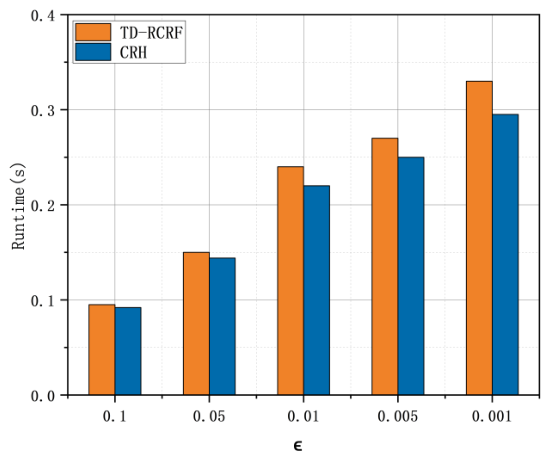
Figure 6, the runtimes of both TD-RCRF and CRH decrease as
increases, with
. TD-RCRF incurs a slightly longer runtime than CRH, mainly due to its integration of mobile users’ reputation factors, though both remain within the same order of magnitude. In particular, TD-RCRF and CRH require 0.246 s and 0.214 s, respectively, indicating a 13% improvement by TD-RCRF when
.
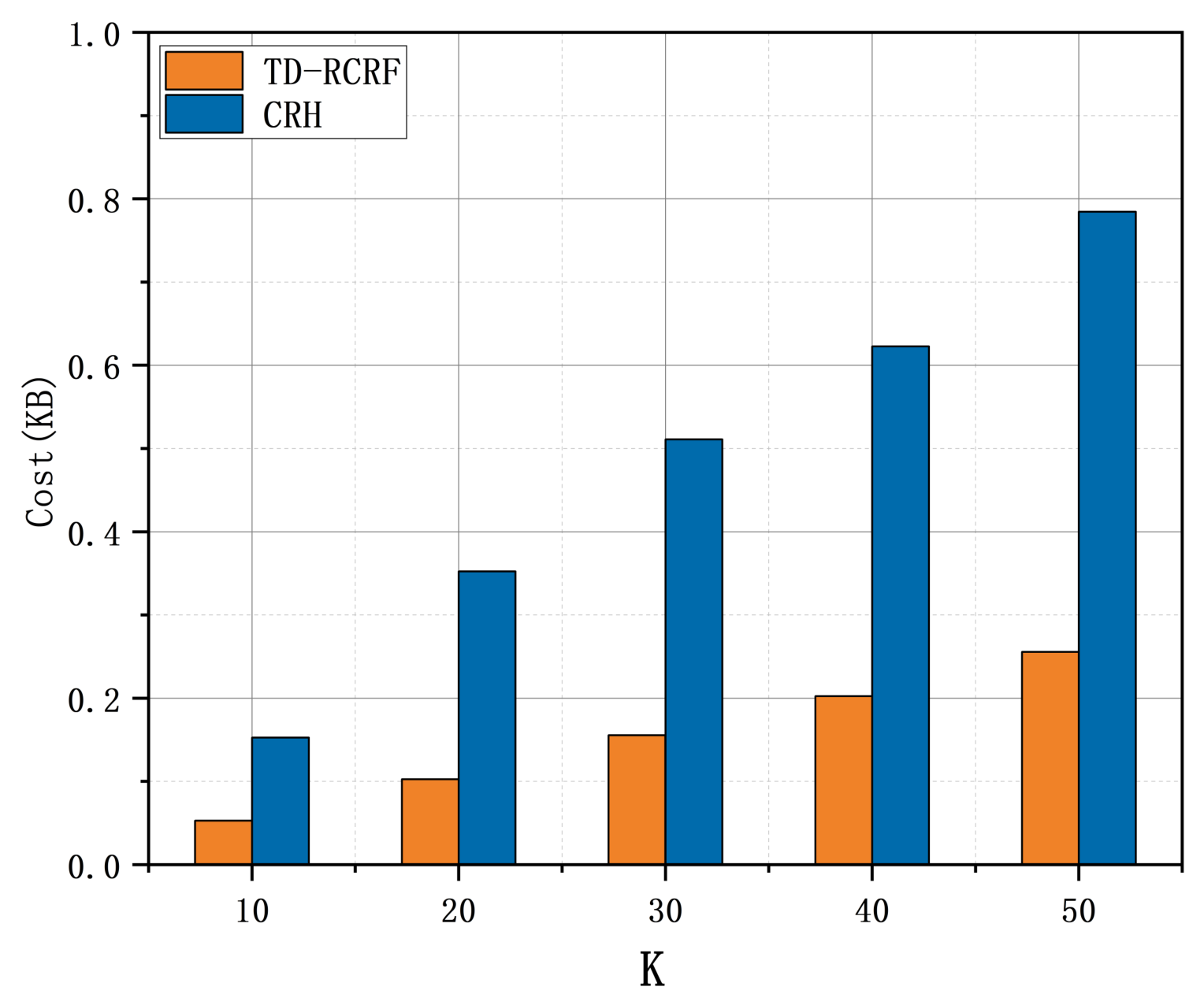
Figure 7 shows that computational cost rises with increasing
K in both schemes, under the assumption that sensory data has a bit-length of 32 and
. Notably, CRH aggregates more user data since it considers the total number of subscribers linked to the K mobile users, rather than a direct count of K users. This leads to TD-RCRF consistently incurring lower communication overhead than CRH. For example, when
, the communication cost for TD-RCRF is 0.109 KB compared to 0.338 KB in CRH, representing a 67.8% reduction.
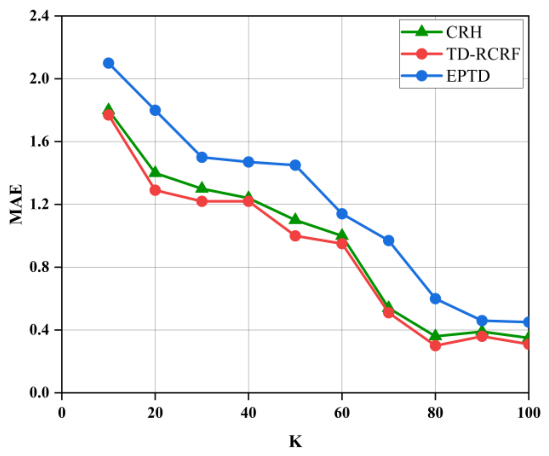
Accuracy MAE. From
Figure 8, it can be seen that in TD-RCRF and CRH, when
is certain and K increases, the MAE decreases gradually. And with the change in K, the MAE of TD-RCRF is always smaller or equal to the MAE of CRH.
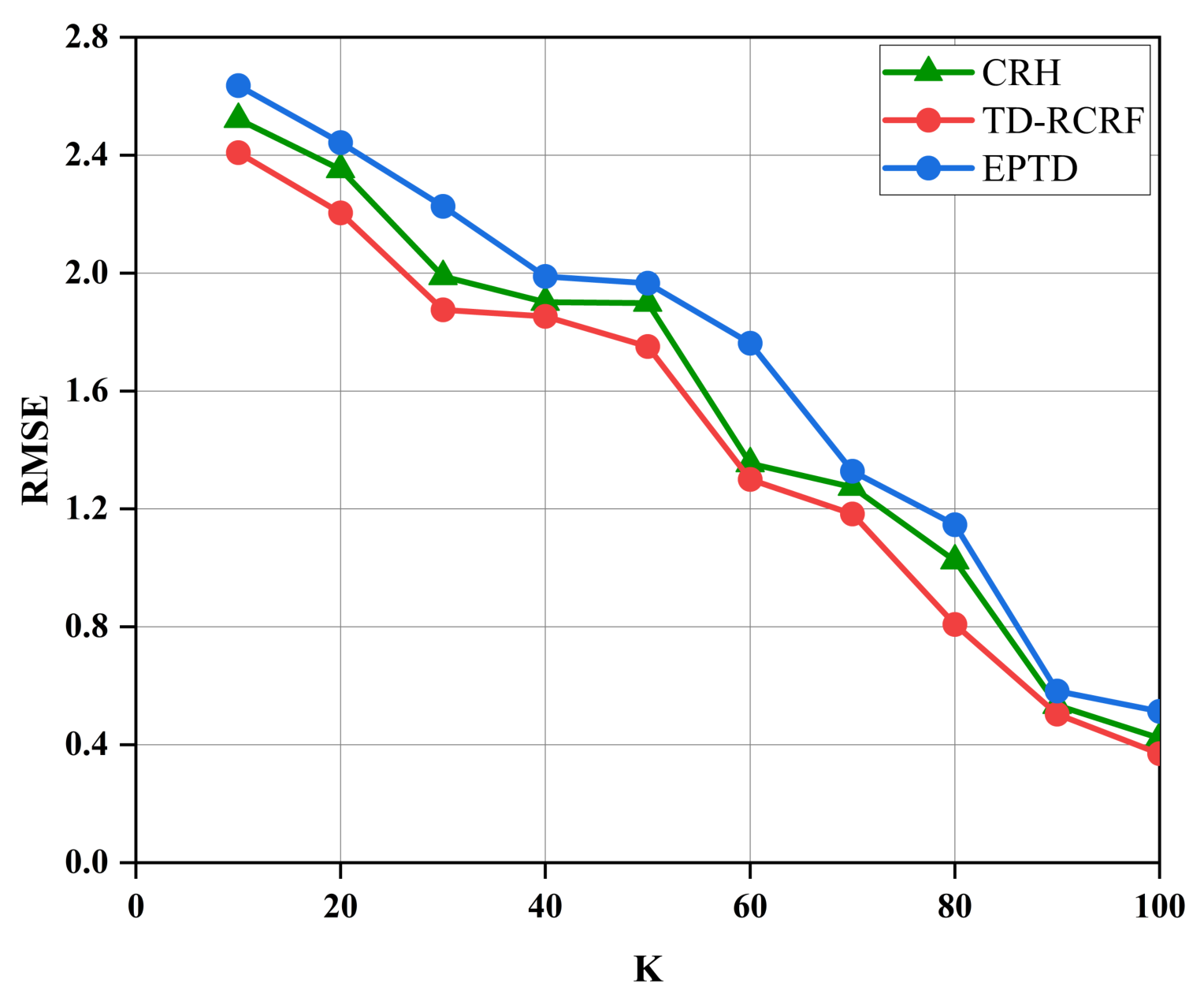
Accuracy RMSE. From
Figure 9, it can be seen that in TD-RCRF and CRH, when
is constant and K increases, the RMSE decreases gradually. And, with the change in K, the RMSE of TD-RCRF is always smaller than the RMSE of CRH.
8. Conclusions
In this paper, we propose a privacy-preserving secret sharing-based truth discovery framework. The scheme can be widely applied to various mobile crowdsensing scenarios. We adopt secret sharing to protect the privacy of sensing data and weights, utilize the Pedersen commitment mechanism to protect the privacy of reputation values, and enhance the accuracy of truth discovery by screening highly reputable users. Meanwhile, the scheme uses a dual-cloud architecture to cooperate with the calculation of truth, reducing the computational and communication burden on the user side. Theoretical analysis and experimental evaluation show that the scheme performs well in terms of privacy protection and computing efficiency, and is a safe and reliable scheme.
In the future, our research will focus on two forward-looking directions. First, we will extend the existing scheme to edge computing environments to reduce the impact of network instability on privacy data aggregation. Second, we will design a lighter privacy protection scheme to reduce the computation and communication costs for mobile users, making it more suitable for resource-constrained devices and applications with high real-time requirements.