Article

A Traversal-Aware Hybrid ACO Framework Integrating JPS and GA for Optimized Path Planning of Obstacle-Crossing Robots

School of Mechanical Engineering, Hubei University of Technology, Wuhan 430068, China
*
Author to whom correspondence should be addressed.
Mathematics 2026, 14(9), 1461; https://doi.org/10.3390/math14091461
Submission received: 25 March 2026 / Revised: 19 April 2026 / Accepted: 23 April 2026 / Published: 26 April 2026

Abstract

To address the lack of traversable region awareness in conventional path planning algorithms for obstacle-crossing robots, an adaptive path planning method is proposed. First, a traversal-aware environment model is constructed by introducing graded traversable regions with associated physical traversal costs. To effectively navigate this complex model, a hybrid Ant Colony Optimization (ACO) framework integrating Jump Point Search (JPS) and the Genetic Algorithm (GA) is developed. Specifically, a JPS-inspired pruning strategy is incorporated into the state transition process to significantly reduce redundant node expansion. Crucially, genetic operators—namely crossover and mutation—are embedded within the main ACO iterative loop to dynamically sustain population diversity and effectively mitigate stagnation in local optima. Correspondingly, the pheromone initialization, state transition mechanisms, and update rules are redesigned to incorporate the robot’s obstacle traversal capabilities. The framework is further complemented by path optimization operations that reduce unnecessary turning points. Extensive simulation experiments demonstrate that the proposed method outperforms conventional ACO-based and classical path planning algorithms. In particular, it achieves an average reduction of 11.1% in path length and 65.5% in the number of waypoints, while ensuring effective coordination with the robot’s physical traversal capabilities. These results validate the superior search efficiency, robustness, and practical applicability of the proposed approach.

1. Introduction

Path planning is a fundamental technology for enabling mobile robots to navigate autonomously. Classic graph-based algorithms, such as Dijkstra [1], provide optimal shortest paths, while sampling-based methods, including RRT [2] and RRT* [3], offer efficient exploration in high-dimensional spaces. Potential field approaches [4] and dynamic environment methods [5] further extend path planning to real-time and time-varying scenarios. Despite these advances, most traditional algorithms are designed for flat or structured indoor environments and often fail to fully utilize the obstacle-crossing capabilities of mobile robots in complex outdoor terrains.
The Ant Colony Optimization (ACO) algorithm [6], proposed by Dorigo, has been widely applied to path planning due to its bio-inspired search strategy and adaptability. Nevertheless, classical ACO suffers from several limitations: low search efficiency, excessive turning points, and a tendency to become trapped in local optima [7].
To overcome these issues, several hybrid ACO frameworks have been proposed, integrating ACO with methods such as A*, Dijkstra, or potential field-based strategies to improve convergence speed and path feasibility. However, most of these hybrid frameworks are either loosely coupled or primarily focus on computational efficiency [8], while still overlooking the integration of obstacle-crossing adaptability and path quality metrics into the optimization objective. This represents a critical research gap in mobile robot path planning.
To address these limitations, this paper proposes a novel hybrid ACO-based path planning method that explicitly considers obstacle-crossing capabilities, path quality metrics, and robustness in high-cost environments. The proposed approach tightly integrates global ACO search with local refinement strategies, resulting in paths with higher efficiency, smoother trajectories, and fewer unnecessary turns. Furthermore, we provide a comprehensive evaluation framework—including path length, number of turning points, obstacle crossings, total cost, and iteration count—offering a more complete performance assessment than existing hybrid ACO methods.
The main work of this study is as follows:
(1)
Formulated a traversal-aware cost evaluation model that accurately quantifies the comprehensive traversal cost of complex obstacle-crossing maneuvers, encompassing both single- and double-sided traversals.
(2)
Proposed an integrated hybrid optimization framework, OC-ACO, tailored to this cost model. The framework incorporates a JPS-inspired pruning strategy to refine the search space and embeds crossover and mutation operators from the Genetic Algorithm (GA) into the ACO iterative process. This integration dynamically sustains population diversity and effectively mitigates premature convergence.
(3)
Conducted extensive simulations across varying local perception scales. The results demonstrate that the proposed framework significantly reduces comprehensive traversal costs while maintaining stable computational performance and robustness in complex, unstructured environments.

2. Materials and Methods

2.1. Introduction to the Ant Colony Optimization

Ant Colony Optimization (ACO), proposed by Marco Dorigo et al. in 1992 [6], is a swarm intelligence optimization algorithm inspired by the foraging behavior of real ant colonies in nature. During the process of searching for food, ants deposit a chemical substance known as “pheromone” along their paths [9]. Subsequent ants can perceive the concentration of this substance and exhibit a probabilistic preference for paths with higher pheromone levels [10]. Over time, pheromones accumulate faster on shorter paths compared with longer ones, ultimately guiding the entire colony to converge upon the optimal or near-optimal path. This process exemplifies the characteristics of positive feedback mechanisms and distributed computing [11].
To apply this to discrete optimization problems such as path planning or the Traveling Salesperson Problem (TSP), a graph theory approach is typically employed for mathematical modeling.

2.1.1. Problem Definition and Parameter Initialization

Let graph G = ( V , E ) epresent the search space of the robot, where V = { v 1 , v 2 , , v n } is the set of nodes (i.e., discretized grids or waypoints), n is the total number of nodes, and E is the set of edges connecting the nodes. Suppose there are m ants in the graph, and the physical distance or transition cost between node i and node j is denoted as d i j [12]. During the algorithm initialization phase ( t = 0 ), the initial pheromone concentration on all edges is typically set to an identical, exceptionally small constant, i.e., τ i j 0 = τ 0 . Concurrently, a tabu list, denoted as t a b u k k = 1 ,   2 , , m , is allocated to each ant to record the nodes that ant k has already visited, thereby preventing the formation of loops during the path search [13].

2.1.2. State Transition Rule

At time t during the iteration process, ant k located at node i needs to calculate the probability of moving to the next feasible node based on the pheromone concentration and heuristic information in the current environment. The roulette wheel selection strategy is commonly adopted. and its state transition probability p i j k t [14] is mathematically formulated as:
P i j k ( t ) = τ i j t α η i j t β s ϵ a l l o w e d k τ i s t α η i s t β ,   i f   j a l l o w e d k                                                       0                                                       o t h e r w i s e              
The physical significance of the parameters in the equation is as follows:
(1)
a l l o w e d k = { V t a b u k } represents the set of adjacent nodes that ant k is currently permitted to visit.
(2)
τ i j t denotes the pheromone concentration on edge i , j at time t .
(3)
η i j t is the heuristic information factor, typically defined as the reciprocal of the distance, i.e., η i j t = 1 d i j , representing the desirability of transitioning from node i to node j .
(4)
α is the pheromone heuristic factor, reflecting the relative importance of the accumulated pheromones in guiding the path search. A larger α value indicates a stronger tendency for ants to follow previously traversed paths, enhancing the algorithm’s local search capability, but increasing the susceptibility to falling into local optima.
(5)
β is the expectation heuristic factor, reflecting the relative importance of objective heuristic information (e.g., distance) in path selection. A larger β value renders the state transition probability closer to a greedy algorithm.

2.1.3. Pheromone Update Rule

To prevent premature convergence caused by the infinite accumulation of pheromones deposited in early stages, a pheromone evaporation mechanism is introduced. After all m ants have completed a full path construction (i.e., completed one iteration), a global update of the pheromones on all edges in graph G is required [15].The pheromone update rule generally follows the Ant Cycle System model:
τ i j t + 1 = 1 ρ τ i j t + Δ τ i j
Δ τ i j = k = 1 m Δ τ i j k
The physical significance of the parameters in the equation is as follows:
(1)
ρ 0 , 1 is the pheromone evaporation rate, and 1 ρ represents the pheromone retention factor. ρ determines the rate at which historical pheromones disappear.
(2)
Δ τ i j is the sum of the pheromone increments deposited by all ants on edge i , j during the current iteration.
(3)
Δ τ i j k is the amount of pheromone deposited by the k t h ant on edge i , j . According to the model proposed by Dorigo, its calculation formula is:
Δ τ i j k = Q L k , i f   a n t   k   t r a v e r s e s   e d g e   i , j   i n   t h e   c u r r e n t   i t e r a t i o n             0 ,     o t h e r w i s e
where Q is the pheromone intensity constant (typically a fixed positive value), and L k represents the total length (or total cost) of the complete path constructed by ant k in the current iteration [16]. This formula indicates that the shorter the path found by an ant, the greater the pheromone concentration increment left on its path, thereby attracting more ants in the subsequent iteration.

2.2. Improved Ant Colony Optimization

2.2.1. Search Method

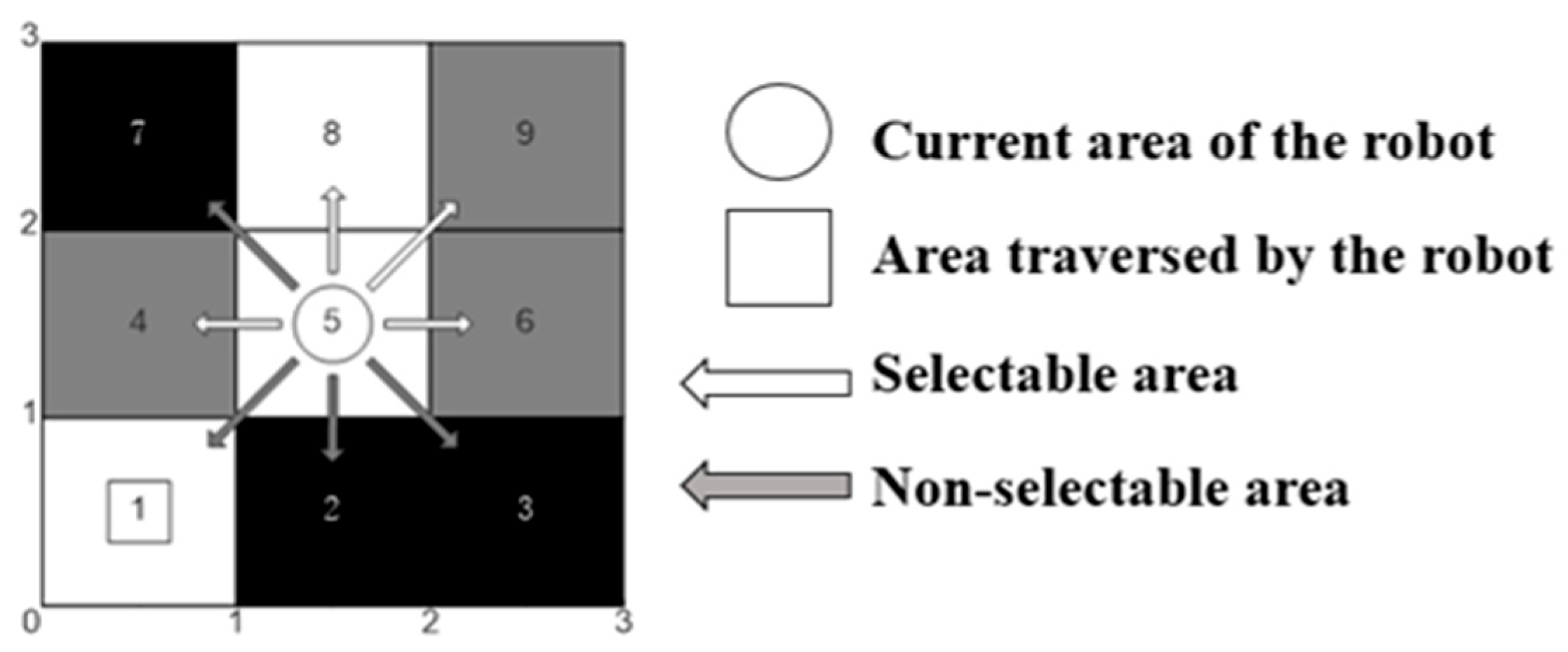
The Ant Colony Optimization (ACO) algorithm employs an eight-directional search strategy [17], which offers the advantages of low computational complexity and high search efficiency. The specific search logic is defined as follows [18]: assuming the robot is currently located at position 5, it is allowed to move towards any adjacent non-black region (i.e., obstacle-free cell) within its eight directions, strictly avoiding any previously visited nodes. As illustrated in Figure 1, suppose the robot has navigated from position 1 to position 5. During the subsequent path selection phase, it initially identifies all eight surrounding nodes, yielding the set P n = { 1 ,   2 ,   3 ,   4 ,   6 ,   7 ,   8 } . Subsequently, by eliminating the black regions (obstacles) and the previously traversed nodes from this initial set, the updated set of feasible candidate nodes is determined as P n = { 4 ,   6 ,   8 ,   9 } .
Once the feasible candidate set P n is determined, the algorithm stochastically selects the next node along the path based on state transition probabilities [19]. This transition probability represents the likelihood of the robot moving to a specific candidate node during its random search process. In the Ant Colony Optimization (ACO) algorithm, the state transition probability is formulated as follows:
P i j m = τ i j α · η i j β s ε P n τ i s α · η i s β , ( i , j ) ϵ p n                                 0                     ,   o t h e r w i s e
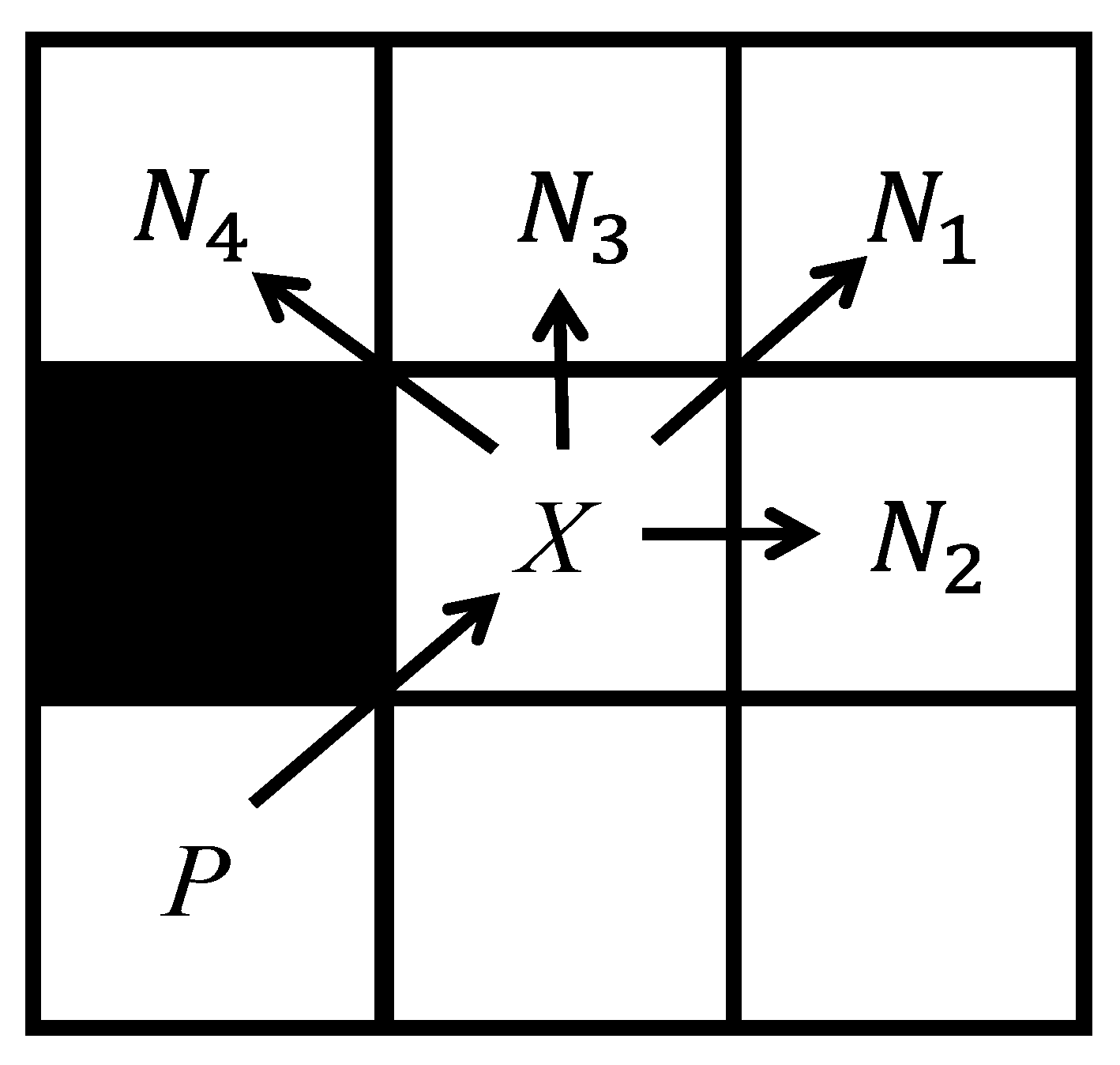
To refine the selection of effective nodes and enhance search efficiency, a customized neighborhood pruning strategy inspired by Jump Point Search (JPS) is integrated into the state transition process of the ACO algorithm. Unlike the standard JPS, which performs a global jump-point scan, this strategy leverages the forced neighbor logic to dynamically restrict the set of candidate nodes at each step, thereby reducing redundant node expansions [20].
During the path construction process, let P be the parent node and X be the current node. To ensure path optimality while compressing the search space, the algorithm determines the candidate successor set S n e x t based on the distribution of obstacles around X . The core logic involves identifying forced neighbors: if the presence of an obstacle necessitates passing through node X to reach neighbor N via an optimal path starting from P , then N is defined as a forced neighbor of X [21].
The proposed pruning strategy is categorized into two scenarios based on the local environment of node X :
(1)
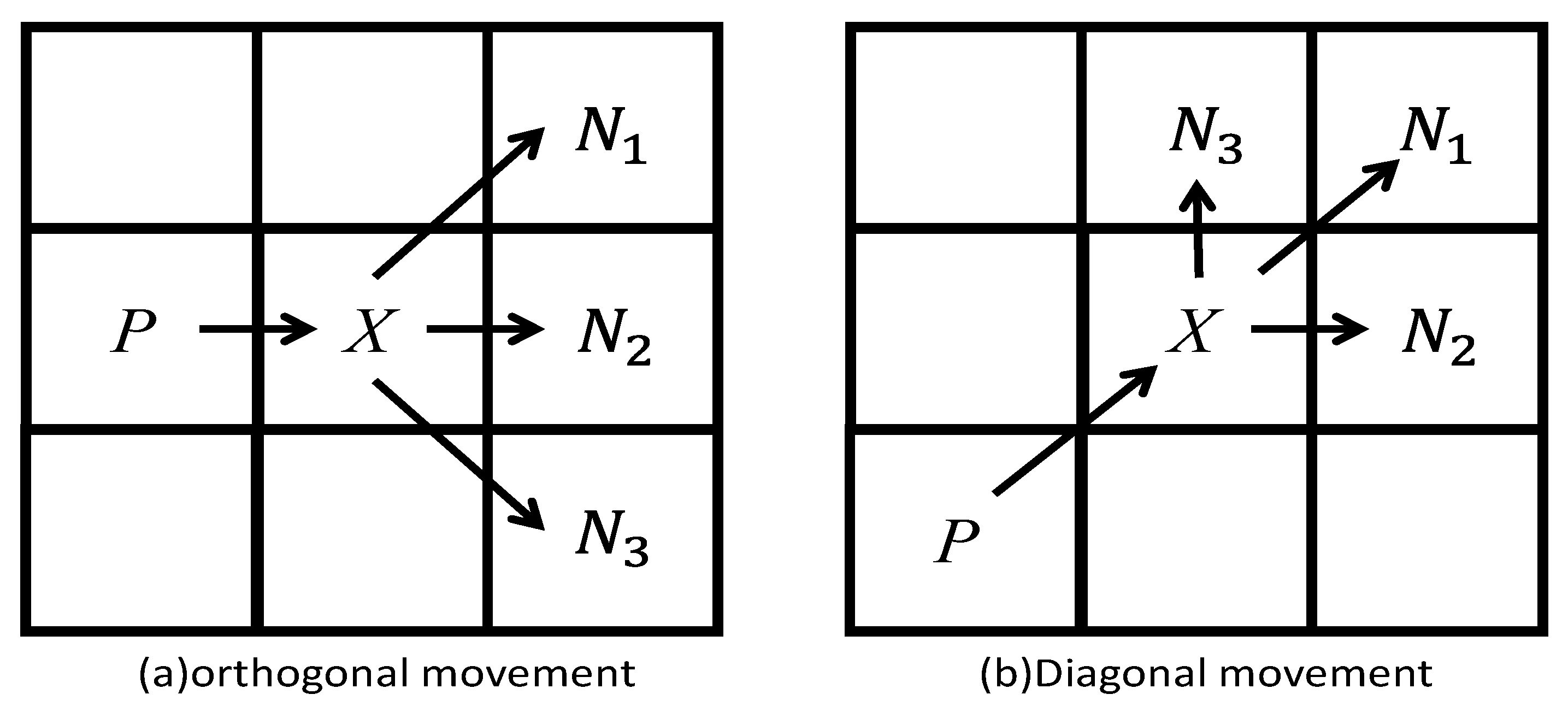
Obstacle-free Regions (Figure 2): When there are no obstacles in the vicinity of X , the algorithm applies natural neighbor pruning rules. If the transition P X is a straight move, only the three nodes located directly ahead and at the adjacent diagonals are retained as candidates (Figure 2a). If the transition is a diagonal move, the candidates are restricted to the nodes in the diagonal direction and its two adjacent cardinal directions (Figure 2b). This approach minimizes the branching factor by eliminating symmetrical redundant nodes.
(2)
Obstacle-occupied Regions (Figure 3): When obstacles are present adjacent to X , the algorithm evaluates whether the forced neighbor rule is triggered. As illustrated in Figure 3, if an obstacle obstructs alternative bypass routes such that node N 4 can only be reached optimally through X , N 4 is identified as a forced neighbor and added to the candidate set S n e x t .
In this framework, the ant selects the next destination node N i from the pruned candidate set S n e x t according to the state transition probability. Crucially, while the pruning strategy identifies discrete nodes, the algorithm treats the segment X , N i as a directed edge within the graph-theoretical model. Consequently, the pheromone τ i j is stored and updated on these connecting edges rather than individual nodes. This formulation ensures that the mathematical description of pheromone deposition is fully consistent with the edge-based logic of the global path update.

2.2.2. Crossover and Mutation Operations

The traditional Ant Colony Optimization (ACO) algorithm suffers from a slow convergence rate and susceptibility to stagnation in local optima. To overcome these limitations, this study does not merely employ the Genetic Algorithm (GA) as a simple post-processing tool. Instead, its crossover and mutation operators are deeply integrated into the main iterative loop of the ACO algorithm. Specifically, after the entire ant population completes path construction in each generation, these operations are applied to the current elite solutions, strictly prior to the global pheromone update. This co-evolutionary mechanism dynamically sustains population diversity, thereby counteracting the positive feedback trap of pheromone accumulation and significantly enhancing the algorithm’s capability to escape local optima.
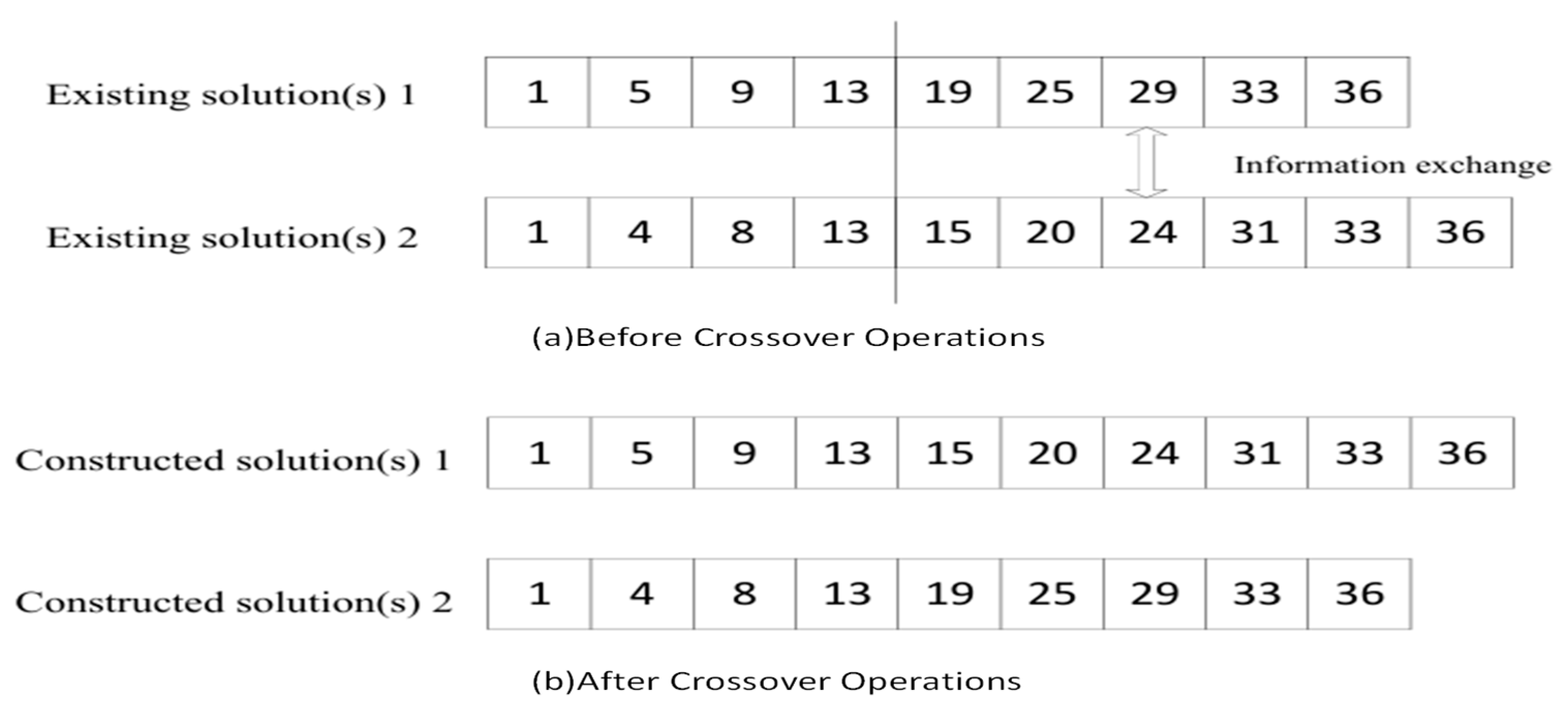
The crossover operation [22] employs a single-point crossover strategy, an illustrative example of which is presented in Figure 4. Suppose the two parent individuals are given as { 1 , 5 , 9 , 13 , 19 , 25 , 29 , 33 , 36 } and { 1 , 4 , 8 , 13 , 15 , 20 , 24 , 31 , 33 , 36 } , respectively. By identifying the intersection of these two paths, the set of common nodes is determined as I = { 13 , 33 } . A node is then randomly selected from set I to serve as the crossover point. Assuming node { 13 } is chosen, the path segments after this point are swapped, resulting in the generation of two new offspring: { 1 , 5 , 9 , 13 , 15 , 20 , 24 , 31 , 33 , 36 } and { 1 , 4 , 8 , 13 , 19 , 25,   29 , 33 , 36 } .
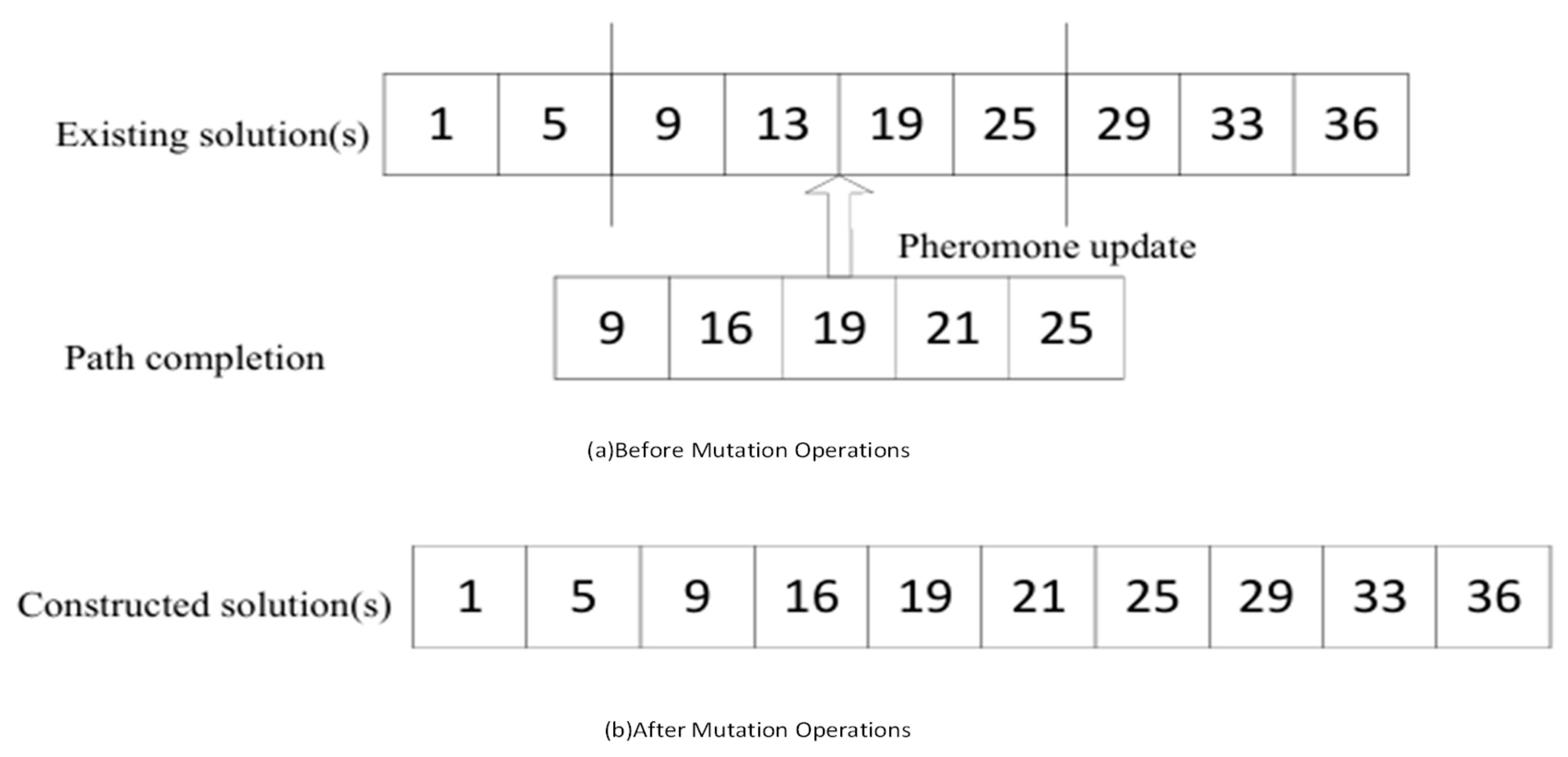
An illustrative example of the mutation operation is presented in Figure 5 [23]. Assuming the parent individual is represented by the sequence { 1 , 5 , 9 , 13 , 19 , 25 , 29 , 33 , 36 } , two nodes, specifically 9 and 25, are randomly selected as the truncation points. A reconnection procedure is subsequently applied to bridge these two points, generating a new local path segment: { 9 , 16 , 19 , 21 , 25 } . By replacing the original segment between the truncation points with this newly generated sub-path, the resulting offspring individual is obtained as { 1 , 5 , 9 , 16 , 19 , 21 , 25 , 29 , 33 , 36 } .

2.2.3. Path Optimization

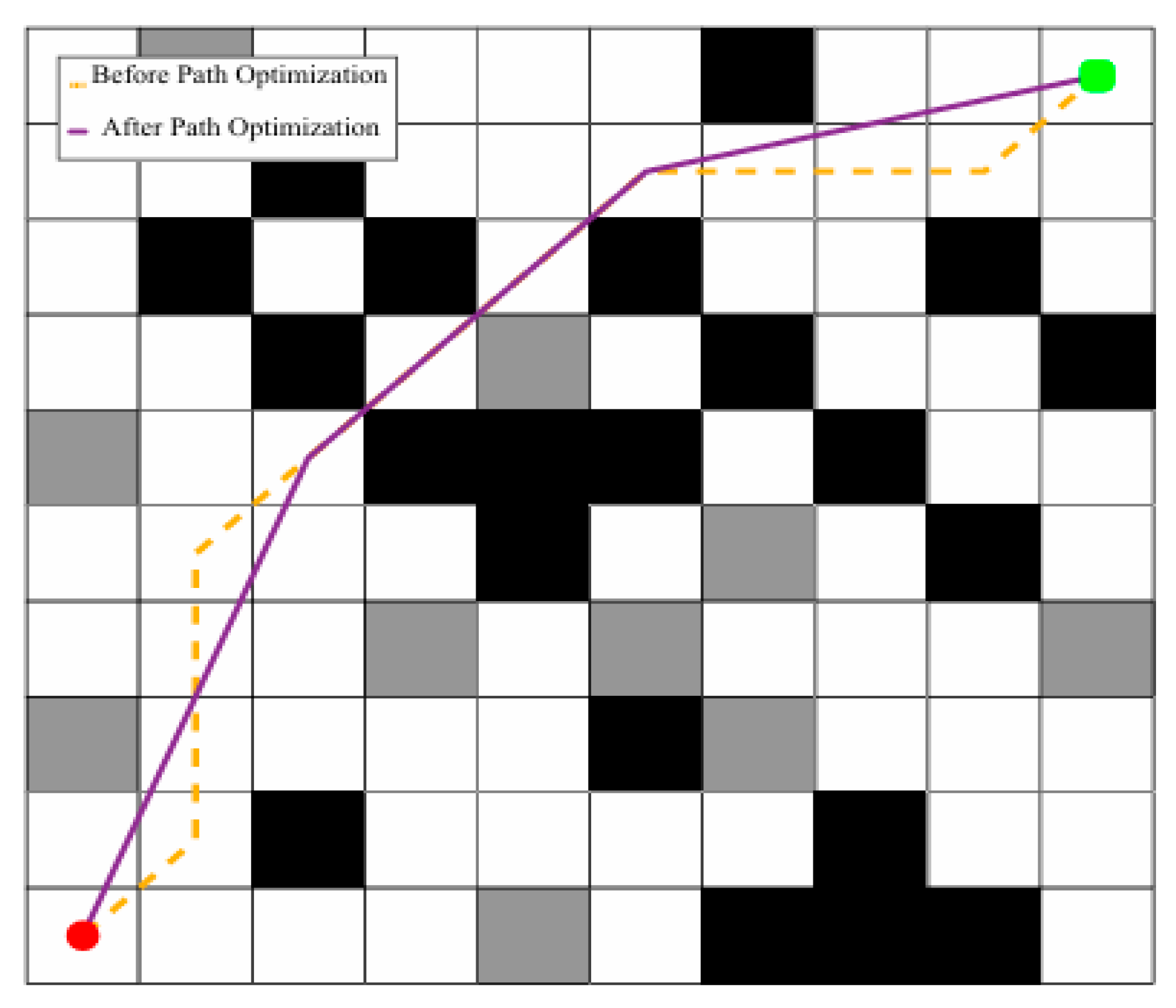
Due to the inherent limitations of the eight-directional search method, the robot is constrained to move exclusively in horizontal, vertical, and 45° diagonal directions. Consequently, the generated paths often exhibit numerous redundant inflection points and excessively large turning angles. To address this, an optimization procedure is applied to the generated population to eliminate these local sub-optimalities. The fundamental logic of this optimization operation is defined as follows: if the direct straight-line segment connecting two nodes does not traverse any impassable regions (i.e., obstacles), and its traversal cost is strictly lower than that of the original path segment between these two nodes, all intermediate nodes are removed. The original sub-path is subsequently replaced by this direct connection, as illustrated in Figure 6.
The original path before optimization was {1, 12, 22, 32, 42, 53, 64, 75, 86, 87, 88, 89, 100}, while the optimized path became {1, 53, 64, 75, 86, 100}. The detailed data of the paths before and after optimization are shown in Table 1. It can be seen that the optimized path is shorter, has fewer turning points and smaller bends, and the movement direction of the robot is not restricted.

2.3. Obstacle-Crossing Adaptive Ant Colony Algorithm

2.3.1. Non-Uniform Initialization of Pheromone Distribution

In traditional algorithms, the initial pheromone concentration across all feasible grid cells is identical, resulting in a completely random path search during the first iteration [24]. Following the introduction of gray regions, a clear distinction is made between the gray and white cells. Furthermore, an impact factor related to the distance to the target point is incorporated to optimize the initial pheromone distribution. The calculation rule for the modified initial pheromone is expressed as Equation (6) [25]:
τ i j 10 D i j ,   A i j = 0 0 ,       A i j = 1 8 D i j , A i j = 2
where D denotes the Euclidean distance between the node at coordinates i , j and the destination point. A i j { 0 ,   1 ,   2 } acts as a discrete categorical variable representing the terrain traversability attribute of the edge. A i j = 0 denotes flat, obstacle-free terrain assigned a high initial pheromone weight to encourage preferential routing through energy-efficient areas. A i j = 1 indicates an impassable obstacle, which strictly enforces a zero-pheromone constraint and nullifies heuristic desirability to prevent any risk of collision. A i j = 2 represents crossable yet complex terrains that are permissible for traversal but are penalized with a lower initial pheromone weight compared with flat ground, accurately reflecting the associated traversal cost.
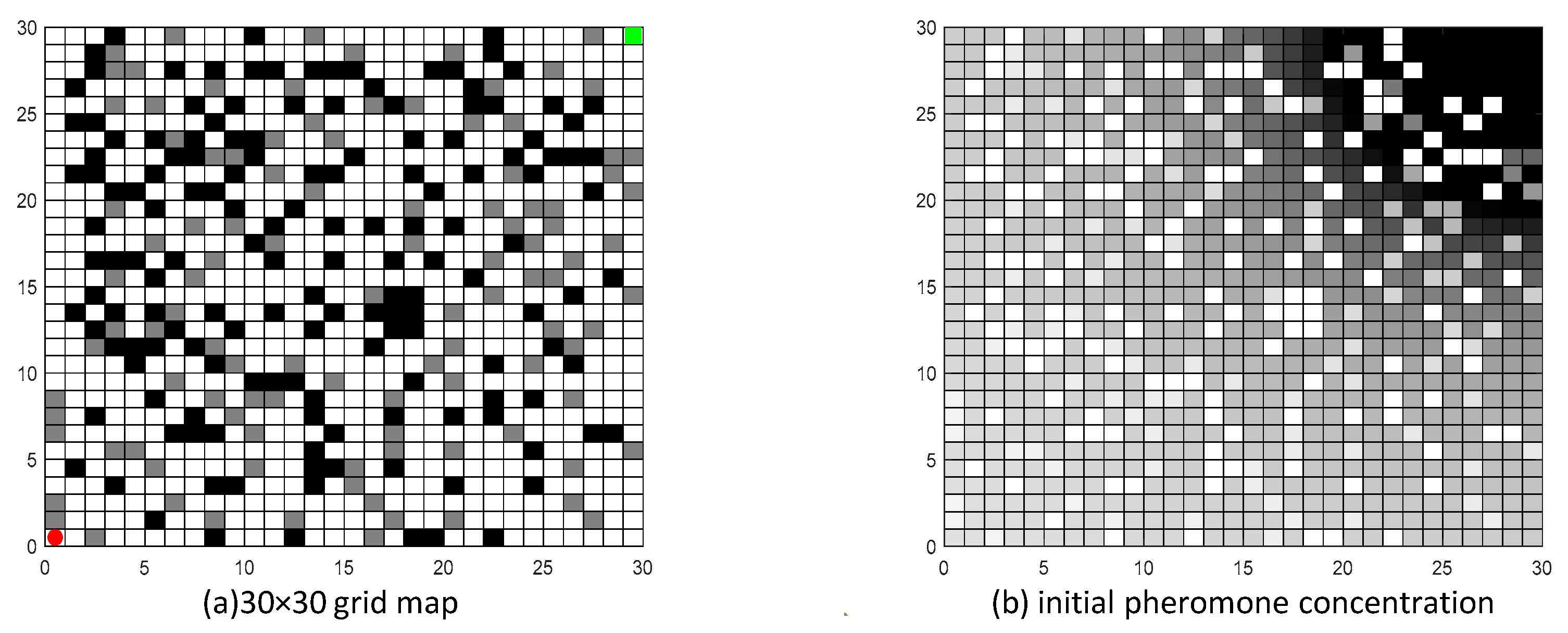
To evaluate the performance, the initial pheromones were calculated within a randomly generated 30 × 30 grid map, and the resulting distribution is presented in Figure 7. In Figure 7a, the bottom-left corner denotes the starting point, while the top-right corner represents the destination. In Figure 7b, the color gradient indicates the pheromone level; specifically, a darker grid color corresponds to a higher pheromone concentration within that cell.

2.3.2. Improved State Transition Probability Function

After obtaining the search range P n through the improved search method, the next node is selected using the improved transition probability formula [26]. The improved formula is as follows:
P i j m = A i j γ · τ i j α · η i j β s P n A i s γ · τ i s α · η i s β , ( i , j ) P n                                   0                                 , o t h e r w i s e
A i j = 1 , A i j = 0 0.5 , A i j = 2
where A i j denotes the terrain impact factor; γ is the weight exponent associated with A i j ; d j e represents the Euclidean distance between node j and the destination point; φ is the weight exponent of d j e ; and A i j γ indicates the terrain of the given node.
At the same time, the expression of η i j is improved by incorporating the angle σ between line segment i j and line segment i e , so that the points with a similar direction of movement to the destination direction have a larger transition probability [27]. The specific expression is shown in Formula (9):
η i j = 1 d i j + d j e + σ φ
here, φ represents the weight index of σ .

2.3.3. Improved Path Selection Strategy

After each iteration of the algorithm, the path selection function is used to determine whether the path is good or not, and the optimal solution is updated. The path selection in the traditional ant colony algorithm only depends on the path length, without considering the influencing factors of turning points and obstacle crossing [28]. Therefore, it is improved as follows:
V f = L + λ i = 1 k V t i + θ j = 1 l V p j
where V f denotes the total comprehensive path cost, and L represents the standard length of the path. The variables k and l indicate the total number of turning points and crossed obstacles along the path, respectively. V t i represents the specific penalty cost (e.g., time or energy consumption) associated with the i -th turning point, while V p j denotes the penalty cost for crossing the j -th obstacle. The parameters λ and θ serve as weighting coefficients that regulate the relative importance of the turning penalty and the obstacle-crossing penalty, respectively.
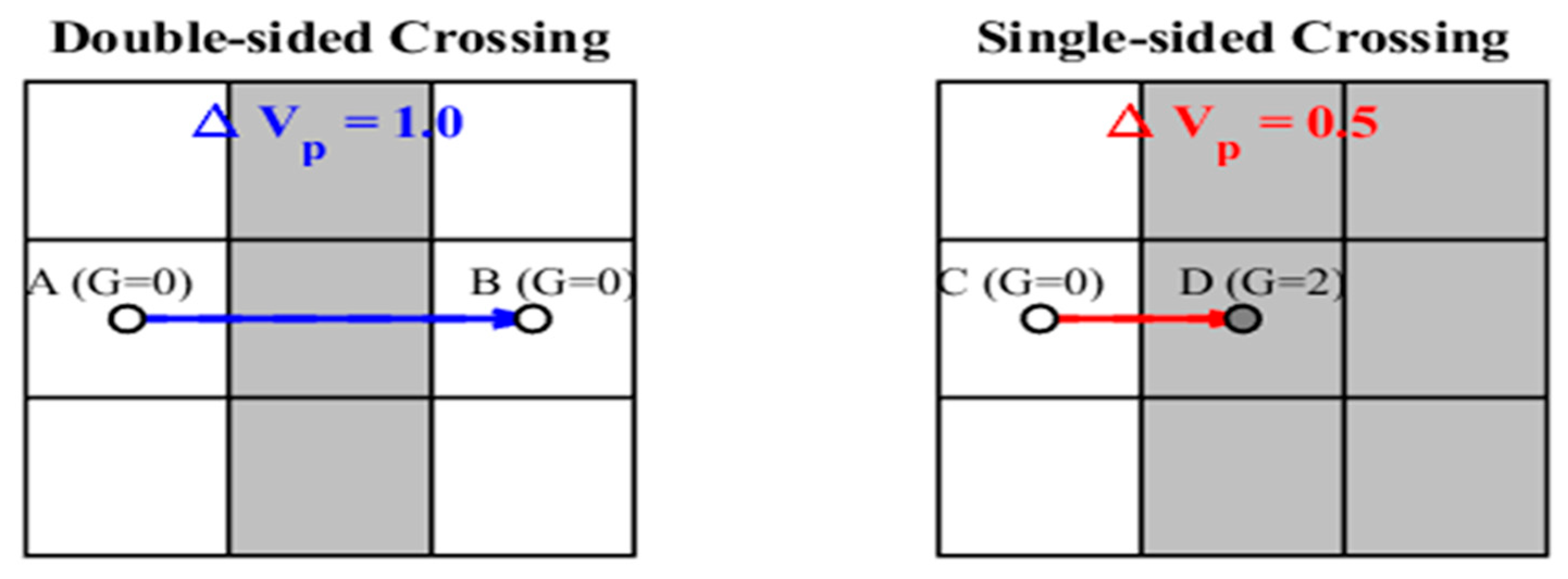
The calculation of the passable cost V t at the inflection point adopts the hierarchical processing method, as shown in Table 2. The calculation rule for the obstacle-crossing cost V p is as follows, as shown in Figure 8:
(1)
Double-sided crossing ( + 1.0 ): Triggered when G A = 0 and G B = 0 , but the interpolated line segment L A B intersects any grid where G = 2 .
(2)
Single-sided crossing (+0.5): Triggered when the segment boundary shifts, e.g., G A = 0 and G B = 2 , or vice versa.

2.3.4. Improved Pheromone Update Rule

After all ants have completed one iteration of path search, the pheromone concentrations on all edges along the globally optimal path are updated, thereby increasing the probability that these edges will be selected by ants in the next iteration [29]. The pheromone update rule is given as follows:
τ i j t + 1 = 1 ρ τ i j t + Δ τ i j t
Δ τ i j t = ρ k = 1 m Δ τ i j k
τ i j k = Q L K , i f   e d g e   ( i , j )   i s   t r a v e r s e d   b y   a n t   k 0 , o t h e r w i s e
In the formula, Δ τ i j represents the change in pheromone; t is the number of iterations; ρ denotes the pheromone evaporation rate; m is the number of ants; Q is a constant; and L k is the path length. The total path cost obtained from Equation (8) is utilized to optimize the pheromone update rule in Equation (11). The optimized formulation is presented in Equation (12), where the path length L K is replaced by the path cost V f , thereby leading to a more reasonable convergence direction.

2.3.5. Algorithm Procedure

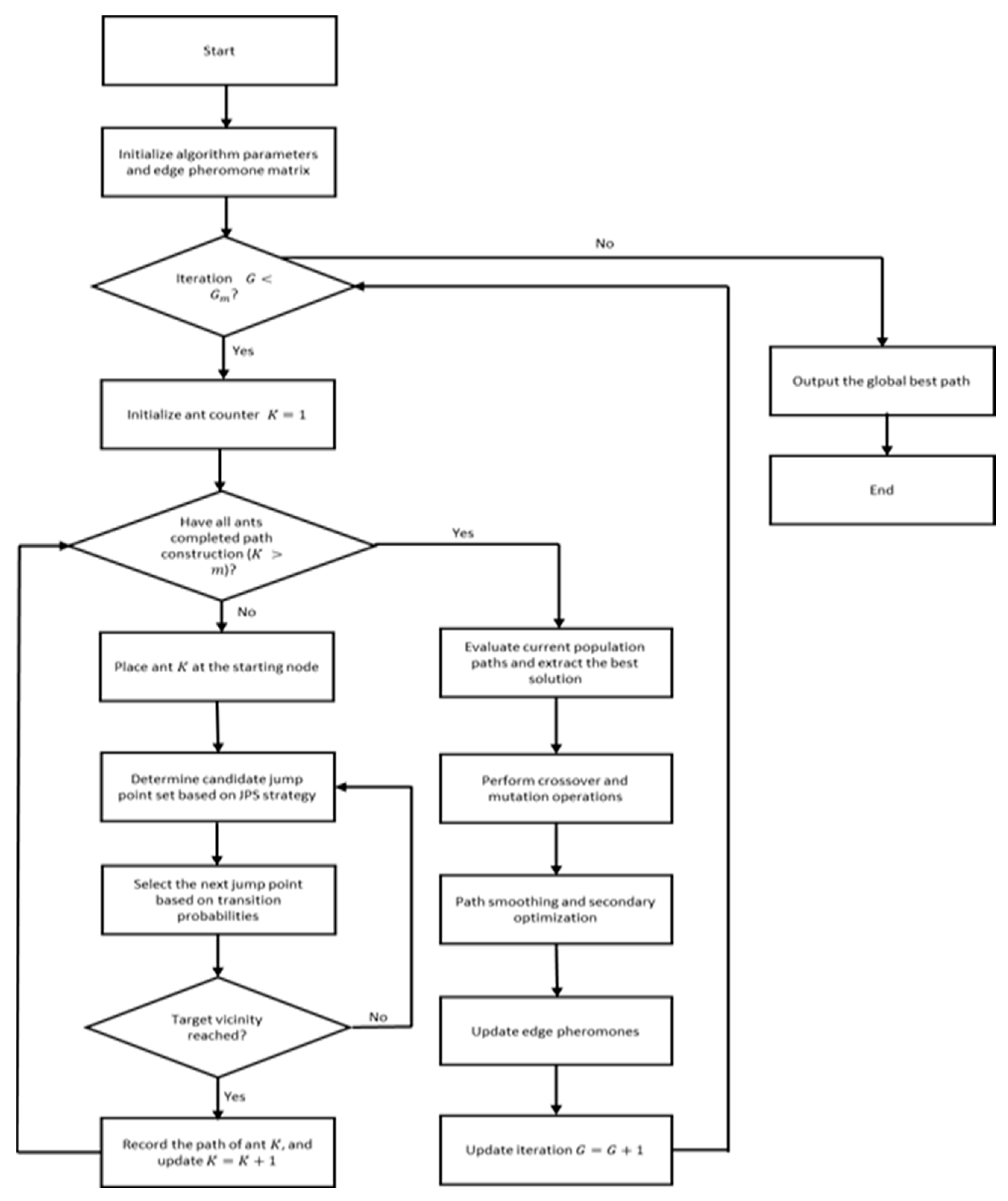
The improved algorithm procedure is shown in Figure 9. During path construction, if an ant encounters a dead-end where the candidate jump point set is empty (i.e., no valid moves are available), the current path construction for this ant is terminated. This invalid path is subsequently discarded and excluded from the pheromone update process to prevent the algorithm from propagating misleading information or entering an infinite loop.

2.4. Analysis of the Proposed Algorithm

To evaluate the theoretical soundness of the OC-ACO framework, this section analyzes its computational complexity and convergence behavior.
Let N denote the total number of grids in the local map, m be the ant population size, G m be the maximum number of iterations, and L a v g be the average number of nodes in a constructed path. For a 2D grid environment, L a v g scales proportionally to N . Let C denote the maximum size of the pruned candidate set (typically C 3 ), and m e l i t e be the number of elite solutions selected for genetic operations and pheromone reinforcement.
The time complexity per iteration consists of three main components:
(1)
JPS-ACO Search: Standard ACO evaluates up to 8 neighboring nodes per step. The JPS-inspired pruning strategy restricts candidate nodes to a smaller subset of size C [30]. While the asymptotic time complexity remains O m L a v g , this pruning mechanism significantly reduces the constant factor of the computational overhead.
(2)
GA Operations: Selecting elite individuals and applying crossover and mutation operators to their path encodings requires O m e l i t e L a v g time, where m e l i t e m .
(3)
Pheromone Update: The evaporation and reinforcement steps collectively require O N + m e l i t e L a v g time, as global pheromone evaporation is applied to all edges proportional to the grid size N .
Overall, the total asymptotic time complexity is bounded by O G m m L a v g + m e l i t e L a v g + N . Substituting L a v g N the expression becomes O G m m N + m e l i t e N + N . As the map size N increases, the linear term N dominates the sub-linear term O G m N . Consequently, the asymptotic complexity simplifies to confirming linear scalability with respect to the local environment size.
The iterative process of the proposed algorithm can be modeled as a discrete-time Markov Chain (DTMC) [31]. Let S t be the state of the algorithm at iteration t , and X * denote the subset of states containing the global optimal path.
In standard ACO, pheromone stagnation often leads to local optima. However, in OC-ACO, the embedded GA mutation operator provides an exogenous stochastic perturbation (with probability P m > 0 ), and pheromone trails are strictly bounded within τ m i n , τ m a x These mechanisms ensure that from any given state, there exists a finite sequence of transitions with strictly positive probability leading to any other state. Consequently, the underlying Markov Chain is irreducible [31].
Furthermore, the elitist retention strategy introduces a positive probability of remaining in the same state when no better solution is found, creating self-loops in the state transition graph. This guarantees that the chain is also aperiodic.
The elitist strategy in the GA phase ensures that the fitness of the best-so-far solution x b e s t t is non-increasing:
f x b e s t t + 1 f x b e s t t
Since the chain is irreducible and the best-so-far solution is monotonically retained, the algorithm will almost surely visit the optimal state X * infinitely often as t . By the fundamental limit theorem of Markov Chains, this implies:
lim t P x b e s t t X * = 1

3. Experimental Design

3.1. Experimental Subjects and Parameter Settings

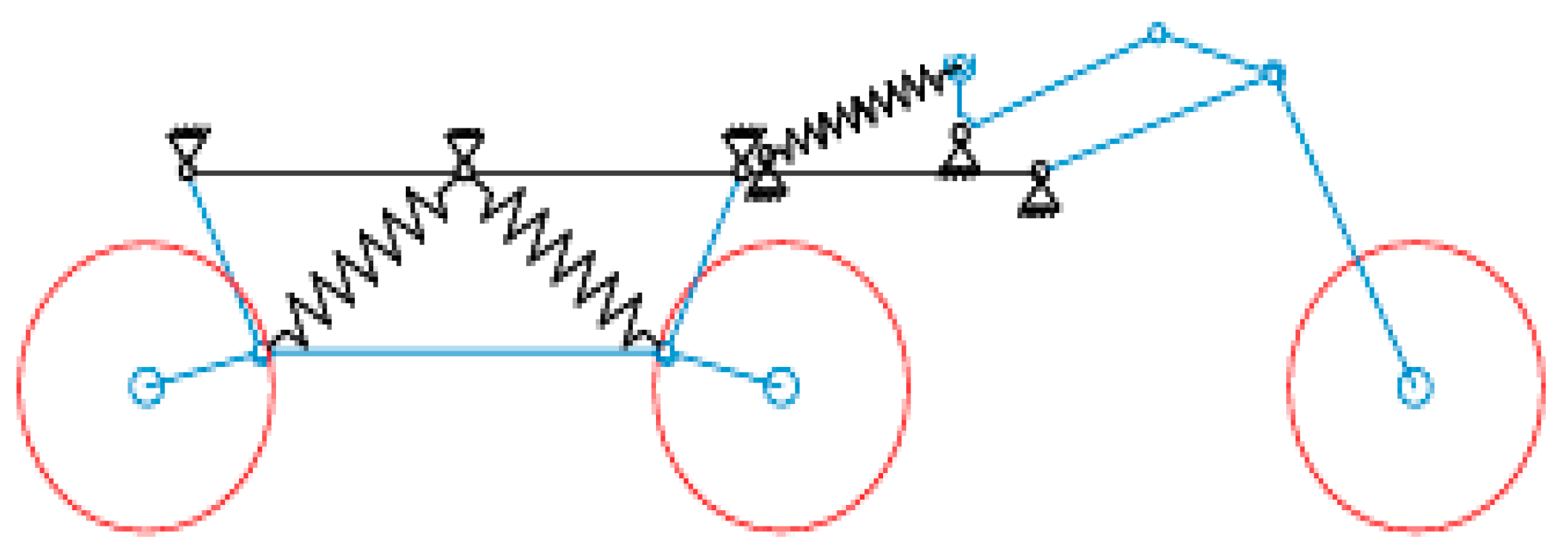
The experimental platform utilized in this simulation study is a custom-designed obstacle-surmounting mobile robot, specifically developed for search and rescue (SAR) operations. The mechanical structure schematic of this robot is illustrated in Figure 10.
The obstacle-surmounting performance of the robot is detailed in Table 3. The steering mechanism of the robot relies primarily on the coordinated differential operation of its wheels. Under ideal conditions, the platform is capable of executing in-place turns with a turning radius of zero. However, due to the interaction with complex terrains, turning maneuvers incur substantial energy consumption and may introduce other unpredictable uncertainties. Consequently, it is imperative to minimize the number of turning points (i.e., inflection points) in the planned path as much as possible.
The experimental parameters used in this study are shown in Table 4. The proposed hybrid ACO-based path planning algorithm involves several key parameters that influence its performance. The parameters and their functions are summarized as follows:
G m (Maximum number of iterations): 100 iterations were used to allow sufficient convergence without excessive computation.
m (Number of ants): 50 ants were employed per iteration to balance search diversity and computational efficiency.
α (Pheromone importance factor): 2, determining the influence of historical pheromone trails on path selection.
β (Heuristic information weight): 6, determining the influence of heuristic information, such as distance to the target, to guide ants toward promising paths.
γ (Terrain weight factor): 1, controlling the impact of terrain difficulty or high-cost regions on path selection.
ρ (Pheromone evaporation rate): 0.3, balancing the influence of past paths and exploration of new paths.
φ (Goal distance weight factor): 0.5, adjusting the preference toward paths closer to the target.
λ (Turning penalty factor): 1.5, penalizing unnecessary turning points to improve path smoothness.
θ (Obstacle-crossing cost coefficient): 0.75, controlling the algorithm’s tendency to traverse high-cost or partially obstructed regions.
P c (Crossover probability): 0.8, determining the frequency of genetic recombination among elite solutions to accelerate the convergence toward the global optimum.
P m (Mutation rate): 0.05, providing an exogenous stochastic perturbation to the path sequences to dynamically sustain population diversity and mitigate stagnation in local optima.
The parameter configurations are systematically determined based on established literature and prior theoretical foundations, avoiding computationally prohibitive combinatorial searches [32]. The parameters are classified into two categories. The standard algorithmic parameters (e.g., G m , m , α , ρ , P c , P m ) adopt classical configurations widely recommended in heuristic literature to theoretically ensure a stable balance between exploration and exploitation [33,34]. Meanwhile, the domain-specific environmental and kinematic parameters (e.g., β ,   γ ,   φ ,   λ ,   θ ) directly inherit the physical and navigational constraints established in our previous foundational research on obstacle-crossing robots [35]. Consequently, these parameters are not treated as free variables requiring arbitrary tuning but as fixed system constants derived from either canonical solvers or empirical robotic characterization.

3.2. Working Environment Model

The simulation environment adopted in this study follows the fundamental configuration established in our previous work [35]. The experimental object utilized in this simulation is a custom-designed obstacle-crossing mobile robot dedicated to Search and Rescue (SAR) missions. To clearly define the scope of our evaluations, it is essential to establish the operational context of the simulations.
In unpredictable SAR environments, exploring macroscopic global maps is often impractical due to the limited range of onboard sensors. Therefore, this study focuses on the local planning layer. The experiments are conducted on high-resolution local grid maps of varying sizes: 20 × 20, 30 × 30, 50 × 50, and 60 × 60. The upper bound of 60 × 60 corresponds to a realistic perception window for depth sensors in cluttered rubble (e.g., a 3 m × 3 m area at 5 cm resolution), while the smaller sizes are included to evaluate the algorithm’s computational consistency across varying local window dimensions. These dimensions do not represent macroscopic environments; rather, they reflect the scale at which real-time local trajectory optimization must operate.
By evaluating the algorithm across these incrementally enlarged local windows, we aim to verify its robustness and computational efficiency within the constraints of local planning. Within these micro-scale representations, our proposed algorithm executes a comprehensive search to overcome local minima and calculate optimal obstacle-crossing trajectories. To ensure clarity, only the key characteristics of this local environment are briefly described below.
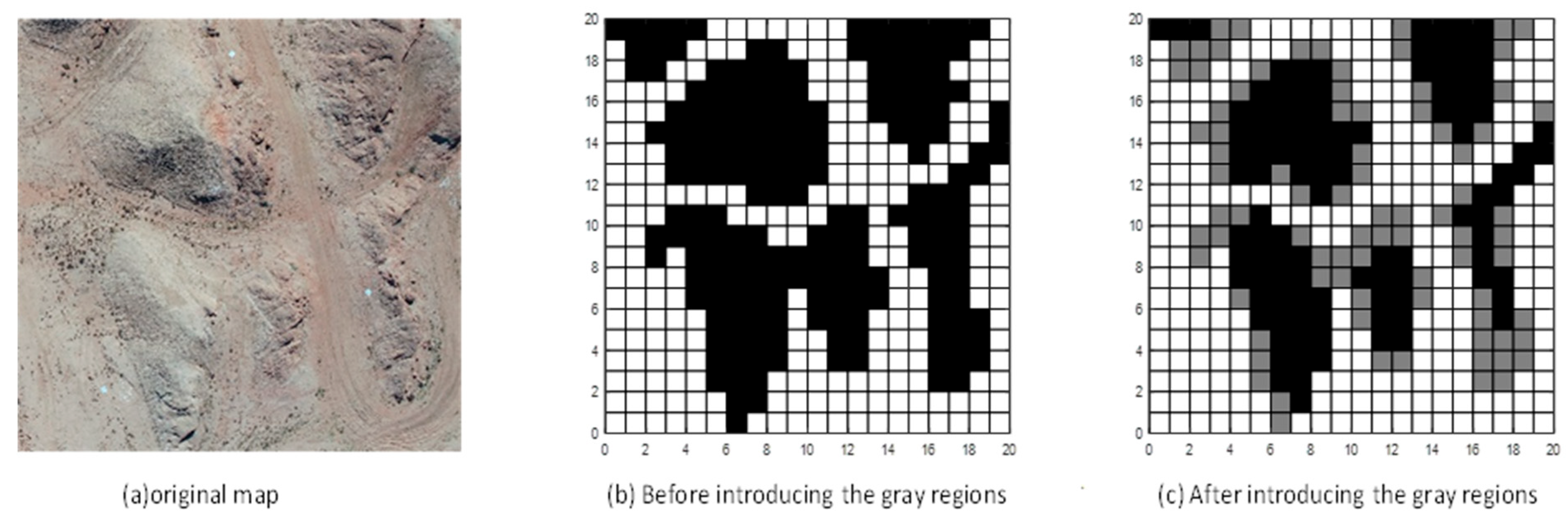
The grid map is one of the most widely used environment representations in path planning due to its simplicity and intuitive structure. Therefore, it is adopted as the simulation environment for the mobile robot. Figure 11a presents the original map. For the same environment, the grid maps generated before and after introducing the gray regions are shown in Figure 11b and Figure 11c, respectively. It is evident that, prior to the incorporation of gray regions, a significant number of grid cells are classified as non-traversable. After introducing the gray regions, many of these cells are reclassified as traversable (i.e., allowing obstacle crossing), thereby increasing the diversity of feasible paths.

4. Results and Analysis

4.1. Ablation Experiment

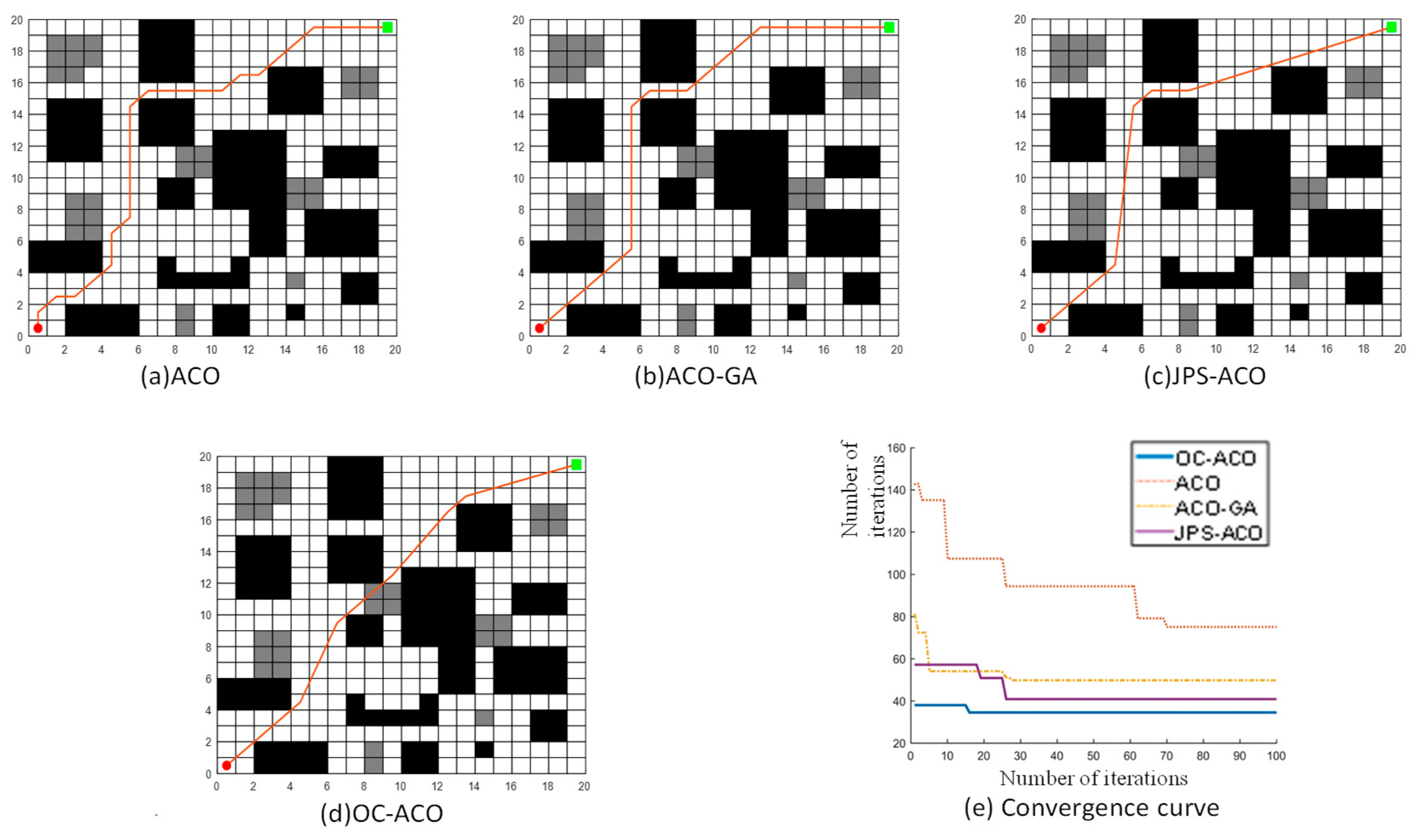
To evaluate the individual contributions of each algorithmic module, an ablation study was conducted on a 20 × 20 grid map. Four algorithm variants were compared: the traditional Ant Colony Optimization (ACO), ACO enhanced with Genetic Algorithm operators (ACO-GA), ACO integrated with Jump Point Search (JPS-ACO), and the proposed Obstacle-Crossing adaptive ACO (OC-ACO), which combines GA operators, JPS, and traversal-aware cost adaptation. The experimental results are shown in Figure 12, and the corresponding data are summarized in Table 5.
The results indicate that OC-ACO achieved the best performance in terms of path length, with improvements of 9.2%, 6.8%, and 3.6% over ACO, ACO-GA, and JPS-ACO, respectively. In addition, JPS-ACO alone reduced the path length by 2.9% compared with ACO, highlighting the efficiency gain contributed by the Jump Point Search module. Regarding the number of turning points, OC-ACO reduced unnecessary turns by 12% relative to ACO and by 7% relative to ACO-GA, demonstrating that the GA operators and traversal-aware cost module contribute to generating smoother paths. JPS-ACO also decreased turning points by 5%, indicating its effectiveness in reducing redundant turns.
In terms of obstacle-crossing capability, OC-ACO outperformed the other variants, achieving a 15% improvement over ACO-GA when traversing high-cost or partially obstructed regions, which confirms the effectiveness of the obstacle-crossing adaptive module. The total path cost of OC-ACO was lower than that of ACO, ACO-GA, and JPS-ACO by 8.7%, 5.3%, and 2.1%, respectively, further demonstrating the combined advantages of all proposed modules in optimizing overall path quality.
These results clearly indicate that GA operators enhance global search capability and path quality (ACO → ACO-GA), Jump Point Search improves traversal efficiency and path smoothness (ACO-GA → JPS-ACO), and the traversal-aware cost adaptation significantly increases obstacle-crossing ability and overall path optimality (JPS-ACO → OC-ACO). Therefore, each module contributes independently to the algorithm’s performance, and their combination in OC-ACO achieves optimal results across path length, smoothness, obstacle handling, and total cost.

4.2. Comparative Experiment

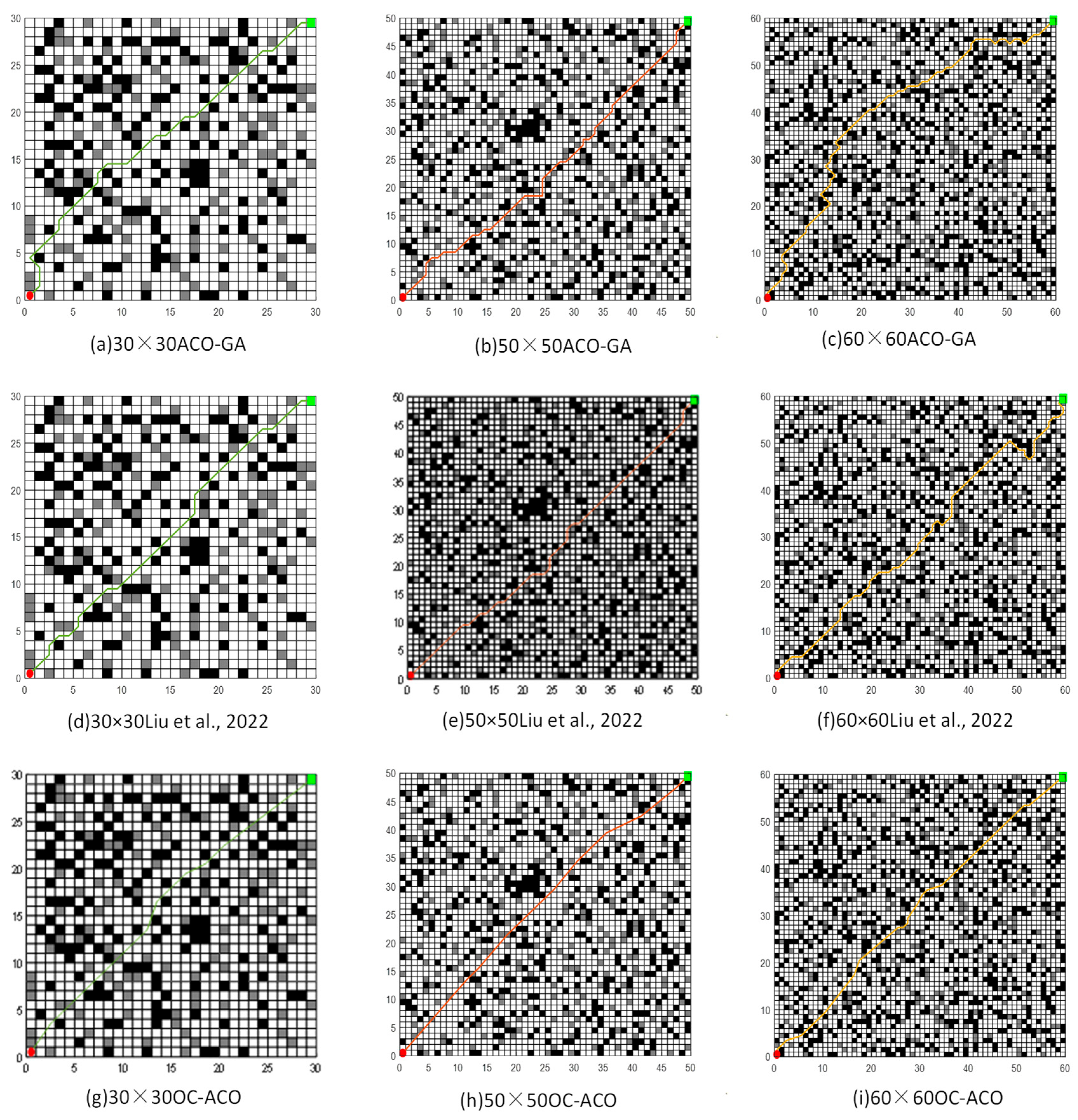
Simulation experiments were conducted on maps of sizes 30 × 30, 50 × 50, and 60 × 60. Due to the complexity of the maps, the traditional ACO algorithm failed to converge to an effective solution. Therefore, the ACO-GA algorithm, the algorithm proposed in reference [36], and the OC-ACO algorithm were compared. The experimental results are shown in Figure 13, and the corresponding data are presented in Table 6, Table 7 and Table 8.
From the comparison results, it can be observed that:
(1)
On the 30 × 30 map, compared with the other two algorithms, the OC-ACO algorithm reduces the path length by 10.0% and 5.9%, respectively, and decreases the number of turning points by 62.5% and 53.8%, respectively.
(2)
On the 50 × 50 map, the OC-ACO algorithm achieves reductions of 7.1% and 4.1% in path length, and 66.7% and 50.0% in the number of turning points, respectively, compared with the other two algorithms.
(3)
On the 60 × 60 map, the OC-ACO algorithm reduces the path length by 16.2% and 13.6%, and the number of turning points by 67.4% and 57.1%, respectively, compared with the other two algorithms.
In summary, compared with the ACO-GA algorithm and the algorithm in reference [36], the OC-ACO algorithm achieves improvements in path length, number of turning points, and turning angle, demonstrating the feasibility of the proposed algorithm.
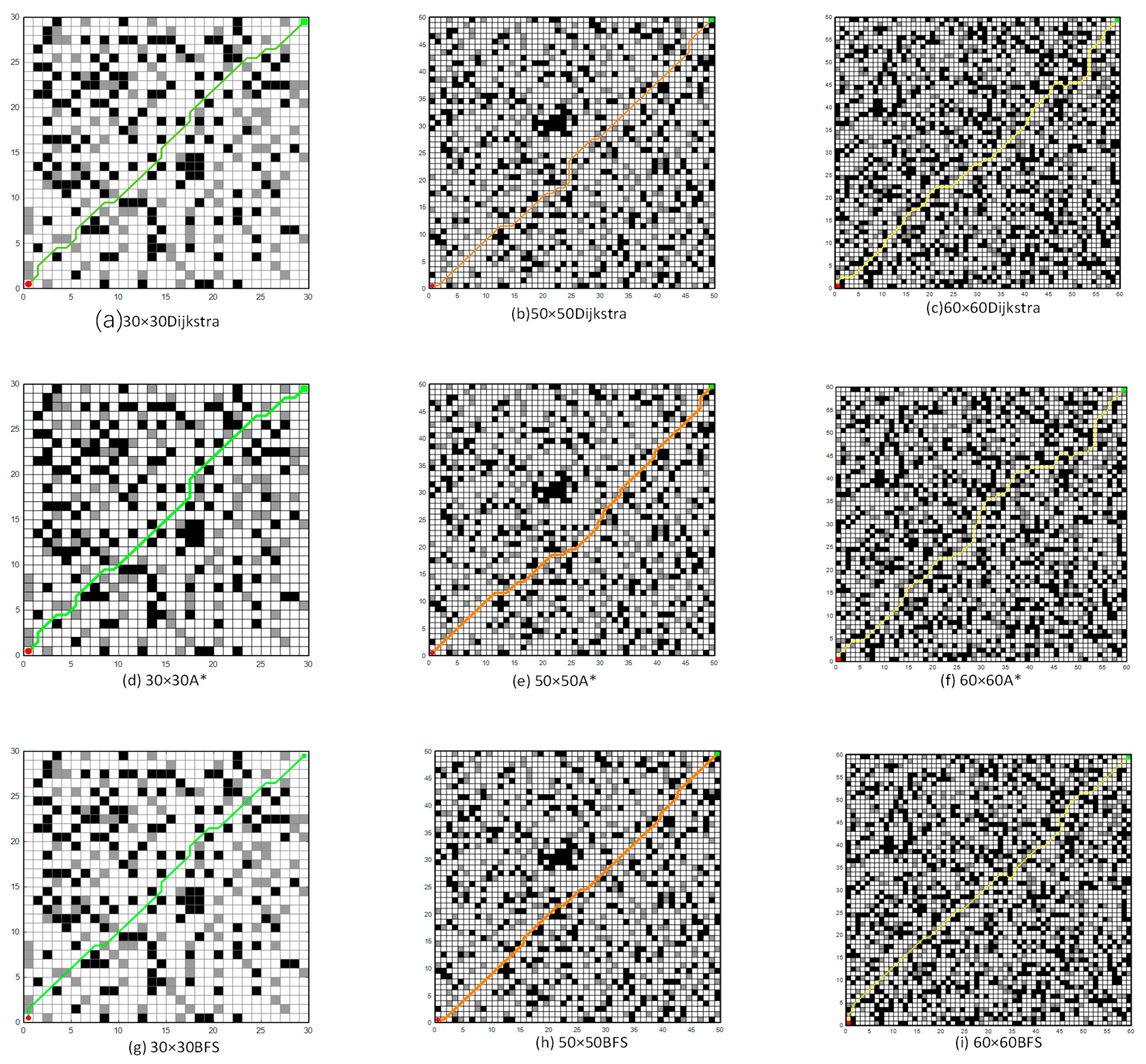
While the preceding experiments focused on comparisons with ACO variants, it is equally important to situate the proposed algorithm within other standard path planning methods. To this end, we further compared the OC-ACO algorithm against three widely recognized baseline algorithms: Dijkstra’s algorithm, A*, and Breadth-First Search (BFS). These comparisons were carried out on local grid maps of 30 × 30, 50 × 50, and 60 × 60. The experimental results are shown in Figure 14, and the corresponding data are presented in Table 9, Table 10 and Table 11.
The simulation results clearly expose the limitations of conventional path planning algorithms in complex, unstructured environments. Specifically, strictly obstacle-avoidant algorithms such as Dijkstra and A* that operate under binary obstacle assumptions record zero obstacle crossings. Consequently, while their path lengths equate to their total path costs, they often fall into topological traps in dense environments. For instance, in the 60 × 60 map (Table 11), A* suffers from heuristic misleading, yielding a sub-optimal path length of 95.39 with an excessive 44 turning points, which is highly detrimental to the continuous kinematic execution of a mobile robot. Conversely, the BFS algorithm aggressively minimizes the absolute path length (e.g., 89.78 in the 60 × 60 map) but completely ignores the physical traversal constraints. This naive routing behavior forces 15 obstacle crossings, causing the comprehensive total path cost to drastically surge to 169.66, rendering the path physically unviable for energy-efficient execution.
In stark contrast, the proposed OC-ACO algorithm demonstrates superior environmental adaptability and comprehensive optimization capabilities. By integrating the traversal-aware cost evaluation model, OC-ACO dynamically balances geometric distance and physical energy expenditure. As shown in the tables, OC-ACO achieves a highly competitive total path cost of 127.63, significantly outperforming the naive crossing behavior of BSF. Furthermore, thanks to the JPS-inspired pruning strategy and embedded GA operations, OC-ACO effectively curtails redundant node expansions, requiring only 30 iterations, achieving stable convergence within approximately 30 iterations, thereby maintaining high computational consistency.
It is particularly noteworthy that OC-ACO dramatically reduces the number of unnecessary turning points to 8, representing a substantial improvement over A* and Dijkstra. This reduction strictly aligns with the algorithmic design of the turning penalty factor ( λ ), ensuring that the generated paths are not only mathematically optimal in terms of traversal cost but also inherently smooth and kinematically feasible for practical obstacle-crossing robots.
Similar performance trends are consistently observed in the 30 × 30 and 50 × 50 scenarios (Table 9 and Table 10), further confirming the robustness and environmental adaptability of the proposed algorithm across different map resolutions.

4.3. Graded Obstacle-Crossing Experiment

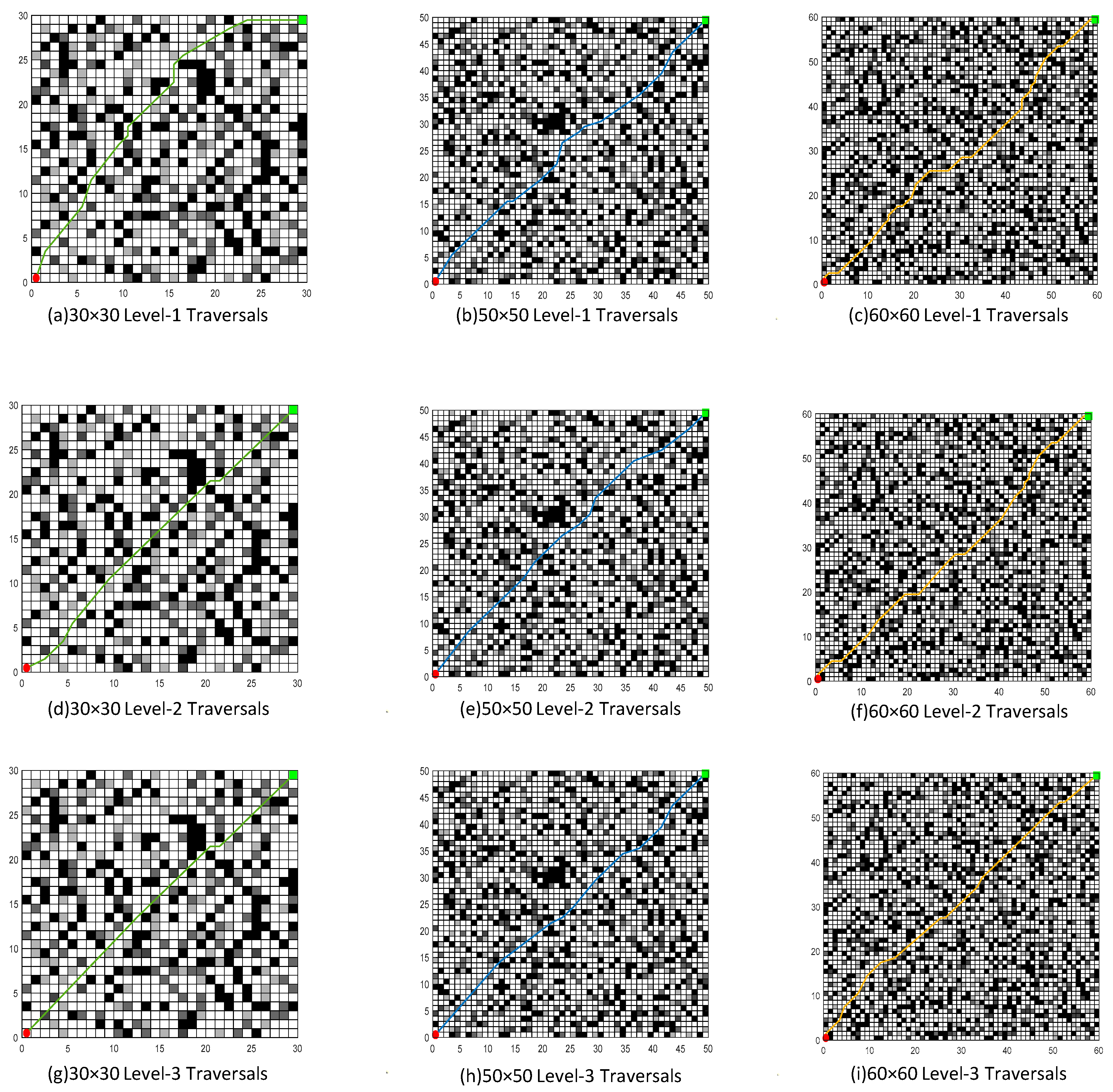
To extend the applicability of the OC-ACO algorithm, traversable regions are categorized into different levels with corresponding traversal costs assigned. Simulation experiments are conducted on 30 × 30, 50 × 50, 60 × 60 maps. The obstacle information for each level is given in Table 12. The OC-ACO algorithm is employed in the experiments. The results are shown in Figure 15, and the corresponding data are presented in Table 13, Table 14 and Table 15.
From the comparison results, it can be observed that:
(1)
On the 30 × 30 map, the secondary and tertiary obstacle-crossing levels achieve reductions of 7.0% and 7.3% in path length, respectively, compared with the primary level, and reductions of 40.0% and 60.0% in the number of turning points, respectively.
(2)
On the 50 × 50 map, the secondary and tertiary levels reduce the path length by 1.1% and 1.4%, and the number of turning points by 9.1% and 18.2%, respectively, compared with the primary level.
(3)
On the 60 × 60 map, the secondary and tertiary levels achieve reductions of 1.8% and 6.4% in path length, and 24.0% and 48.0% in the number of turning points, respectively, compared with the primary level.
In summary, algorithms with higher obstacle-crossing levels provide greater flexibility in path selection, allowing a trade-off between obstacle crossing and obstacle avoidance with lower overall cost. However, as the number of levels increases, the marginal benefits of adding additional levels gradually diminish, while the computational and hardware requirements increase significantly. Therefore, an appropriate obstacle-crossing level should be selected according to practical application needs.

5. Conclusions

This paper proposes an obstacle-crossing ant colony optimization algorithm (OC-ACO) to address the limitations of traditional ACO in path planning, including low efficiency, excessive turning points, and susceptibility to local optima. By integrating Jump Point Search (JPS), Genetic Algorithm (GA), and path optimization strategies, the proposed method improves global search capability and path quality. In addition, gray traversable regions are introduced, and key components such as pheromone initialization, transition probability, and update rules are redesigned to incorporate obstacle traversal capability.
Simulation results on grid maps of different scales demonstrate that the OC-ACO algorithm outperforms ACO and ACO-GA in terms of convergence speed, path length, number of waypoints, and total path cost, validating its effectiveness. Furthermore, experiments with hierarchical traversal levels show that the proposed method can flexibly adapt to practical scenarios by assigning different traversal costs based on robot capabilities.
Overall, the proposed algorithm provides an effective solution for path planning in environments with traversable obstacles.

Author Contributions

Conceptualization, L.H. and D.Z.; methodology, L.H.; software, Y.W.; validation, L.H., X.H., and T.X.; formal analysis, L.H.; investigation, L.H.; resources, L.H.; data curation, Y.W.; writing—original draft preparation, L.H.; writing—review and editing, L.H.; visualization, L.H.; supervision, D.Z.; project administration, D.Z.; funding acquisition, D.Z. All authors have read and agreed to the published version of the manuscript.

Funding

This research was funded by the Hubei Province (High-end Equipment Manufacturing Industry) High-value Patent Cultivation Center Project (2024-211).

Data Availability Statement

The data presented in this study are available at https://github.com/datashare768/Obstacle-Crossing-Robots (accessed on 5 April 2026).

Conflicts of Interest

The authors declare no conflicts of interest.

Abbreviations

The following abbreviations are used in this manuscript:
ACOAnt Colony Optimization
JPSJump Point Search
GAGenetic Algorithm
ACO-GAAnt Colony Optimization with Genetic Algorithm
JPS-ACOthe improved Jump Point Search-based Ant Colony Optimization
OC-ACOthe obstacle-crossing adaptive Ant Colony Optimization

References

  1. Dijkstra, E.W. A note on two problems in connexion with graphs. Numer. Math. 1959, 1, 269–271. [Google Scholar] [CrossRef]
  2. LaValle, S.M. Rapidly-Exploring Random Trees: A New Tool for Path Planning; Iowa State University: Ames, IA, USA, 1998. [Google Scholar]
  3. Karaman, S.; Frazzoli, E. Sampling-based algorithms for optimal motion planning. Int. J. Robot. Res. 2011, 30, 846–894. [Google Scholar] [CrossRef]
  4. Khatib, O. Real-Time Obstacle Avoidance for Manipulators and Mobile Robots. Int. J. Robot. Res. 1986, 5, 90–98. [Google Scholar] [CrossRef]
  5. Ge, S.S.; Cui, Y.J. Dynamic Motion Planning for Mobile Robots Using Potential Field Method. Auton. Robot. 2002, 13, 207–222. [Google Scholar] [CrossRef]
  6. Dorigo, M. Optimization, Learning and Natural Algorithms. Ph.D. Thesis, Politecnico di Milano, Milan, Italy, 1992. [Google Scholar]
  7. Liu, L.; Wang, X.; Yang, X.; Liu, H.; Li, J.; Wang, P. Path planning techniques for mobile robots: Review and prospect. Expert Syst. Appl. 2023, 227, 120254. [Google Scholar] [CrossRef]
  8. Hamad, I.I.; Hasan, M.S. A Review: On using ACO Based Hybrid Algorithms for Path Planning of Multi-Mobile Robotics. Int. J. Interact. Mob. Technol. 2020, 14, 145–156. [Google Scholar] [CrossRef]
  9. Blum, C. Ant colony optimization: A bibliometric review. Phys. Life Rev. 2024, 51, 87–95. [Google Scholar] [CrossRef]
  10. Dorigo, M.; Maniezzo, V.; Colorni, A. Ant system: Optimization by a colony of cooperating agents. IEEE Trans. Syst. Man Cybern. Part B 1996, 26, 29–41. [Google Scholar] [CrossRef] [PubMed]
  11. Socha, K.; Dorigo, M. Ant colony optimization for continuous domains. Eur. J. Oper. Res. 2008, 185, 1155–1173. [Google Scholar] [CrossRef]
  12. Dorigo, M.; Birattari, M.; Stutzle, T. Ant colony optimization. IEEE Comput. Intell. Mag. 2006, 1, 28–39. [Google Scholar] [CrossRef]
  13. Yang, X.S.; He, X. Firefly algorithm: Recent advances and applications. Int. J. Swarm Intell. 2013, 1, 36–50. [Google Scholar] [CrossRef]
  14. Dorigo, M.; Gambardella, L.M. Ant colony system: A cooperative learning approach to the traveling salesman problem. IEEE Trans. Evol. Comput. 1997, 1, 53–66. [Google Scholar] [CrossRef]
  15. Hu, J.; Wu, H.; Zhong, B.; Xiao, R. Swarm intelligence-based optimisation algorithms: An overview and future research issues. Int. J. Autom. Control 2020, 14, 656–693. [Google Scholar] [CrossRef]
  16. Tang, J.; Liu, G.; Pan, Q. A Review on Representative Swarm Intelligence Algorithms for Solving Optimization Problems: Applications and Trends. IEEE/CAA J. Autom. Sin. 2021, 8, 1627–1643. [Google Scholar] [CrossRef]
  17. Li, E.; Qi, K. Ant Colony Algorithm for Path Planning Based on Grid Feature Point Extraction. J. Shanghai Jiaotong Univ. (Sci.) 2023, 28, 86–99. [Google Scholar] [CrossRef]
  18. Shi, Y.; Zhang, H.; Li, Z.; Hao, K.; Liu, Y.; Zhao, L. Path planning for mobile robots in complex environments based on improved ant colony algorithm. Math. Biosci. Eng. 2023, 20, 15568–15602. [Google Scholar] [CrossRef]
  19. Zhao, D.; Liu, L.; Yu, F.; Heidari, A.A.; Wang, M.; Chen, H.; Muhammad, K. Opposition-based ant colony optimization with all-dimension neighborhood search for engineering design. J. Comput. Des. Eng. 2022, 9, 1007–1044. [Google Scholar] [CrossRef]
  20. Yang, Z.; Li, J.; Yang, L.; Chen, H.; Watanabe, K. A Smooth Jump Point Search Algorithm for Mobile Robots Path Planning Based on a Two-Dimensional Grid Model. J. Robot. 2022, 2022, 7682201. [Google Scholar] [CrossRef]
  21. Harabor, D.; Grastien, A. Online Graph Pruning for Pathfinding on Grid Maps. Proc. AAAI Conf. Artif. Intell. 2011, 25, 1114–1119. [Google Scholar] [CrossRef]
  22. Roshanzamir, M.; Palhang, M.; Mirzaei, A. Graph structure optimization of Genetic Network Programming with ant colony mechanism in deterministic and stochastic environments. Swarm Evol. Comput. 2019, 51, 100581. [Google Scholar] [CrossRef]
  23. Dai, L.; Jin, Z.; Zhao, X.; Du, X.; Ma, Z. Adaptive Genetic Algorithm Integrated with Ant Colony Optimization for Multi-Task Agricultural Machinery Scheduling. Agriculture 2025, 15, 2319. [Google Scholar] [CrossRef]
  24. Zhang, S.; Pu, J.; Si, Y. An Adaptive Improved Ant Colony System Based on Population Information Entropy for Path Planning of Mobile Robot. IEEE Access 2021, 9, 24933–24945. [Google Scholar] [CrossRef]
  25. Liang, S.; Jiao, T.; Du, W.; Qu, S. An improved ant colony optimization algorithm based on context for tourism route planning. PLoS ONE 2021, 16, e0257317. [Google Scholar] [CrossRef] [PubMed]
  26. Lin, B.-C.; Mei, Y.; Zhang, M. Automated design of state transition rules in ant colony optimization by genetic programming: A comprehensive investigation. Memetic Comput. 2025, 17, 2. [Google Scholar] [CrossRef]
  27. Zhang, Z.; Dou, Y.; Xu, X.; Ma, Y.; Jiang, J.; Tan, Y. Operational Requirements Analysis Method Based on Question Answering of WEKG. J. Syst. Eng. Electron. 2024, 35, 386–395. [Google Scholar] [CrossRef]
  28. Bai, X.; Liu, D.; Xu, X. A Review of Improved Methods for Ant Colony Optimization in Path Planning. J. Ship Res. 2024, 68, 77–92. [Google Scholar] [CrossRef]
  29. Stützle, T.; Hoos, H.H. Ant System. Future Gener. Comput. Syst. 2000, 16, 889–914. [Google Scholar] [CrossRef]
  30. Akka, K.; Khaber, F. Mobile robot path planning using an improved ant colony optimization. Int. J. Adv. Robot. Syst. 2018, 15, 1729881418774673. [Google Scholar] [CrossRef]
  31. Duan, H.; Wang, D.; Yu, X. Markov Chains and Martingale Theory Based Convergence Proof of Ant Colony Algorithm and Its Simulation Platform. In Proceedings of the 2006 6th World Congress on Intelligent Control and Automation, Dalian, China, 21–23 June 2006; pp. 3057–3061. [Google Scholar]
  32. Chen, T.; Chen, S.; Zhang, K.; Qiu, G.; Li, Q.; Chen, X. A jump point search improved ant colony hybrid optimization algorithm for path planning of mobile robot. Int. J. Adv. Robot. Syst. 2022, 19, 17298806221127953. [Google Scholar] [CrossRef]
  33. Garcia, M.A.P.; Montiel, O.; Castillo, O.; Sepúlveda, R.; Melin, P. Path planning for autonomous mobile robot navigation with ant colony optimization and fuzzy cost function evaluation. Appl. Soft Comput. 2009, 9, 1102–1110. [Google Scholar] [CrossRef]
  34. Deng, W.; Zhang, L.; Zhou, X.; Zhou, Y.; Sun, Y.; Zhu, W.; Chen, H.; Deng, W.; Chen, H.; Zhao, H. Multi-strategy particle swarm and ant colony hybrid optimization for airport taxiway planning problem. Inf. Sci. 2022, 612, 576–593. [Google Scholar] [CrossRef]
  35. Zhao, D.; Cai, G.; Wang, Y.; Li, X. Path Planning of Obstacle-Crossing Robot Based on Golden Sine Grey Wolf Optimizer. Appl. Sci. 2024, 14, 1129. [Google Scholar] [CrossRef]
  36. Liu, J.Q.; Wang, T.H.; Dong, Z. Path planning of mobile robot based on improved ant colony algorithm. Transducer Microsyst. Technol. 2022, 41, 140–143. [Google Scholar] [CrossRef]
Figure 1. Search mode of the algorithmic.
Mathematics 14 01461 g001
Figure 2. Search scope when there are no black areas around.
Mathematics 14 01461 g002
Figure 3. Search scope when there are black areas around.
Mathematics 14 01461 g003
Figure 4. Crossover operations.
Mathematics 14 01461 g004
Figure 5. Mutation operations.
Mathematics 14 01461 g005
Figure 6. Before and after path optimization.
Mathematics 14 01461 g006
Figure 7. Initial pheromone concentration of 30 × 30 map.
Mathematics 14 01461 g007
Figure 8. Obstacle-crossing cost.
Mathematics 14 01461 g008
Figure 9. Algorithm Procedure.
Mathematics 14 01461 g009
Figure 10. The mechanical structure schematic of the robot.
Mathematics 14 01461 g010
Figure 11. Working environment model.
Mathematics 14 01461 g011
Figure 12. Gradient-based experiment results.
Mathematics 14 01461 g012
Figure 13. Comparisons with ACO variants: ACO-GA algorithm and Reference [36].
Mathematics 14 01461 g013
Figure 14. Comparisons with other standard path planning methods.
Mathematics 14 01461 g014
Figure 15. Graded obstacle-crossing experiment result.
Mathematics 14 01461 g015
Table 1. Comparison of path optimization.
ParametersBefore OptimizationAfter Optimization
Path length14.485313.7509
Number of inflection points42
Table 2. Inflection point toll grading.
Corner (ω)Traversal Cost
ω ≤ π / 6 ω
π / 6 < ω ≤ π / 3 3   ω
π / 3 < ω ≤ π / 2 9   ω
ω > π / 2 1000   ω
Table 3. Performance of robot to overcome obstacles.
Obstacle-Surmounting CapabilityParameter Settings
Maximum vertical obstacle height400 mm
Maximum climbing slope40%
Maximum trench crossing width500 × 200 mm
Lateral obstacle140 mm
Table 4. The Experiment parameter settings.
Parameter NameValue
Maximum number of iterations G m 100
Number of ants m 50
Pheromone importance factor α 2
Heuristic information weight β 6
Terrain weight factor γ 1
Pheromone evaporation rate ρ 0.3
Goal distance weight factor φ 0.5
Turning point weight coefficient λ 1.5
Obstacle-surmounting cost coefficient θ 0.75
Crossover Probability P c 0.8
Mutation Rate P m 0.05
Table 5. Gradient experimental data.
AlgorithmPath LengthNumber of Inflection PointsNumber of Obstacle CrossingsTotal Path CostNumber of Iterations
ACO32.7312075.1470
ACO-GA31.895048.5628
JPS-ACO30.834041.0526
OC-ACO29.735131.1116
Table 6. The 30 × 30 grid map result.
AlgorithmPath LengthNumber of Turning PointsNumber of Obstacle CrossingsTotal Path CostNumber of Iterations
ACO-GA45.36160119.5843
Reference [35]43.3613089.3024
OC-ACO40.816346.714
Table 7. The 50 × 50 grid map result.
AlgorithmPath LengthNumber of Turning PointsNumber of Obstacle CrossingsTotal Path CostNumber of Iterations
ACO-GA75.15240195.3350
Reference [35]72.81160129.3612
OC-ACO69.8081076.0012
Table 8. The 60 × 60 grid map result.
AlgorithmPath LengthNumber of Turning PointsNumber of Obstacle CrossingsTotal Path CostNumber of Iterations
ACO-GA102.61460424.23100
Reference [35]99.53350328.6834
OC-ACO85.95158127.6330
Table 9. The 30 × 30 grid map result.
AlgorithmPath LengthNumber of Turning PointsNumber of Obstacle CrossingsTotal Path CostNumber of Iterations
Dijkstra43.3616043.36742
A*43.3614043.36154
BFS42.7711462.08741
Table 10. The 50 × 50 grid map result.
AlgorithmPath LengthNumber of Turning PointsNumber of Obstacle CrossingsTotal Path CostNumber of Iterations
Dijkstra72.8113072.812080
A*72.8118072.81419
BFS71.0511493.682085
Table 11. The 60 × 60 grid map result.
AlgorithmPath LengthNumber of Turning PointsNumber of Obstacle CrossingsTotal Path CostNumber of Iterations
Dijkstra91.8832091.882680
A*95.3944095.391256
BFS89.782115169.662680
Table 12. Information on barriers at all levels.
Obstacle LevelTraversal CostObstacle Color
Level-11Mathematics 14 01461 i001
Level-22Mathematics 14 01461 i002
Level-33Mathematics 14 01461 i003
Table 13. The 30 × 30 grid map result.
Obstacle Traversal LevelPath LengthNumber of WaypointsNumber of Obstacle TraversalsTotal Path Cost
Level-1Level-2Level-3
Level-144.69421040070.3325
Level-241.5737623060.5338
Level-341.4224424257.0252
Table 14. The 50 × 50 grid map result.
Obstacle Traversal LevelPath LengthNumber of WaypointsNumber of Obstacle TraversalsTotal Path Cost
Level-1Level-2Level-3
Level-171.14061180091.1490
Level-270.34541095084.4733
Level-370.1606994183.9387
Table 15. The 60 × 60 grid map result.
Obstacle Traversal LevelPath LengthNumber of WaypointsNumber of Obstacle TraversalsTotal Path Cost
Level-1Level-2Level-3
Level-189.031425900196.8270
Level-287.454119620166.1374
Level-383.3750131044124.7229
Disclaimer/Publisher’s Note: The statements, opinions and data contained in all publications are solely those of the individual author(s) and contributor(s) and not of MDPI and/or the editor(s). MDPI and/or the editor(s) disclaim responsibility for any injury to people or property resulting from any ideas, methods, instructions or products referred to in the content.