Article

A System Dynamics Model for Simulating the Development of Postgraduate Innovation Capacity in Smart Learning Environments


1
Equipment Management & UAV Engineering College, Air Force Engineering University, Xi’an 710051, China
2
School of Humanities and Education, Xi’an Eurasia University, Xi’an 710065, China
*
Author to whom correspondence should be addressed.
Mathematics 2026, 14(9), 1460; https://doi.org/10.3390/math14091460
Submission received: 23 March 2026 / Revised: 20 April 2026 / Accepted: 21 April 2026 / Published: 27 April 2026
(This article belongs to the Section E: Applied Mathematics)

Abstract

This study develops a system dynamics model to simulate the development of postgraduate innovation capacity in smart learning environments. Grounded in the system dynamics view that system behavior emerges from feedback structure, time delays, and nonlinear interaction rather than from isolated factor effects, the model represents postgraduate innovation capacity through three interrelated subsystems—summary ability, imagination, and transformative ability—and captures their interactions with learning support, learning assessment, learning resources, and data analysis. Based on data extracted from publicly available postgraduate education development quality reports, the relationships among variables were formulated, and the model was tested for dimensional consistency, numerical robustness, and behaviorally plausible performance. Simulation experiments were conducted to examine the dynamic evolution of postgraduate innovation capacity under different parameter perturbation scenarios. Scenario-based sensitivity comparisons were performed to identify the key factors influencing system behavior. The simulation results reveal several important system characteristics, including diminishing marginal returns in learning support, saturation effects in learning resources, delayed cumulative effects in learning assessment, and upper-range amplification in data analysis. In addition, the development of imagination exhibits an exponential growth pattern, while transformative ability is constrained by system feedback structures. These findings indicate that postgraduate innovation capacity development is governed by a nonlinear dynamic system rather than by linear factor relationships. From an applied mathematics perspective, the proposed model provides a quantitative simulation framework for examining the structural behavior of a complex educational system under feedback, delay, and scenario perturbations.

1. Introduction

1.1. Background

The development of postgraduate innovation capacity can be viewed as a dynamic process rather than a static outcome. In this study, postgraduate innovation capacity refers to scientific research-related innovation capacity in postgraduate education. This process involves multiple interacting factors, including learning support, learning resources, assessment mechanisms, and data feedback, which influence each other over time. These interactions form feedback structures and time-delay effects, making the development of postgraduate innovation capacity a complex dynamic system [1]. Traditional empirical approaches often focus on linear relationships between variables, but such methods are limited in explaining the dynamic evolution process of postgraduate innovation capacity.
Existing studies on smart learning environments and postgraduate innovation capacity have mainly examined learning performance, learning behavior, and the role of digital technologies in education. Most of these studies use statistical analysis or structural equation modeling to analyze the relationships between variables. While these methods are useful for identifying correlations, they generally assume static relationships and do not capture the dynamic interactions among system variables. In practice, postgraduate innovation capacity develops through accumulation, feedback, and adjustment processes, which involve nonlinear relationships and time-delay effects [2]. Therefore, it is necessary to use dynamic modeling methods to analyze the development process of postgraduate innovation capacity.
System dynamics is a method designed to analyze complex systems characterized by feedback loops, nonlinear relationships, and time delays [3]. It has been widely used to simulate the dynamic behavior of complex systems in management, policy analysis, and innovation systems research. Therefore, this study applies a system dynamics approach to construct a simulation model of postgraduate innovation capacity development. The model includes three subsystems—summary, imagination, and transformative ability—and describes the interactions among learning support, learning resources, learning assessment, and data analysis. Simulation and scenario-based sensitivity comparisons are conducted to analyze system behavior under different scenarios.
The remainder of this paper is organized as follows. Section 2 presents the research methods, data processing, model construction, and model validity tests. Section 3 reports the simulation results and presents the scenario-based sensitivity comparisons. Section 4 discusses the system behavior and model implications. Finally, Section 5 concludes the paper and outlines future research directions.

1.2. Literature Review

1.2.1. System Dynamics and Complex Systems

System dynamics is a method for analyzing complex systems characterized by feedback loops, time delays, and nonlinear relationships. It was originally developed by Forrester [1] and has been widely used to study industrial, social, and policy systems. Unlike traditional statistical methods, system dynamics focuses on system structure and dynamic behavior over time. In complex systems, system behavior is often determined by feedback structures rather than by individual factors, and nonlinear relationships frequently occur due to system constraints and delays. Therefore, system dynamics provides an effective tool for modeling and simulating complex systems [4]. System dynamics models typically consist of feedback loops and stock–flow structures, which are used to describe system structure and simulate system behavior over time [5,6]. This perspective is also consistent with the broader tradition of feedback thought in system dynamics and social systems theory, which emphasizes structural causation and time-dependent system behavior in complex systems [7]. Recent applied mathematical studies have further shown that complex dynamical systems may exhibit bifurcation and diffusion-driven regime changes, highlighting the importance of rigorous dynamic analysis in nonlinear systems [8]. Recent studies have also highlighted finite-time attractivity, exponential stability, and discontinuity-related effects in nonlinear dynamic systems, further underscoring the relevance of structurally grounded dynamic modeling [9].

1.2.2. Applications of System Dynamics in Education and Innovation Systems

In recent years, system dynamics has been increasingly used to study a wide range of complex applied systems, including healthcare, energy, product development, educational organizations, and innovation systems [10,11,12]. For example, Mohammadi and Faskhodi (2022) used system dynamics to model knowledge management processes in educational institutions and showed that feedback structures play an important role in knowledge development [13]. Uriona and Grobbelaar (2019) reviewed system dynamics models in innovation system research and found that innovation development is typically influenced by multiple interacting subsystems rather than by single variables [14]. More recent studies have applied system dynamics to simulate innovation systems and policy impacts, demonstrating the usefulness of simulation methods for analyzing long-term system behavior [15]. These studies suggest that innovation capacity development is influenced by system structure, feedback mechanisms, and resource interactions, and therefore can be analyzed using dynamic simulation models [16].
However, the existing literature still shows two limitations. First, many studies use system dynamics primarily as a simulation tool without sufficiently linking the modeled mechanisms to broader educational-system reasoning. Second, although education and innovation are both fields in which feedback, accumulation, and adaptation are central, relatively few studies have focused specifically on postgraduate innovation capacity as a dynamic developmental process. From this perspective, the present study extends prior work by modeling postgraduate innovation capacity not merely as an evaluative outcome, but as a structurally generated dynamic process embedded in a smart learning environment.

1.2.3. Postgraduate Innovation Capacity as a Dynamic System

Postgraduate innovation capacity development is not a static outcome but a nonlinear dynamic system involving accumulation, feedback, and adaptation [17]. In such systems, different subsystems interact with each other and produce nonlinear behavior over time. In addition, system behavior is often sensitive to parameter changes, meaning that small changes in certain variables may lead to differences in system outcomes [18]. Therefore, it is necessary to use simulation methods to analyze how postgraduate innovation capacity evolves under different conditions [19]. Based on previous studies, this study represents postgraduate innovation capacity using three subsystems—summary, imagination, and transformative ability—and constructs a system dynamics model to simulate their dynamic interactions. From an educational-systems perspective, postgraduate innovation capacity can also be understood as a learning-organization process shaped by adaptation, interaction, and feedback rather than by isolated instructional variables alone [20].
Although previous studies have examined education systems and innovation systems, most have relied on statistical analysis, structural-equation approaches, or conceptual discussion. Such approaches are useful for identifying associations, but they are less suitable for explaining how capability development evolves through feedback, reinforcement, delay, and structural constraint. Few studies have constructed dynamic simulation models to analyze the evolution of postgraduate innovation capacity over time, and even fewer have examined how different smart-learning functions jointly shape its developmental trajectory. In particular, the nonlinear relationships, feedback structures, and sensitivity characteristics of postgraduate innovation capacity development have not been sufficiently explored through simulation methods. Therefore, this study represents postgraduate innovation capacity through three interrelated subsystems—summary ability, imagination, and transformative ability—and constructs a system dynamics model to analyze how the structure of smart learning environments influences their long-term development under different scenarios.

2. Research Methods and Model Construction

2.1. Methodology Explanation

The relationship between smart learning environments and postgraduate innovation capacity is a multi-layered dynamic system, influenced by both endogenous variables and feedback from the external environment. System dynamics is a comprehensive research method that combines systems theory and management, using computer simulation technology to study the structure, function, and behavior patterns of complex systems. It emphasizes system wholeness, dynamics, and nonlinearity, and allows for the revelation of internal connections through mathematical modeling and computer simulation. The specific reasons for using system dynamics in this paper are as follows:
  • The main research question is based on the connotations and constituent elements of smart learning environments and postgraduate innovation capacity. System dynamics excels at analyzing the structure and functions of such complex systems [21].
  • This paper focuses on the relationship between smart learning environments and postgraduate innovation capacity. System dynamics helps with sorting variables in complex systems, analyzing behavioral series of research objects, and conducting scenario-based sensitivity comparisons of system variables.
  • Existing research lacks studies from a simulation perspective to examine the relationship between postgraduate innovation capacity and smart learning environments, so a combined qualitative and quantitative, theory-building system dynamics approach is adopted.

2.2. Data Collection and Processing

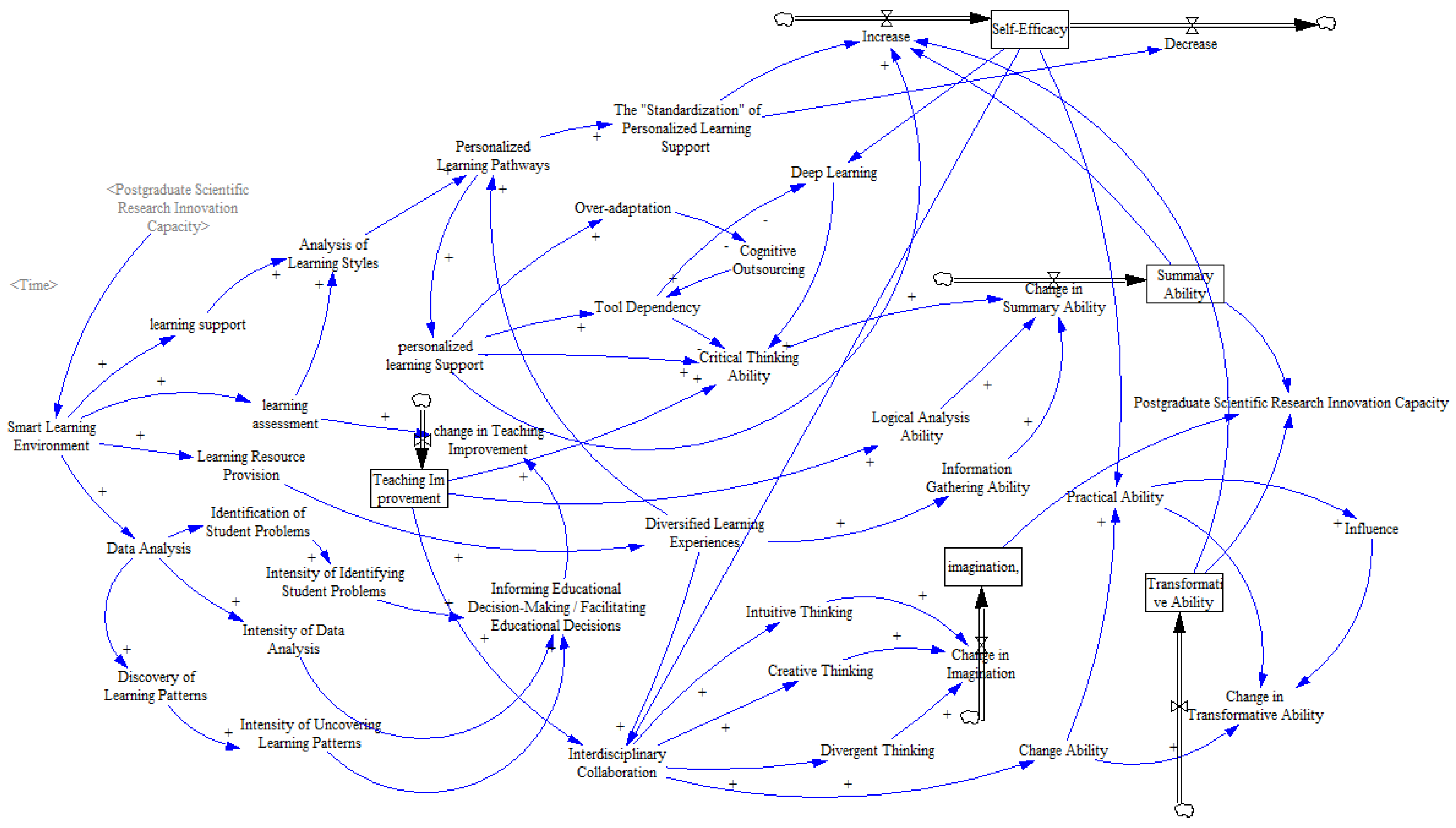
Based on the conceptual framework described above, this study identified the main influence paths through which smart learning environments affect postgraduate innovation capacity and then quantified the relative importance of the observable indicators using the entropy method. Figure 1 highlights three dominant reinforcing pathways in the system. First, data analysis improves educational decision-making and teaching improvement, which then enhances critical thinking and logical analysis, thereby promoting the growth of summary ability. Second, the same data-analysis–teaching-improvement pathway strengthens interdisciplinary collaboration, which further stimulates creative, divergent, and intuitive thinking and thus supports the development of imagination. Third, summary ability also feeds forward through self-efficacy, practical ability, and change ability, reinforcing the growth of transformative ability. Taken together, the model suggests that data analysis and teaching improvement function as central coordinating mechanisms, while the three core abilities are linked through mutually reinforcing feedback structures rather than isolated linear paths. The main data sources and indicator weights are presented in Table 1.
The data were extracted from publicly available postgraduate education development quality reports issued between 2021 and 2024 by 15 Chinese universities from different regions of China. The institutions were selected based on the public availability and relative completeness of their postgraduate quality reports. To improve transparency and traceability, the observable indicators were manually coded from the reports using a predefined protocol. For each candidate item, the original wording was reviewed in context and then assigned to a unified indicator category according to its substantive meaning rather than exact label matching alone. When different universities used different expressions for conceptually similar practices, platforms, courses, or outputs, these entries were harmonized into common coding categories. Supplementary Table S1 reports the source institutions, coverage years, report titles, and public links, while Supplementary Table S2 documents the core observable items, school-year evidence entries, original excerpts, coding results, and comparability notes used to support the present revision. Supplementary Table S3 provides a compact mapping between the coded observable items, their entropy-based weights, the higher-level constructs they inform, and the related implemented subsystem pathways reported in Table 2.
The observable set focused on items with relatively direct conceptual links, clearer quantifiability, and stronger cross-institutional comparability. Structured entries such as counts, percentages, and binary records were retained as codable evidence, whereas text-only descriptions were preserved for traceability and harmonization checking. Importantly, the supplementary coding tables are intended to document the source structure, evidence basis, and coding workflow of the observable indicators in a transparent manner; they are not presented as a line-by-line replacement of all original intermediate calculation files.
To improve the mathematical transparency of the weighting procedure, the entropy method used in this study is briefly described as follows. Let xij denote the original value of indicator j for university i. Because all indicators were treated as positive indicators, min–max normalization was first applied:
z i j = x i j m i n ( x j ) m a x ( x j ) m i n ( x j )
where zij is the normalized value of indicator j for university i. The proportion of indicator j for university i was then calculated as
p i j = z i j k i = 1 n z i j
where n denotes the number of universities. The entropy value of indicator j was computed by
e j = k i = 1 n p i j ln ( p i j ) ,                             k = 1 ln ( n )
The degree of divergence of indicator j was then defined as
d j = 1 e j
and the final entropy weight of indicator j was obtained by
w j = d j j = 1 m d j
where m denotes the total number of indicators. Under this procedure, indicators with greater cross-institutional variation received larger weights because they contained more discriminative information.
Importantly, the observable items were used as proxy indicators for the institutional conditions, training opportunities, or externally visible outputs related to each higher-level construct, rather than as direct psychometric measurements of student ability itself. Accordingly, the entropy weights were used to characterize the relative empirical importance of the observable indicators and to support the initial parameterization of the model. They were not interpreted as direct causal elasticities of the dynamic system. Structural parameters associated with delay, accumulation, scaling, and bounded system behavior were specified and calibrated within the system dynamics framework.

2.3. Variable and Model Construction

Based on the literature review, the empirical indicator structure, and the logic of system dynamics, this study constructed a dynamic simulation model of postgraduate innovation capacity in smart learning environments using Vensim PLE. The model consists of three interacting subsystems—summary ability, imagination, and transformative ability—which are jointly influenced by four major environmental functions: learning support, learning assessment, learning resource provision, and data analysis. In total, the model contains 40 variables, including 3 level variables, 3 rate variables, and 34 auxiliary variables. The overall stock–flow and feedback structure is shown in Figure 1, and the main variables and equations are summarized in Table 2.
In the model, postgraduate innovation capacity is represented as a dynamic state-variable system rather than as a static evaluation result. The three core dimensions, namely summary ability S(t), imagination I(t), and transformative ability T(t), evolve over time according to changes in the corresponding rate variables. Their general dynamic forms can be expressed as
d S ( t ) d t = f 1 ( L s , L a , L r , D ; θ 1 ) ,
d I ( t ) d t = f 2 ( L s , L a , L r , D ; θ 2 ) ,
d T ( t ) d t = f 3 ( L s , L a , L r , D ; θ 3 )
where Ls, La, Lr, and D denote learning support, learning assessment, learning resource provision, and data analysis, respectively, and θi represents the parameter set associated with each subsystem.
The expressions above provide the general dynamic representation, whereas Table 2 summarizes the implemented stock–flow relationships: summary-ability change is represented through critical thinking, logical analysis, and information gathering; imagination change through creative, divergent, and intuitive thinking; and transformative-ability change through change ability, practical ability, and influence, with upstream drivers captured through the auxiliary pathways in Table 2. For clarity, the implemented subsystem-level rate structures can be schematically expressed as
d S ( t ) d t α 1 C T A + α 2 L A A I + α 3 I G A ,
d I ( t ) d t β 1 C T + β 2 D T + β 3 I T ,
d T ( t ) d t m i n ( γ 1 C A + γ 2 P A + γ 3 I N F , 100 )
where CTA denotes critical thinking ability, LAA logical analysis ability, IGA information gathering ability, CT creative thinking, DT divergent thinking, IT intuitive thinking, CA change ability, PA practical ability, and INF influence. These bridge equations are schematic subsystem-level representations of the implemented stock–flow equations summarized in Table 2 rather than full closed-form analytical identities. Their upstream determinants are represented through the auxiliary-variable pathways reported in Table 2.
The model includes both linear and nonlinear components. Linear weighted relationships are used to represent first-order directional influences among auxiliary variables. Nonlinear behavior arises from several structural mechanisms. First, delayed adjustment is represented through the first-order delay function DELAY1 and the smoothing function SMOOTH, which capture lagged responses in educational improvement processes. Second, stock accumulation is represented through INTEG, which allows system states such as self-efficacy, teaching improvement, and the three ability dimensions to evolve cumulatively over time. Third, bounded growth, upper-range amplification, and diminishing-return patterns emerge from functions such as MIN, conditional relationships, and the interaction of multiple feedback loops. Thus, the nonlinear response of the model should be understood as jointly generated by equation-level implementation and system-level structure.
The coefficients reported in Table 2 were obtained through a combination of entropy-informed initialization, structural specification, and simulation-based calibration. More specifically, the entropy-based weights were first used to determine the relative ordering and initial scaling of indicator-related inputs. The final coefficient magnitudes were then adjusted within the system dynamics framework so that the implemented equations satisfied dimensional consistency, generated behaviorally plausible trajectories, and preserved coherent relative responses across the benchmark scenarios. Because the three subsystems differ in feedback depth, accumulation structure, and boundedness conditions, numerical equality between entropy-weight percentages and implementation-level coefficients was neither imposed nor expected.

2.4. Model Validity Tests

To evaluate the reliability of the proposed system dynamics model, this study considered model validity from the perspectives of dimensional consistency, numerical robustness, and behaviorally plausible system performance. Following the general logic of system dynamics validation, the aim was not to claim exact forecasting precision for a specific institution, but to assess whether the model structure is internally coherent, numerically stable, and capable of generating substantively reasonable patterns for the studied system.
First, dimensional consistency was examined using the unit-checking function in Vensim PLE. The major variables and equations passed the dimensional consistency test, indicating that the stock–flow relationships and equation specifications were internally coherent [22]. This result reduces the possibility that the reported simulation trajectories were driven by unit inconsistency or equation misspecification.
Second, a numerical robustness test was conducted by changing the simulation time step. In this study, the time step was increased by 50% to examine whether the principal results were sensitive to discretization settings. After this adjustment, the model remained stable and the main trajectories of summary ability, imagination, and transformative ability preserved their general patterns [23]. In particular, the overall direction of change, the relative ordering of subsystem responses, and the main turning-point characteristics were not materially altered. This suggests that the reported simulation patterns are not artifacts of a specific numerical integration setting.
Third, behavioral plausibility was assessed by examining whether the simulated trajectories were consistent with theoretically expected patterns in educational innovation processes. The model reproduced several substantively meaningful dynamics, including delayed cumulative effects of learning assessment, diminishing marginal effects of learning support, saturation tendencies in learning resource provision, and amplified effects of data analysis under stronger intervention conditions. These results do not constitute a point-by-point empirical fit test; rather, they indicate that the model generates behavior consistent with the conceptual structure and feedback mechanisms specified in this study.
The present model should therefore be understood as a data-informed and theory-guided system dynamics framework for structural analysis rather than as a deterministic forecasting tool. Its value lies in revealing dynamic mechanisms, comparing scenario trajectories, and identifying structurally influential factors. At the same time, the model has limitations. The parameterization is supported by coded documentary evidence from publicly available institutional reports rather than by fully continuous longitudinal micro-level observations, and future work could further strengthen the framework through richer empirical time-series validation and broader cross-institutional calibration.
Taken together, the dimensional consistency test, time-step robustness test, and behavioral plausibility assessment suggest that the model provides a sufficiently reliable basis for the subsequent scenario simulation and scenario-based sensitivity comparisons.

3. Simulation Analysis of Postgraduate Innovation Capacity

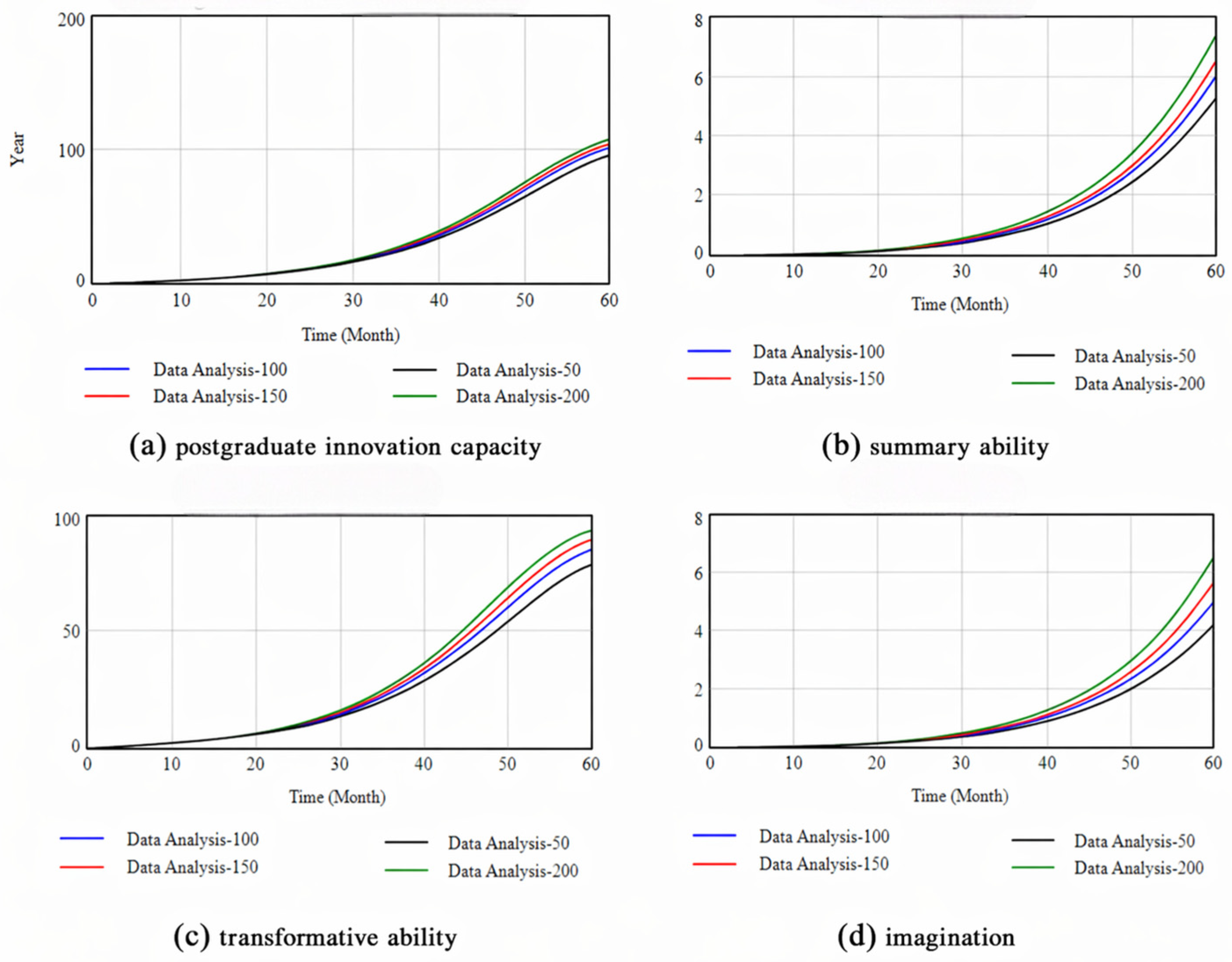
In the scenario analysis, the input levels of 50%, 100%, 150%, and 200% were selected to represent a reduced-input case, a baseline case, a moderate enhancement case, and a strong enhancement case, respectively, so as to examine directional response, marginal change, and nonlinear sensitivity around the reference setting [18]. Prior to analyzing specific variable interventions, a brief explanation regarding measurement scales and variable trajectories is necessary. It is important to note the differences in the y-axis scales among the sub-abilities in the upcoming simulation graphs. Within this system dynamics model, different cognitive dimensions are quantified using distinct mathematical constructs based on their underlying educational characteristics. Specifically, transformative ability is modeled as a bounded variable (scaled 0–100) reflecting the maturation process of complex cognitive skills, which naturally forms an S-shaped (Logistic) curve. In contrast, summary ability and imagination are modeled as unbounded accumulative indices. These represent the continuous gathering of foundational knowledge and creative stimuli over time, resulting in exponential upward trends with lower absolute numerical values within the 60-month timeframe. Consequently, the absolute y-axis values cannot be directly compared across different charts. The primary focus of the following scenario-based sensitivity comparisons lies in the relative growth trends, curve shapes, and marginal differences caused by varying input proportions, rather than the absolute numerical outputs across different cognitive dimensions. The following quantitative comparisons are intended to complement the visual interpretation of scenario trajectories and to clarify relative changes across input settings; they are not presented as a substitute for a full formal parametric sensitivity framework.

3.1. Scenario-Based Comparison of Learning Support on Postgraduate Innovation Capacity

This section selects learning support, one of the core functions of smart learning environments, as a key variable for scenario-based sensitivity comparisons. By adjusting the input proportion of the key variable (set at 50%, 100%, 150%, and 200%), the trends in the target variables—summary ability, imagination, and transformative ability within postgraduate innovation capacity—are observed.
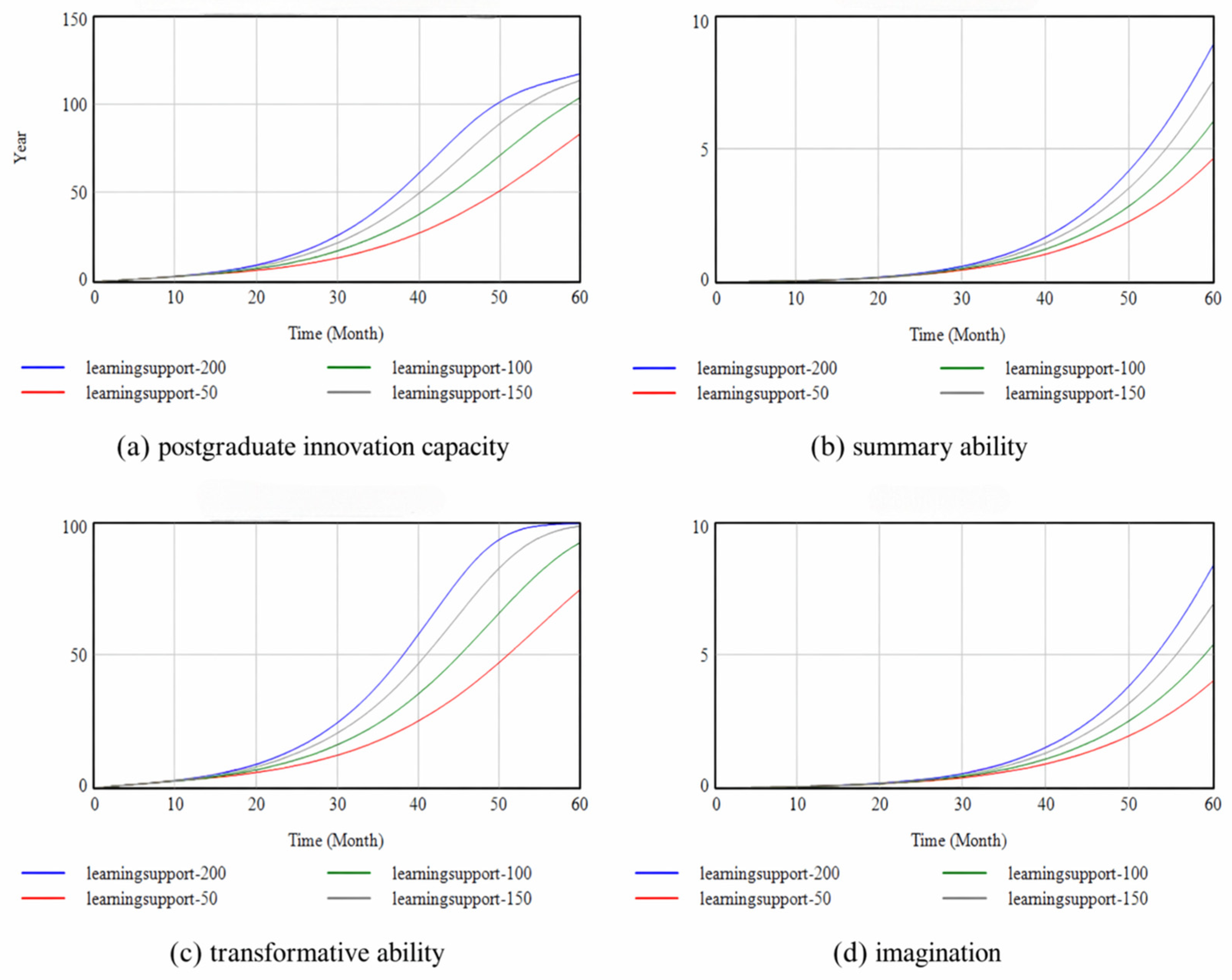
Figure 2 shows that increasing learning support has a consistently positive effect on all three abilities, but the marginal gain gradually decreases at higher input levels, indicating a diminishing-return pattern in the system. Quantitatively, at month 60, the 150% learning-support scenario increased summary ability, imagination, and transformative ability by 37.0%, 38.3%, and 60.7%, respectively, relative to the baseline, whereas the 200% scenario increased them by 77.1%, 79.7%, and 135.0%. At the same time, the additional increase from 150% to 200% was 29.3% for summary ability, 29.9% for imagination, and 46.2% for transformative ability. By contrast, the 50% scenario reduced the three corresponding outputs by 26.9%, 27.9%, and 40.8% at month 60. These values indicate a positive response to learning support, while also suggesting that the resulting system changes should be interpreted in terms of marginal variation rather than simple linear proportionality. Specifically, learning support appears to exert a positive influence on summary ability and imagination, but its effect on transformative ability shows diminishing marginal returns. As the input proportion increases from 150% to 200%, the incremental growth of transformative ability narrows. This suggests that excessively intensive external support may constrain the efficiency of transformative-ability development under the current system structure. In extremely high-support scenarios, over-standardization of personalized learning support and cognitive outsourcing can be interpreted as internal frictions that reduce the efficiency of higher-order innovation development rather than directly lowering the absolute level of transformative ability.

3.2. Scenario-Based Comparison of Learning Assessment on Postgraduate Innovation Capacity

This section selects learning assessment, another core function of smart learning environments, as a key variable for scenario-based sensitivity comparisons. Closely related variables include analyzing students’ learning styles and supporting instructor teaching improvement. Adjusting the input proportion of learning assessment (at 50%, 100%, 150% and 200%) reveals the trends in summary ability, imagination, and transformative ability within postgraduate innovation capacity.
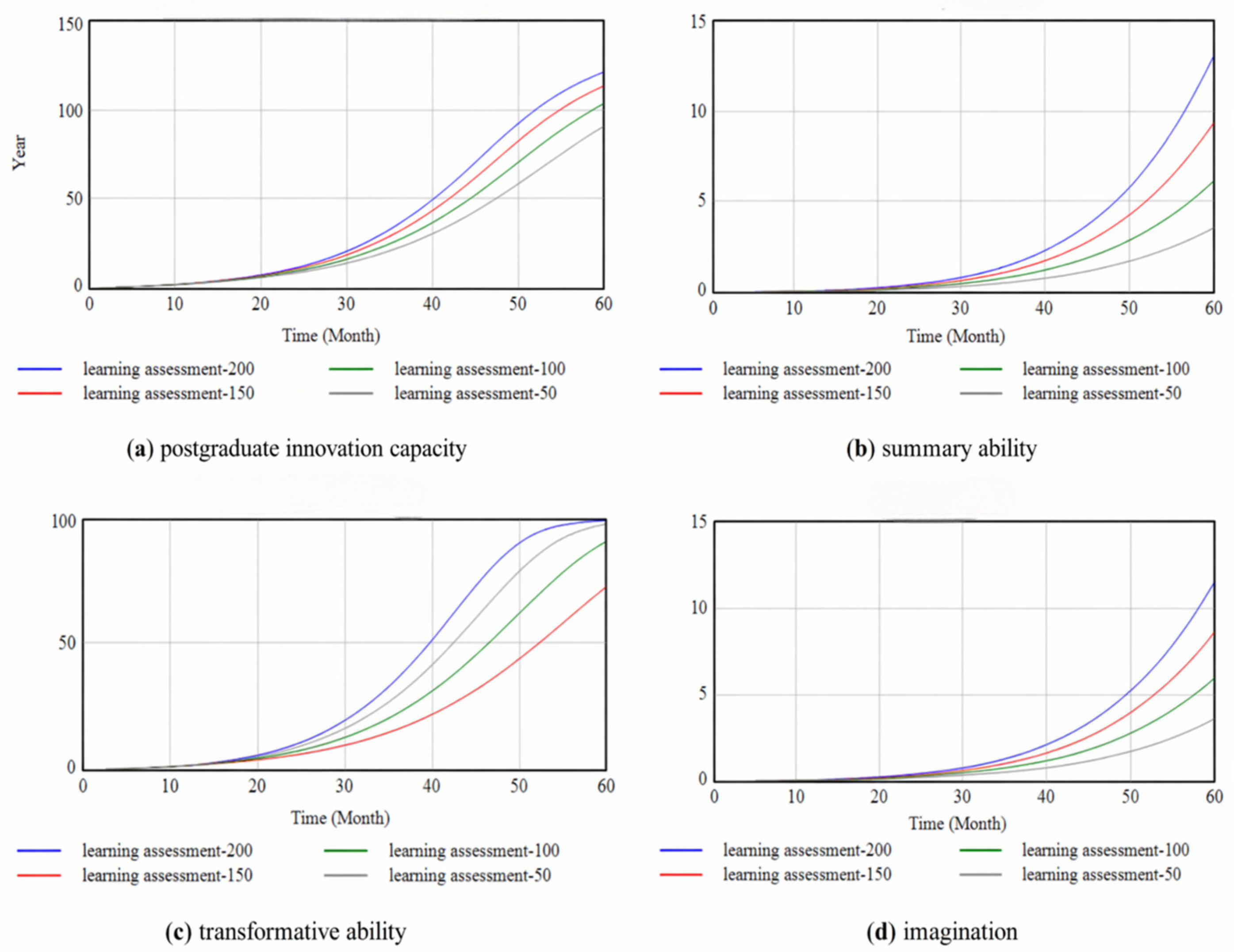
Figure 3 indicates that learning assessment exerts a delayed but cumulative influence on postgraduate innovation capacity. As assessment input increases, postgraduate innovation capacity grows, especially in summary ability and transformative ability, with imagination growing more slowly. In the model, learning assessment influences postgraduate innovation capacity through feedback mechanisms that adjust learning behavior and teaching improvement over time. This not only helps students identify problems and adjust strategies, but also gives teachers objective feedback to improve teaching, enhancing summary ability and transformative ability. Notably, the positive effect becomes stronger after 18 months of use, suggesting a cumulative and lagged effect. The delayed and cumulative role of learning assessment can also be seen quantitatively. For summary ability, the 150% and 200% scenarios were 17.1% and 34.1% above baseline at month 12, but the corresponding differences increased to 42.6% and 87.8% at month 36 and to 65.9% and 149.0% at month 60. A similar pattern appears for imagination, where the 150% and 200% scenarios were 14.4% and 28.0% above baseline at month 12, 39.9% and 81.9% above baseline at month 36, and 62.8% and 141.3% above baseline at month 60. Transformative ability also shows accumulation over time, with the 150% and 200% scenarios exceeding baseline by 4.1% and 5.9% at month 12, 20.4% and 38.6% at month 36, and 39.0% and 83.6% at month 60. These values are consistent with the interpretation that learning assessment exerts a lagged but progressively stronger influence on postgraduate innovation capacity. The system requires time for behavioral adjustment and feedback accumulation before the effect becomes pronounced. However, observing the 150% and 200% scenarios reveals a trend of diminishing marginal returns at extremely high levels of assessment. The narrowed gap between the 150% and 200% curves indicates that while continuous evaluation is beneficial, excessive and overly dense assessments provide limited additional capacity gains, suggesting that an optimal assessment frequency may be more effective than simple maximization.

3.3. Scenario-Based Comparison of Learning Resources on Postgraduate Innovation Capacity

Here, the integration and provision of learning resources—a main function of smart learning environments—is examined as a key variable. Closely associated is the logical analysis ability of postgraduates. Adjusting the input proportion of learning resources (at 50%, 100%, 150%, and 200%) shows the trends in summary ability, imagination, and transformative ability.
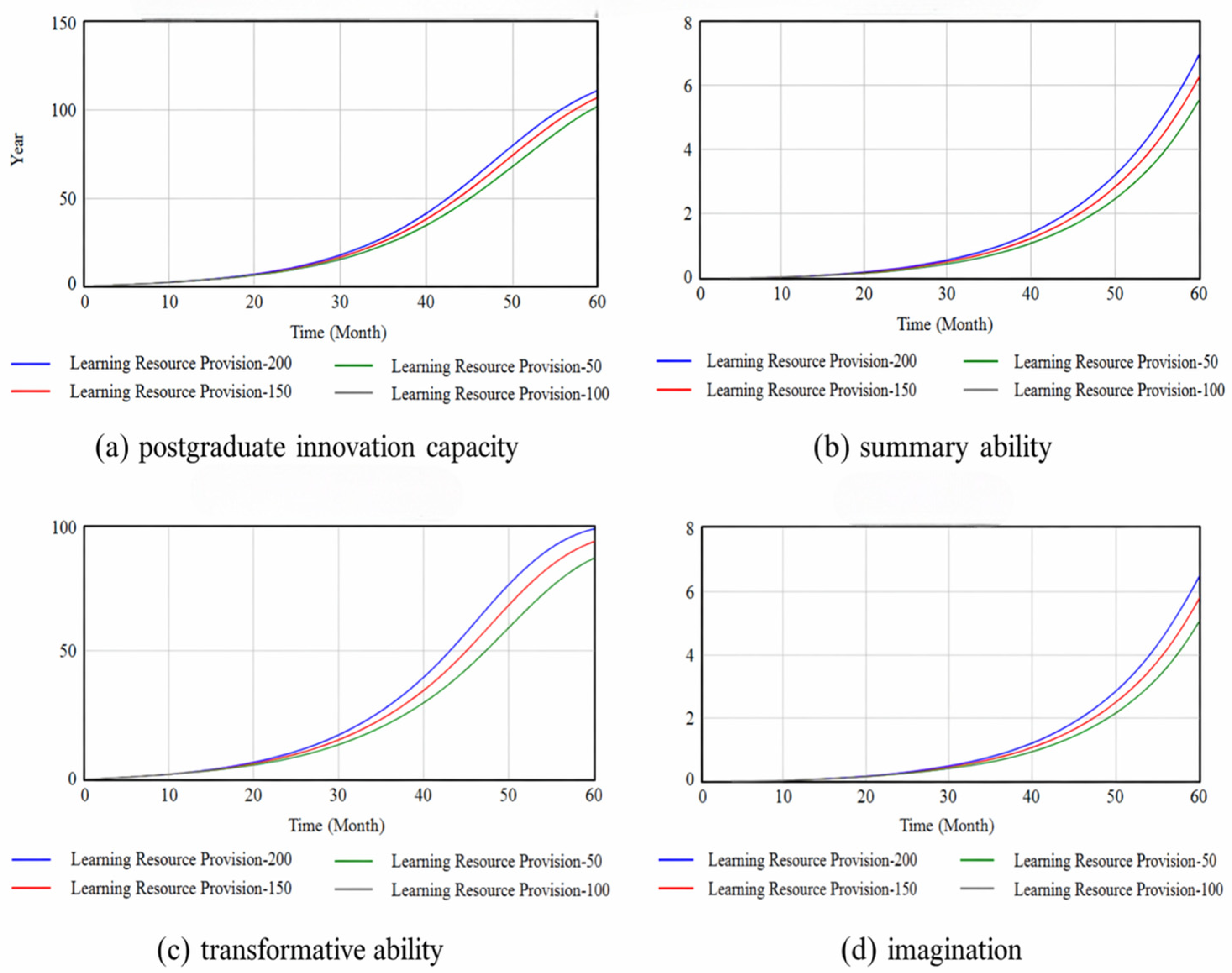
Figure 4 indicates that learning resources enhance postgraduate innovation capacity in a generally positive manner, but the growth tendency becomes flatter at higher levels, reflecting a saturation-like pattern in resource-driven development. However, a notable feature of these results is the highly constrained marginal effect of resource scaling. Despite increasing the resource provision from 50% up to 200%, the visual gaps between the four curves remain remarkably narrow across all capacities.
The richness and diversity of resources can broaden academic horizons and strengthen interdisciplinary research, laying a necessary foundation for improvements in summary ability, imagination, and transformative ability. Nevertheless, the tightly clustered curves suggest an early saturation tendency in resource utility. The saturation tendency of learning resources is also reflected in the quantitative comparisons. At month 60, the 150% and 200% resource scenarios increased summary ability by 13.0% and 23.3%, imagination by 11.6% and 20.4%, and transformative ability by 11.0% and 18.6%, respectively, relative to baseline. However, the additional increase from 150% to 200% remained limited, amounting to only 9.1% for summary ability, 7.8% for imagination, and 6.9% for transformative ability. The 50% scenario, by comparison, reduced the corresponding outputs by 8.4%, 7.2%, and 6.4% at month 60. These relatively narrow gaps support the interpretation that, once a basic level of resource provision is reached, further increases generate only modest additional gains. While essential, simply increasing the quantity of accessible materials does not proportionally translate into deep cognitive development, likely due to students’ intrinsic cognitive load limits. Once foundational resource needs are met (e.g., at the 50% level), further capacity breakthroughs appear to depend more on effective learning support and assessment mechanisms rather than mere resource accumulation.

3.4. Scenario-Based Comparison of Data Analysis on Postgraduate Innovation Capacity

This section analyzes data analysis, one of the main functions of smart learning environments, as a key variable. Closely related variables include mining learning patterns and guiding educational decision-making. Adjusting data analysis input (at 50%, 100%, 150%, and 200%) shows trends in summary ability, imagination, and transformative ability.
Figure 5 indicates that data analysis primarily amplifies summary ability and imagination, while its effect on transformative ability remains more limited. This amplification becomes more pronounced at higher input levels, especially when the scenario increases from 150% to 200%. The pattern is therefore better interpreted as an upper-range amplification effect than as a uniformly linear response across all subsystems. Quantitatively, data analysis produced a moderate but consistent amplification effect, especially for summary ability and imagination. At month 36, the 200% data-analysis scenario exceeded baseline by 21.5% in summary ability and 19.9% in imagination, whereas the corresponding increase in transformative ability was 7.1%. At month 60, the 200% scenario remained 21.2% above baseline for summary ability and 20.1% above baseline for imagination, compared with 11.6% for transformative ability. Moreover, the additional increase from 150% to 200% at month 60 was 9.1% for summary ability, 8.7% for imagination, and 5.4% for transformative ability. These results indicate that the upper-range effect of data analysis is more pronounced for summary ability and imagination than for transformative ability, which is consistent with its role as a structural amplifier in the model rather than a uniformly direct driver of all subsystems.
While the direct absolute trajectories for transformative ability appear more tightly clustered in the graphs, data analysis plays a vital structural role. It optimizes instructor improvement and interdisciplinary collaboration, amplifying the positive effect of other interventions on postgraduate innovation capacity. This confirms the synergistic effect of smart learning environment modules, showing that data analysis is not isolated but interacts with other functions to drive overall postgraduate innovation capacity improvement.

4. Discussion and Model Implications

This study develops a nonlinear system dynamics framework for simulating the evolution of postgraduate innovation capacity in smart learning environments. By modeling the interactions among learning support, learning assessment, learning resources, and data analysis, the study shows how structural feedback, time delays, and upper-range amplification patterns jointly shape system behavior [24]. First, some variables demonstrate diminishing marginal effects over time, indicating that continuous increases in input do not always lead to proportional increases in postgraduate innovation capacity. Second, certain variables show saturation effects, suggesting that system performance approaches a limit under specific conditions. Third, some subsystems exhibit stronger upper-range responses, where changes in variables may become more pronounced once interaction effects accumulate beyond lower-intensity conditions. These results indicate that postgraduate innovation capacity development is governed by the interaction of multiple feedback loops rather than by single-factor effects. This interpretation is also consistent with the broader system dynamics view that feedback-rich systems often generate nonlinear behavior, delayed responses, and decision misperceptions when judged through static intuition alone [25]. More broadly, these findings support the view that educational systems should be understood as socially structured, feedback-rich processes rather than as collections of isolated variables, which reinforces the broader educational significance of system dynamics [26].
Based on the simulation results, the following subsections discuss the implications of different variables for system behavior and model interpretation.

4.1. Implications of Learning Support Simulation

The simulation results indicate that increasing learning support has a positive effect on postgraduate innovation capacity, but the effect is nonlinear [27]. When the level of learning support is relatively low, increases in support improve summary ability and imagination. However, when the support level continues to increase, the marginal effect on transformative ability gradually decreases. This suggests that the relationship between learning support and postgraduate innovation capacity is not linear but constrained by system structure.
From the perspective of the system dynamics model, learning support influences postgraduate innovation capacity through multiple feedback loops, including its effects on personalized learning paths, teaching improvement, and interdisciplinary collaboration. When support is excessively high, the system shows a crowding effect, where excessive external intervention reduces the space for independent exploration, thereby lowering the growth efficiency of higher-level postgraduate innovation capacity. Therefore, the model suggests that learning support should be maintained within a moderate range to achieve the best system performance rather than being maximized continuously.

4.2. Implications of Learning Assessment and Time-Delay Effects

The simulation results show that learning assessment has a positive impact on postgraduate innovation capacity, especially on summary ability and transformative ability. However, the effect does not appear immediately but shows a clear time-delay characteristic. The simulation curves indicate that the effect becomes more pronounced after a certain period, which reflects the accumulation process within the system.
In the system dynamics model, learning assessment affects postgraduate innovation capacity indirectly through teaching improvement and learning behavior adjustment. This process involves time delays because changes in learning strategies and teaching methods require time to influence cognitive development. Therefore, the model demonstrates that assessment functions as a long-term driving factor rather than a short-term stimulus [3]. This time-delay effect is a typical characteristic of dynamic systems and explains why continuous assessment produces stronger long-term effects than short-term interventions [1].

4.3. Resource Saturation Effect in the Simulation Model

The simulation results show that increasing learning resources improves all three dimensions of postgraduate innovation capacity, but the marginal effect is relatively limited compared with other variables [2]. The simulation curves under different resource levels are relatively close, indicating that the system reaches a saturation state when resource supply reaches a certain level.
This saturation effect suggests that resource input is a necessary condition for postgraduate innovation capacity development, but it is not the main driving factor. In the system structure, learning resources mainly affect postgraduate innovation capacity through summary ability and interdisciplinary collaboration, but their effects are constrained by other subsystems such as learning support and assessment. Therefore, the model indicates that once the basic resource demand is satisfied, further improvement in postgraduate innovation capacity depends more on system coordination rather than continuous resource expansion.

4.4. Synergistic Effect of Data Analysis in the System

The simulation results indicate that data analysis plays a synergistic role in the system [28]. Unlike other variables that directly affect postgraduate innovation capacity, data analysis mainly influences the system indirectly by improving teaching adjustment and interdisciplinary collaboration. As a result, data analysis amplifies the effects of other variables through system feedback loops [29].
In the higher-input scenarios, the effect of data analysis becomes more pronounced, indicating an upper-range amplification pattern in the system rather than a uniformly linear response. At a conceptual level, the upper-range amplification observed here is broadly consistent with recent applied mathematical studies showing that nonlinear diffusive systems may generate amplified nonlinear responses under saturation-type mechanisms [30]. This suggests that data analysis functions as a structural variable in the model, which does not directly increase postgraduate innovation capacity but enhances the efficiency of other subsystems through feedback mechanisms [31,32]. More generally, recent studies have shown that diffusion and externally mediated impacts can substantially reshape long-term system trajectories, which is compatible with the structural amplification role identified for data analysis in the present model [33].

4.5. Growth Mechanism of Imagination in the Simulation Model

The simulation results show that imagination develops more slowly than summary ability in the early stages but accelerates in the later stages, showing an exponential growth trend [27].
This indicates that imagination is influenced by long-term accumulation and interdisciplinary collaboration in the system. In the system structure, imagination is mainly driven by interdisciplinary collaboration and diverse learning experiences. These variables require a long accumulation period before producing effects, which explains why imagination shows a delayed but accelerated growth pattern [3]. This result reflects the cumulative characteristic of innovation-related cognitive abilities in dynamic systems and suggests that imagination development depends more on long-term system evolution than on short-term interventions.
Overall, the simulation results demonstrate that the development of postgraduate innovation capacity in smart learning environments is governed by a dynamic system with multiple feedback loops, time delays, and nonlinear relationships [26]. Different subsystems play different roles in the system: learning support acts as a short-term driving factor, learning assessment produces long-term cumulative effects, learning resources are subject to saturation constraints, and data analysis functions as a structural amplification factor. These findings indicate that postgraduate innovation capacity development is the result of system structure and variable interaction rather than the effect of a single factor. The system dynamics model developed in this study provides a quantitative framework for analyzing the dynamic evolution of postgraduate innovation capacity and can be used to simulate different development scenarios [34].

5. Conclusions and Future Research

This study develops a nonlinear system dynamics framework for simulating the evolution of postgraduate innovation capacity in smart learning environments. By representing postgraduate innovation capacity as a dynamic system composed of summary ability, imagination, and transformative ability, the model captures the interactions among learning support, learning assessment, learning resources, and data analysis through feedback loops, stock–flow relationships, and scenario perturbations.
The simulation results show that postgraduate innovation capacity is governed by structural feedback rather than by isolated factor effects. Specifically, learning support exhibits diminishing marginal returns, learning assessment produces delayed cumulative effects, learning resources are subject to saturation constraints, and data analysis functions as a structural amplifier within the system. These findings indicate that the proposed framework can be used not only to describe system evolution, but also to analyze how different parameter settings change the trajectories of key subsystems. From an applied mathematics perspective, the study provides a computational framework for examining the behavior of a complex educational system under nonlinear and time-dependent conditions.
A limitation of the present study is that, compared with static statistical or structural-equation approaches, the present model emphasizes structural feedback and dynamic trajectories rather than cross-sectional effect identification. A more systematic comparison with alternative modeling approaches remains an important direction for future research.
Future research may extend the current model in several directions. First, the parameter estimation procedure may be further refined through larger-scale longitudinal datasets and cross-institutional calibration. Second, the present framework may be combined with Bayesian Networks to model probabilistic dependencies among summary ability, imagination, and transformative ability, thereby complementing the deterministic structure of the current system dynamics model. Third, future studies may compare alternative model structures or introduce additional variables, such as institutional heterogeneity and disciplinary differences, in order to test the generalizability of the proposed framework.

Supplementary Materials

The following supporting information can be downloaded at: https://www.mdpi.com/article/10.3390/math14091460/s1, Table S1: Source institutions and report information. Table S2: Core observable items and school-year evidence entries. Table S3: Mapping of coded observable items, entropy-based weights, higher-level constructs, and related implemented subsystem pathways.

Author Contributions

Conceptualization, J.L. and L.Z.; methodology, J.L. and L.Z.; software, J.L.; validation, J.L.; formal analysis, J.L.; investigation, J.L.; data curation, J.L.; visualization, J.L.; writing—original draft preparation, J.L.; writing—review and editing, J.L. and L.Z.; supervision, L.Z.; project administration, L.Z.; funding acquisition, J.L. All authors have read and agreed to the published version of the manuscript.

Funding

This research was funded by the 2025 Xi’an Eurasia University Project: The Design and Application of a Student Personalized Learning Recommendation Platform Based on Knowledge Graph from the Perspective of Student-Centeredness (No: 2025ZD10).

Data Availability Statement

The data used in this study were extracted from publicly available postgraduate education development quality reports released by 15 universities. The titles, years, and URLs of these reports are provided in Supplementary Table S1. The processed data and simulation settings are available from the corresponding author upon reasonable request.

Acknowledgments

The authors used ChatGPT (https://chat.openai.com, accessed 19 April 2026) to assist with language polishing and expression refinement during manuscript preparation. All conceptual development, model design, data processing, interpretation of results, and final revisions were completed by the authors.

Conflicts of Interest

The authors declare no conflicts of interest. The funders had no role in the design of the study; in the collection, analyses, or interpretation of data; in the writing of the manuscript; or in the decision to publish the results.

References

  1. Forrester, J.W. Industrial dynamics. J. Oper. Res. Soc. 1997, 48, 1037–1041. [Google Scholar] [CrossRef]
  2. Meadows, D.H. Thinking in Systems: A Primer; Chelsea Green Publishing: White River Junction, VT, USA, 2008. [Google Scholar]
  3. Sterman, J.D. System Dynamics: Systems Thinking and Modeling for a Complex World; McGraw-Hill: New York, NY, USA, 2000. [Google Scholar]
  4. Wolstenholme, E.F. System enquiry using system dynamics. Int. J. Syst. Sci. 1986, 17, 111–120. [Google Scholar] [CrossRef]
  5. Lane, D.C. The emergence and use of diagramming in system dynamics: A critical account. Syst. Res. Behav. Sci. 2008, 25, 3–23. [Google Scholar] [CrossRef]
  6. Richardson, G.P.; Pugh, A.L. Introduction to system dynamics modeling with DYNAMO. J. Oper. Res. Soc. 1997, 48, 1146. [Google Scholar] [CrossRef]
  7. Richardson, G.P. Feedback Thought in Social Science and Systems Theory; University of Pennsylvania Press: Philadelphia, PA, USA, 1991. [Google Scholar]
  8. Li, W.; Zhang, L.; Cao, J. A note on Turing–Hopf bifurcation in a diffusive Leslie–Gower model with weak Allee effect on prey and fear effect on predator. Appl. Math. Lett. 2026, 172, 109741. [Google Scholar] [CrossRef]
  9. Li, W.; Zhang, L.; Cao, J.; Xu, F.; Cai, Z. Finite time attractivity and exponentially stable of a multi-stage epidemic system with discontinuous incidence. Qual. Theory Dyn. Syst. 2025, 24, 199. [Google Scholar] [CrossRef]
  10. Dangerfield, B.C. System dynamics applications to European healthcare issues. In Operational Research for Emergency Planning in Healthcare: Volume 2; Mustafee, N., Ed.; Palgrave Macmillan: London, UK, 2016; pp. 296–315. [Google Scholar] [CrossRef]
  11. Ford, A. System dynamics and the electric power industry. Syst. Dyn. Rev. 1997, 13, 57–85. [Google Scholar] [CrossRef]
  12. Rodrigues, L.L.R.; Dharmaraj, N.; Rao, B.R.S. System dynamics approach for change management in new product development. Manag. Res. News 2006, 29, 512–523. [Google Scholar] [CrossRef]
  13. Mohammadi, M.; Faskhodi, A.A. Modeling the dynamics of knowledge management in educational institutes: A system dynamics approach. Educ. Self Dev. 2022, 17, 86–104. [Google Scholar] [CrossRef]
  14. Uriona, M.; Grobbelaar, S.S. Innovation system policy analysis through system dynamics modelling: A systematic review. Sci. Public Policy 2019, 46, 28–44. [Google Scholar] [CrossRef]
  15. Samara, E.; Kilintzis, P.; Katsoras, E.; Martnidis, G.; Kosti, P. A system dynamics approach for the development of a regional innovation system. J. Innov. Entrep. 2024, 13, 28. [Google Scholar] [CrossRef]
  16. Andriyani, Y.; Yohanitas, W.A.; Kartika, R.S. Adaptive innovation model design: Integrating agile and open innovation in regional areas innovation. J. Open Innov. Technol. Mark. Complex. 2024, 10, 100197. [Google Scholar] [CrossRef]
  17. Raza, A. Nonlinear dynamics in complex systems: A mathematical approach. Front. Appl. Phys. Math. 2024, 1, 42–56. [Google Scholar] [CrossRef]
  18. Borgonovo, E. Sensitivity analysis. In Tutorials in Operations Research: Advancing the Frontiers of OR/MS: From Methodologies to Applications; INFORMS: Catonsville, MD, USA, 2023; pp. 52–81. [Google Scholar] [CrossRef]
  19. Rahmandad, H.; Sterman, J.D. Heterogeneity and network structure in the dynamics of diffusion: Comparing agent-based and differential equation models. Manag. Sci. 2008, 54, 998–1014. [Google Scholar] [CrossRef]
  20. Senge, P.M. The Fifth Discipline: The Art and Practice of the Learning Organization; Doubleday/Currency: New York, NY, USA, 1990. [Google Scholar]
  21. Saeed, K. Slicing a complex problem for system dynamics modeling. Syst. Dyn. Rev. 1992, 8, 251–261. [Google Scholar] [CrossRef]
  22. Barlas, Y. Formal aspects of model validity and validation in system dynamics. Syst. Dyn. Rev. 1996, 12, 183–210. [Google Scholar] [CrossRef]
  23. Lyneis, J.M. System dynamics for market forecasting and structural analysis. Syst. Dyn. Rev. 2000, 16, 3–25. [Google Scholar] [CrossRef]
  24. Sterman, J.D. Learning from evidence in a complex world. Am. J. Public Health 2006, 96, 505–514. [Google Scholar] [CrossRef]
  25. Sterman, J.D. Misperceptions of feedback in dynamic decision making. Organ. Behav. Hum. Decis. Process. 1989, 43, 301–335. [Google Scholar] [CrossRef]
  26. Lane, D.C. Rerum cognoscere causas: Part II—Opportunities generated by the agency/structure debate and suggestions for clarifying the social theoretic position of system dynamics. Syst. Dyn. Rev. 2001, 17, 293–309. [Google Scholar] [CrossRef]
  27. Strogatz, S.H. Nonlinear dynamics and chaos. Comput. Phys. 1994, 8, 532–537. [Google Scholar] [CrossRef]
  28. Bianchi, C. Improving performance and fostering accountability in the public sector through system dynamics modelling. Syst. Res. Behav. Sci. 2010, 27, 361–384. [Google Scholar] [CrossRef]
  29. Kempe, D.; Kleinberg, J.; Tardos, É. Maximizing the spread of influence through a social network. In Proceedings of the Ninth ACM SIGKDD International Conference on Knowledge Discovery and Data Mining, Washington, DC, USA, 24–27 August 2003; pp. 137–146. [Google Scholar] [CrossRef]
  30. Li, W.; Yang, L.; Cao, J. Threshold dynamics of a degenerated diffusive incubation-period host–pathogen model with saturation incidence rate. Appl. Math. Lett. 2025, 160, 109312. [Google Scholar] [CrossRef]
  31. Zhou, Q.; Yang, F. Innovation diffusion with network effects and bandwagon effects based on complex networks. In WHICEB 2020 Proceedings; Springer: Cham, Switzerland, 2020; Available online: https://aisel.aisnet.org/whiceb2020/23 (accessed on 23 October 2025).
  32. Hashemizadeh, A.; Ju, Y.; Abadi, F.Z.B. Policy design for renewable energy development based on system dynamics. Appl. Energy 2024, 376, 124331. [Google Scholar] [CrossRef]
  33. Li, W.; Zhao, W.; Cao, J.; Huang, L. Dynamics of a linear source epidemic system with diffusion and media impact. Z. Angew. Math. Phys. 2024, 75, 144. [Google Scholar] [CrossRef]
  34. Yuan, J.; Mou, Q.; Xu, C.; Zhang, J. Policy simulation of China’s green hydrogen industry development based on system dynamics. China Popul. Resour. Environ. 2023, 33, 49–58. (In Chinese) [Google Scholar]
Figure 1. System Dynamics Model Flowchart of Smart Learning Environments and Postgraduate Innovation Capacity.
Mathematics 14 01460 g001
Figure 2. Trends in Postgraduate Innovation Capacity and Its Subsystems after Changes in Learning Support: (a) postgraduate innovation capacity; (b) summary ability; (c) transformative ability; (d) imagination. Note: The y-axis scales differ across dimensions due to their distinct mathematical constructs.
Mathematics 14 01460 g002
Figure 3. Trends in Postgraduate Innovation Capacity and Its Subsystems after Changes in Learning Assessment: (a) postgraduate innovation capacity; (b) summary ability; (c) transformative ability; (d) imagination. Note: The y-axis scales differ across dimensions, as explained in Figure 2.
Mathematics 14 01460 g003
Figure 4. Trends in Postgraduate Innovation Capacity and Its Subsystems after Changes in Learning Resources: (a) postgraduate innovation capacity; (b) summary ability; (c) transformative ability; (d) imagination. Note: The y-axis scales differ across dimensions, as explained in Figure 2.
Mathematics 14 01460 g004
Figure 5. Trends in Postgraduate Innovation Capacity and Its Subsystems after Changes in Data Analysis: (a) postgraduate innovation capacity; (b) summary ability; (c) transformative ability; (d) imagination. Note: The y-axis scales differ across dimensions, as explained in Figure 2.
Mathematics 14 01460 g005
Table 1. Main Data Sources and Weights.
Specific Measurement IndicatorsData SourceWeights
Learning SupportGraduate Teaching Evaluation System7.80%
Learning AssessmentOnline Learning Logs7.14%
Learning Resource ProvisionNumber of Online Course Platforms7.23%
Data AnalysisInformation Management of Cultivation Process2.84%
Critical Thinking AbilityNumber of Speculative/Research-oriented Courses6.65%
Logical Analysis AbilityLogical Training Platforms/Projects0.02%
Information Gathering AbilityInformation Skills Training6.65%
Intuitive Thinking AbilityCutting-edge Academic Lectures/Forums4.35%
Creative Thinking AbilityNumber of Awards in Discipline Competitions5.23%
Divergent Thinking AbilityInterdisciplinary Platforms/Projects6.33%
Transformative AbilityNumber of Achievement Transformation Projects19.9%
Practical AbilityNumber of Employed in Key Industries20.0%
InfluenceNumber of Papers in Top Journals26.8%
Table 2. Main Model Variables and Equations.
Level VariableRate VariableMain Auxiliary Variables
(Partial)
Equation
Summary AbilityChange in Summary AbilityCritical Thinking AbilityPersonalized Learning Support × 0.062 + Tool Dependency × −0.05 + Teaching Improvement × 0.069 + Deep Learning × 0.058
Logical Analysis AbilityTeaching Improvement × 0.069
Information Gathering AbilityDiverse Learning Experiences × 0.058
Personalized Learning SupportPersonalized Learning Paths × 0.071
Teaching ImprovementSMOOTH (Change in Teaching Improvement, Semester Cycle)
ImaginationChange in ImaginationIntuitive ThinkingInterdisciplinary Collaboration × 0.316
Creative ThinkingInterdisciplinary Collaboration × 0.413
Divergent ThinkingInterdisciplinary Collaboration × 0.271
Interdisciplinary Collaboration(Diverse Learning Experiences × 0.18 + Teaching Improvement × 0.29 + Self-Efficacy × 0.138)/10
Transformative AbilityChange in Transformative AbilityTransformative AbilityInterdisciplinary Collaboration × 0.316
Practical AbilityTransformative Ability + (Self-Efficacy − 0.5) × 0.1
InfluencePractical Ability + 0.12
Self-EfficacyINTEG (Initial Value, Growth–Decline)
Interdisciplinary Collaboration(Diverse Learning Experiences × 0.18 + Teaching Improvement × 0.29 + Self-Efficacy × 0.138)/10
Note: The coefficients listed in Table 2 were specified in the system dynamics implementation using entropy-informed relative indicator importance together with structural assumptions, subsystem aggregation, and behavioral calibration. They should be interpreted as structural simulation parameters rather than direct statistical estimates or one-step numerical transformations of the entropy weights.
Disclaimer/Publisher’s Note: The statements, opinions and data contained in all publications are solely those of the individual author(s) and contributor(s) and not of MDPI and/or the editor(s). MDPI and/or the editor(s) disclaim responsibility for any injury to people or property resulting from any ideas, methods, instructions or products referred to in the content.