A System Dynamics Model for Simulating the Development of Postgraduate Innovation Capacity in Smart Learning Environments


Abstract
1. Introduction
1.1. Background
1.2. Literature Review
1.2.1. System Dynamics and Complex Systems
1.2.2. Applications of System Dynamics in Education and Innovation Systems
1.2.3. Postgraduate Innovation Capacity as a Dynamic System
2. Research Methods and Model Construction
2.1. Methodology Explanation
- The main research question is based on the connotations and constituent elements of smart learning environments and postgraduate innovation capacity. System dynamics excels at analyzing the structure and functions of such complex systems [21].
- This paper focuses on the relationship between smart learning environments and postgraduate innovation capacity. System dynamics helps with sorting variables in complex systems, analyzing behavioral series of research objects, and conducting scenario-based sensitivity comparisons of system variables.
- Existing research lacks studies from a simulation perspective to examine the relationship between postgraduate innovation capacity and smart learning environments, so a combined qualitative and quantitative, theory-building system dynamics approach is adopted.
2.2. Data Collection and Processing
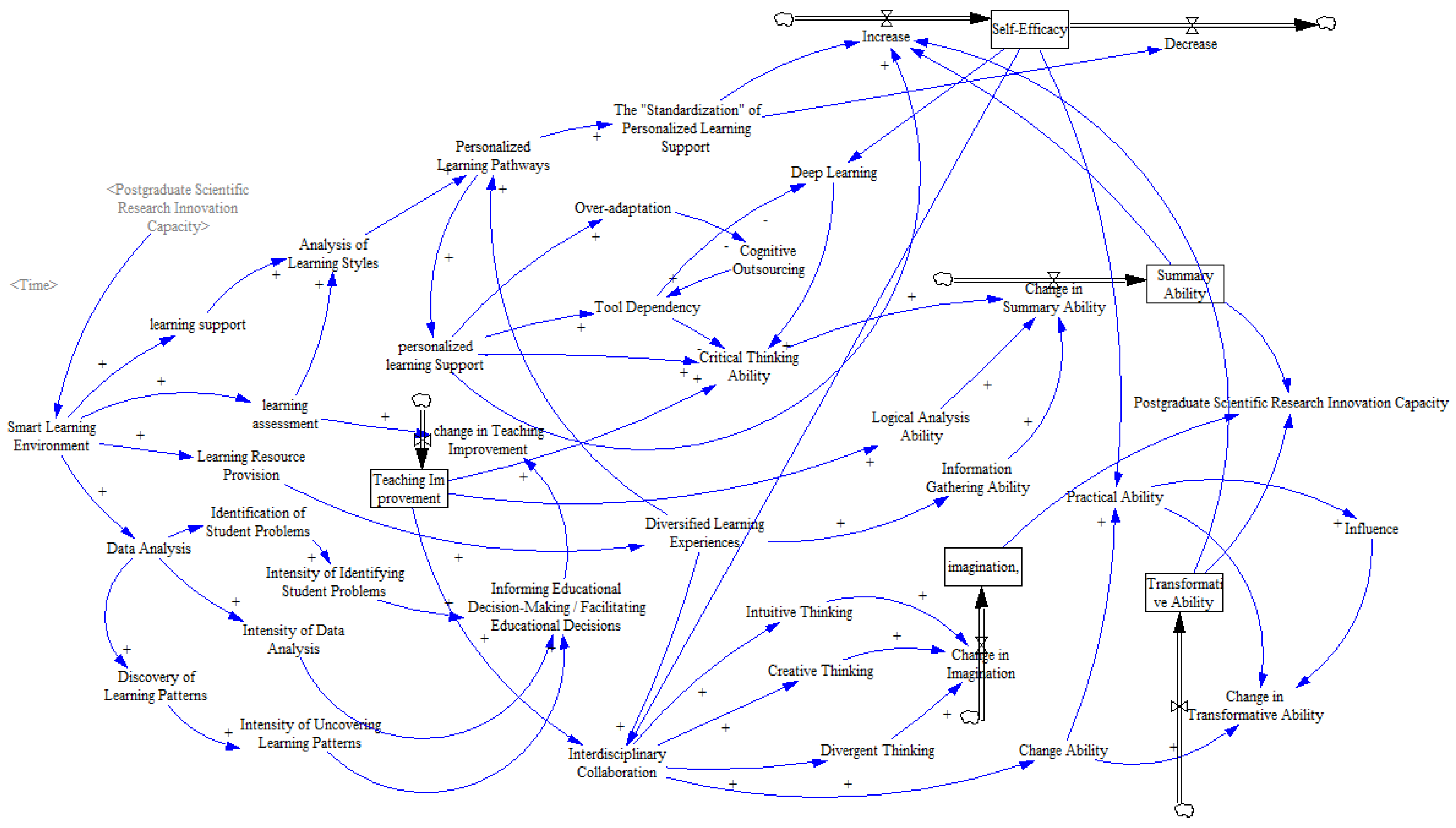
2.3. Variable and Model Construction
2.4. Model Validity Tests
3. Simulation Analysis of Postgraduate Innovation Capacity
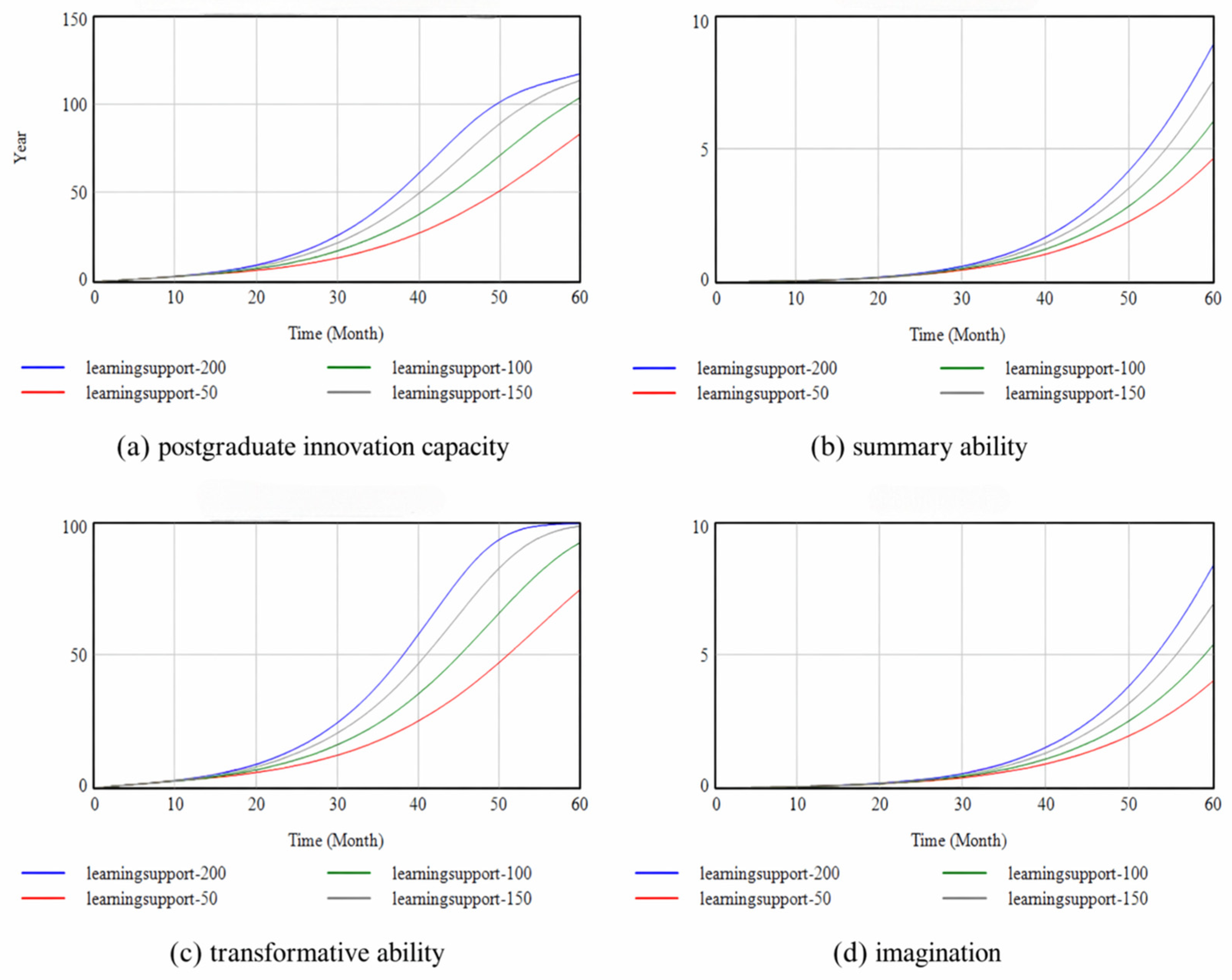
3.1. Scenario-Based Comparison of Learning Support on Postgraduate Innovation Capacity
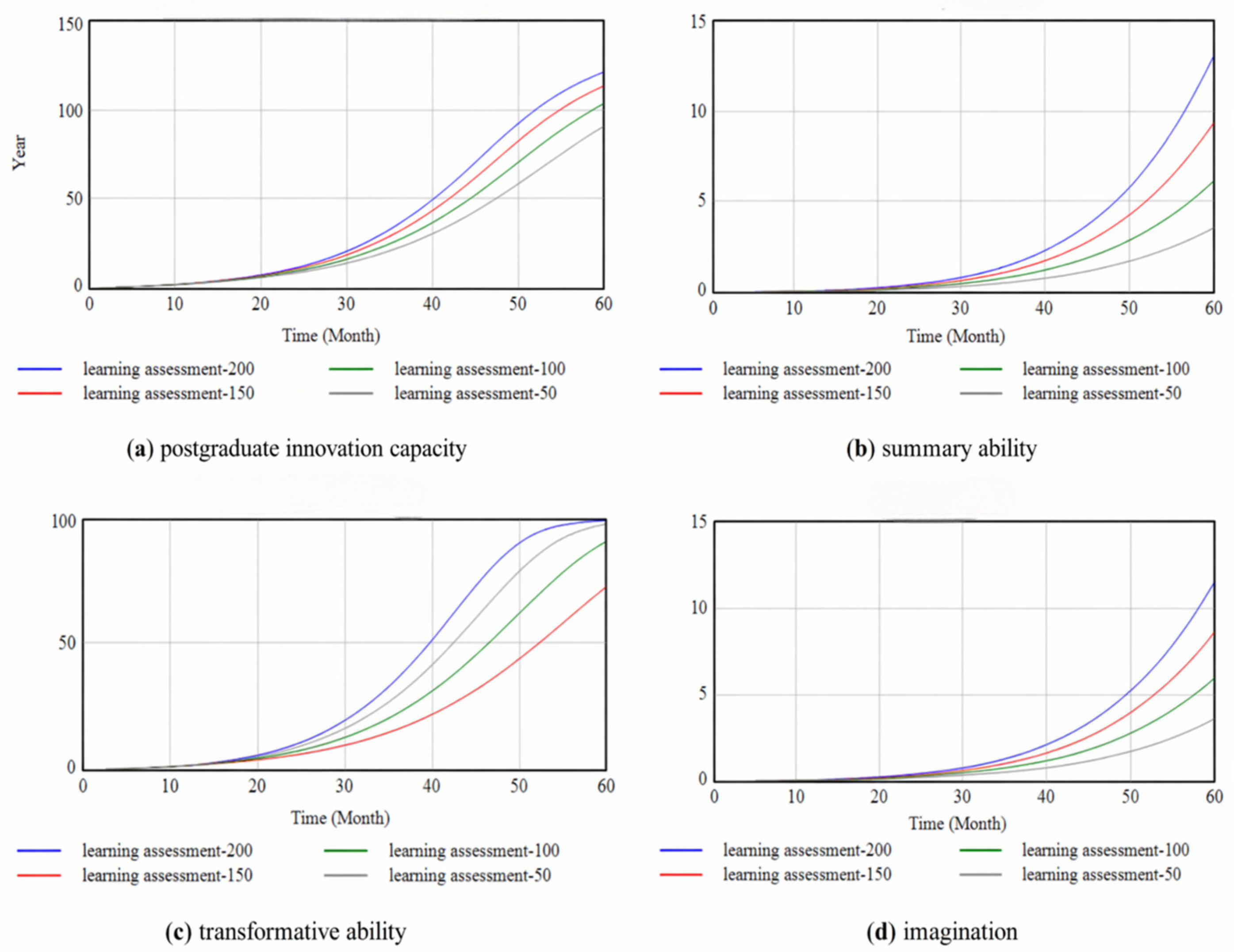
3.2. Scenario-Based Comparison of Learning Assessment on Postgraduate Innovation Capacity
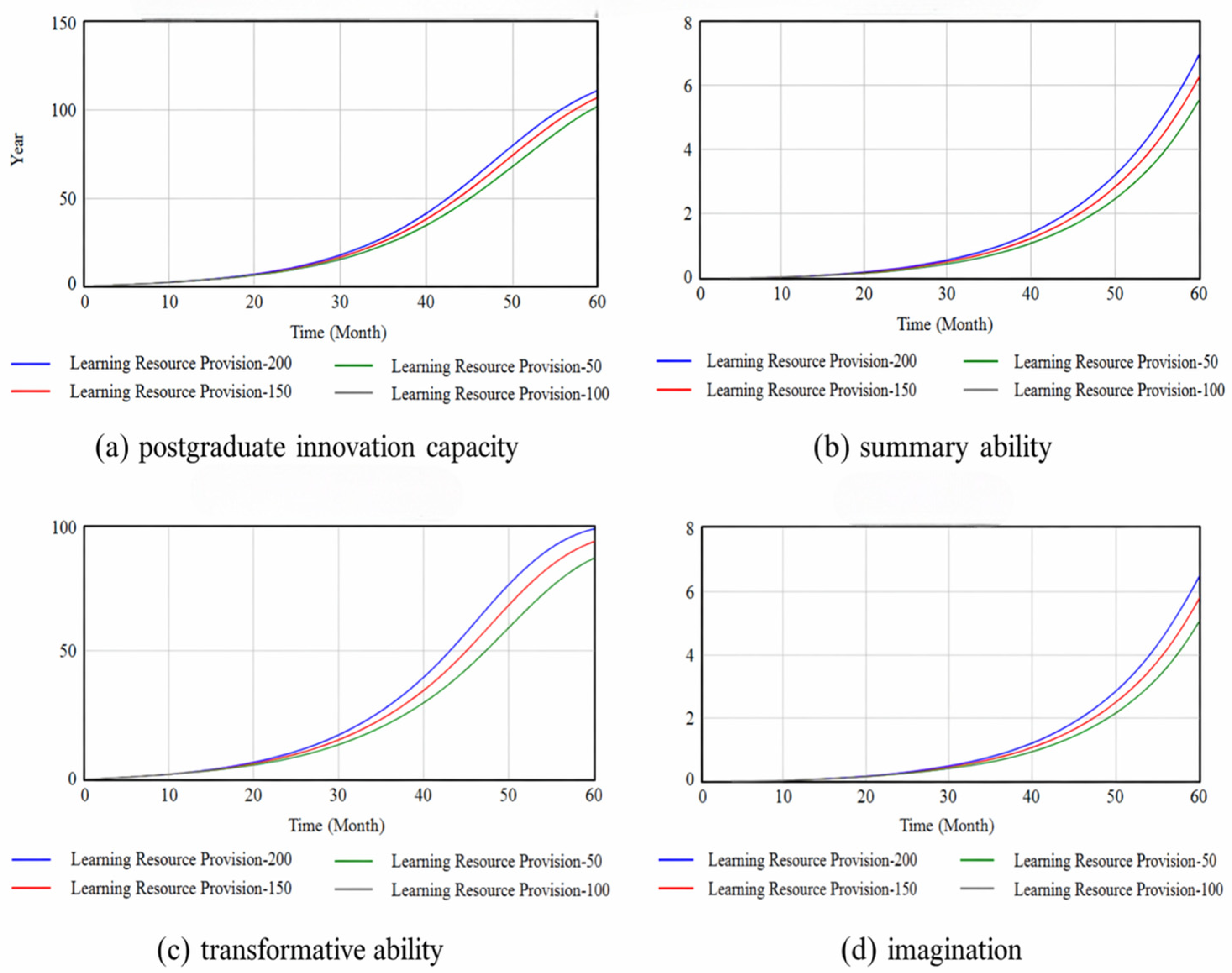
3.3. Scenario-Based Comparison of Learning Resources on Postgraduate Innovation Capacity
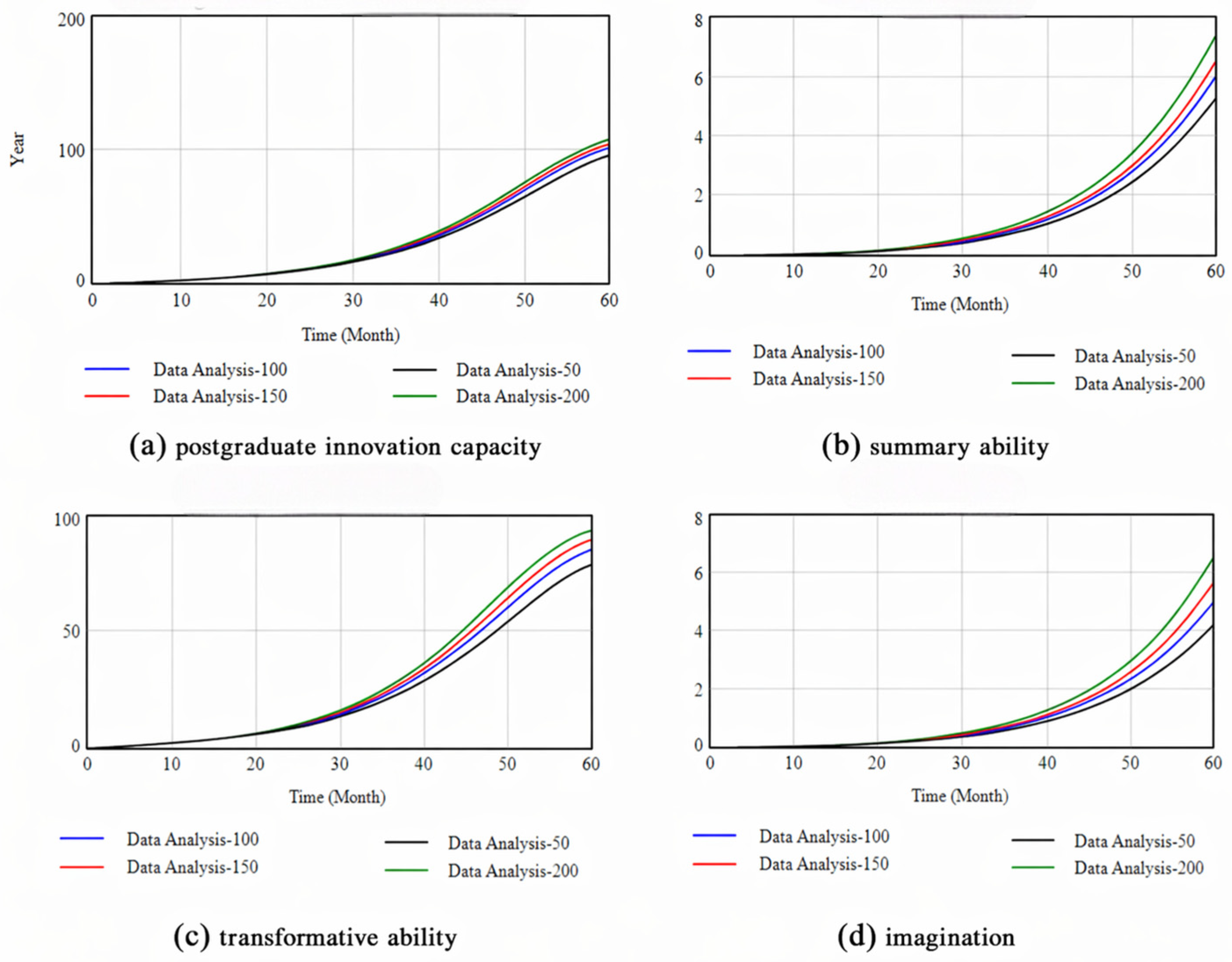
3.4. Scenario-Based Comparison of Data Analysis on Postgraduate Innovation Capacity
4. Discussion and Model Implications
4.1. Implications of Learning Support Simulation
4.2. Implications of Learning Assessment and Time-Delay Effects
4.3. Resource Saturation Effect in the Simulation Model
4.4. Synergistic Effect of Data Analysis in the System
4.5. Growth Mechanism of Imagination in the Simulation Model
5. Conclusions and Future Research
Supplementary Materials
Author Contributions
Funding
Data Availability Statement
Acknowledgments
Conflicts of Interest
References
- Forrester, J.W. Industrial dynamics. J. Oper. Res. Soc. 1997, 48, 1037–1041. [Google Scholar] [CrossRef]
- Meadows, D.H. Thinking in Systems: A Primer; Chelsea Green Publishing: White River Junction, VT, USA, 2008. [Google Scholar]
- Sterman, J.D. System Dynamics: Systems Thinking and Modeling for a Complex World; McGraw-Hill: New York, NY, USA, 2000. [Google Scholar]
- Wolstenholme, E.F. System enquiry using system dynamics. Int. J. Syst. Sci. 1986, 17, 111–120. [Google Scholar] [CrossRef]
- Lane, D.C. The emergence and use of diagramming in system dynamics: A critical account. Syst. Res. Behav. Sci. 2008, 25, 3–23. [Google Scholar] [CrossRef]
- Richardson, G.P.; Pugh, A.L. Introduction to system dynamics modeling with DYNAMO. J. Oper. Res. Soc. 1997, 48, 1146. [Google Scholar] [CrossRef]
- Richardson, G.P. Feedback Thought in Social Science and Systems Theory; University of Pennsylvania Press: Philadelphia, PA, USA, 1991. [Google Scholar]
- Li, W.; Zhang, L.; Cao, J. A note on Turing–Hopf bifurcation in a diffusive Leslie–Gower model with weak Allee effect on prey and fear effect on predator. Appl. Math. Lett. 2026, 172, 109741. [Google Scholar] [CrossRef]
- Li, W.; Zhang, L.; Cao, J.; Xu, F.; Cai, Z. Finite time attractivity and exponentially stable of a multi-stage epidemic system with discontinuous incidence. Qual. Theory Dyn. Syst. 2025, 24, 199. [Google Scholar] [CrossRef]
- Dangerfield, B.C. System dynamics applications to European healthcare issues. In Operational Research for Emergency Planning in Healthcare: Volume 2; Mustafee, N., Ed.; Palgrave Macmillan: London, UK, 2016; pp. 296–315. [Google Scholar] [CrossRef]
- Ford, A. System dynamics and the electric power industry. Syst. Dyn. Rev. 1997, 13, 57–85. [Google Scholar] [CrossRef]
- Rodrigues, L.L.R.; Dharmaraj, N.; Rao, B.R.S. System dynamics approach for change management in new product development. Manag. Res. News 2006, 29, 512–523. [Google Scholar] [CrossRef]
- Mohammadi, M.; Faskhodi, A.A. Modeling the dynamics of knowledge management in educational institutes: A system dynamics approach. Educ. Self Dev. 2022, 17, 86–104. [Google Scholar] [CrossRef]
- Uriona, M.; Grobbelaar, S.S. Innovation system policy analysis through system dynamics modelling: A systematic review. Sci. Public Policy 2019, 46, 28–44. [Google Scholar] [CrossRef]
- Samara, E.; Kilintzis, P.; Katsoras, E.; Martnidis, G.; Kosti, P. A system dynamics approach for the development of a regional innovation system. J. Innov. Entrep. 2024, 13, 28. [Google Scholar] [CrossRef]
- Andriyani, Y.; Yohanitas, W.A.; Kartika, R.S. Adaptive innovation model design: Integrating agile and open innovation in regional areas innovation. J. Open Innov. Technol. Mark. Complex. 2024, 10, 100197. [Google Scholar] [CrossRef]
- Raza, A. Nonlinear dynamics in complex systems: A mathematical approach. Front. Appl. Phys. Math. 2024, 1, 42–56. [Google Scholar] [CrossRef]
- Borgonovo, E. Sensitivity analysis. In Tutorials in Operations Research: Advancing the Frontiers of OR/MS: From Methodologies to Applications; INFORMS: Catonsville, MD, USA, 2023; pp. 52–81. [Google Scholar] [CrossRef]
- Rahmandad, H.; Sterman, J.D. Heterogeneity and network structure in the dynamics of diffusion: Comparing agent-based and differential equation models. Manag. Sci. 2008, 54, 998–1014. [Google Scholar] [CrossRef]
- Senge, P.M. The Fifth Discipline: The Art and Practice of the Learning Organization; Doubleday/Currency: New York, NY, USA, 1990. [Google Scholar]
- Saeed, K. Slicing a complex problem for system dynamics modeling. Syst. Dyn. Rev. 1992, 8, 251–261. [Google Scholar] [CrossRef]
- Barlas, Y. Formal aspects of model validity and validation in system dynamics. Syst. Dyn. Rev. 1996, 12, 183–210. [Google Scholar] [CrossRef]
- Lyneis, J.M. System dynamics for market forecasting and structural analysis. Syst. Dyn. Rev. 2000, 16, 3–25. [Google Scholar] [CrossRef]
- Sterman, J.D. Learning from evidence in a complex world. Am. J. Public Health 2006, 96, 505–514. [Google Scholar] [CrossRef]
- Sterman, J.D. Misperceptions of feedback in dynamic decision making. Organ. Behav. Hum. Decis. Process. 1989, 43, 301–335. [Google Scholar] [CrossRef]
- Lane, D.C. Rerum cognoscere causas: Part II—Opportunities generated by the agency/structure debate and suggestions for clarifying the social theoretic position of system dynamics. Syst. Dyn. Rev. 2001, 17, 293–309. [Google Scholar] [CrossRef]
- Strogatz, S.H. Nonlinear dynamics and chaos. Comput. Phys. 1994, 8, 532–537. [Google Scholar] [CrossRef]
- Bianchi, C. Improving performance and fostering accountability in the public sector through system dynamics modelling. Syst. Res. Behav. Sci. 2010, 27, 361–384. [Google Scholar] [CrossRef]
- Kempe, D.; Kleinberg, J.; Tardos, É. Maximizing the spread of influence through a social network. In Proceedings of the Ninth ACM SIGKDD International Conference on Knowledge Discovery and Data Mining, Washington, DC, USA, 24–27 August 2003; pp. 137–146. [Google Scholar] [CrossRef]
- Li, W.; Yang, L.; Cao, J. Threshold dynamics of a degenerated diffusive incubation-period host–pathogen model with saturation incidence rate. Appl. Math. Lett. 2025, 160, 109312. [Google Scholar] [CrossRef]
- Zhou, Q.; Yang, F. Innovation diffusion with network effects and bandwagon effects based on complex networks. In WHICEB 2020 Proceedings; Springer: Cham, Switzerland, 2020; Available online: https://aisel.aisnet.org/whiceb2020/23 (accessed on 23 October 2025).
- Hashemizadeh, A.; Ju, Y.; Abadi, F.Z.B. Policy design for renewable energy development based on system dynamics. Appl. Energy 2024, 376, 124331. [Google Scholar] [CrossRef]
- Li, W.; Zhao, W.; Cao, J.; Huang, L. Dynamics of a linear source epidemic system with diffusion and media impact. Z. Angew. Math. Phys. 2024, 75, 144. [Google Scholar] [CrossRef]
- Yuan, J.; Mou, Q.; Xu, C.; Zhang, J. Policy simulation of China’s green hydrogen industry development based on system dynamics. China Popul. Resour. Environ. 2023, 33, 49–58. (In Chinese) [Google Scholar]




| Specific Measurement Indicators | Data Source | Weights |
|---|---|---|
| Learning Support | Graduate Teaching Evaluation System | 7.80% |
| Learning Assessment | Online Learning Logs | 7.14% |
| Learning Resource Provision | Number of Online Course Platforms | 7.23% |
| Data Analysis | Information Management of Cultivation Process | 2.84% |
| Critical Thinking Ability | Number of Speculative/Research-oriented Courses | 6.65% |
| Logical Analysis Ability | Logical Training Platforms/Projects | 0.02% |
| Information Gathering Ability | Information Skills Training | 6.65% |
| Intuitive Thinking Ability | Cutting-edge Academic Lectures/Forums | 4.35% |
| Creative Thinking Ability | Number of Awards in Discipline Competitions | 5.23% |
| Divergent Thinking Ability | Interdisciplinary Platforms/Projects | 6.33% |
| Transformative Ability | Number of Achievement Transformation Projects | 19.9% |
| Practical Ability | Number of Employed in Key Industries | 20.0% |
| Influence | Number of Papers in Top Journals | 26.8% |
| Level Variable | Rate Variable | Main Auxiliary Variables (Partial) | Equation |
|---|---|---|---|
| Summary Ability | Change in Summary Ability | Critical Thinking Ability | Personalized Learning Support × 0.062 + Tool Dependency × −0.05 + Teaching Improvement × 0.069 + Deep Learning × 0.058 |
| Logical Analysis Ability | Teaching Improvement × 0.069 | ||
| Information Gathering Ability | Diverse Learning Experiences × 0.058 | ||
| Personalized Learning Support | Personalized Learning Paths × 0.071 | ||
| Teaching Improvement | SMOOTH (Change in Teaching Improvement, Semester Cycle) | ||
| Imagination | Change in Imagination | Intuitive Thinking | Interdisciplinary Collaboration × 0.316 |
| Creative Thinking | Interdisciplinary Collaboration × 0.413 | ||
| Divergent Thinking | Interdisciplinary Collaboration × 0.271 | ||
| Interdisciplinary Collaboration | (Diverse Learning Experiences × 0.18 + Teaching Improvement × 0.29 + Self-Efficacy × 0.138)/10 | ||
| Transformative Ability | Change in Transformative Ability | Transformative Ability | Interdisciplinary Collaboration × 0.316 |
| Practical Ability | Transformative Ability + (Self-Efficacy − 0.5) × 0.1 | ||
| Influence | Practical Ability + 0.12 | ||
| Self-Efficacy | INTEG (Initial Value, Growth–Decline) | ||
| Interdisciplinary Collaboration | (Diverse Learning Experiences × 0.18 + Teaching Improvement × 0.29 + Self-Efficacy × 0.138)/10 |
Disclaimer/Publisher’s Note: The statements, opinions and data contained in all publications are solely those of the individual author(s) and contributor(s) and not of MDPI and/or the editor(s). MDPI and/or the editor(s) disclaim responsibility for any injury to people or property resulting from any ideas, methods, instructions or products referred to in the content. |
© 2026 by the authors. Licensee MDPI, Basel, Switzerland. This article is an open access article distributed under the terms and conditions of the Creative Commons Attribution (CC BY) license.
Share and Cite
Liu, J.; Zhang, L. A System Dynamics Model for Simulating the Development of Postgraduate Innovation Capacity in Smart Learning Environments. Mathematics 2026, 14, 1460. https://doi.org/10.3390/math14091460
Liu J, Zhang L. A System Dynamics Model for Simulating the Development of Postgraduate Innovation Capacity in Smart Learning Environments. Mathematics. 2026; 14(9):1460. https://doi.org/10.3390/math14091460
Chicago/Turabian StyleLiu, Jingshu, and Lei Zhang. 2026. "A System Dynamics Model for Simulating the Development of Postgraduate Innovation Capacity in Smart Learning Environments" Mathematics 14, no. 9: 1460. https://doi.org/10.3390/math14091460
APA StyleLiu, J., & Zhang, L. (2026). A System Dynamics Model for Simulating the Development of Postgraduate Innovation Capacity in Smart Learning Environments. Mathematics, 14(9), 1460. https://doi.org/10.3390/math14091460