Article

High-Order Line-Soliton Interactions and Anomalous Scattering of Lumps in a (2+1)-Dimensional Reverse Space–Time Nonlinear Schrödinger Equation


1
School of Physics, Beihang University, Beijing 100191, China
2
School of Mathematical Sciences, Beihang University, Beijing 100191, China
*
Author to whom correspondence should be addressed.
Mathematics 2026, 14(9), 1429; https://doi.org/10.3390/math14091429
Submission received: 26 March 2026 / Revised: 16 April 2026 / Accepted: 20 April 2026 / Published: 24 April 2026

Abstract

This study presents a systematic investigation of nonlinear wave interactions in a (2+1)-dimensional nonlinear Schrödinger equation with a space–time-symmetric potential. We focus on the interaction dynamics of high-order line-soliton solutions and on the anomalous scattering phenomena exhibited by high-order lump solutions, which correspond to fully localized spatiotemporal optical wave packets. Using the generalized Darboux transformation, we obtain, for the first time, explicit high-order line-soliton solutions for this model. A rigorous asymptotic analysis framework is developed to characterize the behavior of these solutions on both long and short time scales. Furthermore, high-order lump solutions are constructed, and their decomposition and anomalous scattering properties are elucidated. This work provides new insights into complex wave dynamics in higher-dimensional integrable systems and their implications for multidimensional beam propagation in nonlinear optical media.

1. Introduction

Nonlinear evolution equations play a fundamental role in describing a broad variety of complex phenomena in nature, ranging from fluid dynamics and plasma physics to nonlinear optics and condensed matter systems [1,2]. In nonlinear science, integrable systems hold a pivotal position, offering profound insights into a wide range of physical phenomena, including propagation of stable shallow-water pulses in channels [3], dynamics of ion-acoustic and Langmuir-envelope structures in plasmas [4], and matter-wave solitons in Bose–Einstein condensates [5,6]. A defining characteristic of these systems is their formulation as a compatibility condition for a pair of linear operators, conventionally known as the Lax pair [7]. To construct exact solutions of integrable systems, several powerful constructive techniques have been developed, notably Hirota’s bilinear method [8], Darboux transformation [9], and the inverse scattering transform (IST) [10,11,12].
In (2+1)-dimensional integrable systems, lump solutions, also known as the (2+1)-dimensional solitons, represent a significant class of localized solutions characterized by their algebraically decaying properties. Initially discovered in the Kadomtsev–Petviashvili I (KP-I) equation [13], these solutions have since been extensively studied in various integrable models, such as the Davey–Stewartson (DS) system [14] and the Bogoyavlenskii–Kadomtsev–Petviashvili (BKP) equation [15]. Numerous approaches have been established for constructing lump solutions [13,14,15,16,17,18].
Lump solutions are of considerable physical importance. In the KP-I equation, they model localized surface depressions in shallow water waves [19,20,21]. They also arise in other physical contexts, such as in the Gross–Pitaevskii equation within the transonic regime, relevant to Bose–Einstein condensates [22], and spatiotemporal localized wave packets in Kerr optical media [23]. Lumps can display distinct scattering behaviors. In normal lump scattering, both the velocity and phase of the lumps remain unchanged after the interaction [24]. However, when lumps propagate with identical asymptotic velocities, a striking interaction phenomenon known as anomalous scattering occurs [25,26].
Line-solitons form a fundamental family of coherent structures in higher-dimensional integrable systems and have been widely studied in defocusing-type equations such as the KP-II equation [27]. Unlike lump solutions, which are localized in all spatial directions, line-solitons are localized only in the direction normal to their crest, while remaining extended along the crest line in the x-y plane. In this geometric sense, they are smooth throughout the x-y plane and decay away from the crest in all directions except for a finite number of characteristic directions. In the KP-II equation, the interactions among line-solitons display rich complexity, including both elastic and resonant phenomena [28]. For the DS-I equation, previous studies have obtained localized waves on a solitonic background containing two line solitons. The two line solitons remain parallel and preserve their velocities and profiles before and after collision [29].
Several complementary approaches have been developed for deriving localized wave solutions and analyzing their dynamics in integrable systems. In particular, the inverse scattering transform and the associated Riemann–Hilbert method are well suited to characterizing the global integrable structure and long-time asymptotic behavior [30], while the Hirota bilinear method is effective for constructing multi-wave solutions on specific backgrounds [31]. By contrast, the Darboux transformation is particularly advantageous for the algebraic construction of high-order exact solutions in integrable systems [32,33]. A generalized form known as the ( n , N n ) -fold Darboux transformation has been systematically developed for (1+1)-dimensional integrable systems [34]. Furthermore, its extension to (2+1)-dimensional integrable models has attracted considerable attention and has been extensively employed in the construction of high-order solutions [35,36,37,38].
The nonlinear Schrödinger (NLS) equation stands as one of the most fundamental integrable models in mathematical physics. It finds widespread applications across various industrial and engineering domains, including plasma physics [39], Bose–Einstein condensates [40], and nonlinear optics [41]. In particular, the NLS equation in fiber optics, given by
i u Z + α 2 u T T + γ | u | 2 u = 0 ,
serves as a fundamental model for a continuous-wave beam propagating inside a nonlinear optical medium with Kerr nonlinearity, where α and γ are real constants that represent the effect of dispersion and Kerr nonlinearity, respectively [41,42]. A significant extension of the NLS equation to (2+1) dimensions leads to an important integrable model, first introduced in [43],
i u t = u x y + V u , V x = 2 σ y | u | 2 ,
where the parameter σ = ± 1 . It was later derived by Strachan in the context of symmetry-based integrable systems, and can alternatively be obtained via a dimensional reduction of the self-dual Yang–Mills equations [44]. In the context of nonlinear optics, Equation (2) can be interpreted as describing the evolution of a quasi-monochromatic beam in a planar or bulk Kerr medium, where x and y play the role of transverse spatial coordinates and the potential V accounts for an effective refractive-index modulation induced by the beam intensity [5]. This higher-dimensional system constitutes a natural generalization of Equation (1), as it reduces to the focusing form of the NLS equation (1) under the symmetry reduction x = y .
Several exact solutions for Equation (2) have been derived in previous works, including the first-order line-soliton and lump solutions [35,45]. Local and nonlocal NLS-type equations have been widely studied as models for self-focusing, modulational instability, and multi-pole solitons. In higher dimensions, localized wave interactions yield richer structures, with dimensionality playing a crucial role in determining waveform deformation, peak merging and splitting behavior, and the spatiotemporal distribution of energy during the interaction process, while nonlocal AKNS reductions reveal dynamics absent from the classical local case [46]. In this paper, we focus on the (2+1)-dimensional NLS equation in Equation (2) featuring a space–time symmetric potential V, i.e., the (2+1)-dimensional reverse space–time (RST) NLS equation
i u t = u x y + V u , V x = 2 σ y u ( x , y , t ) u ( x , y , t ) .
The reverse space–time constraint in Equation (3) couples the field at ( x , y , t ) with that at the symmetry-related point ( x , y , t ) . This constraint affects the admissible solution family and is closely related to the central symmetry exhibited by the obtained solutions. A significant advantage of this RST nonlocal extension is that it preserves the integrability of the local (2+1)-dimensional NLS equation. We prove this property in Section 2. Although Equation (3) is studied here primarily as an integrable nonlocal model, it can also be viewed as a symmetry-constrained extension of the optical system in Equation (2). From this perspective, the reverse space–time reduction preserves the analytical structure of the local model while selecting a highly symmetric class of wave fields.
In this work, our main contributions are threefold. First, we show that Equation (3) admits both high-order line-soliton and high-order lump solutions, which are constructed systematically via the ( n , N n ) -fold Darboux transformation. Second, we reveal that the high-order line solitons exhibit dynamical properties that are fundamentally different from those of standard N-solitons, while sharing certain similarities with the large-parameter asymptotics of multi-pole solitons in the matrix NLS equation [47]. Third, for the high-order lump solutions, we uncover anomalous scattering behavior through a large-parameter asymptotic analysis: the lump velocity varies with time, and the asymptotic trajectories contain an O ( t 1 / 3 ) term, indicating a clear deviation from exact straight-line motion. To obtain these results, we derive the solution transformations via the N-fold Darboux transformation and construct the high-order solutions by the ( n , N n ) -fold Darboux transformation. Motivated by the DS-I equation [29], we further study their interaction dynamics and asymptotic behaviors through a dominant-balance analysis, which provides a rigorous description of both long-time and short-time regimes.
The remainder of this paper is organized as follows. In Section 2, we establish the integrability of the (2+1)-dimensional RST-NLS equation by deriving its AKNS Lax pair and introducing the reverse space–time nonlocal reduction. In Section 3, we systematically construct the generalized ( n , N n ) -fold Darboux transformation for the AKNS system (6). In Section 4, we apply the generalized Darboux transformation to construct high-order line-soliton solutions and analyze their short- and long-time asymptotic behaviors. Section 5 constructs high-order lump solutions and reveals their anomalous scattering phenomena. Finally, Section 6 summarizes the main results and offers a brief discussion.

2. Integrability of the (2+1)-Dimensional RST-NLS Equation

A remarkable reduction of the local (2+1)-dimensional NLS equation in Equation (2) was proposed in Ref. [35]. Specifically, if the solution u ( x , y , t ) also satisfies the (1+1)-dimensional NLS equation
i u y = u x x + 2 | u | 2 u ,
then substituting this constraint into the system (2) yields the (1+1)-dimensional complex modified Korteweg–de Vries (cmKdV) equation [48]:
u t + u x x x + 6 | u | 2 u x = 0 .
Thus, under the constraint (4), admissible solutions must satisfy both the NLS Equation (4) and the cmKdV Equation (5). This structure is furnished by the Ablowitz–Kaup–Newell–Segur (AKNS) framework: Equations (4) and (5) are commuting flows within the AKNS hierarchy, and this hierarchy naturally provides a Lax-pair formulation for the (2+1)-dimensional Equation (2) [49].
Within this framework, the system admits a Lax pair given by
Φ x = U Φ , Φ y = P Φ , Φ t = V Φ ,
where
U = i λ J + Q , P = 2 i λ 2 J + 2 λ Q i R , V = 4 i λ 3 J + 4 λ 2 Q 2 i λ R + S ,
and
J = 1 0 0 1 , Q = 0 u v 0 , R = u v u x v x u v , S = u v x v u x 2 u 2 v u x x 2 u v 2 + v x x v u x u v x .
The compatibility of this linear system is ensured by the zero-curvature conditions
U y P x + [ U , P ] = 0 , U t V x + [ U , V ] = 0 ,
where [ A , B ] = A B B A denotes the matrix commutator.
Substituting the matrices from Equation (8) into the zero-curvature conditions (9) yields the governing coupled system of evolution equations. Specifically, the first condition, U y P x + [ U , P ] = 0 , gives rise to the NLS-type flow
i u y ( u x x + 2 u 2 v ) = 0 , i v y + ( v x x + 2 v 2 u ) = 0 .
Similarly, the second condition, U t V x + [ U , V ] = 0 , produces the mKdV-type flow
u t + ( u x x x + 6 u v u x ) = 0 , v t + ( v x x x + 6 u v v x ) = 0 .
Extending beyond this framework, we investigate a nonlocal reduction of the system. This approach is inspired by the pioneering work of Ablowitz and Musslimani, which launched the field of nonlocal integrable systems and their capacity to reveal surprising new wave behaviors [50,51]. While previous studies on related models have explored PT -symmetric reductions [52], we for the first time introduce an RST symmetry constraint
v ( x , y , t ) = σ u ( x , y , t ) , σ = ± 1 .
Substituting this constraint (12) into the coupled system (10) and (11) yields an integrable nonlocal system. A notable property of this nonlocal formulation is that the cases σ = 1 (focusing-type) and σ = 1 (defocusing-type) are not fundamentally distinct. Indeed, if u ( x , y , t ) solves the focusing case, then the transformation u i u produces a solution of the defocusing case. Therefore, without loss of generality, we set σ = 1 for the remainder of our analysis.

3. Generalized Darboux Transformation

In this section, we develop the generalized Darboux transformation for the AKNS system in (9). We begin with the N-fold Darboux transformation, and then extend it to the generalized ( n , N n ) -fold Darboux transformation to generate high-order solutions.

3.1. N-Fold Darboux Transformation

We begin by introducing a gauge transformation
Φ ¯ = T Φ ,
where Φ is a solution to the Lax pair in Equation (6). The new eigenfunction Φ ¯ satisfies a new Lax pair of the same form, but with transformed potentials
Φ ¯ x = U ¯ Φ ¯ , Φ ¯ y = P ¯ Φ ¯ , Φ ¯ t = V ¯ Φ ¯ .
By substituting Equation (13) into these relations, we derive the following conditions
T x + T U = U ¯ T , T y + T P = P ¯ T , T t + T V = V ¯ T .
For the N-fold Darboux transformation, the matrix T is constructed as a polynomial of degree N in the spectral parameter λ :
T ( λ ) = λ N I + j = 0 N 1 λ j T ( j ) = λ N + j = 0 N 1 T 11 ( j ) λ j j = 0 N 1 T 12 ( j ) λ j j = 0 N 1 T 21 ( j ) λ j λ N + j = 0 N 1 T 22 ( j ) λ j ,
where I is the identity matrix and T ( j ) are 2 × 2 matrices to be determined.
Firstly, we analyze the spatial transformation for the x-direction
T x + T U = U ¯ T ,
where the Lax matrices U and U ¯ have the structure
U = i λ J + Q , U ¯ = i λ J + Q ¯ ,
with the potential matrices given by
Q = 0 u v 0 , Q ¯ = 0 u ¯ v ¯ 0 .
Substituting these forms into Equation (17) and expanding both sides as polynomials in λ , we obtain
T x + T U = j = 0 N 1 λ j ( T ( j ) ) x + i λ N + 1 J + λ N Q + i j = 0 N 1 λ j + 1 T ( j ) J + j = 0 N 1 λ j T ( j ) Q , U ¯ T = i λ N + 1 J + λ N Q ¯ + i j = 0 N 1 λ j + 1 J T ( j ) + j = 0 N 1 λ j Q ¯ T ( j ) .
By equating the coefficients of the λ N term, we find the following relationship:
Q ¯ = Q + i [ T ( N 1 ) , J ] ,
Next, we analyze the transformation for the y-direction and t-direction:
T y + T P = P ¯ T , T t + T V = V ¯ T ,
where
P = 2 i λ 2 J + 2 λ Q i R , P ¯ = 2 i λ 2 J + 2 λ Q ¯ i R ¯ , V = 4 i λ 3 J + 4 λ 2 Q 2 i λ R + S , V ¯ = 4 i λ 3 J + 4 λ 2 Q ¯ 2 i λ R ¯ + S ¯ .
A similar procedure on the y-direction and t-direction yields
Q ¯ = Q + i [ T ( N 1 ) , J ] .
By substituting
T ( N 1 ) = T 11 ( N 1 ) T 12 ( N 1 ) T 21 ( N 1 ) T 22 ( N 1 ) ,
into relations (21) and (24), one obtains the N-fold Darboux transformation for the AKNS system (6),
u ¯ ( x , y , t ) = u ( x , y , t ) 2 i T 12 ( N 1 ) ( x , y , t ) , v ¯ ( x , y , t ) = v ( x , y , t ) 2 i T 21 ( N 1 ) ( x , y , t ) .

3.2. Generalized ( n , N n ) -Fold Darboux Transformation

To construct the generalized ( n , N n ) -fold Darboux transformation, we employ a limiting procedure via a Taylor expansion given by
T ( λ i + ε 2 ) Φ i ( λ i + ε 2 ) = k = 0 j = 0 k T ( j ) ( λ i ) Φ i ( k j ) ( λ i ) ε 2 k = 0 ,
where the derivatives are defined as
T ( k ) ( λ i ) = 1 k ! k T ( λ ) λ k | λ = λ i , Φ i ( k ) ( λ i ) = 1 k ! k Φ i ( λ ) λ k | λ = λ i : = ϕ i ( k ) ( λ i ) , ψ i ( k ) ( λ i ) T .
Balancing the coefficient of each power of ε yields a system of linear algebraic equations,
T ( λ i ) Φ i ( 0 ) ( λ i ) = 0 , T ( λ i ) Φ i ( 1 ) ( λ i ) + T ( 1 ) ( λ i ) Φ i ( 0 ) ( λ i ) = 0 , j = 0 m i T ( j ) ( λ i ) Φ i ( m i j ) ( λ i ) = 0 .
The total order of the transformation is N = i = 1 n ( m i + 1 ) , where n is the number of distinct spectral parameters λ i and m i is the highest order of derivative used for each λ i . According to Refs. [53,54], we establish the following theorem for the ( n , N n ) -fold Darboux transformation.
Remark 1.
The spectral problem (27) is covariant under the gauge transformation equation (Equation (13)); its generalized Darboux transformation is
v ¯ ( x , y , t ) = v ( x , y , t ) 2 i T 12 ( N 1 ) ( x , y , t ) , u ¯ ( x , y , t ) = u ( x , y , t ) 2 i T 21 ( N 1 ) ( x , y , t ) ,
where
T 12 ( N 1 ) = Δ T 12 ( N 1 ) Δ N , Δ N = det Δ m 1 + 1 ( 1 ) , Δ m 2 + 1 ( 2 ) , , Δ m n + 1 ( n ) T , Δ T 12 ( N 1 ) = Δ 1 , 1 ( i ) Δ 1 , 2 ( i ) ϕ i ( 0 ) ( λ i ) Δ 1 , N + 1 ( i ) Δ 1 , N + 2 ( i ) ψ i ( 0 ) ( λ i ) Δ 2 , 1 ( i ) Δ 2 , 2 ( i ) ϕ i ( 1 ) ( λ i ) Δ 2 , N + 1 ( i ) Δ 2 , N + 2 ( i ) ψ i ( 1 ) ( λ i ) Δ m i + 1 , 1 ( i ) Δ m i + 1 , 2 ( i ) ϕ i ( m i ) ( λ i ) Δ m i + 1 , N + 1 ( i ) Δ m i + 1 , N + 2 ( i ) ψ i ( m i ) ( λ i ) Δ m i + 2 , 1 ( i ) Δ m i + 2 , 2 ( i ) ϕ i ( 1 ) ( λ i ¯ ) Δ m i + 2 , N + 1 ( i ) Δ m i + 2 , N + 2 ( i ) ψ i ( 1 ) ( λ i ¯ ) Δ m i + 3 , 1 ( i ) Δ m i + 3 , 2 ( i ) ϕ i ( 2 ) ( λ i ¯ ) Δ m i + 3 , N + 1 ( i ) Δ m i + 3 , N + 2 ( i ) ψ i ( 2 ) ( λ i ¯ ) Δ 2 ( m i + 1 ) , 1 ( i ) Δ 2 ( m i + 1 ) , 2 ( i ) ϕ i ( m i ) ( λ i ¯ ) Δ 2 ( m i + 1 ) , N + 1 ( i ) Δ 2 ( m i + 1 ) , N + 2 ( i ) ψ i ( m i ) ( λ i ¯ ) ,
and each of the entries Δ j , s ( i ) ( 1 j 2 ( m i + 1 ) , 1 s 2 N ) is defined as
Δ j , s ( i ) = k = 0 j 1 C N s k λ i N s k ϕ i ( j 1 k ) ( λ i ) , 1 j m i + 1 , 1 s N , k = 0 j 1 C 2 N s k λ i 2 N s k ψ i ( j 1 k ) ( λ i ) , 1 j m i + 1 , N + 1 s 2 N , k = 0 j N 1 C N s k ( λ i ¯ ) N s k ϕ i ( j 1 N k ) ( λ i ¯ ) , m i + 2 j 2 ( m i + 1 ) , 1 s N , k = 0 j N 1 C 2 N s k ( λ i ¯ ) 2 N s k ψ i ( j 1 N k ) ( λ i ¯ ) , m i + 2 j 2 ( m i + 1 ) , N + 1 s 2 N .
And Δ T 12 ( N 1 ) is obtained from the determinant Δ N by replacing its ( N + 1 ) -th column with the vector g ( 1 ) , , g ( n ) T , where the components of g ( i ) = g j ( i ) 2 ( m i + 1 ) × 1 are
g j ( i ) = k = 0 j 1 C N k λ i N k ϕ i ( j 1 k ) ( λ i ) , 1 j m i + 1 , k = 0 j N 1 C N k ( λ i ¯ ) N k ϕ i ( j 1 N k ) ( λ i ¯ ) , m i + 2 j 2 ( m i + 1 ) .
Based on Theorem 1, solutions of the AKNS system can be constructed from appropriate seed solutions. For the nonlocal Equation (3), an additional constraint, given by
T 12 ( N 1 ) ( x , y , t ) = T 21 ( N 1 ) ( x , y , t ) ,
must be introduced to ensure the nonlocal condition v ( x , y , t ) = u ( x , y , t ) is satisfied.

4. Line-Soliton Solutions

In this section, we focus on line-soliton solutions of Equation (3). We systematically construct high-order line-soliton solutions via the generalized ( n , N n ) -fold Darboux transformation. An asymptotic analysis framework is developed to investigate both short- and long-time dynamics, revealing characteristic interaction patterns of high-order solitons. Here, the order of a line-soliton refers to its order in the generalized Darboux transformation hierarchy: the first-order line-soliton is the standard one-soliton solution, while high-order line-solitons are generated by high-order Darboux transformations and possess more intricate structures.
We begin by taking the trivial solution u ( x , y , t ) = 0 as the seed solution. The corresponding fundamental eigenfunction of the Lax pair is given by
Φ = ϕ i ( λ ) ψ i ( λ ) = e i λ ( x + 2 λ y + 4 λ 2 t ) e i λ ( x + 2 λ y + 4 λ 2 t ) .
We consider the Taylor expansion
Φ ( λ + ε 2 ) = Φ ( 0 ) ( λ ) + Φ ( 1 ) ( λ ) ε 2 + Φ ( 2 ) ( λ ) ε 4 + ,
and apply Remark 1 to compute line-soliton solutions for Equation (3).

4.1. Standard Line-Soliton

By applying the generalized (1,0)-fold Darboux transformation, we obtain the first-order line-soliton,
u 1 = 2 i Δ T 21 ( 0 ) Δ 1 ,
where the determinants are constructed from the eigenfunctions as follows:
Δ 1 = ϕ ( 0 ) ( λ ) ψ ( 0 ) ( λ ) ϕ ( 0 ) ( λ ¯ ) ψ ( 0 ) ( λ ¯ ) , Δ T 21 ( 0 ) = λ ψ ( 0 ) ( λ ) ψ ( 0 ) ( λ ) λ ¯ ψ ( 0 ) ( λ ¯ ) ψ ( 0 ) ( λ ¯ ) .
By substituting the corresponding terms with the spectral parameter λ , we obtain the explicit line-soliton solution,
u 1 = 2 i ( λ λ ¯ ) e 2 i λ ( x + 2 λ y + 4 λ 2 t ) + e 2 i λ ¯ ( x + 2 λ ¯ y + 4 λ ¯ 2 t ) .
We impose the complex conjugate condition and let λ = g + i f and λ ¯ = g i f , where f , g R . Under this condition, the first-order line-soliton solution simplifies to the standard single-soliton solution,
u 1 = 2 f exp i 2 g x + 4 ( g 2 f 2 ) y + 8 ( g 3 3 g f 2 ) t sech 2 f x + 4 g y + 4 ( 3 g 2 f 2 ) t .
This solution represents a localized traveling wave packet with amplitude 2 f . The trajectory of the soliton is determined by the motion of its crest, given by
x + 4 g y + 4 ( 3 g 2 f 2 ) t = 0 .
We obtain wave vector k = ( 1 , 4 g ) and frequency ω = 4 ( 3 g 2 f 2 ) . The velocity v is parallel to k and satisfies the physical relation ω k · v = 0 . Solving this system yields
v = ( v 1 , v 2 ) = 4 ( f 2 3 g 2 ) 1 + 16 g 2 , 16 g ( f 2 3 g 2 ) 1 + 16 g 2 .

4.2. Second-Order Line-Soliton

For the second-order case ( N = 2 ), we apply the generalized (1,1)-fold Darboux transformation to obtain the second-order line-soliton solution,
u 2 = 2 i Δ T 21 ( 1 ) Δ 2 ,
where the determinants Δ 2 and Δ T 21 ( 1 ) are constructed from the eigenfunctions,
Δ 2 = ϕ ( 0 ) ( λ ) ψ ( 0 ) ( λ ) ϕ ( 1 ) ( λ ) ψ ( 1 ) ( λ ) ϕ ( 0 ) ( λ ¯ ) ψ ( 0 ) ( λ ¯ ) ϕ ( 1 ) ( λ ¯ ) ψ ( 1 ) ( λ ¯ ) λ ϕ ( 0 ) ( λ ) λ ψ ( 0 ) ( λ ) λ ϕ ( 1 ) ( λ ) + ϕ ( 0 ) ( λ ) λ ψ ( 1 ) ( λ ) + ψ ( 0 ) ( λ ) λ ¯ ϕ ( 0 ) ( λ ¯ ) λ ¯ ψ ( 0 ) ( λ ¯ ) λ ¯ ϕ ( 1 ) ( λ ¯ ) + ϕ ( 0 ) ( λ ¯ ) λ ¯ ψ ( 1 ) ( λ ¯ ) + ψ ( 0 ) ( λ ¯ ) ,
Δ T 21 ( 1 ) = ϕ ( 0 ) ( λ ) ψ ( 0 ) ( λ ) ϕ ( 1 ) ( λ ) λ ϕ ( 0 ) ( λ ) ϕ ( 0 ) ( λ ¯ ) ψ ( 0 ) ( λ ¯ ) ϕ ( 1 ) ( λ ¯ ) λ ¯ ϕ ( 0 ) ( λ ¯ ) λ ϕ ( 0 ) ( λ ) λ ψ ( 0 ) ( λ ) λ ϕ ( 1 ) ( λ ) + ϕ ( 0 ) ( λ ) λ 2 ϕ ( 0 ) ( λ ) λ ¯ ϕ ( 0 ) ( λ ¯ ) λ ¯ ψ ( 0 ) ( λ ¯ ) λ ¯ ϕ ( 1 ) ( λ ¯ ) + ϕ ( 0 ) ( λ ¯ ) λ ¯ 2 ϕ ( 0 ) ( λ ¯ ) .
The explicit form of the second-order line-soliton is obtained as follows:
u 2 = 4 ( λ λ ¯ ) e ξ ( λ ) g 2 + e ξ ( λ ¯ ) g ¯ 2 2 cosh ξ ( λ ) ξ ( λ ¯ ) + 4 ( g 2 i ) ( g ¯ 2 i ) + 2 ,
with the auxiliary functions
ξ ( ζ ) = 2 i ζ x + 2 y ζ 2 + 4 t ζ 3 , g 2 = i + x ( λ λ ¯ ) + 4 y λ ¯ ( λ λ ¯ ) + 12 t λ λ ¯ 2 12 t λ ¯ 3 , g ¯ 2 = i + x ( λ ¯ λ ) + 4 y λ ( λ ¯ λ ) + 12 t λ ¯ λ 2 12 t λ 3 .
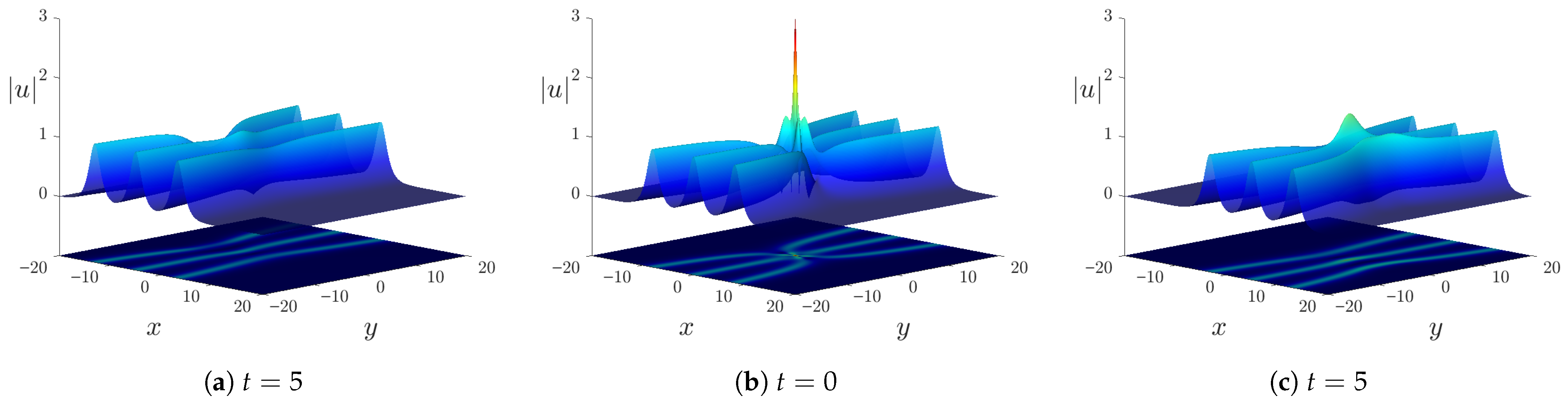
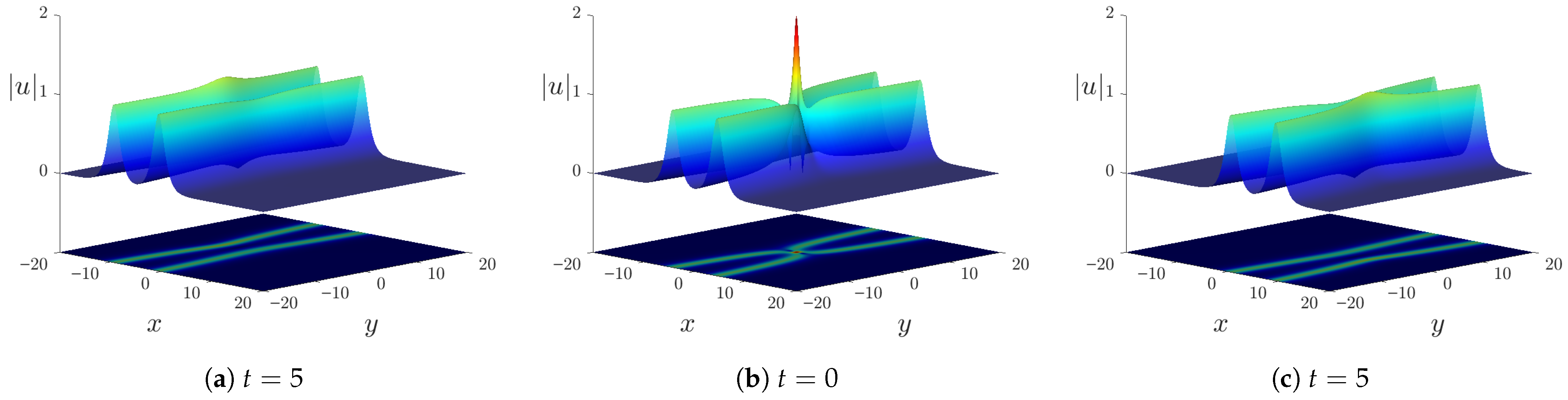
Figure 1a–c illustrate the spatial evolution of the second-order line-soliton solution | u 2 ( x , y , t ) | with parameters f = 1 2 and g = 0 . Figure 1b captures the solution at the moment t = 0 , where it forms a single peak with an amplitude of 2. In contrast, Figure 1a,c show that for small times away from zero ( t 0 ), this structure divides into two solitons of irregular shape.
For large | t | , the second-order line-soliton asymptotically splits into two parallel standard line-solitons with logarithmically shifted crest trajectories. To understand the long-term dynamics of this solution, we perform an asymptotic analysis for large time ( | t | ), leading to the following remarks.
Remark 2.
As | t | , the second-order line-soliton asymptotically splits into two parallel standard line-solitons, and the peak amplitude of each converges to 2 f , matching the amplitude of the standard line-soliton.
To describe the large-time behavior of the second-order line-soliton, we introduce the asymptotic ansatz. To describe the asymptotic trajectory of the line-soliton in Equation (43), we propose an ansatz for the motion trajectory of particles located on the crest line of the line-solitons,
x v 1 t + m 1 ln | t | + n 1 , y v 2 t + m 2 ln | t | + n 2 , | t | .
The asymptotic velocity ( v 1 , v 2 ) is adopted from the one-soliton solution. Substituting this ansatz into the solution and balancing the dominant terms determines the logarithmic correction and the constant phase shift. A dominant balance analysis yields direct linear relationships as
m 1 + 4 g m 2 1 2 f = 0 , n 1 + 4 g n 2 1 4 f ln ξ = 0 .
The asymptotic amplitude is determined by substituting the derived trajectory into the solution | u 2 | and evaluating its large-time limit. The parameter ξ , which dictates the asymptotic phase shift, is found by maximizing the solution’s amplitude in this limit,
arg max ξ R lim | t | u 2 v 1 t + m 1 ln | t | + n 1 , v 2 t + m 2 ln | t | + n 2 , t .
The calculation of this limit yields a constant value for ξ
ξ = 1024 64 f 8 g 2 + 9 f 4 ( g + 8 g 3 ) 2 + f 6 ( 1 + 80 g 2 + 640 g 4 ) ( 1 + 16 g 2 ) 2 .
Therefore, as | t | , the asymptotic trajectories for the two separating soliton crests are obtained as follows:
Σ ± ( x , y , t ) : = x + 4 g y + 4 3 g 2 f 2 t ± 1 2 f ln | t | + 1 4 f ln ξ = 0 ,
For large | t | , the second-order line-soliton separates into two distinct parallel line-solitons in the ( x , y ) plane. The resulting asymptotic amplitude of the second-order line-soliton is derived as
| u 2 ( x , y , t ) | = 2 f + O t 1 ln | t | , | t | .
This shows that as | t | , the peak amplitude of each separating line-soliton converges to 2 f , consistent with the amplitude of a first-order line-soliton. Additionally, we obtain the asymptotic velocity of the soliton,
v v 1 + O t 1 , v 2 + O t 1 , | t | .
As | t | , the velocity of the soliton approaches the velocity of the standard line-soliton.
Furthermore, this asymptotic behavior is well-approximated by a linear superposition of two standard line-solitons,
| u 2 ( x , y , t ) | 2 f sech 2 f Σ + + sech 2 f Σ , | t | .
To quantify the accuracy of the asymptotic description in the present exactly solvable setting, we define a diagnostic error function E r r 1 ( x , y , t ) as the absolute difference between the explicit exact solution | u 2 | and its two-soliton asymptotic approximation. Its purpose is solely to visualize the discrepancy between the asymptotic prediction and the exact solution, and hence to verify the convergence of the asymptotic description
Err 1 ( x , y , t ) : = | u 2 ( x , y , t ) | 2 f sech ( 2 f Σ + ) + sech ( 2 f Σ ) .
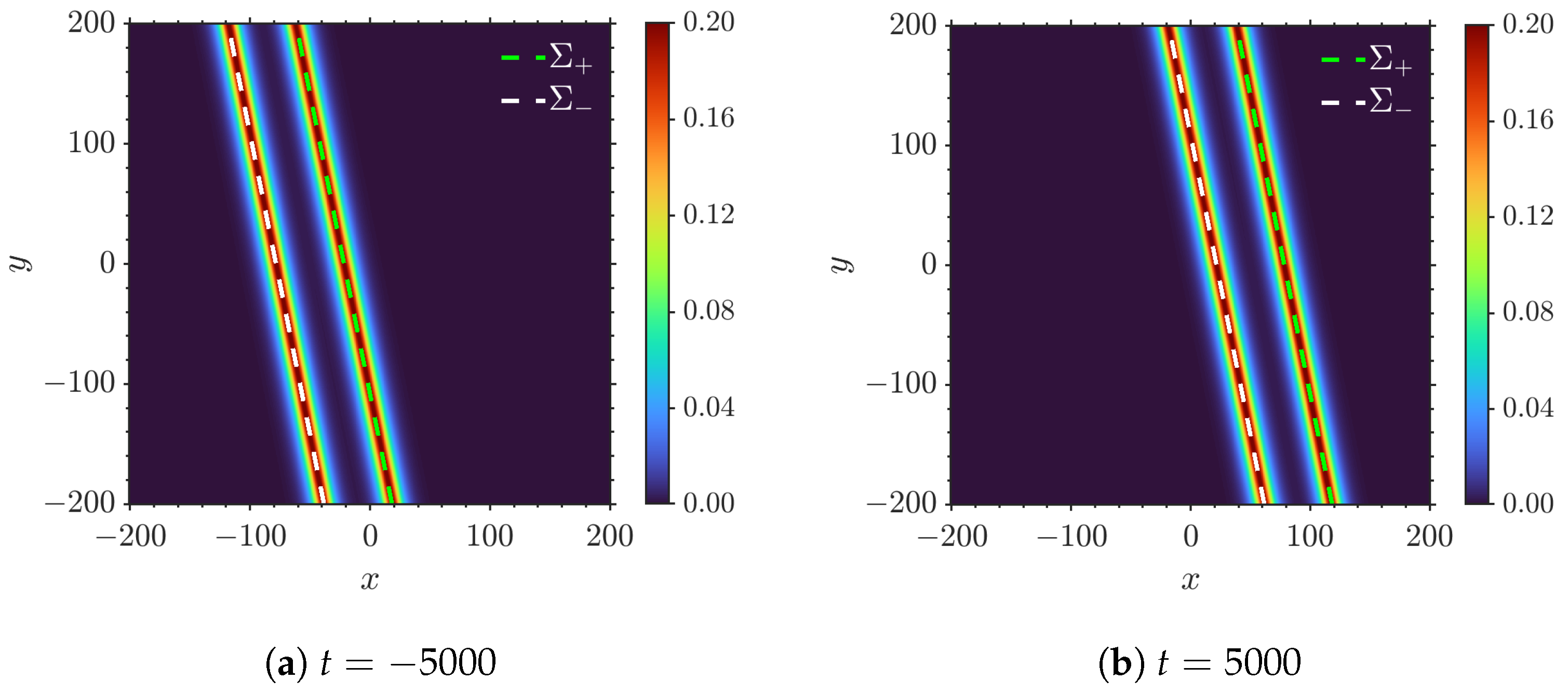
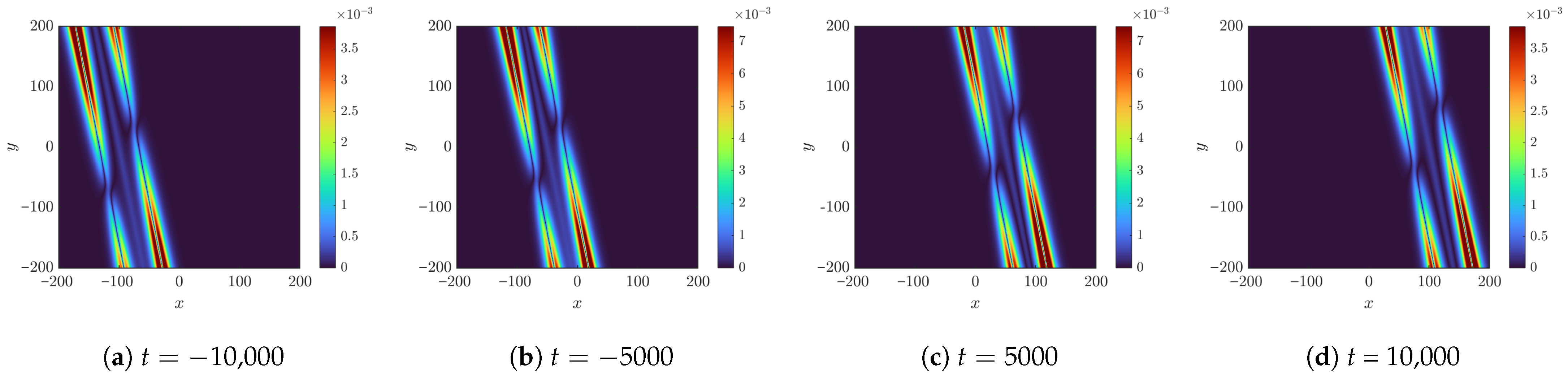
Figure 2 shows soliton splitting at t = ± 5000 for g = 0.05 and f = 0.1 , with the amplitude approaching its predicted value of 2 f = 0.2 . Figure 3 shows the corresponding error is concentrated between the solitons and decays as | t | increases, which confirms the theoretical convergence.
We now analyze the spatial asymptotic behavior of the solution at the fixed time t = 0 .
Remark 3.
At t = 0 , as | y | , the crest of the second-order line-soliton splits into two logarithmic curves, and the amplitude along these curves converges to the one-soliton amplitude of 2 f .
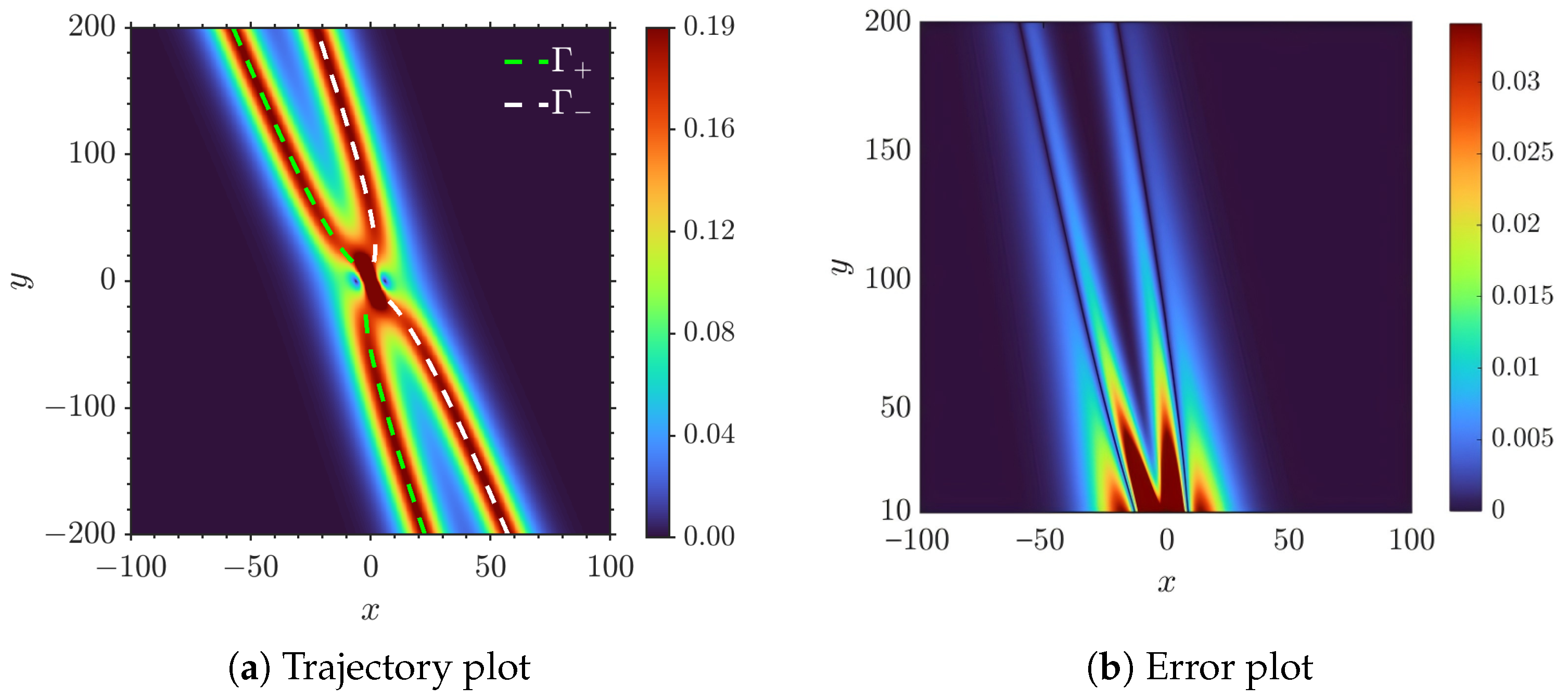
In the limit of large | y | , a dominant balance analysis shows the soliton’s crests asymptotically follow the curves Γ ± :
Γ ± : = x + 4 g y ± 1 2 f ln | y | + 1 4 f ln γ = 0 .
The spatial phase shift parameter γ is determined by maximizing the solution’s modulus along these curves,
arg max γ R lim | y | u 2 4 g y 1 2 f ln | y | + 1 4 f ln γ , y , 0 = 256 f 4 .
The asymptotic amplitude along the crests is obtained as
u 2 4 g y 1 2 f ln | y | + 1 4 f ln γ , y , 0 = 2 f + O y 1 ln | y | , | y | ,
which indicates that the crests follow the curves Θ ± and that their amplitude converges to 2 f .
Similarly, at t = 0 , the second-order line-soliton can be described asymptotically as the superposition of two line-solitons,
| u 2 ( x , y , 0 ) | 2 f sech 2 f Γ + + sech 2 f Γ , | y | .
We also define the error function
Err 2 ( x , y ) : = | u 2 ( x , y , 0 ) | 2 f sech 2 f Γ + + sech 2 f Γ .
Figure 4 illustrates the trajectory and error at t = 0 , indicating that as | y | increases, the discrepancy between the trajectories and the theoretical prediction decreases.

4.3. Third-Order Line-Soliton

The third-order line-soliton solution is constructed by applying the generalized (1,2)-fold Darboux transformation. This procedure yields the solution,
u 3 = 2 i Δ T 21 ( 2 ) Δ 3 .
As illustrated in Figure 5, the third-order line-soliton | u 3 ( x , y , t ) | reaches a peak amplitude of 3 at t = 0 before splitting into three irregular solitons at other times.
Then, Δ 3 is the determinant of the following 6 × 6 matrix,
Δ 3 = λ 2 ϕ ( 0 ) ( λ ) λ ϕ ( 0 ) ( λ ) ϕ ( 0 ) ( λ ) λ 2 ψ ( 0 ) ( λ ) λ ψ ( 0 ) ( λ ) ψ ( 0 ) ( λ ) λ ¯ 2 ϕ ( 0 ) ( λ ¯ ) λ ¯ ϕ ( 0 ) ( λ ¯ ) ϕ ( 0 ) ( λ ¯ ) λ ¯ 2 ψ ( 0 ) ( λ ¯ ) λ ¯ ψ ( 0 ) ( λ ¯ ) ψ ( 0 ) ( λ ¯ ) 2 λ ϕ ( 0 ) ( λ ) + λ 2 ϕ ( 1 ) ( λ ) ϕ ( 0 ) ( λ ) + λ ϕ ( 1 ) ( λ ) ϕ ( 1 ) ( λ ) 2 λ ψ ( 0 ) ( λ ) + λ 2 ψ ( 1 ) ( λ ) ψ ( 0 ) ( λ ) + λ ψ ( 1 ) ( λ ) ψ ( 1 ) ( λ ) 2 λ ¯ ϕ ( 0 ) ( λ ¯ ) + λ ¯ 2 ϕ ( 1 ) ( λ ¯ ) ϕ ( 0 ) ( λ ¯ ) + λ ¯ ϕ ( 1 ) ( λ ¯ ) ϕ ( 1 ) ( λ ¯ ) 2 λ ¯ ψ ( 0 ) ( λ ¯ ) + λ ¯ 2 ψ ( 1 ) ( λ ¯ ) ψ ( 0 ) ( λ ¯ ) + λ ¯ ψ ( 1 ) ( λ ¯ ) ψ ( 1 ) ( λ ¯ ) ϕ ( 0 ) ( λ ) + 2 λ ϕ ( 1 ) ( λ ) + λ 2 ϕ ( 2 ) ( λ ) ϕ ( 1 ) ( λ ) + λ ϕ ( 2 ) ( λ ) ϕ ( 2 ) ( λ ) ψ ( 0 ) ( λ ) + 2 λ ψ ( 1 ) ( λ ) + λ 2 ψ ( 2 ) ( λ ) ψ ( 1 ) ( λ ) + λ ψ ( 2 ) ( λ ) ψ ( 2 ) ( λ ) ϕ ( 0 ) ( λ ¯ ) + 2 λ ¯ ϕ ( 1 ) ( λ ¯ ) + λ ¯ 2 ϕ ( 2 ) ( λ ¯ ) ϕ ( 1 ) ( λ ¯ ) + λ ¯ ϕ ( 2 ) ( λ ¯ ) ϕ ( 2 ) ( λ ¯ ) ψ ( 0 ) ( λ ¯ ) + 2 λ ¯ ψ ( 1 ) ( λ ¯ ) + λ ¯ 2 ψ ( 2 ) ( λ ¯ ) ψ ( 1 ) ( λ ¯ ) + λ ¯ ψ ( 2 ) ( λ ¯ ) ψ ( 2 ) ( λ ¯ )
The determinant Δ T 21 ( 2 ) is obtained from Δ 3 by replacing its fourth column with the vector ( λ 3 ϕ ( 0 ) ( λ ) , λ ¯ 3 ϕ ( 0 ) ( λ ¯ ) , 3 λ 2 ϕ ( 0 ) ( λ ) λ 3 ϕ ( 1 ) ( λ ) , 3 λ ¯ 2 ϕ ( 0 ) ( λ ¯ ) λ ¯ 3 ϕ ( 1 ) ( λ ¯ ) , 3 λ ϕ ( 0 ) ( λ ) 3 λ 2 ϕ ( 1 ) ( λ ) λ 3 ϕ ( 2 ) ( λ ) , 3 λ ¯ ϕ ( 0 ) ( λ ¯ ) 3 λ ¯ 2 ϕ ( 1 ) ( λ ¯ ) λ ¯ 3 ϕ ( 2 ) ( λ ¯ ) ) .
As | t | , the third-order line-soliton forms a bound-state-type pattern along one central and two logarithmically shifted side trajectories, with amplitude 2 f on each main trajectory. The asymptotic analysis for | t | is described by a central trajectory Ω 0 and two logarithmically shifted side trajectories Ω ± ,
Ω 0 : = x + 4 g y + 4 3 g 2 f 2 t = 0 , Ω ± : = Ω 0 ± 1 f ln | t | + 1 2 f ln ξ 2 = 0 .
The asymptotic amplitude along all three trajectories converges to the same constant value,
lim | t | u 3 4 g y 4 3 g 2 f 2 t , y , t = lim | t | u 3 4 g y 4 3 g 2 f 2 t 1 f ln | t | + 1 2 f ln ξ 2 , y , t = 2 f .
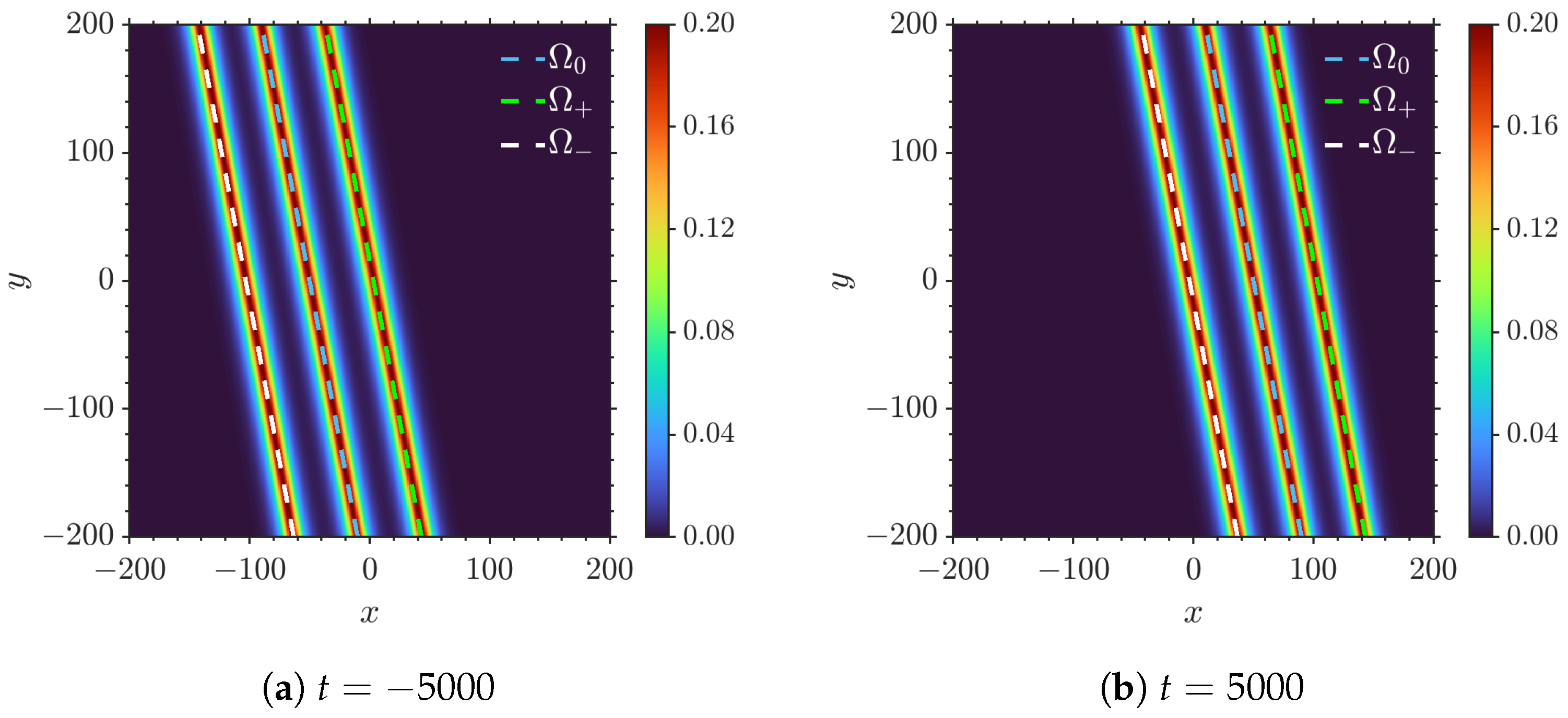
This shows the tripole soliton forms a stable, non-separating bound state with a long-term amplitude of 2 f along its main trajectories. Figure 6 shows the profiles at t = ± 5000 for the parameter g = 0.05 . The two solitons form a parallel, interacting pair with a peak amplitude approaching 0.2 , where the central component Ω 0 is located between Ω + and Ω .
Similarly, we analyze the asymptotic behavior at t = 0 . In the limit of large | y | , a dominant balance analysis shows the soliton’s crests asymptotically follow the curves Θ 0 and Θ ± ,
Θ 0 : = x + 4 g y = 0 , Θ ± : = Θ 0 ± 1 f ln | y | + 1 2 f ln γ 2 = 0 .
The asymptotic amplitude along the crests is then obtained to be
u 3 4 g y 1 f ln | y | + 1 2 f ln γ 2 , y , 0 = 2 f + O ( y 1 ln | y | ) .
This confirms that the crests follow the curves Θ ± and their amplitude converges to 2 f .
In summary, this section examined the asymptotic behavior of high-order line-solitons. The high-order line-solitons exhibit asymptotic trajectories that originate from the nonlinear superposition of constituent line solitons and display distinctive interaction patterns. Moreover, the associated nonlinear interactions decay only slowly as | t | . Similar to the special interaction patterns observed in the DS-I equation and the ( 1 + 1 ) -dimensional NLS equation, the trajectories of high-order line-solitons exhibit logarithmic corrections. As | t | increases, these solitons display a separation behavior analogous to the line-solitons in DS-I equation [29,47].

5. Lump Solutions

This section is devoted to the systematic construction of high-order lump solutions via the generalized ( n , N n ) -fold Darboux transformation. To guarantee that the obtained solutions satisfy the nonlocal reduction condition, suitable restrictions are imposed on the free parameters. The lump solutions are generated from degenerate eigenvalues satisfying λ ¯ = λ * . We further analyze their long-time asymptotic behavior and derive the asymptotic coordinates of the lump maxima. As a consequence, an interaction phenomenon known as anomalous scattering emerges. This phenomenon was first observed for KP-I lumps in a degenerate setting where multiple lumps share the same leading-order propagation velocity, while their velocities remain time-dependent before and after scattering, thereby giving rise to a nontrivial anomalous scattering pattern [15,25,26].
To generate these solutions, we begin with a plane wave as the seed solution. To ensure compliance with the nonlocal condition, we choose a seed solution of the form
u 0 = e i ( a x + b y + c t ) , v 0 = e i ( a x + b y + c t ) .
Substituting this into Equation (3) yields the following parameter constraint among the parameters:
b = 2 + a 2 , c = 6 a + a 3 ,
Next, we construct the eigenfunction of the Lax pair associated with this seed solution. We choose a specific spectral parameter λ and propose the following ansatz for the fundamental solution:
Φ = ϕ i ( λ ) ψ i ( λ ) = M 1 e η + M 2 e η e i 1 2 ( a x + b y + c t ) M 3 e η + M 4 e η e i 1 2 ( a x + b y + c t ) ,
where
η = θ x + μ y + ω t + k = 0 N d k + i e k ε 2 k .
Substituting the ansatz into the fundamental Lax pair Equation (6) yields
M 3 = θ + i 2 ( a 2 λ ) M 1 , M 4 = θ + i 2 ( a 2 λ ) M 2 ,
where
θ = i 2 4 + ( a 2 λ ) 2 , μ = a + 2 λ , ω = 2 + a 2 + 2 a λ + 4 λ 2 .
For a given λ , another independent solution corresponding to its complex conjugate λ * is obtained, denoted as ( ϕ i ( λ * ) , ψ i ( λ * ) ) T . The fundamental solution satisfies the following relations:
ϕ i ( λ i * ) = ψ i * ( λ i ) , ψ i ( λ i * ) = ϕ i * ( λ i ) .
To systematically generate lump solutions, we choose a degenerate spectral parameter in a complex-conjugate pair:
λ = a 2 + i , λ ¯ = a 2 i .
Furthermore, we make a specific choice for the coefficients M 1 and M 2 that is singular in the limit ε 0 ,
M 1 = M 2 = 1 ε .

5.1. First-Order Lump Solution

Applying the generalized (1,0)-fold Darboux transformation, we obtain the first-order lump solution,
u I = u 0 2 i Δ T 21 ( 0 ) Δ 1 ,
where
Δ 1 = ϕ ( 0 ) ( λ ) ψ ( 0 ) ( λ ) ϕ ( 0 ) ( λ ¯ ) ψ ( 0 ) ( λ ¯ ) , Δ T 21 ( 0 ) = λ ψ ( 0 ) ( λ ) ψ ( 0 ) ( λ ) λ ¯ ψ ( 0 ) ( λ ¯ ) ψ ( 0 ) ( λ ¯ ) .
For the solution to satisfy the nonlocal constraint in Equation (31), phase parameters are determined as
d 0 = 1 2 , e 0 = 0 .
The first-order lump solution is simplified to
u I = e i a x + a 2 2 y + a 3 6 a t 1 + 4 + G I ( x , y , t ) H I ( x , y , t ) ,
where
G I ( x , y , t ) = 4 i 4 y + 12 a t , H I ( x , y , t ) = 1 + 4 x 2 + 16 a x y + 16 y 2 + 16 a 2 y 2 48 t x + 24 a 2 t x + 48 a 3 t y + 144 t 2 + 36 a 4 t 2 .
Considering | u I | , the lump maximum is located at
( x , y ) m a x = ( 3 a 2 + 2 t , 3 a t ) ,
with the peak amplitude | u I | m a x = 3 . The lump minima are located at
( x , y ) m i n = ( 3 a 2 + 2 t ± 3 2 , 3 a t ) .
We further obtain the velocity of the lump wave,
v = ( v I , v I I ) = ( 3 ( a 2 + 2 ) , 3 a ) .

5.2. Second-Order Lump Solution

For the second-order case ( N = 2 ), we use the generalized (1,1)-fold Darboux transformation to construct the second-order lump solution,
u I I = u 0 2 i Δ T 21 ( 1 ) Δ 2 .
To satisfy the nonlocal constraint in Equation (31), the first-order phase parameters are obtained as
d 1 = 0 , e 1 = 1 6 .
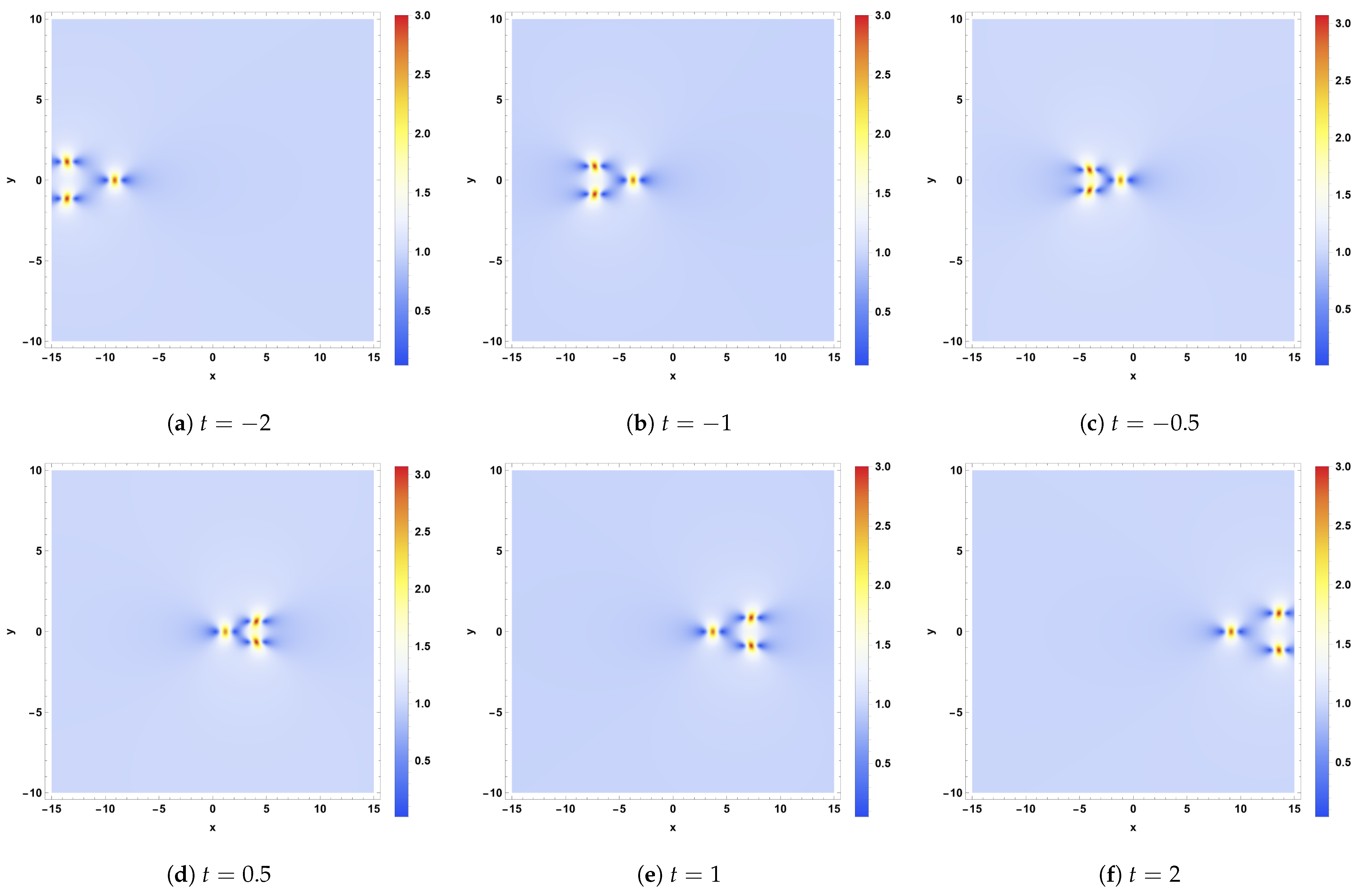
Figure 7 shows the density plot of | u I I | at different times. At t = 0 , the second-order lump solution has a single peak with an amplitude of 5. As | t | increases, it gradually splits into three separate peaks. The motion of these peaks exhibits central symmetry.
To analyze the trajectories of lump peaks as t , we choose a moving coordinate frame that follows the center of the structure. The new coordinates are defined based on the trajectory of the first-order lump,
X = x 3 ( a 2 + 2 ) t , Y = y + 3 a t .
In this ( X , Y , t ) frame, the solution still satisfies the nonlocal condition v ( X , Y , t ) = u ( X , Y , t ) . To identify the large-time scaling of the separating lump peaks, we introduce an auxiliary parameter z such that the peak coordinates are parameterized in terms of the auxiliary variable in z, while time is expanded as a cubic polynomial in z. In the new coordinates, we define t as
t = v 3 z 3 + v 2 z 2 + v 1 z + v 0 .
where v j ( j = 0 , 1 , 2 , 3 ) are real parameters. By introducing the linear transformations X k 1 z + l 1 and Y k 2 z + l 2 , we derive a control polynomial F 1 , which must vanish to balance the leading terms,
F 1 = k 1 2 + 4 a k 1 k 2 + 4 ( 1 + a 2 ) k 2 2 3 + 24 v 3 k 1 + 2 a k 2 k 1 2 + 4 a k 1 k 2 + 4 ( 3 + a 2 ) k 2 2 + 144 v 3 2 .
Therefore, we obtain
v 3 = 1 12 k 1 3 + 6 a k 1 2 k 2 + 12 ( 1 + a 2 ) k 1 k 2 2 2 12 a k 2 3 4 a 3 k 2 3 ± Δ
where the discriminant Δ is
Δ = k 2 2 3 k 1 2 + 12 a k 1 k 2 + 4 ( 1 + 3 a 2 ) k 2 2 2 .
Since v 3 must be real and Δ 0 , the discriminant must be zero. This condition gives three possible pairs for ( k 1 , k 2 ) ,
( k 1 , k 2 ) = ( 2 3 , 0 ) , ( 3 3 a , 3 2 ) , ( 3 + 3 a , 3 2 ) .
We substitute the three ( k 1 , k 2 ) pairs into the second-order lump solution to find its asymptotic form as z . We choose v 3 = 2 3 and the following coefficients for simplicity,
(i)
( k 1 , k 2 ) = ( 2 3 , 0 ) :
l 1 = p 1 1 3 v 2 , l 2 = p 2 .
(ii)
( k 1 , k 2 ) = ( 3 3 a , 3 2 ) :
l 1 = p 1 + 1 3 a 6 v 2 , l 2 = p 2 + 3 12 v 2 .
(iii)
( k 1 , k 2 ) = ( 3 + 3 a , 3 2 ) :
l 1 = p 1 + 1 + 3 a 6 v 2 , l 2 = p 2 3 12 v 2 .
For all of the above cases, we obtain the same asymptotic solution,
u I I = 1 + 4 + 16 i p 2 1 + 4 p 1 2 + 16 a p 1 p 2 + 16 ( 1 + a 2 ) p 2 2 + O 1 z 2 , z .
This limit matches the amplitude of a first-order lump solution at t = 0 , x = p 1 , y = p 2 . This confirms that the second-order solution splits into three first-order lumps at large times. In the ( X , Y ) coordinates, their trajectories are
(i)
( X , Y ) = 2 3 z v 2 3 , 0 ;
(ii)
( X , Y ) = ( 3 3 a ) z + v 2 ( 1 3 a ) 6 , 3 2 z + 3 v 2 12 ;
(iii)
( X , Y ) = ( 3 + 3 a ) z + v 2 ( 1 + 3 a ) 6 , 3 2 z 3 v 2 12 .
By eliminating the parameters z and v 2 , we find the equations for the three lines on which the lumps travel,
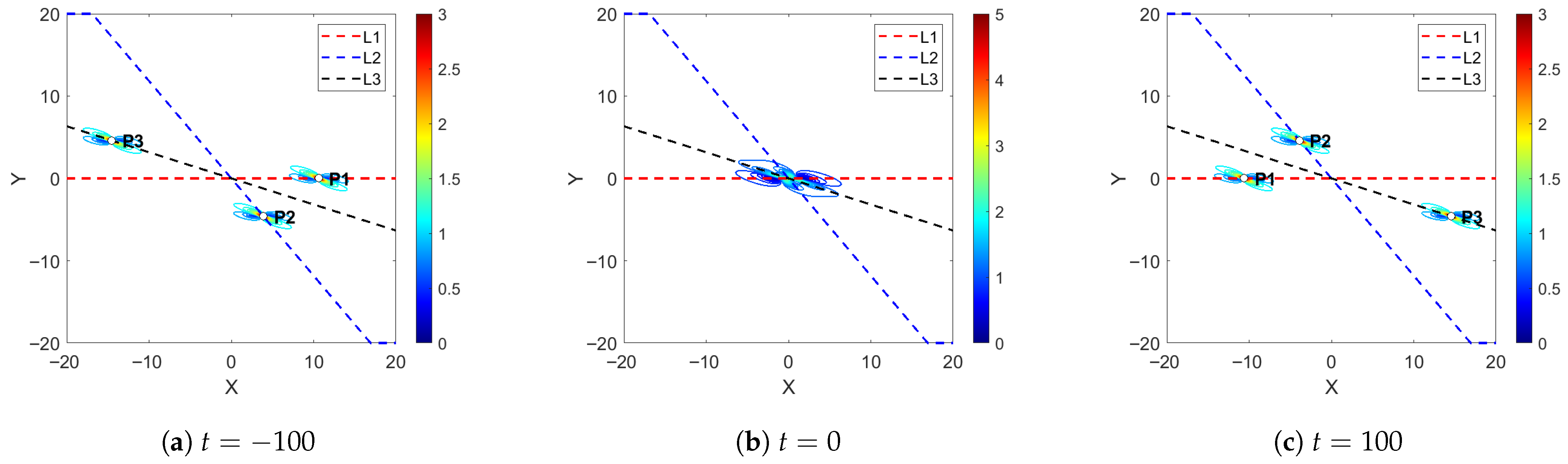
L 1 : Y = 0 , L 2 : 3 X 2 ( 3 3 a ) Y = 0 , L 3 : 3 X + 2 ( 3 + 3 a ) Y = 0 .
These equations show that the center of the three-peak structure stays at the origin ( 0 , 0 ) of the moving frame. Our analysis confirms that the second-order lump splits into three simpler lumps over time, forming a dynamic triangular pattern.
To analyze the dynamics beyond straight lines, we further approximate the positions of the three peaks ( v j = 0 for j = 0 , 1 , 2 ),
X k 1 v 3 1 / 3 t 1 / 3 + O t 1 / 3 , Y k 2 v 3 1 / 3 t 1 / 3 + O t 1 / 3 , t
Figure 8 shows the positions of the three peaks (P1, P2, P3) at t = 100 , 0 , and 100. For large | t | , the peaks follow the predicted paths L1, L2, and L3.
We now transform these results from the moving ( X , Y ) coordinates back to the original ( x , y ) coordinates. This gives the trajectories of the three separating lumps. For | t | , the trajectories of lump peaks are
(i)
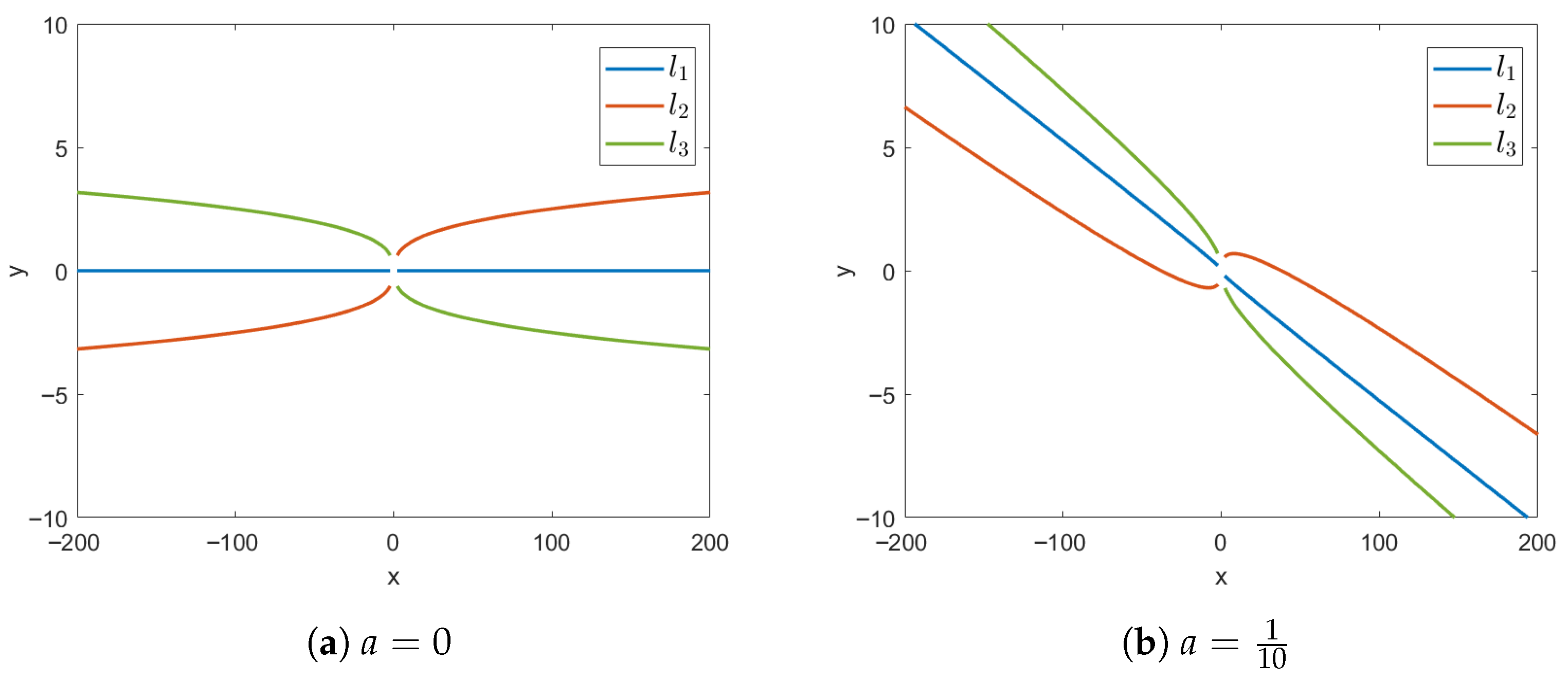
x 1 3 ( a 2 + 2 ) t 2 3 1 2 3 1 / 3 t 1 / 3 + O t 1 / 3 , y 1 3 a t + O t 1 / 3 .
(ii)
x 2 3 ( a 2 + 2 ) t + ( 3 3 a ) 1 2 3 1 / 3 t 1 / 3 + O t 1 / 3 , y 2 3 a t + 3 2 1 2 3 1 / 3 t 1 / 3 + O t 1 / 3 .
(iii)
x 3 3 ( a 2 + 2 ) t + ( 3 + 3 a ) 1 2 3 1 / 3 t 1 / 3 + O t 1 / 3 , y 3 3 a t 3 2 1 2 3 1 / 3 t 1 / 3 + O t 1 / 3 .
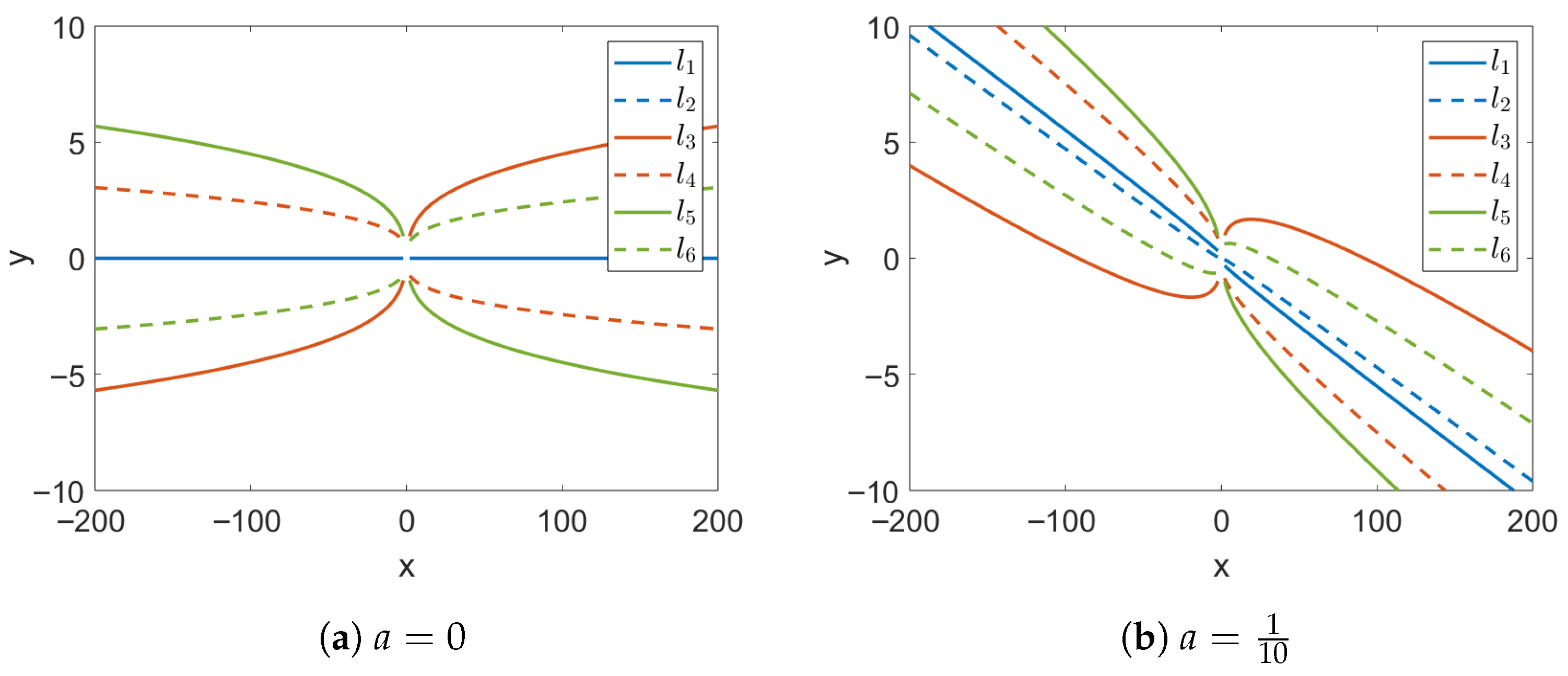
These coordinates define the paths of the separating peaks, labeled l 1 , l 2 , and l 3 . Figure 9 shows these curved paths for a = 0 and a = 1 / 10 , illustrating how the parameter a affects the geometry. The trajectories demonstrate the anomalous scattering, a characteristic pattern for lump interactions. As | t | , the propagation velocity and amplitude of the three lump waves both converge to constant values.

5.3. Third-Order Lump Solution

The third-order lump solution is constructed by applying the generalized (1,2)-fold Darboux transformation. This procedure yields the solution
u I I I = u 0 2 i Δ T 21 ( 2 ) Δ 3 .
To satisfy the nonlocal constraint, the second-order phase parameters are obtained as
d 2 = 1 15 , e 2 = 0 .
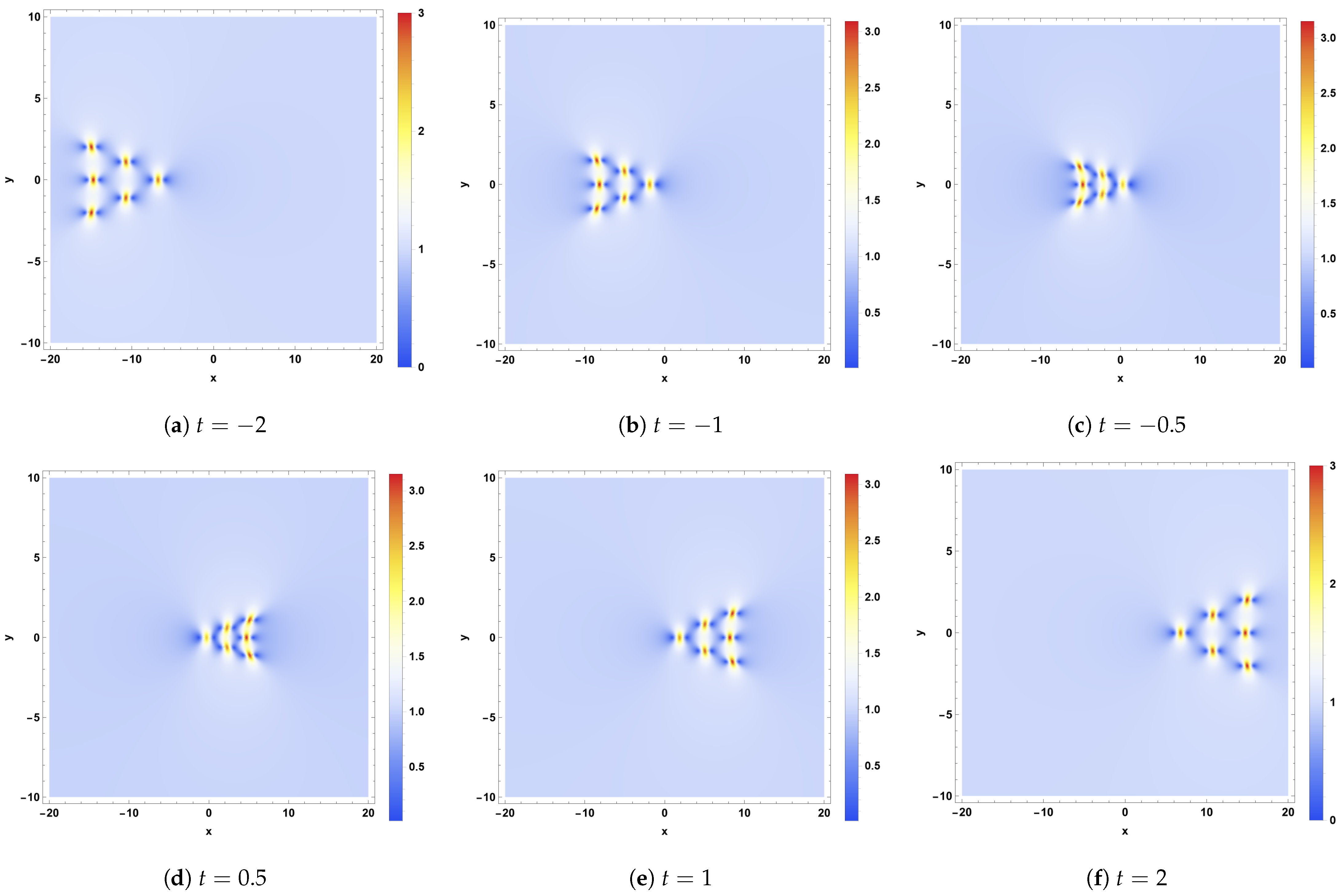
Figure 10 shows the plots of the solution at six time instants: t = ± 2 , ± 1 , ± 0.5 . As time evolves from negative to positive, the six lump waves first converge and then diverge. At t = 0 , the solution appears in a fundamental state with a peak amplitude of 7. The motion of these peaks also exhibits central symmetry.
Similar to the second-order case, we perform the calculations in the moving coordinate frame defined by Equation (83). We again parameterize the coordinates and time using the variable z, which yields the following control polynomial F 2
F 2 = 4096 ( k 1 12 + 24 a k 1 11 k 2 + 24 ( 1 + 11 a 2 ) k 1 10 k 2 2 + 160 a ( 3 + 11 a 2 ) k 1 9 k 2 3 + 240 ( 1 + 18 a 2 + 33 a 4 ) k 1 8 k 2 4 + 768 a ( 5 + 30 a 2 + 33 a 4 ) k 1 7 k 2 5 + 256 5 + 21 a 2 ( 5 + 15 a 2 + 11 a 4 ) k 1 6 k 2 6 + 3072 a ( 1 + a 2 ) ( 5 + 30 a 2 + 33 a 4 ) k 1 5 k 2 7 + 3840 ( 1 + a 2 ) 2 ( 1 + 18 a 2 + 33 a 4 ) k 1 4 k 2 8 + 10240 a ( 1 + a 2 ) 3 ( 3 + 11 a 2 ) k 1 3 k 2 9 + 6144 ( 1 + a 2 ) 4 ( 1 + 11 a 2 ) k 1 2 k 2 10 + 24576 a ( 1 + a 2 ) 5 k 1 k 2 11 + 4096 ( 1 + a 2 ) 6 k 2 12 ) + 120 ( k 1 + 2 a k 2 ) ( k 1 2 + 4 a k 1 k 2 + 4 ( 3 + a 2 ) k 2 2 ) ( k 1 2 + 4 a k 1 k 2 + 4 ( 1 + a 2 ) k 2 2 ) 3 v 3 + 720 ( 3 k 1 6 + 36 a k 1 5 k 2 + 180 ( 1 + a 2 ) k 1 4 k 2 2 + 480 a ( 3 + a 2 ) k 1 3 k 2 3 + 240 ( 1 + 3 a 2 ( 6 + a 2 ) ) k 1 2 k 2 4 + 192 a ( 5 + 30 a 2 + 3 a 4 ) k 1 k 2 5 + 64 ( 7 + 3 a 2 ( 5 + 15 a 2 + a 4 ) ) k 2 6 ) v 3 2 86400 ( k 1 + 2 a k 2 ) ( k 1 2 + 4 a k 1 k 2 + 4 ( 3 + a 2 ) k 2 2 ) v 3 3 + 518400 v 3 4 .
Setting F 2 = 0 yields
v 3 = 1 120 ( 5 3 5 ) k 1 3 6 ( 5 + 3 5 ) a k 1 2 k 2 12 ( 5 + 3 5 ) ( 1 + a 2 ) k 1 k 2 2 2 12 ( 5 3 5 ) a k 2 3 + 4 ( 5 + 3 5 ) a 3 k 2 3 + 10 Δ .
where
Δ = ( 7 + 3 5 ) k 2 2 3 k 1 2 + 12 a k 1 k 2 + 4 ( 1 + 3 a 2 ) k 2 2 2
The parameter v 3 is real, which requires Δ 0 . We choose the specific value v 3 = 8 ( 3 5 5 ) 45 3 and specify the following parameters for each case:
(i)
( k 1 , k 2 ) = 4 3 3 , 0 :
l 1 = p 1 15 + 9 5 8 v 2 , l 2 = p 2 .
(ii)
( k 1 , k 2 ) = 4 3 3 7 3 5 2 1 / 3 , 0 :
l 1 = p 1 + 3 1 2 ( 7 3 5 ) 1 / 3 ( 20 + 9 5 ) 94 42 5 v 2 , l 2 = p 2 .
(iii)
( k 1 , k 2 ) = 2 ( 3 3 a ) 3 , 1 :
l 1 = p 1 + 60 27 5 60 3 a + 27 15 a 4 ( 47 + 21 5 ) v 2 , l 2 = p 2 + 15 3 9 15 16 ( 7 + 3 5 ) v 2 .
(iv)
( k 1 , k 2 ) = 2 3 7 3 5 2 1 / 3 ( 3 3 a ) , 7 3 5 2 1 / 3 :
l 1 = p 1 3 1 2 ( 7 3 5 ) 1 / 3 ( 1885 + 843 5 ) ( 1 + 3 a ) 8 ( 2207 + 987 5 ) v 2 , l 2 = p 2 + 3 3 1 2 ( 7 3 5 ) 1 / 3 ( 20 + 9 5 ) 8 ( 47 + 21 5 ) v 2 .
(v)
( k 1 , k 2 ) = 2 ( 3 + 3 a ) 3 , 1 :
l 1 = p 1 + 60 27 5 + 60 3 a 27 15 a 4 ( 47 + 21 5 ) v 2 , l 2 = p 2 + 15 3 + 9 15 16 ( 7 + 3 5 ) v 2 .
(vi)
( k 1 , k 2 ) = 2 3 7 3 5 2 1 / 3 ( 3 + 3 a ) , 7 3 5 2 1 / 3 :
l 1 = p 1 + 3 1 2 ( 7 3 5 ) 1 / 3 ( 1885 + 843 5 ) ( 1 + 3 a ) 8 ( 2207 + 987 5 ) v 2 , l 2 = p 2 + 3 3 1 2 ( 7 3 5 ) 1 / 3 ( 20 9 5 ) 8 ( 47 + 21 5 ) v 2 .
Remarkably, the asymptotic limit in all three directions converges to the first-order lump solution, consistent with the result in Equation (89) (evaluated at t = 0 , x = p 1 , y = p 2 ). The trajectories of the separating lumps are
(i)
( X , Y ) = 4 3 3 z 15 + 9 5 8 v 2 , 0
(ii)
( X , Y ) = 4 3 3 ( 7 3 5 2 ) 1 / 3 z + 3 ( 1 2 ( 7 3 5 ) ) 1 / 3 ( 20 + 9 5 ) 94 42 5 v 2 , 0
(iii)
( X , Y ) = 2 ( 3 3 a ) 3 z + 60 27 5 60 3 a + 27 15 a 4 ( 47 + 21 5 ) v 2 , z + 15 3 9 15 16 ( 7 + 3 5 ) v 2
(iv)
( X , Y ) = ( 2 3 7 3 5 2 1 / 3 ( 3 3 a ) z + 3 7 3 5 2 1 / 3 ( 843 5 1885 ) ( 3 a 1 ) 8 ( 2207 987 5 ) v 2 , 7 3 5 2 1 / 3 z + 3 3 7 3 5 2 1 / 3 ( 9 5 20 ) 8 ( 21 5 47 ) v 2 )
(v)
( X , Y ) = 2 ( 3 + 3 a ) 3 z + 60 27 5 + 60 3 a 27 15 a 4 ( 47 + 21 5 ) v 2 , z + 15 3 + 9 15 16 ( 7 + 3 5 ) v 2
(vi)
( X , Y ) = ( 2 3 ( 7 3 5 2 ) 1 / 3 ( 3 + 3 a ) z + 3 ( 1 2 ( 7 3 5 ) ) 1 / 3 ( 1885 + 843 5 ) ( 1 + 3 a ) 8 ( 2207 + 987 5 ) v 2 , ( 7 3 5 2 ) 1 / 3 z + 3 3 ( 1 2 ( 7 3 5 ) ) 1 / 3 ( 20 9 5 ) 8 ( 47 + 21 5 ) v 2 )
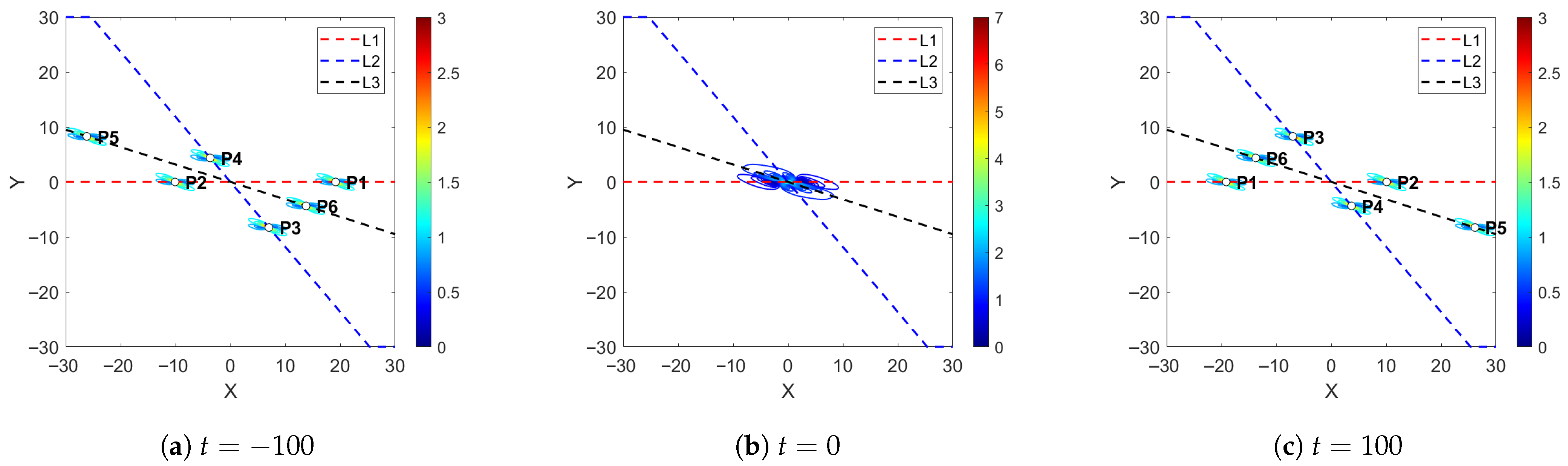
Eliminating the parameters v 2 and z yields the equations for the three lines that govern the asymptotic propagation. These lines are identical to those given in Equation (90), confirming a universal geometric structure for the splitting process. Figure 11 displays the positions of the six peaks, labeled P1 through P6, at three time instants: t = 100 , 0 , 100 . The six peaks are arranged in pairs upon three distinct asymptotic lines: P1 and P2 are located on L1, P3 and P4 on L2, and P5 and P6 on L3. The evolution of these trajectories exhibits central symmetry with respect to the origin, which is in perfect agreement with the theoretical results derived from the asymptotic analysis.
By transforming these asymptotic results from the moving coordinates ( X , Y ) back to the original coordinates ( x , y ) using Equation (83), we obtain explicit trajectories for the centers of the six separating lump waves. We also note that the velocity varies with time and approaches the same constant value as that of the first-order lump solution, given by Equation (80), as | t | . In the original coordinates, by treating t as a parameter, we obtain the positions of the six points, P1–P6, which lie on six corresponding curves, l 1 l 6 . Figure 12 illustrates these curved paths for a = 0 and a = 1 / 10 .
In this section, we investigated the long-time asymptotic behavior of high-order lump solutions. We determined the asymptotic coordinates and trajectories of the lump maxima and showed that these solutions exhibit anomalous scattering, fundamentally different from typical soliton scattering. Specifically, the high-order lumps do not separate through conventional straight-line elastic motion; rather, they separate along symmetry-related curved trajectories with time-dependent velocities, a phenomenon that can be interpreted as a redistribution of the resonant structure and propagation directions. In this sense, the lumps appear as non-stationary resonant structures whose asymptotic expansions for the velocities include terms of order O ( t 1 / 3 ) . As t , both the propagation velocity and the amplitude approach constant limits.

6. Discussions and Conclusions

This study provides a comprehensive analysis of nonlinear wave phenomena in the (2+1)-dimensional RST-NLS equation, with emphasis on the unique interactions of high-order line-solitons and on the dynamics of high-order lump solutions. Our main contributions are summarized as follows:
  • The generalized ( n , N n ) -fold Darboux transformation is constructed for the AKNS system (6) and extended to its nonlocal reduction (31), and this nonlocal reduction preserves the integrable structure of the underlying equation.
  • High-order line-soliton solutions are obtained for the first time for Equation (3), and an asymptotic analysis framework is established to characterize their dynamical behavior. Specifically, explicit expressions for the soliton-separation trajectories are derived in the limits | t | and near t = 0 . These trajectories are found to be similar to those of high-order line solitons in the DS-I equation, exhibiting a positon-like profile near t = 0 and gradually separating into independent line solitons at a logarithmic rate as time evolves [29]. Moreover, the observed asymptotic behavior also resembles the interaction-decay phenomenon of multi-pole solitons in the (1+1)-dimensional matrix NLS equation in the large-parameter regime [47].
  • High-order lump solutions of Equation (3) are obtained. A long-time asymptotic framework is employed to analyze the decomposition of second- and third-order lumps, to determine the asymptotic trajectories of the lump maxima, and to characterize their anomalous scattering with time-dependent velocities.
In the classical KP-I equation, the standard lump solution has been proven to be orbitally stable [55]. However, for the DS-II equations, such localized wave structures have been shown to be unstable [56]. For the (2+1)-dimensional NLS equation discussed in this paper, the stability of the lump solutions, as well as that of high-order lump patterns, remains an open problem. A natural next step is to study the spectrum of the linearized nonlocal operator around the lump background and to complement this with direct numerical time evolution of perturbed lump profiles, especially under localized and symmetry-preserving perturbations. These approaches may help clarify both spectral and dynamical stability in the present model.
Finally, we remark that the nonlocal solutions of (3) constructed in this work also satisfy the underlying local RST-NLS Equation (2). From this viewpoint, the reverse-space–time nonlocal reduction considered here can be interpreted as a symmetry constraint that selects a highly symmetric subclass of localized wave fields. Within this class, the solutions exhibit robust spatiotemporal localization and symmetry properties, providing a convenient theoretical setting for analyzing nonlocal coherent structures in higher-dimensional nonlinear wave equations. In particular, the interaction mechanisms of high-order line solitons and the anomalous scattering of high-order lump solutions offer a theoretical framework for understanding the interaction and energy redistribution of nonlocal wave packets in higher-dimensional dispersive nonlinear systems. These high-order solutions may be relevant to practical applications in higher-dimensional nonlinear media, where complex wave interaction patterns and energy redistribution play an important role, such as in nonlinear optics, fluid dynamics, and Bose–Einstein condensates.

Author Contributions

Conceptualization, M.W.; Methodology, M.W. and G.W.; Software, Y.W., C.F. and H.D.; Validation, M.W., Y.W., H.C. and C.F.; Formal Analysis, M.W. and Y.W.; Investigation, M.W.; Writing—Original Draft Preparation, M.W.; Writing—Review and Editing, G.W. and H.C.; Visualization, M.W. and Y.W.; Supervision, G.W. and H.C.; Project Administration, Y.W. and G.W.; Funding Acquisition, M.W. and H.D. All authors have read and agreed to the published version of the manuscript.

Funding

This research was funded by the Beijing Natural Science Foundation grant No. QY25200.

Data Availability Statement

The original contributions presented in this study are included in the article. Further inquiries can be directed to the corresponding author.

Acknowledgments

We thank Tianwei Qiu for his contributions to the research and writing of this paper.

Conflicts of Interest

The authors declare no conflicts of interest.

References

  1. Vinita; Saha Ray, S. Symmetry analysis, optimal subalgebra, quasi-self-adjointness condition with conservation laws and analytical solutions for the (1+1)-dimensional Pochhammer–Chree model in longitudinal wave propagation. Pramana 2024, 98, 23. [Google Scholar] [CrossRef]
  2. Al-Raeei, M. Applying fractional quantum mechanics to systems with electrical screening effects. Chaos Solitons Fractals 2021, 150, 111209. [Google Scholar] [CrossRef]
  3. Hammack, J.L.; Segur, H. The Korteweg–de Vries equation and water waves. Part 2. Comparison with experiments. J. Fluid Mech. 1974, 65, 289–314. [Google Scholar] [CrossRef]
  4. Washimi, H.; Taniuti, T. Propagation of ion-acoustic solitary waves of small amplitude. Phys. Rev. Lett. 1966, 17, 996–998. [Google Scholar] [CrossRef]
  5. Kakei, S.; Ikeda, T.; Takasaki, K. Hierarchy of (2+1)-dimensional nonlinear Schrödinger equation, self-dual Yang–Mills equation, and toroidal Lie algebras. Ann. Henri Poincaré 2002, 3, 817–845. [Google Scholar] [CrossRef]
  6. Alayachi, H.S. A reliable analytic technique for solving two nonlinear models in mathematical physics. AIP Adv. 2024, 14, 055024. [Google Scholar] [CrossRef]
  7. Lax, P.D. Integrals of nonlinear equations of evolution and solitary waves. Commun. Pure Appl. Math. 1968, 21, 467–490. [Google Scholar] [CrossRef]
  8. Hirota, R. Exact solution of the Korteweg–de Vries equation for multiple collisions of solitons. Phys. Rev. Lett. 1971, 27, 1192–1194. [Google Scholar] [CrossRef]
  9. Gu, C.; Hu, H.; Zhou, Z. Darboux Transformations in Integrable Systems: Theory and Their Applications to Geometry; Springer: Dordrecht, The Netherlands, 2005. [Google Scholar] [CrossRef]
  10. Zakharov, V.E.; Manakov, S.V. Asymptotic behavior of nonlinear wave systems integrated by the inverse scattering method. Sov. Phys. JETP 1976, 44, 106–112. [Google Scholar]
  11. Gardner, C.S.; Greene, J.M.; Kruskal, M.D.; Miura, R.M. Method for solving the Korteweg–de Vries equation. Phys. Rev. Lett. 1967, 19, 1095–1097. [Google Scholar] [CrossRef]
  12. Ablowitz, M.J.; Clarkson, P.A. Solitons, Nonlinear Evolution Equations and Inverse Scattering; Cambridge University Press: Cambridge, UK, 1991. [Google Scholar] [CrossRef]
  13. Satsuma, J.; Ablowitz, M.J. Two-dimensional lumps in nonlinear dispersive systems. J. Math. Phys. 1979, 20, 1496–1503. [Google Scholar] [CrossRef]
  14. Ohta, Y.; Yang, J. Rogue waves in the Davey–Stewartson I equation. Phys. Rev. E 2012, 86, 036604. [Google Scholar] [CrossRef] [PubMed]
  15. Qiu, T.; Wang, Z.; Yang, X. Multi-pole lump solutions and anomalous scattering in the BKP equation. Chaos Solitons Fractals 2025, 198, 116522. [Google Scholar] [CrossRef]
  16. Ma, W.X.; Zhou, Y. Lump solutions to nonlinear partial differential equations via Hirota bilinear forms. J. Differ. Equ. 2018, 264, 2633–2659. [Google Scholar] [CrossRef]
  17. Guil, F.; Manas, M. Darboux transformations for the Davey–Stewartson equations. Phys. Lett. A 1996, 217, 1–6. [Google Scholar] [CrossRef]
  18. Fokas, A.S.; Ablowitz, M.J. On the inverse scattering and direct linearizing transforms for the Kadomtsev–Petviashvili equation. Phys. Lett. A 1983, 94, 67–70. [Google Scholar] [CrossRef]
  19. Diorio, J.; Cho, Y.; Duncan, J.H.; Akylas, T.R. Gravity–capillary lumps generated by a moving pressure source. Phys. Rev. Lett. 2009, 103, 214502. [Google Scholar] [CrossRef]
  20. Ablowitz, M.J.; Segur, H. On the evolution of packets of water waves. J. Fluid Mech. 1979, 92, 691–715. [Google Scholar] [CrossRef]
  21. Infeld, E.; Senatorski, A.; Skorupski, A.A. Decay of Kadomtsev–Petviashvili solitons. Phys. Rev. Lett. 1994, 72, 1345–1347. [Google Scholar] [CrossRef]
  22. Berloff, N.G.; Roberts, P.H. Motions in a Bose condensate. X. New results on the stability of axisymmetric solitary waves of the Gross–Pitaevskii equation. J. Phys. A 2004, 37, 11333–11351. [Google Scholar] [CrossRef]
  23. Baronio, F.; Wabnitz, S.; Kodama, Y. Optical Kerr spatiotemporal dark-lump dynamics of hydrodynamic origin. Phys. Rev. Lett. 2016, 116, 173901. [Google Scholar] [CrossRef]
  24. Yang, X.; Wang, Z.; Zhang, Z. Generation of anomalously scattered lumps via lump chains degeneration within the Mel’nikov equation. Nonlinear Dyn. 2023, 111, 15293–15307. [Google Scholar] [CrossRef]
  25. Gorshkov, K.A.; Pelinovsky, D.E.; Stepanyants, Y.A. Normal and anomalous scattering, formation and decay of bound states of two-dimensional solitons described by the Kadomtsev–Petviashvili equation. JETP 1993, 77, 237–245. [Google Scholar]
  26. Qiu, T.; Wang, Z.; Yang, X. Generation of anomalously scattered lump waves for the (2+1)-dimensional Date–Jimbo–Kashiwara–Miwa equation. Eur. Phys. J. Plus 2025, 140, 95. [Google Scholar] [CrossRef]
  27. Kodama, Y.; Williams, L. KP solitons and total positivity for the Grassmannian. Invent. Math. 2014, 198, 637–699. [Google Scholar] [CrossRef]
  28. Biondini, G. Line soliton interactions of the Kadomtsev–Petviashvili equation. Phys. Rev. Lett. 2007, 99, 064103. [Google Scholar] [CrossRef]
  29. Guo, L.J.; Chen, L.; Mihalache, D.; He, J. Dynamics of soliton interaction solutions of the Davey–Stewartson I equation. Phys. Rev. E 2022, 105, 014218. [Google Scholar] [CrossRef]
  30. Deift, P.; Zhou, X. A steepest descent method for oscillatory Riemann–Hilbert problems. Asymptotics for the MKdV equation. Ann. Math. 1993, 137, 295–368. [Google Scholar] [CrossRef]
  31. Hirota, R. Exact envelope-soliton solutions of a nonlinear wave equation. J. Math. Phys. 1973, 14, 805–809. [Google Scholar] [CrossRef]
  32. Rogers, C.; Schief, W.K. Bäcklund and Darboux Transformations: Geometry and Modern Applications in Soliton Theory; Cambridge University Press: Cambridge, UK, 2002. [Google Scholar] [CrossRef]
  33. Matveev, V.B.; Salle, M.A. Darboux Transformations and Solitons; Springer: Berlin, Germany, 1991. [Google Scholar] [CrossRef]
  34. Ling, L.; Zhao, L.C.; Guo, B. Darboux transformation and multi-dark soliton for N-component nonlinear Schrödinger equations. Nonlinearity 2015, 28, 3243–3261. [Google Scholar] [CrossRef]
  35. Chen, M.; Li, B.; Yu, Y.X. Darboux transformations, higher-order rational solitons and rogue wave solutions for a (2+1)-dimensional nonlinear Schrödinger equation. Commun. Theor. Phys. 2019, 71, 27–36. [Google Scholar] [CrossRef]
  36. Cui, X.Q.; Wen, X.Y.; Lin, Z. Soliton solutions, lump solutions, mixed interactional solutions and their dynamical analysis of the (2+1)-dimensional Calogero–Degasperis system. Pramana 2023, 98, 1. [Google Scholar] [CrossRef]
  37. Cui, X.Q.; Wen, X.Y.; Li, Z.D. Magnetization reversal phenomenon of higher-order lump and mixed interaction structures on periodic background in the (2+1)-dimensional Heisenberg ferromagnet spin equation. Chaos Solitons Fractals 2024, 182, 114770. [Google Scholar] [CrossRef]
  38. Ablowitz, M.J.; Chakravarty, S.; Trubatch, A.D.; Villarroel, J. A novel class of solutions of the non-stationary Schrödinger and the Kadomtsev–Petviashvili I equations. Phys. Lett. A 2000, 267, 132–146. [Google Scholar] [CrossRef]
  39. Davey, A.; Stewartson, K. On three-dimensional packets of surface waves. Proc. R. Soc. A 1974, 338, 101–110. [Google Scholar] [CrossRef]
  40. Taniuti, T.; Yajima, N. Perturbation method for a nonlinear wave modulation. I. J. Math. Phys. 1969, 10, 1369–1372. [Google Scholar] [CrossRef]
  41. Hasegawa, A.; Tappert, F. Transmission of stationary nonlinear optical pulses in dispersive dielectric fibers. I. Anomalous dispersion. Appl. Phys. Lett. 1973, 23, 142–144. [Google Scholar] [CrossRef]
  42. Agrawal, G.P. Nonlinear Fiber Optics, 5th ed.; Academic Press: Amsterdam, The Netherlands, 2013. [Google Scholar] [CrossRef]
  43. Bullough, R.K.; Caudrey, P.J. Solitons (Topics in Current Physics); Springer: Berlin, Germany, 1980. [Google Scholar] [CrossRef]
  44. Yuan, F.; Ghanbari, B.; Zhang, Y.; Wazwaz, A.M. From breather solutions to lump solutions: A construction method for the Zakharov equation. Chin. Phys. B 2023, 32, 120201. [Google Scholar] [CrossRef]
  45. Hosseini, K.; Sadri, K.; Mirzazadeh, M.; Salahshour, S. An integrable (2+1)-dimensional nonlinear Schrödinger system and its optical soliton solutions. Optik 2021, 229, 166247. [Google Scholar] [CrossRef]
  46. Qiu, T.; Wang, M.; Wang, Z.; Liu, X.K.; Sun, J. Modulational instability, rogue waves and multi-pole solitons for the fifth-order reverse space-time nonlinear Schrödinger equation. Physica D 2026, 488, 135101. [Google Scholar] [CrossRef]
  47. Song, X.M.; Du, Z. Double-pole solitons for the higher-order matrix nonlinear Schrödinger equation: Asymptotic analysis. Phys. Fluids 2025, 37, 025121. [Google Scholar] [CrossRef]
  48. He, J.S.; Wang, S.R.; Li, L.J.; Wang, L.H.; Porsezian, K. Few-cycle optical rogue waves: Complex modified Korteweg–de Vries equation. Phys. Rev. E 2014, 89, 062917. [Google Scholar] [CrossRef]
  49. Ablowitz, M.J.; Kaup, D.J.; Newell, A.C.; Segur, H. The inverse scattering transform–Fourier analysis for nonlinear problems. Stud. Appl. Math. 1974, 53, 249–315. [Google Scholar] [CrossRef]
  50. Ablowitz, M.J.; Musslimani, Z.H. Integrable nonlocal nonlinear Schrödinger equation. Phys. Rev. Lett. 2013, 110, 064105. [Google Scholar] [CrossRef]
  51. Ablowitz, M.J.; Musslimani, Z.H. Integrable nonlocal nonlinear equations. Stud. Appl. Math. 2017, 139, 7–59. [Google Scholar] [CrossRef]
  52. Liu, Y.K.; Li, B. Rogue waves in the (2+1)-dimensional nonlinear Schrödinger equation with a parity-time-symmetric potential. Chin. Phys. Lett. 2017, 34, 010202. [Google Scholar] [CrossRef]
  53. Zhu, Z.N.; Zhao, H.Q.; Wu, X.N. On the continuous limits and integrability of a new coupled semidiscrete mKdV system. J. Math. Phys. 2011, 52, 043508. [Google Scholar] [CrossRef]
  54. Lin, Z.; Wen, X.Y. Dynamical analysis of position-controllable loop rogue wave and mixed interaction phenomena for the complex short pulse equation in optical fiber. Nonlinear Dyn. 2022, 108, 2573–2593. [Google Scholar] [CrossRef]
  55. Liu, Y.; Wei, J. Nondegeneracy, Morse index and orbital stability of the KP-I lump solution. Arch. Ration. Mech. Anal. 2019, 234, 1335–1389. [Google Scholar] [CrossRef]
  56. Gadyl’shin, R.R.; Kiselev, O.M. Structural instability of a soliton for the Davey–Stewartson II equation. Theor. Math. Phys. 1999, 118, 278–284. [Google Scholar] [CrossRef]
Figure 1. Spatial profiles of the second-order line-soliton | u 2 ( x , y , t ) | with parameters f = 1 2 and g = 0 at (a) t = 5 , (b) t = 0 , and (c) t = 5 . The solution forms a single peak at t = 0 and splits into two irregular line-soliton structures for t 0 .
Mathematics 14 01429 g001
Figure 2. Dynamic evolution of the second-order soliton | u 2 ( x , y , t ) | with parameters g = 0.05 and f = 0.1 , showing its separation into two parallel solitons.
Mathematics 14 01429 g002
Figure 3. Visualization of the error function E r r ( x , y , t ) for the second-order soliton with parameters g = 0.05 and f = 0.1 .
Mathematics 14 01429 g003
Figure 4. Trajectory and error plots for the second-order line-soliton | u 2 ( x , y , t ) | with parameters g = 0.05 and f = 0.1 .
Mathematics 14 01429 g004
Figure 5. The third-order line-soliton | u 3 ( x , y , t ) | with parameters f = 1 2 and g = 0 .
Mathematics 14 01429 g005
Figure 6. Dynamic evolution of the third-order line-soliton | u 3 ( x , y , t ) | with parameters g = 0.05 and f = 0.1 .
Mathematics 14 01429 g006
Figure 7. Density plots of the second-order lump solution | u I I ( x , y , t ) | at (a) t = 2 , (b) t = 1 , (c) t = 0.5 , (d) t = 0.5 , (e) t = 1 , and (f) t = 2 .
Mathematics 14 01429 g007
Figure 8. Dynamic evolution of the second-order lump solution | u I I ( X , Y , t ) | with parameter a = 1 .
Mathematics 14 01429 g008
Figure 9. Dynamic evolution of the second-order lump solution | u I I ( x , y , t ) | .
Mathematics 14 01429 g009
Figure 10. The third-order lump solution | u I I I ( x , y , t ) | at different times.
Mathematics 14 01429 g010
Figure 11. Dynamic evolution of the third-order lump solution | u I I I ( X , Y , t ) | with parameter a = 1 .
Mathematics 14 01429 g011
Figure 12. Evolution of the third-order lump solution | u I I I ( x , y , t ) | .
Mathematics 14 01429 g012
Disclaimer/Publisher’s Note: The statements, opinions and data contained in all publications are solely those of the individual author(s) and contributor(s) and not of MDPI and/or the editor(s). MDPI and/or the editor(s) disclaim responsibility for any injury to people or property resulting from any ideas, methods, instructions or products referred to in the content.