1. Introduction
The Weibull distribution is one of the most fundamental and widely used models in reliability theory and lifetime data analysis due to its mathematical simplicity, interpretability, and flexibility in modeling monotone failure rates. Its closed-form expressions for key reliability measures, such as the survival and hazard rate, make it particularly attractive for practical applications in engineering, biomedical sciences, and industrial reliability. Despite these advantages, the classical Weibull model is limited by the restrictive nature of its hazard rate, which can only be monotonic, either strictly increasing or strictly decreasing.
In practice, however, lifetime data frequently display more complex failure mechanisms, including non-monotonic, unimodal, bathtub-shaped, and multi-turning-point hazard rate patterns. These limitations of the standard Weibull distribution have motivated extensive research aimed at developing flexible generalizations capable of capturing richer hazard rate dynamics while retaining the desirable analytical properties of the Weibull framework. Recently, Baker [
1] introduced a novel approach for constructing two flexible three-parameter Weibull distributions by applying Manly’s transformation (proposed by Manly [
2]) to well-established baseline models. These models, referred to as the Y-Weibull and Z-Weibull distributions, are distinguished by their tail characteristics: one is designed to capture heavier right tails, whereas the other accommodates lighter or more rapidly decaying tails, thereby enhancing flexibility in lifetime and reliability modeling.
Both formulations admit closed-form expressions for the probability density and cumulative distribution functions, which facilitates likelihood-based inference, and they reduce to the standard Weibull model as special cases when the transformation parameter is set to zero.
The central idea of this framework is to enhance distributional flexibility—particularly in terms of skewness, tail behavior, and hazard rate shapes—while preserving analytical tractability. By embedding Manly’s exponential transformation within classical survival distributions, the resulting models are capable of accommodating a wide range of empirical behaviors frequently observed in reliability engineering, actuarial science, biomedical, and survival analysis. Compared with existing generalized survival distributions in the literature, such as exponentiated, transmuted, and Marshall–Olkin-type families, the Baker’s framework offers several notable advantages; see Cressie [
3]. First, it provides a unified and transparent mechanism for model construction, avoiding the proliferation of ad hoc parameterizations that often complicate inference. Second, the resulting probability density and hazard functions remain mathematically well-behaved and interpretable, facilitating both theoretical analysis and practical implementation. Third, the additional flexibility introduced by Manly’s transform enables the models to capture complex hazard rate shapes, including increasing, decreasing, bathtub, and unimodal forms, which are not simultaneously attainable under many existing generalizations. For additional details, see, for example, Nwakuya and Nkwocha [
4].
From an inferential perspective, the Y- and Z-Weibull distributions proposed by Baker [
1] are well suited for likelihood-based estimation and model comparison. The presence of closed-form expressions or rapidly convergent series representations for key quantities, such as moments and survival functions, supports efficient numerical implementation. Consequently, these models provide a valuable alternative to existing flexible survival distributions, offering improved goodness-of-fit without excessive computational or conceptual complexity. In the present study, attention is restricted to the Y-Weibull model, hereafter termed the Baker–T1 distribution, which extends the classical Weibull framework through an additional transformation parameter that regulates skewness and tail behavior. In the following section, the structural characteristics of the Baker–T1 model are presented in more detail.
Although Baker [
1] introduced two novel extensions of the Weibull distribution based on Manly’s transformation, the proposed models were primarily presented from a constructional perspective. A detailed investigation of their statistical properties was not fully developed, and several important distributional characteristics, such as higher-order moments, skewness, kurtosis, and inferential behavior, were not examined in sufficient depth. Moreover, the estimation framework was limited, leaving open questions regarding the comparative performance of alternative parametric estimation techniques.
To address this important gap, the present study provides a comprehensive theoretical and inferential treatment of the Baker–T1 distribution. Specifically, we derive a wide range of fundamental properties, including moments, central moments, skewness, kurtosis, and reliability measures. In addition, we develop and implement eight parametric estimation methodologies for the model parameters, allowing for a systematic comparison of their efficiency and robustness. Although recent transformation-based approaches, most notably Baker’s construction via Manly’s transformation, have introduced promising extensions to the Weibull family, these models have so far been explored primarily from a structural or constructional perspective.
A rigorous and unified statistical treatment of their theoretical properties, inferential behavior, and practical performance remains largely absent from the literature. In particular, essential characteristics such as higher-order moments, dispersion measures, order statistics, and comparative efficiency of competing estimation procedures have not been systematically investigated. This gap limits the practical adoption of Baker-type models despite their evident flexibility and analytical appeal. Motivated by this shortcoming, the present study undertakes a comprehensive analysis of the Baker–T1 model, aiming to establish it as a mature and practically implementable lifetime distribution by developing its full probabilistic structure, inferential machinery, and empirical relevance through simulation and real-data applications.
Now, the main original contributions of this work can be summarized as follows:
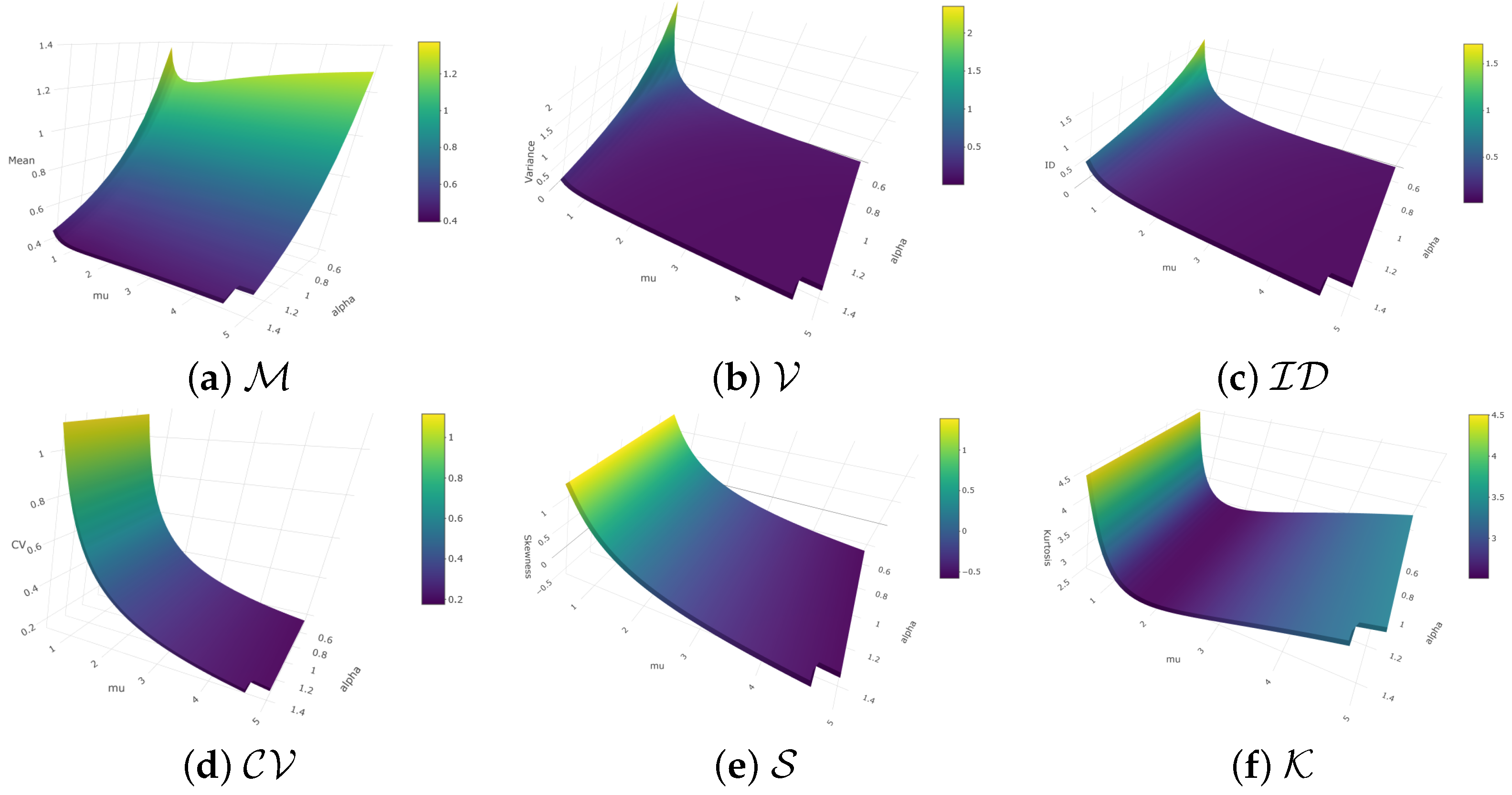
A complete probabilistic characterization of the Baker–T1 distribution is provided, including closed-form expressions or convergent series representations for the quantile function, reliability measures, hazard and reversed-hazard, skewness, kurtosis, and dispersion indices.
General expressions for the rth moments are derived and shown to exist for all positive orders.
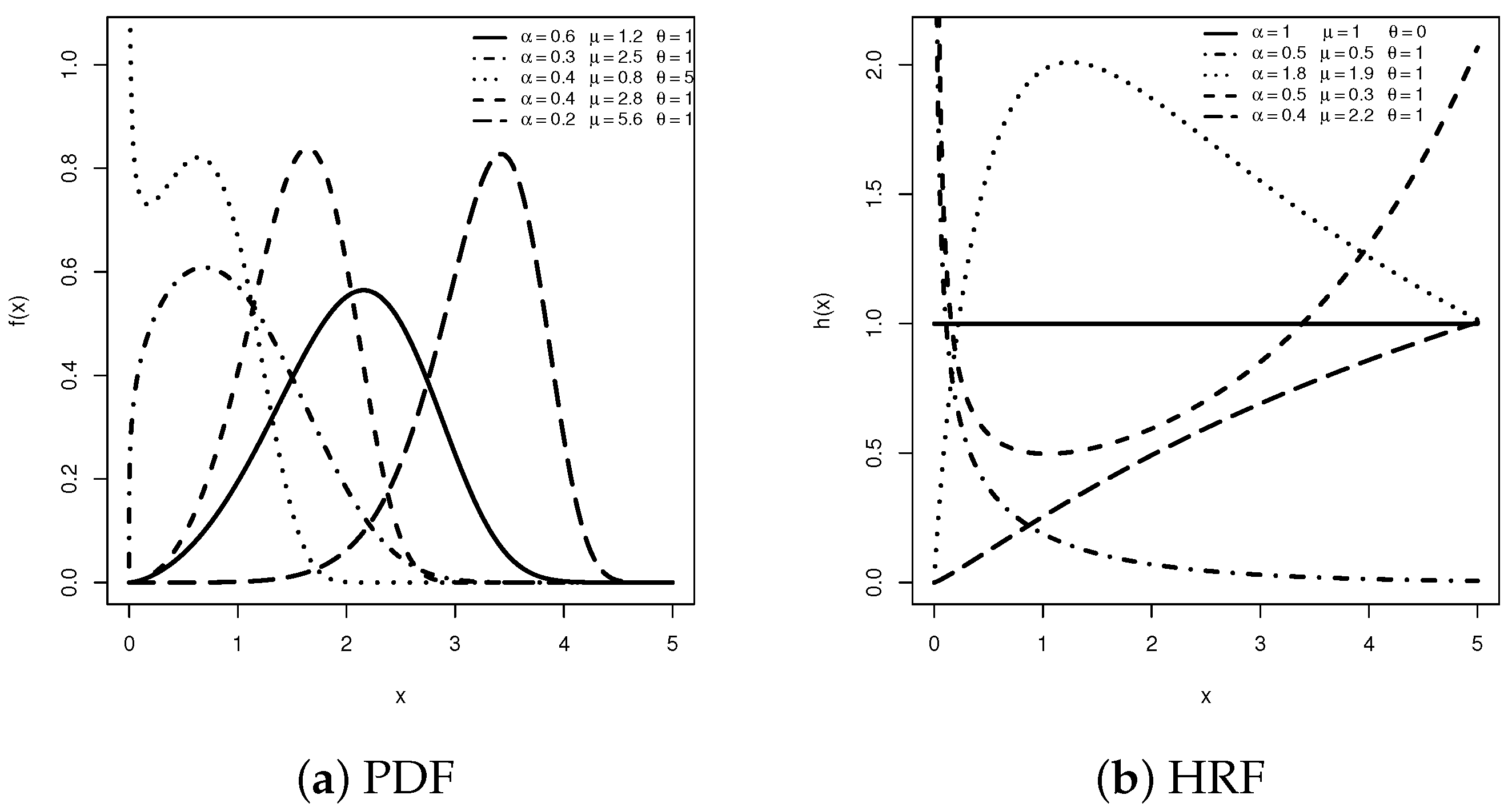
Both analytically and graphically, the Baker–T1 model can generate a wide range of hazard rate shapes, including increasing, decreasing, bathtub-shaped, and unimodal forms, within a single parametric framework, a feature not attainable by the classical Weibull distribution.
Exact closed-form expressions for the densities of order statistics are derived, including the minimum and maximum order statistics, facilitating inference on extremes and reliability-related quantities.
Eight classical parametric estimation methods are developed and implemented for the Baker–T1 model, namely maximum likelihood, maximum product of spacings, least squares, weighted least squares, percentile estimation, Cramér–von Mises, Anderson–Darling, and right-tail Anderson–Darling estimation.
A comprehensive simulation study is conducted to compare the finite-sample performance of all proposed estimators under diverse parameter configurations and sample sizes, using multiple accuracy criteria and ranking measures.
Using two genuine datasets from biomedical and engineering sectors, the Baker–T1 model consistently outperforms thirteen competing lifetime distributions based on nine information-theoretic criteria. This superiority arises from its enhanced flexibility in capturing skewness, tail behavior, and non-monotone hazard rate structures, which competing models fail to accommodate simultaneously. The empirical results confirm that the Baker–T1 distribution provides a more accurate, robust, and interpretable fit across fundamentally different application domains.
The study is organized as follows.
Section 2 formally introduces the Baker–T1 distribution.
Section 3 presents its fundamental statistical properties.
Section 4 describes parameter estimation using eight classical approaches.
Section 5 reports a Monte Carlo simulation study.
Section 6 illustrates the model’s application to two genuine datasets. Finally,
Section 7 concludes with remarks, practical recommendations, and suggestions for future research.
2. The Baker–T1 Model
Baker [
1] proposed two distinct three-parameter versions of the Weibull distribution, each characterized by different tail behaviors. This transformation preserves the Weibull distribution as the baseline while inducing additional flexibility in skewness, tail weight, and hazard rate structure. Consequently, the proposed models named Y- and Z-Weibull are capable of capturing numerous failure rates, with one formulation accommodating heavier right tails and the other allowing lighter or more rapidly decaying tails. In this part, we focus on the Baker–T1 lifespan model, which was first mentioned as the Y-Weibull model. Let
X be a nonnegative random variable following the Baker–T1 distribution, denoted by
, where
. Subsequently, the resulting cumulative distribution function (CDF), denoted by
, and probability density function (PDF), denoted by
, are obtained as follows:
and
where
governs the time scale,
controls the shape, and
determines the distributional tail behavior. The Baker–T1 model extends the standard Weibull (Gompertz) distribution, which can be found as a special case by setting
. In
Appendix A, additional derivation steps for the Baker–T1 model are provided.
In the present study, attention is restricted to the Y-Weibull model introduced by Baker [
1], which is hereafter referred to as the Baker–T1 distribution. This terminology is adopted to explicitly acknowledge Baker’s transformation-based construction while providing a concise label for the specific model variant analyzed in depth in this work. It is important to note that the Baker–T1 distribution is not a new model in the sense of redefining the original formulation, but rather a comprehensive theoretical and inferential development of the Y-Weibull case within Baker’s framework.
It is important to emphasize that a broad class of lifetime distributions in the literature shares a common exponential-type representation of the form . These models typically differ in the specific functional form assigned to , which governs the distribution’s tail behavior and hazard rate structure. Notable examples include:
The exponential power distribution (Smith and Bain [
5]), where
;
The Gompertz distribution (Gompertz [
6]), where
;
The Chen distribution (Chen [
7]), where
;
The modified Weibull extension (Xie et al. [
8]), where
;
The Weibull–Weibull family (Bourguignon et al. [
9]), where
.
In contrast, the Baker–T1 distribution arises from Manly’s exponential transformation embedded within Baker’s construction framework, leading to the transformation function This formulation introduces a non-trivial interaction among the parameters , , and , where the parameter simultaneously governs the deformation of the exponential argument and the tail behavior of the distribution. Such a structure differs fundamentally from the aforementioned models and cannot, in general, be reduced to them through simple parameter reparameterization. Moreover, while several existing models achieve flexibility through exponentiation or compounding mechanisms, the Baker–T1 model modifies the argument of the exponential function via a transformation-based approach. This feature yields enhanced adaptability in capturing complex hazard rate shapes, including increasing, decreasing, bathtub-shaped, and unimodal forms within a unified framework. Therefore, although the Baker–T1 distribution shares a superficial structural similarity with other exponential-type models, it should be regarded as a distinct transformation-based extension characterized by its unique parameter interaction and construction methodology.
4. Methods of Estimation
Evaluating and contrasting estimation techniques is crucial for determining which procedures yield the most reliable and efficient parameter estimates from a statistical standpoint. In this section, eight well-established classical estimation methods are applied to derive point estimates of the Baker–T1 model parameters
,
, and
. Specifically, the maximum likelihood and maximum product of spacings methods are likelihood-based approaches. The least-squares and weighted least-squares methods rely on minimizing the discrepancy between empirical and theoretical distribution functions. The percentile method provides a quantile-based alternative that is easy to implement and less sensitive to certain model assumptions. In addition, the Cramér–von Mises, Anderson–Darling, and right-tail Anderson–Darling methods are minimum distance estimators that differ in how they weight deviations between empirical and fitted distributions. Collectively, these methods offer a comprehensive framework for evaluating estimation performance from multiple theoretical and practical perspectives. For detailed treatments of these estimation methodologies, the reader is referred to Hassan and Alharbi [
10], Shafiq et al. [
11], Alqasem et al. [
12], and Alotaibi et al. [
13], among others.
4.1. Maximum Likelihood
The maximum likelihood technique is among the most commonly employed methods in statistical inference, owing to its simplicity and intuitive formulation. In addition, MLEs enjoy a number of attractive theoretical properties (see, e.g., Rohde [
14]). Let
denote a random sample.
From (
2), the log-likelihood function (log-LF),
, for the Baker–T1 distribution parameters is:
where
The MLEs
of
can be obtained by solving the following system of score equations:
and
respectively, where
(for
). Since Equations (
20)–(
22) cannot be expressed explicitly, numerical optimization methods are required. For this purpose, we recommend using optimization iterative procedures, such as Newton–Raphson or BFGS, via the maxLik package v1.5-2.2 (Henningsen and Toomet [
15]) to obtain
.
4.2. Maximum Product of Spacings
The maximum product of spacings (MPS) approach is commonly viewed as a strong competitor to the maximum likelihood method in statistical inference. Estimators obtained via MPS (MPSEs) share many of the favorable theoretical characteristics associated with MLEs. In line with Cheng and Amin [
16], the objective function to be maximized is defined as the natural logarithm of the MPS criterion. Specifically, let
denote the order statistics of a random sample of size
n drawn from the underlying population.
From (
1), the log-MPS,
, for the Baker–T1 distribution parameters is:
where
The MPSEs
of
, can be obtained by simultaneously solving the following three non-linear equations:
and
respectively, where
and
(for
). Just like in the MLEs’ scenario, we recommend using the maxLik package (Henningsen and Toomet [
15]) to obtain the MPSEs
(
) of
(
).
4.3. Least-Squares and Weighted Least-Squares
This subsection is devoted to the least-squares estimation (LSE) and weighted least-squares estimation (WLSE) procedures for the Baker–T1 distribution. These methods aim to minimize the sum of squared deviations between the theoretical cumulative distribution function and its empirical counterpart. Let
denote the ordered observations of a random sample; it is well established that
From (
1), the LSE (say,
) and WLSE (say,
) of
can be acquired by minimizing the next two quantities with respect to
:
and
Thus, the
and
expressions of
can be solved simultaneously using the following three equations:
and
where
(for LSE) and
(for WLSE),
,
,
and
.
4.4. Percentile
Owing to the availability of an explicit quantile function, the underlying distribution lends itself naturally to percentile-based estimation of its unknown parameters. This approach seeks to minimize the sum of squared discrepancies between the theoretical percentiles of the distribution and their empirical counterparts.
For the Baker–T1 model, from (
6), the percentile estimators (PCEs) of
,
, and
, denoted by
, are obtained by minimizing the following function:
where
and
.
The PCEs
can be obtained by solving the next equations simultaneously
and
where
and
4.5. Cramér–Von Mises
The Cramér–von Mises (CvM) estimation method provides a minimum-distance approach for parameter estimation by minimizing the discrepancy between the empirical distribution function and the corresponding theoretical distribution, making it a robust and widely used alternative in distributional inference. From (
1), the CvM estimators (CvMEs) for
,
, and
of the Baker–T1 distribution, denoted by
, can be obtained by minimizing
with respect to
,
, and
, where
.
The CvMEs
of
can be obtained by solving the following three non-linear equations:
and
where
,
,
and
.
4.6. Anderson–Darling and RT Anderson–Darling
The Anderson–Darling (AD) and right-tail AD (RTAD) estimation methods constitute weighted minimum-distance approaches that emphasize tail behavior by assigning greater importance to discrepancies between the empirical and theoretical distribution functions in the tail regions, thereby yielding efficient parameter estimates for distributions with pronounced tail characteristics.
From (
1) and (
3), the AD estimators (ADEs) for
of the Baker–T1 distribution, denoted by
, can be obtained by minimizing
with respect to
,
, and
.
The ADEs
of
can be obtained by solving the following three non-linear equations:
and
where
From (
1) and (
3), the RTAD estimators (RTADEs) for
of the Baker–T1 distribution, denoted by
, can be obtained by minimizing
with respect to
,
, and
.
The RTADEs
of
can be obtained by solving the following system of non-linear equations:
and
respectively, where
, , and .
5. Simulation Study
This section employs a Monte Carlo simulation study to assess the finite-sample performance of the proposed estimators under a variety of controlled settings. For each experimental configuration, 5000 independent samples are generated with sample sizes . The simulated data are drawn from the distribution using different combinations of the model parameters in order to represent a broad range of distributional behaviors. Specifically, two values are considered for each unknown parameter, namely , , and , which are arranged into the following five parameter groups for :
Group-1: ;
Group-2: ;
Group-3: ;
Group-4: ;
Group-5: .
The selected parameter configurations are intended to ensure a thorough assessment of estimator performance across a diverse set of plausible conditions, encompassing both symmetric and asymmetric distributions as well as light- and heavy-tailed behaviors. All numerical computations were implemented in the
software environment (version 4.2.2). The parameter values of
for Group-
i (
) were chosen to represent a wide spectrum of distributional shapes associated with the Baker–T1 model. Specifically, smaller values of
correspond to highly skewed and heavy-tailed distributions, whereas larger values lead to more symmetric and lighter-tailed forms. Consequently, the simulation design facilitates the evaluation of estimator accuracy and robustness under both extreme and moderate settings. It should be noted that the initial values of
were set equal to their true parameter values to ensure stable convergence of the optimization algorithms while enabling a fair comparison of the intrinsic performance of the competing estimators. This choice is justified within simulation frameworks, where the true parameter values are known in advance (see Alotaibi et al. [
13]), but it should not be applicable in practical applications. Alternatively, moment-based or percentage-based configuration can be used, in addition to improving network search, to assign appropriate starting points for each parameter.
Let
denote the estimates of a parameter
obtained from
N Monte Carlo replications. The estimation accuracy is evaluated using the mean squared error (MSE), mean absolute bias (MAB), and relative absolute bias (RAB), defined respectively as
,
, and
. For each parameter and performance criterion, estimation methods are ranked in ascending order, with rank one indicating the best performance; this rank is referred to as the order rank (OR). The total rank (TR) of a given method is obtained by summing its ORs across all parameters (see
Table 2,
Table 3,
Table 4,
Table 5 and
Table 6). To summarize performance over five different parameter settings, the mean TR (MTR) and mean OR (MOR) are computed as the averages of the corresponding TRs and ORs across all scenarios, respectively, with smaller values indicating superior overall efficiency; see
Table 7.
The simulation outcomes reported in
Table 2,
Table 3,
Table 4,
Table 5 and
Table 6 consistently indicate that estimator accuracy improves as the sample size
n increases, thereby supporting the consistency of all considered estimators. Among the competing methods, the ML and MPS procedures repeatedly yield more precise and stable estimates relative to the remaining approaches. The results listed in
Table 7 reveal that the ML method exhibits superior performance in most settings, followed closely by the MPS and AD methods. Based on average ranking performance, the estimation techniques can be ordered from most to least efficient as follows: ML, MPS, AD, RTAD, WLS, PC, LS, and CvM. These conclusions are fully consistent with the detailed results presented in
Table 2,
Table 3,
Table 4,
Table 5 and
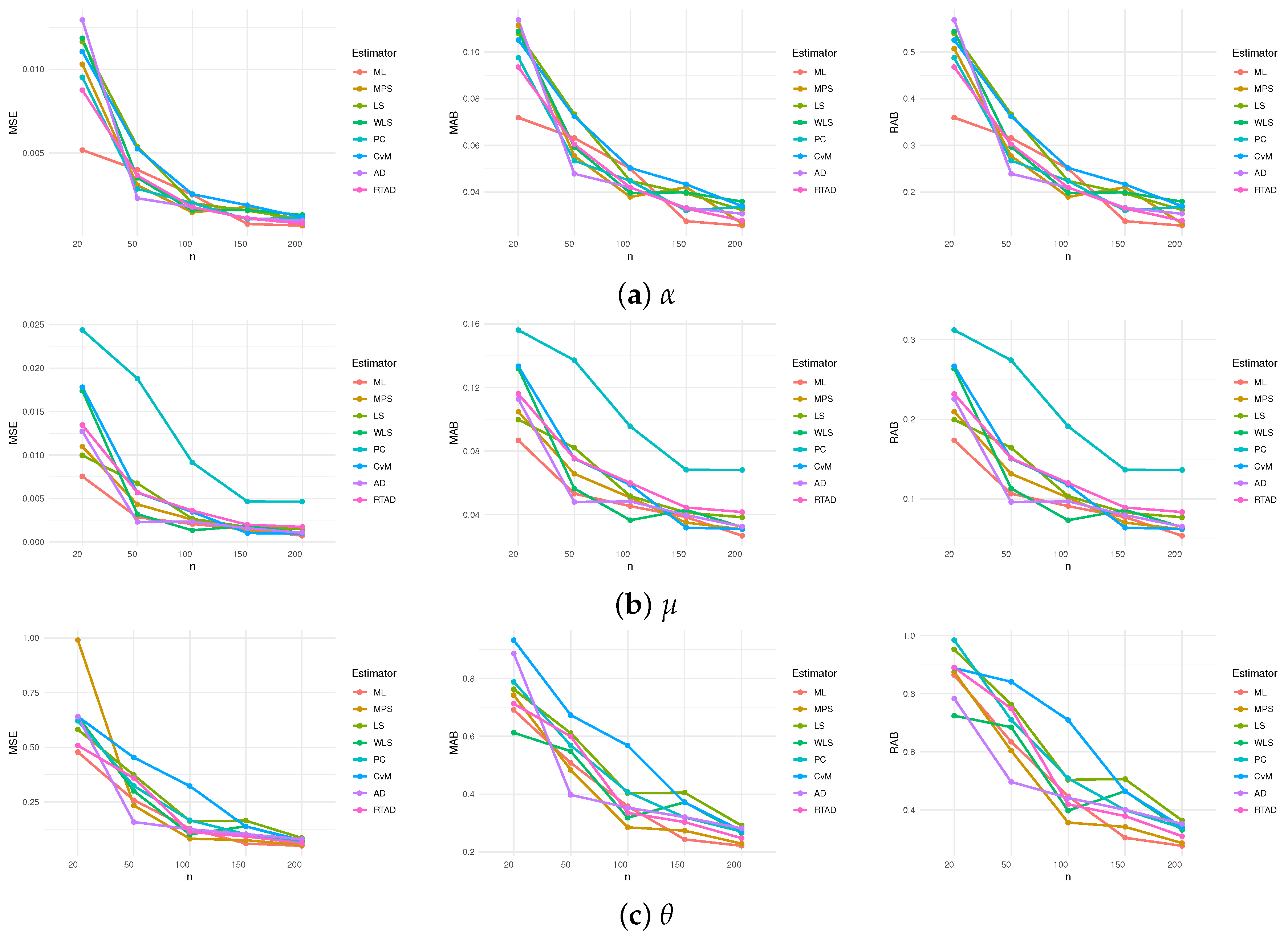
Table 6. As an illustrative example,
Figure 3 depicts the simulation results for Group-1, including the MSE, MAB, and RAB values associated with the parameters
,
, and
. The fitted curves corresponding to each estimation method further corroborate the numerical findings reported in
Table 2. Overall, the ML method is recommended for practical applications involving the Baker–T1 distribution, with the MPS approach representing a robust and effective alternative in situations where ML estimation is impractical or computationally demanding. It is worth noticing here that the ML and MPS methods generally achieve faster convergence with average run-times of approximately 0.35 and 0.75 s/replication and require fewer iterations compared to others. These findings highlight the reliability and robustness of likelihood-based approaches, particularly ML and MPS, in achieving efficient parameter estimation for the Baker–T1 distribution across varying sample sizes.
6. Real-World Applications
This section presents two illustrative applications—one drawn from engineering and the other from a clinical setting—to showcase the practical effectiveness of the proposed inferential procedures and to emphasize the flexibility of the Baker–T1 model in modeling diverse real-world phenomena. The considered applications are described below.
Application 1: Reliability studies frequently rely on data describing the number of shocks experienced by a component prior to failure, as such information is critical for assessing failure dynamics under repeated loading conditions. Murthy et al. [
17] emphasize that shock-count data are instrumental in modeling lifetime variability and in formulating stochastic degradation models driven by cumulative damage mechanisms. In this setting, the dataset presented in
Table 8, which contains twenty recorded shock-to-failure observations, provides a meaningful empirical foundation for analyzing the reliability behavior of systems operating in random shock environments; see Cordeiro et al. [
18] and Elshahhat and Seyam [
19] for a detailed description.
Application 2: Blood cancer, commonly referred to as leukemia, affects the blood-forming tissues and can be fatal if not appropriately treated, making its investigation essential for improving clinical outcomes. Analyzing survival and time-to-event data in this context contributes to a better understanding of disease progression and supports the development of reliable statistical models for prognostic evaluation in hematologic oncology. In this application,
Table 8 reports the survival times (in years) of 40 leukemia patients treated at a Ministry of Health hospital in Saudi Arabia. This dataset was provided by Imran [
20] and later reanalyzed by Klakattawi [
21].
Firstly, before fitting the proposed Baker–T1 model,
Table 9 provides a detailed descriptive summary of the datasets considered in Applications 1 and 2, including the mean, mode, quartiles (
), standard deviation (SD), and skewness. The reported statistics indicate that:
Application 1: The data show low central tendency with small variability, indicating consistently lower values and a slightly left-skewed distribution, suggesting most observations cluster around the mean with few lower-end extremes.
Application 2: The data exhibit a higher mean and greater dispersion, reflecting more variability in outcomes, while the slight negative skewness suggests a longer tail toward lower values despite generally higher measurements.
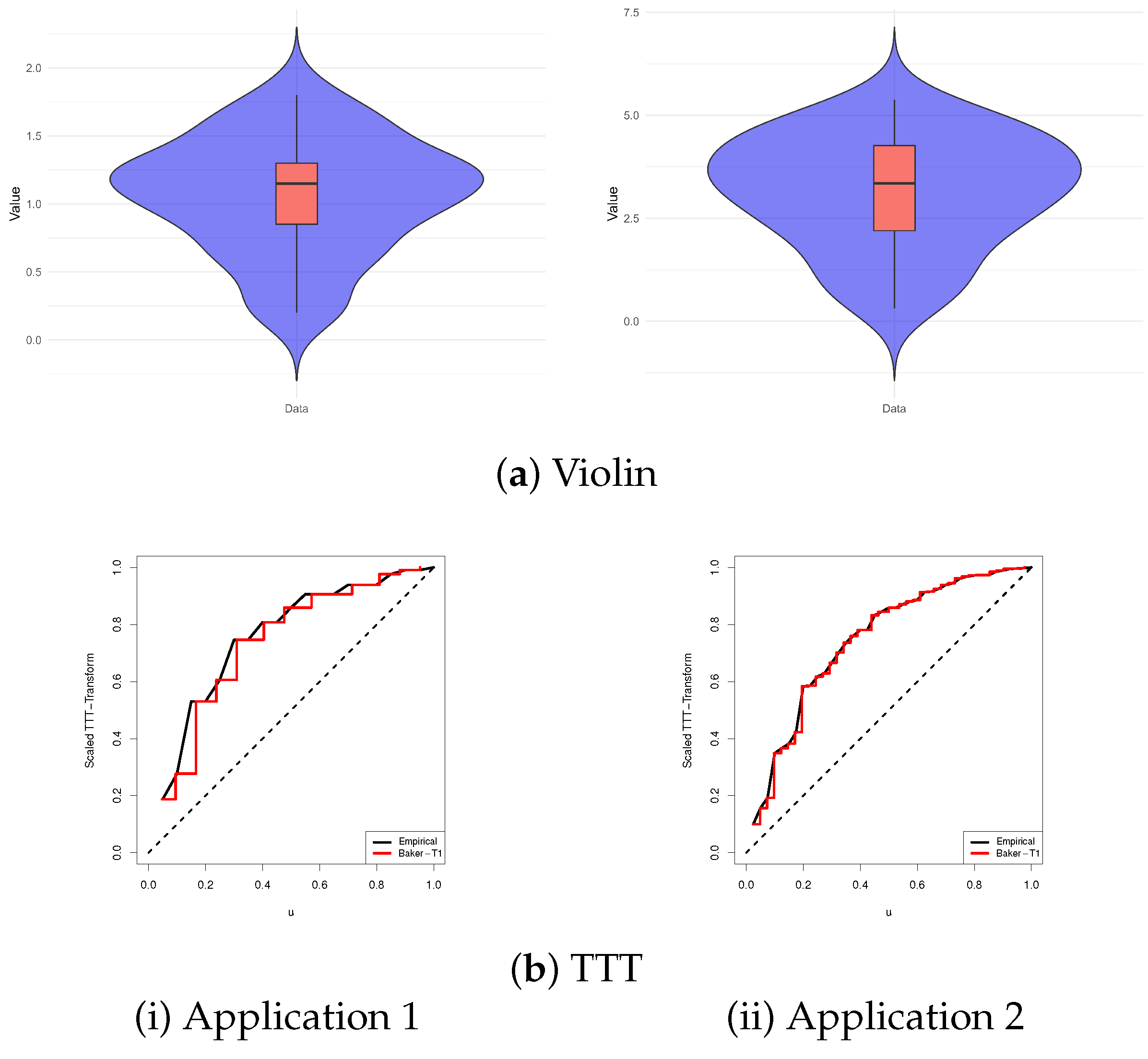
The slight negative skewness observed in both applications is visually confirmed by the violin plots (see
Figure 4a), which show greater density toward higher values with thinner lower tails, consistent with the summarized skewness measures in
Table 9. For clarification, in Application 1, the Baker–T1 distribution reflects an IFR pattern as evidenced by the TTT plot (see
Figure 4b), indicating aging behavior where the risk of failure grows over time and aligns with systems showing gradual wear-out rather than early instability. As shown in
Figure 4b, for Application 2, the TTT plot likewise confirms an IFR structure, and the fitted Baker–T1 parameters suggest heavier tails, highlighting increasing risk with time alongside non-negligible probabilities of extreme performance outcomes relevant to reliability margin assessment. These combined graphical and experimental results confirm the suitability of the Baker–T1 distribution for modeling data with increasing failure rates and slight asymmetry particularly.
To assess the adequacy of the proposed Baker–T1 distribution for the complete datasets analyzed in Applications 1 and 2, its performance was benchmarked against nine competing lifetime models possessing flexible and unbounded hazard rate forms (see
Table 10). Model evaluation was carried out using eight commonly adopted goodness-of-fit and information-based criteria: (i) the negative log-likelihood (
), (ii) Akaike Information Criterion (
), (iii) Bayesian Information Criterion (
), (iv) Consistent Akaike Information Criterion (
), (v) Hannan–Quinn Information Criterion (
), (vi) Anderson–Darling statistic (
), (vii) Cramér–von Mises statistic (
), and (viii) the Kolmogorov–Smirnov statistic (
) together with its associated
-value.
The ML estimates of the model parameters
along with their corresponding standard errors (SEs) alongside the corresponding numerical values of criteria (i)–(viii) were obtained using the AdequacyModel package v2.0.0 (Marinho et al. [
22]) and are reported in
Table 11. All parameters were initialized using admissible starting values consistent with their theoretical domains; see, for example, Mariel et al. [
23]. According to the adopted selection rules, models yielding smaller values of
,
,
,
,
,
,
, and
, together with larger
-values, are preferred. The results summarized in
Table 11 clearly indicate that the corresponding fitted values for the criteria (i)–(viii) of the Baker–T1 model are the lowest compared to other competitors. Subsequently, the Baker–T1 model provides the best overall fit among all competing distributions listed in
Table 10.
Table 10.
Thirteen competitive models of the Baker–T1 distribution.
Table 10.
Thirteen competitive models of the Baker–T1 distribution.
|
Model | Symbol | Author (s) |
|---|
|
New Extended Weibull | NEW | Peng and Yan [24] |
| Alpha Power Weibull | APW | Nassar et al. [25] |
| Power Generalized Weibull | PGW | Bagdonavicius and Nikulin [26] |
| Exponentiated Weibull | EW | Mudholkar and Srivastava [27] |
| Weibull Exponential | WE | Oguntunde et al. [28] |
| Harris Extended Exponential | HEE | Pinho et al. [29] |
| Very Flexible Weibull | VFW | Ahmad and Hussain [30] |
| Alpha Power Exponential | APE | Mahdavi and Kundu [31] |
| Birnbaum Saunders | BS | Birnbaum and Saunders [32] |
| Nadarajah Haghighi | NH | Nadarajah and Haghighi [33] |
| Generalized Exponential | GE | Gupta and Kundu [34] |
| Gamma | G | Johnson et al. [35] |
| Weibull | W | Weibull [36] |
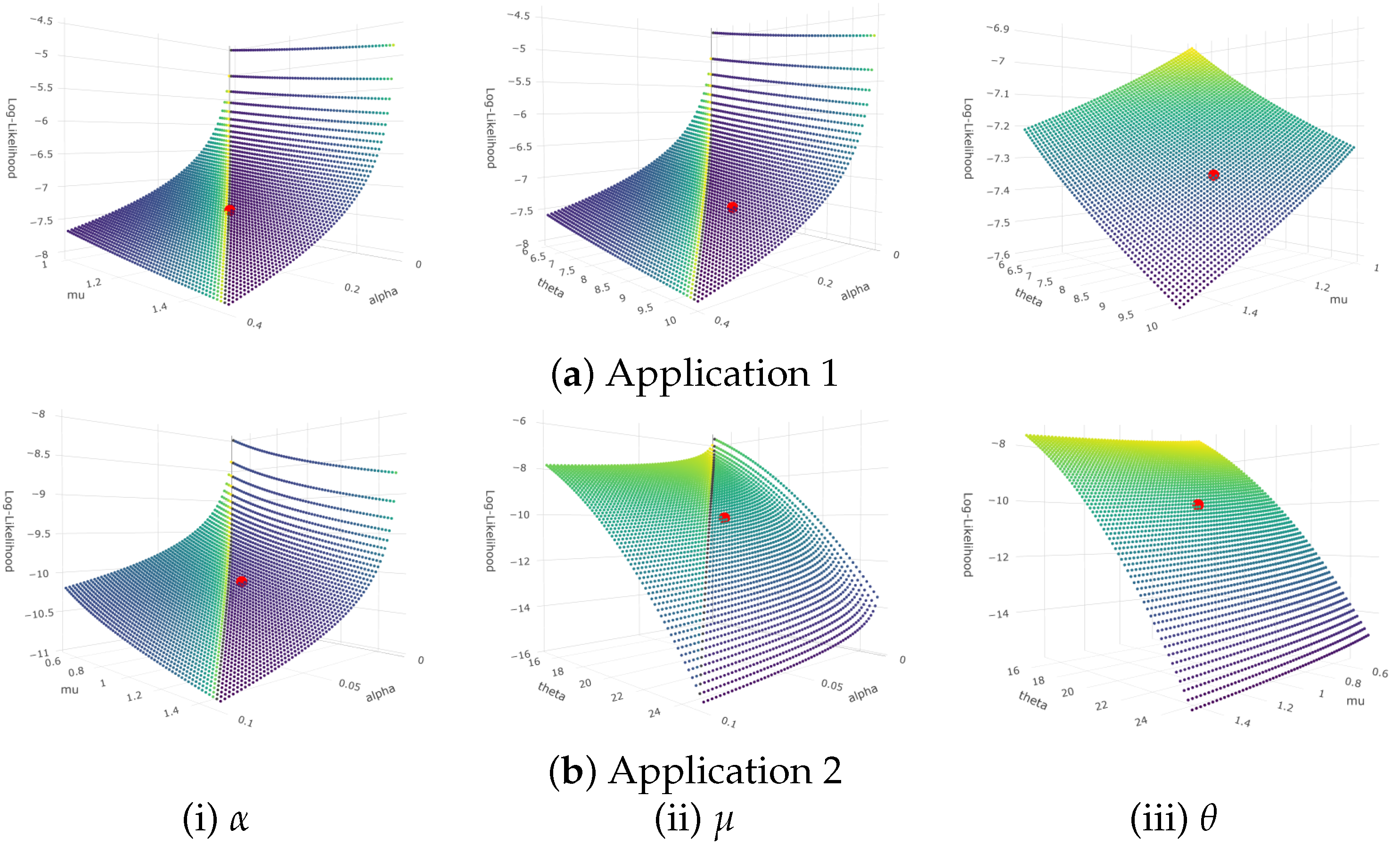
To facilitate the numerical optimization of the Baker–T1 model parameters
,
, and
for the two empirical datasets considered in Applications 1 and 2, the contour plots of the log-likelihood function are illustrated in
Figure 5. These plots show that the selected initial values, indicated by the red points, lie in close proximity to the corresponding maximum likelihood estimates reported in
Table 11. Furthermore, the contours provide evidence that the MLEs of
,
, and
not only exist but are also unique.
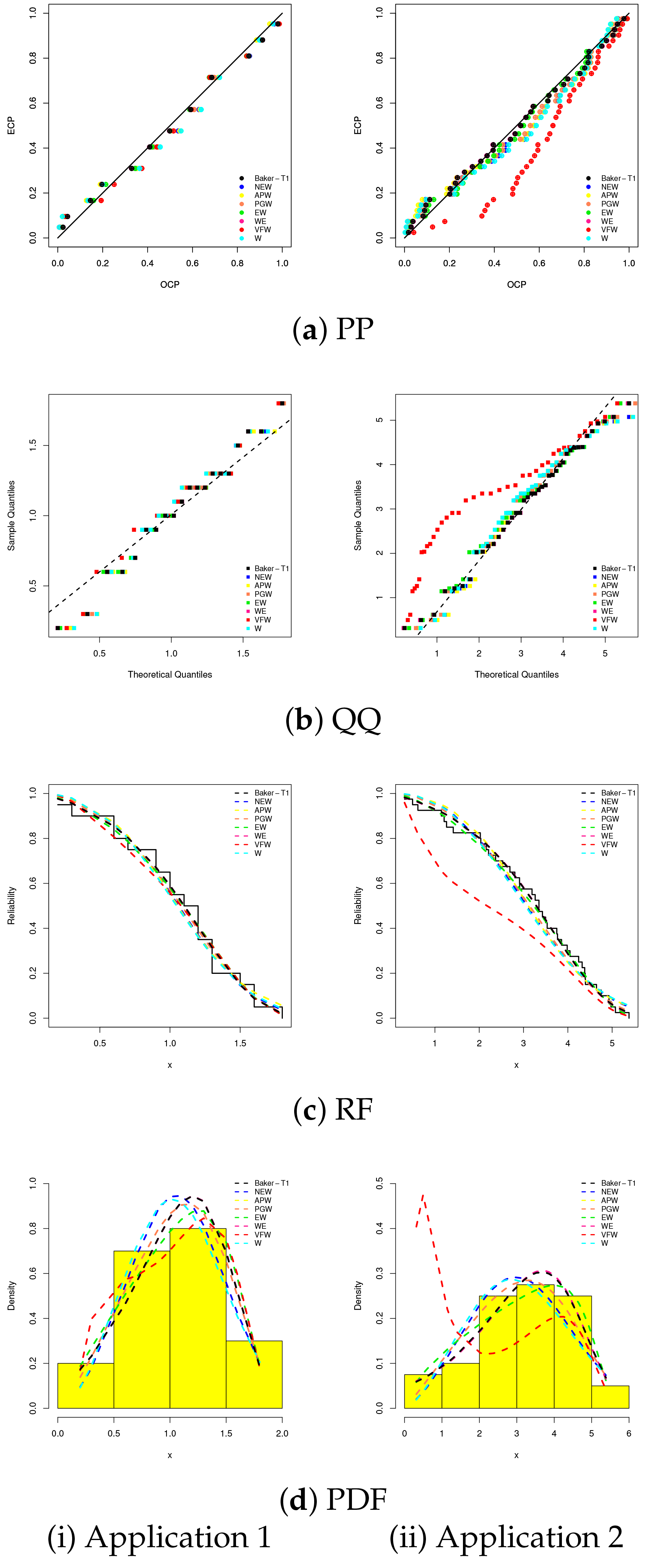
Figure 6 presents a comprehensive graphical comparison between the Baker–T1 model and its competing distributions for the datasets examined in Applications 1 and 2, using four complementary diagnostic panels: (i) probability–probability (PP) plots, (ii) quantile–quantile (QQ) plots, (iii) fitted reliability functions (RFs), and (iv) fitted probability density functions (PDFs). The graphical evidence in
Figure 6a–c is consistent with the numerical findings reported in
Table 11, demonstrating that the Baker–T1 model yields fitted values that closely track the empirical data in both applications. Moreover,
Figure 6d reveals that the estimated Baker–T1 densities exhibit right-skewed and strictly right-skewed shapes for Applications 1 and 2, respectively.
In summary, although several competing models listed in
Table 11 provide satisfactory fits to the proposed two real-world datasets, the Baker–T1 distribution demonstrates clear overall superiority when assessed using multiple complementary criteria. Specifically, it consistently yields the smallest values for all information-based measures while simultaneously producing the largest
-value, reflecting an optimal trade-off between model fit and parsimony. In addition, the graphical diagnostics presented in
Figure 6 indicate a closer concordance between the empirical distributions and their theoretical counterparts under the Baker–T1 model. Beyond these empirical results, the Baker–T1 distribution offers a notable theoretical advantage: unlike many unit distributions, it is capable of accommodating decreasing, increasing, bathtub-shaped, and inverted bathtub-shaped hazard rate functions with considerable flexibility.
Overall, the empirical findings from both application domains provide compelling evidence that the Baker–T1 distribution is not merely an alternative, but a strictly superior modeling choice relative to the 13 competing lifetime distributions considered. Its dominance across two fundamentally different real-world datasets confirms its robustness, adaptability, and broad applicability, thereby establishing the Baker–T1 model as a powerful and reliable tool for lifetime and reliability analysis in both biomedical and engineering contexts.
7. Conclusions
This paper develops a comprehensive and rigorous treatment of the Baker–T1 distribution, a recently proposed transformation-based extension of the Weibull model derived via Manly’s exponential transformation. By developing its full probabilistic structure, the work elevates the Baker–T1 model from a constructional concept to a fully operational statistical tool for lifetime and reliability analysis. Fundamental distributional properties—including reliability measures, hazard and reversed-hazard functions, quantiles, moments, dispersion indices, skewness, kurtosis, and order statistics—were derived and examined in detail, revealing a high degree of analytical tractability alongside substantial modeling flexibility.
A key finding of this study is the ability of the Baker–T1 distribution to accommodate a wide range of density and hazard rate shapes, including monotone, bathtub-shaped, and unimodal forms, within a single parametric framework. This flexibility enables the model to capture complex failure mechanisms and heterogeneous aging behaviors that are commonly observed in real-world data but are not adequately represented by classical Weibull or many of its existing generalizations.
From an inferential perspective, an extensive estimation framework was developed by implementing eight classical parametric estimation methods. A large-scale Monte Carlo simulation study demonstrated that all estimators exhibit consistency, with estimation accuracy improving as the sample size increases. Among the competing approaches, maximum likelihood and maximum product of spacings estimators consistently provided superior finite-sample performance, confirming their suitability for practical implementation. The empirical analyses based on genuine biomedical and engineering datasets further validated the practical relevance of the Baker–T1 model, where it consistently outperformed thirteen competing lifetime distributions according to likelihood-based and information-theoretic criteria. These results collectively establish the Baker–T1 distribution as a robust, flexible, and empirically superior alternative for modeling complex lifetime data.
7.1. Practical Recommendations
Based on the theoretical developments, simulation evidence, and real-data applications presented in this study, several practical recommendations can be made. First, the Baker–T1 distribution is strongly recommended for applications involving non-monotone hazard structures, heavy-tailed behavior, or pronounced skewness, particularly in biomedical survival analysis and engineering reliability studies. Second, for parameter estimation, the maximum likelihood method should be regarded as the primary choice due to its overall efficiency and stability, with the maximum product of spacings method serving as a reliable alternative in situations involving small samples or numerical challenges. Third, the availability of a closed-form quantile function makes the Baker–T1 model especially attractive for simulation-based studies, percentile estimation, and risk assessment applications. Finally, practitioners are encouraged to consider the Baker–T1 distribution as a competitive benchmark when conducting model comparison studies involving Weibull-type or transformation-based lifetime models.
7.2. Future Directions
Although this study provides a comprehensive foundation for the Baker–T1 distribution, several promising avenues for future research remain open. One natural extension is the development of Bayesian inference procedures for the Baker–T1 model, including prior sensitivity analysis and hierarchical formulations for complex data structures. Another important direction involves extending the Baker–T1 framework to accommodate censored, truncated, or progressively censored data, which frequently arise in reliability testing and medical follow-up studies.
In addition, while both real datasets analyzed exhibit mild to moderate skewness, future work may extend the analysis to more heavily skewed data to further assess the flexibility of the proposed Baker–T1 model.
Further research may also explore regression and accelerated failure-time versions of the Baker–T1 model, allowing covariate information to be incorporated into the scale or shape parameters. Multivariate extensions and dependence modeling using copula-based constructions represent another fruitful area for investigation. Finally, comparative studies involving additional real datasets and alternative goodness-of-fit measures could further strengthen the empirical evidence supporting the Baker–T1 model and broaden its adoption across diverse applied domains.