1. Introduction
The boundary element method (BEM) [
1,
2] is a numerical technique based on boundary integral equations (BIEs) in which only the boundary is discretized. In linear elasticity, BEM is commonly derived from Somigliana’s displacement and traction identities using fundamental solutions, yielding exact boundary-integral representations prior to discretization. BEM has been successfully applied to a wide range of problems, including static and dynamic analyses, infinite-domain problems, crack analysis, and moving-boundary problems [
3,
4,
5,
6,
7,
8,
9,
10].
In many direct BEM formulations, collocation at boundary points leads to the boundary-source case with free-term coefficient
(for smooth boundaries), which inevitably introduces singular (and nearly singular) integrals. Although numerous techniques exist to treat such integrals [
11,
12], the need for special quadrature and case distinctions complicates implementation [
12,
13] and can limit robust, unified post-processing.
These techniques can be broadly categorized according to the nature of the singularity [
11,
12]. For nearly singular integrals (source point close to the element), methods include element subdivision [
14,
15], adaptive Gaussian integration [
16], and variable transformation [
17,
18,
19]. Weakly singular integrals (logarithmic in 2D,
in 3D) can be treated by analytical formulas for constant elements [
13,
20], weighted Gaussian integration [
12,
21,
22], or singularity subtraction [
23,
24,
25]. Strongly singular and hypersingular integrals, which are divergent in the Riemann sense, require interpretation as Cauchy principal values or Hadamard finite parts and are often handled by weighted integration [
26] or singularity subtraction [
27,
28].
Several classic strategies avoid boundary singularities by moving sources away from the physical boundary, including the Kupradze method, the method of fundamental solutions (MFS), indirect BEM formulations, and Trefftz-type approaches [
29,
30,
31,
32,
33,
34,
35,
36]. These methods typically employ an exterior contour or fictitious boundary/sources. A detailed review of these techniques is beyond the scope of this paper; the interested reader is referred to the cited literature.
Recent developments have further advanced these fictitious-domain approaches. The boundary knot method (BKM) with ghost points for high-order Helmholtz-type PDEs [
37] and the improved BKM with fictitious points [
38] extend the BKM framework to multi-domain problems while keeping the source points outside the physical domain. A hybrid singular boundary method (SBM) and MFS for elastic wave propagation [
39] combines the advantages of both methods for 2.5D problems. A lightning-fast MFS [
40] introduces a variational preconditioner to accelerate MFS solves by orders of magnitude, addressing the computational scalability challenges of traditional MFS. Despite these advances, all the above methods remain within the indirect framework: the physical boundary variables are recovered from expansion coefficients and do not individually satisfy the three equations of elasticity.
In contrast, the goal of this work is to remain within the direct Somigliana-identity framework while eliminating singular integrals in both solution and evaluation steps.
We introduce an extended equivalent model in which the original elastic domain bounded by the physical boundary is embedded into a larger domain bounded by an auxiliary contour . The extension is geometric and is accompanied by a consistent extension of material properties (and body forces, if present), so that the solution restricted to coincides with the original one. The governing BIEs are enforced on (so that collocation points are interior with ), while the original boundary conditions are satisfied on via Somigliana identities evaluated along . With a suitable separation between and , the resulting discrete system contains no singular integrals.
The main contributions of this work are summarized as follows:
An extended equivalent model viewpoint that yields a nonsingular direct BEM for two-dimensional elastostatics by shifting the integration contour to an auxiliary boundary .
A unified post-processing procedure in which the same regular integral expressions can be used for boundary and interior evaluation without separately treating singular and nearly singular cases.
A practical separation parameter and numerical evidence (including a rigid-body displacement test and benchmark problems) guiding a robust choice of .
Compared with conventional direct BEM (displacement BIE, ), the present method (both displacement BIE and traction BIE, ) shares the same essential property: the unknowns on the physical boundary satisfy the three equations of elasticity and the prescribed boundary conditions. The key difference is that conventional BEM requires special treatment of singular integrals in both the solution and post-processing stages, whereas the present method avoids singular integrals altogether, particularly in post-processing, where conventional BEM often faces nearly singular integrals when evaluating fields close to the boundary.
Table 1 further distinguishes the present method from fictitious-domain approaches that do not enforce the three equations on the physical boundary.
The remainder of this paper is organized as follows.
Section 2 reformulates the two-dimensional elastostatic problem using the extended equivalent model and presents the proposed nonsingular BEM.
Section 3,
Section 4 and
Section 5 provide three benchmark examples comparing the conventional BEM (displacement BIE) with the present method (combined displacement and traction BIEs).
Section 6 discusses limitations of the proposed approach and possible remedies. Conclusions are drawn in
Section 7.
2. An Integral-Invariant Perspective for a Nonsingular Direct BEM
2.1. Background: Singular Integrals in the Conventional Direct BEM
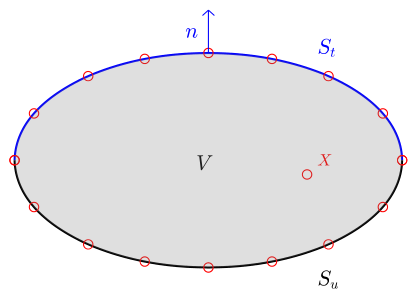
Consider a two-dimensional, linear, isotropic elastic body (
Figure 1) occupying a domain
with boundary
. In the absence of body forces, the displacement BIE is commonly written as
where
and
denote displacement and traction on
, respectively; and
with
for
,
for exterior points, and
when
lies on a boundary corner of interior angle
(so that
at a smooth boundary point);
and
are the Kelvin fundamental solutions [
12,
13] for 2-D elasticity,
where
,
are the shear modulus and Poisson’s ratio, respectively; and
is the component of unit outer normal on
.
In the classical collocation BEM, the physical boundary serves simultaneously as the integration contour and as the locus of collocation (source) points. As a consequence, boundary-source collocation () inevitably introduces singular kernels and requires special quadrature or regularization. This issue becomes particularly severe for close boundaries and thin configurations, where nearly singular integrals can dominate the discretization error.
2.2. Motivation: Moving the Integration Contour and Integral Invariants
To avoid boundary singularities, a nonsingular BEM must separate the source points from the integration boundary. There are two natural ways to do so:
Place source points outside the domain (), which is closely related to the Kupradze method and exterior-contour ideas;
Place source points strictly inside an enlarged domain (), which is typically used for interior evaluation (post-processing) via Somigliana identities.
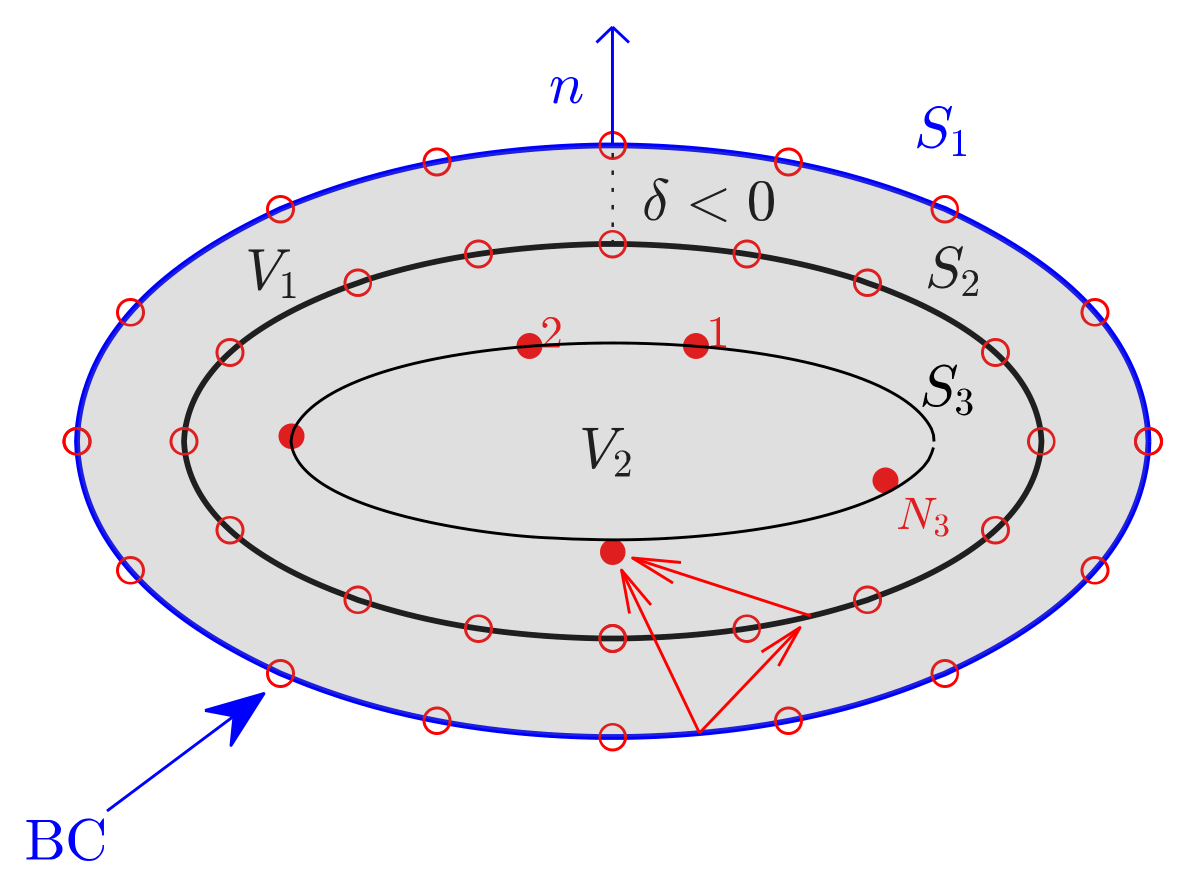
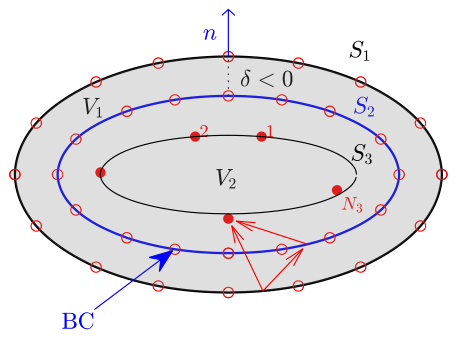
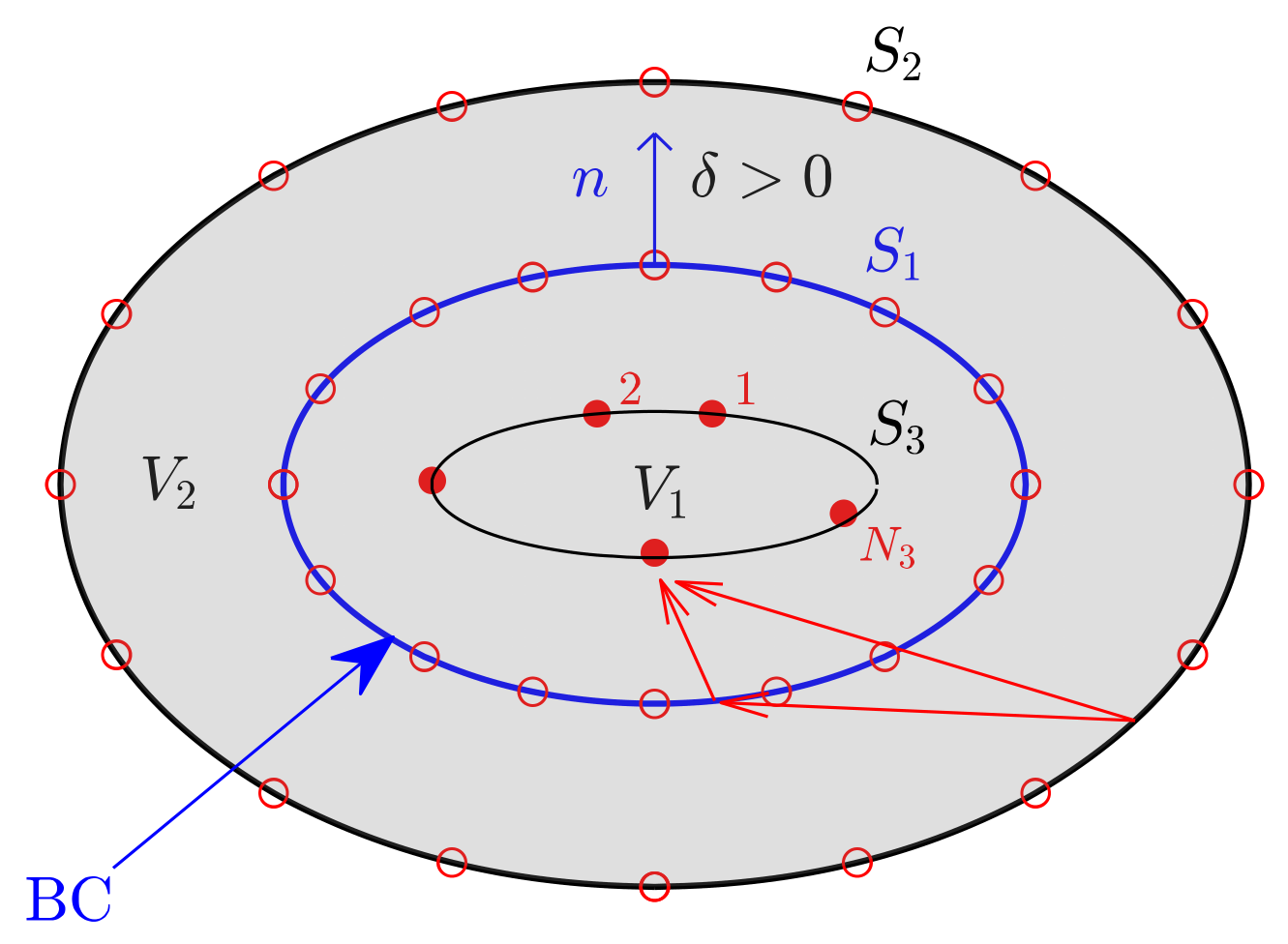
The central observation of this chapter is that the second choice can be elevated from a post-processing tool to a full nonsingular direct BEM by introducing additional closed contours (
Figure 2) and exploiting quantities that remain invariant under changes of the integration path.
2.3. Three-Contour Setting and Somigliana Identities
Let
be the physical boundary of the original solution domain
as shown in
Figure 2. Introduce an auxiliary contour
and an interior contour
(a probe contour (conceptual)) such that
lies inside both
and
. The third contour
is introduced as a conceptual tool to illustrate the integral-invariant principle (see
Section 2.4). It helps to show that the same interior fields can be represented using either
or
as the integration contour. Denote by
the number of boundary collocation points on
after discretization (
). For each contour, we write the displacement and traction at a source point
as
and
.
If the boundary variables on
are treated as independent unknowns, then for any point on an interior contour
with
, the Somigliana displacement and traction identities give
where
and
are the traction kernels [
41,
42] obtained from stress fundamental solutions and the normal vector on the target contour.
Here
is the unit outer normal of surface
, and
,
are fundamental solutions in the stress BIE [
12]:
with
The key point is that, for strictly inside , all kernels in Equations (4) and (5) are regular. Hence, by evaluating these identities on interior contours, one can build algebraic relations among boundary variables without encountering singular integrals.
After discretization using boundary elements, the continuous Somigliana displacement and traction identities lead to the following linear algebraic systems:
where column vectors
and
collect the nodal displacements and tractions on boundary
, respectively. The matrices
and
are assembled from the fundamental solutions
and
, respectively, and represent the contribution of the displacement BIE. Similarly,
and
are assembled from the traction fundamental solutions
and
, corresponding to the traction BIE.
2.4. Integral Invariants and Constraint Relations
Because is enclosed by both and , the same interior fields on can be represented by Somigliana identities with either integration contour. Therefore, the boundary-to-interior mappings induced by and must be consistent on . This consistency can be viewed as an integral-invariant principle: the interior solution is invariant with respect to the choice of a surrounding integration path, provided the boundary data are compatible.
In a discretized setting, this invariance yields nonsingular constraint equations that couple the boundary variables on and . Eliminating intermediate variables on produces an algebraic system that is equivalent to the conventional collocation BEM on , but avoids singular integration altogether when and are separated by a distance.
2.5. Relative Distance Parameter and Practical Considerations
We characterize the separation between
and
by a dimensionless separation parameter
where
is a representative Euclidean distance between the two contours (e.g., an average offset distance) and
is a characteristic length of
.
The sign of
is determined by the relative position of
with respect to the outward normal
of
. If
lies on the side opposite to
(i.e., inside the physical domain as shown in
Figure 3), we take
; if it lies on the same side as
(outside the domain as shown in
Figure 4), we take
. This signed definition allows us to explore the behavior of the method as
varies continuously over the real line, encompassing configurations that range from fully interior to fully exterior contours.
Choosing involves a trade-off:
If is too small, the integrals become nearly singular, leading to quadrature difficulties and reduced accuracy;
If is too large, the kernels decay and the resulting linear system may become ill-conditioned.
Hence, a moderate separation is preferred. In practice, can be selected by a lightweight numerical diagnostic (e.g., a rigid-body displacement test or a short -sweep on a coarse mesh) and then fixed for the benchmark computations.
Equivalence between and configurations. A key observation is that the cases and are not independent; they are related by a simple symmetry. When , the integration contour lies inside the physical boundary . In this configuration, one may alternatively prescribe the well-posed boundary conditions on the inner contour rather than on the outermost . This shifted configuration is mathematically equivalent to the model with boundary conditions prescribed on . The equivalence follows from the fact that the Somigliana identities are invariant under a change of which contour carries the prescribed data, provided the solution in the original domain remains unchanged. This symmetry provides a convenient conceptual bridge: the case, which is closer to conventional BEM thinking, can be used to understand the formulation, while the latter offers the practical advantage of complete singularity avoidance.
As varies continuously from negative to positive values, the integrals undergo a natural transition: from nonsingular (, with singularities only in post-processing), to exactly singular (), and finally to singularity-free in the primary solution stage (, with no singularities in either solution or post-processing). This continuous variation highlights the unifying potential of the integral-invariant framework, which encompasses the classical BEM as a special limiting case.
Approximate extension and the role of boundary conditions. Although the geometry, material properties, and body forces can be extended exactly from
to
for the
configuration (
Figure 4), the boundary conditions on
cannot be guaranteed to extend exactly to
. The reason is that the boundary conditions represent a low-dimensional “slice” of the full solution; information is lost when mapping from the high-dimensional interior solution to the lower dimensional boundary. Consequently, the solution obtained on
in the present formulation is only an approximate extension of the true solution. This situation is analogous to a truncated Taylor series: a finite number of terms provides a highly accurate approximation near the expansion point (here, near
), but deviates gradually as one moves further away into the layer
.
Transition to an exact extension via additional constraints. If one wishes to refine the solution on to become the exact extension, additional constraints can be imposed. For example, requiring that the unknowns on also satisfy a boundary integral equation (displacement BIE or a traction recovery-based constraint) would enforce the three equations of elasticity on . In the limiting case where well posed boundary conditions are prescribed on both and , the layer region becomes a standard, well-posed elasticity problem, and the solution on becomes the exact extension of the solution on .
This transition from approximate to exact extension is conceptually important: it shows that the present method provides a flexible framework in which the auxiliary boundary can be either an approximate extension (as used in this paper, without additional constraints) or, when needed, upgraded to an exact one by incorporating suitable constraints (as discussed in
Section 6).
2.6. Connection to Extended-Boundary Models
The above integral-invariant viewpoint is closely related to the “extended equivalent model” used in nonsingular direct BEM formulations: is embedded in a larger domain bounded by , and the BIEs are enforced on (with ), while boundary conditions are imposed on through Somigliana identities evaluated along . This perspective leads to a practically useful nonsingular method with unified post-processing.
Role of the third contour and solvability condition. The third contour is introduced as a conceptual tool to illustrate the integral invariant principle. In the discrete setting, a degree of freedom analysis can be performed to determine whether must be retained.
Consider first the
configuration (
Figure 3) with well-posed boundary conditions prescribed on the inner contour
. The unknowns on
can be optionally retained; we introduce binary parameters
to indicate whether displacements and tractions on
are treated as the integral-invariant variables. Following a standard counting of equations and unknowns, the system is solvable when
. This condition permits
without compromising solvability, provided the boundary conditions on
are properly prescribed.
By the symmetry established in
Section 2.5, the
configuration (
Figure 4) with well-posed boundary conditions prescribed on the inner contour
is mathematically equivalent. Hence, in our computational setup (
, boundary conditions on
), the same analysis allows
.
Moreover, the integral-invariant formulation naturally shifts certain integral evaluations—traditionally performed during post-processing—to the solution stage. Because the same regular integrals are used for both constructing the system matrix and evaluating interior fields, the information carried by can be deferred to post-processing without affecting the solution on and .
Consequently, to maximize the computational efficiency of the nonsingular scheme, we set and solve only the unknowns on and using Equations (11) and (12) with , .
This choice keeps the computational cost comparable to conventional BEM throughout the entire simulation (including both the solution stage and the post-processing stage) while maintaining a fully regularized formulation.
Once the unknowns on and are solved, the displacements and stresses at any point in or on can be evaluated using the Somigliana identities, without any distinction between singular and nonsingular cases.
2.7. Summary
By introducing auxiliary contours and exploiting the invariance of interior fields with respect to the surrounding integration path, Somigliana identities can be used not only for post-processing but also to derive a nonsingular direct BEM. The resulting formulation avoids singular integrals, supports unified boundary/interior evaluation, and provides a geometric parameter to balance quadrature robustness and algebraic conditioning.
2.8. Well-Posedness, Stability, and Practical Choice of the Separation Parameter
The proposed formulation avoids singular kernels by separating the physical boundary from the integration contour by a nonzero distance. Consequently, the Somigliana kernels are evaluated at strictly positive source–field distances, and the numerical quadrature does not require Cauchy principal values or Hadamard finite-part interpretations.
From an analysis viewpoint, the method can be interpreted as an equivalent problem posed on an enlarged domain , where boundary unknowns on are determined such that the prescribed boundary conditions on are satisfied when the Somigliana representation is evaluated on . Under standard assumptions for two-dimensional linear elastostatics (e.g., homogeneous isotropic elasticity and sufficiently smooth boundaries), Somigliana identities provide a valid representation. In computation, however, the discrete system quality depends strongly on the separation between and .
The separation parameter has two competing effects:
- (i)
If is too small, the integrals become nearly singular, which increases quadrature error and can deteriorate convergence.
- (ii)
If is too large, the mapping from unknowns on to the response on may become ill-conditioned, amplifying discretization and round-off errors.
To assess whether a given
is sufficiently large to avoid near-singular integrals, a rigid-body displacement test is performed under the
configuration (
Figure 3). Setting
and zero tractions, Equation (11) requires that
equal the sum of the columns of
. The accuracy of
is sensitive to near-singular integration; therefore, monitoring its error provides an indirect means of selecting a suitable
. The absolute error and relative error appearing in this paper are defined as,
where
,
represent the exact and numerical values, respectively.
Figure 5 shows the error of the rigid-body displacement field for the square plate (
Figure 6) with eight constant elements per side, evaluated on the interior contour
under the
configuration (
Figure 3). The relative error of
ranges from
to
. The error decays exponentially as the distance between the source point and the integration contour increases. This exponential decay reflects the inherent behavior of the kernel functions
and
, and confirms that a moderate separation (e.g.,
) is sufficient to avoid near-singular effects in the
case.
By the symmetry established in
Section 2.5, the same exponential decay is expected for the
configuration (
Figure 4), with the physical boundary
playing the role of the probe. Based on this expectation and on the benchmark examples, we adopt
for all computations in this paper. This value balances the need to avoid near-singularity against the risk of ill-conditioning at larger separations. The rigid-body displacement test not only validates the choice of
but also indirectly indicates when the mesh refinement has reached a level where the integral accuracy becomes adequate. In this context, the test plays a different role from that in conventional BEM: There, it is used to circumvent strong singular integrals, whereas here it serves to verify that the integrated coefficient matrices are sufficiently accurate for the chosen
(i.e., that near-singular integrals have been adequately suppressed). We are aware that very large values of
may lead to ill-conditioning; the present study deliberately avoids this regime, as our focus is on demonstrating that the method successfully avoids near-singular integrals. A theoretical optimization of
is left for future work.
3. Example 1: Square Plate Under Pure Dirichlet Boundary Conditions
Implementation details for conventional BEM. For all benchmarks, the conventional BEM uses constant elements, following the standard Fortran implementation described in [
20] (Fortran 90). Singular integrals are handled analytically using formulas for constant elements [
20]. All boundary integrals are evaluated with four Gaussian points per element, which is the same quadrature used for the present method. No special treatment is applied to nearly singular integrals in either method. This ensures a fair comparison under identical numerical conditions. All figures and post-processing were performed using MATLAB R2022a.
Remark on the choice of boundary conditions. The square plate with pure Dirichlet boundary conditions is a well-known challenging benchmark for the boundary element method, especially when constant elements are employed. Three distinct but interrelated factors contribute to this difficulty.
First, as rigorously established by Lubuma & Nicaise [
43], the convergence of classical BEM deteriorates in polyhedral domains due to edge and vertex singularities of the solution. Even for a simple square, the presence of corners leads to singular behavior that constant elements—lacking the ability to represent such singularities—cannot accurately capture unless the mesh is sufficiently refined.
Second, the analysis of Rosen & Cormack [
44] shows that corners in the BEM require additional constraints—the so-called gauge conditions—to obtain bounded and well-behaved fields near corners. In the standard displacement BIE formulation, these conditions are not automatically enforced, which explains why the shear stress, despite vanishing analytically, is often poorly reproduced.
Third, as demonstrated by Dijkstra [
45] for 2D Laplace problems, the boundary integral equation can become singular for certain critical domain sizes, a phenomenon related to the logarithmic capacity of the domain. For a square, this critical size may be accidentally encountered, leading to ill-conditioned systems and poor accuracy, even when the boundary conditions are of Dirichlet type.
These difficulties make the square plate an ideal test case for assessing the robustness of the proposed nonsingular BEM. By avoiding singular integrals altogether and by providing a clear geometric parameter to control the separation between the physical and auxiliary boundaries, the method successfully circumvents the corner singularities and critical-size issues that plague conventional BEM, as confirmed by the numerical results presented below.
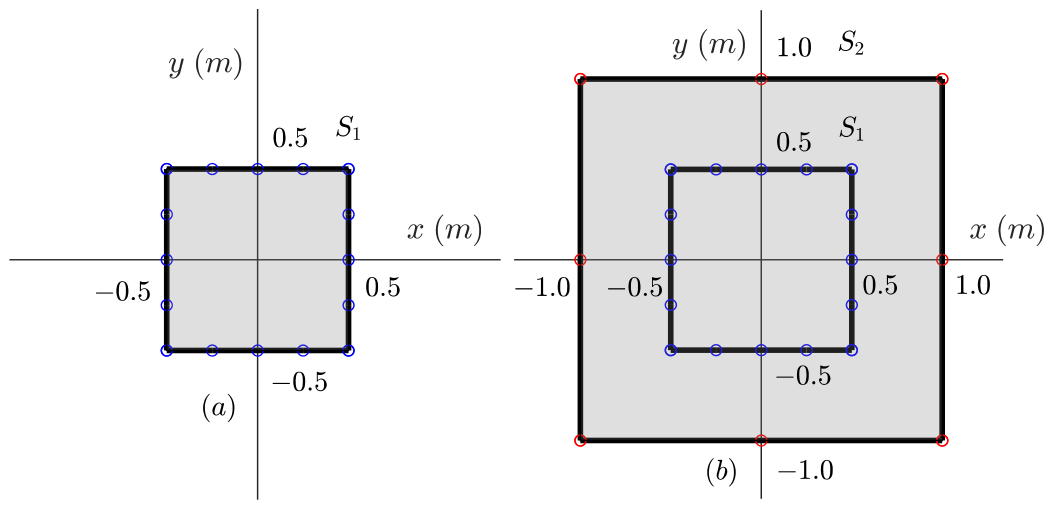
The first example (
Figure 6) considers a square plate of dimensions
under plane-strain conditions, uniformly compressed by prescribed Dirichlet displacements. The material parameters are Young’s modulus
and Poisson’s ratio
. The prescribed displacements are
and
on the corresponding boundaries. This choice reduces the displacement BIE to a form analogous to the single-layer potential method, which is known to be ill-posed [
34,
46,
47]; the example therefore provides a stringent test for both the conventional and the proposed BEM.
The analytical solutions [
48] for this problem is given by
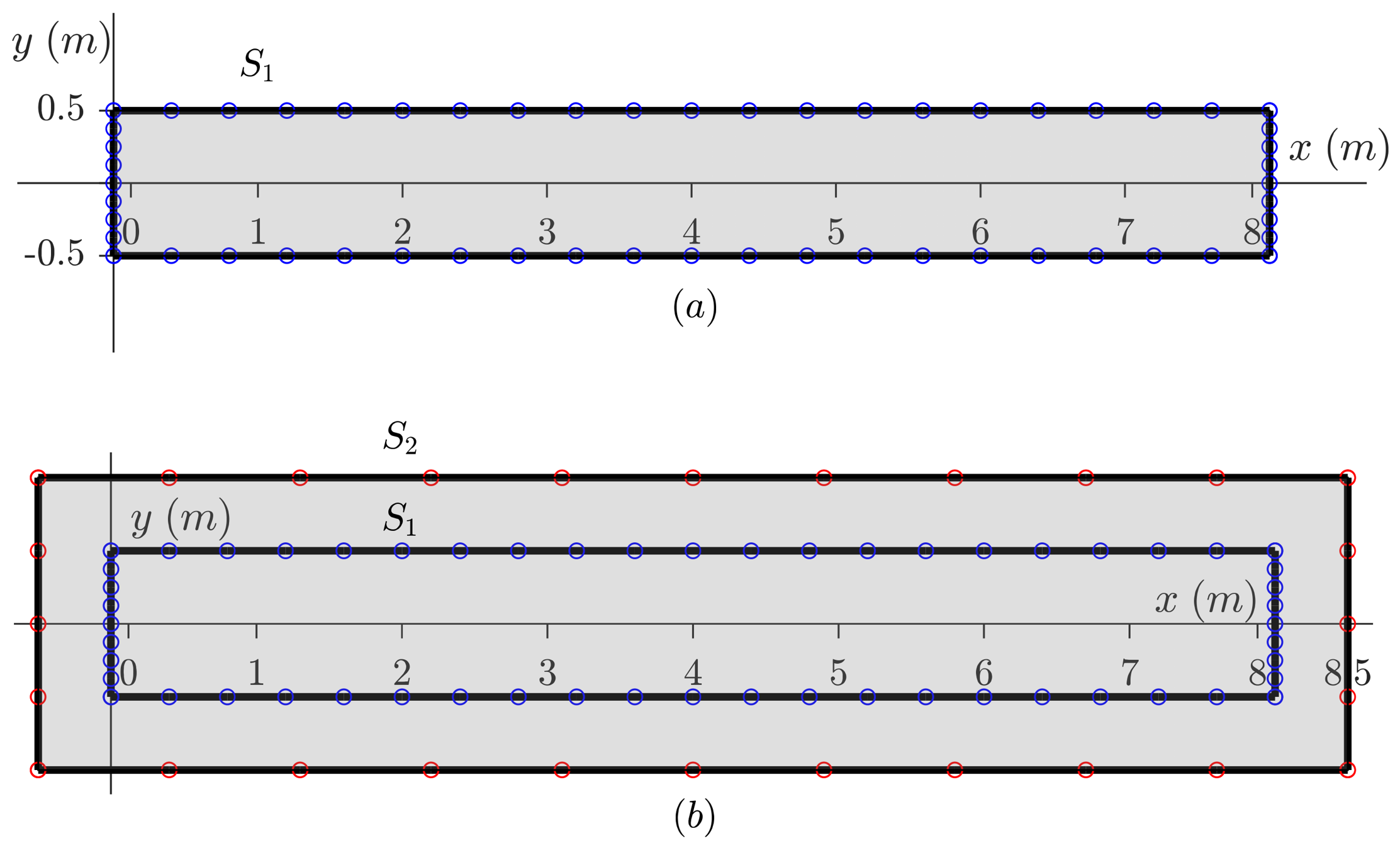
The physical boundary consists of the four sides , . With the chosen separation parameter , the auxiliary contour is placed at , . All integrals are evaluated using four Gaussian points per element, and constant elements are employed throughout.
To verify that the chosen
effectively avoids near-singular integrals, a rigid-body displacement test is performed. Setting
and zero tractions, Equation (11) requires that
equal the sum of the columns of
.
Table 2 shows the first eight components of
obtained with
elements on
and four Gaussian points per element. The relative errors are of the order
, confirming that
provides a safe separation.
Mean value:
; Maximum value:
.
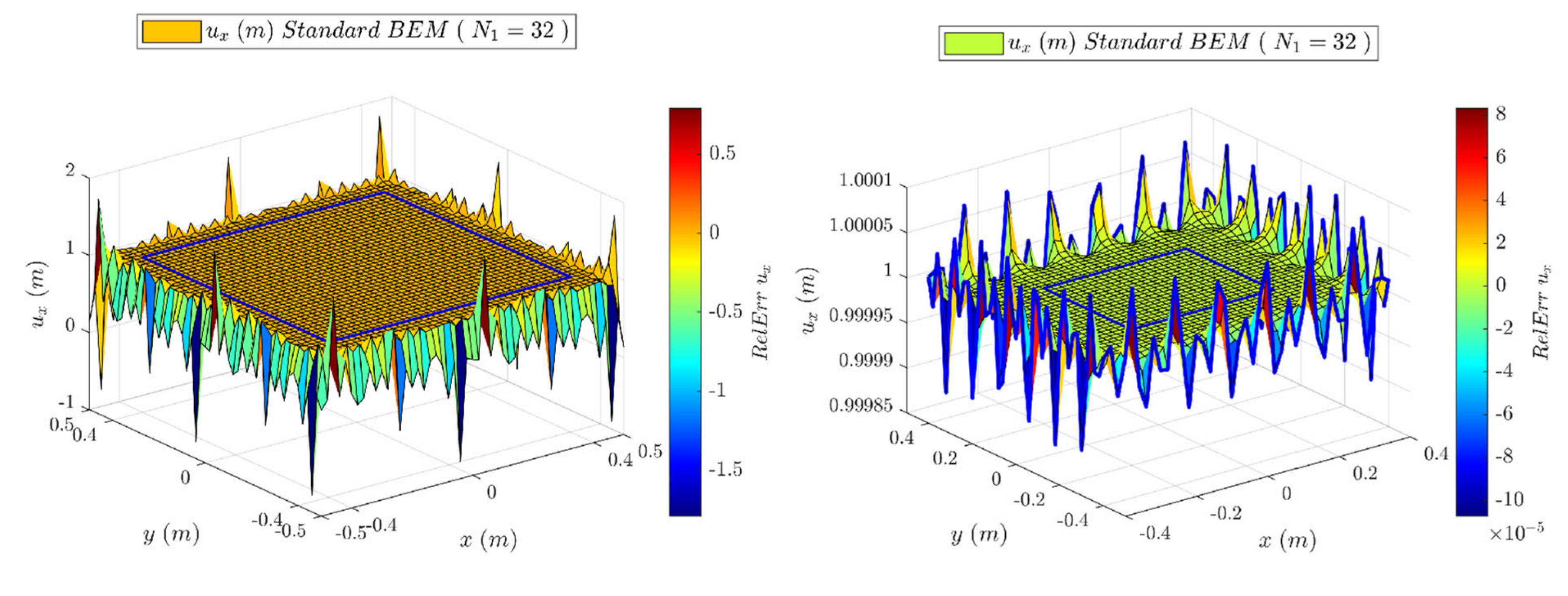
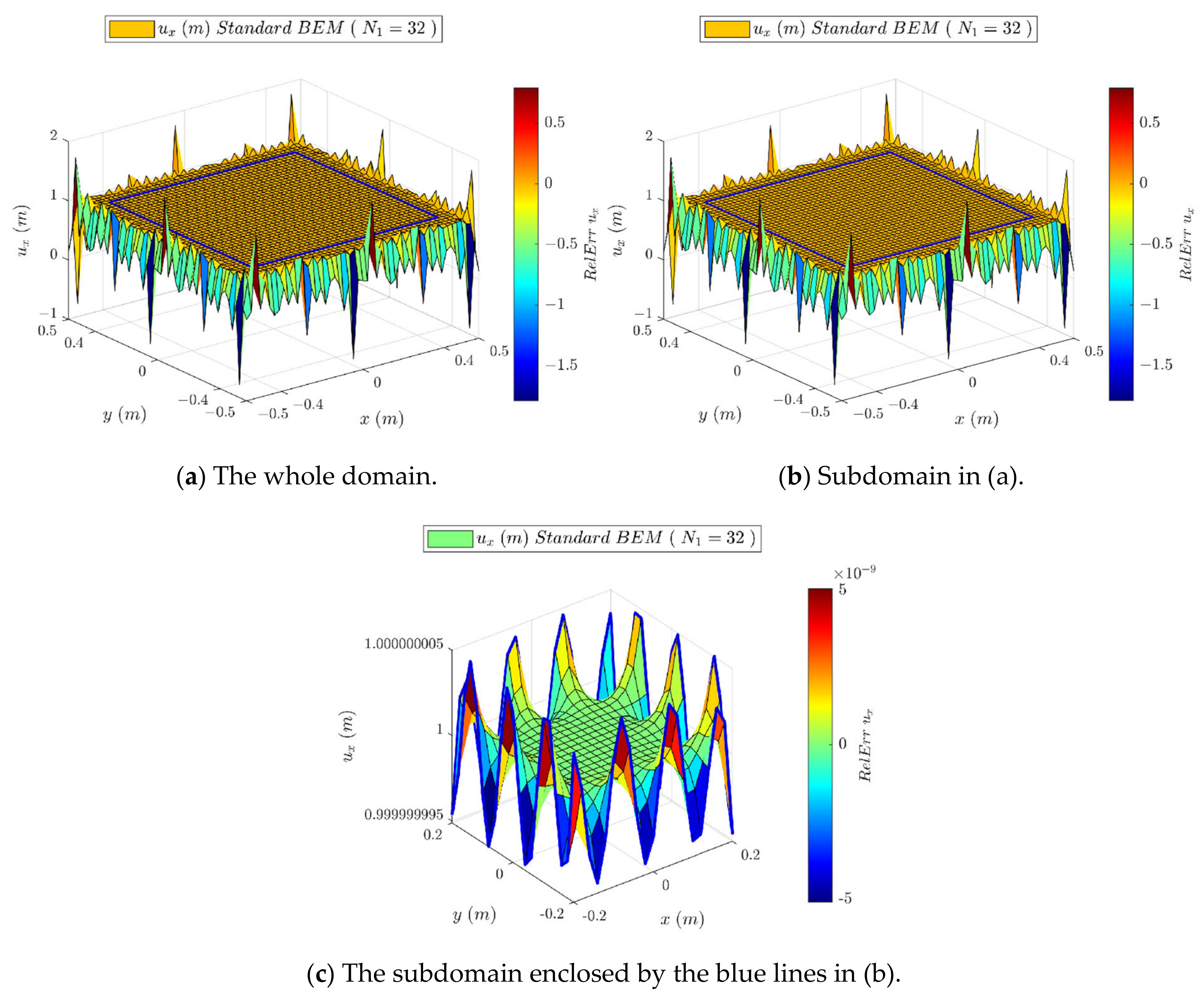
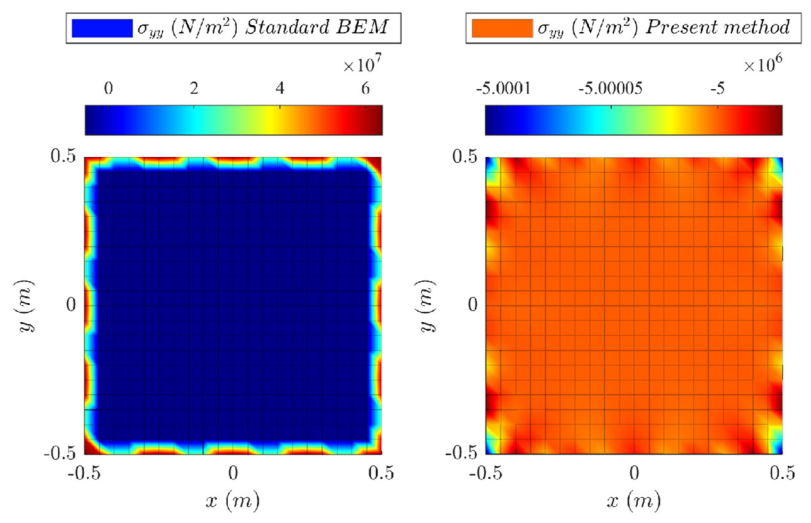
Figure 7 compares the
field obtained by the conventional BEM (left) and the present method (right), evaluated on a
grid covering
. The conventional BEM, implemented in Fortran [
20] without treatment of Cauchy principal values or Hadamard finite parts, exhibits significant oscillations near the boundary. In contrast, the present method produces a smooth and accurate stress field throughout the domain, including regions arbitrarily close to the boundary. This improvement is achieved with the same mesh density and the same number of Gaussian points, underscoring the robustness of the nonsingular formulation.
We acknowledge that the performance of conventional BEM could be improved by using advanced quadrature for nearly singular integrals or by employing higher-order elements. However, the present method achieves high accuracy without requiring such enhancements, demonstrating that the improvement stems from the fundamental singularity-avoidance idea rather than from a more sophisticated numerical implementation.
To avoid contamination by singular or nearly singular effects,
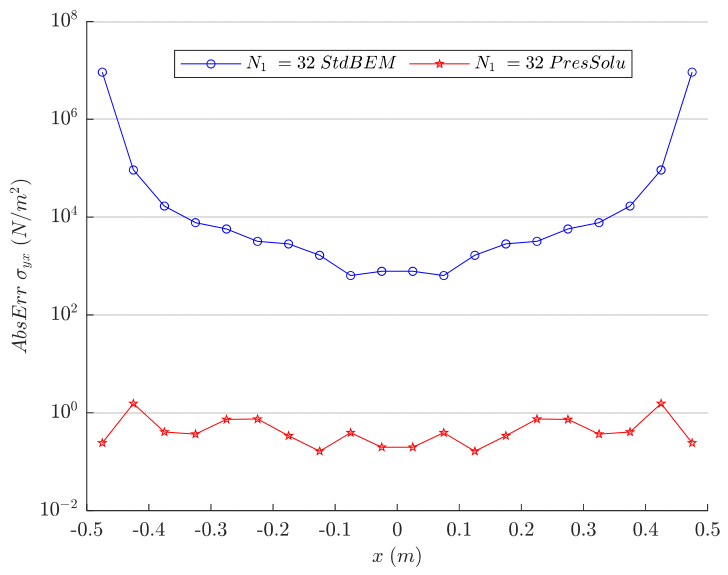
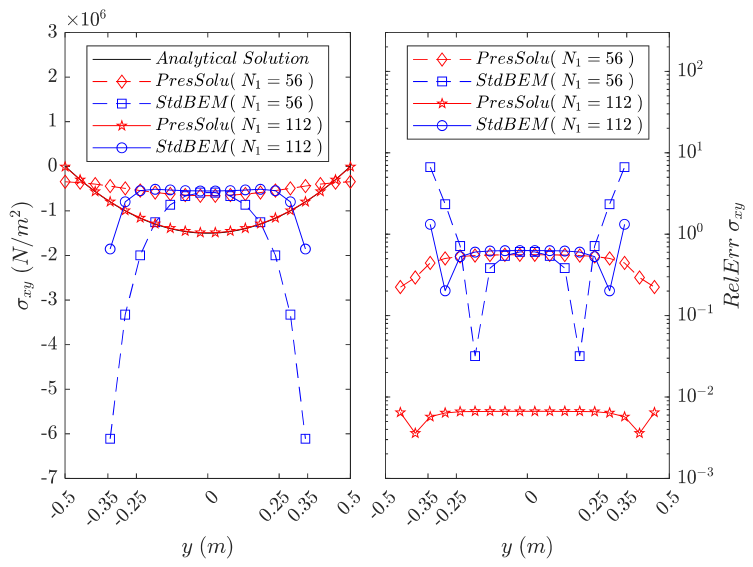
Figure 8 compares the shear stress
along the interior line
lying safely inside
, obtained with eight elements per side. The conventional BEM exhibits large fluctuations, with errors ranging from
to
Pa. In contrast, the present method yields an average error of
Pa. Further refinement can reduce this error to
Pa, demonstrating that the gauge-condition-like constraints inherent in the present formulation effectively regularize the corner behavior discussed in [
44].
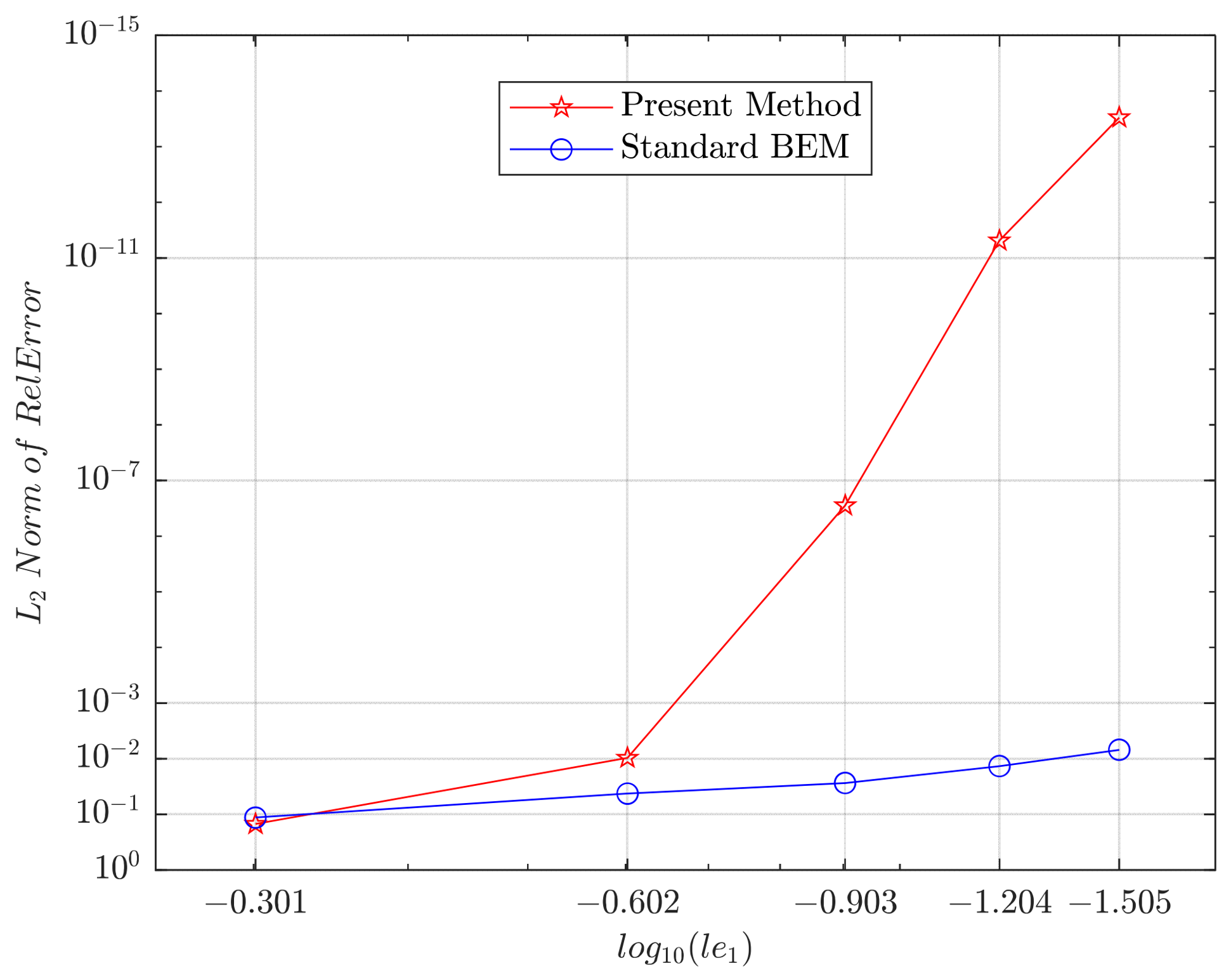
Figure 9 presents the
norm of the relative error of the total displacement along the line
(
) as a function of the element size
on
(ranging from
m to
m).
The convergence curve of the present method exhibits two distinct stages:
Coarse meshes (e.g., one element per side on ): the integral accuracy is insufficient, limiting the convergence rate.
Refined meshes: as decreases, the integrals become sufficiently accurate, leading to a rapid convergence. Doubling the mesh in this stage reduces the error by approximately four orders of magnitude, whereas the conventional BEM requires four successive doublings to achieve a single order-of-magnitude reduction.
The two-stage convergence behavior is related to the mesh size relative to . When the mesh is too coarse, the discretization on cannot accurately represent the geometric details of or the spatial variation of the boundary conditions, leading to insufficient integral accuracy. Once the mesh is refined enough to resolve the geometry at the scale of , the integrals become sufficiently accurate and the convergence enters a rapid stage. This is precisely why we introduced the rigid-body displacement test: it verifies that the integrated coefficient matrices are accurate enough for the chosen and indirectly indicates when the mesh refinement has reached the required level.
When the element size is reduced to (corresponding to ), the relative error of along begins to fluctuate between and . This indicates that the accuracy has reached the limit of double-precision arithmetic, leaving little room for further improvement.
4. Example 2: Thick-Walled Cylinder Under Internal and External Pressure
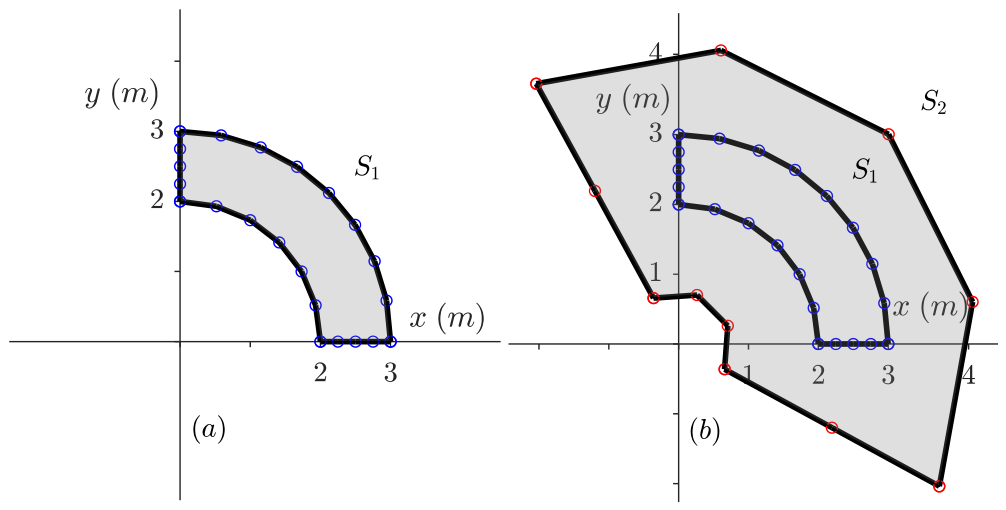
The second example considers a thick-walled cylinder under plane-strain conditions. A quarter model [
5] is used, as shown in
Figure 10. The inner pressure is
and the outer pressure
. Due to symmetry, the normal displacement on the radial sections is constrained to zero. The material parameters are Young’s modulus
and Poisson’s ratio
. The separation parameter is set to
, and all integrals are evaluated with four Gaussian points per element.
In polar coordinates, the original boundaries are
,
,
,
. The auxiliary contour
is obtained by a regular dilation: its radii are
and
, and its angular range is
to
, where
is determined from
via Equations (18) and (19).
For this thick-walled cylinder problem, the rigid-body displacement test shows that the relative errors are of the order (four Gaussian points per element for the mesh), confirming that provides a safe separation.
The analytical solution for the radial displacement and stresses is given by [
5,
49]
And the stress components
are,
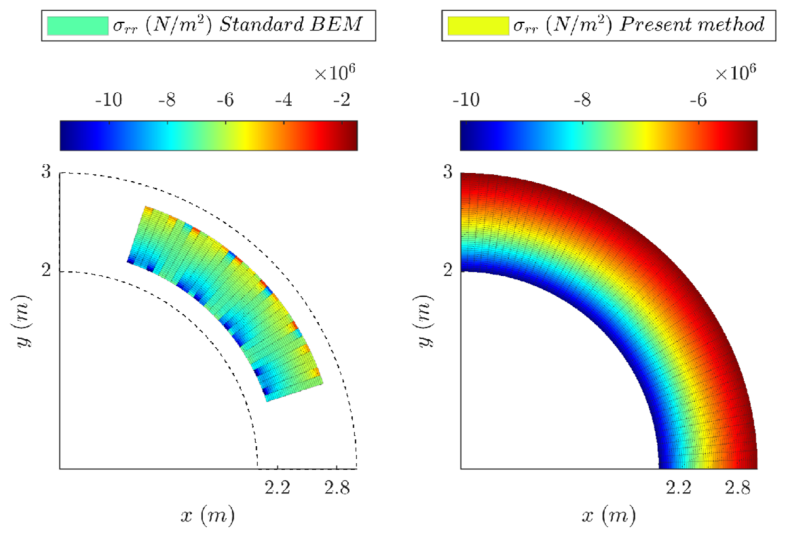
Figure 11 compares the
field obtained by the conventional BEM (left) and the present method (right), evaluated on a
grid covering
. To avoid the singular region, the conventional BEM results are shown only in a subdomain
; the present method is evaluated over the entire domain.
The present method yields at and at , in excellent agreement with the applied pressures ( and ). In contrast, the conventional BEM gives at and at , both outside the analytical range. Moreover, its numerical varies with , contradicting the axisymmetric analytical solution.
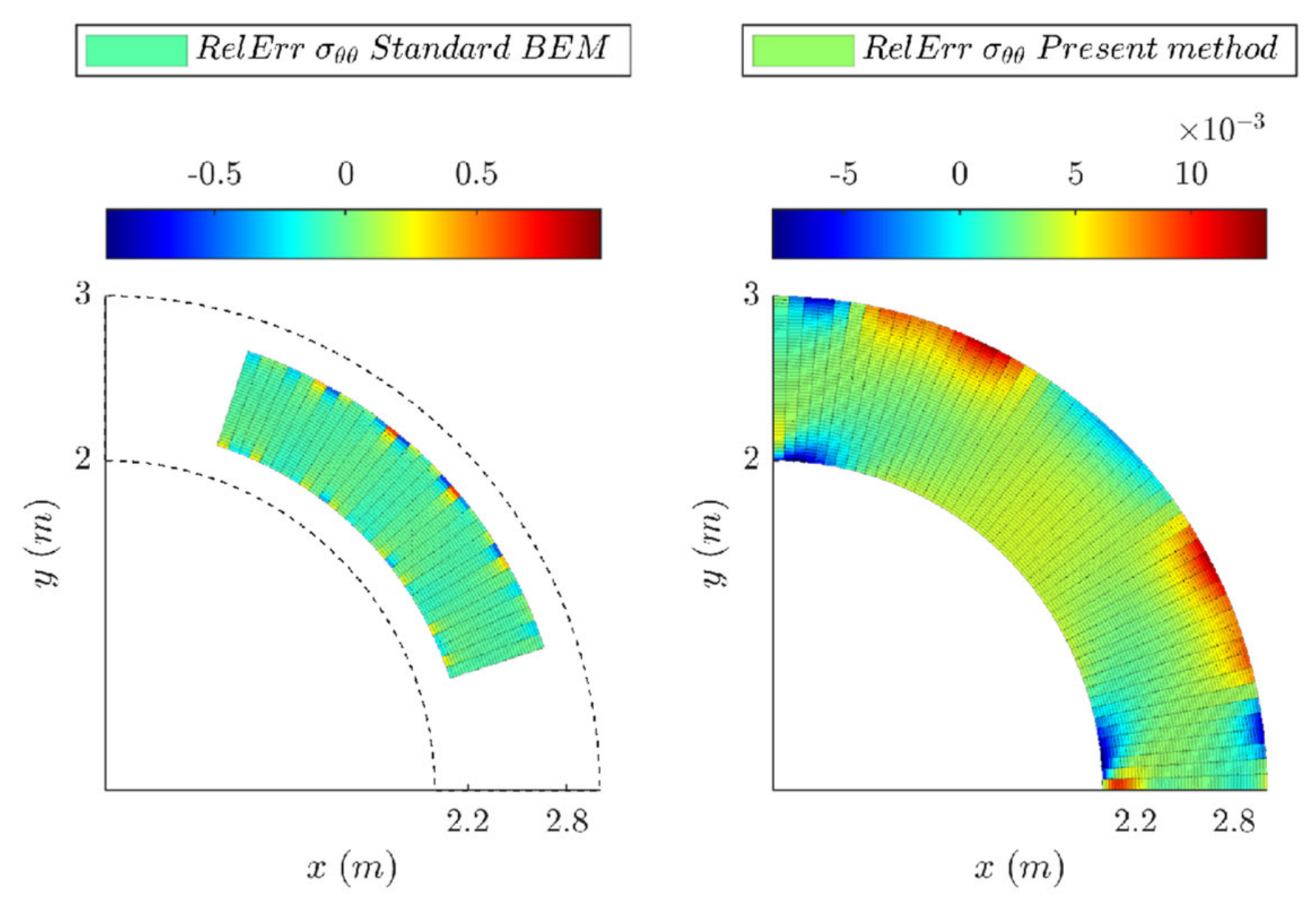
Figure 12 shows the relative error of
over
. The conventional BEM error ranges from
to
, while that of the present method ranges from
to
. Both methods show the same pattern: Error is largest near the boundaries and decays rapidly inward, a direct manifestation of the exponential distance-decay law for kernel-induced errors, already observed in the rigid-body displacement test (
Figure 5a–c). Here, the decay is confirmed for stress fields, i.e., derivatives of displacements.
The conventional BEM also possesses this potential advantage—its kernels inherently decay with distance—but this decay is fully exploited only in the interior, where integrals are regular. Near the boundary, singular and nearly singular integrals force special treatment, at considerable computational cost. In effect, it pays a heavy price for not fully leveraging off-boundary decay.
The present method, firmly within the direct Somigliana framework, places the integration contour outside the physical domain, making all integrals regular even arbitrarily close to the boundary. This allows it to fully exploit the off-boundary decay already present in direct BEM kernels, thereby circumventing singular integrals without resorting to fictitious boundaries or abstract densities. The result is high accuracy everywhere while remaining a true direct BEM, a crucial distinction from indirect methods like MFS or single-layer potentials.
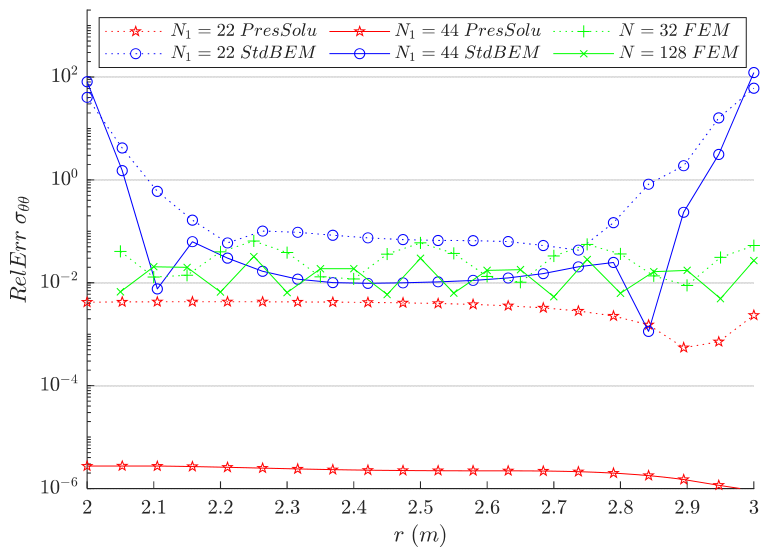
Figure 13 compares the relative error of
along the radial line
for the conventional BEM, the present BEM, and FEM. The FEM mesh is chosen to match the BEM discretization on
, resulting in 32 uniform elements in the coarse case and 128 in the refined case.
At , FEM achieves relative errors of (coarse mesh) and (refined mesh). The present method, with only 22 elements on , attains an error of at ; with 44 elements, the error drops to . The conventional BEM does not reach an acceptable error () until the evaluation point is moved sufficiently far from the boundary.
In summary, the present method delivers higher accuracy and faster convergence than both conventional BEM and FEM on this curved-boundary problem, while using coarser discretizations and avoiding any special treatment of singular or nearly singular integrals.
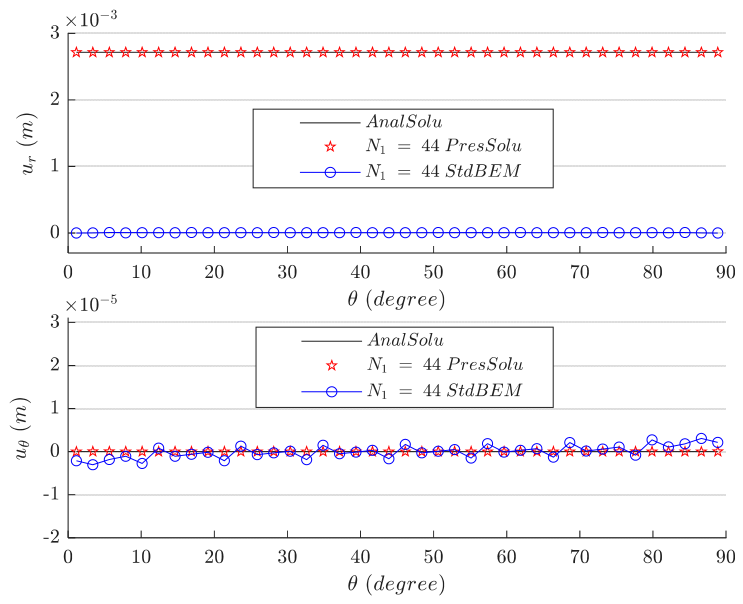
To further validate the extended equivalent model outside the original physical domain
,
Figure 14 presents the displacement distributions along the circular arc at
, which lies inside the extended region
. For the conventional BEM, the evaluation point at
is an exterior point (
). The computed displacement
fluctuates around zero. In contrast, the present method treats the same point as an interior point of the extended domain
because the integration contour is placed on
(
). The Somigliana identities therefore yield smooth and continuous displacement fields. The radial displacement
exhibits no variation with
, and the circumferential displacement
is closer to zero, both in agreement with the analytically extended solution. This smooth, approximate extension into part of
—even without additional constraints on
—illustrates the transition from an accurate solution on
to a physically plausible, though approximate, solution in the extended region, as discussed in the context of the Taylor-series analogy in
Section 2.5.
5. Example 3: Cantilever Beam Under Parabolic End Load
The third example [
50] considers a Timoshenko beam of length
, height
, and thickness
, under plane-stress conditions. A parabolic shear traction corresponding to a resultant force
is applied at the free end (
), while the fixed end (
) is clamped. The material parameters are Young’s modulus
and Poisson’s ratio
. The separation parameter is set to
, and all integrals are evaluated with four Gaussian points per element. The physical boundary
coincides with the original beam boundaries; the auxiliary contour
is obtained by a uniform expansion with
, as illustrated in
Figure 15b. Similarly, For this cantilever beam, the rigid-body displacement test shows that the relative errors are of the order
(four Gaussian points per element for the
mesh), confirming that
provides a safe separation.
The analytical solution for this problem is given by [
50,
51],
where
represent the moment of inertia.
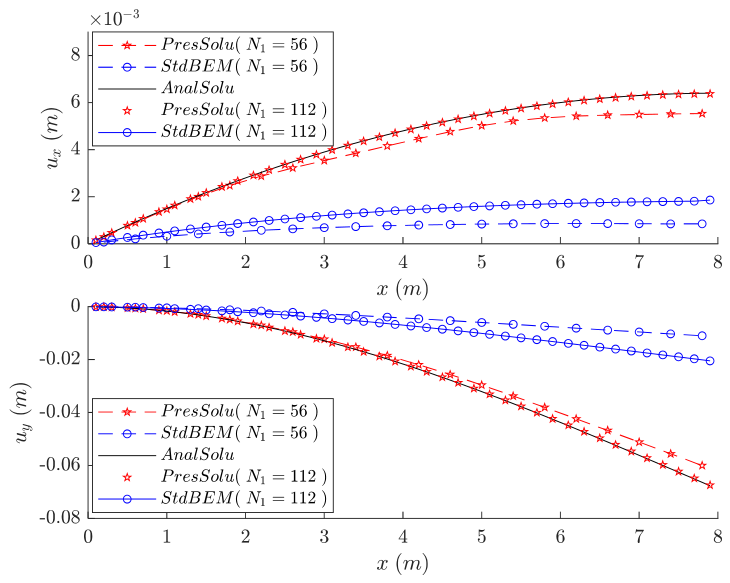
Figure 16 shows the computed displacement components
and
along the top line
of
. The conventional BEM (with constant elements) fails completely on this slender structure, a well-known consequence of the inability of constant elements to represent rigid-body rotation modes [
52]. In contrast, the present method yields accurate displacements throughout the beam.
The relative error of
at the free end is approximately
(
). For comparison, the element-free Galerkin (EFG) method [
50] with a
regular nodal arrangement and linear basis gives a tip deflection ratio of 0.999 (relative error
); with quadratic basis, the ratio is 1.00. While a strict quantitative comparison is complicated by fundamental differences in discretization and dimensionality (EFG is a domain-based method with interior nodes, whereas the present method is a boundary-only method), the accuracy achieved by the present method with a simple constant-element discretization is of the same order as that reported for EFG in [
50].
We note that conventional BEM with linear or quadratic elements would produce more accurate results for this bending-dominated problem. The present method, however, already achieves satisfactory accuracy using the same constant elements, demonstrating that the improvement stems from the formulation itself rather than from a more sophisticated element type.
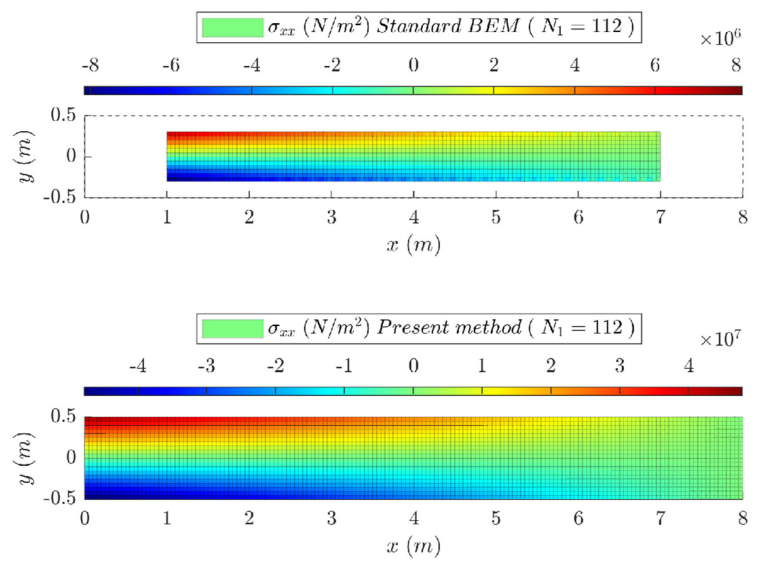
Figure 17 compares the
field obtained by the conventional BEM (upper subplot) and the present method (lower subplot), evaluated on a
grid covering
. The conventional BEM exhibits substantial errors: at two representative points, (
) and (
), the relative errors are
and
, respectively. The present method reduces these errors to
and
. This significant improvement demonstrates that the proposed nonsingular formulation can effectively model these slender structures [
53,
54,
55] even with constant elements.
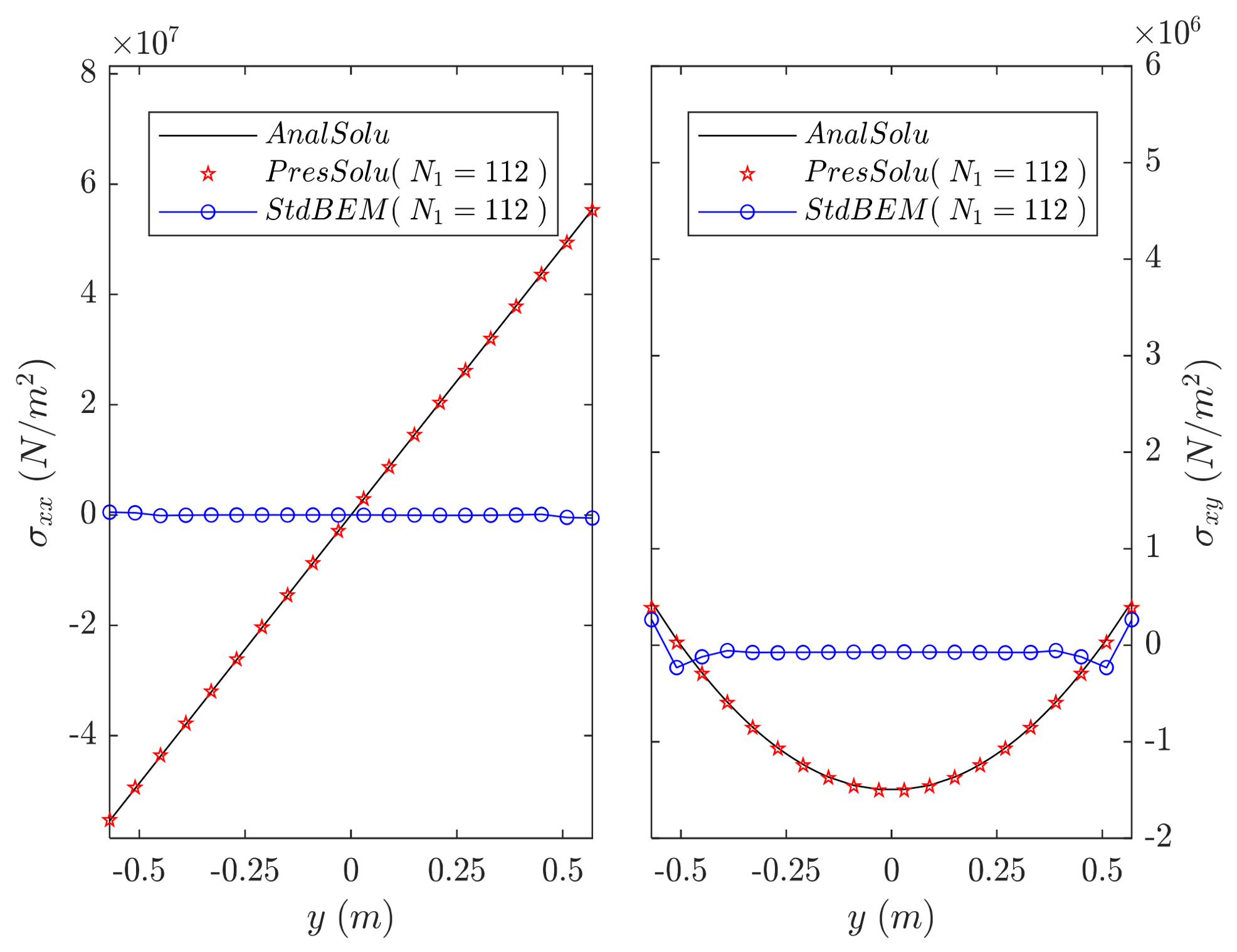
Figure 18 shows the shear stress
on the cross section
. The conventional BEM converges very slowly; doubling the mesh twice reduces its error only modestly. In contrast, the present method achieves a two-order-of-magnitude reduction in error with the same refinement. This convergence behavior is superior even to that of a three-dimensional self-regular BEM [
56], which showed no error reduction after three successive mesh refinements.
To examine the extension capability for derivative quantities,
Figure 19 shows the stress distributions on the extension line
(to the left of the fixed end), which lies inside the extended region
. For the conventional BEM, this point is exterior to the solution domain (
), and the computed stresses are close to zero. In contrast, the present method treats it as an interior point of the extended domain
because the integration contour is placed on
. The Somigliana identities therefore yield smooth and continuous stress fields that closely follow the analytically extended solution. This result demonstrates that the present method can smoothly extend not only displacements but also stresses into part of
, even though the extension is only approximate (analogous to a truncated Taylor series). Together with the displacement extension shown for the thick cylinder (
Figure 14), these examples confirm that the extended equivalent model provides a physically plausible, though approximate, continuation of both the solution and its derivatives.
6. Discussion About Conditioning and Possible Remedies
More severe tests for thin structures (e.g., a thin cantilever plate with aspect ratio 100:1, a thin cylindrical shell) are proposed as future work. Potential challenges include mesh resolution, the trade-off in choosing
, and curvature effects. The present method has not yet been tested on such extreme geometries, but the analysis in
Section 2 suggests that the
configuration avoids near-singular integrals on the physical boundary, which may offer advantages over conventional direct BEM.
Although the present examples are limited to single-connected domains, the method can be extended to multi-connected regions (e.g., domains with holes or inclusions) by appropriately constructing the auxiliary boundary and treating each boundary component. A systematic study of multi-connected cases is left for future work.
A systematic parametric study of (e.g., its interaction with mesh size, geometry, and conditioning) is beyond the scope of this proof-of-concept study and is left for future work. We are aware that very large values of may lead to ill-conditioning; the present study deliberately avoids this regime, as our focus is on demonstrating that the method successfully avoids near-singular integrals. The conditioning issue will be addressed in future research.
As discussed in
Section 2.5, the choice of
involves an inherent trade-off: too small a separation leads to near-singular integrals, while too large a separation causes the coefficient matrices to become nearly linearly dependent, leading to ill-conditioned systems. This section focuses on strategies to mitigate the latter issue.
Stabilization through additional constraints. The first numerical example (
Section 3) provides insight into how stability can be improved. When well-posed boundary conditions are prescribed on both
and
, the unknowns on the outer boundary
—which otherwise oscillate freely—are forced to return to values consistent with the analytically extended solution. This behavior can be understood by interpreting the layer
as an isolated elastic body whose inner and outer boundaries are precisely
and
. On this isolated body, the problem is well-posed, and its solution is unique. Therefore, imposing appropriate constraints on
effectively removes the indeterminacy of the outermost variables, thereby reducing the condition number and enhancing stability.
Additional constraints. Two families of constraints can be applied to , each with its own trade-off:
Nonsingular constraints derived from the traction-recovery method [
12,
13]. These bring the fully nonsingular nature of the formulation and, if successful, would allow larger
values without sacrificing stability. It is worth noting that the discrete system obtained from the traction-recovery method, combined with the equilibrium condition
, is algebraically equivalent to the discretized traction boundary integral equation, as both satisfy the three fundamental equations of elasticity.
Singular constraints obtained directly from the displacement BIE. Although this reintroduces weak singularities (), it provides the strongest possible coupling and ensures that the extended model remains mathematically sound even in the most demanding cases. The weak singularity can be handled by standard rigid-body mode techniques.
Remarkably, if either type of constraint is imposed, the solvability condition of the system becomes independent of the discretization parameters , , and the presence or absence of . This “self-sufficiency” reflects the fact that the constraints supply the missing information needed to fully determine the outermost variables, making the system well-posed regardless of how the interior contours are treated.
It is also worth noting the continuity between the present method and conventional direct BEM. When the separation parameter is very small, the integrals in the present method become nearly singular, and its performance approaches that of conventional BEM (which also suffers from near-singular integrals when evaluation points are close to the boundary). In this sense, the two formulations are not competitors but members of the same direct BEM family. Many techniques developed for conventional BEM—such as singularity-subtraction quadrature, element subdivision, or higher-order shape functions—can be adapted to improve the present method. We therefore view conventional BEM not as a method to be surpassed, but as a rich source of numerical techniques that can complement the present framework.
Additional remedies. Beyond constraint addition, several established techniques could be adapted to further improve conditioning:
Extended-precision arithmetic is primarily a diagnostic tool for exploring the limits of the formulation (e.g., distinguishing ill-conditioning from round-off errors); it is not recommended for routine large-scale engineering applications.
Exploring these options in detail is left for future work. Even without them, the present method already achieves high accuracy and avoids singular integrals throughout the solution and post-processing stages, while offering a clear path for further stability improvements.
7. Conclusions
We have developed a nonsingular direct BEM for two-dimensional elastostatics based on an extended equivalent model within the direct Somigliana-identity framework. The key idea is to introduce an auxiliary boundary that encloses the physical boundary . The governing BIEs are enforced on , and the unknowns on both and are solved simultaneously via the Somigliana identities that link them. The prescribed boundary conditions are imposed on through these same identities evaluated along . This construction removes the boundary-source singularities intrinsic to conventional collocation BEM and ensures that all integrals remain regular throughout the solution and post-processing stages.
The separation between and is characterized by a dimensionless parameter . Numerical evidence, including a rigid-body displacement test and benchmark problems, indicates that a moderate separation (e.g., in the studied cases) effectively suppresses near-singular effects while maintaining stability. The proposed formulation also enables unified field evaluation on and inside using the same nonsingular BIEs, avoiding special quadrature rules and case-by-case singular treatment. The results further suggest improved accuracy and faster convergence at reduced computational cost; however, the evidence on thin-structure performance is currently limited to a relatively mild Timoshenko-beam benchmark, and broader plate- and shell-type validations remain to be carried out.
Quantitatively, the proposed method reduces errors by two to four orders of magnitude compared to conventional BEM under identical numerical conditions (same mesh, same quadrature, no special treatment of near-singular integrals). For example, in the square plate example, the relative error in displacement drops from approximately to ; in the thick cylinder, the error in is reduced from about to ; and in the cantilever beam, the error in falls from roughly 80% to 0.6%. These improvements are achieved without any special treatment of singular or nearly singular integrals, highlighting the potential of the proposed singularity-free direct BEM framework.
In summary, the proposed method differs fundamentally from fictitious-domain approaches such as the MFS and indirect BEM by staying within the direct Somigliana framework, enforcing the three equations of elasticity on the physical boundary, and using a physically extended auxiliary boundary
. The method naturally provides a smooth, though only approximate, extension of the solution into part of
(as demonstrated in (
Figure 14 and
Figure 19), and this extension can be upgraded to an exact one by imposing additional constraints if needed. These features, together with the complete avoidance of singular integrals, establish the present method as a novel and practical alternative within the direct BEM family. Future work will focus on systematic guidelines for constructing
and selecting
in complex geometries, and on improving conditioning for large separations—for instance, through additional constraints on the outer boundary variables or through extended-precision arithmetic. Extensions to problems with body forces, material inhomogeneity, and three-dimensional analyses will also be pursued.