Article

Estimation of the Half-Logistic Inverse Rayleigh Distribution Parameters via Ranked Set Sampling: Methods and Applications


by
Amer Ibrahim Al-Omari
1,*,
Sid Ahmed Benchiha
2 and
Ghadah Alomani
3
1
Department of Mathematics, Faculty of Science, Al Al-Bayt University, Mafraq 25113, Jordan
2
Laboratory of Statistics and Stochastic Processes, University of Djillali Liabes, P.O. Box 89, Sidi Bel Abbes 22000, Algeria
3
Department of Mathematical Sciences, College of Science, Princess Nourah bint Abdulrahman University, P.O. Box 84428, Riyadh 11671, Saudi Arabia
*
Author to whom correspondence should be addressed.
Mathematics 2026, 14(8), 1281; https://doi.org/10.3390/math14081281
Submission received: 20 February 2026 / Revised: 3 April 2026 / Accepted: 5 April 2026 / Published: 12 April 2026
(This article belongs to the Section D1: Probability and Statistics)

Abstract

This study investigates a range of parameter estimation methods for the Half-Logistic Inverse Rayleigh Distribution (HLIRD) under two distinct sampling frameworks: ranked set sampling (RSS) and simple random sampling (SRS). The estimation techniques considered include maximum likelihood estimation, ordinary and weighted least squares, and the maximum and minimum product of spacings methods. Model adequacy is evaluated using five goodness-of-fit criteria: the Anderson–Darling (AD) statistic, its right- and left-tail variants, the second-order left-tail AD statistic, and the Cramér–von Mises statistic. An extensive simulation study is conducted to thoroughly evaluate and compare the performance of the proposed estimators while maintaining a fixed total number of observations across both sampling schemes. The practical relevance of the proposed methods is further illustrated through an application to a real dataset consisting of 69 carbon fiber specimens, with tensile strength measurements (in GPa) recorded at a gauge length of 20 mm. The numerical results demonstrate that estimators based on RSS consistently outperform their SRS counterparts across all considered performance measures, including mean squared error, bias, and mean absolute relative error. Overall, the findings highlight the advantages of employing RSS for parameter estimation of the HLIRD, particularly due to its superior efficiency in small-sample scenarios.

1. Introduction

The development of new probability distributions plays a fundamental role in expanding the statistical toolkit available for modeling real-world uncertainty. Since many natural and applied phenomena do not conform to classical distributions such as the normal or binomial, novel distributions provide researchers with greater flexibility to accommodate complex data structures, including those exhibiting skewness, heavy tails, or other irregular patterns. This enhanced modeling capacity translates into more accurate predictions, richer analytical insights, and more robust decision-making across a wide range of disciplines, including statistics, machine learning, finance, engineering, and the natural sciences. Consequently, the construction of new distributional families represents a meaningful contribution to the broader goal of characterizing the behavior of randomness in increasingly complex and heterogeneous systems.
The inverse Rayleigh distribution (IRD) was originally proposed by [1] as a probabilistic model for the analysis of reliability and survival data. Due to the importance of the IRD, many researchers considered it in different modifications and applications. Khan [2] explored the modified inverse Rayleigh distribution, offering insights into its structure, behavior, and theoretical foundations. Shala and Merovci [3] introduced a three-parameter extension of the inverse Rayleigh distribution and examined its performance through simulation and real-data applications. Ahmed et al. [4] conducted an investigation into goodness-of-fit tests aimed at evaluating the reliability of estimates obtained from the modified inverse Rayleigh distribution, employing simulation studies for this purpose. Building on the half-logistic transformation established by [5] under the half-logistic generated (HL-G) family of continuous distributions, Almarashi et al. [6] proposed the half-logistic inverse Rayleigh distribution (HLIRD), whose probability density function (pdf) takes the following
f ( x ; α , λ ) = 4 λ α 2 e α x 2 1 e α x 2 λ 1 x 3 1 + 1 e α x 2 λ 2 , x , λ , α > 0 ,
and the associated CDF (cumulative distribution function) is defined as:
F ( x ; α , λ ) = 1 1 e α x 2 λ 1 + 1 e α x 2 λ ,
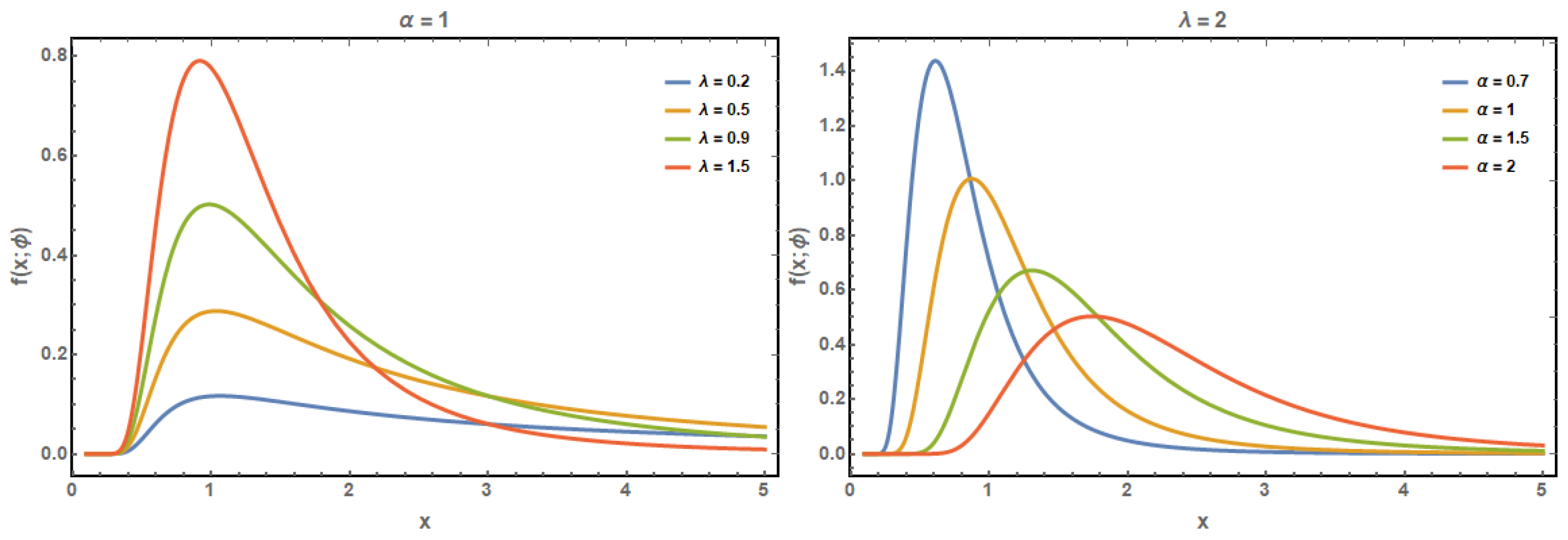
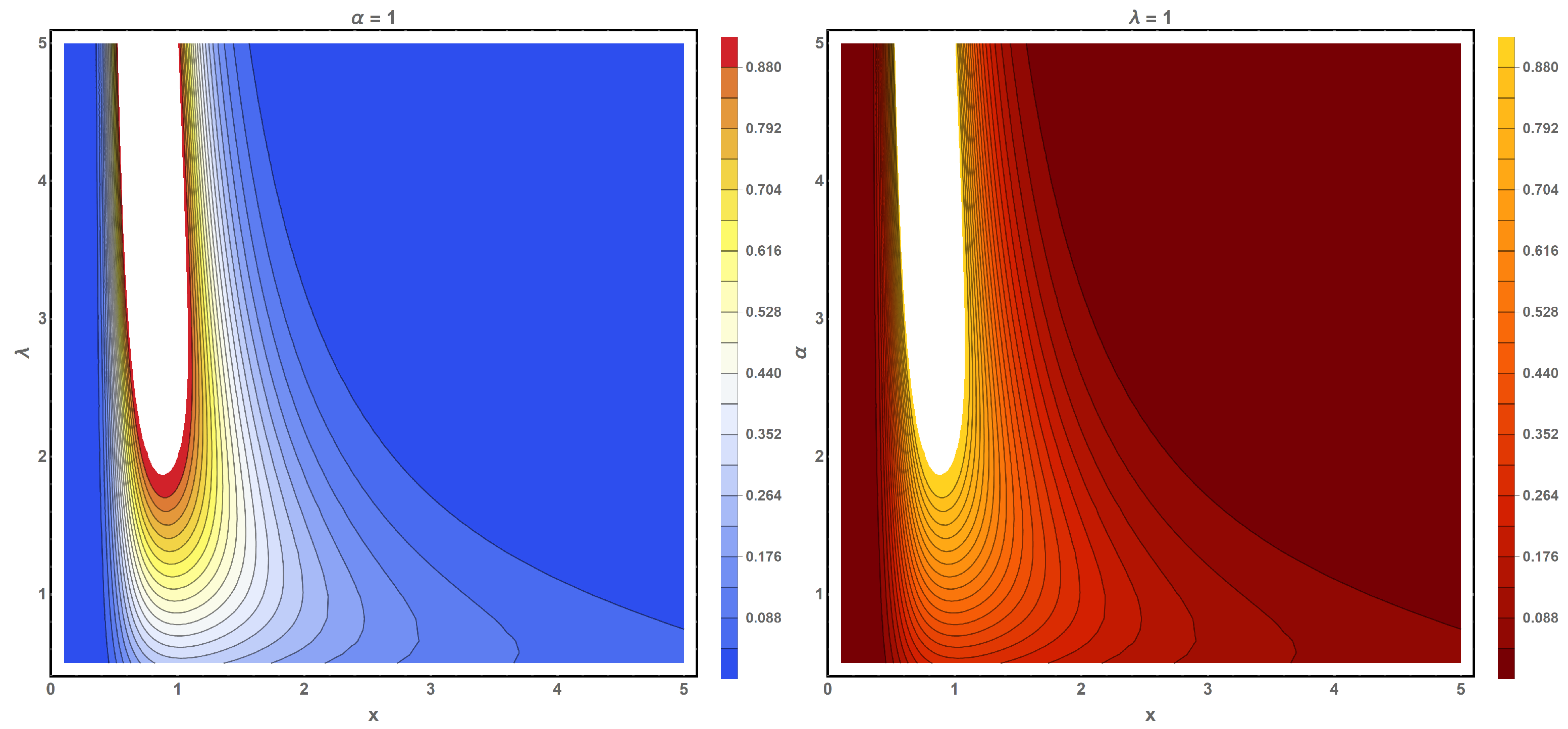
where λ is a shape parameter, and α is a scale parameter. Due to the flexibility of the HLIRD, many authors suggested several modifications of the distribution, as Almarashi et al. [6] showed that the HLIRD model can effectively accommodate lifetime data with various right-skewed characteristics, beyond the capability of the traditional inverse Rayleigh distribution. Shrahili et al. [7] extended the HLIRD and proposed a new distribution, termed the Sine HLIRD. Oseghale and Micah [8] introduced the half logistic generalized inverse Rayleigh distribution as a flexible tool for modeling breast cancer data. Figure 1 includes the pdf plot of the HLIRD for several values of α and β . Figure 2 presents the pdf contour plots when α = 1 and β = 1 .
The quantile function of the HLIR distribution, denoted Q ( u ; α , λ ) , is obtained by inverting the corresponding CDF, such that it fulfills the condition F Q ( u ; α , λ ) ; α , λ = u for all u ( 0 , 1 ) , where
Q ( u ; α , λ ) = α log 1 1 u 1 + u 1 λ 1 2 , u ( 0 , 1 ) .
By virtue of its closed form, the quantile function proves particularly useful for computing the quartiles of the HLIR distribution and for generating random samples from it (see [5]). The hazard function of the HLIRD is expressed as:
h ( x ; α , λ ) = 2 λ α 2 e ( α / x ) 2 x 3 1 e ( α / x ) 2 1 + 1 e ( α / x ) 2 λ x > 0 , α > 0 , λ > 0 .
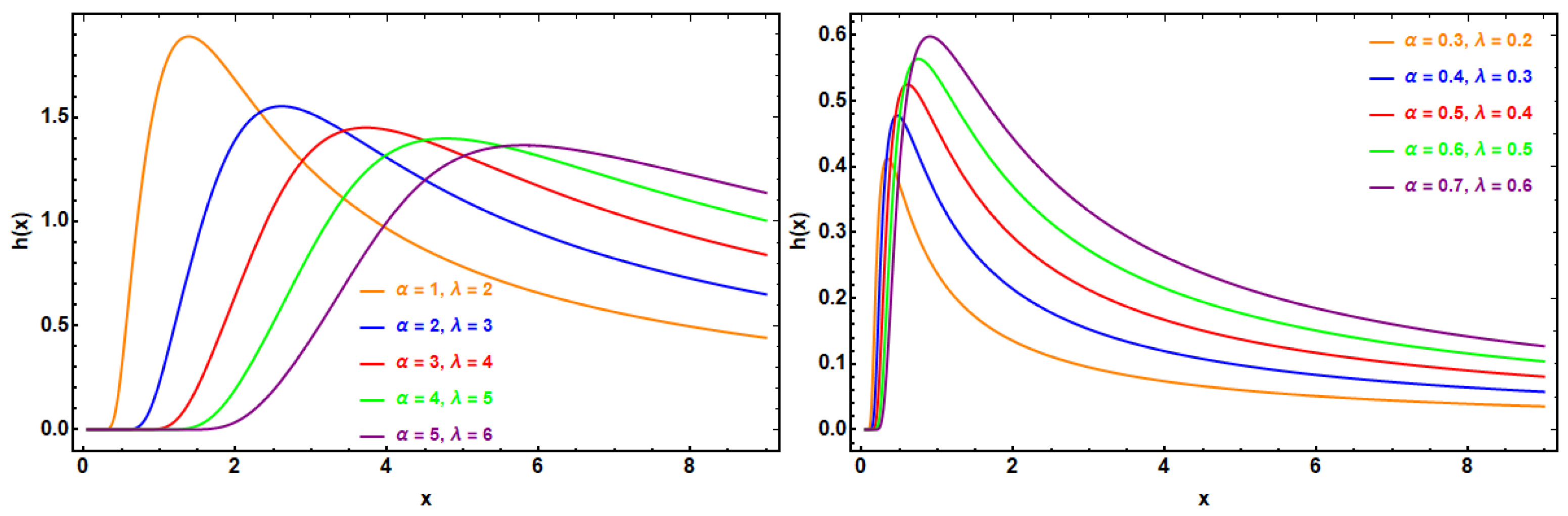
As x 0 + , the exponent ( α / x ) 2 forces e ( α / x ) 2 0 , yields h ( x ) 0 . As x , applying the approximation 1 e ( α / x ) 2 ( α / x ) 2 gives h ( x ) λ / x 0 . Hence, the hazard vanishes at both extremes of the support. The scale parameter α enters solely through the ratio ( α / x ) 2 , shifting the hazard peak along the x-axis without altering its shape. The shape parameter λ appears both as a multiplier in the numerator and as an exponent in the denominator; smaller values of λ produce a broader, flatter hazard profile, while larger values sharpen and concentrate the modal peak. Since h ( x ; α , λ ) > 0 for all x ( 0 , ) and vanishes at both boundaries, the hazard must attain an interior maximum, yielding an upside-down bathtub (unimodal) shape.
The hazard function plots for several parameter values are given in the following Figure 3. It can be noted that the plots have different shapes, including increasing–deceasing.
As far as we are aware, the application of the HLIRD in the context of RSS has not been previously addressed in the literature, and the present study represents the first attempt to bridge this gap. This combination allows for more efficient estimation of population parameters when data collection is costly or difficult, highlighting the practical advantages of integrating the flexibility of the HLIRD with the efficiency of RSS. Ranked set sampling [9] is a method designed to improve estimation accuracy by using ranking information without requiring full measurement of every item. Instead of randomly selecting units and measuring each one, as in simple random sampling, RSS draws several small groups of units. Within each group, units are ranked using a readily observable characteristic, and only one unit per group is actually measured according to its assigned rank. This procedure produces samples that are more representative of the population and often yields more precise estimates without additional measurement cost. By extending the HLIRD to this sampling framework, the study addresses a gap in the literature and provides a foundation for future applications in reliability and lifetime data analysis.
The ranked set sampling procedure is described as follows:
Step 1: Begin by randomly selecting n 2 units from the study population, then partition them at random into n equal groups, each consisting of n observations.
Step 2: Within each group, order the units according to the characteristic of interest. This ordering can be performed using expert opinion or through an auxiliary variable that is related to the main variable of interest.
Step 3: The final sample is then assembled by selecting the unit with the lowest rank from the first group, the unit with the second-lowest rank from the second group, and continuing in this fashion until the unit bearing the highest rank is drawn from the n-th group.
Step 4: The whole procedure is repeated across r cycles, ultimately yielding a complete measurement sample of total size r n .
It is worth noting that when planning an RSS design, the set size should generally be kept small in order to reduce the likelihood of ranking errors. To demonstrate the RSS approach in a general setting with set size n, let X i ( h ) represent the unit with rank h within the i-th set, where h = 1 , 2 , , n . The above steps are illustrated as:
X 11 , X 12 , X 13 , X 1 n X 21 , X 22 , X 23 , X 2 n X n 1 , X n 2 , X n 3 , X n n Step 1 X 1 ( 1 ) , X 1 ( 2 ) , X 1 ( 3 ) , X 1 ( n ) X 2 ( 1 ) , X 2 ( 2 ) , X 2 ( 3 ) , X 2 ( n ) X n ( 1 ) , X n ( 2 ) , X n ( 3 ) , X n ( n ) Step 2 X 1 ( 1 ) , X 1 ( 2 ) , X 1 ( 3 ) , X 1 ( n ) X 2 ( 1 ) , X 2 ( 2 ) , X 2 ( 3 ) , X 2 ( n ) X n ( 1 ) , X n ( 2 ) , X n ( 3 ) , X n ( n ) . Step 3
At the last step, the selected RSS units are:
X 1 ( 1 ) , X 2 ( 2 ) , X 3 ( 3 ) , X 4 ( 4 ) , , X n ( n ) .
Many authors used the RSS in the estimation of distribution parameters, goodness of fit tests, and in statistical inference and applications. For example, Al-Omari and Bouza [10] suggested a review of RSS including some of its modifications and applications. Haq et al. [11] examined invariant and the best linear unbiased estimators in the context of location–scale families under a double RSS sampling scheme. Al-Omari et al. [12] investigated efficient parameter estimation for the generalized Quasi-Lindley distribution within the framework of ranked set sampling and illustrated the approach through practical applications. Jiang and Gui [13] explored Bayesian inference for the parameters of the Kumaraswamy distribution using ranked set sampling. Al-Omari and Abdallah [14] addressed the problem of estimating the distribution function by employing both moving extreme and minimax ranked set sampling techniques. Irshad et al. [15] explored parameter estimation for the Farlie–Gumbel–Morgenstern bivariate Bilal distribution within the framework of RSS. Kumari et al. [16] proposed a novel ranked set sampling modification, termed neutrosophic median ranked set sampling, for estimating the population mean and demonstrated its application using demographic data. Aljohani [17] developed statistical inference procedures for a newly proposed distribution within the ranked set sampling framework, accompanied by relevant applications. Zubair et al. [18] developed a novel ranked set sampling approach termed double extreme-cum-median ranked set sampling, aimed at enhancing sampling efficiency. Alomani et al. [19] proposed parameter estimation procedures for the inverse power Lindley distribution under RSS, demonstrating their practical utility through an application to failure time data. Newer and Alanazi [20] explored Bayesian estimation and prediction procedures for linear exponential models, employing ordered moving extremes ranked set sampling and demonstrating their usefulness with medical data. Bhushan and Kumar [21] considered imputation of missing data under RSS using multi auxiliary information. Alliu et al. [22] considered the RSS for sample size optimization in accelerated failure time models with progressive Type-II censoring. Tatlı and Gül [23] investigated the median RSS in finding the maximum likelihood estimation of the unit Gompertz distribution. GUL and Yeniay Koçer [24] used folded RSS for estimating Gompertz distribution parameters. Hassan et al. [25] obtained the L-moments method estimators of the Gamma/Gompertz distribution parameters using RSS methods.
The primary objective of this study is to evaluate and compare various estimation methods for the parameters of the HLIRD under two sampling frameworks: RSS and SRS. Specifically, the study aims to:
1.
Investigate and evaluate a range of parameter estimation approaches for the HLIRD, encompassing ordinary least squares (OLS), maximum likelihood estimation (MLE), weighted least squares (WLS), and the maximum product of spacings (MPS) method.
2.
Assess the distributional adequacy of the proposed model by means of five diagnostic measures, comprising the Cramér–von Mises statistic, the Anderson–Darling (AD) statistic along with its right- and left-tail variants, and the left-tail second-order AD statistic.
3.
An exhaustive simulation experiment is performed to thoroughly investigate and contrast the statistical behavior of the adopted estimators across both RSS and SRS frameworks, while keeping the aggregate number of measured units identical between the two designs.
4.
Illustrate the practical relevance of the proposed estimation approaches through a real-data application involving 69 carbon fiber specimens with strength measurements recorded in GPa, obtained under tensile testing at a gauge length of 20 mm.
5.
Measure the relative superiority of RSS over SRS by gauging estimator accuracy through three performance criteria, namely mean absolute relative error (MARE), absolute bias, and mean squared error (MSE).
The rest of this paper proceeds as follows. Section 2 outlines the parameter estimation approaches adopted for the HLIRD. Section 3 details the findings of an extensive simulation experiment, whereas Section 4 demonstrates the practical utility of the proposed methods via a real-data application. Section 5 brings the paper to a close with a synthesis of the key conclusions and a discussion of possible avenues for future investigation.

2. Parameter Estimation of the HLIRD

Within the RSS framework, sixteen estimation procedures are employed to estimate the parameters α and λ of the HLIRD. Throughout all methods, let z ( i 1 : s ) j denote the i 1 th ranked observation (i.e., the i 1 th order statistic) from the i 1 th set in the jth cycle, where i 1 = 1 , 2 , , s and j = 1 , 2 , , w , constituting the RSS data for Z with a total sample size of n = s w . For notational convenience, the selected sample under the RSS design is compactly represented as z i 1 j .

2.1. Maximum Likelihood Estimation

Under the RSS framework, the MLEs of the parameters α and λ of the HLIRD are derived as follows. Let z i j ( i = 1 , , s , j = 1 , 2 , , w ) denote the observed RSS of size n = s w , where s represents the set size, and w denotes the number of cycles, drawn from the HLIRD. The likelihood function of Θ = ( α , λ ) based on RSS takes the following form:
L ( Θ ) = j = 1 w i = 1 s f ( i : s ) ( z i j , α , λ ) ,
where
f ( i : s ) ( z i j , α , λ ) = 1 B ( i , s i + 1 ) G ( z i j ) i 1 1 G ( z i j ) s i g ( z i j ) = 1 B ( i , s i + 1 ) × 1 ( 1 exp ( ( α / z i j ) 2 ) ) λ 1 + ( 1 exp ( ( α / z i j ) 2 ) ) λ i 1 × 1 1 ( 1 exp ( ( α / z i j ) 2 ) ) λ 1 + ( 1 exp ( ( α / z i j ) 2 ) ) λ s i × 4 α 2 λ ( 1 exp ( α 2 / z i j 2 ) ) λ z i j 3 ( ( 1 exp ( α 2 / z i j 2 ) ) λ + 1 ) 2 ( exp ( α 2 / z i j 2 ) 1 ) .
Substituting the pdf given in Equation (4) into Equation (3), the likelihood function of the observed sample can be expressed as:
L ( Θ ) ( 4 α 2 λ ) n j = 1 w h = 1 s 1 ( 1 exp ( ( α / z i j ) 2 ) ) λ 1 + ( 1 exp ( ( α / z i j ) 2 ) ) λ i 1 2 ( 1 exp ( ( α / z i j ) 2 ) ) λ 1 + ( 1 exp ( ( α / z i j ) 2 ) ) λ s i × ( 1 exp ( α 2 / z i j 2 ) ) λ z i j 3 ( ( 1 exp ( α 2 / z i j 2 ) ) λ + 1 ) 2 ( exp ( α 2 / z i j 2 ) 1 ) .
L ( Θ ) ( 4 α 2 λ ) n j = 1 w h = 1 s ( 1 A ( Θ ) ) i 1 · ( 2 A ( Θ ) ) s i · A ( Θ ) ( 1 + A ( Θ ) ) i 1 · ( 1 + A ( Θ ) ) s i · z i j 3 ( A ( Θ ) + 1 ) 2 ( exp ( α 2 / z i j 2 ) 1 ) = ( 4 α 2 λ ) n j = 1 w h = 1 s 2 s i ( 1 A ( Θ ) ) i 1 A ( Θ ) s i + 1 z i j 3 ( 1 + A ( Θ ) ) s + 1 ( exp ( α 2 / z i j 2 ) 1 ) ,
where A ( Θ ) = ( 1 exp ( ( α / z i j ) 2 ) ) λ . The log-likelihood function of Equation (5) is as follows:
log L ( Θ ) 2 n log ( α ) + log ( λ ) + j = 1 w h = 1 s ( i 1 ) log ( 1 A ( Θ ) ) + j = 1 w h = 1 s ( s i + 1 ) log ( A ( Θ ) ) j = 1 w h = 1 s ( s + 1 ) log ( 1 + A ( Θ ) ) 3 j = 1 w h = 1 s log ( z i j ) j = 1 w h = 1 s log ( exp ( α 2 / z i j 2 ) 1 ) .
The MLEs α ˜ and λ ˜ of the parameters α and λ , respectively, are obtained by taking the partial derivatives of the log-likelihood function in Equation (7) with respect to each unknown parameter and equating the resulting expressions to zero, yielding:
log L ( Θ ) α = 2 n α j = 1 w h = 1 s ( i 1 ) A ( Θ ) α 1 A ( Θ ) + j = 1 w h = 1 s ( s i + 1 ) A ( Θ ) α A ( Θ ) j = 1 w h = 1 s ( s + 1 ) A ( Θ ) α 1 + A ( Θ ) j = 1 w h = 1 s 2 α / z i j 2 · exp ( α 2 / z i j 2 ) exp ( α 2 / z i j 2 ) 1 ,
log L ( Θ ) λ = n λ j = 1 w h = 1 s ( i 1 ) A ( Θ ) λ 1 A ( Θ ) + j = 1 w h = 1 s ( s i + 1 ) A ( Θ ) λ A ( Θ ) j = 1 w h = 1 s ( s + 1 ) A ( Θ ) λ 1 + A ( Θ ) ,
where A ( Θ ) α = λ ( 1 exp ( ( α / z i j ) 2 ) ) λ 1 · exp ( ( α / z i j ) 2 ) · 2 α z i j 2 and A ( Θ ) λ = ( 1 exp ( ( α / z i j ) 2 ) ) λ · log ( 1 exp ( ( α / z i j ) 2 ) ) . Since α ˜ and λ ˜ do not admit closed-form solutions, numerical optimization methods must be employed, such as the Newton–Raphson iterative algorithm, to obtain their estimates.
The variance–covariance matrix associated with the MLE is obtained by evaluating the Hessian matrix of the log-likelihood function, that is, the matrix of second-order partial derivatives of log L ( Θ ) with respect to α and λ . The resulting observed Fisher information matrix is given by:
I ( Θ ) = H ( Θ ) = 2 log L α 2 2 log L α λ 2 log L λ α 2 log L λ 2 Θ = Θ ^ .
The variance–covariance matrix of the MLE Θ ^ = ( α ^ , λ ^ ) is then approximated by
Var ^ ( Θ ^ ) I ( Θ ^ ) 1 .
The diagonal elements of I ( Θ ^ ) 1 provide the estimated variances Var ^ ( α ^ ) and Var ^ ( λ ^ ) , from which approximate 100 ( 1 γ ) % confidence intervals for the parameters are constructed as
λ ^ ± z γ / 2 Var ^ ( λ ^ ) , α ^ ± z γ / 2 Var ^ ( α ^ ) ,
where z γ / 2 denote the upper γ / 2 quantile of the standard normal distribution. The second-order partial derivatives constituting the Hessian are obtained by differentiating Equations (8) and (9), yield
2 log L α 2 = 2 n α 2 j = 1 w h = 1 s ( i 1 ) A ( Θ ) α α 1 A ( Θ ) + A ( Θ ) α 2 ( 1 A ( Θ ) ) 2 + j = 1 w h = 1 s ( s i + 1 ) A ( Θ ) α α A ( Θ ) A ( Θ ) α 2 ( A ( Θ ) ) 2 j = 1 w h = 1 s ( s + 1 ) A ( Θ ) α α 1 + A ( Θ ) A ( Θ ) α 2 ( 1 + A ( Θ ) ) 2 j = 1 w h = 1 s α 2 α / z i j 2 · exp ( α 2 / z i j 2 ) exp ( α 2 / z i j 2 ) 1 ,
2 log L λ 2 = n λ 2 j = 1 w h = 1 s ( i 1 ) A ( Θ ) λ λ 1 A ( Θ ) + A ( Θ ) λ 2 ( 1 A ( Θ ) ) 2 + j = 1 w h = 1 s ( s i + 1 ) A ( Θ ) λ λ A ( Θ ) A ( Θ ) λ 2 ( A ( Θ ) ) 2 j = 1 w h = 1 s ( s + 1 ) A ( Θ ) λ λ 1 + A ( Θ ) A ( Θ ) λ 2 ( 1 + A ( Θ ) ) 2 ,
2 log L α λ = j = 1 w h = 1 s ( i 1 ) A ( Θ ) α λ 1 A ( Θ ) + A ( Θ ) α · A ( Θ ) λ ( 1 A ( Θ ) ) 2 + j = 1 w h = 1 s ( s i + 1 ) A ( Θ ) α λ A ( Θ ) A ( Θ ) α · A ( Θ ) λ ( A ( Θ ) ) 2 j = 1 w h = 1 s ( s + 1 ) A ( Θ ) α λ 1 + A ( Θ ) A ( Θ ) α · A ( Θ ) λ ( 1 + A ( Θ ) ) 2 ,
where the required second-order derivatives of A ( Θ ) are
A ( Θ ) α α = λ ( λ 1 ) 1 e ( α / z i j ) 2 λ 2 e ( α / z i j ) 2 · 2 α z i j 2 2
+ λ 1 e ( α / z i j ) 2 λ 1 · α e ( α / z i j ) 2 · 2 α z i j 2 ,
A ( Θ ) λ λ = 1 e ( α / z i j ) 2 λ log 1 e ( α / z i j ) 2 2 ,
A ( Θ ) α λ = 1 e ( α / z i j ) 2 λ 1 · e ( α / z i j ) 2 · 2 α z i j 2 · log 1 e ( α / z i j ) 2 .

2.2. Ordinary and Weighted Least Squares Methods

The ordinary least squares estimates (OLSEs) and weighted least squares estimates (WLSEs) were originally proposed by [26] for estimating the parameters of the beta distribution. Let z ( 1 : n ) , z ( 2 : n ) , , z ( n : n ) denote an ordered sample drawn from the HLIRD, with set size s and cycle number w, forming an RSS of total size n = s w . The OLSEs α ˜ of α and λ ˜ of λ are obtained by minimizing the following objective function:
Δ 1 ( Θ ) = i = 1 n 1 A ( Θ ) 1 + A ( Θ ) u i 2 ,
where u i = i n + 1 . Alternatively, the estimates α ˜ and λ ˜ may be obtained by solving the following system of nonlinear equations in place of Equation (19):
Δ 1 ( Θ ) α = i = 1 n 1 A ( Θ ) 1 + A ( Θ ) u i Φ 1 z ( i : n ) Θ = 0 ,
and
Δ 1 ( Θ ) λ = i = 1 n 1 A ( Θ ) 1 + A ( Θ ) u i Φ 2 z ( i : n ) Θ = 0 .
where
Φ 1 z ( i : n ) Θ = 2 A ( Θ i ) α ( 1 + A ( Θ i ) ) 2 ,
Φ 2 z ( i : n ) Θ = 2 A ( Θ i ) λ ( 1 + A ( Θ i ) ) 2 .
The WLSEs α ˜ of α and λ ˜ of λ are determined by minimizing the following function:
Δ 2 ( Θ ) = i = 1 n w i 1 A ( Θ ) 1 + A ( Θ ) u i 2 ,
where w i = ( n + 1 ) 2 ( n + 2 ) i ( n i + 1 ) . Equivalently, the estimates α ˜ and λ ˜ can be obtained by solving the following system of nonlinear equations as an alternative to Equation (22):
Δ 2 ( Θ ) α = i = 1 n w i 1 A ( Θ ) 1 + A ( Θ ) u i Φ 1 z ( i : n ) Θ = 0 ,
and
Δ 2 ( Θ ) λ = i = 1 n w i 1 A ( Θ ) 1 + A ( Θ ) u i Φ 2 z ( i : n ) Θ = 0 ,
where Φ 1 . Θ and Φ 2 . Θ are given in Equations (20) and (21).
For the least squares and weighted least squares estimators, closed-form variances are unavailable due to the nonlinear dependence of the estimating equations on the parameters. The variances are therefore approximated via the bootstrap resampling method: a large number B of bootstrap samples are drawn (with replacement) from the original data, the estimators α ^ ( b ) and λ ^ ( b ) are recomputed for each replicate b = 1 , , B , and the bootstrap variance is estimated as
Var ^ boot ( θ ^ ) = 1 B 1 b = 1 B θ ^ ( b ) θ ^ ¯ 2 , θ ^ ¯ = 1 B b = 1 B θ ^ ( b ) .

2.3. Minimum Distance Estimation Methods

Estimation procedures grounded in the minimization of widely recognized goodness-of-fit statistics have proven effective and yield reliable results across a broad range of settings. Three such approaches are considered here, each of which operates by minimizing a discrepancy measure between the theoretical and empirical cumulative distribution functions.

2.3.1. Cramér-Von Mises Estimators

The Cramér–von Mises statistic was originally introduced independently by [27,28], and has since been widely adopted as a standard goodness-of-fit criterion in statistical inference. Let z ( 1 : n ) , z ( 2 : n ) , , z ( n : n ) denote an ordered sample generated from the HLIRD, yielding an RSS of size n = s w , where s and w represent the set size and cycle number, respectively. The Cramér–von Mises estimates (CVMEs) α ˜ of α and λ ˜ of λ are then obtained by minimizing the following function:
Ψ 1 ( Θ ) = 1 12 n + i = 1 n 1 A ( Θ ) 1 + A ( Θ ) 2 i 1 2 n 2 .
As an alternative to minimizing Equation (24), the estimates α ˜ and λ ˜ may equivalently be obtained by solving the following system of nonlinear equations:
Ψ 1 ( Θ ) α = i = 1 n 1 A ( Θ ) 1 + A ( Θ ) 2 i 1 2 n Φ 1 z ( i : n ) Θ = 0 ,
and
Ψ 1 ( Θ ) λ = i = 1 n 1 A ( Θ ) 1 + A ( Θ ) 2 i 1 2 n Φ 2 z ( i : n ) Θ = 0 ,
where Φ 1 . Θ and Φ 2 . Θ are given in Equations (20) and (21).
For the Cramér–von Mises (CvM) estimator, which minimizes a nonlinear goodness-of-fit statistic, no closed-form variance expression exists, and the bootstrap approach is again the standard method for variance quantification.

2.3.2. Anderson Darling

The Anderson–Darling (AD) statistic was first introduced by [29] and later extended in [30]. Let z ( 1 : n ) , z ( 2 : n ) , , z ( n : n ) denote an ordered sample constituting an RSS of size n = s w , where s and w represent the set size and cycle number, respectively, drawn from the HLIRD. The Anderson–Darling estimates (ADEs) α ˜ of α and λ ˜ of λ are obtained by minimizing the following objective function:
Ψ 2 ( Θ ) = n 1 n i = 1 n ( 2 i 1 ) log 1 A ( z ( i : n ) Θ ) 1 + A ( z ( i : n ) Θ ) + log 2 A ( z ( 1 + n i : n ) Θ ) 1 + A ( z ( 1 + n i : n ) Θ ) .
In place of Equation (25), the estimates α ˜ and λ ˜ may alternatively be obtained by numerically solving the following system of nonlinear equations:
Ψ 2 ( Θ ) α = i = 1 n ( 2 i 1 ) [ 1 + A ( z ( i : n ) Θ ) / Φ 1 z ( i : n ) Θ 1 A ( z ( i : n ) Θ ) + 1 + A ( z ( 1 + n i : n ) Θ ) / Φ 1 z ( 1 + n i : n ) Θ 2 A ( z ( 1 + n i : n ) Θ ) ] = 0 ,
and
Ψ 2 ( Θ ) λ = i = 1 n ( 2 i 1 ) [ 1 + A ( z ( i : n ) Θ ) / Φ 2 z ( i : n ) Θ 1 A ( z ( i : n ) Θ ) + 1 + A ( z ( 1 + n i : n ) Θ ) / Φ 2 z ( 1 + n i : n ) Θ 2 A ( z ( 1 + n i : n ) Θ ) ] = 0 ,
where Φ 1 . Θ and Φ 2 . Θ are given in Equations (20) and (21).

2.3.3. Right-Tail AD

Let z ( 1 : n ) , z ( 2 : n ) , , z ( n : n ) denote an ordered sample constituting an RSS of size n = s w , where s and w represent the set size and cycle number, respectively, drawn from the HLIRD. The right-tail AD estimates (RTADEs) α ˜ of α and λ ˜ of λ are obtained by minimizing the following function:
Ψ 3 ( Θ ) = n 2 2 i = 1 n 1 A ( z ( i : n ) Θ ) 1 + A ( z ( i : n ) Θ ) 1 n i = 1 n ( 2 i 1 ) log 2 A ( z ( 1 + n i : n ) Θ ) 1 + A ( z ( 1 + n i : n ) Θ ) .
Rather than minimizing Equation (26), the estimates α ˜ and λ ˜ can equivalently be obtained by numerically solving the following system of nonlinear equations:
Ψ 3 ( Θ ) α = 2 i = 1 n 1 + A ( z ( i : n ) Θ ) / Φ 1 z ( i : n ) Θ 1 A ( z ( i : n ) Θ ) 1 n i = 1 n ( 2 i 1 ) 1 + A ( z ( 1 + n i : n ) Θ ) / Φ 1 z ( 1 + n i : n ) Θ 2 A ( z ( 1 + n i : n ) Θ ) = 0 ,
and
Ψ 3 ( Θ ) λ = 2 i = 1 n 1 + A ( z ( i : n ) Θ ) / Φ 2 z ( i : n ) Θ 1 A ( z ( i : n ) Θ ) 1 n i = 1 n ( 2 i 1 ) 1 + A ( z ( 1 + n i : n ) Θ ) / Φ 2 z ( 1 + n i : n ) Θ 2 A ( z ( 1 + n i : n ) Θ ) = 0 ,
where Φ 1 . Θ and Φ 2 . Θ are given in Equations (20) and (21).

2.4. Method of Maximum and Minimum Spacing Distance

The MPS method was independently proposed by [31,32] as a robust alternative to maximum likelihood estimation, particularly in situations where the likelihood function is unbounded or difficult to maximize. This approach is grounded in maximizing the geometric mean of the spacings computed from the observed data.

2.4.1. Maximum Product Spacing Distance

Let z ( 1 : n ) , z ( 2 : n ) , , z ( n : n ) denote an ordered sample constituting an RSS of size n = s w , drawn from the HLIRD with CDF (2). The uniform spacings are subsequently defined as:
Ω i = 1 A ( z ( i : n ) Θ ) 1 + A ( z ( i : n ) Θ ) 1 A ( z ( i 1 : n ) Θ ) 1 + A ( z ( i 1 : n ) Θ ) , i = 1 , 2 , . . . , n + 1 ,
where 1 A ( z ( 0 : n ) Θ ) 1 + A ( z ( 0 : n ) Θ ) = 0 , 1 A ( z ( n + 1 : n ) Θ ) 1 + A ( z ( n + 1 : n ) Θ ) = 1 , and i = 1 n + 1 Ω i = 1 .
The MPSEs α ˜ and λ ˜ are obtained by maximizing the following function with respect to α and λ :
η 1 = i = 1 n + 1 log Ω i n + 1 .
As an alternative to directly solving Equation (27), the MPSEs α ˜ 7 and λ ˜ 7 may be obtained by numerically solving the following system of equations:
η 1 α = 1 n + 1 i = 1 n + 1 1 Ω i Φ 1 z ( i : n ) Θ Φ 1 z ( i 1 : n ) Θ = 0 ,
and
η 1 λ = 1 n + 1 i = 1 n + 1 1 Ω i Φ 2 z ( i : n ) Θ Φ 2 z ( i 1 : n ) Θ = 0 ,
where Φ 1 . Θ and Φ 2 . Θ are given in Equations (20) and (21).

2.4.2. Minimum Product Spacing Distance

Let z ( 1 : n ) , z ( 2 : n ) , , z ( n : n ) denote an ordered sample drawn from the HLIRD, with set size s and cycle number w, forming an RSS of total size n = s w . The modified second-order AD estimates (MSADEs) α ˜ and λ ˜ , as well as the modified second-order Anderson–Darling left-tail estimates (MSALDEs) α ˜ and λ ˜ , are respectively obtained by minimizing the following functions:
η 2 = i = 1 n + 1 Ω i 1 n + 1 , η 3 = i = 1 n + 1 log Ω i log 1 n + 1 .
The following non-linear equations can possibly be solved in place of (28) to obtain α ˜ 8 and λ ˜ 8 as
η 2 α = i = 1 n + 1 Ω i 1 n + 1 Ω i 1 n + 1 Φ 1 z ( i : n ) α , λ Φ 1 z ( i 1 : n ) α , λ = 0 ,
and
η 2 λ = i = 1 n + 1 Ω i 1 n + 1 Ω i 1 n + 1 Φ 2 z ( i : n ) α , λ Φ 2 z ( i 1 : n ) α , λ = 0 ,
where Φ 1 ( · Θ ) and Φ 2 ( · Θ ) are as defined in Equations (20) and (21), respectively. It may be possible to solve the following non-linear equations in lieu of Equation (20) to obtain α ˜ and λ ˜ .
η 3 α = i = 1 n + 1 log Ω i log 1 n + 1 log Ω i log 1 n + 1 1 Ω i Φ 1 z ( i : n ) T Φ 1 z ( i 1 : n ) T = 0 ,
and
η 3 λ = i = 1 n + 1 log Ω i log 1 n + 1 log Ω i log 1 n + 1 1 Ω i Φ 2 z ( i : n ) T Φ 2 z ( i 1 : n ) T = 0 ,
where Φ 1 . Θ and Φ 2 . Θ are given in Equations (20) and (21).
Subsequently, the modified second-order Swain–Drane estimates (MSSDEs) α ˜ and λ ˜ , together with the modified second-order Swain–Drane left-tail estimates (MSSLDEs) α ˜ and λ ˜ , are respectively obtained by minimizing the following objective functions:
η 4 = i = 1 n + 1 Ω i 1 n + 1 2 , η 5 = i = 1 n + 1 log Ω i log 1 n + 1 2 .
As an alternative to solving Equation (29), the estimates α ˜ and λ ˜ may also be obtained by solving the following system of nonlinear equations:
η 4 α = i = 1 n + 1 Ω i 1 n + 1 Φ 1 z ( i : n ) Θ Φ 1 z ( i 1 : n ) Θ = 0 ,
and
η 4 λ = i = 1 n + 1 Ω i 1 n + 1 Φ 2 z ( i : n ) Θ Φ 2 z ( i 1 : n ) Θ = 0 ,
where Φ 1 . Θ and Φ 2 . Θ are given in Equations (20) and (21).
Equivalently, instead of solving Equation (21), the estimates α ˜ and λ ˜ may be obtained by numerically solving the following system of nonlinear equations:
η 5 α = i = 1 n + 1 log Ω i log 1 n + 1 1 Ω i Φ 1 z ( i : n ) Θ Φ 1 z ( i 1 : n ) Θ = 0 ,
and
η 5 λ = i = 1 n + 1 log Ω i log 1 n + 1 1 Ω i Φ 2 z ( i : n ) Θ Φ 2 z ( i 1 : n ) Θ = 0 ,
where Φ 1 ( · Θ ) and Φ 2 ( · Θ ) are as previously defined in Equations (20) and (21), respectively. Finally, MSLD estimates (MSLDE) α ˜ of α and λ ˜ are yielded, respectively, by minimizing the following function:
η 6 = i = 1 n + 1 e Ω i 1 n + 1 Ω i 1 n + 1 1 .
Rather than minimizing Equation (30), the estimates α ˜ and λ ˜ can equivalently be obtained by solving the following system of nonlinear equations:
η 6 α = i = 1 n + 1 e Ω i 1 n + 1 1 Φ 1 z ( i : n ) Θ Φ 1 z ( i 1 : n ) Θ = 0 ,
and
η 6 λ = i = 1 n + 1 e Ω i 1 n + 1 1 Φ 2 z ( i : n ) Θ Φ 2 z ( i 1 : n ) Θ = 0 ,
where Φ 1 . Θ and Φ 2 . Θ are given in Equations (20) and (21).
For the maximum product of spacings (MPS) estimator, the variance–covariance matrix can be approximated analogously to MLE by inverting the negative Hessian of the log-spacings objective function, evaluated at the MPS estimates. Alternatively, the bootstrap approach described above applies equally here.

3. Numerical Simulation

This section presents a comprehensive evaluation of various estimation techniques for the HLIR model. To assess the performance of our proposed estimators, we implement a Monte Carlo simulation study using two distinct sampling approaches: SRS and RSS. The simulation study and empirical application were conducted using the statistical software R version 4.3.0 (2023-04-21 ucrt).
Our simulation framework follows these key steps:
1.
SRS Generation
  • Create datasets with sample sizes corresponding to RSS combinations: n = 15, 20, 24, 25, 32, and 40.
  • Execute 5000 Monte Carlo replications ( M = 5000 ) for each sample size using the proposed model.
2.
RSS Construction
  • Implement three different set sizes: n = 3 , 4 , and 5.
  • Apply two cycle configurations: w = 5 and 8 cycles for each set size.
  • This creates six RSS combinations with corresponding total sample sizes:
    ( n = 3 , w = 5 m = 15 ) , ( n = 3 , w = 8 m = 24 ) , ( n = 4 , w = 5 m = 20 ) ( n = 4 , w = 8 m = 32 ) , ( n = 5 , w = 5 m = 25 ) , ( n = 5 , w = 8 m = 40 ) .
3.
Parameter Estimation and Performance Assessment
We compute optimal distribution parameter estimates ( α ^ , λ ^ ) for both sampling schemes and evaluate their performance using four complementary metrics:
Average Absolute Bias (BIAS), MSE, and MARE, respectively defined as:
| B i a s ( ζ ^ ) | = 1 M i = 1 M | ζ ^ ζ | , M S E = 1 M i = 1 M ( ζ ^ ζ ) 2 , M A R E = 1 M i = 1 M | ζ ^ ζ | ζ .
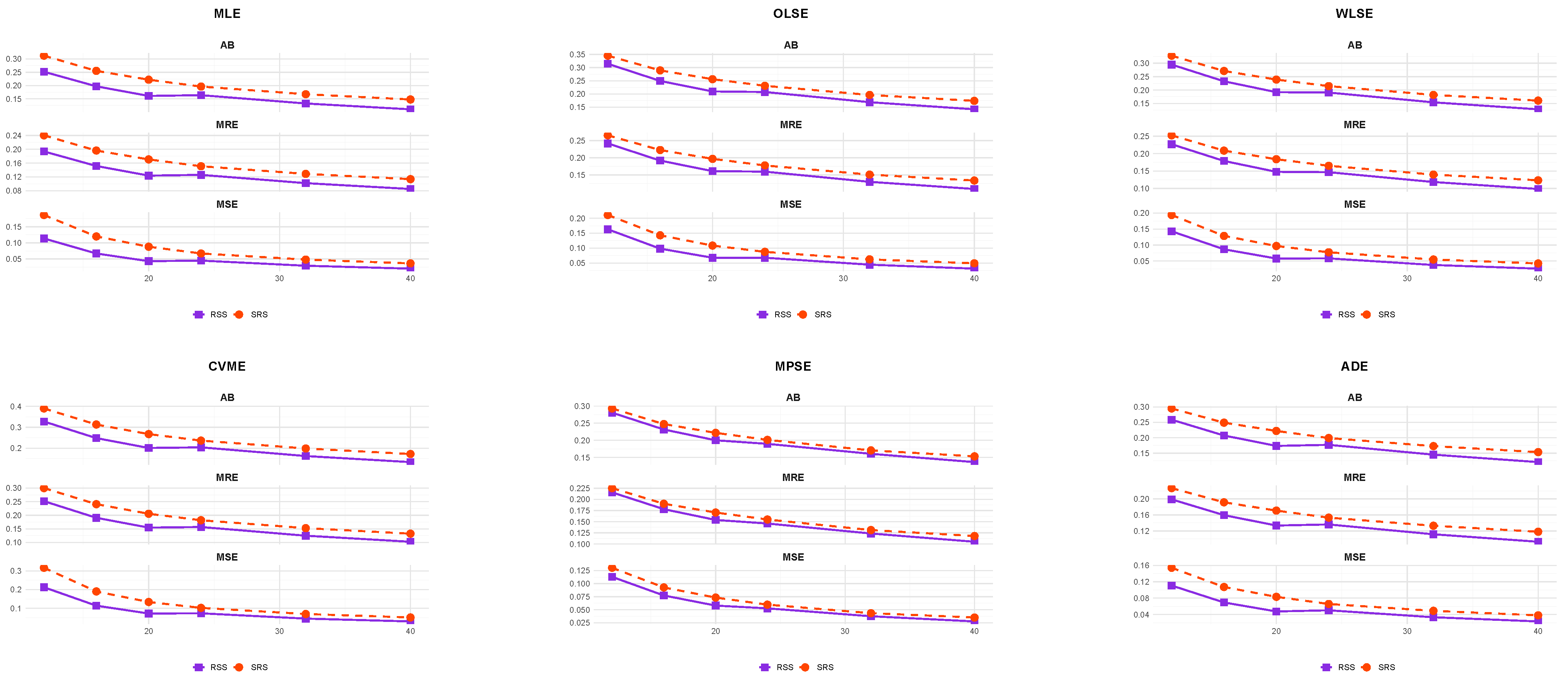
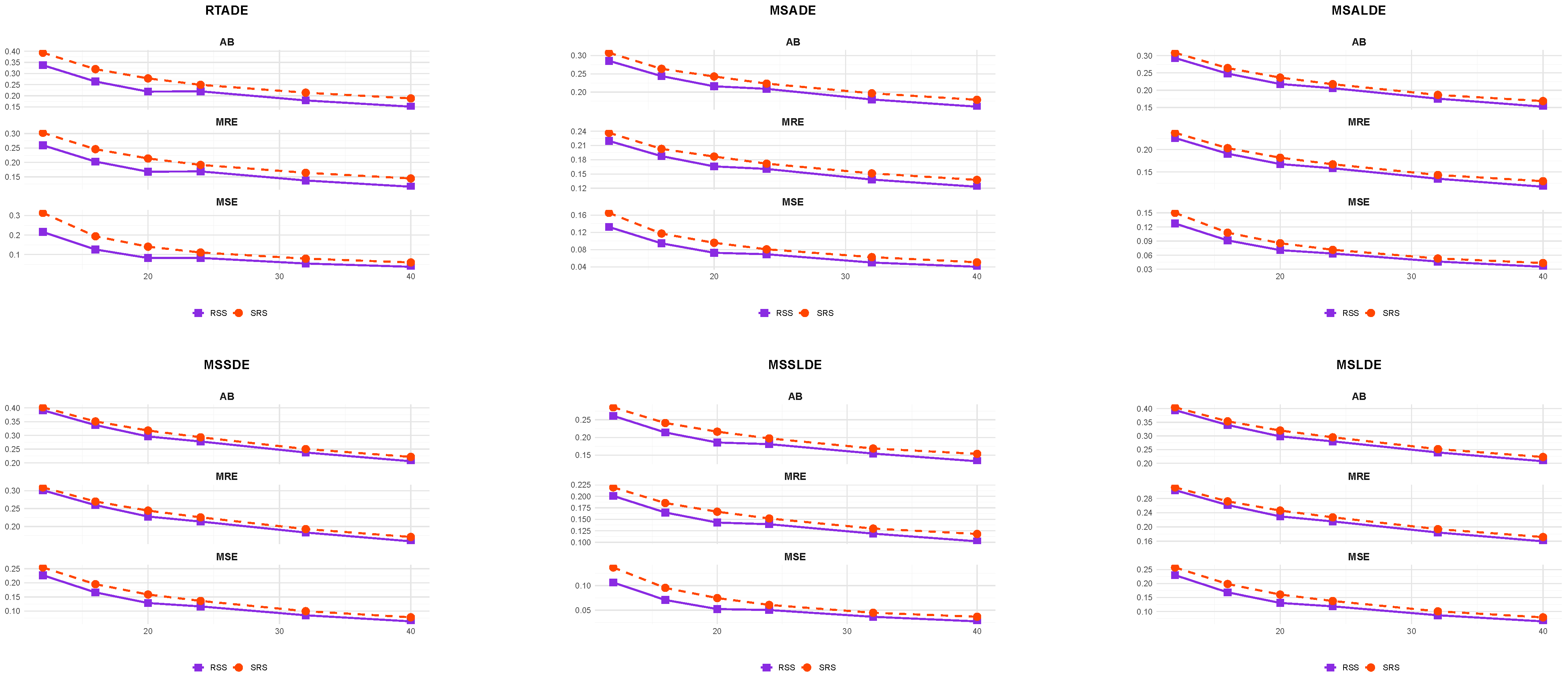
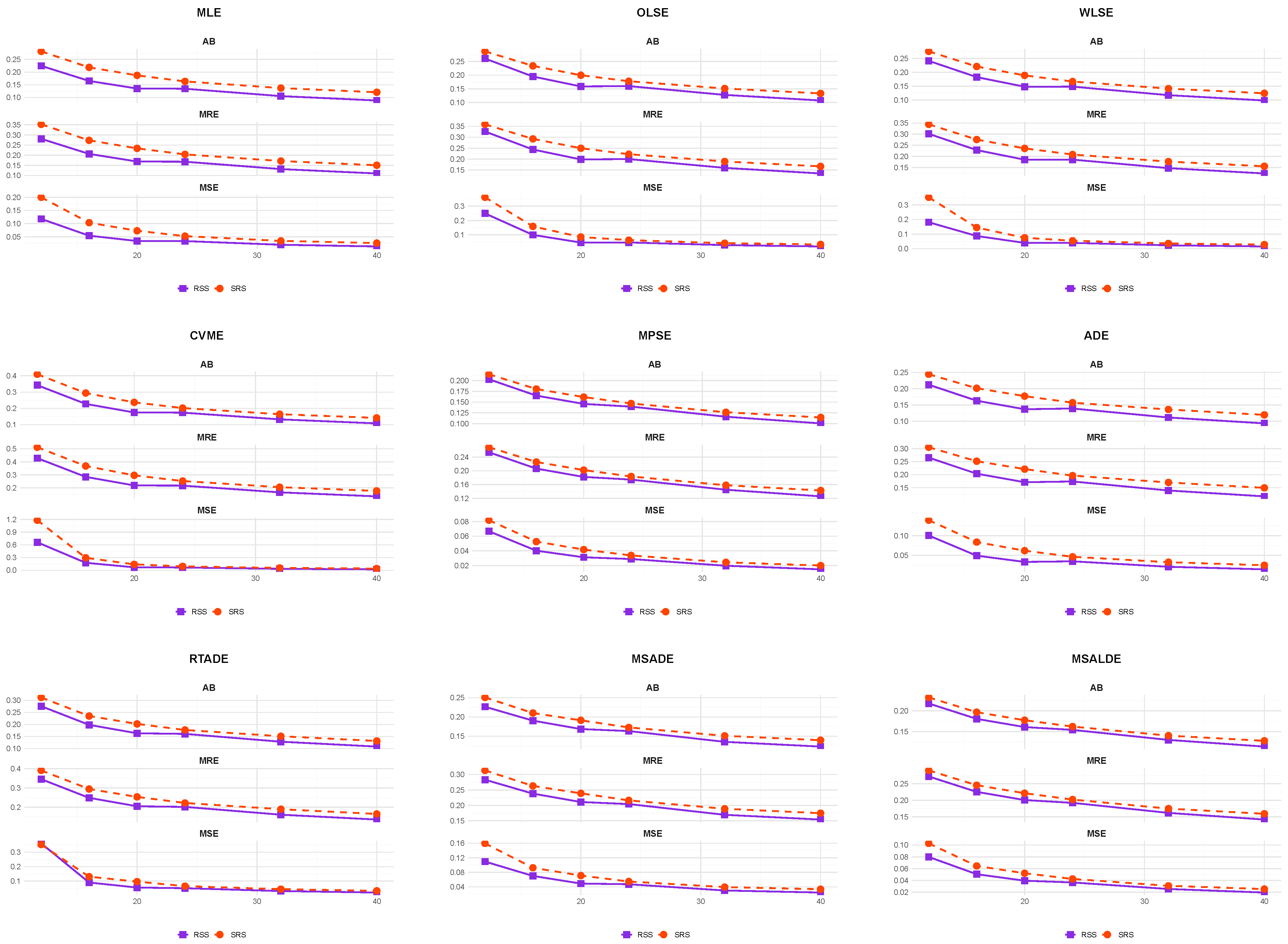
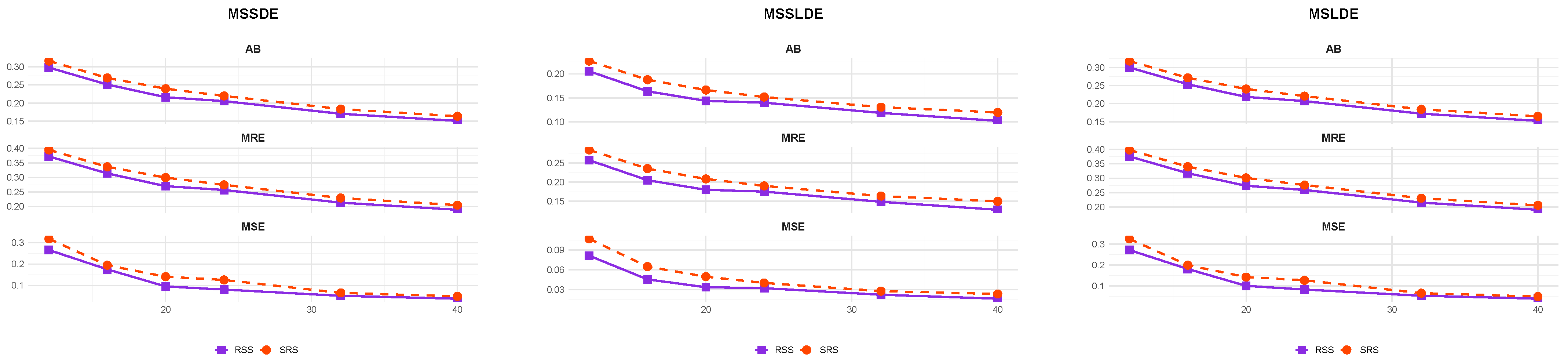
In this section, performance metrics are tabulated across comprehensive tables for analysis. Also, ranking tables provide comparative performance assessment for both SRS and RSS approaches, derived from individual metric rankings across all sample sizes, and efficiency comparison tables present MSE ratios between SRS and RSS methods. Table 1, Table 2 and Table 3 summarize the simulation results for α = 1.3 and λ = 0.8 under SRS, RSS, and their relative efficiency, respectively. Also, the results are plotted in Figure 4 and Figure 5 for more illustration.
Under SRS (Table 1), all estimators are consistent, with AB and MSE decreasing monotonically as N increases. The reduction is more pronounced for MSE than for AB, and convergence is faster for α than for λ , reflecting the greater difficulty of estimating the scale parameter. Among all methods, MPSE consistently achieves the lowest Rank across all configurations, establishing it as the most reliable estimator under SRS, followed closely by MSSLDE. At the other extreme, CVME and MSLDE are persistently the weakest performers, exhibiting particularly large MSE values for λ at small sample sizes, which strongly suggests their unsuitability for the model under study. MLE occupies a middling position under SRS, with performance improving progressively as N increases, consistent with its well-known asymptotic efficiency properties. Furthermore, AE values for α are systematically above the true value across all methods, indicating a persistent positive bias, while the bias behavior for λ is less uniform and varies across estimators and sample sizes.
Under RSS (Table 2), a marked shift in the relative performance of estimators is observed. MLE emerges as the best-performing method in nearly every configuration, with substantially improved Rank values relative to SRS, followed by ADE. This reversal carries an important practical implication: the choice of estimation method should explicitly account for the sampling design employed, as the best-performing estimator under SRS does not necessarily retain that advantage under RSS. Consistent with theory, all estimators achieve lower AB and MSE under RSS than under SRS at equivalent sample sizes, with the improvement being more pronounced in MSE than in AB, reflecting the primary role of RSS as a variance-reduction mechanism. Nevertheless, the magnitude of improvement is not uniform across methods, indicating a non-trivial interaction between the estimation criterion and the sampling design. MSLDE and MSSDE remain the weakest performers under RSS, confirming their unsuitability regardless of the sampling scheme adopted.
Table 3 confirms the uniform superiority of RSS over SRS, with virtually every efficiency value exceeding 1.0 across all methods, sample sizes, and metrics. The sole exception is the MSE-based efficiency of RTADE for λ at N = 3 × 4 , which equals 0.9782 , most plausibly attributable to amplified ranking errors at very small set sizes. MLE registers the largest efficiency gains, with MSE-based relative efficiency reaching 2.0439 at N = 5 × 4 , consistent with its superior performance in Table 2. By contrast, MPSE yields comparatively modest gains, suggesting that it already extracts near-maximum information from unstructured samples. Across all methods, MSE-based efficiencies consistently exceed those based on AB or MARE, as expected given that RSS primarily reduces variance rather than bias. Finally, efficiency gains are found to be more sensitive to increases in set size r than to increases in the number of cycles k, consistent with RSS theory and with the practical recommendation to favor larger set sizes when the cost of ranking is low relative to the cost of measurement.

4. Application

This section demonstrates the practical applicability of the proposed estimation methods through empirical analysis.
In this study, we focus on RSS with perfect ranking to evaluate the performance and efficiency of different estimators without the variability introduced by ranking errors. To illustrate the practical applicability of the model, we analyzed an already available reliability dataset as a representative example. The comparison of parameter estimation under both SRS and RSS designs provides clear insights into the relative performance of the proposed estimation methods. While other datasets could also be used, this choice effectively demonstrates the effectiveness of the estimators in a real-data scenario. Application to data arising directly from sampling designs may be considered as a potential extension.
The dataset analyzed in this study consists of tensile strength measurements, expressed in GPa, for 69 carbon fiber specimens tested under tension at a gauge length of 20 mm [33]. A complete listing of the data values is provided in Table 4. The measurements exhibit moderate variability and range from 1.312 to 3.585, spanning a total range of 2.273 units.
Table 5 presents comprehensive summary statistics that characterize the central tendency, dispersion, and shape of the dataset. The sample mean is 2.451 with a standard deviation of 0.495, indicating moderate variability around the central value. The median value of 2.478 is very close to the mean, suggesting approximate symmetry in the distribution. This observation is further supported by the skewness coefficient of 0.028 , which is nearly zero and indicates minimal asymmetry. The kurtosis value of 2.941 is close to 3, the value expected for a normal distribution, suggesting the data has a distribution with tail behavior similar to the normal distribution.
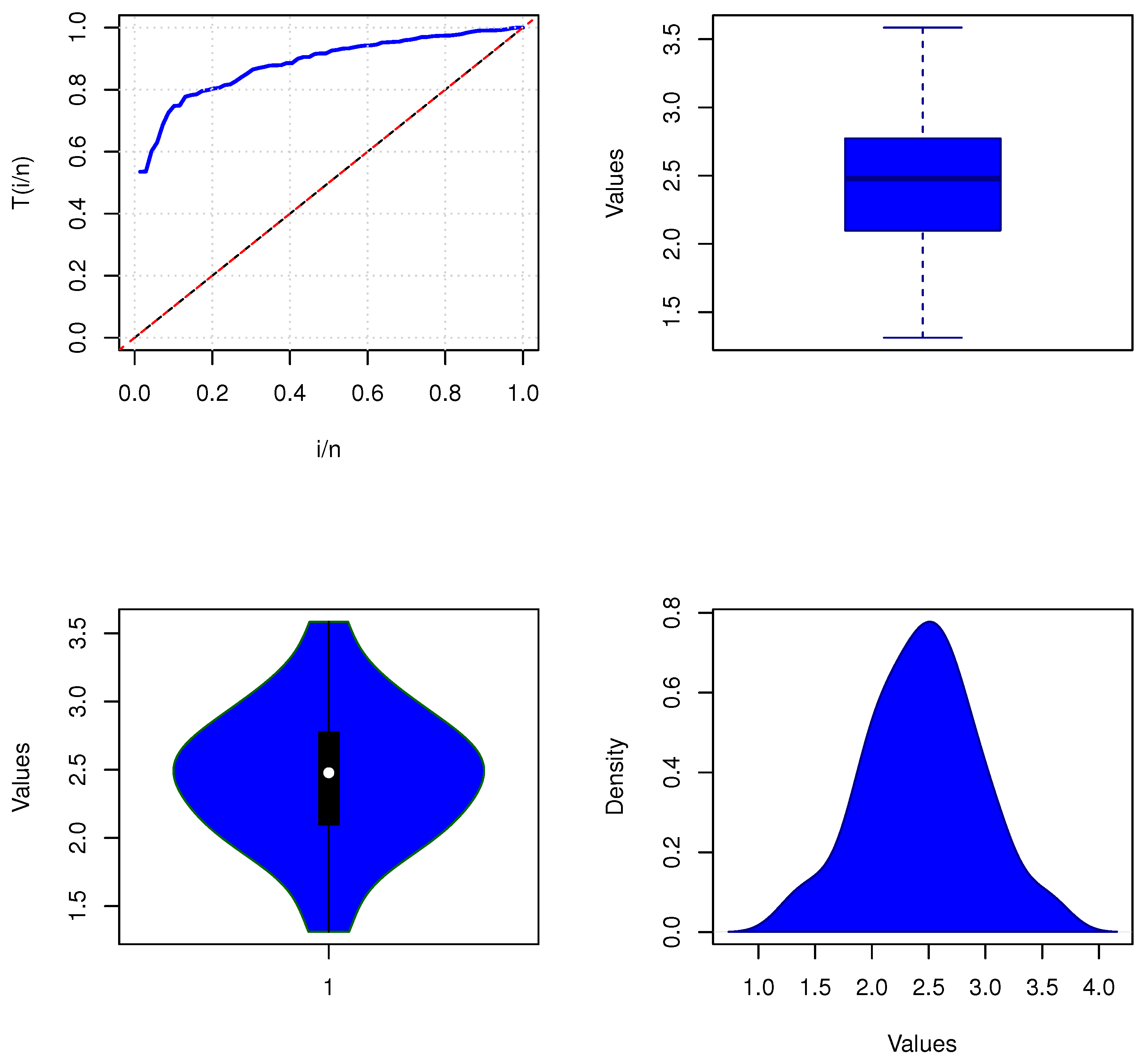
Figure 6 provides a comprehensive graphical overview of the dataset through violin plots, a box plot, kernel density estimation, and a Total Time on Test (TTT) representation. The shape of the hazard rate function is visually assessed using the TTT approach. For a sample of size n, the empirical TTT plot is constructed by plotting T ( i / n ) against i / n , where T ( i / n ) denotes the scaled cumulative total time on test, defined as
T ( i / n ) = j = 1 i X ( j ) + ( n i ) X ( i ) j = 1 n X ( j ) ,
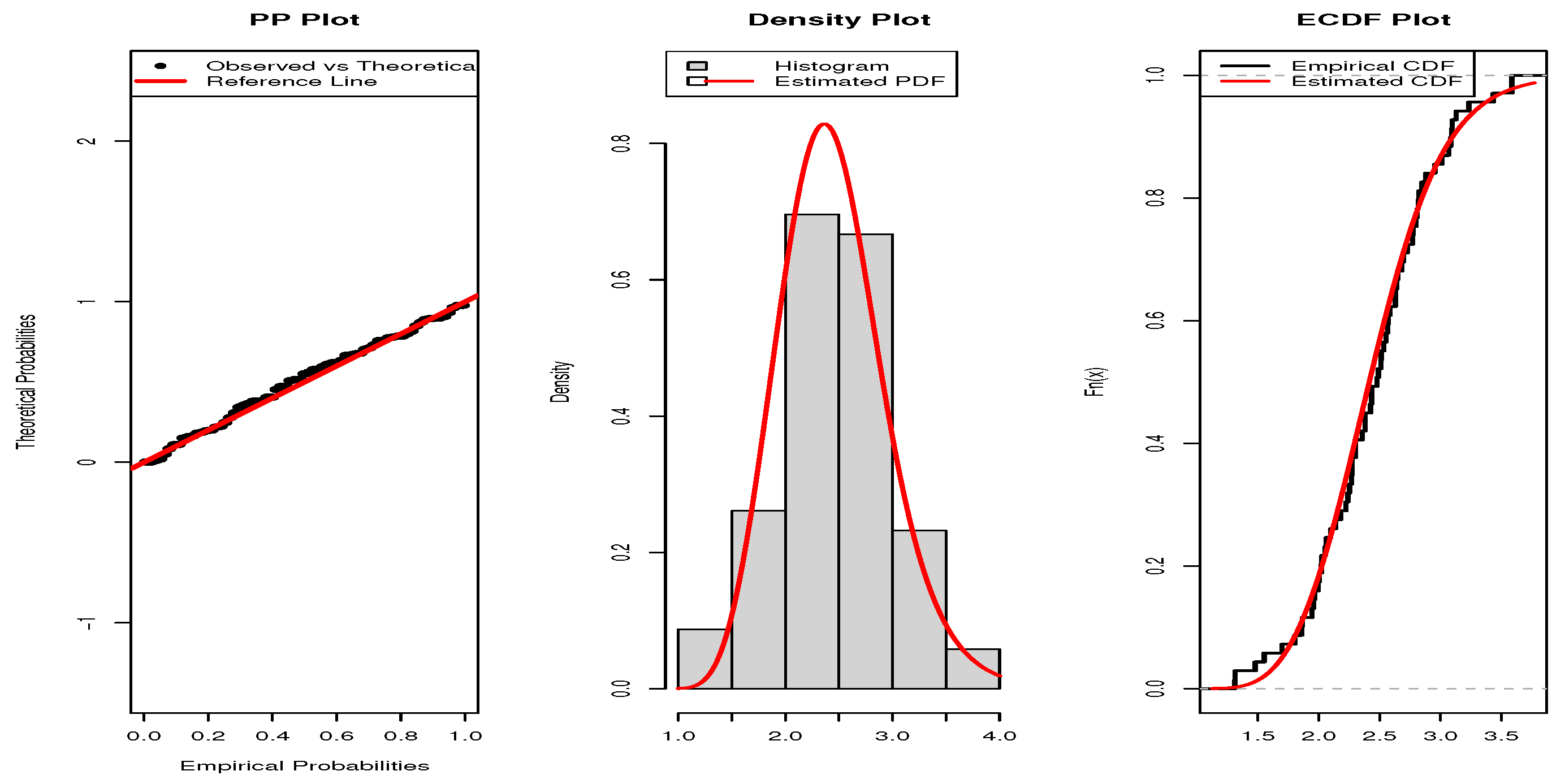
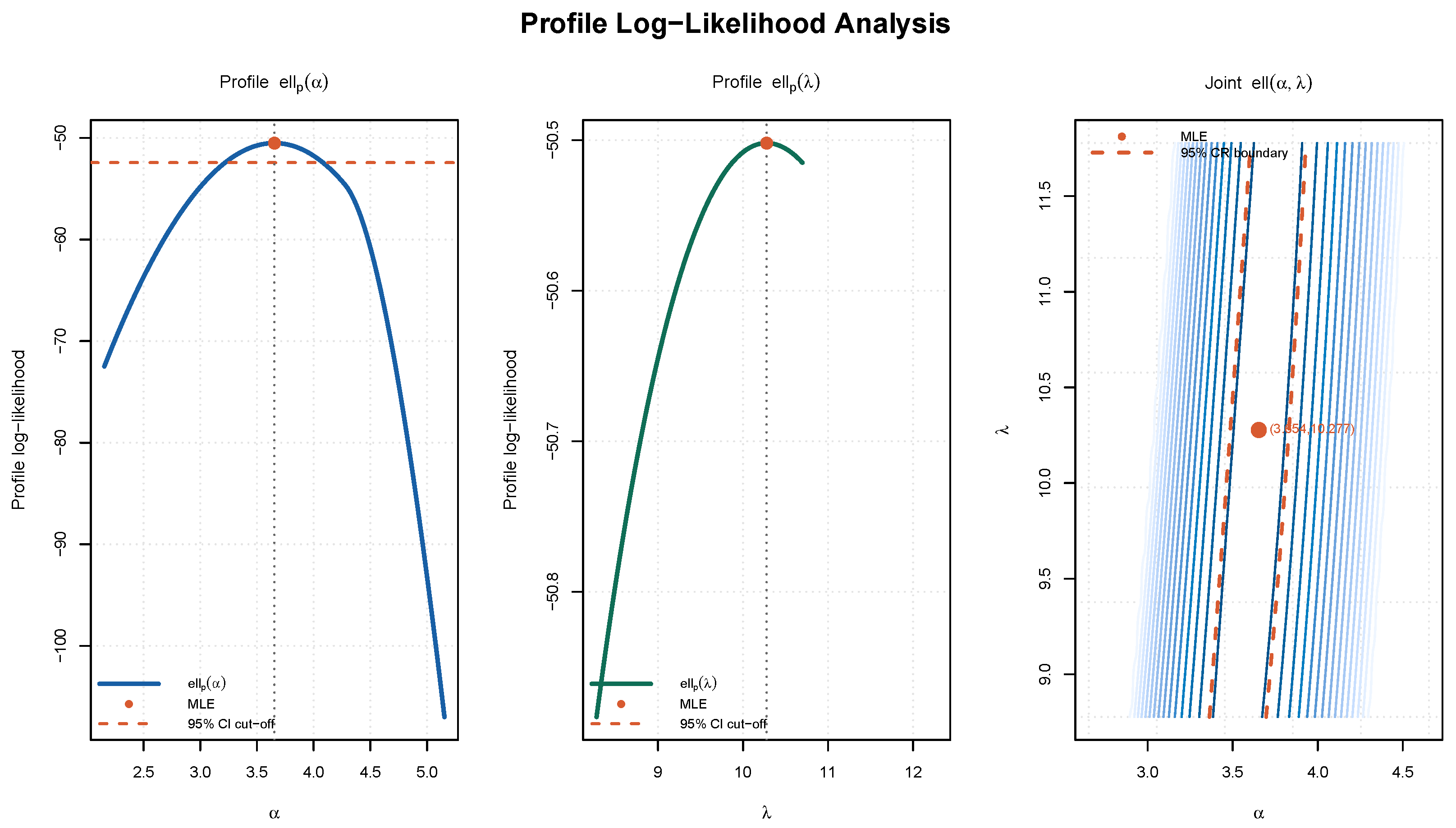
with X ( i ) representing the ith order statistic of the sample. The violin plot reveals the distribution’s symmetry and concentration around the central values. The kernel density estimate shows a unimodal distribution with slight negative skewness, consistent with the computed skewness coefficient. Also, the empirical cumulative distribution function (ECDF), histogram, and Probability–Probability (P–P) plots are presented in Figure 7. The ECDF demonstrates smooth, monotonic growth without sudden jumps or plateaus, indicating no clustering of observations at specific values. Figure 8 shows the profile log-likelihood of the HLIRD based on fiber data.
The Kolmogorov–Smirnov test yielded a test statistic of D = 0.0596 with a corresponding p-value of 0.9668, providing strong evidence that the proposed model fits the data well. This high p-value indicates no significant departure from the theoretical distribution, supporting the model’s adequacy for representing this dataset.
We systematically compared twelve different parameter estimation methods under two sampling designs: SRS and RSS. For each combination of estimation method and sampling design, we estimated the shape parameter θ and scale parameter η of the proposed distribution. The performance of each estimator was evaluated using multiple goodness-of-fit criteria, including the Anderson–Darling (AD) statistic [34], CvM statistic, Kolmogorov–Smirnov (KS) distance, and the associated p-value from the KS test.
Table 6 presents a comprehensive summary of results for all estimation procedures under both sampling schemes, namely RSS and SRS. The methods considered encompass MLE, OLSE, weighted least squares estimation WLSE, CvME, MPSE, ADE, RTADE, and several modified AD variants, including MSADE, MSALDE, MSSDE, MSSLDE, and MSLDE.
For the SRS design, the performance of the estimators varies appreciably. While MSALDE, RTADE, and MSADE yield the largest KS p-values, their superiority is also reflected in relatively smaller AD and CvM statistics, indicating better overall goodness-of-fit. Notably, MSALDE attains the lowest AD (1.7410) and CvM (0.2641) values, demonstrating its robustness among the competing methods. In contrast, MSSDE and MSDE perform poorly, as indicated by their large AD and CvM values and very small p-values, suggesting a clear lack of fit. Classical methods such as MLE and CVME exhibit comparatively weaker performance under SRS, likely due to their sensitivity to deviations from model assumptions. In contrast, tail-sensitive estimators, including RTADE and other Anderson–Darling-type variants, appear more effective in capturing distributional features, particularly in the tails. Under the RSS design, a pronounced improvement is observed across all estimation methods. The goodness-of-fit statistics (AD, CvM, and KS) are substantially reduced, while the associated p-values increase markedly, often approaching unity, indicating excellent agreement between the fitted and theoretical distributions. Among the estimators, RTADE achieves the best performance, with the highest p-value (0.9994) and one of the smallest KS statistics, followed by ADE and MSALDE. Furthermore, estimators that perform relatively poorly under SRS, such as MLE and MPSE, show considerable improvement under RSS, highlighting the efficiency of ranked set sampling. This improvement is attributable to the additional information provided by the ranking process, which reduces variability and enhances sample representativeness. Overall, the differences among estimators become less pronounced under RSS. Although some methods retain a slight advantage, the performance gap narrows substantially, indicating that the sampling design plays a more influential role than the choice of estimation method in determining estimation accuracy.
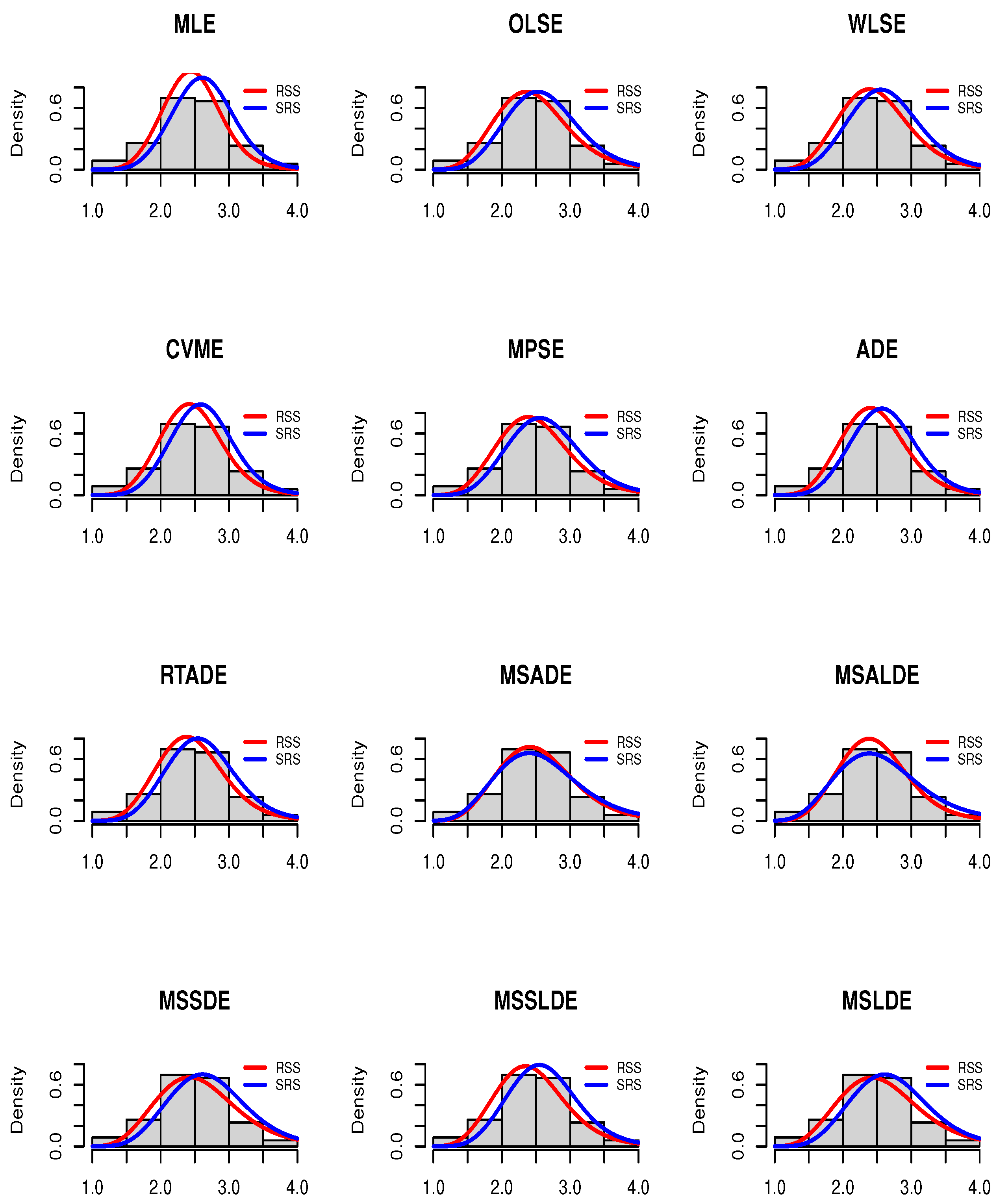
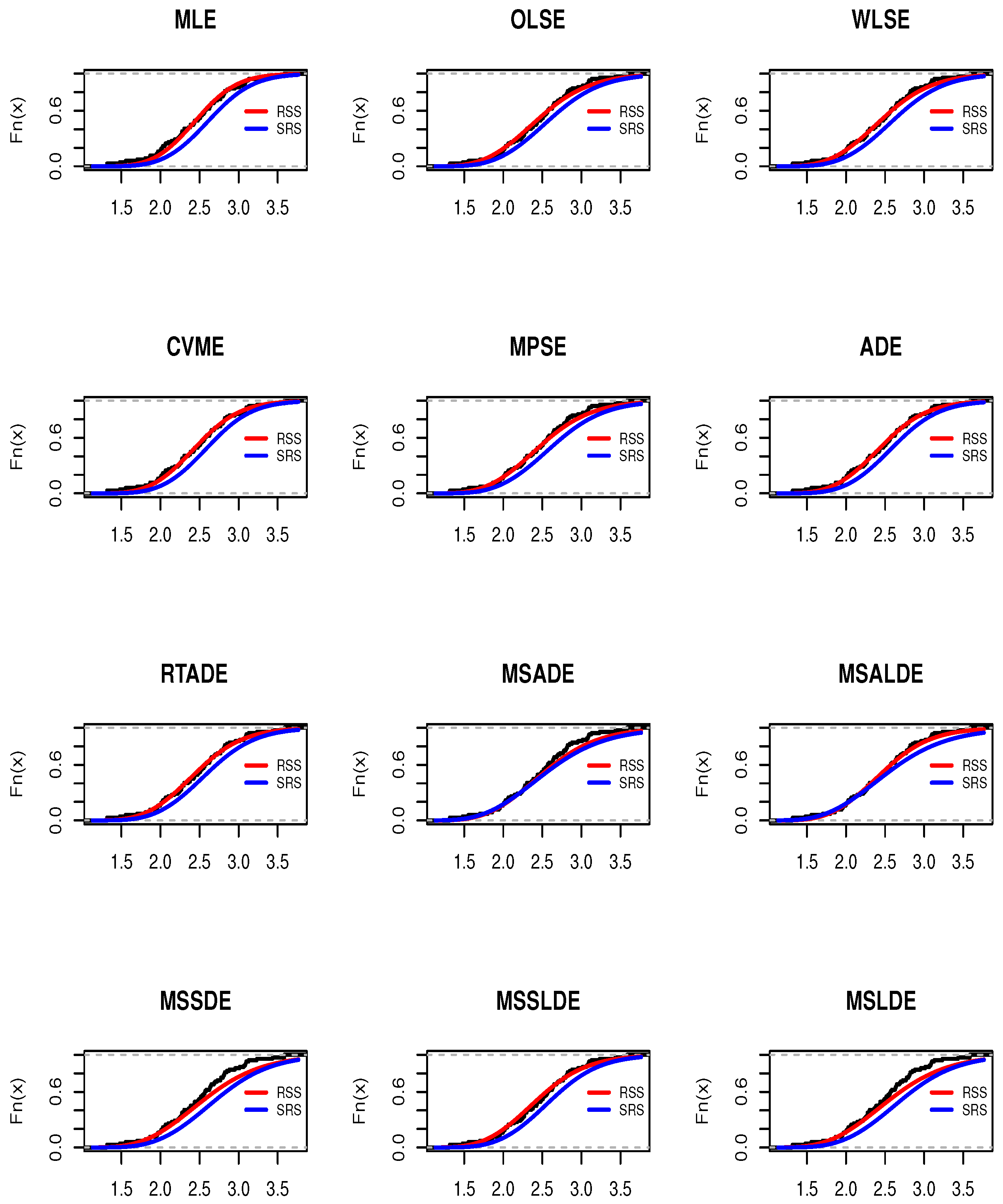
The superiority of RSS is further illustrated in Figure 9 and Figure 10, which display the fitted probability density functions and cumulative distribution functions for selected estimation methods under both sampling schemes. The RSS-based estimates demonstrate closer adherence to the empirical distribution across the entire support, particularly in the tails where differences between methods are most pronounced.

5. Conclusions

This study presented a comparative analysis of several parameter estimation methods for the HLIRD under both SRS and RSS designs, encompassing MLE, OLSE, WLSE, CVME, MPSE, ADE, RTADE, MSADE, MSALDE, MSSDE, MSSLDE, and MSLDE.
The simulation results revealed several consistent findings. All estimators are consistent under both schemes, with AB and MSE decreasing monotonically as N increases, and convergence being faster for α than for λ . Under SRS, MPSE consistently emerged as the best-performing estimator, followed by MSSLDE, while CVME and MSLDE were persistently the weakest. A notable shift occurred under RSS, where MLE emerged as the dominant method in nearly every configuration, followed by ADE, overtaking MPSE, which led under SRS. This reversal underscores the important practical implication that the choice of estimation method should explicitly account for the sampling design employed. RSS demonstrated a clear and uniform advantage over SRS across all metrics, with MLE registering the largest efficiency gains, reaching a MSE-based relative efficiency of 2.0439 at N = 5 × 4 . Efficiency gains were also found to be more sensitive to increases in set size r than to increases in the number of cycles k, consistent with RSS theory. These improvements were achieved without increasing the number of measured units, highlighting RSS as a cost-effective sampling strategy.
The real data analysis on 69 carbon fibers further validated these findings, with the HLIRD providing an excellent fit to the tensile-strength data and RSS-based estimators demonstrating superior precision and stability over their SRS counterparts, confirming the practical relevance of the proposed framework.
Overall, the results strongly support the integration of RSS with HLIRD modeling in reliability analysis and materials engineering, where precise estimation is critical and data collection may be costly. Future research directions include the development of Bayesian and shrinkage-based estimators, the construction of confidence intervals under RSS, and the extension of the HLIRD through truncated or weighted approaches. The HLIRD parameters may also be estimated using other RSS variants such as paired double RSS [11] and multistage RSS [35].

Author Contributions

Conceptualization, A.I.A.-O., S.A.B. and G.A.; methodology, A.I.A.-O., S.A.B. and G.A.; software, A.I.A.-O. and S.A.B.; validation, A.I.A.-O., S.A.B. and G.A.; formal analysis, A.I.A.-O., S.A.B. and G.A.; investigation, A.I.A.-O. and S.A.B.; resources, A.I.A.-O., S.A.B. and G.A.; data curation, A.I.A.-O., S.A.B. and G.A.; writing—original draft preparation, A.I.A.-O., S.A.B. and G.A.; writing—review and editing, A.I.A.-O., S.A.B. and G.A.; visualization, A.I.A.-O., S.A.B. and G.A.; funding acquisition, G.A. All authors have read and agreed to the published version of the manuscript.

Funding

This research was funded by Princess Nourah bint Abdulrahman University Researchers Supporting Project number PNURSP2026R226.

Data Availability Statement

The original contributions presented in this study are included in the article. Further inquiries can be directed to the corresponding author.

Acknowledgments

The authors express their gratitude to Princess Nourah bint Abdulrahman University Researchers Supporting Project number (PNURSP2026R226), Princess Nourah bint Abdulrahman University, Riyadh, Saudi Arabia.

Conflicts of Interest

The authors declare no conflicts of interest to report regarding the present study.

References

  1. Trayer, V. Inverse Rayleigh (ir) Model. In Proceedings of the Academy of Science, Doklady Akad, Nauk Belarus, USSR; Nauka i Tekhnika: Minsk, Belarus, 1964. [Google Scholar]
  2. Khan, M.S. Modified inverse Rayleigh distribution. Int. J. Comput. Appl. 2014, 87, 28–33. [Google Scholar] [CrossRef]
  3. Shala, M.; Merovci, F. A new three-parameter inverse Rayleigh distribution: Simulation and application to real data. Symmetry 2024, 16, 634. [Google Scholar] [CrossRef]
  4. Ahmed, H.A.; Eidi, J.H.; Salih, M.A.M. Goodness-of-fit test for estimates reliability of the modified inverse Rayleigh distribution by simulation. AIP Conf. Proc. 2025, 3264, 050129. [Google Scholar]
  5. Cordeiro, G.M.; Alizadeh, M.; Marinho, E.P.R.D. The Type I Half-Logistic Family of Distributions. J. Stat. Comput. Simul. 2016, 86, 707–728. [Google Scholar] [CrossRef]
  6. Almarashi, A.M.; Badr, M.M.; Elgarhy, M.; Jamal, F.; Chesneau, C. Statistical Inference of the Half-Logistic Inverse Rayleigh Distribution. Entropy 2020, 22, 449. [Google Scholar] [CrossRef]
  7. Shrahili, M.; Elbatal, I.; Elgarhy, M. Sine Half-Logistic Inverse Rayleigh Distribution: Properties, Estimation, and Applications in Biomedical Data. J. Math. 2021, 2021, 4220479. [Google Scholar] [CrossRef]
  8. Oseghale, O.; Micah, E.S. Half Logistic Generalized Inverse Rayleigh Distribution for Modeling Breast Cancer Data. Int. J. Math. Anal. Model. 2025, 7, 589–606. [Google Scholar]
  9. McIntyre, G.A. A method of unbiased selective sampling, using ranked sets. Aust. J. Agric. Res. 1952, 3, 385–390. [Google Scholar] [CrossRef]
  10. Al-Omari, A.I.; Bouza, C.N. Review of ranked set sampling: Modifications and applications. Rev. Investig. Oper. 2014, 35, 215–240. [Google Scholar]
  11. Haq, A.; Brown, J.; Moltchanova, E.; Ibrahim Al-Omari, A.I. Best linear unbiased and invariant estimation in location-scale families based on double-ranked set sampling. Commun. -Stat.-Theory Methods 2016, 45, 25–48. [Google Scholar] [CrossRef]
  12. Al-Omari, A.I.; Benchiha, S.; Almanjahie, I.M. Efficient estimation of the generalized Quasi-Lindley distribution parameters under ranked set sampling and applications. Math. Probl. Eng. 2021, 2021, 9982397. [Google Scholar] [CrossRef]
  13. Jiang, H.; Gui, W. Bayesian inference for the parameters of Kumaraswamy distribution via ranked set sampling. Symmetry 2021, 13, 1170. [Google Scholar] [CrossRef]
  14. Al-Omari, A.I.; Abdallah, M.S. Estimation of the distribution function using moving extreme and MiniMax ranked set sampling. Commun.-Stat.-Simul. Comput. 2023, 52, 1909–1925. [Google Scholar] [CrossRef]
  15. Irshad, M.; Maya, R.; Al-Omari, A.I.; Hanandeh, A.A.; Arun, S. Estimation of a parameter of farlie-Gumbel-Morgenstern bivariate Bilal distribution by ranked set sampling. Reliab. Theory Appl. 2023, 18, 129–140. [Google Scholar]
  16. Kumari, A.; Singh, R.; Smarandache, F. New modification of ranked set sampling for estimating population mean: Neutrosophic median ranked set sampling with an application to demographic data. Int. J. Comput. Intell. Syst. 2024, 17, 210. [Google Scholar] [CrossRef]
  17. Aljohani, H.M. Statistical inference for a novel distribution using ranked set sampling with applications. Heliyon 2024, 10, e26893. [Google Scholar] [CrossRef]
  18. Zubair, M.; Yasin, S.; Al-Bossly, A.; Ali, A.; Al Samman, F.M.; A. Almazah, M.M.; Iqbal, K. Double extreme-cum-median ranked set sampling. PloS ONE 2024, 19, e0312140. [Google Scholar] [CrossRef]
  19. Alomani, G.; Benchiha, S.A.; Al-Omari, A.I. Estimation of the inverse power Lindley distribution parameters using ranked set sampling with an application to failure time data. Axioms 2025, 14, 801. [Google Scholar] [CrossRef]
  20. Newer, H.A.; Alanazi, B.S. Bayesian estimation and prediction for linear exponential models using ordered moving extremes ranked set sampling in medical data. AIMS Math. 2025, 10, 1162–1182. [Google Scholar] [CrossRef]
  21. Bhushan, S.; Kumar, A. Imputation of missing data using multi auxiliary information under ranked set sampling. Commun.-Stat.-Simul. Comput. 2025, 54, 1500–1521. [Google Scholar] [CrossRef]
  22. Alliu, I.; Yu, L.; Samawi, H.; Kersey, J. Optimizing Sample Size for Accelerated Failure Time Model in Progressive Type-II Censoring through Rank Set Sampling. Int. J. Stat. Med. Res. 2025, 14, 86–99. [Google Scholar] [CrossRef]
  23. Tatlı, Ş.D.; Gül, H.H. Maximum Likelihood Estimation of The Unit Gompertz Distribution Using Median Ranked Set Sampling. Bitlis Eren Üniv. Fen Bilimleri Dergisi 2026, 15, 123–136. [Google Scholar] [CrossRef]
  24. GUL, H.H.; Yeniay Koçer, N. Estimation of the Gompertz distribution’s parameters under folded ranked set sampling. Sigma J. Eng. Nat. Sci. 2025, 43, 737–747. [Google Scholar] [CrossRef]
  25. Hassan, N.M.; Rady, E.H.A.; Rashwan, N.I. L-moments method to estimate Gamma/Gompertz distribution based on ranked set sampling designs. J. Math. Comput. Sci. 2021, 11, 8221–8239. [Google Scholar]
  26. Swain, J.J.; Venkatraman, S.; Wilson, J.R. Least-squares estimation of distribution functions in Johnson’s translation system. J. Stat. Comput. Simul. 1988, 29, 271–297. [Google Scholar] [CrossRef]
  27. Cramér, H. On the composition of elementary errors. Scand. Actuar. J. 1928, 1, 13–74. [Google Scholar] [CrossRef]
  28. von Mises, R. Wahrscheinlichkeit, Statistik und Wahrheit [Probability, Statistics and Truth]. Verlag von Julius Springer, Wien.]; Julius Springer: Vienna, Austria, 1928. [Google Scholar] [CrossRef]
  29. Anderson, T.W.; Darling, D.A. Asymptotic theory of certain goodness-of-fit criteria based on stochastic processes. Ann. Math. Stat. 1952, 23, 193–212. [Google Scholar] [CrossRef]
  30. Anderson, T.W.; Darling, D.A. A test of goodness of fit. J. Am. Stat. Assoc. 1954, 49, 765–769. [Google Scholar] [CrossRef]
  31. Cheng, R.C.H.; Amin, N.A.K. Estimating parameters in continuous univariate distributions with a shifted origin. J. R. Stat. Soc. Ser. B Methodol. 1983, 45, 394–403. [Google Scholar] [CrossRef]
  32. Ranneby, B. The maximum spacing method: An estimation method related to the maximum likelihood method. Scand. J. Stat. 1984, 11, 93–112. [Google Scholar]
  33. Bader, M.G.; Priest, A.M. Statistical aspects of fibre and bundle strength in hybrid composites. In Progress in Science and Engineering of Composites, ICCM-IV, Tokyo; Hayashi, T., Kawata, K., Umekawa, S., Eds.; Elsevier Science Publishers: Amsterdam, The Netherlands, 1982; pp. 1129–1136. [Google Scholar]
  34. Pettitt, A.N. A two-sample Anderson-Darling rank statistic. Biometrika 1976, 63, 161–168. [Google Scholar]
  35. Al-Saleh, M.; Al-Omari, A. Multistage ranked set sampling. J. Stat. Plan. Inference 2002, 102, 273–286. [Google Scholar] [CrossRef]
Figure 1. Pdf shapes of the HLIRD for some λ , α .
Mathematics 14 01281 g001
Figure 2. The pdf contour shapes of the HLIRD for some values of λ , α .
Mathematics 14 01281 g002
Figure 3. The hazard function of the HLIRD plots for some λ , α .
Mathematics 14 01281 g003
Figure 4. Comparison between SRS and RSS for estimating α .
Mathematics 14 01281 g004aMathematics 14 01281 g004b
Figure 5. Comparison between SRS and RSS for estimating λ .
Mathematics 14 01281 g005aMathematics 14 01281 g005b
Figure 6. The TTT, box, violin and density plots for the real dataset.
Mathematics 14 01281 g006
Figure 7. The PP, histogram, and ECDF plots based on the real data.
Mathematics 14 01281 g007
Figure 8. Profile Log–Likelihood of the HLIRD based on fiber data.
Mathematics 14 01281 g008
Figure 9. The pdf plots using SRS and RSS based on different estimation methods.
Mathematics 14 01281 g009
Figure 10. The CDF plots using SRS and RSS based on different estimation methods.
Mathematics 14 01281 g010
Table 1. Simulation performance metrics for α = 1.3 , λ = 0.8 under SRS.
NParametersMLEOLSEWLSECVMEMPSEADERTADEMSADEMSALDEMSSDEMSSLDEMSLDE
3 ×4AE( α )1.47141.29091.30361.52981.19181.35291.44401.28131.21621.14521.28761.1459
AB( α )0.312360.345280.328270.389890.292920.295030.3932100.307740.308550.4022110.285310.404812
MSE( α )0.186560.210880.194070.3167120.130310.153940.3138110.165250.149930.254390.136820.257410
MARE( α )0.240360.265580.252470.299890.225320.226930.3025100.236740.237350.3094110.219410.311312
AE( λ )0.97900.85550.86061.10270.74370.87950.95610.82390.76100.76340.81780.7656
AB( λ )0.281970.287480.275360.4096120.214810.244140.312290.250650.232230.3157100.227120.318411
MSE( λ )0.200260.3621110.352291.1838120.081910.139540.3540100.159650.102820.318770.107030.32458
MARE( λ )0.352470.359380.344260.5121120.268510.305140.390390.313250.290330.3946100.283920.398011
∑ Rank38514266822592521581164
3 × 8AE( α )1.37531.28761.30261.41381.20911.31921.35601.26551.22031.18301.26611.1825
AB( α )0.196210.231080.214750.236390.201440.199130.2489100.223270.217460.2932110.197420.295212
MSE( α )0.067040.087680.077360.102390.059810.065730.1104100.080770.071550.1360110.060720.137512
MARE( α )0.150910.177780.165150.181890.155040.153230.1915100.171770.167260.2255110.151820.227112
AE( λ )0.87460.81420.82210.91860.74510.83260.85550.78920.75680.75030.78900.7503
AB( λ )0.163350.177890.166660.2021100.146810.157030.177380.172970.161940.2196110.151920.221112
MSE( λ )0.052450.062680.054760.0908100.033710.046440.064490.054760.042530.1257110.040120.127012
MARE( λ )0.204150.222390.208260.2527100.183510.196330.221680.216170.202340.2745110.189920.276312
∑ Rank215034571219554128661272
4 ×4AE( α )1.42571.29451.30821.47561.20001.34041.39851.27511.21721.16341.27731.1629
AB( α )0.255240.289580.271270.313190.247420.248930.3196100.263750.264260.3509110.241010.353612
MSE( α )0.119960.143080.128670.190390.092710.107130.1937100.117250.107940.1951110.095320.198312
MARE( α )0.196340.222780.208670.240990.190320.191530.2459100.202950.203260.2699110.185410.272012
AE( λ )0.92290.83650.84211.00000.74120.85710.89610.80480.75520.75470.80000.7556
AB( λ )0.218760.234180.220670.2943120.180510.201240.235290.210350.196630.2693100.188020.271811
MSE( λ )0.103660.158890.145280.2940120.052610.083840.130370.092550.064520.1948100.064830.198911
MARE( λ )0.273460.292680.275770.3679120.225610.251540.294090.262950.245730.3366100.235020.339811
∑ Rank32494363821553024631169
4 × 8AE( α )1.36301.29651.31021.39471.22781.32201.35001.27171.23781.19971.27371.1989
AB( α )0.167410.196370.181950.198690.170730.172940.2136100.196780.186460.2505110.168820.251912
MSE( α )0.048030.062470.054660.069690.043510.049040.0789100.062680.053150.0997110.044720.100612
MARE( α )0.128810.151070.139950.152890.131330.133040.1643100.151380.143460.1927110.129820.193812
AE( λ )0.85720.81080.81890.88980.75360.82690.84390.78850.76420.74720.78750.7470
AB( λ )0.137040.151170.141160.1645100.126410.136130.151390.151280.140050.1834110.130720.184512
MSE( λ )0.034350.041380.036260.0538100.024310.032640.043490.039470.030830.0647110.027720.065612
MARE( λ )0.171340.188970.176460.2056100.158010.170130.189290.189080.175050.2293110.163420.230712
∑ Rank184334571012574730661272
5 × 4AE( α )1.39711.29121.30511.43841.20611.32991.37501.26691.21961.16961.27391.1687
AB( α )0.222030.256180.239160.267390.221820.222140.2779100.242770.236550.3178110.216410.319912
MSE( α )0.088050.108680.096970.133890.073310.083130.1402100.095860.085540.1586110.074620.160512
MARE( α )0.170730.197080.183960.205690.170620.170840.2138100.186770.181950.2444110.166510.246112
AE( λ )0.89710.82350.83040.95030.74560.84570.87560.79730.75750.74970.79540.7496
AB( λ )0.187150.199880.188760.2372100.161710.177030.202590.191370.177240.2395110.166520.240912
MSE( λ )0.072960.084580.075270.1391100.041710.061940.095890.071150.052130.1411110.049620.142312
MARE( λ )0.233950.249780.235860.2965100.202110.221330.253190.239170.221540.2994110.208120.301112
∑ Rank27483857821573923661072
5 × 8AE( α )1.34461.29201.30471.37261.23091.31141.33271.26771.23991.20621.26891.2060
AB( α )0.147610.174080.160650.172170.153420.153420.1880100.178990.168560.2218110.153640.223012
MSE( α )0.036220.049370.042350.051390.035210.038140.0593100.050680.043460.0781110.036630.079012
MARE( α )0.113610.133880.123550.132470.118020.118020.1446100.137690.129660.1706110.118140.171612
AE( λ )0.84550.80920.81700.87330.75850.82120.83380.78910.76530.75330.78620.7536
AB( λ )0.120540.133180.124350.1417100.114310.119620.131870.139890.127560.1636110.119730.164812
MSE( λ )0.026150.032680.028360.0396100.019910.024830.031970.033590.025340.0488110.023320.049612
MARE( λ )0.150640.166480.155350.1771100.142810.149520.164770.174790.159460.2046110.149630.206012
∑ Rank14473153815515334661972
Table 2. Simulation performance metrics for α = 1.3 , λ = 0.8 under RSS.
NParametersMLEOLSEWLSECVMEMPSEADERTADEMSADEMSALDEMSSDEMSSLDEMSLDE
3 × 4AE( α )1.41771.22901.24021.45751.14571.29851.37411.23811.17031.09521.23861.0952
AB( α )0.251810.314580.295070.327390.280540.258520.3371100.285550.293360.3916110.261130.394512
MSE( α )0.113640.163080.143070.212590.112930.110620.2159100.132560.127350.2267110.106310.229912
MARE( α )0.193710.241980.226970.251890.215740.198820.2593100.219650.225760.3013110.200830.303512
AE( λ )0.92730.80620.80411.02670.70960.83440.90350.78420.72550.71980.78040.7214
AB( λ )0.224750.261080.241170.3426120.203110.212030.275990.226560.217640.2977100.205720.300411
MSE( λ )0.118060.249480.181570.6612120.066810.100540.3619110.109650.079820.266390.081430.271310
MARE( λ )0.280950.326380.301470.4283120.253910.265130.344990.283160.272040.3721100.257120.375411
∑ Rank224842631416593227621468
3 × 8AE( α )1.35731.26001.27591.38541.19371.29801.32691.24821.20861.15551.25081.1554
AB( α )0.163810.207680.190750.204060.189840.177020.2197100.208890.205870.2779110.181130.280212
MSE( α )0.044910.067970.058250.073490.052740.050320.0826100.069280.063660.1165110.050320.118312
MARE( α )0.126010.159780.146750.156960.146040.136220.1690100.160690.158370.2137110.139330.215512
AE( λ )0.85560.78960.79820.89030.73000.81290.83280.77460.74170.72670.77090.7276
AB( λ )0.134410.159970.148250.1741100.139530.139120.161180.163590.153960.2053110.140040.207312
MSE( λ )0.033630.046470.040160.0644100.028810.034840.050090.047280.036550.0805110.032220.082912
MARE( λ )0.168010.199970.185350.2176100.174430.173920.201380.204390.192460.2567110.175040.259212
∑ Rank84431511914555237661872
4 × 4AE( α )1.37761.23201.24711.40831.16141.29021.33871.23211.18371.10731.24121.1067
AB( α )0.197110.249590.232750.248170.231640.207320.2639100.243860.248170.3376110.214230.340112
MSE( α )0.067010.098380.086650.114290.077340.069420.1259100.094570.091560.1661110.070730.168512
MARE( α )0.151710.191990.179050.190870.178140.159520.2030100.187660.190870.2597110.164830.261612
AE( λ )0.88070.78240.78930.93200.71190.81410.85090.76990.72840.70880.77020.7104
AB( λ )0.165240.195180.182660.2277100.165130.163010.198590.190570.180550.2510110.163920.253912
MSE( λ )0.054150.099290.087470.1762110.040210.049230.089780.070160.050540.1754100.045520.180812
MARE( λ )0.206540.243880.228360.2846100.206430.203810.248290.238170.225650.3138110.204820.317312
∑ Rank165134541711563934651572
4 × 8AE( α )1.33871.26661.28001.36301.20681.29561.31831.24561.21861.16761.25531.1675
AB( α )0.132610.168970.154230.162560.160750.145220.178990.1798100.175580.2378110.154540.239612
MSE( α )0.029010.044760.037540.045070.037650.033420.0538100.050090.046680.0852110.036530.086512
MARE( α )0.102010.130070.118630.125060.123650.111720.137690.1383100.135080.1830110.118840.184312
AE( λ )0.83720.78690.79500.86270.73710.80580.82140.76960.74840.72390.77180.7246
AB( λ )0.105310.127760.117540.132890.116030.111620.128770.1356100.129780.1705110.118750.172412
MSE( λ )0.019610.027870.023450.0338100.019610.020930.030290.030080.025460.0511110.022240.053312
MARE( λ )0.131610.159660.146940.166090.145030.139420.160970.1695100.162180.2132110.148450.215512
∑ Rank63923472213515746662572
5 × 4AE( α )1.35461.23651.25151.38111.16991.28371.31711.22951.18671.12161.23781.1214
AB( α )0.161010.209670.192140.201160.200250.173620.2184100.215980.218090.2962110.185830.298512
MSE( α )0.043110.067960.057740.072380.058050.047520.0821100.072690.070870.1285110.052330.130612
MARE( α )0.123810.161270.147840.154760.154050.133520.1680100.166080.167790.2278110.142930.229612
AE( λ )0.85680.77350.78190.89050.71510.80370.82850.76290.72740.70650.76340.7083
AB( λ )0.135210.158760.147950.1751100.145840.136920.163680.168790.160770.2160110.143830.218912
MSE( λ )0.034040.045970.040160.0690100.031210.033320.054790.049180.039550.0951110.033630.100412
MARE( λ )0.169010.198360.184850.2189100.182240.171120.204680.210990.200970.2700110.179730.273712
∑ Rank63928502412555144661872
5 × 8AE( α )1.32761.26871.28161.34851.21591.29311.31061.25001.22631.18201.25501.1818
AB( α )0.110610.141870.128130.133550.136660.121020.150880.1601100.152390.2060110.132740.207412
MSE( α )0.019910.031470.026030.030060.027750.023220.037090.0401100.035480.0636110.027240.064612
MARE( α )0.085110.109170.098630.102750.105160.093020.116080.1232100.117290.1584110.102140.159512
AE( λ )0.82640.78420.79260.84620.74250.80090.81260.76970.75090.72960.77110.7301
AB( λ )0.088010.107160.098330.108170.100540.093520.108580.1233100.113690.1509110.102050.152412
MSE( λ )0.013210.018560.015840.021190.014730.014420.020080.0244100.019470.0376110.016250.039212
MARE( λ )0.110010.133960.122930.135170.125740.116920.135780.1541100.142090.1886110.127550.190512
∑ Rank63919392812496051662772
Table 3. The values of the efficiency of RSS relative to SRS for α = 1.3 , λ = 0.8 using several estimation methods.
NParametersMLEOLSEWLSECVMEMPSEADERTADEMSADEMSALDEMSSDEMSSLDEMSLDE
3 × 4AB( α )1.24051.09771.11261.19091.04451.14141.16641.07781.05171.0271.09261.026
MSE( α )1.64261.29291.35641.49031.1551.39111.45381.24641.17731.12151.28621.1197
MARE( α )1.24051.09771.11261.19091.04451.14141.16641.07781.05171.0271.09261.026
AB( λ )1.25471.10111.1421.19561.05761.1511.13161.10641.06711.06051.10421.06
MSE( λ )1.69711.4521.94041.79031.22571.38780.97821.45641.28931.19681.31511.1961
MARE( λ )1.25471.10111.1421.19561.05761.1511.13161.10641.06711.06051.10421.06
3 × 8AB( α )1.19791.11261.12541.15851.06131.1251.13331.06881.05651.05521.09021.0536
MSE( α )1.49061.28981.32841.39321.13471.30641.33651.16631.12481.16731.20731.162
MARE( α )1.19791.11261.12541.15851.06131.1251.13331.06881.05651.05521.09021.0536
AB( λ )1.21491.11181.12381.1611.05221.12861.10051.05771.05181.06971.08531.0663
MSE( λ )1.56021.35121.36331.41021.1691.33421.28651.15961.16471.56161.24871.5315
MARE( λ )1.21491.11181.12381.1611.05221.12861.10051.05771.05181.06971.08531.0663
4 × 4AB( α )1.29451.16031.16561.26211.06831.20061.2111.08161.06491.03931.1251.0398
MSE( α )1.78951.45511.48481.66641.19861.54371.53871.23991.17871.17461.34911.1772
MARE( α )1.29451.16031.16561.26211.06831.20061.2111.08161.06491.03931.1251.0398
AB( λ )1.32431.21.20771.29271.09311.2341.18441.10421.08931.07271.14711.0707
MSE( λ )1.91461.60121.66121.66841.30961.70451.45171.31951.27661.11091.42341.0999
MARE( λ )1.32431.21.20771.29271.09311.2341.18441.10421.08931.07271.14711.0707
4 × 8AB( α )1.26231.1621.17971.22191.06231.19031.19411.0941.06191.05331.09261.0513
MSE( α )1.65351.39571.45541.54791.15721.46671.46851.25071.13981.17061.22591.1627
MARE( α )1.26231.1621.17971.22191.06231.19031.19411.0941.06191.05331.09261.0513
AB( λ )1.30171.18311.2011.23831.08931.21951.17541.11511.07961.07571.10131.0705
MSE( λ )1.75241.48591.54761.59091.23841.5611.43611.31671.2131.26551.24971.2307
MARE( λ )1.30171.18311.2011.23831.08931.21951.17541.11511.07961.07571.10131.0705
5 × 4AB( α )1.37881.22191.24451.32911.10781.27941.27221.12431.08491.07281.1651.0717
MSE( α )2.04391.59941.67911.85151.26411.74841.70751.31961.20731.23461.42761.2295
MARE( α )1.37881.22191.24451.32911.10781.27941.27221.12431.08491.07281.1651.0717
AB( λ )1.38391.25921.27581.35441.1091.29341.23711.13381.10231.1091.15781.1003
MSE( λ )2.14761.84141.87562.01661.33811.86031.75291.44811.31851.48471.47451.4178
MARE( λ )1.38391.25921.27581.35441.1091.29341.23711.13381.10231.1091.15781.1003
5 × 8AB( α )1.33491.22691.25321.28851.12251.2681.24631.11691.10641.07661.15741.0755
MSE( α )1.82041.571.62741.70911.27011.6381.60511.26181.22491.22781.34381.2245
MARE( α )1.33491.22691.25321.28851.12251.2681.24631.11691.10641.07661.15741.0755
AB( λ )1.36931.24291.26431.31081.13651.2791.21441.13411.12251.08461.17311.0813
MSE( λ )1.97751.75621.79931.87951.3561.72051.59761.37571.30411.29711.44141.265
MARE( λ )1.36931.24291.26431.31081.13651.2791.21441.13411.12251.08461.17311.0813
Table 4. The 69 carbon fibers observations.
Observed Values
1.3121.3141.4791.5521.7001.8031.8611.8651.9441.958
1.9661.9972.0062.0212.0272.0552.0632.0982.1402.179
2.2242.2402.2532.2702.2722.2742.3012.3012.3592.382
2.3822.4262.4342.4352.4782.4902.5112.5142.5352.554
2.5662.5702.5862.6292.6332.6422.6482.6842.6972.726
2.7702.7732.8002.8092.8182.8212.8482.8802.9543.012
3.0673.0843.0903.0963.1283.2333.4333.5853.585
Table 5. Descriptive statistics of the real dataset.
nMeanMedianSDSkewnessKurtosisRange
692.4512.4780.495−0.0282.9412.273
MinMaxQ1Q3IQRCV (%)
1.3123.5852.0982.7730.67520.20
Table 6. Parameter estimation methods comparison values and goodness of fit tests based on SRS and RSS.
Method α ^ λ ^ ADCvMKSp-Value
SRS
MLE3.653910.27735.96100.91850.17550.0285
OLSE3.86979.72353.27450.54710.14560.1072
WLSE3.982910.74954.19460.70490.15480.0732
CVME4.284815.83464.81320.73690.16000.0584
MPSE3.92169.80404.48970.77480.16660.0434
ADE4.156513.56724.22270.66740.14710.1009
RTADE4.001911.46073.39320.54760.13530.1596
MSADE3.39816.15571.90740.29850.13600.1557
MSALDE3.35485.97401.74100.26410.13090.1881
MSSDE3.92078.66067.71381.41440.22140.0023
MSSLDE3.999511.20343.77980.62180.14430.1130
MSDE3.92228.65227.79791.43080.22260.0021
RSS
MLE3.453210.16650.79440.05820.07850.7890
OLSE3.50438.16610.45690.04880.06330.9449
WLSE3.61289.09920.40440.03490.05860.9716
CVME3.894313.17990.43800.02770.05910.9693
MPSE3.57228.50250.51340.05090.06960.8919
ADE3.784511.50550.34160.02170.04680.9982
RTADE3.675310.16600.31940.02600.04360.9994
MSADE3.53587.57521.10170.15010.10390.4453
MSALDE3.64019.56040.34860.02800.05090.9940
MSSDE3.46426.55711.97140.31330.13640.1531
MSSLDE3.52448.67820.42670.05460.06170.9551
MSLDE3.45726.47782.04410.32740.13880.1399
Disclaimer/Publisher’s Note: The statements, opinions and data contained in all publications are solely those of the individual author(s) and contributor(s) and not of MDPI and/or the editor(s). MDPI and/or the editor(s) disclaim responsibility for any injury to people or property resulting from any ideas, methods, instructions or products referred to in the content.