Article

Study of a Coupled Integral–Multipoint Boundary Value Problem of Langevin–Type Nonlinear Riemann–Liouville and Hadamard Fractional Differential Equations


1
Nonlinear Analysis and Applied Mathematics (NAAM)-Research Group, Department of Mathematics, Faculty of Science, King Abdulaziz University, P.O. Box 80203, Jeddah 21589, Saudi Arabia
2
Department of Mathematics, College of Applied and Educational Sciences, Ibb University, Ibb 6001196, Yemen
3
Mathematics Department, Al-Lith University College, Umm Al-Qura University, P.O. Box 112, Al-Lith 21961, Saudi Arabia
4
Department of Mathematics, University of Ioannina, 451 10 Ioannina, Greece
*
Author to whom correspondence should be addressed.
Mathematics 2026, 14(8), 1280; https://doi.org/10.3390/math14081280
Submission received: 15 March 2026 / Revised: 2 April 2026 / Accepted: 9 April 2026 / Published: 12 April 2026
(This article belongs to the Special Issue Advances in Fractional Calculus for Modeling and Applications)

Abstract

Fractional Langevin models are found to be useful in the study of physical phenomena such as diffusion processes, gait variability, etc. Langevin equations involving different fractional–order operators and boundary conditions have been addressed by many researchers. In this article, we formulate a new Langevin model consisting of a coupled system of Riemann–Liouville and Hadamard–type nonlinear fractional differential equations and coupled multipoint–integral boundary conditions. We present the existence and Ulam–Hyers stability criteria for solutions of the given model problem. Our study is based on the tools of the fixed–point theory. Numerical examples with graphical representations of solutions are offered to demonstrate the application of the obtained results. Our work is novel and useful in the given configuration, and specializes to some new results.

1. Introduction

During the study of Brownian motion, the Newton’s second law of motion for stochastic physics presented by Langevin [1] is called the Langevin equation. However, the failure of this equation to deal with the complex systems describing the physical phenomena in anomalous transport [2], statistical mechanics [3], fluctuation–dissipation configuration [4], etc., led to its several generalizations.
The topic of fractional calculus has been extensively studied during the last two decades due to the application of its tools in diverse disciplines like neural networks [5], diffusion processes [6,7], synchronization [8], immune systems [9], ecological models [10], financial economics, etc. In contrast to the classical derivative, we do have many definitions of fractional derivatives like Riemann–Liouville, Caputo (Liouville–Caputo), Hadamard, Hilfer, etc. The Hadamard fractional derivative [11] contains a logarithmic function in its definition. For further details, see the text [12].
Let us now dwell on some applications of Riemann–Liouville and Hadamard fractional operators. The Riemann–Liouville fractional derivative operators are used to model complex dynamical systems depending on memory effects and nonlocal interactions like predator–prey systems [13], diffusive process [14], reaction–diffusion systems [15], etc. On the other hand, the Hadamard–type fractional integral and derivative operators, introduced in [16,17], find their applications in probability theory [18], generalization of the Lomnitz logarithmic creep law [19], nonlocal scaling dynamics [20], etc.
The fractional analogue of the Langevin equation was presented in [21] by replacing the ordinary derivative in it by its fractional counterpart, while the Langevin equation having two different fractional orders was outlined in [22]. Fractional Langevin models associated with diffusion process and gait variability are discussed in [23] and [24], respectively. Fractional-order Langevin equations equipped with a variety of boundary conditions have been addressed by many authors; for example, see [25,26,27]. For some recent work on boundary value problems for fractional Langevin equations, see [28,29,30]; one can find some results on Ulam–Hyers stability for fractional Langevin equations in [31,32]. The notion of Ulam–Hyers stability, introduced in [33] and refined in [34], appears in various fields, like functional equations [35], Black–Scholes equation [36], etc. In [37], the authors studied Hyers–Ulam–Rassias stability of fractional delay differential equations with delay.
Keeping in mind the importance of Riemann–Liouville and Hadamard fractional derivative operators described in the paragraph before the preceding one, a coupled system of Riemann–Liouville and Hadamard fractional Langevin equations with fractional integral boundary conditions was studied in [38]. In this paper, we enrich this study by considering a new class of coupled fractional Langevin equations of arbitrary orders containing Riemann–Liouville and Hadamard fractional derivative operators of the form
D a + ρ 1 R L D a + ω 1 R L + μ 1 ( τ ) x ( τ ) = f ( τ , x ( τ ) , y ( τ ) ) , ρ 1 ( 0 , 1 ) , ω 1 ( n 1 , n ) , n 2 , τ T , D a + ρ 2 H D a + ω 2 H + μ 2 ( τ ) y ( τ ) = g ( τ , x ( τ ) , y ( τ ) ) , ρ 2 ( 0 , 1 ) , ω 2 ( m 1 , m ) , m 2 , τ T ,
supplemented with a new type of coupled integral–multipoint boundary conditions
x ( a ) = 0 , D a + ω 1 v 1 R L x ( a ) = 0 , v 1 = 1 , 2 , 3 , , n 1 , y ( a ) = 0 , D a + ω 2 v 2 H y ( a ) = 0 , v 2 = 1 , 2 , 3 , , m 1 , x ( b ) = λ 1 a b 1 s y ( s ) d s + i = 1 p η i y ( α i ) , α i ( a , b ) , λ 1 0 , η i R , y ( b ) = λ 2 a b x ( s ) d s + j = 1 q ζ j x ( σ j ) , σ j ( a , b ) , λ 2 0 , ζ j R .
where D a + ( . ) R L and D a + ( . ) H , respectively, denote the Riemann–Liouville and Hadamard fractional derivative operators of order ( . ) , T = [ a , b ] , a > 0 , μ 1 , μ 2 C ( T , R ) and f , g C ( [ a , b ] × R × R , R ) . Throughout this paper, τ T .
Here, it is imperative to mention that the kernel structure in the definition of the Riemann–Liouville derivative is power–like, which is appropriate for nonlocal behavior. On the other hand, the Hadamard fractional derivative has a logarithmic-type kernel better suited for scaling invariance and physical phenomena containing long–range memory over logarithmic time scales. Thus, the underlying idea in the present research is to investigate a Langevin-type system containing the coupling of Riemann–Liouville and Hadamard fractional derivative operators, which are of different nature in terms of their kernels.
Our objective in this study is to establish the existence, uniqueness and Ulam–Hyers stability results for the proposed problem (1) and (2). We illustrate the obtained results with numerical examples.
In the next section, we present the related definitions and an auxiliary lemma. In Section 3, we prove the existence and uniqueness of solutions for the given problem by applying Leray–Schauder’s alternative and Banach’s fixed-point theorem, respectively. Section 4 contains the Ulam–Hyers stability results for problem (1) and (2). Numerical examples are presented in Section 5, and the graphical solutions are discussed in Section 6. We discuss some special cases of the obtained results in the last section.

2. A Preliminary Result

Let us begin this section with some related material from fractional calculus [12].
Definition 1. 
The (left) Riemann–Liouville fractional integral of order α R + for a function φ L 1 [ a , b ] , denoted by I a + α R L φ , is defined by
I a + α R L φ τ = 1 Γ α a + τ τ z α 1 φ z d z ,
where Γ denotes the Euler gamma function.
Definition 2. 
Let φ , φ ( m ) L 1 [ a , b ] , a , b R and q ( m 1 , m ) , m N . The Riemann–Liouville fractional derivative of order q, denoted by D a + q R L φ , is defined as
D a + q R L φ τ = d m d τ m I a + m q φ τ = 1 Γ m q d m d τ m a τ τ z m 1 q φ z d z .
Definition 3. 
The Hadamard fractional integral of order q > 0 for a continuous function φ : [ a , ) R is given by
I a + q H φ ( τ ) = 1 Γ q a τ log τ z q 1 φ ( z ) z d z , τ > a > 0 ,
where log ( . ) = log e ( . ) .
Definition 4. 
The Hadamard fractional derivative of order q > 0 for a continuous function φ : [ a , ) R is given by
D a + q H φ ( τ ) = δ n I a + n q H φ ( τ ) , n = [ q ] + 1 ,
where δ n = τ d d τ n and [ q ] denotes the integer part of the real number q.
Lemma 1. 
If φ is a continuous function and p , q R + , then
( i )
I a + p R L I a + q R L φ ( τ ) = I a + p + q R L φ ( τ ) holds at almost every point τ T . In case p + q > 1 , then this relation holds at any point τ T (Lemma 2.3 in [12], p. 73).
( i i )
For q > p > 0 , the relation D a + p R L I q R L φ ( τ ) = I q p φ ( τ ) holds almost everywhere on T (Property 2.2 in [12]; p. 74).
Note that D a + p R L ( τ a ) p i = 0 , i = 1 , 2 , , [ p ] + 1 , where [ p ] is the largest integer less than p and
D a + p R L ( τ a ) λ = Γ ( λ + 1 ) Γ ( λ p + 1 ) ( τ a ) λ p , p 0 , λ > 1
(Property 2.1 in [12]; p. 71).
Lemma 2. 
For 0 < a < and p > 0 , q > 0 , we have
1. 
I a + q H log x a p 1 ( τ ) = Γ ( p ) Γ ( p + q ) log τ a p + q 1 ;
2. 
D a + q H log x a p 1 ( τ ) = Γ ( p ) Γ ( p q ) log τ a p q 1 , p > q .
In particular, for p = 1 , we have
D a + q H 1 ( τ ) = 1 Γ ( 1 q ) log τ a q 0 , 0 < q < 1 ,
while for i = [ p ] + 1 , we have
D a + p H ( log x a ) p i ( τ ) = 0 .
Theorem 1. 
For g L 1 ( a , b ) and I a + n α R L g ( τ ) A C n [ a , b ] , we have
I a + α R L D a + α R L g ( τ ) = g ( τ ) j = 1 n D a + α j R L g ( a ) Γ ( α j + 1 ) ( τ a ) α j ,
where n = [ α ] + 1 , α > 0 and A C n [ a , b ] = { f : [ a , b ] C : D n 1 [ f ( τ ) ] A C [ a , b ] , D = d d τ } .
Theorem 2. 
For g L 1 ( a , b ) and I a + n α H g ( τ ) A C δ n [ a , b ] , we have
I a + α H D a + α H g ( τ ) = g ( τ ) j = 1 n δ ( n j ) I a + n α H g ( a ) Γ ( α j + 1 ) log τ a α j ,
where 0 < a < b < , and n = [ α ] + 1 , α > 0 and A C δ n [ a , b ] = { f : [ a , b ] R : δ n 1 [ f ( τ ) ] A C [ a , b ] , δ = τ d d τ } .
Here, we use the following notation:
I a + q R L = I q R L , D a + q R L = D q R L , I a + q H = I q H and D a + q H = D q H .
Now, we present the auxiliary lemma dealing with the linear version of the system (1) with boundary conditions (2).
Lemma 3. 
For χ 1 , χ 2 C ( T , R ) , Δ = ( A 1 B 2 A 2 B 1 ) 0 , the integral representation for the unique solution of the linear system
D ρ 1 R L D ω 1 R L + μ 1 ( τ ) x ( τ ) = χ 1 ( τ ) , D ρ 2 H D ω 2 H + μ 2 ( τ ) y ( τ ) = χ 2 ( τ ) ,
subject to the boundary conditions in (2) is given by
x ( τ ) = a τ ( τ s ) ρ 1 + ω 1 1 Γ ( ρ 1 + ω 1 ) χ 1 ( s ) ( τ s ) ω 1 1 Γ ( ω 1 ) μ 1 ( s ) x ( s ) d s   + S 1 ( τ ) { a b λ 1 s a s ( log s u ) ρ 2 + ω 2 1 Γ ( ρ 2 + ω 2 ) χ 2 ( u ) u ( log s u ) ω 2 1 Γ ( ω 2 ) μ 2 ( u ) y ( u ) u d u d s   + i = 1 p η i a α i ( log α i s ) ρ 2 + ω 2 1 Γ ( ρ 2 + ω 2 ) χ 2 ( s ) s ( log α i s ) ω 2 1 Γ ( ω 2 ) μ 2 ( s ) y ( s ) s d s   a b ( b s ) ρ 1 + ω 1 1 Γ ( ρ 1 + ω 1 ) χ 1 ( s ) ( b s ) ω 1 1 Γ ( ω 1 ) μ 1 ( s ) x ( s ) d s }       + S 2 ( τ ) { a b a s λ 2 ( s u ) ρ 1 + ω 1 1 Γ ( ρ 1 + ω 1 ) χ 1 ( u ) ( s u ) ω 1 1 Γ ( ω 1 ) μ 1 ( u ) x ( u ) d u d s   + j = 1 q ζ j a σ j ( σ j s ) ρ 1 + ω 1 1 Γ ( ρ 1 + ω 1 ) χ 1 ( s ) ( σ j s ) ω 1 1 Γ ( ω 1 ) μ 1 ( s ) x ( s ) d s   a b ( log b s ) ρ 2 + ω 2 1 Γ ( ρ 2 + ω 2 ) χ 2 ( s ) s ( log b s ) ω 2 1 Γ ( ω 2 ) μ 2 ( s ) y ( s ) s d s }
and
y ( τ ) = a τ ( log τ s ) ρ 2 + ω 2 1 Γ ( ρ 2 + ω 2 ) χ 2 ( s ) s ( log τ s ) ω 2 1 Γ ( ω 2 ) μ 2 ( s ) y ( s ) s d s   + Z 1 ( τ ) { a b λ 1 s a s ( log s u ) ρ 2 + ω 2 1 Γ ( ρ 2 + ω 2 ) χ 2 ( u ) u ( log s u ) ω 2 1 Γ ( ω 2 ) μ 2 ( u ) y ( u ) u d u d s   + i = 1 p η i a α i ( log α i s ) ρ 2 + ω 2 1 Γ ( ρ 2 + ω 2 ) χ 2 ( s ) s ( log α i s ) ω 2 1 Γ ( ω 2 ) μ 2 ( s ) y ( s ) s d s   a b ( b s ) ρ 1 + ω 1 1 Γ ( ρ 1 + ω 1 ) χ 1 ( s ) ( b s ) ω 1 1 Γ ( ω 1 ) μ 1 ( s ) x ( s ) d s }       + Z 2 ( τ ) { a b a s λ 2 ( s u ) ρ 1 + ω 1 1 Γ ( ρ 1 + ω 1 ) χ 1 ( u ) ( s u ) ω 1 1 Γ ( ω 1 ) μ 1 ( u ) x ( u ) d u d s   + j = 1 q ζ j a σ j ( σ j s ) ρ 1 + ω 1 1 Γ ( ρ 1 + ω 1 ) χ 1 ( s ) ( σ j s ) ω 1 1 Γ ( ω 1 ) μ 1 ( s ) x ( s ) d s   a b ( log b s ) ρ 2 + ω 2 1 Γ ( ρ 2 + ω 2 ) χ 2 ( s ) s ( log b s ) ω 2 1 Γ ( ω 2 ) μ 2 ( s ) y ( s ) s d s } ,
where
  S 1 ( τ ) = B 2 Γ ( ρ 1 ) ( τ a ) ρ 1 + ω 1 1 Δ Γ ( ρ 1 + ω 1 ) , S 2 ( τ ) = A 2 Γ ( ρ 1 ) ( τ a ) ρ 1 + ω 1 1 Δ Γ ( ρ 1 + ω 1 ) , Z 1 ( τ ) = B 1 Γ ( ρ 2 ) ( log τ a ) ρ 2 + ω 2 1 Δ Γ ( ρ 2 + ω 2 ) , Z 2 ( τ ) = A 1 Γ ( ρ 2 ) ( log τ a ) ρ 2 + ω 2 1 Δ Γ ( ρ 2 + ω 2 ) , A 1 = Γ ( ρ 1 ) ( b a ) ρ 1 + ω 1 1 Γ ( ρ 1 + ω 1 ) , A 2 = λ 1 Γ ( ρ 2 ) ( log b a ) ρ 2 + ω 2 Γ ( ρ 2 + ω 2 + 1 ) + i = 1 p η i Γ ( ρ 2 ) ( log α i a ) ρ 2 + ω 2 1 Γ ( ρ 2 + ω 2 ) , B 1 = λ 2 Γ ( ρ 1 ) ( b a ) ρ 1 + ω 1 Γ ( ρ 1 + ω 1 + 1 ) + j = 1 q ζ j Γ ( ρ 1 ) ( σ j a ) ρ 1 + ω 1 1 Γ ( ρ 1 + ω 1 ) , B 2 = Γ ( ρ 2 ) ( log b a ) ρ 2 + ω 2 1 Γ ( ρ 2 + ω 2 ) , Ω 1 = a b λ 1 s I ρ 2 + ω 2 H χ 2 ( s ) I ω 2 H μ 2 ( s ) y ( s ) d s + i = 1 p η i I ρ 2 + ω 2 H χ 2 ( α i ) I ω 2 H μ 2 ( α i ) y ( α i ) I I ρ 1 + ω 1 R L χ 1 ( b ) I ω 1 R L μ 1 ( b ) x ( b ) , Ω 2 = a b λ 2 I ρ 1 + ω 1 R L χ 1 ( s ) I ω 1 R L μ 1 ( s ) x ( s ) d s + j = 1 q ζ j I ρ 1 + ω 1 R L χ 1 ( σ j ) I ω 1 R L μ 1 ( σ j ) x ( σ j ) I ρ 2 + ω 2 H χ 2 ( b ) H I ω 2 μ 2 ( b ) y ( b ) .
Proof. 
By operating the Riemann–Liouville and the Hadamard integral operators I ρ 1 R L and I ρ 2 H on the first and second equations in (3), respectively, we get
( D ω 1 R L + μ 1 ( τ ) ) x ( τ ) = I ρ 1 R L χ 1 ( τ ) + c 0 ( τ a ) ρ 1 1 , ( D ω 2 H + μ 2 ( τ ) ) y ( τ ) = I ρ 2 H χ 2 ( τ ) + e 0 ( log τ a ) ρ 2 1 ,
where c 0 , e 0 R are unknown arbitrary constants. Next, we apply the Riemann–Liouville and Hadamard integral operators I ω 1 R L and I ω 2 H , respectively, on the first and second equations in (7) to obtain
x ( τ ) = I ρ 1 + ω 1 R L χ 1 ( τ ) I ω 1 R L μ 1 ( τ ) x ( τ ) + c 0 Γ ( ρ 1 ) Γ ( ρ 1 + ω 1 ) ( τ a ) ρ 1 + ω 1 1 + c 1 ( τ a ) ω 1 1 + c 2 ( τ a ) ω 1 2 + + c n ( τ a ) ω 1 n , y ( τ ) = I ρ 2 + ω 2 H χ 2 ( τ ) I ω 2 H μ 2 ( τ ) y ( τ ) + e 0 Γ ( ρ 2 ) Γ ( ρ 2 + ω 2 ) ( log τ a ) ρ 2 + ω 2 1 + e 1 ( log τ a ) ω 2 1 + e 2 ( log τ a ) ω 2 2 + + e m ( log τ a ) ω 2 m ,
where c i , e j R , i = 1 , 2 , , n , j = 1 , 2 , , m are unknown arbitrary constants. Combining the conditions x ( a ) = 0 = y ( a ) with (8), we find that c n = e m = 0 as n 1 < ω 1 < n and m 1 < ω 2 < m . Thus, (8) takes the form
x ( τ ) = I ρ 1 + ω 1 R L χ 1 ( τ ) I ω 1 R L μ 1 ( τ ) x ( τ ) + c 0 Γ ( ρ 1 ) Γ ( ρ 1 + ω 1 ) ( τ a ) ρ 1 + ω 1 1 + c 1 ( τ a ) ω 1 1 + c 2 ( τ a ) ω 1 2 + + c n 1 ( τ a ) ω 1 ( n 1 ) , y ( τ ) = I ρ 2 + ω 2 H χ 2 ( τ ) I ω 2 H μ 2 ( τ ) y ( τ ) + e 0 Γ ( ρ 2 ) Γ ( ρ 2 + ω 2 ) ( log τ a ) ρ 2 + ω 2 1 + e 1 ( log τ a ) ω 2 1 + e 2 ( log τ a ) ω 2 2 + + e m 1 ( log τ a ) ω 2 ( m 1 ) .
From the first equation of (9), we have
D ω 1 1 R L x ( τ ) = I ρ 1 + 1 R L χ 1 ( τ ) I 1 R L μ 1 ( τ ) x ( τ ) + c 0 Γ ( ρ 1 ) Γ ( ρ 1 + 1 ) ( τ a ) ρ 1 + c 1 Γ ( ω 1 ) , D ω 1 2 R L x ( τ ) = I ρ 1 + 2 R L χ 1 ( τ ) I 2 R L μ 1 ( τ ) x ( τ ) + c 0 Γ ( ρ 1 ) Γ ( ρ 1 + 2 ) ( τ a ) ρ 1 + 1 + c 1 Γ ( ω 1 ) ( τ a ) + c 2 Γ ( ω 1 1 ) , D ω 1 ( n 1 ) R L x ( τ ) = I ρ 1 + n 1 R L χ 1 ( τ ) I n 1 R L μ 1 ( τ ) x ( τ ) + c 0 Γ ( ρ 1 ) Γ ( ρ 1 + n 1 ) ( τ a ) ρ 1 + n 2 + c 1 Γ ( ω 1 ) Γ ( n 1 ) ( τ a ) n 2 + + c n 1 Γ ( ω 1 n + 2 ) .
Using the above expressions in the conditions D ω 1 v 1 R L x ( a ) = 0 , v 1 = 1 , 2 , 3 , , n 1 , we find that c i = 0 for i = 1 , 2 , , n 1 . Similarly, from the second equation of (9) with conditions D ω 2 v 2 H y ( a ) = 0 , v 2 = 1 , 2 , 3 , , m 1 , we can find that e j = 0 for j = 1 , 2 , , m 1 . Now, inserting the above values of c i = 0 and e j = 0 in (9), we get
x ( τ ) = I ρ 1 + ω 1 R L χ 1 ( τ ) I ω 1 R L μ 1 ( τ ) x ( τ ) + c 0 Γ ( ρ 1 ) Γ ( ρ 1 + ω 1 ) ( τ a ) ρ 1 + ω 1 1 , y ( τ ) = I ρ 2 + ω 2 H χ 2 ( τ ) I ω 2 H μ 2 ( τ ) y ( τ ) + e 0 Γ ( ρ 2 ) Γ ( ρ 2 + ω 2 ) ( log τ a ) ρ 2 + ω 2 1 .
Substituting (10) into the last two conditions of (2), we obtain
A 1 c 0 A 2 e 0 = Ω 1 , B 1 c 0 + B 2 e 0 = Ω 2 ,
where A 1 , A 2 , B 1 , B 2 , Ω 1 , and Ω 2 are given in (6).
Solving the system (11) for c 0 and e 0 , we find that
  c 0 = 1 Δ B 2 Ω 1 + A 2 Ω 2 , e 0 = 1 Δ B 1 Ω 1 + A 1 Ω 2 .
Inserting the above values of c 0 and e 0 in (10) and using (6) yields the solution (4) and (5). We obtain the converse of the lemma by direct computation. □
Corollary 1. 
( Special case: μ 1 ( τ ) = μ 1 = constant and μ 2 ( τ ) = μ 2 = constant) For χ 1 , χ 2 C ( T , R ) , Δ = ( A 1 B 2 A 2 B 1 ) 0 , the unique solution of the linear system
D ρ 1 R L ( D ω 1 R L + μ 1 ) x ( τ ) = χ 1 ( τ ) , D ρ 2 H ( D ω 2 H + μ 2 ) y ( τ ) = χ 2 ( τ ) ,
subject to the boundary conditions in (2) is given by
x ( τ ) = I ρ 1 + ω 1 R L χ 1 ( τ ) μ 1 I ω 1 R L x ( τ ) + S 1 ( τ ) [ a b λ 1 s I ρ 2 + ω 2 H χ 2 ( s ) μ 2 I ω 2 H y ( s ) d s + i = 1 p η i I ρ 2 + ω 2 H χ 2 ( α i ) μ 2 I ω 2 H y ( α i ) I ρ 1 + ω 1 R L χ 1 ( b ) μ 1 I ω 1 R L x ( b ) ] + S 2 ( τ ) [ a b λ 2 I ρ 1 + ω 1 R L χ 1 ( s ) μ 1 I ω 1 R L x ( s ) d s + j = 1 q ζ j I ρ 1 + ω 1 R L χ 1 ( σ j ) μ 1 I ω 1 R L x ( σ j ) I ρ 2 + ω 2 H χ 2 ( b ) μ 2 I ω 2 H y ( b ) ] , y ( τ ) = I ρ 2 + ω 2 H χ 2 ( τ ) μ 2 I ω 2 H y ( τ ) + Z 1 ( τ ) [ a b λ 1 s I ρ 2 + ω 2 H χ 2 ( s ) μ 2 I ω 2 H y ( s ) d s + i = 1 p η i I ρ 2 + ω 2 H χ 2 ( α i ) μ 2 I ω 2 H y ( α i ) I ρ 1 + ω 1 R L χ 1 ( b ) μ 1 I ω 1 R L x ( b ) ] + Z 2 ( τ ) [ a b λ 2 I ρ 1 + ω 1 R L χ 1 ( s ) μ 1 I ω 1 R L x ( s ) d s + j = 1 q ζ j I ρ 1 + ω 1 R L χ 1 ( σ j ) μ 1 I ω 1 R L x ( σ j ) I ρ 2 + ω 2 H χ 2 ( b ) μ 2 I ω 2 H y ( b ) ] .

3. Existence and Uniqueness Results

Let H denote the Banach space of all continuous functions from [ a , b ] R endowed with the supremum norm x = sup τ T | x ( τ ) | . Then, the product space H × H is also a Banach space endowed with the norm ( x , y ) = x + y , ( x , y ) H × H .
By Lemma 3, problem (1) and (2) can be transformed into a fixed-point problem as ( x , y ) = W ( x , y ) , where W : H × H H × H is an operator defined by
W ( x , y ) ( τ ) = W 1 ( x , y ) ( τ ) W 2 ( x , y ) ( τ ) ,
where
W 1 ( x , y ) ( τ ) = a τ ( τ s ) ρ 1 + ω 1 1 Γ ( ρ 1 + ω 1 ) f ( s , x ( s ) , y ( s ) ) ( τ s ) ω 1 1 Γ ( ω 1 ) μ 1 ( s ) x ( s ) d s   + S 1 ( τ ) { a b λ 1 s a s ( log s u ) ρ 2 + ω 2 1 Γ ( ρ 2 + ω 2 ) g ( u , x ( u ) , y ( u ) ) u ( log s u ) ω 2 1 Γ ( ω 2 ) μ 2 ( u ) y ( u ) u d u d s   + i = 1 p η i a α i ( log α i s ) ρ 2 + ω 2 1 Γ ( ρ 2 + ω 2 ) g ( s , x ( s ) , y ( s ) ) s ( log α i s ) ω 2 1 Γ ( ω 2 ) μ 2 ( s ) y ( s ) s d s   a b ( b s ) ρ 1 + ω 1 1 Γ ( ρ 1 + ω 1 ) f ( s , x ( s ) , y ( s ) ) ( b s ) ω 1 1 Γ ( ω 1 ) μ 1 ( s ) x ( s ) d s }       + S 2 ( τ ) { a b a s λ 2 ( s u ) ρ 1 + ω 1 1 Γ ( ρ 1 + ω 1 ) f ( u , x ( u ) , y ( u ) ) ( s u ) ω 1 1 Γ ( ω 1 ) μ 1 ( u ) x ( u ) d u d s   + j = 1 q ζ j a σ j ( σ j s ) ρ 1 + ω 1 1 Γ ( ρ 1 + ω 1 ) f ( s , x ( s ) , y ( s ) ) ( σ j s ) ω 1 1 Γ ( ω 1 ) μ 1 ( s ) x ( s ) d s   a b ( log b s ) ρ 2 + ω 2 1 Γ ( ρ 2 + ω 2 ) g ( s , x ( s ) , y ( s ) ) s ( log b s ) ω 2 1 Γ ( ω 2 ) μ 2 ( s ) y ( s ) s d s } ,
W 2 ( x , y ) ( τ ) = a τ ( log τ s ) ρ 2 + ω 2 1 Γ ( ρ 2 + ω 2 ) g ( s , x ( s ) , y ( s ) ) s ( log τ s ) ω 2 1 Γ ( ω 2 ) μ 2 ( s ) y ( s ) s d s   + Z 1 ( τ ) { a b λ 1 s a s ( log s u ) ρ 2 + ω 2 1 Γ ( ρ 2 + ω 2 ) g ( u , x ( u ) , y ( u ) ) u ( log s u ) ω 2 1 Γ ( ω 2 ) μ 2 ( u ) y ( u ) u d u d s   + i = 1 p η i a α i ( log α i s ) ρ 2 + ω 2 1 Γ ( ρ 2 + ω 2 ) g ( s , x ( s ) , y ( s ) ) s ( log α i s ) ω 2 1 Γ ( ω 2 ) μ 2 ( s ) y ( s ) s d s   a b ( b s ) ρ 1 + ω 1 1 Γ ( ρ 1 + ω 1 ) f ( s , x ( s ) , y ( s ) ) ( b s ) ω 1 1 Γ ( ω 1 ) μ 1 ( s ) x ( s ) d s }       + Z 2 ( τ ) { a b a s λ 2 ( s u ) ρ 1 + ω 1 1 Γ ( ρ 1 + ω 1 ) f ( u , x ( u ) , y ( u ) ) ( s u ) ω 1 1 Γ ( ω 1 ) μ 1 ( u ) x ( u ) d u d s   + j = 1 q ζ j a σ j ( σ j s ) ρ 1 + ω 1 1 Γ ( ρ 1 + ω 1 ) f ( s , x ( s ) , y ( s ) ) ( σ j s ) ω 1 1 Γ ( ω 1 ) μ 1 ( s ) x ( s ) d s   a b ( log b s ) ρ 2 + ω 2 1 Γ ( ρ 2 + ω 2 ) g ( s , x ( s ) , y ( s ) ) s ( log b s ) ω 2 1 Γ ( ω 2 ) μ 2 ( s ) y ( s ) s d s } ,
Observe that the fixed points of the operator W are solutions to problem (1) and (2).
In the sequel, we set the notation
U 1 = ( b a ) ρ 1 + ω 1 Γ ( ρ 1 + ω 1 + 1 ) 1 + S ˜ 1 + S ˜ 2 [ λ 2 ( b a ) ρ 1 + ω 1 + 1 Γ ( ρ 1 + ω 1 + 2 ) + j = 1 q | ζ j | ( σ j a ) ρ 1 + ω 1 Γ ( ρ 1 + ω 1 + 1 ) ] , U 2 = S ˜ 1 λ 1 ( log b a ) ρ 2 + ω 2 + 1 Γ ( ρ 2 + ω 2 + 2 ) + i = 1 p | η i | ( log α i a ) ρ 2 + ω 2 Γ ( ρ 2 + ω 2 + 1 ) + S ˜ 2 ( log b a ) ρ 2 + ω 2 Γ ( ρ 2 + ω 2 + 1 ) , U 3 = 1 + S ˜ 1 I ω 1 R L | μ 1 ( b ) | + S ˜ 2 [ a b λ 2 I ω 1 R L | μ 1 ( s ) | d s + j = 1 q | ζ j | I ω 1 R L | μ 1 ( σ j ) | ] , U 4 = S ˜ 1 a b λ 1 s I ω 2 H | μ 2 ( s ) | d s + i = 1 p | η i | I ω 2 H | μ 2 ( α i ) | + S ˜ 2 I ω 2 H | μ 2 ( b ) | , V 1 = Z ˜ 1 ( b a ) ρ 1 + ω 1 Γ ( ρ 1 + ω 1 + 1 ) + Z ˜ 2 [ λ 2 ( b a ) ρ 1 + ω 1 + 1 Γ ( ρ 1 + ω 1 + 2 ) + j = 1 q | ζ j | ( σ j a ) ρ 1 + ω 1 Γ ( ρ 1 + ω 1 + 1 ) ] , V 2 = Z ˜ 1 λ 1 ( log b a ) ρ 2 + ω 2 + 1 Γ ( ρ 2 + ω 2 + 2 ) + i = 1 p | η i | ( log α i a ) ρ 2 + ω 2 Γ ( ρ 2 + ω 2 + 1 ) + ( log b a ) ρ 2 + ω 2 Γ ( ρ 2 + ω 2 + 1 ) 1 + Z ˜ 2 , V 3 = Z ˜ 1 I ω 1 R L | μ 1 ( b ) | + Z ˜ 2 [ a b λ 2 I ω 1 R L | μ 1 ( s ) | d s + j = 1 q | ζ j | I ω 1 R L | μ 1 ( σ j ) | ] , V 4 = Z ˜ 1 a b λ 1 s I ω 2 H | μ 2 ( s ) | d s + i = 1 p | η i | I ω 2 H | μ 2 ( α i ) | + 1 + Z ˜ 2 I ω 2 H | μ 2 ( b ) | ,
where
S ˜ ψ = sup τ T | S ψ ( τ ) | , Z ˜ ψ = sup τ T | Z ψ ( τ ) | , ψ = 1 , 2 , 3 , 4 .
Remark 1. 
In the special case of μ 1 ( τ ) = μ 1 = constant and μ 2 ( τ ) = μ 2 = constant, U 3 , U 4 , V 3 and V 4 become
U ^ 3 = μ 1 [ ( b a ) ω 1 Γ ( ω 1 + 1 ) 1 + S ˜ 1 + S ˜ 2 [ λ 2 ( b a ) ω 1 + 1 Γ ( ω 1 + 2 ) + j = 1 q | ζ j | ( σ j a ) ω 1 Γ ( ω 1 + 1 ) , U ^ 4 = μ 2 S ˜ 1 λ 1 ( log b a ) ω 2 + 1 Γ ( ω 2 + 2 ) + i = 1 p | η i | ( log α i a ) ω 2 Γ ( ω 2 + 1 ) + S ˜ 2 ( log b a ) ω 2 Γ ( ω 2 + 1 ) , V ^ 3 = μ 1 [ Z ˜ 1 ( b a ) ω 1 Γ ( ω 1 + 1 ) + Z ˜ 2 [ λ 2 ( b a ) ω 1 + 1 Γ ( ω 1 + 2 ) + j = 1 q | ζ j | ( σ j a ) ω 1 Γ ( ω 1 + 1 ) , V ^ 4 = μ 2 Z ˜ 1 λ 1 ( log b a ) ω 2 + 1 Γ ( ω 2 + 2 ) + i = 1 p | η i | ( log α i a ) ω 2 Γ ( ω 2 + 1 ) + ( log b a ) ω 2 Γ ( ω 2 + 1 ) 1 + Z ˜ 2 .
Now, we proceed to present our main results. In our first result, we establish the existence of solutions for problem (1) and (2), which rely on the Leray–Schauder alternative [39].
Theorem 3. 
Let f , g : [ a , b ] × R × R R be a continuous functions satisfying the condition
( H 1 )
There exist real constants γ ψ , δ ψ 0 , ψ = 1 , 2 , and γ 0 , δ 0 > 0 such that
| f ( τ , x , y ) | γ 0 + γ 1 | x | + γ 2 | y | , | g ( τ , x , y ) | δ 0 + δ 1 | x | + δ 2 | y | , x , y R .
Then, problem (1) and (2) has at least one solution on [ a , b ] , provided that 0 < max { F 1 , F 2 } < 1 , where
F 1 = γ 1 ( U 1 + V 1 ) + δ 1 ( U 2 + V 2 ) + ( U 3 + V 3 ) , F 2 = γ 2 ( U 1 + V 1 ) + δ 2 ( U 2 + V 2 ) + ( U 4 + V 4 ) ,
and U ψ , V ψ , and ψ = 1 , 2 , 3 , 4 are given in (17).
Proof. 
Let us first establish that the operator W : H × H H × H defined by (14) is completely continuous. Observe that the operator W is continuous in view of the continuity of functions f and g. Let P ν = { ( x , y ) H × H : ( x , y ) ν } .
For any ( x , y ) P ν , we have
| f ( τ , x , y ) | γ 0 + γ 1 x + γ 2 y γ 0 + ( γ 1 + γ 2 ) ( x , y ) γ 0 + ( γ 1 + γ 2 ) ν : = L 1 , | g ( τ , x , y ) | δ 0 + δ 1 x + δ 2 y δ 0 + ( δ 1 + δ 2 ) ( x , y ) δ 0 + ( δ 1 + δ 2 ) ν : = L 2 .
Then, for any ( x , y ) P ν , we obtain
W 1 ( x , y ) sup τ T { a τ ( τ s ) ρ 1 + ω 1 1 Γ ( ρ 1 + ω 1 ) | f ( s , x ( s ) , y ( s ) ) | + ( τ s ) ω 1 1 Γ ( ω 1 ) | μ 1 ( s ) x ( s ) | d s   + | S 1 ( τ ) | { a b λ 1 s a s ( log s u ) ρ 2 + ω 2 1 Γ ( ρ 2 + ω 2 ) | g ( u , x ( u ) , y ( u ) ) | u + ( log s u ) ω 2 1 Γ ( ω 2 ) | μ 2 ( u ) y ( u ) | u d u d s   + i = 1 p | η i | a α i ( log α i s ) ρ 2 + ω 2 1 Γ ( ρ 2 + ω 2 ) | g ( s , x ( s ) , y ( s ) ) | s + ( log α i s ) ω 2 1 Γ ( ω 2 ) | μ 2 ( s ) y ( s ) | s d s   + a b ( b s ) ρ 1 + ω 1 1 Γ ( ρ 1 + ω 1 ) | f ( s , x ( s ) , y ( s ) ) | + ( b s ) ω 1 1 Γ ( ω 1 ) | μ 1 ( s ) x ( s ) | d s }       + | S 2 ( τ ) | { a b a s λ 2 ( s u ) ρ 1 + ω 1 1 Γ ( ρ 1 + ω 1 ) | f ( u , x ( u ) , y ( u ) ) | + ( s u ) ω 1 1 Γ ( ω 1 ) | μ 1 ( u ) x ( u ) | d u d s   + j = 1 q | ζ j | a σ j ( σ j s ) ρ 1 + ω 1 1 Γ ( ρ 1 + ω 1 ) | f ( s , x ( s ) , y ( s ) ) | + ( σ j s ) ω 1 1 Γ ( ω 1 ) | μ 1 ( s ) x ( s ) | d s   + a b ( log b s ) ρ 2 + ω 2 1 Γ ( ρ 2 + ω 2 ) | g ( s , x ( s ) , y ( s ) ) | s + ( log b s ) ω 2 1 Γ ( ω 2 ) | μ 2 ( s ) y ( s ) | s d s } } L 1 U 1 + L 2 U 2 + ( U 3 + U 4 ) ν ,
where U ψ , ψ = 1 , 2 , 3 , 4 are given in (17). Hence,
W 1 ( x , y ) L 1 U 1 + L 2 U 2 + ( U 3 + U 4 ) ν .
Similarly, we can find that
W 2 ( x , y ) L 1 V 1 + L 2 V 2 + ( V 3 + V 4 ) ν ,
where V ψ , ψ = 1 , 2 , 3 , 4 are given in (17).
Hence,
W ( x , y ) = W 1 ( x , y ) + W 2 ( x , y ) L 1 ( U 1 + U 2 ) + L 2 ( U 2 + V 2 ) + ( U 3 + U 4 + V 3 + V 4 ) ν ,
which shows that W ( P ν ) is uniformly bounded.
Next, we show that W ( P ν ) is equicontinuous. For that, we take τ 1 , τ 2 T with τ 1 < τ 2 , ( x , y ) P ν . Then, we obtain
| W 1 ( x , y ) ( τ 2 ) W 1 ( x , y ) ( τ 1 ) | | a τ 2 ( τ 2 s ) ρ 1 + ω 1 1 Γ ( ρ 1 + ω 1 ) f ( s , x ( s ) , y ( s ) ) ( τ 2 s ) ω 1 1 Γ ( ω 1 ) μ 1 ( s ) x ( s ) d s a τ 1 ( τ 1 s ) ρ 1 + ω 1 1 Γ ( ρ 1 + ω 1 ) f ( s , x ( s ) , y ( s ) ) ( τ 1 s ) ω 1 1 Γ ( ω 1 ) μ 1 ( s ) x ( s ) d s | + | S 1 ( τ 2 ) S 1 ( τ 1 ) | | Ω ˜ 1 | + | S 2 ( τ 2 ) S 2 ( τ 1 ) | | Ω ˜ 2 | L 1 Γ ( ρ 1 + ω 1 + 1 ) 2 ( τ 2 τ 1 ) ρ 1 + ω 1 + | ( τ 2 a ) ρ 1 + ω 1 ( τ 1 a ) ρ 1 + ω 1 | + ν | a τ 1 ( τ 2 s ) ω 1 1 ( τ 1 s ) ω 1 1 Γ ( ω 1 ) μ 1 ( s ) d s + τ 1 τ 2 ( τ 2 s ) ω 1 1 Γ ( ω 1 ) μ 1 ( s ) d s | + | B 2 | Γ ( ρ 1 ) Δ Γ ( ρ 1 + ω 1 ) | ( τ 2 a ) ρ 1 + ω 1 1 ( τ 1 a ) ρ 1 + ω 1 1 | | Ω ˜ 1 | + | A 2 | Γ ( ρ 1 ) Δ Γ ( ρ 1 + ω 1 ) | ( τ 2 a ) ρ 1 + ω 1 1 ( τ 1 a ) ρ 1 + ω 1 1 | | Ω ˜ 2 | 0 as ( τ 2 τ 1 ) 0 independently of ( x , y ) P ν ,
where
| Ω ˜ 1 | L 1 Γ ( ρ 1 + ω 1 + 1 ) ( b a ) ρ 1 + ω 1 + L 2 λ 1 ( log b a ) ρ 2 + ω 2 + 1 Γ ( ρ 2 + ω 2 + 2 ) + i = 1 p | η i | ( log α i a ) ρ 2 + ω 2 Γ ( ρ 2 + ω 2 + 1 ) + ν [ I ω 1 R L | μ 1 ( b ) | + a b λ 1 s I ω 2 H | μ 2 ( s ) | d s + i = 1 p | η i | I ω 2 H | μ 2 ( α i ) | ] | Ω ˜ 2 | L 1 [ λ 2 ( b a ) ρ 1 + ω 1 + 1 Γ ( ρ 1 + ω 1 + 2 ) + j = 1 q | ζ j | ( σ j a ) ρ 1 + ω 1 Γ ( ρ 1 + ω 1 + 1 ) ] + L 2 Γ ( ρ 2 + ω 2 + 1 ) ( log b a ) ρ 2 + ω 2 + ν [ a b λ 2 I ω 1 R L | μ 1 ( s ) | d s + j = 1 q | ζ j | I ω 1 R L | μ 1 ( σ j ) | + I ω 2 H | μ 2 ( b ) | ] .
Thus, W 1 ( P ν ) and W 2 ( P ν ) are equicontinuous. Consequently, W ( P ν ) is equicontinuous. Therefore, according to the Arzelà–Ascoli theorem, W ( P ν ) is completely continuous.
Next, we introduce a set G = { ( x , y ) H × H : ( x , y ) = ϱ W ( x , y ) , 0 < ϱ < 1 } and verify that it is bounded. Letting ( x , y ) G , we have ( x , y ) = ϱ W ( x , y ) . Thus, x ( τ ) = ϱ W 1 ( x , y ) ( τ ) and y ( τ ) = ϱ W 2 ( x , y ) ( τ ) for τ T . Then, it follows by the assumption ( H 1 ) that
x = sup τ T | x ( τ ) | sup τ T | W 1 ( x , y ) ( τ ) | sup τ T { a τ ( τ s ) ρ 1 + ω 1 1 Γ ( ρ 1 + ω 1 ) γ 0 + γ 1 | x | + γ 2 | y | + ( τ s ) ω 1 1 Γ ( ω 1 ) | μ 1 ( s ) x ( s ) | d s   + | S 1 ( τ ) | { a b λ 1 s a s ( log s u ) ρ 2 + ω 2 1 Γ ( ρ 2 + ω 2 ) δ 0 + δ 1 | x | + δ 2 | y | u + ( log s u ) ω 2 1 Γ ( ω 2 ) | μ 2 ( u ) y ( u ) | u d u d s   + i = 1 p | η i | a α i ( log α i s ) ρ 2 + ω 2 1 Γ ( ρ 2 + ω 2 ) δ 0 + δ 1 | x | + δ 2 | y | s + ( log α i s ) ω 2 1 Γ ( ω 2 ) | μ 2 ( s ) y ( s ) | s d s   + a b ( b s ) ρ 1 + ω 1 1 Γ ( ρ 1 + ω 1 ) γ 0 + γ 1 | x | + γ 2 | y | + ( b s ) ω 1 1 Γ ( ω 1 ) | μ 1 ( s ) x ( s ) | d s }       + | S 2 ( τ ) | { a b a s λ 2 ( s u ) ρ 1 + ω 1 1 Γ ( ρ 1 + ω 1 ) γ 0 + γ 1 | x | + γ 2 | y | + ( s u ) ω 1 1 Γ ( ω 1 ) | μ 1 ( u ) x ( u ) | d u d s   + j = 1 q | ζ j | a σ j ( σ j s ) ρ 1 + ω 1 1 Γ ( ρ 1 + ω 1 ) γ 0 + γ 1 | x | + γ 2 | y | + ( σ j s ) ω 1 1 Γ ( ω 1 ) | μ 1 ( s ) x ( s ) | d s   + a b ( log b s ) ρ 2 + ω 2 1 Γ ( ρ 2 + ω 2 ) δ 0 + δ 1 | x | + δ 2 | y | s + ( log b s ) ω 2 1 Γ ( ω 2 ) | μ 2 ( s ) y ( s ) | s d s ,
which implies that
x ( γ 0 U 1 + δ 0 U 2 ) + ( γ 1 U 1 + δ 1 U 2 + U 3 ) x + ( γ 2 U 1 + δ 2 U 2 + U 4 ) y .
Similarly, one can find that
y ( γ 0 V 1 + δ 0 V 2 ) + ( γ 1 V 1 + δ 1 V 2 + V 3 ) x + ( γ 2 V 1 + δ 2 V 2 + V 4 ) y .
Thus, from (22) and (23) together with the values of F 1 and F 2 given in (18), we have
x + y γ 0 ( U 1 + V 1 ) + δ 0 ( U 2 + V 2 ) + max ( F 1 , F 2 ) x + y ,
which can alternatively be written as
( x , y ) 1 Q 0 [ γ 0 ( U 1 + V 1 ) + δ 0 ( U 2 + V 2 ) ] ,
where Q 0 = 1 max ( F 1 , F 2 ) .
Therefore, the set G is bounded. In consequence, with the Leray–Schauder alternative [39], we deduce that the operator W has at least one fixed point. Hence, problem (1) and (2) has at least one solution on T . □
Next, we accomplish a uniqueness result for problem (1) and (2) with the aid of a fixed-point theorem due to Banach [39].
Theorem 4. 
Assume that f , g : [ 0 , 1 ] × R × R R are continuous functions satisfying the Lipschitz conditions, as follows:
( H 2 )
There exist positive constants K 1 and K 2 such that
| f ( τ , x 2 , y 2 ) f ( τ , x 1 , y 1 ) | K 1 ( | x 2 x 1 | + | y 2 y 1 | ) , | g ( τ , x 2 , y 2 ) g ( τ , x 1 , y 1 ) | K 2 ( | x 2 x 1 | + | y 2 y 1 | ) , x 1 , x 2 , y 1 , y 2 R .
Then, problem (1) and (2) has a unique solution on [ a , b ] if
H = K 1 ( U 1 + V 1 ) + K 2 ( U 2 + V 2 ) + max ( U 3 + V 3 , U 4 + V 4 ) < 1 ,
where U p , V p , and p = 1 , 2 , 3 , 4 are given in (17).
Proof. 
For verifying the hypotheses of Banach’s fixed-point theorem, we consider a closed ball A r = { ( x , y ) H × H : ( x , y ) r } with
r B 1 ( U 1 + V 1 ) + B 2 ( U 2 + V 2 ) 1 K 1 ( U 1 + V 1 ) + K 2 ( U 2 + V 2 ) max ( U 3 + V 3 , U 4 + V 4 ) ,
where sup τ T | f ( τ , 0 , 0 ) | = B 1 < and sup τ T | g ( τ , 0 , 0 ) | = B 2 < . Now, we establish that W A r A r , where W : A r H × H is given by (14). By ( H 2 ) , we have
| f ( τ , x ( τ ) , y ( τ ) ) | = | f ( τ , x ( τ ) , y ( τ ) ) f ( τ , 0 , 0 ) + f ( τ , 0 , 0 ) | K 1 ( x + y ) + B 1 K 1 r + B 1 , | g ( τ , x ( τ ) , y ( τ ) ) | = | g ( τ , x ( τ ) , y ( τ ) ) g ( τ , 0 , 0 ) + g ( τ , 0 , 0 ) | K 2 ( x + y ) + B 2 K 2 r + B 2 .
For ( x , y ) A r , it follows by using (26) that
W 1 ( x , y ) sup τ T { a τ ( τ s ) ρ 1 + ω 1 1 Γ ( ρ 1 + ω 1 ) K 1 r + B 1 + ( τ s ) ω 1 1 Γ ( ω 1 ) | μ 1 ( s ) x ( s ) | d s   + | S 1 ( τ ) | { a b λ 1 s a s ( log s u ) ρ 2 + ω 2 1 Γ ( ρ 2 + ω 2 ) K 2 r + B 2 u + ( log s u ) ω 2 1 Γ ( ω 2 ) | μ 2 ( u ) y ( u ) | u d u d s   + i = 1 p | η i | a α i ( log α i s ) ρ 2 + ω 2 1 Γ ( ρ 2 + ω 2 ) K 2 r + B 2 s + ( log α i s ) ω 2 1 Γ ( ω 2 ) | μ 2 ( s ) y ( s ) | s d s   + a b ( b s ) ρ 1 + ω 1 1 Γ ( ρ 1 + ω 1 ) K 1 r + B 1 + ( b s ) ω 1 1 Γ ( ω 1 ) | μ 1 ( s ) x ( s ) | d s }     + | S 2 ( τ ) | { a b a s λ 2 ( s u ) ρ 1 + ω 1 1 Γ ( ρ 1 + ω 1 ) K 1 r + B 1 + ( s u ) ω 1 1 Γ ( ω 1 ) | μ 1 ( u ) x ( u ) | d u d s   + j = 1 q | ζ j | a σ j ( σ j s ) ρ 1 + ω 1 1 Γ ( ρ 1 + ω 1 ) K 1 r + B 1 + ( σ j s ) ω 1 1 Γ ( ω 1 ) | μ 1 ( s ) x ( s ) | d s   + a b ( log b s ) ρ 2 + ω 2 1 Γ ( ρ 2 + ω 2 ) K 2 r + B 2 s + ( log b s ) ω 2 1 Γ ( ω 2 ) | μ 2 ( s ) y ( s ) | s d s } } K 1 r + B 1 U 1 + U 3 x + K 2 r + B 2 U 2 + U 4 y .
Likewise, we can find that
W 2 ( x , y ) K 1 r + B 1 V 1 + V 3 x + K 2 r + B 2 V 2 + V 4 y .
From (28) and (28) together with (25), we get
W ( x , y ) = W 1 ( x , y ) + W 2 ( x , y ) K 1 ( U 1 + V 1 ) + K 2 ( U 2 + V 2 ) r + B 1 ( U 1 + V 1 ) + B 2 ( U 2 + V 2 ) + max ( U 3 + V 3 , U 4 + V 4 ) r r ,
which shows that W ( x , y ) A r . Hence, W A r A r since ( x , y ) A r is an arbitrary element.
Next, we verify that the operator W is a contraction. For that, let ( x 1 , y 1 ) , ( x 2 , y 2 ) A r . Then, for any τ T , we obtain
  W 1 ( x 2 , y 2 ) W 1 ( x 1 , y 1 ) sup τ T { a τ [ ( τ s ) ρ 1 + ω 1 1 Γ ( ρ 1 + ω 1 ) | f ( s , x 2 ( s ) , y 2 ( s ) ) f ( s , x 1 ( s ) , y 1 ( s ) ) |   + ( τ s ) ω 1 1 Γ ( ω 1 ) | μ 1 ( s ) ( x 2 ( s ) x 1 ( s ) ) | ] d s   + | S 1 ( τ ) | { a b λ 1 s a s [ ( log s u ) ρ 2 + ω 2 1 Γ ( ρ 2 + ω 2 ) | g ( u , x 2 ( u ) , y 2 ( u ) ) g ( u , x 1 ( u ) , y 1 ( u ) ) | u   + ( log s u ) ω 2 1 Γ ( ω 2 ) | μ 2 ( u ) ( y 2 ( u ) y 1 ( u ) ) | u ] d u d s   + i = 1 p | η i | a α i [ ( log α i s ) ρ 2 + ω 2 1 Γ ( ρ 2 + ω 2 ) | g ( s , x 2 ( s ) , y 2 ( s ) ) g ( s , x 1 ( s ) , y 1 ( s ) ) | s   + ( log α i s ) ω 2 1 Γ ( ω 2 ) | μ 2 ( s ) ( y 2 ( s ) y 1 ( s ) ) | s ] d s   + a b [ ( b s ) ρ 1 + ω 1 1 Γ ( ρ 1 + ω 1 ) | f ( s , x 2 ( s ) , y 2 ( s ) ) f ( s , x 1 ( s ) , y 1 ( s ) ) |   + ( b s ) ω 1 1 Γ ( ω 1 ) | μ 1 ( s ) ( x 2 ( s ) x 1 ( s ) ) | ] d s }   + | S 2 ( τ ) | { a b a s λ 2 [ ( s u ) ρ 1 + ω 1 1 Γ ( ρ 1 + ω 1 ) | f ( u , x 2 ( u ) , y 2 ( u ) ) f ( u , x 1 ( u ) , y 1 ( u ) ) |   + ( s u ) ω 1 1 Γ ( ω 1 ) | μ 1 ( u ) ( x 2 ( u ) x 1 ( u ) ) | ] d u d s   + j = 1 q | ζ j | a σ j [ ( σ j s ) ρ 1 + ω 1 1 Γ ( ρ 1 + ω 1 ) | f ( s , x 2 ( s ) , y 2 ( s ) ) f ( s , x 1 ( s ) , y 1 ( s ) ) |   + ( σ j s ) ω 1 1 Γ ( ω 1 ) | μ 1 ( s ) ( x 2 ( s ) x 1 ( s ) ) | ] d s   + a b [ ( log b s ) ρ 2 + ω 2 1 Γ ( ρ 2 + ω 2 ) | g ( s , x 2 ( s ) , y 2 ( s ) ) g ( s , x 1 ( s ) , y 1 ( s ) ) | s   + ( log b s ) ω 2 1 Γ ( ω 2 ) | μ 2 ( s ) ( y 2 ( s ) y 1 ( s ) ) | s ] d s ,
which implies that
W 1 ( x 2 , y 2 ) W 1 ( x 1 , y 1 ) K 1 U 1 + K 2 U 2 ( x 2 x 1 + y 2 y 1 ) + U 3 x 2 x 1 + V 4 y 2 y 1 .
Similarly, we can find that
W 2 ( x 2 , y 2 ) W 2 ( x 1 , y 1 ) K 1 V 1 + K 2 V 2 ( x 2 x 1 + y 2 y 1 ) + U 3 x 2 x 1 + U 4 y 2 y 1 .
From the foregoing inequalities, we get
W ( x 2 , y 2 ) W ( x 1 , y 1 ) [ K 1 ( U 1 + V 1 ) + K 2 ( U 2 + V 2 ) + max ( U 3 + V 3 , U 4 + V 4 ) ] ( x 2 x 1 + y 2 y 1 ) ,
which, by (24), implies that W is a contraction. Therefore, there exists a unique fixed point for the operator W in A r when applying Banach’s fixed–point theorem, which corresponds to a unique solution to problem (1) and (2) on T . □

4. Stability Analysis

Let us first develop the arguments for the Ulam–Hyers stability [40] of problem (1) and (2).
For an arbitrary ε = ( ε 1 , ε 2 ) > 0 and τ T , we consider a system of inequalities with boundary conditions (2) given by
| D ρ 1 R L ( D ω 1 R L + μ 1 ( τ ) ) u ^ ( τ ) f ( τ , u ^ ( τ ) , v ^ ( τ ) ) | ε 1 , | D ρ 2 H ( D ω 2 H + μ 2 ( τ ) ) v ^ ( τ ) g ( τ , u ^ ( τ ) , v ^ ( τ ) ) | ε 2 .
If ( u ^ , v ^ ) H × H is a solution of the system of inequalities (30) with boundary conditions (2), then there exist functions ϕ 1 , ϕ 2 C ( T , R ) with | ϕ 1 ( τ ) | ε 1 , | ϕ 2 ( τ ) | ε 2 , and τ T , such that ( u ^ , v ^ ) H × H satisfies the system of Riemann–Liouville and Hadamard–type fractional Langevin equations
D ρ 1 R L ( D ω 1 R L + μ 1 ( τ ) ) u ^ ( τ ) = f ( τ , u ^ ( τ ) , v ^ ( τ ) ) + ϕ 1 ( τ ) , D ρ 2 H ( D ω 2 H + μ 2 ( τ ) ) v ^ ( τ ) = g ( τ , u ^ ( τ ) , v ^ ( τ ) ) + ϕ 2 ( τ ) .
Thus, for the forthcoming analysis, we consider the boundary value problem
I ρ 1 R L D ω 1 R L + μ 1 ( τ ) u ^ ( τ ) = f ( τ , u ^ ( τ ) , v ^ ( τ ) ) + ϕ 1 ( τ ) , D ρ 2 H D ω 2 H + μ 2 ( τ ) v ^ ( τ ) = g ( τ , u ^ ( τ ) , v ^ ( τ ) ) + ϕ 2 ( τ ) , u ^ ( a ) = 0 , D ω 1 v 1 R L u ^ ( a ) = 0 , v 1 = 1 , 2 , 3 , , n 1 , v ^ ( a ) = 0 , D ω 2 v 2 H v ^ ( a ) = 0 , v 2 = 1 , 2 , 3 , , m 1 , u ^ ( b ) = a b λ 1 s v ^ ( s ) d s + i = 1 p η i v ^ ( α i ) , α i ( a , b ) , λ 1 0 , η i R , v ^ ( b ) = λ 2 a b u ^ ( s ) d s + j = 1 q ζ j u ^ ( σ j ) , σ j ( a , b ) , λ 2 0 , ζ j R .
Definition 5. 
System (1) and (2) is called Ulam–Hyers–stable if we can find c = ( c f , c g ) > 0 , such that—for each solution ( u ^ , v ^ ) H × H of (31)—there exists a unique solution ( x , y ) H × H of system (1) and (2) satisfying
( u ^ , v ^ ) ( x , y ) c ( ε 1 , ε 2 ) T .
Definition 6. 
System (1) and (2) is said to be generalized Ulam–Hyers-stable if there exists a unique solution ( x , y ) H × H of system (1) and (2) satisfying
( u ^ , v ^ ) ( x , y ) Λ ( ϵ ) ,
for each solution ( u ^ , v ^ ) H × H of (31), where Λ C ( R + × R + , R + ) with Λ ( 0 , 0 ) = 0 .
Theorem 5. 
Let f , g C ( T × R × R , R ) and the assumption ( H 2 ) and the condition (24) hold. Then, system (1) and (2) is Ulam–Hyers–stable and hence generalized Ulam–Hyers–stable in H × H .
Proof. 
By Lemma 3, we can write the solution of (31) as
u ^ ( τ ) = a τ ( τ s ) ρ 1 + ω 1 1 Γ ( ρ 1 + ω 1 ) f ( s , u ^ ( s ) , v ^ ( s ) ) + ϕ 1 ( s ) ( τ s ) ω 1 1 Γ ( ω 1 ) μ 1 ( s ) u ^ ( s ) d s   + S 1 ( τ ) { a b λ 1 s a s [ ( log s u ) ρ 2 + ω 2 1 Γ ( ρ 2 + ω 2 ) g ( u , u ^ ( u ) , v ^ ( u ) ) + ϕ 2 ( u ) u ( log s u ) ω 2 1 Γ ( ω 2 ) μ 2 ( u ) v ^ ( u ) u ] d u d s   + i = 1 p η i a α i [ ( log α i s ) ρ 2 + ω 2 1 Γ ( ρ 2 + ω 2 ) g ( s , u ^ ( s ) , v ^ ( s ) ) + ϕ 2 ( s ) s   ( log α i s ) ω 2 1 Γ ( ω 2 ) μ 2 ( s ) v ^ ( s ) s ] d s   a b ( b s ) ρ 1 + ω 1 1 Γ ( ρ 1 + ω 1 ) f ( s , u ^ ( s ) , v ^ ( s ) ) + ϕ 1 ( s ) ( b s ) ω 1 1 Γ ( ω 1 ) μ 1 ( s ) u ^ ( s ) d s }       + S 2 ( τ ) { a b a s λ 2 [ ( s u ) ρ 1 + ω 1 1 Γ ( ρ 1 + ω 1 ) f ( u , u ^ ( u ) , v ^ ( u ) ) + ϕ 1 ( u ) ( s u ) ω 1 1 Γ ( ω 1 ) μ 1 ( u ) u ^ ( u ) ] d u d s   + j = 1 q ζ j a σ j [ ( σ j s ) ρ 1 + ω 1 1 Γ ( ρ 1 + ω 1 ) f ( s , u ^ ( s ) , v ^ ( s ) ) + ϕ 1 ( s )   ( σ j s ) ω 1 1 Γ ( ω 1 ) μ 1 ( s ) u ^ ( s ) ] d s   a b ( log b s ) ρ 2 + ω 2 1 Γ ( ρ 2 + ω 2 ) g ( s , u ^ ( s ) , v ^ ( s ) ) + ϕ 2 ( s ) s ( log b s ) ω 2 1 Γ ( ω 2 ) μ 2 ( s ) v ^ ( s ) s d s } ,
v ^ ( τ ) = a τ ( log τ s ) ρ 2 + ω 2 1 Γ ( ρ 2 + ω 2 ) g ( s , u ^ ( s ) , v ^ ( s ) ) + ϕ 2 ( s ) s ( log τ s ) ω 2 1 Γ ( ω 2 ) μ 2 ( s ) v ^ ( s ) s d s   + Z 1 ( τ ) { a b λ 1 s a s [ ( log s u ) ρ 2 + ω 2 1 Γ ( ρ 2 + ω 2 ) g ( u , u ^ ( u ) , v ^ ( u ) ) + ϕ 2 ( u ) u ( log s u ) ω 2 1 Γ ( ω 2 ) μ 2 ( u ) v ^ ( u ) u ] d u d s   + i = 1 p η i a α i [ ( log α i s ) ρ 2 + ω 2 1 Γ ( ρ 2 + ω 2 ) g ( s , u ^ ( s ) , v ^ ( s ) ) + ϕ 2 ( s ) s   ( log α i s ) ω 2 1 Γ ( ω 2 ) μ 2 ( s ) v ^ ( s ) s ] d s   a b ( b s ) ρ 1 + ω 1 1 Γ ( ρ 1 + ω 1 ) f ( s , u ^ ( s ) , v ^ ( s ) ) + ϕ 1 ( s ) ( b s ) ω 1 1 Γ ( ω 1 ) μ 1 ( s ) u ^ ( s ) d s }       + Z 2 ( τ ) { a b a s λ 2 [ ( s u ) ρ 1 + ω 1 1 Γ ( ρ 1 + ω 1 ) f ( u , u ^ ( u ) , v ^ ( u ) ) + ϕ 1 ( u ) ( s u ) ω 1 1 Γ ( ω 1 ) μ 1 ( u ) u ^ ( u ) ] d u d s   + j = 1 q ζ j a σ j [ ( σ j s ) ρ 1 + ω 1 1 Γ ( ρ 1 + ω 1 ) f ( s , u ^ ( s ) , v ^ ( s ) ) + ϕ 1 ( s )   ( σ j s ) ω 1 1 Γ ( ω 1 ) μ 1 ( s ) u ^ ( s ) ] d s   a b ( log b s ) ρ 2 + ω 2 1 Γ ( ρ 2 + ω 2 ) g ( s , u ^ ( s ) , v ^ ( s ) ) + ϕ 2 ( s ) s ( log b s ) ω 2 1 Γ ( ω 2 ) μ 2 ( s ) v ^ ( s ) s d s } .
In view of | ϕ 1 | < ε 1 , | ϕ 2 | < ε 2 and (17), we have
sup τ T | u ^ ( τ ) a τ ( τ s ) ρ 1 + ω 1 1 Γ ( ρ 1 + ω 1 ) f ( s , u ^ ( s ) , v ^ ( s ) ) ( τ s ) ω 1 1 Γ ( ω 1 ) μ 1 ( s ) u ^ ( s ) d s   S 1 ( τ ) { a b λ 1 s a s ( log s u ) ρ 2 + ω 2 1 Γ ( ρ 2 + ω 2 ) g ( u , u ^ ( u ) , v ^ ( u ) ) u ( log s u ) ω 2 1 Γ ( ω 2 ) μ 2 ( u ) v ^ ( u ) u d u d s   + i = 1 p η i a α i ( log α i s ) ρ 2 + ω 2 1 Γ ( ρ 2 + ω 2 ) g ( s , u ^ ( s ) , v ^ ( s ) ) s ( log α i s ) ω 2 1 Γ ( ω 2 ) μ 2 ( s ) v ^ ( s ) s d s   a b ( b s ) ρ 1 + ω 1 1 Γ ( ρ 1 + ω 1 ) f ( s , u ^ ( s ) , v ^ ( s ) ) ( b s ) ω 1 1 Γ ( ω 1 ) μ 1 ( s ) u ^ ( s ) d s }       S 2 ( τ ) { a b a s λ 2 ( s u ) ρ 1 + ω 1 1 Γ ( ρ 1 + ω 1 ) f ( u , u ^ ( u ) , v ^ ( u ) ) ( s u ) ω 1 1 Γ ( ω 1 ) μ 1 ( u ) u ^ ( u ) d u d s   + j = 1 q ζ j a σ j ( σ j s ) ρ 1 + ω 1 1 Γ ( ρ 1 + ω 1 ) f ( s , u ^ ( s ) , v ^ ( s ) ) ( σ j s ) ω 1 1 Γ ( ω 1 ) μ 1 ( s ) u ^ ( s ) d s   a b ( log b s ) ρ 2 + ω 2 1 Γ ( ρ 2 + ω 2 ) g ( s , u ^ ( s ) , v ^ ( s ) ) s ( log b s ) ω 2 1 Γ ( ω 2 ) μ 2 ( s ) v ^ ( s ) s d s } | U 1 ε 1 + U 2 ε 2
and
  sup τ T | v ^ ( τ ) a τ ( log τ s ) ρ 2 + ω 2 1 Γ ( ρ 2 + ω 2 ) g ( s , u ^ ( s ) , v ^ ( s ) ) s ( log τ s ) ω 2 1 Γ ( ω 2 ) μ 2 ( s ) v ^ ( s ) s d s   Z 1 ( τ ) { a b λ 1 s a s ( log s u ) ρ 2 + ω 2 1 Γ ( ρ 2 + ω 2 ) g ( u , u ^ ( u ) , v ^ ( u ) ) u ( log s u ) ω 2 1 Γ ( ω 2 ) μ 2 ( u ) v ^ ( u ) u d u d s   + i = 1 p η i a α i ( log α i s ) ρ 2 + ω 2 1 Γ ( ρ 2 + ω 2 ) g ( s , u ^ ( s ) , v ^ ( s ) ) s ( log α i s ) ω 2 1 Γ ( ω 2 ) μ 2 ( s ) v ^ ( s ) s d s   a b ( b s ) ρ 1 + ω 1 1 Γ ( ρ 1 + ω 1 ) f ( s , u ^ ( s ) , v ^ ( s ) ) ( b s ) ω 1 1 Γ ( ω 1 ) μ 1 ( s ) u ^ ( s ) d s }       Z 2 ( τ ) { a b a s λ 1 ( s u ) ρ 1 + ω 1 1 Γ ( ρ 1 + ω 1 ) f ( u , u ^ ( u ) , v ^ ( u ) ) ( s u ) ω 1 1 Γ ( ω 1 ) μ 1 ( u ) u ^ ( u ) d u d s   + j = 1 q ζ j a σ j ( σ j s ) ρ 1 + ω 1 1 Γ ( ρ 1 + ω 1 ) f ( s , u ^ ( s ) , v ^ ( s ) ) ( σ j s ) ω 1 1 Γ ( ω 1 ) μ 1 ( s ) u ^ ( s ) d s   a b ( log b s ) ρ 2 + ω 2 1 Γ ( ρ 2 + ω 2 ) g ( s , u ^ ( s ) , v ^ ( s ) ) s ( log b s ) ω 2 1 Γ ( ω 2 ) μ 2 ( s ) v ^ ( s ) s d s } | V 1 ε 1 + V 2 ε 2 .
By ( H 2 ) , we have that
u ^ x = sup τ T | u ^ ( τ ) x ( τ ) | U 1 ε 1 + U 2 ε 2 + sup τ T { a τ [ ( τ s ) ρ 1 + ω 1 1 Γ ( ρ 1 + ω 1 ) | f ( s , u ^ ( s ) , v ^ ( s ) ) f ( s , x ( s ) , y ( s ) ) | + ( τ s ) ω 1 1 Γ ( ω 1 ) | μ 1 ( s ) u ^ ( s ) x ( s ) | ] d s + S 1 ( τ ) { a b λ 1 s a s [ ( log s u ) ρ 2 + ω 2 1 Γ ( ρ 2 + ω 2 ) | g ( u , u ^ ( u ) , v ^ ( u ) ) g ( u , x ( u ) , y ( u ) ) | u   + ( log s u ) ω 2 1 Γ ( ω 2 ) | μ 2 ( u ) v ^ ( u ) y ( u ) | u ] d u d s   + i = 1 p | η i | a α i [ ( log α i s ) ρ 2 + ω 2 1 Γ ( ρ 2 + ω 2 ) | g ( s , u ^ ( s ) , v ^ ( s ) ) g ( s , x ( s ) , y ( s ) ) | s   + ( log α i s ) ω 2 1 Γ ( ω 2 ) | μ 2 ( s ) v ^ ( s ) y ( s ) | s ] d s   + a b [ ( b s ) ρ 1 + ω 1 1 Γ ( ρ 1 + ω 1 ) | f ( s , u ^ ( s ) , v ^ ( s ) ) f ( s , x ( s ) , y ( s ) ) |   + ( b s ) ω 1 1 Γ ( ω 1 ) | μ 1 ( s ) u ^ ( s ) x ( s ) | ] d s }   + S 2 ( τ ) { a b a s λ 1 [ ( s u ) ρ 1 + ω 1 1 Γ ( ρ 1 + ω 1 ) | f ( u , u ^ ( u ) , v ^ ( u ) ) f ( u , x ( u ) , y ( u ) ) |   + ( s u ) ω 1 1 Γ ( ω 1 ) | μ 1 ( u ) u ^ ( u ) x ( u ) | ] d u d s   + j = 1 q | ζ j | a σ j [ ( σ j s ) ρ 1 + ω 1 1 Γ ( ρ 1 + ω 1 ) | f ( s , u ^ ( s ) , v ^ ( s ) ) f ( s , x ( s ) , y ( s ) ) |   + ( σ j s ) ω 1 1 Γ ( ω 1 ) | μ 1 ( s ) u ^ ( s ) x ( s ) | ] d s   + a b [ ( log b s ) ρ 2 + ω 2 1 Γ ( ρ 2 + ω 2 ) | g ( s , u ^ ( s ) , v ^ ( s ) ) g ( s , x ( s ) , y ( s ) ) | s   + ( log b s ) ω 2 1 Γ ( ω 2 ) | μ 2 ( s ) v ^ ( s ) y ( s ) | s ] d s U 1 ε 1 + U 2 ε 2 + K 1 U 1 + K 2 U 2 ( u ^ x + v ^ y ) + U 3 u ^ x + U 4 v ^ y .
In a similar fashion, one can find that
v ^ y V 1 ε 1 + V 2 ε 2 + K 1 V 1 + K 2 V 2 ( u ^ x + v ^ y ) + V 3 u ^ x + V 4 v ^ y .
Thus, by condition (24), we get
( u ^ , v ^ ) ( x , y ) u ^ x + v ^ y ( U 1 + V 1 ) ε 1 + ( U 2 + V 2 ) ε 2 + K 1 ( U 1 + V 1 ) + K 2 ( U 2 + V 2 ) u ^ x + v ^ y + max ( U 3 + V 3 , U 4 + V 4 ) ( u ^ x + v ^ y ) .
Therefore,
( u ^ , v ^ ) ( x , y ) ( U 1 + V 1 ) ε 1 + ( U 2 + V 2 ) ε 2 1 K 1 ( U 1 + U 1 ) + K 2 ( U 2 + V 2 ) max ( U 3 + V 3 , U 4 + V 4 ) .
Letting c = ( c f , c g ) = U 1 + V 1 1 H , U 2 + V 2 1 H , we get
( u ^ , v ^ ) ( x , y ) c ε T ,
where H = K 1 ( U 1 + V 1 ) + K 2 ( U 2 + V 2 ) + max ( U 3 + V 3 , U 4 + V 4 ) < 1 , by the condition (24). Hence, system (1) and (2) is Ulam–Hyers–stable. Furthermore, it is generalized Ulam–Hyers stable since ( u ^ , v ^ ) ( x , y ) Λ ( ε ) with Λ ( ε ) = c ε T , Λ ( 0 , 0 ) = 0 . □

5. Examples

Here, we present examples illustrating the results obtained in the last section.
Example 1. 
Consider a coupled system of nonlinear Langevin equations
D 7 10 R L D 37 10 R L + τ 2 100 x ( τ ) = f ( τ , x ( τ ) , y ( τ ) ) , τ [ 1 , 3 ] , D 8 10 H D 27 10 H + 1 τ y ( τ ) = g ( τ , x ( τ ) , y ( τ ) ) , τ [ 1 , 3 ] ,
subject to the boundary data
x ( 1 ) = 0 , D 27 / 10 R L x ( 1 ) = 0 , D 17 / 10 R L x ( 1 ) = 0 , D 7 / 10 R L x ( 1 ) = 0 , y ( 1 ) = 0 , D 17 / 10 H y ( 1 ) = 0 , D 7 / 10 H y ( 1 ) = 0 , x ( 3 ) = 15 1 3 1 s y ( s ) d s + i = 1 3 η i y ( α i ) , y ( 3 ) = 10 1 3 x ( s ) d s + j = 1 4 ζ j x ( σ j ) ,
with ρ 1 = 0.7 ,   ρ 2 = 0.8 ,   ω 1 = 3.7 ,   ω 2 = 2.7 ,   n = 4 ,   m = 3 ,   λ 1 = 15 ,   λ 2 = 10 ,   α 1 = 1.25 ,   α 2 = 1.5 ,   α 3 = 1.75 ,   σ 1 = 2 ,   σ 2 = 2.25 ,   σ 3 = 2.5 ,   σ 4 = 2.75 ,   ζ 1 = 1 ,   ζ 2 = 3 ,   ζ 3 = 2 ,   ζ 4 = 7 ,   η 1 = 1 / 9 ,   η 2 = 1 / 7 ,   η 3 = 1 / 3 ,   μ 1 ( τ ) = τ 2 100 ,   μ 2 ( τ ) = 1 τ .
Using the given values, we find that U 1 0.88005111 , U 2 0.02069756 , U 3 0.03393529 , U 4 0.04596575 , V 1 0.18395889 , V 2 0.21617910 , V 3 0.00709356 , and V 4 0.48009696 ( U p and V p , p = 1 , 2 , 3 , 4 , are given in (17)).
(a)
To illustrate Theorem 3, for τ [ 1 , 3 ] , we take
  f ( τ , x ( τ ) , y ( τ ) ) = 1 10 + cos x ( τ ) 25 τ 2 + 15 + | y ( τ ) | 2 ( τ + 4 ) 2 ( 1 + | y ( τ ) | ) , g ( τ , x ( τ ) , y ( τ ) ) = 1 8 τ 2 + 1 + x ( τ ) sin y ( τ ) 7 τ 3 + 8 + | y ( τ ) | ( τ + 4 ) 2 ( 1 + | x ( τ ) | 2 ) ,
and note that
| f ( τ , x , y ) | 1 10 + 1 40 | x | + 1 50 | y | ,
| g ( τ , x , y ) | 1 3 + 1 15 | x | + 1 25 | y | ;
that is, the assumption ( H 1 ) holds with γ 0 = 1 10 , γ 1 = 1 40 , γ 2 = 1 50 , δ 0 = 1 3 , δ 1 = 1 15 , δ 2 = 1 25 .
Moreover, we find that F 1 0.08342089 < 1 and F 2 0.55681798 < 1 . Thus, the hypotheses of Theorem 3 are verified. Therefore, the conclusion of Theorem 3 applies to problem (33) and (34) with f and g given in (35).
(b)
For illustrating Theorem 4, we take
f ( τ , x ( τ ) , y ( τ ) ) = 1 6 ( τ + 9 ) tan 1 x ( τ ) + cos y ( τ ) 12 ( τ + 24 ) + 15 e τ , τ [ 1 , 3 ] , g ( τ , x ( τ ) , y ( τ ) ) = 1 5 30 τ 2 + 70 | x ( τ ) | 1 + | x ( τ ) | + sin y ( τ ) + 25 τ 2 , τ [ 1 , 3 ] .
For each τ [ 1 , 3 ] and x 1 , y 1 , x 2 , y 2 R , we notice that
| f ( τ , x 2 , y 2 ) f ( τ , x 1 , y 1 ) | 1 60 ( | x 2 x 1 | + | y 2 y 1 | ) ,
| g ( τ , x 2 , y 2 ) g ( τ , x 1 , y 1 ) | 1 50 ( | x 2 x 1 | + | y 2 y 1 | ) .
Thus, the condition ( H 2 ) holds true with K 1 = 1 60 and K 2 = 1 50 . Further, we have
K 1 ( U 1 + V 1 ) + K 2 ( U 2 + V 2 ) + max ( U 3 + V 3 , U 4 + V 4 ) 0.54853375 < 1 .
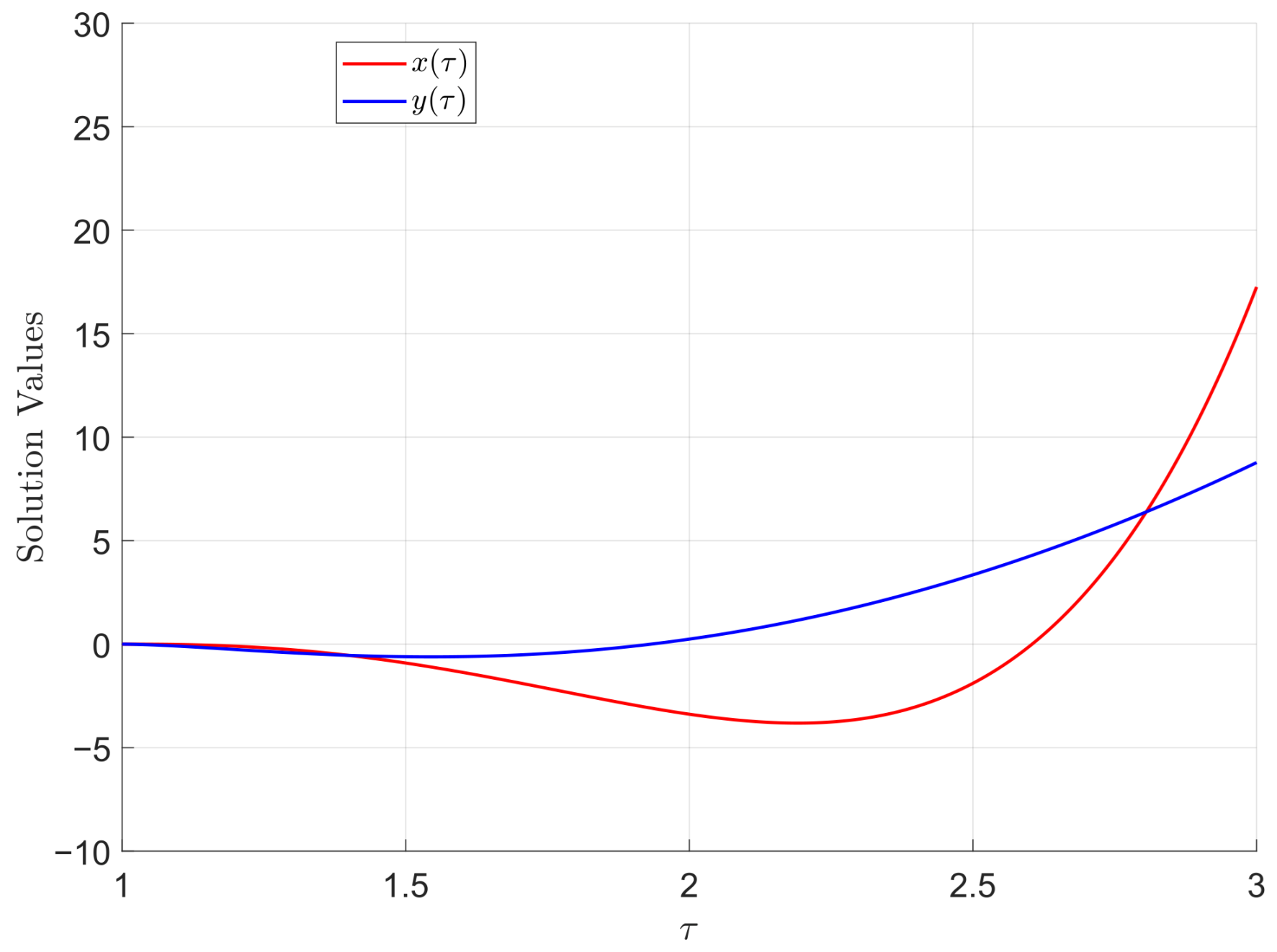
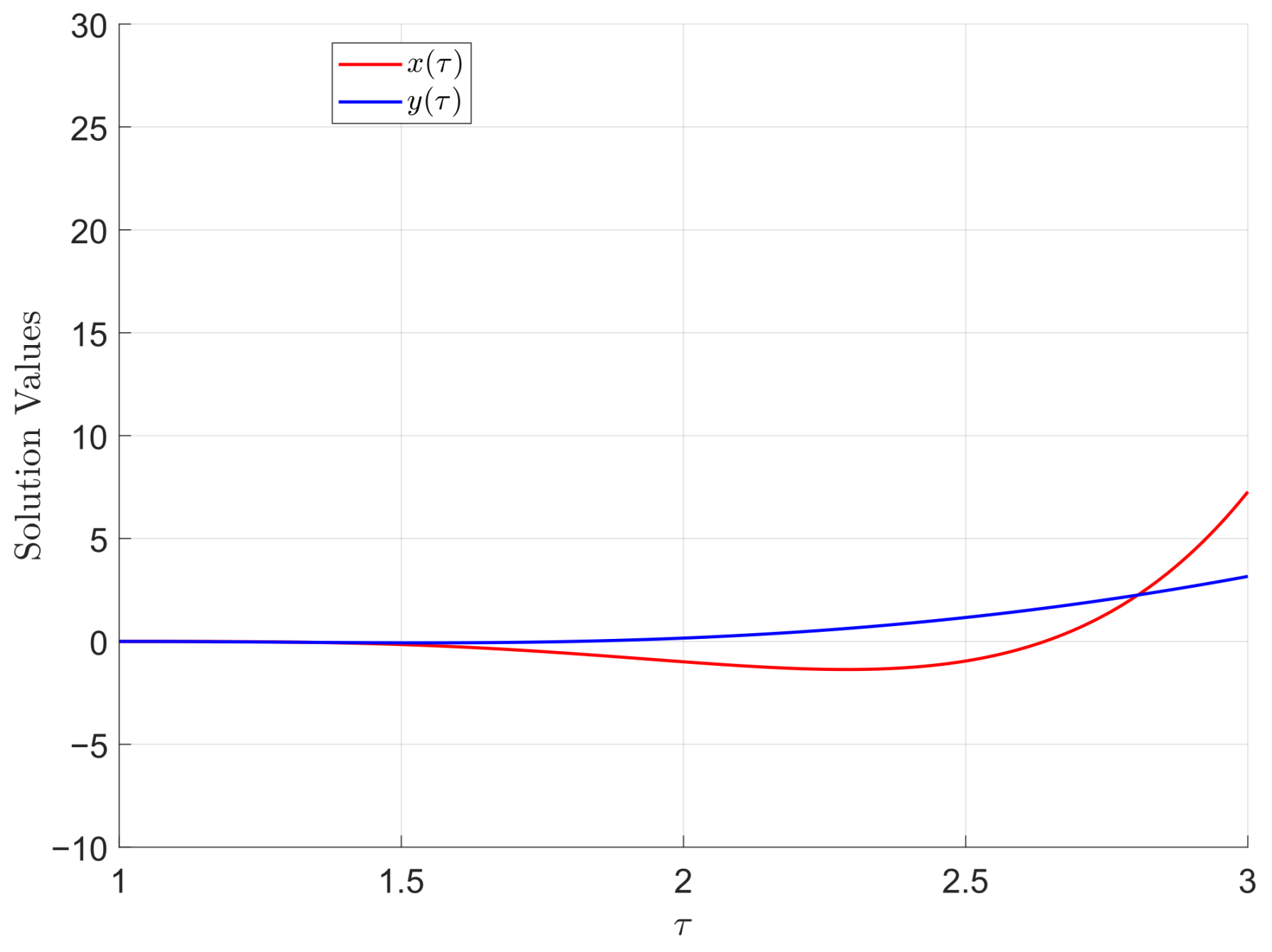
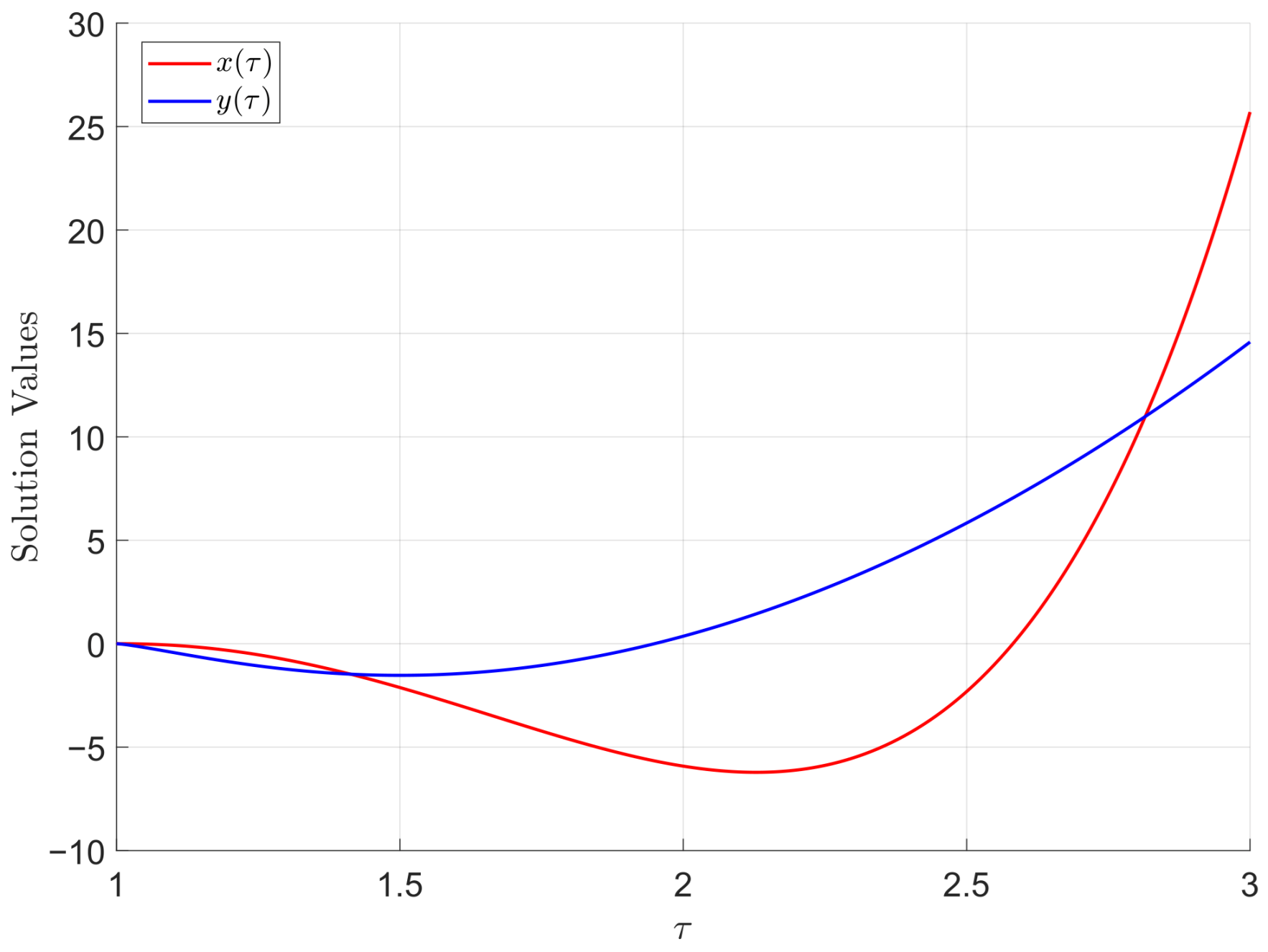
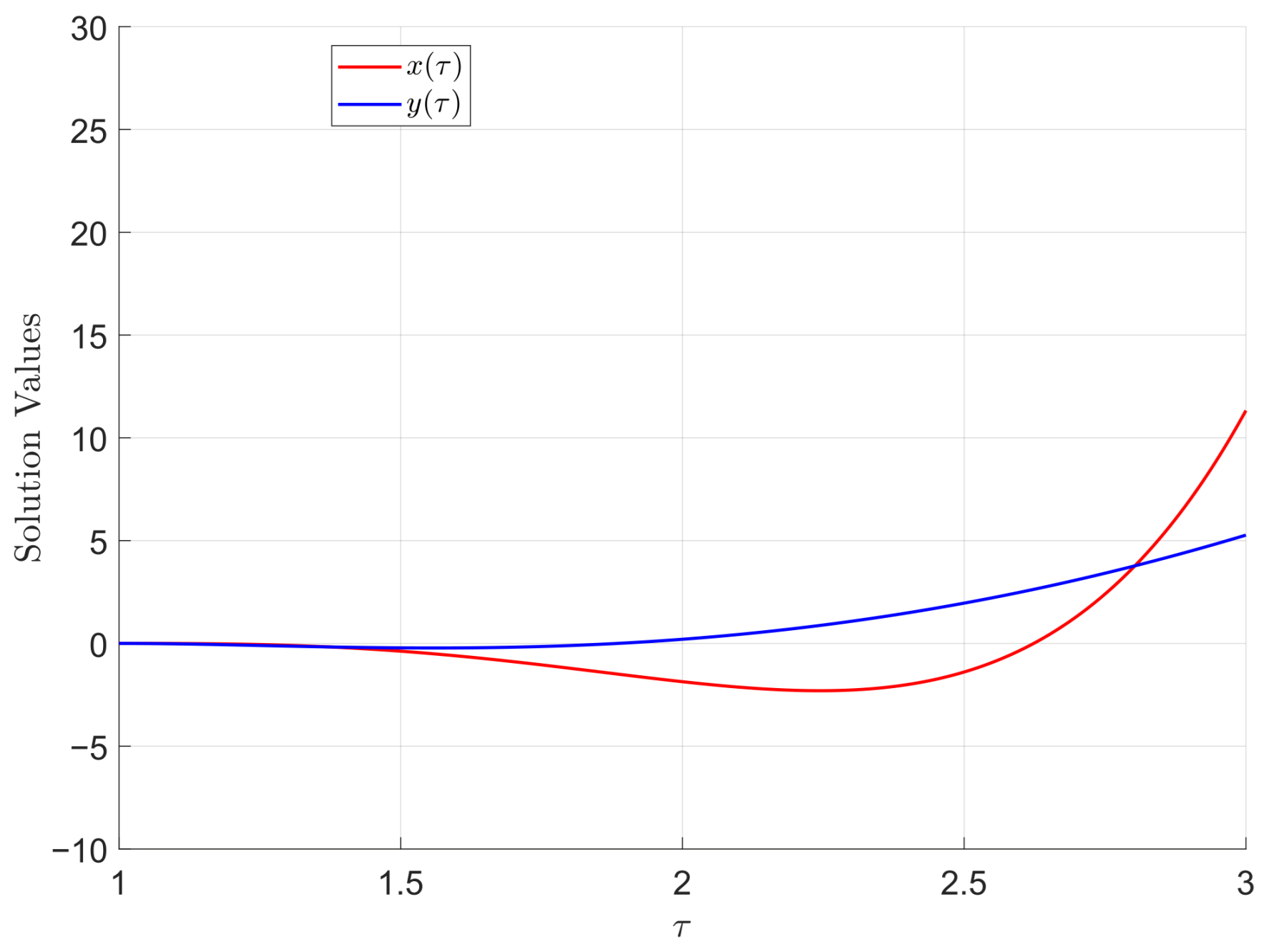
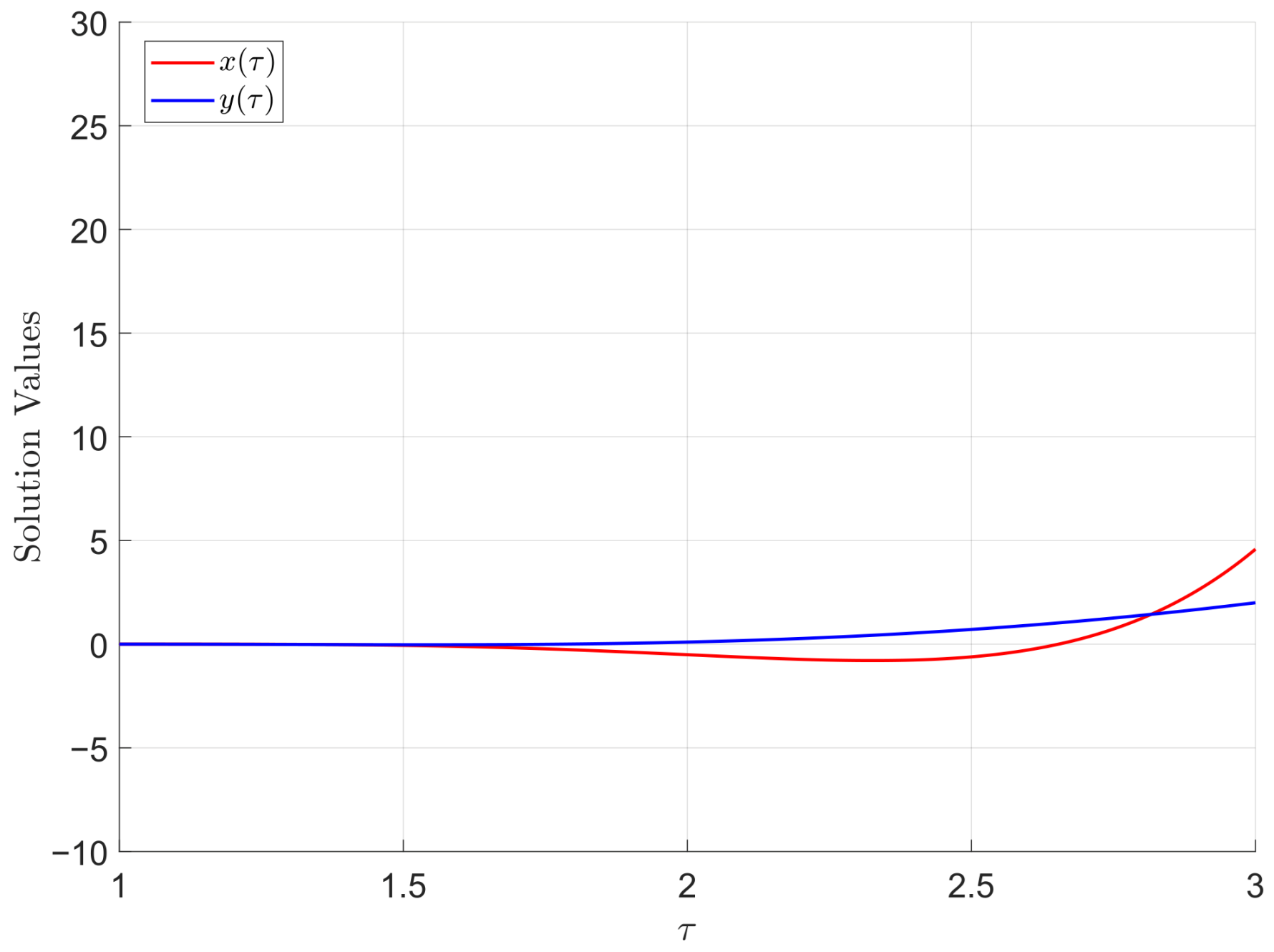
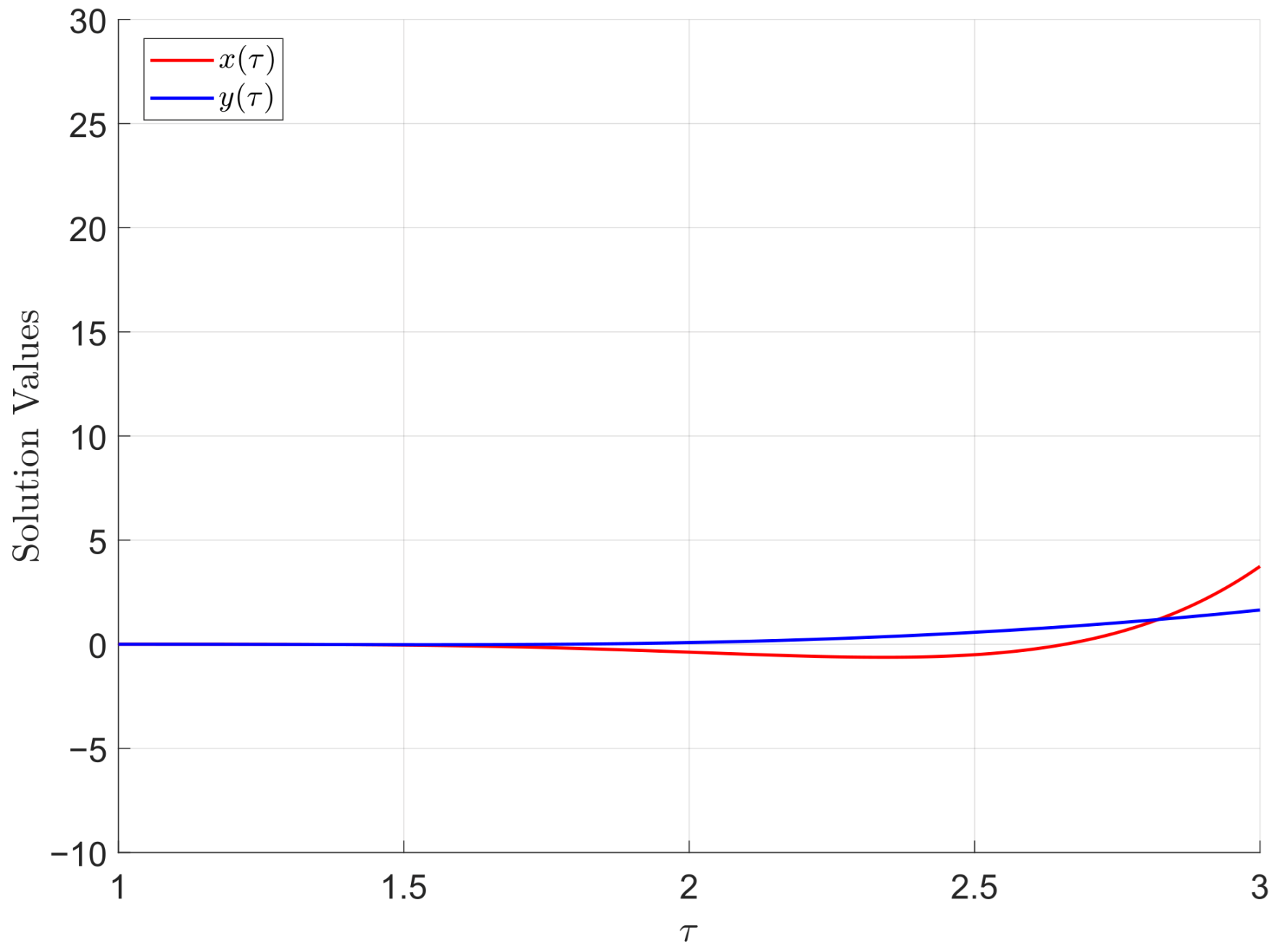
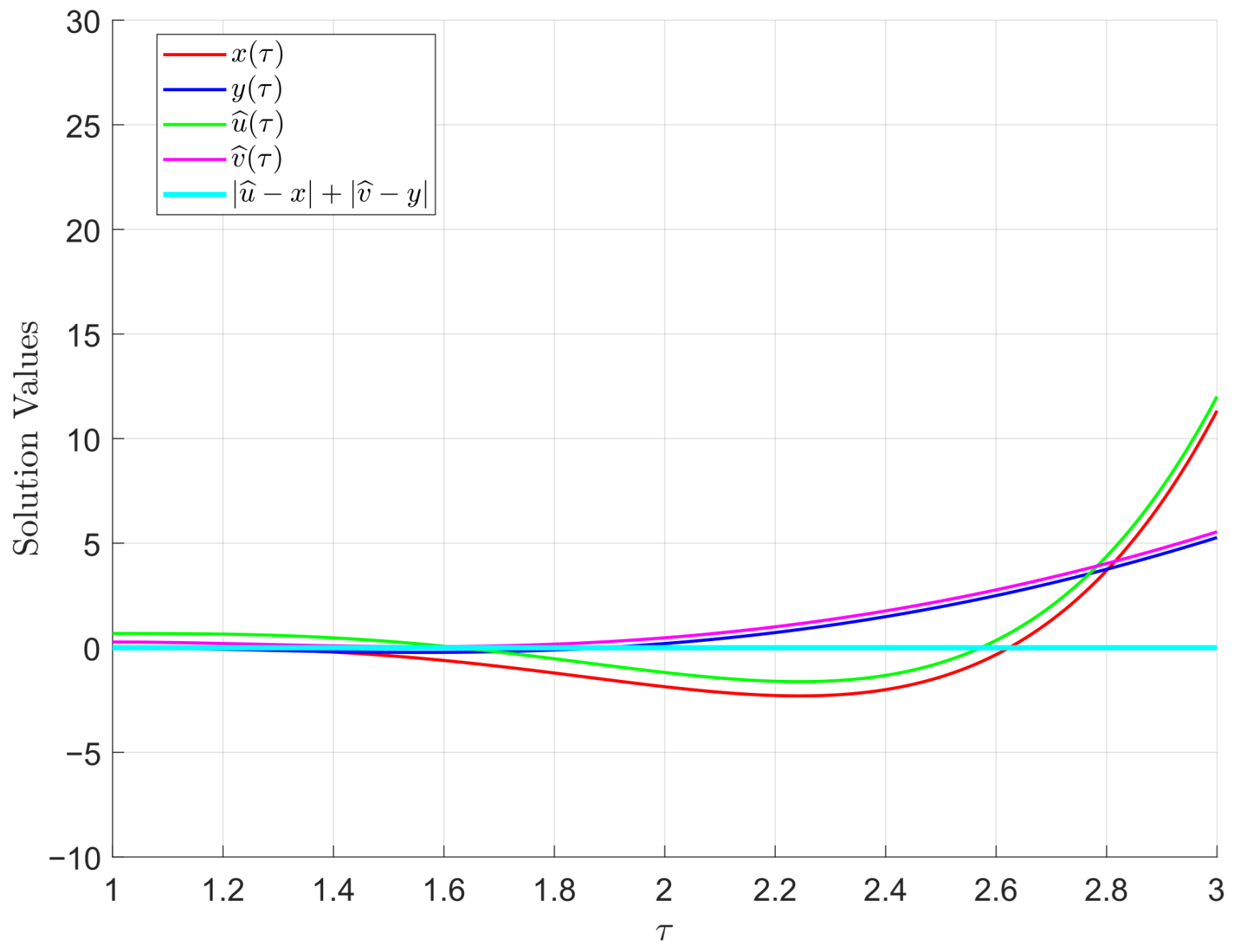
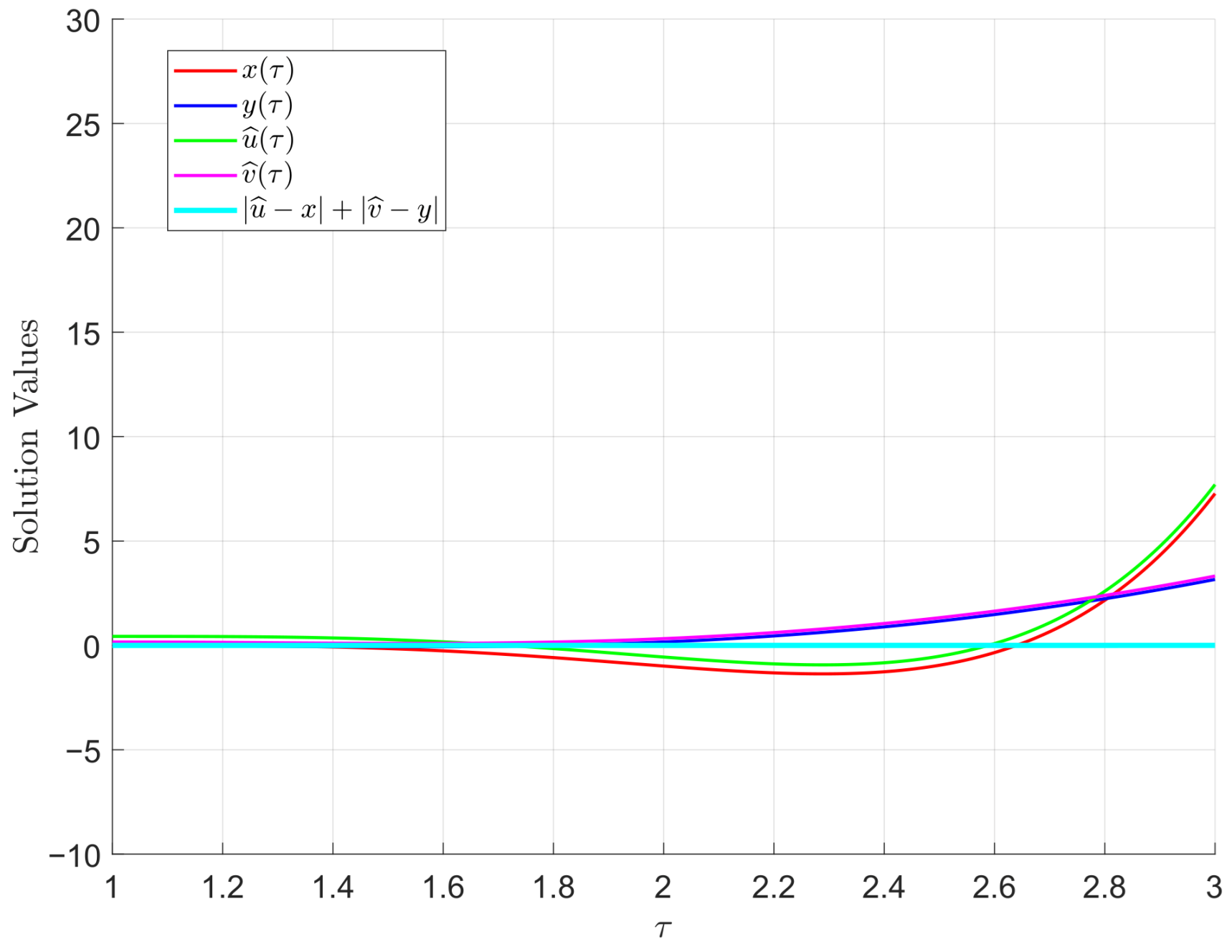
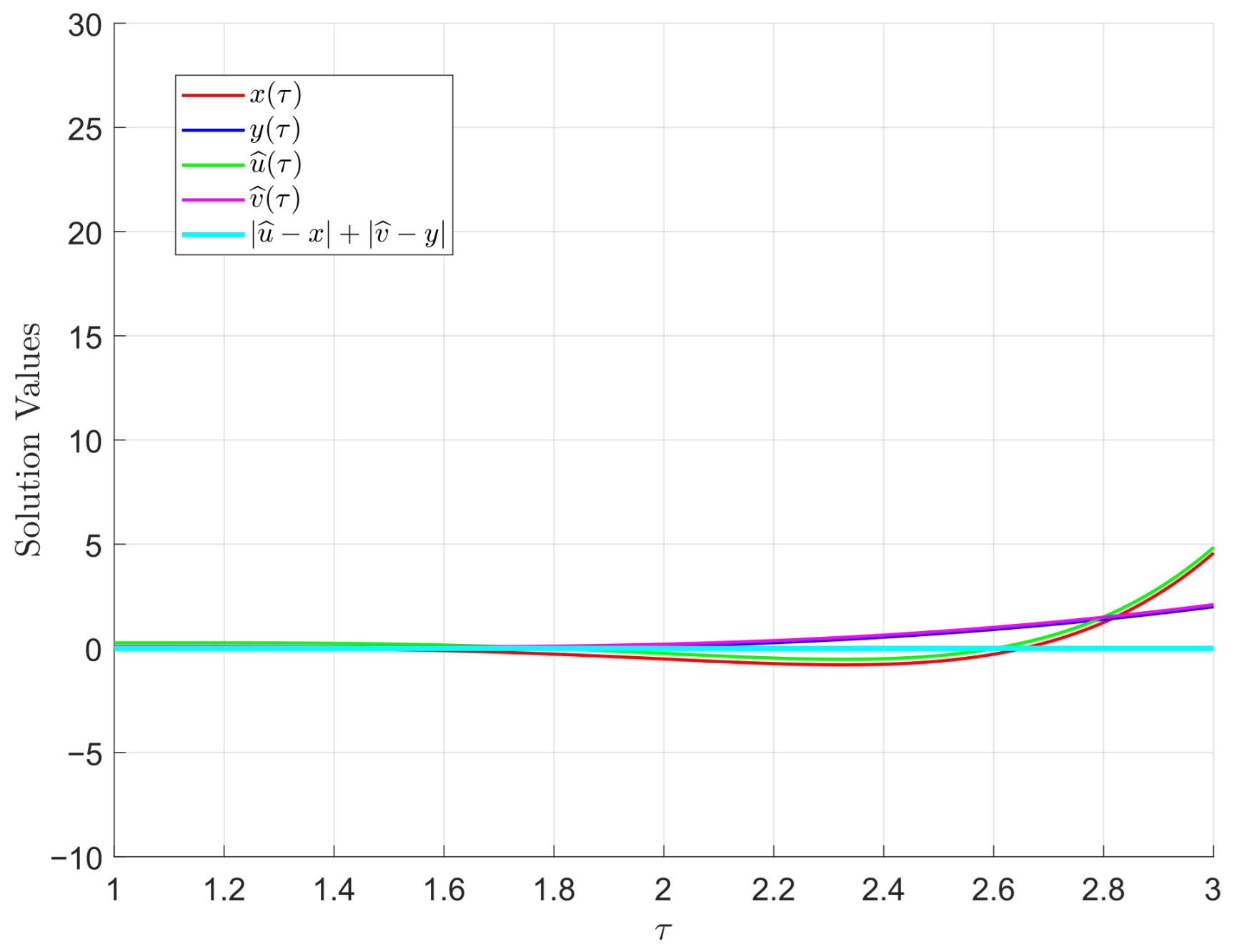
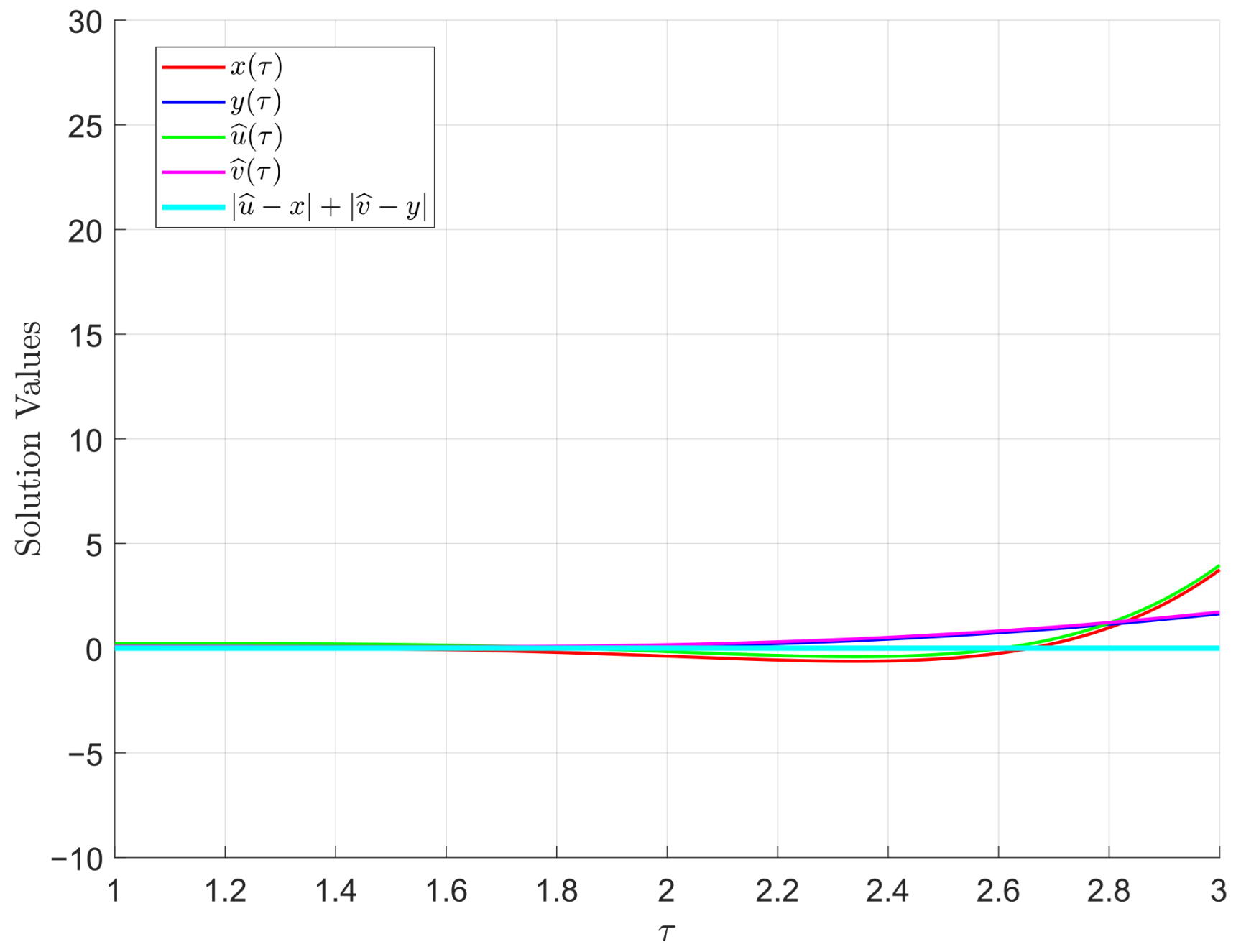
Clearly, the hypothesis of Theorem 4 is satisfied. Hence, problems (33) and (34) with the nonlinear functions f and g given by (36) have a unique solution on T . The numerical solutions for problem (33) and (34) with the nonlinearities f and g given in (36) for different values of ρ 1 , ρ 2 , ω 1 and ω 2 are shown in Figure 1, Figure 2, Figure 3, Figure 4, Figure 5 and Figure 6.
Example 2. 
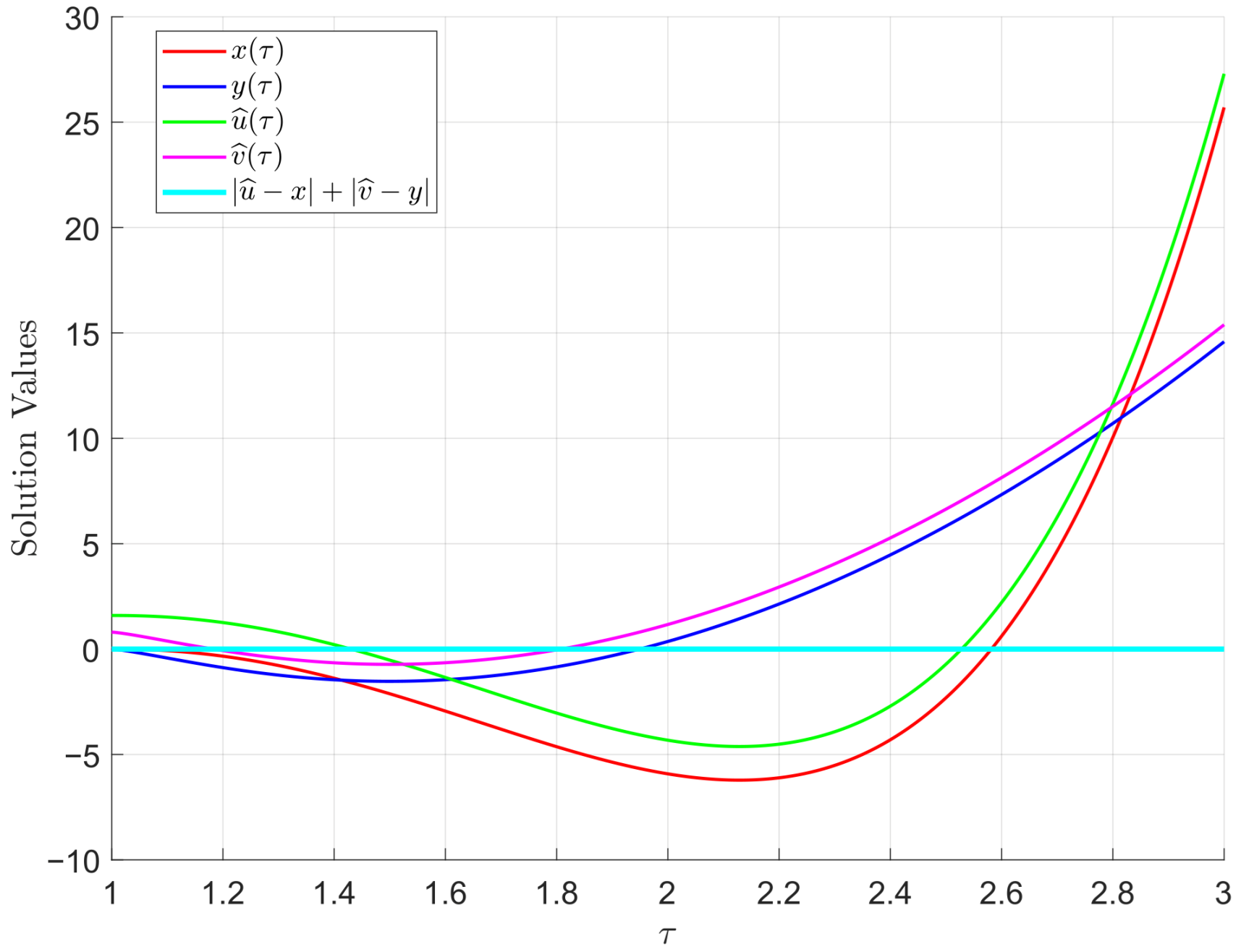
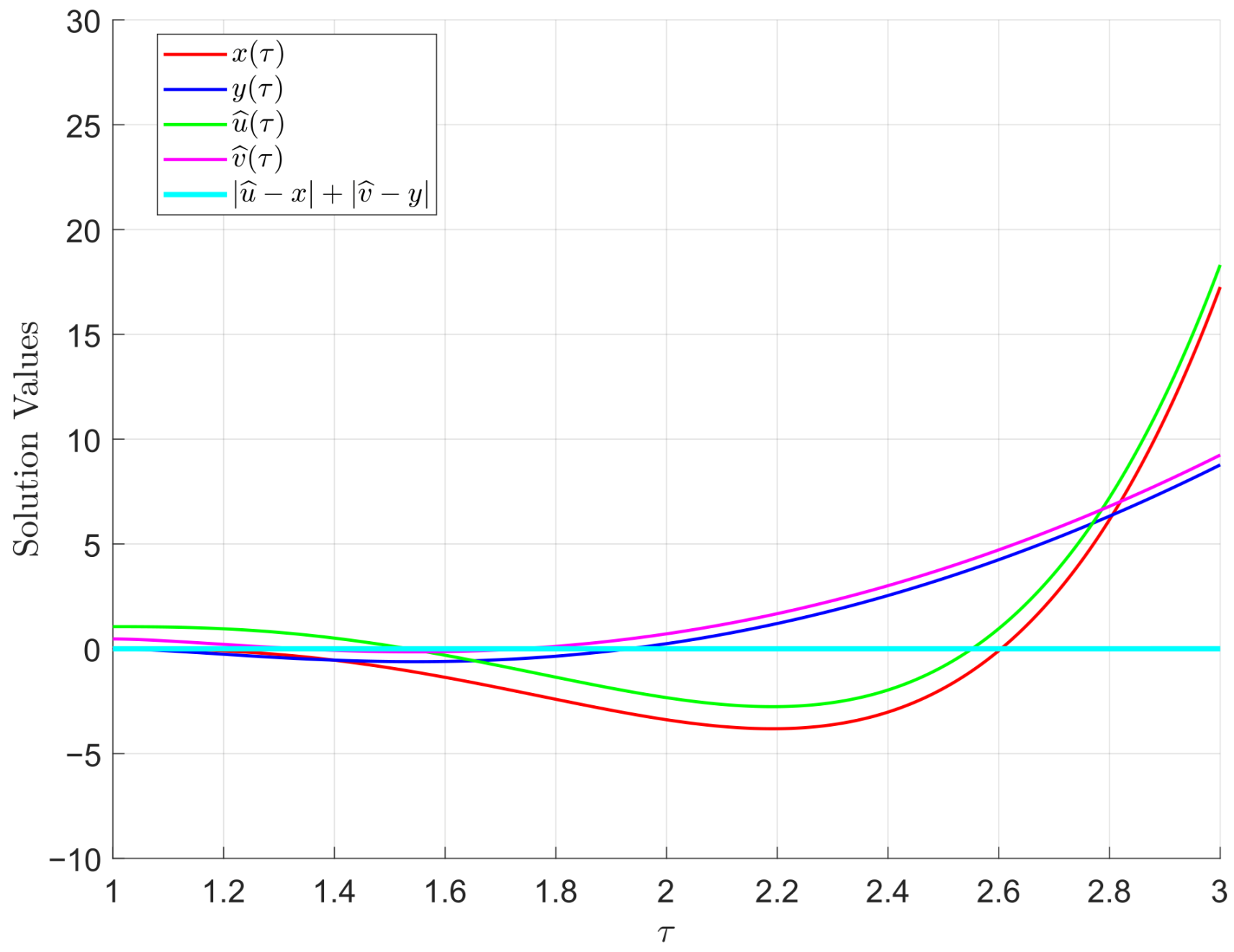
Problem (33) and (34) with f and g given in (36) is Ulam–Hyers-stable as well as generalized Ulam–Hyers-stable, since H 0.54853375 < 1 . The Ulam–Hyers stability for problem (33) and (34) with the nonlinearities f and g given in (36) and ϕ 1 ( τ ) = 1 τ + 500 , ϕ 2 ( τ ) = 1 τ + 1000 for different values of ρ 1 , ρ 2 and ω 1 , ω 2 is depicted in Figure 7, Figure 8, Figure 9, Figure 10, Figure 11 and Figure 12.

6. Discussion

We used the fixed–point operator equation ( x , y ) = W ( x , y ) , where W is defined in (14), to compute the numerical approximation of the solution ( x , y ) for problem (33) and (34) with the nonlinearities f and g given in (36) (a similar argument holds for the solution ( u ^ , v ^ ) for (31)). We applied a composite Simpson’s rule using the MATLAB R2024a (24.1.0.2537033, MathWorks, Inc., Galway, Ireland) platform to obtain the numerical approximation of solutions.
The value for each numerical solution depends on the condition (24), which changes by varying the values of fractional parameters ρ j , ω j , j = 1 , 2 . We denoted the left-hand side of the condition (24) by H and calculated its value for each case and placed it below each numerical simulation in Figure 1, Figure 2, Figure 3, Figure 4, Figure 5 and Figure 6 to demonstrate that the condition (24) is satisfied, i.e., each value is less than 1. Looking at the profile of solutions ( x , y ) in Figure 1, Figure 2, Figure 3, Figure 4, Figure 5 and Figure 6, the gap between the graphical solutions x and y decreases with increasing values of fractional parameters ρ j , ω j , j = 1 , 2 .
The Ulam–Hyers stability for the solutions ( u ^ , v ^ ) , associated with the numerical solutions ( x , y ) presented in Figure 1, Figure 2, Figure 3, Figure 4, Figure 5 and Figure 6, is demonstrated in Figure 7, Figure 8, Figure 9, Figure 10, Figure 11 and Figure 12. In the same pattern, we can compute the numerical approximation for the solutions ( x , y ) for different combinations of values of fractional parameters ρ j , ω j , j = 1 , 2 .

7. Conclusions

We developed the existence and Ulam–Hyers stability criteria for solutions of a nonlocal nonlinear Langevin–type coupled integral boundary value problem involving Riemann–Liouville and Hadamard fractional derivative operators. The results accomplished in this paper are novel in the given setting and specialize to some new results. For example, by taking λ 1 = λ 2 = 0 , our results correspond to the ones for the nonlocal coupled multipoint boundary conditions:
x ( a ) = 0 , D ω 1 v 1 R L x ( a ) = 0 , v 1 = 1 , 2 , 3 , , n 1 , y ( a ) = 0 , D ω 2 v 2 H y ( a ) = 0 , v 2 = 1 , 2 , 3 , , m 1 , x ( b ) = i = 1 p η i y ( α i ) , y ( b ) = j = 1 q ζ j x ( σ j ) , α i , σ j , ( a , b ) , η i , ζ j R .
If we choose η i = ζ j = 0 , i = 1 , , p , j = 1 , , q , then we get the results associated with coupled integral boundary conditions:
x ( a ) = 0 , D ω 1 v 1 R L x ( a ) = 0 , v 1 = 1 , 2 , 3 , , n 1 , y ( a ) = 0 , D ω 2 v 2 H y ( a ) = 0 , v 2 = 1 , 2 , 3 , , m 1 , x ( b ) = λ 1 a b 1 s y ( s ) d s , y ( b ) = λ 2 a b x ( s ) d s , λ 1 , λ 2 0 .
In future work, we plan to work on the multivalued variant of problem (1) and (2).

Author Contributions

Conceptualization, B.A. and S.K.N.; methodology, B.A., H.A.S., B.M.A. and S.K.N.; validation, B.A., H.A.S., B.M.A. and S.K.N.; formal analysis, B.A., H.A.S., B.M.A. and S.K.N.; writing—original draft preparation, B.A., H.A.S., B.M.A. and S.K.N. All authors have read and agreed to the published version of the manuscript.

Funding

This research work was funded by Umm Al-Qura University, Saudi Arabia under grant number: 26UQU4470050GSSR01.

Institutional Review Board Statement

Not applicable.

Informed Consent Statement

Not applicable.

Data Availability Statement

Data are contained within the article.

Acknowledgments

The authors extend their appreciation to Umm Al-Qura University, Saudi Arabia for funding this research work through grant number: 26UQU4470050GSSR01. The authors also thank the reviewers for their constructive remarks on this study, which led to its improvement.

Conflicts of Interest

The authors declare no conflicts of interest.

References

  1. Langevin, P. Sur la théorie du mouvement brownien. CR Acad. Sci. 1908, 146, 530. [Google Scholar]
  2. Klages, R.; Radons, G.; Sokolov, M. (Eds.) Anomalous Transport: Foundations and Applications; Wiley VCH: Weinheim, Germany, 2008. [Google Scholar]
  3. Kubo, R.; Toda, M.; Hashitsume, N. Statistical Physics II: Nonequilibrium Statistical Mechanics; Springer Science: Berlin/Heidelberg, Germany, 1991; Volume 2. [Google Scholar]
  4. Kubo, R. The fluctuation-dissipation theorem. Rep. Prog. Phys. 1966, 29, 255–284. [Google Scholar] [CrossRef]
  5. Xu, Y.; Li, Y.; Li, W. Adaptive finite-time synchronization control for fractional-order complex-valued dynamical networks with multiple weights. Commun. Nonlinear Sci. Numer. Simul. 2020, 85, 105239. [Google Scholar] [CrossRef]
  6. Wang, H.; Zheng, X. Well posedness and regularity of the variable-order time-fractional diffusion equations. J. Math. Anal. Appl. 2019, 475, 1778–1802. [Google Scholar] [CrossRef]
  7. Zheng, X.; Wang, H. An error estimate of a numerical approximation to a hidden-memory variable-order space-time fractional diffusion equation. SIAM J. Numer. Anal. 2020, 58, 2492–2514. [Google Scholar] [CrossRef]
  8. Xu, Y.; Li, W. Finite-time synchronization of fractional-order complex-valued coupled systems. Phys. A 2020, 549, 123903. [Google Scholar] [CrossRef]
  9. Ding, Y.; Wang, Z.; Ye, H. Optimal control of a fractional-order HIV-immune system with memory. IEEE Trans. Contr. Sys. Technol. 2012, 20, 763–769. [Google Scholar] [CrossRef]
  10. Javidi, M.; Ahmad, B. Dynamic analysis of time fractional order phytoplankton–toxic phytoplankton–zooplankton system. Ecol. Model. 2015, 318, 8–18. [Google Scholar] [CrossRef]
  11. Hadamard, J. Essai sur l’étude des fonctions données par leur développement de Taylor. J. Mat. Pure Appl. Ser. 1892, 8, 101–186. [Google Scholar]
  12. Kilbas, A.A.; Srivastava, H.M.; Trujillo, J.J. Theory and Applications of the Fractional Differential Equations; North-Holland Mathematics Studies; Elsevier: Amsterdam, The Netherlands, 2006. [Google Scholar]
  13. Rihan, F.A.; Lakshmanan, S.; Hashish, A.H.; Rakkiyappan, R.; Ahmed, E. Fractional order delayed predator-prey systems with Holling type-II functional response. Nonlinear Dynam. 2025, 80, 777–789. [Google Scholar] [CrossRef]
  14. Gómez-Aguilar, J.F.; López-López, M.G.; Alvarado-Martínez, V.M.; Reyes-Reyes, J.; Adam-Medina, M. Modeling diffusive transport with a fractional derivative without singular kernel. Phys. A 2016, 447, 467–481. [Google Scholar] [CrossRef]
  15. Owolabi, K.M. Mathematical analysis and numerical simulation of patterns in fractional and classical reaction-diffusion systems. Chaos Solitons Fractals 2016, 93, 89–98. [Google Scholar] [CrossRef]
  16. Butzer, P.L.; Kilbas, A.A.; Trujillo, J.J. Fractional calculus in the Mellin setting and Hadamard-type fractional integrals. J. Math. Anal. Appl. 2002, 269, 1–27. [Google Scholar] [CrossRef]
  17. Kilbas, A.A. Hadamard-type fractional calculus. J. Korean Math. Soc. 2001, 38, 1191–1204. [Google Scholar]
  18. Garra, R.; Orsingher, E.; Polito, F. A note on Hadamard fractional differential equations with varying coefficients and their applications in probability. Mathematics 2018, 6, 4. [Google Scholar] [CrossRef]
  19. Garra, R.; Mainardi, F.; Spada, G. A generalization of the Lomnitz logarithmic creep law via Hadamard fractional calculus. Chaos Solitons Fractals 2017, 102, 333–338. [Google Scholar] [CrossRef]
  20. Tarasov, V.E. Fractional dynamics with non-local scaling. Commun. Nonlinear Sci. Numer. Simul. 2021, 102, 105947. [Google Scholar] [CrossRef]
  21. Eab, C.H.; Lim, S.C. Fractional generalized Langevin equation approach to single-file diffusion. Phys. A 2010, 389, 2510–2521. [Google Scholar] [CrossRef]
  22. Lim, S.C.; Li, M.; Teo, L.P. Langevin equation with two fractional orders. Phys. Lett. A 2008, 372, 6309–6320. [Google Scholar] [CrossRef]
  23. Eule, S.; Friedrich, R.; Jenko, F.; Kleinhans, D. Langevin approach to fractional diffusion equations including inertial effects. J. Phys. Chem. B 2007, 111, 11474–11477. [Google Scholar] [CrossRef]
  24. West, B.J.; Latka, M. Fractional Langevin model of gait variability. J. Neuroeng. Rehabil. 2005, 2, 24. [Google Scholar] [CrossRef] [PubMed]
  25. Torres, C. Existence of solution for fractional Langevin equation: Variational approach. Electron. J. Qual. Theory Differ. Equ. 2014, 54, 1–14. [Google Scholar] [CrossRef]
  26. Li, B.; Sun, S.; Sun, Y. Existence of solutions for fractional Langevin equation with infinite-point boundary conditions. J. Appl. Math. Comput. 2017, 53, 683–692. [Google Scholar] [CrossRef]
  27. Zhang, W.; Ni, J. Qualitative analysis of tripled system of fractional Langevin equations with cyclic anti-periodic boundary conditions. Fract. Calc. Appl. Anal. 2023, 26, 2392–2420. [Google Scholar] [CrossRef]
  28. Baghani, H.; Alzabut, J.; Nieto, J.J. A coupled system of Langevin differential equations of fractional order and associated to antiperiodic boundary conditions. Math. Methods Appl. Sci. 2024, 47, 10900–10910. [Google Scholar] [CrossRef]
  29. Ahmad, B.; Saeed, H.A.; Ntouyas, S.K. A study of a nonlocal coupled integral boundary value problem for nonlinear Hilfer–Hadamard-type fractional Langevin equations. Fractal Fract. 2025, 9, 229. [Google Scholar] [CrossRef]
  30. Alsaedi, A.; Saeed, H.A.; Alsulami, H. Existence and stability of solutions for a nonlocal multi-point and multi-strip coupled boundary value problem of nonlinear fractional Langevin equations. Bull. Math. Sci. 2024, 15, 2450014. [Google Scholar] [CrossRef]
  31. Baitiche, Z.; Derbazi, C.; Matar, M.M. Ulam stability for nonlinear-Langevin fractional differential equations involving two fractional orders in the ψ-Caputo sense. Appl. Anal. 2022, 101, 4866–4881. [Google Scholar] [CrossRef]
  32. Zhao, K. Existence and UH-stability of integral boundary problem for a class of nonlinear higher-order Hadamard fractional Langevin equation via Mittag-Leffler functions. Filomat 2023, 37, 1053–1063. [Google Scholar] [CrossRef]
  33. Ulam, S.M. A Collection of Mathematical Problems; Interscience Tracts in Pure and Applied Mathematics; Interscience Publishers: New York, NY, USA; London, UK, 1960. [Google Scholar]
  34. Rassias, T.M. On the stability of the linear mapping in Banach spaces. Proc. Amer. Math. Soc. 1978, 72, 297–300. [Google Scholar] [CrossRef]
  35. Jung, S.M. Hyers-Ulam-Rassias Stability of Functional Equations in Mathematical Analysis; Hadronic Press: Palm Harbor, FL, USA, 2001. [Google Scholar]
  36. Lungu, N.; Ciplea, S.A. Ulam-Hyers stability of Black-Scholes equation. Stud. Univ. Babes-Bolyai Math. 2016, 61, 467–472. [Google Scholar]
  37. Benzarouala, C.; Tunç, C. Hyers-Ulam-Rassias stability of fractional delay differential equations with Caputo derivative. Math. Methods Appl. Sci. 2024, 47, 13499–13509. [Google Scholar] [CrossRef]
  38. Sudsutad, W.; Ntouyas, S.K.; Tariboon, J. Systems of fractional Langevin equations of Riemann-Liouville and Hadamard types. Adv. Differ. Equ. 2015, 2015, 235. [Google Scholar] [CrossRef]
  39. Granas, A.; Dugundji, J. Fixed Point Theory; Springer: New York, NY, USA, 2003. [Google Scholar]
  40. Rus, I.A. Ulam stabilities of ordinary differential equations in a Banach space. Carpath. J. Math. 2010, 26, 103–107. [Google Scholar]
Figure 1. Numerical approximation of x ( τ ) and y ( τ ) for ρ 1 = 0.1 , ρ 2 = 0.2 , ω 1 = 3.1 , ω 2 = 2.1 ( H = 0.83764104 ) .
Mathematics 14 01280 g001
Figure 2. Numerical approximation of x ( τ ) and y ( τ ) for ρ 1 = 0.3 , ρ 2 = 0.4 , ω 1 = 3.3 , ω 2 = 2.3 ( H = 0.74251915 ) .
Mathematics 14 01280 g002
Figure 3. Numerical approximation of x ( τ ) and y ( τ ) for ρ 1 = 0.5 , ρ 2 = 0.6 , ω 1 = 3.5 , ω 2 = 2.5 ( H = 0.64415380 ) .
Mathematics 14 01280 g003
Figure 4. Numerical approximation of x ( τ ) and y ( τ ) for ρ 1 = 0.7 , ρ 2 = 0.8 , ω 1 = 3.7 , ω 2 = 2.7 ( H = 0.54853375 ) .
Mathematics 14 01280 g004
Figure 5. Numerical approximation of x ( τ ) and y ( τ ) for ρ 1 = 0.9 , ρ 2 = 0.92 , ω 1 = 3.9 , ω 2 = 2.9 ( H = 0.45479809 ) .
Mathematics 14 01280 g005
Figure 6. Numerical approximation of x ( τ ) and y ( τ ) for ρ 1 = 0.98 , ρ 2 = 0.96 , ω 1 = 3.99 , ω 2 = 2.99 ( H = 0.41540961 ) .
Mathematics 14 01280 g006
Figure 7. Ulam–Hyers stability for x ( τ ) and y ( τ ) associated with Figure 1.
Mathematics 14 01280 g007
Figure 8. Ulam–Hyers stability for x ( τ ) and y ( τ ) associated with Figure 2.
Mathematics 14 01280 g008
Figure 9. Ulam–Hyers stability for x ( τ ) and y ( τ ) associated with Figure 3.
Mathematics 14 01280 g009
Figure 10. Ulam–Hyers stability for x ( τ ) and y ( τ ) associated with Figure 4.
Mathematics 14 01280 g010
Figure 11. Ulam–Hyers stability for x ( τ ) and y ( τ ) associated with Figure 5.
Mathematics 14 01280 g011
Figure 12. Ulam–Hyers stability for x ( τ ) and y ( τ ) associated with Figure 6.
Mathematics 14 01280 g012
Disclaimer/Publisher’s Note: The statements, opinions and data contained in all publications are solely those of the individual author(s) and contributor(s) and not of MDPI and/or the editor(s). MDPI and/or the editor(s) disclaim responsibility for any injury to people or property resulting from any ideas, methods, instructions or products referred to in the content.