Exploring Marshall–Olkin Models Through Bibliometric and Topic Modeling Approaches Using Latent Dirichlet Allocation (1981–2025): A Study Based on Scopus Data





Abstract
1. Introduction
2. Materials and Methods
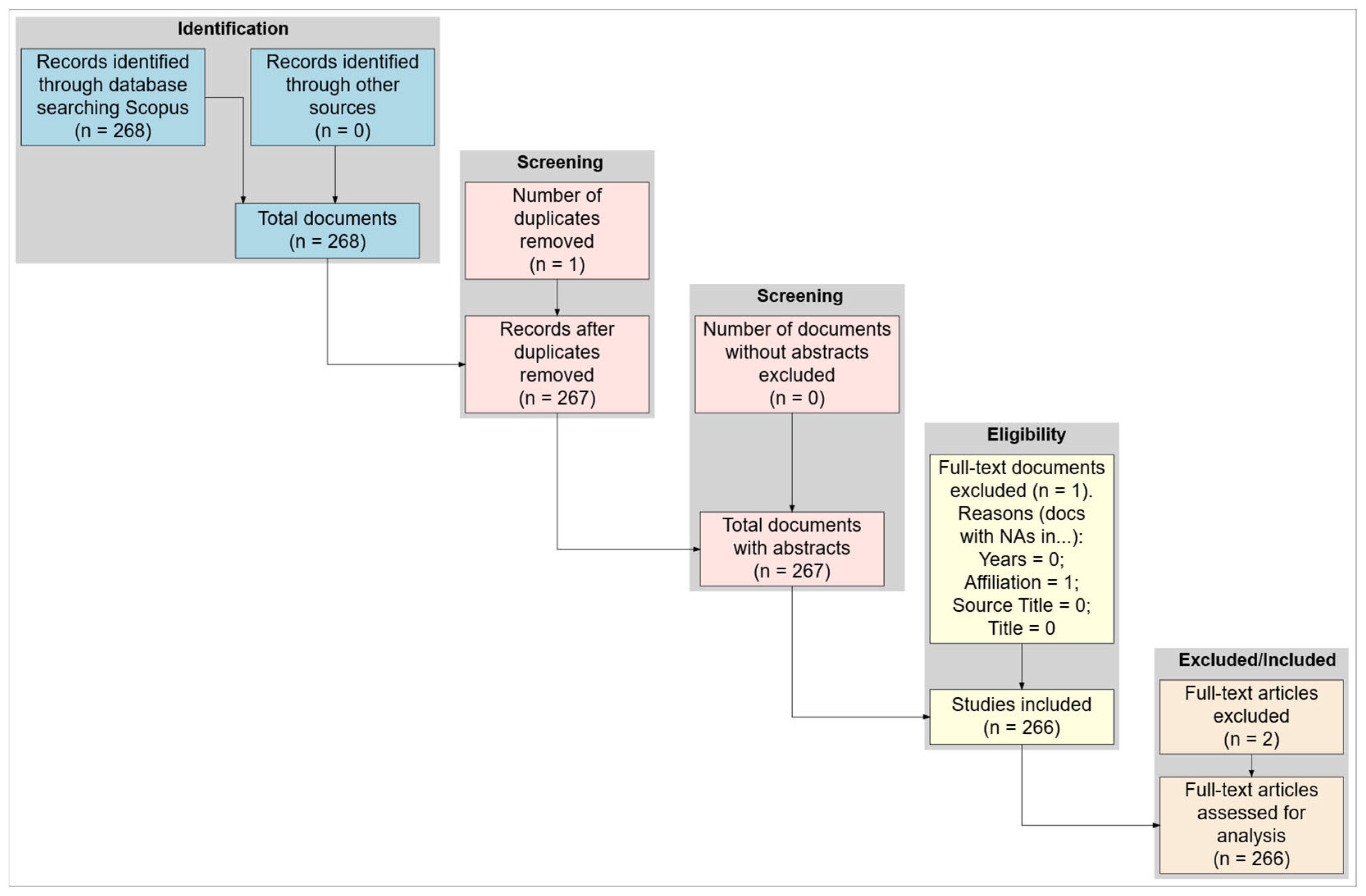
2.1. Data Collection

2.2. Bibliometric Analysis
- Social structure: examining co-authorship networks and country-level collaborations to identify patterns of scholarly interaction.
- Intellectual structure: assessing the citation impact of highly cited documents, authors, and sources to detect influential contributions in the field.
- Conceptual structure: mapping emerging themes and clusters of keywords to understand how theoretical developments and applications have evolved over time.
- Performance analysis, which evaluates the productivity and impact metrics of authors, journals, and countries.
- Science mapping, implemented through probabilistic topic modeling and semantic clustering, reveals knowledge structures and thematic patterns within the field.
2.3. Topic Modeling Analysis
2.4. Software and Computational Tools
3. Results
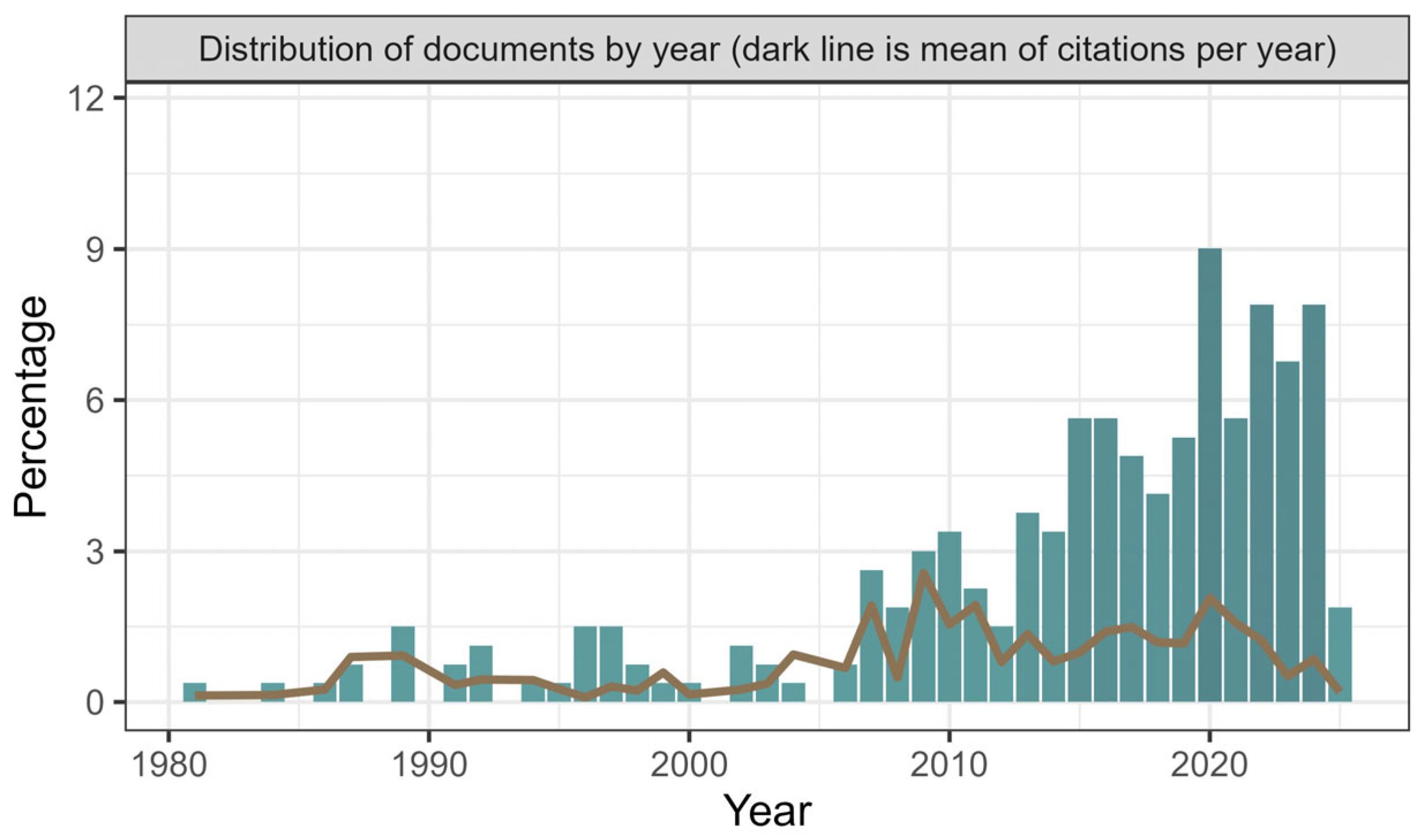
3.1. General Information
3.2. Sources
3.3. Authors
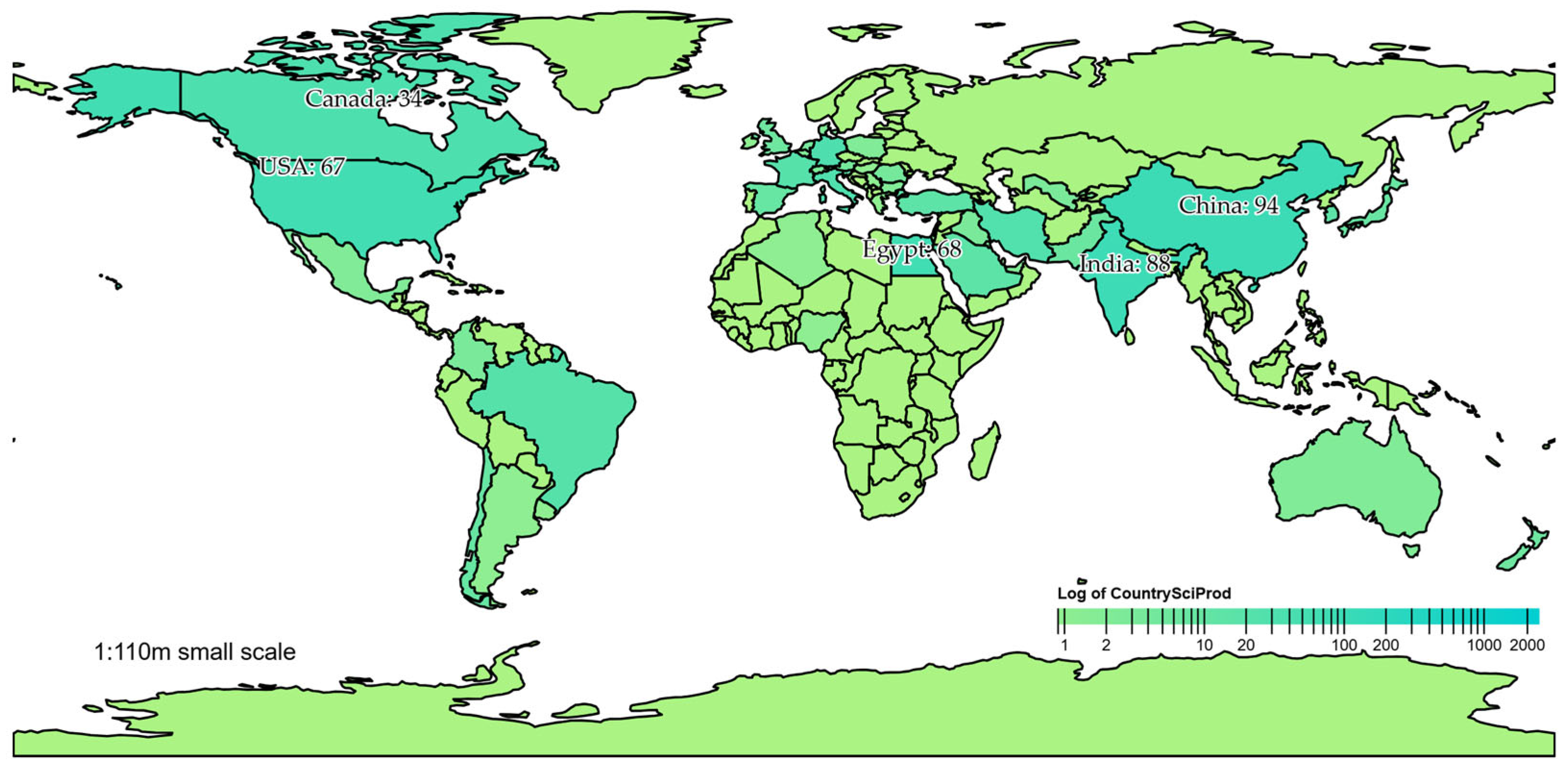
3.4. Countries
3.5. Topics Identification
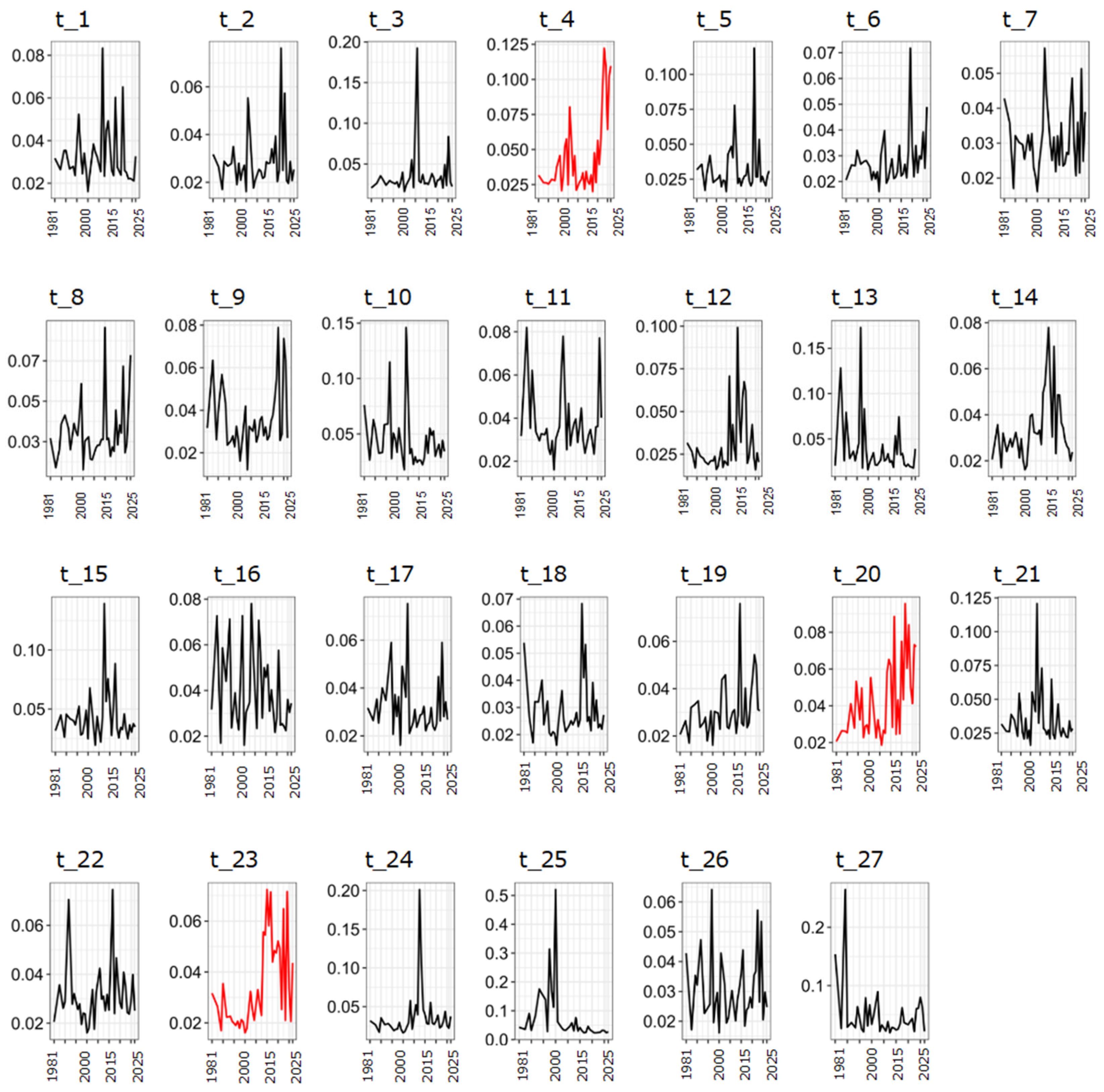
3.6. Topic Trends
3.7. Topic Distributions Across Sources and Years
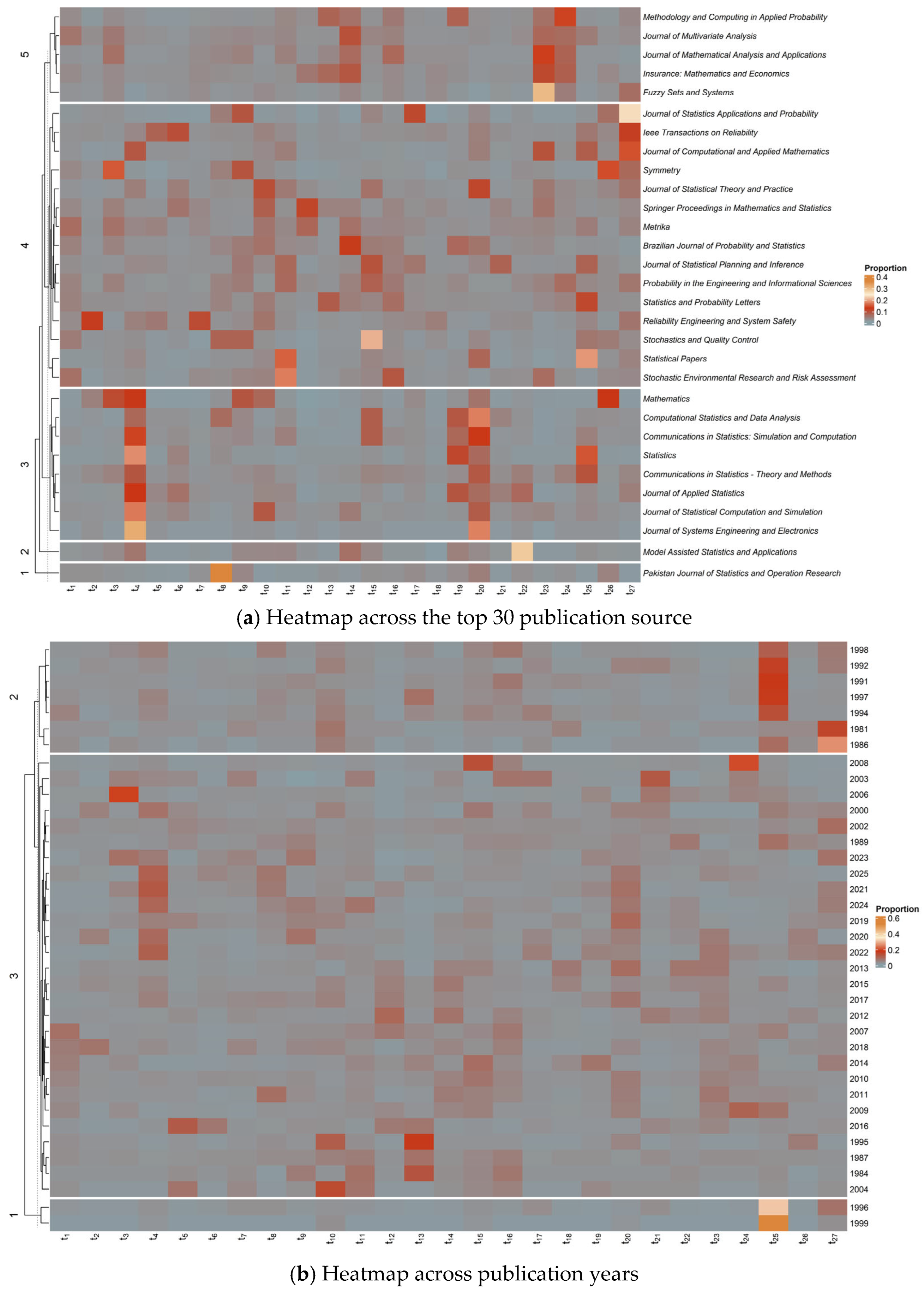
- Cluster 5 (upper band). This cluster gathers broadly theoretical and general statistical journals such as Journal of Multivariate Analysis, Statistics and Probability Letters, Journal of Mathematical Analysis and Applications, Insurance: Mathematics and Economics, and Fuzzy Sets and Systems. The strongest intensities are observed for t14 (Discrete Lévy Copulas and Hierarchical Structures), t23 (Marshall–Olkin copulas and functional extensions), and t24 (Tail dependence in multivariate models). These patterns indicate that, while these outlets cover a broad thematic range, they play a key role in advancing the theoretical underpinnings of dependence modeling and copula-based approaches.
- Cluster 4 (second band). Includes applied statistics and reliability outlets such as IEEE Transactions on Reliability, Reliability Engineering and System Safety, Journal of Statistical Planning and Inference, Probability in the Engineering and Informational Sciences, Symmetry, and Journal of Computational and Applied Mathematics. This group shows concentrations in t20 (Estimation of Unknown Parameters in Weibull models), t25 (Bivariate Exponential Stress-Strength Models), and t27 (system reliability and shock models), reflecting applied contexts of Marshall–Olkin models in lifetime data, stress-strength analysis, and system reliability.
- Cluster 3 (third band). This cluster consists mainly of computation-oriented outlets such as Communications in Statistics: Simulation and Computation, Communications in Statistics—Theory and Methods, Journal of Statistical Computation and Simulation, Journal of Applied Statistics, Computational Statistics and Data Analysis, and Mathematics. The dominant intensities are observed in t4 (Bayesian competing risks and censoring), t20 (Weibull parameter estimation), and t19 (hazard functions and reversed distributions), which appear across most journals in this cluster. In addition, t25 (Bivariate Exponential Stress-Strength Models) shows relevance in selected outlets, while t26 (generalizations of Weibull and special distributions) is more prominent in Mathematics. Altogether, this cluster reflects a focus on methodological and computational developments supporting Bayesian inference, parametric estimation, and hazard-based modeling in the Marshall–Olkin framework.
- Clusters 1 and 2 (bottom). They include journals such as Stochastic Environmental Research and Risk Assessment and the Journal of Systems Engineering and Electronics and reflect emerging or interdisciplinary outlets where Marshall–Olkin models intersect with environmental, engineering, or financial domains. Although their distributions are more scattered, they show localized concentrations in t8 (Hazard and Failure Rate Modeling) and t22 (Frailty and Shared Survival Models), with additional links to t7 (Multivariate Dependence in Insurance Models) and t18 (Systemic Risk in Banking Systems). These patterns suggest that Clusters 1 and 2 capture niche but diverse applications of the models, spanning risk assessment, reliability, and financial systems.
- Cluster 1 (bottom) captures a very specific period in the late 1990s (1996 and 1999), with concentrated contributions in t25 (Bivariate Exponential Stress-Strength Models) and, to a lesser extent, t27 (system reliability and shock models). These early applications highlight the initial role of Marshall–Olkin models in classical reliability frameworks, particularly in stress-strength analysis and system-level failure modeling. Unlike other clusters, the thematic scope here is narrow, suggesting that the adoption of Marshall–Olkin approaches during this phase was focused on extending reliability methods rather than exploring broader distributional generalizations.
- Cluster 2 (upper band) groups primarily early contributions (1980s–1990s), covering years such as 1981, 1986, 1988, 1991, 1992, 1994, and 1997. The most consistent intensities are observed in t25 (Bivariate Exponential Stress-Strength Models) and t27 (system reliability and shock models), reflecting the consolidation of Marshall–Olkin models within the reliability and stress-strength literature during this period. This cluster shows a thematic pattern very similar to Cluster 1, but spread across a wider temporal window, suggesting that the early adoption of MO models was largely driven by their ability to generalize and operationalize classical reliability concepts.
- Cluster 3 (middle band) spans the 2000s through the mid-2020s and marks a transition from the early reliability-oriented applications to a more diversified set of research themes. Unlike Clusters 1 and 2, where t25 and t27 dominated, their influence here is diluted, giving way to emerging directions. Notable intensities include t3 (Stochastic Ordering and Likelihood Ratios) in 2006; t5 (MO Copulas and Reliability), t13 (Limit Laws and Geometric Distributions), t15 (EM Algorithm for Bivariate Exponential Models), and t24 (Tail Dependence in Multivariate Models) in 2008; and sustained activity in t4 (Bayesian competing risks and censoring) across the 2020s. Topics such as t20 (Weibull estimation) and t23 (MO Copulas and functional extensions) also appear with moderate prevalence, pointing to methodological developments in parametric inference and dependence modeling. Overall, Cluster 3 reflects the broadening of Marshall–Olkin research into Bayesian methods, copula theory, and stochastic modeling, aligning with the diversification of applied probability and interdisciplinary uptake in finance, biostatistics, and engineering.
4. Discussion
- Reliability and survival (engineering/biomedicine). Topics t22 (Frailty and Shared Survival Models), t17 (Lifetime Models and Likelihood Inference), t15 (EM Algorithm for Bivariate Exponential Models), t27 (system reliability and shock models), t25 (Bivariate Exponential Stress-Strength Models), and t8 (Hazard and Failure Rate Modeling) reflect the classical MO use case: modeling dependent lifetimes, competing risks, and stress-strength reliability. Illustrative applications include degradation and shock models for series/parallel systems (t27), censored device lifetimes and clinical survival with shared frailty (t22), and EM-based estimation for bivariate exponential MO variants under incomplete data (t15). The prominence of IEEE Transactions on Reliability and Reliability Engineering & System Safety among sources aligns with this thematic pillar.
- Finance and insurance (risk/capital/contagion). Topics t12 (Credit Risk and Financial Defaults), t18 (Systemic Risk in Banking Systems), t24 (Tail Dependence in Multivariate Models), and t5 (MO Copulas and Reliability) document the adoption of MO-type copulas for credit portfolio losses, CDO tranching, and systemic risk measures. The focus on tail co-movements (t24) and asymmetric dependence is consistent with post-crisis risk management. Journals such as Insurance: Mathematics and Economics, Computational Statistics & Data Analysis, and Journal of Multivariate Analysis cluster strongly around these topics.
- Generalizations and multivariate structure. Topics t16 (Gamma and Multivariate MO Extensions), t11 (Classes of Bivariate Distributions), t26 (Generalizations of Weibull and Special Distributions), t3 (Stochastic Ordering and Likelihood Ratios), and t1 (Residual Life and Entropy Measures) trace theoretical extensions: new distributional families, identifiability/ordering results, and residual-life/entropy characterizations, often coupled to EM, Bayesian, and Monte Carlo (t6) toolkits. The rise in t23 (MO Copulas and functional extensions) signals an active frontier linking MO shocks with transform-based copula constructions, hierarchical/dependent Lévy structures (t14), and high-dimensional dependence modeling.
5. Conclusions
Author Contributions
Funding
Data Availability Statement
Acknowledgments
Conflicts of Interest
References
- Marshall, A.W.; Olkin, I. A multivariate exponential distribution. J. Am. Stat. Assoc. 1967, 62, 30–44. [Google Scholar] [CrossRef]
- Nelsen, R.B. An Introduction to Copulas; Springer: New York, NY, USA, 2006. [Google Scholar]
- Sarhan, A.M.; Gomaa, R.S.; Magar, A.M.; Alsadat, N. Bivariate exponentiated generalized inverted exponential distribution with applications on dependent competing risks data. AIMS Math. 2024, 9, 29439–29473. [Google Scholar] [CrossRef]
- Bayramoglu, I.; Ozkut, M. Recent Developments About Marshall–Olkin Bivariate Distribution. J. Stat. Theory Pract. 2022, 16, 58. [Google Scholar] [CrossRef]
- Brango, H.; Guerrero, A.; Llinás, H. Marshall–Olkin Bivariate Weibull Model with Modified Singularity (MOBW-μ): A Study of Its Properties and Correlation Structure. Mathematics 2024, 12, 2183. [Google Scholar] [CrossRef]
- González-Hernández, I.J.; Granillo-Macías, R.; Rondero-Guerrero, C.; Simón-Marmolejo, I. Marshall–Olkin distributions: A bibliometric study. Scientometrics 2021, 126, 9005–9029. [Google Scholar] [CrossRef]
- Blei, D.M.; Ng, A.Y.; Jordan, M.I. Latent Dirichlet Allocation. J. Mach. Learn. Res. 2003, 3, 993–1022. [Google Scholar]
- Rejeb, A.; Rejeb, K.; Zrelli, I. Exploring the state-of-the-art of halal food research using latent Dirichlet allocation. Discov. Food 2025, 5, 24. [Google Scholar] [CrossRef]
- Tekin, Y. Initialization in Gibbs Sampling Implementation of LDA. In 2024 32nd Signal Processing and Communications Applications Conference (SIU); IEEE: Mersin, Turkey, 2024; pp. 1–4. [Google Scholar]
- Brown, C.K.; Cameron, B.G. Assessing changes in reliability methods over time: An unsupervised text mining approach. Qual. Reliab. Eng. Int. 2024, 40, 3597–3619. [Google Scholar] [CrossRef]
- Zhang, H.; Chen, B.; Guo, D.; Zhou, M. WHAI: Weibull hybrid autoencoding inference for deep topic modeling. arXiv 2018, arXiv:180301328. [Google Scholar]
- Amoualian, H. Modeling and Learning Dependencies with Copulas in Latent Topic Models; Université Grenoble Alpes: Saint-Martin-d’Hères, France, 2017. [Google Scholar]
- Amoualian, H.; Clausel, M.; Gaussier, E.; Amini, M.R. Streaming-LDA: A copula-based approach to modeling topic dependencies in document streams. In Proceedings of the 22nd ACM SIGKDD International Conference on Knowledge Discovery and Data Mining, San Francisco, CA, USA, 13–17 August 2016; ACM: New York, NY, USA, 2016; pp. 695–704. [Google Scholar]
- Lin, L.; Jiang, H.; Rao, Y. Copula guided neural topic modelling for short texts. In Proceedings of the 43rd International ACM SIGIR Conference on Research and Development in Information Retrieval, Online, 25–30 July 2020; ACM: New York, NY, USA, 2020; pp. 1773–1776. [Google Scholar]
- Blei, D.M.; Lafferty, J.D. Dynamic topic models. In Proceedings of the 23rd International Conference on Machine Learning, Online, 26–28 August 2020; ACM: New York, NY, USA, 2006; pp. 113–120. [Google Scholar]
- Roberts, M.E.; Stewart, B.M.; Tingley, D.; Lucas, C.; Leder-Luis, J.; Gadarian, S.K.; Albertson, B.; Rand, D.G. Structural topic models for open-ended survey responses. Am. J. Political Sci. 2014, 58, 1064–1082. [Google Scholar] [CrossRef]
- Oliveira, R.P.; Achcar, J.A.; Mazucheli, J.; Bertoli, W. A new class of bivariate Lindley distributions based on stress and shock models and some of their reliability properties. Reliab. Eng. Syst. Saf. 2021, 211, 107533. [Google Scholar] [CrossRef]
- Algarni, A. On a new generalized Lindley distribution: Properties, estimation and applications. PLoS ONE 2021, 16, e0246468. [Google Scholar] [CrossRef] [PubMed]
- Eghwerido, J.T.; Oguntunde, P.E.; Agu, F.I. The Alpha Power Marshall-Olkin-G Distribution: Properties and Applications. Sankhya A Indian J. Stat. 2023, 85, 172–197. [Google Scholar] [CrossRef]
- Eshima, S.; Imai, K.; Sasaki, T. Keyword-assisted topic models. Am. J. Political Sci. 2024, 68, 730–750. [Google Scholar] [CrossRef]
- Donthu, N.; Kumar, S.; Mukherjee, D.; Pandey, N.; Lim, W.M. How to conduct a bibliometric analysis: An overview and guidelines. J. Bus. Res. 2021, 133, 285–296. [Google Scholar] [CrossRef]
- Mongeon, P.; Paul-Hus, A. The journal coverage of Web of Science and Scopus: A comparative analysis. Scientometrics 2016, 106, 213–228. [Google Scholar] [CrossRef]
- Falagas, M.E.; Pitsouni, E.I.; Malietzis, G.A.; Pappas, G.; Kouranos, V.D.; Arencibia-Jorge, R.; Karageorgopoulos, D.E.; Reagan-Shaw, S.; Nihal, M.; Ahmad, N.; et al. Comparison of PubMed, Scopus, web of science, and Google scholar: Strengths and weaknesses. FASEB J. 2008, 22, 338–342. [Google Scholar] [CrossRef]
- Aria, M.; Cuccurullo, C. bibliometrix: An R-tool for comprehensive science mapping analysis. J. Informetr. 2017, 11, 959–975. [Google Scholar] [CrossRef]
- Röder, M.; Both, A.; Hinneburg, A. Exploring the Space of Topic Coherence Measures. In Proceedings of the Eighth ACM International Conference on Web Search and Data Mining, Shanghai, China, 2–6 February 2015; ACM: New York, NY, USA, 2015; pp. 399–408. [Google Scholar]
- Hastie, T.; Tibshirani, R.; Friedman, J.H. The Elements of Statistical Learning: Data Mining, Inference, and Prediction; Springer: New York, NY, USA, 2009. [Google Scholar]
- Jagarlamudi, J.; Daumé, H., III; Udupa, R. Incorporating lexical priors into topic models. In Proceedings of the 13th Conference of the European Chapter of the Association for Computational Linguistics, Avignon, France, 23–27 April 2012; ACL: Avignon, France, 2012; pp. 204–213. [Google Scholar]
- Sievert, C.; Shirley, K. LDAvis: A method for visualizing and interpreting topics. In Proceedings of the Workshop on Interactive Language Learning, Visualization, and Interfaces, Baltimore, MD, USA, 27 June 2014; ACL: Avignon, France, 2014; pp. 63–70. [Google Scholar]
- Haupka, N.; Culbert, J.H.; Schniedermann, A.; Jahn, N.; Mayr, P. Analysis of the publication and document types in OpenAlex, Web of Science, Scopus, PubMed and Semantic Scholar. Quant. Sci. Stud. 2026, 7, 179–194. [Google Scholar] [CrossRef]
- Kim, E. In-depth examination of coverage duration: Analyzing years covered and skipped in journal indexing. Publications 2024, 12, 10. [Google Scholar] [CrossRef]
- Franceschini, F.; Maisano, D.; Mastrogiacomo, L. The museum of errors/horrors in Scopus. J. Informetr. 2016, 10, 174–182. [Google Scholar] [CrossRef]
- Liu, W.; Wang, H. Red alert: Millions of “homeless” publications in Scopus should be resettled. J. Assoc. Inf. Sci. Technol. 2025, 76, 1283–1291. [Google Scholar] [CrossRef]



| Description | Result |
|---|---|
| Main information about data: | |
| Timespan | 1981:2025 |
| Sources (journals, books, etc.) | 119 |
| Documents | 266 |
| Annual growth rate % | 3.73 |
| Document average age | 10.4 |
| Average citations per doc | 11.99 |
| Document contents: | |
| Keywords Plus | 655 |
| Author’s keywords | 845 |
| Authors: | |
| Authors | 404 |
| Authors of single-authored docs | 29 |
| Authors collaboration: | |
| Single-authored docs | 41 |
| Co-authors per doc | 2.42 |
| International co-authorships % | 30.08 |
| Document types: | |
| Article | 250 |
| Conference paper | 11 |
| Other (book, editorial, note, review, etc.) | 5 |
| Source | Publisher | Pub. | Cit. | h-Index | Year | |
|---|---|---|---|---|---|---|
| 1 | Communications in Statistics—Theory and Methods | Taylor & Francis | 19 | 149 | 9 | 1992 |
| 2 | Journal of Multivariate Analysis | Elsevier | 15 | 399 | 10 | 1989 |
| 3 | Computational Statistics and Data Analysis | Elsevier | 8 | 360 | 7 | 2009 |
| 4 | Communications in Statistics—Simulation and Computation | Taylor & Francis | 8 | 36 | 4 | 2017 |
| 5 | Methodology and Computing in Applied Prob. | Springer | 8 | 93 | 4 | 2008 |
| 6 | IEEE Transactions on Reliability | IEEE | 7 | 182 | 6 | 1981 |
| 7 | Journal of Statistical Computation and Simulation | Taylor & Francis | 7 | 64 | 4 | 2011 |
| 8 | Journal of Applied Statistics | Taylor & Francis | 6 | 43 | 3 | 2006 |
| 9 | Mathematics | MDPI | 6 | 76 | 3 | 2020 |
| 10 | Journal of Statistical Planning and Inference | Elsevier | 5 | 213 | 5 | 1989 |
| 11 | Journal of Computational and Applied Mathematics | Elsevier | 5 | 58 | 4 | 2014 |
| 12 | Metrika | Springer | 5 | 50 | 4 | 1998 |
| 13 | Statistics and Probability Letters | Elsevier | 5 | 39 | 4 | 1991 |
| 14 | Fuzzy Sets and Systems | Elsevier | 5 | 31 | 3 | 2016 |
| 15 | Journal of Statistical Theory and Practice | Taylor & Francis | 5 | 28 | 3 | 2015 |
| 16 | Symmetry | MDPI | 5 | 62 | 3 | 2020 |
| 17 | Journal of Statistics Applications and Probability | Natural Sciences Publishing | 5 | 32 | 2 | 2018 |
| 18 | Insurance: Mathematics and Economics | Elsevier | 4 | 43 | 4 | 2007 |
| 19 | Springer Proceedings in Mathematics and Stat. | Springer | 4 | 37 | 3 | 2015 |
| 20 | Statistical Papers | Springer | 4 | 52 | 3 | 1997 |
| 21 | Brazilian Journal of Probability and Statistics | Taylor & Francis/ASA | 4 | 27 | 2 | 2017 |
| 22 | Stoch. Environmental Research—Risk Assessment | Springer | 4 | 12 | 2 | 2010 |
| 23 | Pakistan Journal of Statistics—Operation Research | Univ. Punjab | 3 | 38 | 3 | 2021 |
| 24 | Prob. in the Engineering—Informational Sciences | Cambridge Univ. Press | 3 | 18 | 3 | 2013 |
| 25 | Reliability Engineering and System Safety | Elsevier | 3 | 61 | 3 | 2020 |
| 26 | Statistics | Taylor & Francis | 3 | 7 | 2 | 1996 |
| 27 | Stochastics and Quality Control | De Gruyter | 3 | 14 | 2 | 2008 |
| 28 | Journal of Mathematical Analysis and Applications | Elsevier | 2 | 9 | 2 | 1991 |
| 29 | Journal of Systems Engineering and Electronics | IEEE/Chinese Society of Electronics | 2 | 8 | 2 | 2019 |
| 30 | Model Assisted Statistics and Applications | IOS Press | 2 | 8 | 2 | 2013 |
| Rank | Author | Country | Pub. | Cit. | h-Index | Year |
|---|---|---|---|---|---|---|
| 1 | Kundu, Debasis | India | 18 | 361 | 8 | 2009 |
| 2 | Hanagal, David D. | India | 12 | 107 | 6 | 1991 |
| 3 | Scherer, Matthias | Germany | 9 | 137 | 6 | 2009 |
| 4 | Shi, Yimin | China | 9 | 66 | 5 | 2017 |
| 5 | Eliwa, Mohamed S. | Egypt | 8 | 125 | 6 | 2016 |
| 6 | Kolev, Nikolai | Brazil | 8 | 55 | 4 | 2015 |
| 7 | Mai, Jan-Frederik | Germany | 7 | 127 | 6 | 2009 |
| 8 | El-Morshedy, Mahmoud | Egypt | 7 | 104 | 5 | 2020 |
| 9 | Durante, Fabrizio | Italy | 6 | 158 | 6 | 2010 |
| 10 | Mulinacci, Sabrina | Italy | 6 | 49 | 4 | 2011 |
| 11 | Yousof, Haitham M. | Egypt | 5 | 132 | 4 | 2020 |
| 12 | Cherubini, Umberto | Italy | 5 | 45 | 3 | 2011 |
| 13 | Gui, Wenhao | China | 5 | 40 | 3 | 2021 |
| 14 | Omladič, Matjaž | Slovenia | 5 | 33 | 3 | 2016 |
| 15 | Pinto, Jayme | Brazil | 5 | 30 | 3 | 2015 |
| 16 | Wang, Liang | China | 5 | 19 | 3 | 2021 |
| 17 | Balakrishnan, Narayanaswamy | Canada | 5 | 97 | 2 | 2007 |
| 18 | Bai, Xuchao | China | 4 | 47 | 4 | 2019 |
| 19 | Hofert, Marius | Canada | 4 | 53 | 4 | 2010 |
| 20 | Li, Haijun | United States | 4 | 200 | 4 | 2008 |
| 21 | Lu, Jye-Chyi | United States | 4 | 95 | 4 | 1989 |
| 22 | Xu, Ancha | China | 4 | 92 | 4 | 2013 |
| 23 | Li, Xiaohu | China | 4 | 94 | 3 | 2011 |
| 24 | Rubino, Gerardo | France | 4 | 22 | 3 | 2016 |
| 25 | Sarhan, Ammar M. | Egypt | 4 | 131 | 3 | 2007 |
| 26 | Abuelamayem, Ola A. | Egypt | 4 | 11 | 2 | 2020 |
| 27 | Aly, Hanan M. | Egypt | 4 | 11 | 2 | 2020 |
| 28 | Dey, Arabin Kumar | India | 4 | 91 | 2 | 2009 |
| 29 | Zhang, Cheng | China | 4 | 12 | 2 | 2016 |
| 30 | Dey, Sanku | India | 3 | 70 | 3 | 2017 |
| Rank | Country | Pub. | Cit. | Cit./Pub. |
|---|---|---|---|---|
| 1 | China | 94 | 327 | 3.5 |
| 2 | India | 88 | 452 | 5.1 |
| 3 | Egypt | 68 | 296 | 4.4 |
| 4 | USA | 67 | 266 | 4.0 |
| 5 | Canada | 34 | 219 | 6.4 |
| 6 | Germany | 33 | 156 | 4.7 |
| 7 | Italy | 32 | 113 | 3.5 |
| 8 | Iran | 27 | 80 | 3 |
| 9 | France | 22 | 77 | 3.5 |
| 10 | Brazil | 21 | 46 | 2.2 |
| 11 | Saudi Arabia | 15 | 49 | 3.3 |
| 12 | Turkey | 15 | 42 | 2.8 |
| 13 | South Korea | 14 | 4 | 0.3 |
| 14 | Slovenia | 13 | 33 | 2.5 |
| 15 | Chile | 9 | 16 | 1.8 |
| 16 | Spain | 9 | 30 | 3.3 |
| 17 | Japan | 8 | 5 | 0.6 |
| 18 | Pakistan | 7 | 41 | 5.9 |
| 19 | New Zealand | 6 | 5 | 0.8 |
| 20 | United Kingdom | 6 | 27 | 4.5 |
| 21 | Austria | 4 | 100 | 25 |
| 22 | Romania | 4 | 0 | 0 |
| 23 | Colombia | 3 | 0 | 0 |
| 24 | Iraq | 3 | 0 | 0 |
| 25 | Switzerland | 3 | 6 | 2 |
| 26 | Uzbekistan | 3 | 0 | 0 |
| 27 | Kuwait | 2 | 8 | 4 |
| 28 | Mexico | 2 | 2 | 1 |
| 29 | Poland | 2 | 1 | 0.5 |
| 30 | United Arab Emirates | 2 | 0 | 0 |
| Label | Prev. | Pub. | Top Terms | |
|---|---|---|---|---|
| t4 | Bayesian Competing Risks and Censoring | 6.098 | 30 | compet, risk, compet_risk, censor, depend, bayesian, interv, depend_compet, base, estim, infer, posterior, failur, maximumlikelihood, illustr |
| t20 | Estimation of Unknown Parameters in Weibull Models | 5.384 | 19 | paramet, estim, unknown, weibul_distribut, weibul, unknown_paramet, maximumlikelihood, distribut, consid, bay, bivari_weibul, marshallolkin_bivari, bay_estim, prior, obtain |
| t27 | System Reliability and Shock Models | 4.533 | 19 | compon, system, shock, reliabl, independ, parallel, seri, parallel_system, system_compon, obtain, lifetim, bivari, magnitud, distribut, numer |
| t25 | Bivariate Exponential Stress-Strength Models | 4.478 | 21 | exponenti, bivari_exponenti, test, exponenti_distribut, bivari, marshallolkin, model, distribut, stress, freund, compon, strength, marshallolkin_bivari, estim, block |
| t23 | Marshall–Olkin Copulas and Functional Extensions | 4.326 | 19 | copula, class, function, transform, variabl, introduc, singular, depend, stochast, marshallolkin_copula, famili, induc, shock, gener, random_variabl |
| t9 | Marginal and Joint Distributions | 4.276 | 12 | distribut, bivari, joint, margin, moment, exponenti, introduc, gompertz, real, densiti, maximumlikelihood, hazard, hazard_rate, import, call |
| t15 | EM Algorithm for Bivariate Exponential Models | 4.125 | 7 | distribut, bivari, algorithm, em, em_algorithm, exponenti_distribut, marshallolkin, exponenti, estim, bivari_distribut, observ, bivari_exponenti, distribut_marshallolkin, paramet, maximumlikelihood |
| t10 | Marshall–Olkin Applications and Variants | 3.809 | 11 | marshal, olkin, marshal_olkin, olkin_bivari, correl, bivari, distribut, distribut_marshal, applic, olkin_copula, mobw, olkin_distribut, pareto, paramet, variat |
| t11 | Classes of Bivariate Distributions | 3.671 | 5 | bivari, distribut, model, bivari_distribut, continu, absolut, absolut_continu, class, develop, common, observ, set, exist, fit, class_bivari |
| t24 | Tail Dependence in Multivariate Models | 3.668 | 9 | depend, multivari, tail, tail_depend, marshallolkin, extrem, copula, distribut, exampl, examin, lower, upper, orthant, model, multivari_distribut |
| t8 | Hazard and Failure Rate Modeling | 3.662 | 8 | distribut, rate, increas, lifetim, failur_rate, shape, hazard_rate, constant, decreas, rate_distribut, bivari, failur, hazard, monoton, paramet |
| t14 | Discrete Lévy Copulas and Hierarchical Structures | 3.618 | 15 | lévy, archimedean, discret, structur, variabl, hierarch, copula, depend, introduc, distribut, depend_structur, correspond, memori, sampl, random_variabl |
| t12 | Credit Risk and Financial Defaults | 3.516 | 13 | default, risk, credit, price, structur, cdo, depend, analyt, standard, correl, deriv, model, time, depend_structur, contract |
| t19 | Hazard Functions and Reversed Distributions | 3.497 | 7 | distribut, hazard, effect, bivari, analyz, invers, observ, flexibl, singular, proport, singular_compon, base, revers_hazard, invers_weibul, revers |
| t16 | Gamma and Multivariate Marshall–Olkin Extensions | 3.454 | 10 | distribut, character, marshallolkin, extend, marshallolkin_distribut, multivari, gamma, bivari, applic, gamma_distribut, size, margin_distribut, laplac, possess, chen |
| t3 | Stochastic Ordering and Likelihood Ratios | 3.428 | 6 | order, stochast, condit, distribut, stochast_order, likelihood, posit, ratio, likelihood_ratio, weak, multivari, suffici, usual, bivari, random |
| t22 | Frailty and Shared Survival Model | 3.367 | 6 | surviv, distribut, bivari, frailti, group, share, joint, time, parametr, specif, covari, exponenti, fit, model, real |
| t17 | Lifetime Models and Likelihood Inference | 3.268 | 4 | distribut, bivari, lifetim, likelihood, lifetim_distribut, analyz, ratio, marshallolkin, bivari_lifetim, statist, distribut_bivari, likelihood_ratio, test, confid, engin |
| t26 | Generalizations of Weibull and Special Distributions | 3.253 | 5 | weibul, paramet, gener, bivari, distribut, univari, extens, special, unit, kumaraswami, altern, real, real_life, assess, illustr |
| t5 | Marshall–Olkin Copulas and Reliability | 3.236 | 4 | failur, mo, reliabl, simultan, link, calibr, methodologi, mo_copula, optim, copula, exponenti, correl, suggest, captur, small |
| t13 | Limit Laws and Geometric Distributions | 3.118 | 9 | distribut, law, limit, geometr, bivari, random, converg, marshallolkin, approxim, variabl, poisson, larg, bivari_geometr, compound, geometr_distribut |
| t1 | Residual Life and Entropy Measures | 3.112 | 4 | distribut, residu, bivari, extrem, ag, variabl, measur, random, life, residu_life, entropi, student, marshallolkin, import, random_variabl |
| t6 | Monte Carlo and Markov Chain Methods | 3.077 | 4 | markovchain, montecarlo_markovchain, montecarlo, compar, estim, effici, network, base, markov, distribut, markov_chain, chain, chain_montecarlo, independ, propos |
| t2 | Ranked Sampling and Control Charts | 3.053 | 6 | sampl, rank, distribut, modifi, rank_sampl, simpl, base, design, random, skew, chart, control, bivari, varianc, state |
| t7 | Multivariate Dependence in Insurance Models | 3.024 | 4 | model, random, base, combin, distribut, depend, field, bivari, margin, dimension, emploi, caus, copula, laplac, insur |
| t21 | Bayesian Procedures and Statistical Frameworks | 2.979 | 5 | procedur, situat, bivari, prior, parametr, distribut, approach, bayesian, statist, consist, model, identifi, likelihood, methodologi, framework |
| t18 | Systemic Risk in Banking Systems | 2.969 | 4 | risk, measur, system, propos, imag, bank, system_risk, qualiti, distribut, state, distort, depend, origin, countri, bank_system |
Disclaimer/Publisher’s Note: The statements, opinions and data contained in all publications are solely those of the individual author(s) and contributor(s) and not of MDPI and/or the editor(s). MDPI and/or the editor(s) disclaim responsibility for any injury to people or property resulting from any ideas, methods, instructions or products referred to in the content. |
© 2026 by the authors. Licensee MDPI, Basel, Switzerland. This article is an open access article distributed under the terms and conditions of the Creative Commons Attribution (CC BY) license.
Share and Cite
Llinás, H.; Llinás, B.; López, C.; Nuñez, D. Exploring Marshall–Olkin Models Through Bibliometric and Topic Modeling Approaches Using Latent Dirichlet Allocation (1981–2025): A Study Based on Scopus Data. Mathematics 2026, 14, 1215. https://doi.org/10.3390/math14071215
Llinás H, Llinás B, López C, Nuñez D. Exploring Marshall–Olkin Models Through Bibliometric and Topic Modeling Approaches Using Latent Dirichlet Allocation (1981–2025): A Study Based on Scopus Data. Mathematics. 2026; 14(7):1215. https://doi.org/10.3390/math14071215
Chicago/Turabian StyleLlinás, Humberto, Brian Llinás, Carlos López, and Daniela Nuñez. 2026. "Exploring Marshall–Olkin Models Through Bibliometric and Topic Modeling Approaches Using Latent Dirichlet Allocation (1981–2025): A Study Based on Scopus Data" Mathematics 14, no. 7: 1215. https://doi.org/10.3390/math14071215
APA StyleLlinás, H., Llinás, B., López, C., & Nuñez, D. (2026). Exploring Marshall–Olkin Models Through Bibliometric and Topic Modeling Approaches Using Latent Dirichlet Allocation (1981–2025): A Study Based on Scopus Data. Mathematics, 14(7), 1215. https://doi.org/10.3390/math14071215