1. Introduction
All graphs considered in this paper are simple. In vertex coloring, if adjacent vertices are allowed to receive the same color, the coloring is called a defective coloring. Let and denote the classes of forests and graphs with maximum degree at most d, respectively, and denote by . For , let be a family of graphs. If the vertex set of a graph G can be partitioned into k subsets such that the subgraph induced by belongs to , then this partition is called a -coloring or a -partition of G. The well-known Four-Color Theorem can be restated as follows: every planar graph admits an -partition.
Coloring problems of planar graphs have been extensively studied. In 1986, Cowen et al. [
1] proved that every planar graph is
-colorable. Grötzsch [
2] showed that every triangle-free planar graph admits an
-partition. Stenberg [
3] conjectured that every planar graph without 4-cycles and 5-cycles admits an
-partition. Although this conjecture was disproved by Cohen-Addad et al. [
4], the related coloring problems have continued to attract considerable attention. For example, Chen et al. [
5] proved that such graphs admit a
-partition. However, whether they admit a
-partition remains an open problem.
Since the 3-coloring problem for this class of graphs is difficult, researchers have investigated their 2-colorings. Sittitrai and Nakprasit [
6] proved that, for any positive integer
k, these graphs do not admit a
-coloring, but they admit
-,
-, and
-colorings. Liu and Lv [
7] later improved the last result and proved that these graphs are
-colorable. Recently, Li et al. [
8] proved that these graphs are
-colorable.
For forest partitions, Choi et al. [
9] proved that such graphs admit an
-partition and proposed the following conjecture.
Problem 1. Every planar graph without 4-cycles and 5-cycles admits an -partition, where d is a positive integer.
In 2024, Tangjai et al. [
10] advanced this line of research. They proved that every planar graph without 4- and 5-cycles admits an
-partition, where
is a disjoint union of paths and
, which is closer to
than previous results. However, the maximum degree has not yet been reduced to 2. Due to the difficulty of the forest partition problem for planar graphs without 4- and 5-cycles, many researchers have turned to studying the forest partition problem for planar graphs without 4- and 6-cycles. Wang et al. [
11] proved that every planar graph without 4- and 6-cycles admits an
-partition. Hu et al. [
12] improved this result by showing that such graphs admit an
-partition. Meanwhile, Huang et al. [
13] proved that these graphs also admit an
-partition.
Since planar graphs without 4- and 6-cycles already admit an -partition, this paper focuses on addressing Problem 1. For planar graphs without 4- and 5-cycles, the discussion becomes very complicated when a vertex is adjacent to multiple triangles. In this paper, by imposing a sparsity condition on triangles, we improve Problem 1 to . Triangle sparsity means that each vertex is adjacent to at most one triangle, that is, any two triangles are vertex-disjoint. As a consequence, we obtain the following result.
Theorem 1. Every planar graph without 4-cycles and 5-cycles in which any two triangles are vertex-disjoint admits an -partition.
Next, we introduce several notions used in the paper. Let v be a vertex in G. The number of neighbors of v is called the degree of v, denoted by . If (or ≥k, ≤k), then v is called a k-vertex (or -vertex, -vertex). Similarly, define a k-face (or -face, -face). Let be a k-face. If for , then f is called a -face.
If a 2-vertex incident with a 3-face, then the 2-vertex is called a bad 2-vertex; otherwise it is called a good 2-vertex. Let v be a vertex in G, u be a neighbor of v, and f be a 3-face incident with u such that v is not incident with f. Then v is called an external neighbor of u (with respect to f). If u is a 3-vertex, then f is called a pendant face of v, and u is called a pendant vertex of v. Let , . Denote by and the numbers of vertices in and , respectively; that is, and .
A k-vertex adjacent to a -vertex is called a rich k-vertex; otherwise it is called a poor k-vertex. If a 3-face f is not adjacent to any rich 5-vertex but is adjacent to a 3-vertex u whose external neighbor is also a 3-vertex, then f is called a special 3-face. If a poor 5-vertex v is adjacent to a 3-face and , then v is called a terrible 5-vertex. A -face adjacent to a terrible 5-vertex is called a terrible 3-face. Let , and denote .
2. Structure of a Minimal Counterexample
In the rest of this paper, we assume that G is a minimal counterexample to Theorem 1. That is, G does not admit an -partition, but every proper subgraph of G admits an -partition. Clearly, G is connected and has minimum degree at least 2.
If is an -partition of some subgraph of G, we call a partial -partition of G. We let be a partial -partition of G and let v be a vertex of G. For , if , then we say that u is an -neighbor of v. If v has i -neighbors and , then v is called -saturated.
Lemma 1. Let v be a vertex in G and . If is a partial -partition of ,
- (1)
the neighbors of v are not in the same part;
- (2)
if u is the unique -neighbor of v, then u is -saturated, and it has at least an -neighbor. That is, u is an -vertex;
- (3)
if u is the unique -neighbor of v and , then u has an -saturated neighbor w which is an -vertex.
Proof. (1) If for each , then is an -partition of G, a contradiction.
(2) If u is not -saturated, then since u is unique -neighbor of v, is an -partition of G. If u has no -neighbor, then is an -partition of G. Hence u must be -saturated and has at least an -neighbor, so u is an -vertex.
(3) By Lemma 1(2), u is -saturated and has at least one -neighbor w. If w is not -saturated, then is an -partition of G, a contradiction. If w has no -neighbor other than u, then is an -partition of G, a contradiction. So, w is -saturated and w has no -neighbor other than u, where . Thus w is an -vertex. □
For a 2-vertex v of G, by Lemma 1(1) and (2), one neighbor of v is an -saturated -vertex and the other is an -saturated -vertex.
Lemma 2. G contains no -face.
Proof. Assume to the contrary that is a -face in G, where and . Let be an -partition of , with being -saturated and is -saturated. Then is an -partition of G, a contradiction. □
Lemma 3. G contains no special -face.
Proof. Suppose is a special 3-face with and . Let the external -neighbors of v be , and the external neighbor of u and w be and , with . By minimality of G, has an partial -partition . By Lemma 1(1) and (2), v is unique -saturated neighbor of u and . By symmetry, assume and . If is -saturated, then is an -partition of G, a contradiction. Therefore, is not -saturated. If , then is an -partition of G, a contradiction. If , then is an -partition of G, a contradiction. □
Lemma 4. Let v be a 3-vertex of G. If v is incident to a -face, then v has an external -neighbor.
Proof. Let be a -face, and suppose v has an external -neighbor . By minimality of G, admits a partial -partition . By Lemma 1(1), since v is a 3-vertex, it must have a unique -neighbor for some . By Lemma 1(2), is -saturated with . By symmetry, assume is the unique -neighbor of v with . Since is a -vertex, is -saturated, and the external neighbors of lie in . Hence , since is not -saturated, then is an -partition of G, a contradiction. □
Lemma 5. Let v be a poor 4-vertex of G. Then .
Proof. Suppose . Let u be a good 2-neighbor of v. Let be an -partition of . Since , v is the only -neighbor of u. Hence, by Lemma 1(3), v has a -neighbor. So, v is a rich 4-vertex of G, a contradiction.
Suppose . Assume that a pendant face of v is either a terrible -face or a -face, where u is the pendant vertex of v and f is a -face. Let be an -partition of .
By Lemma 1(1) and (2), u has exactly one -neighbor, and this neighbor is an -saturated -vertex. Since all neighbors of u are -vertex, u has a unique -saturated neighbor. If v is the unique -saturated neighbor of u, then by Lemma 1(3), v has a -neighbor, a contradiction. If y is the unique -saturated neighbor of u, then and . When , all external neighbors of y lie in . In this case, is an -partition of G, a contradiction. When , the face f is a terrible -face and the external neighbors of y are all -vertex. If the external neighbor of x belongs to , then is an -partition of G, a contradiction. If the external neighbor of x belongs to , then is an -partition of G, a contradiction. □
Lemma 6. Let v be a 4-vertex of G, and suppose that v is incident with a -face , where u is a poor 3-vertex. If w is not a rich 5-vertex, then .
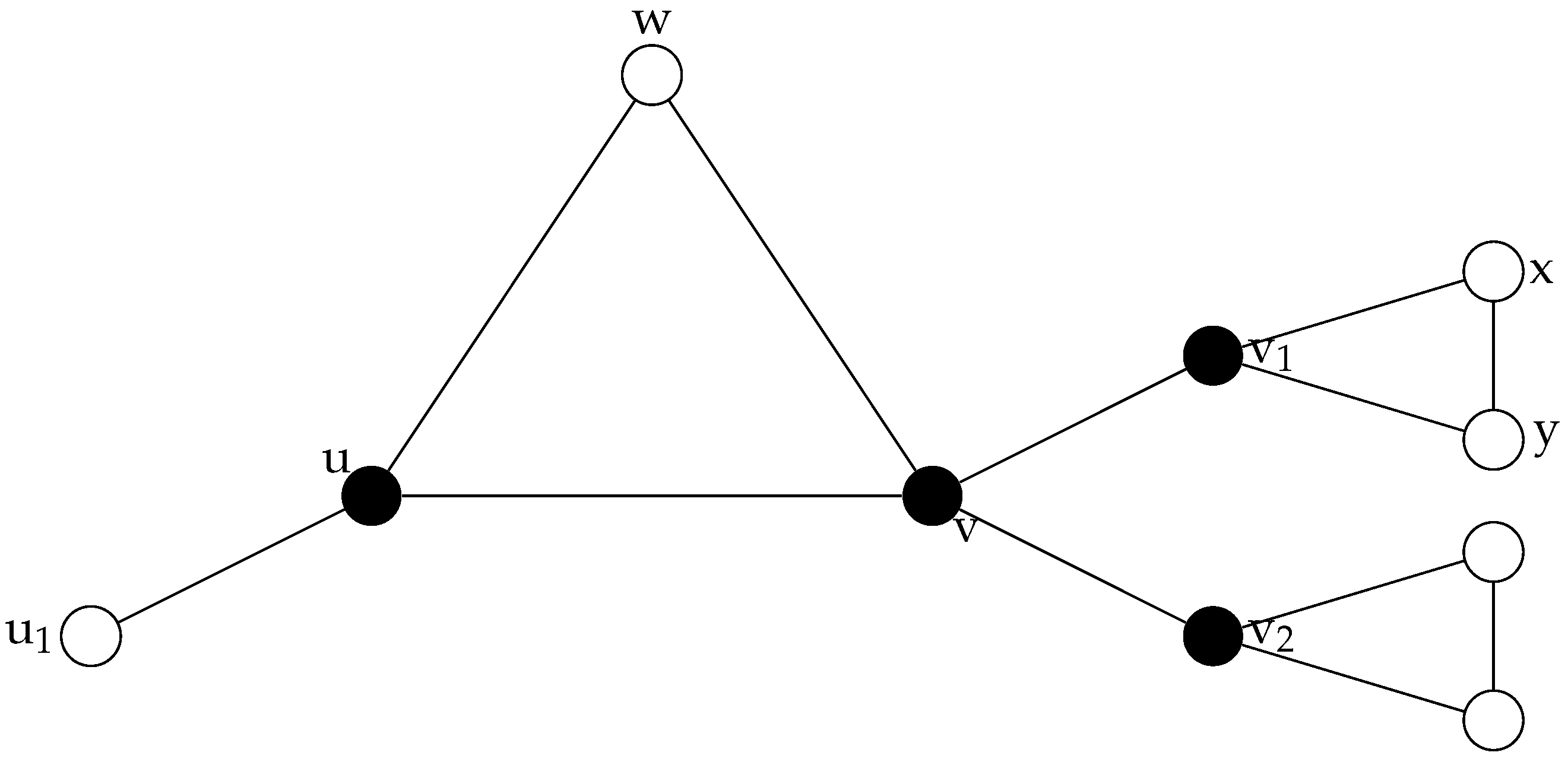
Proof. Let
be the external neighbor of
u, and let
be the external neighbors of
v. Assume that
. Then all neighbors of
v are
-vertex. By Lemma 5,
. Hence
, see
Figure 1. Let
be an
-partition of
. Since
u is a poor 3-vertex, by Lemma 1(2),
u does not have a unique
-neighbor. Thus
u has exactly one
-neighbor.
If v is the unique -neighbor of u, then v is -saturated and , while . Then, is an -partition of G, a contradiction. Hence .
If is the unique -neighbor of u, then is -saturated. If at least one of belongs to , then is an -partition of G, a contradiction. Thus . Let be the -face incident with . If , then is an -partition of G, a contradiction. Hence, exactly one of belongs to . Without loss of generality, assume and . Then x is not -saturated, and thus is an -partition of G, a contradiction.
From the above arguments, we conclude that w is the unique -neighbor of u. Thus, w is -saturated. If , then is an -partition of G, a contradiction. If , let be the three external -neighbors of w with and . If is -saturated, then is an -partition of G, a contradiction. Hence, is not -saturated. If at least one of belongs to , then is an -partition of G, a contradiction. Thus, . In this case, is an -partition of G, a contradiction. □
Lemma 7. Let v be a rich 5-vertex of G. If v is incident with a -face, then v has at least one external -neighbor.
Proof. Let be a -face and suppose that the three external neighbors of v are all -vertices. Let be an -partition of . Then v is -saturated and w is -saturated. Since and , it follows that all external neighbors of w belong to . By symmetry, we may assume that and . If is -saturated, then is an -partition of G, a contradiction. If is not -saturated, then is an -partition of G, also a contradiction. □
Lemma 8. Let v be an -vertex of G, and let . For an -partition of , the following hold:
- (1)
v is -saturated and every neighbor of other than v belongs to ;
- (2)
if v is a poor 5-vertex and , then .
Proof. When , by Lemma 1, v is -saturated and the other neighbor of is -saturated. Now suppose . Let be a pendant 3-face of v with and let be the external neighbor of x. Since all neighbors of are -vertices, exactly one of is -saturated and the other two belong to . Clearly x is not -saturated. If y is -saturated, then by Lemma 1(2) and (3), . Thus, f is a terrible -face. If , then is an -partition of G, a contradiction. If , then is an -partition of G, a contradiction.
Suppose . By , v is -saturated and all neighbors of other than v belong to . Assume that another neighbor of v belongs to . If is -saturated, then is an -partition of G, a contradiction. Hence, is not -saturated. If all neighbors of belong to , then is an -partition of G, a contradiction. Thus has at least one neighbor in .
If , let with . Then is an -partition of G, a contradiction. If , let and assume , . If x is not -saturated, then is an -partition of G, a contradiction. Hence, x is -saturated and thus .
If , then all external neighbors of x belong to . Then is an -partition of G, a contradiction. If , then x is a terrible 5-vertex and . In this case, x has exactly one external neighbor in , which is not -saturated. Let . If , then is an -partition of G, a contradiction. If , then is an -partition of G, a contradiction. □
Lemma 9. Let v be a poor 5-vertex of G. Then . In particular, if v is incident with a special 3-face, then .
Proof. Let . Suppose . Without loss of generality assume that . For an -partition of , by Lemma 8(1), v is -saturated. By Lemma 8(2), , a contradiction.
Now suppose that v is incident with a special 3-face and . Assume and let the special 3-face be , where and the external neighbor of is a 3-vertex x. By Lemma 8(1), v is -saturated. By Lemma 8(2), . Thus, . If , then is an -partition of G, a contradiction. If , since x is a 3-vertex, if x is -saturated, then is an -partition of G, a contradiction. Thus, x is not -saturated, and is an -partition of G, a contradiction. □
Lemma 10. Let v be a poor 6-vertex of G. If v is incident with a special -face, then
Proof. Assume that . Let be a special -face, where the external neighbors of v are , and the external neighbors of x and y are and , respectively, with . Without loss of generality, assume that . Let be an -partition of . By Lemma 1(1) and (2), we have and v is -saturated. Thus, at least one of belongs to . Without loss of generality, assume . If , then is an -partition of G, a contradiction. Hence, . If all neighbors of belong to , then is an -partition of G, a contradiction. Therefore, has at least one neighbor in . If , let , then . In this case, is an -partition of G, a contradiction. If , let , and assume . If u is not -saturated, then is an -partition of G, a contradiction. Thus, u is -saturated, and hence . When , is an -partition of G, a contradiction. When , u is a terrible 5-vertex and . Let . Then u has exactly one external neighbor in , and it is not -saturated. If , then is an -partition of G, a contradiction. If , then is an -partition of G, a contradiction. □
For a -face , where u is a poor 3-vertex, w is a terrible 5-vertex, and v has three pendant faces which are -faces or terrible -faces, we call f a bad 3-face. The edge is called the -edge of f. Let the external neighbors of v and w be and , respectively. For this bad 3-face f, the following two results hold.
Lemma 11. For the above bad 3-face f, let be an -partition of . Then , and all neighbors of belong to .
Proof. Let . When , let ; when , let . By Lemma 8, v is -saturated and . By Lemma 8, . Hence, . Next, we prove that .
If at most one of belongs to , then is an -partition of G, a contradiction. If two of them belong to , say . If , when , is an -partition of G, a contradiction; when , is an -partition of G, a contradiction. If , when , is an -partition of G, a contradiction. If one of belongs to , say , then is an -partition of G, a contradiction. Thus, . Now, we prove that all neighbors of belong to .
Suppose that has at least one neighbor in . For each , if has a neighbor in , move from to . After performing this modification, obtain another -partition of G. Since w is a terrible 5-vertex, is an -partition of G, a contradiction. Hence, all neighbors of belong to . □
Lemma 12. The -edge of the above bad 3-face f is incident with a -face.
Proof. Since 3-faces are not adjacent and G contains no 4-cycles or 5-cycles, we may assume that is incident with a 6-face . Without loss of generality, let . For an -partition of , by Lemma 11, we have and all their neighbors belong to . If , then is an -partition of G, a contradiction. If , then y is a terrible 5-vertex. Let . Then, ; otherwise, is an -partition of G, a contradiction. For , if some has all its neighbors in , then is an -partition of G, a contradiction. If some has one neighbor in and the other in , then is an -partition of G, a contradiction. □
3. Discharging
Let the initial charge of a vertex v in G be , and the initial charge of a face f be . By Euler’s formula , we obtain Next, we design a series of discharging rules and redistribute the charges so that the final charge of every vertex and every face is nonnegative. However, the total charge remains unchanged, which leads to a contradiction. Let and denote the final charges of a vertex v and a face f in G, respectively.
If v is adjacent to a 3-face f, we define as the charge that v sends to f. If x is a neighbor of v, we define as the charge that v sends to x. The discharging rules are as follows.
- R1
Let v be a 4-vertex and suppose that v is incident with a 3-face f. Then
- R2
Let v be a d-vertex with , and suppose that v is incident with a 3-face f. Then
- R3
Let v be a d-vertex with , and suppose that v is incident with a 3-face f. Then
- R4
Let v be a d-vertex with . Then
- R5
Let v be a -vertex. Then
- R6
Each 3-face sends 1 to each incident bad 2-vertex; each -face f sends 1 to each incident bad 2-vertex, and sends to each bad 3-face adjacent to f with common edge being a -edge.
Let denote the final charge of a 5-vertex v after applying Rules R4 and R5.
- R7
Each 5-vertex v sends to each incident 3-face.
Lemma 13. For every face f of G, we have .
Proof. Since G contains no 4-cycles and no 5-cycles, G has no 4-faces or 5-faces. Because there is no charge transfer between a 6-face and other vertices or faces, we have . Hence, it suffices to consider -faces and 3-faces. Let f be a k-face. If , let be the number of bad 2-vertices incident with f, and let be the number of bad 3-faces adjacent to f such that the common edge is a -edge.
Case 1. .
If , clearly . If , by the structure of bad 3-faces we have and . Hence, . By R6,
Case 2. .
Since the vertices of triangles are pairwise disjoint and by the construction of bad 3-faces, we have . By R6, When , ; when ,
Case 3. .
Suppose that f is incident with a 5-vertex v. By R4 and R5 we obtain the following bounds for : If v has an external -neighbor, then . If v is poor but not a terrible 5-vertex, then . If v is a terrible 5-vertex and f is a special 3-face, then by Lemma 9, , hence If v is a terrible 5-vertex and f is not a special 3-face but the number of pendant -faces and terrible -faces of v is at most 2, then Otherwise .
Let with . Suppose . By R1, R2, R3 and R7, every -vertex sends at least 1 to f. Hence, Suppose . When , by Lemma 2, . By R1, R3 and R6, When , by R3, R6 and R7, When , by R2, R3 and R6, Suppose . If , then by R2 and R3, Next, consider the case .
Case 3.1. .
When , by Lemma 4, each has an external -neighbor. By R4 and R5, . When , by Lemma 4, both and have external -neighbors. If both and are rich vertices, then by R1 and R5, Otherwise, by R1, R4 and R5, When , if f is special, then by R2, ; if f is not special, then by R2, R4 and R5, When , by R3, .
When
, by Lemma 3,
f is not a special 3-face, and hence both
and
have external
-neighbors. Assume that
is a rich 5-vertex. Then
has an external
-neighbor. By R7,
Assume that
is a poor 5-vertex. If
is a terrible 5-vertex, then
f is a terrible
-face. By R4, R5 and R7,
If
is not a terrible 5-vertex, then
. The summary of the final charge is shown in
Table 1.
Case 3.2. .
When , if is rich, then by R1 and R5, If is poor, then by R1 and R4, When , by R1, R2 and R3,
When
, if
is a rich 5-vertex, then
has an external
-neighbor. By R7,
If
is poor but not a terrible 5-vertex, then by R1 and R7,
If
is a terrible 5-vertex and
f is a special 3-face, then
is a poor 3-vertex. By R1 and R7,
If
is a terrible 5-vertex and
f is not a special 3-face, then by R1, R4, R5 and R7,
. The summary of the final charge is shown in
Table 2.
Case 3.3. .
When
, by R2, R3 and R7,
When
, if at least one of
and
is a rich 5-vertex, without loss of generality assume that
is a rich 5-vertex. Then
has an external
-neighbor. By R7,
If both
and
are poor 5-vertices and at least one of them is not a terrible 5-vertex, then
If both
and
are terrible 5-vertices and
f is a special 3-face, then
Now assume that both
and
are terrible 5-vertices and
f is not a special 3-face. If the numbers of pendant
-faces and terrible
-faces incident with
and
are at most 2, then by R4, R5 and R7,
If at least one of
and
is incident with three pendant
-faces or terrible
-faces, then
f is a bad 3-face or
is a rich 3-vertex. By Lemma 12 and R4, R5, R6 and R7,
. The summary of the final charge is shown in
Table 3. □
Lemma 14. For every vertex v of G, we have .
Proof. Since a 3-vertex sends no charge, . Let v be a d-vertex.
Case 1. .
If v is a bad 2-vertex, then v is incident with a 3-face and a -face. By R6, If v is a good 2-vertex, by R4 and R5,
Case 2. .
By Lemma 6, if v is incident with a -face f such that f is adjacent to a poor 3-vertex but not adjacent to any rich 5-vertex, then .
Suppose that v is a poor 4-vertex. By Lemma 5, we have . When v is incident with the above -face f, by R1 and R4, When v is incident with other 3-faces, by R1 and R4, When v is not incident with any 3-face, by R1 and R4,
Suppose that v is a rich 4-vertex. When v is incident with the above -face f, then v has an external -neighbor. By R1, R4 and R5, When v is incident with other 3-faces, by R1, R4 and R5, When v is not incident with any 3-face, by R1, R4 and R5,
Case 3. .
If v is incident with a 3-face, then by R4, . Hence, by R7, Assume that v is not incident with any 3-face. If v is a rich 5-vertex, then . By R4, If v is a poor 5-vertex, then by Lemma 9, . By R4,
Case 4. .
If v is not incident with any 3-face, then by R4, Now assume that v is incident with a 3-face. If , then by R2 and R4,
For , if v is incident with a special -face, then when v is rich, by R2 and R4, when v is poor, by Lemma 10, . By R2 and R4, If v is incident with other 3-faces, then by R2 and R4,
Case 5. .
If v is not incident with any 3-face, then by R5, Now assume that v is incident with a 3-face . If both and are -vertices, then f is a -face. By R3 and R5, If both and are -vertices, then by R3 and R5, If exactly one of and is a -vertex, assume without loss of generality that is a -vertex. Then is a -vertex. By R5, v sends no charge to . When f is a -face, by Lemma 2, . By R3 and R5, When f is a -face, by R3 and R5, When f is any other 3-face, by R3 and R5, □