1. Introduction
Throughout this paper, unless otherwise stated, considered graphs are finite and simple and digraphs are orientations of such graphs. Therefore, digraphs have neither loops nor parallel arcs.
Let G be a graph. Its vertex set will be denoted by and its edge set will be denoted by . A graph H is a subgraph of G, if and . If in addition , then the subgraph H is said to be a spanning subgraph of G. Let x be a vertex of G. If is an edge of G, then we say that y is a neighbor of x. Also, we say that x and y are neighbors. The degree of x, denoted by , is the number of all its neighbors in G. G is said to be m-degenerate, if every subgraph of G has a vertex of degree at most m. A set of vertices is said to be a stable set in G, if any two vertices x and y in S are not neighbors in G. The stability of G is S is a stable set in . The chromatic number of G, denoted by , is the smallest k such that is a union of k stable sets. Equivalently, if k is the smallest number such that we can color all the vertices of G by k colors in a way that any two neighbor vertices receive distinct colors. If , then we say that G is k-chromatic. A complete graph is a graph such that any two distinct vertices are neighbors. A tournament is an orientation of a complete graph.
Let D be a digraph and suppose that D is an orientation of a graph G. We will say that G is the underlying graph of D. The vertex set and arc set of D will be denoted by and . denotes the digraph with vertex set and arc set . If a digraph (resp. graph) H is isomorphic to a subdigraph (resp. graph) of a digraph (resp. subgraph) G, then we say that G contains H. The stability of D and the chromatic number of D are those of its underlying graph G.
A path is a graph with and . An oriented path is an orientation of a path. A directed path is an oriented path with . The previous path is said to be a directed path from to . A cycle is a graph with and . An oriented cycle is an orientation of a cycle. A directed cycle is an oriented cycle with . If is an oriented path, then for , is the oriented path . The length of a path or cycle (resp. oriented path or cycle) is the number of its edges (resp. arcs). A Hamiltonian oriented path (resp. cycle) P of a digraph H is an oriented path (resp. cycle) contained in H such that ; that is, it passes through all the vertices of H. A digraph that has a Hamiltonian directed cycle is called a Hamiltonian digraph. A graph is connected if between any two of its vertices there is a path. A digraph is said to be strongly connected if between any two of its vertices there is a directed path. A tree is a connected graph that has no cycle. A rooted tree is a tree in which one vertex has been designated as the root.
Let H be a an oriented path or cycle but not a directed cycle. A block P of H is a maximal directed path contained in H. That is, if is also a directed path contained in H and contains P, then . Observe that the number of blocks of an oriented cycle which is not directed is always even. An oriented cycle or an oriented path with t blocks is one that has exactly t blocks. A subdivision of a digraph H is a digraph obtained from H by replacing some of its arcs by a directed path from x to y. Note that a subdivision of an oriented cycle (resp. oriented path) with t blocks is again an oriented cycle (resp. oriented path) with t blocks, but the length of each block might increase.
It is known that tournaments are “rich” digraphs; that is, they contain many structures such as oriented paths, oriented trees and oriented cycles. For example, with three exceptions only, any tournament on
n vertices contains any oriented path on
n vertices [
1]. Are
n-chromatic digraphs also rich? In other words, which digraphs
H are sub-digraphs of all digraphs with sufficiently large chromatic number?
We have the following classical result.
Theorem 1 (Roy-Galli [
2,
3])
. Every digraph with chromatic number at least contains a directed path of length at least n. For non-directed paths, El Joubbeh and Ghazal [
4] proved that every
-chromatic digraph contains every oriented path on
n vertices with
blocks for some function
g. However, the only connected oriented graphs
H that are possibly candidates to generalize Theorem 1 are oriented trees. This is due to the following Theorem.
Theorem 2 (Erdős [
5])
. For every and , there is a graph with chromatic number at least k and girth at least g. But for strongly connected digraphs Bondy proved the following.
Theorem 3 (Bondy [
6])
. Every strongly connected digraph of chromatic number at least n contains a directed cycle of length at least n. By interpreting directed cycles of length at least n as subdivisions of the directed cycle of length n, the preceding Theorem establishes a special case of a conjecture proposed by Cohen et al.:
Conjecture 1 ([
7])
. For every oriented cycle C, there is a constant such that every strongly connected digraph with chromatic number at least contains a subdivision of C. Let
C be any oriented cycle on
n vertices. Note that every Hamiltonian digraph is strongly connected. For the class of Hamiltonian digraphs, El Joubbeh [
8] proved that
and Ghazal et al. [
9] refined the proof and showed that
. For a generalization of these results see [
10]. In addition, Al-Mniny and Ghazal [
11] used secant edges to show that if
C is a cycle with two blocks of respective lengths
k and
m, say
, then every
-chromatic digraph
D spanned by a Hamiltonian directed path contains a subdivision of
C. The proofs of the results in [
8,
9,
10] rely on a tool called secant edges, proposed in [
11] by Al-Mniny and Ghazal. In this paper, we will also exploit certain secant edges to improve the latter bound
and derive a tight bound.
2. Main Results
The following lemma about the chromatic number is well known in graph theory.
Lemma 1. Let G be a graph. If G is m-degenerate, then .
Definition 1. Suppose that is a linear ordering of the vertices of a graph G. Let k be a positive integer. An edge is called a k-jump with respect to L, if . It is said to contain an l-jump , if . It is said to be a minimal k-jump if it contains no k-jump other than itself.
Forbidding k-jumps in a graph yields a bound on its chromatic number, as stated in the following proposition.
Proposition 1. Let G be a graph that has no k-jump with respect to a linear ordering of its vertices. Then .
Proof. For each , let . Assume that is not a stable set for some i. Then there are two non-negative integers such that . Since , then is a k-jump, which is a contradiction. Hence, for every , is a stable set. Since , then . □
In the next definition and theorem, we consider a more general configuration involving pairs of jumps. Specifically, we introduce the notion of -secant edges, which captures a structured interaction between two edges, and examine its implications for the chromatic number.
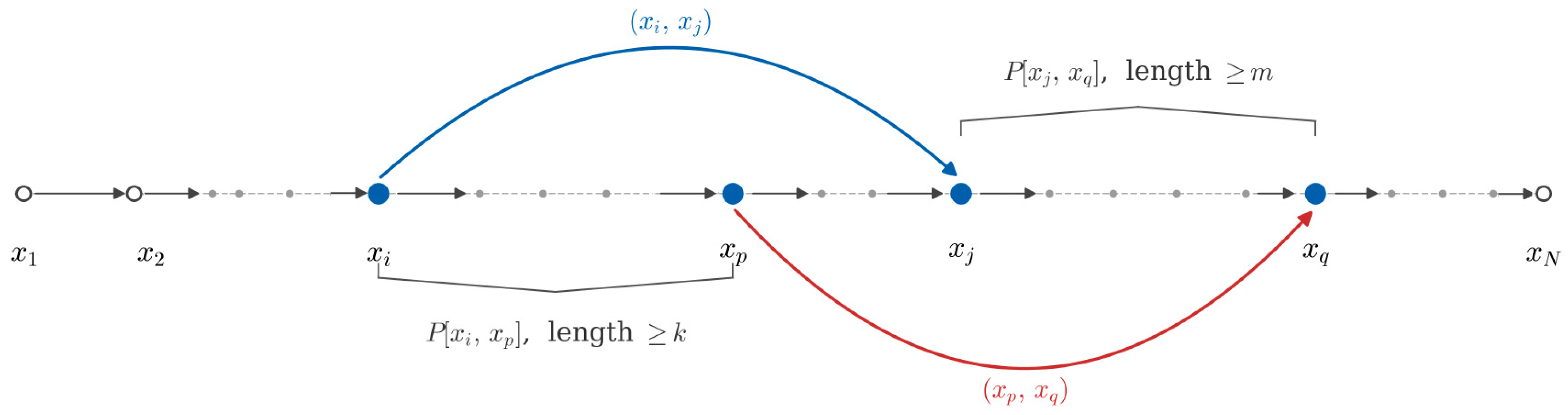
Definition 2. Suppose that is a linear ordering of the vertices of a graph G. Let k and m be positive integers. Two edges and are said to be -secant edges if , and .
Theorem 4. If a graph has no -secant edges with respect to some linear ordering of its vertices, then its chromatic number is at most .
Proof. Let H be a graph that has no -secant edges with respect to some linear ordering . We will show that H is -degenerate. Let G be a subgraph of H and let denote the restriction of to the vertices of G. Clearly, any -secant edges of G with respect to L are -secant edges of H with respect to . Hence, G has no -secant edges with respect to L. We will show that G has a vertex of degree at most .
Suppose that G has no -jump. Then the neighbors of are in the set . Hence . Now we suppose that G has a -jump. Let be a minimal -jump with i being chosen the smallest. That is, if is a minimal -jump different from , then . We will show .
Let . Assume that . Then it is a -jump and hence it contains a minimal -jump with . This contradicts the minimality of i. Hence, . Therefore, has no neighbor in the set .
Let and suppose that . By minimality of , we get that . Therefore, has at most k neighbors in the set . Hence, it has at most neighbors in the set .
Let and suppose that . Clearly, if , then and are -secant edges of G, which is a contradiction. Therefore, . Therefore, has at most neighbors in the set .
So, the degree of in G is . This shows that H is -degenerate. Hence, its chromatic number is at most . □
The above theorem is a key ingredient in the proof of the main result, namely Theorem 5. Specifically, if the underlying graph of a digraph admitting a Hamiltonian directed path contains no -secant edges, then Theorem 4 guarantees that its chromatic number is bounded. On the other hand, if such secant edges exist, they can be utilized to construct the required cycle.
Theorem 5. Let C be a cycle with two blocks and let n denote the number of its vertices. Then every -chromatic digraph that has a Hamiltonian directed path contains a subdivision of C.
Proof. Let C be a cycle with two blocks of respective length k and m. Let n denote the number of its vertices. Then . Let D be an -chromatic digraph that has a Hamiltonian directed path .
Let G denote the underlying graph of D and we consider the linear order of the vertices of G. Assume that G has no -secant edges. Then by Theorem 4, we get that , a contradiction. Therefore, G has -secant edges and with , and . We have four cases according to the orientations in D of the edges and . In each of these case we will construct a subdivision of C.
Suppose that
and
are in
. Then the directed path
and the directed path
form a subdivision of
C (see
Figure 1).
Suppose that and are in . Then the directed path and the directed path form a subdivision of C.
Suppose that and are in . Then the directed path and the directed path form a subdivision of C.
Suppose that and are in . Then the directed path and the directed path form a subdivision of C. □
Let
C be a cycle with two blocks of respective length
k and
m, where
. Then
is the number of vertices of
C. Let
D be a digraph spanned by a Hamiltonian directed path. Al-Mniny and Ghazal [
11] proved that if
, then
D contains a subdivision of
C. Since
and
, then
k can take any integer value
and
. So, in terms of
n, which is the number of vertices of the cycle, the bound
obtained in [
11] satisfies
. So, our bound
obtained in Theorem 5 is significantly smaller than
.
In addition, our bound is tight. To see this, let be the oriented cycle of two blocks; each is of length one. That is C consists of only vertices and only two arcs and these arcs are parallel. Let D be the directed cycle on three vertices. Clearly, and D does not contain any subdivision of C.
Theorem 6 ([
12])
. The vertex set of any digraph D is the union of the vertex sets of at most disjoint directed paths. Corollary 1. Let C be a cycle with two blocks and let n denote the number of its vertices. Let D be an -chromatic digraph that has a Hamiltonian directed path. Then D contains a subdivision of C.
Proof. Let C be a cycle with two blocks and let n denote the number of its vertices. Let D be an -chromatic digraph that has a Hamiltonian directed path. By Theorem 6, the vertex set of any digraph D is the union of the vertex sets of t disjoint directed paths , where . For each , let be the subdigraph of D induced by the vertices of . Since D is an -chromatic digraph, then there is such that . By Theorem 5, , and consequently D, contains a subdivision of C. □