


Abstract
This paper investigates the dynamics of a three-dimensional nonlinear model of the financial system and the conditions for the emergence of chaotic behavior. The well-known chaotic system with given parameters and initial conditions is considered as a basis. For the initial model, critical points are analyzed, two-dimensional and three-dimensional phase portraits are constructed, and Lyapunov exponents are calculated, which allow confirming the presence of chaos and assessing the degree of sensitivity to initial data. Next, a modification of the system is proposed, consisting of changing the degree of the variable in the second equation. For the group of models obtained, we considered the generalized form of the system, found its critical points, and classified them. At the next stage, a bifurcation analysis was performed: by changing the key parameters of the modified systems, bifurcation diagrams were constructed, and parameter regions corresponding to critical points, periodicity, quasi-periodicity, and chaos were identified. The results demonstrate that the nature of the dynamics depends significantly on both the parameters and the degree of nonlinearity and allow conclusions to be drawn about the mechanisms of chaos in the financial model under consideration.
Keywords:
chaos; attractor; Lyapunov exponents; Kaplan–York dimension; chaotic solutions; bifurcation analysis MSC:
34C25; 34D45
1. Introduction
Chaos theory originated in the natural sciences [1], particularly mathematics and physics [2], where it was developed to analyze complex nonlinear systems that exhibit a strong sensitivity to initial conditions [3,4]. Over time, the fundamental principles of chaos theory have been increasingly applied in economics to investigate disturbances in economic systems and evaluate their potential consequences [5,6]. Chaotic economic [7] and financial market models [8] have long been a central topic of investigation for economists and theoreticians. In recent decades, the increasing instability of financial markets and the increasing role of stochastic factors have further stimulated interest in the application of chaos theory within the financial domain [9]. In this context, a variety of financial models have been extensively examined in the literature with the aim of describing and predicting complex market dynamics (see, for example, [5,10,11,12]).
In chaos theory, methods such as linear and bifurcation analysis [13,14,15], the construction of strange attractors [16,17], and the calculation of Lyapunov exponents [18,19], as well as numerical methods, are widely used to study nonlinear dynamic systems. The study is based on dynamic systems and their phase spaces [3]. Thanks to these methods, it is possible to most accurately characterize the properties of nonlinear dynamical systems, such as sensitivity to initial conditions, non-periodicity, and unpredictability.
The study focuses on a financial dynamical system described by a special set of ordinary differential equations. The analysis concentrates on the properties of attracting sets and their dependence on the model parameters. Graphs of solutions, phase portraits, bifurcation diagrams, and the dynamics of Lyapunov exponents are constructed to illustrate the evolution of the system and predict its future behavior.
Although a number of nonlinear financial models exhibiting chaotic dynamics have been proposed in the literature, most existing studies are based on quadratic or quartic nonlinearities. However, empirical financial data often exhibit strong nonlinear effects, including leptokurtic distributions and heavy-tailed fluctuations. These features indicate that market dynamics may involve stronger nonlinear feedback mechanisms than those captured by low-order nonlinear terms. In this study, the nonlinear term is generalized to , where , allowing us to investigate how the degree of nonlinearity affects system stability, bifurcations, and the emergence of chaotic regimes. This approach provides additional insight into the role of higher-order nonlinearities in the generation of complex financial dynamics. Nevertheless, the influence of higher-order nonlinear terms on the dynamical behavior of financial models remains insufficiently investigated. In particular, the role of varying degrees of nonlinearity in shaping the structure of the phase space and the complexity of system dynamics has not been studied in detail. This motivates the present work, where a generalized financial model with a nonlinear term of the form is considered and its dynamical properties are analyzed.
This manuscript is organized as follows. The Introduction provides a brief overview of chaos theory, outlines the current state of research on nonlinear dynamical systems, and emphasizes the relevance of these concepts to financial modeling. Section 2 introduces a three-dimensional mathematical model of the financial system. In Section 3, the dynamic properties of the proposed three-dimensional nonlinear system are investigated. To achieve a more comprehensive analysis, the model is generalized by replacing the nonlinear term with , where is an integer. This section includes analysis of critical points, the construction of bifurcation diagrams, the visualization of attractors, the plotting of solution graphs, and the computation of the Lyapunov spectrum and Lyapunov dimension. Finally, the Discussion section summarizes the main results and contributions of this study.
The main contributions of this study can be summarized as follows:
- The critical points of the classical three-dimensional financial system are derived analytically and their existence conditions are determined.
- The local stability of the critical points is investigated by constructing the Jacobian matrix of the system and analyzing the corresponding eigenvalues.
- A generalized nonlinear financial model is proposed by modifying the degree of the variable in the second equation, which leads to a new class of dynamical behavior.
- The critical points of the generalized system are obtained, and their stability properties are analyzed, revealing the conditions under which the system transitions between stable and unstable regimes.
- The global dynamics of the system are investigated using phase portraits, Lyapunov exponents, and bifurcation diagrams.
2. Three-Dimensional Mathematical Model of Financial System
The model (1) describes a three-dimensional financial system where x is the interest rate, y indicates the level of investment demand, and z reflects how prices grow exponentially. In addition, the constant represents the rate of household savings, corresponds to investment costs, and measures the elasticity of demand in commercial markets. The parameter d is a positive scaling parameter [12].
In system (1), there are two quadratic nonlinearities and one quartic nonlinearity, , which together generate rich and complex dynamics. The three-dimensional system (1) exhibits a chaotic attractor when the parameters are set to
and the initial conditions are
Definition 1.
A continuous map is chaotic if it is topologically transitive, has dense periodic points, and exhibits sensitive dependence on initial conditions [20].
2.1. Stability and Dynamical Analysis
Dynamical analysis of chaotic systems involves exploring the underlying mechanics and behaviors that lead to chaos [21].
Let the third equation of the system (1) be equal to zero: .
Then
Substitute (4) into the first equation of the system (1)
Let us consider the first case, where . Then substituting into Equation (4) to get . After that, substitute into the second equation of the system (1) and equate to zero
From Equation (7) get . Taking into account the parameters (2), the first critical point is obtained: .
Let us consider the second case, where . Then and . After that, substitute into the second equation of the system (1) and equate to zero
After simplifying (8) get
Taking into account the parameters (2), the two roots of Equation (9) are obtained: . The second and third critical points are and .
Once the fixed points are determined, their stability is examined through the computation of the system’s Jacobian matrix. Let us build the Jakobian matrix
The Jacobian matrix provides a linear approximation of the system near critical points and allows their type to be determined based on the eigenvalues. This analysis plays a key role in studying the local stability of a dynamical system [22].
The characteristic matrix is
and the characteristic equation is
Put the values of the first critical point in (12) and get three roots
This result indicates that the critical point behaves as a saddle point and is unstable.
Put the values of the second critical point in (12) and get three roots
This result indicates that the critical point behaves as a saddle-focus point and is unstable.
Put the values of the third critical point in (12) and get three roots
This result indicates that the critical point behaves as a saddle-focus point and is unstable.
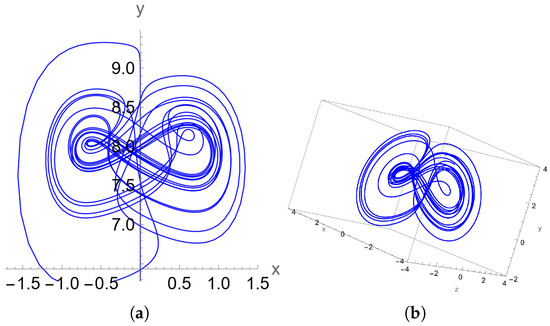
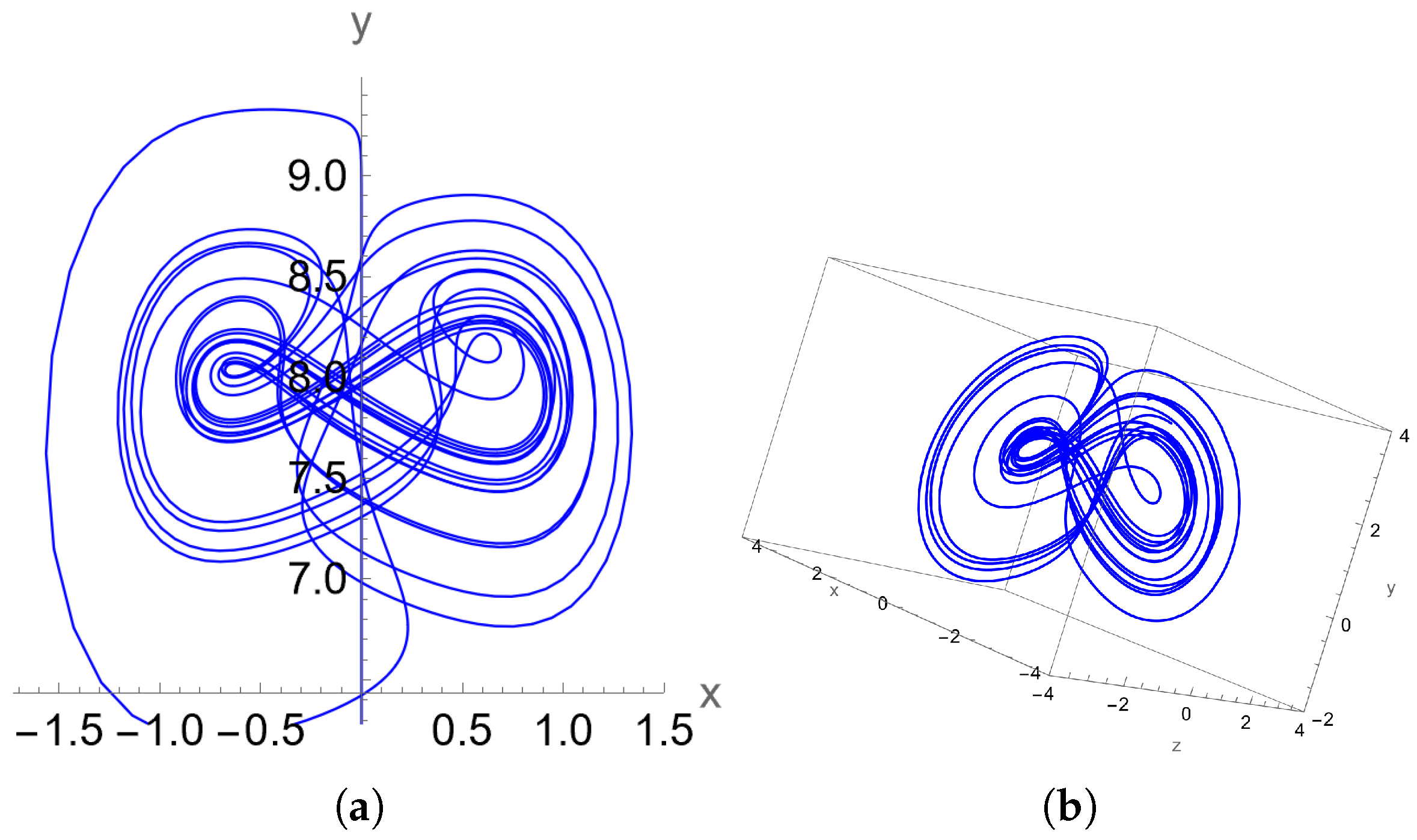
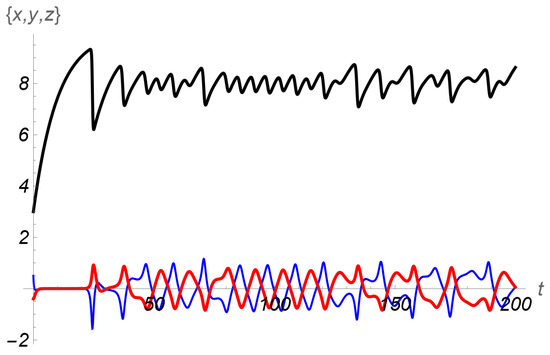
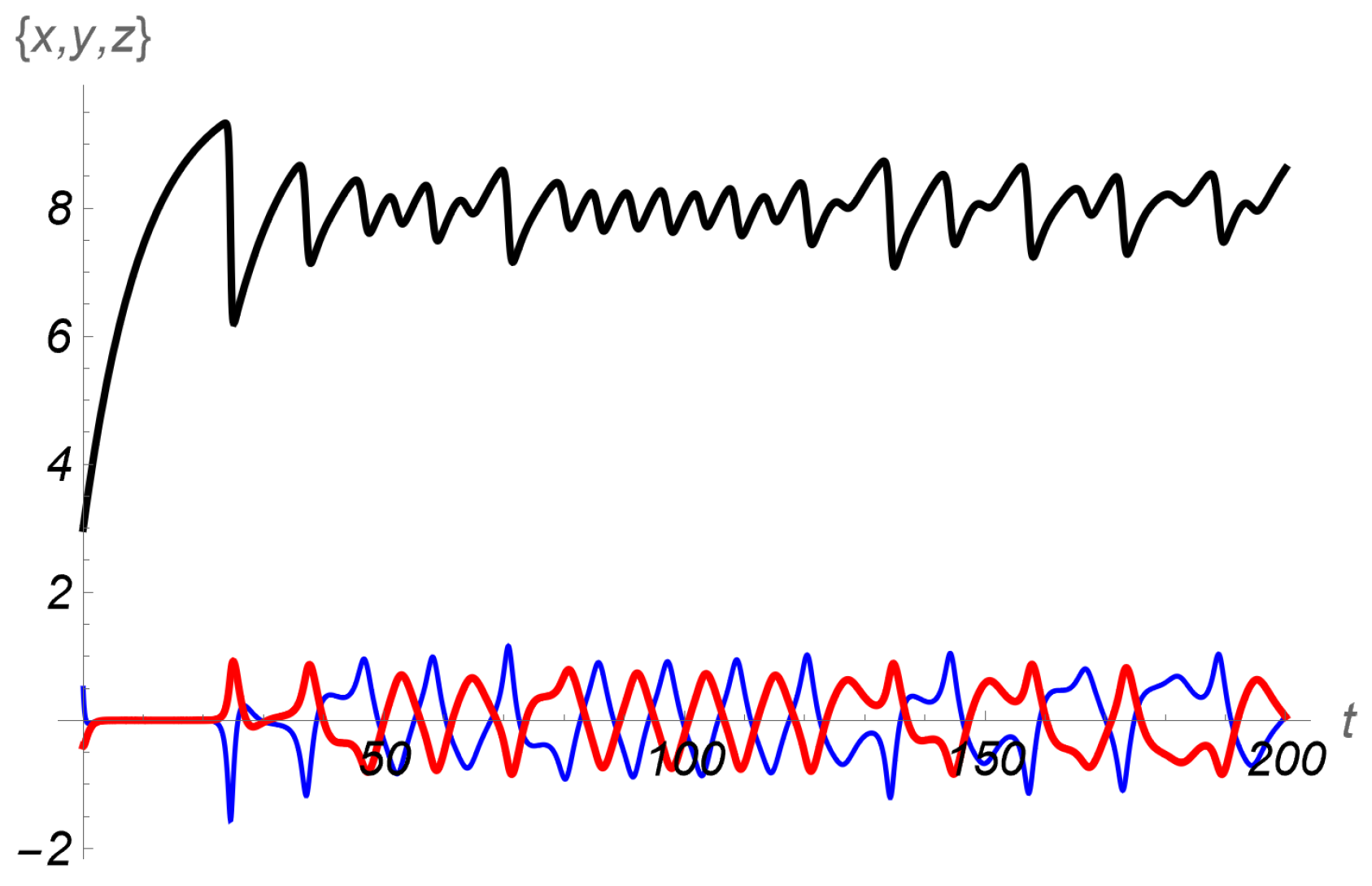
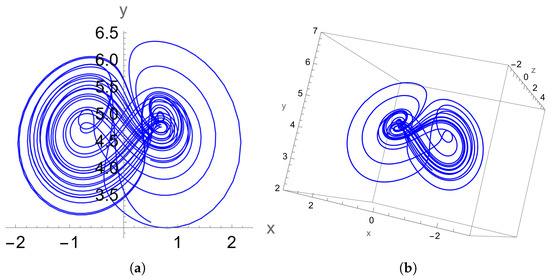
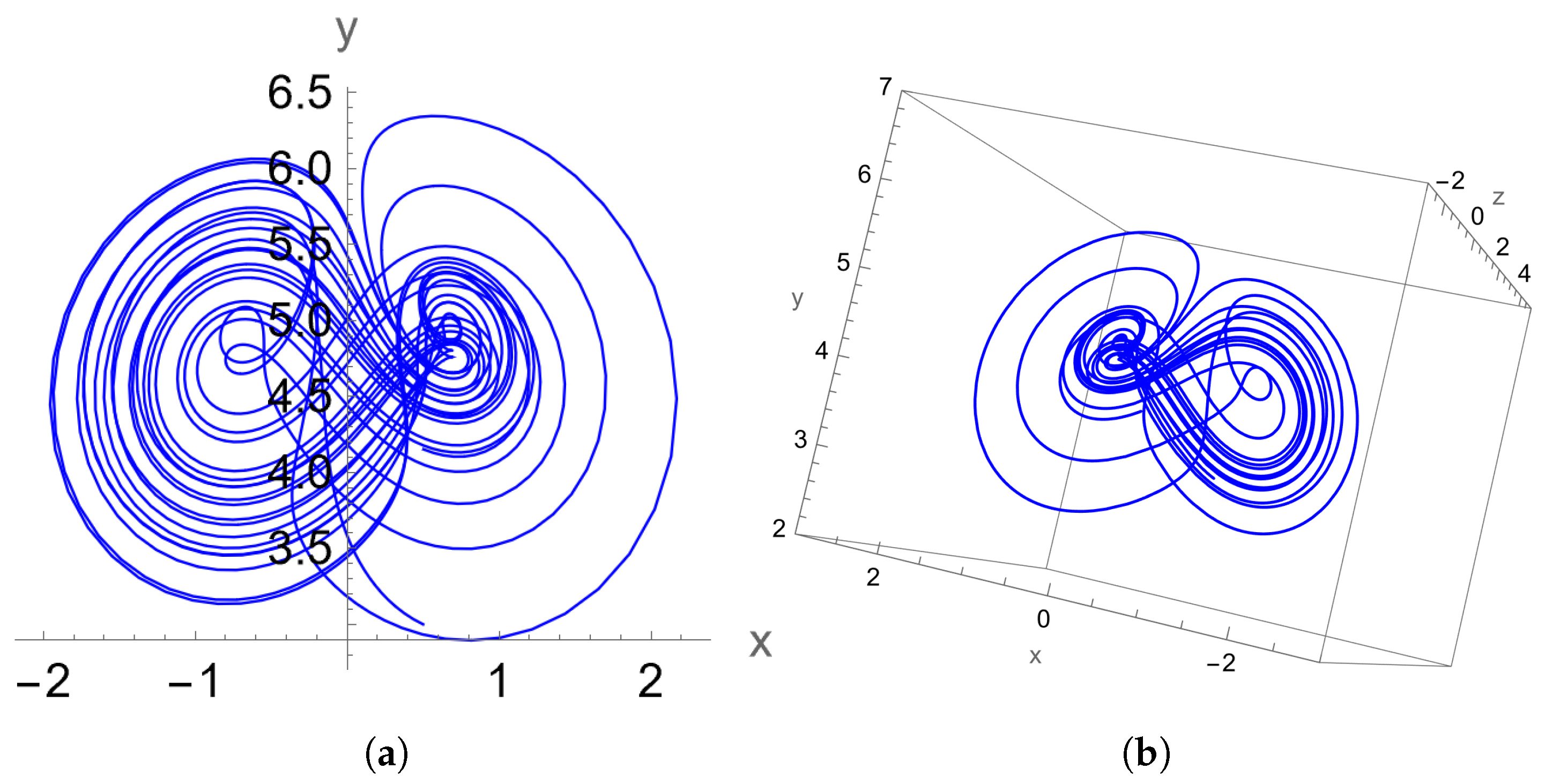
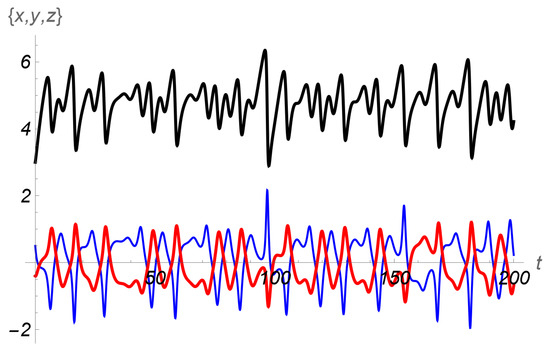
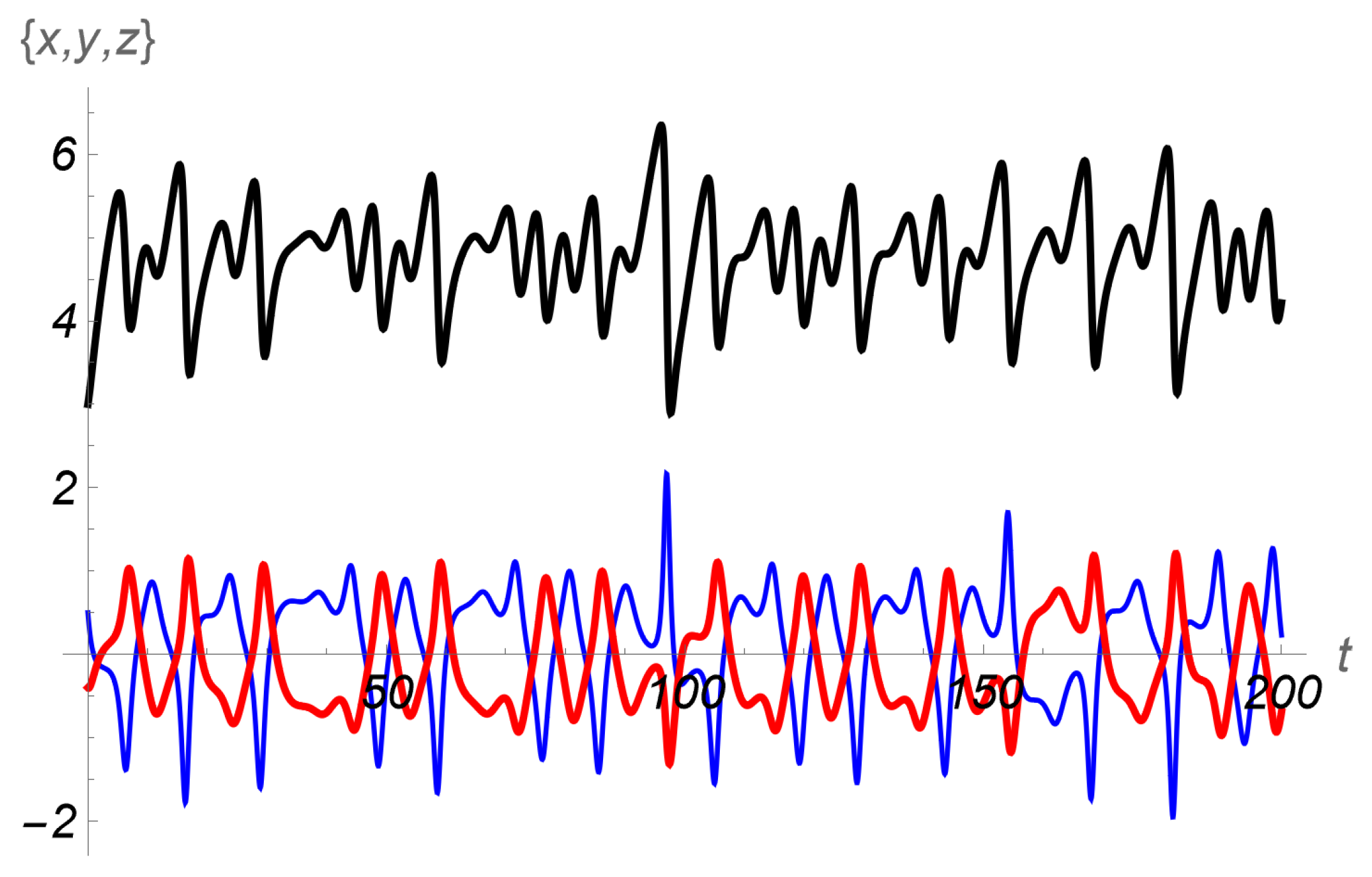
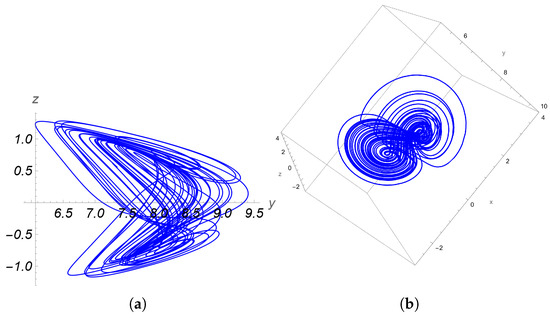
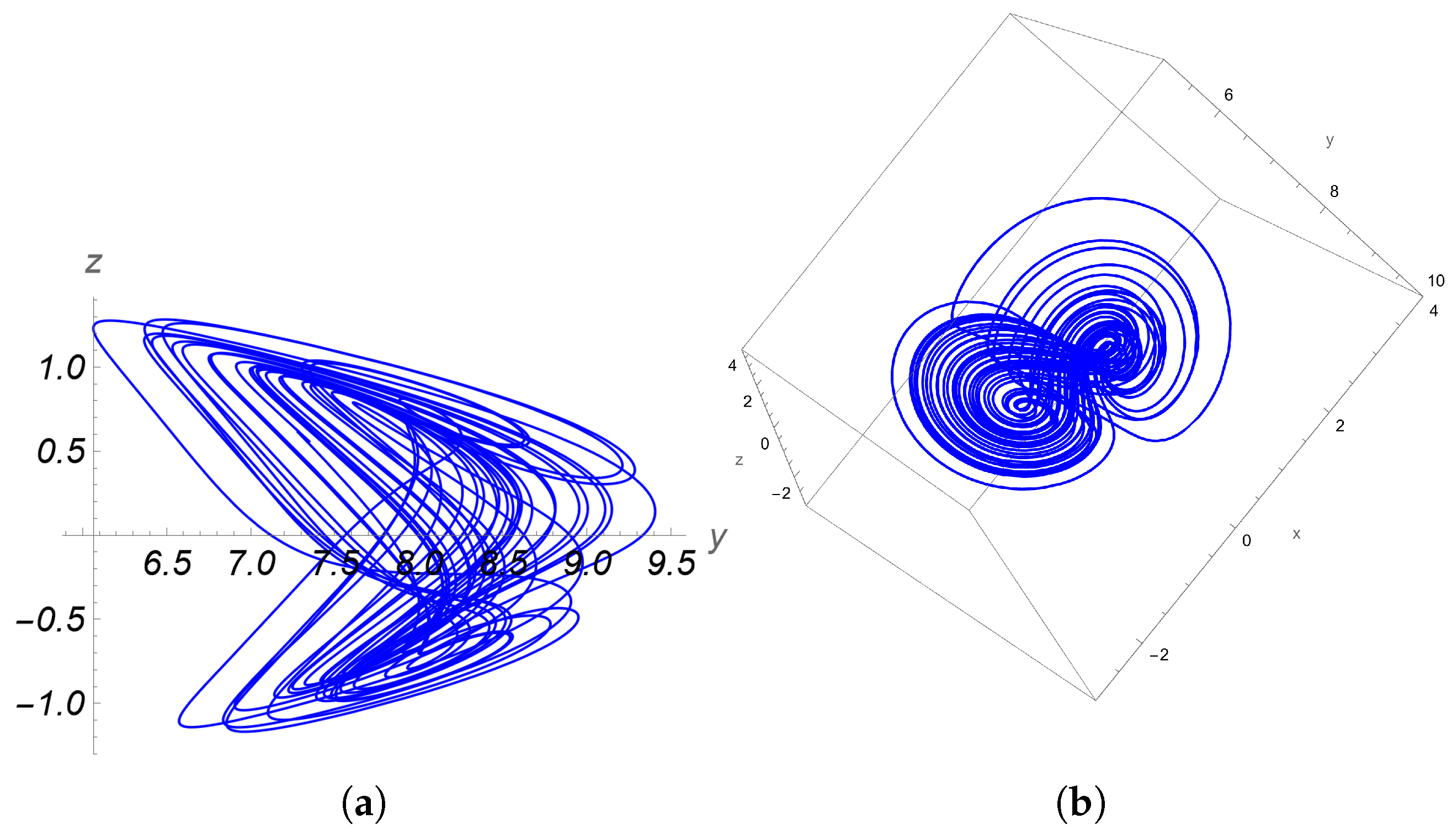
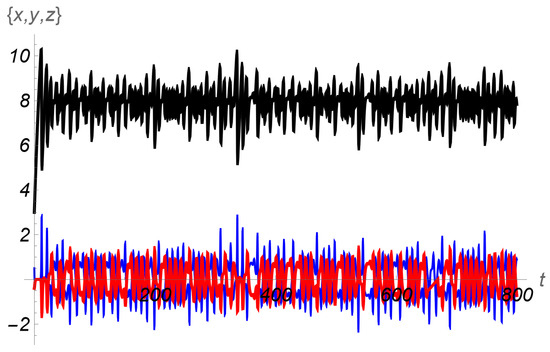
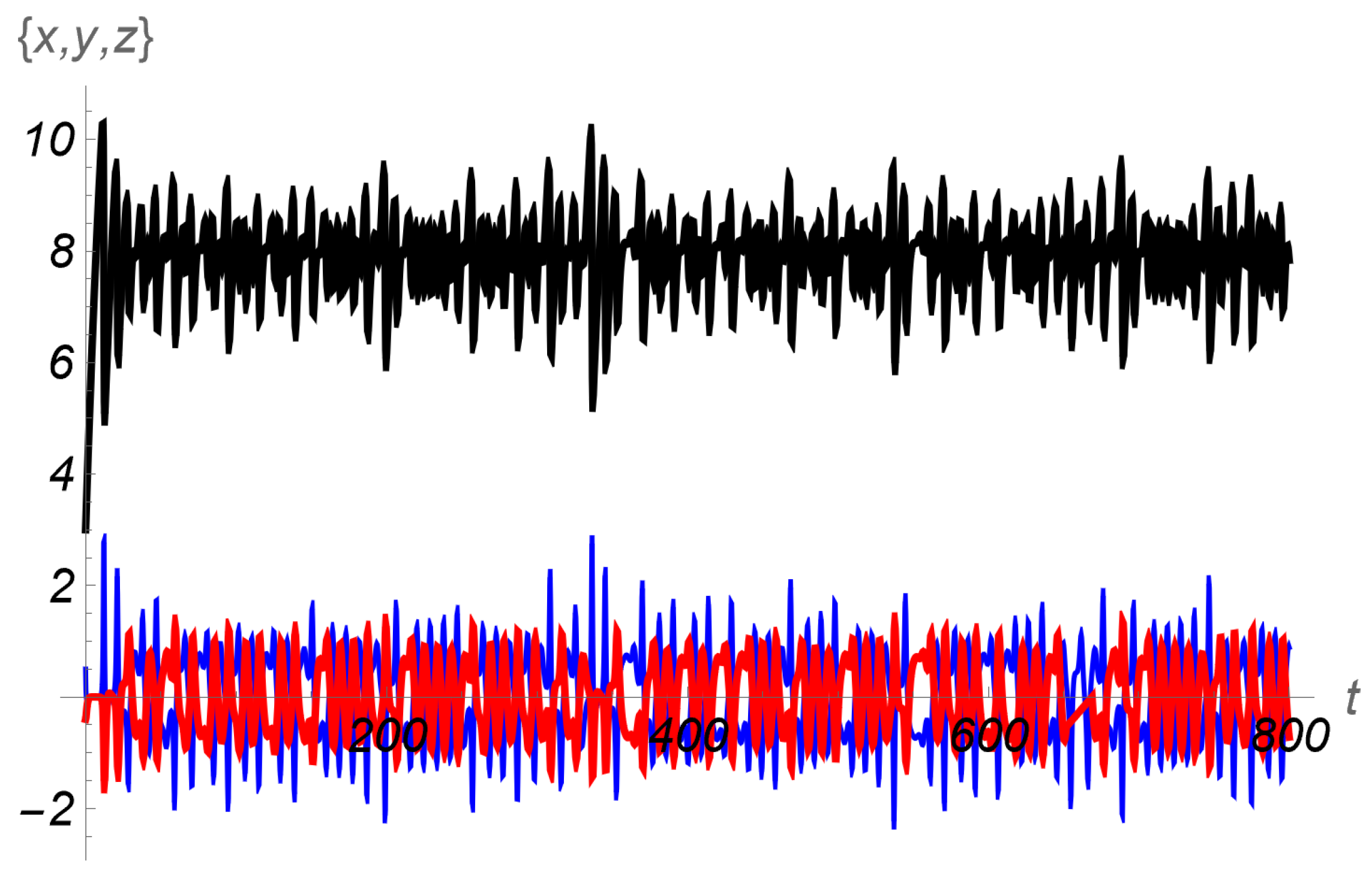
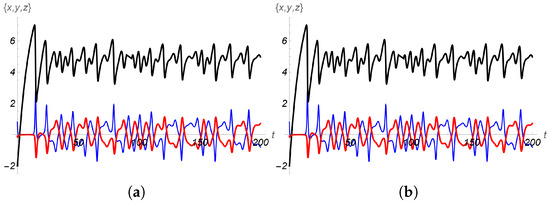
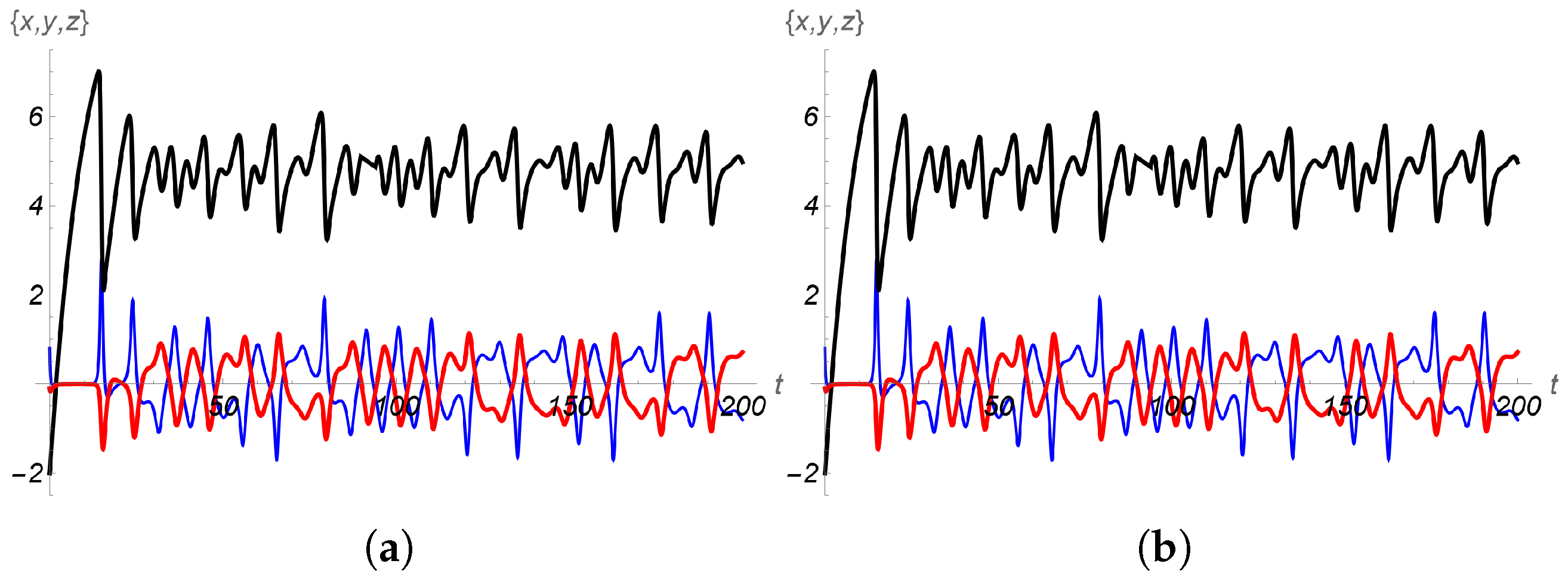
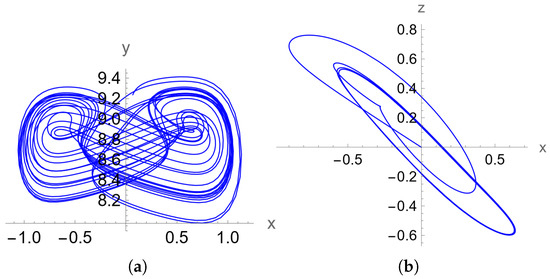
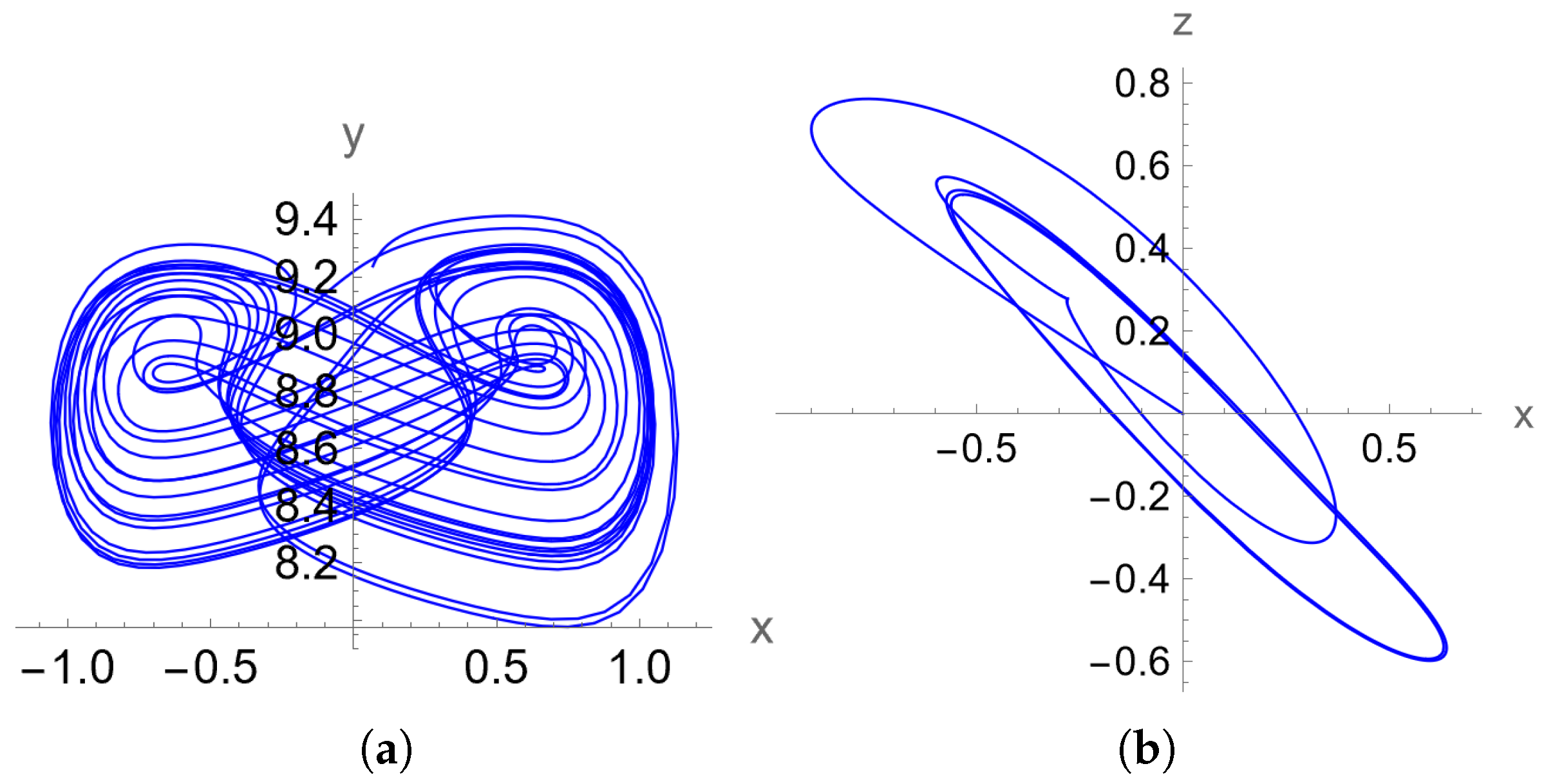
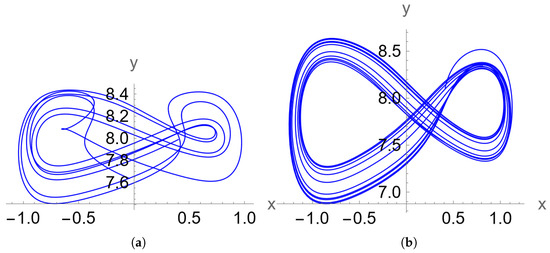
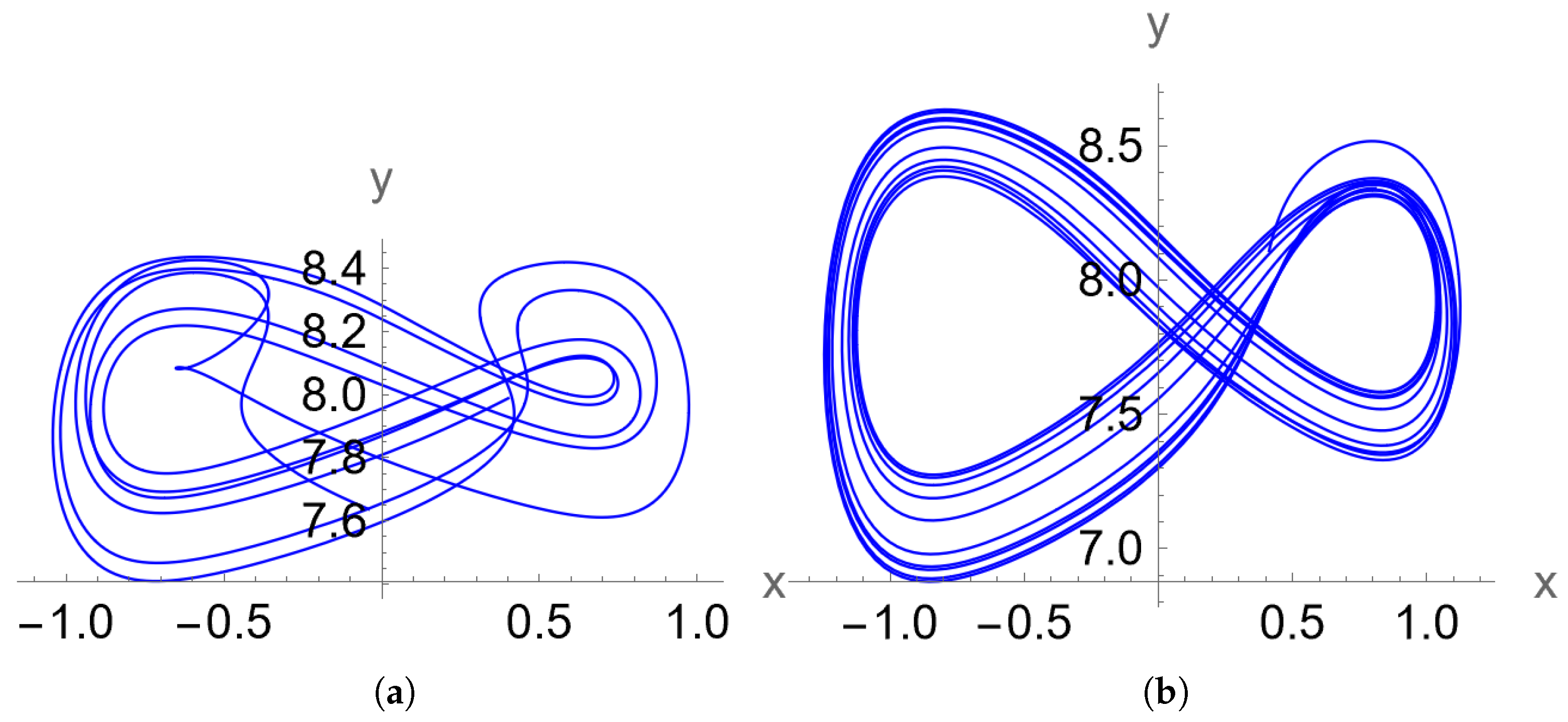
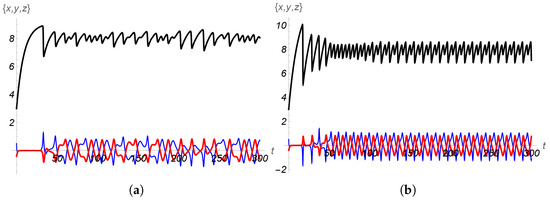
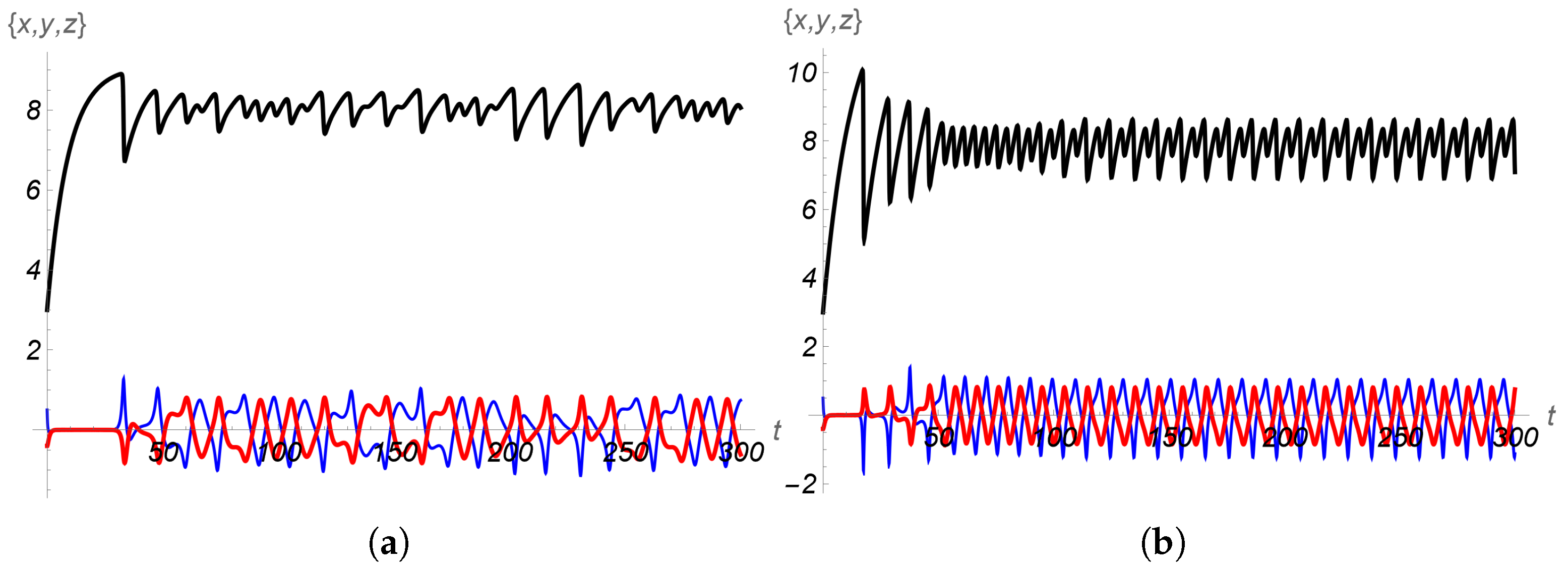
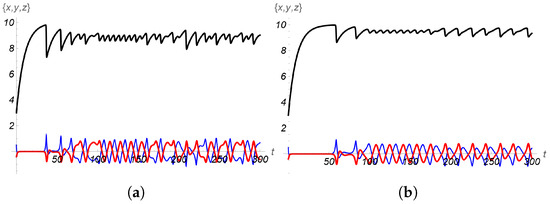
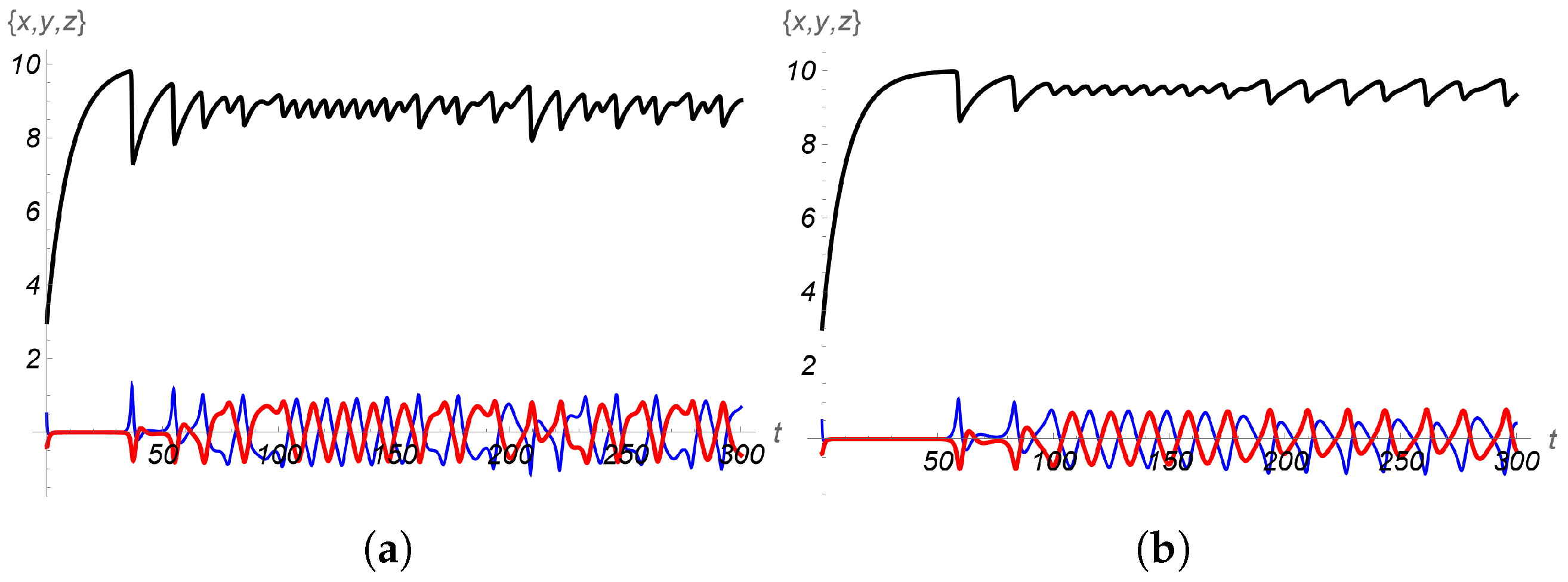
Figure 1 shows the phase plots of system (1), while Figure 2 displays the corresponding solution graphs.
Figure 1.
Phase portraits illustrating the dynamics of system (1) in the two-dimensional plane and the three-dimensional state space: (a) Phase trajectories in the plane. (b) Phase portrait in state space.
Figure 2.
Solutions of the system (1) with the initial conditions ; ; .
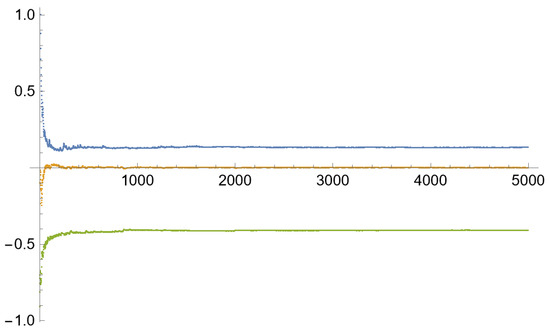
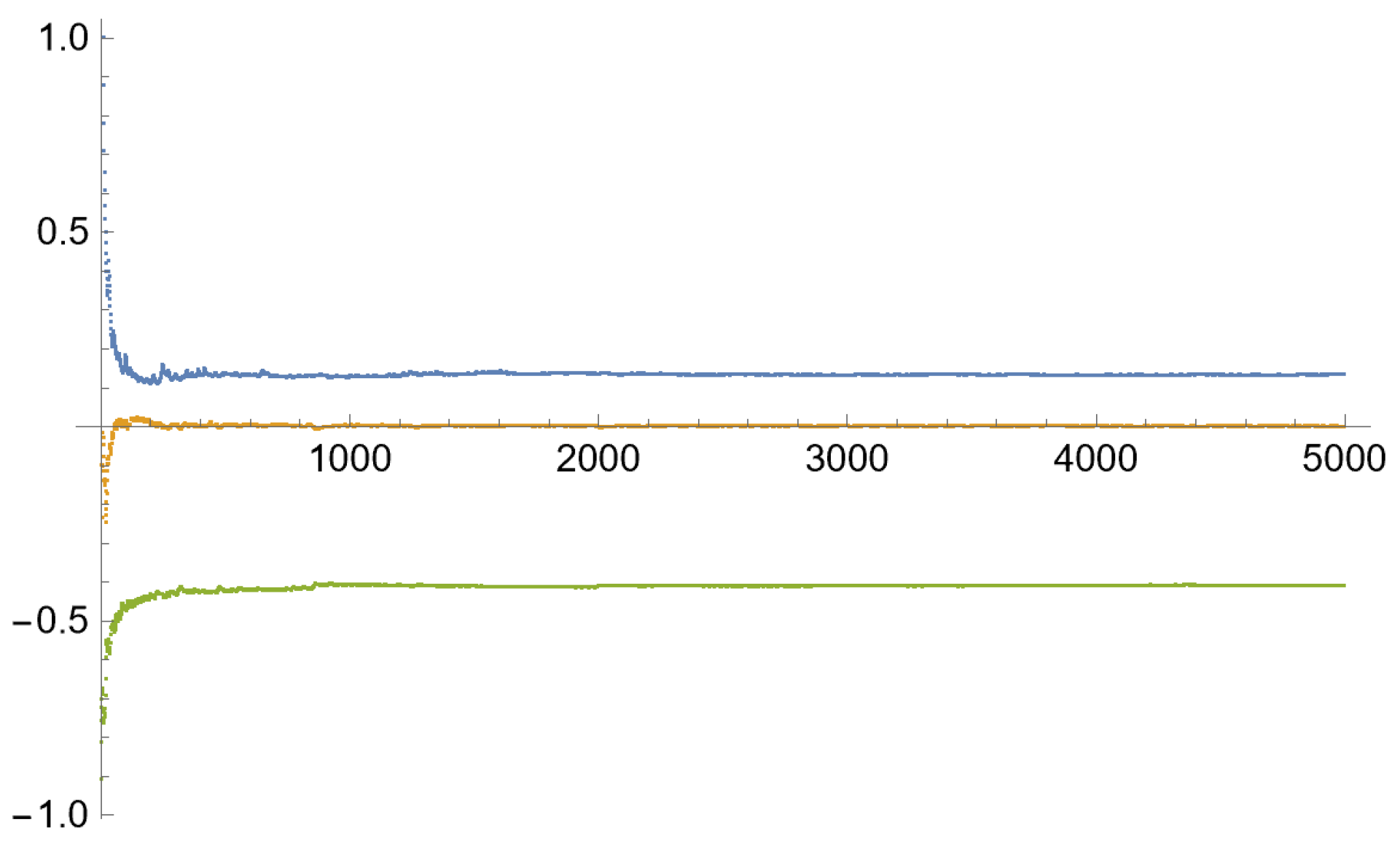
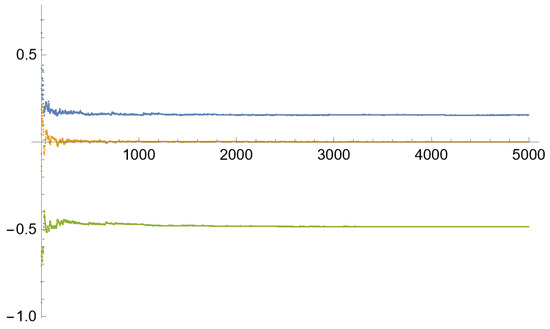
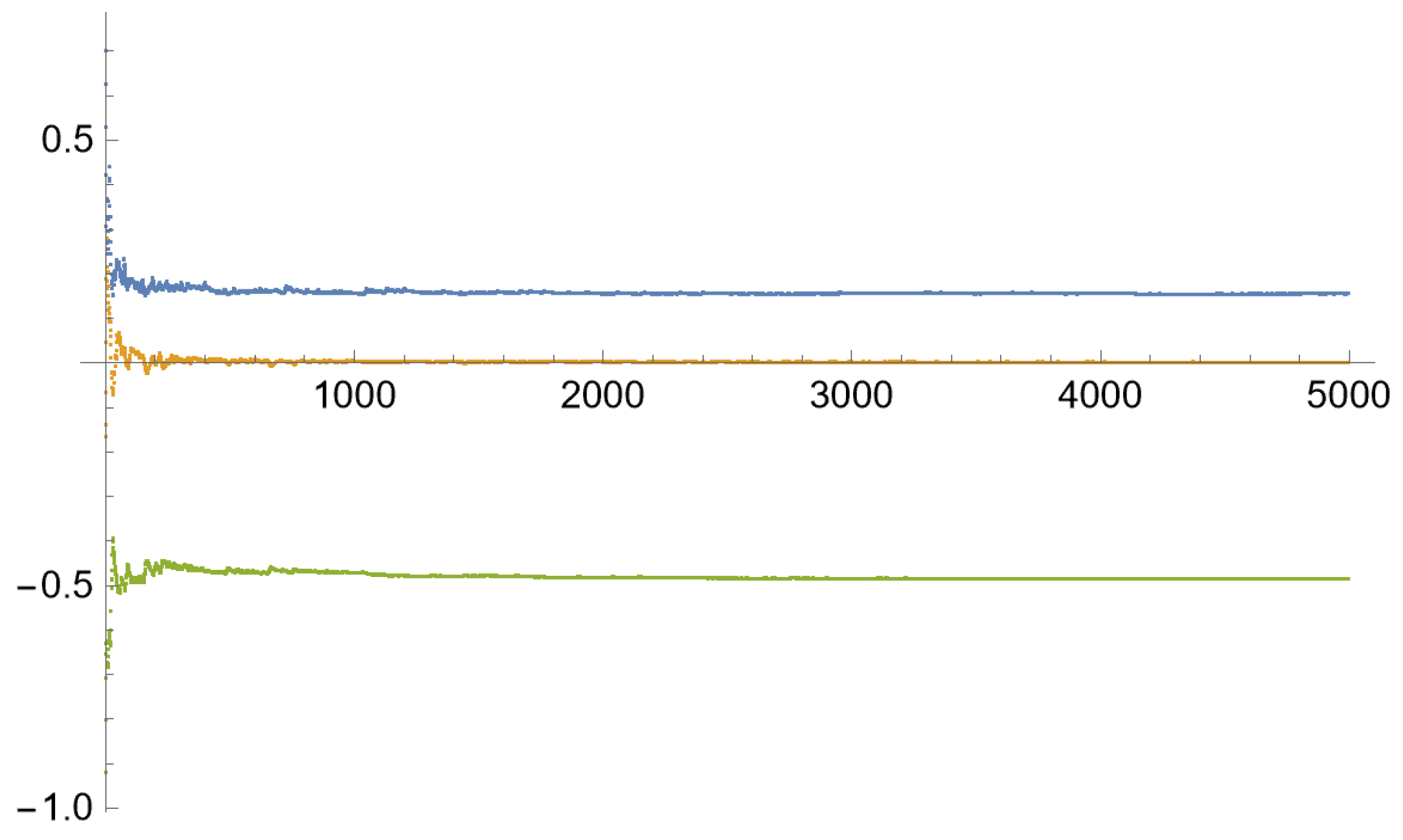
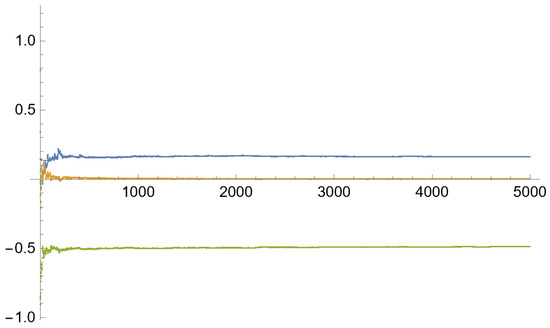
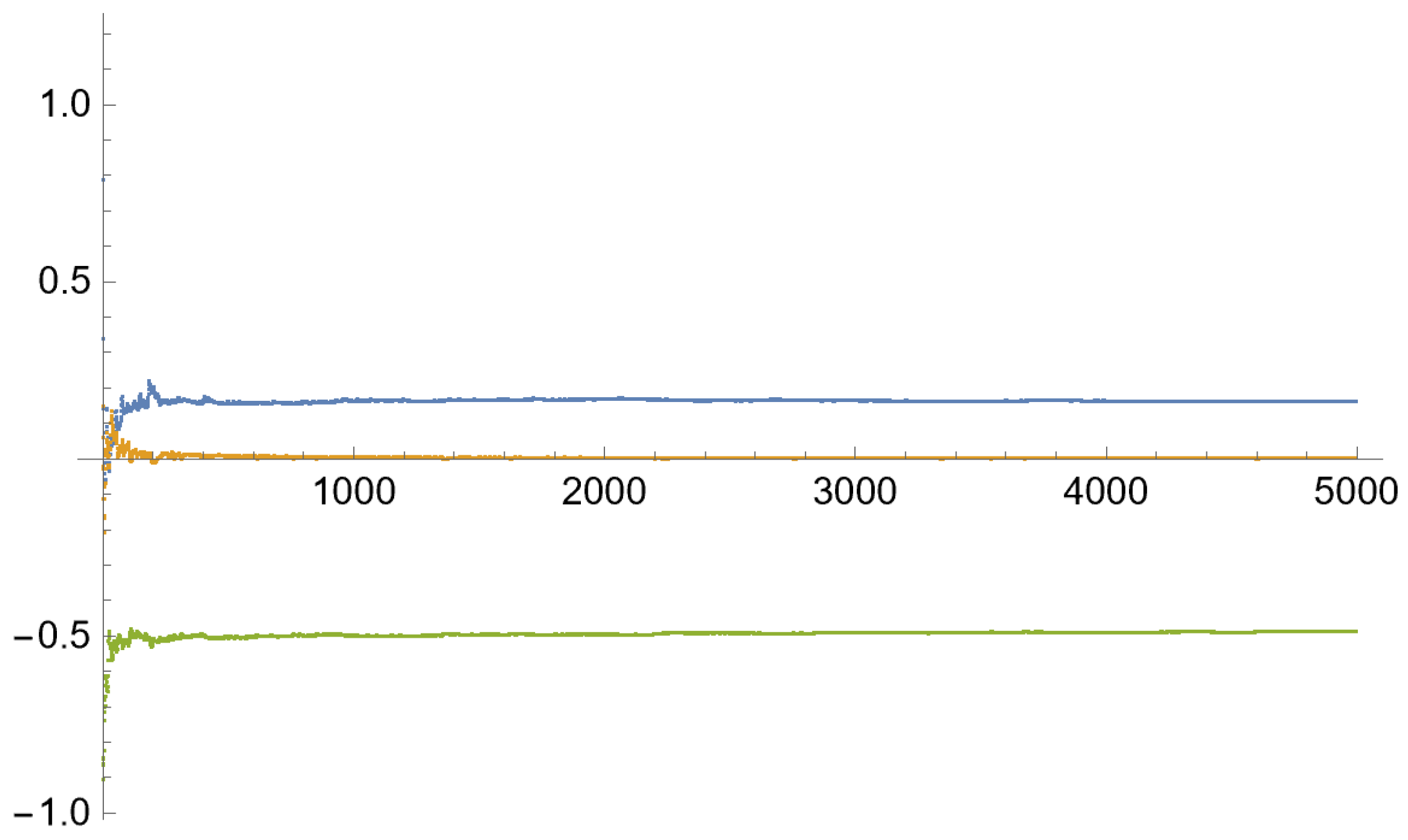
The Lyapunov exponent is a fundamental measure of the sensitivity of a system to initial conditions, which is a defining characteristic of chaotic dynamics [23,24]. The Lyapunov exponents for system (1) with given parameters (2) and initial conditions (3) were calculated as follows:
Let us compute the Kaplan–Yorke dimension [25] using the formula
where j is the largest integer that satisfies
A chaotic system has at least one positive Lyapunov exponent, and the more positive the largest Lyapunov exponent, the more unpredictable the system is [26].
The system (1) is dissipative since the sum of the Lyapunov exponents is negative and chaotic since the first Lyapunov exponent is positive, . Computing the full spectrum of Lyapunov exponents is mathematically challenging. The calculations were carried out using Wolfram Mathematica 13 and Matlab R2025b. Figure 3 displays the Lyapunov characteristic exponents of the system (1).
Figure 3.
Lyapunov characteristic exponents for the system (1) with initial conditions ; ; .
The system (1) represents the classical three-dimensional financial model that has been widely studied in the literature [12].
2.2. Bifurcation Analysis
Table 1 presents the analysis of system dynamics for various values of the parameter a.
Table 1.
Parameter a analysis.
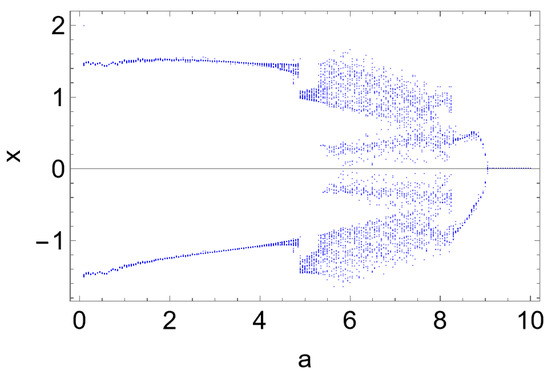
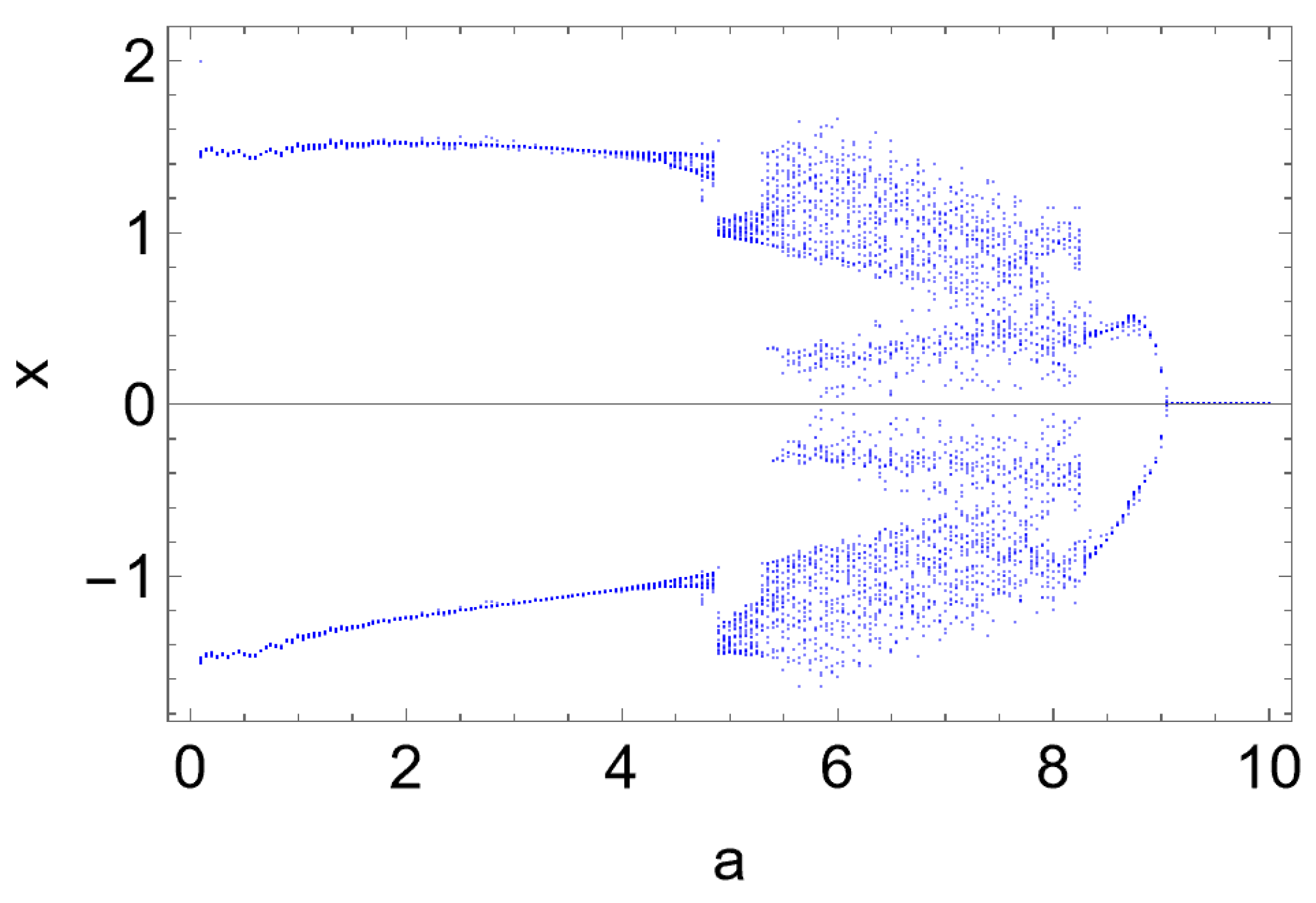
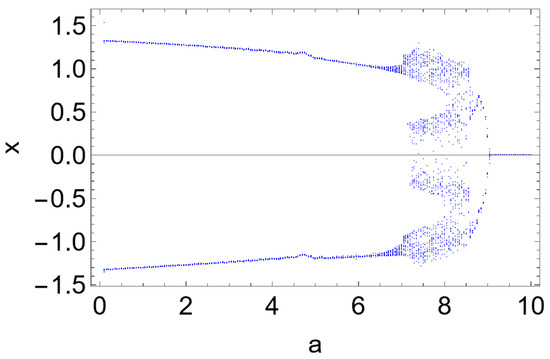
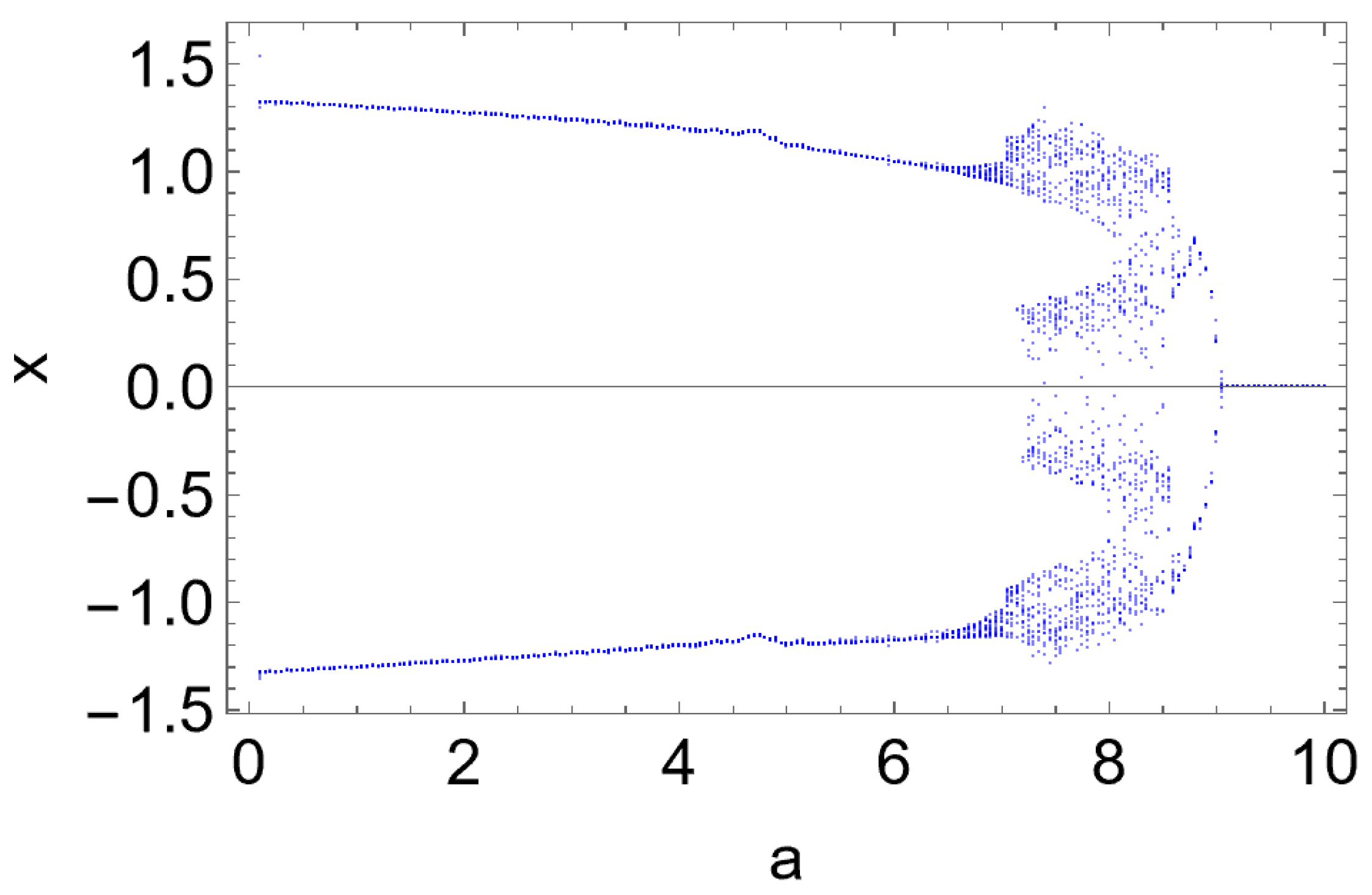
The bifurcation diagram for the parameter a is explored. Figure 4 displays the bifurcation diagram of the system (1), obtained by varying the control parameter a. The parameters , and d remain fixed. The bifurcation diagram is plotted when a is varied between .
Figure 4.
Bifurcation diagram.
Table 2 presents the analysis of system dynamics for various values of the parameter b.
Table 2.
Parameter b analysis.
The bifurcation diagram for the parameter b is explored. Figure 5 displays the bifurcation diagram of the system (1), obtained by varying the control parameter b. The parameters , and d remain fixed. The bifurcation diagram is plotted when b is varied between .
Figure 5.
Bifurcation diagram.
Table 3 presents the analysis of system dynamics for various values of the parameter c.
Table 3.
Parameter c analysis.
The bifurcation diagram for the parameter c is explored. Figure 6 displays the bifurcation diagram of the system (1), obtained by varying the control parameter c. The parameters , and d remain fixed. The bifurcation diagram is plotted when c is varied between .
Figure 6.
Bifurcation diagram.
Table 4 presents the analysis of system dynamics for various values of the parameter d.
Table 4.
Parameter d analysis.
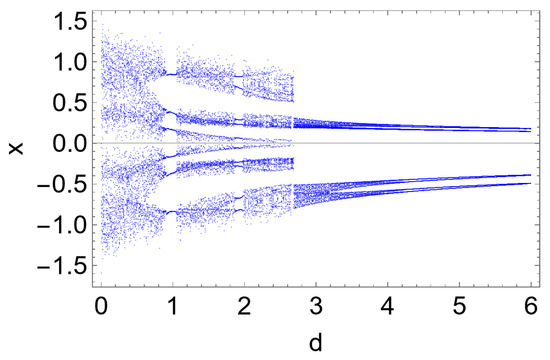
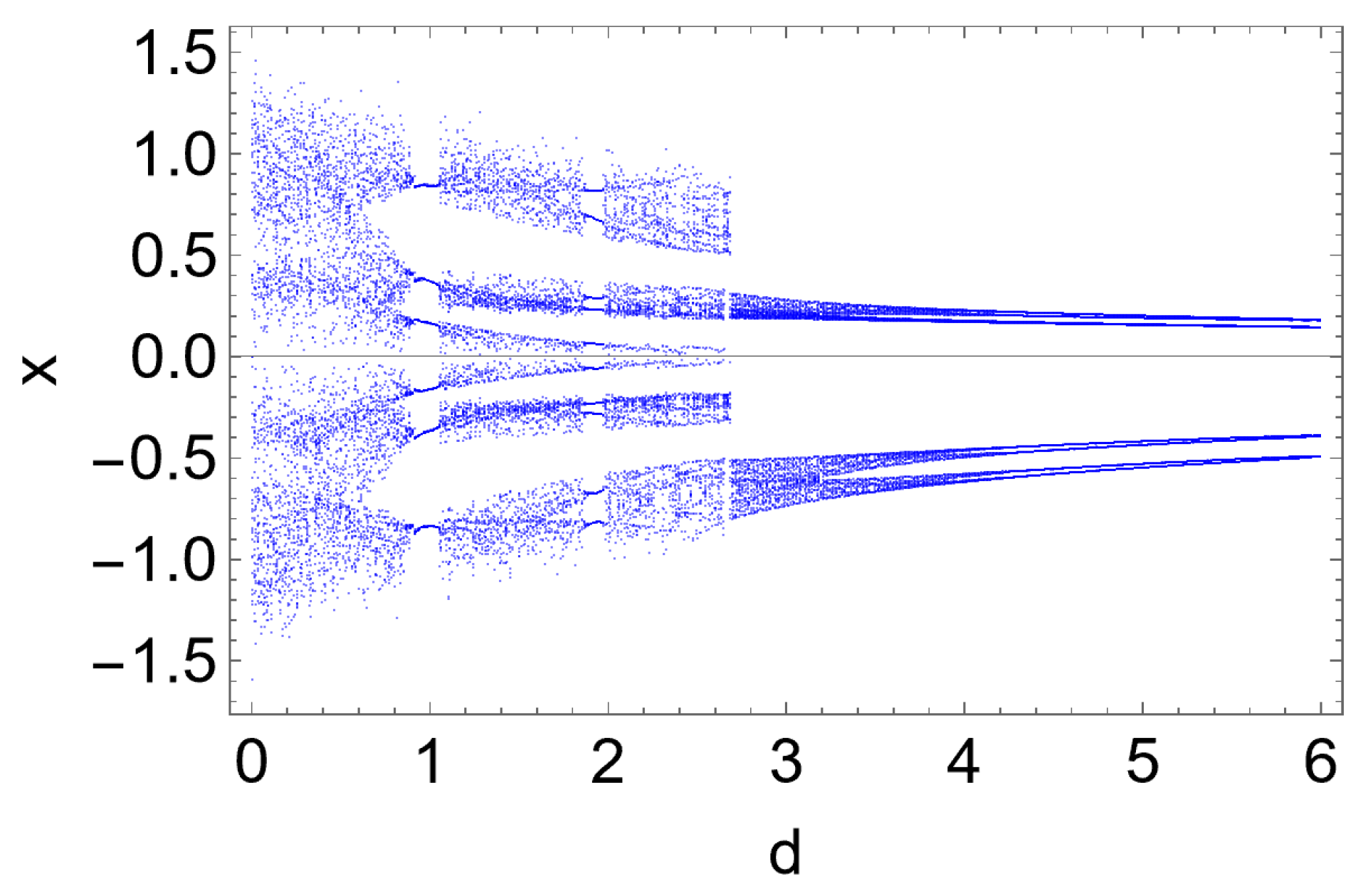
The bifurcation diagram for the parameter d is explored. Figure 7 displays the bifurcation diagram of the system (1), obtained by varying the control parameter d. The parameters , and c remain fixed. The bifurcation diagram is plotted when d is varied between .
Figure 7.
Bifurcation diagram.
In order to investigate the influence of higher-order nonlinearities on the dynamics of financial systems, we consider a generalized version of this model in the next section.
3. Results
In the system of differential Equation (1), the term introduces a high degree of nonlinearity in the dynamics of the variable y. To perform a more comprehensive analysis, this term is generalized by replacing , where is an integer. The system takes the form
For each specific value of k, a comprehensive analysis will be performed.
The divergence of the vector field of system (19) is given by
If the divergence is negative in a region of the phase space, the system is dissipative, and the trajectories converge to a bounded attractor [24].
3.1. Case 1: k = 2
3.1.1. Stability and Dynamical Analysis
Let the third equation of the system (19) and be equal to zero: .
Then
Substitute (21) into the first equation of the system (19)
Let us consider the first case, where . Then substituting into Equation (21) to get . After that, substitute into the second equation of the system (19) and equate to zero
From Equation (24) get . Taking into account the parameters (2), the first critical point is obtained: .
Let us consider the second case, where . Then and . After that, substitute into the second equation of the system (19) and equate to zero
After simplifying (25) get
Taking into account the parameters (2), the two roots of Equation (26) are obtained: . The second and third critical points are and .
Once the fixed points are determined, their stability is examined through the computation of the system’s Jacobian matrix. Let us build the Jakobian matrix
The Jacobian matrix provides a linear approximation of the system near critical points and allows their type to be determined based on the eigenvalues. This analysis plays a key role in studying the local stability of a dynamical system [22].
The characteristic matrix is
and the characteristic equation is
Put the values of the first critical point in (29) and get three roots
This result indicates that the critical point behaves as a saddle point and is unstable.
Put the values of the second critical point in (29) and get three roots
This result indicates that the critical point behaves as a saddle-focus point and is unstable.
Put the values of the third critical point in (29) and get three roots
This result indicates that the critical point behaves as a saddle-focus point and is unstable.
The stability of the critical points is analyzed using the Jacobian matrix and the corresponding eigenvalues obtained from local linearization of the system. In addition to the Jacobian matrix analysis based on local linearization, global stability of nonlinear systems can also be investigated using the direct Lyapunov method. Such approaches provide complementary tools for studying the stability properties of dynamical systems. The eigenvalues of the Jacobian matrix determine the type and stability of the critical points.
To analyze the possibility of Hopf bifurcation, the Jacobian matrix of system (19) is considered at critical points. A Hopf bifurcation occurs when a pair of complex conjugate eigenvalues of the Jacobian matrix crosses the imaginary axis, while the third eigenvalue remains with a negative real part. Under such conditions, the critical point loses stability, and a periodic orbit may arise.
3.1.2. Bifurcation Analysis
The bifurcation analysis examines the dynamics of the system without regard to parameter interdependence and explores how the behavior of the system changes with different parameter values [22,27].
The bifurcation analysis is carried out by varying the parameter , while keeping the remaining parameters fixed. This approach allows us to investigate the changes in the system dynamics and to identify parameter ranges in which periodic and chaotic regimes occur. Table 5 presents the analysis of system dynamics for various values of the parameter a.
Table 5.
Parameter a analysis.
The bifurcation analysis performed revealed that the system exhibits chaotic behavior for , but periodic behavior for .
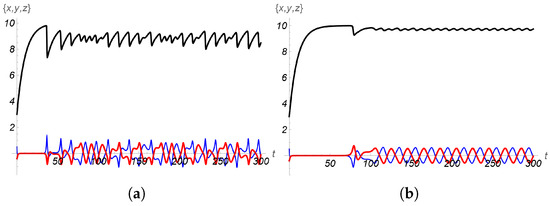
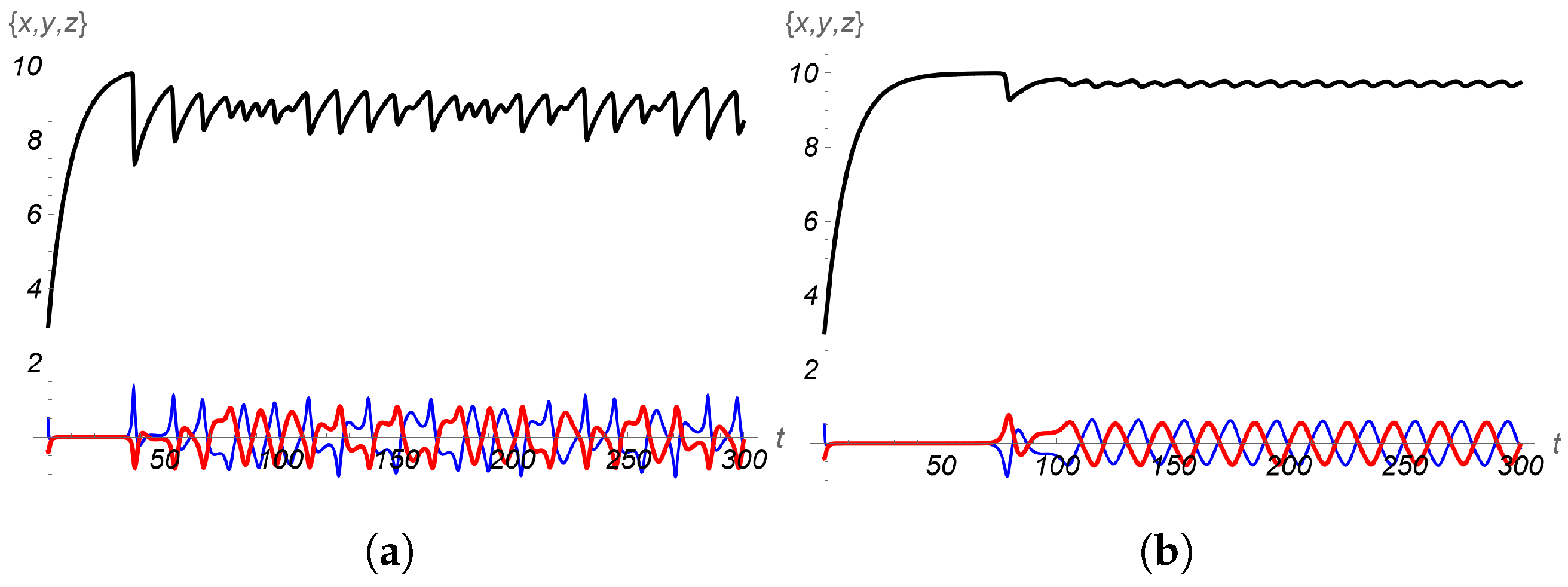
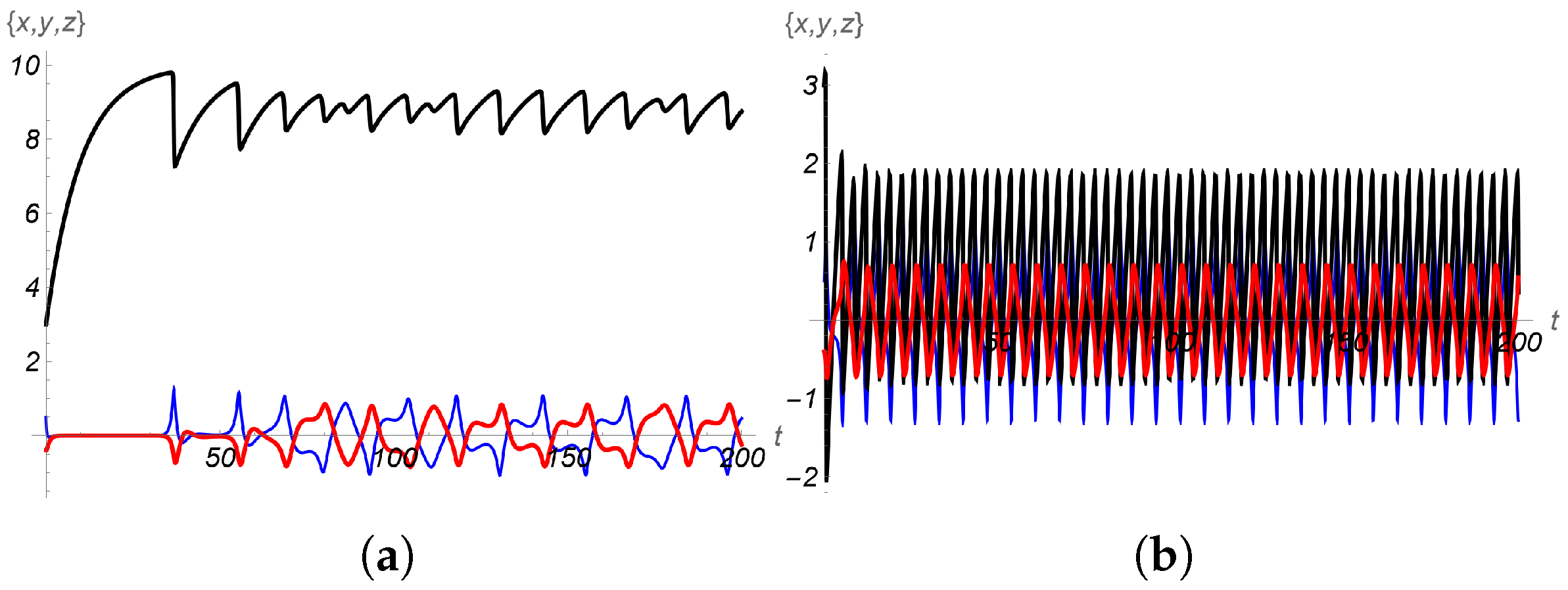
Figure 8 shows the phase plots of system (19), , while Figure 9 displays the corresponding solution graphs.
Figure 8.
Phaseportraits illustrating the dynamics of system (19), in the two-dimensional planes and the three-dimensional state space: (a) Phase trajectories in the plane, . (b) Phase portrait in state space, .
Figure 9.
Solutions of the system (19) with the initial conditions ; , .
The Lyapunov exponents for system (19), , and parameters , , , and initial conditions (3) were calculated as follows:
The system is (19) and is dissipative, since the sum of the Lyapunov exponents is negative. Figure 10 displays the Lyapunov characteristic exponents of the system (19), .
Figure 10.
Lyapunov characteristic exponents for the system (19), and with initial conditions ; ; .
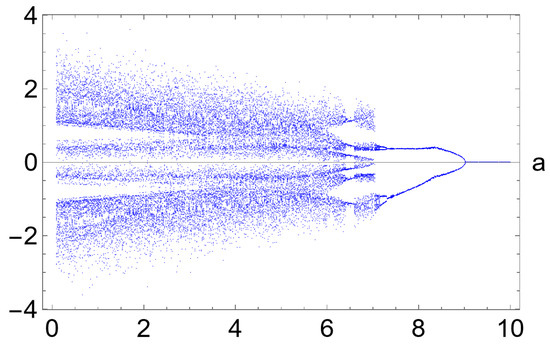
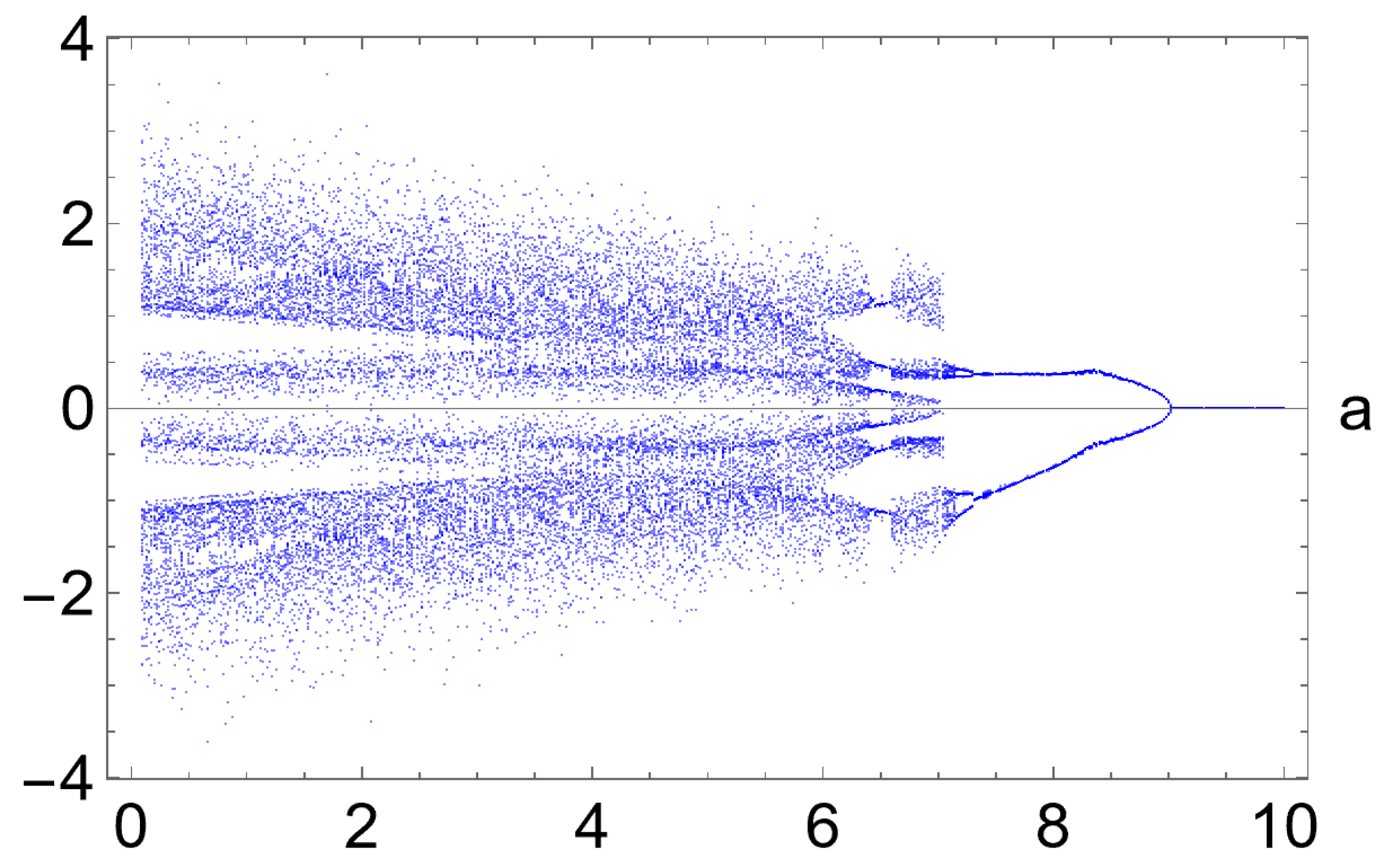
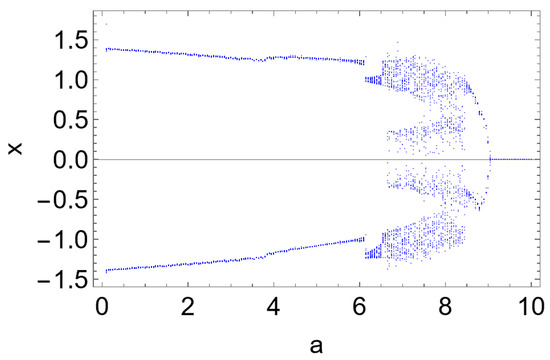
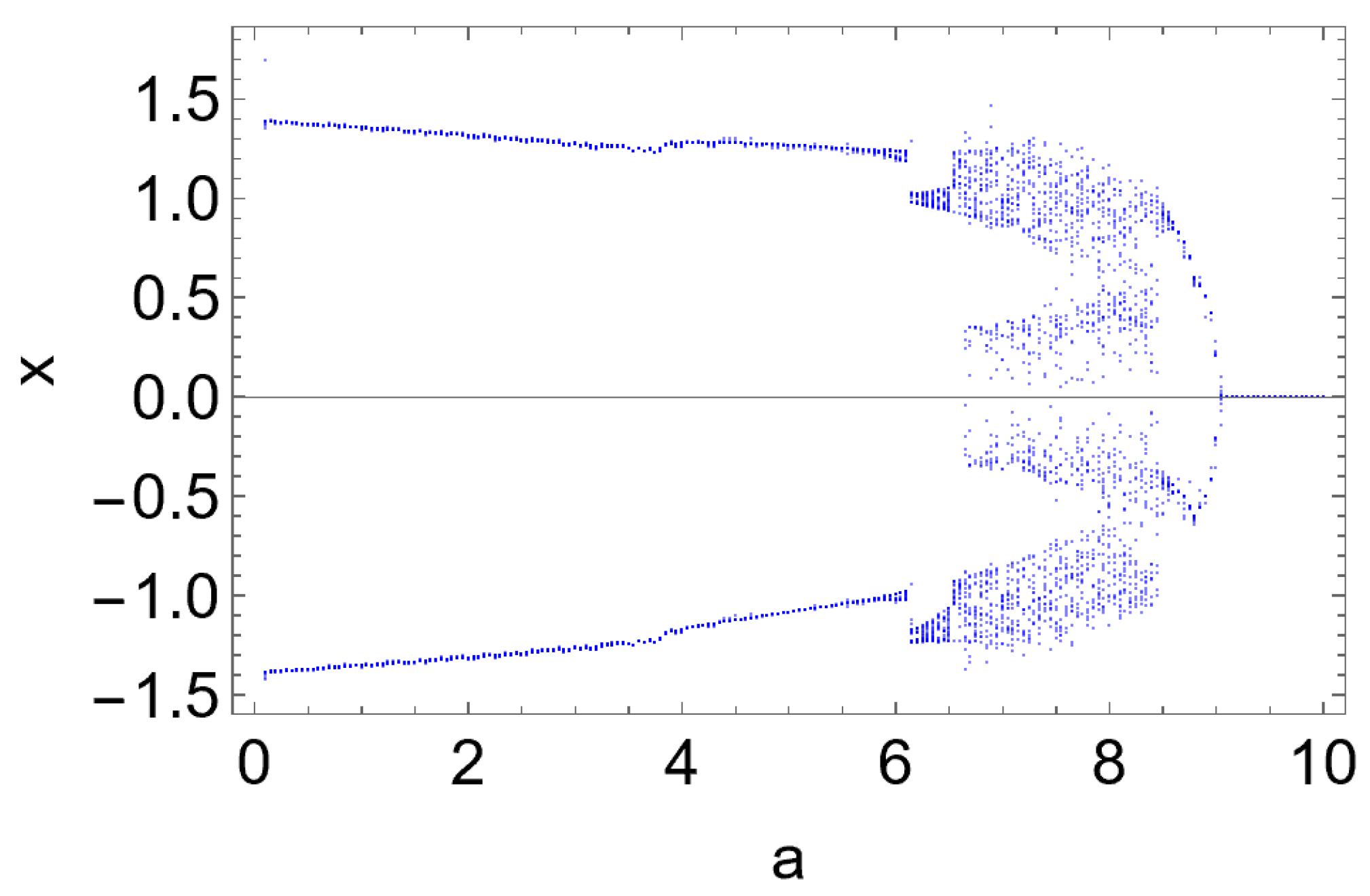
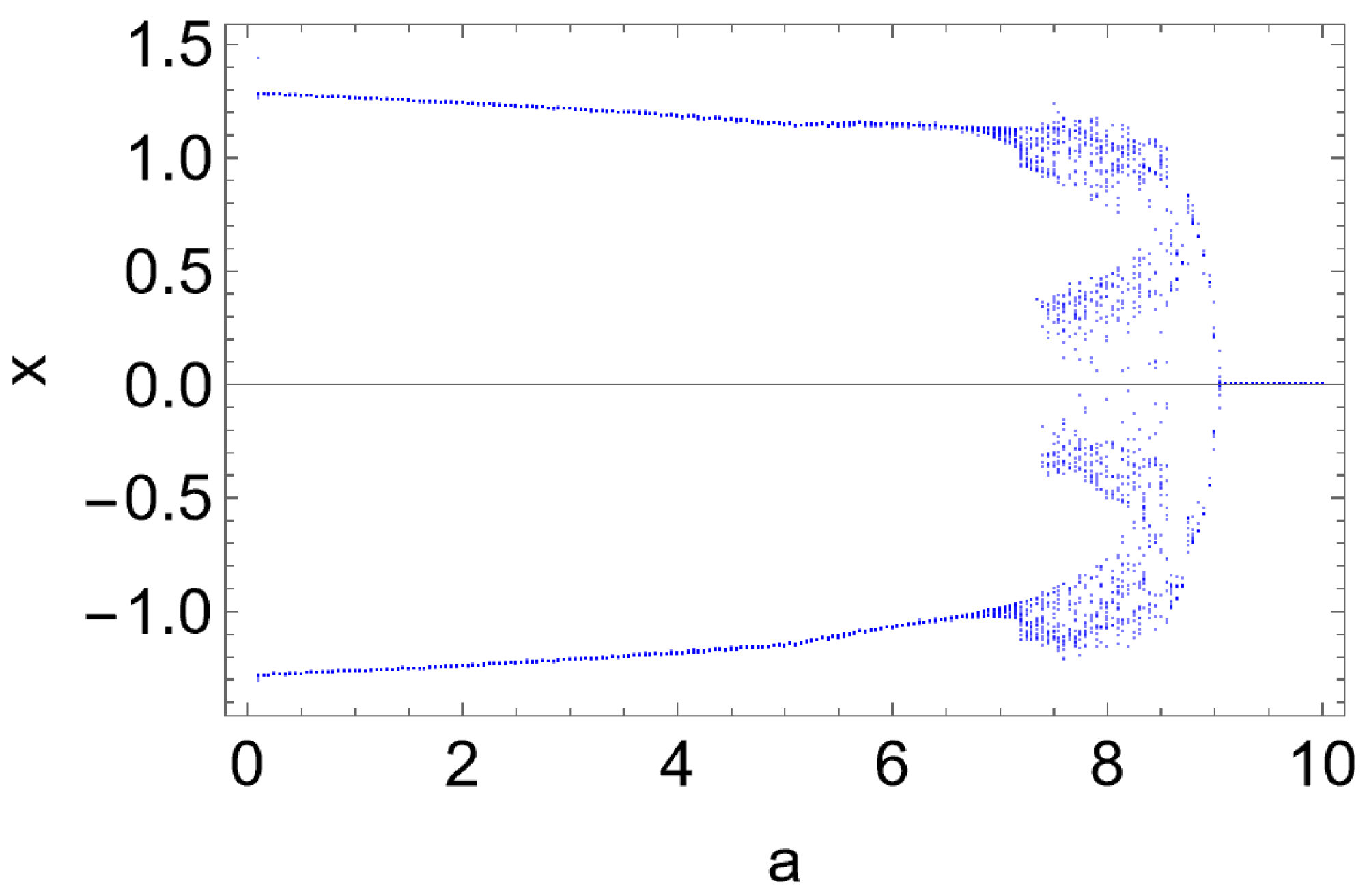
Bifurcation diagrams are analyzed by varying one parameter at a time and keeping the others fixed [28]. The bifurcation diagram for the parameter a is explored. Figure 11 displays the bifurcation diagram of the system (19) for , obtained by varying the control parameter a. The parameters , and d remain fixed. The bifurcation diagram is plotted when a is varied between .
Figure 11.
Bifurcation diagram.
For small values of parameter a, the diagram shows a dense cloud of points, indicating chaotic dynamics. As a increases, there is a crisis of chaos, and the attractor shrinks. Periodic windows emerge in intermediate ranges of a, followed by a transition to an asymptotically stable equilibrium for large values of a. The results obtained are in full agreement with the Lyapunov exponent spectrum reported in Table 5.
Figure 12.
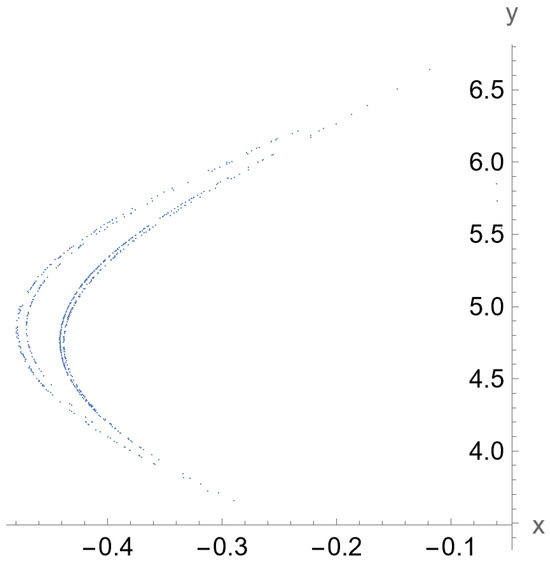
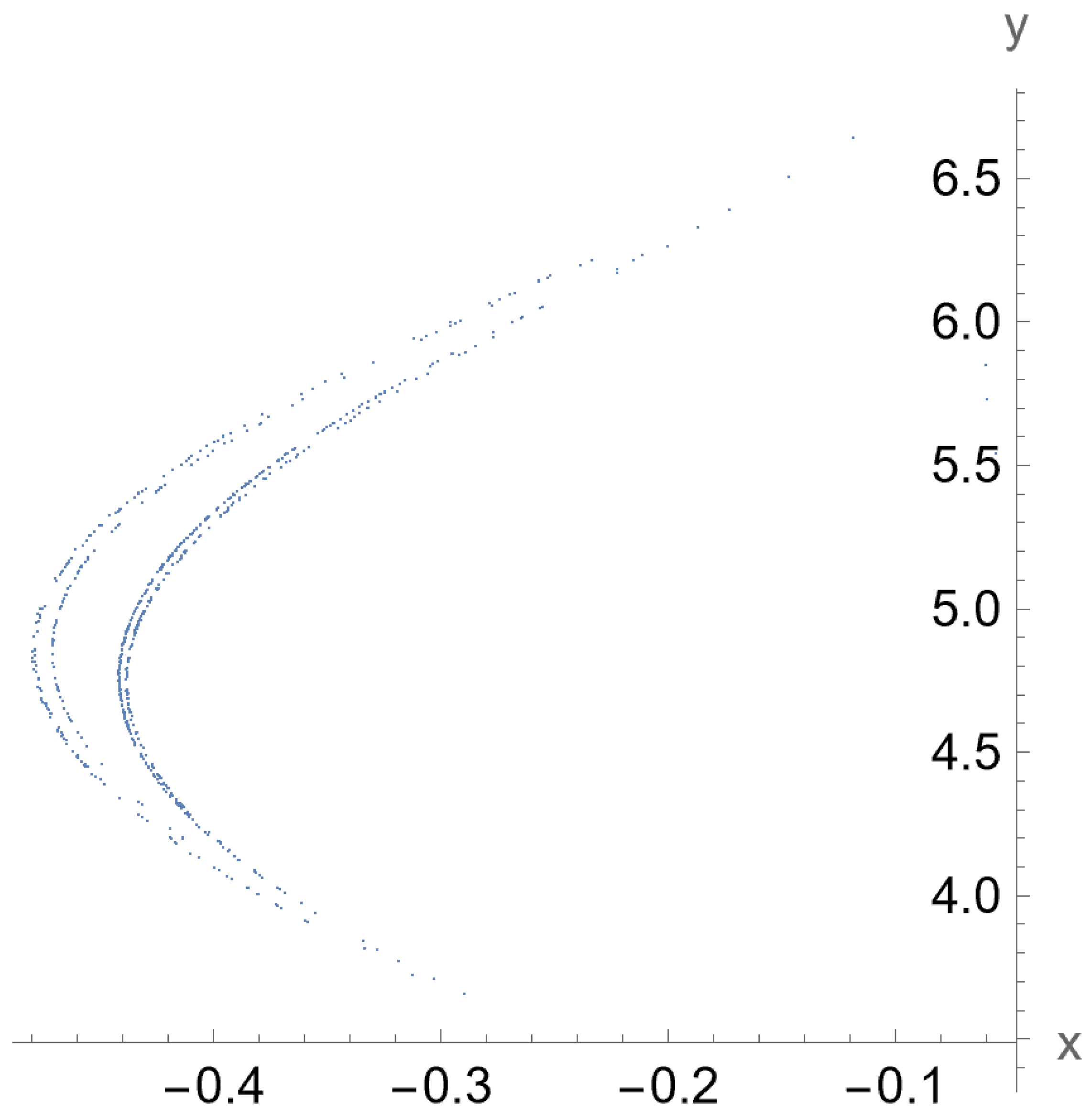
Poincaré section of the system (19) for , .
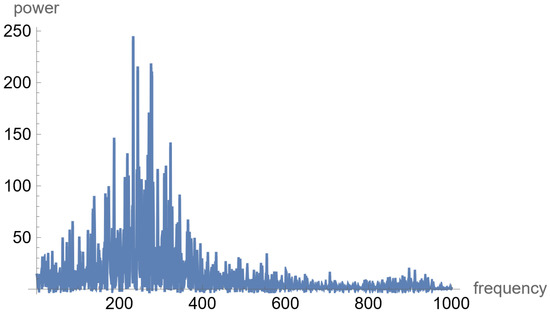
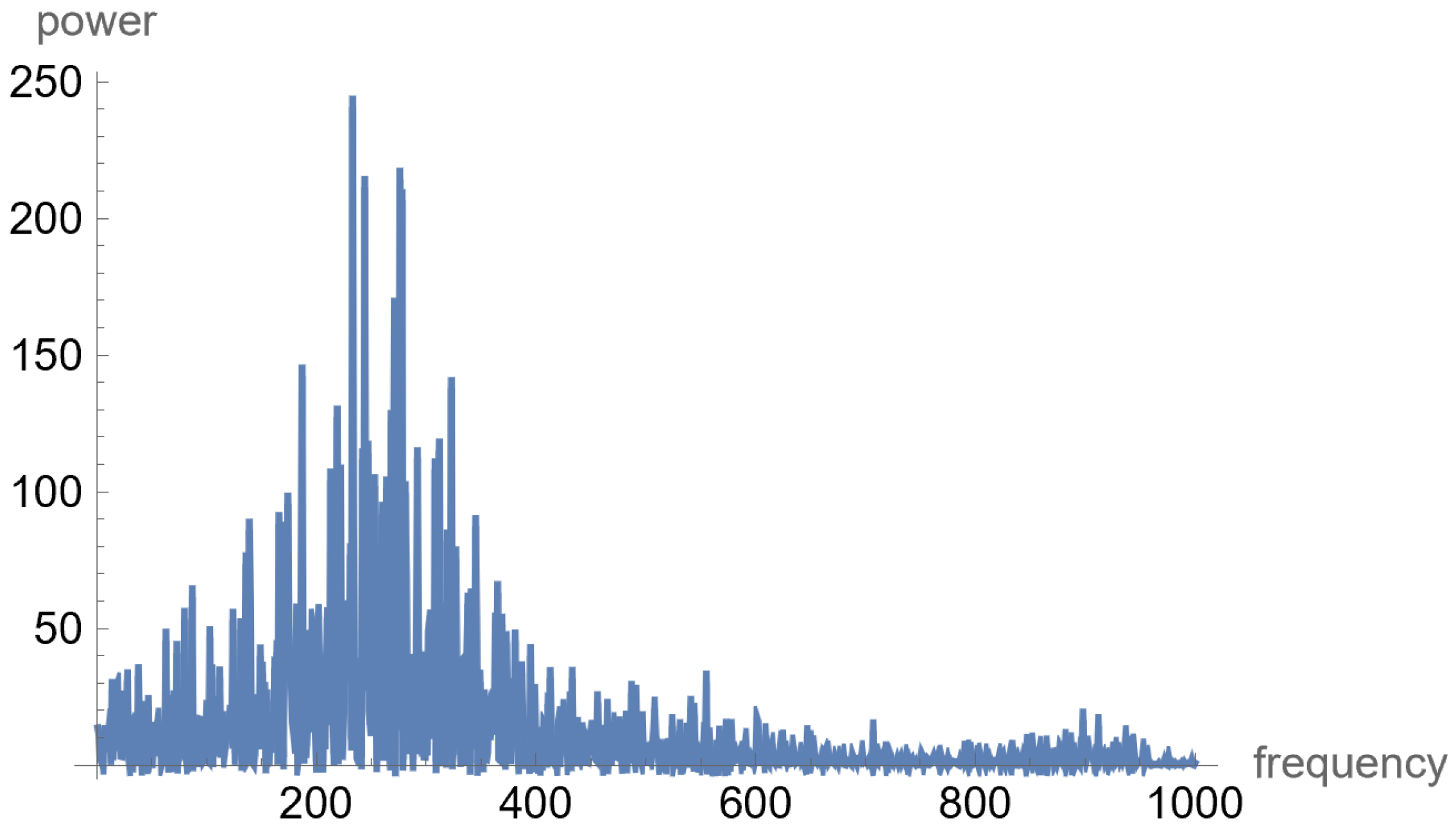
To further confirm the chaotic nature of the proposed system, a Poincaré section was constructed by recording the intersection points of the system trajectories with the plane under the condition . The resulting set of points forms a scattered structure, indicating the complex geometry of the attractor. The absence of a closed curve and the irregular distribution of intersection points provide additional evidence of chaotic dynamics in the system. Figure 13 displays the power spectrum of the time series . The spectrum exhibits a broadband structure without dominant frequency peaks, which is characteristic of chaotic dynamics.
Figure 13.
Power spectrum of the time series for the system (19) for , .
Table 6 presents the analysis of system dynamics for various values of the parameter b.
Table 6.
Parameter b analysis.
The bifurcation analysis performed revealed that the system exhibits chaotic behavior for , but periodic behavior for .
Figure 14 shows the phase plots of system (19), , while Figure 15 displays the corresponding solution graphs.
Figure 14.
Phase portraits illustrating the dynamics of system (19), in the two-dimensional planes and the three-dimensional state space: (a) Phase trajectories in the plane, . (b) Phase portrait in state space, .
Figure 15.
Solutions of the system (19) with the initial conditions ; ; , .
The Lyapunov exponents for system (19), and parameters are , , and initial conditions (3) were calculated as follows:
Figure 16 displays the Lyapunov characteristic exponents of the system (19), .
Figure 16.
Lyapunov characteristic exponents for the system (19), and with initial conditions ; ; .
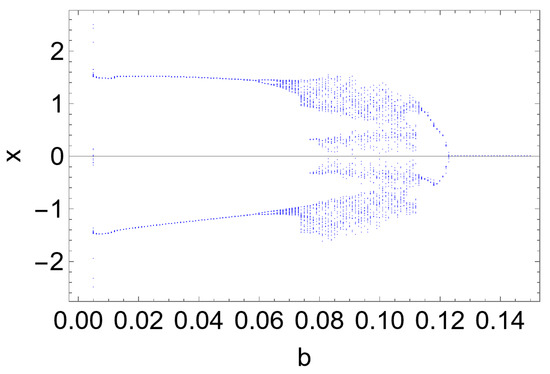
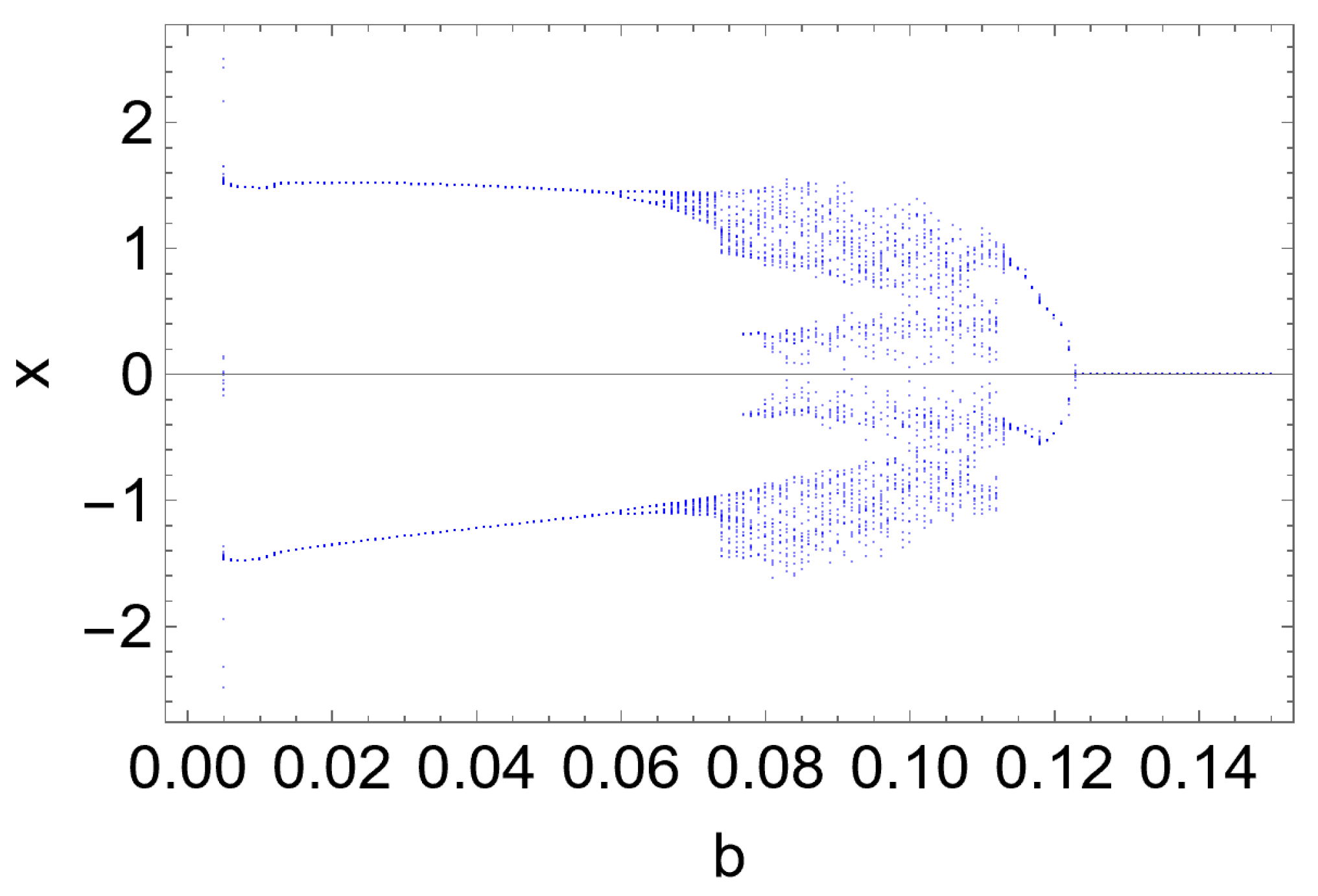
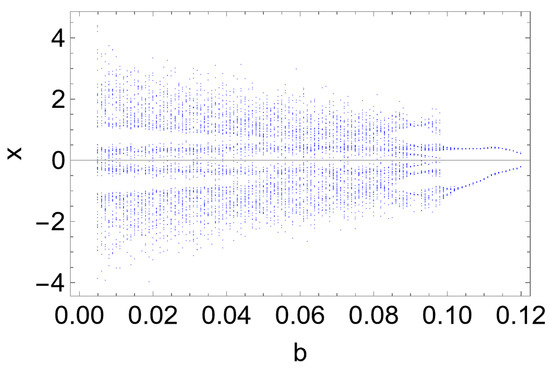
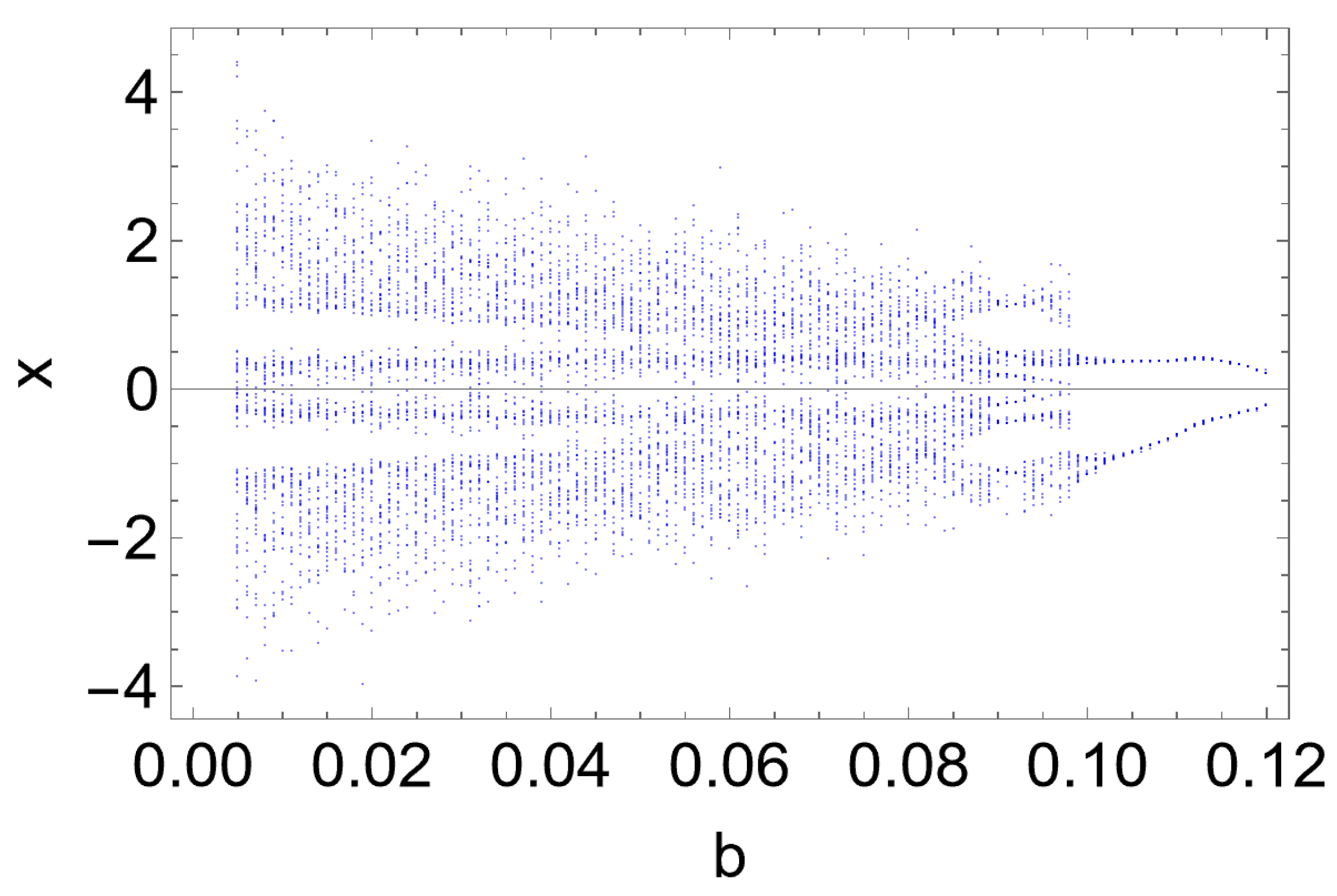
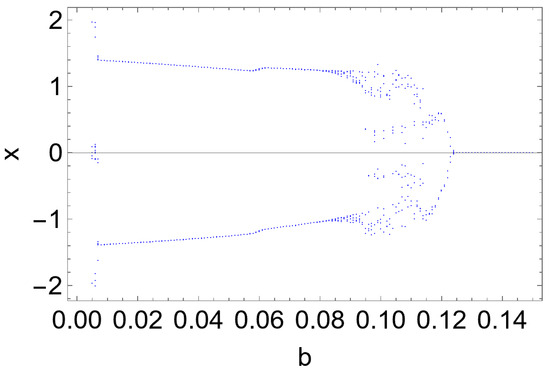
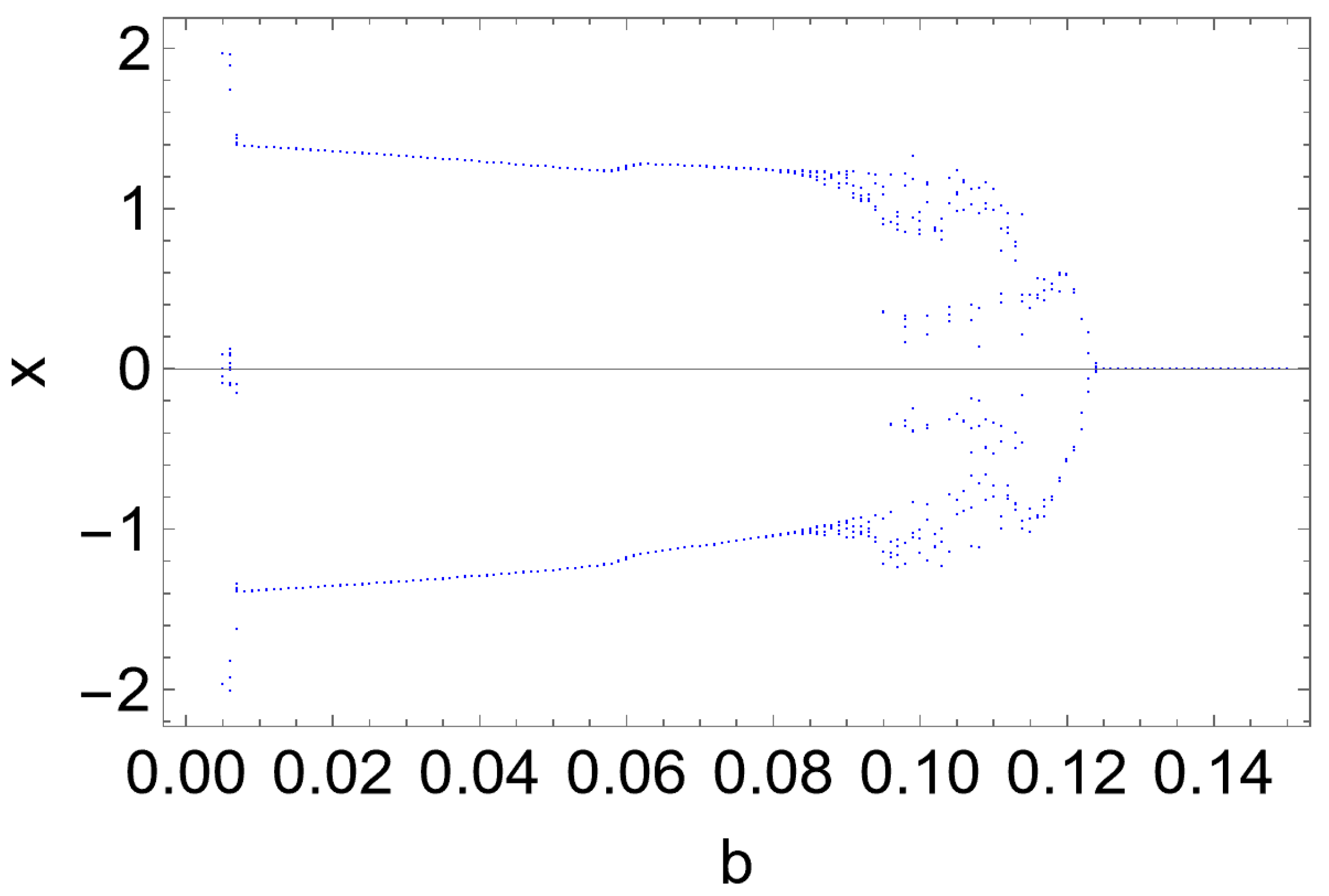
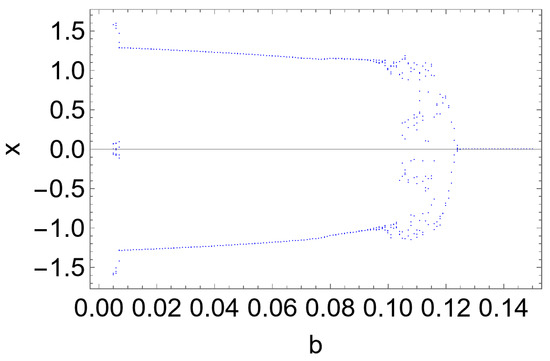
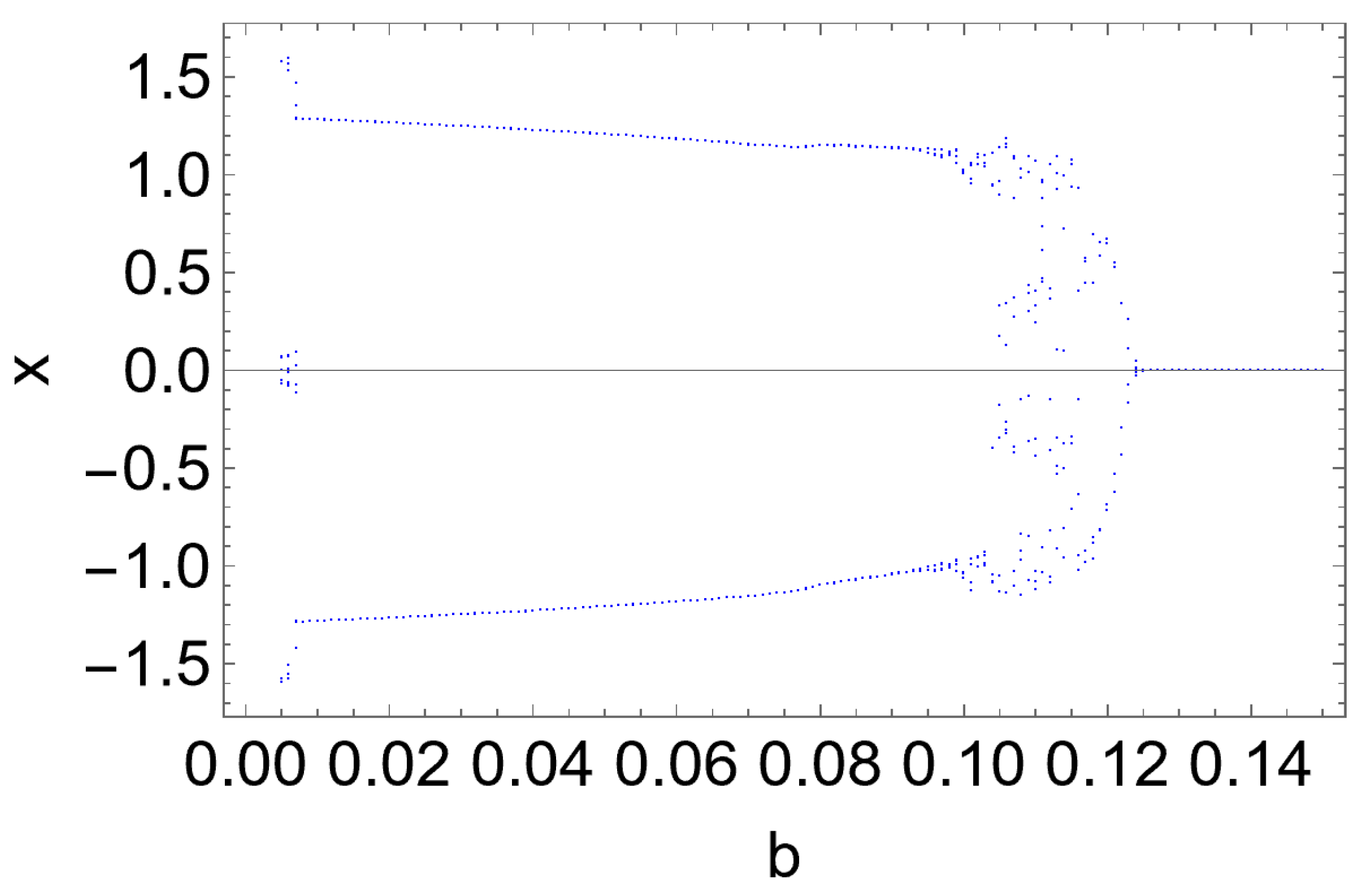
The bifurcation diagram for the parameter b is explored. Figure 17 displays the bifurcation diagram of the system (19) for , obtained by varying the control parameter b. The parameters , and d remain fixed. The bifurcation diagram is plotted when b is varied between .
Figure 17.
Bifurcation diagram.
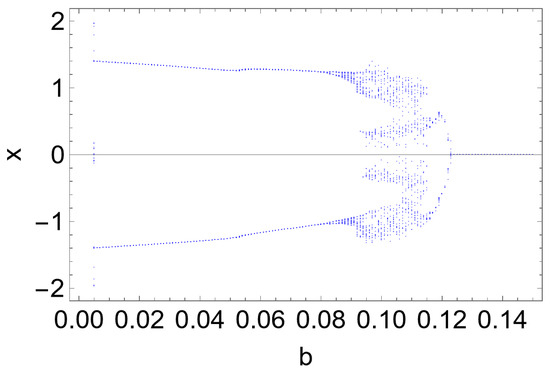
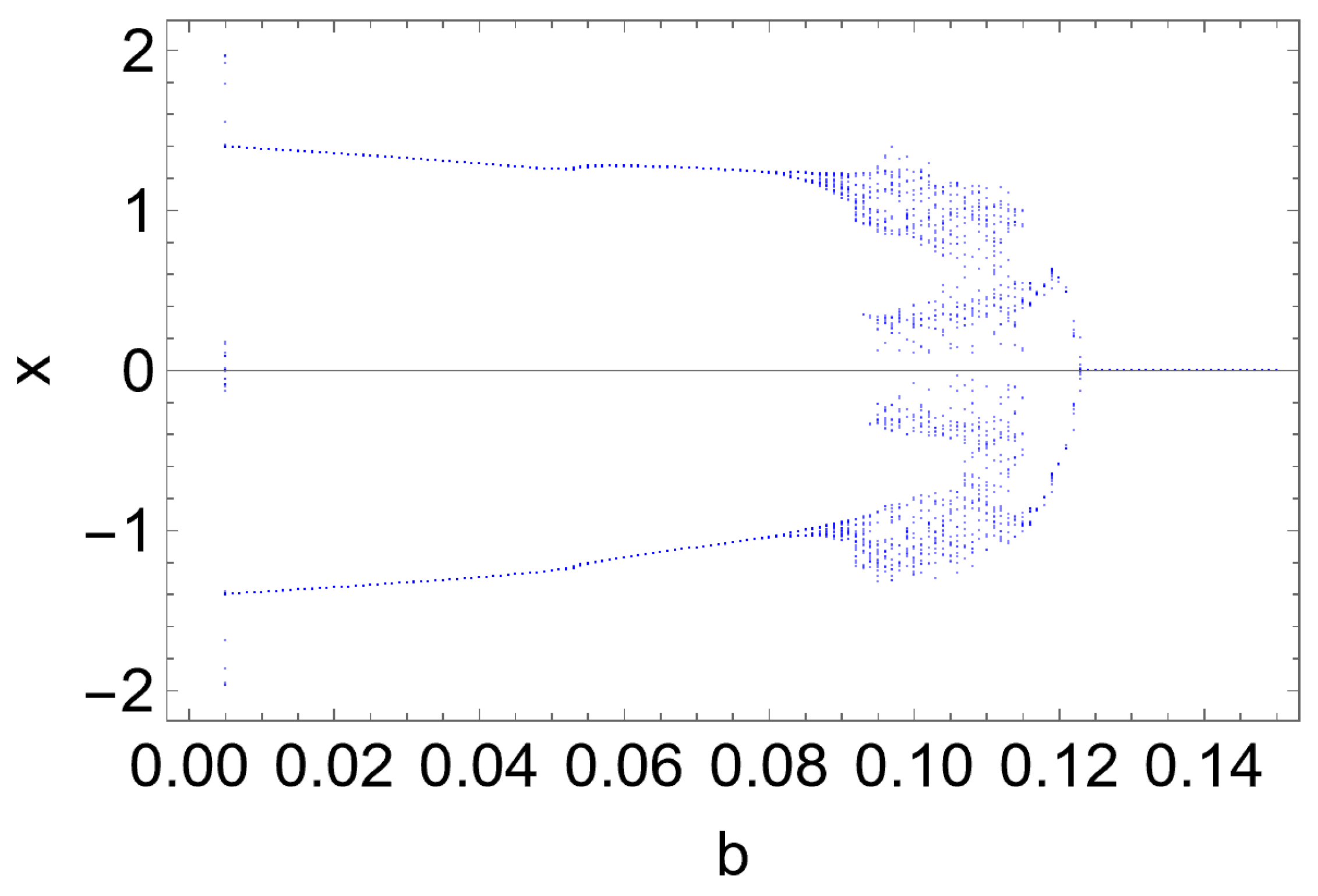
Since chaotic behavior occurs only for small values of the parameter b, a zoomed-in bifurcation diagram is presented to highlight the chaotic regime.
Table 7 presents the analysis of system dynamics for various values of the parameter c.
Table 7.
Parameter c analysis.
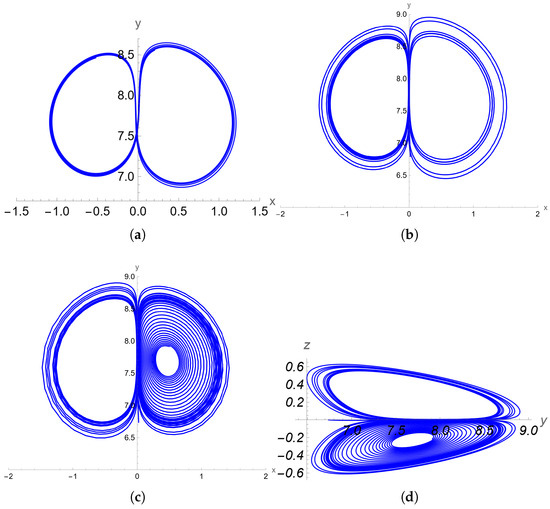
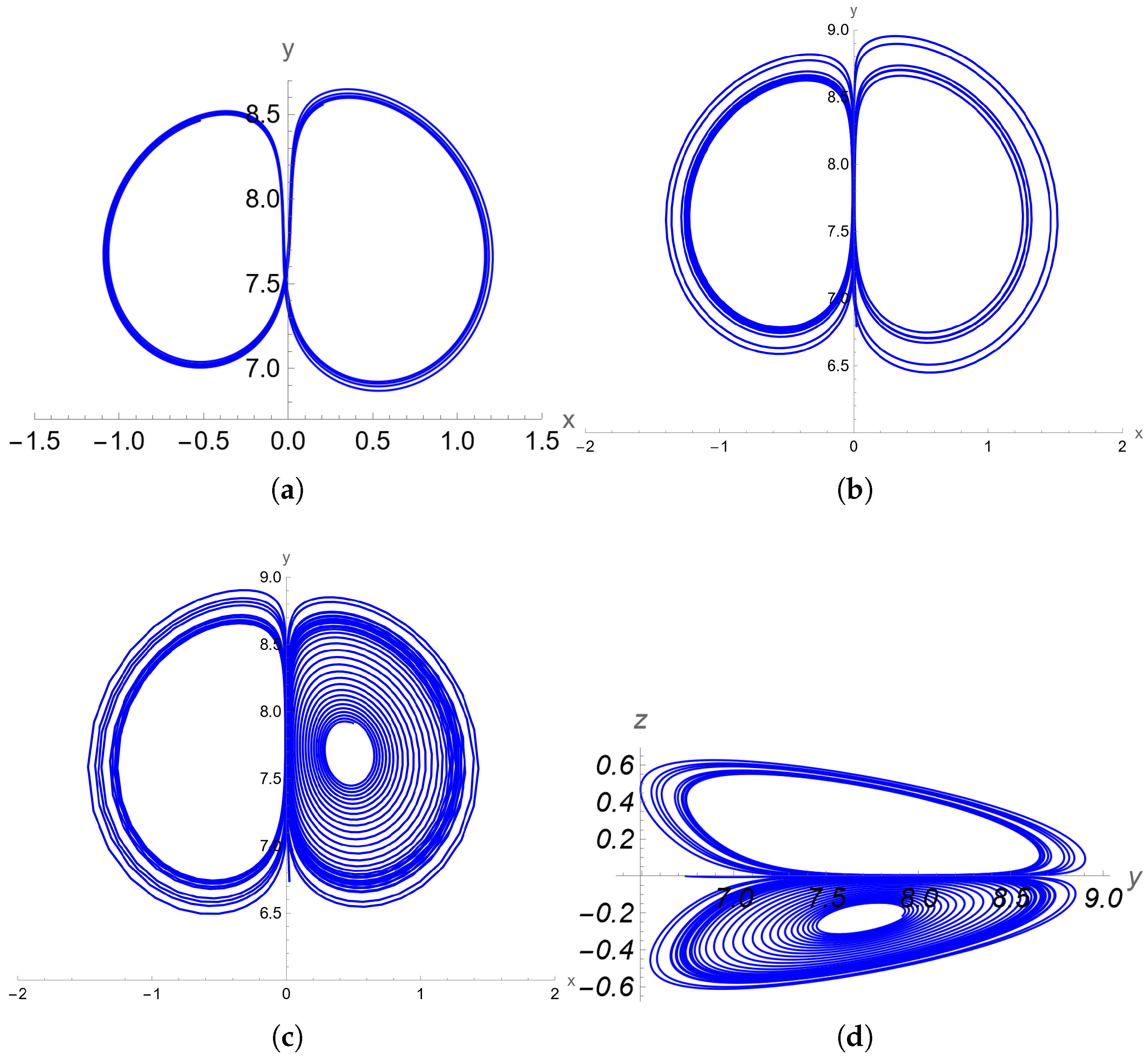
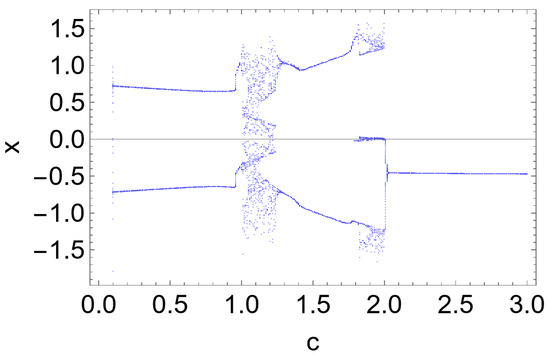
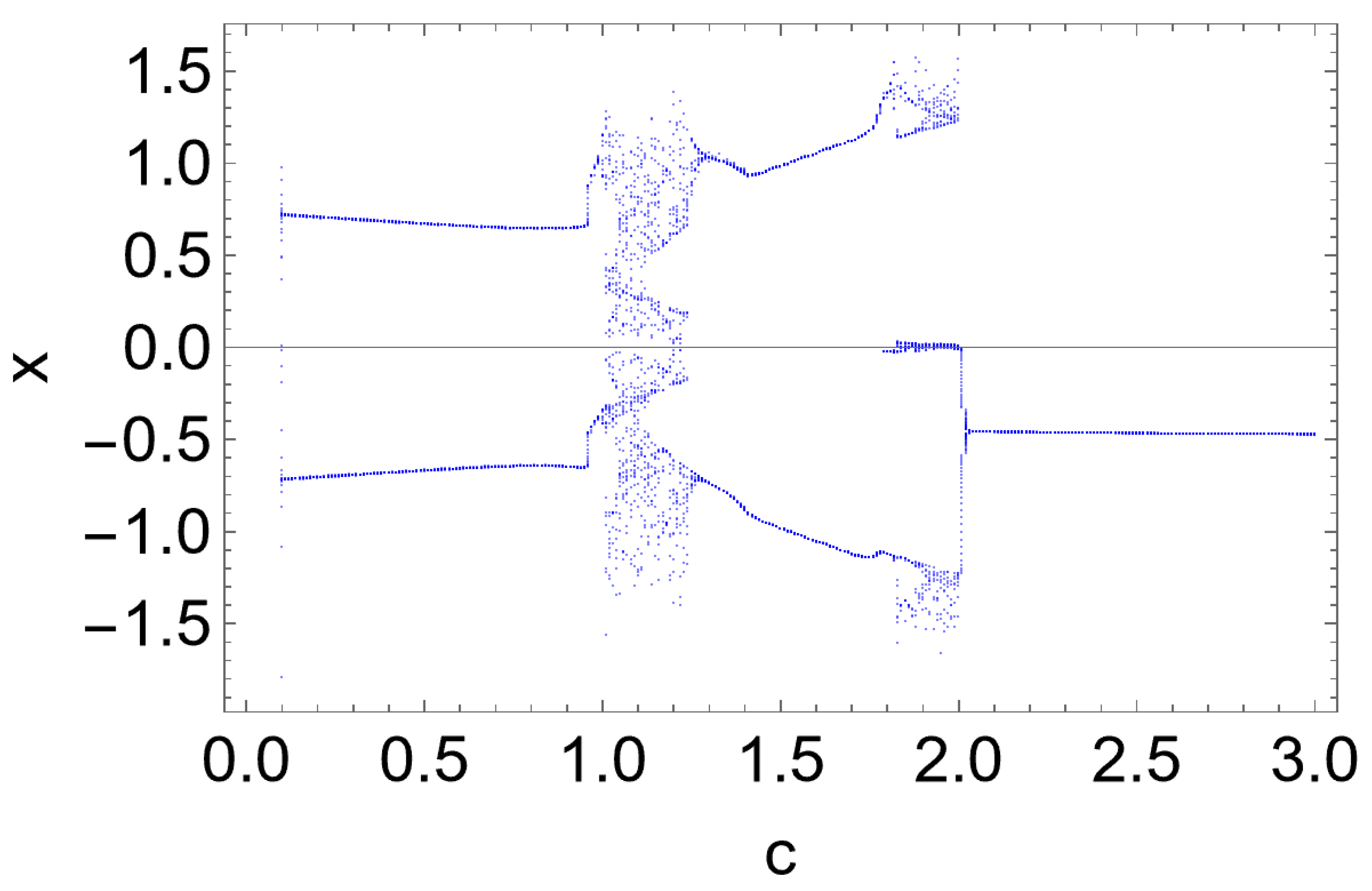
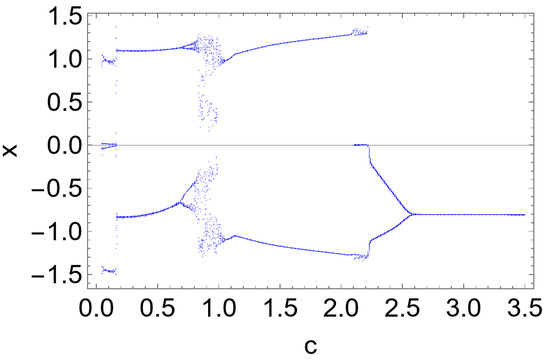
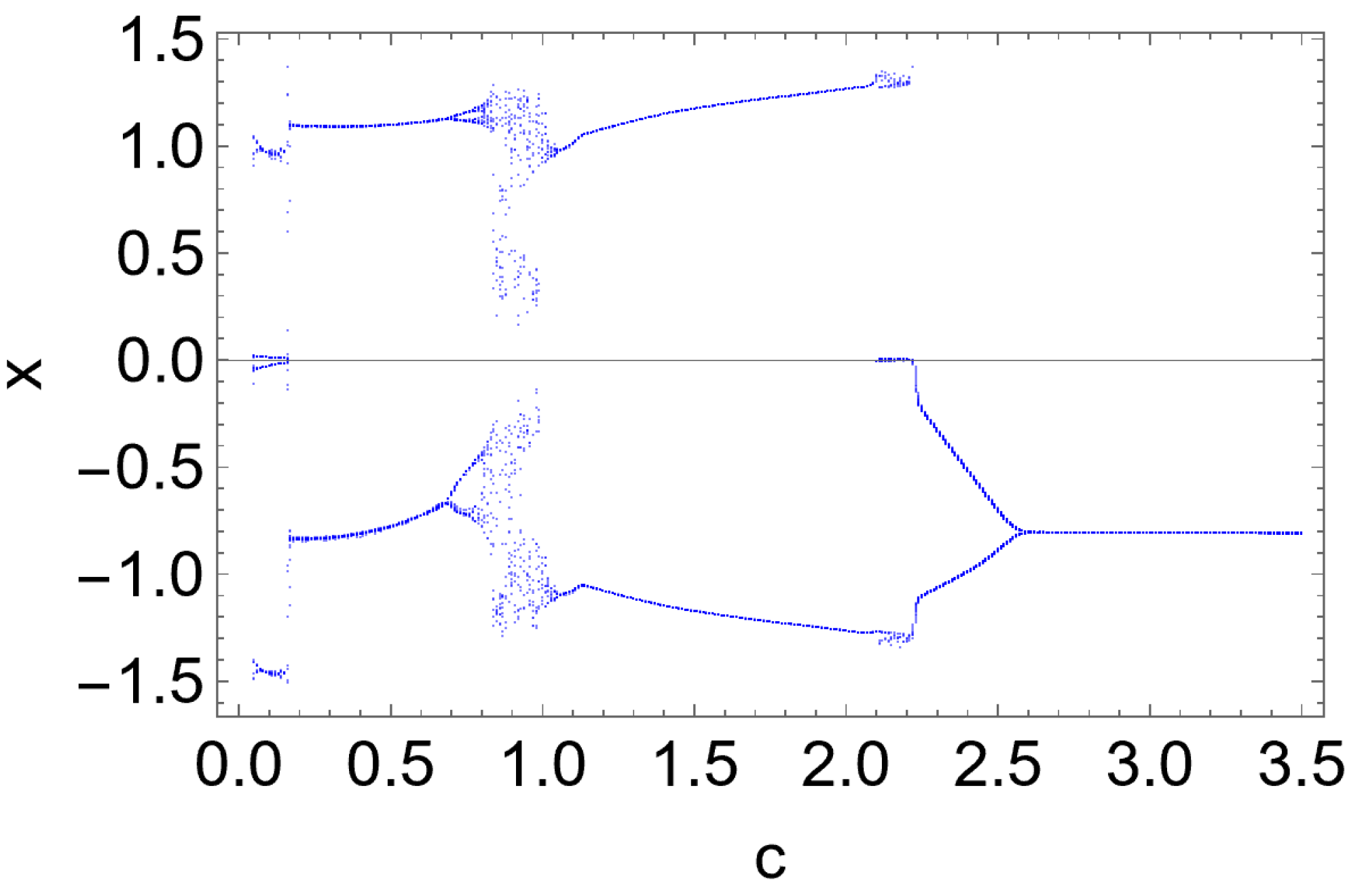
The bifurcation analysis performed revealed that the system exhibits periodic behavior for , chaotic behavior for , quasiperiodic behavior for , and asymptotically stable behavior for .
Two zero Lapunov values in 3D systems indicate quasiperiodic dynamic [29]. Quasiperiodicity describes a type of behavior that retains oscillatory features while lacking strict periodic regularity. Such dynamics exhibit patterns that do not repeat with a fixed period and are therefore not exactly periodic [30].
Definition 2.
Quasi-periodic solutions are characterized by a discrete frequency spectrum, which does not consist of integer multiples of one single base frequency. The spectrum consists of linear combinations of frequencies [30,31].
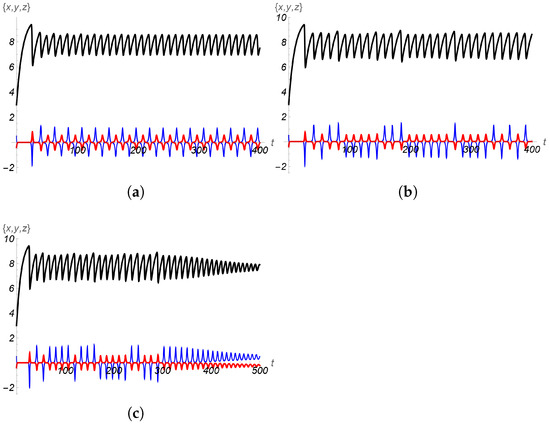
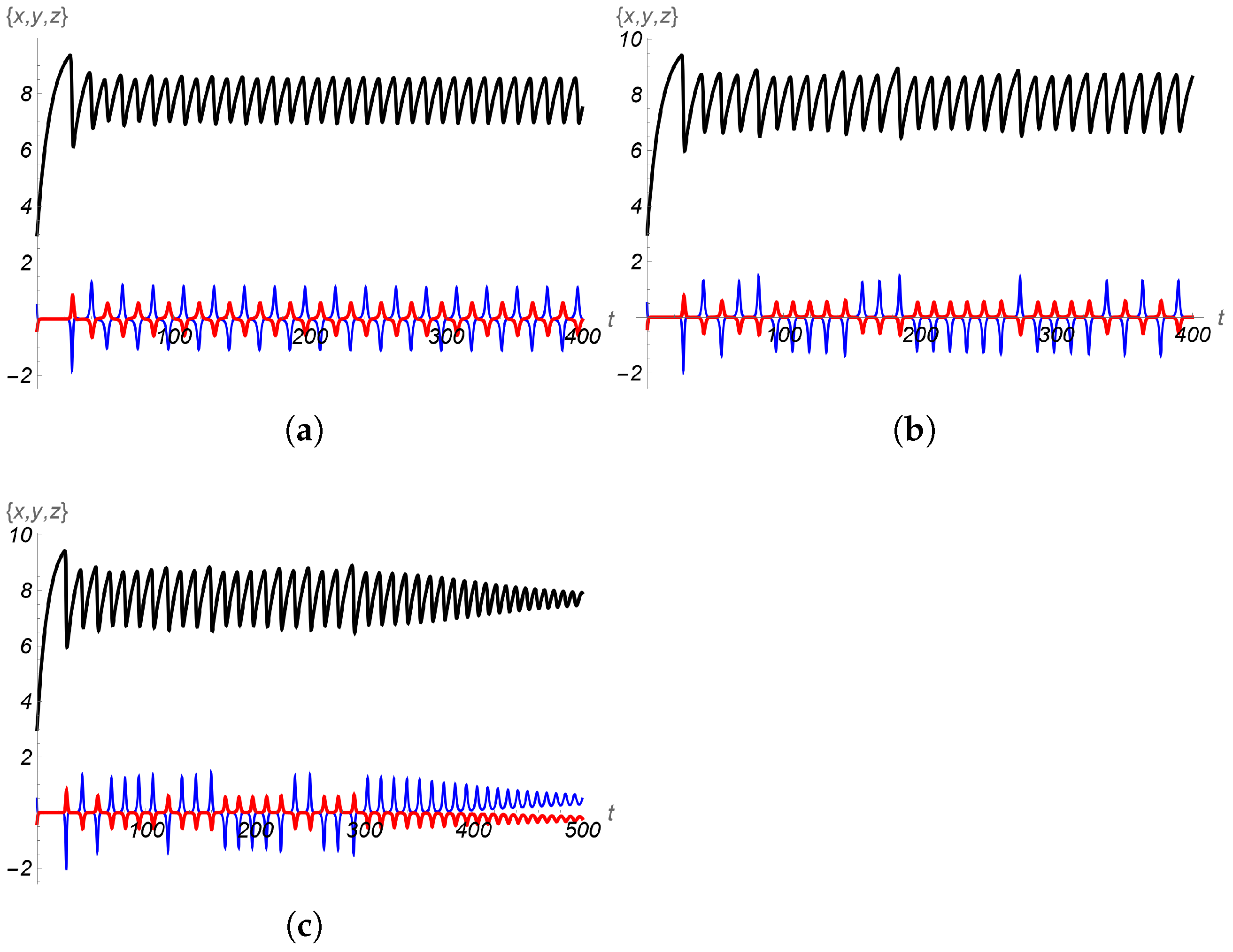
Figure 18.
Phase portraits illustrating the dynamics of system (19), in the two-dimensional planes (a) Phase trajectories in the plane, . (b) Phase trajectories in the plane, . (c) Phase trajectories in the plane, . (d) Phase portrait in state space, .
Figure 19.
Solutions of the system (19) with the initial conditions ; (a) . (b) . (c) .
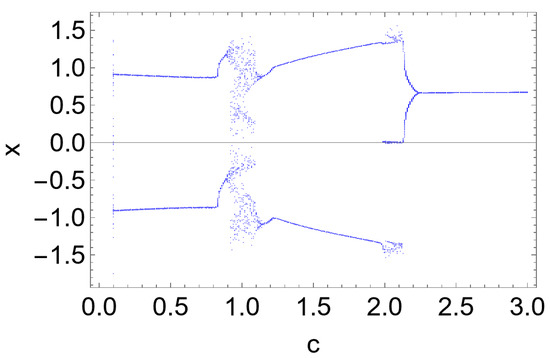
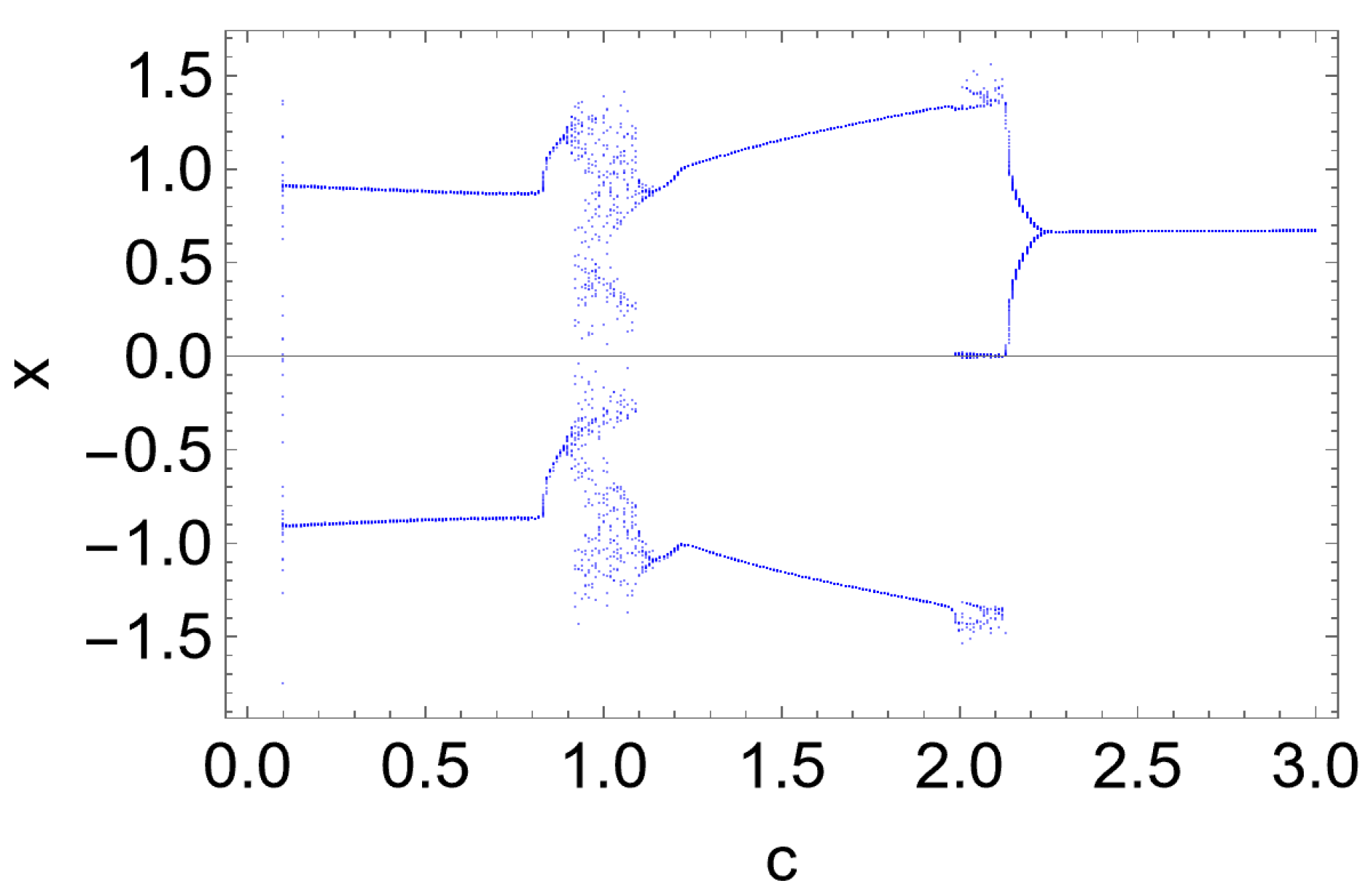
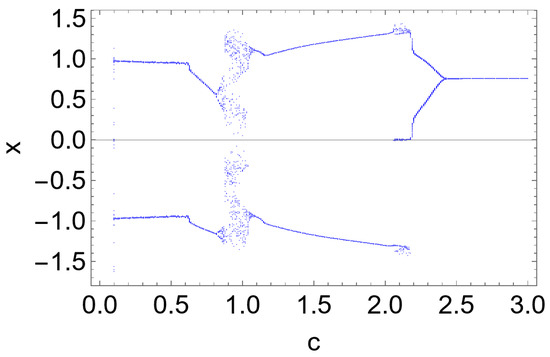
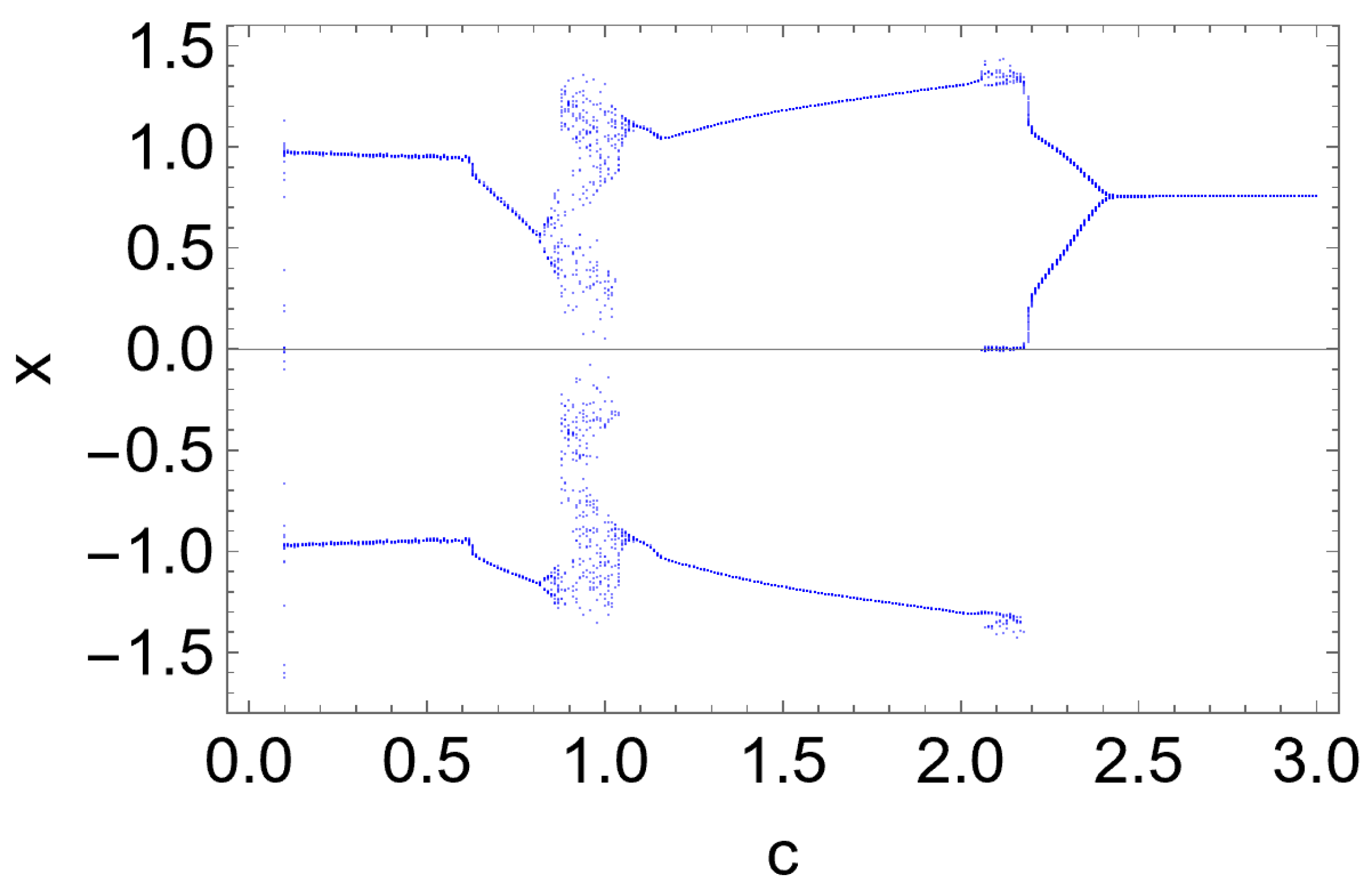
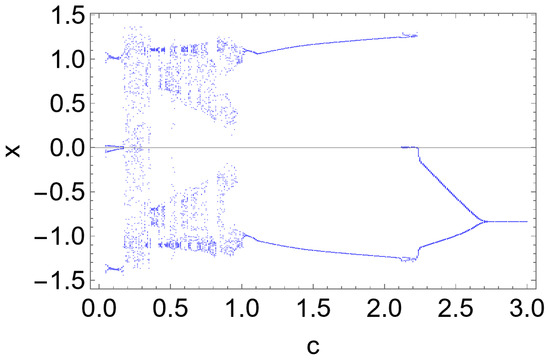
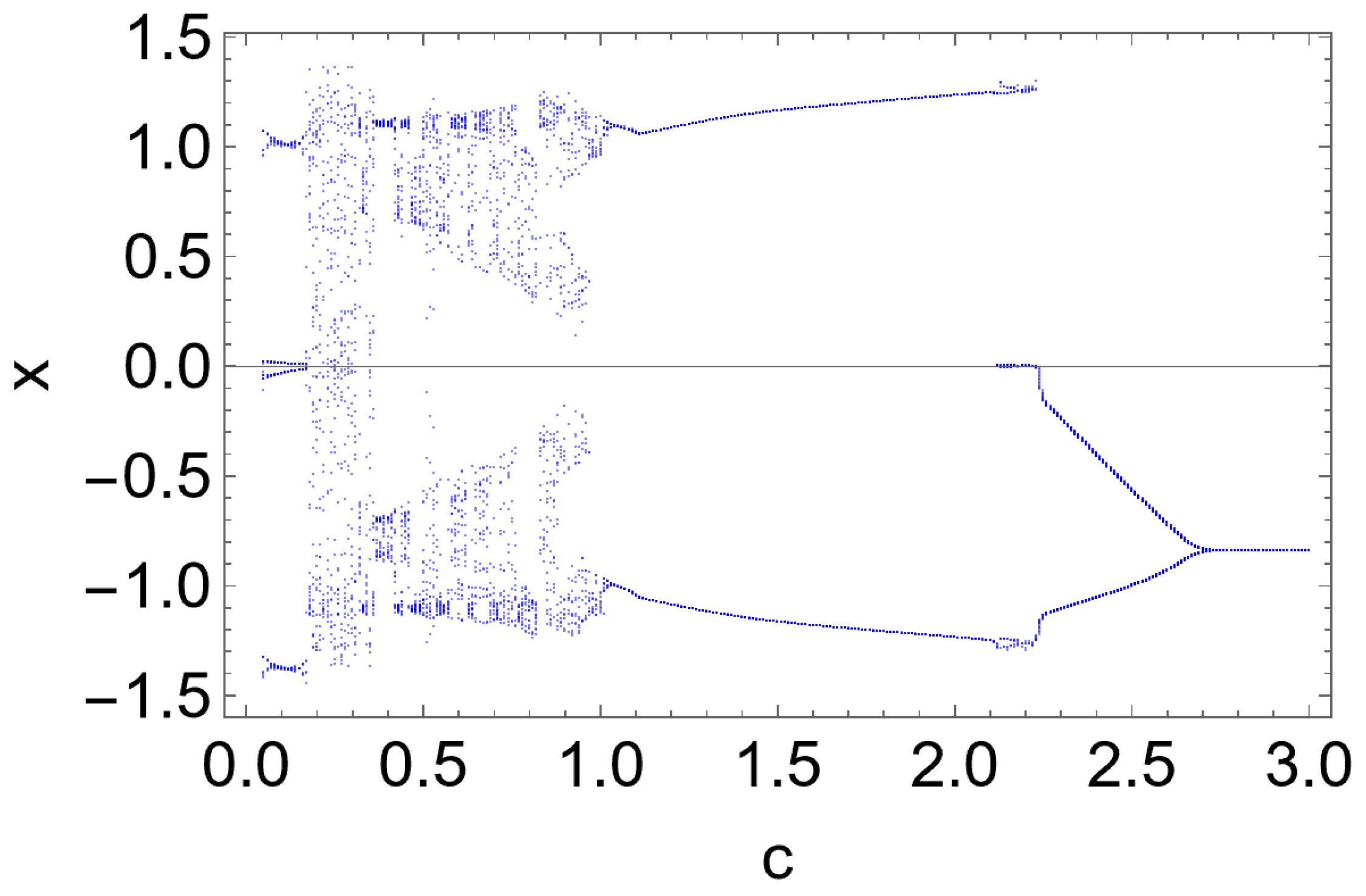
The bifurcation diagram reveals a sequence of qualitative changes in the dynamics of the system as the parameter c varies. For small values of c, the system exhibits stable periodic oscillations, which lose stability and transition to a regime of weak chaotic dynamics. As c increases further, the chaotic attractor transforms into a quasiperiodic regime. The subsequent destruction of quasiperiodic behavior leads to the convergence of system trajectories to a stable critical point, indicating asymptotic stability. Figure 20 displays the bifurcation diagram of the system (19) for , obtained by varying the control parameter c. The parameters , and d remain fixed. The bifurcation diagram is plotted when b is varied between .
Figure 20.
Bifurcation diagram.
Table 8 presents the analysis of system dynamics for various values of the parameter d.
Table 8.
Parameter d analysis.
An analysis of the parameter d shows that the system maintains periodic dynamics throughout the considered range, with no evidence of bifurcations or transitions to more complex regimes.
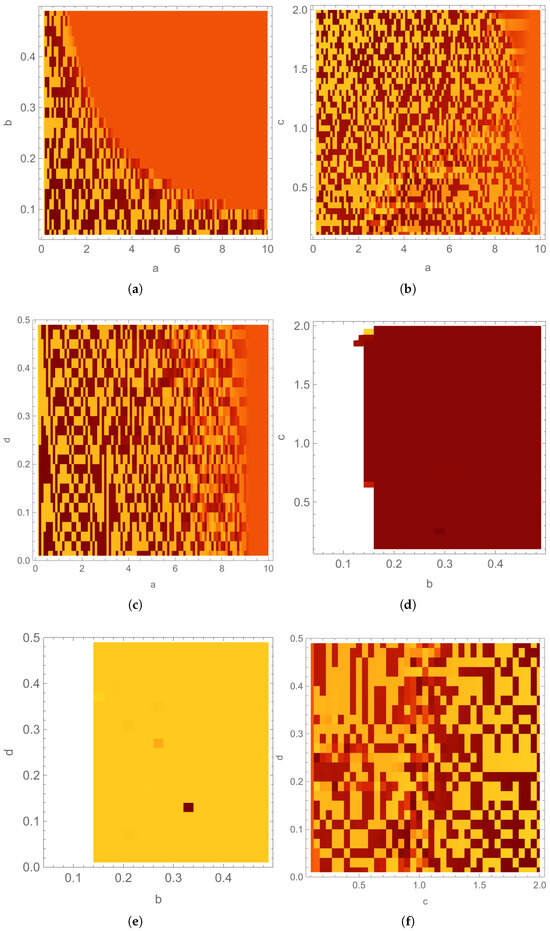
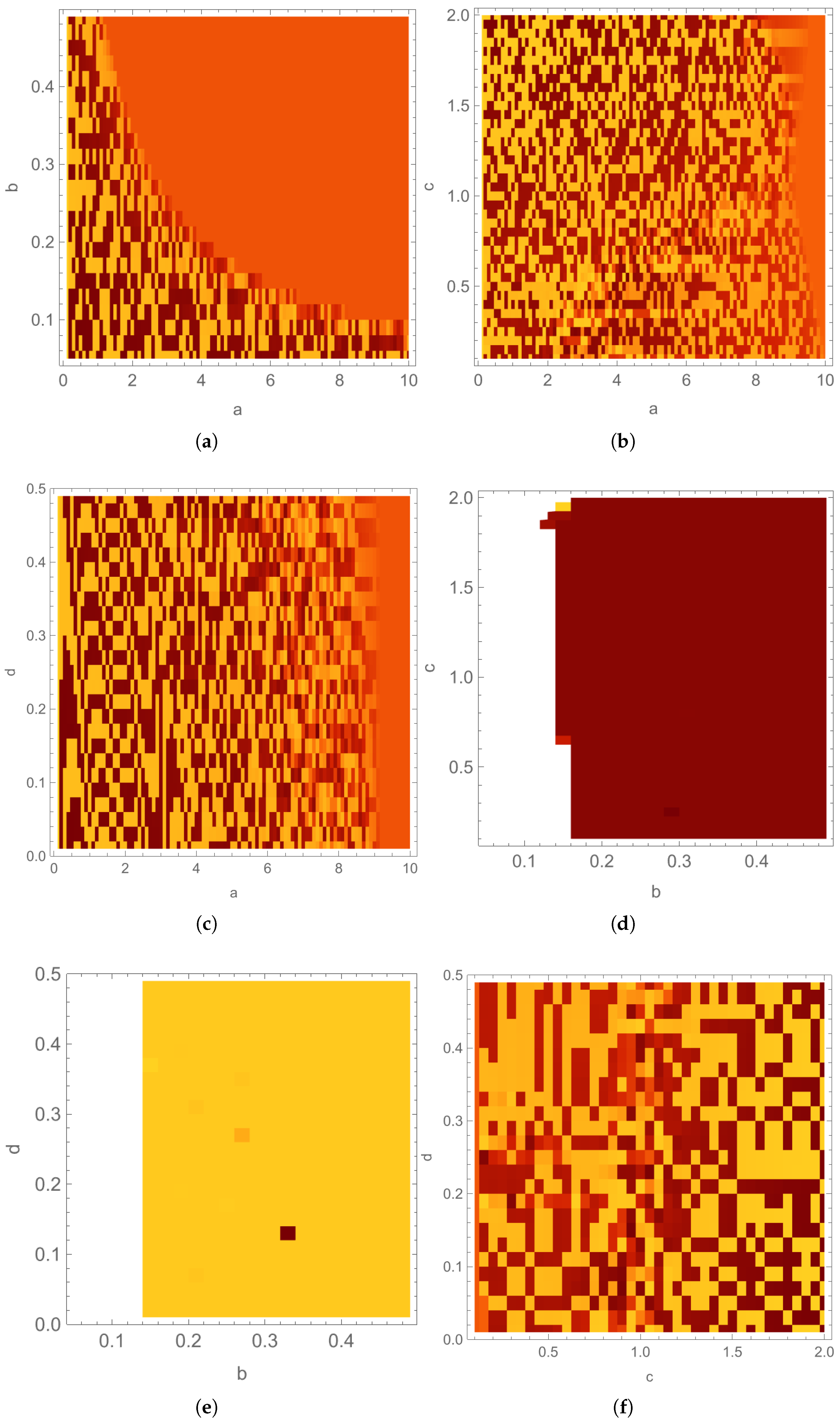
To analyze the coupling effects between the system parameters, two-parameter bifurcation diagrams were constructed in several parameter planes. The resulting parameter-plane maps are presented in Figure 21. These diagrams provide a global view of the system dynamics and reveal regions corresponding to different dynamical regimes. The results demonstrate that the interaction between parameters plays a significant role in shaping the system behavior and complements the single-parameter bifurcation analysis.
Figure 21.
Two-parameter bifurcation diagrams illustrating the coupling effects between system parameters. (a) . (b) . (c) . (d) . (e) . (f) .
3.1.3. Robustness of the System with Respect to Initial Conditions
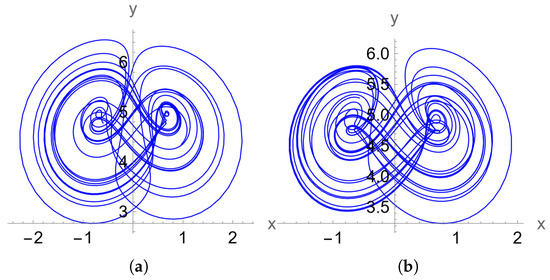
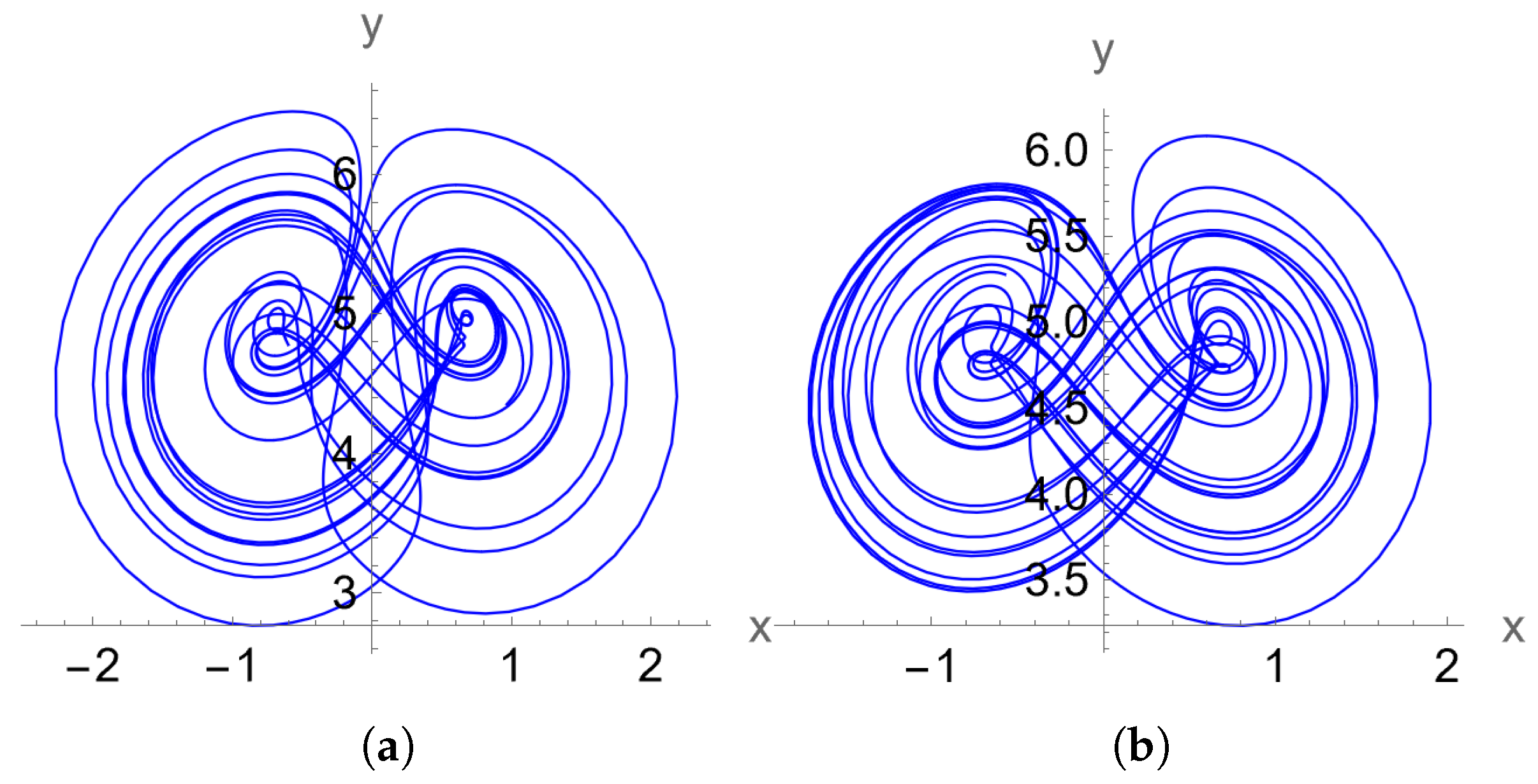
Figure 22 shows the phase plots of system (19), , while Figure 23 displays the corresponding solution graphs.
Figure 22.
Phase portraits illustrating the dynamics of system (19), in the two-dimensional planes (a) Phase trajectories in the plane, , . (b) Phase trajectories in the plane, , .
Figure 23.
Solutions of the system (19) with different initial conditions. (a) , ; . (b) .
Simulations with different initial conditions lead to the same chaotic attractor, confirming that the dynamics of the system are robust and not dependent on a specific initial state.
3.2. Case 2: k = 3
3.2.1. Stability and Dynamical Analysis
The system is (19) and with given parameters (2) and initial conditions (3). The first critical point is obtained similarly as in Case 1.
Let us consider the second case, where . Then and . After that, substitute into the second equation of the system (19) and equate to zero
After simplifying (37) get
Taking into account the parameters (2), one real root of Equation (38) is obtained: . The second critical point is . Let us build the Jakobian matrix
The characteristic matrix is
and the characteristic equation is
Put the values of the first critical point in (41) and get three roots
This result indicates that the critical point behaves as a saddle point and is unstable.
Put the values of the second critical point in (41) and get three roots
This result indicates that the critical point behaves as a saddle-focus point and is unstable.
3.2.2. Bifurcation Analysis
Table 9 presents the analysis of system dynamics for various values of the parameter a.
Table 9.
Parameter a analysis.
For small values of the parameter a, the computation of Lyapunov exponents produces indeterminate values. This occurs because the numerical algorithm used to estimate the Lyapunov spectrum does not converge to stable values within the considered integration time. In this parameter range, the system trajectories diverge rapidly in the phase space, which leads to numerical instability in the orthonormalization procedure of the Lyapunov exponent algorithm. As an increase, stable periodic dynamics emerge, followed by convergence to an asymptotically stable critical point.
Table 10 presents the analysis of system dynamics for various values of the parameter b.
Table 10.
Parameter b analysis.
The analysis of parameter b shows that, except for very small values where the Lyapunov exponents are indeterminate, the system exhibits asymptotically stable behavior throughout the range of parameter b. For , all Lyapunov exponents are strictly negative, indicating convergence of the trajectories to a stable critical point.
Table 11 presents the analysis of system dynamics for various values of the parameter c.
Table 11.
Parameter c analysis.
The analysis of parameter c reveals that for small values of this parameter, the Lyapunov exponents are indeterminate, indicating the absence of a well-defined asymptotic regime. As c increases, all Lyapunov exponents become negative, which implies the asymptotic stability of the system. Thus, the parameter c plays a stabilizing role, leading to suppression of complex dynamics and convergence to a stable critical point.
Table 12 presents the analysis of system dynamics for various values of the parameter d.
Table 12.
Parameter d analysis.
For small values of the parameter d, the computation of Lyapunov exponents yields indeterminate results, indicating that the system does not reach a well-defined asymptotic regime within the integration time considered. As d increases, stable periodic dynamics and quasiperiodic dynamics emerge.
3.3. Case 3: k = 5
3.3.1. Stability and Dynamical Analysis
The system is (19) and with given parameters (2) and initial conditions (3). The first critical point is obtained similarly as in Case 1.
Let us consider the second case, where . Then and . After that, substitute into the second equation of the system (19) and equate to zero
After simplifying (44) get
Taking into account the parameters (2), one real root of Equation (45) is obtained: . The second critical point is . Let us build the Jakobian matrix
The characteristic matrix is
and the characteristic equation is
Put the values of the first critical point in (48) and get three roots
This result indicates that the critical point behaves as a saddle point and is unstable.
Put the values of the second critical point in (48) and get three roots
This result indicates that the critical point behaves as a saddle-focus point and is unstable.
3.3.2. Bifurcation Analysis
Table 13 presents the analysis of system dynamics for various values of the parameter a.
Table 13.
Parameter a analysis.
For small values of parameter a, the computation of Lyapunov exponents yields indeterminate results, indicating that the system does not reach a well-defined asymptotic regime within the integration time considered. As the increase, stable periodic dynamics emerge, followed by convergence to an asymptotically stable critical point.
Table 14 presents the analysis of system dynamics for various values of the parameter b.
Table 14.
Parameter b analysis.
The analysis of parameter b reveals that for small values of this parameter, the Lyapunov exponents are indeterminate, indicating the absence of a well-defined asymptotic regime. As b increases, all Lyapunov exponents become negative, which implies the asymptotic stability of the system.
Table 15 presents the analysis of system dynamics for various values of the parameter c.
Table 15.
Parameter c analysis.
The analysis of parameter c reveals that for small values of this parameter, the Lyapunov exponents are indeterminate, indicating the absence of a well-defined asymptotic regime. As c increases, all Lyapunov exponents become negative, which implies the asymptotic stability of the system.
Table 16 presents the analysis of system dynamics for various values of the parameter c.
Table 16.
Parameter d analysis.
For small values of the parameter d, the computation of Lyapunov exponents yields indeterminate results, indicating that the system does not reach a well-defined asymptotic regime within the integration time considered. As d increases, stable periodic dynamics emerges.
3.4. Case 4: k = 6
3.4.1. Stability and Dynamical Analysis
The system is (19) and with given parameters (2) and initial conditions (3). The first critical point is obtained similarly as in Case 1.
Let us consider the second case, where . Then and . After that, substitute into the second equation of the system (19) and equate to zero
After simplifying (51) get
Taking into account the parameters (2), the two roots of Equation (52) are obtained: . The second and third critical points are and . Let us build the Jakobian matrix
The characteristic matrix is
and the characteristic equation is
Put the values of the first critical point in (55) and get three roots
This result indicates that the critical point behaves as a saddle point and is unstable.
Put the values of the second critical point in (55) and get three roots
This result indicates that the critical point behaves as a saddle-focus point and is unstable.
Put the values of the third critical point in (55) and get three roots
This result indicates that the critical point behaves as a saddle-focus point and is unstable.
3.4.2. Bifurcation Analysis
Table 17 presents the analysis of system dynamics for various values of the parameter a.
Table 17.
Parameter a analysis.
The bifurcation analysis performed revealed that the system exhibits periodic behavior for and , chaotic behavior for , and asymptotically stable for .
Figure 24 shows the phase plots of system (19), , while Figure 25 displays the corresponding solution graphs.
Figure 24.
Phase portraits illustrating the dynamics of system (19), in the two-dimensional planes: (a) Phase trajectories in the plane, . (b) Phase trajectories in the plane, .
Figure 26 displays the bifurcation diagram of the system (19) for , obtained by varying the control parameter a. The parameters , and d remain fixed. The bifurcation diagram is plotted when a is varied between .
Figure 26.
Bifurcation diagram.
Table 18 presents the analysis of system dynamics for various values of the parameter b.
Table 18.
Parameter b analysis.
The bifurcation analysis performed revealed that the system exhibits chaotic behavior for , periodic behavior for and , and asymptotically stable behavior for . Figure 27 shows the phase plots of system (19), , while Figure 28 displays the corresponding solution graphs.
Figure 27.
Phase portraits illustrating the dynamics of system (19), in the two-dimensional planes: (a) Phase trajectories in the plane, . (b) Phase trajectories in the plane, .
Figure 29 displays the bifurcation diagram of the system (19) for , obtained by varying the control parameter b. The parameters , and d remain fixed. The bifurcation diagram is plotted when b is varied between .
Figure 29.
Bifurcation diagram.
Table 19 presents the analysis of system dynamics for various values of the parameter c.
Table 19.
Parameter c analysis.
The bifurcation analysis performed revealed that the system exhibits chaotic behavior for , periodic behavior for and , and asymptotically stable behavior for .
Figure 30 displays the bifurcation diagram of the system (19) for , obtained by varying the control parameter c. The parameters , and d remain fixed. The bifurcation diagram is plotted when b is varied between .
Figure 30.
Bifurcation diagram.
Table 20 presents the analysis of system dynamics for various values of the parameter b.
Table 20.
Parameter d analysis.
The bifurcation analysis performed revealed that the system exhibits chaotic behavior for , quasiperiodic behavior for , and periodic behavior for .
Figure 31 displays the bifurcation diagram of the system (19) for , obtained by varying the control parameter d. The parameters , and c remain fixed. The bifurcation diagram is plotted when d is varied between .
Figure 31.
Bifurcation diagram.
3.5. Case 5: k = 7
3.5.1. Stability and Dynamical Analysis
The system is (19) and with given parameters (2) and initial conditions (3). The first critical point is obtained similarly as in Case 1. .
Let us consider the second case, where . Then and . After that, substitute into the second equation of the system (19) and equate to zero
After simplifying (25) get
Taking into account the parameters (2), only one real root of Equation (60) is obtained: . The second critical point is . Let us build the Jakobian matrix
The characteristic matrix is
and the characteristic equation is
Put the values of the first critical point in (63) and get three roots
This result indicates that the critical point behaves as a saddle point and is unstable.
Put the values of the second critical point in (63) and get three roots
This result indicates that the critical point behaves as a saddle-focus point and is unstable.
3.5.2. Bifurcation Analysis
Table 21 presents the analysis of system dynamics for various values of the parameter a.
Table 21.
Parameter a analysis.
For , the computation of Lyapunov exponents yields indeterminate results, indicating that the system does not reach a well-defined asymptotic regime within the integration time considered. As a increases, stable periodic dynamics emerge.
Table 22 presents the analysis of system dynamics for various values of the parameter b.
Table 22.
Parameter b analysis.
The bifurcation analysis performed revealed that the system exhibits an asymptotically stable behavior for .
Table 23 presents the analysis of system dynamics for various values of the parameter c.
Table 23.
Parameter c analysis.
The bifurcation analysis performed revealed that the system exhibits an asymptotically stable behavior for and .
Table 24 presents the analysis of system dynamics for various values of the parameter c.
Table 24.
Parameter d analysis.
For small values of the parameter d, the computation of Lyapunov exponents yields indeterminate results, indicating that the system does not reach a well-defined asymptotic regime within the integration time considered. As d increases, stable periodic dynamics emerge.
3.6. Case 6: k = 8
3.6.1. Stability and Dynamical Analysis
The system is (19) and with given parameters (2) and initial conditions (3). The first critical point is obtained similarly as in Case 1. .
Let us consider the second case, where . Then and . After that, substitute into the second equation of the system (19) and equate to zero
After simplifying (66) get
Taking into account the parameters (2), the two roots of Equation (67) are obtained: . The second and third critical points are and . Let us build the Jakobian matrix
The characteristic matrix is
and the characteristic equation is
Put the values of the first critical point in (70) and get three roots
This result indicates that the critical point behaves as a saddle point and is unstable.
Put the values of the second critical point in (70) and get three roots
This result indicates that the critical point behaves as a saddle-focus point and is unstable.
Put the values of the third critical point in (70) and get three roots
This result indicates that the critical point behaves as a saddle-focus point and is unstable.
3.6.2. Bifurcation Analysis
Table 25 presents the analysis of system dynamics for various values of the parameter a.
Table 25.
Parameter a analysis.
The bifurcation analysis performed revealed that the system exhibits chaotic behavior for , periodic behavior for and , quasiperiodic behavior for , and asymptotically stable behavior for .
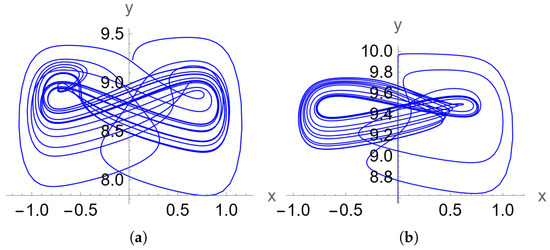
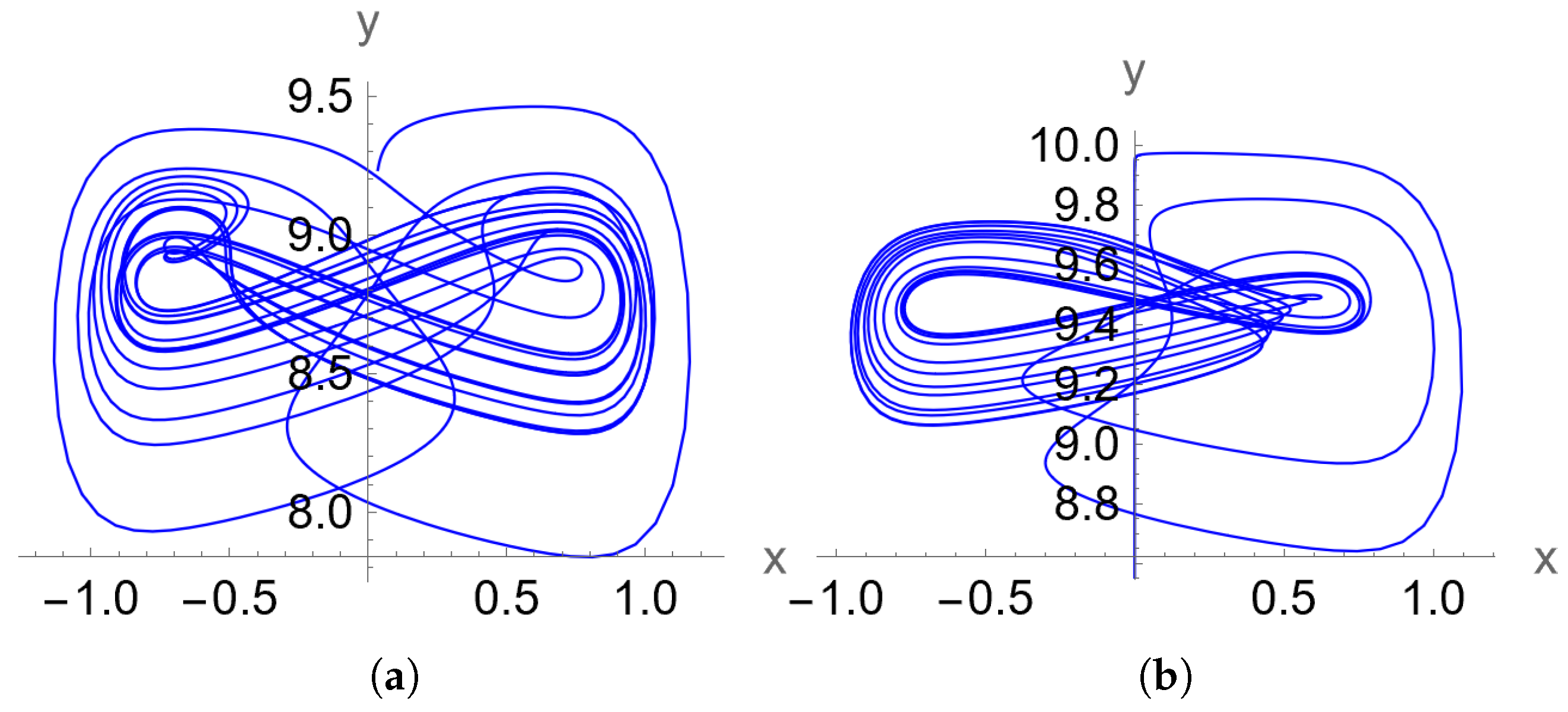
Figure 32 shows the phase plots of system (19), , while Figure 33 displays the corresponding solution graphs.
Figure 32.
Phase portraits illustrating the dynamics of system (19), in the two-dimensional planes: (a) Phase trajectories in the plane, . (b) Phase trajectories in the plane, .
Figure 34 displays the bifurcation diagram of the system (19) for , obtained by varying the control parameter a. The parameters and d remain fixed. The bifurcation diagram is plotted when a is varied between .
Figure 34.
Bifurcation diagram.
Table 26 presents the analysis of system dynamics for various values of the parameter b.
Table 26.
Parameter b analysis.
The bifurcation analysis performed revealed that the system exhibits chaotic behavior for , periodic behavior for and , and asymptotically stable behavior for .
Figure 35 displays the bifurcation diagram of the system (19) for , obtained by varying the control parameter b. The parameters , and d remain fixed. The bifurcation diagram is plotted when b is varied between .
Figure 35.
Bifurcation diagram.
Table 27 presents the analysis of system dynamics for various values of the parameter c.
Table 27.
Parameter c analysis.
Figure 36 displays the bifurcation diagram of the system (19) for , obtained by varying the control parameter c. The parameters and d remain fixed. The bifurcation diagram is plotted when c is varied between .
Figure 36.
Bifurcation diagram.
Table 28 presents the analysis of system dynamics for various values of the parameter d.
Table 28.
Parameter d analysis.
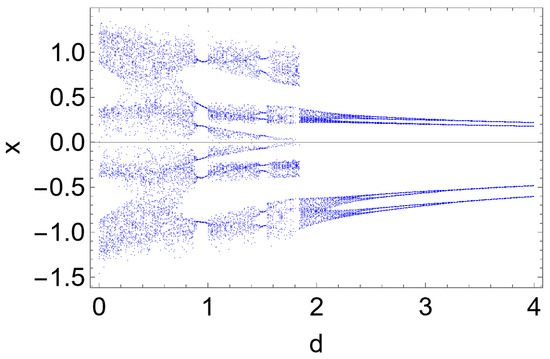
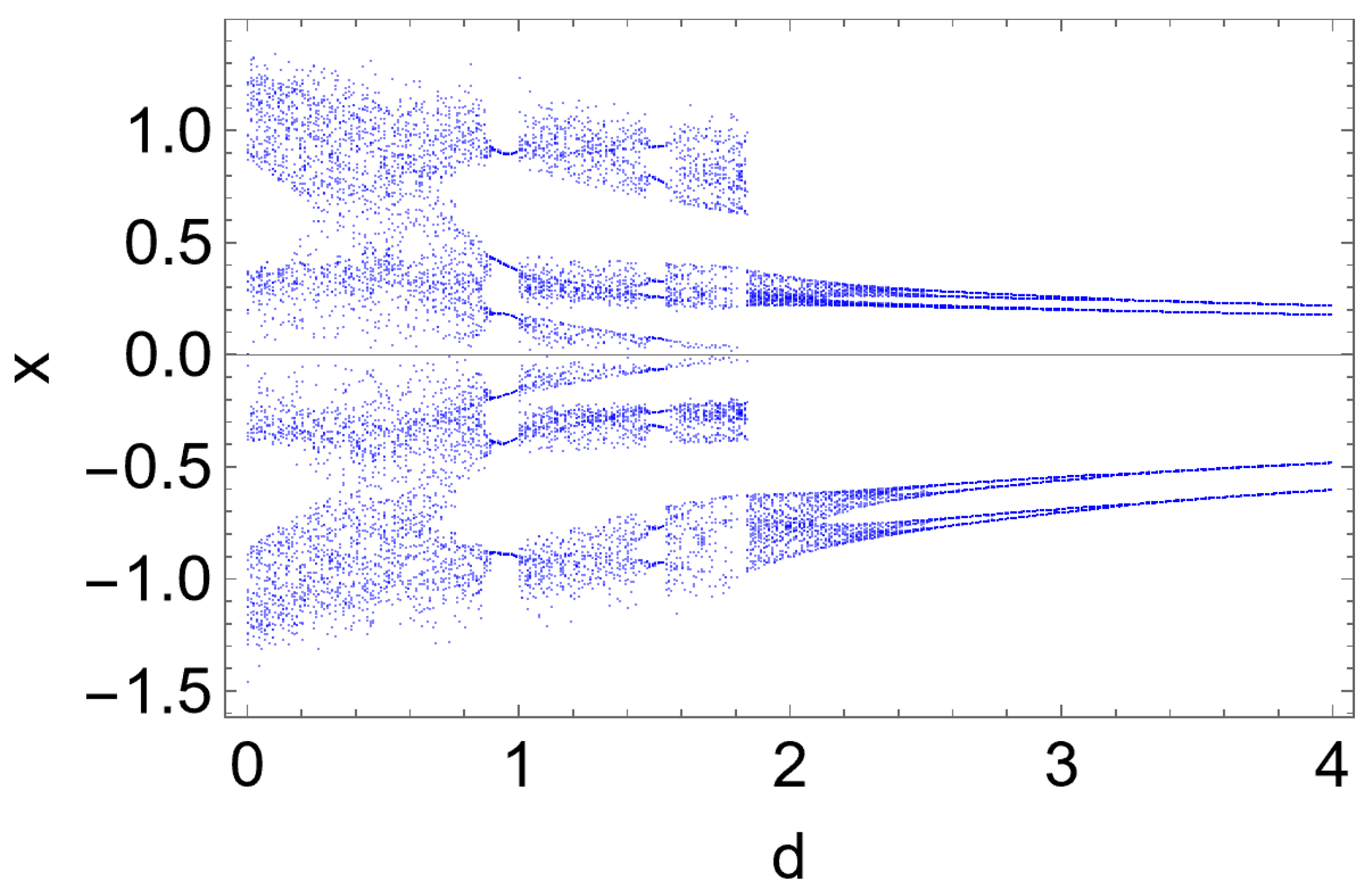
Figure 37 displays the bifurcation diagram of the system (19) for , obtained by varying the control parameter d. The parameters , and c remain fixed. The bifurcation diagram is plotted when d is varied between .
Figure 37.
Bifurcation diagram.
3.7. Case 7: k = 9
3.7.1. Stability and Dynamical Analysis
The system is (19) and with given parameters (2) and initial conditions (3). The first critical point is obtained similarly as in Case 1. .
Let us consider the second case, where . Then and . After that, substitute into the second equation of the system (19) and equate to zero
After simplifying (74) get
Taking into account the parameters (2), only one real root of Equation (75) is obtained: . The second critical point is . Let us build the Jakobian matrix
The characteristic matrix is
and the characteristic equation is
Put the values of the first critical point in (78) and get three roots
This result indicates that the critical point behaves as a saddle point and is unstable.
Put the values of the second critical point in (78) and get three roots
This result indicates that the critical point behaves as a saddle-focus point and is unstable.
3.7.2. Bifurcation Analysis
Table 29 presents the analysis of system dynamics for various values of the parameter a.
Table 29.
Parameter a analysis.
For , the computation of Lyapunov exponents yields indeterminate results, indicating that the system does not reach a well-defined asymptotic regime within the integration time considered. As a increases, stable periodic dynamics emerges.
Table 30 presents the analysis of system dynamics for various values of the parameter b.
Table 30.
Parameter b analysis.
The bifurcation analysis performed revealed that the system exhibits an asymptotically stable behavior for .
Table 31 presents the analysis of system dynamics for various values of the parameter c.
Table 31.
Parameter c analysis.
For , the computation of Lyapunov exponents yields indeterminate results; the system exhibits an asymptotically stable behavior for .
Table 32 presents the analysis of system dynamics for various values of the parameter c.
Table 32.
Parameter d analysis.
For the computation of Lyapunov exponents yields indeterminate results, the system exhibits periodic behavior for .
3.8. Case 8: k = 10
3.8.1. Stability and Dynamical Analysis
The system is (19) and with given parameters (2) and initial conditions (3). The first critical point is obtained similarly as in Case 1. .
Let us consider the second case, where . Then and . After that, substitute into the second equation of the system (19) and equate to zero
After simplifying (81) get
Taking into account the parameters (2), the two roots of Equation (82) are obtained: . The second and third critical points are and . Let us build the Jakobian matrix
The characteristic matrix is
and the characteristic equation is
Put the values of the first critical point in (85) and get three roots
This result indicates that the critical point behaves as a saddle point and is unstable.
Put the values of the second critical point in (85) and get three roots
This result indicates that the critical point behaves as a saddle-focus point and is unstable.
Put the values of the third critical point in (85) and get three roots
This result indicates that the critical point behaves as a saddle-focus point and is unstable.
3.8.2. Bifurcation Analysis
Table 33 presents the analysis of system dynamics for various values of the parameter a.
Table 33.
Parameter a analysis.
The bifurcation analysis performed revealed that the system exhibits chaotic behavior for , periodic behavior for and , and asymptotically stable behavior for .
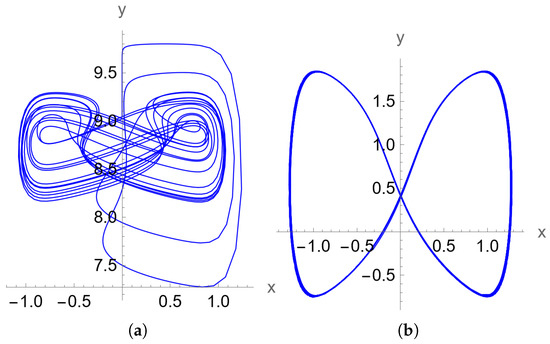
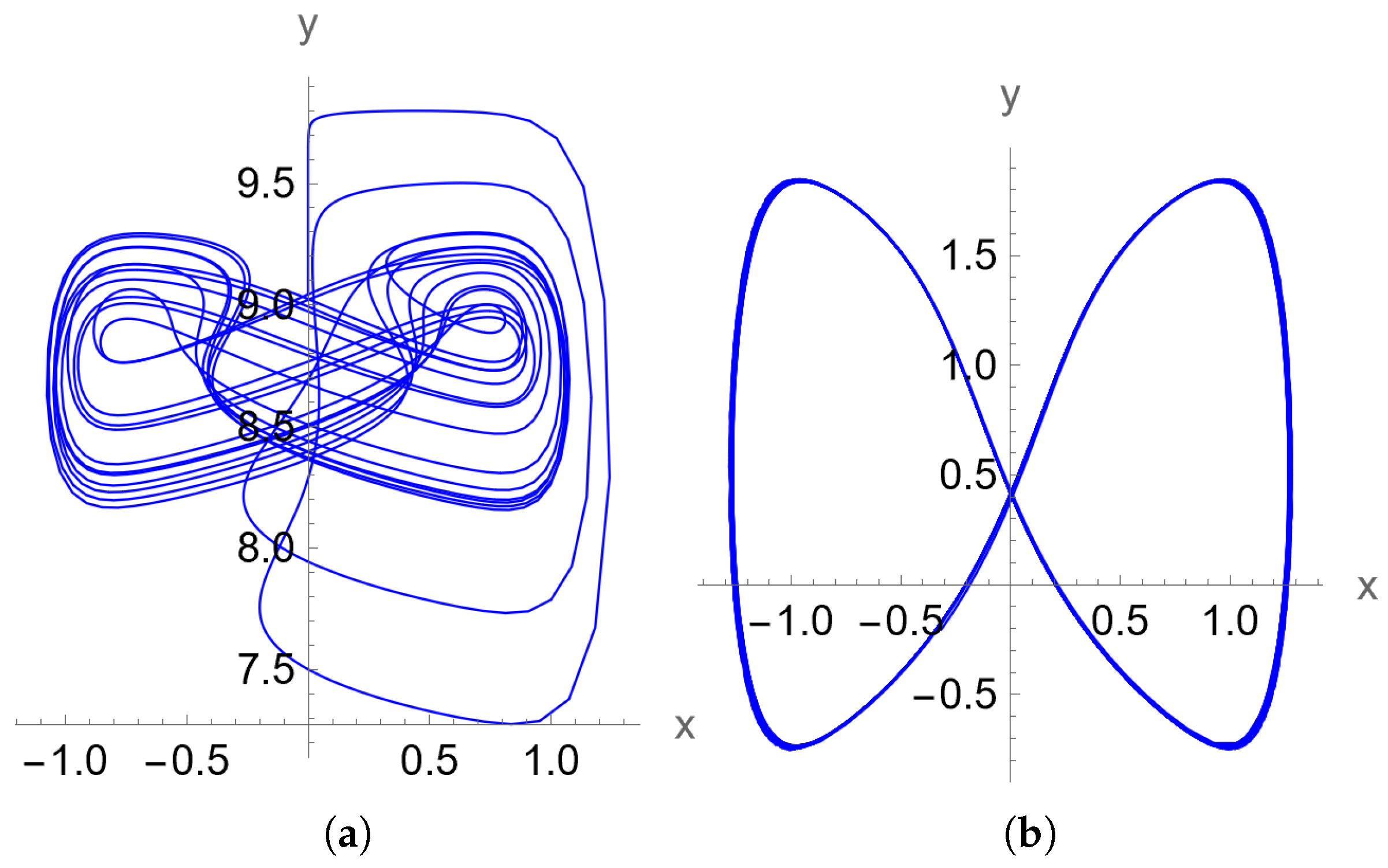
Figure 38 shows the phase plots of system (19), , while Figure 39 displays the corresponding solution graphs.
Figure 38.
Phase portraits illustrating the dynamics of system (19), in the two-dimensional planes: (a) Phase trajectories in the plane, . (b) Phase trajectories in the plane, .
Figure 40 displays the bifurcation diagram of the system (19) for , obtained by varying the control parameter a. The parameters and d remain fixed. The bifurcation diagram is plotted when a is varied between .
Figure 40.
Bifurcation diagram.
Table 34 presents the analysis of system dynamics for various values of the parameter a.
Table 34.
Parameter b analysis.
The bifurcation analysis performed revealed that the system exhibits chaotic behavior for , periodic behavior for and , and asymptotically stable behavior for . Figure 41 displays the bifurcation diagram of the system (19) for , obtained by varying the control parameter b. The parameters , and d remain fixed. The bifurcation diagram is plotted when b is varied between .
Figure 41.
Bifurcation diagram.
Table 35 presents the analysis of system dynamics for various values of the parameter c.
Table 35.
Parameter c analysis.
Figure 42 displays the bifurcation diagram of the system (19) for , obtained by varying the control parameter c. The parameters , and d remain fixed. The bifurcation diagram is plotted when c is varied between .
Figure 42.
Bifurcation diagram.
Table 36 presents the analysis of system dynamics for various values of the parameter d.
Table 36.
Parameter d analysis.
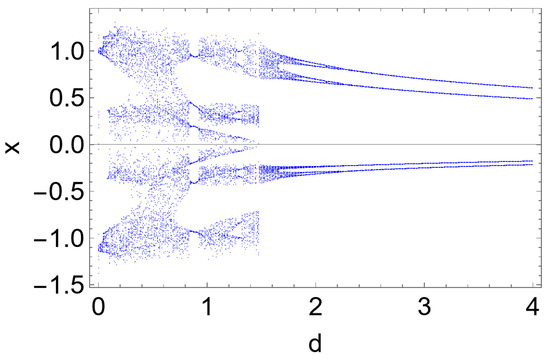
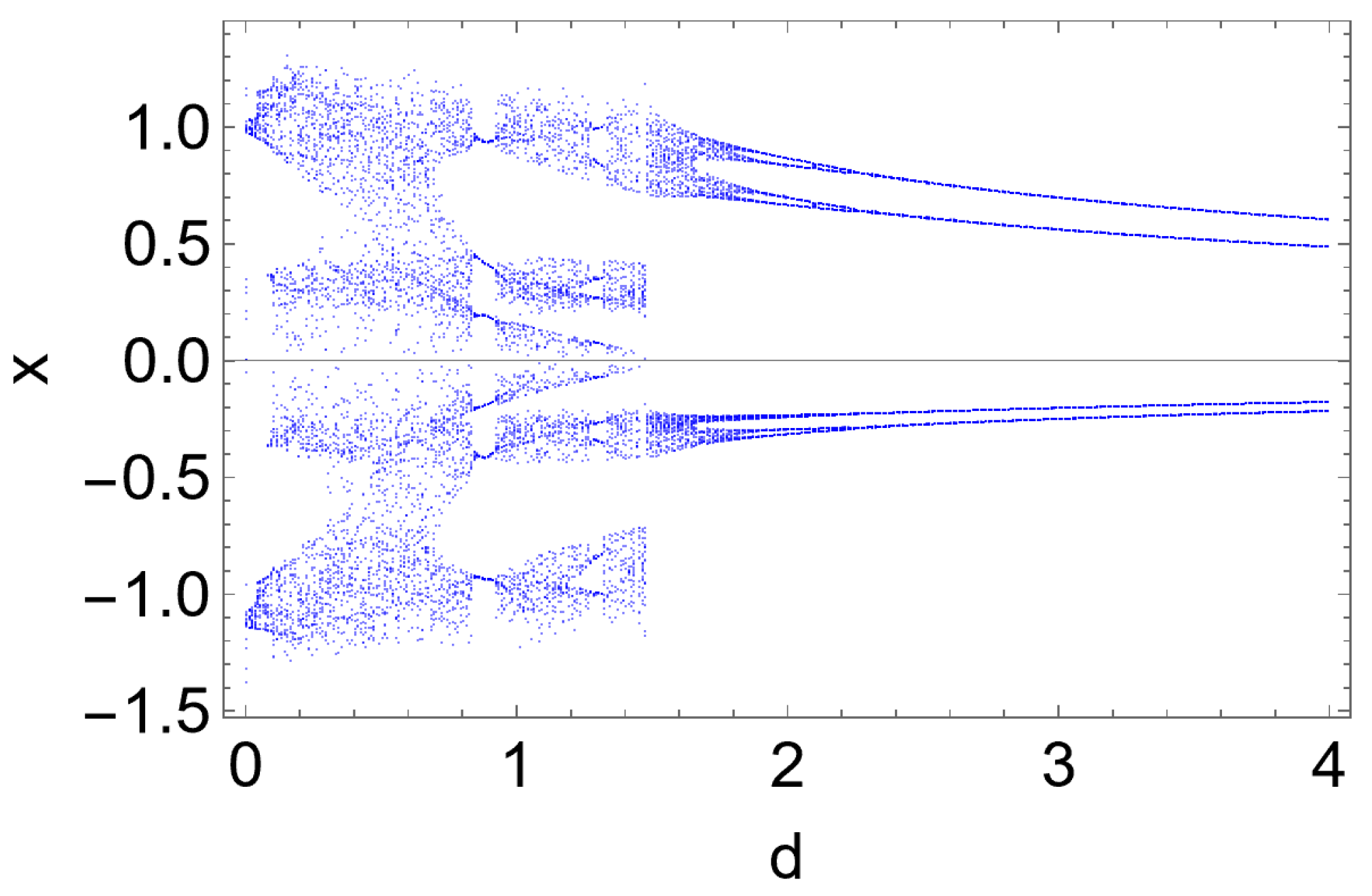
Figure 43 displays the bifurcation diagram of the system (19) for , obtained by varying the control parameter d. The parameters , and c remain fixed. The bifurcation diagram is plotted when d is varied between .
Figure 43.
Bifurcation diagram.
4. Discussion
This paper investigates the dynamics of a three-dimensional nonlinear financial model and analyzes the conditions for the emergence of chaotic behavior. The well-known chaotic system with given parameters and initial conditions was considered as the initial model. Critical points were found for it, two-dimensional and three-dimensional phase portraits were constructed, and Lyapunov exponents were calculated. The results obtained confirmed the presence of chaotic behavior and the high sensitivity of the system to initial conditions.
To deepen the study, a modification of the model was proposed based on changing the degree of the nonlinear term in the second equation and a class of modified systems with nonlinearity of the form , where . The parameter k plays an important role in controlling the nonlinear interaction between the system variables. As the value of k increases, the strength of the nonlinear terms in the system also increases, which improves the coupling between the state variables. This stronger nonlinear interaction leads to more complex trajectories in phase space and can destabilize regular periodic behavior. As a result, the system undergoes a transition from simple dynamics to more complicated oscillations and chaotic behavior. Therefore, increasing the parameter k contributes to the growth of the dynamical complexity in the proposed system.
Critical points were found and classified for the generalized model, which made it possible to analyze phase spaces at various degrees of nonlinearity.
Next, a bifurcation analysis of the modified systems was performed as the parameters changed. The bifurcation diagrams showed transitions between different dynamical regimes, including equilibrium states, periodic oscillations, quasi-periodic behavior, and chaos. Together with phase portraits and Lyapunov exponent analysis, this shows that both the parameters of the system and the degree of nonlinearity strongly influence the nature of the dynamics of the financial model.
Compared with classical chaotic financial models, the proposed system introduces an additional degree of nonlinearity through the term . Related studies on multidimensional chaotic maps, such as the design of three-dimensional logistic maps and optimization approaches for chaotic systems, also highlight the importance of introducing stronger nonlinear structures to enhance dynamical complexity. In traditional financial models, nonlinear interactions are usually represented by quadratic terms. In contrast, the generalized form considered in this study allows the degree of nonlinearity to vary, providing greater flexibility in describing complex financial dynamics. The numerical analysis shows that increasing the parameter k significantly affects the structure of the phase space and the bifurcation behavior of the system. This shows that the proposed model can capture a wider range of dynamical regimes compared to the existing chaotic financial models.
From a financial interpretation perspective, higher-order nonlinear terms can be associated with stronger nonlinear feedback mechanisms in financial markets. Such nonlinearities may reflect the amplification of market reactions during periods of high volatility, speculative activity, or rapid price adjustments. The presence of strong nonlinear effects is consistent with empirical observations of financial markets. In such markets, price changes often exhibit large irregular fluctuations and occasional extreme events. Although the proposed model represents a stylized dynamical system, the inclusion of higher-order nonlinear terms may provide a possible mathematical mechanism capable of producing large fluctuations and complex irregular dynamics similar to those observed in real financial markets.
High-dimensional chaotic systems have also been widely studied in engineering applications such as image and data encryption. These studies indicate that complex chaotic dynamics can provide useful mechanisms for secure information processing, suggesting that chaotic financial models may also have potential applications in areas such as financial data encryption and risk prediction.
The results obtained deepen our understanding of deterministic chaotic states in financial dynamics and can serve as a basis for further research into stability, management, and forecasting in nonlinear economic and financial models.
Author Contributions
Conceptualization, I.S. and A.L.; methodology, I.S.; software, I.S.; validation, A.L. and I.S.; formal analysis, A.L.; investigation, I.S. and A.L.; resources, I.S. and A.L.; data curation, I.S. and A.L.; writing—original draft preparation, I.S. and A.L.; writing—review and editing, I.S.; visualization, I.S. and A.L.; supervision, I.S.; project administration, I.S. and A.L.; funding acquisition, A.L. All authors have read and agreed to the published version of the manuscript.
Funding
The work was developed within the framework of the EU ERDF-funded project “RTU Doctoral Grants for Supporting Scientific Excellence in Smart Specialization Areas” (No. 1.1.1.8/1/24/I/007) within the framework of a doctoral grant (ID 8038).
Institutional Review Board Statement
Not applicable.
Data Availability Statement
The data presented in this study are available on request from the corresponding author due to the fact that the data are provided in the form of computational program files requiring additional clarification for proper interpretation.
Acknowledgments
During the preparation of this manuscript, the author(s) used Chat GPT5 to improve the quality of the language. The authors have reviewed and edited the content and take full responsibility for the content of this publication.
Conflicts of Interest
The authors declare no conflicts of interest.
References
- El-Dessoky, M.M.; Alzahrani, E.; Al-Rehily, N. Control and adaptive modified function projective synchronization of a new hyperchaotic system. Alex. Eng. J. 2021, 60, 39853990. [Google Scholar] [CrossRef] [Scilit]
- Nahar, J.; Parmikanti, K.; Hidayanti, M.; Johansyah, M.D.; Vaidyanathan, S.; Ramar, R.; Sambas, A.; Aruna , C.; Hidayanti, M. Dynamic behavior and control analysis in a new chaotic three-tier supply chain system with a sinusoidal modelling uncertainty for resilient manufacturing networks. Sci. Rep. 2026, 16, 274–284. [Google Scholar] [CrossRef] [Scilit] [PubMed]
- Charalampidis, N.; Volos, C.K.; Moysıs, L.; Stouboulos, I. A Chaotification Model Based on Modulo Operator and Secant Functions for Enhancing Chaos. Chaos Theory Appl. 2022, 4, 274–284. [Google Scholar] [CrossRef] [Scilit]
- Kozlovska, O.; Sadyrbaev, F.; Samuilik, I. A New 3D Chaotic Attractor in Gene Regulatory Network. Mathematics 2024, 12, 100. [Google Scholar] [CrossRef] [Scilit]
- Samuilik, I.; Sadyrbaev, F.; Levicka, A. On Mathematical Models of a Finance System. WSEAS Trans. Syst. Control 2025, 20, 50–55. [Google Scholar] [CrossRef] [Scilit]
- Lavrikova, Y.G.; Buchinskaia, O.N.; Myslyakova, Y.G. Chaos Theory: Expanding the Boundaries of Economic Research. AlterEconomics 2023, 20, 79–109. [Google Scholar] [CrossRef] [Scilit]
- Mihailescu, E. Inverse limits and statistical properties for chaotic implicitly defined economic models. J. Math. Anal. Appl. 2012, 394, 517–528. [Google Scholar] [CrossRef] [Scilit]
- Foroni, I.; Gardini, L. Homoclinic bifurcations in heterogeneous market model. Chaos Solitons Fractals 2003, 15, 743–760. [Google Scholar] [CrossRef] [Scilit]
- Klioutchnikov, I.; Sigova, M.; Beizerov, N. Chaos Theory in Finance. Procedia Comput. Sci. 2017, 119, 368–375. [Google Scholar] [CrossRef] [Scilit]
- Gao, Q.; Ma, J. Chaos and Hopf bifurcation of a finance system. Nonlinear Dyn. 2009, 58, 209–216. [Google Scholar] [CrossRef] [Scilit]
- Vaidyanathan, S.; Volos, C.K.; Tacha, O.I.; Kyprianidis, I.M.; Stouboulos, I.N.; Pham, V.T. Analysis, control and circuit simulation of a novel 3-D finance chaotic system. Stud. Comput. Intell. 2016, 636, 495–512. [Google Scholar]
- Vaidyanathan, S.; Sambas, A.; Kacar, S.; Çavuşoğlu, Ü. A New Finance Chaotic System, its Electronic Circuit Realization, Passivity based Synchronization and an Application to Voice Encryption. Nonlinear Eng. 2019, 8, 193–205. [Google Scholar] [CrossRef] [Scilit]
- Diabi, L.; Ouannas, A.; Hioual, A.; Grassi, G.; Momani, S. The Discrete Ueda System and Its Fractional Order Version: Chaos, Stabilization and Synchronization. Mathematics 2025, 13, 239. [Google Scholar] [CrossRef] [Scilit]
- Johansyah, M.D.; Sambas, A.; Hannachi, F.; Hamidzadeh, S.M.; Rusyn, V.; Hidayanti, M.; Foster, B.; Rusyaman, E. Dynamics and Stabilization of Chaotic Monetary System Using Radial Basis Function Neural Network Control. Mathematics 2024, 12, 3977. [Google Scholar] [CrossRef] [Scilit]
- Zaamoune, F.; Volos, C. Sculpting Chaos: Task-Specific Robotic Control with a Novel Hopfield System and False Attractors. Symmetry 2025, 17, 2081. [Google Scholar] [CrossRef] [Scilit]
- Kopp, M. Chaos and complexity in a four-dimensional system with hyperbolic tangent nonlinearity and no equilibrium. Turk. World Math. Soc. J. Appl. Eng. Math. 2025, 15, 11. [Google Scholar]
- Wen, L.; Cui, L.; Lin, H.; Yu, F. Chaotic Dynamics Analysis and FPGA Implementation Based on Gauss Legendre Integral. Mathematics 2025, 13, 201. [Google Scholar] [CrossRef] [Scilit]
- Abbas, A.; Khaliq, A.; Saqib, M.; Tulu, A. Stability analysis, chaos control, and complex attractors in a modified Rossler model. AIP Adv. 2025, 15, 075218. [Google Scholar] [CrossRef] [Scilit]
- Kopp, M. A New Memristor-Based 4D Hyperchaotic System with Seven Terms and No Equilibrium Points. Nonlinear Dyn. Syst. Theory 2025, 25, 288–298. [Google Scholar]
- Devaney, R.L. An Introduction to Chaotic Dynamical Systems. In Accessibility Symbol Accessibility Information: An Introduction to Chaotic Dynamical Systems; Taylor Francis Group: Abingdon, UK, 2021. [Google Scholar] [CrossRef] [Scilit]
- Ramar, R.; Sambas, A.; Kaçar, S.; Kuzievich, K.J.; Sulaiman, I.M.; Ordukaya, M.; Telçeken, M. Design of New Chaotic System with Hyperbolic Sine Function based on Pseudo-Random Number Generation for Medical Image Encryption. J. Nonlinear Math. Phys. 2025, 32, 52. [Google Scholar] [CrossRef] [Scilit]
- Rüstemli, S.; Sezgin, N.; Coskun, B.; Sahin, G. Investigation of the Effect of Harmonics Caused by Transformer-Induced Nonlinear Loads on Electrical Energyl. Rev. Int. Métodos Numér. Cálc. Diseño Ing. 2025, 41, 64634. [Google Scholar] [CrossRef] [Scilit]
- Echenausía-Monroy, J.L.; Ontañón-García, L.J.; Magallón-García, D.A.; Huerta-Cuellar, G.; Gilardi-Velázquez, H.E.; Cuesta-García, J.R.; Rivera-Rodríguez, R.; Álvarez, J. The Shape of Chaos: A Geometric Perspective on Characterizing Chaos. Mathematics 2026, 14, 15. [Google Scholar] [CrossRef] [Scilit]
- Zaamoune, F.; Tinedert, I.E.; Abro, K.A.; Faizan, M. A Novel Approach to Structured Multistability in a 3D Chaotic System: Implementation and Circuit Validation. Int. J. Numer. Model. Electron. Netw. 2025, 38, e70123. [Google Scholar] [CrossRef] [Scilit]
- Kaplan, J.L.; Yorke, J.A. Chaotic behavior of multidimensional difference equations. WSEAS Trans. Syst. 1979, 730, 268–275. [Google Scholar] [CrossRef] [Scilit]
- Nosrati, K.; Volos, C. Bifurcation Analysis and Chaotic Behaviors of Fractional-Order Singular Biological Systems. In Nonlinear Dynamical Systems with Self-Excited and Hidden Attractors. Studies in Systems, Decision and Control; Pham, V.T., Vaidyanathan, S., Volos, C., Kapitaniak, T., Eds.; Springer: Cham, Switzerland, 2018; Volume 133. [Google Scholar] [CrossRef] [Scilit]
- Kopp, M.; Samuilik, I. Applications of a New 6D Hyperchaotic System with Hidden Attractors in Secure Communication and Wheeled Mobile Robot Navigation. Chaos Theory Appl. 2025, 7, 239–252. [Google Scholar] [CrossRef] [Scilit]
- Singh, P.P.; Roy, B.K.; Volos, C. Chapter 9—Memristor-based novel 4D chaotic system without equilibria: Analysis and projective synchronization. In Advances in Nonlinear Dynamics and Chaos (ANDC), Mem-Elements for Neuromorphic Circuits with Artificial Intelligence Applications; Volos, C., Pham, V., Eds.; Academic Press: Cambridge, MA, USA, 2021; pp. 183–205. [Google Scholar] [CrossRef] [Scilit]
- Sprott, J.C. Elegant Chaos; World Scientific: Singapore, 2010. [Google Scholar]
- Kozlovska, O.; Samuilik, I. Quasi-periodic solutions for a three-dimensional system in gene regulatory network. WSEAS Trans. Syst. 2023, 22, 727–733. [Google Scholar] [CrossRef] [Scilit]
- Buerle, S.; Fiedler, R.; Hetzler, H. An engineering perspective on the numerics of quasiperiodic oscillations. Nonlinear Dyn. 2022, 108, 3927–3950. [Google Scholar] [CrossRef] [Scilit]

Disclaimer/Publisher’s Note: The statements, opinions and data contained in all publications are solely those of the individual author(s) and contributor(s) and not of MDPI and/or the editor(s). MDPI and/or the editor(s) disclaim responsibility for any injury to people or property resulting from any ideas, methods, instructions or products referred to in the content. |
© 2026 by the authors. Licensee MDPI, Basel, Switzerland. This article is an open access article distributed under the terms and conditions of the Creative Commons Attribution (CC BY) license.