Enhanced Causal Discovery for Autocorrelated Time Series via Adaptive Momentary Conditional Independence


Abstract
1. Introduction
- We deeply investigate the mechanism behind the significant performance decline of causal discovery algorithms in autocorrelated data, revealing that conditioning on historical non-confounder nodes substantially reduces test power.
- We develop aMCI, a novel methodology that strategically modifies conditioning sets in time series data to effectively overcome the masking effects of autocorrelation.
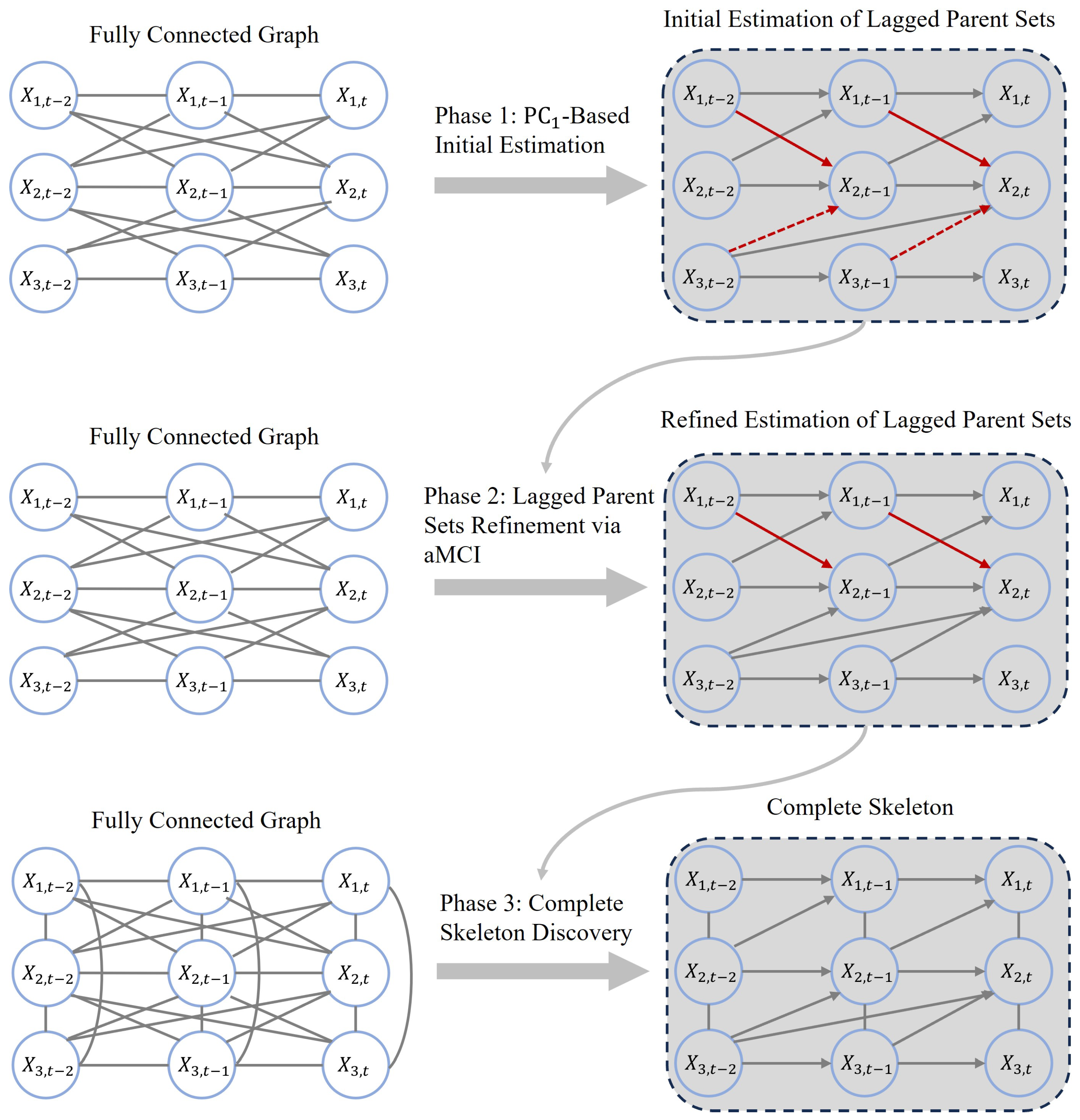
- We propose ECD-aMCI, a multi-phase algorithm designed to fully leverage the capabilities of aMCI through the progressive refinement of causal structures. The proposed algorithm provides a hyperparameter-insensitive, order-independent, and provably consistent framework to learn both lagged and contemporaneous links.
- We offer a novel perspective for constraint-based algorithms, emphasizing that theoretically equivalent design choices under ideal conditions may yield significantly different results in practice, thereby necessitating a preference for choices more robustly suited to the underlying data characteristics.
2. Preliminaries
2.1. Notations
2.2. d-Separation and Completed Partially Directed Acyclic Graph
2.3. The PCMCI Algorithm
3. Method
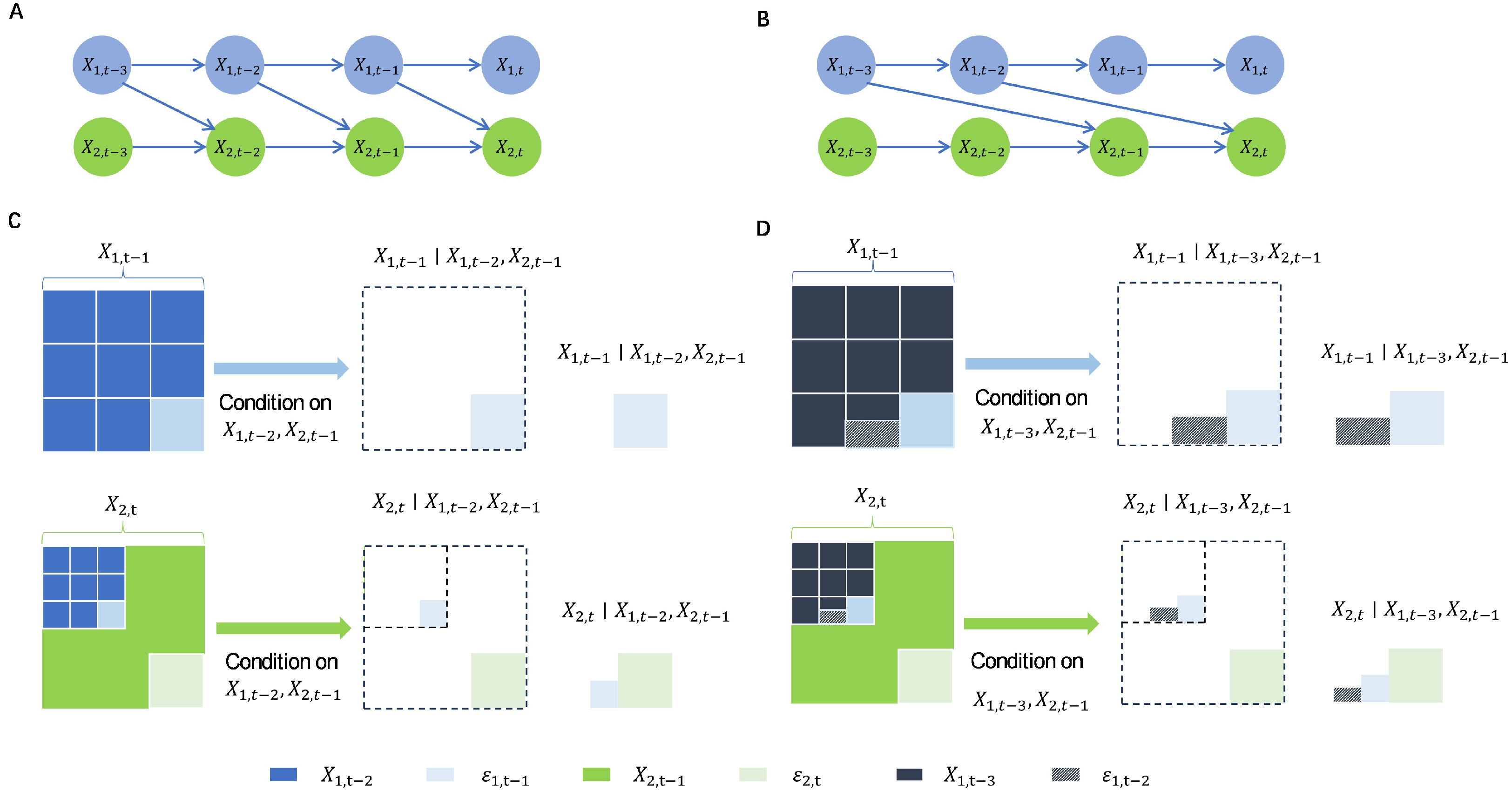
3.1. Intuitive Insights of aMCI
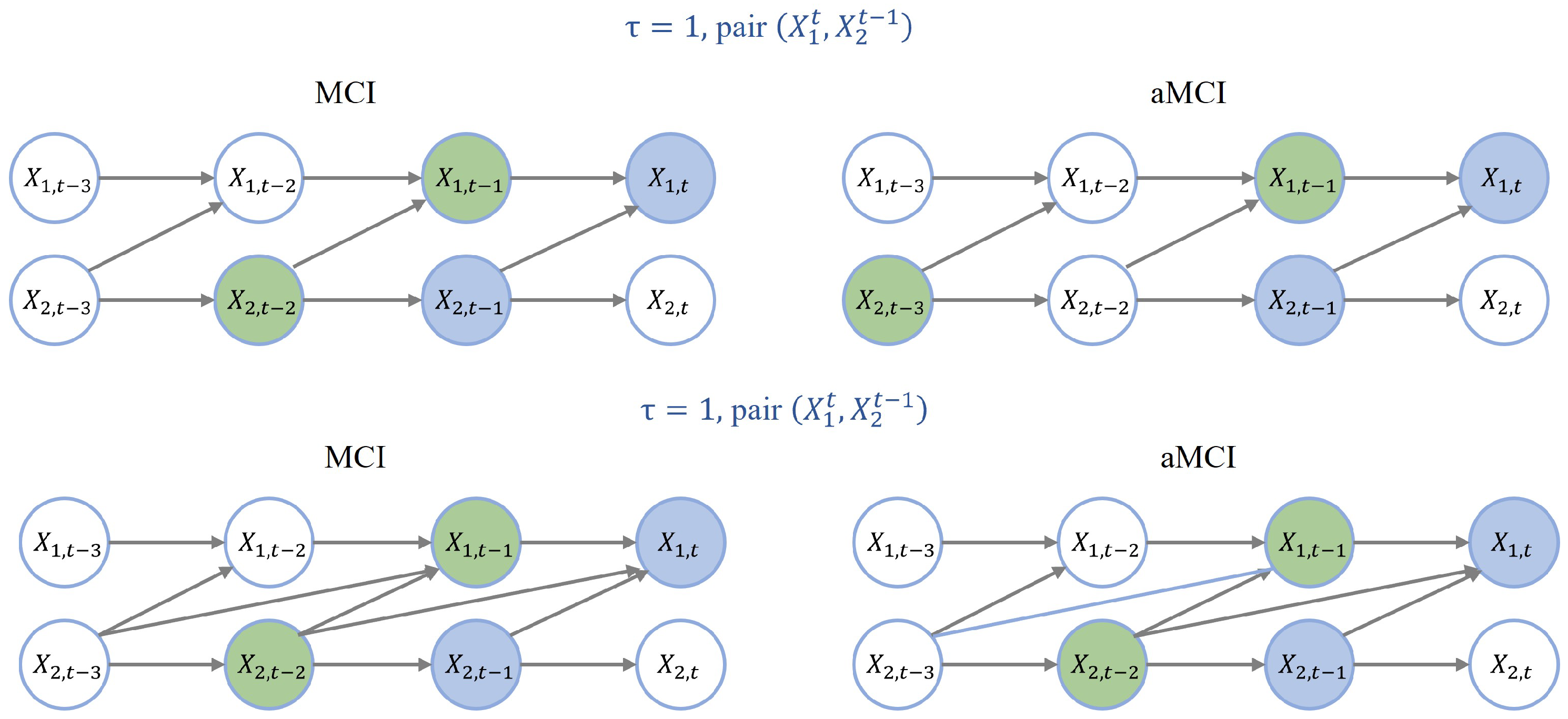
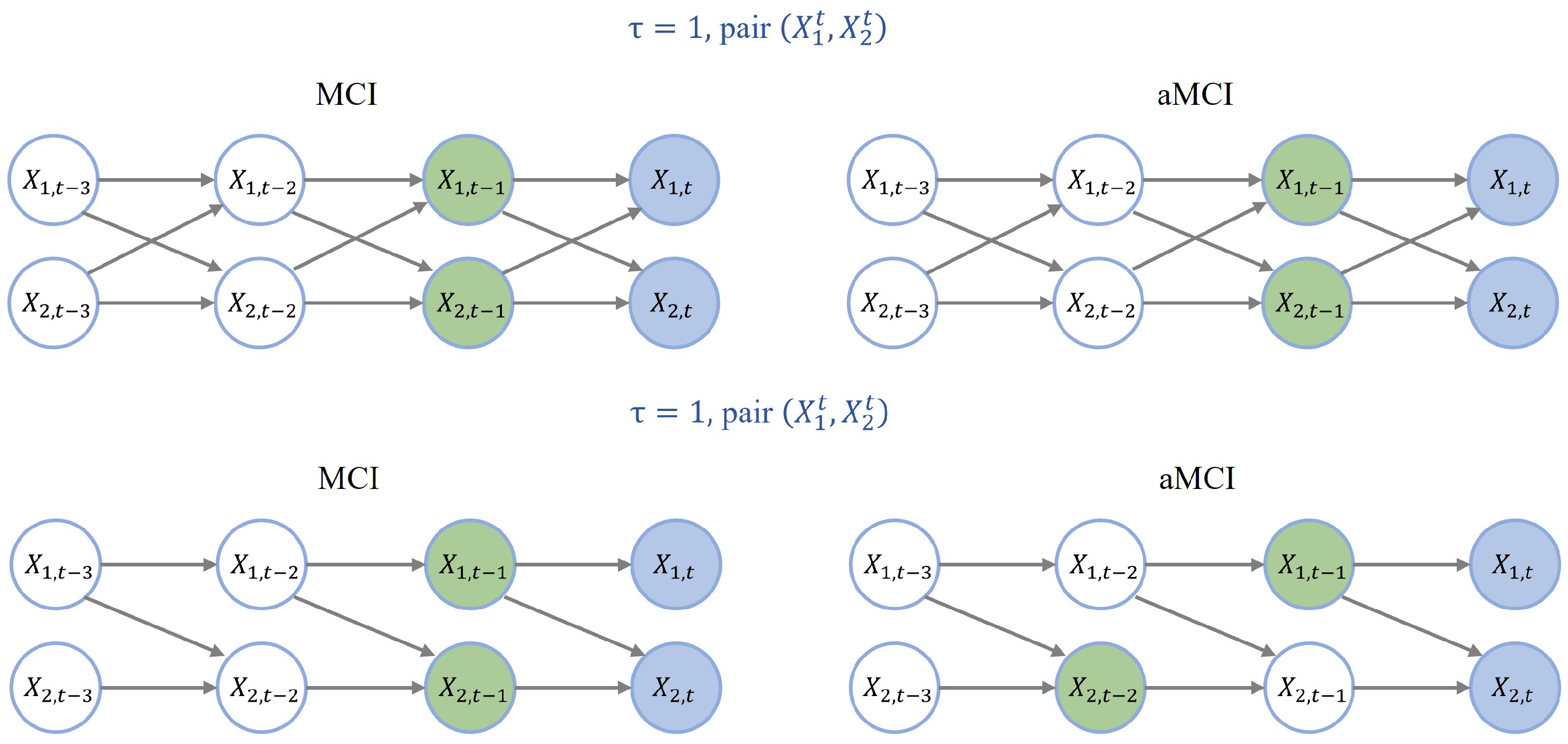
3.2. Adaptive Momentary Conditional Independence
| Algorithm 1 The aMCI method |
|
3.3. Enhanced Causal Discovery Algorithm
| Algorithm 2 Phase 1: PC1-Based Initial Estimation of Lagged Parent Sets |
|
| Algorithm 3 Phase 2: Refined Lagged Parent Skeleton via aMCI |
|
| Algorithm 4 Phase 3: Complete Skeleton Discovery |
|
3.4. Theoretical Properties
4. Evaluation
4.1. Baselines
4.2. Evaluation Metrics
4.3. Simulated Data Generation
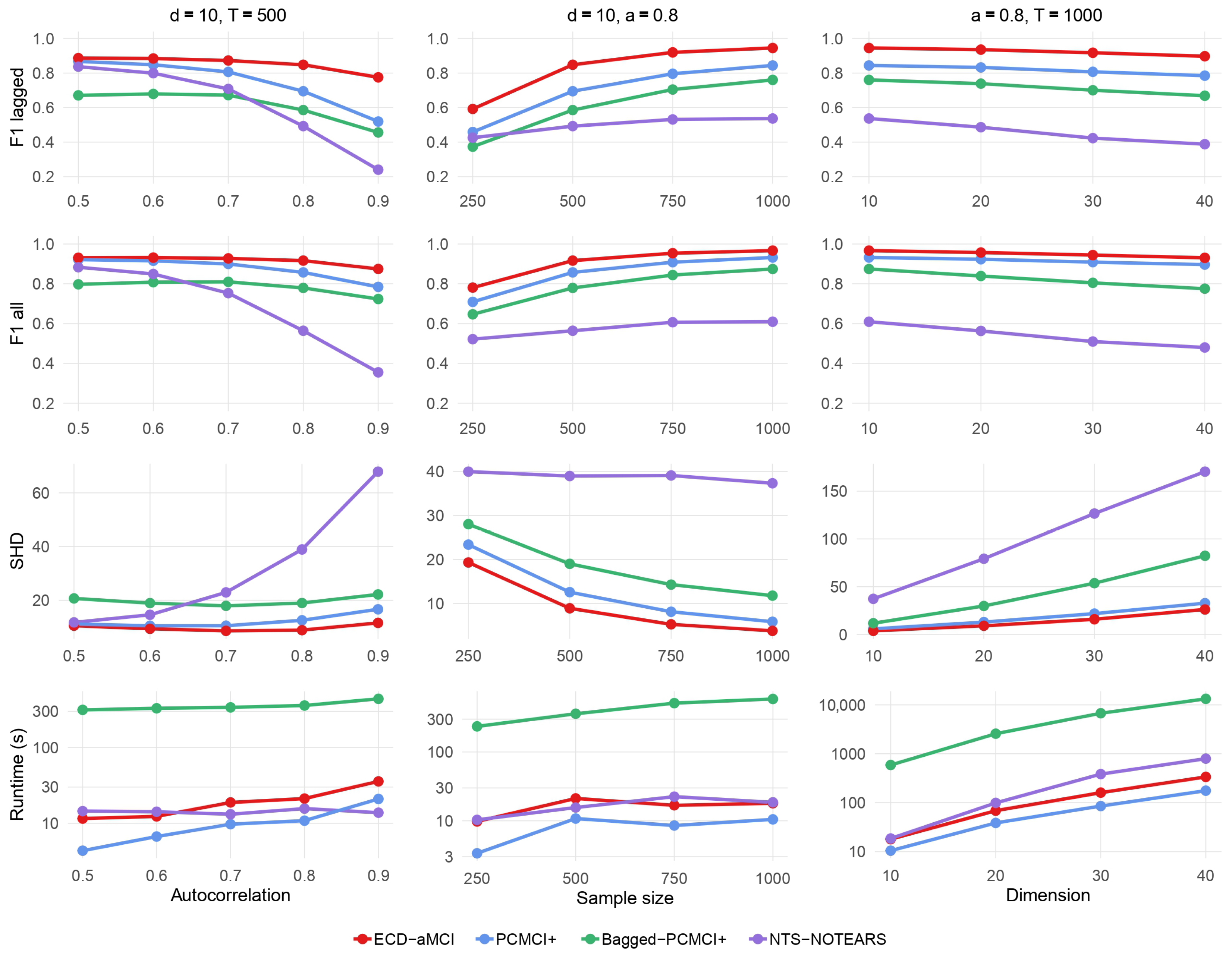
4.4. Results
4.4.1. Linear Setting
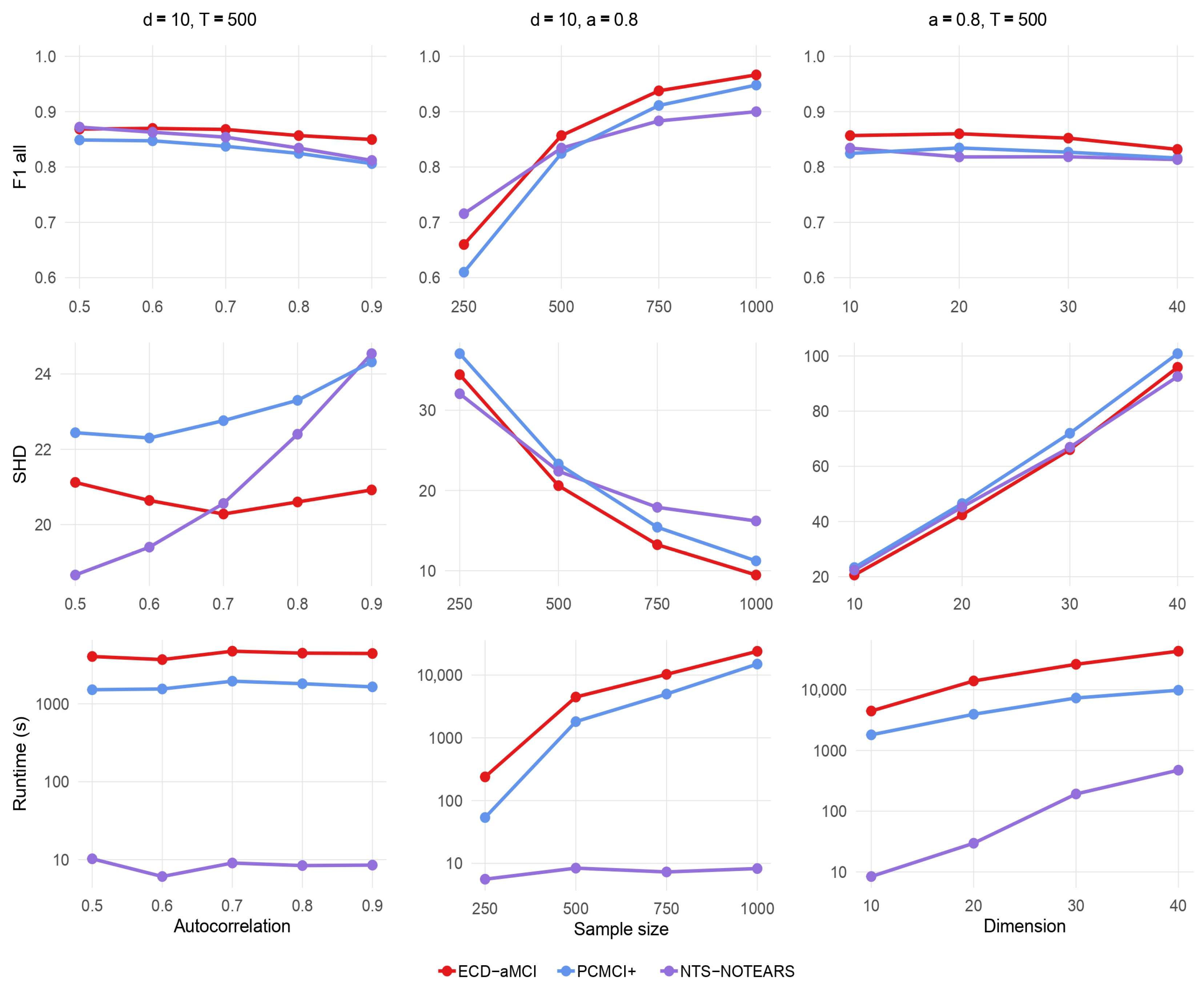
4.4.2. Nonlinear Setting
4.5. Benchmark Data
4.6. Hyperparameters Analysis
5. Discussion
- The proposed algorithm is currently limited to regularly sampled time series and cannot handle irregular sampling intervals. If causal graphs need to be learned from irregularly sampled or event-driven time series data [27], frameworks based on stochastic processes would be more appropriate [28,29].
- Addressing latent confounders remains an important direction for future work. Ignoring latent confounding factors may lead to incorrect causal conclusions. Some existing causal discovery algorithms account for unobserved confounders; for example, tsFCI [30] and SVAR-FCI [31] extract information regarding ancestral relationships among observed variables to learn a partial ancestral graph. Since ECD-aMCI and tsFCI are both constraint-based algorithms, future research could consider combining the insights of the aMCI method with the frameworks of tsFCI and SVAR-FCI to handle the effects of latent confounding.
- In many practical scenarios (e.g., financial data with trends, climatic data with regime shifts or structural breaks), time series may not be stationary [32]. Therefore, investigating the scalability of the ECD-aMCI algorithm on non-stationary data is an important direction. Algorithms designed for non-stationary time series are typically built upon foundations established for stationary cases [32,33,34]. For instance, the SPACETIME algorithm’s core strategy involves identifying change points in the distribution and assuming stationarity between them [34]. Consequently, the insights of the ECD-aMCI algorithm can potentially transfer to algorithms designed for non-stationary time series.
6. Conclusions
Author Contributions
Funding
Data Availability Statement
Acknowledgments
Conflicts of Interest
Abbreviations
| aMCI | Adaptive momentary conditional independence |
| SCM | Structural causal model |
| GC | Granger causality |
| SB | Score-based |
| CB | Constraint-based |
| DAG | Directed acyclic graph |
| SHD | Structural hamming distance |
Appendix A. Pseudocodes of the Orientation Rules
| Algorithm A1 Detailed collider phase with conservative rules |
|
| Algorithm A2 Detailed rule orientation phase |
|
Appendix B. Proofs of Theoretical Properties
- (1)
- Algorithm 2 eliminates a link from if and only if for some subset during the iterative conditional independence tests, where is the third outcome of the aMCI. Here, denotes the contemporaneous adjacencies. By the principle of faithfulness, this conditional independence directly implies that and are d-seperated by in the true causal graph, thus .
- (2)
- According to the conclusion of Step 1, does not contain descendants. Thus, the causal Markov condition yields . Applying the weak union property of conditional independence, we derive . Note that since , for the case where , we assume is not a descendant of (as the alternate case would be covered by exchanging and ).Now it suffices to prove that the conditioning set must be tested in Algorithm 4. Algorithm 4 systematically tests across all subsets . The contrapositive of Step 2 (1) confirms that the estimated contemporaneous adjacencies consistently include the true contemporaneous adjacencies as a subset, i.e., . Furthermore, Step 1 also confirms that encompasses all lagged parents of , i.e., . Consequently, during the iteration process, there exists a subset such that . Algorithm 4 will detect and subsequently remove from .
Appendix C. Detailed Hyperparameter Settings
Appendix C.1. Hyperparameters of Linear Settings
- ECD-aMCI, PCMCI+: Confidence level , maximum time lag , condition independence test .
- Bagged-PCMCI+: Confidence level , maximum time lag , condition independence test , boot samples .
- NTS-NOTEARS: for , for , , , , the number of hidden layers = 1.
Appendix C.2. Hyperparameters of Nonlinear Settings
- ECD-aMCI, PCMCI+: Confidence level , maximum time lag , condition independence test .
- NTS-NOTEARS: for , for , , , , the number of hidden layers = 1.
References
- Miao, W.; Shi, X.; Li, Y.; Tchetgen, E.J.T. A confounding bridge approach for double negative control inference on causal effects. Stat. Theory Relat. Fields 2024, 8, 262–273. [Google Scholar] [CrossRef]
- Xu, T.; Zhao, J. Relaxed doubly robust estimation in causal inference. Stat. Theory Relat. Fields 2024, 8, 69–79. [Google Scholar] [CrossRef] [PubMed]
- Nogueira, A.R.; Pugnana, A.; Ruggieri, S.; Pedreschi, D.; Gama, J. Methods and tools for causal discovery and causal inference. Wiley Interdiscip. Rev. Data Min. Knowl. Discov. 2022, 12, e1449. [Google Scholar] [CrossRef]
- Gong, C.; Zhang, C.; Yao, D.; Bi, J.; Li, W.; Xu, Y. Causal discovery from temporal data: An overview and new perspectives. ACM Comput. Surv. 2024, 57, 1–38. [Google Scholar] [CrossRef]
- Runge, J.; Nowack, P.; Kretschmer, M.; Flaxman, S.; Sejdinovic, D. Detecting and quantifying causal associations in large nonlinear time series datasets. Sci. Adv. 2019, 5, eaau4996. [Google Scholar] [CrossRef] [PubMed]
- Hyvärinen, A.; Zhang, K.; Shimizu, S.; Hoyer, P.O. Estimation of a structural vector autoregression model using non-Gaussianity. J. Mach. Learn. Res. 2010, 11, 1709–1731. [Google Scholar]
- Peters, J.; Janzing, D.; Schölkopf, B. Causal inference on time series using restricted structural equation models. Adv. Neural Inf. Process. Syst. 2013, 26, 154–162. [Google Scholar]
- Assaad, C.K.; Devijver, E.; Gaussier, E.; Ait-Bachir, A. A Mixed Noise and Constraint-Based Approach to Causal Inference in Time Series. In Proceedings of the Machine Learning and Knowledge Discovery in Databases (Research Track); Springer: Cham, Germany, 2021; pp. 453–468. [Google Scholar]
- Wu, T.; Wu, X.; Wang, X.; Liu, S.; Chen, H. Nonlinear Causal Discovery in Time Series. In Proceedings of the 31st ACM International Conference on Information & Knowledge Management; Association for Computing Machinery: New York, NY, USA, 2022; CIKM ’22; pp. 4575–4579. [Google Scholar] [CrossRef]
- Löwe, S.; Madras, D.; Zemel, R.; Welling, M. Amortized Causal Discovery: Learning to Infer Causal Graphs from Time-Series Data. In Proceedings of the First Conference on Causal Learning and Reasoning; PMLR; JMLR: Cambridge, MA, USA, 2022; Volume 177, pp. 509–525. [Google Scholar]
- Li, H.; Yu, S.; Principe, J. Causal Recurrent Variational Autoencoder for Medical Time Series Generation. In Proceedings of the AAAI Conference on Artificial Intelligence; AAAI Press: Washington, DC, USA, 2023; Volume 37, pp. 8562–8570. [Google Scholar] [CrossRef]
- Zheng, X.; Aragam, B.; Ravikumar, P.K.; Xing, E.P. Dags with no tears: Continuous optimization for structure learning. Adv. Neural Inf. Process. Syst. 2018, 31, 9492–9503. [Google Scholar]
- Pamfil, R.; Sriwattanaworachai, N.; Desai, S.; Pilgerstorfer, P.; Georgatzis, K.; Beaumont, P.; Aragam, B. DYNOTEARS: Structure learning from time-series data. In Proceedings of the International Conference on Artificial Intelligence and Statistics; PMLR; JMLR: Cambridge, MA, USA, 2020; pp. 1595–1605. [Google Scholar]
- Sun, X.; Schulte, O.; Liu, G.; Poupart, P. NTS-NOTEARS: Learning Nonparametric DBNs With Prior Knowledge. arXiv 2023, arXiv:2109.04286. [Google Scholar] [CrossRef]
- Runge, J. Discovering contemporaneous and lagged causal relations in autocorrelated nonlinear time series datasets. In Proceedings of the Conference on Uncertainty in Artificial Intelligence; PMLR; JMLR: Cambridge, MA, USA, 2020; pp. 1388–1397. [Google Scholar]
- Debeire, K.; Gerhardus, A.; Runge, J.; Eyring, V. Bootstrap aggregation and confidence measures to improve time series causal discovery. In Proceedings of the Causal Learning and Reasoning; PMLR; JMLR: Cambridge, MA, USA, 2024; pp. 979–1007. [Google Scholar]
- Pearl, J. Causality; Cambridge University Press: Cambridge, UK, 2009. [Google Scholar]
- Spirtes, P.; Glymour, C.; Scheines, R.; Kauffman, S.; Aimale, V.; Wimberly, F. Constructing Bayesian Network Models of Gene Expression Networks from Microarray Data. In Proceedings of the Atlantic Symposium on Computational Biology, Genome Information Systems & Technology; Association for Intelligent Machinery: Durham, NC, USA, 2002. [Google Scholar]
- Meek, C. Causal inference and causal explanation with background knowledge. In Proceedings of the Eleventh Conference on Uncertainty in Artificial Intelligence, San Francisco, CA, USA, 18–20 August 1995; UAI’95. pp. 403–410. [Google Scholar]
- Spirtes, P.; Glymour, C.; Scheines, R. Causation, Prediction, and Search; MIT Press: Cambridge, MA, USA, 2001. [Google Scholar]
- Biswas, R.; Shlizerman, E. Statistical perspective on functional and causal neural connectomics: The Time-Aware PC algorithm. PLoS Comput. Biol. 2022, 18, e1010653. [Google Scholar] [CrossRef] [PubMed]
- Colombo, D.; Maathuis, M.H. Order-independent constraint-based causal structure learning. J. Mach. Learn. Res. 2014, 15, 3741–3782. [Google Scholar]
- Hotelling, H. New Light on the Correlation Coefficient and its Transforms. J. R. Stat. Soc. Ser. B (Methodol.) 1953, 15, 193–225. [Google Scholar] [CrossRef]
- Runge, J. Conditional independence testing based on a nearest-neighbor estimator of conditional mutual information. In Proceedings of the International Conference on Artificial Intelligence and Statistics; PMLR; JMLR: Cambridge, MA, USA, 2018; pp. 938–947. [Google Scholar]
- Reisach, A.; Seiler, C.; Weichwald, S. Beware of the simulated dag! causal discovery benchmarks may be easy to game. Adv. Neural Inf. Process. Syst. 2021, 34, 27772–27784. [Google Scholar]
- Smith, S.M.; Miller, K.L.; Salimi-Khorshidi, G.; Webster, M.; Beckmann, C.F.; Nichols, T.E.; Ramsey, J.D.; Woolrich, M.W. Network modelling methods for FMRI. Neuroimage 2011, 54, 875–891. [Google Scholar] [CrossRef]
- Daley, D.J.; Vere-Jones, D. An Introduction to the Theory of Point Processes: Volume I: Elementary Theory and Methods; Springer: New York, NY, USA, 2003. [Google Scholar]
- Truccolo, W.; Eden, U.T.; Fellows, M.R.; Donoghue, J.P.; Brown, E.N. A point process framework for relating neural spiking activity to spiking history, neural ensemble, and extrinsic covariate effects. J. Neurophysiol. 2005, 93, 1074–1089. [Google Scholar] [CrossRef]
- Eichler, M.; Dahlhaus, R.; Dueck, J. Graphical modeling for multivariate Hawkes processes with nonparametric link functions. J. Time Ser. Anal. 2017, 38, 225–242. [Google Scholar] [CrossRef]
- Entner, D.; Hoyer, P. On causal discovery from time series data using FCI. In Proceedings of the 5th EuropeanWorkshop on Probabilistic Graphical Models, Helsinki, Finland, 13–15 September 2010; Myllymäki, P., Roos, T., Jaakkola, T., Eds.; HIIT: Helsinki, Finland, 2010; pp. 121–128. [Google Scholar]
- Malinsky, D.; Spirtes, P. Causal Structure Learning from Multivariate Time Series in Settings with Unmeasured Confounding. In Proceedings of the 2018 ACM SIGKDD Workshop on Causal Disocvery; Le, T.D., Zhang, K., Kıcıman, E., Hyvärinen, A., Liu, L., Eds.; PMLR; JMLR: Cambridge, MA, USA, 2018; Volume 92, pp. 23–47. [Google Scholar]
- Huang, B.; Zhang, K.; Gong, M.; Glymour, C. Causal discovery and forecasting in nonstationary environments with state-space models. In Proceedings of the International Conference on Machine Learning; PMLR; JMLR: Cambridge, MA, USA, 2019; pp. 2901–2910. [Google Scholar]
- Zhang, K.; Huang, B.; Zhang, J.; Glymour, C.; Schölkopf, B. Causal discovery from nonstationary/heterogeneous data: Skeleton estimation and orientation determination. In Proceedings of the IJCAI: Proceedings of the Conference; AAAI Press: Washington, DC, USA, 2017; Volume 2017, p. 1347. [Google Scholar]
- Mameche, S.; Cornanguer, L.; Ninad, U.; Vreeken, J. SPACETIME: Causal Discovery from Non-Stationary Time Series. Proc. AAAI Conf. Artif. Intell. 2025, 39, 19405–19413. [Google Scholar] [CrossRef]




| Category | Method | Graph Type | Nonlinear | Instantaneous |
|---|---|---|---|---|
| SCM-based | VAR-LiNGAM | Window | No | Yes |
| TiMINo | Summary | Yes | No | |
| NBCB | Summary | Yes | Yes | |
| NCDH | Summary | Yes | No | |
| GC-based | ACD | Summary | Yes | No |
| CR-VAE | Summary | Yes | Yes | |
| Score-based | DYNOTEARS | Window | No | Yes |
| NTS-NOTEARS | Window | Yes | Yes | |
| Constraint-based | PCMCI | Window | Yes | No |
| PCMCI+ | Window | Yes | Yes | |
| Bagged-PCMCI+ | Window | Yes | Yes |
| Notation | Description |
|---|---|
| True parent set of in | |
| Estimated lagged parent set of | |
| True lagged parent set of | |
| Estimated contemporaneous adjacency set of | |
| True contemporaneous adjacency set of | |
| Adaptive Momentary Conditional Independence method | |
| Conditional independence relation | |
| Generic link (directed → or undirected ) | |
| Conflicting link orientation | |
| d-separation | Graph-theoretic conditional independence criterion |
| Category | Method | Window | Contemporaneous |
|---|---|---|---|
| CB | PCMCI+ | Y | Y |
| CB | Bagged-PCMCI+ | Y | Y |
| SB | NTS-NOTEARS | Y | Y |
| SB | DYNOTEARS | Y | Y |
| SCM | VAR-LiNGAM | Y | Y |
| SCM | TiMINo | N | Y |
| SCM | NBCB | N | Y |
| SCM | NCDH | N | N |
| GC | ACD | N | N |
| GC | CR-VAE | N | Y |
| Metric | Method | a | ||||
|---|---|---|---|---|---|---|
| 0.9 | 0.8 | 0.7 | 0.6 | 0.5 | ||
| F1-scorelagged | ECD-aMCI | 0.775 ± 0.106 | 0.848 ± 0.077 | 0.873 ± 0.072 | 0.884 ± 0.067 | 0.886 ± 0.064 |
| PCMCI+ | 0.519 ± 0.156 | 0.695 ± 0.118 | 0.807 ± 0.086 | 0.848 ± 0.073 | 0.867 ± 0.066 | |
| Bagged-PCMCI+ | 0.456 ± 0.148 | 0.586 ± 0.121 | 0.672 ± 0.101 | 0.679 ± 0.098 | 0.671 ± 0.091 | |
| NTS-NOTEARS | 0.240 ± 0.150 | 0.493 ± 0.194 | 0.708 ± 0.097 | 0.799 ± 0.074 | 0.837 ± 0.071 | |
| F1-scoreall | ECD-aMCI | 0.875 ± 0.054 | 0.917 ± 0.037 | 0.928 ± 0.035 | 0.932 ± 0.034 | 0.931 ± 0.033 |
| PCMCI+ | 0.785 ± 0.066 | 0.857 ± 0.046 | 0.900 ± 0.037 | 0.916 ± 0.034 | 0.922 ± 0.033 | |
| Bagged-PCMCI+ | 0.724 ± 0.069 | 0.779 ± 0.054 | 0.810 ± 0.048 | 0.808 ± 0.050 | 0.798 ± 0.050 | |
| NTS-NOTEARS | 0.355 ± 0.122 | 0.564 ± 0.160 | 0.753 ± 0.059 | 0.850 ± 0.043 | 0.883 ± 0.042 | |
| SHD | ECD-aMCI | 11.603 ± 4.102 | 8.903 ± 3.169 | 8.643 ± 3.107 | 9.410 ± 3.121 | 10.547 ± 3.126 |
| PCMCI+ | 16.673 ± 4.559 | 12.570 ± 3.393 | 10.560 ± 3.039 | 10.543 ± 2.958 | 11.207 ± 2.997 | |
| Bagged-PCMCI+ | 22.203 ± 4.877 | 18.997 ± 4.030 | 17.947 ± 4.004 | 18.977 ± 4.247 | 20.717 ± 4.186 | |
| NTS-NOTEARS | 67.903 ± 16.787 | 38.937 ± 10.174 | 22.957 ± 5.424 | 14.623 ± 4.004 | 11.793 ± 3.583 | |
| Runtime (s) | ECD-aMCI | 35.68 ± 21.64 | 21.15 ± 12.93 | 18.80 ± 13.11 | 12.30 ± 4.22 | 11.53 ± 3.60 |
| PCMCI+ | 20.92 ± 13.96 | 10.80 ± 5.61 | 9.71 ± 6.63 | 6.66 ± 2.28 | 4.34 ± 0.97 | |
| Bagged-PCMCI+ | 439.70 ± 120.31 | 359.30 ± 89.56 | 339.73 ± 89.41 | 330.18 ± 75.78 | 314.70 ± 74.63 | |
| NTS-NOTEARS | 13.76 ± 9.98 | 15.59 ± 11.42 | 13.13 ± 5.02 | 14.15 ± 4.80 | 14.43 ± 5.52 | |
| Metric | Method | T | |||
|---|---|---|---|---|---|
| 250 | 500 | 750 | 1000 | ||
| F1-scorelagged | ECD-aMCI | 0.592 ± 0.134 | 0.848 ± 0.077 | 0.920 ± 0.055 | 0.945 ± 0.046 |
| PCMCI+ | 0.459 ± 0.135 | 0.695 ± 0.118 | 0.796 ± 0.106 | 0.844 ± 0.080 | |
| Bagged-PCMCI+ | 0.374 ± 0.131 | 0.586 ± 0.121 | 0.705 ± 0.113 | 0.760 ± 0.093 | |
| NTS-NOTEARS | 0.426 ± 0.191 | 0.493 ± 0.194 | 0.531 ± 0.158 | 0.537 ± 0.164 | |
| F1-scoreall | ECD-aMCI | 0.781 ± 0.058 | 0.917 ± 0.037 | 0.954 ± 0.027 | 0.967 ± 0.024 |
| PCMCI+ | 0.709 ± 0.060 | 0.857 ± 0.046 | 0.909 ± 0.043 | 0.932 ± 0.032 | |
| Bagged-PCMCI+ | 0.647 ± 0.062 | 0.779 ± 0.054 | 0.844 ± 0.051 | 0.874 ± 0.043 | |
| NTS-NOTEARS | 0.522 ± 0.173 | 0.564 ± 0.160 | 0.607 ± 0.135 | 0.610 ± 0.142 | |
| SHD | ECD-aMCI | 19.317 ± 3.854 | 8.903 ± 3.169 | 5.267 ± 2.631 | 3.783 ± 2.330 |
| PCMCI+ | 23.360 ± 3.556 | 12.570 ± 3.393 | 8.123 ± 3.421 | 5.857 ± 2.586 | |
| Bagged-PCMCI+ | 28.003 ± 4.234 | 18.997 ± 4.030 | 14.283 ± 4.167 | 11.780 ± 3.603 | |
| NTS-NOTEARS | 39.940 ± 7.682 | 38.937 ± 10.174 | 39.063 ± 7.767 | 37.303 ± 6.749 | |
| Runtime (s) | ECD-aMCI | 9.790 ± 2.842 | 21.154 ± 12.929 | 16.803 ± 5.779 | 17.980 ± 7.912 |
| PCMCI+ | 3.375 ± 0.887 | 10.797 ± 5.614 | 8.548 ± 2.449 | 10.487 ± 3.330 | |
| Bagged-PCMCI+ | 235.378 ± 51.948 | 359.303 ± 89.555 | 512.583 ± 113.982 | 589.065 ± 137.459 | |
| NTS-NOTEARS | 10.321 ± 3.378 | 15.589 ± 11.417 | 22.436 ± 15.596 | 18.564 ± 4.539 | |
| Metric | Method | d | |||
|---|---|---|---|---|---|
| 10 | 20 | 30 | 40 | ||
| F1-scorelagged | ECD-aMCI | 0.945 ± 0.046 | 0.935 ± 0.031 | 0.917 ± 0.028 | 0.897 ± 0.027 |
| PCMCI+ | 0.844 ± 0.080 | 0.833 ± 0.101 | 0.807 ± 0.108 | 0.785 ± 0.115 | |
| Bagged-PCMCI+ | 0.760 ± 0.093 | 0.739 ± 0.095 | 0.700 ± 0.095 | 0.669 ± 0.097 | |
| NTS-NOTEARS | 0.537 ± 0.164 | 0.486 ± 0.176 | 0.423 ± 0.189 | 0.388 ± 0.198 | |
| F1-scoreall | ECD-aMCI | 0.967 ± 0.024 | 0.957 ± 0.018 | 0.944 ± 0.016 | 0.931 ± 0.018 |
| PCMCI+ | 0.932 ± 0.032 | 0.924 ± 0.042 | 0.909 ± 0.047 | 0.897 ± 0.050 | |
| Bagged-PCMCI+ | 0.874 ± 0.043 | 0.839 ± 0.044 | 0.805 ± 0.042 | 0.776 ± 0.043 | |
| NTS-NOTEARS | 0.610 ± 0.142 | 0.563 ± 0.161 | 0.510 ± 0.184 | 0.480 ± 0.189 | |
| SHD | ECD-aMCI | 3.783 ± 2.330 | 9.077 ± 3.445 | 15.963 ± 4.585 | 26.157 ± 7.028 |
| PCMCI+ | 5.857 ± 2.586 | 12.957 ± 6.062 | 21.823 ± 10.238 | 32.750 ± 14.379 | |
| Bagged-PCMCI+ | 11.780 ± 3.603 | 29.827 ± 6.990 | 53.683 ± 9.811 | 82.400 ± 12.798 | |
| NTS-NOTEARS | 37.303 ± 6.749 | 79.283 ± 11.669 | 126.643 ± 13.792 | 170.520 ± 17.492 | |
| Runtime (s) | ECD-aMCI | 17.980 ± 7.912 | 68.724 ± 18.949 | 160.456 ± 66.461 | 337.322 ± 183.383 |
| PCMCI+ | 10.487 ± 3.330 | 38.660 ± 13.031 | 85.480 ± 32.818 | 176.178 ± 102.563 | |
| Bagged-PCMCI+ | 589.065 ± 137.459 | 2571.851 ± 699.392 | 6732.931 ± 2098.731 | 13,243.336 ± 3738.661 | |
| NTS-NOTEARS | 18.564 ± 4.539 | 99.162 ± 53.911 | 384.579 ± 188.730 | 795.130 ± 407.888 | |
| Metric | Method | a | ||||
|---|---|---|---|---|---|---|
| 0.9 | 0.8 | 0.7 | 0.6 | 0.5 | ||
| F1-scorelagged | ECD-aMCI | 0.737 ± 0.101 | 0.752 ± 0.107 | 0.778 ± 0.093 | 0.794 ± 0.079 | 0.816 ± 0.077 |
| PCMCI+ | 0.685 ± 0.117 | 0.713 ± 0.103 | 0.738 ± 0.101 | 0.763 ± 0.097 | 0.784 ± 0.092 | |
| NTS-NOTEARS | 0.718 ± 0.103 | 0.745 ± 0.091 | 0.766 ± 0.084 | 0.789 ± 0.078 | 0.809 ± 0.081 | |
| F1-scoreall | ECD-aMCI | 0.850 ± 0.037 | 0.857 ± 0.039 | 0.868 ± 0.036 | 0.870 ± 0.032 | 0.869 ± 0.035 |
| PCMCI+ | 0.806 ± 0.045 | 0.825 ± 0.040 | 0.837 ± 0.038 | 0.847 ± 0.034 | 0.849 ± 0.035 | |
| NTS-NOTEARS | 0.812 ± 0.046 | 0.834 ± 0.041 | 0.854 ± 0.041 | 0.863 ± 0.039 | 0.872 ± 0.040 | |
| SHD | ECD-aMCI | 20.920 ± 3.123 | 20.600 ± 3.280 | 20.280 ± 2.892 | 20.640 ± 2.544 | 21.120 ± 2.903 |
| PCMCI+ | 24.320 ± 3.552 | 23.300 ± 3.132 | 22.760 ± 3.178 | 22.300 ± 2.744 | 22.440 ± 2.815 | |
| NTS-NOTEARS | 24.540 ± 4.679 | 22.400 ± 3.863 | 20.560 ± 4.253 | 19.400 ± 3.950 | 18.660 ± 4.246 | |
| Runtime (s) | ECD-aMCI | 4423.80 ± 696.92 | 4467.35 ± 876.32 | 4733.17 ± 823.10 | 3692.25 ± 836.55 | 4046.83 ± 1067.61 |
| PCMCI+ | 1649.92 ± 388.47 | 1811.52 ± 414.25 | 1951.26 ± 465.31 | 1550.20 ± 356.56 | 1515.32 ± 424.96 | |
| NTS-NOTEARS | 8.52 ± 1.05 | 8.40 ± 1.41 | 9.06 ± 1.26 | 6.08 ± 0.51 | 10.27 ± 2.06 | |
| Metric | Method | T | |||
|---|---|---|---|---|---|
| 250 | 500 | 750 | 1000 | ||
| F1-scorelagged | ECD-aMCI | 0.425 ± 0.141 | 0.752 ± 0.107 | 0.890 ± 0.063 | 0.944 ± 0.045 |
| PCMCI+ | 0.387 ± 0.137 | 0.713 ± 0.103 | 0.839 ± 0.083 | 0.899 ± 0.046 | |
| NTS-NOTEARS | 0.566 ± 0.094 | 0.745 ± 0.091 | 0.824 ± 0.074 | 0.841 ± 0.060 | |
| F1-scoreall | ECD-aMCI | 0.660 ± 0.052 | 0.857 ± 0.039 | 0.938 ± 0.027 | 0.966 ± 0.022 |
| PCMCI+ | 0.610 ± 0.051 | 0.825 ± 0.040 | 0.911 ± 0.030 | 0.948 ± 0.024 | |
| NTS-NOTEARS | 0.716 ± 0.051 | 0.834 ± 0.041 | 0.883 ± 0.034 | 0.900 ± 0.031 | |
| SHD | ECD-aMCI | 34.440 ± 3.226 | 20.600 ± 3.280 | 13.240 ± 3.734 | 9.460 ± 3.390 |
| PCMCI+ | 37.060 ± 2.760 | 23.300 ± 3.132 | 15.420 ± 3.909 | 11.220 ± 3.324 | |
| NTS-NOTEARS | 32.060 ± 4.688 | 22.400 ± 3.863 | 17.900 ± 4.239 | 16.200 ± 3.980 | |
| Runtime (s) | ECD-aMCI | 238.83 ± 31.69 | 4467.35 ± 876.32 | 10,259.70 ± 2007.56 | 23,890.22 ± 3613.27 |
| PCMCI+ | 53.76 ± 9.85 | 1811.52 ± 414.25 | 4985.80 ± 1353.46 | 14,973.02 ± 3799.10 | |
| NTS-NOTEARS | 5.60 ± 0.35 | 8.40 ± 1.41 | 7.31 ± 0.75 | 8.28 ± 0.74 | |
| Metric | Method | d | |||
|---|---|---|---|---|---|
| 10 | 20 | 30 | 40 | ||
| F1-scorelagged | ECD-aMCI | 0.752 ± 0.107 | 0.782 ± 0.057 | 0.755 ± 0.043 | 0.733 ± 0.047 |
| PCMCI+ | 0.713 ± 0.103 | 0.757 ± 0.068 | 0.731 ± 0.051 | 0.730 ± 0.048 | |
| NTS-NOTEARS | 0.745 ± 0.091 | 0.741 ± 0.072 | 0.727 ± 0.046 | 0.729 ± 0.050 | |
| F1-scoreall | ECD-aMCI | 0.857 ± 0.039 | 0.860 ± 0.026 | 0.852 ± 0.021 | 0.832 ± 0.024 |
| PCMCI+ | 0.825 ± 0.040 | 0.834 ± 0.030 | 0.827 ± 0.021 | 0.816 ± 0.023 | |
| NTS-NOTEARS | 0.834 ± 0.041 | 0.818 ± 0.036 | 0.818 ± 0.020 | 0.813 ± 0.026 | |
| SHD | ECD-aMCI | 20.600 ± 3.280 | 42.400 ± 5.223 | 66.040 ± 6.579 | 95.880 ± 9.024 |
| PCMCI+ | 23.300 ± 3.132 | 46.500 ± 5.442 | 71.980 ± 5.941 | 100.840 ± 7.630 | |
| NTS-NOTEARS | 22.400 ± 3.863 | 45.240 ± 6.445 | 66.900 ± 6.655 | 92.540 ± 9.104 | |
| Runtime (s) | ECD-aMCI | 4467.35 ± 876.32 | 13,977.40 ± 3313.75 | 26,279.66 ± 4543.04 | 43,190.11 ± 8954.29 |
| PCMCI+ | 1811.52 ± 414.25 | 3949.59 ± 1480.62 | 7322.64 ± 1707.84 | 9831.77 ± 2665.12 | |
| NTS-NOTEARS | 8.40 ± 1.41 | 29.66 ± 3.47 | 192.25 ± 84.32 | 473.98 ± 173.88 | |
| Method | ||||
|---|---|---|---|---|
| F1-Scoreall | SHD | F1-Scoreall | SHD | |
| ECD-aMCI | 0.908 ± 0.075 | 5.940 ± 1.737 | 0.843 ± 0.048 | 17.840 ± 2.129 |
| NTS-NOTEARS | 0.672 ± 0.056 | 11.040 ± 2.218 | 0.646 ± 0.039 | 28.060 ± 3.706 |
| PCMCI+ | 0.871 ± 0.081 | 6.560 ± 1.651 | 0.809 ± 0.059 | 19.280 ± 2.307 |
| Method | SHD | |
|---|---|---|
| ECD-aMCI | 0.5872 | 103 |
| PCMCI+ | 0.5524 | 109 |
| Bagged-PCMCI+ | 0.5000 | 120 |
| NTS-NOTEARS | 0.3956 | 110 |
| -scoreall | 0.917 ± 0.037 | 0.910 ± 0.038 | 0.905 ± 0.040 | 0.902 ± 0.042 | 0.900 ± 0.041 | 0.897 ± 0.042 |
| SHD | 8.903 ± 3.169 | 9.280 ± 3.289 | 9.657 ± 3.451 | 9.953 ± 3.492 | 10.173 ± 3.600 | 10.423 ± 3.568 |
| Data Type | CI Test | SHD | |
|---|---|---|---|
| Linear | ParCorr | ||
| GPDC | |||
| CMIKNN | |||
| fMRI | ParCorr | ||
| GPDC | |||
| CMIKNN |
Disclaimer/Publisher’s Note: The statements, opinions and data contained in all publications are solely those of the individual author(s) and contributor(s) and not of MDPI and/or the editor(s). MDPI and/or the editor(s) disclaim responsibility for any injury to people or property resulting from any ideas, methods, instructions or products referred to in the content. |
© 2026 by the authors. Licensee MDPI, Basel, Switzerland. This article is an open access article distributed under the terms and conditions of the Creative Commons Attribution (CC BY) license.
Share and Cite
Gao, M.; Zhou, Y. Enhanced Causal Discovery for Autocorrelated Time Series via Adaptive Momentary Conditional Independence. Mathematics 2026, 14, 1129. https://doi.org/10.3390/math14071129
Gao M, Zhou Y. Enhanced Causal Discovery for Autocorrelated Time Series via Adaptive Momentary Conditional Independence. Mathematics. 2026; 14(7):1129. https://doi.org/10.3390/math14071129
Chicago/Turabian StyleGao, Minglong, and Yingchun Zhou. 2026. "Enhanced Causal Discovery for Autocorrelated Time Series via Adaptive Momentary Conditional Independence" Mathematics 14, no. 7: 1129. https://doi.org/10.3390/math14071129
APA StyleGao, M., & Zhou, Y. (2026). Enhanced Causal Discovery for Autocorrelated Time Series via Adaptive Momentary Conditional Independence. Mathematics, 14(7), 1129. https://doi.org/10.3390/math14071129