Closed-Form Heteroclinic Orbits for a Three-Parameter Dynamical System Using a Modified Optimal Parametric Iteration Method


Abstract
1. Introduction
2. Closed-Form Solutions for q 3D Dynamical System
3. Theoretical Approach of the Modified Optimal Parametric Iteration Method (mOPIM)
3.1. Basic Ideas
3.2. Semi-Analytical Solutions via mOPIM Technique
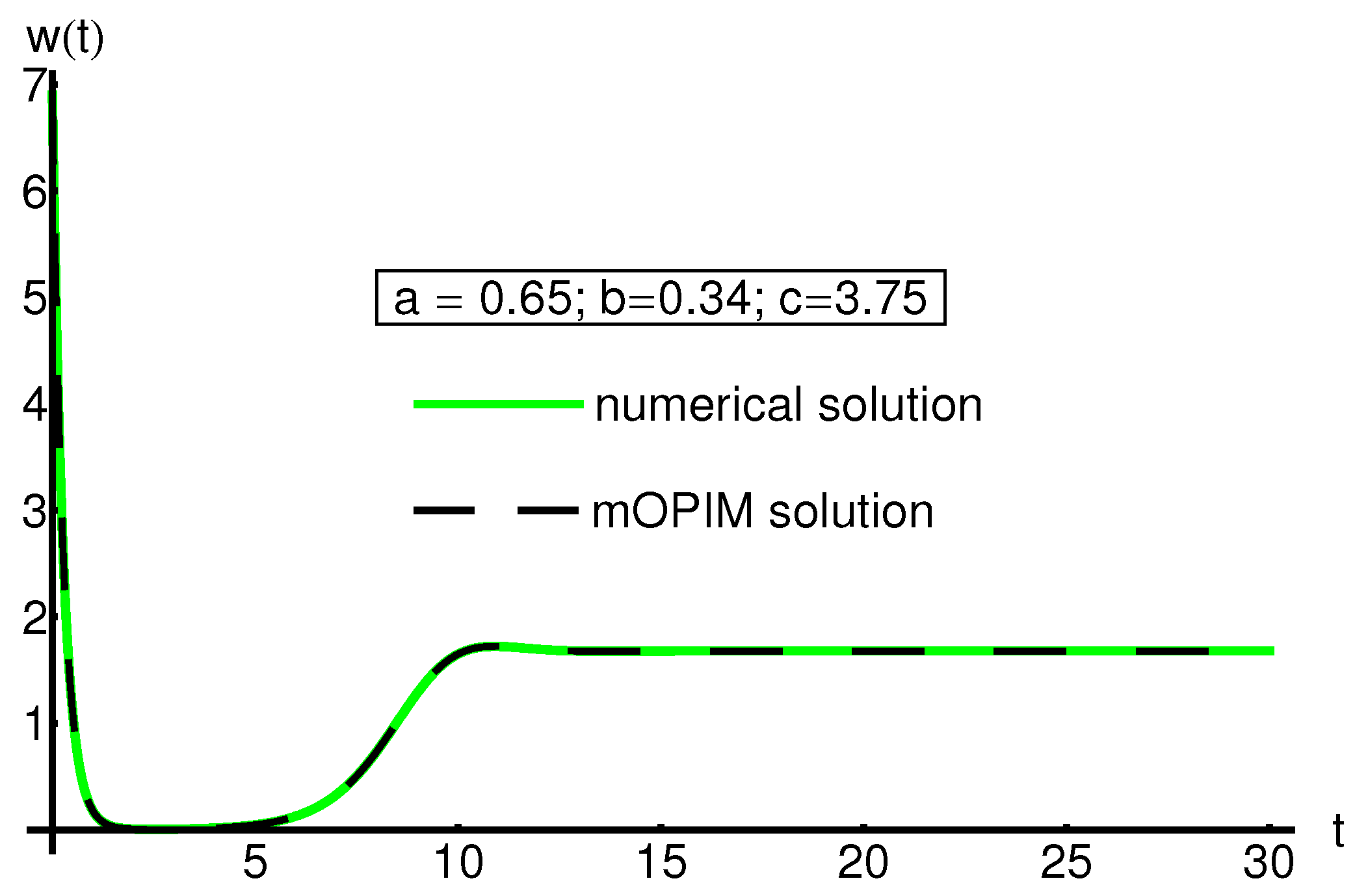
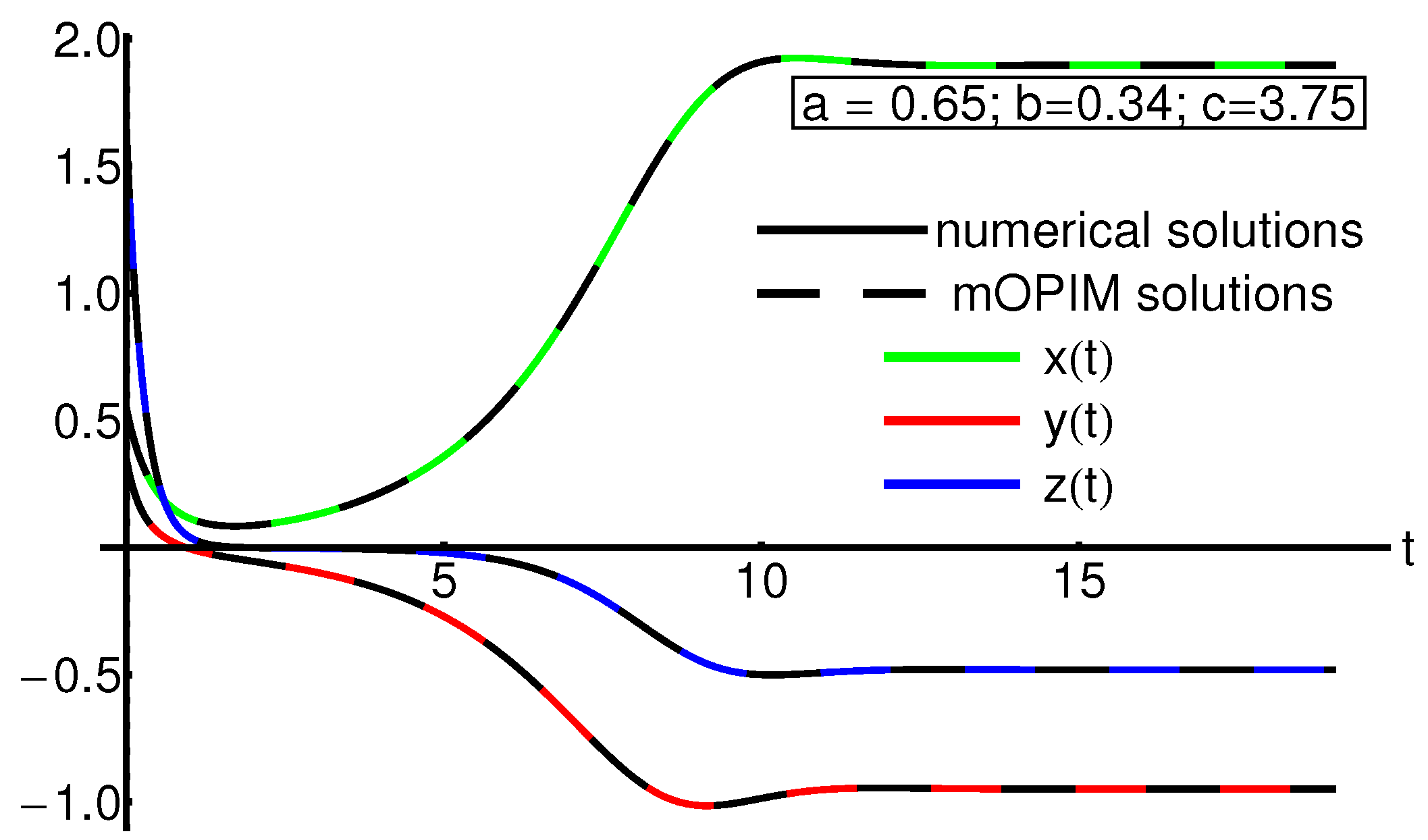
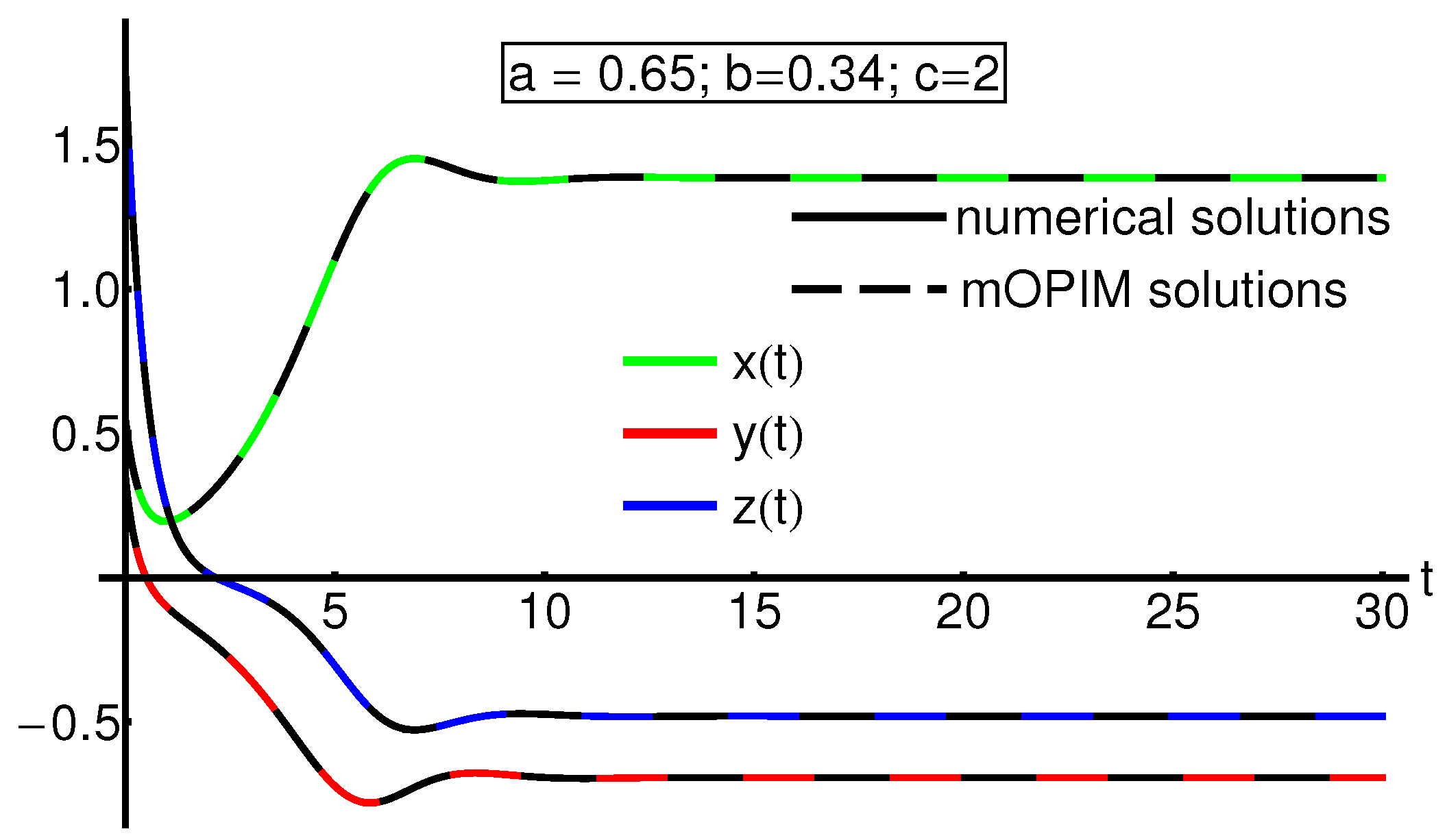
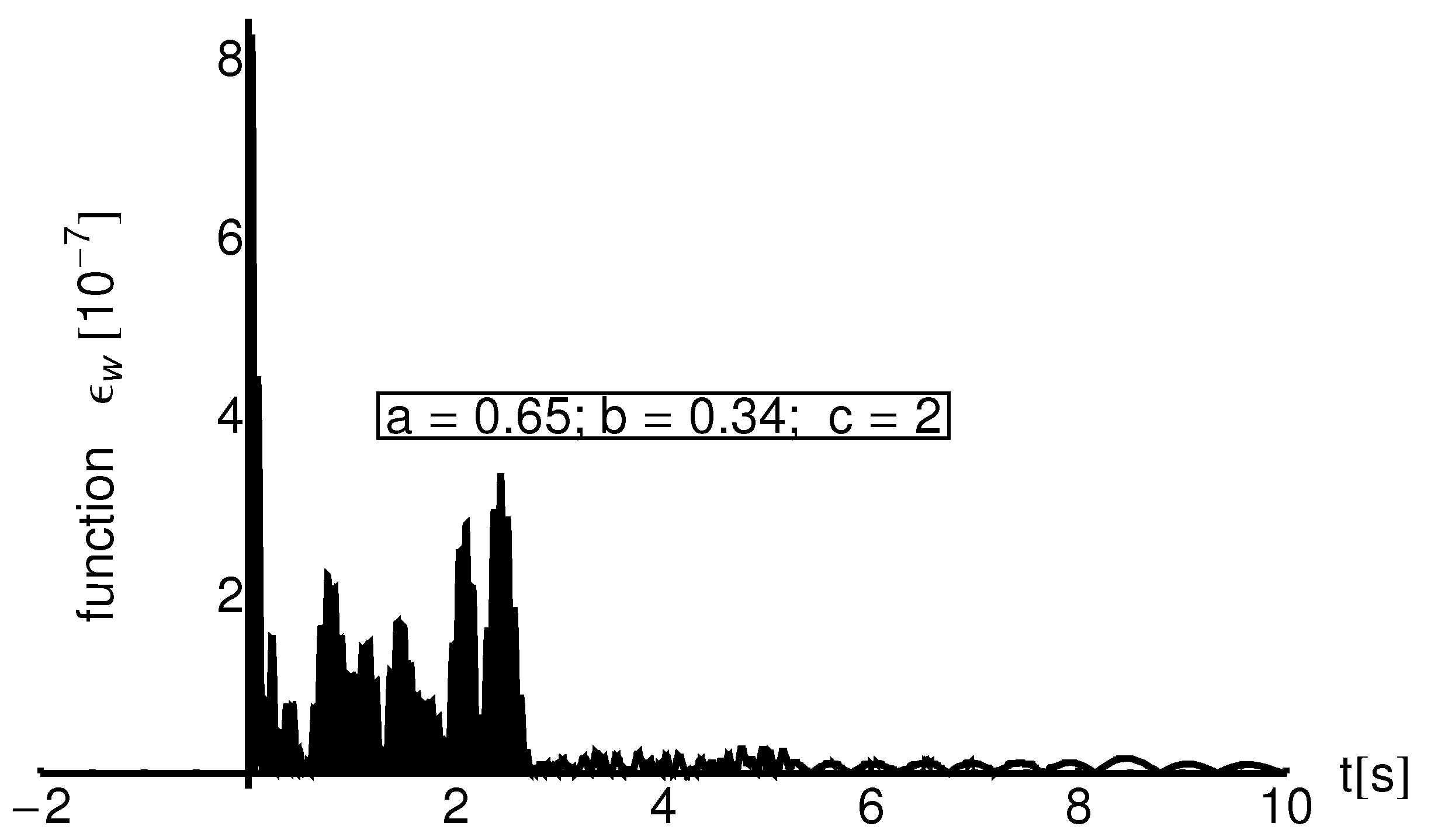
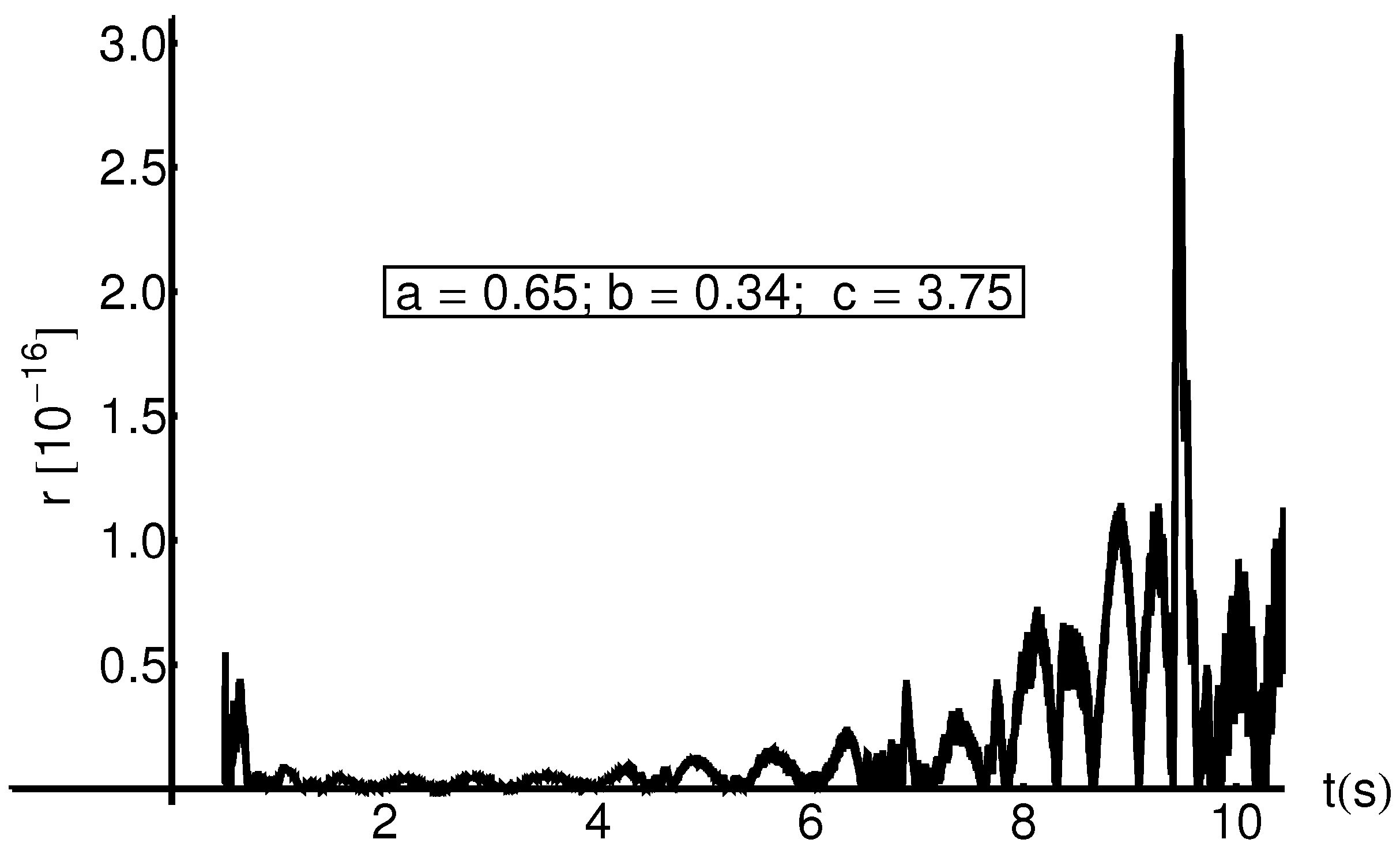
4. Numerical Results and Discussion
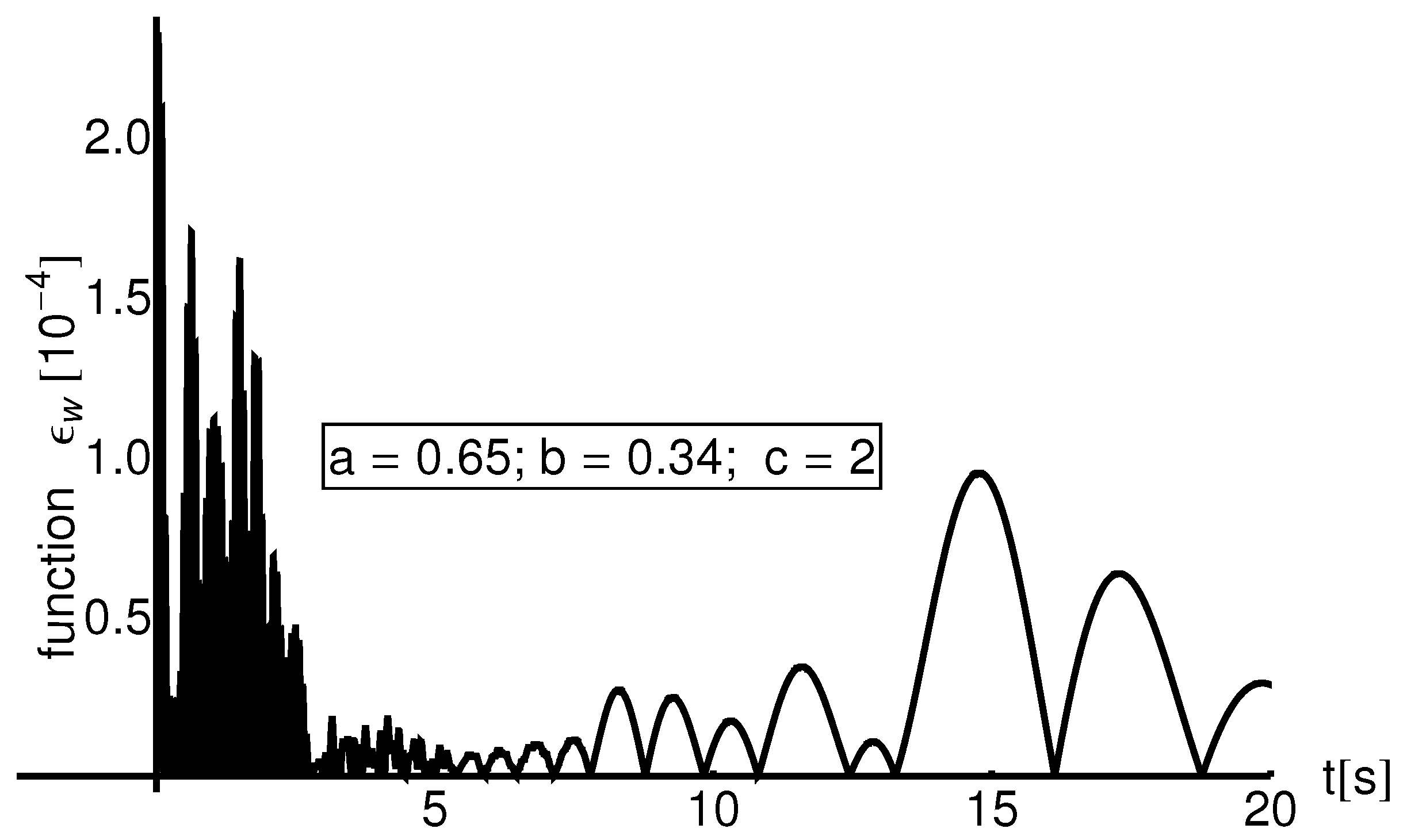
5. Qualitative Analysis of Errors
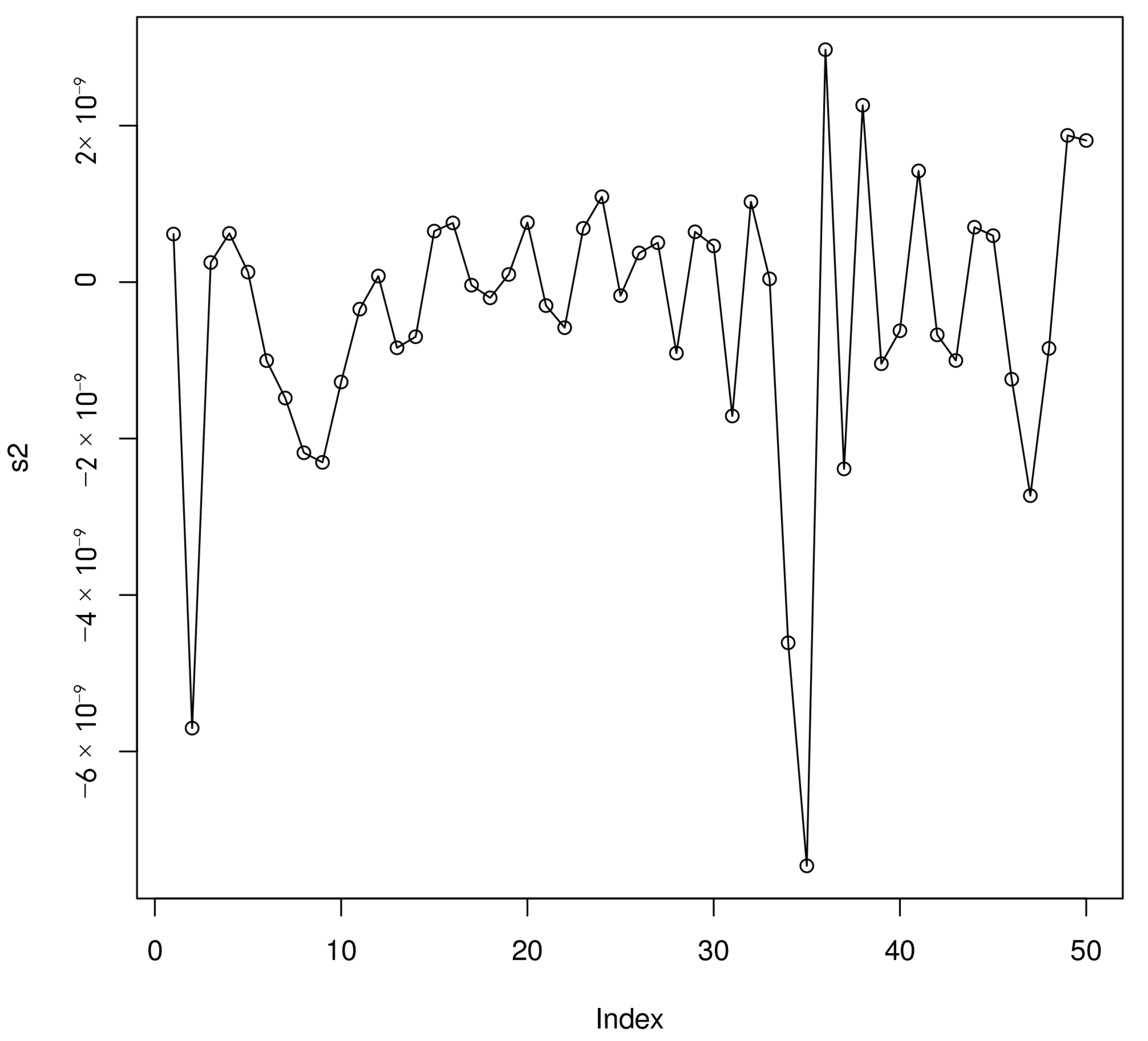
5.1. Study of Heteroscedasticity
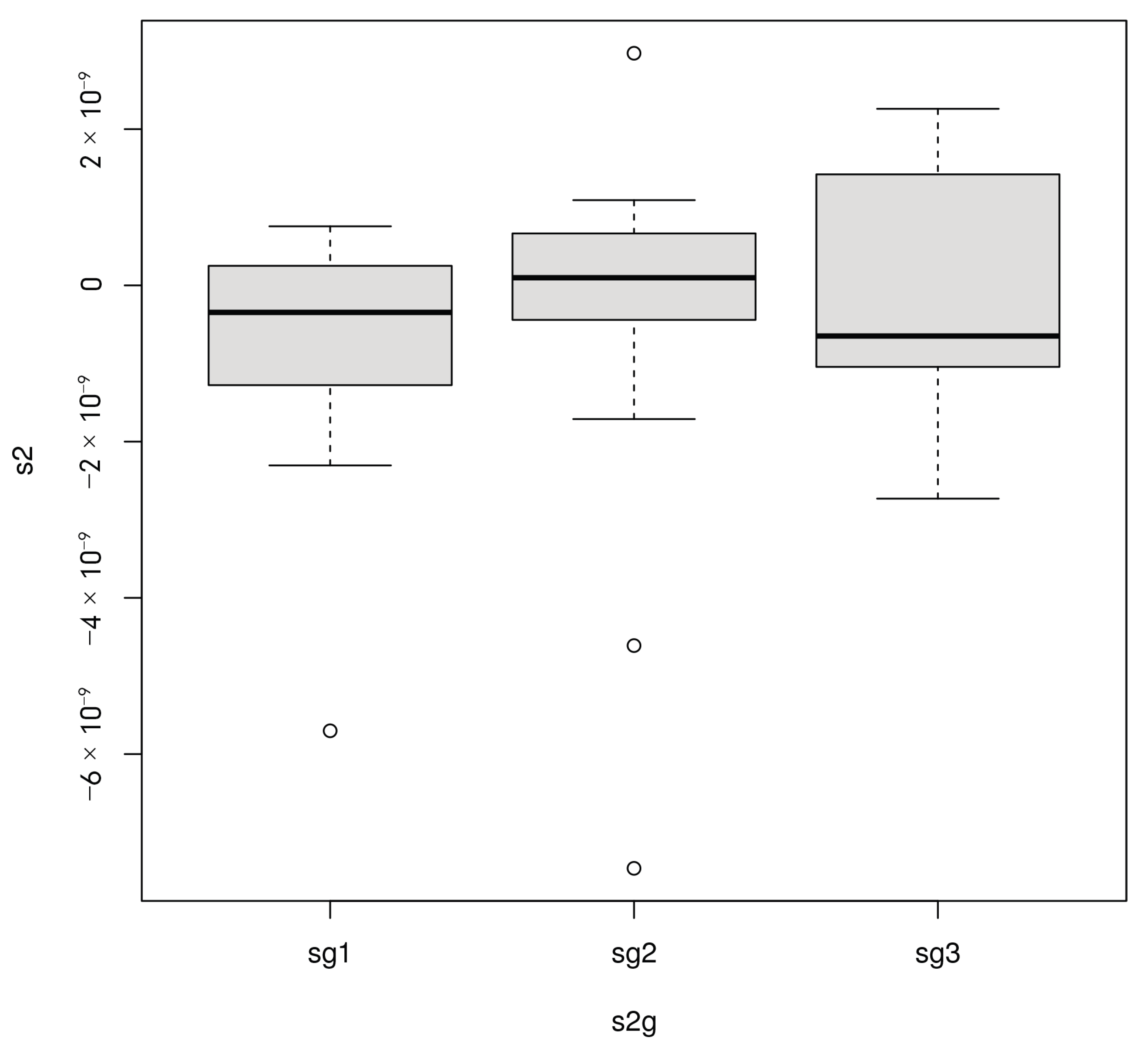
- First, the boxplot graph in the Figure 14:
- The statistical mean value and, respectively, the standard deviation: Mean value of groupsStandard deviation of groups
- The Bartlett test in R (see details at https://www.rdocumentation.org/packages/stats/versions/3.6.2/topics/bartlett.test, accessed on 10 February 2026)Null Hypothesis (): All group variances are equal.Alternative Hypothesis (): At least two group variances are different.Results from R-software:Bartlett’s K-squared = 2.6764, df = 2, p-value = 0.2623Because the p-value = 0.2623 > 0.05, then, the decision is that “it fails to reject ” i.e., “data is consistent with equal variances” for a statistical point of view.
- The Levene’s test in R (see https://www.rdocumentation.org/packages/lawstat/versions/3.2/topics/levene.test, accessed on 10 February 2026)Results from the R-software:Df F value47 0.0972 0.9076Because, the p-value = 0.9076 > 0.05, then the decision is “Fail to reject the null hypothesis”, i.e., “The assumption of equal variances (homoscedasticity) holds true”.
- The Fligner–Killeen test (see for detail at https://www.rdocumentation.org/packages/stats/versions/3.6.2/topics/fligner.test, accessed on 10 February 2026)Results from the R-software:Fligner–Killeen:med chi-squared = 0.6515, df = 2, p-value = 0.722Because the p-value = 0.722 > 0.05, the statistical decision is “Fail to reject ” and that indicates “no significant difference in variances”.
5.2. Study of Autocorrelation
- Durbin–Watson test (details can be found at https://www.rdocumentation.org/packages/car/versions/3.1-3/topics/durbinWatsonTest, accessed on 10 February 2026)Null Hypothesis (): There is no first-order autocorrelation in the residuals.Alternative Hypothesis (): First-order autocorrelation exists.As a simple remark for the statistical decision, a p-value below 0.05 indicates significant autocorrelation, allowing rejection of the null hypothesis that residuals are uncorrelated. Also, some common interpretations in the case of the auto-correlation presence:: Residuals are likely independent (no autocorrelation).: Suggests positive autocorrelation, common in time-series data.: Suggests negative autocorrelationResults from the R-software:DW = 2.0399, p-value = 0.4415We find that the p-value = 0.4415 > 0.05; hence, the statistical decision is “Fail to reject the null hypothesis”.
- The Breusch–Godfrey test (see https://www.rdocumentation.org/packages/lmtest/versions/0.9-40/topics/bgtest, accessed on 10 February 2026)Results from R-software:LM test = 0.070308, df = 1, p-value = 0.7909We see that the p-value = 0.7909 > 0.05, so the decision is “Fail to reject the null hypothesis”; that is, “there is no serial correlation of any order”.
5.3. Study of Normality
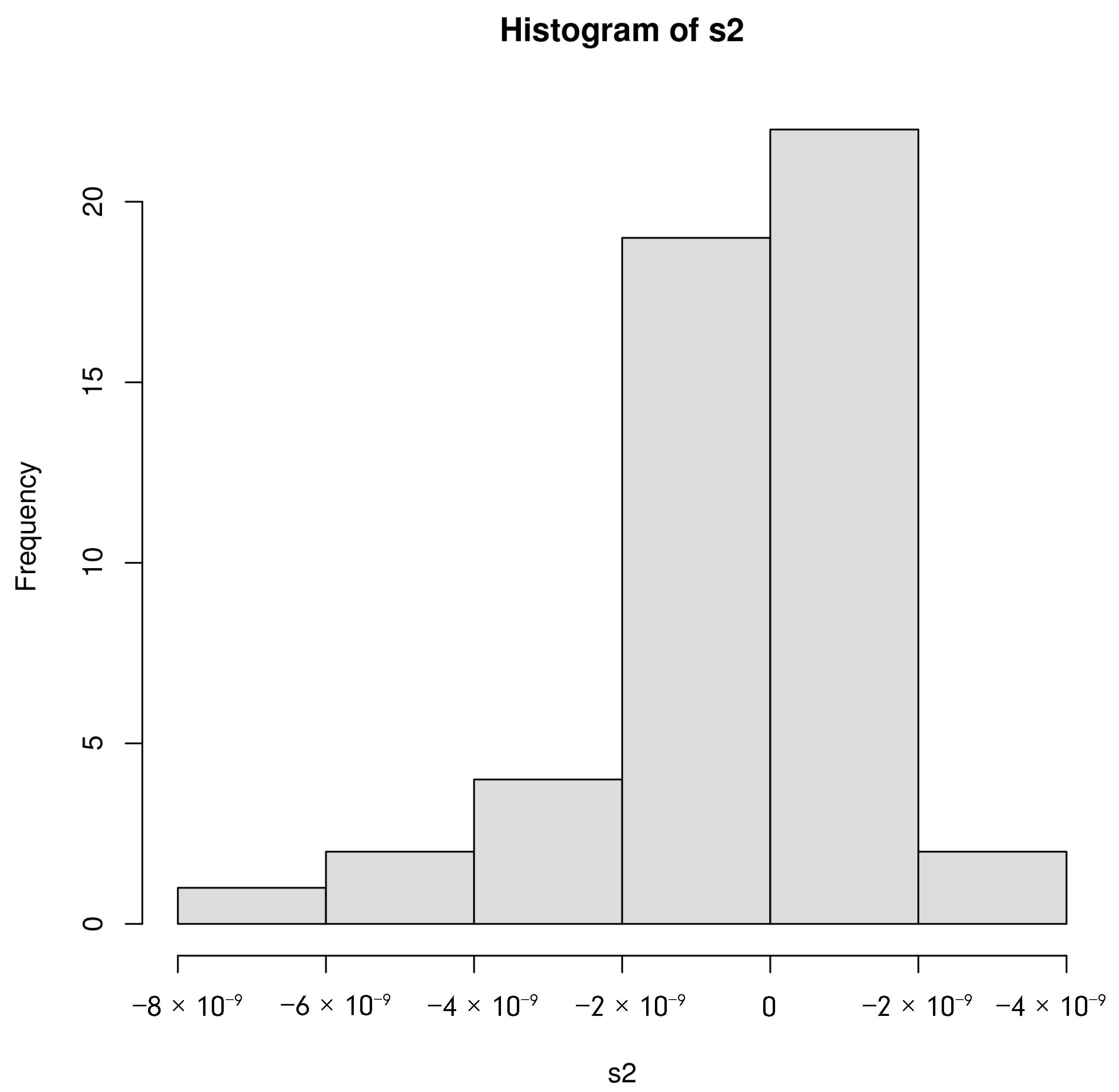
- Shapiro–Wilk test (see more details about this test at https://www.rdocumentation.org/packages/stats/versions/3.6.2/topics/shapiro.test, accessed on 10 February 2026)Results for our data:W = 0.87366, p-value = 7.223×10⁻⁵In this case, if the p-value = 0.0007223 << 0.05, then a decision can be “Reject ”, i.e., “data is significantly non-normal”.
- Komogorov–Smirnov test (see https://www.rdocumentation.org/packages/dgof/versions/1.5.1/topics/ks.test, accessed on 10 February 2026)Results from R-software:D = 0.15222, p-value = 0.1776The p-value = 0.1776 > 0.05, hence, the statistical decision is “Fail to reject the null hypothesis of normality”.
- Anderson–Darling normality test (see https://www.rdocumentation.org/packages/nortest/versions/1.0-4/topics/ad.test, accessed on 10 February 2026)Results form R-softwareA = 0.20828, p-value = 0.8572In this case, the p-value = 0.8572 > 0.5; therefore, the decision is “Fail to reject the null hypothesis”.
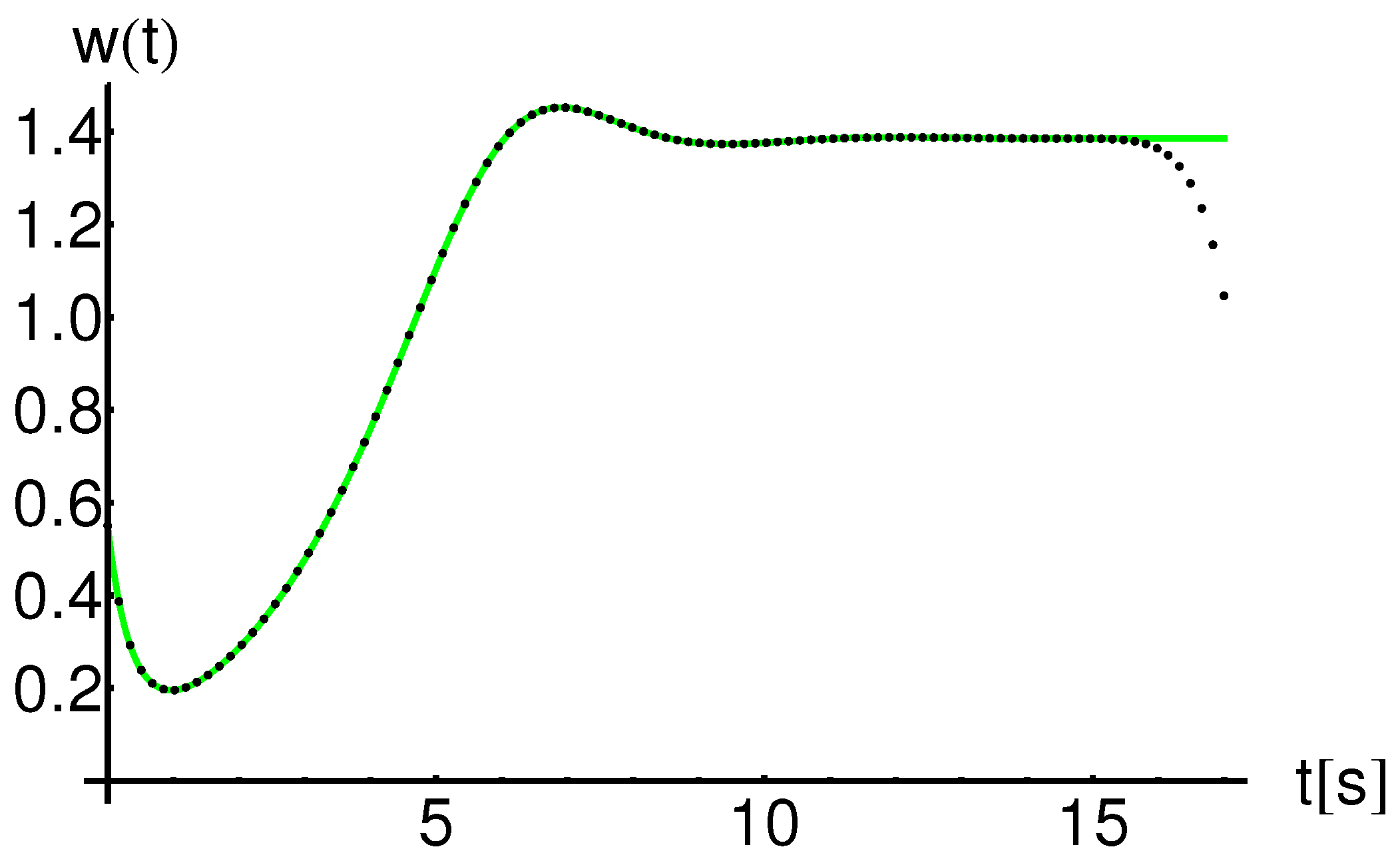
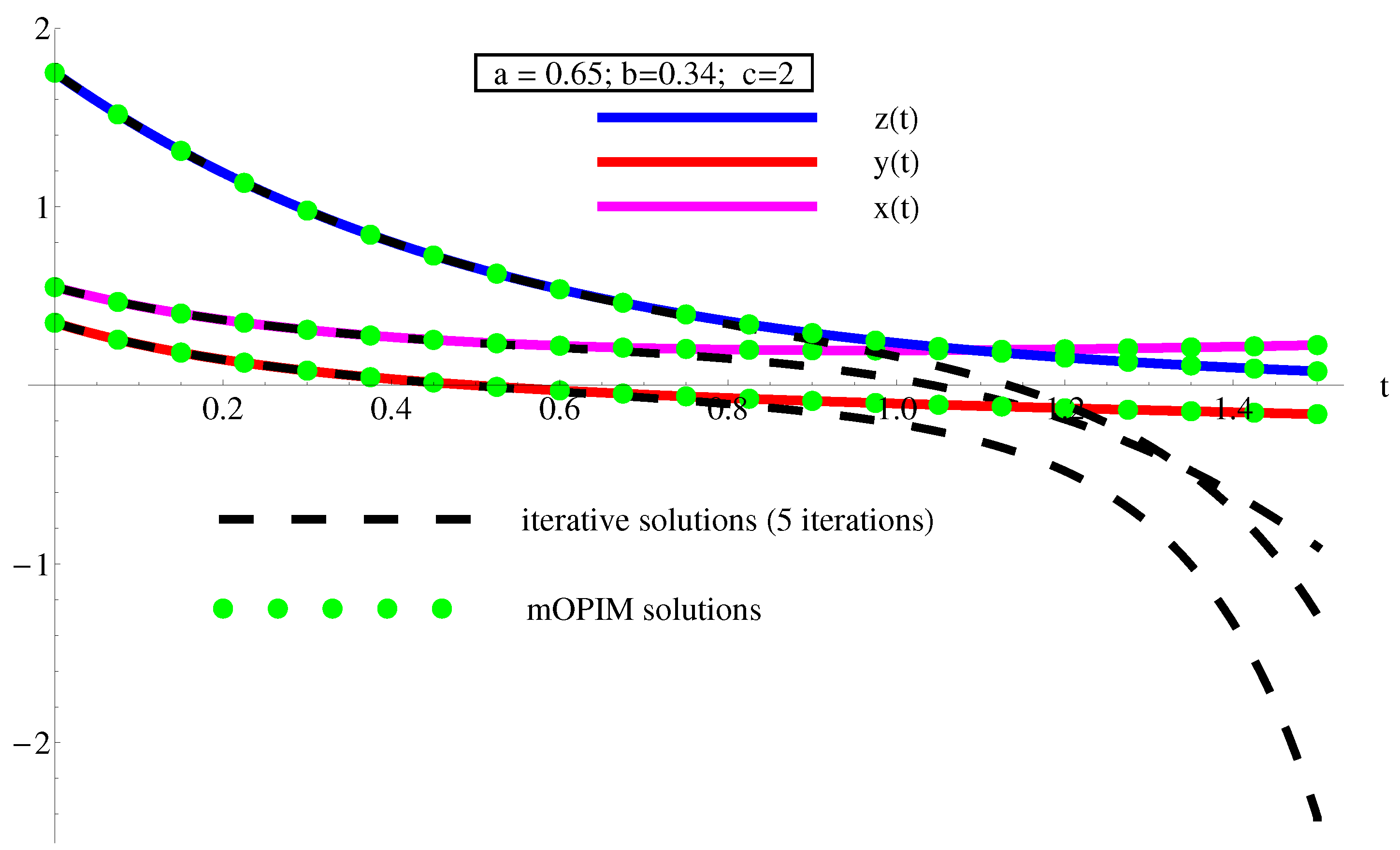
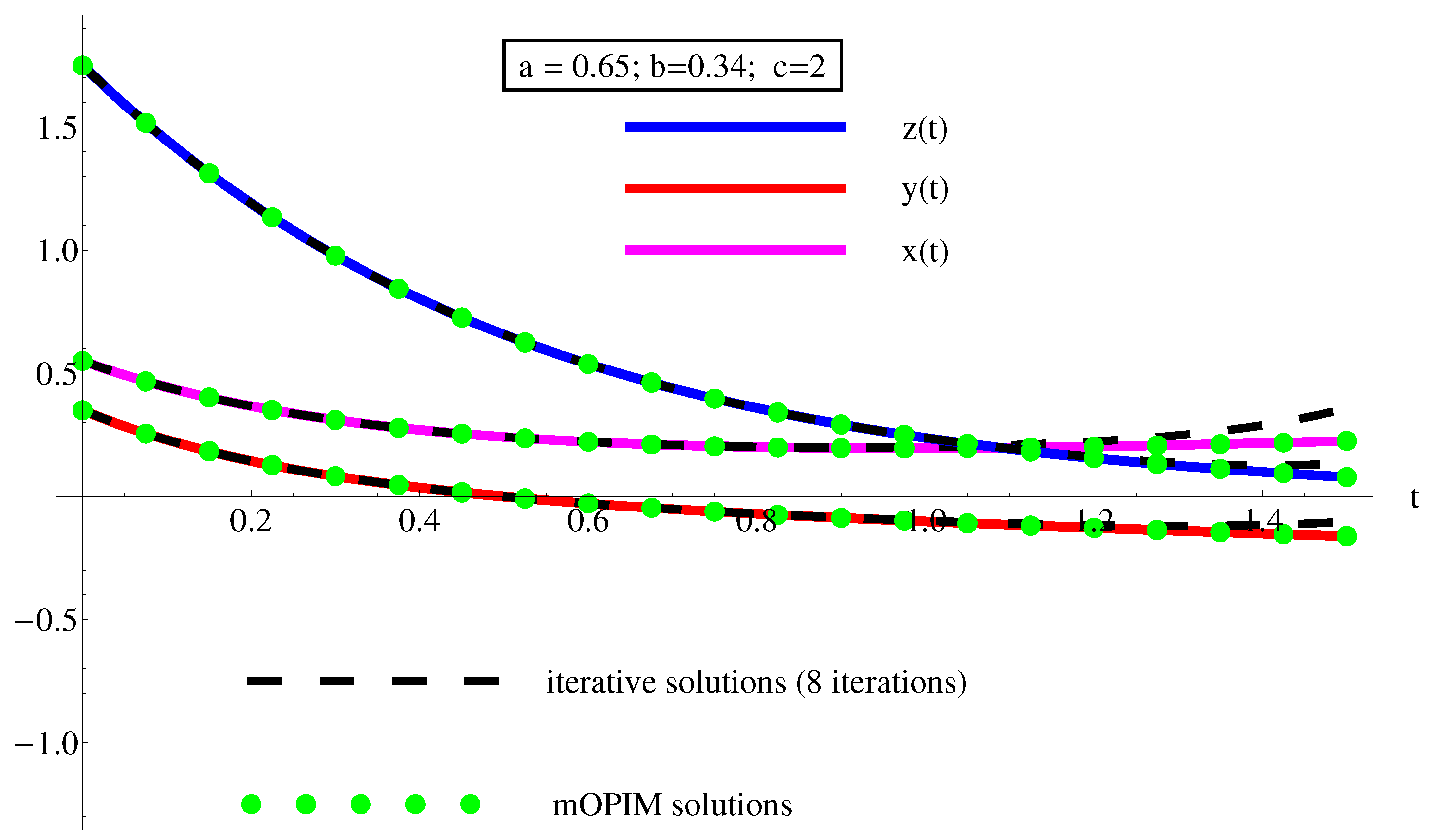
5.4. mOPIM Technique Versus the Iterative Method
6. Conclusions
Author Contributions
Funding
Data Availability Statement
Acknowledgments
Conflicts of Interest
Appendix A
References
- Lorenz, E.N. Deterministic nonperiodic flow. J. Atmos. Sci. 1963, 20, 130–141. [Google Scholar] [CrossRef]
- Banks, J.; Brooks, J.; Cairns, G.; Davis, G.; Stacey, P. On Devaney’s definition of chaos. Am. Math. Mon. 1992, 99, 332–334. [Google Scholar] [CrossRef]
- Anees, A.; Hussain, I. A Novel Method to Identify Initial Values of Chaotic Maps in Cybersecurity. Symmetry 2019, 11, 140. [Google Scholar] [CrossRef]
- Yang, K.; Liao, X. Exploration of Parameter Space in the Lorenz Attractor. Math. Model. Algorithm Appl. 2024, 3, 57–60. [Google Scholar] [CrossRef]
- Xia, D.; Dai, L. Theoretical and numerical approach for quantifying sensitivity to system parameters of nonlinear systems. Nonlinear Eng. 2025, 14, 20250147. [Google Scholar] [CrossRef]
- Tsallis, C.; Borges, E. Nonlinear dynamical systems: Time reversibility versus sensitivity to the initial conditions. Chaos Solitons Fractals 2023, 182, 114743. [Google Scholar] [CrossRef]
- Rössler, O.E. An Equation for Continuous Chaos. Phys. Lett. A 1976, 57, 397–398. [Google Scholar] [CrossRef]
- Chen, G.; Ueta, T. Yet another chaotic attractor. Int. J. Bifurc. Chaos 1999, 9, 1465–1466. [Google Scholar] [CrossRef]
- Lü, J.; Chen, G.; Zhang, S. Dynamical analysis of a new chaotic attractor. Int. J. Bifurc. Chaos 2002, 12, 1001–1015. [Google Scholar] [CrossRef]
- Qi, G.; Liang, X. Force Analysis of Qi Chaotic System. Int. J. Bifurc. Chaos 2016, 26, 1650237. [Google Scholar] [CrossRef]
- Saeed, N.A.; Saleh, H.A.; El-Ganaini, W.A.; Kamel, M.; Mohamed, M.S. On a New Three-Dimensional Chaotic System with Adaptive Control and Chaos Synchronization. Shock Vib. 2023, 2023, 1969500. [Google Scholar] [CrossRef]
- Wang, H.; Pan, J.; Ke, G.; Hu, F. A Pair of Centro-Symmetric Heteroclinic Orbits Coined. Adv. Contin. Discret. 2024, 2024, 14. [Google Scholar] [CrossRef]
- Stroita, D.C.; Bordeasu, D.; Dragan, F. System Identification of a Servo-Valve Controlled Hydraulic Cylinder Operating Under Variable Load. Mathematics 2025, 13, 341. [Google Scholar] [CrossRef]
- Manea, A.-S.; Stroita, D.-C.; Bordeasu, I.; Ghera, C.; Luca, A.-N. Air-Dynamic Measurements on “S” Shape Hydrofoils. In Mechanisms and Machine ScienceOpen Source Preview; Springer: Cham, Switzerland, 2025; Volume 174, pp. 47–56. [Google Scholar] [CrossRef]
- Rajendra, P.; Brahmajirao, V. Modeling of Dynamical Systems through Deep Learning. Biophys. Rev. 2020, 12, 1311–1320. [Google Scholar] [CrossRef] [PubMed]
- Ghadami, A.; Epureanu, B. Data-Driven Prediction in Dynamical Systems: Recent Developments. Philos. Trans. The Royal Soc. A Math. Phys. Eng. Sci. 2022, 380, 20210213. [Google Scholar] [CrossRef]
- Ene, R.-D.; Pop, N.; Badarau, R. Semi-Analytical Solutions for the Shimizu–Morioka Dynamical System. Axioms 2025, 14, 580. [Google Scholar] [CrossRef]
- Ene, R.-D.; Pop, N.; Badarau, R. Closed-Form Solutions for a Dynamical System Using Optimal Parametric Iteration Method. Axioms 2026, 15, 1. [Google Scholar] [CrossRef]
- Marinca, V.; Herisanu, N. An Optimal Iteration Method for Strongly Nonlinear Oscillators. J. Appl. Math. 2012, 2012, 906341. [Google Scholar] [CrossRef]
- Marinca, V.; Herisanu, N. Optimal Parametric Iteration Method. In Nonlinear Dynamical Systems in Engineering; Springer: Berlin/Heidelberg, Germany, 2012. [Google Scholar] [CrossRef]
- Deng, K.; Yu, S. Estimating ultimate bound and finding topological horseshoe for anew chaotic system. Optik 2014, 125, 6044–6048. [Google Scholar] [CrossRef]
- Marinca, V.; Draganescu, G.E. Construction of approximate periodic solutions to a modified van der Pol oscillator. Nonlinear Anal. Real World Appl. 2010, 11, 4355–4362. [Google Scholar] [CrossRef]
- Marinca, B.; Marinca, V. Approximate analytical solutions for thin film flow of a fourth grade fluid down a vertical cylinder. Proc. Rom. Acad. Ser. A 2018, 19, 69–76. [Google Scholar]
- Cardone, A.; Conte, D.; D’Ambrosio, R.; Paternoster, B. Multivalue collocation methods for ordinary and fractional differential equations. Mathematics 2022, 10, 185. [Google Scholar] [CrossRef]
- Ene, R.-D.; Pop, N.; Lapadat, M.; Dungan, L. Approximate closed-form solutions for the Maxwell-Bloch equations via the Optimal Homotopy Asymptotic Method. Mathematics 2022, 10, 4118. [Google Scholar] [CrossRef]
- Williams, T.A.; Sweeney, D.J.; Anderson, D.R. Statistics for Business and Economics, 11th ed.; South-Western College Pub: Cincinnati, OH, USA, 2010; Available online: https://link.springer.com/book/10.1007/978-3-662-65846-8 (accessed on 10 February 2026).
- Cox, D.R.; Snell, E.J. A general definition of residuals. J. R. Stat. Soc. Ser. B. 1968, 30, 248–275. Available online: https://www.jstor.org/stable/2984505 (accessed on 10 February 2026). [CrossRef]
- Bartlett, M.S. Properties of sufficiency and statistical tests. Proc. R. Stat. Soc. Ser. A 1937, 160, 268–282. Available online: https://www.jstor.org/stable/96803 (accessed on 10 February 2026). [CrossRef]
- Levene, H. Robust Tests for Equality of Variances; Olkin, I., Ghurye, S.G., Hoeffding, W., Madow, W.G., Mann, H.B., Eds.; Stanford University Press: Palo Alto, CA, USA, 1960; Available online: https://www.jstor.org/stable/2285659 (accessed on 10 February 2026).
- Olkin, I.; Ghurye, S.G.; Hoeffding, W.; Madow, W.G.; Mann, H.B. (Eds.) Contributions to Probability and Statistics: Essays in Honor of Harold Hotelling; Stanford University Press: Redwood City, CA, USA, 1960; pp. 278–292. Available online: https://epubs.siam.org/doi/10.1137/1003016 (accessed on 10 February 2026).
- Conover, W.J.; Johnson, M.E.; Johnson, M.M. A comparative study of tests for homogeneity of variances, with applications to the outer continental shelf bidding data. Technometrics 1981, 23, 351–361. Available online: https://www.jstor.org/stable/1268225 (accessed on 10 February 2026). [CrossRef]
- Durbin, J.; Watson, G.S. Testing for Serial Correlation in Least Squares Regression, I. Biometrika 1950, 37, 409–428. Available online: https://www.jstor.org/stable/2332391 (accessed on 10 February 2026).
- Durbin, J.; Watson, G.S. Testing for Serial Correlation in Least Squares Regression, II. Biometrika 1951, 38, 159–179. Available online: https://www.jstor.org/stable/2332325 (accessed on 10 February 2026). [CrossRef]
- Breusch, T.S. Testing for Autocorrelation in Dynamic Linear Models. Aust. Econ. Pap. 1978, 17, 334–355. Available online: https://onlinelibrary.wiley.com/doi/10.1111/j.1467-8454.1978.tb00635.x (accessed on 10 February 2026). [CrossRef]
- Godfrey, L.G. Testing Against General Autoregressive and Moving Average Error Models when the Regressors Include Lagged Dependent Variables. Econometrica 1978, 46, 1293–1301. Available online: https://www.jstor.org/stable/1913829 (accessed on 10 February 2026). [CrossRef]
- Shapiro, S.S.; Wilk, M.B. An analysis of variance test for normality (complete samples). Biometrika 1965, 52, 591–611. Available online: https://www.jstor.org/stable/2333709 (accessed on 10 February 2026). [CrossRef]
- Daniel, W.W. “Kolmogorov–Smirnov One-Sample Test”. Applied Nonparametric Statistics, 2nd ed.; PWS-Kent: Boston, MA, USA, 1990; pp. 319–330. Available online: https://books.google.ro/books?id=0hPvAAAAMAAJ&pg=PA319&redir_esc=y (accessed on 10 February 2026).
- Anderson, T.W.; Darling, D.A. A Test of Goodness-of-Fit. J. Am. Stat. Assoc. 1954, 49, 765–769. Available online: https://www.jstor.org/stable/2281537 (accessed on 10 February 2026). [CrossRef]
- Daftardar-Gejji, V.; Jafari, H. An iterative method for solving nonlinear functional equations. J. Math. Anal. Appl. 2006, 316, 753–763. [Google Scholar] [CrossRef]







| for | |||
|---|---|---|---|
| 0 | 0.5499999951 | 0.55 | 4.8231 |
| 3 | 0.4773703776 | 0.4773703851 | 7.5475 |
| 6 | 1.3774410902 | 1.3774410805 | 9.6353 |
| 9 | 1.3757946522 | 1.3757946423 | 9.9399 |
| 12 | 1.3878088268 | 1.3878088303 | 3.5324 |
| 15 | 1.3853010140 | 1.3853010159 | 1.8866 |
| 18 | 1.3856816387 | 1.3856816367 | 1.9998 |
| 21 | 1.3856370801 | 1.3856370757 | 4.4526 |
| 24 | 1.3856407573 | 1.3856407584 | 1.0533 |
| 27 | 1.3856406979 | 1.3856406950 | 2.8460 |
| 30 | 1.3856406327 | 1.3856406295 | 3.1503 |
| for | |||
|---|---|---|---|
| 0 | 6.9024999993 | 6.9025 | 6.1467 |
| 3 | 0.0065148716 | 0.0065148701 | 1.4414 |
| 6 | 0.1288368206 | 0.1288368208 | 2.0911 |
| 9 | 1.2878994227 | 1.2878994219 | 8.0715 |
| 12 | 1.6959357827 | 1.6959357821 | 5.7847 |
| 15 | 1.6794403021 | 1.6794403026 | 5.1767 |
| 18 | 1.6800157815 | 1.6800157831 | 1.5464 |
| 21 | 1.6799997839 | 1.6799997813 | 2.5877 |
| 24 | 1.6799999853 | 1.6799999854 | 8.1595 |
| 27 | 1.6800000005 | 1.6800000010 | 4.5572 |
| 30 | 1.6799999979 | 1.6799999998 | 1.8108 |
| for | |||
|---|---|---|---|
| 0 | 0.5500000118420334 | 0.55 | 1.1842 |
| 3 | 0.4773688853 | 0.4773703851 | 1.4998 |
| 6 | 1.3774456400 | 1.3774410805 | 4.5594 |
| 9 | 1.3758109760 | 1.3757946423 | 1.6333 |
| 12 | 1.3878322367 | 1.3878088303 | 2.3406 |
| 15 | 1.3853921525 | 1.3853010159 | 9.1136 |
| 18 | 1.3856390193 | 1.3856816367 | 4.2617 |
| 21 | 1.3856460918 | 1.3856370757 | 9.0161 |
| 24 | 1.3856408397 | 1.3856407584 | 8.1330 |
| 27 | 1.3856398221 | 1.3856406950 | 8.7290 |
| 30 | 1.3856410367 | 1.3856406295 | 4.0719 |
| 5 Iterations | 8 Iterations | |||
|---|---|---|---|---|
| 0 | 0.55 | 0.5499999951 | 0.55 | 0.55 |
| 0.15 | 0.4017708691 | 0.4017708612 | 0.4017660802 | 0.4017708684 |
| 0.30 | 0.3104242855 | 0.3104243299 | 0.3101733342 | 0.3104245484 |
| 0.45 | 0.2544282526 | 0.2544282041 | 0.2520579351 | 0.2544358594 |
| 0.60 | 0.2212758090 | 0.2212758157 | 0.2100902278 | 0.2213566010 |
| 0.75 | 0.2034134260 | 0.2034136365 | 0.1671499114 | 0.2039027309 |
| 0.90 | 0.1961178916 | 0.1961180752 | 0.1031772101 | 0.1982128316 |
| 1.05 | 0.1963496108 | 0.1963496888 | −0.0063040127 | 0.2034692125 |
| 1.20 | 0.2021105486 | 0.2021105613 | −0.1901168373 | 0.2227403396 |
| 1.35 | 0.2120704721 | 0.2120705248 | −0.4794393043 | 0.2657949353 |
| 1.5 | 0.2253404724 | 0.2253406402 | −0.9031510107 | 0.3578749377 |
Disclaimer/Publisher’s Note: The statements, opinions and data contained in all publications are solely those of the individual author(s) and contributor(s) and not of MDPI and/or the editor(s). MDPI and/or the editor(s) disclaim responsibility for any injury to people or property resulting from any ideas, methods, instructions or products referred to in the content. |
© 2026 by the authors. Licensee MDPI, Basel, Switzerland. This article is an open access article distributed under the terms and conditions of the Creative Commons Attribution (CC BY) license.
Share and Cite
Ene, R.-D.; Negrea, R.; Badarau, R.; Pop, N. Closed-Form Heteroclinic Orbits for a Three-Parameter Dynamical System Using a Modified Optimal Parametric Iteration Method. Mathematics 2026, 14, 1126. https://doi.org/10.3390/math14071126
Ene R-D, Negrea R, Badarau R, Pop N. Closed-Form Heteroclinic Orbits for a Three-Parameter Dynamical System Using a Modified Optimal Parametric Iteration Method. Mathematics. 2026; 14(7):1126. https://doi.org/10.3390/math14071126
Chicago/Turabian StyleEne, Remus-Daniel, Romeo Negrea, Rodica Badarau, and Nicolina Pop. 2026. "Closed-Form Heteroclinic Orbits for a Three-Parameter Dynamical System Using a Modified Optimal Parametric Iteration Method" Mathematics 14, no. 7: 1126. https://doi.org/10.3390/math14071126
APA StyleEne, R.-D., Negrea, R., Badarau, R., & Pop, N. (2026). Closed-Form Heteroclinic Orbits for a Three-Parameter Dynamical System Using a Modified Optimal Parametric Iteration Method. Mathematics, 14(7), 1126. https://doi.org/10.3390/math14071126