1. Introduction
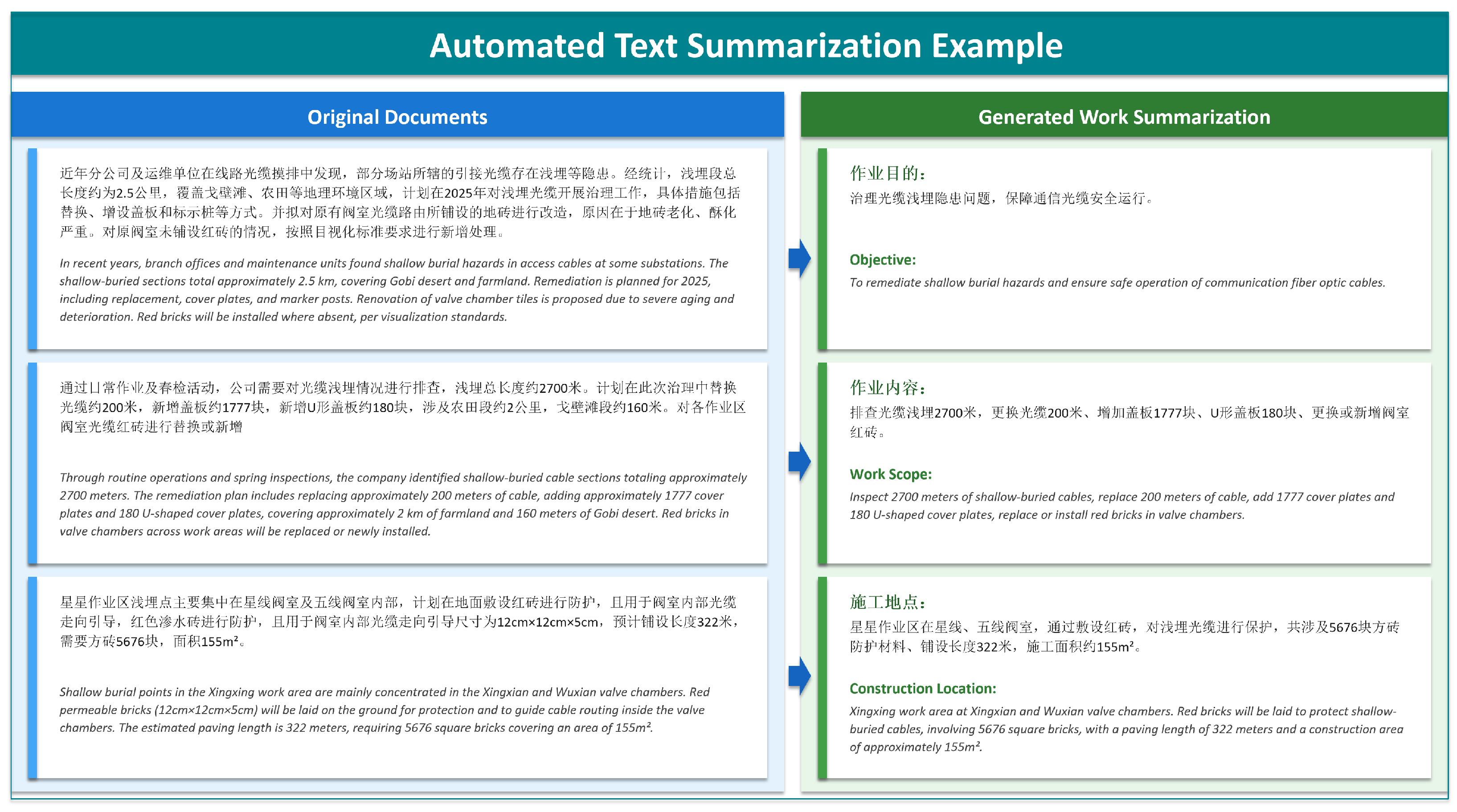
The ongoing digital transformation of the oil and gas pipeline industry has created an urgent demand for automated document processing technologies. The National Pipeline Network Group manages large-scale pipeline infrastructure spanning the country, with extensive communication network systems supporting operational monitoring and control. Modern pipeline communication system maintenance activities continuously generate large volumes of unstructured textual data, including operation logs, alarm records, inspection reports, and technical maintenance narratives. These documents typically contain detailed procedural descriptions, network topology information, equipment parameters, and domain-specific terminology, resulting in high information density but excessive length. As a consequence, manually converting such documents into standardized work orders or maintenance summaries for communication operation and maintenance management systems is not only time-consuming but also highly prone to human errors. Therefore, automated document summarization has become a critical enabling technology for improving the accuracy, efficiency, and reliability of pipeline communication system maintenance workflows, supporting the strategic transformation from manual to digital operation and maintenance, and offering substantial practical value for national integrated pipeline network management.
Recent progress in abstractive summarization has been driven by Transformer-based models such as BART [
1], which combine bidirectional encoders with autoregressive decoders to simultaneously capture contextual semantics and generate coherent summaries. BART has demonstrated robust performance across a range of generation tasks, including summarization, by learning to reconstruct corrupted input text using the Transformer architecture. Subsequent work has advanced the quality of abstractive summaries through improved content planning and semantic coherence. For example, Narayan et al. [
2] introduce learned entity prompts to ground the generation process, showing that intermediate planning mechanisms can improve entity specificity and reduce hallucination in generated summaries. In parallel, recent approaches [
3] explore hierarchical attention and graph representations to better model local and global discourse structures in long documents, yielding enhanced coverage of salient information for scientific summarization. Although these studies achieve notable improvements in generation quality, they predominantly rely on full fine-tuning and extensive manual hyperparameter search, resulting in high computational cost and inefficient tuning processes that limit their practical deployment in industrial settings. This limitation has motivated the development of parameter-efficient fine-tuning methods.
Parameter-efficient fine-tuning methods effectively address the computational overhead of full model adaptation by substantially reducing the number of trainable parameters. Among these techniques, Low-Rank Adaptation (LoRA) [
4] has emerged as a widely adopted approach for efficiently fine-tuning pretrained Transformer models by injecting trainable low-rank matrices into attention layers while freezing the original pretrained weights. Building on this foundation, Weight-Decomposed Low-Rank Adaptation (DoRA) [
5] further enhances parameter-efficient fine-tuning by decomposing pretrained weights into magnitude and directional components, and applying LoRA updates to direction while directly optimizing magnitude, thereby more closely emulating the learning dynamics of full fine-tuning. These methods dramatically reduce the number of trainable parameters compared to full fine-tuning, significantly lowering memory and computation requirements. However, the performance of these methods remains highly sensitive to hyperparameter configurations, such as low-rank dimension and scaling factors, which can substantially affect adaptation quality. In practice, hyperparameter selection still largely depends on manual tuning or grid search, leading to inefficient exploration and difficulties in identifying optimal configurations in high-dimensional search spaces. This limitation underscores the need for automated and efficient hyperparameter optimization strategies in parameter-efficient fine-tuning frameworks.
Evolutionary and swarm intelligence algorithms have been widely applied to hyperparameter optimization in machine learning due to their ability to efficiently explore large search spaces without requiring gradient information. Representative methods include Genetic Algorithm (GA) [
6], Particle Swarm Optimization (PSO) [
7], Differential Evolution (DE) [
8], and several nature-inspired algorithms such as Firefly Algorithm (FA) [
9], Bat Algorithm (BA) [
10], and Grey Wolf Optimizer (GWO) [
11]. Among these meta-heuristics, the Artificial Bee Colony (ABC) algorithm [
12], inspired by the foraging behavior of honey bee swarms, has attracted significant research interest for both continuous and discrete optimization problems due to its simple structure and competitive performance. However, the standard ABC algorithm has two key limitations. First, purely random initialization of the population ignores prior knowledge, which may result in suboptimal solutions and inefficient exploration of the search space. Second, when a candidate solution fails to improve beyond a predefined limit, it is directly abandoned and replaced by a random solution, which may discard potentially valuable search directions and hinder optimization performance. In the PEFT hyperparameter optimization setting, where each evaluation is costly, these two weaknesses are particularly harmful: random initialization wastes early evaluations on poor configurations, and premature abandonment of stagnated solutions discards partially useful search information before it can be refined. Recent advances in automated search problems have demonstrated the effectiveness of incorporating learned guidance mechanisms to navigate high-dimensional search spaces. For instance, attention-based mechanisms have been successfully applied to neural architecture search [
13,
14,
15], while learned importance guidance has enhanced population-based feature selection [
16,
17]. These limitations of the standard ABC algorithm and the demonstrated effectiveness of knowledge-guided strategies motivate the enhancements to population initialization and stagnation handling proposed in this work.
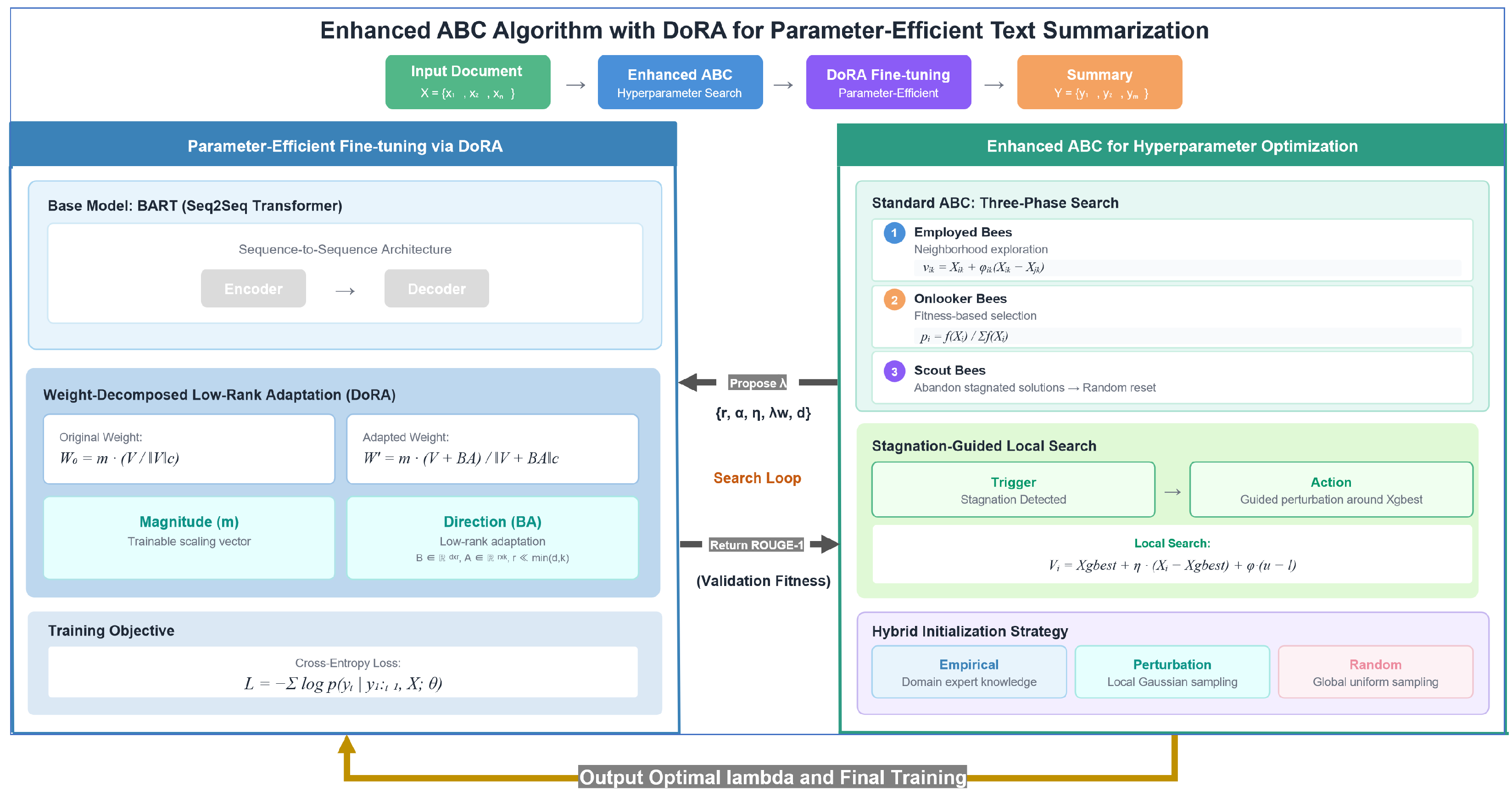
To address the limitations discussed above, this paper proposes a parameter-efficient abstractive summarization framework that integrates DoRA-based fine-tuning with an enhanced Artificial Bee Colony (ABC) optimization strategy. The proposed framework employs DoRA to achieve efficient domain adaptation for text summarization while using an improved ABC algorithm to automate hyperparameter search. To overcome the two inherent limitations of the standard ABC algorithm, we introduce two core improvement strategies: hybrid population initialization and stagnation-guided local search. The core insight is that domain knowledge about effective hyperparameter regions, which is available from prior fine-tuning experience, can substantially reduce wasted evaluations during early search, and that stagnated solutions in PEFT hyperparameter search often retain partial structural information that is worth refining rather than discarding. These two mechanisms together improve search quality without increasing the evaluation budget, which is critical when each evaluation requires a full model training run. The main contributions of this work are summarized as follows:
We propose a hybrid framework that integrates DoRA parameter-efficient fine-tuning with an enhanced ABC algorithm for automated hyperparameter optimization in text summarization.
We introduce a hybrid initialization strategy that combines empirical solutions from domain knowledge. This strategy improves solution quality by exploiting prior knowledge while maintaining global exploration capability.
We develop a stagnation-guided local search mechanism that performs guided perturbation around the global best solution when a candidate exceeds the stagnation threshold but remains below the abandonment limit. This mechanism preserves valuable search information and enhances the algorithm’s ability to escape local optima.
While this work focuses on pipeline communication maintenance summarization, the proposed framework is general in design and can be applied to other domain-specific NLP tasks.
3. Problem Formulation
This work addresses hyperparameter optimization for parameter-efficient text summarization. We formulate text summarization as a supervised learning problem where a model learns to generate concise summaries from input documents.
Let
denote an input document and
denote the target summary, where
. The model parameters
are trained by minimizing the cross-entropy loss:
where
N is the number of training samples and
is the length of the
i-th summary.
The hyperparameter optimization problem seeks the optimal configuration
that minimizes the validation performance:
where
denotes the trained model parameters under hyperparameter configuration
,
is the validation metric, and
is the hyperparameter space. In our work,
is the validation loss or negative ROUGE-1 score, and the hyperparameters
include continuous variables (i.e., learning rate
, weight decay
, dropout rate
d) and discrete variables (i.e., low-rank dimension
r, scaling factor
). Specifically, the continuous hyperparameters are bounded as
,
, and
. The discrete hyperparameters are constrained to
and
. Three additional hyperparameters, namely batch size, gradient accumulation steps, and warmup ratio, are fixed at 16, 2, and 0.01, respectively.
6. Conclusions
This paper presents an efficient and robust framework for domain-specific text summarization based on parameter-efficient fine-tuning and automated hyperparameter optimization. By integrating weight-decomposed low-rank adaptation with an enhanced Artificial Bee Colony algorithm, the proposed method addresses the dual challenges of high computational cost and hyperparameter sensitivity when adapting large pretrained models to specialized domains.
The enhanced optimization strategy introduces a hybrid initialization mechanism and a stagnation-guided local search scheme, which improve solution quality by leveraging prior knowledge while preserving useful search directions. Experimental results on a public Chinese summarization benchmark and a real-world oil and gas pipeline communication corpus demonstrate consistent improvements over full fine-tuning, manually tuned parameter-efficient methods, and several representative evolutionary optimizers. These results confirm that effective hyperparameter search plays a critical role in unlocking the full potential of parameter-efficient adaptation.
Nevertheless, several limitations of the current framework should be noted. First, experiments are conducted on Chinese-language corpora only, which limits conclusions about cross-lingual generalizability. Second, the current evaluation budget is feasible for BART-scale models but may become a practical bottleneck when scaling to larger language models with higher per-trial training cost. Future work will explore extending the proposed framework to larger language models and additional sequence generation tasks, as well as incorporating resource-aware optimization and distributed search strategies to further enhance scalability and practical applicability in industrial environments. Evaluation on corpora from other specialized application domains and additional languages, along with statistical significance testing, is also planned to further validate the transferability and robustness of the proposed framework.