Article

Multi-Objective Intermodal Transport Optimization via Fuzzy AHP and Goal Programming

1
Department of Industrial Engineering, Faculty of Engineering, Çukurova University, Adana 01330, Türkiye
2
Department of Industrial Engineering, Faculty of Engineering, Tarsus University, Tarsus 33400, Türkiye
*
Author to whom correspondence should be addressed.
Mathematics 2026, 14(6), 992; https://doi.org/10.3390/math14060992
Submission received: 13 February 2026 / Revised: 12 March 2026 / Accepted: 12 March 2026 / Published: 14 March 2026
(This article belongs to the Special Issue Operations Research, Logistics, and Supply Chain Analysis)

Abstract

Logistics centers play a significant role in regional economic growth and development by optimizing logistics chains, minimizing transportation and transfer costs, shortening transit times, and enabling centralized management through support services. Intermodal transportation is an important function that enables goods to be transported efficiently using multiple modes of transport at logistics centers. This study examines 12 operational logistics centers in Türkiye, evaluating five types of transportation: unimodal (highway, railway) and intermodal (highway/railway, highway/airway, and highway/marine). The assessment considers four key criteria (transportation cost, carbon emissions, transportation risk, and transportation time) under various transportation distance and volume scenarios. The Fuzzy AHP method is employed to weight these criteria, and a goal programming model is developed to optimize transport mode selection. Among the evaluated transport modes, air transportation was not selected in any scenario due to its high cost and carbon emissions, aligning with the study’s focus on cost-efficiency and sustainability. The findings provide scenario-based recommendations for the most suitable transportation modes at each logistics center, contributing to more efficient and sustainable logistics operations.

1. Introduction

With the globalization of production and trade worldwide, the importance of logistics centers in terms of supply chain management efficiency is increasing [1]. Logistics centers make an important contribution to the survival of the country’s economies and the economic and social development of the regions [2]. Logistics centers are located in the area of large industrial centers, main transport hubs, traffic corridors, ports, important maneuvering areas, etc. They are located near the areas and are important locations where freight flows and logistics networks are built [3]. In addition, logistics centers are areas that are planned and built to best manage all activities involved in freight movement [4]. Logistics centers are special centers where many different activities such as transportation, export, import, transit transactions, distribution, storage, handling, consolidation, infrastructure services, insurance and banking, consultancy, and production take place, both nationally and internationally. Logistics centers provide quality service and an effective selection of the most efficient means of transportation, thanks to their multimodal transportation [4]. Various transportation studies identify different types of multimodal transportation, including intermodal, multimodal, comodal, and synchromodal systems [5]. More intensive and rational use of the intermodal transport system improves the logistics center network and the intermodal transport terminal [6]; one of the main objectives of the transport policy of the European Commission is the development of the intermodal transport system [7]. To develop an intermodal transport system, it is necessary to establish and develop an intermodal transport network, with logistics centers representing a modern connection of different transport modes and technologies [6]. The intermodal transport system, which is one of the transport systems that connects the various branches of transport and creates a harmonious transport chain [8], necessitates the increasing competition in the global market and the need for adequate planning of transport processes [9].
The motivation of this study is the transportation modes used in intermodal transportation in logistics centers. The study aims to evaluate the appropriate transportation modes by considering the values of intermodal transportation systems used in logistics centers such as transportation distance, transportation amount, cost, carbon emission, transportation risk, and transportation time. In this context, 12 active logistics centers in Türkiye are considered. The selection of the optimal intermodal transport system transport modes for the logistics centers under consideration is evaluated. In the study, a goal programming model was developed as MIP and four goals were considered in the weighted goal programming model as cost, carbon emission, transportation time, and transportation risk. The weights of these goal values were found by the Fuzzy AHP approach. Unlike ranking-based MCDM methods such as Fuzzy AHP–TOPSIS, which are primarily used to rank alternatives, the integration of Fuzzy AHP with goal programming provides a stronger decision framework for optimization problems. Fuzzy AHP allows the determination of criteria weights under uncertainty, while goal programming enables the simultaneous minimization of deviations from multiple conflicting goals within a constrained environment. Therefore, the hybrid Fuzzy AHP–Goal Programming approach is particularly suitable for transportation planning problems where operational constraints such as transportation distance and cargo volume must be considered alongside multiple performance criteria.
The proposed model is designed as a decision-support tool for transportation planners, logistics operators, freight forwarders, and policymakers involved in logistics network planning. Although individual logistics centers may not directly determine transport mode decisions in all cases, they act as critical intermodal nodes within transportation networks. Therefore, evaluating the most suitable transport modes under different shipment volumes and transportation distances can support strategic planning and infrastructure utilization decisions.
As a result of the study, the most appropriate intermodal transportation system transportation modes based on logistics centers were found within the scope of cost, carbon emission, transportation time, and transportation risk. Although studies are comparing unimodal and intermodal transportation, no study considers cost, carbon emission, transportation time, and transportation risk together and applies goal programming by weighing these criteria with Fuzzy AHP. This study is expected to serve as a guide for practitioners by incorporating broad criteria perspective and testing various scenarios. It is also thought that logistics centers will contribute to the application perspectives.
The remainder of this paper is organized as follows. Section 2 presents a review of the relevant literature on transport mode selection and multi-criteria decision-making approaches used in logistics and intermodal transportation studies. Section 3 describes the research methodology. Section 4 presents the study and scenario structure, explaining how transportation distance and shipment volume are used to construct different operational scenarios. Section 5 presents the model results and evaluates the performance of different transportation alternatives across various scenarios. Finally, Section 6 concludes by discussing the practical and theoretical implications, and Section 7 summarizes the main findings of the research.

2. Related Works

By supporting the increasing importance of intermodal transportation, this study aims to reduce transportation costs by improving its organization and using the most effective vehicles at every stage. Intermodal transportation facilitates the management of supply chains by creating significant positive external effects such as reducing dependence on environmentally harmful transportation or reducing time and transportation costs [8]. There has been significant growth in intermodal transport research in freight distribution since the 1990s [10]. Intermodal transport has grown tremendously over the past decade as a result of the development of container shipping services and supply chain shares [11]. Intermodal transport is a comprehensive system for the transport of goods. Goods are grouped into loading units and an efficient combination of multiple modes of transport is used between the place of dispatch and the destination [10]. Intermodal transport saves energy, time, and costs, improves the quality of services, and supports the sustainable development of the transport system [12]. With intermodal transport in logistics centers, quality service and efficiency of vehicles are provided.
Kreutzberger et al. [13] provide an overview of studies and articles dealing with the external effects of both intermodal and unimodal transport. Braekers et al. [14] provide an overview of how the external costs of intermodal transport and unimodal road transport can be compared. Pekin et al. [15] compared unimodal and intermodal modes of transport and concluded that the longer the distance traveled, the greater the degree to which the lower variable costs of intermodal transport compensate for the extra transfer costs at the terminals. Sahin et al. [16] consider different intermodal transportation models based on cost analysis for Türkiye, considering technical, economic, and operational parameters. The study discusses sea–road, sea–rail, road–rail, and sea–road–rail transport. A cargo transportation case study was conducted using the proposed model. Then, a single-road transport mode is compared with intermodal modes in terms of transport costs. The research reveals that single modes of transport tend to be advantageous in short-distance transport and that intermodal transport has advantages in long-distance transport. Martínez–López et al. [17] investigated the sustainability of intermodal transport chains within the framework of the European emission regulations affecting heavy-duty vehicles and maritime transport. The authors developed a multi-objective mathematical model to evaluate total transport costs, transport time, and environmental costs associated with unimodal road transport and intermodal maritime transport chains. The results indicated that smaller and faster vessels equipped with LNG propulsion systems could improve the competitiveness of intermodal transport compared to road transport. In their study, Cansız and Ünsalan [18] compare road, rail, and multimodal transportation (rail, road) types for route optimization in freight transportation, considering the amount of carbon dioxide released from vehicles depending on fuel consumption, transportation cost, transportation time and transportation type. Hruška et al. [19] describe a general model for selecting the appropriate transport mode from three potential transport modes using AHP.
When the performance indices are examined in the study, it is seen that the highest performance among the three different transport modes are realized in the multimodal transport type. Additionally, there are many different studies for intermodal transportation. Arnold et al. [20] address the problem of optimal positioning of rail/road terminals for freight transport. Li-li and Yan [21] combine different Multi-Criteria Decision-Making (MCDM) methods to evaluate the location of logistics centers in their study. Chang [22] and Heggen et al. [23] deal with the intermodal container routing problem in their work. Wang et al. [24] discuss a Multi-Criteria Decision-Making (MCDM) method based on the Fuzzy Analytical Hierarchy Process (AHP) for the evaluation of the logistics distribution center so that decision-makers can express their preferences with uncertainty. Bruns and Knust [25] deal with the problem of freight planning for trains in intermodal container terminals with the Mixed Integer Programming (MIP) model. Nossack and Pesch [26] deal with a truck scheduling problem that arises in an intermodal container. In a study by Bhattacharya et al. [27], the MIP model is used to optimize the schedules for the intermodal transport network. Zečević et al. [12] deal with the study of intermodal transportation terminal location selection using different MCDM methods. Derse and Göçmen [28] address intermodal hazardous material transportation by simultaneously using the risk analysis methodology and mathematical modeling approach. Zhang et al. [29] model integrated road, rail, air and walking transport as a four-layer network, considering their interdependencies. The findings in the study provide recommendations for transportation planners to design national multimodal transportation systems and plan trips for stakeholders. Chupin et al. [30] propose a multi-objective optimization method for intermodal freight transportation planning within the framework of sustainable service network design. The approach aims to balance economic efficiency and environmental sustainability by minimizing both transportation costs and delivery times. Topaloglu Yildiz and Doymuş [31] examine the problem of optimal route selection in an intermodal transportation network encompassing road, rail, sea, and inland waterways. There are other studies on intermodal facility location selection [7,32,33,34]. Table 1 includes literature studies that include comparisons of intermodal and unimodal transport areas, scope, evaluation criteria, and methodologies for different situations.

3. Materials and Methods

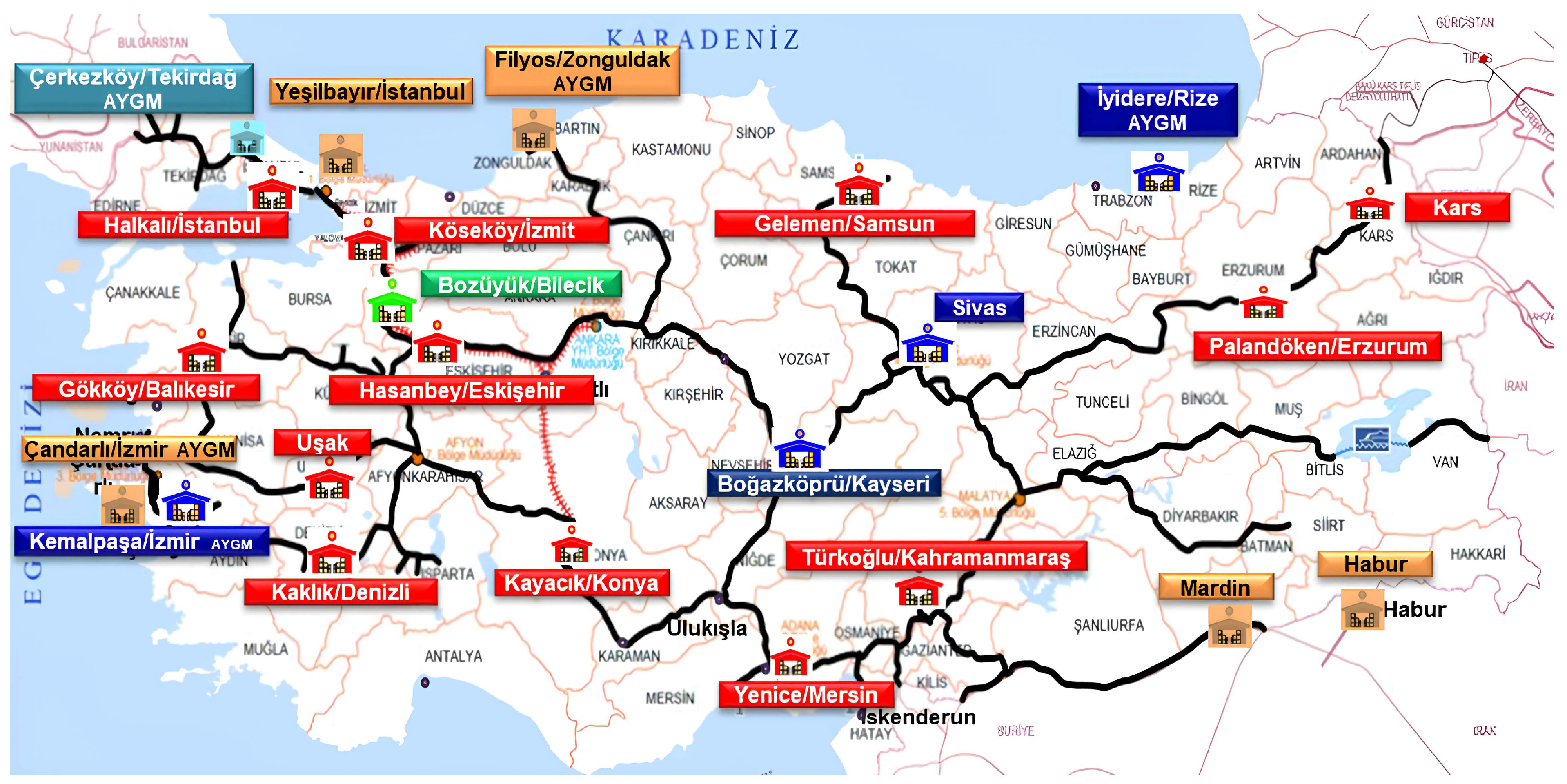
Intermodal transportation activities in logistics centers are important, and these activities should be evaluated for efficiency and effectiveness. In this study, considering the 12 logistics centers in Türkiye, the most appropriate intermodal transportation types in these areas are evaluated. In the information obtained from the Republic of Turkey Ministry of Transport and Infrastructure [45], the red areas indicated in Figure 1 represent the logistics centers that have been put into operation, the dark blue areas represent the logistics centers under construction, the light blue is in the tender phase, the green areas represent completed projects, and the yellow areas are in the study and planning stages. The study discusses 12 logistics centers that are open for operation and indicated in red. These centers are Gelemen/Samsun, Köseköy/İzmit, Uşak, Halkalı/İstanbul, Hasanbey/Eskişehir, Gökköy/Balıkesir, Kaklık/Denizli, Türkoğlu/Kahramanmaraş, Palandoken/Erzurum, Kayacık/Konya, Yenice/Mersin, and Kars.
Different intermodal transportation activities are carried out in the logistics centers discussed. In these activities, while highway transportation and railway transportation are carried out as unimodal transportation; highway/railway, highway/airway, and highway/marine transportation activities are carried out as intermodal transportation. According to the 2020 Annual Report published by the General Directorate of Turkish State Railways, some characteristics of logistics centers are presented in Table 2 for each center and are used in this study.
The study is conducted according to the methodology algorithm shown in Algorithm 1. In this study, an evaluation is made for each logistics center by considering goals (cost, carbon emissions, transportation risk, and transportation time) under the transportation distance and transportation amount constraints. In this study, transportation risk refers to operational risks associated with freight transportation activities, including accident probability, cargo damage risk, and safety-related factors, that may differ across transportation modes. These risk values were obtained from the study of Derse et al. [47], which provides quantitative risk assessments for hazardous material transportation modes. The values used in this study represent comparative operational risk levels between transportation modes. While making this evaluation, a weighted goal programming model is being developed and the weights in the developed model are obtained by the Fuzzy AHP method.
Algorithm 1. The algorithm of the methodology
Step 1: Define evaluation criteria
    (Cost, Carbon Emission, Transportation Risk, Transportation Time)
Step 2: Collect expert judgments for pairwise comparison
Step 3: Apply Fuzzy AHP method
    - Compute fuzzy synthetic extent values
    - Calculate criteria weights
Step 4: Define operational scenarios
    based on transport distance and shipment volume
Step 5: Formulate weighted goal programming model.
Step 6: Integrate Fuzzy AHP criteria weights into the objective functions.
Step 7: Solve the optimization model using CPLEX solver
Step 8: Determine the optimal transport mode for each scenario.
Output:
Optimal transport mode decision for logistics centers.
The proposed framework provides a robust decision-making structure by integrating Fuzzy AHP with goal programming. The robustness of the framework arises from three complementary methodological components. First, the Fuzzy AHP method allows the incorporation of uncertainty in expert judgments when determining the relative importance of decision criteria. Second, the goal programming model enables the simultaneous optimization of multiple conflicting objectives such as cost, carbon emissions, transportation risk, and transportation time. Third, the scenario-based structure evaluates the performance of transport alternatives under different operational conditions, particularly transportation distance and shipment volume. The integration of these components enables the proposed model to generate more reliable and flexible transport decisions for logistics centers.
AHP method was originally developed by Saaty as an MCDM method [48]. The fuzzy logic approach was also developed by Zadeh [49]. There are different studies combining these two methods, considering the situation of decision-makers under uncertainty. In this study, the method developed by Chang [50] was applied to find the weights with the Fuzzy AHP method. The applied Fuzzy AHP method steps are as follows.
Step 1. Decision-makers compare the importance of criteria using linguistic variables such as “equally important”, “moderately more important”, or “strongly more important”. These linguistic judgments are represented by triangular fuzzy numbers. A ˜ triangular fuzzy number is defined as A ˜ (l,m,u), where l = lower bound, m = most probable value, and u = upper bound.
The pairwise comparison matrix is expressed as:
A ˜ = 1 a 1 n ˜ a n 1 ˜ 1
where a i j ˜ = l i j ,   m i j ,   u i j represents the fuzzy comparison value between criteria i and j. It is the step of making pairwise comparisons between criteria and converting them to triangular fuzzy numbers according to their linguistic terms. The triangular fuzzy scale equivalents used are presented in Table 3 as developed by Chang [50].
Step 2. After constructing the fuzzy comparison matrix, the synthetic extent value for each criterion is calculated using Chang [50]’s extent analysis method. In this step, the fuzzy comparison values obtained from expert judgments are aggregated in order to calculate the fuzzy synthetic extent values for each criterion. These synthetic extent values represent the relative dominance of each criterion within the decision hierarchy and provide the basis for comparing the importance of criteria under uncertainty.
Step 3. To compare the relative importance of criteria, the degree of possibility between fuzzy synthetic extent values is calculated. This step evaluates the likelihood that one criterion is more important than another based on the overlap of their fuzzy numbers. By comparing these fuzzy extent values, the relative preference of each criterion over the others can be determined. This process enables the transformation of fuzzy comparisons into comparable priority measures.
Step 4. Based on the degree of possibility values obtained in the previous step, the weight of each criterion is calculated (Equation (1)). The minimum degree of possibility for each criterion is determined and used to construct the weight vector:
W = (d(A1), d(A2), …, d(An))
where d(Ai) represents the relative importance value of criterion i. In this step, the importance level of each criterion (n) is calculated according to the other criteria (i = 1, …, n; j = 1, …, n).
Step 5. The calculated weight values are normalized to ensure that the total weight of all criteria equals one. The normalized weight vector (Equation (2)) is obtained as follows:
Wi = (d(A1)/∑d(Ai), d(A2)/∑d(Ai), …, d(An)/∑d(Ai))
These normalized weights represent the final importance levels of the evaluation criteria and are subsequently used in the goal programming model.
Goal programming is a well-known modification and extension of linear programming, developed in the early 1960s thanks to the work of Charnes and Cooper [51]. Goal programming can be used as an effective approach to handle a decision with multiple and conflicting goals. Also, the objective function of a goal programming model may consist of inhomogeneous units of measure [52]. The goal programming general objective function model is Equation (3) and the constraint equation is Equation (4). The wj factors weigh the problem hierarchy. Bj represents the objective goal of the jth resource. aji is the usage of jth resource of every possible alternative ith decision.
Minimize   z :   j = 1 J w j   ( d j + ,   d j )
i = 1 N ( a ji   x i ) d j + + d j = B j ;   j = 1 ,   ,   m
The integrated AHP method and goal programming model embody the AHP results in the goal programming model [52]. Moreover, the combined AHP–Goal Programming approach attempts to minimize the overall deviations in the objective function given the various goals and objectives. In the study, AHP is used by evaluating important criteria and calculating their weights, which forms the basis for goal programming. The obtained Fuzzy AHP weight values are entered as wj into the developed weighted goal programming model. The nomenclature of the developed weighted goal programming is reflected in Table 4.
Equation (5) represents the objective function equation. This equation considers the minimization of the sums of cost, carbon emission amount, transportation risk, and transportation time according to transportation modes. Equations (6)–(9) represent the goal constraint equations for cost, carbon emission, transportation risk, and transportation time, respectively. Equation (10) shows that the entire quantity demanded must be moved. Equation (11) states that the sum of the weights used should be one. Equation (12) is the decision variables’ constraint equation.
Minimize   z :   w 1   · d 11   + w 2   · d 21   + w 3   · d 31   + w 4   · d 41  
i = 1 I m = 1 M x i m · ( d s i m · c 1 · m k + u z d s i m ) c i · m k d 11 + d 12   = g 1
i = 1 I m = 1 M x i m · ( d s i m · e m 1 · m k + u z d s i m ) e m i · m k d 21 + d 22   = g 2
i = 1 I m = 1 M x i m · ( d s i m · r 1 · m k + u z d s i m r i · m k ) d 31 + d 32   = g 3
i = 1 I m = 1 M x i m · ( d s i m / s 1 + u z d s i m / s i ) d 41 + d 42 = g 4
m = 1 M x i m · c a p m m k                                                                                                 ; i
j = 1 J w j   = 1
0 d j 1 ,   d j 2 ;   0 x i j   a n d   i n t e g e r                                                                     ; i , j
The i parameter, expressed in the model, represents logistics centers. This paremeter covers Gelemen/Samsun, Köseköy/İzmit, Uşak, Halkalı/İstanbul, Hasanbey/Eskişehir, Gökköy/Balıkesir, Kaklık/Denizli, Türkoğlu/Kahramanmaraş, Palandoken/Erzurum, Kayacık/Konya, Yenice/Mersin, and Kars. The m parameter, expressed in the model, denotes road, air, marine, and rail transport. The j parameter, expressed in the model, represents the goal indices and these goals are cost, carbon emission amount, transportation risk, and transportation time. c m , e m m and c a p m parameters expressed in the model, excluding airline data, were taken from the study of Sahin et al. [16]. capm refers to the capacity for each transport mode. The r m value is taken from Derse and Göçmen [28]’s study. s m , mk, uz and gj values are user input. wj values are the weight values obtained with Fuzzy AHP. The dsim values expressed in the model are the values in Table 2 taken from the General Directorate of Turkish State Railways’s 2020 annual report [46].

4. Results

In the study, in the logistics centers of Gelemen/Samsun, Köseköy/İzmit, Uşak, Halkalı/İstanbul, Hasanbey/Eskişehir, Gökköy/Balıkesir, Kaklık/Denizli, Türkoğlu/Kahramanmaraş, Palandoken/Erzurum, Kayacık/Konya, Yenice/Mersin, and Kars the unimodal and intermodal transport structures are evaluated. While making this evaluation, under the transportation amount and transportation distance constraints, the transportation cost, the carbon emission resulting from transportation, transportation risk, and transportation time are considered as goal values. The mentioned criteria are determined by literature review and expert opinion. These evaluation criteria are examined for weighting in the Fuzzy AHP system. Table 5 presents the initial triangular fuzzy numbers for the evaluation criteria and the results obtained from the fuzzy AHP steps. Expert opinions are taken for these values. In this study, the opinions of five experts are taken; experts work at logistics center.
As a result of the weighted goal programming model, which is integrated with the fuzzy AHP weights, transportation decisions have emerged for logistics centers. In the model, the goals aimed to minimize the sum of transportation cost, carbon emission resulting from transportation, transportation risk, and transportation time goal values, and each goal aims to achieve minimization within itself.
In order to evaluate the performance of different transport modes under varying operational conditions, a scenario-based approach was adopted in this study. The scenarios were constructed based on two key operational variables: transportation distance and shipment volume. These variables were selected because they are among the most influential factors affecting transport mode selection in logistics operations. The transportation distance represents the spatial dimension of logistics operations and reflects typical route lengths between logistics centers and their destination markets. Shipment volume represents the operational scale of freight movements and directly affects transportation cost-efficiency and modal feasibility. In the scenarios, the product quantities to be transported are determined as 20 tons, 200 tons, 2000 tons and 10,000 tons. Transport distances are entered as 40 km, 400 km, and 4000 km. Table 6 shows the results of 20 tons for different transport distances. According to the table, it has been decided that all transportation should be made in the form of unimodal transportation and by the highway. In addition, as seen in the table, each transportation decision is made for one highway vehicle. It is abbreviated as Highway HW.
Table 7 shows the results for 200 tons for different transport distances. According to the table, the study has decided to make the modes of transportation unimodal (railway) and intermodal (highway/railway, highway/marine). According to the table, the number of every vehicle used is one. Table 8 shows the results of 2000 tons for different transport distances. According to the table, the study has decided to make the modes of transportation unimodal (railway) and intermodal (highway/railway, highway/marine). According to the table, one vehicle is sufficient for highway/marine transportation, and three vehicles are required for railway or highway/railway transportation.
Table 9 shows the results of 10,000 tons for different transport distances. According to the table, the study has decided to make the modes of transportation unimodal (railway) and intermodal (highway/railway, highway/marine). According to the table, different numbers of vehicles are needed for unimodal or intermodal transportation decisions.

5. Discussion

In the study, transport modes are evaluated, and unimodal (highway transportation, railway transportation) and intermodal (highway/railway, highway/airway and highway/marine transportation) systems are discussed for 12 active logistics centers in Türkiye. This study aligns with and expands on previous research on intermodal transportation by incorporating a multi-criteria decision-making approach that balances cost, environmental impact, and operational efficiency. Kreutzberger et al. [13] and Braekers et al. [14] emphasize the external cost advantages of intermodal transport over unimodal transport, particularly in long-distance logistics. Similarly, Pekin et al. [15] demonstrate that intermodal transportation becomes cost-effective as the transport distance increases, a finding that is also supported by the results of this study. However, unlike these studies, the present research integrates transportation risk and carbon emissions into the decision-making process, providing a more comprehensive evaluation of intermodal logistics. Furthermore, Sahin et al. [16] evaluate different intermodal transportation models for Türkiye but focus primarily on cost analysis. While their study highlights the advantages of sea–road, sea–rail, and road–rail transport combinations, it does not integrate a weighted decision model such as Fuzzy AHP. In contrast, the proposed approach provides a more robust decision-making framework for transport mode selection by integrating Fuzzy AHP and goal programming. In this framework, Fuzzy AHP is used to determine the relative importance of decision criteria such as cost, carbon emissions, transportation time, and transportation risk, while the goal programming model optimizes transport mode selection by considering these weighted criteria simultaneously. This integration enables a structured prioritization of multiple criteria and supports more balanced transportation decisions under different operational scenarios. Martínez–López et al. [17] consider environmental costs in intermodal transport, and their approach relies on a mathematical model. The present study overcomes this limitation by testing different shipment sizes and distances, allowing for a more dynamic and flexible application of intermodal transport strategies. The results of this study also build upon recent advancements in multimodal logistics optimization. For example, Zečević et al. [12] apply multi-criteria decision-making (MCDM) methods to intermodal terminal location selection, focusing on infrastructure placement rather than transport mode efficiency. Similarly, Tadić et al. [53] explore intermodal network planning, but their research lacks an integrated cost-risk-environmental impact assessment. By combining Fuzzy AHP and goal programming, this study provides a novel contribution by systematically weighting and optimizing intermodal transport decisions. In summary, while previous studies have acknowledged the benefits of intermodal transportation, they often focus on isolated factors such as cost or infrastructure. This research advances the field by integrating multiple evaluation criteria, considering real-world constraints such as shipment size, distance, and environmental impact, making it a valuable reference for future research and policy development.
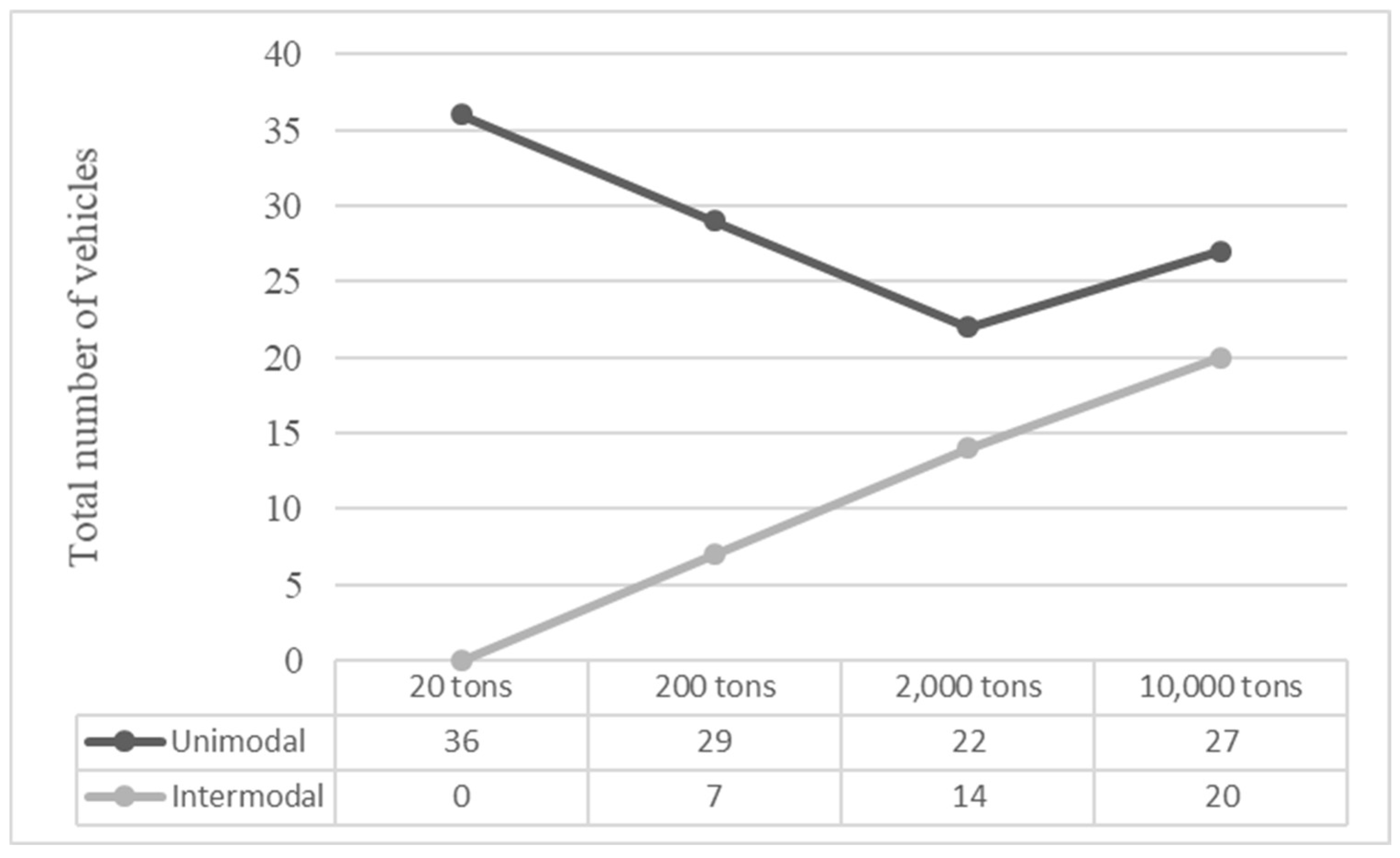
As a result of the scenarios applied according to Figure 2, more unimodal transportation decisions are made. Figure 2 presents a comparison between unimodal and intermodal transport modes, illustrating the shift towards intermodal transport as shipment volume increases. In the study, it is seen that the increase in the amount of goods to be transported enables more intermodal transportation decisions to be made. Considering that the weight of the cost and carbon emission goals are high, it can be assumed that the reason for this is that intermodal transportation provides cost and carbon emission advantages in large quantities. Similarly, Kreutzberger et al. [13] state that intermodal transport is more environmentally friendly than unimodal road transport for the transport of goods. An et al. [54] state in their study that promoting multi-transportation will potentially offer an effective solution to reduce carbon emissions and encourage modal changes towards sustainable transportation. Although some findings align with general logistics industry observations—such as the increasing advantage of intermodal transportation with larger shipment volumes—the proposed model provides a structured quantitative framework that enables decision-makers to evaluate these relationships systematically. Instead of relying on general assumptions, the model quantifies the trade-offs between cost, carbon emissions, transportation risk, and time across multiple logistics centers and operational scenarios. This allows transportation planners to identify the most appropriate transport mode combinations for specific shipment volumes and distances.
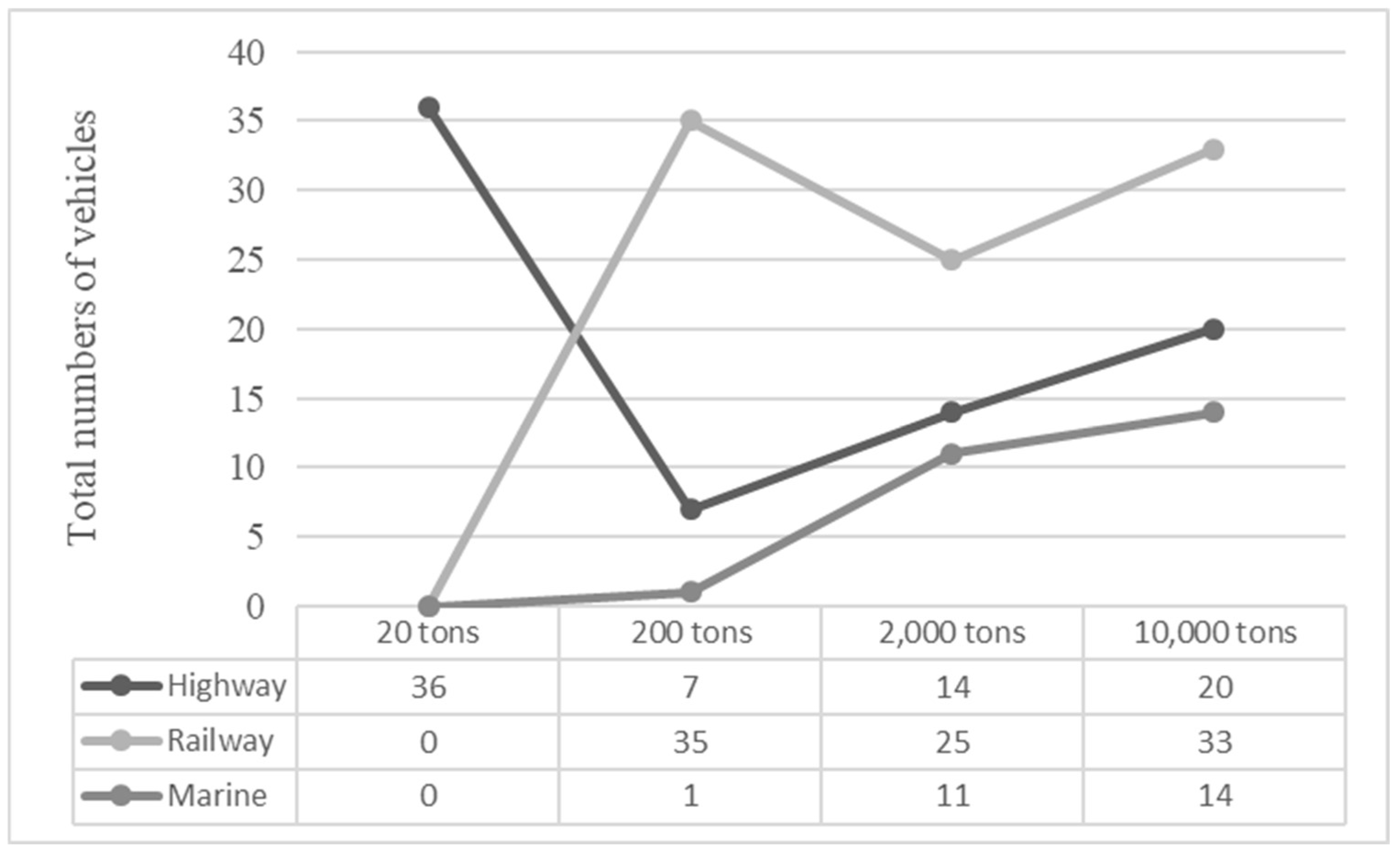
Figure 3 shows that, among all transportation activities, the most decisions, except for low tonnages (20 tons), are made in favor of rail transport, followed by road and sea transport. The main reason for this is the proximity of logistics centers and rail connections.
Table 10 and Table 11 show cases where distance and transport amount are considered individually. Considering the distances in all scenarios in Table 10, it is seen that unimodal and intermodal decisions are made for each logistics center. Table 11 shows that the change in the amount of transport and the unimodal and intermodal decisions differ. This shows that for unimodal and intermodal transport choices, changes in the amount of transport are more effective than changes in distance.
The study results provide managerial implications for the development of intermodal transportation. It is seen that multimodal transportation modes should be used instead of unimodal transportation, especially as the number of products to be transported increases. It is seen that, with this choice, transportation can be achieved with less greenhouse gas emissions and costs. In this context, strategies to develop vehicles and infrastructures and increase the number of qualified personnel working in the field will help increase intermodal transportation activities, and intermodal terminal yard management can be improved by integrating truck, ship and train schedules [55]. Moreover, Gandhi et al. [56]’s study shows that choosing multimodal transportation instead of unimodal transportation can reduce negative externalities (such as pollution). The study also shows that increasing logistics efficiency provides uninterrupted transfer, and significantly increases operational reliability and efficiency.

6. Implications (Practical and Theoretical)

The findings of this study provide important practical and theoretical implications for the development of intermodal transportation strategies in logistics centers. From a practical perspective, the study offers a structured decision-support framework for selecting the most appropriate transportation mode based on multiple criteria, including transportation cost, carbon emissions, transportation risk, and transportation time. The integration of Fuzzy AHP and goal programming enables decision-makers to first determine the relative importance of conflicting criteria under uncertainty and then optimize transportation decisions accordingly. This integrated approach allows logistics managers and policymakers to evaluate alternative transportation configurations more systematically compared to single-objective or purely cost-based evaluations.
The results indicate that the competitiveness of intermodal transportation increases significantly as shipment volumes grow and transportation distances expand. Under these conditions, intermodal solutions provide advantages in terms of both cost-efficiency and environmental performance. These findings suggest that logistics operators and transportation planners should consider intermodal alternatives, particularly for high-volume freight movements. Furthermore, the scenario analyses conducted in this study demonstrate how transportation decisions change under different shipment size conditions, providing practical insights for strategic planning in logistics centers. Policymakers may also use these findings to prioritize infrastructure investments that support rail and maritime transportation, which play a crucial role in enabling efficient intermodal transport systems. Such investments can contribute to improved resource utilization, reduced highway congestion, and lower carbon emissions within national logistics networks.
From a theoretical perspective, this study contributes to the literature on multi-criteria decision-making in transportation logistics by proposing a hybrid decision framework that integrates Fuzzy AHP with goal programming. While previous studies often evaluate transportation alternatives primarily based on cost considerations, this research incorporates multiple sustainability-related criteria, including environmental impact and transportation risk, within the optimization framework. The use of Fuzzy AHP enables the model to capture the uncertainty inherent in expert judgments when determining criteria weights, whereas goal programming provides a systematic mechanism for balancing multiple objectives simultaneously. Although logistics centers are considered nodes within the broader transport network rather than fully independent decision-makers, they still play a critical operational role in determining feasible transport alternatives and operational configurations. In this context, the proposed integrated Fuzzy AHP–Goal Programming framework supports network-level transportation planning by evaluating alternative transport modes under different operational scenarios. Therefore, the methodology can be flexibly applied in different logistics networks while still respecting the structural dependencies that exist between logistics centers and the overall transport system.
Another important theoretical contribution of this study lies in its scenario-based analytical structure. By examining different shipment volume conditions, the research demonstrates how transportation mode preferences shift depending on operational circumstances. The findings also reveal that certain modes, such as air transportation, are not selected in any scenario due to their relatively high cost and carbon emission levels within the evaluated context. These insights contribute to ongoing discussions in sustainable transportation literature regarding the trade-offs between economic efficiency and environmental performance in freight transportation systems.
Overall, this research provides a comprehensive framework that can assist both researchers and practitioners in understanding and optimizing transportation mode selection within logistics centers. Future studies may extend this framework by incorporating additional real-world factors such as infrastructure capacity constraints, dynamic demand fluctuations, network congestion conditions, and fuel price variability, which may further enhance the applicability of intermodal transport optimization models.

7. Conclusions

Logistics centers play a crucial role in regional economies by optimizing transportation activities and enhancing supply chain efficiency. Among their core functions, intermodal transportation stands out as a key strategy for reducing costs, minimizing carbon emissions, and improving overall logistics performance. However, effective intermodal transport requires careful evaluation of multiple criteria, such as cost, carbon emissions, transport risk, time, distance, and cargo volume.
This study analyzed 12 logistics centers in Türkiye, evaluating the suitability of unimodal (highway, railway) and intermodal (highway/railway, highway/airway, highway/marine) transport modes under various scenarios. A fuzzy AHP-weighted goal programming model was developed to determine the optimal transport mode by balancing cost-effectiveness, environmental impact, and operational efficiency. The results indicate that as cargo volume increases, the preference for intermodal transport grows, reinforcing its potential for long-distance, high-capacity logistics operations. Additionally, CPU-optimized results were obtained within one second using CPLEX, demonstrating the model’s computational efficiency. Logistics centers are considered critical nodes within the transport network rather than completely independent decision-makers. However, they still influence operational transport decisions by selecting among feasible transport alternatives within the network structure. Therefore, the proposed model is intended to support network-level transportation planning by identifying suitable transport mode combinations for different operational conditions.
Despite its contributions, this study has certain limitations. The analysis assumes fixed transport routes without considering real-time dynamic factors such as traffic congestion, seasonal fluctuations, or infrastructure constraints. Future research could integrate real-time data analytics, AI-driven optimization models, or simulation techniques to enhance decision-making adaptability, and the adoption of emerging technologies such as blockchain, IoT, and AI-powered route optimization could transform logistics operations by increasing transparency, security, and efficiency. Moreover, while this study incorporates carbon emissions as a sustainability criterion, additional environmental and social factors—such as air pollution, noise levels, and energy consumption—could be explored for a more comprehensive sustainability assessment. Additionally, the study is specific to Türkiye, but its framework can be applied to different geographical and economic contexts. Future research could compare intermodal transport preferences across various regions, considering infrastructure quality, regulatory frameworks, and economic conditions. Lastly, expanding optimization techniques beyond goal programming—such as genetic algorithms, particle swarm optimization, or ant colony optimization—could provide computationally efficient solutions for complex, large-scale logistics networks.

Author Contributions

Conceptualization, O.D. and M.N.; methodology, O.D. and M.N.; software, O.D. and M.N.; validation, O.D. and M.N.; formal analysis, O.D. and M.N.; investigation, O.D. and M.N.; data curation, O.D. and M.N.; writing—original draft preparation, O.D. and M.N.; writing—review and editing, O.D. and M.N.; visualization, O.D. and M.N. All authors have read and agreed to the published version of the manuscript.

Funding

This research received no external funding.

Data Availability Statement

The original contributions presented in this study are included in the article. Further inquiries can be directed to the corresponding author.

Conflicts of Interest

The authors declare no conflict of interest.

References

  1. Rimienė, K.; Grundey, D. Logistics centre concept through evolution and definition. Eng. Econ. 2007, 54, 87–95. [Google Scholar]
  2. Zarali, F.; Yazgan, H.R.; Delice, Y. A new solution method of ant colony-based logistic center area layout problem. Sadhana 2018, 43, 83. [Google Scholar] [CrossRef]
  3. Mirčetić, D.; Nikoličić, S.; Maslarić, M. Logistic centers: Literature review and papers classification. In Proceedings of the Fifth International Conference Transport and Logistics, Niš, Serbia, 5 June 2014. [Google Scholar]
  4. Meidute, I. Comparative analysis of the definitions of logistics centres. Transport 2005, 20, 106–110. [Google Scholar] [CrossRef]
  5. SteadieSeifi, M.; Dellaert, N.; Nuijten, W.; Van Woensel, T.; Raoufi, R. Multimodal freight transportation planning: A literature review. Eur. J. Oper. Res. 2014, 233, 1–15. [Google Scholar] [CrossRef]
  6. Tadić, S.; Zečević, S. Development of Intermodal Transport and Logistics in Serbia. Int. J. Traffic Transp. Eng. 2012, 2, 380–390. [Google Scholar] [CrossRef] [PubMed]
  7. Roso, V.; Brnjac, N.; Abramovic, B. Inland intermodal terminals location criteria evaluation: The case of Croatia. Transp. J. 2015, 54, 496–515. [Google Scholar] [CrossRef]
  8. Kadłubek, M. Railways in intermodal transport in Poland. Res. Logist. Prod. 2011, 1, 203–211. [Google Scholar]
  9. Tadić, S.; Krstić, M.; Roso, V.; Brnjac, N. Planning an intermodal terminal for the sustainable transport networks. Sustainability 2019, 11, 4102. [Google Scholar] [CrossRef]
  10. Agamez-Arias, A.D.M.; Moyano-Fuentes, J. Intermodal transport in freight distribution: A literature review. Transp. Rev. 2017, 37, 782–807. [Google Scholar] [CrossRef]
  11. Laaziz, E.H. A comparison of intermodal transportation service network design models. In Proceedings of the 2015 International Conference on Industrial Engineering and Systems Management (IESM), Seville, Spain, 21–23 October 2015; pp. 757–762. [Google Scholar]
  12. Zečević, S.; Tadić, S.; Krstić, M. Intermodal transport terminal location selection using a novel hybrid MCDM model. Int. J. Uncertain. Fuzziness Knowl. Based Syst. 2017, 25, 853–876. [Google Scholar] [CrossRef]
  13. Kreutzberger, E.; Macharis, C.; Woxenius, J. Intermodal versus unimodal road freight transport: A review of comparisons of the external costs. In Transportation Economics—Towards Better Performance Systems; Taylor & Francis: Milton Park, UK, 2006; pp. 31–56. [Google Scholar]
  14. Braekers, K.; Janssens, G.K.; Caris, A. Review on the comparison of external costs of intermodal transport and unimodal road transport. In Proceedings of the BIVEC-GIBET Transportation Research Day, Brussels, Belgium, 27 May 2009; pp. 875–890. [Google Scholar]
  15. Pekin, E.; Macharis, C.; Meers, D.; Rietveld, P. Location Analysis Model for Belgian Intermodal Terminals: Importance of the value of time in the intermodal transport chain. Comput. Ind. 2013, 64, 113–120. [Google Scholar] [CrossRef]
  16. Sahin, B.; Yilmaz, H.; Ust, Y.; Guneri, A.F.; Gulsun, B.; Turan, E. An approach for economic analysis of intermodal transportation. Sci. World J. 2014, 2014, 630320. [Google Scholar] [CrossRef] [PubMed]
  17. Martínez-López, A.; Sobrino, P.C.; González, M.C.; Trujillo, L. Optimization of a container vessel fleet and its propulsion plant to articulate sustainable intermodal chains versus road transport. Transp. Res. Part D Transp. Environ. 2018, 59, 134–147. [Google Scholar] [CrossRef]
  18. Cansiz, Ö.F.; Ünsalan, K. Karma Taşımacılık Türleri Esas Alınarak Rota Karşılaştırılması: Vaka Analizi [Comparison of Routes Based on Combined Transportation Types: Case Analysis]. Fırat Üniversitesi Mühendislik Bilim. Derg. 2020, 32, 11–21. [Google Scholar] [CrossRef]
  19. Hruška, R.; Kmetík, M.; Chocholáč, J. Selection of the transport mode using the AHP method within distribution logistics of motor fuels. Promet Traffic Transp. 2021, 33, 905–917. [Google Scholar]
  20. Arnold, P.; Peeters, D.; Thomas, I. Modelling a rail/road intermodal transportation system. Transp. Res. Part E Logist. Transp. Rev. 2004, 40, 255–270. [Google Scholar]
  21. Li-li, Q.; Yan, C. An interactive integrated MCDM based on FANN and application in the selection of logistic center location. In Proceedings of the 2007 International Conference on Management Science and Engineering, Harbin, China, 20–22 August 2007; pp. 162–167. [Google Scholar]
  22. Chang, T.-S. Best routes selection in international intermodal networks. Comput. Oper. Res. 2008, 35, 2877–2891. [Google Scholar] [CrossRef]
  23. Heggen, H.; Molenbruch, Y.; Caris, A.; Braekers, K. Intermodal container routing: Integrating long-haul routing and local drayage decisions. Sustainability 2019, 11, 1634. [Google Scholar] [CrossRef]
  24. Wang, M.H.; Lee, H.S.; Chu, C.W. Evaluation of logistic distribution center selection using the fuzzy MCDM approach. Int. J. Innov. Comput. Inf. Control 2010, 6, 5785–5796. [Google Scholar]
  25. Bruns, F.; Knust, S. Optimized load planning of trains in intermodal transportation. OR Spectr. 2012, 34, 511–533. [Google Scholar]
  26. Nossack, J.; Pesch, E. A truck scheduling problem arising in intermodal container transportation. Eur. J. Oper. Res. 2013, 230, 666–680. [Google Scholar] [CrossRef]
  27. Bhattacharya, A.; Kumar, S.A.; Tiwari, M.K.; Talluri, S. An intermodal freight transport system for optimal supply chain logistics. Transp. Res. Part C Emerg. Technol. 2014, 38, 73–84. [Google Scholar] [CrossRef]
  28. Derse, O.; Göçmen, E. Transportation mode choice using fault tree analysis and mathematical modeling approach. J. Transp. Saf. Secur. 2021, 13, 642–660. [Google Scholar] [CrossRef]
  29. Zhang, H.; Ouyang, M.; Sun, W.; Hong, L. An approach for accessibility assessment and vulnerability analysis of national multimodal transport systems. Risk Anal. 2023, 43, 2312–2329. [Google Scholar] [CrossRef] [PubMed]
  30. Chupin, A.; Ragas, A.A.M.A.; Bolsunovskaya, M.; Leksashov, A.; Shirokova, S. Multi-objective optimization for intermodal freight transportation planning: A sustainable service network design approach. Sustainability 2025, 17, 5541. [Google Scholar] [CrossRef]
  31. Topaloglu Yildiz, S.; Doymuş, M. Multi-objective intermodal transportation planning with real-life application. Marit. Policy Manag. 2025, 52, 745–763. [Google Scholar] [CrossRef]
  32. Sörensen, K.; Vanovermeire, C.; Busschaert, S. Efficient metaheuristics to solve the intermodal terminal location problem. Comput. Oper. Res. 2012, 39, 2079–2090. [Google Scholar] [CrossRef]
  33. Teye, C.; Bell, M.G.; Bliemer, M.C. Urban intermodal terminals: The entropy maximising facility location problem. Transp. Res. Part B Methodol. 2017, 100, 64–81. [Google Scholar] [CrossRef]
  34. Paçacı, B.; Erol, S.; Çubuk, M.K. AHP–MARCOS–TOPSIS Approach in Logistics Center Site Selection: Türkiye Example. Sustainability 2026, 18, 604. [Google Scholar] [CrossRef]
  35. Macharis, C.; Van Hoeck, E.; Pekin, E.; Van Lier, T. A decision analysis framework for intermodal transport: Comparing fuel price increases and the internalisation of external costs. Transp. Res. Part A Policy Pract. 2010, 44, 550–561. [Google Scholar] [CrossRef]
  36. Baykasoğlu, A.; Dudaklı, N.; Subulan, K.; Taşan, A.S. An integrated fleet planning model with empty vehicle repositioning for an intermodal transportation system. Oper. Res. 2022, 22, 2063–2098. [Google Scholar] [CrossRef]
  37. Ertem, M.A.; Akdogan, M.A.; Kahya, M. Intermodal transportation in humanitarian logistics with an application to a Turkish network using retrospective analysis. Int. J. Disaster Risk Reduct. 2022, 72, 102828. [Google Scholar] [CrossRef]
  38. Shoukat, R.; Zhang, X. Global and local supply chain sourcing design: Cost and delivery reliability comparison in unimodal and intermodal transportation. Int. J. Shipp. Transp. Logist. 2022, 15, 164–190. [Google Scholar] [CrossRef]
  39. Miyoba, F.; Mujuni, E.; Ndiaye, M.; Libati, H.M.; Abu-Mahfouz, A.M. Sustainable rail/road unimodal transportation of bulk cargo in Zambia: A review of algorithm-based optimization techniques. Mathematics 2024, 12, 348. [Google Scholar] [CrossRef]
  40. Guo, D.; Su, Y.; Zhang, X.; Yang, Z.; Duan, P. Multi-Objective Optimization of Short-Inverted Transport Scheduling Strategy Based on Road–Railway Intermodal Transport. Sustainability 2024, 16, 6310. [Google Scholar] [CrossRef]
  41. Petralia, M.M.; Tebaldi, L. From Road Transport to Intermodal Freight: The Formula 1 Races Logistics Case. Sustainability 2025, 17, 6889. [Google Scholar] [CrossRef]
  42. Jiang, M.; Lv, S.; Zhang, Y.; Wu, F.; Pei, Z.; Wu, G. A low-carbon scheduling method for container intermodal transport using an improved grey Wolf–Harris hawks hybrid algorithm. Appl. Sci. 2025, 15, 4698. [Google Scholar] [CrossRef]
  43. Huang, Y.; Cui, H.; Lu, Y.; Sun, Y. Modeling a Reliable Intermodal Routing Problem for Emergency Materials in the Early Stage of Post-Disaster Recovery Under Uncertainty of Demand and Capacity. Appl. Syst. Innov. 2026, 9, 27. [Google Scholar] [CrossRef]
  44. Sharmin, A.; Martinez-Ferguson, M.; Camur, M.C.; Li, X. Decarbonizing Freight Through Intermodal Transport: An Operations Research Perspective—Part II: Modal Configurations and Sustainability Pathways. Futur. Transp. 2026, 6, 37. [Google Scholar] [CrossRef]
  45. Republic of Turkey Ministry of Transport and Infrastructure. Available online: https://www.tcdd.gov.tr/kurumsal/lojistik-merkezler (accessed on 7 November 2025).
  46. General Directorate of Turkish State Railways, 2020 Annual Report. Available online: http://www.sp.gov.tr/upload/xSPRapor/files/Mjq9A+TCDD_20_FR.pdf (accessed on 10 March 2025).
  47. Derse, O.; Oturakci, M.; Dagsuyu, C. Risk Analysis Application to Hazardous Material Transportation Modes. Transp. Res. Rec. J. Transp. Res. Board 2022, 2676, 586–597. [Google Scholar] [CrossRef]
  48. Saaty, T.L. The Analytic Process: Planning, Priority Setting, Resources Allocation; McGraw: New York, NY, USA, 1980. [Google Scholar]
  49. Zadeh, L.A. Fuzzy sets. Inf. Control 1965, 8, 338–853. [Google Scholar] [CrossRef]
  50. Chang, D.-Y. Applications of the extent analysis method on fuzzy AHP. Eur. J. Oper. Res. 1996, 95, 649–655. [Google Scholar] [CrossRef]
  51. Charnes, A.; Cooper, W.W. Management models and industrial applications of linear programming. Manag. Sci. 1957, 4, 38–91. [Google Scholar] [CrossRef]
  52. Bertolini, M.; Bevilacqua, M. A combined goal programming—AHP approach to maintenance selection problem. Reliab. Eng. Syst. Saf. 2006, 91, 839–848. [Google Scholar] [CrossRef]
  53. Tadić, S.; Krstić, M.; Brnjac, N. Selection of efficient types of inland intermodal terminals. J. Transp. Geogr. 2019, 78, 170–180. [Google Scholar] [CrossRef]
  54. An, Z.; Heinen, E.; Watling, D. The level and determinants of multimodal travel behavior: Does trip purpose make a difference? Int. J. Sustain. Transp. 2023, 17, 103–117. [Google Scholar] [CrossRef]
  55. Archetti, C.; Peirano, L.; Speranza, M.G. Optimization in multimodal freight transportation problems: A Survey. Eur. J. Oper. Res. 2022, 299, 1–20. [Google Scholar] [CrossRef]
  56. Gandhi, N.; Kant, R.; Thakkar, J.J. Evaluation of benefits due to adoption of enablers of unimodal road to intermodal railroad freight transportation. Transp. Policy 2024, 146, 295–311. [Google Scholar] [CrossRef]
Figure 1. Logistics centers for Türkiye [45].
Mathematics 14 00992 g001
Figure 2. Unimodal transport versus intermodal transport.
Mathematics 14 00992 g002
Figure 3. Transport modes in total transportation.
Mathematics 14 00992 g003
Table 1. Comparison table with the literature.
ReferencesTransportationScopeEvaluation Criteria’sMethodologies
Macharis et al. [35]Unimodal (road); Intermodal (rail + road)Impact of fuel price increases on intermodal transport market areaFuel price, transport cost, external costs, modal shiftGIS-based model, scenario analysis
Pekin et al. [15]Unimodal (road); Intermodal (rail + road)Market area analysis of intermodal terminals in BelgiumCost, value of time, backhaul, post-haulage distanceGIS Network Model, scenario analysis
Sahin et al. [16]Unimodal (road); Intermodal (sea + road, sea + rail, road + rail, sea + road + rail)Cost comparison of unimodal and intermodal transport alternativesTransportation cost, external costs, technical, economic and operational parametersCost analysis model, Comparative case study
Baykasoğlu et al. [36]MultimodalIntegrated fleet planning in intermodal logistics networks in EuropeTransport cost, fleet utilization, outsourcing, allocation efficiencyMixed Integer Linear Programming (MILP), optimization
Ertem et al. [37]Unimodal (road); Intermodal (rail + road + waterway)Intermodal transportation for humanitarian logistics under disaster disruptionsDemand satisfaction, network disruptions, capacity constraintsMulti-period Multicommodity Network Flow Model, mathematical programming
Shoukat and Zhang [38]Global and local sourcing transportationSupplier sourcing strategy comparison in supply chainsCost and delivery reliabilityBi-objective MILP, Multi-objective Genetic Algorithm, Pareto Analysis
Miyoba et al. [39]Intermodal (rail + road)Systematic review of mathematical optimization techniques for unimodal rail/road freight transport in ZambiaCO2 emissions, transport cost, sustainabilitySystematic review; comparison of optimization techniques
Guo et al. [40]Intermodal (rail + road)Multi-objective scheduling optimization for road–rail intermodal scenarioCost, delivery time window, number of vehicles, carbon emissionsMathematical modeling: Scheduling optimization model; vehicle unloading
Petralia and Tebaldi [41]Intermodal (rail + road)Unimodal–intermodal comparing, network designCost, carbon emissions, operational complexityCase study, scenario analysis
Jiang et al. [42]Container + MultimodalLow-carbon container intermodal scheduling for inland port systemsTransportation cost, carbon emissions, time efficiency, soft time windowMulti-objective Optimization
Huang et al. [43]Multimodal (disaster logistics)Intermodal route for emergency supplies after disaster; demand and capacity uncertaintyTransport time, reliability, costFuzzy Linear Programming, case study
Sharmin et al. [44]Unimodal–intermodal comparisonApplication of OR models to decarbonization in intermodal transport; chronological, modal and sustainability perspectiveEmission reduction, energy use, network resilience, efficiency gainsOR framework; strategic–tactical–operational decision levels
Paçacı et al. [34] MultimodalDetermining the most suitable location for an economy-based logistics centerCost, service, socio-economic criterias, insfrastructureMCDM (AHP, MARCOS, TOPSIS)
This StudyUnimodal (highway, railway); intermodal (highway/railway, highway/airway, highway/marine)Unimodal and intermodal comparison for logistics centers in TürkiyeCost, emissions and riskFuzzy approach, MCDM (AHP), Mathematical Programming Model
Table 2. Some information for logistics centers [46].
Logistics Centers in OperationJunction Line (km)Highway (km)Nearest Port (km)Nearest Airport (km)
Gelemen/Samsun32513
Köseköy/İzmit--1512
Uşak--2157.5
Halkalı/İstanbul--1019
Hasanbey/Eskişehir-323710
Gökköy/Balıkesir--18717
Kaklık/Denizli--25030
Türkoğlu/Kahramanmaraş--15630
Palandöken/Erzurum-223216
Kayacık/Konya--3663
Yenice/Mersin-14223
Kars5.5-27712
Table 3. The triangular fuzzy scale of AHP values [50].
The Scale of Classic AHPFuzzy Triangular ScaleLinguistic Terms
1(1,1,1)Equally Important
3(2,3,4)Weakly Important
5(4,5,6)Fairly Important
7(6,7,8)Strongly Important
9(8,9,9)Absolutely Important
2(1,2,3)Intermittent Values
4(3,4,5)
6(5,6,7)
8(7,8,9)
Table 4. Nomenclature of the goal programming model.
NomenclatureDescription
I, M, Jset of the logistics center, set of modes, set of goals
c m transport cost of modes (highway, railway, airway, marine)
e m m emission amount by modes
r m risk value by modes
s m transportation time by modes
c a p m capacity by modes
m k amount to be moved
uzdistance to move
wjweights of goals
dsimdistance of logistics centers to modes
gjthe value of the goal
dj1, dj2positive and negative deviation values from goal j, respectively
x i m integer decision variable showing how many of which modes should be used from which logistics center
Table 5. Triangular fuzzy number values of evaluation criteria and weight values.
CostEmissionRiskTime
Cost(1, 1, 1)(1, 1, 1)(2, 3, 4)(4, 5, 6)
Emission(1, 1, 1)(1, 1, 1)(2, 3, 4)(2, 3, 4)
Risk(1/4, 1/3, 1/2)(1/4, 1/3, 1/2)(1, 1, 1)(3, 4, 5)
Time(1/6, 1/5, 1/4)(1/4, 1/3, 1/2)(1/5, 1/4, 1/3)(1, 1, 1)
Weight0.3990.3510.1740.076
Table 6. Evaluation of different transport distances for 20 tons.
Logistics Centers in OperationAmount to Be Transported (20 Tons)/Distance (40 km)Amount to Be Transported (20 Tons)/Distance (400 km)Amount to Be Transported (20 Tons)/Distance (4000 km)
1HW1HW1HW1
2HW1HW1HW1
3HW1HW1HW1
4HW1HW1HW1
5HW1HW1HW1
6HW1HW1HW1
7HW1HW1HW1
8HW1HW1HW1
9HW1HW1HW1
10HW1HW1HW1
11HW1HW1HW1
12HW1HW1HW1
Highway: HW.
Table 7. Evaluation of different transport distances for 200 tons.
Logistics Centers in OperationAmount to Be Transported (20 Tons)/Distance (40 km)Amount to Be Transported (20 Tons)/Distance (400 km)Amount to Be Transported (20 Tons)/Distance (4000 km)
1HW/RW1HW/RW1HW/RW1
2RW1RW1RW1
3RW1RW1RW1
4RW1RW1RW1
5RW1RW1RW1
6RW1RW1RW1
7RW1RW1RW1
8RW1RW1RW1
9RW1RW1RW1
10RW1RW1RW1
11HW/MR1RW1RW1
12HW/RW1HW/RW1HW/RW1
Highway: HW; Railway: RW; Marine: MR.
Table 8. Evaluation of different transport distances for 2000 tons.
Logistics Centers in OperationAmount to Be Transported (20 Tons)/Distance (40 km)Amount to Be Transported (20 Tons)/Distance (400 km)Amount to Be Transported (20 Tons)/Distance (4000 km)
1HW/MR1HW/MR1HW/MR1
2HW/MR1HW/MR1HW/MR1
3RW3RW3RW3
4HW/MR1HW/MR1HW/MR1
5RW3RW3RW3
6RW3RW3RW3
7RW3RW3RW3
8RW3RW3RW3
9RW3RW3RW3
10RW3HW/MR1RW3
11HW/MR1RW3RW3
12HW/RW3HW/RW3HW/RW3
Highway: HW; Railway: RW; Marine: MR.
Table 9. Evaluation of different transport distances for 10,000 tons.
Logistics Centers in OperationAmount to Be Transported (10,000 Tons)/Distance (40 km)Amount to Be Transported (10,000 Tons)/Distance (400 km)Amount to Be Transported (10,000 Tons)/Distance (4000 km)
1HW/RW2HW/RW2HW/RW2
HW/MR3HW/MR3HW/MR3
2HW/MR4RW2RW2
HW/MR3HW/MR3
3RW15RW15RW15
4RW2RW2RW2
HW/MR3HW/MR3HW/MR3
5RW15RW15RW15
6RW15RW15RW15
7RW15RW15RW15
8RW15RW15RW15
9RW15RW15RW15
10RW15HW/MR4RW15
11HW/MR4RW2RW6
HW/MR3HW/MR2
12HW/RW15HW/RW2HW/RW15
HW/MR3
Highway: HW; Railway: RW; Marine: MR.
Table 10. Effects of different distances on mode of transport.
Logistics Centers in OperationDistance (40 km)Distance (400 km)Distance (4000 km)
Transportation ModesUnimodalIntermodalUnimodalIntermodalUnimodalIntermodal
1
2
3
4
5
6
7
8
9
10
11
12
Table 11. Effects of different amounts to be transported on the mode of transport.
Logistics Centers in OperationAmount to Be Transported (20 Tons)Amount to Be Transported (200 Tons)Amount to Be Transported (2000 Tons)Amount to Be Transported (10,000 Tons)
Transportation ModesUnimodalIntermodalUnimodalIntermodalUnimodalIntermodalUnimodalIntermodal
1
2
3
4
5
6
7
8
9
10
11
12
Disclaimer/Publisher’s Note: The statements, opinions and data contained in all publications are solely those of the individual author(s) and contributor(s) and not of MDPI and/or the editor(s). MDPI and/or the editor(s) disclaim responsibility for any injury to people or property resulting from any ideas, methods, instructions or products referred to in the content.