1. Introduction
1.1. Background
In recent years, the High-Speed Rail (HSR) network in China has undergone rapid development, evolving from the initial “Four Vertical and Four Horizontal” corridors to the more extensive “Eight Vertical and Eight Horizontal” network. As the network scale stabilizes, the focus of HSR development has strategically shifted from “Scale and Speed” to “Quality and Efficiency”. This transition aims to enhance the service quality and operational sustainability of the railway system while maintaining high-efficiency transportation.
However, this shift brings significant operational challenges. To meet the growing travel demand, railway operators often increase the frequency of trains, leading to high-density timetables. In such saturated scenarios, the interaction between trains becomes increasingly tight, making the system highly susceptible to disturbances. Minor primary delays can easily propagate to subsequent trains and neighboring lines, causing widespread secondary delays and reducing the overall punctuality and reliability of the network.
Traditionally, railway carrying capacity is defined as the maximum number of trains that can be operated on a given line within a specific time window. Standard metrics, such as those defined in UIC 406 leaflets, focus heavily on maximizing train counts and capacity utilization rates. While effective for static planning, these volume-oriented metrics often overlook the dynamic nature of railway operations. They tend to ignore the “cost” of stability—specifically, the service reliability from the passengers’ perspective and the operational robustness of the timetable. Consequently, it is essential to reconcile the calculated theoretical capacity with the practical, reliable capacity required for high-quality service, particularly regarding how redundancy allocation is integrated into the timetabling process.
1.2. Literature Review
The allocation of redundancy in train timetables has evolved significantly, yet existing research exhibits limitations that necessitate a complementary value-oriented perspective toward Value-oriented Stochastic Robust Optimization. This framework distinguishes itself from traditional robust optimization, which focuses on minimizing worst-case scenarios, and from conventional stochastic models that solely address arrival delays. The development of this field can be categorized into three stages, highlighting the gaps that the proposed methodologies aim to bridge.
1.2.1. From Single Reliability Indicators to Value-Oriented Assessment
The first stage of research primarily focused on capacity utilization and nominal feasibility, often relying on traditional, single-dimensional reliability indicators that fail to capture the systematic value of service quality. Early foundational works concentrated on modeling train timetabling problems (TTP) to satisfy capacity constraints [
1], or maximizing the exploitation of line capacity [
2]. Subsequent studies assessed capacity through various operating parameters [
3] and surveyed nominal versus robust timetabling problems [
4], establishing the base for optimized timetables in practice [
5]. However, these approaches often optimized for static punctuality or simple waiting times [
6], without fully integrating the heterogeneous value of passenger delays. While some attempts were made to weight waiting costs [
7,
8] or improve station area robustness [
9], they lacked a unified framework to evaluate the “value” of reliability. Even when considering overtaking [
10] or specific station constraints, the evaluation remained largely technical rather than service-value-oriented.
1.2.2. A Complementary Value-Oriented Perspective: Value-Oriented Stochastic Robust Optimization
The allocation of redundancy in train timetables has evolved significantly, yet existing research exhibits limitations that necessitate a complementary value-oriented perspective toward Value-oriented Stochastic Robust Optimization. This framework distinguishes itself from traditional robust optimization, which focuses on minimizing worst-case scenarios, and from conventional stochastic models that solely address arrival delays. The development of this field can be categorized into three stages, highlighting the gaps that the proposed methodologies aim to bridge. Consequently, there is a critical need to transition from these traditional indicators to the proposed Reliability Value (RV) framework, which establishes an integrated evaluation framework.
1.2.3. Integration of Dispatching Logic into Full-Process Modeling
The second stage reveals a disconnection between timetable modeling and operational reality, specifically the failure to account for real-time dispatching interventions during the design phase. Theoretical stability analyses, such as those using max-plus algebra [
11], often assume static delay propagation without considering the active role of dispatchers. Although multi-level frameworks have been proposed to link macroscopic and microscopic levels [
12,
13], they rarely model the dynamic decision-making logic of rescheduling fully. Research has explored disturbance robustness through simulation [
14] and stochastic modeling of delay propagation [
15], yet often treats the timetable as a fixed entity under perturbation. Recent advanced methodologies, including Markov chains for delay evolution [
16] and quantum computing solvers [
17], still face challenges in integrating the “human-in-the-loop” aspect of dispatching. As noted in recent studies on timetable fragility [
18,
19], identifying weak spots requires factoring in dispatching decisions, which remains difficult in standard models. This gap underscores the necessity of the proposed comprehensive full-process modeling method, which achieves a deep integration of multi-phase redundancy allocation logic with the characterization of stochastic perturbation features.
1.2.4. Adaptive Resource Allocation for Efficiency–Stability Trade-Offs
The third stage concerns the allocation of redundancy resources, where existing methods often struggle to achieve an optimal trade-off between operating efficiency and system stability through adaptive configuration. While seminal works introduced stochastic optimization for cyclic timetables [
20] and fast heuristics for robustness [
21], the allocation often relies on static rules or simplified knapsack formulations [
22]. Researchers have attempted to balance efficiency and robustness by reallocating margins [
23] or adjusting time supplements [
24], but these adjustments are frequently reactive rather than collaborative. Strategies such as recovery-to-optimality [
25], travel-time-dependent headways [
26], and inserting robust train paths [
27] have improved resilience but often lack a unified optimization mechanism. Even sophisticated approaches combining line planning [
28] or utilizing ADMM for joint rescheduling [
29] and chance-constrained programming [
30] face challenges in adaptively balancing high-speed transfer optimization [
31] with global network stability. To address this, the proposed collaborative integrated stochastic optimization strategy is introduced to realize the optimal trade-off between efficiency and stability via adaptive resource configuration.
1.3. Research Gaps and Contributions
Existing studies on HSR timetabling and capacity optimization have made significant progress, particularly in the application of buffer time allocation and redundancy layout. Methods ranging from heuristic approaches to optimization algorithms have been employed to optimize train schedules. However, most current research evaluates capacity utilization primarily through the lens of operational efficiency (e.g., minimizing total travel time or maximizing train numbers). There is a notable lack of studies that systematically quantify the “value” of reliability from a user-centric perspective and integrate it into the modeling process. Specifically, the trade-off between the economic benefits of increased capacity and the potential losses due to unreliability (e.g., delay penalties and passenger dissatisfaction) remains under-explored. To address these limitations, this paper proposes a novel framework for integrating reliable value into the process modeling of HSR timetabling with redundancy allocation. The core contributions of this study are as follows:
Proposal of a Novel Reliable Value (RV)-Oriented Framework for HSR timetabling: Unlike traditional metrics that focus solely on volume or punctuality, this framework introduces a composite “Reliable Value” metric that integrates “Expected Running Time Value” (efficiency) with “Indirect Capacity Loss Value” (stability). This shifts the assessment paradigm from a static capacity view to a value-based quality assessment, quantitatively balancing the economic benefits of speed against the service penalties of unreliability.
Development of a Comprehensive Process-Oriented Modeling Approach: We construct a “Reserve Capacity Incremental Heuristic Optimization Framework” that treats reserve capacity as a systematically varied analytical parameter rather than a static constant. This approach seamlessly integrates the static planning of redundancy layout with the dynamic simulation of timetable adjustment under stochastic delay scenarios, allowing for a precise characterization of how initial delays propagate and trigger secondary capacity losses.
A Synergetic Integrated Stochastic Optimization Strategy: This study devises a unified optimization strategy that synergistically optimizes the redundancy layout (Planning Phase) and the corresponding recovery schemes (Operational Phase). By analyzing the non-linear relationship between reserve capacity allocation and system performance, we identify the optimal “saturation point” of redundancy, thereby achieving the optimal trade-off where the marginal gain in reliability maximizes the overall system value without excessively compromising operational efficiency.
By bridging the gap between static capacity planning and dynamic operational reliability, this study provides theoretical support and practical guidelines for dispatchers to transition from simply adding buffer time to allocating it efficiently based on value.
Specifically, this study aims to answer the following core research questions:
- 1.
How can we construct a theoretically self-consistent composite indicator that integrates both operational efficiency and delay penalties into a “Reliable Value” metric?
- 2.
Under stochastic disturbance environments, what is the quantitative evolution law between reserved reserve capacity and the realized system reliable value?
- 3.
How can we identify and define the optimal non-linear saturation interval for high-speed railway timetable redundancy configuration?
The remainder of this paper is organized as follows.
Section 2 introduces the concept of Reliable Value (RV) and elaborates on the Reliable Value-oriented framework for HSR timetabling, including the definitions of redundancy time and the incremental heuristic optimization framework.
Section 3 formulates the mathematical model, detailing the Mixed-Integer Linear Programming (MILP) formulation, objective functions, and constraints for both redundancy layout and adjustment recovery phases.
Section 4 presents a case study on the Beijing–Shanghai high-speed railway to validate the proposed model, analyzing the relationship between reserve capacity allocation and system reliable value, along with parameter sensitivity analysis. Finally,
Section 5 concludes the paper with a summary of key findings, practical implications, and directions for future research.
2. Reliable Value-Oriented Capacity in Train Timetable
2.1. Reliable Value and Capacity in Train Operations
The punctuality and reliability of train operations are fundamental manifestations of high service value. Building upon the characterization of “Brand Value” and “Market Value”, this study extends from the planning phase to the operational phase. It further analyzes the quantitative impact of service-level factors, such as the dynamic on-time performance of trains, and the allocation of reserve capacity to conduct research oriented towards “Reliable Value”.
From a theoretical perspective, the concept of “Reliable Value” is grounded in service utility theory and the generalized cost framework. In transportation economics, the value of travel time is typically measured by the Value of Time (VOT). Passengers’ utility loss due to delays is widely modeled as a monotonically decreasing function of delay duration [
32,
33]. Assuming a passenger utility function
, where
t is the travel time and
is the time utility weight, it is evident that utility is strictly inversely proportional to running time. This confirms that the inverse relationship between “Value” and “Time” is not an empirical assumption but is rooted in the principle of generalized cost minimization. Furthermore, from the operator’s perspective, increased expected running time and delay deviation correspond to higher track occupation costs and implicit capacity loss, leading to reduced operational utility. Thus, the Reliable Value metric serves as a rigorous theoretical anchor for balancing efficiency and reliability.
In this context, reserve capacity [
34,
35,
36] is defined as the extra additional capacity beyond the minimum daily utilized capacity required to complete a given transportation task based on a specified transportation volume. This paper provides a quantitative standard for reserve capacity from the perspective of time occupation. Reserve capacity allocation refers to the time reserved by the railway system to cope with emergencies or temporarily increased transportation demands. It represents the maximum redundant planning time available for train adjustments, providing a margin for adjusting the redundancy layout of running times and arrival/departure times for different trains within sections.
Under the guidance of reliable value, the service level of trains is the focal point for improving quality and efficiency. Metrics such as train punctuality rate, delay duration, and delay probability are expressions of service levels during the train transportation process and are also key to characterizing capacity loss and capacity recovery. In this study, “Reliable Value”-oriented optimization focuses on enhancing the transportation scheme to ensure the punctuality and reliability of high-speed railway operations. The aim is to guarantee timely and reliable arrivals, providing passengers with a stable and efficient travel experience. In this process, the layout and setting of redundancy time play a crucial role.
2.1.1. Connotation and Classification of Redundancy Time
Redundancy time is the “surplus” time beyond the standard time allocation. It refers to the extra time reserved during the train operation process, utilized to cope with delays, congestion, or other uncertain factors. The setting of redundancy time can enhance the reliability and stability of trains, reducing the impact of operational uncertainties on the transportation system. Through the rational allocation of redundancy time, the probability of train delays and congestion can be reduced, thereby improving the on-time rate of trains and the quality of transportation services. Ultimately, this enhances passenger satisfaction and the benefits of transportation organization, endowing the system with stronger system resilience.
In the context of resilience theory [
37], resilience is defined as the system’s ability to absorb disturbances and recover to a stable state. The “Expected Deviation Penalty” in our framework directly measures the system’s Absorption Capacity and recovery efficiency, while “Expected Running Time” anchors the baseline performance. Therefore, the Reliable Value metric provides a quantitative tool for evaluating the time-dimension resilience of the railway network. Redundancy time can be categorized into two types based on the type of operation it corresponds to: “Self-recovery time” and “Buffer time”.
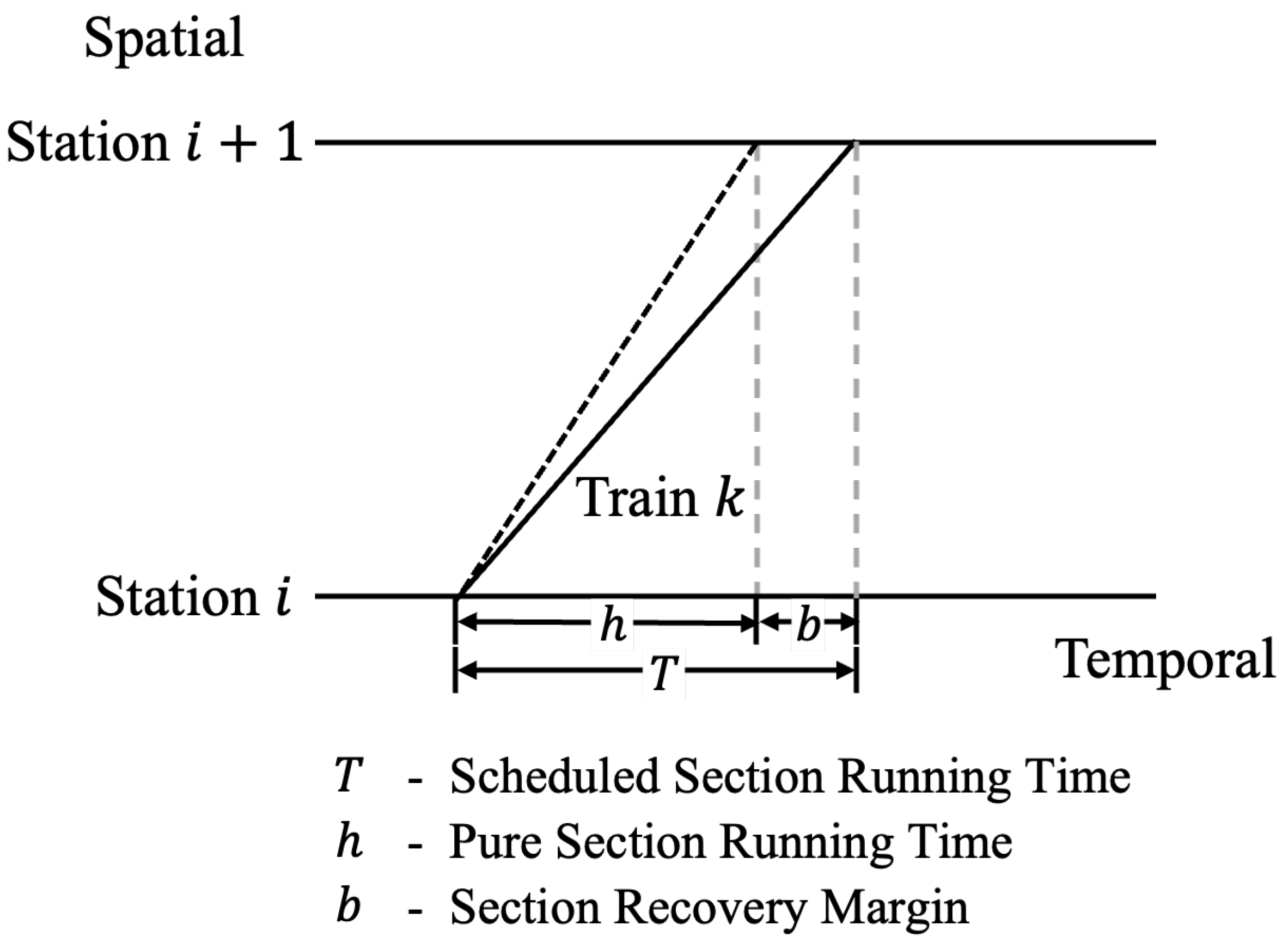
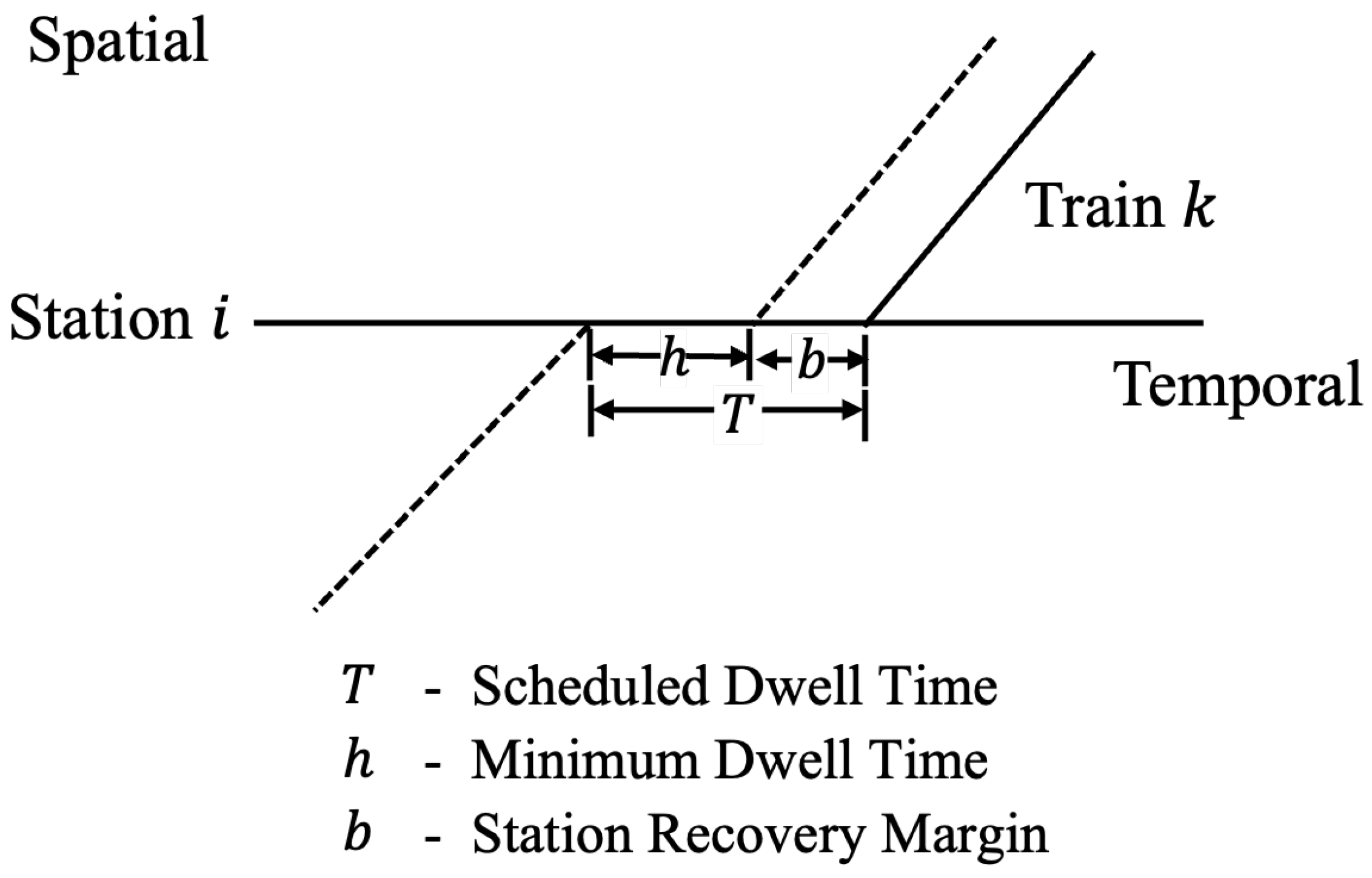
The former (Self-recovery time) is primarily allocated to the operation of a single train. Its purpose is to control the intensity of initial delays and improve the train’s ability to “catch up” (recover schedule) when delays occur, as illustrated in
Figure 1 and
Figure 2. The latter (Buffer time) is generally set between two or multiple trains to prevent the propagation of delays.
In the scenario shown in
Figure 1, Train
k is affected by uncertain factors while traveling through the section, causing its arrival time at Station
to be delayed. To ensure the smooth completion of the current transportation task, it is necessary to utilize the redundancy time within the timetable section for recovery. This method of recovery is referred to as section “recovery margin” (or section padding). In the figure,
T represents the charted section running time,
h represents the standard operation time, and
b represents the section recovery margin (Section “Scatter Point” time).
In the scenario shown in
Figure 2, the dwell time of Train
k at Station
i is composed of two parts: the standard operation time and the station “recovery margin” time. This design endows Train
k with a certain degree of self-recovery time at Station
i, allowing it to cope with various factors that might affect operations within the station. Here,
T denotes the charted dwell time,
h denotes the standard operation time, and
b denotes the station recovery margin (Station “Scatter Point” time).
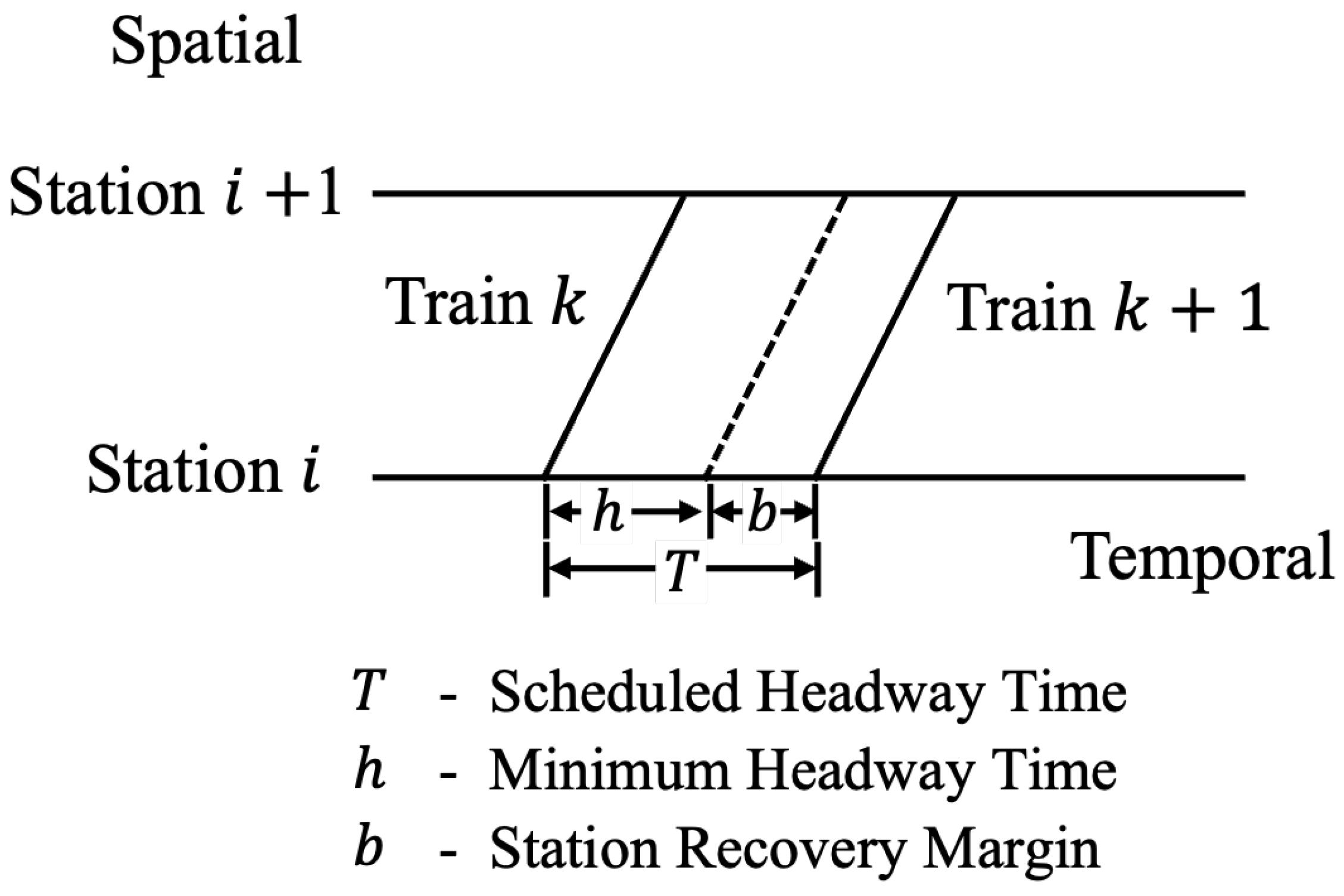
In the railway transportation system shown in
Figure 3, the departure interval between Train
k and Train
includes not only the standard departure interval but also an additional station buffer time
b reserved between the two. This operation establishes a mutually independent operation mode between the two trains. The setting of buffer time can both cope with a certain degree of interference and ensure the normal order of train operations. In the figure,
T represents the charted departure interval time,
h represents the standard departure interval time, and
b represents the station buffer time.
2.1.2. Adjustment and Recovery Indicators Under Delay Scenarios
The objective of analyzing redundancy time allocation is to effectively manage various delay scenarios and construct a more robust and reliable transportation scheme. Under the guidance of reliable value, indicator optimization during the timetable operation phase is the key to improving quality and efficiency. Among these indicators, train punctuality rate, delay duration, and delay probability are manifestations of service levels in the train transportation process and are crucial for characterizing capacity loss and capacity recovery.
In the adjustment and recovery schemes corresponding to different delay scenarios, the total running time and total deviation time of each train vary. By considering the probability of different delay scenarios, the resulting “Expected Running Time” and “Expected Deviation Time” can comprehensively reflect the effectiveness of the redundancy layout, further expressing the improvement level of reliable value.
In the study of high-speed railway transportation indicators presented in this paper, we approach the problem through indicators related to capacity loss and recovery, such as Expected Running Time and Expected Delay Deviation Time. We analyze how to adjust reserve capacity allocation and redundancy time layout to improve train punctuality and reliability, thereby enhancing passengers’ trust and satisfaction with high-speed railways. Consequently, the expected running time and deviation time under various delay scenarios serve as dynamic indicators of the redundancy layout’s effectiveness, comprehensively reflecting capacity loss and recovery.
2.2. Reliable Value-Oriented Optimization Approach for High-Speed Railway Capacity Utilization
Approaching from the perspective of capacity utilization, “Reliable Value” further characterizes the dynamic service level of train operations. This involves the allocation of reserve capacity time for train operations, the essence of which is the optimization of the redundancy time layout. This is also a manifestation of dynamic service level optimization. Research on dynamic service levels is often inseparable from the setting of redundancy time. Due to factors such as speed differences, stops, and overtaking, different redundancy times are generated between train paths. These redundancy times have a certain impact on elements such as capacity loss and capacity recovery within capacity utilization. The concept of train “Reliable Value” can achieve a quantitative expression for this part of capacity utilization research. Redundancy time helps to analyze the usage of effective and ineffective capacity within capacity utilization, as well as the delay propagation laws of capacity loss. Generally speaking, redundancy time is greater than or equal to zero, and its layout has varying effects on the delay recovery of train paths.
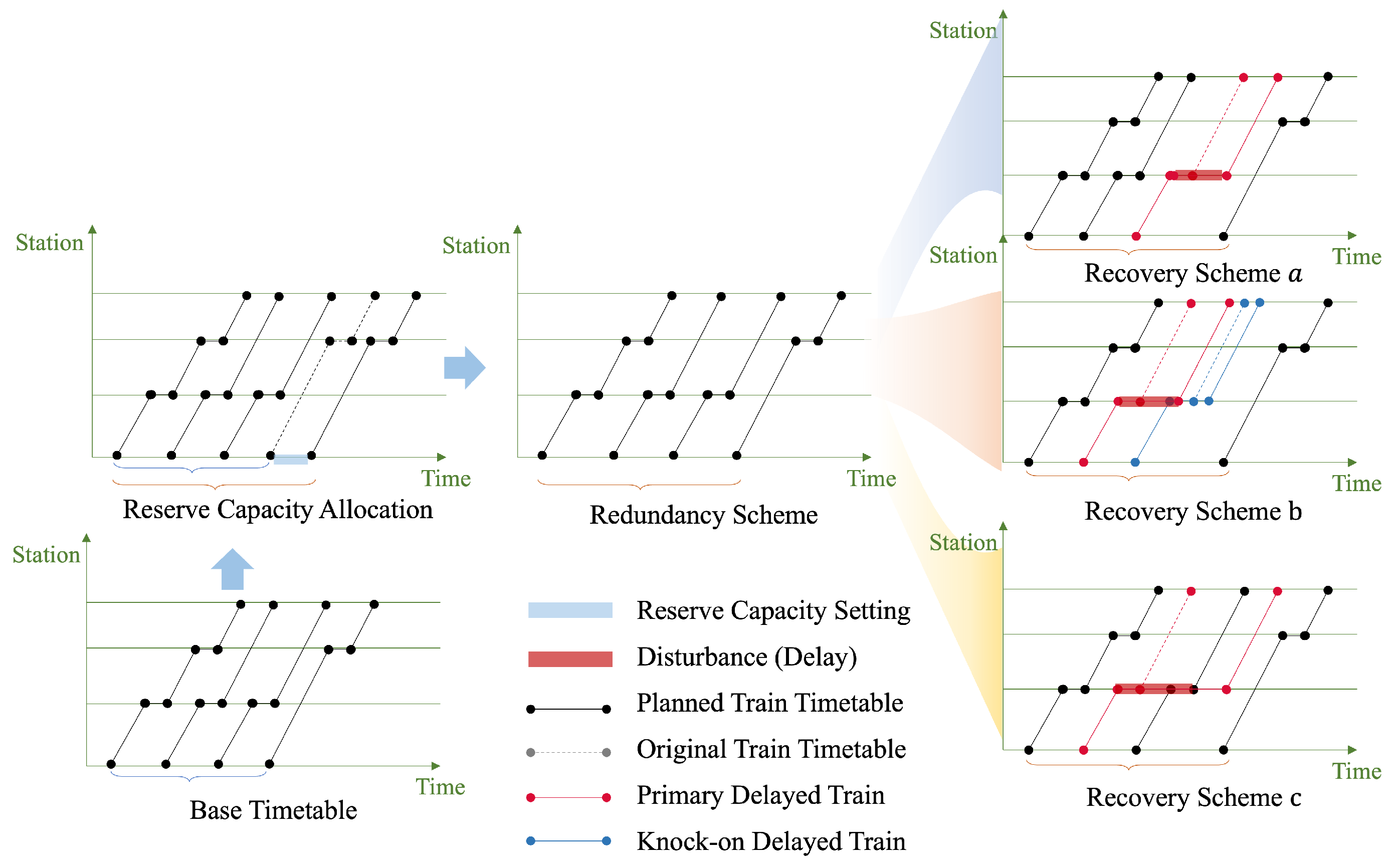
Capacity reserve time refers to the total redundancy planning time available for train adjustments. Essentially, it is a kind of “shared resource” (or pooled allowance) that provides adjustment margins for the redundancy layout of running times and arrival/departure times for different trains within sections, rather than functioning solely as a buffer for a single specific train. As shown in
Figure 4, the redundancy time layout of trains yields different effects under different adjustment and recovery schemes. Since it is difficult to characterize the value of buffer time setting for a single train—given that buffer time acts on specific trains and specific delays in concrete scenarios—the consideration of redundancy time layout and dynamic performance should proceed from the perspective of the trains as a whole. This paper uses the capacity reserve time arranged across the entire set of train paths as the measurement standard, rather than limiting it to a single train path. By using the running time and deviation time of all trains as indicators to characterize capacity loss and recovery, the concept of “Reliable Value” is proposed.
The quantitative research on capacity loss and recovery can be measured by changes in the number of train flows or the delay times of different train types. In particular, both the transmission delay time of capacity loss and the recovery time are related to the moment when the capacity loss occurs, exhibiting dynamic variability. This is because the number of trains on the timetable and the capacity utilization rate vary in subsequent time periods at different moments, resulting in different impacts of capacity loss. The system capacity synergy is dynamically coordinated as a whole.
This paper studies the state of capacity loss and recovery from the perspectives of running time and delay time and further quantifies this as “Reliable Value”, which includes “Expected Running Time Value” and “Indirect Capacity Loss Value”.
Expected Running Time: This refers to the expected total running time of trains under the probabilities of different delay scenarios within the adjustment and recovery schemes. The larger the expected running time, the smaller the corresponding Expected Running Time Value.
Indirect Capacity Loss: This describes the expected weighted deviation time of each train’s arrival at its destination station under the adjustment and recovery schemes for different delay scenarios. The larger the expected weighted deviation time, the smaller the corresponding Indirect Capacity Loss Value.
2.3. Reliable Value-Oriented Heuristic Optimization Framework with Incremental Reserve Capacity
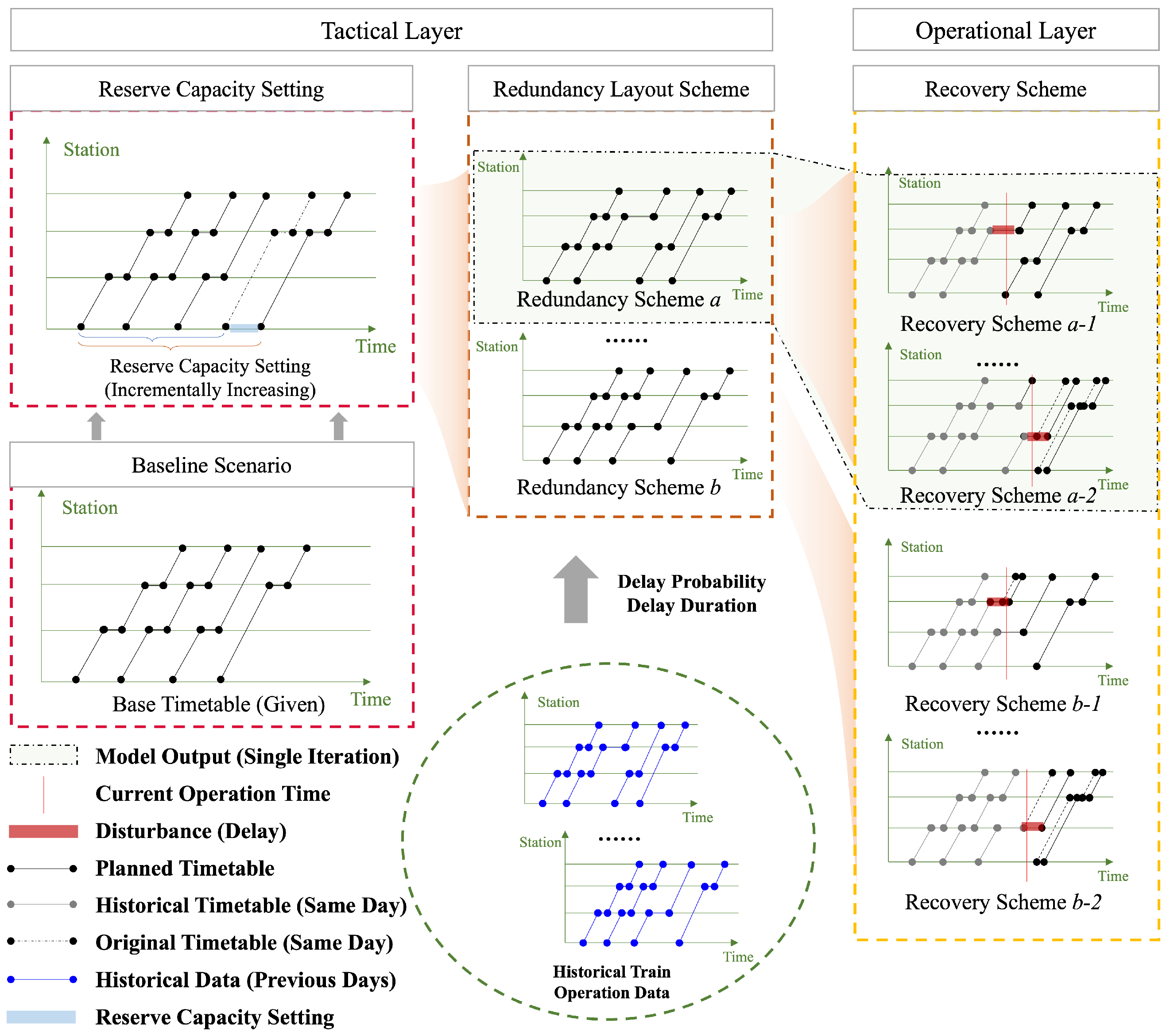
This study constructs a capacity utilization optimization model framework based on the base train timetable (Base Graph) and the incremental setting of reserve capacity. In this chapter, “Reserve Capacity” is defined as the maximum redundancy time that can be added to the train operation scheme, which can be understood as the total value of planned redundancy time. The larger the reserve capacity setting, the greater the allocable margin for both the self-recovery time of individual trains and the buffer time between trains. This study continuously increases the reserve capacity setting to synergistically optimize the redundancy layout and the transportation organization plan for adjustment and recovery.
The model is founded on the Base Timetable. When capacity loss occurs, corresponding operational adjustments are made to form a recovery scheme, and the dispatching operations—specifically the arrival and departure times of trains at stations within the recovery scheme—are further adjusted. Initial delays generate knock-on (secondary) delays, triggering further operational adjustments and capacity losses until full schedule recovery is achieved. The constructed capacity utilization optimization model can simultaneously optimize for different delay scenarios to minimize the propagation of capacity loss under various conditions. The determination of decision variables within the train operation reserve scheme and the adjustment recovery scheme constitutes the core optimization task of the model. The impact of stochastic disturbances in different delay scenarios represents external environmental factors formed based on the distribution of actual delay data. The objective is to maximize the train delay value and the average expected delay time value.
The “Reserve Capacity Incremental Heuristic Optimization Framework” refers to treating reserve capacity as a control variable within the Reliable Value-oriented capacity utilization model and optimizing the system’s Reliable Value by continuously increasing reserve capacity. The design of this framework aims to maximize the Reliable Value of the transportation system by dynamically adjusting the magnitude of reserve capacity, thereby enhancing the operational stability and reliability of the transportation system, as illustrated in
Figure 5.
In this framework, reserve capacity is regarded as an adjustable parameter. By stepwise increasing the reserve capacity, the transportation system can be optimized under different operating conditions. This involves adjusting the arrival and departure times of trains in the redundancy layout scheme, as well as the arrival and departure times in the adjustment recovery schemes under different delay scenarios, to achieve the goal of maximizing Reliable Value. Simultaneously, by inputting delay parameters for different scenarios, the redundancy layout scheme and the adjustment recovery scheme are optimized synergistically. The changes in Reliable Value are characterized by the “Expected Running Time” and “Expected Delay Deviation Time” derived from the adjustment recovery schemes.
This study constructs a Reliable Value-oriented carrying capacity utilization optimization model to optimize the expected running time and expected deviation time when the reserve capacity allocation duration is fixed, thereby obtaining the corresponding value-weighted results. As reserve capacity increases continuously, the expected deviation time for each train decreases continuously, meaning the system can cope with more complex disturbance adjustments; but this inevitably increases the expected total running time of the trains. Through the Reserve Capacity Incremental Heuristic Optimization Framework, the quantitative relationship between different reserve capacities and operational Reliable Value is mined, thereby improving the operational efficiency and service quality of the transportation organization.
3. Mathematical Modeling
This study establishes a Single Integrated Mixed-Integer Linear Programming (MILP) model to solve the problem. The model can be interpreted as the deterministic equivalent formulation of a finite-scenario two-stage stochastic programming problem.
First Stage (Here-and-Now): In the redundancy layout phase, decisions are made regarding the baseline timetable structure and redundancy allocation (variables ) before any delay scenario is realized.
Second Stage (Wait-and-See): In the adjustment and recovery phase, recourse decisions (variables ) are made to recover the schedule under specific realized delay scenarios ().
By using the scenario approach with probability weighting, we convert the stochastic problem into a large-scale deterministic MILP that can be solved directly by standard solvers.
3.1. Symbol Definitions and Assumptions
This study makes the following assumptions for the Reliable Value-oriented capacity utilization optimization model:
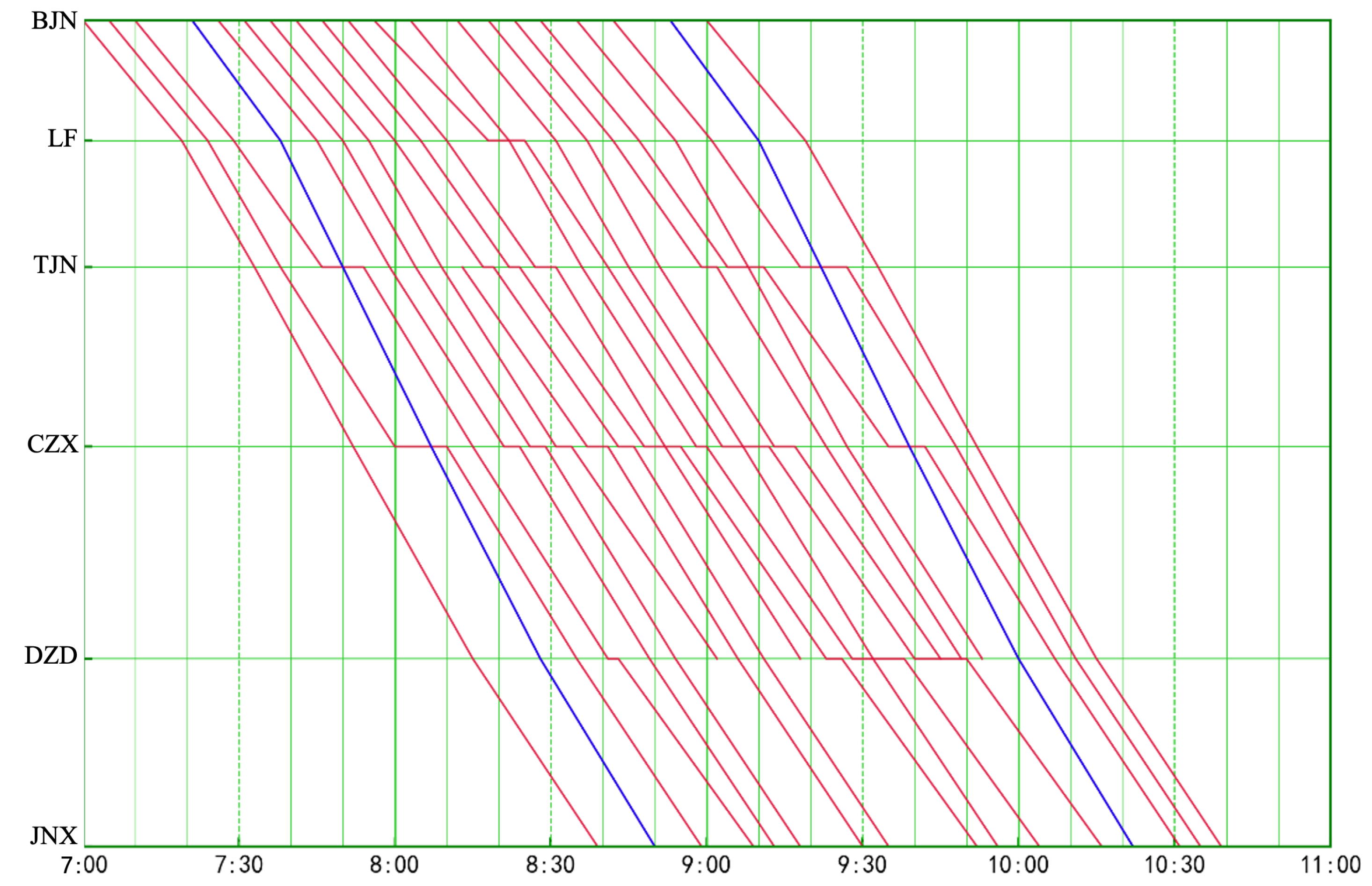
(1) The Base Timetable is Known The primary research object of this chapter is the utilization of railway carrying capacity under different reserve capacity allocations. The train set base timetable (Base Graph) serves as the input for the problem and is considered a known condition before solving the model (
Figure 6).
(2) Rolling Stock and Crew Circulation are Not Considered While the optimization process of capacity utilization involves rolling stock and crew resources, this paper assumes that these resources are sufficient to focus strictly on the time-dimension redundancy of the infrastructure. The complex constraints of resource circulation are left for future research (see
Section 5.3).
(3) Single-Point Failure Scenarios and Independence The stochastic scenarios are modeled as single-point failure scenarios, where each scenario involves a primary delay to a single train at a specific location. The initial disturbances are assumed to be independent events (following the distribution from [
38]), consistent with the assumptions in Assumption (3). While the initial delays are independent, the propagation of delays (secondary delays) is fully endogenous and interdependent, captured by the conflict resolution constraints of the MILP model.
The sets, indices, parameters, and variables of the model are presented in
Table 1 and
Table 2.
3.2. Objective Functions
In the study of capacity under a reliable value orientation, value and time exhibit an inverse proportional relationship. The optimization model aims to maximize the expected running time value and the indirect capacity loss value during the timetable adjustment and recovery phase under delay scenarios. This is equivalent to minimizing the expected running time and the expected deviation time.
3.2.1. Minimizing Expected Running Time
Minimizing the expected running time implies minimizing the weighted total travel time of trains after adjustment under the probabilities of different delay scenarios. In the railway transport industry, enterprises strive to achieve objectives with minimal expenditure when executing transport tasks. Shortening the total travel time of trains not only reduces the demand for transport resources, thereby lowering operating costs, but also decreases passenger travel duration, enhancing the overall quality of service. Therefore, this study establishes the minimization of the expected running time of trains as an optimization objective, as shown in Equation (
1).
3.2.2. Minimizing Indirect Capacity Loss (Expected Deviation Time)
This objective seeks to minimize the total expected delay time of each train at its final station in the adjustment and recovery scheme. During operations, even when delays occur, transport enterprises aim to utilize the train’s own recovery time and the buffer time between trains to restore the transport organization to the pre-delay scenario as quickly as possible, thereby reducing indirect capacity losses. This study selects the minimization of the total expected delay deviation time in the adjustment and recovery scheme as a sub-objective, as shown in Equation (
2).
The model employs the utility method to convert the objective function from a multi-objective formulation into a single objective, as shown in Equation (
3).
The adoption of the linear weighting method (scalarization) is primarily driven by practical operational requirements and computational tractability. In real-world railway operations, decision-makers ultimately require a single, deterministic, and directly executable timetabling plan. The linear weighting method allows us to incorporate their a priori operational policy preferences directly into the model. Furthermore, since our formulation is a large-scale, complex Mixed-Integer Linear Programming (MILP) problem, computing the exact and complete Pareto frontier is computationally prohibitive for practical instances at this stage.
Simultaneously, under the reliable value orientation, the optimization status of time indicators is observed by controlling the allocation of reserve capacity. The two aforementioned objectives may conflict during the optimization process. For instance, as the reserve capacity increases, the expected deviation time of each train continuously decreases—meaning the system can cope with more complex disturbance adjustments—but this inevitably increases the total expected running time of the trains.
To address this potential conflict, this study continues to use a linear weighting method to trade off between these two conflicting objectives. Since the expected running time and expected deviation time are essentially optimization directions of different dimensions and time is inversely related to value under the reliable orientation (i.e., the longer the time occupation, the lower its value), this research utilizes the Max-Min normalization method to normalize the fractions of these two objective functions for reliable value analysis:
Based on the discussion above, this study applies linear weighting to the normalized objective functions to derive the final reliable value objective function
F as follows:
3.3. Constraints of the Reliable Value-Oriented Capacity Utilization Optimization Model
The model utilizes variables and to construct the arrival and departure time architecture of the redundancy (buffered) layout scheme. Similarly, variables and are used to construct the arrival and departure time architecture of the adjustment recovery scheme under different scenarios w. This framework completes the construction of the collaborative optimization model.
3.3.1. Redundancy Layout Phase
The primary decision content in the redundancy layout phase involves the “scattering” (scheduling) of trains at stations or in sections, as well as the buffer time reserved between trains. This specifically includes constraints on dwell times, section running times, safety headways, operation time windows, redundancy layout logic, section traversing order, and reserve capacity settings.
Constraints (
6) and (
7) ensure that the dwell time of a train at a station falls within the feasible range defined by the technical minimum and maximum dwell times. If the train does not stop (
), the dwell time is zero.
- 2.
Section Running Time Constraints
Constraints (
8) and (
9) define the running time of a train in the section between stations
i and
. The running time is determined by the pure running time
plus any starting (
) and braking (
) time losses if the train stops. The simultaneous use of upper and lower bounds effectively fixes the running time to the technical standard.
- 3.
Safety Headway Constraints
To ensure safety, minimum time intervals must be maintained between trains. Constraints (
10) and (
11) enforce the departure headway at station
i, governed by the binary variable
which determines the order of trains in the subsequent section.
M is a large positive number used to relax the constraint for the non-active order.
Similarly, Constraints (
12) and (
13) enforce the arrival headway at station
i, ensuring safe separation upon arrival based on the train order.
- 4.
Operation Time Window Constraints
Constraints (
14) and (
15) ensure that the arrival and departure times of all trains fall within the allowable operation time window
of the station.
- 5.
Redundancy Layout Logic Constraints
The buffered timetable must not advance the schedule compared to the baseline timetable. Constraints (
16) and (
17) ensure that the planned arrival and departure times in the redundancy scheme are no earlier than those in the baseline timetable.
- 6.
Section Order Constraints
Constraint (
18) ensures the logical consistency of the binary order variables, stating that for any pair of trains, one must precede the other in a given section.
- 7.
Reserve Capacity Setting Constraints
Constraint (
19) defines the allocation of reserve capacity. It stipulates that the difference between the dwell time in the buffered timetable and the dwell time in the baseline timetable is limited by the allocated reserve capacity parameter
. This effectively distributes the redundancy buffer into station dwell times. It is important to clarify that
serves as a global parameter and an upper bound (not a mandatory fixed increment) for the additional dwell time of any train at any station. This parameter corresponds to the “Reserve Capacity” setting utilized in the incremental optimization framework. The optimization solver will endogenously decide the optimal distribution of redundancy within this bound to maximize the objective function. This prevents the artificial inflation of dwell times where redundancy is not beneficial.
- 8.
Decision Variable Domain Constraints
Constraint (
20) defines the domain of the binary decision variables used for train sequencing.
3.3.2. Adjustment and Recovery Phase
The primary decision content in the adjustment and recovery phase involves determining the recovered arrival and departure times of trains under different delay scenarios. Specifically, this includes recovery running time constraints, section running time constraints for adjusted trains, additional stop constraints, safety headway constraints, section traversing order constraints, delay scenario constraints, time upper/lower bound constraints for objective function construction, and decision variable constraints for train order and stopping patterns under different scenarios.
Constraints (
21) and (
22) ensure that the realized arrival and departure times in the recovery phase (
) cannot be earlier than the planned times in the buffered timetable (
). This maintains the causality that operations cannot proceed faster than the scheduled buffer allows without violation.
- 2.
Adjusted Section Running Time Constraints
Constraints (
23) and (
24) define the running time in the recovery phase. The time taken to traverse a section depends on the recovery dwell status
. If a train stops (or is forced to stop) in a scenario, the starting and braking time losses are added.
- 3.
Additional Stop Constraints
Constraint (
25) ensures that if a train was originally scheduled to stop in the baseline plan (
), it must also stop in the recovery scenario (
). However, the solver can choose to add stops (
where
) to resolve conflicts.
- 4.
Safety Headway Constraints (Recovery Phase)
Similar to the redundancy phase, safety headways must be maintained during recovery. Constraints (
26) through (
29) enforce minimum separation times for departures and arrivals under each scenario
w, governed by the scenario-specific train order variable
.
- 5.
Section Order Consistency Constraints
Constraint (
30) ensures logical consistency for the binary order variables in the recovery phase.
- 6.
Delay Scenario Constraints
Constraint (
31) introduces the exogenous delay into the system. It states that the arrival time in scenario
w must account for the specific delay duration
added to the planned arrival time.
- 7.
Global Time Bound Constraints
Constraints (
32) and (
33) define the auxiliary variables
and
, which represent the makespan (latest arrival) and earliest start time (earliest departure) of the system under scenario
w. These are used in the objective function to calculate total elapsed time.
- 8.
Decision Variable Domain Constraints
Constraints (
34) and (
35) define the binary domains for the sequencing and stop-status variables in the recovery phase.
3.4. Model Complexity Analysis
The complexity of the model is determined by the number of decision variables and constraints.
Table 3 summarizes the scale of the optimization problem proposed in this chapter. As indicated in the table, the complexity depends on the number of stations
, the number of trains in the set
, and the number of delay scenarios
.
4. Case Study Analysis of Reliable Value-Oriented Capacity Utilization Optimization
4.1. Case Scenario Setup
This case study utilizes the baseline train timetable as input parameters to analyze the impact of reserve capacity allocation on reliable value in the “BJN - JNX” section. Thirty groups of experiments are designed with reserve capacity values ranging from 1 min to 30 min. These experiments are numbered 1 to 30, representing reserve capacity allocations of 1 min, 2 min, …, up to 30 min, respectively.
Based on practical conditions and the differing scales of the objective components, the parameters are set as and . The rationale for this significant difference is twofold:
Dimensional Homogenization: The expected running time () typically ranges from 150–200 min, while the expected deviation () is often compressed to 0.5–2 min. The factor of 200 balances their gradients in the optimization process.
Reliability-Oriented Philosophy: In high-speed rail operations, the penalty for delays (secondary costs like missed connections and reputation loss) is substantially higher than the marginal cost of planned running time.
The delay scenario settings are derived from the train arrival punctuality distribution model (please refer to [
38]), wherein the punctuality distribution for TJN Station adopts the whole-line distribution model. Delay durations (in minutes) and delay probabilities are configured for each station within the studied section. Fifty interference scenarios are set for the experiment, which are modeled as independent single-point failure scenarios, consistent with the assumption that simultaneous multi-point failures are rare “Black Swan” events outside the scope of daily timetable robustness. The specific delay interference scenarios are detailed in
Table 4, and other case parameters are listed in
Table 5.
Given that the optimization model constructed in this paper constitutes a Mixed-Integer Linear Programming (MILP) problem, we employ the SCIP (Solving Constraint Integer Programs) 8.0 solver for experimentation. SCIP is currently one of the most efficient non-commercial solvers for mixed-integer programming, providing a robust framework for handling the complex constraints and variables defined in our model. To ensure a balance between computational efficiency and solution quality, specific solver parameters were configured as follows: the optimality gap tolerance (MIPGAP) was set to 1%, and a strict time limit of 3600 s was imposed for each run. Presolving was enabled to simplify the problem structure before solving, and heuristics were utilized with their default settings.
4.2. Case Result Analysis
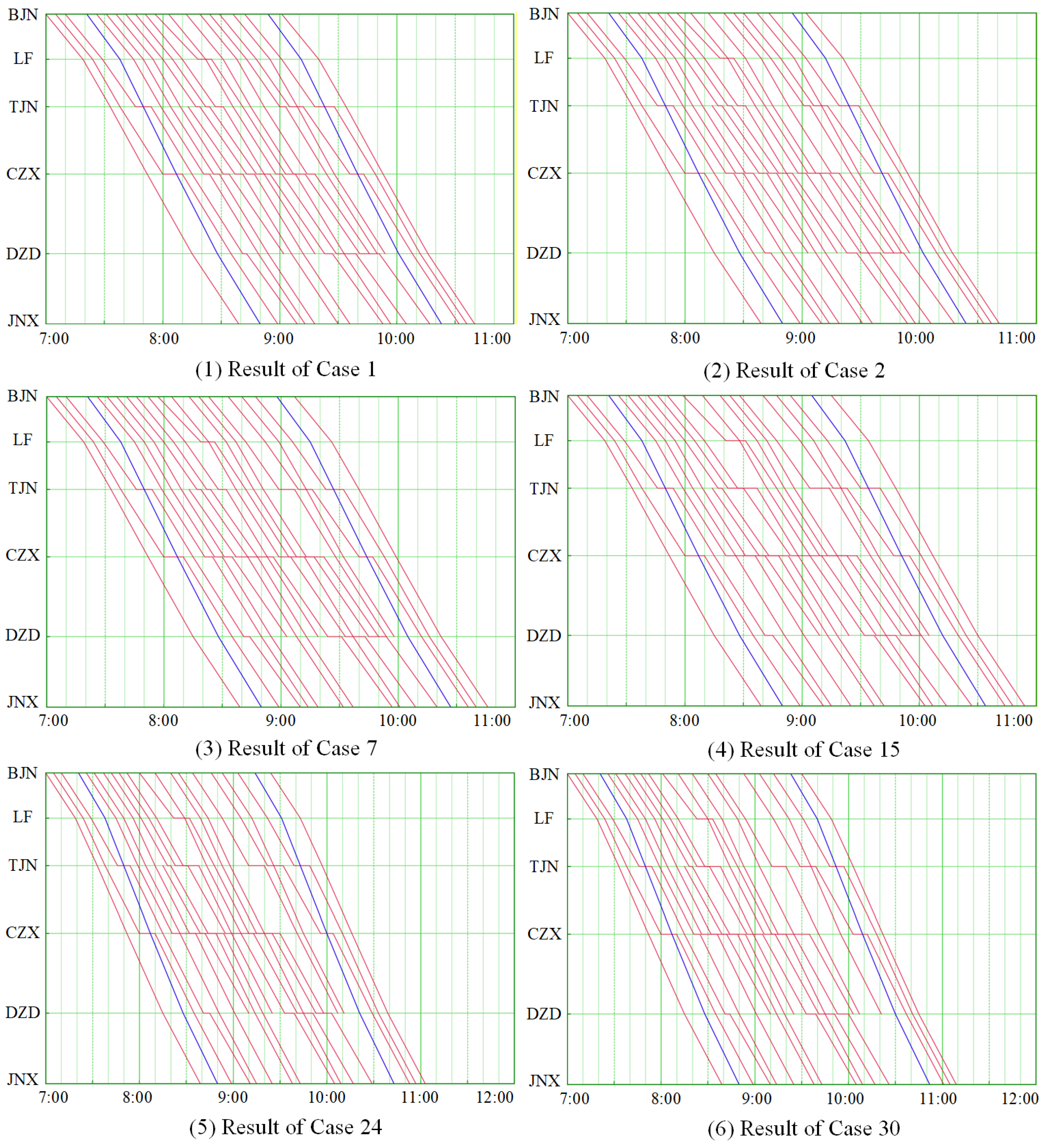
The results of the case analysis are illustrated below. By utilizing the SCIP solver, global optimal or high-quality feasible solutions were successfully obtained for all scenarios within the specified time limit. All 30 groups of experiments were completed efficiently, with an average solution time of 2043.24 s. Specifically, all runs successfully terminated before the 3600-s time limit, and the final optimality gap (MIP Gap) consistently converged to within 1%, ensuring the reliability of the solutions. The optimization results for the redundant layout schemes of selected representative cases are visually represented in
Figure 7, and the detailed numerical results are listed in
Table 5. For the complete visualization of all 30 scenarios, please refer to
Figure S1 in Supplementary Materials.
As indicated in
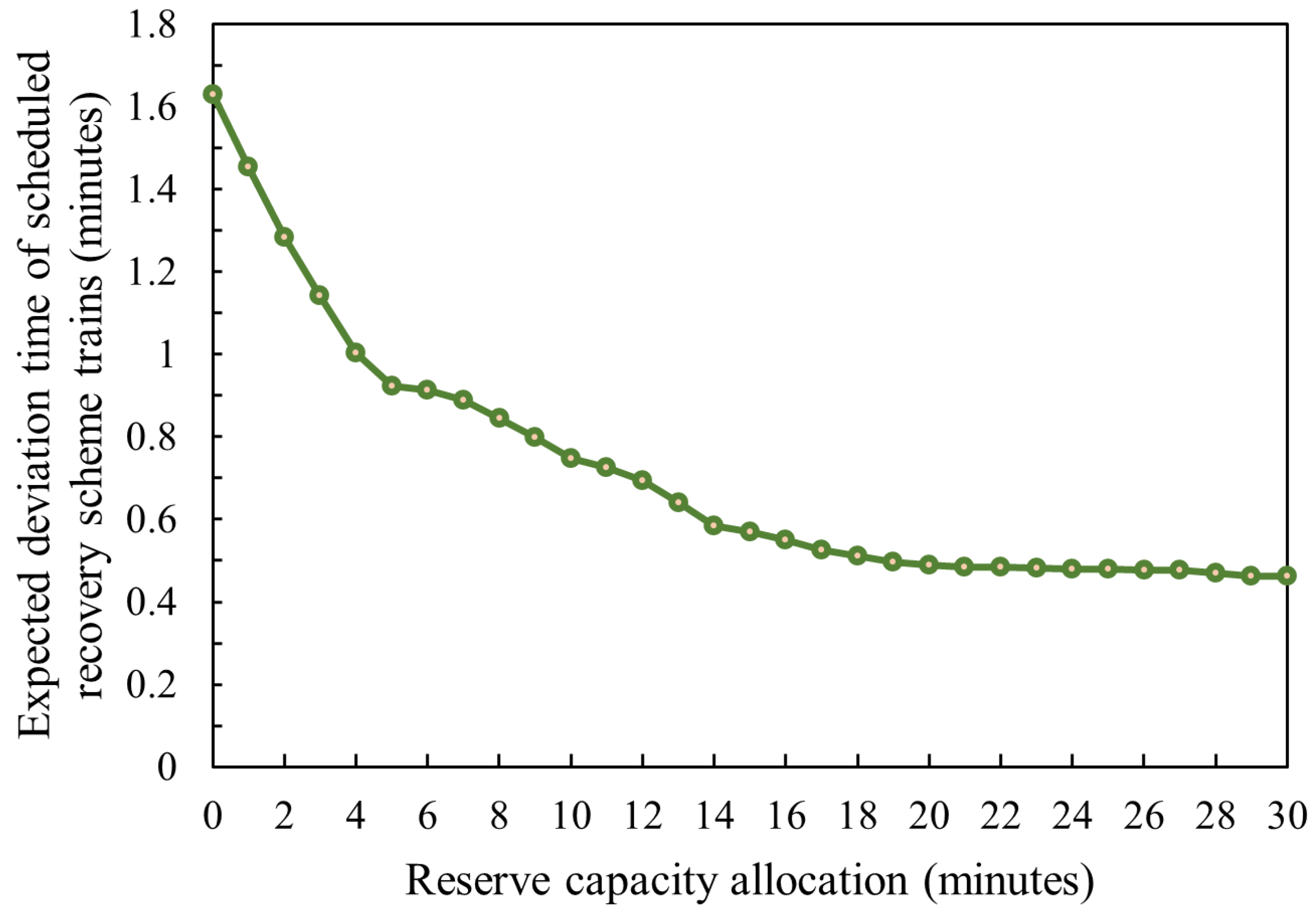
Table 5, as the reserve capacity allocation time increases, the buffer time between train paths and the recovery time allocated to the paths themselves also increase. Consequently, the expected delay time at each station after adjustment and recovery gradually decreases.
Figure 8 illustrates that the expected deviation time decreases until it reaches 0.5 min, after which the trend becomes flat. A possible reason for this phenomenon is as follows: Initially, the setting of reserve capacity effectively increases the buffer time between train paths and the intrinsic recovery time of the paths, which plays a significant role in absorbing initial delays and knock-on delays. However, as the reserve capacity allocation continues to increase, train delays inevitably persist regardless of the size of the buffer time set between train groups. This impact does not change with the variation of the total redundancy planning value, resulting in diminishing marginal utility. The corresponding indirect capacity loss value first increases and then tends to plateau.
As shown in
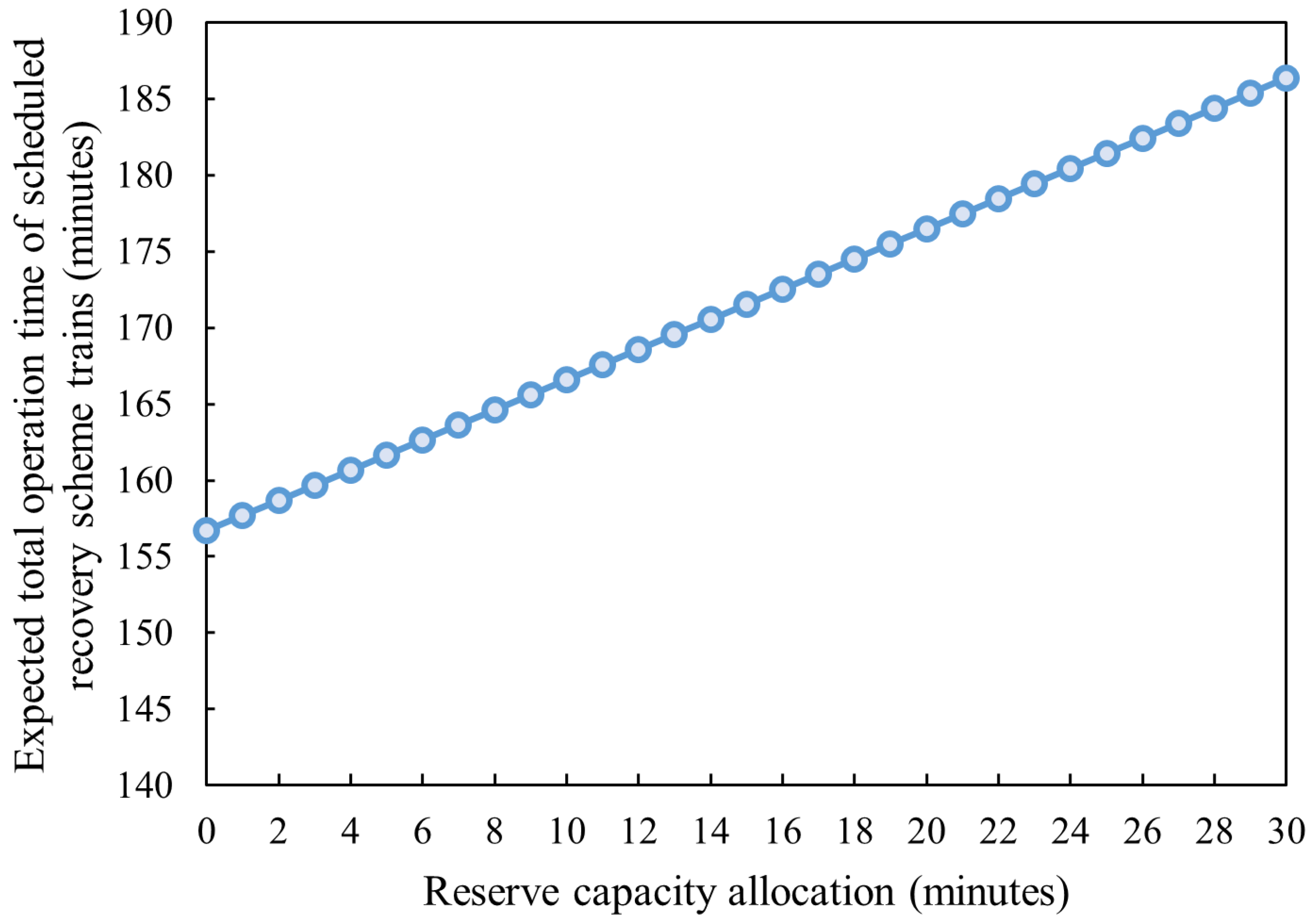
Figure 9, as the reserve capacity allocation value increases, the expected total running time of trains in the adjustment and recovery phase also increases. Although the model optimization process aims to minimize the expected running time, the elongation of buffer times between train paths and the recovery times of the paths themselves causes the total expected running time during adjustment and recovery to increase. Consequently, its corresponding expected running time value continuously decreases.
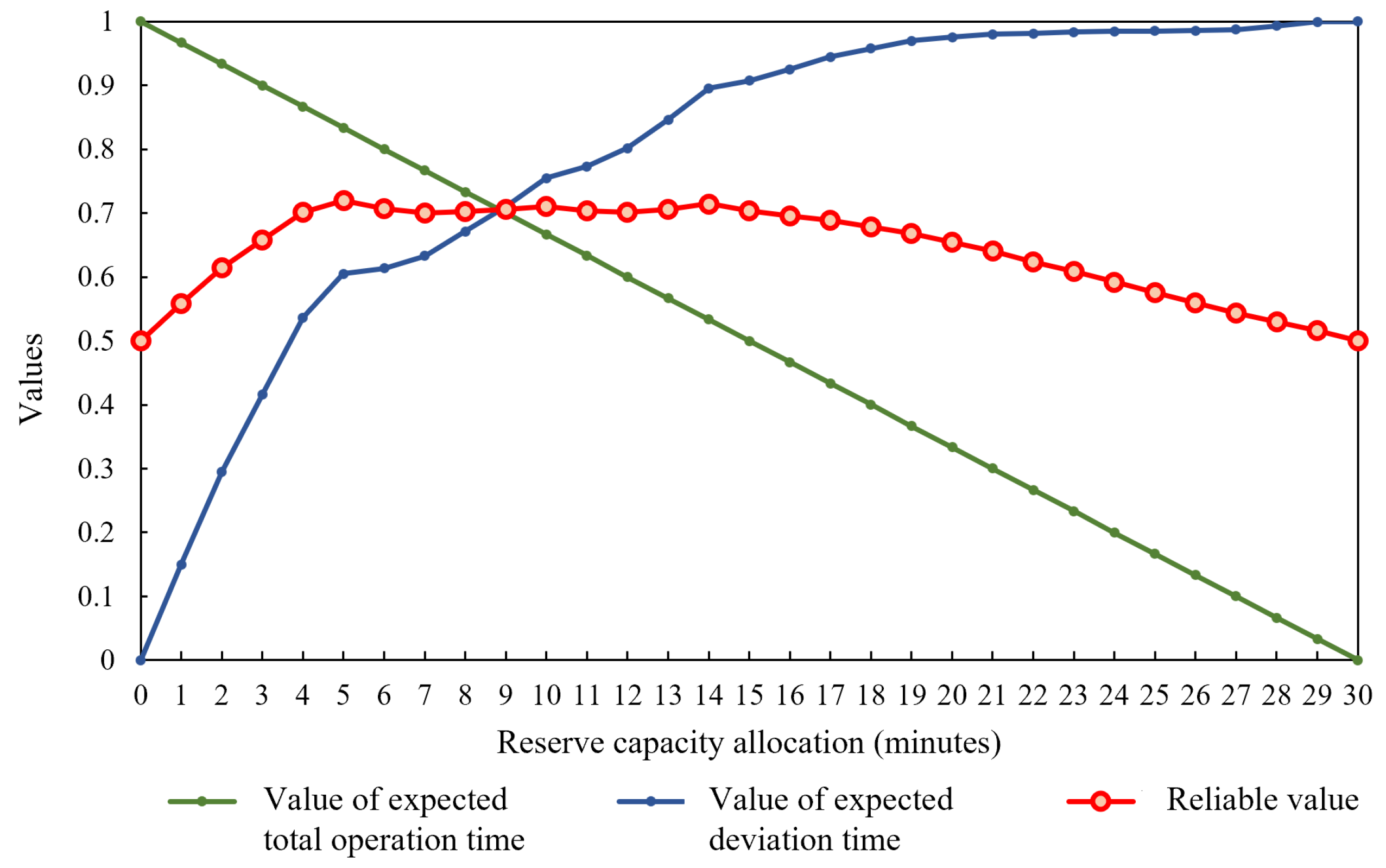
The reliable value results for each experimental case are shown in
Figure 10. The expected running time value is inversely proportional to the expected running time, and the indirect capacity loss value is inversely proportional to the expected deviation time. The reliable value comprises both the expected running time value and the indirect capacity loss value. Through Equation (
5), with parameters
and
both set to 0.5 (representing a neutral preference [
39]), the variation curve of the reliable value is analyzed.
As seen in the figure, as the total redundancy planning value increases, the expected running time value gradually decreases, while the indirect capacity loss value gradually increases. For the weighted reliable value, the trend shows an initial increase, followed by a plateau, and finally a decrease. The study finds that, based on the baseline timetable within a two-hour scope, under the given delay scenarios and parameter conditions, setting a reserve capacity and maximum redundancy time of 5–14 min can achieve good anti-interference effects. When the reserve capacity setting continues to increase, the unutilized invalid capacity in the system continues to increase, and capacity loss gradually rises. After a certain magnitude, the reliable value decreases, demonstrating the characteristic of diminishing marginal benefits.
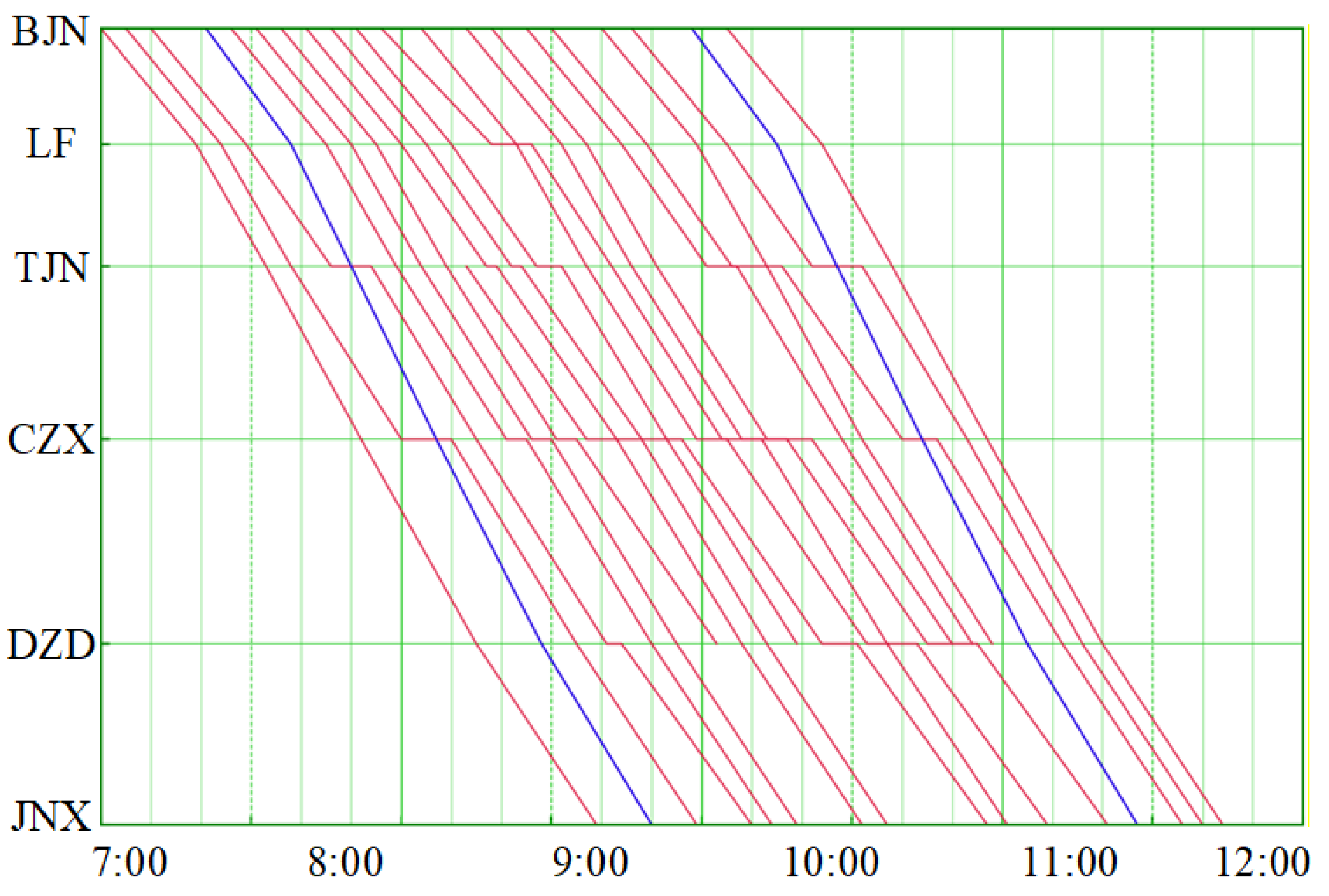
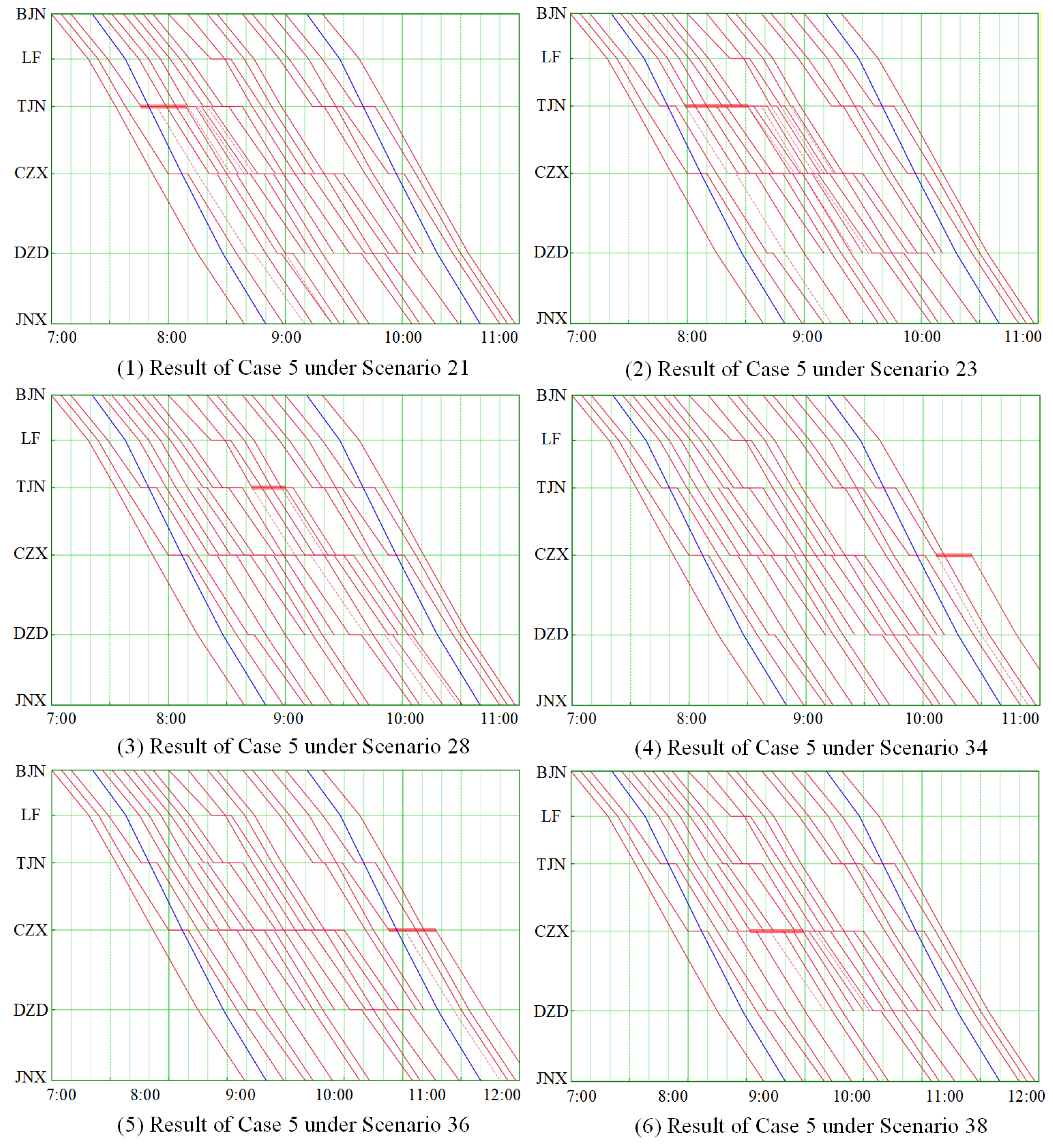
The redundancy layout scheme and adjustment recovery scheme for Case 5 (reserve capacity set to 5 min) are presented below.
Figure 11 illustrates the optimized static redundancy structure. Instead of a uniform distribution, the model strategically allocates the 5-min reserve capacity as buffer times and dwell time margins at critical interaction bottlenecks. This structural elasticity is tested in
Figure 12, which displays the selected recovery scenarios. As observed in scenarios such as Scenario 21 and Scenario 34, the pre-positioned redundancy effectively acts as a shock absorber. It dampens the primary delays (indicated in red) and prevents them from propagating as severe secondary delays to subsequent trains, thereby validating that a moderate reserve capacity (5 min) can achieve significant resilience gains. (Readers can refer to
Figures S1 and S2 in Supplementary Materials for the complete visualization of all scenarios).
Cost–Benefit Analysis of Redundancy
The results in
Figure 10 not only identify the optimal interval but also reveal the economic logic behind redundancy allocation. In the “pre-saturation” phase (reserve capacity < 5 min), adding 1 min of redundancy yields a significant marginal benefit. The reduction in expected deviation time (and thus the avoided delay penalty) far exceeds the marginal cost of the increased planned running time. This is because the initial redundancy is highly efficient in absorbing primary delays. However, once the reserve capacity exceeds the saturation point (around 14 min), the marginal benefit diminishes rapidly. The system enters a state of “diminishing returns”, where additional redundancy converts into pure resource waste (increased running time) without providing proportional reliability gains. This analysis provides a quantitative basis for the “Marginal Economic Benefit Analysis” discussed in
Section 5.2, guiding operators to avoid over-engineering.
4.3. Parameter Sensitivity Analysis
To validate the robustness of the proposed model and incorporate the Pareto concept, we conducted a comprehensive sensitivity analysis on key parameters: the penalty coefficient and the preference weights . By systematically varying these weights and solving the model multiple times, we effectively approximated the Pareto frontier. This analysis explicitly illustrates the trade-off trajectory between theoretical capacity and operational reliability, providing decision-makers with a flexible reference that aligns with the Pareto analysis framework.
4.3.1. Sensitivity to Penalty Coefficient
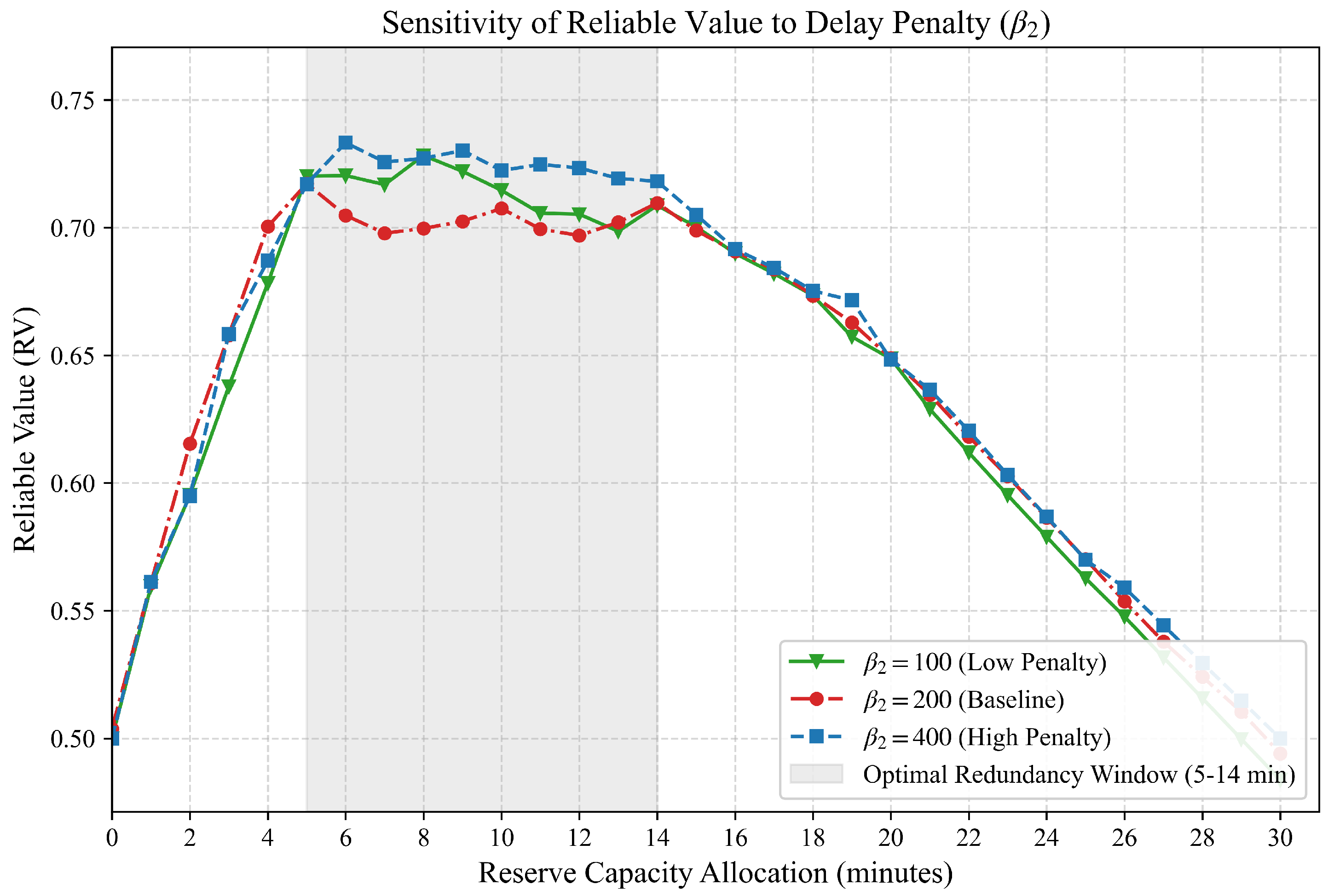
Figure 13 illustrates the sensitivity of the reliable value (RV) to the delay penalty coefficient
. We varied
from 100 (low penalty) to 400 (high penalty) while keeping other parameters constant.
The results indicate a consistent “optimal redundancy window” between 5 and 14 min across all scenarios. Within this range, the RV remains near its peak. This stability suggests that the optimal reserve capacity is primarily governed by the physical trade-off between resource cost and delay mitigation capability, rather than being an artifact of the specific penalty weight. When capacity min, the system lacks sufficient buffer to absorb disturbances, leading to sharp reliability drops regardless of the penalty weight. Conversely, when capacity min, the marginal gain in reliability diminishes while the physical resource cost (implied in the objective function) increases, causing the RV to decline. Therefore, the identified 5–14 min window represents a robust operating region for the timetable, insensitive to variations in the subjective valuation of delay penalties.
4.3.2. Sensitivity to Preference Weights
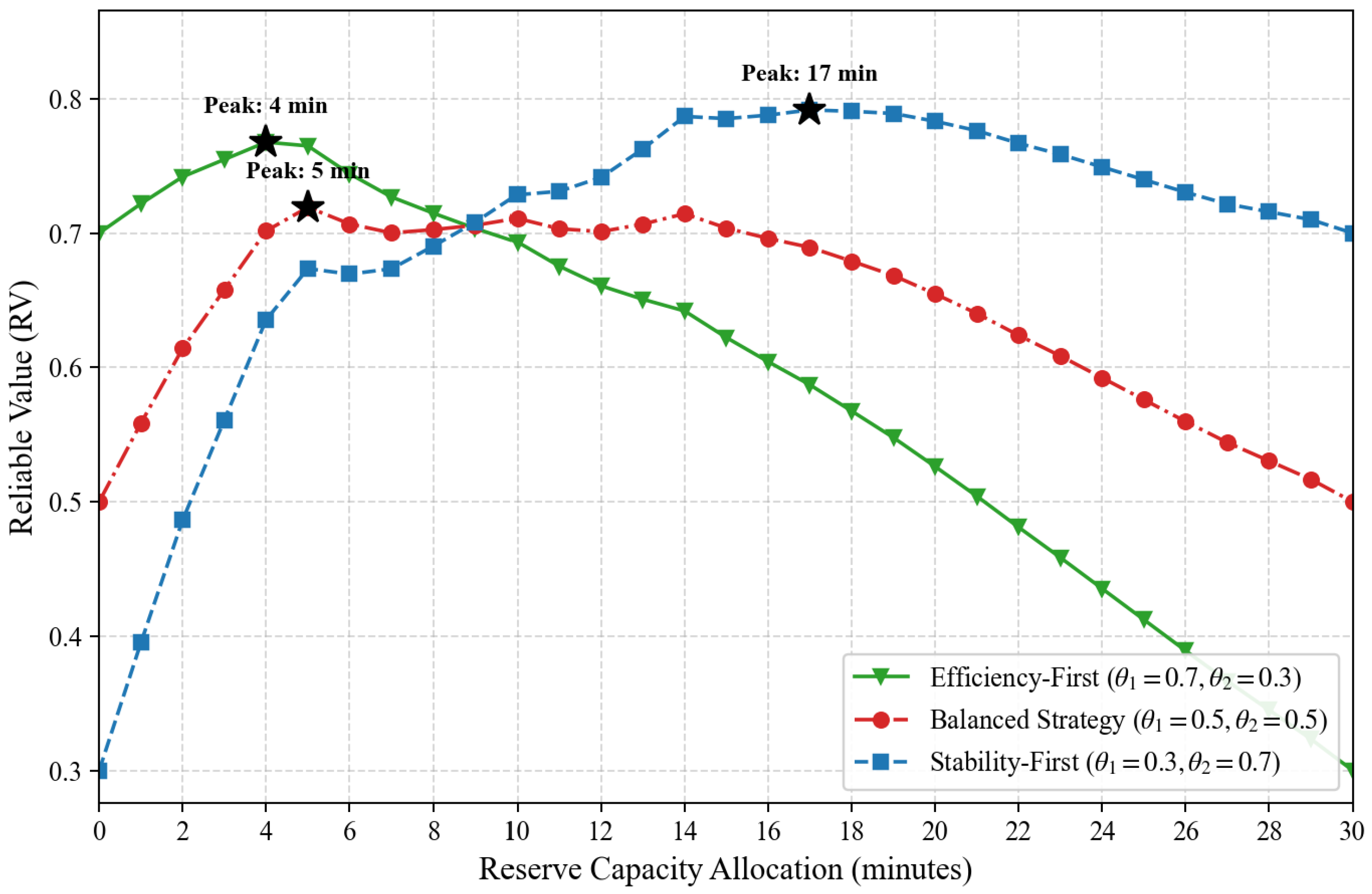
We examined three strategy profiles for the final Reliable Value calculation, as illustrated in
Figure 14:
Efficiency-First Strategy (): The decision-maker prioritizes running time reduction. The Reliable Value peaks early at a reserve capacity of 4 min. Beyond this point, the marginal gain in reliability is insufficient to offset the penalty of increased travel time, causing the RV curve to decline sharply. This suggests that for efficiency-sensitive operators, minimal redundancy (just enough to absorb minor delays) is optimal.
Balanced Strategy (): Representing a neutral stance, the optimal reserve capacity is found at 5 min. The curve exhibits a relatively flat plateau between 5 and 14 min, indicating a robust “sweet spot” where the trade-off between efficiency and stability is well-balanced.
Stability-First Strategy (): The decision-maker prioritizes punctuality and delay recovery. The optimal reserve capacity shifts significantly to the right, peaking at 17 min. The curve maintains high values across a broad range (approx. 14–22 min), demonstrating that when reliability is paramount, the system benefits from substantial redundancy to absorb severe disruptions.
In all cases, the non-linear “inverted U-shape” (or saturation) curve of Reliable Value persists, validating the generalizability of the proposed framework. The distinct shifts in peak locations (4 min vs. 5 min vs. 17 min) quantitatively confirm that the optimal redundancy allocation is highly sensitive to the operator’s strategic preference.
5. Conclusions
This study has systematically addressed the challenge of reconciling theoretical railway capacity with operational reliability by proposing a novel Reliable Value (RV)-oriented framework for high-speed railway timetabling. Through the integration of redundancy allocation into process modeling, we have bridged the gap between static planning and dynamic operational performance, offering both theoretical insights and practical tools for railway dispatchers transitioning from volume-centric to value-centric capacity management.
5.1. Summary of Key Findings and Contributions
Our research yields several significant findings that advance the understanding of capacity utilization under reliability constraints. First, the proposed Reliable Value metric successfully quantifies the trade-off between operational efficiency and service stability. By decomposing RV into the Expected Running Time Value (reflecting efficiency) and the Indirect Capacity Loss Value (reflecting robustness), we demonstrate that traditional capacity metrics focusing solely on train counts or theoretical throughput are insufficient for high-quality service evaluation. The RV framework enables a holistic assessment that accounts for both the economic benefits of increased speed and the service penalties incurred by unreliability.
Second, the Reserve Capacity Incremental Heuristic Optimization Framework reveals a non-linear, saturation-driven relationship between reserve capacity allocation and system performance. Our case study on the BJN–JNX corridor demonstrates that reserve capacity settings between 5 and 14 min yield optimal RV under the tested delay scenarios, balancing buffer adequacy with capacity utilization efficiency. Beyond this optimal range, the system exhibits diminishing marginal returns—additional reserve capacity fails to proportionally improve delay absorption while significantly increasing expected running times. Below this threshold, insufficient redundancy leads to widespread delay propagation, drastically reducing indirect capacity loss value.
Third, the synergetic integrated optimization strategy successfully coordinates redundancy layout (Planning Phase) with dynamic recovery schemes (Operational Phase). By considering stochastic delay scenarios with realistic probability distributions, the model captures the propagation mechanics of primary and secondary delays, enabling proactive rather than reactive timetable design. The computational experiments demonstrate that the SCIP solver efficiently handles the MILP formulation, achieving high-quality solutions within practical time limits (average 2043 s across 30 scenarios).
From a theoretical perspective, this work makes several notable contributions to railway operations research. We extend capacity theory from static volume measures to dynamic value-based assessments, introducing the Reliable Value construct that integrates user-centric service quality with operator-centric efficiency. The process-oriented modeling approach treats reserve capacity as a first-class decision variable rather than a post hoc adjustment parameter, enabling systematic exploration of the redundancy–performance frontier. By quantifying the saturation point of reserve capacity, we provide a decision-theoretic foundation for optimal buffer allocation, moving beyond heuristic rules of thumb toward evidence-based timetable design.
5.2. Practical Implications
For railway operators and dispatchers, our findings offer actionable guidance for improving timetable quality and operational resilience.
Marginal Economic Benefit Analysis: The identification of the 5–14 min optimal interval reveals a critical economic insight. In the “pre-saturation” phase (left of the interval), adding 1 min of redundancy yields a marginal benefit (avoided delay penalties) that far exceeds the marginal cost of increased running time. However, once the “saturation point” is crossed, additional redundancy converts into pure resource waste. This guides investment decisions to avoid over-engineering.
Dispatcher Feasibility and KPI: The proposed Reliable Value metrics can be encapsulated into real-time Key Performance Indicators (KPIs) for dispatching consoles. Unlike current “fire-fighting” manual adjustments, an RV-based dashboard would allow dispatchers to visualize the “value” of their recovery decisions, promoting global optimization over local fixes.
Policy and Planning Standards: We recommend that national railway agencies incorporate value-oriented redundancy thresholds into timetabling norms (e.g., updating the static UIC 406 capacity standards). Shifting from a single-dimensional “Speed First” policy to a dual-track “Speed-Reliability” value standard will enhance the long-term competitiveness of high-speed rail.
In the context of China’s strategic shift from “Scale and Speed” to “Quality and Efficiency” in high-speed rail development, this research demonstrates that reliable capacity is not simply the product of maximal buffer allocation, but rather the outcome of intelligently calibrated redundancy that balances throughput and robustness. The existence of a saturation point in reserve capacity allocation underscores a fundamental principle: quality-oriented capacity management requires optimization, not maximization. By providing railway planners with quantitative tools to transition from reactive delay management to proactive resilience engineering, this study contributes to the realization of sustainable, passenger-centric railway operations.
5.3. Limitations and Future Research Directions
While this study provides a comprehensive framework, several limitations warrant further investigation.
First, the current “Single-Point Failure” assumption and the independent scenario generation simplify the complex spatiotemporal correlations of real-world disturbances. Future research should explore correlation modeling using Copula functions or Bayesian Networks to capture the dependency between consecutive delays.
Second, the model focuses on infrastructure capacity, abstracting away rolling stock and crew circulation. Integrating these resource constraints leads to a stronger NP-Hard problem, which may require advanced decomposition algorithms such as Lagrangian relaxation or column generation.
Third, we assume a risk-neutral decision-maker (using expected value). While advanced risk-based methods like Conditional Value-at-Risk (CVaR) or Distributionally Robust Optimization (DRO) offer better handling of high-impact, low-probability events, integrating them into the current deterministic equivalent MILP framework would require introducing significant auxiliary variables and constraints. Given the current problem scale (30 experimental groups × 50 scenarios), this would lead to computational intractability. Therefore, the expected value approach serves as a necessary simplification. Future research should explore decomposition algorithms to enable the application of these risk-averse measures.
Fourth, the scalability to large-scale networks is limited by the monolithic MILP structure. Adopting a rolling horizon approach or bi-level programming (to include passenger route choice behavior) would be necessary for network-wide implementation.
Fifth, the current model employs a global parameter to govern the reserve capacity upper bound for all trains and stations. While this simplifies the solution space and reveals system-level laws, it overlooks the heterogeneity of station importance and bottleneck characteristics. Future research should investigate station-dependent dynamic AllCap strategies, allowing for differentiated redundancy allocation based on node topology and traffic density to further enhance microscopic precision.
Finally, while our identified redundancy range aligns with the empirical buffer time guidelines discussed in Chinese railway industry standards, direct external verification using confidential real-world dispatching logs remains a goal for future industrial collaboration. Additionally, designing efficient multi-objective metaheuristics (e.g., NSGA-II) to accurately depict the full Pareto front for this complex timetabling formulation is a highly promising direction for our future research.
As high-speed rail networks worldwide face increasing demands for both capacity and punctuality, the RV-oriented approach offers a pathway toward intelligent, resilient, and user-focused railway systems. Future advancements in real-time data analytics, predictive modeling, and integrated transportation planning will further enhance the applicability of the Reliable Value paradigm, ultimately contributing to the development of railway systems that harmonize efficiency with reliability in service of both operators and passengers.