1. Introduction
Domination and its variants have been extensively studied in graph theory. The domination problem is known to be NP-complete for general graphs and remains NP-complete for planar graphs with maximum degree 3 [
1], grid graphs [
2], cubic planar graphs [
3], chordal graphs [
4], circle graphs [
5], and many other graph classes. In contrast, the domination problem can be solved in polynomial time on several highly restricted graph classes, including trees [
6], interval graphs [
7], and cographs [
8]. These sharp complexity boundaries have motivated further investigations into domination variants—including paired domination, restrained domination, and fair domination—on structured graph families. In particular, while domination is known to be NP-complete on grid graphs, the computational complexity of several domination variants on grid-like and supergrid-like graph classes remains open, providing strong motivation for recent research in this direction. Comprehensive surveys and references on domination and its variants can be found in the monographs by Haynes, Hedetniemi, and Slater [
9,
10], as well as in Johnson’s NP-completeness columns [
11] and subsequent works that classify domination problems across numerous graph families.
Fair domination was introduced as a refinement of domination to impose local balance constraints [
12]. The authors showed that the 1-fair domination problem coincides with the perfect domination problem. Nevertheless, this notion differs from efficient domination (also known as perfect codes), in which the closed neighborhoods of the dominating vertices form a partition of the vertex set; that is, every vertex is dominated by exactly one vertex of the dominating set.
Several studies have investigated fair domination in specific graph classes. Maravilla et al. [
13] examined
k-fair dominating sets in graphs obtained from operations such as join, corona, composition, and Cartesian product, providing bounds or exact values for their
k-fair domination numbers. Hajian and Rad [
14] determined an upper bound for the fair domination number of the cactus graphs and showed that this bound coincides with the 1-fair domination number for these graphs. In the same year, Jayasree and Radha [
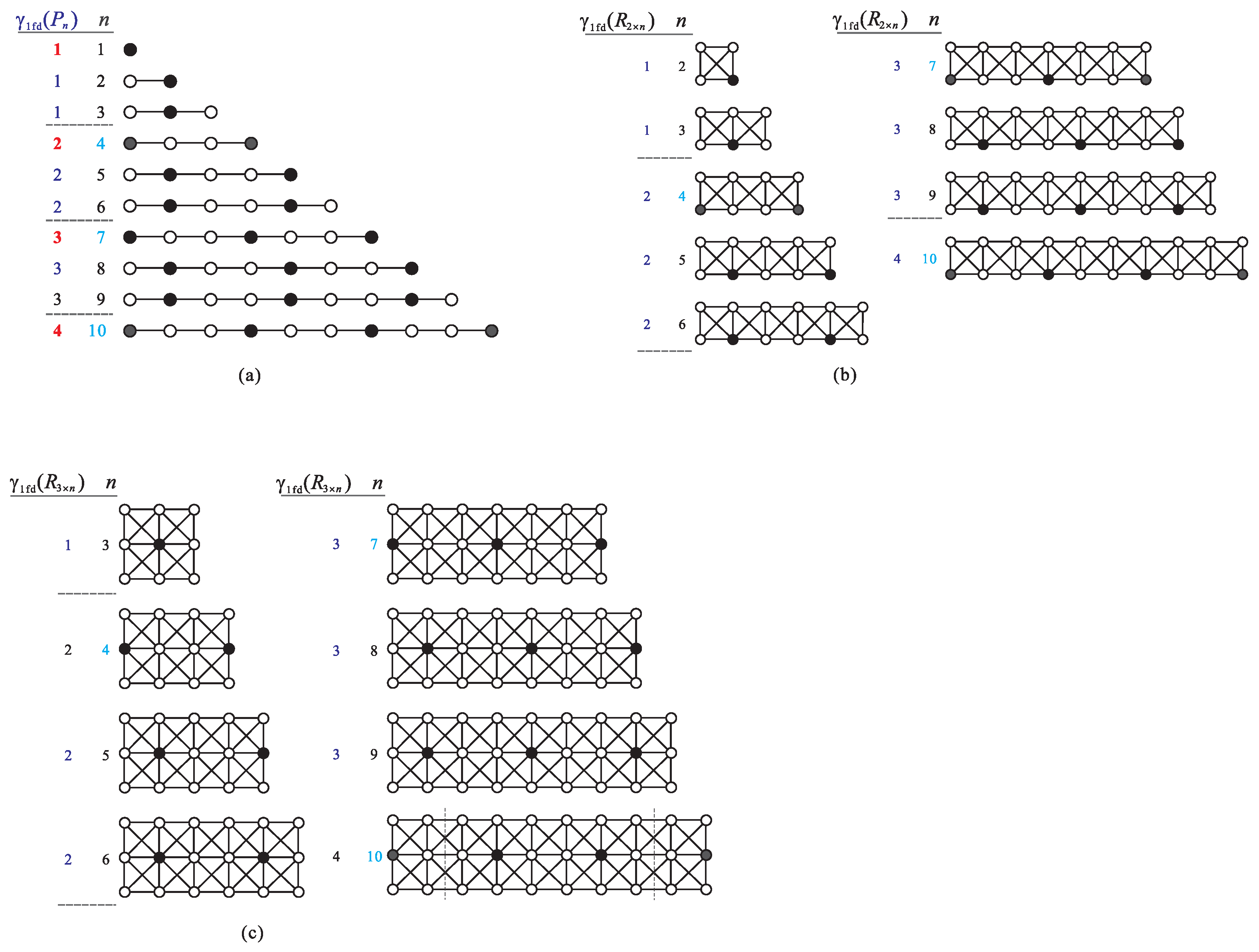
15] calculated the 1-fair domination number for several special graphs, including paths, cycles, Sierpiński graphs, and rectangular supergrid graphs. Hajian et al. [
16] further established an upper bound for the fair domination number of outerplanar graphs. Sangeetha et al. [
17] systematically calculated the fair domination number for several special graphs, including mill graphs, sunlet graphs, crown graphs, ladder graphs, prism graphs, gear graphs, web graphs, and helm graphs. More recently, Alikhani and Safazadeh [
18] analyzed the number of fair dominating sets in several special graphs, such as complete bipartite graphs, cycles, paths, sociable friendship graphs, and triangular cactus graphs. Despite this growing body of work, the complexity of the 1-fair and 2-fair domination problems on grid graphs remains unresolved.
Supergrid graphs and their variants arise naturally in the study of grid-based network models and have attracted increasing attention in recent years. An extended supergrid graph generalizes a grid graph by allowing additional edges while preserving a grid-like structure, and it contains both grid graphs and supergrid graphs as special cases. Despite their structural regularity, domination-type problems on extended supergrid graphs remain far from fully understood, especially under fairness constraints. The supergrid graphs were first introduced in [
19], where it was shown that the Hamiltonian cycle and path problems for these graphs are NP-complete. Supergrid graphs and related grid-like graph classes have also been considered in domination-type problems [
20,
21]. However, fair domination on extended supergrid graphs has not previously been investigated from a theoretic complexity perspective.
Our Contributions
In this paper, we investigate the 1-fair and 2-fair domination problems on extended supergrid graphs from a computational complexity perspective. Our main focus is on establishing hardness results, complemented by positive results for restricted graph classes. The contributions of this paper can be summarized as follows:
We prove that the 1-fair domination problem is NP-complete on extended supergrid graphs, even when restricted to planar graphs with maximum degree 4. In [
22], we claimed that the 2-fair domination problem on extended supergrid graphs is NP-complete; however, the proof contains a flaw. Therefore, its complexity remains open.
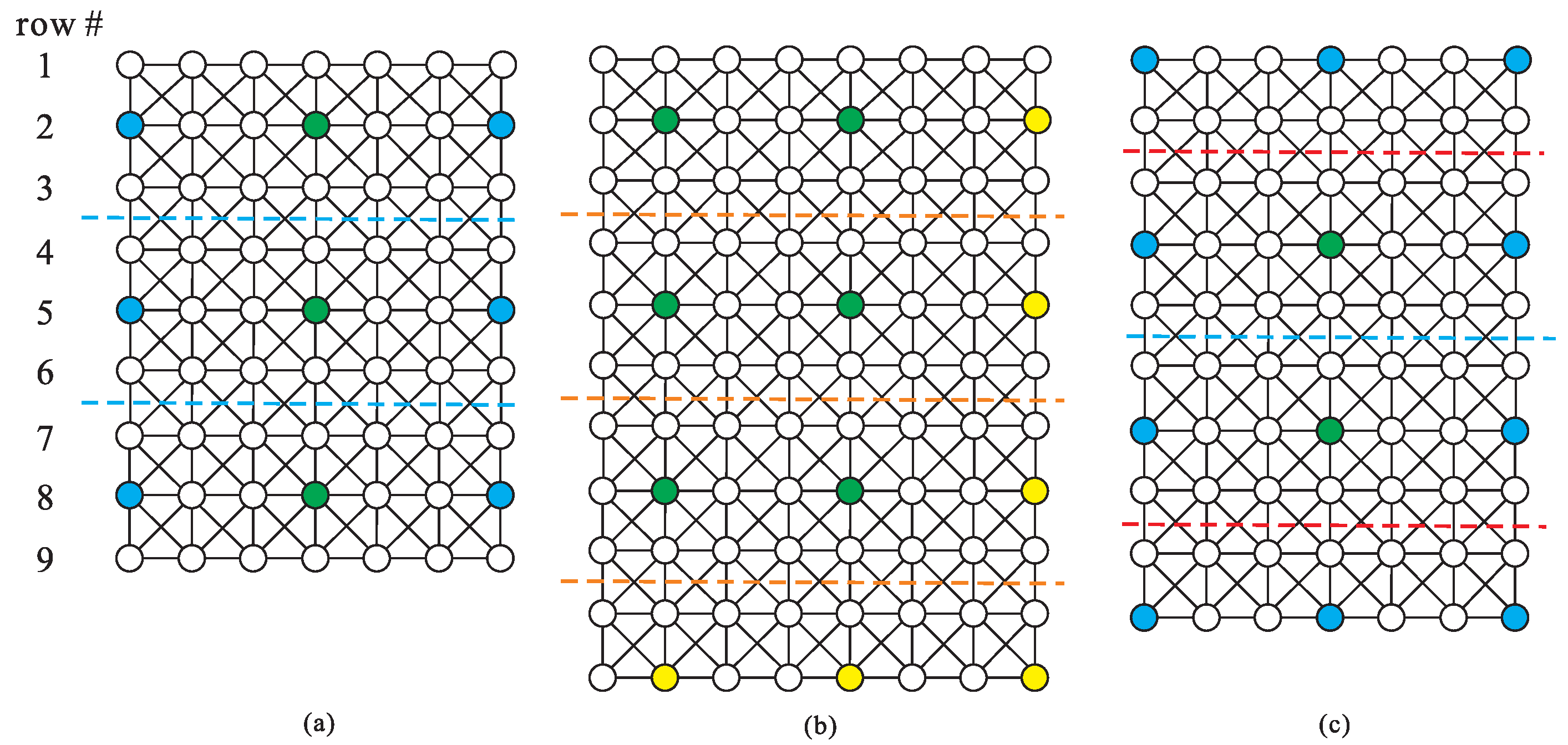
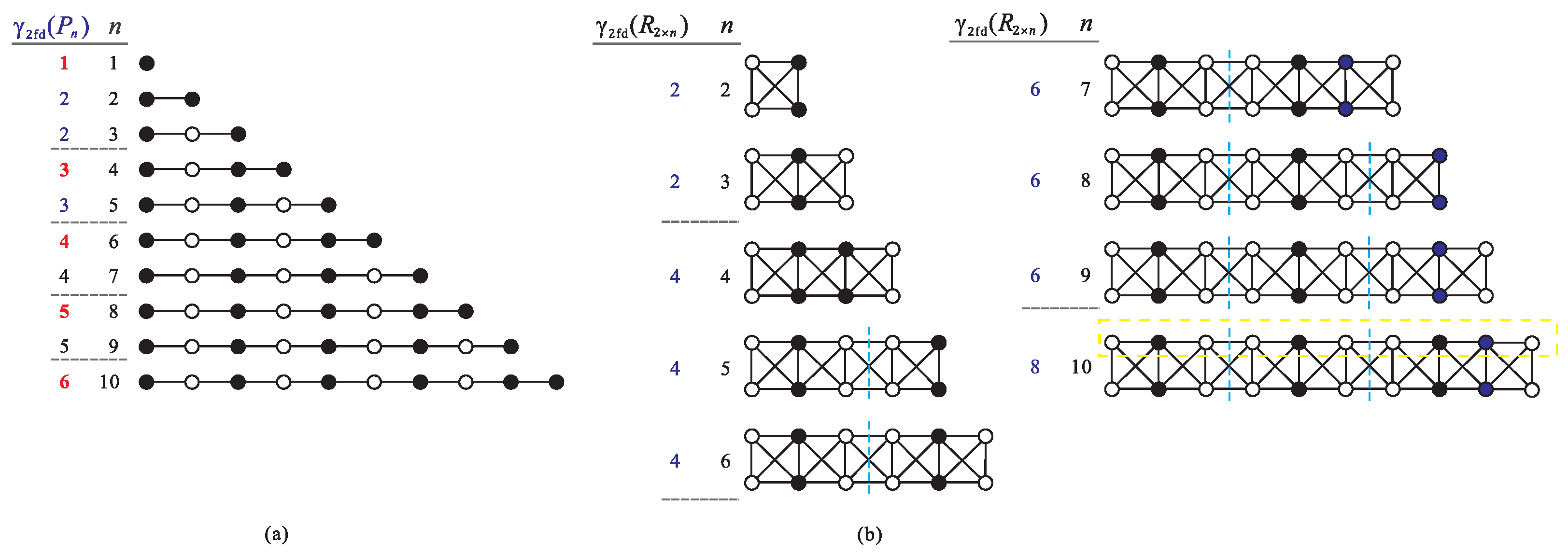
We analyze the structural properties of rectangular supergrid graphs with respect to fair domination and present a linear-time algorithm to compute minimum 1-fair dominating sets. We further provide a linear-time algorithm for the 2-fair domination problem on small rectangular supergrid graphs. The computational complexity of the 2-fair domination problem on large rectangular supergrid graphs, however, remains open.
We formulate an integer linear programming (ILP) model for computing optimal k-fair dominating sets and apply it to small supergrid graphs. The experimental results reveal that, due to the fairness constraints, many graphs admit the entire vertex set as the unique fair dominating set. Motivated by this observation, we introduce a variant called the restricted fair domination problem, whose computational complexity and potential applications merit further study.
These results reveal a sharp contrast between the intractable behavior of fair domination on general extended supergrid graphs and the tractable structure of rectangular subclasses, while the ILP-based study provides additional insight into structural irregularities and motivates the restricted fair domination model.
The remainder of this paper is organized as follows.
Section 2 introduces the notation and preliminary concepts.
Section 3 establishes the NP-completeness of the 1-fair domination problem on extended supergrid graphs.
Section 4 investigates the 1-fair and 2-fair domination numbers of rectangular supergrid graphs.
Section 5 presents the ILP model and introduces the restricted fair domination variant. Finally,
Section 6 concludes the paper and discusses directions for future research.
2. Preliminaries and Definitions
All graphs considered in this paper are simple and undirected. For a graph G, let and denote its vertex set and edge set, respectively. For a vertex , the open neighborhood of v is , and the closed neighborhood of v is . The degree of v in G is . For a subset , the subgraph induced by S is denoted by , and we define and . A path P in a graph G is a sequence of adjacent vertices that begins at and ends at , called a -path. All vertices are distinct, except in the special case where the path forms a cycle and . When there is no ambiguity, a path on n vertices is denoted by .
2.1. Supergrid-Related Graph Classes
An
infinite two-dimensional integer supergrid is an infinite graph whose vertices are placed at all integer coordinate points in the two-dimensional Euclidean plane. Each vertex
v is indicated by
, where
and
represent its
x- and
y-coordinates, respectively. In
, two vertices
u and
v are adjacent if and only if
and
, where
and
denote the absolute differences between the
x-coordinates and
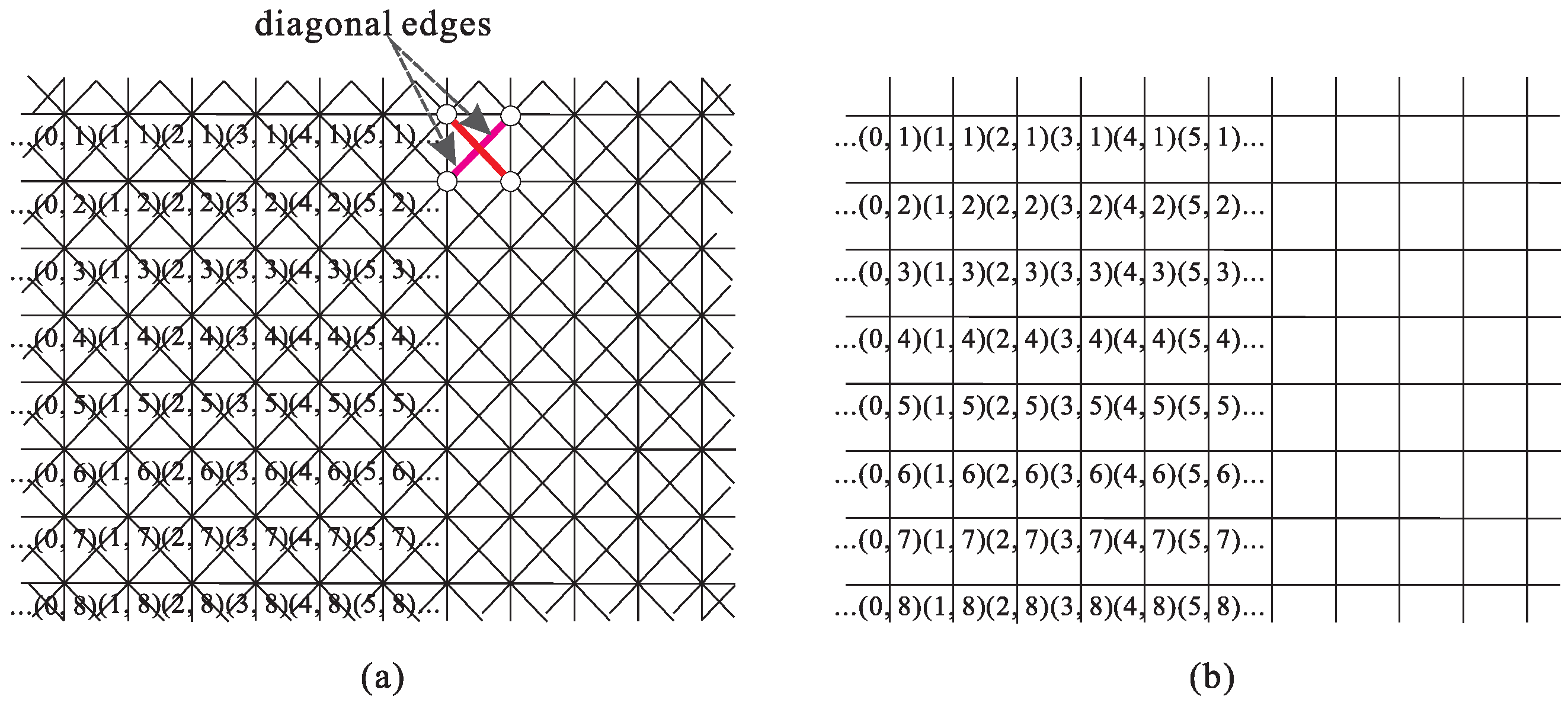
y-coordinates of the two vertices, respectively. Thus, the supergrid contains horizontal, vertical, and two types of diagonal edges (left-skewed and right-skewed). A horizontal (respectively, vertical) path in
is a sequence of consecutive horizontal (respectively, vertical) edges. For example,
Figure 1a depicts a partial segment of the
infinite graph
.
An
infinite two-dimensional integer grid is obtained from
by removing all diagonal edges. Two vertices
w and
z in
are adjacent if and only if
. For example,
Figure 1b depicts a partial segment of the
infinite graph
.
A supergrid graph is any finite, connected vertex-induced subgraph of . Equivalently, its vertices correspond to a finite subset of integer lattice points in , and two vertices are adjacent if and only if their Euclidean distance is at most .
A grid graph is any finite, connected vertex-induced subgraph of . Equivalently, its vertices correspond to a finite subset of integer lattice points in , and two vertices are adjacent if and only if their Euclidean distance is one, that is, they differ by one in exactly one coordinate.
It should be noted that in grid graphs each vertex has a degree of at most 4, and every grid graph is both bipartite and planar [
23]. However, in supergrid graphs, a vertex may have a degree up to 8, and such graphs are not necessarily bipartite or planar. This indicates that supergrid graphs have a more complex structure, which in turn leads to greater computational challenges when dealing with domination-related problems.
An extended supergrid graph is a finite, connected subgraph of , while a grid graph (respectively, supergrid graph) is a finite, vertex-induced subgraph of (respectively, ). Note that an extended supergrid graph is not necessarily a vertex-induced subgraph of . Thus, this class includes grid graphs and supergrid graphs as subclasses.
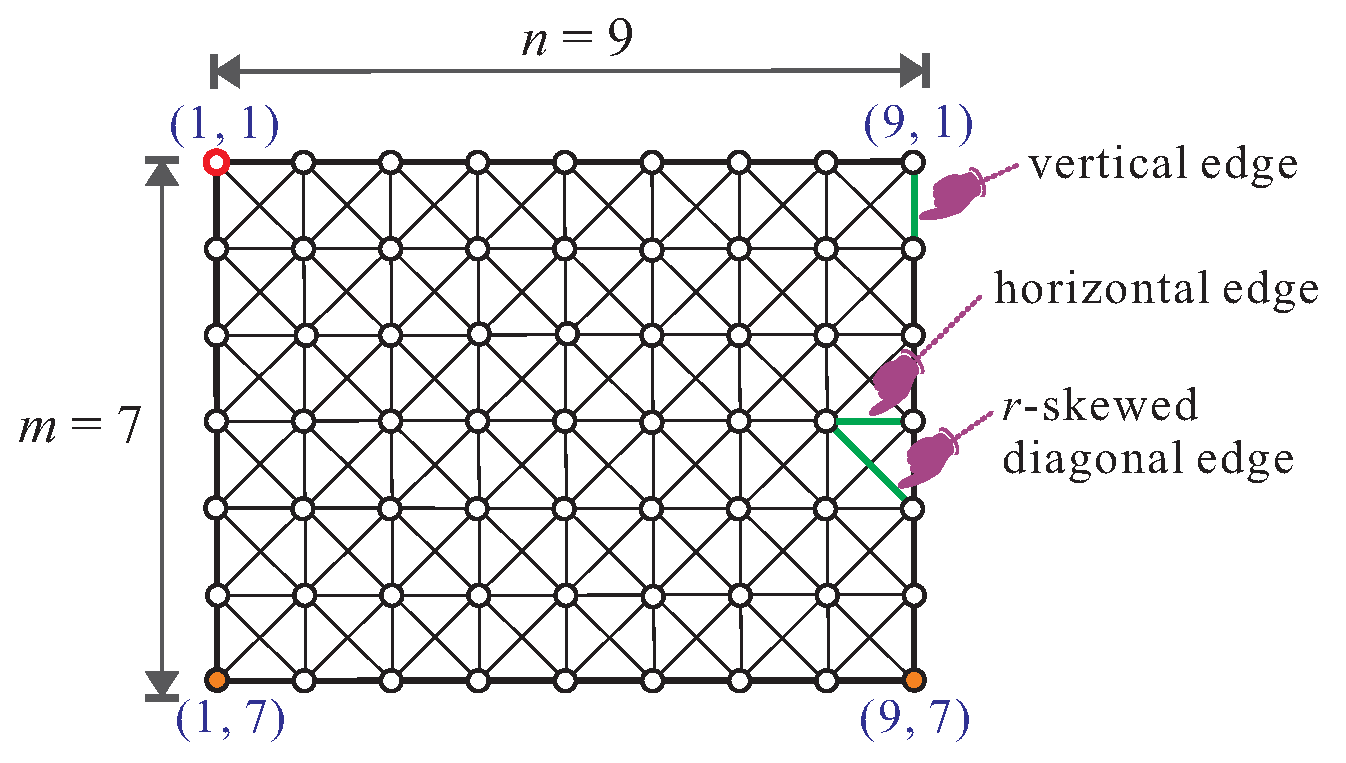
A rectangular supergrid graph (also called a King’s graph) is the vertex-induced subgraph of on the vertex set . Equivalently, it is the strong product of the paths and . Two distinct vertices u and v are adjacent if and only if and , and . Such graphs exhibit strong regularity properties that play a crucial role in the design of efficient algorithms for fair domination. A rectangular grid graph is the vertex-induced subgraph of on the same vertex set. Equivalently, it is the Cartesian product of the paths and , where two distinct vertices u and v are adjacent if and only if .
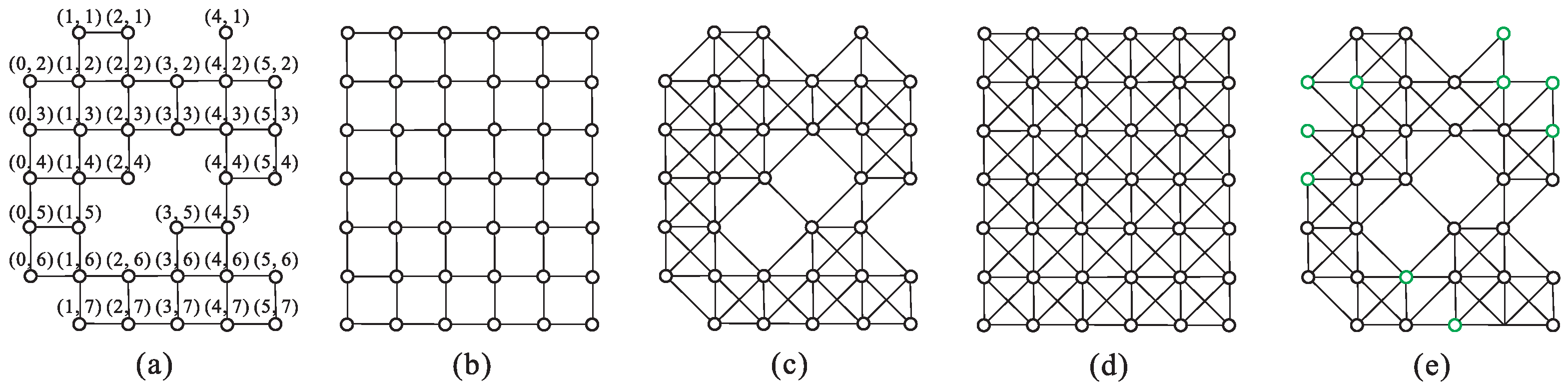
Figure 2 presents examples of a grid graph, a rectangular grid graph, a supergrid graph, a rectangular supergrid graph, and an extended supergrid graph that is not an induced subgraph of
. In
Figure 2, we assume that the vertex with coordinates
is located at the upper-left corner, and the coordinates increase to the right and downward. For illustration,
Figure 2a displays the coordinates of the vertices in the grid graph.
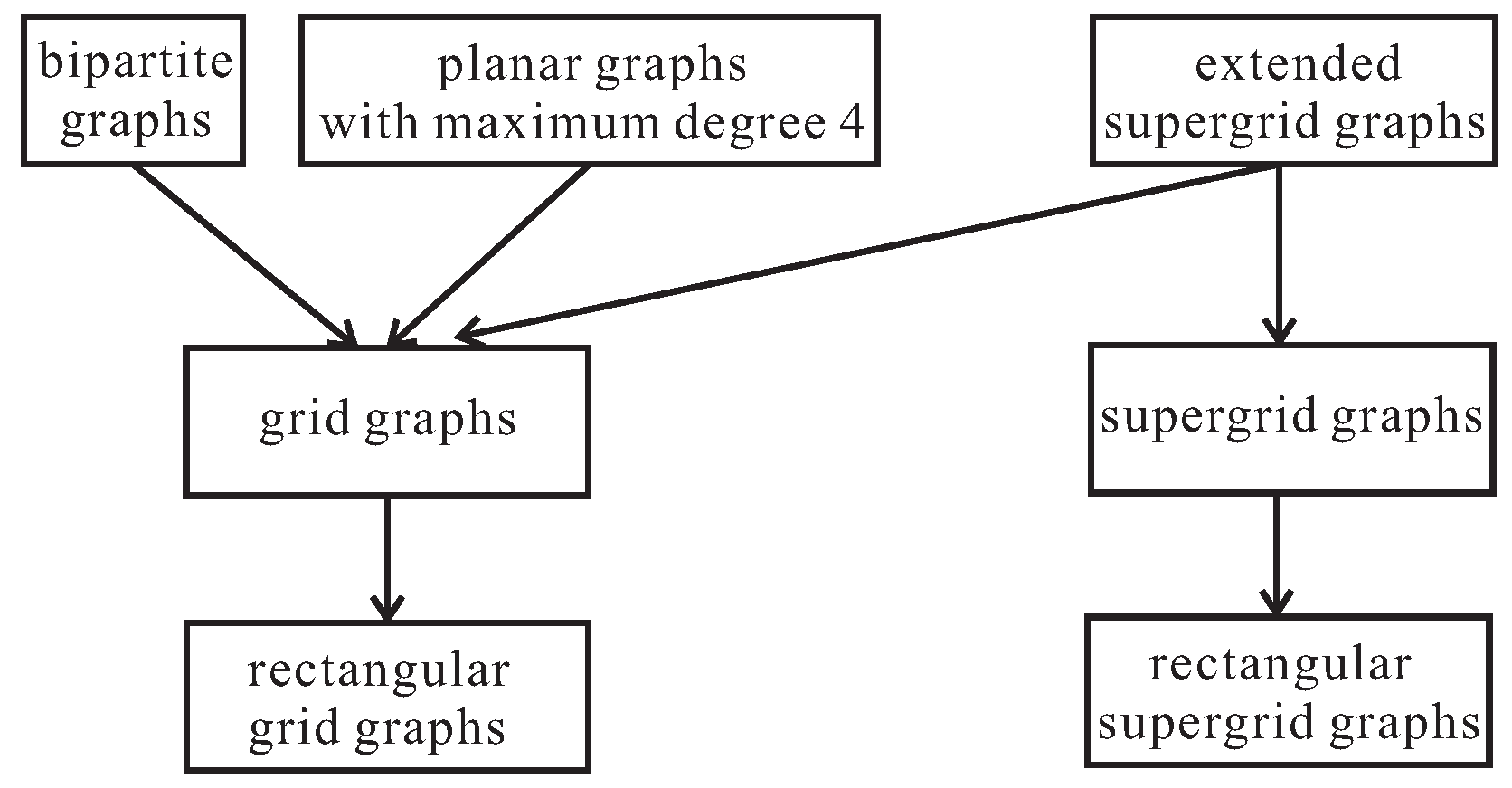
Figure 3 illustrates the relationships among these graph classes.
2.2. Domination and Fair Domination
A dominating set of a graph G is a subset such that for every vertex . For a vertex v and a dominating set D of G, v is said to be dominated by D. The domination number of G, denoted by , is the minimum cardinality of a dominating set of G. The domination problem is to find a dominating set of size .
Let k be a positive integer. A dominating set F of G is called a k-fair dominating set if every vertex satisfies . The k-fair domination problem is to find a k-fair dominating set of minimum cardinality. Since is a k-fair dominating set of G (because ), every graph admits a trivial k-fair dominating set. Let denote the minimum cardinality of a k-fair dominating set of G.
Clearly, if the maximum degree of the vertex of a graph
G is
, then the only
-fair dominating set in
G is
, where
. For example, in grid graphs (which have a maximum degree 4), the only 5-fair dominating set is the entire vertex set.
Figure 4a depicts a minimum 1-fair dominating set of a grid graph, while
Figure 4b shows a 1-fair dominating set that is not minimum, and
Figure 4c shows a dominating set that is not 1-fair.
3. NP-Completeness Results
In this section, we establish the computational hardness of fair domination on extended supergrid graphs. We prove that the 1-fair domination problem is NP-complete for grid and supergrid graphs. Moreover, the reduction extends to planar graphs with maximum degree 4. Chen et al. [
20] showed that the domination and independent domination problems on supergrid graphs are NP-complete. Following a similar approach, we show that the 1-fair domination problem also remains NP-complete on this graph class and on grid graphs. Our proof is based on a polynomial time reduction from the domination problem on grid graphs, which was proved NP-complete by Clark et al. [
2]. Specifically, we transform any instance of the domination problem on grid graphs into an equivalent instance of the 1-fair domination problem on grid and supergrid graphs.
Theorem 1 ([
2])
. The domination problem on grid graphs is NP-complete. We first prove that the 1-fair domination problem is NP-complete on grid graphs. Given a grid graph , we construct another grid graph, denoted by . The key property of the construction is that has a dominating set D with if and only if has a 1-fair dominating set with .
Given an input grid graph
, we construct a new grid graph
as follows (see Algorithm 1):
| Algorithm 1 Grid graph construction algorithm |
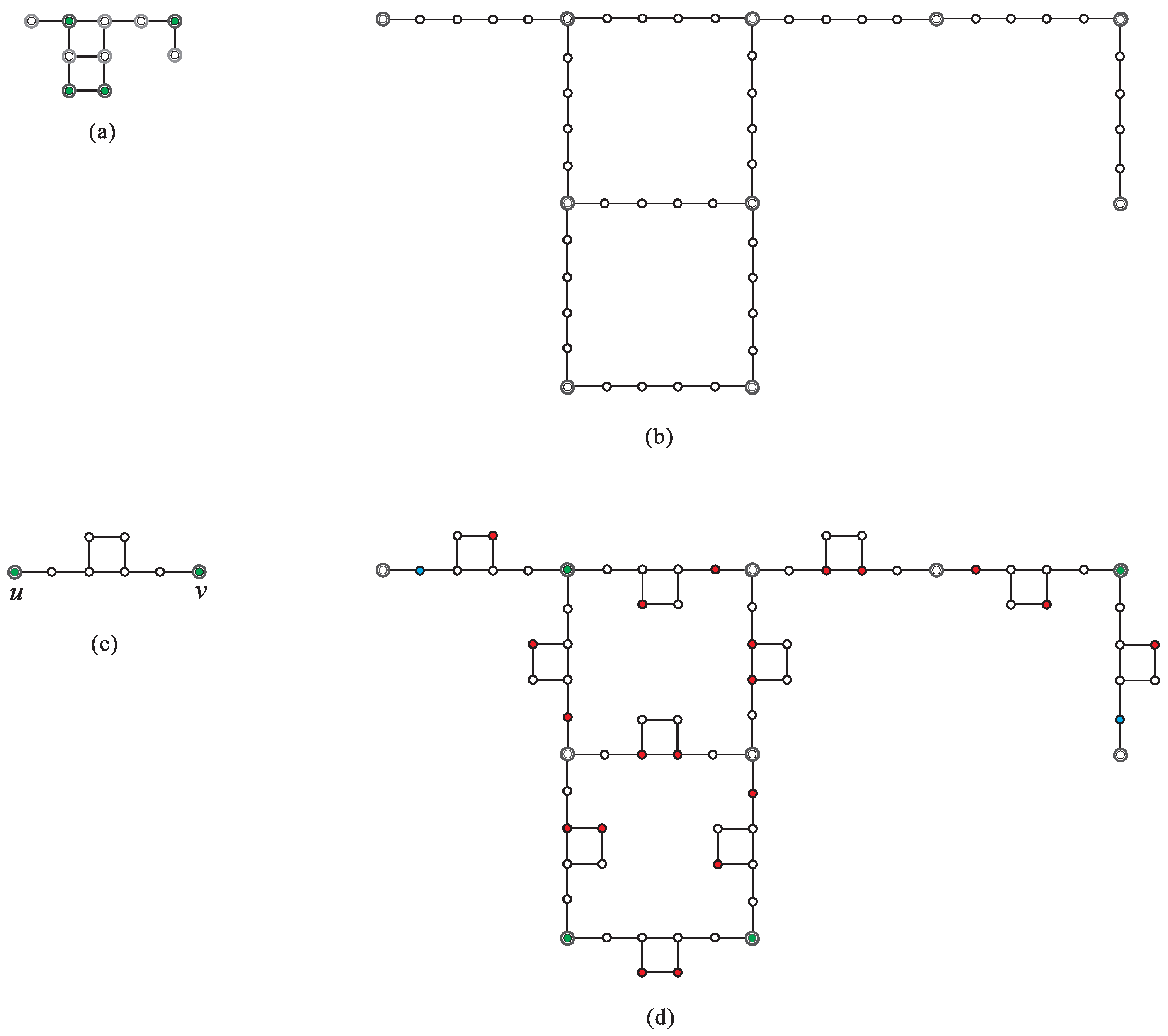
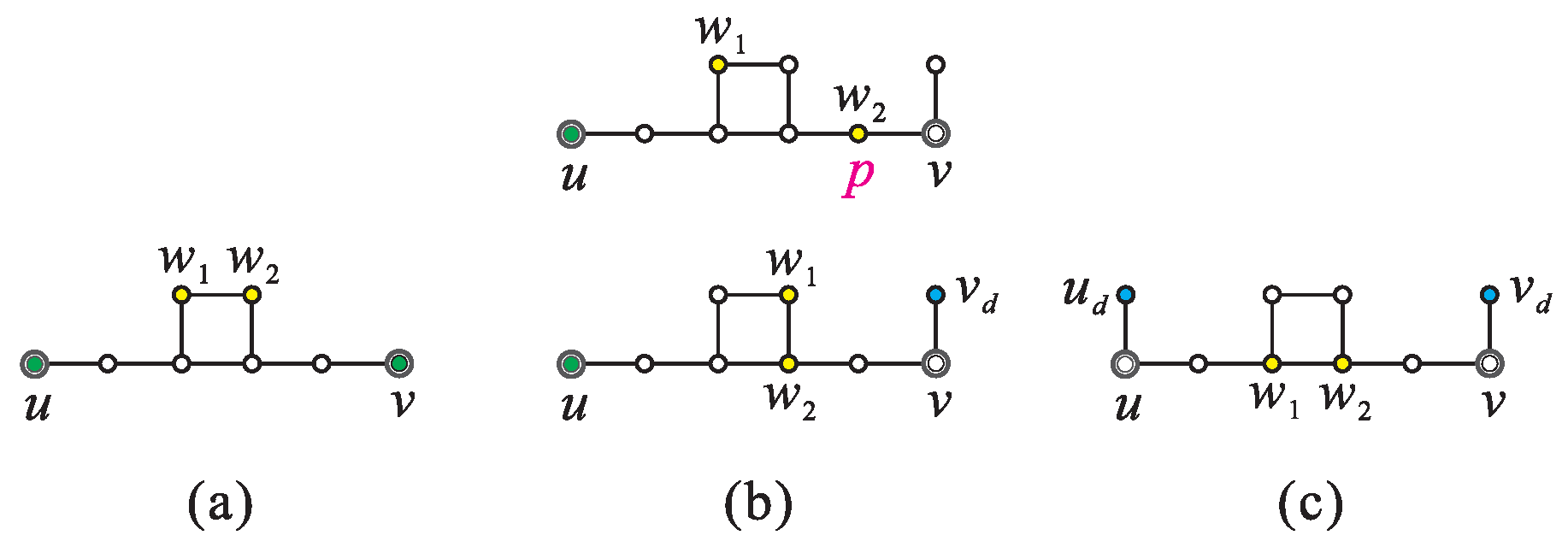
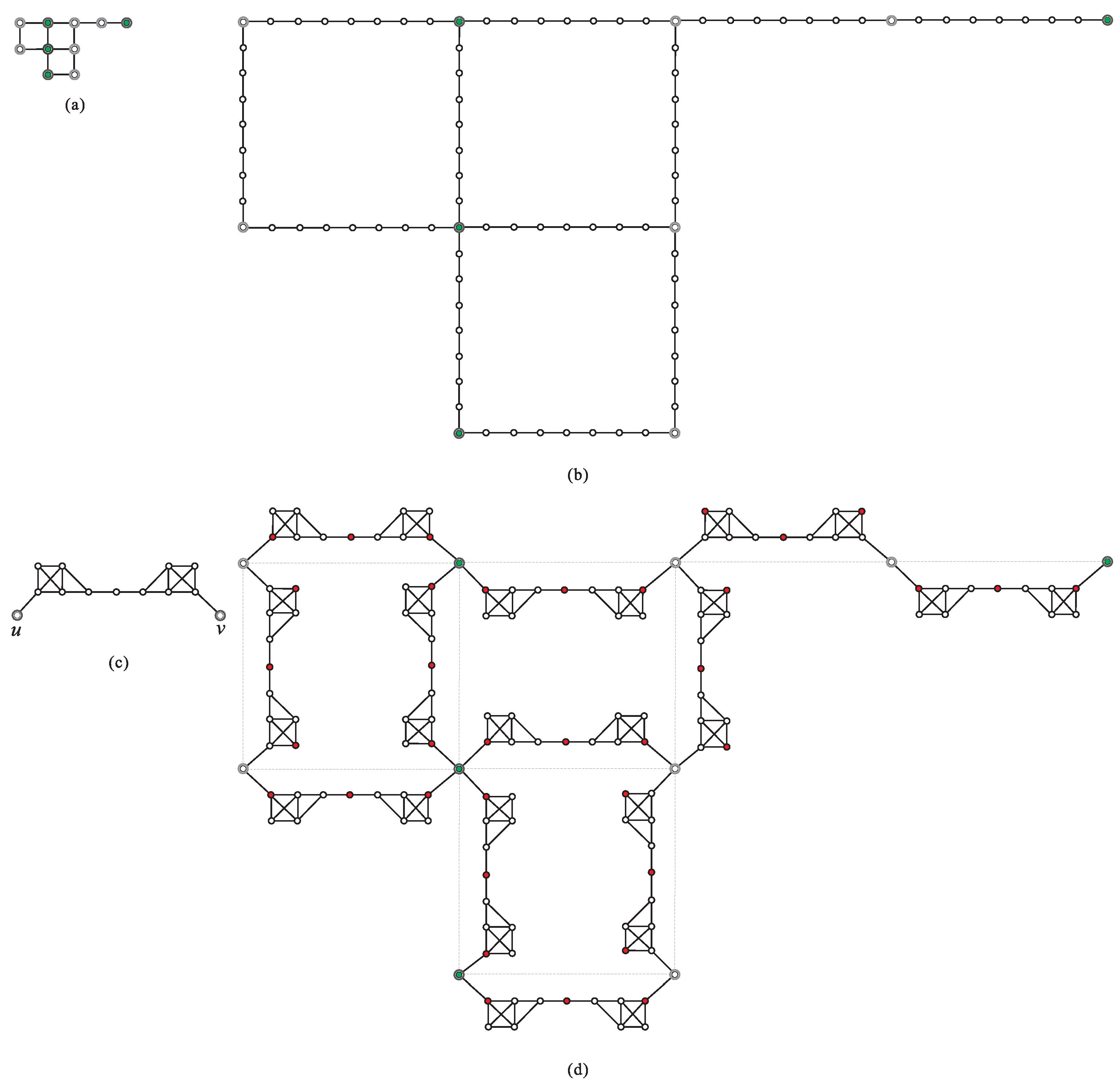
Input: A grid graph . Output: The constructed grid graph . Step 1: Construct the 5- subdivision graph of the input grid graph . For each edge , subdivide it by inserting four new vertices so that is replaced by a path of length 5 between u and v. Since is a grid graph, each subdivided edge forms a horizontal or vertical path. The resulting graph is the 5-subdivision of , denoted by . An example of is shown in Figure 5b for the grid graph in Figure 5a. Step 2: Introduce square tentacles. For each -path in corresponding to an original edge , we replace the path with a connected subgraph called a -square tentacle, denoted by . This tentacle is a small grid subgraph whose endpoints u and v (the original vertices of ) serve as connectors. An example of a -square tentacle is shown in Figure 5c. Step 3: Final construction. After performing the above replacement for every such path, the resulting graph is denoted by and output it.
|
In our previous work [
20,
21], we introduced a placement strategy to place square tentacles on the enlarged grid graph
so that any two tentacles intersect only at their connectors. The idea is summarized as follows. Consider a unit square in the grid graph
whose vertices are
,
,
, and
. These four vertices serve as the connectors for the corresponding square tentacles. If both
i and
j are odd or both are even, the tentacles are placed as shown in
Figure 6a; otherwise, they are arranged as in
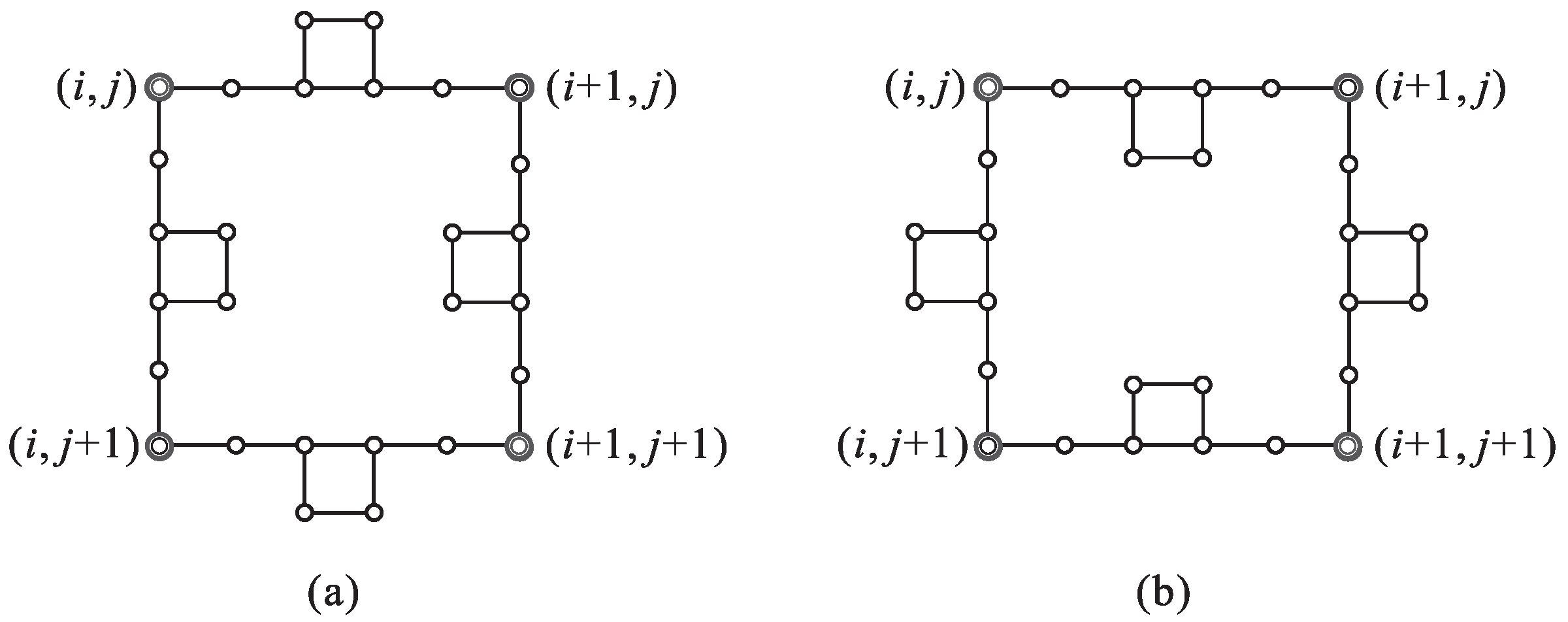
Figure 6b. When square tentacles are placed within a unit square of the enlarged grid graph
, at most two tentacles appear in the square, and they always occupy opposite sides. Moreover, these two tentacles are separated by at least two grid points. Consequently, no vertex other than the connectors is shared by different square tentacles. We refer to this placement scheme as
Rule AT (arrangement of the tentacles).
The following lemma shows that Algorithm 1, together with Rule AT, can be executed in linear time.
Lemma 1. Given a grid graph , Algorithm 1 constructs a new grid graph in -linear time.
Proof. We show that Algorithm 1 can be implemented in linear time and that the resulting graph is a grid graph.
Let
be the input grid graph with
and
. In Step 1, each edge of
is subdivided four times, introducing exactly four new vertices and five edges per original edge. Consequently, the resulting graph
has
and can be constructed by processing each edge once. Hence Step 1 runs in
time.
In Step 2, each subdivided path corresponding to an original edge is replaced by a constant-size tentacle . Since the size of each tentacle is bounded by a constant independent of n and m, each replacement requires time. Applying this operation to all m edges requires time.
Since Step 3 merely outputs the constructed graph , its running time is proportional to the output size and hence is .
Therefore, the total running time of the construction is , which is linear in the size of the input graph. Moreover, since all replacements use horizontal and vertical grid paths and grid subgraphs, the resulting graph remains a grid graph. □
We next show that the grid graph admits a dominating set D with if and only if the grid graph admits a 1-fair dominating set with , thereby completing the correctness of the reduction.
Before presenting the proof, we define the
core of a
-square tentacle
as the set of its internal vertices, namely,
We first establish the only-if part as follows.
Lemma 2. Let be a grid graph, and let be the grid graph constructed from by Algorithm 1. If has a dominating set D with , then contains a 1-
fair dominating set with Proof. Let
D be a dominating set of
with
. We construct a set
as follows. Initially, let
For each edge , let denote the corresponding square tentacle with core . By Rule AT, distinct tentacles intersect only at their connectors, and hence their cores are pairwise disjoint.
For each tentacle
, select two vertices
according to the connector configuration shown in
Figure 7, and update
By the property of square tentacle illustrated in
Figure 7, this choice ensures that every vertex of
not in
is adjacent to exactly one vertex of
, regardless of whether the connectors
u and
v belong to
D.
Since two vertices are added for each edge of
, we obtain
Thus, every vertex of satisfies the 1-fair domination condition, and is a 1-fair dominating set of the desired size.
For example,
Figure 5a shows a dominating set
D of
with
. The corresponding 1-fair dominating set
of
, with
is illustrated in
Figure 5d. □
The construction of the 1-fair dominating set in Lemma 2 proceeds in three stages:
- Stage 1:
Process all square tentacles with ;
- Stage 2:
Process those with exactly one connector in D (i.e., or );
- Stage 3:
Process the remaining square tentacles with .
By the structure of the square tentacle, we have the following lemma and observation.
Lemma 3. Let F be a 1-
fair dominating set of . For every edge , Proof. The claim can be verified by inspecting the three configurations in
Figure 7a–c: in each case, selecting fewer than two vertices from
leaves some internal vertex of the tentacle either undominated or adjacent to two selected neighbors, violating the 1-fair condition. □
Observation 1. Let F be a minimum 1-fair dominating set of . If is dominated by a vertex in the tentacle , then .
Next, we prove the if part in the following lemma.
Lemma 4. Let be a grid graph, and let be the grid graph constructed from by Algorithm 1. If contains a 1-fair dominating set with , then has a dominating set D with .
Proof. Let be the family of all 1-fair dominating sets F of such that . Since contains a 1-fair dominating set of size at most , we have . Choose with minimum cardinality, and define .
By Lemma 3, for each
we have
. By Rule AT, different tentacles intersect only at their connectors. Hence, the cores are pairwise disjoint. Then,
Therefore,
It remains to show that D dominates . Assume to the contrary that there exists such that . Since , the 1-fair condition implies that ; let this unique neighbor be p. Because , we have . Thus, p lies in the tentacle for some . By Observation 1, , contradicting . Hence D is a dominating set of .
Finally, if , then . □
By Lemmas 2 and 4, we summarize the following theorem.
Theorem 2. Let be a grid graph, and let be the grid graph constructed from by Algorithm 1 and Rule AT. Then, has a dominating set D with if and only if contains a 1-fair dominating set with .
The 1-fair domination problem clearly belongs to NP, since a given 1-fair dominating set can be verified in polynomial time to satisfy the 1-fair condition. By Theorem 1, Lemma 1, and Theorem 2, we obtain the following result.
Theorem 3. The 1-fair domination problem for grid graphs is NP-complete.
By construction, the graph is planar and has maximum degree 4. Thus, we obtain the following corollary.
Corollary 1. The 1-fair domination problem is NP-complete for planar graphs with maximum degree 4.
Analogously to the construction of the grid graph
from
, we construct a supergrid graph
from
using a different
-tentacle gadget as follows (see Algorithm 2).
| Algorithm 2 Supergrid graph construction algorithm |
|
For example, given the grid graph shown in
Figure 8a, the resulting supergrid graph
is shown in
Figure 8d. Using arguments similar to those in the proof of Lemma 1, we obtain the following lemma.
Lemma 5. Given a grid graph , Algorithm 2, together with Rule AT, constructs a supergrid graph in -linear time.
Proof. We show that Algorithm 2 runs in linear time and that the resulting graph is a supergrid graph.
Let
be the input grid graph with
and
. In Step 1, each edge of
is enlarged eight times, introducing exactly seven new vertices and eight edges per original edge. Consequently, the resulting graph
has
and can be constructed by processing each edge once. Hence, Step 1 runs in
time.
In Step 2, each enlarged path corresponding to an original edge is replaced by a tentacle of constant size. Since the size of each tentacle is bounded by a constant independent of n and m, each replacement requires time. Applying this operation to all m edges requires time.
Step 3 simply produces the resulting graph, which is linear in output size.
Therefore, the total running time of the construction is
, which is linear in the size of the input graph. Moreover, according to Rule AT, each replacement in Step 2 satisfies the requirement that two distinct tentacles are separated by at least three integer lattice points (see
Figure 8d). In addition, the tentacles in
are supergrid graphs and are pairwise disjoint, except for their connectors. Thus, the constructed graph
is a supergrid graph. □
The following lemma establishes a structural property of the -tentacle in .
Lemma 6. Let F be a 1-
fair dominating set of . For every edge , Proof. This follows from the local structure of the tentacle
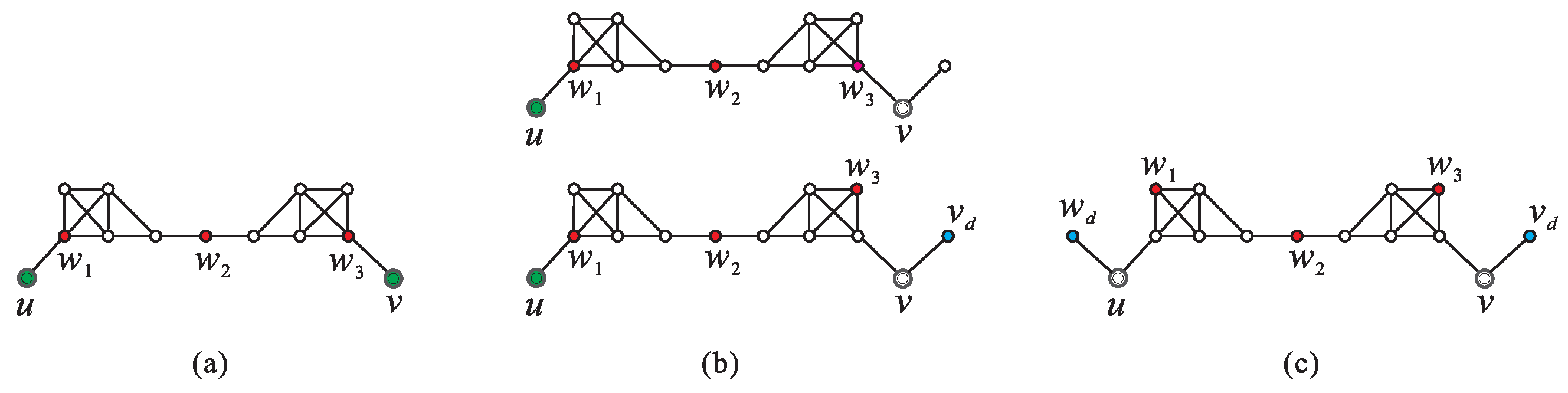
in
Figure 8c: at least three internal vertices are required to satisfy the 1-fair condition for the vertices of the tentacle. □
Using the same arguments as in the proofs of Lemmas 2 and 4, we obtain the following two lemmas.
Lemma 7. Let be a grid graph, and let be the supergrid graph constructed from by Algorithm 2. If has a dominating set D with , then contains a 1-
fair dominating set with Proof. The proof follows the same construction as in Lemma 2. The differences are as follows.
Instead of selecting two core vertices in each square tentacle, we select
three internal vertices in each
-tentacle
, as shown in
Figure 9.
The necessity of selecting at least three internal vertices is guaranteed by Lemma 6, which states that for every
,
Consequently, each edge contributes three vertices (instead of two), and hence
All other arguments are identical to those in Lemma 2. □
Lemma 8. Let be a grid graph, and let be the supergrid graph constructed from by Algorithm 2. If contains a 1-fair dominating set with , then has a dominating set D with .
Proof. The proof follows the same argument as in Lemma 4. The differences are as follows.
Instead of applying Lemma 3 (which guarantees at least two core vertices in each square tentacle), we apply Lemma 6, which guarantees that each tentacle contains at least three internal vertices in any 1-fair dominating set.
Since the internal vertex sets of distinct tentacles are pairwise disjoint, we obtain
The remaining domination argument is identical to that in Lemma 4. □
It follows from Lemmas 7 and 8 that the following theorem holds.
Theorem 4. Let be a grid graph, and let be the supergrid graph constructed from by Algorithm 2 and Rule AT. Then, has a dominating set D with if and only if contains a 1-fair dominating set with .
By Theorem 1, Lemma 5, and Theorem 4, we obtain the following result.
Theorem 5. The 1-fair domination problem for supergrid graphs is NP-complete.
5. ILP Formulation for the k-Fair Domination Problem
In this section, we formulate the k-fair domination problem as an integer linear programming (ILP), which is used as a verification tool for small instances. The proposed ILP formulation is a 0–1 integer linear programming, since each variable represents whether a vertex is selected in the fair dominating set. This ILP model applies not only to extended supergrid graphs but also to arbitrary graphs. Due to its inherent computational complexity, the ILP formulation is employed only for small instances.
For the k-fair domination problem on G, we give the following remark.
Remark 2. If , then any vertex would require , which is impossible. Hence, the only feasible k-fair dominating set is .
Therefore, we assume , since case admits only the trivial solution . In this paper, we use the ILP formulation with or ; that is, we focus on the 1-fair and 2-fair domination problems.
5.1. ILP Formulation
Let
G be a graph with maximum degree
. For each vertex
, we introduce a binary decision variable
Therefore, the introduced model is a 0-1 integer linear programming (ILP) formulation.
5.1.1. General ILP Formulation
The k-fair domination problem on graph G can be formulated as the following integer linear programming.
Constraint (1) ensures that every vertex is dominated (domination condition). Constraints (2) and (3) (the k-fair condition) together enforce that each vertex is adjacent to exactly k vertices of , while no restriction is imposed when . Therefore, every feasible solution corresponds to a k-fair dominating set of G, and conversely. Note that .
5.1.2. Refined ILP Formulation (Compact but Strengthened Model)
The general ILP formulation can be made more compact by incorporating the fairness constraint directly into a modified adjacency matrix. Let
be defined by
Then Constraints (1)–(3) can be replaced by the single equality
This compact formulation reduces the number of constraints and yields a more memory-efficient model. However, it is important to note that Constraint (
5) is strictly stronger than the original
k-fair domination formulation.
Indeed, if
, then Constraint (
5) implies
and hence
. Therefore, any two selected vertices must be nonadjacent, which means that the selected set forms an independent set. This additional restriction is not required in the definition of
k-fair domination and may render the refined model infeasible even when a valid
k-fair dominating set exists.
For this reason, the general ILP formulation is retained as the primary model to guarantee correctness and feasibility for arbitrary instances. The refined formulation may be used as a strengthened (optional) variant in cases where the independent-set property is known to hold. In our computational experiments, the refined model was observed to be faster on instances where feasibility is preserved, but the general model remains necessary to ensure robustness.
5.1.3. Implementation Note
We first attempt to solve the fair domination problem by using the refined ILP model (Constraint (
5)). If it is infeasible, we fall back to the general ILP formulation, which is always feasible since
is a trivial
k-fair dominating set.
5.2. ILP-Based Experiments
We implement the general ILP model to compute minimum 1-fair and 2-fair dominating sets on small supergrid graphs.
5.2.1. Holes (Vertex Deletions)
Let
be an
supergrid graph with vertex set
which is a supergrid graph obtained from
with hole rate
p.
5.2.2. Experimental Setup
In our experiments, the set H is generated uniformly at random among all subsets of size , and a fixed random seed is used to ensure reproducibility. We also guarantee that at least one vertex remains after deletions, that is, , and that the resulting supergrid graph is connected.
All test instances were generated from rectangular supergrid graphs by applying the above vertex-deletion process. The ILP formulation was solved to optimality using the CBC solver through the PuLP interface. Due to its computational complexity, the general ILP model was employed only for small instances and served as an exact experimental tool for investigating the structural behavior of 1-fair and 2-fair domination under vertex deletions.
5.3. ILP Formulation for 1-Fair Domination on Supergrid Graphs
While the theoretical results in the previous sections provide structural characterizations and exact values for several classes of supergrid graphs, the behavior of the 1-fair domination number under structural perturbations remains unclear. In particular, the strict local balance condition of 1-fair domination suggests that even small changes in the graph structure may significantly affect the size and configuration of feasible solutions.
To gain further insight into this phenomenon, we adopt an integer linear programming (ILP) approach to compute minimum 1-fair dominating sets on small supergrid graphs. The ILP formulation allows us to systematically explore how the domination number changes when the graph is subjected to random vertex removals, and to observe structural patterns that are difficult to capture by purely theoretical analysis.
5.3.1. Experimental Setup
In our experiments, we consider the rectangular supergrid graph
, which contains horizontal, vertical, and diagonal edges. To model structural defects, we introduce
holes by randomly removing a prescribed proportion of vertices together with their incident edges. The hole rate
p is chosen from the set
For each hole rate, a general ILP model is used to compute a minimum 1-fair dominating set
, where every vertex not in
is adjacent to exactly one vertex of
. The objective function minimizes
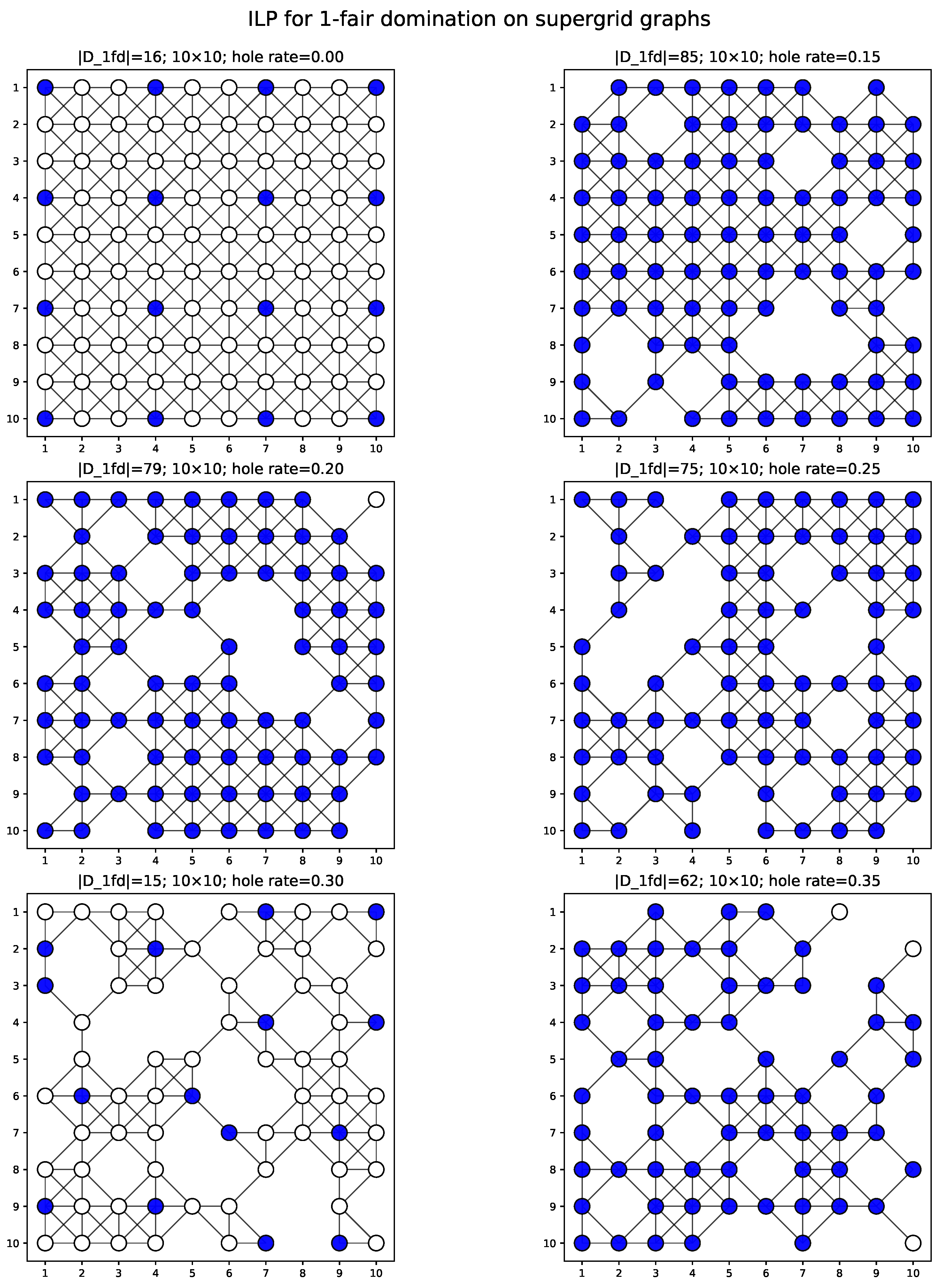
. Representative optimal solutions for different hole rates are illustrated in
Figure 14, where the selected vertices are marked in solid circles.
5.3.2. Analysis of Results
The experimental results reveal a pronounced non-monotonic behavior of the minimum 1-fair dominating set size with respect to the hole rate. When no vertices are removed (), the supergrid graph admits a compact 1-fair dominating set of size 16. However, for moderate hole rates (, , and ), the size of a minimum 1-fair dominating set increases dramatically, reaching values as large as 85 (the entire vertex set of supergrid graph with hole rate ).
This phenomenon can be explained by the strict local balance imposed by the 1-fair constraint. For moderately perturbed graphs, although global connectivity is largely preserved, vertex removals create irregular local neighborhoods. These irregularities often force the ILP solver to include additional dominating vertices in order to avoid multiple domination or violations of the fairness constraint, thus substantially increasing .
Interestingly, when the hole rate becomes sufficiently large (), the size of the minimum 1-fair dominating set decreases again to 15. In this case, the graph typically decomposes into smaller or sparsely connected components with reduced vertex degrees, which are easier to satisfy the 1-fair condition. When the hole rate increases further to , the domination size increases again to 62, reflecting another structural transition of the graph.
Overall, these results indicate that the difficulty of the 1-fair domination problem on supergrid graphs is highly sensitive to intermediate levels of structural disruption. Moderate removals of the vertex can significantly increase the domination cost, whereas more extensive removals can simplify the structure of the graph and reduce the size of a 1-fair minimum dominating set. We summarize these findings as follows.
Observation 2. For supergrid graphs with vertex holes, the size of a minimum 1-fair dominating set is not monotone with respect to the hole rate. In particular, moderate hole rates may substantially increase the domination cost due to local violations of the fairness constraint, while higher hole rates may simplify the graph structure and lead to smaller 1-fair dominating sets.
Observation 3. For supergrid graphs with vertex deletions, an optimal solution of the 1-
fair domination problem may approach selecting almost all remaining vertices. Figure 14 shows that nearly the entire vertex set is selected into the 1-
fair dominating set when and . This phenomenon is caused by low-degree vertices whose local neighborhoods are severely disrupted by holes. The above observations indicate that the degenerate behavior is not an artifact of the ILP solver, but an intrinsic consequence of imposing an exact local fairness constraint on irregular graph structures. Specifically, the requirement that every vertex outside the dominating set must be adjacent to exactly one dominating vertex forces the ILP to include many vertices in the dominating set in order to avoid violations caused by disrupted local neighborhoods.
To address this issue, we introduce a restricted version of k-fair domination that excludes vertices with insufficient local degree from the fairness constraint. This modification prevents the ILP from selecting vertices solely to satisfy local fairness constraints, while preserving the exact fairness requirement on structurally stable vertices.
5.3.3. Restricted k-Fair Domination
Definition 1. Let G be a graph, let be an integer, and let be a fixed integer. For each vertex , define A set is called a -restricted k-fair dominating set of G if the following conditions hold:
- 1.
Domination. For every vertex , - 2.
Restricted fairness. For every vertex with ,
Remark 3. When , we have for all , and the restricted k-fair domination reduces to the classical k-fair domination problem.
The above definition admits a formulation of natural integer linear programming by activating the fairness constraint only on vertices with a degree of at least
. Specifically, the ILP formulation for the restricted problem can be obtained by replacing Constraints (2) and (3) with the following constraints:
where
.
The ILP formulation is modified by activating the fairness constraint only on vertices with a degree of at least , in accordance with Definition 1.
5.3.4. Motivation and Feasibility of Restricted Fair Domination
The classical k-fair domination imposes an exact local balance condition: every vertex outside the dominating set must have exactly k neighbors in it. Under vertex deletions, this equality constraint becomes extremely sensitive to irregular local neighborhoods, and optimal solutions may be forced to include a large fraction of vertices merely to avoid fairness violations. To mitigate this degeneracy, we introduce -restricted k-fair domination, which enforces the fairness equality only on vertices with degree at least , while keeping the domination requirement for all vertices.
This restriction enlarges the feasible region: any k-fair dominating set (if it exists) is also a -restricted k-fair dominating set for any . Moreover, if , then for all and the restricted problem reduces to the domination problem; hence a feasible solution exists whenever G is nonempty.
Proposition 1 (a sufficient condition for degeneracy). Let G be a graph, and let . Suppose that a vertex satisfies . Then, in any k-fair dominating set D of G, we must have . Consequently, if , then every k-fair dominating set D satisfies , and hence .
Proof. Assume for the contradiction that . Since D is k-fair, v must be adjacent to exactly k vertices of D, that is, . However, , a contradiction. Therefore, . The second statement follows immediately. □
Proposition 1 shows that low-degree vertices () are forced to be selected in any feasible solution of the classical k-fair domination problem. Under vertex deletions, many vertices near holes may become low-degree, which explains why the optimal solution can contain a large fraction of vertices. This motivates our -restricted model, where such structurally unstable vertices are excluded from the fairness requirement.
Corollary 2. If , then vertices with are not subject to the fairness constraint in Definition 1, and thus are no longer forced to be included solely due to the infeasibility of .
5.3.5. Experimental Results for the Restricted 1-Fair Domination
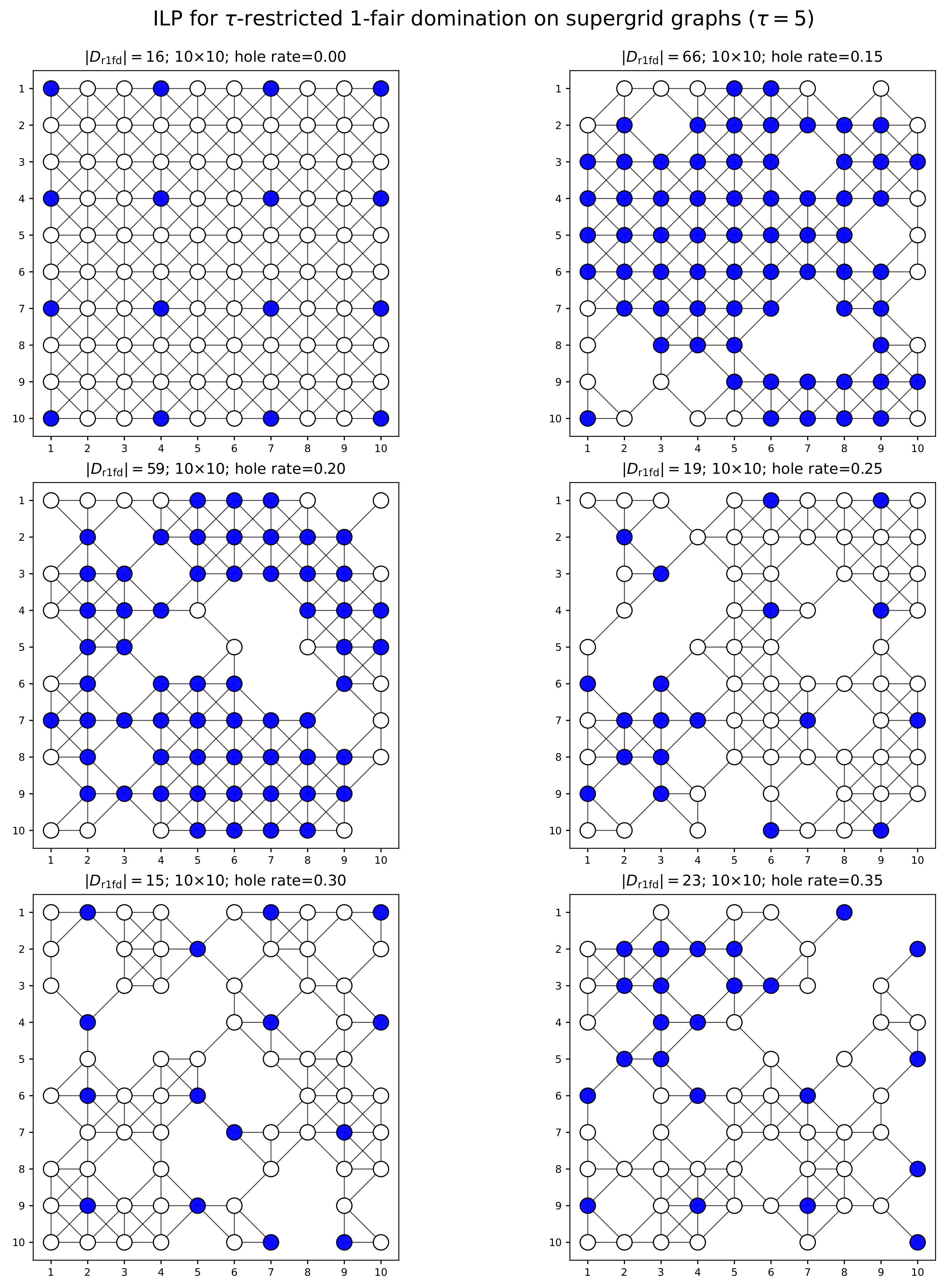
Figure 15 reports the ILP solutions for the
-restricted 1-fair domination problem on the
supergrid graph (using the same instances as in
Figure 14), where
and different hole rates are considered. When no vertices are removed, the restricted model produces a minimum dominating set of size
, which coincides with the optimal solution of the original 1-fair domination problem. This indicates that restricting the scope of fairness enforcement does not affect the optimal solution in regular graph structures.
For moderate hole rates, the restricted formulation exhibits a more stable behavior than the original 1-fair model. In particular, for hole rates and , the restricted model still produces solutions of sizes 66 and 59, respectively, which are smaller than those of the original 1-fair model. When the hole rate increases to , the size of the restricted solution drops significantly to 19, while the original 1-fair model still yields a much larger solution.
When the hole rate increases further ( and ), the restricted model continues to produce compact solutions of sizes 15 and 23, respectively, both of which remain close to the baseline value. This behavior contrasts with the original 1-fair domination problem, where the solution size may remain very large even at higher hole rates.
Overall, these results demonstrate that restricting the enforcement of fairness constraints effectively mitigates the extreme growth and instability observed in the original 1-fair domination problem, leading to solutions that are more robust and predictable under structural perturbations of supergrid graphs.
5.4. ILP Formulation for 2-Fair Domination on Supergrid Graphs
In Lemmas 13 and 14, we compute
for the rectangular supergrid graph
with
and 2. For
, we claimed in [
22] that
, that is, the entire vertex set
is the unique 2-fair dominating set. In this subsection, we will use an ILP model to give counterexamples for it.
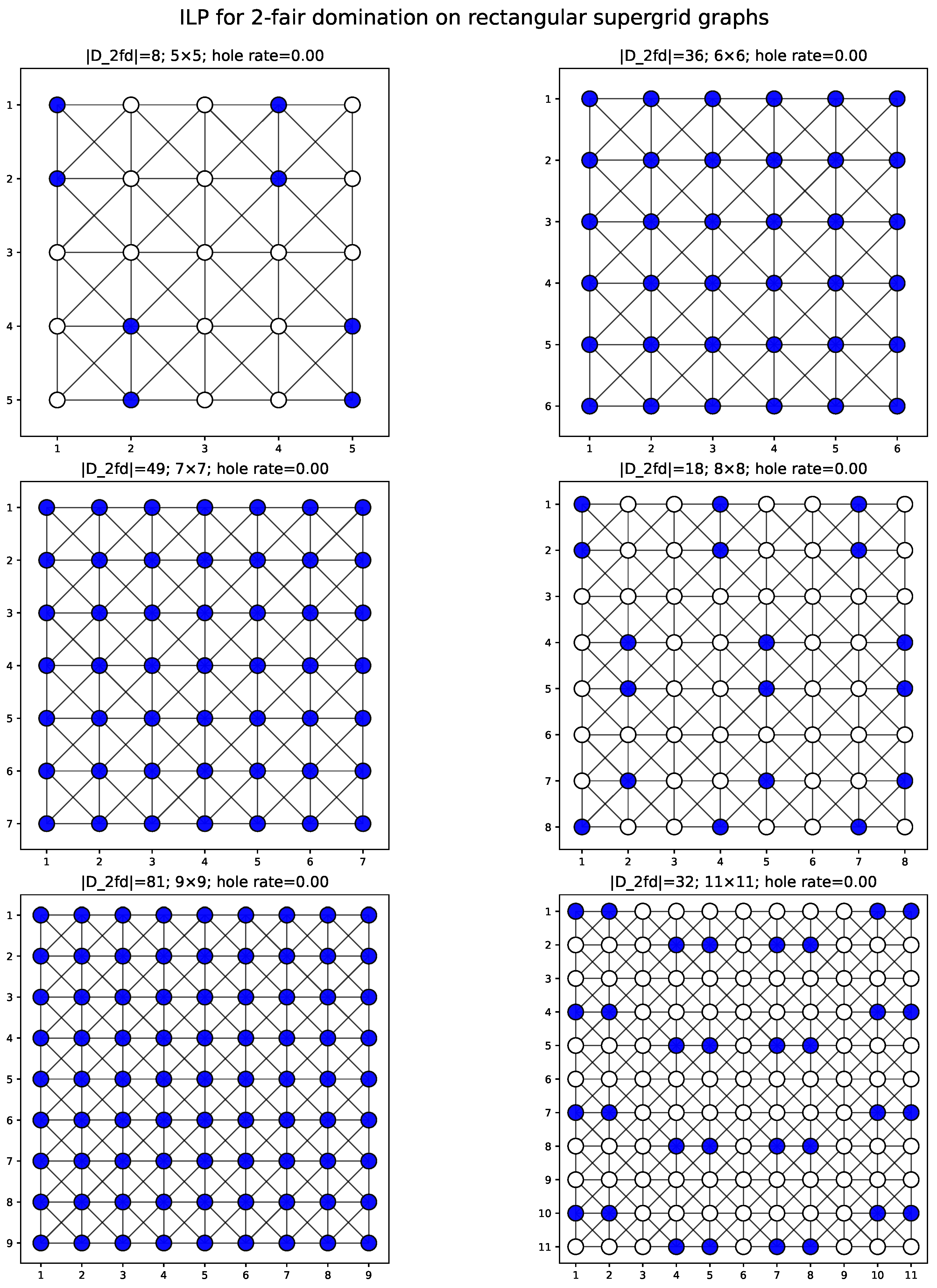
Figure 16 shows the minimum 2-fair dominating sets of
with
and
via general ILP solver. On the other hand,
Figure 16 also shows that many rectangular supergrid graphs admit no proper 2-fair dominating set; that is, their unique 2-fair dominating set is the entire vertex set. This phenomenon is analogous to that observed in the 1-fair domination problem. However,
for
in
Figure 16 and hence the claim in [
22] that
is not true. Currently, we are unable to identify a general structural rule computing
. Therefore, determining the value of
for
remains an open problem.
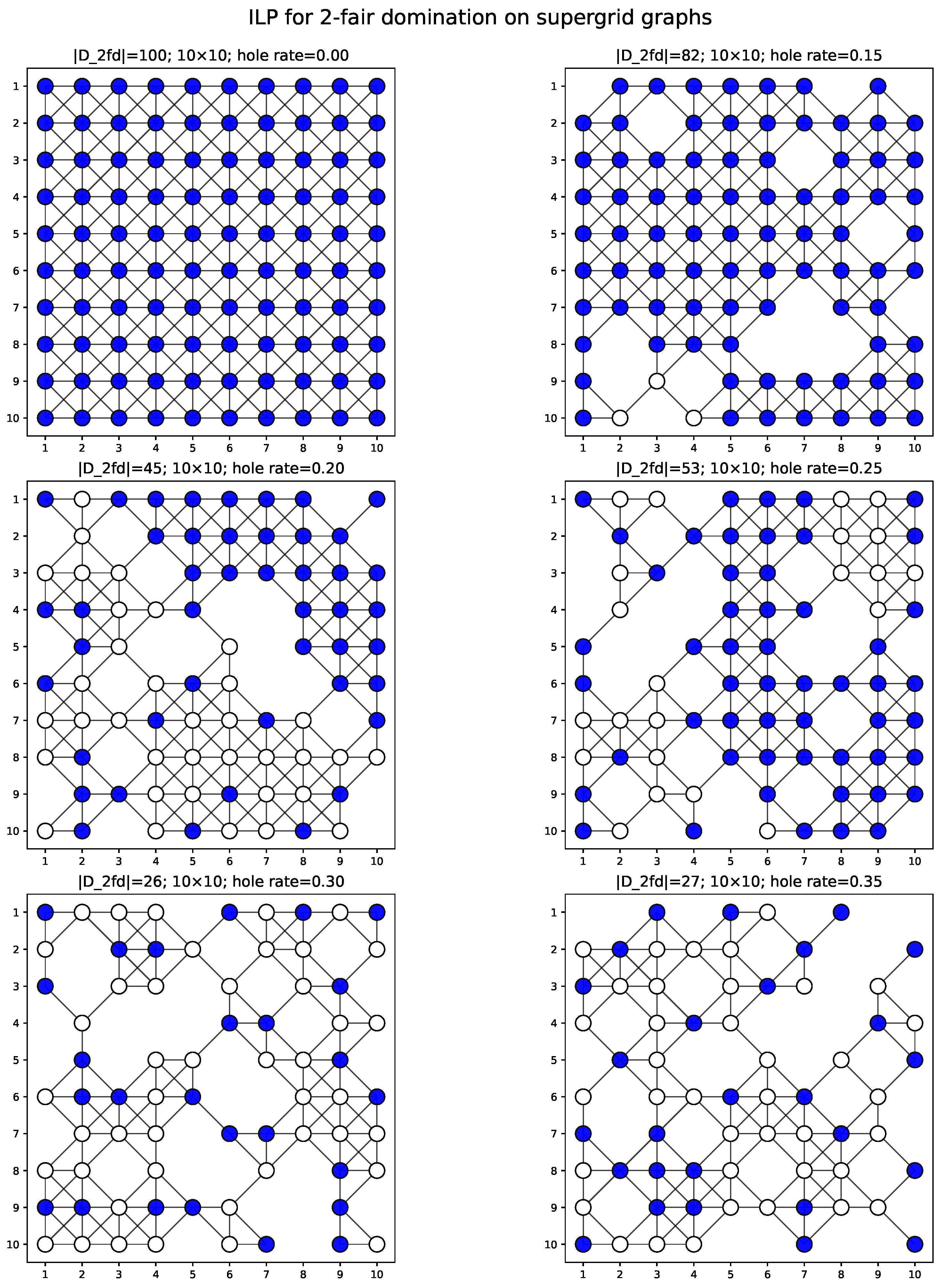
Finally, we use general ILP solver to compute minimum 2-fair dominating sets for small supergrid graphs. The experimental setting is identical to that used for the 1-fair domination problem.
Figure 17 shows the minimum 2-fair dominating sets for the supergrid graphs listed in
Figure 14.
Similar to the 1-fair domination case, there exist graphs G for which the 2-fair constraint is so restrictive that the entire vertex set becomes the only feasible 2-fair dominating set. This happens because each vertex not in the dominating set must be adjacent to exactly two vertices in the set. In some graphs, especially those with boundary vertices or irregular local degrees (such as graphs with holes), this requirement cannot be satisfied unless every vertex is selected. Consequently, the trivial solution becomes the unique feasible 2-fair dominating set. This phenomenon is also observed in the ILP results. For example, the rectangular supergrid without holes yields , meaning that all vertices must be selected.