Article

Forecasting Risk Matrices with Economic Policy Uncertainty and Financial Stress: A Machine Learning Approach

1
School of Cyber Science and Engineering, Wuhan University, Wuhan 430072, China
2
Department of Mathematics, King’s College London, London WC2R 2LS, UK
*
Authors to whom correspondence should be addressed.
Mathematics 2026, 14(6), 938; https://doi.org/10.3390/math14060938
Submission received: 6 February 2026 / Revised: 26 February 2026 / Accepted: 9 March 2026 / Published: 10 March 2026

Abstract

Accurately forecasting the risk matrix and constructing a well-controlled portfolio based on these forecasts is the core objective of effective asset allocation. This paper takes the Chinese stock market as the research object, employing multiple machine learning algorithms to systematically compare the predictive performance of the Financial Stress (FS) indicator and the Economic Policy Uncertainty (EPU) index in sectoral risk management. The forecast results are subsequently applied to portfolio construction and optimization. The findings indicate that, in terms of predictive dimensions, EPU demonstrates strong performance in short-term forecasts, but its explanatory power decays rapidly as the forecasting horizon extends. In contrast, the FS factor achieves forecasting accuracy that is significantly superior to both the EPU factor and traditional price series across all time horizons, exhibiting robust long-memory characteristics and cross-period stability. At the portfolio application level, the minimum variance strategy constructed based on FS forecasts effectively reduces out-of-sample portfolio variance, achieving superior risk control performance compared to strategies based on EPU factor forecasts. This result reveals the differentiated mechanisms of the two factor types: EPU acts as a driving force for short-term risk structure reshaping, while financial stress serves as the core variable driving the evolution of long-term risk structures. Machine learning methods provide an effective technical pathway for capturing these complex nonlinear relationships. The research conclusions offer new empirical evidence for investors to optimize asset allocation decisions and for regulatory authorities to improve risk monitoring systems.

1. Introduction

The profound impact of Economic Policy Uncertainty (EPU) and Financial Stress (FS) on financial markets has been extensively documented in the literature [1,2,3]. Existing studies suggest that EPU, originating from government decision-making and shifts in the broader macroeconomic environment, constitutes a key source of exogenous shocks driving asset pricing and risk identification [4]. In contrast, financial stress indices, which capture liquidity frictions and credit tightening, provide an intrinsically grounded tool for measuring systemic risk [5]. However, although the existing literature has extensively examined the effects of EPU and FS on individual asset returns and volatility, their impact on the risk matrix—that is, the dynamic evolution of cross-industry covariance and correlation structures—still lacks clear theoretical articulation and systematic empirical investigation. From a theoretical perspective, this issue is grounded in well-established foundations. According to the behavioral finance theories of limited attention and heterogeneous beliefs [6,7], policy ambiguity induced by EPU can intensify investors’ divergent interpretations of information, thereby altering inter-industry risk-pricing linkages and reshaping risk transmission channels. Financial contagion theory further suggests that systemic stress conditions captured by FS may trigger correlation jumps and panic-driven co-movements, causing diversification-based industry portfolios to lose their hedging effectiveness during periods of turmoil [8]. Intertemporal asset pricing theory additionally indicates that EPU and FS, as key variables influencing the state-dependent properties of the stochastic discount factor, may induce systematic shifts and dynamic revaluation in the asset covariance structure. Against this backdrop, this study aims to systematically investigate the mechanisms through which these two complementary signals—EPU and FS—affect the risk matrix. By doing so, it seeks not only to fill a critical gap in the literature concerning the prediction of cross-industry linkage structures, but also to provide targeted theoretical and empirical support for investors seeking to improve risk budgeting and asset allocation strategies, as well as for regulators aiming to enhance macroprudential frameworks.
In identifying the impact of shocks on risk structures, the multi-dimensional components of EPU and FS exhibit highly heterogeneous informational characteristics, placing rigorous demands on model feature extraction and forecasting performance. However, existing literature frequently overlooks the dynamic evolutionary processes of EPU and FS factors, as well as the inherent heterogeneity in their impacts across different sectors [9,10,11]. In reality, the transmission of these risk factors to market risk structures is neither static nor uniform; instead, it manifests through industry-specific volatility spillover effects and dynamic correlation shifts. The failure to capture the differentiated and time-varying exposures of these factors across sectors introduces identification biases that directly undermine portfolio construction effectiveness. The nature of these complex relationships dictates that the modeling process must adopt a multidimensional perspective, treating the risk matrix as a quintessential multi-output forecasting task [12,13,14]. This necessity poses a critical challenge for traditional models. Addressing this, the present study first employs a DCC-GARCH framework to extract time-varying pricing factors embedded with EPU and FS information, aimed at identifying dynamic risk spillover patterns and the evolution of pricing characteristics. Building upon this foundation, these factors are integrated into a multi-output machine learning architecture. By precisely characterizing the complex many-to-many non-linear mapping between macro shocks and sectoral risk linkages, this approach establishes a granular and technically robust forecasting framework.
In asset allocation decisions, the risk matrix serves as the core foundation for risk budget allocation. Furthermore, this paper applies the risk matrix forecasting results to portfolio construction. By injecting the predicted matrices embedded with EPU and FS specific risk logic into the portfolio optimization framework [15,16,17], it enables precise identification and hedging of inter-industry linkage risks triggered by different sources. Specifically, the EPU signal helps capture cross-industry sentiment contagion induced by policy environment uncertainty, while the FS signal effectively identifies inter-industry liquidity resonance caused by endogenous financial system stress. This application-level extension enables real-time correction of industry correlation deviations under specific risk shocks, reducing the over-reliance of asset allocation on historical volatility. Many forecasting studies remain confined to comparisons of statistical error metrics [18], without examining whether improvements in predicting the risk matrix translate into out-of-sample gains in portfolio performance or risk reduction. By incorporating the forecasted covariance matrix into a minimum variance portfolio (MVP) framework and evaluating realized variance and weight stability, this study assesses whether the predictions genuinely reduce portfolio risk, thereby advancing the contribution from statistical significance to economic significance. This not only significantly enhances the defensive resilience of portfolios under uncertain disturbances, but also provides diversified empirical support for investors to construct decision-making systems with logical foresight in a volatile macroeconomic environment.
This paper makes marginal contributions in two aspects: First, it achieves an important expansion in the information sources for risk matrix forecasting by incorporating two typical risk signals—policy uncertainty (EPU) and financial system stress (FS)—into the forecasting framework for China’s industry risk matrix for the first time. Unlike previous studies that primarily rely on historical price data [19,20], this paper is grounded in the characteristics of China’s transitional period—namely, the reality that the market is profoundly influenced by policy guidance and liquidity conditions—revealing the differentiated impacts of risk shocks on inter-industry linkage patterns. Utilizing industry-specific data unique to China, this study captures how macroeconomic uncertainty transmits to the risk matrix through specific pricing mechanisms, filling the gap in existing literature regarding the use of forward-looking macroeconomic indicators to characterize the dynamic evolution of inter-industry risk structures. This not only enriches the empirical evidence on macroeconomic risk transmission but also provides a new perspective for understanding the unique financial market mechanisms in China.
Second, this study provides a complementary framework that is both more interpretable and more predictive. Specifically, we first employ a DCC-GARCH model to extract time-varying risk exposure factors of each industry to EPU and FS from historical data, and use them as economically meaningful structured features. These features are then incorporated into a multi-output machine learning model to directly forecast the cross-industry risk matrix. Compared with approaches that rely solely on parametric correlation models, our framework better captures the nonlinearity and heterogeneity in the relationship between macro shocks and inter-industry linkages. In contrast to purely black-box machine learning methods, it preserves clear economic interpretation and transmission logic. Therefore, our approach achieves a more balanced improvement between interpretability and predictive performance, thereby offering a substantive complement and extension to existing risk forecasting methodologies.
Third, at the practical application level, this paper constructs a risk factor-driven investment decision framework and systematically explores the critical role of EPU and FS signals in optimizing portfolio allocation. The findings reveal that incorporating EPU and FS pathways effectively identifies structural changes in industry correlations, thereby correcting the excessive weight concentration problem that emerges in traditional strategies during market turbulence and significantly reducing portfolio risk. The research results provide a feasible reference framework for investors to construct forward-looking and robust hedging strategies in complex macroeconomic environments.
The remainder of this paper is structured as follows. Section 2 details the literature review. Section 3 describes the data and method. Section 4 presents the empirical findings, covering both risk matrix forecasting and its application in portfolio. Section 5 concludes and provides future research directions.

2. Literature Review

Extensive research has demonstrated that Economic Policy Uncertainty (EPU) exerts a significant predictive influence on financial markets, particularly in the dynamic evolution of asset pricing and market volatility [21,22,23,24]. As a core metric characterizing uncertainty in government decision-making and the macroeconomic policy environment, EPU impacts the real economy by influencing corporate investment, consumption, and financing decisions. Simultaneously, it transmits to the stock market through risk premium and expectation adjustment channels, leading to declined returns and elevated volatility [4,25]. Existing studies generally find that during periods of heightened uncertainty, equity markets are more prone to systemic pullbacks, volatility clustering, and “flight-to-quality” behavior. Consequently, EPU possesses robust predictability for downside return pressure and conditional volatility [26,27,28]. In emerging markets, especially those with strong policy-driven characteristics, the impact of EPU on sectoral returns, volatility spillovers, and cross-market linkages is even more pronounced, often exhibiting stronger predictive power during phases of structural reform or institutional transition [29,30]. Recent studies have further integrated EPU into frameworks for tail risk, risk spillovers, and safe-haven asset pricing, finding that EPU explains the time-varying characteristics of correlation and hedging efficiency in multi-asset portfolios, particularly during crises [31,32]. Collectively, this evidence suggests that EPU not only affects the first and second moments of returns but also contains crucial forward-looking information regarding asset dependency structures and systemic risk pricing.
In contrast to EPU, which primarily reflects exogenous policy and macroeconomic shocks, Financial Stress (FS) focuses on the internal vulnerability and instability of the financial system. Its typical measurement synthesizes multi-dimensional information, including credit spreads, term spreads, market volatility, liquidity indicators, and sharp asset price adjustments [33,34,35]. Research indicates that high levels of financial stress are strongly associated with economic recessions, financial crises, and significant asset price corrections, serving as an early warning signal for the accumulation of systemic risk [36,37]. During periods of rising stress, investor risk aversion intensifies, safe-haven demand surges, and financial institutions’ balance sheets contract. This often leads to increased correlations and a higher frequency of co-movements in asset declines, thereby exacerbating market linkages and systemic exposure [38,39]. Consequently, FS has been widely utilized within macro-prudential policy frameworks to monitor systemic risk and financial fragility, serving as a vital tool for counter-cyclical adjustment and financial stability assessment. However, existing literature focuses predominantly on macroeconomic variables, financial institution risk exposures, or tail risk indicators [40], while the holistic forecasting of high-dimensional risk matrices across sectors or asset classes remains relatively under-explored.
The accurate forecasting of the Risk Matrix—typically presented as the conditional covariance matrix of asset returns—is fundamental to modern asset pricing, risk management, and asset allocation. Traditional research relies primarily on multivariate GARCH-type models and their extensions, serving portfolio optimization and risk measurement by characterizing the dynamic evolution of conditional covariance over time [41,42,43]. Some scholars have utilized high-frequency financial data to advance the realized covariance approach [44,45,46], constructing ex-post covariance matrices through the aggregation of high-frequency returns and subsequently modeling and forecasting them using vector autoregression (VAR), factor models, or shrinkage estimation. Recently, machine learning methods have been introduced to covariance forecasting to mitigate issues such as complex non-linear relationships, high dimensionality, and rapid structural changes. Studies have employed algorithms like Random Forests, Gradient Boosting Trees, and Neural Networks to learn latent correlation structures from large-scale cross-sectional and time-series features [47,48].
Overall, however, existing research in risk matrix forecasting remains heavily dependent on historical price and return information. Macro-financial factors are frequently treated as auxiliary control variables rather than core drivers of covariance matrix dynamic reconstruction [49,50]. In particular, research that systematically embeds EPU and FS—two indicators with forward-looking and endogenous complementary characteristics—into a high-dimensional risk matrix forecasting framework is almost non-existent. The established literature pays more attention to the impact of EPU and FS on mean returns, single-asset volatility, or low-dimensional systemic risk indicators, while rarely analyzing how they jointly drive the evolution of covariance structures at the sectoral level or within multi-asset portfolios. Against this backdrop, utilizing a multi-output machine learning framework that incorporates EPU and FS as dual drivers for exogenous policy shocks and endogenous financial fragility to jointly forecast high-dimensional risk matrices can bridge the gap. This approach not only transcends the limitations of traditional price-driven covariance forecasting at the methodological level but also reveals how macroeconomic uncertainty and financial stress reshape inter-sectoral risk linkage structures at the empirical level, thereby filling a distinct void in the literature regarding “macro-financial factor-driven risk matrix forecasting.

3. Data and Methodology

3.1. Data and Preprocessing

The EPU data used in this study are China-specific and are obtained as monthly observations from the authoritative Economic Policy Uncertainty database (www.policyuncertainty.com), capturing policy uncertainty signals in China’s macroeconomic environment. The Financial Stress (FS) index is also China-based and is measured by the China Composite Indicator of Systemic Financial Stress (China CISS), jointly developed by MGF Lab and the European Central Bank (ECB). The underlying data are retrieved from the ECB Data Portal. To ensure comparability and sectoral representativeness, this study take all 11 sector indices aligned with the Global Industry Classification Standard (GICS), covering Energy, Materials, Industrials, Consumer Discretionary, Consumer Staples, Health Care, Financials, Information Technology, Communication Services, Utilities, and Real Estate. Compared to traditional classification frameworks, this system offers an extended historical observation window, enabling a more comprehensive characterization of the Chinese economy’s volatility across diverse cycles. The sample period spans from October 2006 to November 2025, totaling 230 observations. All market-related data were retrieved from the Wind database, ensuring the professional rigor and accuracy of the research benchmark.
Table 1 presents the descriptive statistics for the eleven sector index returns and the core predictive factors. In terms of return performance, all sectors recorded positive monthly average returns, with Health Care exhibiting the highest gain, while Information Technology and Real Estate displayed the greatest standard deviations, indicating higher volatility. Regarding distributional characteristics, all sectors except Real Estate exhibited significant negative skewness, with kurtosis values far exceeding the normal distribution threshold of 3, manifesting distinct “fat-tail” properties. Notably, the FS demonstrated substantially higher positive skewness and kurtosis than EPU, suggesting that FS possesses stronger jump dynamics and extreme risk-capturing capabilities compared to the relatively smoother fluctuations of EPU. This further justifies the necessity of employing machine learning frameworks to capture non-linear risk dynamics. Regarding stationarity, both ADF and PP tests rejected the null hypothesis of a unit root at the 1% significance level, confirming that all variables are stationary I(0) sequences, thereby providing a robust foundation for subsequent machine learning modeling.
In accordance with standard asset pricing theory, this study incorporates EPU/FS into the Capital Asset Pricing Model (CAPM) framework to construct a factor pricing model, aiming to examine the pricing relationship between Chinese sectoral stock returns and EPU/FS:
R i , t = b i , t Mkt M K T t + b i , t F a c t o r F a c t o r t + e i , t
where R i , t = l n P i , t / P i , t 1 denotes the return of sector i at time t ; M K T t represents the market portfolio proxy used to control for common exposure to overall market conditions, and in this study, the CSI 300 Index (HS300) is employed as the market return proxy; and F a c t o r t refers to the EPU/FS factor. The coefficients b i , t Mkt and b i , t F a c t o r measure the exposure of sector i to the market factor and EPU/FS factor, respectively. Notably, the beta ( b i , t F a c t o r ) constitutes the core variable of interest in this study, as it captures the transmission intensity of EPU/FS fluctuations to sectoral pricing.
However, traditional asset pricing models are predominantly built upon linear assumptions and static parameter estimation, which imposes significant limitations when addressing the impacts of EPU/FS shocks. To characterize the time-varying linkage intensity between sectoral returns and factors (EPU or FS), this study employs the DCC-GARCH framework at the second-moment level [51]. The core philosophy of this framework is to separately model “volatility” (scale) and “correlation” (linkage structure) and subsequently synthesize them into conditional covariances. This process yields the time-varying exposures ( b i , t F a c t o r ) consistent with asset pricing theory.
First, let σ i , t and σ F a c t o r , t denote the conditional standard deviations of sector i and factor F , denote the conditional standard deviations of sector i and factor F , respectively, which are estimated via univariate GARCH processes to capture the time-varying volatility of each variable at time t . Second, the conditional correlation matrix C t is obtained by standardizing the auxiliary matrix Q t from the DCC model. At the element level, the conditional correlation coefficient is defined as:
ρ i F , t = q i F a c t o r , t q i i , t q F a c t o r F a c t o r , t
where ρ i F , t characterizes the evolution of the linkage structure over time. Third, the conditional covariance matrix is expressed as H t = D t C t D t , where the covariance element h i F , t satisfies:
h i F , t = ρ i F a c t o r , t σ i , t σ F a c t o r , t
Intuitively, ρ i F , t provides the dimensionless linkage direction and intensity, while σ i , t σ F a c t o r , t provides the dimensioned scale. Their synthesis yields the conditional covariance h i F a c t o r , t suitable for risk measurement and asset pricing.
Finally, the time-varying factor exposure b i , t F a c t o r follows the standard asset pricing definition, i.e., the ratio of conditional covariance to conditional varian
b i , t F a c t o r Cov t R i , t , F a c t o r t Var t F a c t o r t = h i F , t h F F , t = ρ i F a c t o r , t σ i , t σ F a c t o r , t σ F a c t o r , t 2
This approach circumvents several restrictive limitations inherent in traditional research, such as the static assumption that sectoral responses to EPU/FS fluctuations remain constant over time. By relaxing the predefined constraint of invariant correlation coefficients, the DCC-GARCH model allows for time-varying dependencies among variables, thereby providing a more precise characterization of the dynamic linkages between EPU/FS and various industrial sectors. Based on this pricing framework, the study develops forecasting models and sector-based portfolios that deeply integrate EPU/FS factors, offering investors more robust asset allocation strategies.
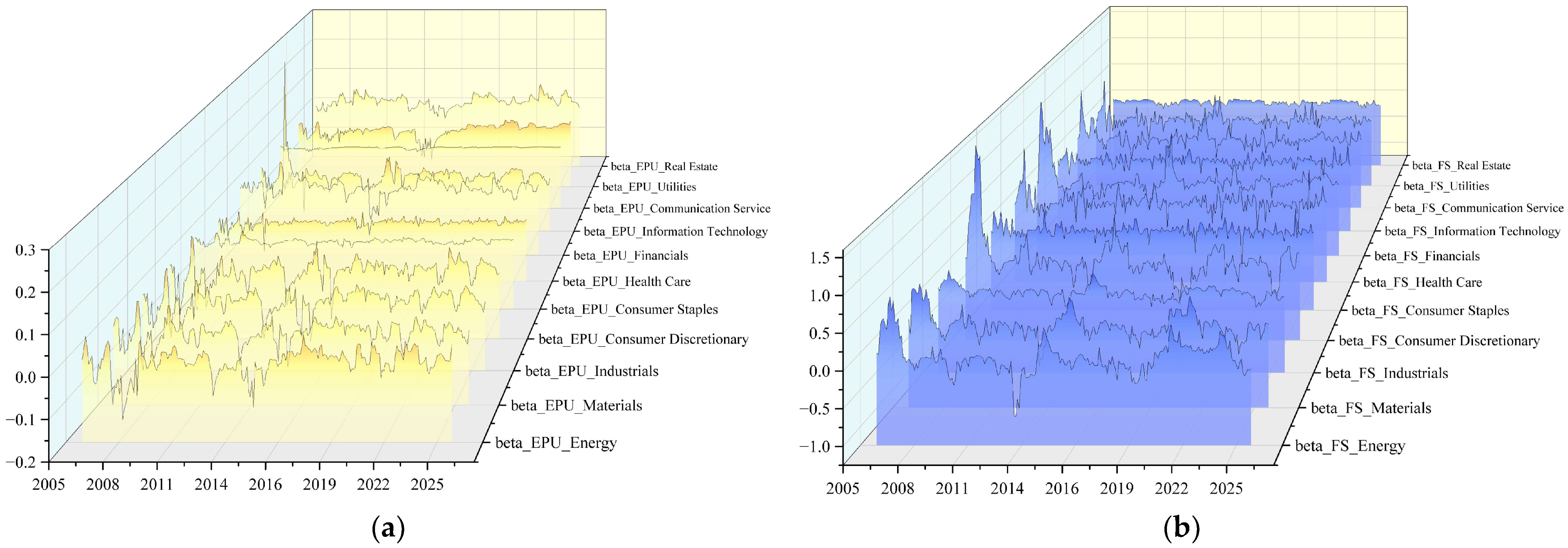
Figure 1 illustrates the evolution of time-varying EPU/FS betas ( b i , t F a c t o r ) for 11 sector indices, revealing two distinct characteristics. First, the results reveal significant heterogeneity in sectoral sensitivity: policy-driven sectors, such as Real Estate and Industrials, exhibit markedly higher intensity in response to EPU shocks, whereas Financials and Consumer sectors demonstrate greater sensitivity to FS. Furthermore, sectoral pricing relationships display pronounced time-varying and non-linear characteristics. Sector betas frequently undergo extreme structural mutations during major policy-related episodes, with representative periods including the 2015 A-share market turbulence, the 2018 US-China trade friction, and the initial outbreak of the COVID-19 pandemic in 2020. These findings provide compelling evidence that the transmission of EPU and FS into market pricing is fundamentally event-driven, rather than following a simplistic linear steady-state relationship.

3.2. Methods

Building upon the data described above, this study aims to examine the marginal contribution of incorporating time-varying EPU/FS betas to the predictive performance of risk matrices across 11 industrial sectors. The primary objective of this research design is to explore whether time-varying EPU/FS betas can effectively capture incremental information regarding the transmission of macro-shocks to sectoral correlations, thereby addressing the perceptual blind spots of traditional price factors in decoding complex market dynamics. To this end, within an evaluation framework encompassing multiple machine learning algorithms, this study utilizes the time-varying EPU/FS betas of 11 sectors to perform multi-output forecasting of the risk matrix. This approach allows us to systematically validate the efficacy of EPU/FS factors in enhancing the predictive accuracy of sectoral covariance matrices. The overall methodological framework of the proposed modeling and evaluation procedure is summarized in Figure 2.

3.2.1. Support Vector Regression (SVR)

Support Vector Regression (SVR) is an extension of the Support Vector Machine (SVM) framework for regression tasks [52]. Unlike traditional Ordinary Least Squares (OLS) which minimizes squared residuals, SVR introduces an ϵ -insensitive loss function. This mechanism defines a tolerance tube around the predicted values; losses are only incurred when the actual observations fall outside this ϵ -margin. This property grants SVR exceptional robustness against outliers and fat-tail noise inherent in financial return series. The objective of SVR is to find a function f x = w T ϕ x + b by solving the following optimization problem:
m i n w , b , ξ , ξ 1 2 w 2 + C i = 1 n ξ i + ξ i
Subject to
y i w T ϕ x i + b ϵ + ξ i
where C is the regularization parameter and ϕ x represents the kernel function used to map input features into a high-dimensional space to handle non-linearity. SVR with Radial Basis Function (RBF) kernel seeks a function that keeps prediction errors within an ϵ -insensitive tube while maximizing flatness. The ϵ -insensitive loss function is defined as:
L ϵ z = m a x 0 , z ϵ ,
where z = y f x is the prediction error. The Lagrangian dual leads to
m a x α , α 1 2 i , j = 1 n α i α i α j α j K x i , x j ϵ i = 1 n α i + α i + i = 1 n y i α i α i
subject to 0 α i , α i C and i = 1 n α i α i = 0 .
Prediction:
y ^ x = i = 1 n α i α i K x i , x + b ,
where K x i , x = e x p γ x i x 2 is the RBF kernel.

3.2.2. Random Forest Regressor (RF)

Random Forest (RF) is an ensemble learning algorithm based on the Bagging (Bootstrap Aggregating) paradigm. It constructs a multitude of decision trees during training and outputs the average prediction of the individual trees [53]. The core strength of RF lies in its dual randomness: random bootstrap sampling of data and random selection of feature subsets at each node split. This mechanism significantly reduces model variance, granting it superior generalization capabilities and robustness against overfitting, especially when navigating noisy financial datasets. Given the training set D = < x 1 , y 1 , , x n , y n > , Random Forest generates predictions through the following steps:
(1)
Bootstrap sampling: Randomly draw B bootstrap samples D b with replacement from D .
(2)
Tree construction: For each bootstrap sample D b , train a regression tree T b . At each node split, randomly select m features ( m M ) from all M features, and choose the optimal split point according to the principle of minimizing the mean squared error (MSE):
m i n j , s x i R 1 j , s y i c 1 2 + x i R 2 j , s y i c 2 2
where j is the feature, s is the split threshold, R 1 , R 2 are the regions after splitting, and c 1 , c 2 are the means of the corresponding regions.
(3)
Ensemble prediction: The final result is the arithmetic average of the predictions from B trees:
f ^ r f B x = 1 B b = 1 B T b x
where y ^ b x is the prediction of the b -th tree ( B = 50 ).

3.2.3. AdaBoost Regressor

AdaBoost (Adaptive Boosting) is a classic boosting ensemble learning algorithm [54]. Unlike Random Forest, which constructs trees in parallel, AdaBoost iteratively builds weak learners (typically shallow decision trees) in a sequential and adaptive manner. Its core idea is to focus on samples that were poorly predicted in previous iterations by dynamically adjusting sample weights, thereby transforming a series of weak learners—whose performance is only slightly better than random guessing—into a strong learner with high accuracy. When dealing with data exhibiting high-frequency transient shocks, such as EPU/FS fluctuations, AdaBoost can rapidly identify hard-to-predict extreme risk shifts through its iterative mechanism. Given the training set D = < x i , y i > i = 1 n , the AdaBoost algorithm proceeds as follows:
(1)
Initialize sample weights: w i = 1 / n for all i = 1 , , n
(2)
For each iteration t = 1 , , T :
Train a weak learner h t x on the weighted training data.
Compute the loss for each sample. Common loss functions include:
Linear loss:
L i , t = y i h t x i / m a x k y k h t x k
Squared loss:
L i , t = y i h t x i 2 / m a x k y k h t x k 2
Exponential loss:
L i , t = 1 e x p y i h t x i / m a x k y k h t x k
(The loss is normalized to 0 , 1 using the maximum absolute error D t .)
Compute the weighted average loss:
L t = i = 1 n w i , t L i , t .
If L t 0.5 , terminate early (optional).
Compute the learner confidence:
β t = L t / 1 L t (or a variant such as β t = L t p for tuned robustness).
Update sample weights: w i , t + 1 = w i , t β t 1 L i , t , then renormalize weights.
(3)
Final prediction: The ensemble output is the weighted median of all weak learner predictions, where each h t is weighted by α t = l o g 1 / β t .

3.2.4. XGBoost Regressor

XGBoost Regressor is a scalable gradient boosting framework that minimizes a regularized objective function using second-order gradient statistics, incorporating tree pruning and handling sparsity to achieve state-of-the-art performance on structured data [55]. XGBoost minimizes a regularized second-order approximated objective:
O b j t = i = 1 n g i f t x i + 1 2 h i f t 2 x i + Ω f t ,
Ω f t = γ T + 1 2 λ w 2 + α w 1 ,
where g i = y ^ t 1 l y i , y ^ t 1 , h i = y ^ t 1 2 l y i , y ^ t 1 , T is leaf count, w leaf weights.
For squared loss, l y , y ^ = 1 2 y y ^ 2 , so g i = y ^ i t 1 y i , h i = 1 .
Leaf score:
w j = G j H j + λ ,
objective after split:
O b j = 1 2 j = 1 T G j 2 H j + λ + γ T .
Split gain:
G a i n = 1 2 G L 2 H L + λ + G R 2 H R + λ G L + G R 2 H L + H R + λ γ .
For each node split, the algorithm searches for the feature and corresponding split point that maximizes the Gain score, thereby ensuring the objective function is minimized at each step of the tree’s growth.

3.2.5. LightGBM Regressor

LightGBM is an advanced gradient boosting decision tree (GBDT) framework [56]. It addresses computational bottlenecks in traditional boosting algorithms on large-scale datasets by introducing Gradient-based One-Side Sampling (GOSS) and Exclusive Feature Bundling (EFB). In this study, LightGBM is employed to capture the high-dimensional non-linear mapping between EPU/FS betas and sectoral risk matrices. LightGBM follows an additive model formulation. At the t -th iteration, the objective is to minimize:
O b j t = i = 1 n L y i , y ^ i t 1 + f t x i + Ω f t
where L is the loss function and Ω f t is the regularization term that penalizes tree complexity (number of leaves and the squared sum of leaf weights). To enable fast optimization, the objective is approximated using a second-order Taylor expansion around the current prediction y ^ i t 1 :
O b j t i = 1 n g i f t x i + 1 2 h i f t 2 x i + Ω f t
where g i = y ^ t 1 L y i , y ^ i t 1 is the first-order gradient and h i = y ^ t 1 2 L y i , y ^ i t 1 is the second-order gradient (Hessian). LightGBM evaluates candidate splits by maximizing the following gain G :
G = 1 2 i L g i 2 i L h i + λ + i R g i 2 i R h i + λ i L R g i 2 i L R h i + λ
where L and R denote the left and right child subsets after splitting, and λ is the L 2 regularization parameter on leaf weights. Instead of using all samples to compute the gain, Gradient-based One-Side Sampling (GOSS) retains instances with large gradients and randomly samples those with small gradients. The adjusted gradients are defined as
g ~ i = g i if   i A 1 a b g i if   i B
where A is the top a % of instances ranked by absolute gradient magnitude, and B is a random subset of size b % drawn from the remaining instances. This mechanism ensures that the model prioritizes poorly fitted samples—particularly useful for capturing sudden shifts induced by EPU/FS shocks.

3.2.6. CatBoost Regressor

CatBoost (Categorical Boosting) is a high-performance gradient boosting algorithm [57]. Although the input features in this study (time-varying EPU/FS betas) are primarily numerical, CatBoost’s distinctive symmetric (oblivious) decision trees and ordered boosting mechanisms endow it with exceptional resistance to overfitting and superior predictive stability when applied to time-series data. Compared to other boosting algorithms, CatBoost more effectively handles noise in financial data and mitigates the gradient bias problem inherent in traditional gradient boosting frameworks. Unlike LightGBM’s leaf-wise growth strategy, CatBoost employs symmetric decision trees as base learners. In each level of the tree, the same splitting criterion (feature + threshold) is applied across all nodes at that depth. This structure provides exponentially faster inference and acts as a form of structural regularization, effectively preventing local overfitting when capturing extreme fluctuations in EPU/FS:
f x = t = 1 T h t x
where h t denotes the t -th symmetric tree. Traditional GBDT algorithms compute gradients using the same dataset for both training the current tree and evaluating its residuals, leading to prediction shift (or gradient bias). CatBoost introduces ordered boosting by applying random permutations to the training samples and estimating the gradient for each sample using models trained only on preceding samples in the permutation:
g i = L y i , F F F = F x i
where F x i is the prediction obtained from models trained exclusively on samples appearing before i in the current random permutation. This approach yields more robust out-of-sample performance, particularly valuable for time-sensitive tasks such as sectoral covariance forecasting. The optimization objective of CatBoost combines the empirical loss with L 2 regularization on leaf weights:
O b j = i = 1 n L y i , y ^ i + λ t = 1 T ω t 2
where ω t represents the vector of leaf weights in the t -th tree, and λ controls the strength of regularization.

3.2.7. Extreme Learning Machine (ELM)

Extreme Learning Machine (ELM) is a novel learning algorithm designed for single-hidden-layer feedforward neural networks (SLFNs) [58]. Unlike traditional neural networks that rely on back-propagation (BP) with iterative gradient descent, the defining feature of ELM is that the input weights and biases of the hidden layer neurons are randomly generated and remain fixed throughout training. The model requires only an analytical solution to compute the output weights, thereby reducing the entire training process to a simple linear least-squares problem. When applied to the time-varying EPU/FS beta data in this study, ELM leverages its extremely fast training speed and excellent non-linear approximation capability to efficiently capture the instantaneous impact of macroeconomic policy shocks on financial markets. For an SLFN with L hidden nodes and activation function G , the prediction function is expressed as
f x i = j = 1 L β j G w j x i + b j = h x i β , i = 1 , , n
or in matrix form:
H β = Y
where w j R d and b j R are the input weight vector and bias of the j -th hidden node, respectively, randomly generated according to any continuous probability distribution and kept fixed. H R n × L is the hidden layer output matrix, with its i , j -th element defined as H i j = G w j x i + b j . β R L × m is the output weight matrix, representing the only parameters to be learned. Y R n × m is the target matrix. Training process: To minimize the approximation error H β Y , the optimal output weights are obtained analytically via the Moore–Penrose generalized inverse H :
β = H Y
In practice, when H T H is nonsingular, this simplifies to β = H T H 1 H T Y ; otherwise, the pseudoinverse ensures the minimum-norm least-squares solution. This closed-form solution eliminates the need for iterative gradient descent, making ELM training thousands of times faster than conventional neural networks while maintaining comparable or superior generalization performance.

3.2.8. Ridge Regression

Ridge Regression is a linear regression method that incorporates an L2 regularization term on the coefficients to prevent overfitting and handle multicollinearity, yielding a closed-form solution that shrinks coefficients toward zero [59]. Ridge minimizes L2-regularized least squares:
J w = y X w 2 2 + α w 2 2 ,
J w = 2 X T y X w + 2 α w = 0 ,
w ^ = X T X + α I 1 X T y .
The essence of Ridge Regression lies in its ‘weight shrinkage’ mechanism. When processing the EPU/FS betas of ten industrial sectors, traditional regression models are prone to abnormal fluctuations in parameter estimates due to the prevalence of strong multicollinearity among sectors. By penalizing excessively large coefficients, Ridge Regression ensures that the model becomes less sensitive to minor noise in the input data. Consequently, it significantly enhances the robustness of risk matrix forecasting while retaining all sectoral features as predictive inputs.

3.2.9. Lasso Regression

Lasso Regression extends linear regression by adding an L1 regularization penalty on the absolute values of coefficients, promoting sparsity by driving some coefficients exactly to zero [60], thus performing simultaneous variable selection. Lasso uses L1 regularization:
J w = y X w 2 2 + α w 1 .
Subgradient condition for optimality (for each coordinate):
X j T y X w + α sign w j = 0 if   w j 0 ,
X j T y X j w j α if   w j = 0 .
Solved via coordinate descent or proximal gradient. Lasso Regression, in essence, operates as a sparse feature selection mechanism. Within the predictive framework of this study, it automatically identifies and eliminates EPU/FS signals that contribute minimally or even introduce noise to the risk matrix forecasting.

3.2.10. Bayesian Ridge Regression

Bayesian Ridge Regression is a probabilistic linear regression approach that places a spherical Gaussian prior on the weights and estimates both coefficients and regularization hyperparameters via empirical Bayes, providing a robust alternative to standard ridge regression. The core advantage of Bayesian Ridge Regression lies in its parametric adaptability and probabilistic inference capabilities. When processing time-varying EPU/FS betas, the model moves beyond the reliance on manually pre-specified penalty parameters ( λ ) typical of standard Ridge Regression; instead, it automatically learns the optimal intensity of regularization from the data by maximizing the marginal likelihood function. This mechanism enables the model to dynamically calibrate the degree of coefficient shrinkage in response to policy fluctuations across different periods. Furthermore, the Bayesian framework provides not only point estimates for the sectoral risk matrix but also a formal measure of uncertainty (confidence intervals). This provides a probabilistic foundation for assessing the reliability of market forecasts under EPU/FS shocks, enhancing the model’s robustness in extreme market environments. The Bayesian Ridge Regression model is set as follows:
Likelihood:
p y | X , w , λ = N y | X w , λ 1 I .
Prior:
p w | α = N w | 0 , α 1 I .
Posterior:
p w | y , X , α , λ N μ , Σ ,
Σ = λ X T X + α I 1 ,
μ = λ Σ X T y .
Hyperparameters maximized via marginal likelihood:
l o g p y | X , α , λ = 1 2 n l o g 2 π + l o g Σ + y X μ T λ 1 I 1 y X μ .

3.2.11. Extra Trees Regressor

Extremely Randomized Trees (Extra Trees) is an ensemble method that constructs multiple unpruned decision trees using extreme randomization [61]: at each node, it selects a random subset of features and chooses split thresholds completely at random from the range of values in the selected feature, without optimizing for impurity reduction. The final prediction is the average of all tree predictions, which helps reduce variance more effectively than standard Random Forests in some cases.
The overall model prediction is given by:
y ^ x = 1 B b = 1 B T b x ,
where y ^ x is the predicted value for input vector x , B is the number of trees in the ensemble (e.g., B = 50 ), T b x is the prediction from the b -th extremely randomized tree. Each tree T b x is constructed recursively. At each internal node: A random subset of K features is selected (typically K = d , where d is the total number of features). For each selected feature f k , a split threshold θ k is chosen uniformly at random from the empirical minimum and maximum values of f k in the current node’s samples:
θ k Uniform m i n f k , m a x f k .
The “best” split s among these random candidates is selected based on a score, such as variance reduction for regression:
Score s = Var y n L n Var y L n R n Var y R ,
where Var is the variance of targets in the node:
Var y = 1 n i = 1 n y i y 2 ,
with n , n L , n R the sample sizes in the parent, left, and right child nodes, and y , y L , y R the corresponding target sets, y = 1 n i = 1 n y i . Leaf nodes predict the mean of their samples:
T b x = y l = 1 n l i l y i ,
where l is the leaf node containing x , and n l is the number of samples in l . The ensemble’s variance is estimated as:
Var y ^ x = ρ σ 2 + 1 ρ B σ 2 ,
where ρ is the average correlation between tree predictions:
ρ = 1 B B 1 b b Corr T b x , T b x ,
and σ 2 is the average tree variance:
σ 2 = 1 B b = 1 B Var T b x .
Extreme randomization often lowers ρ compared to Random Forests. Training is parallelizable across trees, with no pruning applied to maximize bias reduction.

3.2.12. Gaussian Process Regression (GPR)

Gaussian Process Regression (GPR) is a non-parametric probabilistic model grounded in Bayesian theory [62]. Unlike conventional regression approaches that presuppose a specific functional form (e.g., linear or polynomial), GPR posits a prior distribution over the space of possible functions via a Gaussian Process. It defines similarity between data points through a kernel function. When modeling the relationship between EPU/FS betas and sectoral risk matrices, GPR not only provides point predictions of industry covariances but also yields a full posterior predictive distribution, offering rigorous quantification of predictive uncertainty. A Gaussian Process is fully specified by its mean function m x (often assumed zero for simplicity) and covariance function (kernel) k x , x :
f x G P m x , k x , x
Given observed data D = < x i , y i > i = 1 n and a new input x , the predictive distribution is jointly Gaussian. The closed-form posterior mean and variance are:
Predictive mean:
f = k T K + σ n 2 I 1 y
Predictive variance:
var f = k x , x k T K + σ n 2 I 1 k
where K i j = k x i , x j is the training kernel matrix, k is the vector of covariances between x and the training inputs, and σ n 2 represents observation noise variance.

4. Empirical Results

4.1. Implementation Details

This section systematically evaluates the empirical effectiveness of the twelve previously established machine learning models in sectoral risk forecasting. Using 11 Chinese industry stock indices as the research sample, this study performs multi-output forecasting of the sectoral risk matrix (covariance matrix, which is computed based on the asset return vector, representing the second-order moment of the joint distribution of multiple assets) across various algorithms. More importantly, it explores the incremental value of time-varying EPU/FS factors in enhancing predictive accuracy. To evaluate model generalizability, the full sample is partitioned into a training set and a test set using an 80/20 split, with the latter reserved exclusively for out-of-sample performance evaluation.
Within the evaluation system, two categories of metrics are employed: (1) statistical measures of forecasting error, including Mean Squared Error (MSE), Root Mean Squared Error (RMSE) [63], Mean Absolute Error (MAE) [64], and Mean Absolute Percentage Error (MAPE) [65]; and (2) economic performance of the strategies. Specifically, the predicted risk matrices are used to construct a Minimum Variance Portfolio (MVP) [66]. By comparing their out-of-sample volatility performance, we validate the economic utility of the improved forecasting accuracy from a practical investment perspective. The specific definitions are as follows:
(1)
MSE is the most widely used loss function in financial volatility forecasting due to its strong penalty on large errors.
M S E = 1 N t = 1 N y t y ^ t 2
(2)
RMSE is the square root of MSE and shares the same unit as the original data, facilitating intuitive interpretation.
R M S E = 1 N t = 1 N y t y ^ t 2
(3)
MAE is less sensitive to outliers, providing a more robust measure of average prediction bias.
M A E = 1 N t = 1 N y t y ^ t
(4)
MAPE expresses prediction errors as percentages of the true values, making it particularly suitable for comparing forecasting performance across sectors of differing magnitudes.
M A P E = 1 N t = 1 N y t y ^ t y t × 100 %
(5)
Minimum Variance Portfolio (MVP)
To assess the practical value of the predicted covariance matrix Σ ^ t , we construct the global minimum variance portfolio and evaluate its realized performance in the true market environment.
Portfolio Weight Optimization: The optimal asset weights w t are obtained by solving the following constrained minimization problem:
m i n w t w t T Σ ^ t w t
subject to
w t T 1 = 1
Analytical Solution: In the absence of short-sale constraints, the closed-form solution is:
w t = Σ ^ t 1 1 1 T Σ ^ t 1 1
Realized Portfolio Variance: The economic usefulness of the forecasted covariance matrix is ultimately measured by the realized variance using the true covariance matrix Σ real , t :
Realized   Variance = w t T Σ real , t w t
A lower realized variance indicates that the model produces covariance forecasts that are more structurally accurate and economically valuable.

4.2. Forecast Evaluation

Building upon the research design and feature selection described above, this study follows established literature by adopting a 36-period rolling input window to generate forecasts for 1-, 6-, and 12-period horizons [67], representing short-, medium-, and long-term forecasting scales, respectively. By comparing the predictive performance of models incorporating EPU/FS-specific factors, this section provides a systematic evaluation of each model’s statistical accuracy and robustness across diverse forecasting horizons. Overall, the inclusion of the FS and EPU factors consistently reduces prediction errors, indicating that these macroeconomic uncertainty signals provide substantively meaningful incremental information for modeling cross-industry covariance structures and enhance the predictability of the risk matrix.
The results reported in Table 2 clearly indicate that risk-matrix forecasts based on the Financial Stress (FS) feature specification outperform both the EPU-based specification and the traditional return-based benchmark in the vast majority of “model–horizon” combinations, as reflected by systematic reductions in MSE and RMSE. Taking Panel A (1-period forecasts) as an example, in the SVR model, the FS specification achieves an RMSE of 0.0633, which is significantly lower than the EPU specification (0.0717) and the benchmark (0.0679). Its MSE (0.004013) also outperforms EPU (0.005145) and the benchmark (0.004610). Similarly, in the GPR model, the FS specification delivers strong predictive performance, with MSE (0.004045), RMSE (0.063602), MAE (0.045371), and MAPE (1.098) all outperforming both the EPU specification (0.004077, 0.063849, 0.045399, 1.115) and the benchmark (0.004109, 0.064100, 0.045884, 1.129). These findings suggest that FS features provide stable and substantively meaningful incremental information for forecasting cross-industry covariance and correlation structures, thereby significantly enhancing the predictability of the risk matrix.
In contrast to the broad and stable advantage of the FS specification, the gains associated with the EPU specification are more selective in nature. Its improvements relative to the benchmark are primarily concentrated in short-horizon forecasts and within specific algorithmic frameworks. As shown in Panel A of Table 2, for 1-period forecasts, the Lasso model achieves an MSE of 0.004150 under the EPU specification, outperforming the benchmark value of 0.004199. The ExtraTrees model similarly records a lower MSE of 0.004233 under EPU compared to the benchmark (0.004247). In addition, the GPR model achieves a lower MAPE of 1.115 under EPU relative to the benchmark (1.129). These results indicate that policy uncertainty information can improve risk-matrix forecasts in short-term settings, even though the magnitude of error reduction is generally smaller than that achieved by the FS specification. For example, in the SVR model, the reduction in RMSE under the FS specification (from 0.0679 to 0.0633) is substantially larger than under the EPU specification (0.0717, which actually increases relative to the benchmark). Consistent with the short-horizon evidence in Table 2, this pattern aligns with an expectations-based transmission mechanism whereby policy uncertainty first influences investor expectations and pricing behavior, exerting a marginal impact on inter-sectoral correlations before shocks are fully incorporated into market prices [27].
Furthermore, the relative dominance of the FS specification in Table 2 is consistent with the distinct characteristics of the two signals. Empirical evidence shows that the FS specification exhibits more pervasive predictive advantages across horizons and algorithms. In Panel A (1-period forecasts), 10 out of 12 models achieve lower MSE values under the FS specification compared to the benchmark (with ELM and Lasso as exceptions). In Panel B (6-period forecasts), this ratio remains 10 out of 12 (with ELM and ExtraTrees as exceptions). In Panel C (12-period forecasts), 9 out of 12 models continue to exhibit lower MSE values under FS relative to the benchmark. These patterns are consistent with FS being closely linked to liquidity constraints, financing conditions, and endogenous systemic stress, mechanisms that more directly synchronize sectoral returns and induce adjustments in the covariance structure. By contrast, the advantages of the EPU specification are more context-specific and horizon-dependent. In Panel A, only a limited number of models (such as Lasso, ExtraTrees, and GPR) show improvements under EPU relative to the benchmark, whereas many others (e.g., SVR, RF, and XGBoost) exhibit higher prediction errors when EPU is included. The evidence in Table 2 therefore supports the view that EPU influences sectoral correlations through relatively gradual processes such as policy interpretation and expectation formation.
A vertical comparison from Panel A to Panel C further highlights the horizon-related patterns reflected in Table 2. As the forecasting horizon extends from 1 period to 12 periods, prediction errors increase across all specifications, consistent with the general principle of information decay over time. For example, under the FS specification in the GPR model, MSE increases from 0.004045 (1-period) to 0.004127 (6-period), and further to 0.004351 (12-period); MAPE rises from 1.098 to 1.108 and then returns to 1.098, exhibiting minor fluctuations but remaining relatively stable overall. Nevertheless, the FS specification demonstrates stronger cross-horizon resilience. In Panel C (12-period forecasts), the advantage of FS relative to both the benchmark and EPU becomes more pronounced for certain ensemble algorithms. In the Random Forest model, the FS MSE (0.004574) is substantially lower than both the benchmark (0.004910) and EPU (0.004746). In the CatBoost model, the FS MSE (0.004745) also outperforms the benchmark (0.005030) and EPU (0.005245). This cross-horizon evidence indicates that the information captured by FS is associated not only with short-term shifts in correlations but also with more persistent adjustments in inter-sectoral dependence, thereby maintaining strong explanatory and predictive power in medium- to long-term risk-matrix forecasting.
Comparing the performance of various algorithms in Table 2 reveals that the model architecture is crucial for the effective utilization of predictive factors. Ensemble learning and kernel-based models (e.g., CatBoost, GPR, and ExtraTrees) demonstrate significant improvements in predictive accuracy upon the introduction of EPU/FS factors. In contrast, while linear models such as Lasso and Ridge also show enhancements, their degree of improvement remains relatively limited, with overall forecast errors staying at a higher level. Notably, the combination of CatBoost and the FS factor achieves some of the lowest MSE records in multiple tests. From a methodological perspective, this phenomenon suggests that the relationship between macro risk factors and sectoral correlations is characterized by strong non-linearity and high-dimensional interactions. While linear models attempt to fit this relationship through global linear mapping, they tend to capture only coarse average effects, potentially failing to fully exploit the non-linear transmission paths of macro shocks under varying market regimes. Our findings align with the growing body of literature suggesting that flexible machine learning models can significantly outperform linear factor models in characterizing the complex dynamics of financial markets [68].
From a mechanism perspective, traditional return-based factors primarily capture risk compensation and revisions in investor expectations as implied by realized price movements; thus, their information content is essentially an ex-post reflection of historical shocks. Consequently, when forecasting future covariance matrices, these factors predominantly rely on extrapolating the persistence and mean-reversion patterns of volatility. In contrast, the FS and EPU factors measure deep-seated fluctuations in the macro-policy environment, institutional arrangements, and regulatory expectations. Specifically, the Financial Stress (FS) factor reflects the real-time accumulation of systemic risk by capturing constraints on financial intermediaries’ balance sheets, anomalous fluctuations in credit spreads, and the tightening of market liquidity. According to financial friction theory, when financial stress remains elevated, market risk aversion can undergo a non-linear mutation. This leads previously uncorrelated sectors to exhibit ‘forced co-movement’ driven by shared financing constraints and deleveraging pressures. In academic literature, FS and EPU are regarded as forward-looking macro risk factors capable of anticipating structural shifts in corporate earnings expectations, financing costs, and cross-industry capital flows before prices fully adjust [69,70]. Such anticipatory capacity enables the FS factor to capture phenomena such as abrupt shifts in asset correlations triggered.

4.3. Portfolio Analysis

This section further incorporates the covariance matrices predicted by different models into a minimum variance portfolio (MVP) optimization framework to derive sectoral portfolio weights, and evaluates their performance by computing out-of-sample realized portfolio variance. Table 3 reports both the realized variance and the corresponding portfolio weight allocations, thereby assessing whether improvements in statistical prediction translate into economically meaningful risk reduction. The results indicate that forecasting frameworks incorporating the FS factor significantly reduce out-of-sample realized portfolio variance, confirming their practical value for asset allocation and risk budgeting.
In Panel A (1-period forecast), the SVR-FS path achieves an out-of-sample realized variance of 0.00126, significantly lower than its benchmark counterpart (0.00186), representing an approximate 32% reduction in risk. In contrast, the realized variance of the SVR-EPU path is 0.00742, substantially higher than the benchmark specification, indicating that under this algorithmic framework, the EPU feature does not translate into effective risk mitigation. This difference is consistent with the distinct transmission mechanisms of the two signals: FS more directly captures funding-chain conditions, liquidity constraints, and deleveraging pressures, which tend to synchronously alter inter-industry co-movement intensity and trigger a structural revaluation of the covariance matrix. As a result, it is more readily reflected as stable variance reduction within an MVP framework centered on second-moment optimization. By contrast, EPU primarily influences correlation structures through expectations and policy interpretation channels; its impact is typically more lagged and context-dependent, and under relatively linear mapping frameworks, it may not be effectively transformed into systematic adjustments of the covariance matrix.
At the same time, Table 3 shows that EPU can provide usable incremental information within certain nonlinear ensemble learning models. For example, under the XGBoost framework, the EPU path yields a realized variance of 0.00180, significantly lower than the benchmark value of 0.00293 and close to the FS path (0.00178). Similarly, in LightGBM, the EPU path achieves a variance of 0.00175, again lower than the benchmark (0.00223). These findings suggest that the effectiveness of EPU depends more heavily on nonlinear modeling capacity: when the model is capable of capturing nonlinearities and threshold effects in the relationship between policy uncertainty, sectoral expectations, and correlation adjustments, EPU is more likely to be translated into substantive improvements in covariance forecasting and portfolio risk control. Therefore, based on the evidence in Table 3, the FS specification demonstrates greater stability across models, whereas the benefits of the EPU specification are more model-dependent.
A vertical comparison from Panel A to Panel C further highlights the impact of forecast horizons on factor performance. As the forecasting horizon extends, the variance-control capacity of different specifications begins to diverge. In Panel C (12-period forecast), the CatBoost-FS path achieves a realized variance of 0.00002, maintaining the lowest level under that algorithm. In contrast, the LightGBM-EPU path records a realized variance of 0.00030, which is relatively higher among the three feature specifications. This cross-horizon difference suggests that the informational “half-life” of the two signals may differ: the financing conditions, balance sheet constraints, and liquidity tightening embedded in FS tend to exhibit greater persistence and can influence sectoral co-movement structures over longer windows. By contrast, EPU shocks are more likely to be event-driven and stage-specific, with their direction and magnitude varying across phases, thereby leading to less stable performance in longer-horizon forecasts. The evidence in Table 3 thus indicates that the FS specification exhibits more robust risk-control effects across time.
Further examination of the weight allocations (W) under different feature specifications in Table 3 reveals three distinct asset allocation patterns. Under the benchmark specification, weight distributions in several models display pronounced concentration. For instance, in Panel A, SVR assigns a weight of −0.727 to the Industrials sector, while Ridge allocates 1.051 to the Energy sector, reflecting the tendency of models relying solely on historical return information to generate extreme allocation structures. A plausible mechanism is that when future covariance structures are inferred purely from past price dynamics, models may mechanically extrapolate phase-specific correlations, leading the MVP optimization to overconcentrate exposures in a limited number of sectors.
Under the EPU specification, some extreme positions are partially moderated—for example, in Panel A, SVR adjusts the Industrials weight from −0.727 to −0.620—yet substantial cross-algorithm heterogeneity remains. This indicates that while EPU signals may alter the model’s perception of the risk environment, their transmission requires expectation formation and sector-specific pricing adjustments, and different algorithms extract their structural implications with varying effectiveness.
In contrast, under the FS specification, weight distributions across most models become more compressed and balanced. For example, SVR’s Industrials weight shrinks from −0.727 to 0.022, and Ridge’s Energy weight declines from 1.051 to 0.098. At the same time, allocations to Financials and defensive sectors exhibit more economically balanced patterns. This phenomenon is consistent with the mechanism through which FS reflects systemic funding constraints: when models capture the structural feature of heightened co-movement under stress scenarios, the predicted covariance matrix tends to compress spurious diversification effects, thereby naturally suppressing extreme weights and reducing tail exposure within the MVP optimization. Combined with the realized variance results, the FS specification not only lowers portfolio variance numerically but also reduces extreme risk exposures at the structural level.
Taken together, the realized variance and weight distribution evidence in Table 3 indicate that FS features improve both risk levels and weight stability across most models and forecast horizons. By contrast, the improvements associated with EPU features are more model-dependent and concentrated within algorithms capable of capturing nonlinear mapping relationships. From a mechanism perspective, FS functions as a real-time indicator of systemic stress that can structurally reshape the covariance matrix and directly support risk budgeting, whereas EPU acts more as a forward-looking signal of policy-expectation volatility, whose effectiveness depends on the model’s ability to identify nonlinearities and regime-dependent dynamics.
From a deeper perspective of economic mechanisms, the interplay between the external policy environment and internal financial pressures not only alters the conditional volatility of individual sectors but also triggers a systematic repricing of inter-sectoral correlation structures. Specifically, during periods of acute macroeconomic fluctuations, the ensuing surge in risk aversion and expansion of risk premiums often lead to episodic decoupling or recoupling of correlations between pro-cyclical and defensive industries. Due to the significant heterogeneity across sectors—ranging from regulatory sensitivity and policy dependence to financing constraints—these external shocks manifest as directional distortions of correlation coefficients within the risk matrix. Existing literature further indicates that uncertainties significantly influence not only the absolute variance of the stock market but also the systemic risk exposure by restructuring asset interconnectedness [71,72]. The empirical findings of this study confirm that incorporating these macro-feature paths enables models to identify genuine risk linkages among sectors during stress windows, rather than relying on “spurious correlations” generated by historical price-volume data. This global calibration mechanism guides the investment portfolio toward a fundamental transition from “momentum speculation” to “structural risk hedging,” ultimately constructing a logically consistent framework capable of withstanding systemic collapse.

4.4. Robustness Check

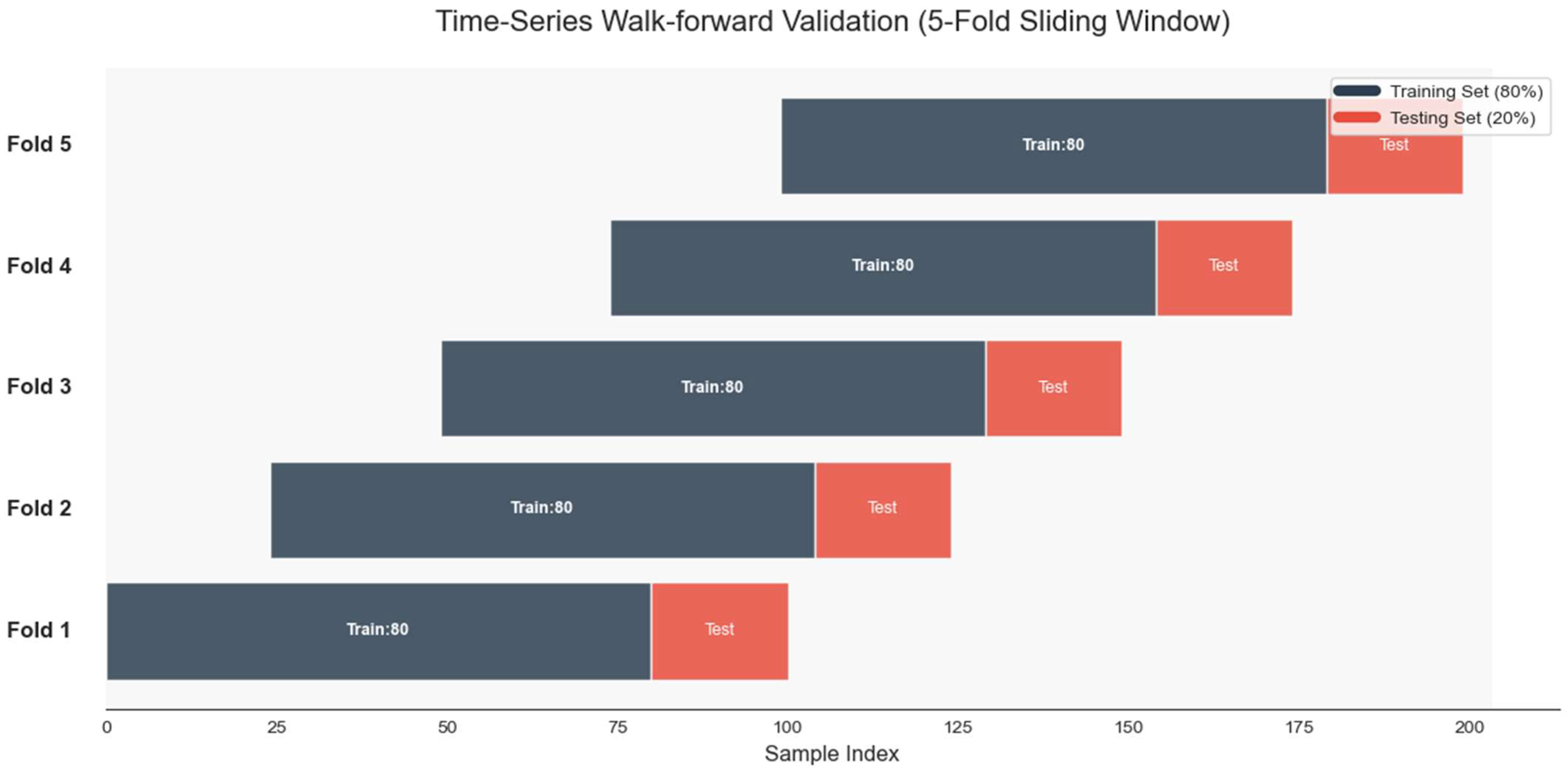
To further ensure the reliability of the empirical findings, this study conducts multi-dimensional stress tests to verify the robustness of the model results. First, a sensitivity analysis of rolling window partitions is performed. To ensure that the empirical conclusions are not dependent on a specific sample splitting method, a sliding window scheme is employed. In this framework, each fold consists of 100 samples, with a sliding step size (steps) set to 25 (Figure 3). This design is intended to cover various economic cycles and market volatility regimes, thereby examining the predictive efficacy of FS and EPU factors across different sample densities and time horizons. Additionally, the training window length was recalibrated from the baseline of 36 months to 24 months to further evaluate the robustness of the results. The predictive performance across these windows exhibits broad consistency with the full-sample results. Second, a robustness check using multiple random seeds is conducted. Given the inherent dependence of non-linear algorithms, such as ensemble learning, on initial random states, all models were retrained and re-evaluated by varying the Random Seeds. The results indicate that core evaluation metrics remain highly stable across different time slices and random initializations. This immunity to sample selection bias and stochastic interference strongly confirms that the reshaping of the risk correlation structure is rooted in the underlying economic logic of the data, rather than being a statistical artifact resulting from the over-fitting of specific algorithmic parameters. Table 4 presents the results of the rolling window analysis for the forecast horizon H = 6, which exhibit high consistency with the primary findings reported above. Due to space constraints, additional robustness test results as well as detailed descriptions of the replicability of the machine learning technique are provided in the Appendix A.

5. Conclusions

This study constructs an integrated framework for risk matrix forecasting and portfolio optimization in the Chinese equity market by transforming Financial Stress (FS) and Economic Policy Uncertainty (EPU) signals into model-ready features. Multiple machine learning algorithms are employed to generate multi-output forecasts of cross-industry covariance structures, and the predicted covariance matrices are subsequently incorporated into a minimum variance portfolio (MVP) framework. In this way, the effectiveness of EPU and FS signals is evaluated from both a forecasting accuracy perspective and a portfolio risk perspective.
The empirical findings indicate that incorporating FS and EPU features improves the characterization of cross-industry correlation structures and enhances risk forecasting performance to varying degrees; however, the stability and applicability of the two signals differ substantially. Overall, the FS feature delivers more consistent error reductions across most models and forecasting horizons and more stably lowers out-of-sample realized portfolio variance. This suggests that the information embedded in FS—such as liquidity constraints, financing conditions, and endogenous systemic stress—can be more directly mapped into shifts in sectoral co-movement structures. In contrast, the improvements associated with EPU are more concentrated in short-term forecasts and exhibit clear model dependence. Under certain linear or weakly nonlinear frameworks, its effects on prediction error and portfolio variance are unstable; yet within some nonlinear ensemble models, EPU significantly improves realized portfolio variance. This pattern indicates that policy uncertainty signals are more likely to influence sectoral correlations through nonlinear and threshold effects, and their incremental value is more effectively extracted in algorithms with stronger nonlinear representation capacity.
At the asset allocation level, the MVP constructed from the predicted covariance matrices further reveals how macro signals reshape portfolio weights. Under benchmark specifications relying solely on historical return information, several models generate highly concentrated industry exposures, reflecting extreme weight allocations in selected sectors. After incorporating FS signals, weight distributions across most models become more compressed and balanced, with extreme positions systematically moderated and realized variance more consistently reduced. This suggests that FS signals help mitigate the concentrated exposures arising from mechanically extrapolating historical correlation structures, aligning sector weights more closely with genuine co-movement patterns under stress conditions and enhancing the portfolio’s out-of-sample risk resilience. By comparison, the impact of EPU on weight structures is more context-dependent: in some models, it moderates extreme exposures and improves risk outcomes, but its effects vary substantially across algorithms. This reflects the fact that EPU operates through expectation formation and sector-specific pricing adjustments and therefore requires suitable model structures to effectively extract its informational content.
Based on the findings above, the practical implications of this study primarily lie in the alignment of signals, modeling frameworks, and allocation strategies. First, sector allocation and risk budgeting should incorporate signals reflecting endogenous financial system stress as macro calibration inputs, especially during periods of market volatility or stress, to correct extreme positions and risk underestimation that arise from relying solely on historical extrapolation. Second, modeling strategies should differentiate according to the characteristics of the signals: for stress-related signals with stronger cross-period stability (such as FS), structural and smoothed feature extraction should be emphasized to enhance consistency in medium- to long-term allocation logic; for policy uncertainty signals with stronger nonlinearity and regime-dependent dynamics (such as EPU), modeling frameworks capable of capturing nonlinear and threshold effects are more appropriate for identifying short-term distortions in sectoral correlations and implementing targeted hedging strategies. Overall, the evidence supports embedding macro uncertainty signals into risk matrix forecasting and portfolio optimization processes, improving the identification of sectoral dependence structures, and enhancing the robustness of asset allocation under complex macroeconomic conditions. Additionally, this framework provides actionable guidance for dynamic risk calibration in portfolio management and industry linkage monitoring in systemic risk: in portfolio management, FS/EPU-driven forecasted covariance matrices can be used to regularly update risk budgets and minimum variance weights, with increased rebalancing frequency during periods of stress; in systemic risk monitoring, continuous tracking of industry correlation and covariance concentration indicators can be used as triggers for stress testing and risk warning.
This study primarily focuses on sector-level data from the equity market, which may limit the direct generalizability of our conclusions to other asset classes such as commodities, bonds, and cryptocurrencies. These assets differ substantially in pricing mechanisms, term-structure features, liquidity constraints, and risk drivers, so the transmission strength and timing of EPU/FS to their covariance structures may not be identical. Future research can extend our framework by incorporating cross-asset data and developing a multi-asset risk-matrix forecasting and portfolio optimization system across equities, bonds, commodities, and cryptocurrencies to further assess the applicability and robustness of macro-uncertainty signals in cross-market allocation.

Author Contributions

Conceptualization, J.D. and W.C.; methodology, J.D.; software, J.D.; validation, J.D., W.C. and Z.W.; formal analysis, J.D.; investigation, W.C.; resources, Z.W.; data curation, W.C. and Z.W.; writing—original draft preparation, J.D.; writing—review and editing, J.D., W.C. and Z.W.; visualization, J.D.; supervision, W.C. and Z.W.; project administration, W.C.; funding acquisition, Z.W. All authors have read and agreed to the published version of the manuscript.

Funding

This research received no external funding.

Institutional Review Board Statement

Not applicable.

Informed Consent Statement

Not applicable.

Data Availability Statement

The original contributions presented in this study are included in the article. Further inquiries can be directed to the corresponding authors.

Acknowledgments

We thank the funders of this project School of Cyber Science and Engineering, Wuhan University, Department of Mathematics, King’s College London and all the teams and individuals who supported this research.

Conflicts of Interest

The authors declare no conflicts of interest.

Appendix A

(1)
Computational Environment and Software Configuration
All experiments in this study were conducted on a Windows 11 (64-bit) operating system, with Python version 3.12.7 (64-bit). Graphical and interface-related dependencies include Qt 5.15.2 and PyQt5 5.15.10. The hardware environment consists of 64 GB RAM and an NVIDIA 5080 GPU (NVIDIA Corporation, Santa Clara, CA, USA). Model implementations are based on publicly available standard libraries, including scikit-learn, XGBoost, LightGBM, and CatBoost. Data processing and computational procedures follow deterministic index-based operations (without random shuffling). The training and testing sets are divided using a fixed 80–20% split rule. Forecasting is conducted under a rolling-window framework (window = 36) with multiple forecast horizons (horizon = 1, 6, 12).
(2)
Random Seed Control and Hyperparameter Specification
All models involving stochastic components explicitly fix random seeds to ensure reproducibility. The specific settings are as follows:
RandomForestRegressor (n_estimators = 50, random_state = 42, n_jobs = −1); AdaBoostRegressor (n_estimators = 50, random_state = 42); XGBRegressor (n_estimators = 50, random_state = 42, n_jobs = −1); LightGBM (n_estimators = 50, random_state = 42, verbose = −1); CatBoostRegressor (n_estimators = 50, random_state = 42, verbose = 0); ExtraTreesRegressor (n_estimators = 50, max_depth = 5, random_state = 42, n_jobs = −1); GaussianProcessRegressor (kernel = C(1.0, (1.0 × 10⁻³, 1.0 × 10³)) × RBF(1.0, (1.0 × 10⁻², 1.0 × 10²)) + WhiteKernel(noise_level = 1.0 × 10⁻⁵), n_restarts_optimizer = 10, random_state = 42); SVR (kernel = ‘rbf’, C = 10, epsilon = 0.01, gamma = ‘auto’); Lasso (alpha = 0.01); Ridge and BayesianRidge use default parameters; ELMRegressor is specified with n_hidden = 50 and generates input weights and biases using np.random.RandomState with fixed random seeds (42 or 123).

References

  1. Phan, D.H.B.; Iyke, B.N.; Sharma, S.S.; Affandi, Y. Economic policy uncertainty and financial stability—Is there a relation? Econ. Model. 2021, 94, 1018–1029. [Google Scholar] [CrossRef]
  2. Wang, L.; Qu, X.; Wang, Y.; Lu, J.; Wang, Q. Economic policy uncertainty, related-party transactions and corporate liquidity. Financ. Res. Lett. 2025, 76, 107010. [Google Scholar] [CrossRef]
  3. Sergeyev, D.; Lian, C.; Gorodnichenko, Y. The economics of financial stress. Rev. Econ. Stud. 2025, 92, 3403–3437. [Google Scholar] [CrossRef]
  4. Baker, S.R.; Bloom, N.; Davis, S.J. Measuring economic policy uncertainty. Q. J. Econ. 2016, 131, 1593–1636. [Google Scholar] [CrossRef]
  5. Cardarelli, R.; Elekdag, S.; Lall, S. Financial stress and economic contractions. J. Financ. Stab. 2011, 7, 78–97. [Google Scholar] [CrossRef]
  6. Anderson, E.W.; Ghysels, E.; Juergens, J.L. Do heterogeneous beliefs matter for asset pricing? Rev. Financ. Stud. 2005, 18, 875–924. [Google Scholar] [CrossRef]
  7. Awosusi, A.A. How do economic policy uncertainty, climate policy uncertainty and us monetary policy uncertainty shape investors’ sentiment in the green market? Appl. Econ. 2025, 1–19. [Google Scholar] [CrossRef]
  8. Allen, F.; Gale, D.M. Financial contagion. J. Political Econ. 2000, 108, 1–33. [Google Scholar] [CrossRef]
  9. Brogaard, J.; Detzel, A. The asset-pricing implications of government economic policy uncertainty. Manag. Sci. 2015, 61, 3–18. [Google Scholar] [CrossRef]
  10. Liang, C.; Luo, Q.; Li, Y.; Huynh, L.D.T. Global financial stress index and long-term volatility forecast for international stock markets. J. Int. Financ. Mark. Inst. Money 2023, 88, 101825. [Google Scholar] [CrossRef]
  11. Tsai, I.-C. The source of global stock market risk: A viewpoint of economic policy uncertainty. Econ. Model. 2017, 60, 122–131. [Google Scholar] [CrossRef]
  12. Taieb, S.B.; Sorjamaa, A.; Bontempi, G. Multiple-output modeling for multi-step-ahead time series forecasting. Neurocomputing 2010, 73, 1950–1957. [Google Scholar] [CrossRef]
  13. Xu, D.; Shi, Y.; Tsang, I.W.; Ong, Y.-S.; Gong, C.; Shen, X. Survey on multi-output learning. IEEE Trans. Neural Netw. Learn. Syst. 2019, 31, 2409–2429. [Google Scholar] [CrossRef]
  14. Sánchez-Fernández, M.; de-Prado-Cumplido, M.; Arenas-García, J.; Pérez-Cruz, F. Svm multiregression for nonlinear channel estimation in multiple-input multiple-output systems. IEEE Trans. Signal Process. 2004, 52, 2298–2307. [Google Scholar] [CrossRef]
  15. Hao, Q.; Li, A. Economic policy uncertainty and institutional portfolio investment. Financ. Manag. 2025, 54, 271–304. [Google Scholar] [CrossRef]
  16. Lee, K.; Jeon, Y.; Jo, C. Chinese economic policy uncertainty and us households’ portfolio decisions. Pac.-Basin Financ. J. 2020, 64, 101452. [Google Scholar] [CrossRef]
  17. Mezghani, T.; Boujelbène-Abbes, M. Financial stress effects on financial markets: Dynamic connectedness and portfolio hedging. Int. J. Emerg. Mark. 2023, 18, 4064–4087. [Google Scholar] [CrossRef]
  18. Younis, I.; Gupta, H.; Shah, W.U.; Sharif, A.; Tang, X.; Amman, H. The effects of economic uncertainty and trade policy uncertainty on industry-specific stock markets equity. Comput. Econ. 2024, 64, 2909–2933. [Google Scholar] [CrossRef]
  19. Liu, M.; Choo, W.C.; Lee, C.C.; Lee, C.C. Trading volume and realized volatility forecasting: Evidence from the China stock market. J. Forecast. 2023, 42, 76–100. [Google Scholar] [CrossRef]
  20. Dai, Z.; Zhu, H.; Zhang, X. Dynamic spillover effects and portfolio strategies between crude oil, gold and Chinese stock markets related to new energy vehicle. Energy Econ. 2022, 109, 105959. [Google Scholar] [CrossRef]
  21. Ma, Y.; Wang, Z.; He, F. How do economic policy uncertainties affect stock market volatility? Evidence from g7 countries. Int. J. Financ. Econ. 2022, 27, 2303–2325. [Google Scholar] [CrossRef]
  22. Ruan, Q.; Zhang, J.; Lv, D. Forecasting exchange rate volatility: Is economic policy uncertainty better? Appl. Econ. 2024, 56, 1526–1544. [Google Scholar] [CrossRef]
  23. Jia, L.; Xu, R.; Wu, J.; Song, M.; Chen, X. Impacts of geopolitical risk and economic policy uncertainty on metal futures price volatility: Evidence from China. Resour. Policy 2023, 87, 104328. [Google Scholar] [CrossRef]
  24. Ye, C.; Ou, H.; Basile, V.; Bhuiyan, M.A. The effect of uncertainty index based on sparse method on volatility prediction of stock market. Expert Syst. Appl. 2025, 290, 128208. [Google Scholar] [CrossRef]
  25. Bretscher, L.; Hsu, A.; Tamoni, A. The real response to uncertainty shocks: The risk premium channel. Manag. Sci. 2023, 69, 119–140. [Google Scholar] [CrossRef]
  26. Shahzad, S.J.H.; Raza, N.; Balcilar, M.; Ali, S.; Shahbaz, M. Can economic policy uncertainty and investors sentiment predict commodities returns and volatility? Resour. Policy 2017, 53, 208–218. [Google Scholar] [CrossRef]
  27. Salisu, A.A.; Demirer, R.; Gupta, R. Policy uncertainty and stock market volatility revisited: The predictive role of signal quality. J. Forecast. 2023, 42, 2307–2321. [Google Scholar] [CrossRef]
  28. Li, X.; Wei, Y.; Chen, X.; Ma, F.; Liang, C.; Chen, W. Which uncertainty is powerful to forecast crude oil market volatility? New evidence. Int. J. Financ. Econ. 2022, 27, 4279–4297. [Google Scholar] [CrossRef]
  29. Adjei, A.N.K.; Tweneboah, G.; Owusu Junior, P. Economic policy uncertainty and spillovers in selected emerging market economies: Time-and frequency-domain approach. J. Financ. Econ. Policy 2025, 17, 1–28. [Google Scholar] [CrossRef]
  30. Li, A.; Zhong, B. Asymmetric spillover connectedness between clean energy markets and industrial stock markets: How uncertainties affect it. PLoS ONE 2025, 20, e0316171. [Google Scholar] [CrossRef]
  31. Demiralay, S.; Golitsis, P.; Fassas, A.; Chen, J. Hedging effectiveness of alternative assets: Evidence from range-based dynamic correlation models. Stud. Econ. Financ. 2025, 43, 30–58. [Google Scholar] [CrossRef]
  32. Papathanasiou, S.; Kenourgios, D.; Koutsokostas, D.; Pergeris, G. Can treasury inflation-protected securities safeguard investors from outward risk spillovers? A portfolio hedging strategy through the prism of COVID-19. J. Asset Manag. 2022, 24, 198. [Google Scholar] [CrossRef]
  33. Gao, W.; Jin, X.; Zhang, H.; He, M. The asymmetric response of higher-order moments of precious metals to energy shocks and financial stresses: Evidence from time-frequency connectedness approach. Energy Econ. 2025, 142, 108171. [Google Scholar] [CrossRef]
  34. Zhang, H.; Wang, P. Does bitcoin or gold react to financial stress alike? Evidence from the Us and China. Int. Rev. Econ. Financ. 2021, 71, 629–648. [Google Scholar] [CrossRef]
  35. Wu, N.; Zhang, Z.; Lin, B. Responses of financial stress and monetary policy to global warming: Evidence from China. Int. Rev. Financ. Anal. 2024, 92, 103092. [Google Scholar] [CrossRef]
  36. Duca, M.L.; Peltonen, T.A. Assessing systemic risks and predicting systemic events. J. Bank. Financ. 2013, 37, 2183–2195. [Google Scholar] [CrossRef]
  37. Hubrich, K.; Tetlow, R.J. Financial stress and economic dynamics: The transmission of crises. J. Monet. Econ. 2015, 70, 100–115. [Google Scholar] [CrossRef]
  38. Oet, M.V.; Dooley, J.M.; Ong, S.J. The financial stress index: Identification of systemic risk conditions. Risks 2015, 3, 420–444. [Google Scholar] [CrossRef]
  39. Kaminsky, G.L.; Reinhart, C.M. Financial markets in times of stress. J. Dev. Econ. 2002, 69, 451–470. [Google Scholar] [CrossRef][Green Version]
  40. Huang, Z.; Zhu, H.; Deng, X.; Zeng, T. Time-frequency tail risk spillover between esg climate and high-carbon assets: The role of economic policy uncertainty and financial stress. Financ. Res. Lett. 2024, 67, 105866. [Google Scholar] [CrossRef]
  41. Ranković, V.; Drenovak, M.; Urosevic, B.; Jelic, R. Mean-univariate garch var portfolio optimization: Actual portfolio approach. Comput. Oper. Res. 2016, 72, 83–92. [Google Scholar] [CrossRef]
  42. Huang, J.-J.; Lee, K.-J.; Liang, H.; Lin, W.-F. Estimating value at risk of portfolio by conditional copula-garch method. Insur. Math. Econ. 2009, 45, 315–324. [Google Scholar] [CrossRef]
  43. Sahamkhadam, M.; Stephan, A.; Östermark, R. Portfolio optimization based on GARCH-EVT-Copula forecasting models. Int. J. Forecast. 2018, 34, 497–506. [Google Scholar] [CrossRef]
  44. Jin, X.; Maheu, J.M. Modeling realized covariances and returns. J. Financ. Econom. 2013, 11, 335–369. [Google Scholar] [CrossRef]
  45. Callot, L.A.; Kock, A.B.; Medeiros, M.C. Modeling and forecasting large realized covariance matrices and portfolio choice. J. Appl. Econom. 2017, 32, 140–158. [Google Scholar] [CrossRef]
  46. Bollerslev, T.; Patton, A.J.; Quaedvlieg, R. Modeling and forecasting (un) reliable realized covariances for more reliable financial decisions. J. Econom. 2018, 207, 71–91. [Google Scholar] [CrossRef]
  47. Torres, R.; Villena, M. On the empirical performance of different covariance-matrix forecasting methods. Neural Comput. Appl. 2024, 36, 9503–9524. [Google Scholar] [CrossRef]
  48. Leccadito, A.; Staino, A.; Toscano, P. A novel robust method for estimating the covariance matrix of financial returns with applications to risk management. Financ. Innov. 2024, 10, 116. [Google Scholar] [CrossRef]
  49. O’Brien, M.; Velasco, S. Macro-financial imbalances and cyclical systemic risk dynamics: Understanding the factors driving the financial cycle in the presence of non-linearities. Macroecon. Dyn. 2025, 29, e13. [Google Scholar] [CrossRef]
  50. Alessandri, P.; Gazzani, A.; Vicondoa, A. Are the effects of uncertainty shocks big or small? Eur. Econ. Rev. 2023, 158, 104525. [Google Scholar] [CrossRef]
  51. Engle, R.F. Dynamic conditional beta. J. Financ. Econom. 2016, 14, 643–667. [Google Scholar] [CrossRef]
  52. Awad, M.; Khanna, R. Support vector regression. In Efficient Learning Machines: Theories, concepts, and Applications for Engineers and System Designers; Apress: Berkeley, CA, USA, 2015; pp. 67–80. [Google Scholar] [CrossRef]
  53. Breiman, L. Random forests. Mach. Learn. 2001, 45, 5–32. [Google Scholar] [CrossRef]
  54. Schapire, R.E. Explaining AdaBoost. In Empirical Inference: Festschrift in Honor of Vladimir N. Vapnik; Springer: Berlin/Heidelberg, Germany, 2013; pp. 37–52. [Google Scholar]
  55. Chen, T.; He, T.; Benesty, M.; Khotilovich, V.; Tang, Y.; Cho, H.; Chen, K.; Mitchell, R.; Cano, I.; Zhou, T. Xgboost: Extreme Gradient Boosting; R Package, Version 04-2. Comprehensive R Archive Network (CRAN) Online. 2015. Available online: https://CRAN.R-project.org/package=xgboost (accessed on 1 February 2026).
  56. Ke, G.; Meng, Q.; Finley, T.; Wang, T.; Chen, W.; Ma, W.; Ye, Q.; Liu, T.-Y. Lightgbm: A highly efficient gradient boosting decision tree. In Advances in Neural Information Processing Systems; Curran Associates, Inc.: Red Hook, NY, USA, 2017; p. 30. [Google Scholar]
  57. Prokhorenkova, L.; Gusev, G.; Vorobev, A.; Dorogush, A.V.; Gulin, A. Catboost: Unbiased boosting with categorical features. In Advances in Neural Information Processing Systems; Curran Associates, Inc.: Red Hook, NY, USA, 2018; p. 31. [Google Scholar]
  58. Huang, G.-B.; Zhu, Q.-Y.; Siew, C.-K. Extreme learning machine: Theory and applications. Neurocomputing 2006, 70, 489–501. [Google Scholar] [CrossRef]
  59. Hoerl, A.E.; Kennard, R.W. Ridge regression: Applications to nonorthogonal problems. Technometrics 1970, 12, 69–82. [Google Scholar] [CrossRef]
  60. Tibshirani, R. Regression shrinkage and selection via the lasso. J. R. Stat. Soc. Ser. B Stat. Methodol. 1996, 58, 267–288. [Google Scholar] [CrossRef]
  61. Geurts, P.; Ernst, D.; Wehenkel, L. Extremely randomized trees. Mach. Learn. 2006, 63, 3–42. [Google Scholar] [CrossRef]
  62. Schulz, E.; Speekenbrink, M.; Krause, A. A tutorial on gaussian process regression: Modelling, exploring, and exploiting functions. J. Math. Psychol. 2018, 85, 1–16. [Google Scholar] [CrossRef]
  63. Patton, A.J. Volatility forecast comparison using imperfect volatility proxies. J. Econom. 2011, 160, 246–256. [Google Scholar] [CrossRef]
  64. Hodson, T.O. Root mean square error (RMSE) or mean absolute error (MAE): When to use them or not. Geosci. Model Dev. Discuss. 2022, 2022, 1–10. [Google Scholar] [CrossRef]
  65. De Myttenaere, A.; Golden, B.; Le Grand, B.; Rossi, F. Mean absolute percentage error for regression models. Neurocomputing 2016, 192, 38–48. [Google Scholar] [CrossRef]
  66. Clarke, R.; De Silva, H.; Thorley, S. Minimum-variance portfolios in the us equity market. J. Portf. Manag. 2006, 33, 10. [Google Scholar] [CrossRef]
  67. Wang, C. Stock return prediction with multiple measures using neural network models. Financ. Innov. 2024, 10, 72. [Google Scholar] [CrossRef]
  68. Gu, S.; Kelly, B.; Xiu, D. Empirical asset pricing via machine learning. Rev. Financ. Stud. 2020, 33, 2223–2273. [Google Scholar] [CrossRef]
  69. Chen, J.; Ma, F.; Qiu, X.; Li, T. The role of categorical epu indices in predicting stock-market returns. Int. Rev. Econ. Financ. 2023, 87, 365–378. [Google Scholar] [CrossRef]
  70. Junttila, J.; Vataja, J. Economic policy uncertainty effects for forecasting future real economic activity. Econ. Syst. 2018, 42, 569–583. [Google Scholar] [CrossRef]
  71. Rigotti, L.; Shannon, C. Uncertainty and risk in financial markets. Econometrica 2005, 73, 203–243. [Google Scholar] [CrossRef]
  72. Lyu, Y.; Yi, H.; Yang, M.; Zou, Y.; Li, D.; Qin, Z. Financial uncertainty shocks and systemic risk: Revealing the risk spillover from the oil market to the stock market. Appl. Energy 2025, 382, 125311. [Google Scholar] [CrossRef]
Figure 1. Time-varying beta series. (a) b i , t EPU . (b) b i , t FS .
Mathematics 14 00938 g001
Figure 2. Methodological framework.
Mathematics 14 00938 g002
Figure 3. Rolling verification process.
Mathematics 14 00938 g003
Table 1. Data descriptive.
VariableMeanSDSkewnessKurtosisMinMaxADFPP
Energy0.00440.0891−0.63285.7665−0.41010.2500−14.265 ***−14.393 ***
Materials0.00700.0981−0.54304.5692−0.35490.2730−13.710 ***−13.772 ***
Industrials0.00660.0878−0.47215.1414−0.35640.2655−13.450 ***−13.544 ***
Consumer Discretionary0.00840.0874−0.39585.3501−0.35590.3172−13.011 ***−13.091 ***
Consumer Staples0.00950.0824−0.48544.1433−0.28420.2277−14.427 ***−14.444 ***
HealthCare0.01010.0870−0.27014.4309−0.31750.3122−14.457 ***−14.474 ***
Financials0.00800.0842−0.08105.4433−0.32490.3175−13.338 ***−13.444 ***
Information Technology0.00980.1022−0.43494.5332−0.40040.2812−13.806 ***−13.779 ***
Communication Services0.00620.0943−0.33527.2679−0.42050.3938−14.509 ***−14.567 ***
Utilities0.00630.0780−0.16645.9358−0.32330.3250−14.909 ***−15.010 ***
RealEstate0.00390.09940.11984.4751−0.34160.3149−14.031 ***−14.172 ***
EPU0.01260.35700.23563.2424−0.96611.1445−24.519 ***−30.654 ***
FS0.08410.09422.35099.89160.00330.5955−4.323 ***−4.591 ***
*** imply the statistical significance level of 1%.
Table 2. Evaluation of model predictions.
ModelFeatureMSERMSEMAEMAPE
Panel A: 1-period
SVREPU0.0051450.0717300.0521412.549732
FS0.0040130.0633460.0463951.804270
benchmark0.0046100.0679000.0513102.464716
RFEPU0.0042650.0653100.0482732.030137
FS0.0041860.0647020.0464821.599939
benchmark0.0043240.0657580.0475562.094928
AdaBoostEPU0.0047270.0687550.0511012.408522
FS0.0043880.0662410.0480191.974238
benchmark0.0044210.0664870.0492922.310125
XGBoostEPU0.0059220.0769550.0593173.387983
FS0.0049820.0705800.0523593.458025
benchmark0.0055770.0746780.0551942.773075
LightGBMEPU0.0048230.0694490.0510092.986291
FS0.0049860.0706130.0517722.357543
benchmark0.0046120.0679100.0507822.694265
ELMEPU0.0062650.0791500.0627095.021667
FS0.0089060.0943710.0702174.518472
benchmark0.0068510.0827700.0631093.887008
RidgeEPU0.0106650.1032700.0784495.209488
FS0.0098980.0994860.0800046.507205
benchmark0.0111410.1055530.0833367.330348
LassoEPU0.0041500.0644180.0467171.536297
FS0.0043580.0660160.0478091.796620
benchmark0.0041990.0647960.0472491.708908
BayesianRidgeEPU0.0135420.1163680.0888536.278818
FS0.0102140.1010620.0812506.668407
benchmark0.0117920.1085920.0857907.620073
GPREPU0.0040770.0638490.0453991.114777
FS0.0040450.0636020.0453711.098367
benchmark0.0041090.0641000.0458841.128547
ExtraTreesEPU0.0042330.0650580.0467441.342984
FS0.0041940.0647600.0466751.479477
benchmark0.0042470.0651660.0475342.000153
CatBoostEPU0.0049190.0701390.0526902.672598
FS0.0046010.0678320.0499422.896800
benchmark0.0046090.0678900.0513272.776865
Panel B: 6-periodFeatureMSERMSEMAEMAPE
SVREPU0.0053330.0730270.0542153.165859
FS0.0041460.0643890.0472421.944144
benchmark0.0046410.0681220.0514192.720944
RFEPU0.0044420.0666510.0497142.860055
FS0.0042990.0655690.0468781.774717
benchmark0.0045240.0672600.0490422.121421
AdaBoostEPU0.0048050.0693160.0510982.639021
FS0.0044690.0668490.0492402.033002
benchmark0.0045610.0675380.0498782.514272
XGBoostEPU0.0062020.0787510.0584553.507845
FS0.0049000.0700010.0517703.023800
benchmark0.0055750.0746690.0561423.797553
LightGBMEPU0.0052690.0725860.0531233.059856
FS0.0047740.0690970.0511122.728685
benchmark0.0046520.0682060.0508622.754102
ELMEPU0.0075480.0868820.0661335.569471
FS0.0079300.0890490.0676425.370794
benchmark0.0072180.0849580.0653105.001222
RidgeEPU0.0136670.1169060.0931197.720820
FS0.0088070.0938430.0738236.451602
benchmark0.0111130.1054160.0820586.980386
LassoEPU0.0042010.0648110.0471221.640506
FS0.0044890.0669970.0484891.796050
benchmark0.0043080.0656390.0477791.699343
BayesianRidgeEPU0.0159200.1261740.1009198.644365
FS0.0090710.0952400.0750666.620043
benchmark0.0116630.1079930.0841177.243136
GPREPU0.0041860.0647000.0463881.255501
FS0.0041270.0642430.0460441.107867
benchmark0.0042120.0649030.0466151.195267
ExtraTreesEPU0.0041750.0646160.0463371.372894
FS0.0041790.0646430.0463121.365704
benchmark0.0042570.0652480.0471961.565862
CatBoostEPU0.0051160.0715270.0531933.177933
FS0.0046350.0680810.0496512.260024
benchmark0.0047170.0686810.0516893.030385
Panel C: 12-periodFeatureMSERMSEMAEMAPE
SVREPU0.0054730.0739820.0549513.494224
FS0.0043260.0657760.0484291.874586
benchmark0.0049150.0701090.0533012.751202
RFEPU0.0047460.0688930.0518212.778744
FS0.0045740.0676290.0490482.128297
benchmark0.0049100.0700690.0520572.286216
AdaBoostEPU0.0051340.0716500.0529652.536894
FS0.0047730.0690840.0510852.147255
benchmark0.0047430.0688670.0511822.313904
XGBoostEPU0.0061870.0786590.0584953.620144
FS0.0054050.0735190.0544043.438061
benchmark0.0057330.0757140.0571963.546748
LightGBMEPU0.0055490.0744910.0544003.027736
FS0.0050500.0710660.0529872.772777
benchmark0.0049990.0707030.0530202.973662
ELMEPU0.008149 0.090272 0.0698605.913705
FS0.0084270.0918010.0705535.076785
benchmark0.0077590.0880860.0679245.366021
RidgeEPU0.0131880.1148410.0911508.368397
FS0.0089800.0947640.0753016.837844
benchmark0.0114630.1070650.0842227.152406
LassoEPU0.0044880.0669940.0490381.740371
FS0.0047200.0687030.0498481.660265
benchmark0.0045610.0675330.0495661.724404
BayesianRidgeEPU0.0148950.1220450.0969189.130487
FS0.0092000.0959180.0762856.972025
benchmark0.0120430.1097400.0863447.447165
GPREPU0.0044390.0666250.0481271.381115
FS0.0043510.0659610.0476141.097768
benchmark0.0044490.0667020.0482811.253879
ExtraTreesEPU0.0043900.0662570.0480181.508622
FS0.0044230.0665090.0480351.188682
benchmark0.0044630.0668090.0485821.316968
CatBoostEPU0.0052450.0724240.0539762.921081
FS0.0047450.0688870.0509172.622902
benchmark0.0050300.0709190.0530202.780529
Notes: Bold values indicate the best performance.
Table 3. Out-of-sample predictive performance for portfolio realized variance and portfolio weights.
ModelFeatureRealized
Variance
Portfolio Weights
W_EnergyW_MaterialsW_IndustrialsW_Consumer
Discretionary
W_Consumer StaplesW_Health CareW_FinancialsW_Information
Technology
W_Communication ServicesW_UtilitiesW_Real
Estate
Panel A: 1-period
SVREPU0.007420.17470−0.03113−0.620690.485990.265640.338960.330530.07552−0.22257−0.302940.50599
FS0.00126−0.02431−0.137270.02232−0.200460.19747−0.033900.365510.060660.050230.75643−0.05669
benchmark0.001860.140900.35613−0.72719−0.222180.362120.262560.172290.19408−0.033190.56676−0.07226
RFEPU0.004440.83584−0.508120.32506−0.093550.262490.558240.29046−0.551090.142850.14311−0.40529
FS0.001890.33156−0.23352−0.655230.04424−0.011200.039500.737680.51949−0.002680.60942−0.37927
benchmark0.007350.47585−0.067270.27654−0.48575−0.324600.504190.84552−0.39138−0.348721.27006−0.75443
AdaBoostEPU0.002590.58928−0.160870.032050.129910.507670.03611−0.00201−0.01273−0.01137−0.00355−0.10449
FS0.001580.165240.08313−0.12227−0.130790.23643−0.044930.058120.160860.188530.355010.05066
benchmark0.00255−0.08601−0.005660.005610.071780.096010.017120.72686−0.01450−0.066080.249500.00537
XGBoostEPU0.001800.23156−0.091150.120460.143990.14385−0.129930.038060.028060.163900.247340.10386
FS0.001780.10988−0.045110.21618−0.048980.10402−0.005450.155900.142200.181290.165380.02468
benchmark0.002930.273700.13448−0.176740.013990.187900.38650−0.019690.06687−0.233450.217770.14867
LightGBMEPU0.001750.35280−0.124620.07275−0.15723−0.041670.302340.33440−0.01308−0.032540.233450.07339
FS0.001380.15558−0.176590.02134−0.047220.101960.183170.216340.022980.225230.284320.01287
benchmark0.002230.08096−0.109650.108420.348020.20972−0.045690.184600.038530.102870.09396−0.01174
ELMEPU0.002040.65155−0.11274−0.313180.209890.18189−0.104580.184900.31528−0.390460.63394−0.25649
FS0.003040.176420.16420−0.99714−0.228690.115690.093291.058770.55224−0.477550.72060−0.17781
benchmark0.002020.17505−0.42747−0.216660.52266−0.175030.101610.780260.00512−0.087320.51394−0.19216
RidgeEPU0.003350.74928−0.66264−0.034550.544950.288360.131990.04988−0.136040.23303−0.198690.03443
FS0.003930.098660.22538−0.814040.590680.106960.43320−0.02758−0.44181−0.064480.633690.25934
benchmark0.005531.05129−0.45215−0.386320.65125−0.070990.556680.31883−0.01915−0.58425−0.278180.21299
LassoEPU0.004130.18355−0.14184−0.279460.310630.189690.231080.55763−0.153960.02027−0.113100.19551
FS0.00223−0.035970.21941−0.05676−0.357080.068860.115280.714640.05646−0.078660.343220.01060
benchmark0.00221−0.308990.00633−0.15977−0.305890.143870.275080.61348−0.069440.191300.535630.07839
BayesianRidgeEPU0.003600.82115−0.81851−0.056320.707640.27443−0.014480.05385−0.090070.21936−0.125030.02799
FS0.004050.075530.23875−0.857270.610310.074170.47482−0.02442−0.46059−0.072690.660090.28130
benchmark0.005671.04890−0.46290−0.386980.63273−0.063220.564740.31318−0.02626−0.58823−0.276000.24403
GPREPU0.003130.07208−0.00153−0.07333−0.016680.135380.193940.197760.414380.06606−0.001430.01337
FS0.002180.237600.010440.00816−0.015800.031050.112020.12581−0.025000.040520.237600.23759
benchmark0.002070.107970.203400.030650.166510.01112−0.012720.00086−0.015630.467860.04203−0.00205
ExtraTreesEPU0.008860.48554−0.86709−0.98362−0.035910.350161.204491.04068−0.30971−0.141650.49887−0.24177
FS0.008880.60572−1.13815−1.003400.361551.001680.569890.665810.01244−0.363780.52969−0.24144
benchmark0.009750.67668−0.72346−0.68244−0.413060.839090.859950.68560−0.41925−0.120290.36584−0.06865
CatBoostEPU0.002020.22842−0.097550.166310.033800.202450.084100.015930.011820.158110.096710.09991
FS0.001940.039930.178460.015900.11635−0.014030.049150.121270.020690.215670.196510.06009
benchmark0.002310.147120.023510.065170.064200.095470.035280.255380.114280.020940.091630.08702
Panel B: 6-period
SVREPU0.000310.51843−0.84016−0.110801.08388−0.268490.886920.38780−0.07992−0.630450.09155−0.03875
FS0.000080.33022−0.23329−0.00651−0.107030.066020.055460.309530.306880.028040.43947−0.18880
benchmark0.000120.40175−0.14844−0.750320.12431−0.151150.831230.147850.17869−0.184900.381570.16943
RFEPU0.000811.28703−0.63041−1.344730.122840.199840.968770.942590.45718−0.113460.02762−0.91727
FS0.000281.09313−0.36874−0.28756−0.161210.174490.52385−0.126820.453070.063500.02635−0.39007
benchmark0.000140.54251−0.37923−1.015970.135150.184910.684940.445760.35863−0.294490.42760−0.08981
AdaBoostEPU0.000300.309330.09206−0.211250.406040.111660.07924−0.026290.12878−0.12440−0.089480.32433
FS0.000090.345010.021390.012680.033760.243960.07657−0.145190.060380.098000.237370.01609
benchmark0.000070.34884−0.02740−0.056680.093680.126340.098380.04193−0.07376−0.040490.357400.13176
XGBoostEPU0.000080.20871−0.199320.337310.077580.130550.179350.01734−0.135960.132060.178120.07428
FS0.000170.077090.026900.060120.081760.185990.103220.19365−0.002060.109650.080440.08325
benchmark0.000130.101970.06638−0.091970.11392−0.021270.188410.028150.047430.051530.360090.15536
LightGBMEPU0.000130.52093−0.28400−0.10691−0.050990.032800.212970.351080.265820.11069−0.097100.04472
FS0.000090.238510.11078−0.19094−0.077740.387920.18858−0.083670.013540.142700.31086−0.04054
benchmark0.000190.28078−0.196380.08904−0.021400.246030.115630.110300.100230.01094−0.008780.27362
ELMEPU0.000150.85068−0.45063−1.033310.88850−0.201950.152880.024320.50111−0.195100.286710.17678
FS0.000240.85840−0.48070−0.439930.69456−0.048040.052710.611630.24220−0.293610.09076−0.28799
benchmark0.000460.501920.97022−2.13727−0.093030.182360.58306−0.051820.33496−0.077121.01012−0.22340
RidgeEPU0.000440.31996−0.51088−1.040510.53471−0.437381.093950.61816−0.245950.082450.88968−0.30417
FS0.000210.368330.22148−1.23202−0.121410.457060.16284−0.000900.32175−0.123341.05142−0.10523
benchmark0.000241.12015−0.52793−0.667820.80654−0.499570.665970.143960.18985−0.385350.053980.10022
LassoEPU0.000150.42636−0.13712−0.334780.271250.022690.468390.14141−0.188190.14551−0.100110.28458
FS0.000120.190610.079960.08297−0.288850.103790.195210.28374−0.00927−0.037800.303520.09613
benchmark0.00011−0.00154−0.01163−0.017880.076980.273740.103600.43502−0.034660.045030.22976−0.09842
BayesianRidgeEPU0.000350.36930−0.44834−0.996720.56062−0.391730.914150.51287−0.218530.093890.80477−0.20029
FS0.000200.367390.20497−1.21598−0.101960.452610.161590.001810.30740−0.118441.04449−0.10388
benchmark0.000241.10159−0.53272−0.672570.80271−0.478690.645230.146090.17340−0.381670.067410.12922
GPREPU0.000180.20058−0.02924−0.149210.105760.244870.135170.227200.117640.023420.003700.12009
FS0.000140.17316−0.041540.011590.037370.021790.099120.154990.060190.115260.199370.16870
benchmark0.000120.204370.141950.068330.02702−0.013060.030580.14160−0.032390.280360.148060.00320
ExtraTreesEPU0.000280.38507−0.07322−0.545510.125630.794370.765000.24121−0.09352−0.11220−0.33341−0.15341
FS0.000370.507500.05422−0.306960.072250.514470.375620.41007−0.38550−0.637800.174760.22137
benchmark0.00055−0.14657−0.08579−0.091700.077130.253310.299350.41863−0.09010−0.225080.036100.55473
CatBoostEPU0.000180.25793−0.029510.24674−0.018050.217420.33454−0.114190.019960.18187−0.04991−0.04680
FS0.000110.202200.066840.062040.123850.132390.115450.08763−0.024040.070310.132860.03045
benchmark0.000220.10871−0.023740.01968−0.001570.101040.141510.165680.212780.112760.095510.06764
Panel C: 12-period
SVREPU0.000151.07893−0.15785−0.742680.14014−0.053221.33759−0.32347−0.11502−0.24022−0.335610.41141
FS0.000020.36578−0.03047−0.102710.23590−0.010780.275130.19334−0.035050.21354−0.03301−0.07166
benchmark0.000050.67290−0.10758−0.866260.03519−0.110120.933990.152550.083310.043980.055190.10685
RFEPU0.000261.10391−0.54476−0.839120.225970.298430.794210.124650.071030.19438−0.11917−0.30953
FS0.000030.600200.01519−0.236770.05502−0.126680.50090−0.04169−0.063830.033780.179780.08410
benchmark0.000100.65895−0.17889−0.456190.164260.219520.566480.035390.17686−0.19376−0.419330.42671
AdaBoostEPU0.000250.231530.243650.167900.060220.138680.043060.138880.09382−0.10279−0.417200.40226
FS0.000020.331840.167500.013040.076950.069910.09412−0.08266−0.036300.102610.249940.01305
benchmark0.000070.07439−0.06540−0.086900.028820.294780.020720.178920.16603−0.019390.236630.17140
XGBoostEPU0.000030.31535−0.366870.424310.025760.325930.05786−0.10288−0.017360.023370.151420.16314
FS0.000030.248960.098920.037640.050580.155470.217140.09696−0.109070.140260.015000.04814
benchmark0.00006−0.015480.015970.052920.240360.003060.229130.03636−0.000450.023840.386260.02804
LightGBMEPU0.000300.167910.04232−0.091530.27398−0.128770.33294−0.006470.59738−0.02697−0.170190.00938
FS0.000040.42130−0.041760.183440.089800.228250.194060.171160.02864−0.00656−0.17658−0.09174
benchmark0.00022−0.238360.009370.053750.071430.112540.205980.486520.079190.047310.052360.11990
ELMEPU0.000050.447810.21384−1.899340.69080−0.301660.30673−0.140310.77309−0.138450.618850.42863
FS0.000091.15525−0.76232−0.278710.14737−0.335750.950470.233190.21719−0.22330−0.03189−0.07151
benchmark0.000171.11807−0.84319−0.530640.812760.376610.229130.235620.08128−0.10576−0.16470−0.20918
RidgeEPU0.000090.79378−0.18255−0.39905−0.45936−0.448011.584310.85841−0.01338−0.15721−0.37338−0.20357
FS0.000030.76425−0.39251−0.131800.305890.015840.566730.310010.047040.02997−0.28056−0.23485
benchmark0.000160.36918−0.02007−0.43981−0.18599−0.291441.10026−0.18304−0.705480.215210.354210.78697
LassoEPU0.000100.196860.05829−0.208900.210410.286110.57887−0.35966−0.134230.35903−0.064090.07731
FS0.000040.169780.203740.00059−0.126820.180910.043420.23115−0.00054−0.007690.31753−0.01207
benchmark0.000050.034760.00741−0.024000.002660.173680.101600.244780.041560.200320.196610.02063
BayesianRidgeEPU0.000080.78189−0.18752−0.45086−0.35161−0.466431.542760.86163−0.01687−0.14073−0.35620−0.21606
FS0.000030.75621−0.39462−0.123200.305120.014800.572990.309780.039340.02667−0.27462−0.23248
benchmark0.000150.36465−0.04006−0.41711−0.23069−0.293231.12178−0.19560−0.679510.212490.390520.76677
GPREPU0.000050.236420.02331−0.042410.022710.179220.159870.141690.073770.122300.020070.06305
FS0.000070.141850.086140.064610.108880.028620.103250.102390.049550.079880.121590.11324
benchmark0.000030.240660.130540.038120.009400.012700.045300.11781−0.018200.247570.109500.06659
ExtraTreesEPU0.000120.46503−0.18211−0.769540.164310.981780.693960.23694−0.03763−0.32497−0.416130.18836
FS0.000130.071750.091370.013060.133290.171740.121430.173300.07176−0.085620.050010.18789
benchmark0.00023−0.009200.110540.051000.161960.143310.197550.056170.13471−0.166920.017780.30312
CatBoostEPU0.000040.308960.012460.341060.11663−0.254940.11702−0.129890.036820.337980.27575−0.16186
FS0.000020.238950.06989−0.010570.131230.109170.036990.01741−0.093140.196900.176920.12626
benchmark0.000060.08252−0.049160.14921−0.118890.273260.166100.016180.032790.078110.186200.18366
Table 4. Prediction performance of robustness check.
ModelFeatureMSERMSEMAEMAPEReal_Port_Var
SVREPU0.0043910.0656580.0486612.4365720.000409
FS0.0039810.0624780.0474762.4566400.000636
benchmark0.0044090.0657110.0496112.9722190.000475
RFEPU0.0042390.0644790.0485702.4637730.000743
FS0.0039760.0623710.0466482.2365890.001118
benchmark0.0040430.0629320.0469551.9935690.000498
AdaBoostEPU0.0047330.0684580.0517473.0784300.000262
FS0.0043000.0650010.0495643.1701690.000227
benchmark0.0042780.0648780.0484852.4006410.000287
XGBoostEPU0.0075920.0863590.0656555.5397370.000280
FS0.0068780.0823520.0613734.6783190.000329
benchmark0.0054280.0733510.0557343.5214340.000308
LightGBMEPU0.0047370.0683490.0517433.4207240.000204
FS0.0049830.0700940.0538703.8359330.000229
benchmark0.0047770.0685550.0517163.4657480.000258
ELMEPU0.0161060.1264490.1004689.9339150.000660
FS0.0158480.1249680.09777610.0737210.000875
benchmark0.0157810.1249650.0978929.5924830.000774
RidgeEPU0.0115030.1054940.0815967.2597940.001165
FS0.0074000.0852490.0676205.5834960.000675
benchmark0.0079990.0891660.0701476.9216570.000592
LassoEPU0.0042910.0652920.0485762.8336240.000210
FS0.0049160.0698270.0534903.2908620.000534
benchmark0.0044100.0658700.0492682.6733340.000233
BayesianRidgeEPU0.0121760.1083690.0839207.5207610.001297
FS0.0074670.0856330.0679355.6397800.000678
benchmark0.0081030.0897470.0706256.9935690.000571
GPREPU0.0037380.0604910.0447661.2952500.000168
FS0.0037380.0605260.0450981.5680150.000253
benchmark0.0037620.0606790.0450441.5236310.000162
ExtraTreesEPU0.0043040.0652570.0489292.4785880.000584
FS0.0037710.0607760.0449641.6392180.000580
benchmark0.0037990.0610690.0452561.7415640.000607
CatBoostEPU0.0045130.0667730.0500292.8058770.000281
FS0.0042460.0645620.0489432.9953530.000190
benchmark0.0044100.0658160.0491012.7867000.000177
Disclaimer/Publisher’s Note: The statements, opinions and data contained in all publications are solely those of the individual author(s) and contributor(s) and not of MDPI and/or the editor(s). MDPI and/or the editor(s) disclaim responsibility for any injury to people or property resulting from any ideas, methods, instructions or products referred to in the content.