Article

An Improved Column Generation Algorithm Based on Minimum-Norm Multipliers

1
Business School, University of Shanghai for Science and Technology, No. 516 Jun Gong Road, Shanghai 200093, China
2
School of Intelligent Emergency Management, University of Shanghai for Science and Technology, No. 516 Jun Gong Road, Shanghai 200093, China
*
Author to whom correspondence should be addressed.
Mathematics 2026, 14(6), 931; https://doi.org/10.3390/math14060931
Submission received: 10 February 2026 / Revised: 5 March 2026 / Accepted: 8 March 2026 / Published: 10 March 2026
(This article belongs to the Section E1: Mathematics and Computer Science)

Abstract

Column generation is a fundamental technique for solving large-scale combinatorial optimization problems such as unit commitment and vehicle routing, yet its performance is often limited by dual oscillation. This study explores the intrinsic cause of this phenomenon from the perspective of shadow price theory and demonstrates that dual oscillation arises from the lack of marginal interpretability of Lagrange multipliers when multiple dual solutions coexist. To address this issue, an improved column generation framework is proposed in which traditional multipliers are replaced with minimum-norm multipliers that possess clear economic meaning and act as directional shadow prices. A generalized pricing subproblem is formulated, and partial minimum-norm multipliers are obtained through convex quadratic optimization to guide column generation. Numerical experiments on a simplified single-period unit commitment case and large-scale cutting stock problems showed that the proposed approach eliminated invalid column generation and achieved speedy convergence to the optimal solution within only two iterations for the unit commitment case, and the classical column generation exhibited slow convergence with dual oscillation in large-scale scenarios while the improved algorithm achieved fast and stable convergence. The results indicate that the stabilization method enhances the consistency of dual variables and provides a more robust foundation for the theoretical and practical development of column generation algorithms.

1. Introduction

Column generation (CG) represents a classical paradigm for solving large-scale linear and integer programming problems. Its theoretical foundation can be traced back to the Dantzig–Wolfe decomposition principle proposed in 1960 [1]. The method iteratively decomposes the original problem into a restricted master problem (RMP) and one or more pricing subproblems (PSPs). During each iteration, CG introduces new columns obtained by solving the PSPs, which are subsequently added to the master problem for re-optimization. The iterative process continues until no further valid columns can be produced, that is, until all variable coefficients satisfy the optimality conditions.
The fundamental advantage of CG lies in its ability to circumvent the computational intractability of explicitly enumerating all feasible columns. The method is particularly suited to large-scale combinatorial optimization problems with decomposable structures and has been successfully applied in areas such as cutting stock, crew scheduling, transportation planning, and vehicle routing problem (VRP) [2]. For instance, Furini et al. [3] developed a CG-based heuristic for two-stage multi-size cutting-stock problems, where dynamic-programming heuristics or integer formulations are used to solve PSPs. A restricted master problem is constructed with a subset of generated columns, and the corresponding upper bound is obtained through solver-based rounding techniques. In the field of crew scheduling, Janacek et al. [4] proposed a periodic crew-scheduling framework formulated via Dantzig–Wolfe decomposition. CG iteratively reconstructs feasible crew assignments while avoiding excessive integer constraints, enabling efficient computation on real-world railway instances. Similarly, Chen and Shen [5] introduced an improved strategy for large-scale crew scheduling in which a pre-compiled set of promising shifts expedites the CG process, leading to significant computational acceleration. Within transportation and routing optimization, Archetti et al. [6] presented a branch and price and cut approach for the split-delivery VRP, dynamically generating routes and achieving new best solutions for multiple benchmark instances. Faiz et al. [7] considered vehicle-routing and scheduling problems with time windows and developed a path-based mixed integer programming formulation that incorporated CG to efficiently handle large-scale routing tasks. In addition, Alfandari et al. [8] demonstrated the effectiveness of a hybrid CG strategy for large-size covering integer programs in real-world transportation planning, showing accelerated convergence and improved integer-solution quality. Beyond classical scheduling and routing applications, Muts et al. [9] extended the CG paradigm to decentralized energy system planning. Their decomposition-based framework enabled parallel resolution of nonlinear subproblems and achieved high-quality solutions for models with thousands of variables, further confirming the versatility of CG in modern optimization contexts. Notably, the large-scale resource-constrained optimization problems addressed by the above CG frameworks are exactly the canonical formulation of distributed resource allocation (DRA) over multi-agent systems, as comprehensively reviewed in [10]. The survey in [10] systematically categorized state-of-the-art distributed algorithms for DRA, which enabled parallel processing, decentralized decision-making, and stronger fault tolerance compared with centralized solutions, thus exhibiting greater practicality in large-scale networked scenarios including smart grid energy management, data center CPU scheduling, and communication network resource allocation. It is worth emphasizing that dual oscillation, the core issue addressed in this paper, is also a critical bottleneck limiting the convergence performance of distributed CG variants for DRA problems. These studies collectively illustrate that CG is a cornerstone methodology in operations research—offering efficient decomposition, adaptive scalability, and broad applicability across diverse large-scale integer and mixed-integer optimization problems.
Despite its broad applicability, conventional CG suffers from a major practical obstacle—dual oscillation. In the early iterations, the RMP contains only a limited number of columns, which frequently leads to primal degeneracy in linear programming: an optimal basic feasible solution in which one or more basic variables are at their bounds (typically zero in standard-form LP). From LP duality and sensitivity analysis, primal degeneracy in the RMP is a key structural source of the non-uniqueness of optimal Lagrange multipliers (dual solutions) [11,12]. In a degenerate optimum, there may exist multiple alternative optimal bases for the RMP, and simplex re-optimization may return different optimal dual multipliers across these bases. As a result, basis changes among alternative optimal bases can cause the selected dual multipliers to jump abruptly between multiple optimal solutions, the core manifestation of dual oscillation. The resulting unstable dual solutions may deviate significantly from the optimal dual solution of the full master problem, and such instability leads PSPs to generate inefficient columns that temporarily improve the objective but contribute little to convergence, thereby increasing the required number of iterations [13]. This slow convergence is particularly severe in large-scale settings, restricting the algorithm’s efficiency. To address this issue, various dual stabilization techniques have been proposed. Their central idea is to modify the dual output from the RMP so that the PSP receives dual information closer to optimality, enabling the generation of more effective columns and accelerating convergence. Common stabilization techniques include dual price smoothing, piecewise linear penalty functions, and artificial column insertion. These approaches aim to balance dual optimality with stability, suppressing oscillations while maintaining convergence.
Dual smoothing methods, such as the weighted averaging approach of Wentges [14], mitigate oscillations by averaging historical dual solutions. Although straightforward and computationally efficient, their performance depends strongly on smoothing parameters; excessive smoothing may obscure the optimal direction. Briant et al. [15] compared the stabilization mechanisms of the Bundle and Kelley methods, noting that the former adapts trust region step sizes to suppress oscillations but requires heuristic tuning and incurs higher per-iteration costs. The piecewise linear penalty function approach restricts the dual feasible region by adding penalty terms related to dual variables, as in the stabilization center framework by Du Merle [16] and its dynamic trust region extension. Ben Amor [13] further incorporated dual optimality inequalities, improving robustness using prior knowledge. The artificial column method, encompassing techniques such as the Big-M approach [17], ensures feasibility but exhibits strong parameter sensitivity and may distort dual interpretations. Artificial columns based on dual optimality inequalities [18] or pre-generated column pools also enhance stability, though their success depends on domain knowledge and parameter tuning. While these techniques achieve notable success, each suffers from limitations: parameter sensitivity, complex implementation, and potential numerical instability. Thus, obtaining high-quality dual information in a robust and efficient manner remains a pivotal challenge in CG.
Mathematically, the dual solution obtained from the RMP corresponds to the Lagrange multiplier of the restricted problem, and PSPs generate valid columns by analyzing these multipliers. Consequently, dual oscillation is intrinsically related to multiplier selection. In resource allocation problems, multipliers can be interpreted as shadow prices that represent the marginal value of resources. However, when constraint qualifications are violated, multipliers may lose this interpretability. If multipliers are non-unique, they may fail to represent shadow prices accurately, leading to instability and erroneous CG [19,20]. Bertsekas and Ozdaglar showed that when the Linear Independence Constraint Qualification (LICQ) does not hold, multiple multipliers can emerge, and not all possess the meaning of shadow prices. In nonlinear programming, shadow prices may even fail to exist [21], implying that multipliers obtained from numerical solvers such as the simplex method might not reflect true marginal resource values and can oscillate dramatically across iterations.
Previous studies introduced special types of multipliers exhibiting shadow price-like properties. Akgul [22] distinguished “buy” and “sell” multipliers—representing, respectively, the producer’s maximum buying price and minimum selling price for resource units under optimal use. Gauvin [23] extended this concept to nonlinear contexts, though practical computation remains challenging under general conditions. Bertsekas and Ozdaglar [21] further proposed “informational multipliers”, describing partial shadow price information, and showed that minimum-norm multipliers constitute a particular class of such informational multipliers. Tao and Gao [24] advanced this framework by defining directional shadow prices and proving that under lower semicontinuity of the optimal solution set, the norm multiplier coincides with the shadow price. Moreover, compared with alternative multipliers, the minimum-norm multiplier exhibits superior stability and robustness with respect to data perturbations, underscoring its potential for real-world applications.
Motivated by these observations, this paper developed an improved column generation framework based on minimum-norm multipliers. The main contributions are summarized as follows:
  • Theoretical contribution. It is shown that when multiple Lagrange multipliers exist, not all of them preserve the economic interpretation of shadow prices. The minimum-norm multiplier was proven to characterize the steepest-ascent direction of shadow prices and to provide the maximal lower bound on the objective improvement rate over all feasible directions.
  • Methodological contribution. To overcome the tendency of traditional PSPs to generate inactive columns under multiple-multiplier settings, a generalized pricing framework is proposed. A convex quadratic formulation was used to compute partial minimum-norm multipliers, together with a column selection strategy that guarantees objective improvement.
  • Empirical contribution: Through a one-dimensional cutting stock example, the existence and impact of multiple multipliers are explicitly illustrated. A single-period unit commitment problem further demonstrates that the proposed method avoids inactive columns and significantly accelerates convergence compared with the traditional CG approach.

Structure of the Paper

The remainder of this paper is organized as follows. Section 2 introduces a class of resource-constrained nonlinear optimization models and the associated value function framework. Section 3 analyzes the origin of non-unique Lagrange multipliers, revisits classical and extended shadow-price concepts, and highlights the limitations of single-resource marginal analysis. Section 4 establishes the theoretical properties of minimum-norm multipliers and their interpretation as directional shadow prices. Section 5 illustrates multiplier non-uniqueness in column generation using a cutting stock example. Section 6 presents the generalized pricing framework, validates the proposed method on a unit commitment problem, and conducts a computational complexity analysis of the improved algorithm. Section 7 conducts numerical experiments on cutting stock problems to verify the algorithm’s performance on large-scale instances. Section 8 concludes the paper and outlines directions for future research.

2. Basic Model

This study considers a class of nonlinear economic system optimization problems with resource constraints, which frequently arise in practical scenarios such as resource allocation and economic scheduling, and is exactly the canonical formulation of DRA over multi-agent systems systematically studied in [12]. This class of model can be directly mapped to a wide range of real-world engineering scenarios including the power system UC problem validated in this work, smart grid automatic generation control, data center task allocation, and transportation network resource scheduling. The basic mathematical formulation is expressed as follows:
max x f ( x ) s . t . g i ( x ) y i , i = 1 , , p g i ( x ) = y i , i = p + 1 , , q
In model (1), both f and g i ( i = 1 , 2 , , q ) are continuous mappings from the n -dimensional Euclidean space n to the real number field . Specifically, the objective function f : n is continuously differentiable, representing the overall utility of the economic system (e.g., total profit or operational efficiency). Each function g i describes an individual resource supply constraint, illustrating the relationship between decision variables and resource consumption.
The vector x n denotes the decision variable, corresponding to the operational scheme of the system. The vector y q represents the resource constraint vector, characterizing the total available resources of the system. Its value fluctuates within a small neighborhood around the nominal resource level y ¯ . The finiteness of resource availability y serves as a fundamental bottleneck in system optimization—small perturbations in y can exert non-negligible effects on the overall utility of the economic system.
For a given resource constraint vector y , the feasible solution set M ( y ) consists of all decision vectors x that satisfy the constraints of model (1). Formally, M ( y ) = x n g i ( x ) y i , i = 1 , , p ; g i ( x ) = y i , i = p + 1 , , q . This set characterizes all operationally feasible configurations of the system under the specific resource supply level y . The value function v ( y ) of model (1) represents the maximum achievable utility of the economic system for a fixed resource level y , defined by v ( y ) = max { f ( x ) x M ( y ) } . As an indicator of system performance, v ( y ) reflects the optimal utility level corresponding to different resource endowments. Correspondingly, the solution set S ( y ) of model (1) contains all decision schemes attaining the optimal utility: S ( y ) = x M ( y ) f ( x ) = v ( y ) . When S ( y ) includes a single element, the optimal solution is unique; otherwise, multiple optimal solutions exist—a phenomenon closely related to the subsequent theoretical analysis of multiple multipliers.

3. Shadow Price Theory Under Multiple Multipliers

In nonlinear optimization theory, Lagrange multipliers naturally correspond to the shadow prices of resources. Under the nominal resource supply level y ¯ , let x ¯ S ( y ¯ ) denote a local optimal solution of model (1). A vector λ ¯ q is defined as a Lagrange multiplier of model (1) at x ¯ if it satisfies the following Karush–Kuhn–Tucker (KKT) conditions:
x L ( x ¯ , λ ¯ ) = 0 λ ¯ i g i ( x ¯ ) = 0 , i = 1 , , p λ ¯ i 0 , i = 1 , , p
Here, the Lagrangian function is defined by L ( x , λ ) = f ( x ) + i = 1 q λ i g i ( x ) . For subsequent analysis, denote by Λ ( y ¯ ) the set of all Lagrange multipliers corresponding to the optimal solutions x S ( y ¯ ) , and let λ min represent the multiplier with the minimum Euclidean norm in this set.

3.1. Classical Definition of Shadow Prices

Classical shadow prices are defined based on the marginal change of the value function. The shadow price p i of the i -th resource equals the partial derivative of v ( y ) with respect to the resource supply y ¯ , evaluated at   y = y ¯ :
p i = v ( y ) y i y = y ¯ = lim Δ y i 0 ( y ¯ + y i e i ) v ( y ¯ ) Δ y i , i = 1 , , q
where e i q denotes the unit vector with one in the i -th position and zeros elsewhere. This derivative quantifies the marginal rate of change in the system’s optimal utility due to infinitesimal resource perturbations, and thus serves as an indicator of resource scarcity. However, classical shadow prices require that the value function v y be differentiable. For non-convex optimization problems or those violating regularity conditions, v y is often non-differentiable, making classical shadow prices inapplicable.

3.2. Extended Shadow Prices

To overcome this limitation, Gauvin introduced the concepts of buy and sell shadow prices, which characterize marginal profit changes using Dini directional derivatives without relying on differentiability. Let v ( y + t e i ) v ( y ¯ ) ] / t M i and m i denote the market buy and sell prices of resource i , respectively ( i = 1 , , q ). If the marginal utility gain from acquiring an additional tt units of resource i exceeds the market buy price (that is, [ v ( y ¯ + t e i ) v ( y ¯ ) ] / t M i ), the resource is worth purchasing. The corresponding buy shadow price is defined by p i + ( y ¯ ) = lim inf t 0 + v ( y ¯ + t e i ) v ( y ¯ ) t . Conversely, if the marginal utility loss from selling tt units of resource ii is smaller than the market sell price (that is, [ v ( y ¯ ) v ( y ¯ t e i ) ] / t m i ), the resource is worth selling. The corresponding sell shadow price is defined as p i ( y ¯ ) = lim sup t 0 + v ( y ¯ ) v ( y ¯ t e i ) t . By removing the differentiability requirement of the value function, buy and sell shadow prices substantially broaden the theoretical applicability of shadow pricing, allowing analysis in non-convex and irregular optimization contexts.
However, these extended shadow prices capture only the individual marginal effects of single resources. They neglect multi-resource interactions, such as complementarity or substitutability among different resources, which may lead to suboptimal system-wide allocation decisions and reduced economic efficiency. This limitation motivates the development of more general multiplier-based extensions—discussed in the next section—capable of representing joint resource effects via the concept of minimum-norm multipliers.

4. Implications of the Minimum-Norm Multiplier

In the resource-constrained economic system optimization model (1), Lagrange multipliers λ i are typically given a clear economic interpretation—representing the marginal value of the i -th constrained resource. However, when Lagrange multipliers are non-unique, which often occurs near inequality boundaries or degenerate points, resource decisions based on a single multiplier may obscure potential improvements in efficiency and introduce ambiguity into economic meaning.

4.1. Minimum-Norm Multiplier Construction and Economic Interpretation

To overcome multiplier ambiguity, we constructed the minimum-norm multiplier problem in the neighborhood of a local optimal solution x ¯ S ( y ¯ ) , assuming that the Mangasarian–Fromovitz Constraint Qualification (MFCQ) holds at x ¯ . The objective was to obtain a unique and stable measure of marginal value, formalized as the following convex optimization problem:
min λ 1 2 ( λ ) 2 s . t . f ( x ¯ ) i = 1 q λ i T g i ( x ¯ ) = 0 λ i g i ( x ¯ ) = 0 , i = 1 , , p λ i 0 , i = 1 , , p
Under the MFCQ, the multiplier set Λ ( x ¯ , y ¯ ) is bounded, closed, and convex; therefore, (2) always admits an optimal solution. Let λ min Λ ( x ¯ , y ¯ ) denote the optimal solution. Economically, λ min represents the vector with the smallest total penalty intensity on constraint violations—hence the “core resource support price” of the system. From the complementary slackness condition, for inactive inequality constraints ( g i ( x ¯ ) < 0 ), we have λ i = 0 . Such constraints can therefore be omitted in subsequent analysis, and we assumed that g i ( x ¯ ) = 0 ,  i = 1 , , p .
Introducing a dual variable d n , the dual form of the primal problem (2) can be expressed as:
max d n f ( x ¯ ) T d 1 2 i q g i ( x ¯ ) T d + 2
where   ( ) + denotes the positive part function. Through strong duality, the dual problem (3) and the primal problem (2) share the same optimal value. Let d ¯ n denote the dual optimal solution. Then, optimality yields the correspondence:
( λ min ) i = g i ( x ) T d + , i = 1 , , q
where λ min i denotes the i-th component of the minimum-norm multiplier, and the essential equality f ( x ¯ ) T d ¯ = Λ min 2 . Thus, the dual problem can be equivalently rewritten as:
max d n f ( x ¯ ) T d s . t . g i ( x ¯ ) , d ¯ = λ min i , i = 1 , , q
The dual optimal direction d ¯ has geometric and economic significance: it characterizes the resource adjustment direction that maximizes the growth rate of the system’s marginal utility v ( y ¯ + d ) around the nominal resource supply y ¯ . Meanwhile, λ min represents the marginal utility improvement rate per unit resource increment along this direction.
Based on the signs of the components of λ min , we can divide resources into two mutually exclusive sets: marginally sensitive resources I + = i ( λ min ) i > 0 and marginally insensitive resources I 0 = i ( λ min ) i = 0 (it is obvious that I + I 0 = 1 , , q ).
  • For i I + :   g i ( x ¯ + λ ¯ t ) = g i ( x ¯ ) + t g i ( x ¯ ) , λ + ο ( t ) = g i ( x ¯ ) + ( λ min ) i t + ο ( t ) ,   i = 1 , , q . Increasing the supply of such resources directly enhances the system value. Moreover, purchasing resources in the proportion of the components of λ min maximizes the improvement in the system’s marginal utility (i.e., f ( x ¯ ) ,   d ¯ = λ min 2 ).
  • For i I 0 ,   g i ( x ¯ + λ ¯ t ) g i ( x ¯ ) ,   i = 1 , , q , increasing the supply of such resources has no impact on the system’s marginal utility, indicating that these resources are already in a state of sufficiency or just meeting the demand.
The above analysis reveals the intuitive economic implications of the minimum-norm multiplier, but the rigorous theoretical link between λ min and the directional derivative of the value function remains to be established. This gap is addressed by the following theorem and its proof.

4.2. The Relationship Between the Minimum-Norm Multiplier and the Directional Derivative of the Value Function

We now establish the theoretical link between λ min and the directional derivative of the value function.
Theorem 1.
Let the nominal resource supply  y ¯  lie in the interior of the domain of the optimal solution mapping  S ( ) , let  x ¯ S ( y ¯ ) , and assume  λ min ( x ¯ , y ¯ ) 0 . If the MFCQ holds at  x ¯  and the feasible set mapping  M ( )  satisfies the Aubin property at  x ¯ , y ¯ , then the directional derivative of the value function along the direction  d * = λ min ( x ¯ , y ¯ ) λ min ( x ¯ , y ¯ )  exists and satisfies  v ( y ¯ , d * ) = λ min ( x ¯ , y ¯ ) .
Proof of Theorem 1.
Through the Aubin property, the value function v is locally Lipschitz at y ¯ [25], and its associated multiplier set satisfies Λ ( x ¯ , y ¯ ) c v ( y ¯ ) , where c v ( y ¯ ) denotes the Clarke subdifferential of v at y ¯ . Since λ min Λ ( x ¯ , y ¯ ) Λ ( x ¯ , y ¯ ) , we have λ min Λ ( x ¯ , y ¯ ) c v ( y ¯ ) . Furthermore, under MFCQ and Robinson’s regularity [26], the mapping Λ ( , ) is upper semicontinuous at x ¯ , y ¯ .
Step 1. Establishing that λ min is the minimum-norm element in c v ( y ¯ ) .
Suppose there exists ξ c v ( y ¯ ) such that ξ < λ min . Then, by the definition of the Clarke subdifferential, there exists sequence x k , y k k = 1 x k , y k such that x k S ( y k ) and v ( y k ) k = 1 ξ . Since MFCQ holds in a neighborhood of ( x k , y k ) , the Envelope theorem implies
v ( y k ) Λ ( x k , y k )
By upper semicontinuity of Λ ( , ) , we obtain ξ Λ ( x ¯ , y ¯ ) , contradicting the minimality of λ min . Hence, for every ξ c v ( y ¯ ) , ξ λ min and therefore λ min is the unique element of smallest norm in c v ( y ¯ ) .
Step 2. Computing the Clarke directional derivative of v at y ¯ along d * .
The Clarke directional derivative of v at y ¯ in direction d * is given by
v c ( y ¯ ; d * ) = lim y y ¯ t 0 + sup v ( y + t d * ) v ( y ) t
Since the Clarke subdifferential c ( y ¯ ) is a compact convex set, the Clarke directional derivative is equal to the support function of this set along direction d * :
v c ( y ¯ ; d * ) = max ξ c v ( y ¯ ) ξ T d *
From Rockafellar (1970, Theorem 27.4) [27], the minimal-norm element λ min satisfies the variational inequality ξ λ min T λ min 0 , ξ c v ( y ¯ ) . Substituting d * = λ min λ min , we have
ξ T d * = ξ T λ min λ min = ξ λ min T λ min + λ min 2 λ min λ min
Equality holds only if ξ = λ min . Hence, the maximum of the support function (5) is uniquely attained at λ min , and v c ( y ¯ ; d * ) = λ min .
Step 3. Proving the existence of the directional derivative and its equivalence to the Clarke derivative.
According to nonsmooth analysis theory, if the support function of the Clarke subdifferential has a unique maximizer along a given direction, then the (standard) directional derivative exists and coincides with the Clarke directional derivative. Since λ min is the unique maximum point of (5), we conclude that the directional derivative of v at y ¯ along d * exists, and
v ( y ¯ ; d * ) = v c ( y ¯ ; d * ) = λ min
This completes the proof. □
The theorem establishes a fundamental link between the minimum-norm multiplier and the directional behavior of the value function in non-smooth optimization settings. It demonstrates that the direction of the minimum-norm multiplier corresponds to the steepest-ascent direction of shadow prices, thereby providing a rigorous economic interpretation of the multiplier as a directional shadow price. This theoretical insight forms the cornerstone of the improved CG framework developed in this study.
It is worth noting that the MFCQ and Aubin property adopted in Theorem 1 are sufficient but not necessary conditions for the existence of the minimum-norm multiplier and its directional shadow price interpretation. For linear constrained optimization problems, MFCQ is automatically and globally satisfied for any non-empty feasible region, and the feasible set mapping is a polyhedral multifunction that inherently satisfies the Aubin property everywhere on its domain.

5. The Multiplier Multiplicity Phenomenon in Column Generation Algorithms

In CG algorithms, dual multipliers often play the role of shadow prices and guide the PSP to identify columns that can improve the objective value of the master problem. However, when the dual problem is degenerate, multiple optimal multipliers may exist, and distinct multipliers can produce different subproblem optima.
More critically, not all optimal multipliers generate effective columns: even if a newly generated column has a negative reduced cost, it may fail to enter the basis, preventing improvement and delaying convergence. Therefore, designing a proper multiplier selection strategy is crucial to the efficiency of CG procedures. The cutting stock problem provides a simple and intuitive setting to illustrate this phenomenon. In what follows, a one-dimensional cutting stock problem is used to demonstrate how multiple optimal dual multipliers lead to distinct algorithmic behaviors in CG.

5.1. Problem Description

Consider a one-dimensional cutting stock problem. A batch of steel pipes of length 18 m must be cut to satisfy three orders: 20 pieces of 3 m, 20 pieces of 6 m, and 18 pieces of 7 m. The goal is to determine cutting patterns that satisfy all orders while minimizing the number of raw pipes used.
Let y i ,   i = 1 , , N denote the number of raw pipes used with the i -th cutting pattern, and let α 1 [ i ] , α 2 [ i ] , α 3 [ i ] ,   i = 1 , , N represent the numbers of 3 m, 6 m, and 7 m pieces produced by pattern i . The integer programming model is
min i = 1 N y i s . t . i = 1 N y i ( α 1 [ i ] , α 2 [ i ] , α 3 [ i ] ) T ( 20 , 20 , 18 ) T y i 0 , i = 1 , , N
Because the number of feasible cutting patterns grows exponentially with the problem scale, explicit enumeration is computationally prohibitive. The CG algorithm addresses this issue by dynamically generating columns (cutting patterns) that have the potential to improve the objective value.

5.2. Problem Analysis

The CG algorithm begins with an RMP containing a limited number of initial patterns. Assume the RMP starts with one pattern α 1 [ i ] , α 2 [ i ] , α 3 [ i ] = ( 1 , 1 , 1 ) , meaning that each 18 m pipe yields one 3 m, one 6 m, and one 7 m piece (2 m waste). The RMP is then
min y 1 s . t . y 1 20 y 1 20 y 1 18 y 1 0
By linear-programming duality, the dual problem is
max 20 λ 1 + 20 λ 2 + 18 λ 3 s . t . λ 1 + λ 2 + λ 3 1 λ 1 , λ 2 , λ 3 0
At the primal optimum y 1 * = 20 , the first two constraints of (6) are tight and the third is slack; thus λ 3 = 0 . Strong duality requires the equality of objective values at the optimum: 20 λ 1   +   20 λ 2 = 20 . Combining this with the active-constraint condition λ 1   + λ 2 1 yields the entire optimal dual solution set:
Λ λ 1 , λ 2 , 0 , 0 | λ 1 + λ 2 = 1 , λ 1 0 , λ 2 0
Equation (7) indicates many dual optima infinitely forming a one-dimensional line segment. The non-uniqueness arises from degeneracy in the primal problem: several constraints are active simultaneously at the optimum, leading to a degenerate optimal basic feasible solution where one or more basic variables take a value of zero at optimality, which aligns with the classic LP duality result that primal degeneracy is closely associated with multiple optimal dual solutions. This example explicitly demonstrates how the practical phenomenon of primal degeneracy translates to the theoretical issue of multiplier non-uniqueness, the root cause of unstable column generation.
The PSP seeks new cutting patterns with negative reduced costs using the current dual multipliers ( λ 1 , λ 2 , λ 3 ) :
  min 1 λ 1 α 1 + λ 2 α 2 + λ 3 α 3 s . t . 3 α 1 + 6 α 2 + 7 α 3 18 α 1 , α 2 , α 3 Z +
A negative reduced cost indicates a promising column. However, when the dual optimum is not unique, different multipliers in Λ lead to different subproblem optima, affecting convergence behavior.

5.3. Comparative Analysis of Different Multiplier Selections

First, select the optimal dual solution ( λ 1 , λ 2 , λ 3 ) = ( 1 , 0 , 0 ) . In this case, the PSP (8) is simplified as:
min 1 α 1 s . t . 3 α 1 + 6 α 2 + 7 α 3 18 α 1 , α 2 , α 3 Z +
This subproblem is equivalent to maximizing α 1 under the capacity constraint. The optimal solution is ( α 1 , α 2 , α 3 ) = ( 6 , 0 , 0 ) , with a corresponding reduced cost of 1 6 = 5 < 0 . After adding this column to the master problem and resolving it, the optimal solution is y 1 = 20 ,   y 2 = 0 , and the objective function value remains 20, indicating no improvement.
Next, select ( λ 1 , λ 2 , λ 3 ) = ( 0 , 1 , 0 ) . The corresponding optimal solution is ( α 1 , α 2 , α 3 ) = ( 0 , 3 , 0 ) , with a reduced cost of 2 < 0 . However, adding this column also fails to improve the objective function value. The reason is that both the new column ( 6 , 0 , 0 ) and ( 0 , 3 , 0 ) only perform well in meeting the demand for a single specification and cannot satisfy the requirements of other specifications at all. Therefore, even though the new columns have negative reduced costs, they fail to enter the basis due to the degeneracy and constraint structure of the master problem, and thus cannot improve the objective function.
In contrast, select the multiplier ( λ 1 , λ 2 ) = ( 1 / 3 , 2 / 3 ) . At this point, the subproblem (8) is simplified as:
min 1 1 3 α 1 2 3 α 2 s . t . 3 α 1 + 6 α 2 + 7 α 3 20 α 1 , α 2 , α 3 Z +
There are multiple optimal solutions, namely ( α 1 , α 2 , α 3 ) =   ( 0 , 3 , 0 ) ,   ( 2 , 2 , 0 ) ,   ( 4 , 1 , 0 ) ,   ( 6 , 0 , 0 ) . Although the reduced cost of all of these solutions is −1, adding these new columns to the master problem separately shows that only the pattern ( α 1 , α 2 , α 3 ) = ( 2 , 2 , 0 ) improves the objective function. The updated master problem is:
min y 1 + y 2 s . t . y 1 + 2 y 2 20 y 1 + 2 y 2 20 y 1 + 0 y 2 18 y 1 0 , y 2 0 ,   integer
The optimal solution is y * = 19 ,   y 1 = 18 ,   y 2 = 1 , which means that only 19 raw steel pipes are needed to meet all delivery requirements.
Different multiplier selections lead to different sequences of columns generated in subsequent iterations, thereby affecting the overall convergence efficiency. This phenomenon indicates that in the case of multiple multipliers, the choice of multipliers not only affects the improvement potential of a single iteration, but also determines whether the algorithm can quickly approach the optimal solution. Therefore, designing a reasonable multiplier selection strategy is essential for enhancing the performance of CG algorithms.

6. Application of the Improved Column Generation Algorithm to the UC Problem

In CG algorithms, dual multipliers play the role of shadow prices that guide the PSP to improve the master problem. When the dual problem is degenerate, multiple optimal multipliers may exist. Using different multipliers can lead to distinct subproblem solutions, and some generated columns may remain inactive with non-positive reduced costs. Therefore, the selection of multipliers is crucial to avoid inactive CG and to accelerate convergence.
This section develops an improved CG method that employs the minimum-norm multiplier introduced in Section 4. By embedding the minimum-norm criterion into the dual update of the RMP, the method stabilizes the iterative process without altering the decomposition structure. The approach was validated on the UC problem where each generating unit’s feasible schedule represents a potential column.

6.1. Multiple Multipliers in the UC Problem

A standard UC problem can be represented by the mixed-integer optimization model
min x g G c g ( x g ) s t . g G A g x g = α x g X ¯ ¯ g , g G
where G denotes the set of generating units, x g includes both discrete variables (unit on/off status) and continuous variables (power output), and the independent physical constraints for each unit are expressed as D g x g d g , with D g l × ( n + m ) and d g l . Here, l represents the number of constraints for unit g including power limits, ramp rates, minimum up/down times, and logical limits. The cost function c g ( x g ) : n + m comprises start-up, no-load, and marginal generation cost coefficients. A g T × ( n + m ) is the global constraint matrix (for example, power-balance equations), and α T denotes the demand vector. A constant load was assumed for simplicity.
Because the UC problem is high-dimensional and highly coupled across time periods, direct optimization is difficult. To improve tractability, the Dantzig–Wolfe decomposition divides the original problem (9) into a global master problem and independent unit-level subproblems. The CG method proceeds iteratively: if the current solution satisfies the optimality conditions, the procedure stops; otherwise, new feasible scheduling schemes (columns) are added into the RMP to gradually reach the optimum.
Each feasible schedule x g for unit g can be represented as a convex combination of the extreme points of its feasible region (i.e., x g = n = 1 N z g n x g n ,   n = 1 N z g n = 1 ,   z g n 0 ,   g G ,   n = 1 , , N ), where x g 1 , x g 2 , , x g N denotes the set of extreme points of X ¯ ¯ g . Substituting the convex-combination coefficients z g n into (9) yields the master linear program:
min z N g G n = 1 N c g ( x g ) z g n s t . g G N = 1 N A g x g n z g n = α n = 1 N z g n = 1 , g G z g n 0 , g G , n = 1 , , N
The master problem (10) is a linear programming problem with decision variables z g n ( g G , n = 1 , , N ) . However, since the number of extreme points in the master problem grows exponentially with the number of units G , enumeration is infeasible, making direct solution impractical. CG avoids full enumeration by dynamically adding effective columns z g n as needed. The corresponding RMP takes the form:
min z N g G , n N c g ( x g ) z g n s t . g G , n N A g x g n z g n = α n N z g n = 1 , g G z g n 0 , g G , n N ^ z g n = 0 , g G , n N ^ c
where N ^ is a subset of the set N , and N ^ c is its complement. Since the initial RMP (11) contains only a small number of columns, it is easy to solve. Let z ^ N be the optimal solution to RMP (10), and μ ^ ,   π ^ g ,   λ ^ g n N be the Lagrange multipliers corresponding to the constraints g G , n N A g x g n z g n = α , n N z g n = 1 ,   g G , z g n 0 ,   g G ,   n N ^ , and z g n = 0 ,   g G ,   n N ^ c , respectively. The optimality conditions of the RMP (11) are as follows:
λ ^ g n = c g ( x g n ) + μ ^ , A g x g n + π ^ g , g G , n N λ ^ g n 0 , g G , n N ^
where λ g is the reduced cost of the decision variable z g n in the current basis of the RMP (11). The optimality conditions of model (10) can be easily derived as:
λ ^ g n = c g ( x g n ) + μ ^ , A g x g n + π ^ g , g G , n N λ ^ g n 0 , g G , n N
Since (12) (13), if every λ ^ g n 0 also holds for all n N , then the RMP solution is globally optimal. Otherwise, columns with negative reduced cost must be generated via the PSP:
λ ¯ = min x g X ¯ ¯ g , n N c g ( x g n ) + μ ^ , A g x g n + π ^ g
If λ ¯ 0 for all g , n , the current solution is optimal; if λ ¯ < 0 , new columns are added. However, when the dual multipliers are non-unique, different μ ^ , π ^ g may generate the same or inactive columns, slowing convergence.
To illustrate the limitations of the traditional PSP in this scenario, consider a simple single-period UC problem with a system load of 100 MW including two units G1 and G2. The power output range of G1 is [40, 80] MW with an energy cost of 50 $/MWh, and the power output range of G2 is [0, 50] MW with an energy cost of 40 $/MWh. The model reads
min 50 a 1 + 40 a 2 s t . a 1 + a 2 = 100 40 a 1 80 0 a 2 50
Assume initial columns z 1 ( 1 ) : a 1 ( 1 ) = 80 , z 2 ( 1 ) : a 2 ( 1 ) = 20 , where a 1 ( 1 ) and a 2 ( 1 ) denote the power outputs of unit 1 and unit 2 under the first scheme, respectively. The corresponding RMP is
min z 4000 z 1 ( 1 ) + 800 z 2 ( 1 ) s t . 80 z 1 ( 1 ) + 20 z 2 ( 1 ) = 100 μ ( 1 ) z 1 ( 1 ) = 1 , z 2 ( 1 ) = 1 π 1 , π 2 z 1 ( 1 ) 0 , z 2 ( 1 ) 0 λ 1 ( 1 ) , λ 2 ( 1 )
Obviously, the optimal solution of the RMP (16) is z 1 ( 1 ) = 1 ,   z 2 ( 1 ) = 1 , with an optimal value of 4800. Let μ ( 1 ) , π 1 , π 2 , λ 1 ( 1 ) , λ 2 ( 1 ) be the multipliers corresponding to the five constraints in the RMP (16). The associated multipliers satisfy:
80 μ ( 1 ) + π 1 λ 1 ( 1 ) = 4000 20 μ ( 1 ) + π 2 λ 2 ( 1 ) = 800 λ 1 ( 1 ) 0 , λ 2 ( 1 ) 0
Clearly, these multipliers are not unique, and arbitrary selection may yield inactive columns. Hence, a multiplier-selection strategy based on the minimum-norm multiplier is proposed.

6.2. Improved CG Method Based on Minimum-Norm Multipliers

In the case of multiple multipliers, the traditional PSP is prone to dual oscillation, which leads to an increased number of redundant iterations. To address this issue, this paper proposes a stabilization improvement solely for the “multiplier selection” step, without altering the original problem decomposition structure.
We note that the traditional PSP generates new columns by judging the non-negativity of the minimum reduced cost λ ¯ (corresponding to the decision variable z g n in the master problem (10)) within the feasible region. In fact, λ ¯ only corresponds to one component in the Lagrange multiplier set Λ ( x g n ) ,   g G ,   n N . As analyzed in Section 4, the minimum l 2 -norm multiplier represents the “optimal” increment of resources—meaning that increasing the resource supply level in this way enables the system to achieve the maximum marginal benefit. Notably, the LP-relaxed RMP for UC derived via Dantzig–Wolfe decomposition and the RMP in general column generation are standard linear programs with non-empty feasible regions. For such linear programs, the MFCQ and the Aubin property of the feasible set mapping are inherently satisfied, which ensures the rigorous theoretical validity of the minimum-norm multiplier’s directional shadow price interpretation (Theorem 1) in practical CG and UC scenarios. In other words, if a component of the minimum-norm multiplier is large, the increase in the corresponding resource will exert a more significant positive impact on the overall system utility. Based on this property, we designed the following generalized PSP to calculate the partial minimum-norm multipliers in the multiplier set.
min λ ^ g n 1 2 λ ^ g n 2 s t . λ ^ g n = c g x g n + μ ^ , A g x g n + π ^ g , g G , n N λ ^ g n = 0 , g G , n N ^ λ ^ g n , g G , n N ^ c π ^ g , μ ^ , g G , n N
We refer to model (18) as the generalized PSP, in which μ ,   π g ,   λ g N represent the Lagrange multipliers corresponding to the constraints in the RMP (11). The equality constraints in model (18) are directly derived from the optimality conditions (11). It is important to note that the optimal solution λ ^ g n of model (18) does not denote the global minimum-norm multiplier over the entire multiplier set (i.e., m i n λ Λ λ ).
Rather, λ ^ g n corresponds to the component λ g n with the smallest norm within the local Lagrange-multiplier set Λ μ , π g , λ g n associated with the decision variable z g n in the RMP (11). Therefore, λ ^ g n is regarded as a partial minimum-norm multiplier in the sense of the multiplier decomposition described above.
Model (18) is a convex quadratic program, which can be solved efficiently by standard quadratic-programming techniques. Its optimal solution, denoted as λ ^ g n , serves as a stable and effective metric for identifying valuable scheduling schemes, thereby establishing the foundation of the improved CG algorithm.
The procedure for solving the UC problem using the generalized PSP (18) can be summarized as follows:
  • Initialization: Select a subset n N ^ from the set of all scheduling schemes N as the initial scheme set. Set the decision variables z g n 0 , n N ^ for the selected schemes while imposing z g n = 0 for the unselected schemes with n N ^ c .
  • Feasible-Scheme Generation: Generate several sequences of scheduling-scheme points within each unit’s feasible region (i.e., construct multiple feasible solutions z g n for all g G and n N ).
  • Partial Minimum-Norm Multiplier Calculation: Compute the partial minimum-norm multiplier λ ^ g n corresponding to each scheduling scheme using model (18), and identify those schemes z g n with the maximum values of λ ^ g n . These schemes contribute most significantly to improving the system’s marginal benefit and should therefore be added to the RMP (11). Note that there may exist multiple schemes attaining the maximum λ ^ g n ; all such schemes should be included in the RMP (11). An advantage of this strategy is that even if the constructed scheme set does not contain the exact optimal solution of the original UC problem, the global optimum can still be represented as a linear combination of these highest-valued schemes.
  • RMP Update and Pruning: Remove the scheduling schemes z g n ,   n N ^ for which the corresponding partial minimum-norm multiplier is λ ^ g n , since they make no positive contribution to the objective function of the system. Re-solve the updated RMP to obtain the new optimal solution, objective value, and dual multipliers μ ^ and π ^ g .
  • Convergence Check: Verify whether the convergence sufficient and necessary condition is satisfied: all feasible scheduling schemes n N have non-negative reduced cost λ ^ g n 0 (i.e., the minimum reduced cost λ defined in Equation (14) satisfies λ ¯ 0 ).
Notably, the partial minimum-norm multiplier λ ^ g n solved by the generalized PSP (18) is the unique element with the smallest Euclidean norm in the feasible reduced cost set. If all partial minimum-norm multipliers satisfy λ ^ g n 0 , all feasible reduced costs are necessarily non-negative, and the convergence condition is strictly satisfied.
If the convergence condition is satisfied, the current RMP solution is the global optimal solution of the original UC problem, and proceed to Step 6; otherwise, retain the updated dual multipliers μ ^ and π ^ g of the RMP, and return to Step 2 to continue the iterative optimization.
To standardize the implementation process of the proposed algorithm and ensure its reproducibility, the complete pseudocode of the improved column generation algorithm(ICG) based on minimum-norm multipliers for the UC problem is summarized in Algorithm 1.
Algorithm 1. Improved Column Generation Algorithm Based on Minimum-Norm Multipliers for UC Problems
Input: Mixed-integer optimization model (9) for the UC problem, set of generating units G , feasible output region X ¯ ¯ g , and cost function c g ( x g ) for each unit g , system power balance constraint matrix A g , load demand α , complete set of feasible scheduling schemes N ;
Step 1: Select an initial subset of feasible scheduling schemes N ^ N ; set the column coefficients z g n 0 for all g G ,   n N ^ , and set z g n = 0 for the unselected schemes with n N ^ c ;
Step 2: Generate all feasible scheduling schemes x g n within the feasible output region X ¯ ¯ g of each unit, and construct all candidate columns for all g G , n N ;
Step 3: Construct the RMP (11) according to the current subset of scheduling schemes N ^ ; solve the RMP to obtain the optimal solution, objective value, dual multiplier μ ^ for the power balance constraint, and dual multipliers π ^ g for the unit convex combination constraints;
Step 4: Calculate the partial minimum-norm multipliers λ ^ g n corresponding to each feasible scheduling scheme by using the model (18) for all g G , n N . If all λ ^ g n 0 (the reduced cost optimality condition is satisfied), then z * is the optimal solution of the RMP, and the globally optimal scheduling scheme of the UC problem is x * = g G n N ^ z g n * x g n (where z g n * is the optimal solution of the RMP (11)). Proceed to the sixth step; otherwise, proceed to the fifth step;
Step 5: Set the value of z g n to 0 for the schemes with λ ^ g n = 0 in the current subset N ^ , and eliminate such non-contributory schemes from N ^ ; identify the scheduling schemes x g n with the maximum λ ^ * values, add these schemes to the current subset of scheduling schemes N ^ , and return to the third step;
Step 6: Output the globally optimal scheduling scheme x * of the UC problem, the minimum total power generation cost of the system, and the optimal column combination coefficients z * .
Notably, the convex quadratic programming nature of the model (18) ensures high computational efficiency. In particular, when the original UC problem exhibits a complex structure and large scale, approximating the global optimum by solving a limited number of convex quadratic programs iteratively leads to a significantly reduced computational burden compared with directly tackling the original mixed-integer linear programming model.
To further illustrate the computational process of the improved algorithm, we continue with the UC problem defined in (15). Assume that there exists N feasible scheduling schemes in total; the specific power outputs of each scheme are omitted for brevity. The initial columns are selected as z 1 1 : a 1 [ 1 ] = 80 ; z 2 1 : a 2 1 = 20 , implying that the remaining N 1 schemes are not included in the initial RMP. Accordingly, set the decision variables as z 1 1 0 ,   z 2 1 0 , for these initial columns, while assigning z 1 i = 0 , z 2 i = 0 , for all the other schemes. The resulting RMP can be formulated as follows:
min 4000 z 1 [ 1 ] + 800 z 2 [ 1 ] + + 50 a 1 [ N ] z 1 [ N ] + 40 a 2 [ N ] z 2 [ N ] s t . 80 z 1 [ 1 ] + 20 z 2 [ 1 ] + + a 1 [ N ] z 1 [ N ] + α 2 [ N ] z 2 [ N ] = 100 z 1 [ 1 ] + + z 1 [ N ] = 1 z 2 [ 1 ] + + z 2 [ N ] = 1 z 1 [ 1 ] 0 , z 2 [ 1 ] 0 z 1 [ i ] = z 2 [ i ] = 0 , i = 2 , , N
Let μ ,   π 1 ,   π 2 denote the Lagrange multipliers corresponding to the first three constraints of the RMP, and let λ i [ j ] be the multipliers associated with z i [ j ] ,   i = 1 , 2 ,   j = 1 , , N , where α i [ j ] represents the power output of the i -th unit under the j -th scheduling scheme. Through derivation, the multipliers satisfy the following optimality conditions:
4000 + 80 μ + π 1 λ 1 [ 1 ] = 0 800 + 20 μ + π 2 λ 1 [ 2 ] = 0 50 α 1 [ j ] + a 1 [ j ] μ + π 1 λ 1 [ j ] = 0 , j = 2 , , N 40 α 2 [ j ] + a 2 [ j ] μ + π 2 λ 2 [ j ] = 0 , j = 2 , , N λ 1 [ 1 ] = λ 2 [ 1 ] = 0
Based on these conditions, the generalized PSP can be formulated as:
min λ 1 2 j = 1 N ( λ 1 [ j ] ) 2 + ( λ 2 [ j ] ) 2 s . t . λ 1 [ 1 ] = λ 2 [ 1 ] = 0 λ 1 [ j ] = 50 a 1 [ j ] + a 1 [ j ] μ + π 1 , j = 2 , , N λ 2 [ j ] = 40 a 2 [ j ] + a 2 [ j ] μ + π 2 , j = 2 , , N
Substituting π 1 = ( 4000 + 80 μ ) and π 2 = ( 800 + 20 μ ) , which are derived from the first equalities λ 1 [ 1 ] = λ 2 [ 1 ] = 0 , transforms the model into a univariate convex optimization problem with respect to μ :
min μ 1 2 j = 2 N a 1 [ j ] 80 μ + ( 50 a 1 [ j ] 4000 ) 2 + a 2 [ j ] 20 μ + 40 a 2 [ j ] 800 2
To obtain the optimal multiplier value, the first-order derivative of the objective function with respect to μ is taken and set equal to zero ( / μ = 0 ). Solving the resulting equation yields the optimal multiplier μ = 45 .
New scheduling schemes are then generated by varying the power outputs of the two units in 10-MW increments. The corresponding reduced-cost vectors and partial minimum-norm values λ ^ j are summarized in Table 1.
From Table 1, the scheduling scheme ( 50 , 50 ) yields the maximum partial minimum-norm value λ ^ j = 212.13 , indicating that it provides the most significant improvement to the system’s marginal benefit. Therefore, this scheme is added to the RMP, leading to the following updated model:
min 4000 z 1 [ 1 ] + 800 z 2 [ 1 ] + 2500 z 1 [ 2 ] + 2000 z 2 [ 2 ] + 50 a 1 [ N ] z 1 [ N ] + 40 a 2 [ N ] z 2 [ N ] s t . 80 z 1 [ 1 ] + 20 z 2 [ 1 ] + 50 z 1 [ 2 ] + 50 z 2 [ 2 ] + + a 1 [ N ] z 1 [ N ] + α 2 [ N ] z 2 [ N ] = 100 z 1 [ 1 ] + + z 1 [ N ] = 1 z 2 [ 1 ] + + z 2 [ N ] = 1 z 1 [ i ] 0 , z 2 [ i ] 0 , i = 1 , 2 z 1 [ i ] = z 2 [ i ] = 0 , i = 3 , , N
After adding the scheduling scheme ( 50 , 50 ) with the maximum partial minimum-norm value to the RMP and re-solving, we recalculate the reduced costs of all feasible scheduling schemes based on the updated optimal dual multipliers. The results show that the reduced costs of all feasible schemes are non-negative ( ( λ 1 [ j ] , λ 2 [ j ] ) 0 ), that is, the minimum reduced cost is λ ¯ 0 , which strictly satisfies the convergence sufficient and necessary condition proposed in this paper.
Compared with the traditional column generation algorithm, which needs multiple iterations to eliminate negative reduced cost columns and achieve convergence, the improved algorithm based on minimum-norm multipliers only needs 2 iterations to satisfy the convergence condition, which verifies the effectiveness of the algorithm in accelerating convergence and eliminating invalid column generation. Although the verification was demonstrated using a simplified UC example, the same mechanism can be readily extended to large-scale UC models and other decomposition-based optimization frameworks, where it is expected to maintain both computational efficiency and convergence robustness.

6.3. Computational Complexity Analysis

This section analyzes the computational complexity of the proposed ICG, with a focus on the additional overhead introduced by the generalized PSP (18), and demonstrates the controllability of the computational burden theoretically.
First, the generalized PSP (18) is a strictly convex quadratic programming (QP) problem with linear equality constraints. Its objective function is the square of the Euclidean norm, with a positive definite identity Hessian matrix, which guarantees a unique global optimal solution. This class of convex QP problems can be solved in polynomial time by standard QP solvers, and its solution efficiency is far higher than that of non-convex programming, LP, or dynamic programming used in the traditional PSP of CG algorithms.
Second, the decision variable dimension of the QP model (18) is exactly equal to the number of dual variables of the RMP (i.e., the number of global constraints plus the number of convex combination constraints). This dimension is far smaller than the variable dimension of the original large-scale optimization problem, and also much lower than the column space dimension that the traditional CG needs to traverse. For most industrial-scale UC and cutting stock problems, the dual variable dimension is usually no more than 1000, and the solution time of such convex QP is at the millisecond level, with negligible additional overhead per iteration.
Finally, we clarify the core cost–benefit trade-off of the proposed algorithm. The total computational cost of the column generation algorithm satisfies:
Total   Computational   Cos t = Average   Time   per   Iteration × Number   of   Iterations
Although the proposed algorithm introduces a small additional QP solution overhead per iteration, it eliminates dual oscillation and invalid column generation through the minimum-norm multiplier selection strategy, reducing the number of iterations by 1–2 orders of magnitude compared with the classical CG algorithm. The sharp drop in the number of iterations can completely offset the minor additional overhead per iteration, and ultimately achieve a lower total computational cost, especially in large-scale scenarios.

7. Numerical Experiments

The numerical results verify that the proposed generalized PSP, which incorporates minimum-norm multiplier selection, effectively eliminates the generation of inactive or redundant columns that commonly occur in traditional CG algorithms. By prioritizing multipliers that contribute most to the marginal system benefit, the method stabilizes the dual iteration process and significantly accelerates convergence toward the global optimum. Although verification was demonstrated using a simplified UC example, the same mechanism can be readily extended to large-scale UC models and other decomposition-based optimization frameworks, where it is expected to maintain both computational efficiency and convergence robustness.
In this section, we present numerical experiments to demonstrate the superiority of our proposed algorithm. The datasets were derived from cutting stock problems and generated randomly. These datasets were categorized into three groups based on size: small, moderate, and large scale samples. The numbers of cutting stock categories in these three samples were 200, 500, and 1000, respectively. The demand for each category was uniformly randomly generated between 1000 and 1100, while the quantity per category was randomly chosen between 1 and 50. The total length of each stock was computed as a weighted sum of the demands across categories, with weights randomly generated between 0 and 500. To introduce degeneracy in the column generation process, the initial cutting pattern was set as ( 1 , , 1 ) T , meaning that each stock is cut to produce one unit for each demand type. We also note that to prevent infinite loops, the maximum number of iterations for the algorithm was set to 500.
We compared the computational efficiency of two algorithms on each dataset: the classical CG and ICG. Our evaluation focused on the number of iterations and the computational time required by each algorithm. Both algorithms were implemented in MATLAB 2020, with optimization problems solved using the YALMIP toolbox. The experiments were conducted on a laptop equipped with an Intel(R) Core(TM) i5-10210U CPU running at 1.60 GHz and 8.00 GB of RAM. Each sample was evaluated five times, and the averaged results are reported in Table 2.
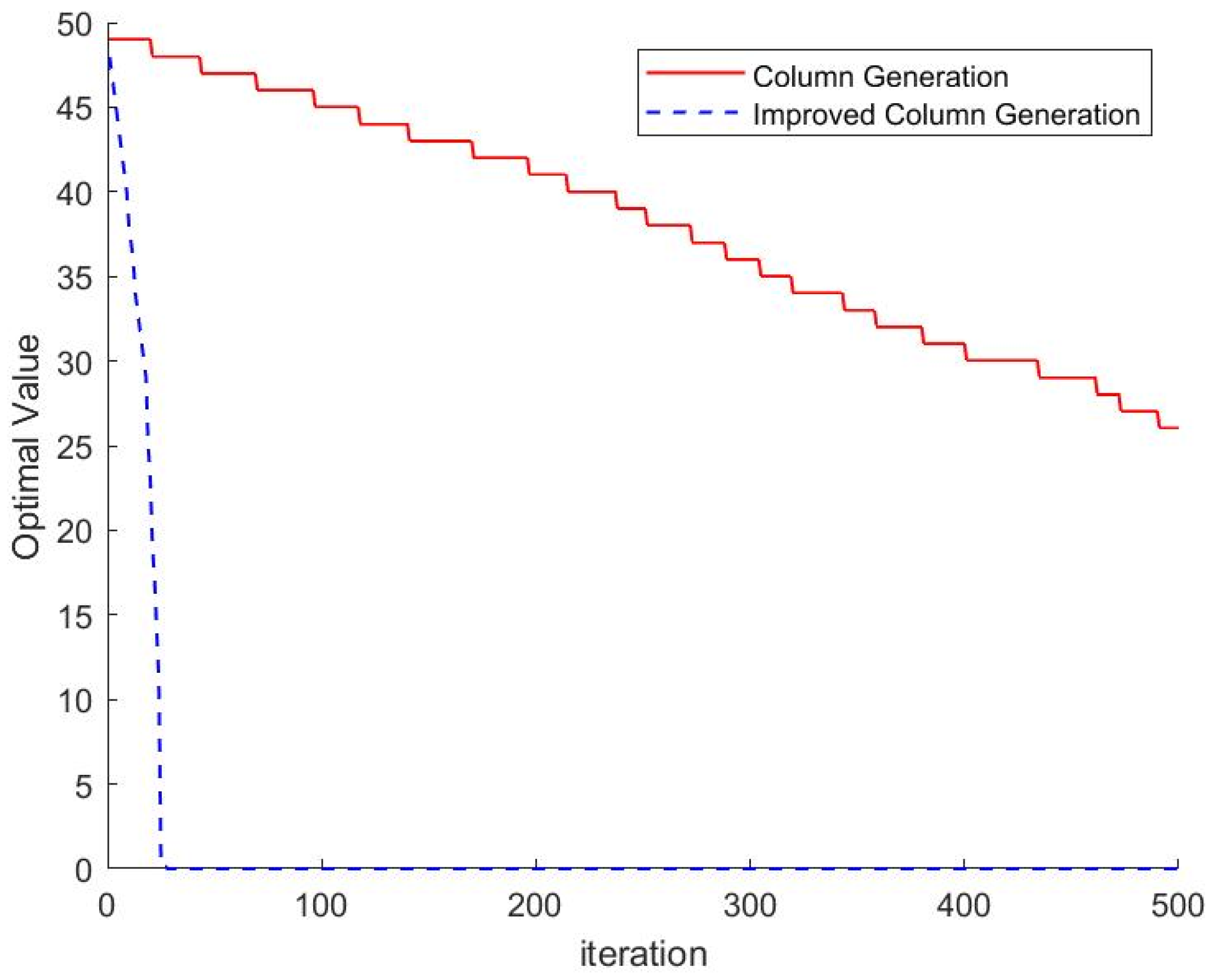
As shown in Table 2, the computational time of the ICG algorithm was slightly lower than that of the CG algorithm for small and moderate-sized samples. However, for the large-scale sample, the CG algorithm failed to converge to an optimal solution within 500 iterations. The most notable improvement of the ICG algorithm lies in the iteration count: the average numbers of iterations for the ICG algorithm on the small, moderate, and large-scale samples were 12, 17.6, and 26.6, respectively. In contrast, the CG algorithm required an average of 197.2 iterations for the small sample and 488.6 iterations for the moderate sample. The CG algorithm’s failure in the large-scale case was attributed to its inability to accurately identify the shadow prices of columns, which led to the inclusion of inefficient columns that hindered further improvement of the objective value.
Figure 1 illustrates the computational efficiency of both algorithms on the large-scale sample. The red solid line represents the progression of the objective value over iterations for the CG algorithm, showing that the objective value often stagnates during the process. The blue dotted line depicts the objective value improvement for the ICG algorithm, revealing rapid progress within the first five iterations. These results demonstrate that the ICG algorithm effectively resolved the degeneracy issue and achieved significantly better performance.

8. Conclusions

This paper addresses the dual oscillation phenomenon in column generation algorithms for large-scale combinatorial optimization by examining its structural origin from the perspective of shadow-price theory and Lagrange multiplier non-uniqueness. Focusing on the role of multiple multipliers, an enhanced column generation scheme based on minimum-norm multiplier selection was developed.
The main conclusions and contributions can be summarized as follows:
  • It was shown that dual oscillation in CG is practically driven by primal degeneracy and basis changes in the RMP, which is a key structural source of the non-uniqueness of Lagrange multipliers. Under such multiple-multiplier conditions, the lack of a unique and economically meaningful marginal interpretation of Lagrange multipliers may cause conventional column generation to produce inactive or redundant columns, thereby degrading convergence behavior.
  • Among all admissible multipliers, the minimum-norm multiplier admits a clear variational and economic interpretation: it characterizes the steepest-ascent direction of shadow prices in the resource space and thus serves as a directional shadow price.
  • Leveraging this property, a generalized pricing framework is proposed in which traditional dual multipliers are replaced by partial minimum-norm multipliers, enabling principled multiplier selection in the presence of dual non-uniqueness.
  • By generating columns associated with the largest partial minimum-norm multipliers, the proposed strategy ensures effective improvement of the master-problem objective and enhances both the stability of pricing and the efficiency of the column generation process.
  • Comprehensive numerical experiments on a single-period UC problem and randomly generated small/moderate/large-scale cutting stock problems confirm that the proposed method mitigates dual oscillation, avoids inactive columns, and achieves a substantial convergence acceleration compared with the standard column generation approach. Specifically, for small and moderate-scale cutting stock instances, the ICG algorithm reduced the iteration steps by more than one order of magnitude and realized a significant reduction in computational time; for large-scale instances, the classical CG algorithm exhibited slow convergence with severe dual oscillation and failed to converge within the iteration limit, while the ICG algorithm achieved fast and stable convergence with only about 27 iterations on average.
Despite these encouraging results, several limitations merit further investigation. First, the current empirical validation was restricted to cutting stock and single-period unit commitment settings; extending the approach to broader classes of large-scale combinatorial and mixed-integer optimization problems is necessary to assess its generality. Second, the current numerical experiments only compared the proposed algorithm with the classical column generation algorithm without stabilization, and a direct benchmarking against established stabilization techniques was not included, which makes it necessary to further verify the relative computational advantages of the proposed method in a more comprehensive experimental framework. Third, the computation of partial minimum-norm multipliers introduced additional overhead; further research is needed to balance computational efficiency with solution quality.
Future research directions include the following:
  • Extension to more complex models. Apply the proposed framework to multi-period, multi-constraint unit commitment formulations and other large-scale mixed-integer programming problems to evaluate scalability and robustness.
  • Algorithmic acceleration. Integrate learning-based or hybrid optimization techniques to reduce the computational burden of computing partial minimum-norm multipliers and improve practical efficiency in large-scale settings.
  • Theoretical development. Further develop the theory of minimum-norm multipliers by investigating their economic and mathematical interpretations in dynamic, stochastic, and nonlinear combinatorial optimization contexts, thereby strengthening the theoretical foundation for stabilizing advanced decomposition algorithms.
  • Comprehensive numerical benchmarking with classical stabilization techniques. Conduct a systematic numerical comparison between the proposed algorithm and established column generation stabilization methods (including bundle stabilization, dual smoothing, and trust-region methods) with standardized algorithm implementation, parameter tuning, and a unified experimental environment to fully verify the relative computational advantages and application boundaries of the proposed method.

Author Contributions

Conceptualization, D.S.; Methodology, D.S. and J.T.; Validation, D.S. and J.H.; Investigation, E.G.; Data curation, D.S. and J.H.; Writing—original draft, D.S.; Writing—review & editing, D.S.; Supervision, J.T.; Project administration, J.T.; Funding acquisition, J.T. All authors have read and agreed to the published version of the manuscript.

Funding

This research was funded by Humanities and Social Sciences of the Ministry of Education (No. 22YJC630125), and Shanghai Office of Philosophy and Social Science (No. 2020JG016-B GL377).

Data Availability Statement

The original contributions presented in this study are included in the article. Further inquiries can be directed to the corresponding author.

Conflicts of Interest

The authors declare no conflict of interest.

Abbreviations

The following abbreviations are used in this manuscript:
CGColumn Generation
ICGImproved Column Generation
RMPRestricted Master Problem
PSPsPricing Subproblems
LPLinear Programming
UCUnit Commitment

References

  1. Dantzig, G.B.; Wolfe, P. The Decomposition Principle for Linear Programs. Oper. Res. 1960, 8, 101–111. [Google Scholar] [CrossRef]
  2. Lübbecke, M.E.; Desrosiers, J. Selected Topics in Column Generation. Oper. Res. 2005, 53, 1007–1023. [Google Scholar] [CrossRef]
  3. Furini, F.; Malaguti, E.; Durán, R.M.; Persiani, A.; Toth, P. A Column Generation Heuristic for the Two-Dimensional Two-Staged Guillotine Cutting Stock Problem with Multiple Stock Sizes. Eur. J. Oper. Res. 2012, 218, 251–260. [Google Scholar] [CrossRef]
  4. Janacek, J.; Kohani, M.; Koniorczyk, M.; Marton, P. Optimization of Periodic Crew Schedules with Application of Column Generation Method. Transp. Res. Part C Emerg. Technol. 2017, 83, 165–178. [Google Scholar] [CrossRef]
  5. Chen, S.; Shen, Y. An Improved Column Generation Algorithm for Crew Scheduling Problems. J. Inf. Comput. Sci. 2013, 10, 175–183. [Google Scholar]
  6. Archetti, C.; Bianchessi, N.; Speranza, M.G. A Column Generation Approach for the Split Delivery Vehicle Routing Problem. Networks 2011, 58, 241–254. [Google Scholar] [CrossRef]
  7. Faiz, T.I.; Vogiatzis, C.; Noor-E-Alam, M. A Column Generation Algorithm for Vehicle Scheduling and Routing Problems. Comput. Ind. Eng. 2019, 130, 222–236. [Google Scholar] [CrossRef]
  8. Alfandari, L.; Sadki, J.; Plateau, A.; Nagih, A. Hybrid Column Generation for Large-Size Covering Integer Programs: Application to Transportation Planning. Comput. Oper. Res. 2013, 40, 1938–1946. [Google Scholar] [CrossRef]
  9. Muts, P.; Bruche, S.; Nowak, I.; Wu, O.; Hendrix, E.M.; Tsatsaronis, G. A Column Generation Algorithm for Solving Energy System Planning Problems. Optim. Eng. 2023, 24, 317–351. [Google Scholar] [CrossRef]
  10. Doostmohammadian, M.; Aghasi, A.; Pirani, M.; Nekouei, E.; Zarrabi, H.; Keypour, R.; Rikos, A.I.; Johansson, K.H. Survey of distributed algorithms for resource allocation over multi-agent systems. Annu. Rev. Control 2025, 59, 100983. [Google Scholar] [CrossRef]
  11. Vanderbeck, F. Implementing Mixed Integer Column Generation. In Column Generation; Springer: Boston, MA, USA, 2005; pp. 331–358. [Google Scholar] [CrossRef]
  12. Bertsimas, D.; Tsitsiklis, J.N. Introduction to Linear Optimization; Athena Scientific: Belmont, MA, USA, 1997. [Google Scholar]
  13. Ben Amor, H.; Desrosiers, J.; Valério de Carvalho, J.M. Dual-Optimal Inequalities for Stabilized Column Generation. Oper. Res. 2006, 54, 454–463. [Google Scholar] [CrossRef]
  14. Wentges, P. Weighted Dantzig-Wolfe Decomposition for Linear Mixed-Integer Programming. Int. Trans. Oper. Res. 1997, 4, 151–162. [Google Scholar] [CrossRef]
  15. Briant, O.; Lemaréchal, C.; Meurdesoif, P.; Michel, S.; Perrot, N.; Vanderbeck, F. Comparison of Bundle and Classical Column Generation. Math. Program. 2008, 113, 299–344. [Google Scholar] [CrossRef]
  16. Du Merle, O.; Villeneuve, D.; Desrosiers, J.; Hansen, P. Stabilized Column Generation. Discret. Math. 1999, 194, 229–237. [Google Scholar] [CrossRef]
  17. Valério de Carvalho, J.M. Exact Solution of Bin-Packing Problems Using Column Generation and Branch-and-Bound. Ann. Oper. Res. 1999, 86, 629–659. [Google Scholar] [CrossRef]
  18. Pessoa, A.; Sadykov, R.; Uchoa, E.; Vanderbeck, F. A Generic Exact Solver for Vehicle Routing and Related Problems. Math. Program. 2020, 183, 483–523. [Google Scholar] [CrossRef]
  19. Tao, J.; Gao, Y. Identification and Calculation of Shadow Prices Under Multiple Lagrange Multipliers. J. Manag. Sci. China 2021, 24, 32–44. (In Chinese) [Google Scholar]
  20. Cortez, K.L.; Rosenblueth, J.F. Normality and Uniqueness of Lagrange Multipliers. Discrete Contin. Dyn. Syst. Ser. A 2018, 38, 539–552. [Google Scholar] [CrossRef]
  21. Bertsekas, D.P.; Ozdaglar, A.E. Pseudonormality and a Lagrange Multiplier Theory for Constrained Optimization. J. Optim. Theory Appl. 2002, 114, 287–343. [Google Scholar] [CrossRef]
  22. Akgul, M. A Note on Shadow Prices in Linear Programming. J. Oper. Res. Soc. 1984, 35, 425–431. [Google Scholar] [CrossRef]
  23. Gauvin, J. Shadow Prices in Nonconvex Mathematical Programming. Math. Program. 1980, 19, 300–312. [Google Scholar] [CrossRef]
  24. Tao, J.; Gao, Y. Directional Shadow Price in Linearly Constrained Nonconvex Optimization Models. J. Glob. Optim. 2023, 88, 431–460. [Google Scholar] [CrossRef]
  25. Bonnans, J.F.; Shapiro, A. Perturbation Analysis of Optimization Problems; Springer Science & Business Media: Berlin/Heidelberg, Germany, 2013. [Google Scholar] [CrossRef]
  26. Robinson, S.M. Strongly Regular Generalized Equations. Math. Oper. Res. 1980, 5, 43–62. [Google Scholar] [CrossRef]
  27. Rockafellar, R.T. Convex Analysis; Princeton University Press: Princeton, NJ, USA, 1970. [Google Scholar]
Figure 1. Convergence performance of CG and ICG on large-scale instance.
Mathematics 14 00931 g001
Table 1. Reduced costs and partial minimum-norm values of generated scheduling schemes.
Scheduling Scheme ( a 1 [ j ] , a 2 [ j ] ) (MW)Reduced-Cost Vector ( λ 1 [ j ] , λ 2 [ j ] ) ($)Partial Minimum-Norm
λ ^ j ($)
50 , 50 ( 150 , 150 ) 212.13
60 , 40 ( 100 , 100 ) 141.42
70 , 30 ( 50 , 50 ) 70.71
80 , 20 ( 0 , 0 ) 0
Table 2. Comparison of computational efficiencies of the column generation algorithm and the improved column generation algorithm.
Sample SizeSample No.Column GenerationImproved Column Generation
Computational Time (Second)Iteration StepsComputational Time (Second)Iteration Steps
Small Size17.46741986.529713
26.72981965.647113
36.70461965.828112
46.10932005.479810
56.93891965.9112
Moderate Size118.318248815.059618
218.466948915.436917
318.563749115.167417
418.392848915.568718
517.929748615.283818
Large Scale1--67.373527
2--67.177826
3--66.825127
4--66.870927
5--66.550326
Note: the notation ‘-’ denotes that the optimal solution could not be found within 500 iterations.
Disclaimer/Publisher’s Note: The statements, opinions and data contained in all publications are solely those of the individual author(s) and contributor(s) and not of MDPI and/or the editor(s). MDPI and/or the editor(s) disclaim responsibility for any injury to people or property resulting from any ideas, methods, instructions or products referred to in the content.