Article

A Mathematical Model for Electro-Magnetohydrodynamic Cavitation Bubbles near a Rigid Wall

by
Ahmed K. Abu-Nab
1,2,*,
Tetsuya Kanagawa
3 and
Yuri V. Fedorov
4
1
Moscow Center for Advanced Studies, Kulakova Str. 20, Moscow 123592, Russia
2
Department of Mathematics and Computer Science, Faculty of Science, Menoufia University, Shebin El-Koom 32511, Egypt
3
Department of Engineering Mechanics and Energy, Institute of Systems and Information Engineering, University of Tsukuba, 1-1-1 Tennodai, Tsukuba 305-8573, Japan
4
Department of Continuum Mechanics, Institute of Mechanics and Engineering, FRC Kazan Scientific Center, Russian Academy of Sciences, Kazan 420111, Russia
*
Author to whom correspondence should be addressed.
Mathematics 2026, 14(6), 930; https://doi.org/10.3390/math14060930
Submission received: 24 January 2026 / Revised: 28 February 2026 / Accepted: 6 March 2026 / Published: 10 March 2026
(This article belongs to the Section E: Applied Mathematics)

Abstract

This study presents a mathematical model of the dynamics of a cavitation bubble oscillating near a rigid wall under an electromagnetic field. The model utilizes a modified Keller–Miksis equation incorporating the compressibility effects of the surrounding Newtonian conducting fluid. The rigid boundary’s effects, modeled using the image method, contributed to an additional pressure, which altered the cavitation bubble’s radial dynamics. Electromagnetic effects were incorporated through the Maxwell stresses induced by an external electric field, electrostatic pressure from surface charge accumulated at the bubble’s interface, and magnetic damping arising from the electric currents induced in the conducting fluid. The resulting nonlinear ordinary differential equation was solved using a fourth- and fifth-order Runge–Kutta scheme. Validation against previous theoretical and experimental studies showed good agreement, confirming the model’s reliability. A parametric analysis showed that the bubble–wall distance, electric field intensity, magnetic field strength, and surface charge magnitude considerably influence the behaviors of oscillating bubbles. Electric fields and surface charges promote bubble expansion, whereas magnetic fields and nearby surfaces restrict its size, thereby influencing its collapse. These behaviors can be attributed to the governing equation and the magnitude of its nonlinear terms. The proposed model provides a consistent mathematical framework for analyzing the electro-magnetohydrodynamic cavitation phenomena near rigid boundaries.

1. Introduction

Cavitation remains an active and multidisciplinary field of research owing to its broad range of scientific and technological applications [1,2,3]. In medical contexts, controlled cavitation phenomena have been exploited for targeted drug delivery within the cardiovascular system, needle-free injection techniques involving small fluid volumes, and noninvasive treatments [4,5,6,7]. In addition to medical applications, cavitation plays an important role in microscale fluid transport; for example, it is used in micropump technologies designed to deliver large quantities of liquid over short time intervals. Cavitation-assisted processes have been proposed in biological and environmental systems to enhance the removal of pharmaceutical contaminants from wastewater. Moreover, laser-induced cavitation bubbles forming near solid boundaries have been shown to generate strong near-wall vortical structures, enabling surface cleaning and inducing (under certain conditions) erosion patterns owing to intense collapse pressures. In laser-based synthesis and processing of colloids, cavitation bubbles act as highly dynamic microreactors while simultaneously introducing challenges related to scalability and process control. These diverse applications continue to motivate fundamental investigations into the dynamics of cavitation bubbles, particularly in confined or near-boundary environments [8,9,10].
Furthermore, cavitation bubbles have been a central topic in fluid mechanics for more than a century because a rapidly expanding and collapsing gas–vapor cavity can concentrate energy at extreme local pressures and velocities, which in turn govern erosion, mixing, acoustic emissions, and impulsive loading in liquids. The mathematical study of spherical bubble collapse is often traced to Rayleigh’s [11] analysis of the collapse of an empty cavity in an incompressible liquid that established canonical inertial scaling for the collapse time and pressure growth. Building on this foundation, work conducted during the mid-twentieth century introduced physically essential corrections, most notably viscosity, surface tension, and time-dependent forcing pressure, leading to the Rayleigh–Plesset family of ordinary differential equations (ODEs) that remain a standard starting point for spherically symmetric bubble modeling [12,13,14,15,16].
As the bubble research focus shifted from idealized collapse to realistic acoustic forcing, it became clear that liquid compressibility and acoustic radiation losses can qualitatively change the dynamics, particularly for violent oscillations and high driving pressures. A landmark development was the Keller–Miksis (KM) equation [17,18,19,20,21], which extends spherical dynamics to include first-order compressibility and radiation effects while retaining a tractable nonlinear ODE structure suitable for analysis and computation. KM-type formulations are extensively used in contemporary modeling to achieve a balance between physical fidelity and mathematical and numerical solutions, such as parametric studies, bifurcation behavior, and sensitivity to forcing parameters [22,23,24,25].
The second historical thread concerns boundary effects, which become dominant whenever bubbles form or oscillate near a solid surface. The presence of a rigid boundary breaks the spherical symmetry in the full 3D problem and considerably alters the collapse timing, jet direction, and pressure localization. Classic reviews by Blake and Gibson [26] synthesized an early theoretical and experimental understanding of cavitation bubbles near boundaries and motivated simplified representations that preserved the key momentum and pressure field effects while remaining analytically interpretable. Over subsequent decades, boundary-integral methods have become a common numerical framework for resolving nonspherical interfaces and jetting. However, they can face challenges when topology changes occur, motivating the parallel development of finite-volume and compressible multiphase computational fluid dynamics approaches. Recent high-speed imaging and quantitative studies have highlighted the sensitivity of near-wall cavitation bubbles to boundary conditions, local gas entrapment, and geometric confinement [25,27,28,29,30,31,32].
In parallel with advances in wall bubble modeling, researchers have explored ways to control or modulate cavitation using external fields. From a continuum mechanics standpoint, electric fields interact with multiphase interfaces through Maxwell stresses and interfacial charge dynamics, introducing additional normal and tangential tractions that can modify the deformation, oscillation, and collapse intensity [33,34,35]. In cavitation-relevant settings, recent investigations have reported that applied electric fields can alter the collapse energetics and near-wall loading, indicating that electrohydrodynamic forcing can serve as a controllable mechanism for enhancing or suppressing collapse-driven effects depending on the configuration and field strength [36,37].
Magnetic fields provide another route for modifying bubble-related flows, particularly when the surrounding liquid conducts electricity [38,39,40]. In these media types, motion-induced currents interacting with an imposed magnetic field produce Lorentz forces that oppose motion and act as effective magnetic damping mechanisms, which are the hallmarks of magnetohydrodynamics. While many magnetic field studies have focused on translational bubble motion or liquid-metal systems, they consistently show that imposed magnetic fields can reduce characteristic velocities and stabilize or regularize bubble interface dynamics in conductive fluids. Moreover, recent experimental work in hydrodynamic cavitation settings has examined the interplay between cavitation-associated charge phenomena and magnetic fields, reinforcing the relevance of coupled electromagnetic effects in cavitation environments [41,42,43].
While previous studies have examined acoustically driven bubble dynamics, electrohydrodynamic effects, magnetohydrodynamic damping, and wall-induced interactions, these mechanisms have often been treated separately. The present study builds on this literature by providing a unified modified Keller–Miksis formulation that consistently couples surface charge effects, electric-field-induced stresses, magnetic damping, and rigid-wall image interactions within a single nonlinear framework. This enables a systematic assessment of how the coupled electromagnetic and hydrodynamic mechanisms jointly modify both the linear resonance characteristics and the strongly nonlinear bubble response near a rigid boundary.
In this study, the dynamics of a cavitation bubble near a rigid wall were modeled using a modified KM equation augmented by electro-magnetohydrodynamic effects. Here, the term “electro-magnetohydrodynamic” denotes the coupled interaction of electromagnetic and hydrodynamic effects governing the bubble dynamics. The rigid boundary is represented via an image-based construction, yielding an additional pressure contribution that depends explicitly on the fixed bubble–wall distance h . Electromagnetic influences are incorporated through a structured pressure decomposition, including (i) a Maxwell-stress-induced pressure associated with a uniform external electric field of amplitude E 0 , (ii) an electrostatic pressure term arising from surface charge accumulation at the bubble’s interface, characterized by the total charge Q , and (iii) a magnetic damping contribution linked to an imposed magnetic field of strength B 0 , representing induction-driven dissipation in the conducting liquid. Together, these effects lead to a nonlinear ODE in which the relative magnitudes of the inertial, compressibility, boundary-induced, and electromagnetic terms govern the temporal evolution of the bubble’s radius. The resulting mathematical model was solved numerically using a high-order Runge–Kutta scheme, and its validity was assessed by comparing it with previous studies [44]. A systematic parametric analysis was conducted to elucidate how the variations in h , E 0 , B 0 , and Q reshaped the oscillatory response, maximum expansion, and collapse dynamics of the bubble. Emphasis is placed on interpreting these behaviors in terms of the structure of the governing equation and competing nonlinear contributions.
The remainder of this paper is organized as follows. Section 2 introduces the physical configuration and modeling assumptions. Section 3 presents the derivation of the electromagnetohydrodynamic formulation and modified KM equation. Section 4 discusses stability and small-amplitude oscillations in the mathematical framework. Section 5 outlines the numerical methodology and the validation strategy. Section 6 presents parametric results and mathematical interpretation. Finally, the conclusions and perspectives are summarized in Section 7.

2. Physical Configuration and Modeling Assumptions

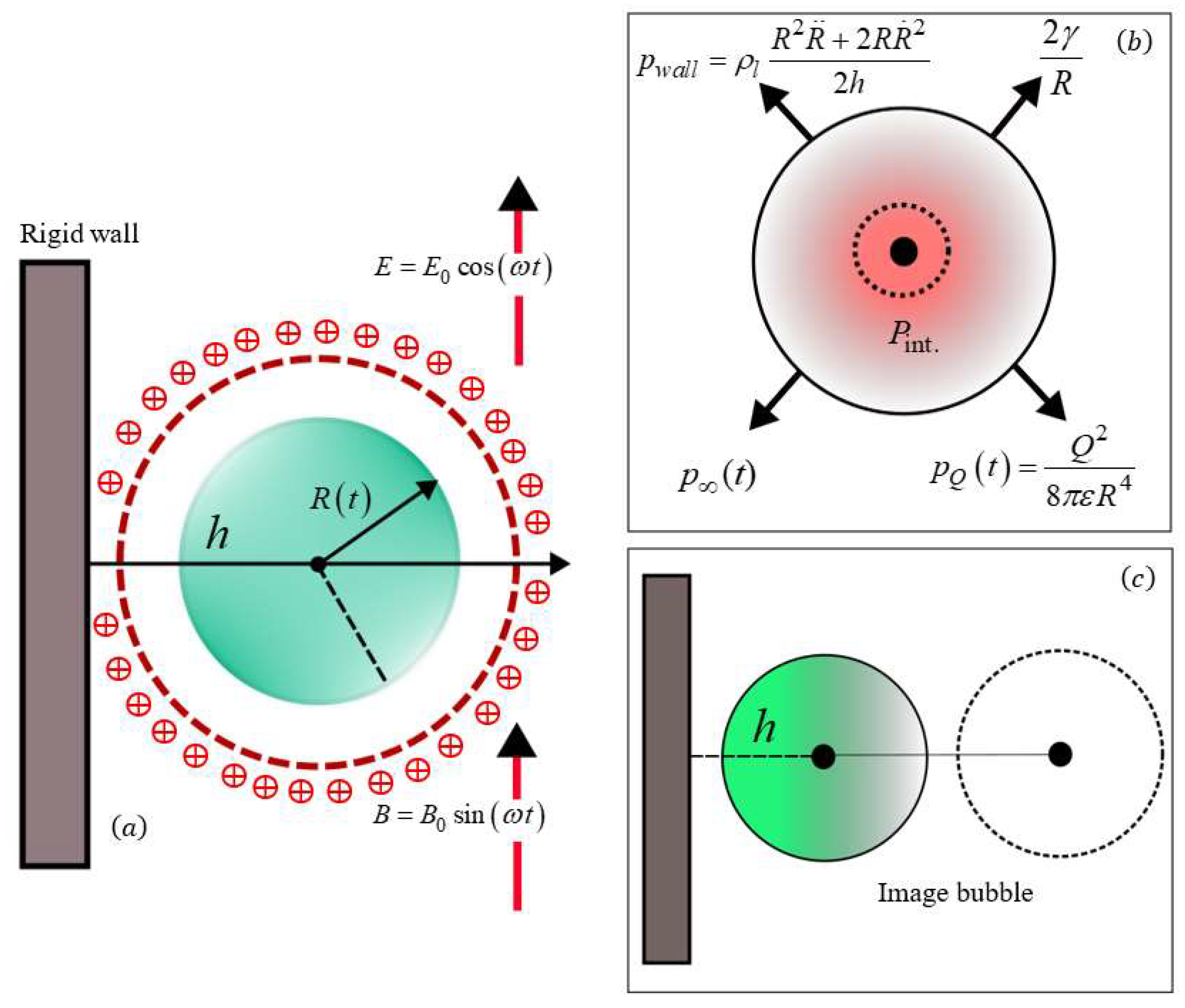
We consider herein a single spherical cavitation bubble of instantaneous radius R immersed in an infinite quiescent Newtonian liquid located at a fixed distance h from a rigid planar wall (Figure 1). The liquid is assumed to be electrically conducting, homogeneous, and isotropic, with a constant density ρ l , dynamic viscosity μ l , and sound speed c . The following assumptions are adopted in mathematical formulation: the bubble contains a mixture of gas and vapor and is driven by an externally imposed time-dependent acoustic pressure field. In addition, uniform external electric and magnetic fields are applied, allowing the investigation of the coupled electro-magnetohydrodynamic effects on the cavitation bubble. To formulate a mathematically tractable model while retaining the essential physical mechanisms, the following assumptions are made: (i) The bubble remains spherical throughout its oscillation, and the translational motion is neglected. (ii) The surrounding liquid is treated as weakly compressible. Compressibility effects are incorporated through a KM-type formulation that captures first-order acoustic radiation and finite sound speed effects while preserving a nonlinear ordinary differential equation structure. (iii) The thermal effects, mass transfer, and chemical reactions inside the bubble are neglected. (iv) A uniform electric field with amplitude E 0 and a uniform magnetic field with strength B 0 are applied externally. (v) The influence of the rigid boundary is represented using the image method, yielding an additional pressure contribution that is dependent on the distance h . Under these assumptions, the cavitation bubble is reduced to a nonlinear ODE governing the temporal evolution of the bubble’s radius R .
Furthermore, it is important to emphasize that the present formulation should be interpreted as a mean-field spherical approximation. Although the externally applied electric and magnetic fields, as well as wall proximity, formally break the exact spherical symmetry of the full three-dimensional problem, we assume that the leading-order dynamics remain predominantly radial. All anisotropic electromagnetic contributions are therefore projected onto their spherically averaged normal components, yielding an effective one-dimensional evolution equation for the bubble radius. The validity of this approximation is discussed in terms of appropriate dimensionless parameters in Section 3.

3. Derivation of the Governing Equations

Under the weakly compressible approximation, the liquid is treated as incompressible at the leading order to determine the radial velocity field u ¯ such that the continuity equation reduces to
u ¯ = 0 .
Herein, u ¯ is the liquid particle velocity. First-order compressibility effects are subsequently incorporated through the KM formulation in the pressure and inertia terms. Owing to spherical symmetry, the velocity field is purely radial and depends only on the radial coordinate r and time t . Substitution into the continuity equation yields
1 r 2 r r 2 u = 0     u ( r , t )   =   R 2 r 2 R ˙ .
Here, R is the instantaneous bubble radius, and R ˙ denotes its time derivative. The momentum balance, including viscous, electromagnetic, and wall-induced effects, is given by
ρ l u ¯ t + u ¯ u ¯ = P + μ l 2 u ¯ + f ¯ m + f ¯ e + f ¯ w a l l + f ¯ Q ,
where ρ l is the density of the liquid, μ l is the dynamic viscosity, P is the hydrodynamic pressure, f ¯ e is the electric force, f ¯ m is the magnetic force, f ¯ w a l l is the wall-induced hydrodynamic force, and f ¯ Q is the surface-charge force.
ρ l u t + u u r = ( P + p e + p Q p w a l l ) r + 2 μ l u r + f m .

3.1. Electric Stress at the Cavitation Bubble Interface

When an electrostatic field is applied to the liquid region, it generates an electric stress vector f ¯ e (an electrostatic force vector per unit area) at the bubble’s interface, which can be expressed as the sum of the liquid-phase f ¯ l and gas-phase f ¯ g contributions:
f ¯ e = f ¯ l + f ¯ g .
The equations for f l and f g [45] are given by
f ¯ l = ε l E l n ( E l n n ¯ l + E l t t ¯ l ) 1 2 ε l E l 2 n ¯ l + 1 2 E l 2 ρ l d ε l d ρ l n ¯ l ,
f ¯ g = ε g E g n ( E g n n ¯ g + E g t t ¯ g ) 1 2 ε g E g 2 n ¯ g + 1 2 E g 2 ρ g d ε g d ρ g n ¯ g ,
where E l and E g are the liquid-phase and gas-phase electric field strengths, respectively, and E l n and E l t represent the normal and tangential components of E l , respectively. E g n and E g t are the normal and tangential components of E g , respectively. ρ g is the density of the cavitation bubble gas, n ¯ l is the unit normal vector directed toward the gas phase, t ¯ l is the unit tangential vector to the bubble’s surface, n ¯ g is the unit normal vector directed toward the liquid phase n ¯ l = n ¯ g , t ¯ g is the unit tangential vector to the bubble’s surface t ¯ g = t ¯ l , ε l , and ε g are the permittivities of the liquid and bubble gas, respectively. For a gas medium, ε g ε 0 , where ε 0 is the vacuum permittivity. For a dielectric bubble, the calculation results based on Equation (5) can be found in Zaghdoudi et al. [45] and are as follows:
f ¯ e = ε 0 ( ε / ε 0 1 ) 2 6 2 E l n 2 E l t 2 n ¯ l ,
using the relations E l n = E l cos θ and E l t = E l sin θ .
For a dielectric bubble in a conducting liquid, the resulting normal electric stress acting on the interface [expressed by Equation (8)] can be further transformed into
f ¯ e = ε 0 ( ε / ε 0 1 ) 2 E l 2 6 ( 3 cos 2 θ 1 ) n ¯ l .
Omitting the subscript of E l , we can rewrite the value of the electric stress vector as
f e = ε 0 ε / ε 0 1 2 E 2 6 3 cos 2 θ 1 .
The positive direction of f e points out of the bubble, while the negative direction of points into the bubble. The problem is complicated by the fact that the component f e depends on the angle θ . Using the framework of a one-dimensional description of the flow, we replace this component with its average value and deduce that
p e f e = 1 2 π 0 2 π ε 0 ( ε / ε 0 1 ) 2 E l 2 6 ( 3 cos 2 θ 1 ) d θ = ε 0 ε / ε 0 1 2 12 E 2 .

3.2. Magnetic Damping Force

In an electrically conducting liquid, the radial motion of the fluid in the presence of a magnetic field induces electric currents according to Ohm’s law. The interaction of these currents with the imposed magnetic field generates Lorentz forces that oppose the motion.
f ¯ m = j ¯ × B ¯ ,   j ¯   =   σ u ¯   ×   B ¯ .
Here, σ is the liquid electrical conductivity, B is the magnetic field, and j is the electric current density. The presence of the uniform magnetic field disturbs the spherical symmetric pattern of dynamic processes around the bubble. In fact, in the case of a radial liquid flow with a velocity u ¯ = u ,     0 ,     0 in a magnetic field B ¯ = B cos θ i ¯ r + B sin θ i ¯ θ , an electric current j ¯ = σ u B sin θ i ¯ φ is induced around the bubble. The interaction of this current with the magnetic field causes an electromagnetic force
f ¯ m = j ¯ × B ¯ = σ u B 2 sin 2 θ   i ¯ r σ u B 2 cos θ sin θ i ¯ θ = f m r i ¯ r + f m θ i ¯ θ ,
where i ¯ r , i ¯ θ , and i ¯ φ are the unit vectors of the physical basis of the spherical coordinate system. The nonpotential component f m θ of the electromagnetic force results in a meridional flow of the liquid around the bubble with a velocity u θ , which disturbs the pure radial flow. When averaged over a sphere of radius r, the meridional component of the electromagnetic force is zero in the case of radial flow.
f m θ = 1 2 π 0 2 π f m θ d θ = 1 2 π σ u B 2 0 2 π sin θ cos θ d θ = 0 .
The average value of the radial component is
f m r = 1 4 π r 2 0 2 π 0 π f m r r 2 sin θ d θ d φ = 2 3 σ u B 2 .
In the one-dimensional description of the velocity field in a viscous liquid, we neglect the meridional flow and replace the component f m r with its average value denoted as f m r .
f m = f m r = 2 3 σ u B 2 .
Although the externally imposed electric and magnetic fields formally break the exact spherical symmetry of the full three-dimensional problem, the present formulation retains only the leading-order radial dynamics and therefore constitutes a mean-field spherical approximation. The anisotropic components of the Maxwell stress and Lorentz force are projected onto their spherically averaged normal contributions, yielding an effective one-dimensional description for the bubble radius. The validity of this reduction can be assessed by comparing the characteristic electromagnetic stresses with the dominant inertial pressure scale ρ l R R ˙ 2 . The electric stress scales as ε l E 0 2 , leading to an electric capillary number
C a E = ε l E 0 2 R 0 γ ,
which measures the relative importance of electric forcing to surface tension stabilization. For C a E = O 1 or smaller, electrohydrodynamic shape distortions remain secondary corrections to the primary radial motion. Similarly, the magnetic contribution scales as σ B 0 2 R 2 , and its ratio to inertial–acoustic forces may be characterized by the magnetic interaction parameter
M n = σ B 0 2 R 0 ρ l c .
In the parameter regime considered in this study, this parameter remains moderate, indicating that the magnetic field primarily introduces effective damping without driving persistent nonspherical deformation modes. Therefore, nonspherical corrections are treated as higher-order effects relative to the dominant radial oscillation dynamics. For the representative parameter range used in the numerical simulations ( R 0 = 2   μ m , E 0 3 × 10 6   V / m , B 0 0.15     T ), the electric capillary number remains C a E 0.12 and the magnetic interaction parameter M n 0.08 , confirming that electromagnetic stresses act as moderate perturbative corrections relative to the dominant inertial–acoustic pressure scale.
The imposed electric and magnetic fields are prescribed as harmonic functions of time,
E = E 0 cos ω t ,   and   B = B 0 sin ω t
where E 0 and B 0 are the field amplitudes, and ω is the angular frequency.

3.3. Electric Pressure Due to Surface Charge

For a cavitation bubble carrying a time-dependent surface charge Q , the electric field produces an additional outward normal pressure on the bubble surface given by the Maxwell electric stress,
p Q t = Q 2 8 π ε R 4 ,
where Q is the total electric charge distributed uniformly over the bubble surface. This term represents the electrostatic repulsion on the bubble’s surface and is included in the normal stress balance, where it opposes the bubble collapse. The present formulation assumes a quasi-electrostatic regime and a uniform distribution of surface charge. The validity of this assumption can be assessed through a timescale argument. The charge relaxation time in a conducting liquid is given by τ c = ε l / σ . For typical values of liquid permittivity and electrical conductivity considered here, τ c is several orders of magnitude smaller than the characteristic oscillation period of the bubble under acoustic excitation. Since τ c T , charge redistribution in the surrounding liquid occurs much faster than the mechanical motion of the interface. Consequently, the quasi-electrostatic approximation and effective uniform surface charge assumption remain valid within the parameter regime of this study. Transient leakage and higher-order charge redistribution effects are therefore neglected.

3.4. Wall-Induced Hydrodynamic Interaction

The rigid wall modifies the surrounding flow field through the image-bubble effect, introducing an additional inertial resistance to bubble motion.
p w a l l = ρ l R 2 R ¨ + 2 R R ˙ 2 2 h ,   h > R
where h is the distance between the bubble’s center and the wall.

3.5. Keller–Miksis Equation in Electromagnetic Field

The governing radial equation is obtained by spherical integration of the momentum equation combined with the normal stress balance at the bubble interface. Additional physical contributions enter through this interfacial condition: viscous stresses via the normal viscous term, wall effects via the image-induced pressure correction, electric stresses via the Maxwell normal stress, and magnetic effects via the spherically averaged Lorentz-force term.
The compressibility effects neglected in the leading-order velocity field are then consistently reintroduced through first-order corrections following the KM approach. Integration of Equation (4) from R to infinity, together with Equations (3), (11) and (16)–(20), yields the modified Rayleigh–Plesset equation
ρ l R R ¨ 1 + R 2 h + 3 2 R ˙ 2 1 + 2 R 3 h = p l ( t ) p 4 μ l R ˙ R 2 3 σ B 2 R R ˙ + Q 2 8 π ε R 4 + ε 0 ( ε / ε 0 1 ) 2 12 E 2 ,
p l ( t ) = p b ( t ) 2 γ R .
The Rayleigh–Plesset Equation (22) can be easily generalized to the KM equation, which incorporates first-order compressibility corrections while retaining spherical symmetry. In the absence of electromagnetic and boundary effects, this equation becomes [18,19]
ρ l 1 R ˙ c + R 2 h R R ¨ + 3 2 1 R ˙ 3 c + 2 R 3 h R ˙ 2 = 1 + R ˙ c + R c d d t P ,
where
P = P int . p ( t ) ,
and
P int . = p b ( t ) 2 γ R 4 μ l R ˙ R + Q 2 8 π ε R 4 2 3 σ B 2 R R ˙ + ε 0 ( ε / ε 0 1 ) 2 12 E 2 .
where R ¨ is the second derivative of the bubble radius, c is the speed of sound in the liquid, γ is the surface tension at the bubble’s interface, P int . is the internal pressure of the bubble, and P t is the pressure acting on the bubble from the surrounding fluid. The term proportional to σ B 2 R R ˙ represents the effective electromagnetic damping arising from the induced electric currents in the electrically conductive fluid. Based on a quasi-static approximation, the radial motion of a bubble in the presence of a time-dependent magnetic field generates an induced electric field that drives eddy currents in the surrounding fluid. The interaction between these currents and the applied magnetic field produces a Lorentz force that opposes local fluid motion. When averaged over a spherically symmetric flow field, this Lorentz force contributes to the additional dissipative stress at the bubble’s interface, manifested as a magnetic damping term in the radial momentum balance. Similar magnetic damping mechanisms have been reported for the magnetohydrodynamic flows of conducting fluids subjected to oscillatory motion.
The pressure inside the bubble is modeled using the polytropic gas law with the inclusion of surface tension effects at equilibrium:
p b ( t ) = p 0 p v + 2 γ R 0 Q 2 8 π ε R 0 4 ε 0 ( ε / ε 0 1 ) 2 12 E 2 R 0 R 3 κ p v ,
where κ is the polytropic exponent of the gas, p v is the vapor pressure inside the bubble, and p 0 is the ambient static pressure. The pressure acting on the bubble consists of the ambient static pressure, and the imposed acoustic pressure is defined as
p ( t ) = p 0 + p a sin ω t ,
where p a is the amplitude of the acoustic pressure, ω is the angular frequency of the ultrasonic excitation, i.e., ω = 2 π f , and f is the excitation frequency. Using Equations (25) and (26), the KM equation [Equation (24)] using can be rewritten as
1 R ˙ c R + R 2 2 h + 4 μ l ρ l c + 2 3 ρ l c σ B 2 R 2 R ¨ = 3 2 1 R ˙ 3 c + 2 R 3 h R ˙ 2 2 γ ρ l R 4 μ l ρ l R ˙ R +
1 ρ l p 0 p v + 2 γ R 0 Q 2 8 π ε R 0 4 ε 0 ( ε / ε 0 1 ) 2 12 E 2 R 0 R 3 κ 1 + R ˙ c 1 3 κ + Q 2 8 π ε ρ l R 4 1 3 R ˙ c
2 3 σ B 2 R R ˙ 1 ρ l 1 + 2 R ˙ c + 1 ρ l 1 + R ˙ c 1 12 ε 0 ε ε 0 1 2 E 2 R ρ l c p a ω cos ω t
1 ρ l p 0 p v + p a sin ω t 1 + R ˙ c .
The above formulation relies on a quasi-static electromagnetic approximation. The externally imposed electric and magnetic fields are assumed to be spatially uniform at the bubble scale. Ohmic conduction is adopted in the surrounding liquid, and magnetic field perturbations induced by the flow are neglected, corresponding to a low magnetic Reynolds number regime. Furthermore, charge relaxation in the conducting liquid is assumed to occur on a timescale much shorter than the bubble oscillation period, justifying the quasi-electrostatic treatment and effective uniform surface charge assumption. Under these conditions, electromagnetic effects enter the governing equation exclusively through spherically averaged Maxwell stresses and effective Lorentz-force-induced damping contributions.
All additional wall and electromagnetic contributions introduced above possess pressure dimensions and are therefore fully consistent with the normal stress balance at the interface.

4. Linear Stability and Small-Amplitude Oscillation Analysis

To gain analytical insights into the oscillatory behavior of the cavitation bubble, we examine the regime of small-amplitude radial oscillations in the equilibrium state. This classical linear analysis allows the identification of the natural frequency and damping characteristics of the bubble while explicitly revealing the influence of electromagnetic fields and wall-induced effects. We assume that the acoustic forcing amplitude is sufficiently small and introduce a perturbation parameter α 1 . The bubble’s radius is expressed as a small deviation from its equilibrium value R 0 , as follows:
R = R 0 ( 1 + x ( t ) ) ,
where x ( t ) = O α is the dimensionless perturbation amplitude. Substituting this expression into the unforced KM equation and retaining only the first-order terms in x yields a linearized equation governing the cavitation bubble dynamics. After linearization, the governing equation reduces to the canonical form of a damped harmonic oscillator, as follows:
x ¨ + δ x ˙ + ω 0 2 x = 0 ,
where δ is the effective damping coefficient, and ω 0 represents the natural angular frequency of the bubble. This reduction indicates that in the small-amplitude regime, the complex nonlinear cavitation bubble dynamics simplify to a mathematically well-understood linear system. The damping coefficient is given by
δ = 4 μ l c R 0 + 3 Q 2 8 π ε R 0 4 + 2 c 3 σ B 2 R 0 + ( 3 κ 1 ) p b 0 ε 0 ( ε / ε 0 1 ) 2 12 E 2 ρ l c R 0 1 + R 0 2 h + 4 μ l ρ l c R 0 + 2 3 ρ l c σ B 2 R 0 ,
The natural frequency of the bubble oscillations is obtained as
ω 0 2 = 3 κ p b 0 2 γ R 0 + 4 Q 2 8 π ε R 0 4 ρ l R 0 2 1 + R 0 2 h + 4 μ l ρ l c R 0 + 2 3 ρ l c σ B 2 R 0 ,
where p b 0 = p 0 p v + 2 γ R 0 Q 2 8 π ε R 0 4 ε 0 ( ε / ε 0 1 ) 2 12 E 2 .
The solutions to the damped harmonic oscillator in Equation (31) represent small-amplitude oscillations. Substituting the values of the various parameters in Equation (33) yields a natural frequency ω 0 for a micrometer-sized bubble in the MHz range, which is in excellent agreement with experimental observations and established theoretical predictions. The expression generalizes the classical Minnaert frequency by incorporating the surface charge, electric field-induced pressure, and wall proximity effects. Furthermore, ω M is the Minnaert resonant frequency [46,47], which is obtained as follows:
ω M 2 = 3 κ p b 0 2 γ / R 0 ρ R 0 2 ,
p b 0 = p 0 p v + 2 γ R 0 ,
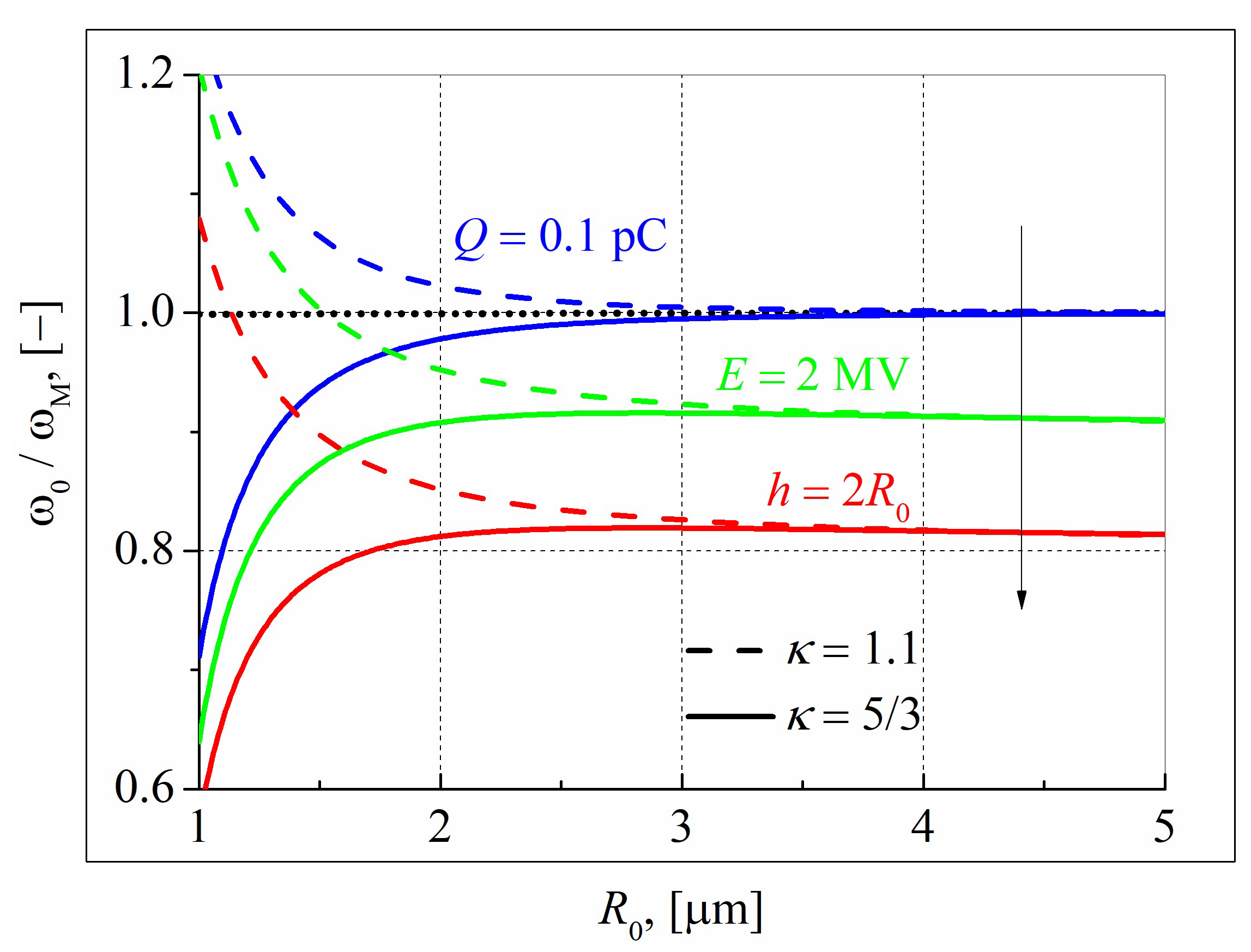
Equation (34) shows that the presence of a charge on the bubble increases the natural frequency if κ < 4 / 3 and, conversely, decreases it if κ > 4 / 3 . The electromagnetic field and the rigid wall reduce the natural oscillation frequency of the bubbles. Figure 2 illustrates the dependence of the normalized natural frequency ω 0 / ω M on the equilibrium radius R 0 , highlighting the competing influences of charge, electric field intensity, and wall distance. Overall, the linear analysis confirms that electromagnetic fields and rigid boundaries provide independent and controllable mechanisms for tuning both the resonance frequency and damping characteristics of cavitation bubbles. These analytical results form a rigorous baseline for interpreting the nonlinear numerical simulations presented in the subsequent sections.

5. Numerical Scheme and Model Validation

The nonlinear dynamics of the cavitation bubble are governed by the modified KM equation derived in Section 3. To facilitate the numerical computation, the governing second-order ODE is rewritten as a system of first-order equations by introducing the state variables
y 1 = R ,   y 2 = R ˙ .
The system then takes the form
y 2 = y ˙ 1 ,   y 1 ( 0 ) = R 0 ,
and
y ˙ 2 = F ( t , y 1 , y 2 ) ,   y 2 ( 0 ) = 0 .
where the term F ( t , y 1 , y 2 ) in Equation (38) represents the nonlinear right-hand side of the modified KM equation, including the compressibility and electromagnetic, viscous, and wall-induced contributions. The Runge–Kutta algorithm was employed to numerically solve the cavitation bubble dynamics in Equation (29). The solution was implemented using an inherently nonstiff ODE solver (ode45) in MATLAB (version R 2021, MathWorks, Natick, MA, USA). It provides a candidate solution using a fourth-order method and controls the error using a fifth-order method. The absolute error in the calculations was 10 9 . At the initial time of t = 0 , the bubble is assumed to be at its equilibrium radius and at rest.
R 0 = R 0 ,   R ˙ 0 = 0 .
The far-field pressure consists of a static ambient component and a harmonic acoustic excitation with a prescribed amplitude and frequency. The electric and magnetic fields are imposed as harmonic functions, consistent with the assumptions introduced in Section 3.
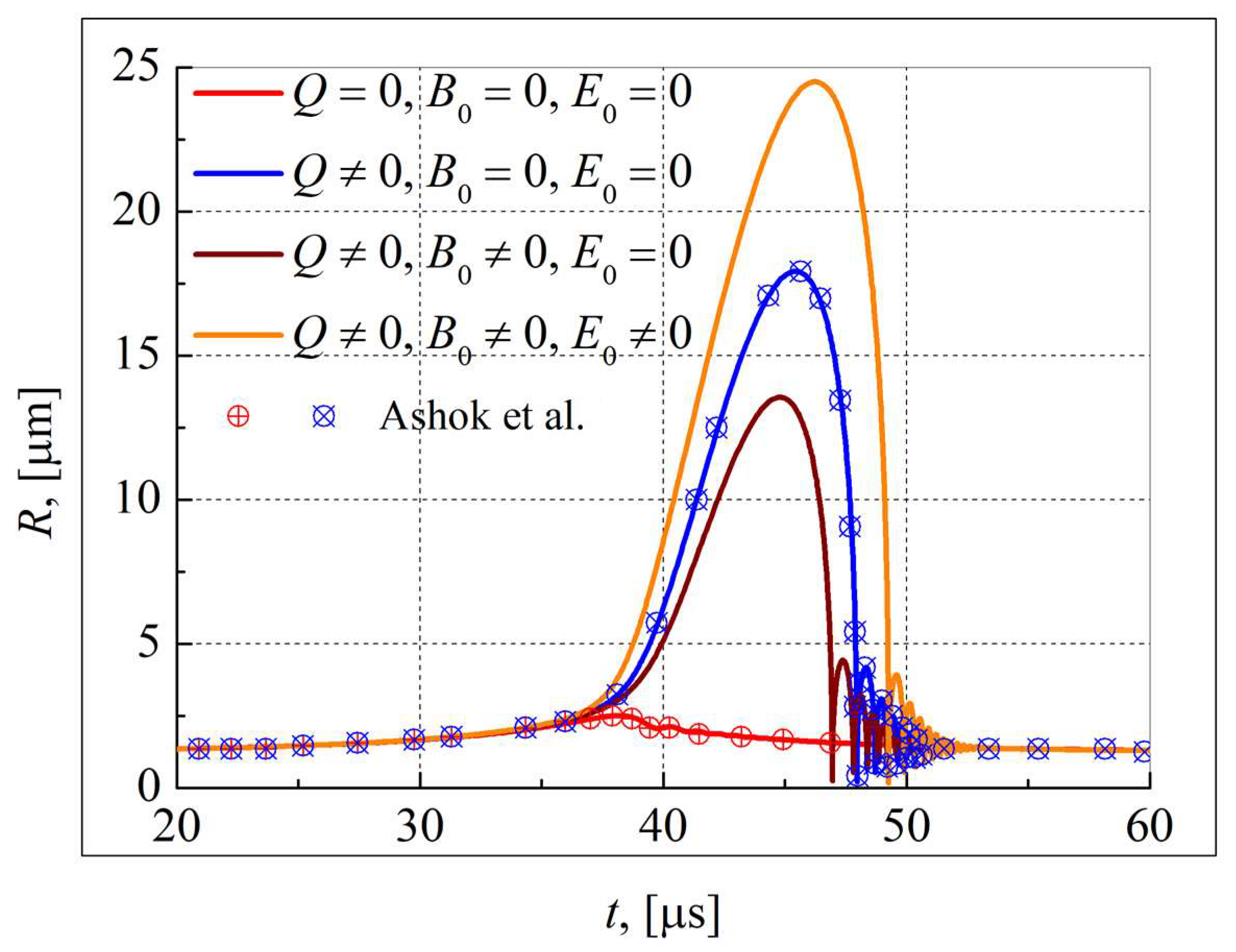
For validation, the baseline configuration without surface charge and electromagnetic forcing Q = 0 ,     B 0 = 0 ,     E 0 = 0 was quantitatively compared with the results of Ashok et al. [44]. The validation results are presented in Figure 3, where the predictions of the present model are compared with the results reported by Ashok et al. [44]. The comparison demonstrates close consistency in the maximum expansion radius, collapse timing, and rebound characteristics, with only minor deviations across the oscillation cycle. The remaining curves represent predictive extensions of the model, illustrating the influence of surface charge and electromagnetic fields beyond the validated baseline case. When the electromagnetic effects were included, the numerical trends remained consistent with those observed in earlier electrohydrodynamic and magnetohydrodynamic investigations. The observed enhancement of bubble expansion with increasing surface charge, suppression of oscillations under the influences of strong magnetic fields, and modulation induced by electric fields align with established theoretical predictions. This close agreement confirms the accuracy, robustness, and physical consistency of the proposed mathematical model.
To further ensure numerical robustness during the strongly nonlinear collapse stage, a systematic tolerance refinement study was conducted. The adaptive solver ode45 was executed with progressively tightened tolerances:
RelTol = 10 6 ,     10 7 ,     10 8 ,   10 9   and AbsTol = 10 9 ,     10 10 ,     10 11 ,   10 12   .
For each tolerance level, the principal dynamical quantities the maximum bubble radius R max and the collapse time t c defined as the instant of minimum radius) were recorded. The relative numerical variation between successive refinements was evaluated as
δ num = S i S i + 1 S i + 1 ,
where S denotes either R max and t c . In all tested cases, δ num < 2 × 10 3 confirming temporal convergence and negligible tolerance dependence. Because rapid acceleration near minimum radius may introduce stiffness, a representative solver comparison was performed between the explicit Runge–Kutta solver ode45 and the stiff implicit solver ode15s. The resulting radius–time histories were practically indistinguishable over the entire oscillation cycle, including during the high-acceleration collapse regime. The discrepancies in R max and t c were below 0.2%, and no phase shift, amplitude distortion, or artificial numerical damping was observed.
Monitoring the adaptive time step further confirmed an automatic reduction by several orders of magnitude during collapse, ensuring adequate temporal resolution of the sharp transient without numerical instability.

6. Results and Discussion

6.1. Parametric Effects on Nonlinear Radial Oscillations

In this section, we present a detailed discussion of the numerical results obtained from the nonlinear solution of the modified KM equation. The main objective is to elucidate how key physical parameters, namely the surface charge Q , bubble–wall distance h , electric field E 0 , and magnetic field B 0 , influence the temporal evolution of the cavitation bubble’s radius R .
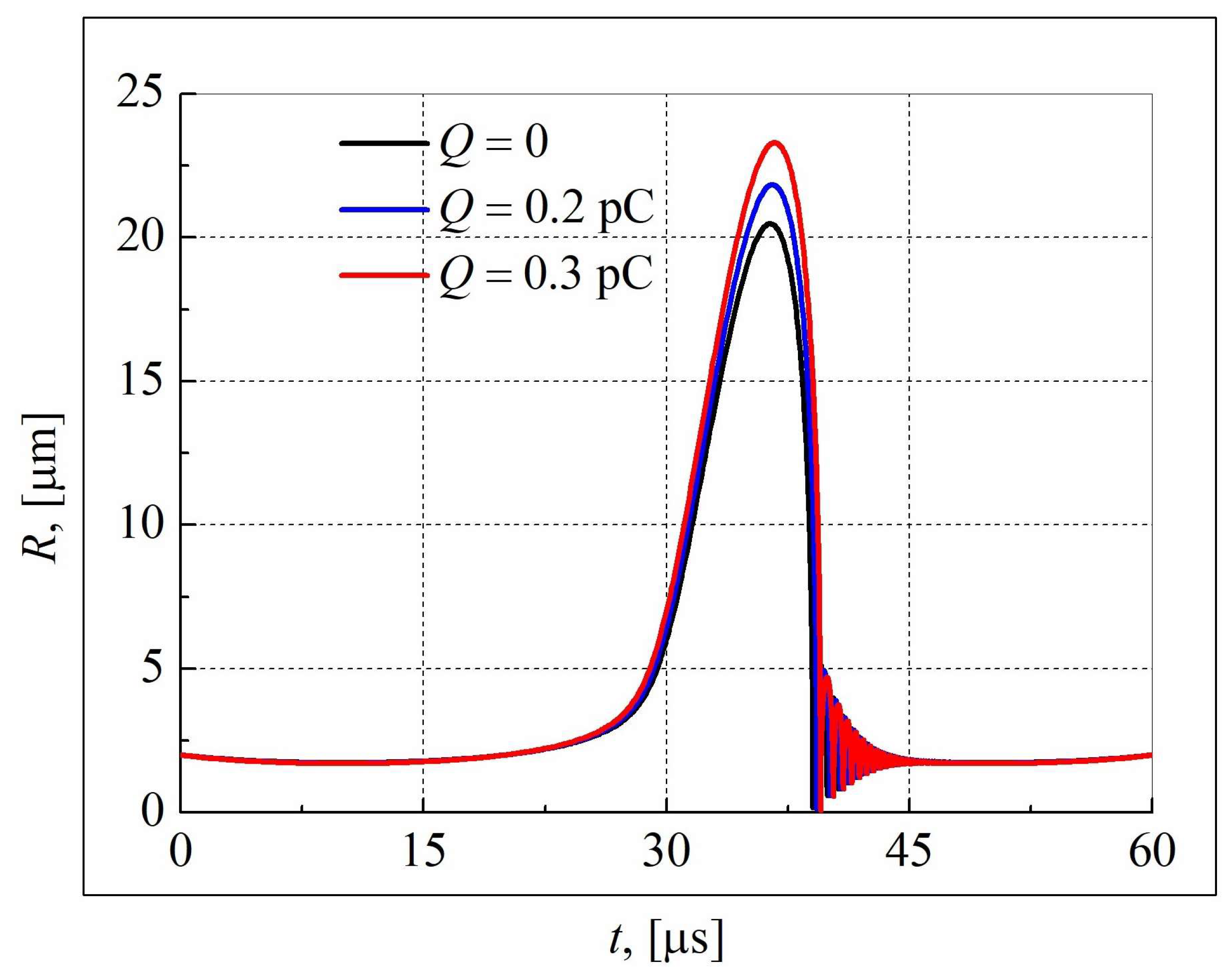
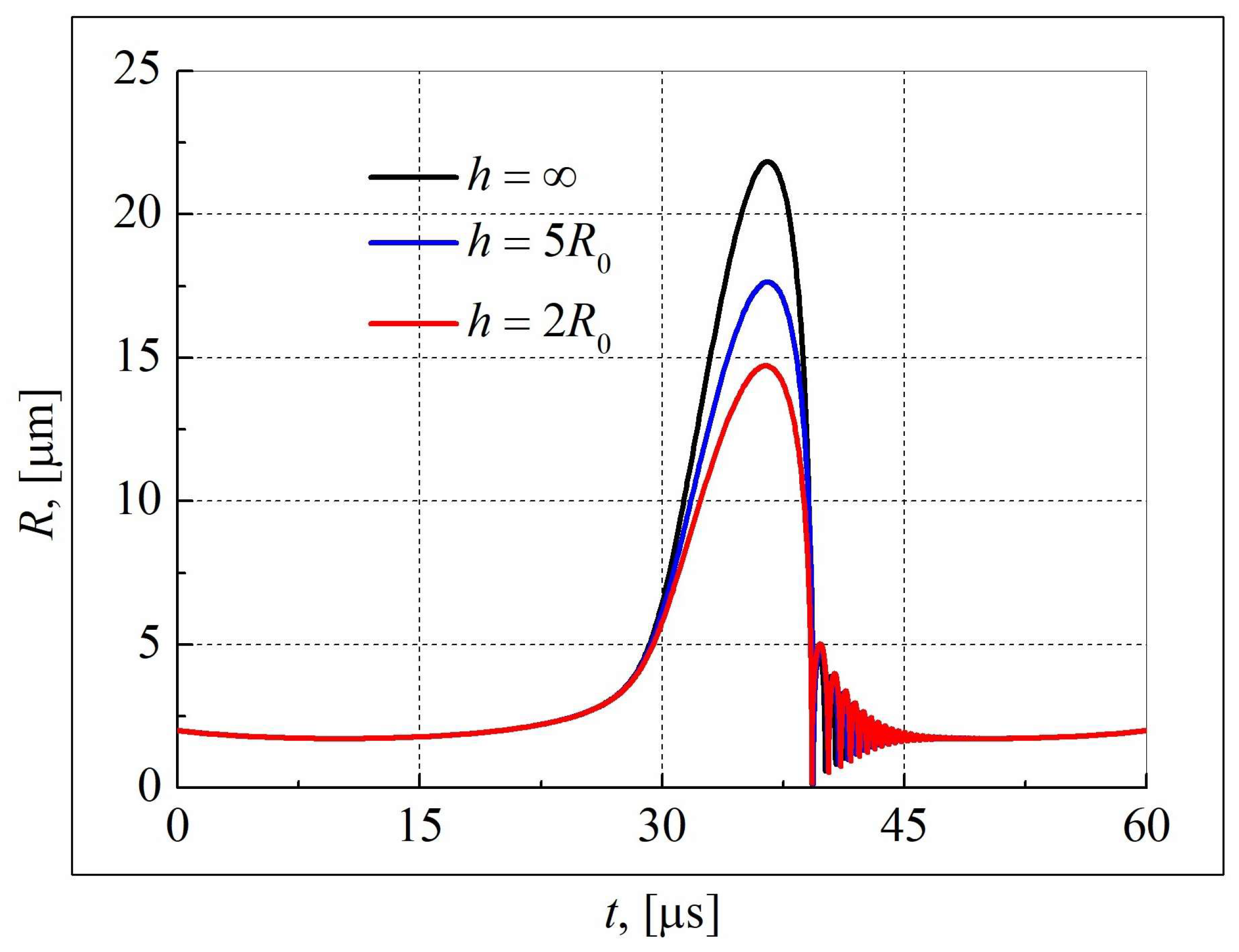
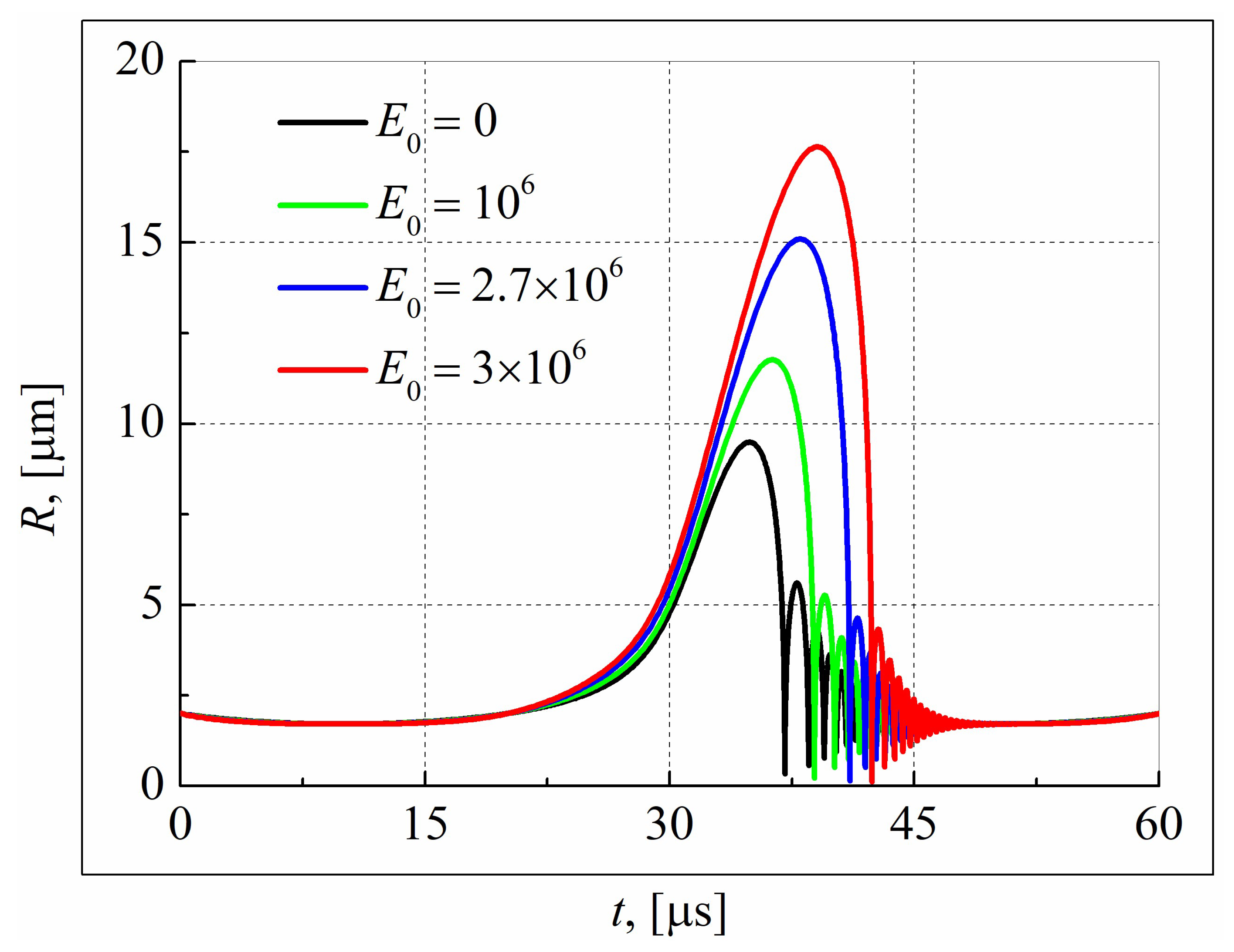
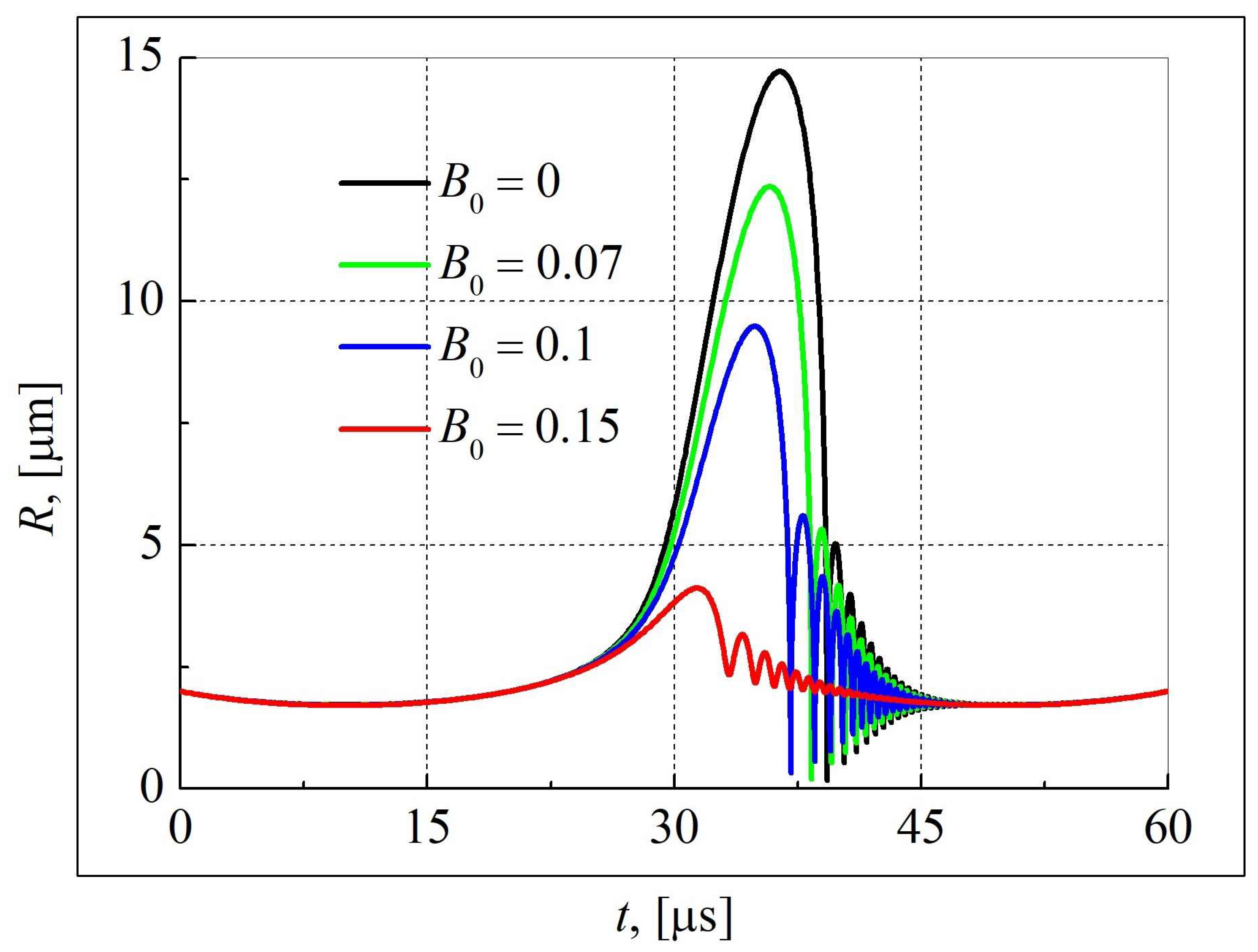
Figure 4 displays the radius versus time responses obtained for different values of the surface charge Q demonstrate a systematic and monotonic influence of electrostatic effects on the cavitation bubble. An increase in Q resulted in a larger maximum bubble radius, followed by a more intense collapse and amplified rebound oscillations, indicating progressive enhancement of the nonlinear response. From a mathematical perspective, this behavior originates from the electrostatic pressure contribution proportional to Q 2 / R 4 in the governing equation. This term modifies the interfacial pressure balance by reducing the effective stabilizing role of surface tension during the expansion stage, thereby permitting the solution to attain larger amplitudes before collapse. The associated increase in inertial energy in the surrounding liquid leads to a more abrupt and energetic collapse phase. The resulting trends are in close agreement with classical stability analyses of charged cavitation bubbles, which have shown that the presence of electric charge expands the parameter range associated with large-amplitude radial oscillations and intensified collapse dynamics. This consistency further confirms the physical soundness and mathematical reliability of the proposed model. Figure 5 shows the effects of the bubble–wall distance h on the cavitation bubble. As the bubble approaches the rigid boundary, a substantial reduction in the maximum expansion radius is observed, along with an earlier and more abrupt collapse. This behavior arises from the wall-induced pressure contribution introduced by the image method. Mathematically, the presence of a wall modifies the inertial terms in the KM equation by introducing an additional resistance proportional to the bubble acceleration. As h decreases, the effective inertia of the system increases, suppressing expansion and accelerating the collapse. The effect of the applied electric field intensity E 0 on the cavitation bubble is shown in Figure 6. Increasing the electric field leads to a noticeable increase in the maximum bubble radius, followed by a more energetic collapse and higher-frequency oscillations. This enhancement originates from the Maxwell stress contribution, which introduces an additional pressure term acting on the bubble interface. According to the governing equation, this electric-field-induced pressure effectively reduces the net restoring force during expansion, thereby amplifying the solution amplitude. The subsequent collapse becomes more violent because of the increased inertial energy accumulated during the expansion phase. Figure 7 illustrates the influence of the magnetic field B 0 on the bubble’s radius as a function of time. In contrast to the electric field effects, increasing B 0 leads to a systematic reduction in both the maximum expansion radius and the intensity of oscillations following collapse. This behavior is a direct manifestation of the magnetic damping term appearing in the governing equation, which is proportional to σ B 0 2 R ˙ . This term represents the effective Lorentz force-based dissipation arising from motion-induced currents in the conducting liquid. As the magnetic field strength increases, this dissipative contribution becomes more prominent, attenuating the radial velocities and smoothing the collapse. The observed suppression of the oscillation amplitude and enhanced damping are fully consistent with established magnetohydrodynamic theories and previous studies [43,48,49], thereby confirming the validity of the proposed model.
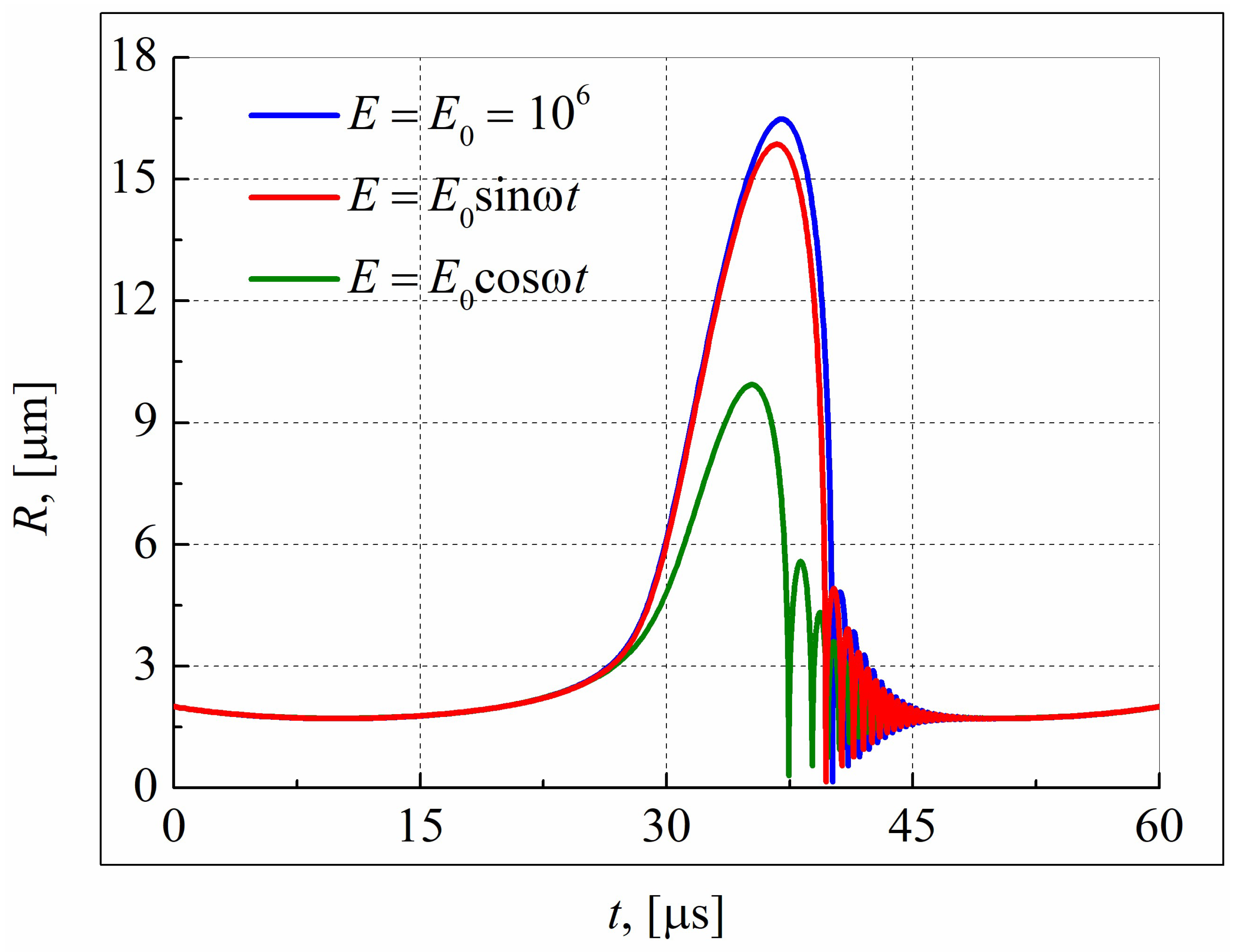
Figure 8 illustrates the temporal evolution of the bubble’s radius R under identical acoustic excitation conditions while varying the temporal form of the applied electric field. Three cases are considered: (a) constant electric field E = E 0 , (b) harmonic field E = E 0 sin ω t , and (c) phase-shifted harmonic field E = E 0 cos ω t . The results indicate that the first two cases yield almost identical responses in terms of maximum expansion and collapse behavior. This suggests that under these conditions, the electromagnetic contribution does not substantially alter the dominant force balance governing the cavitation bubble. From a mathematical perspective, this behavior can be attributed to the fact that the electric-field-induced contribution is either time-independent or partially synchronized with the acoustic excitation, leading to no significant net increase in the work performed on the bubble over a full oscillation cycle. In contrast, the case E = E 0 cos ω t exhibits a pronounced increase in the maximum bubble radius, followed by an abrupt collapse and subsequent high-frequency oscillations. This response indicates that the system transitions into a large-amplitude nonlinear regime in which the inertial terms and nonlinear gas pressure effects in the KM equation become dominant. This observation is consistent with the well-established principle in nonlinear cavitation bubbles that the phase relationship of external forcing is as important as its magnitude. The results in Figure 8 show that the electromagnetic field can have either a negligible or a decisive influence on cavitation bubbles, depending on its temporal phase relative to the acoustic excitation.

6.2. Velocity–Radius Phase Portrait Analysis

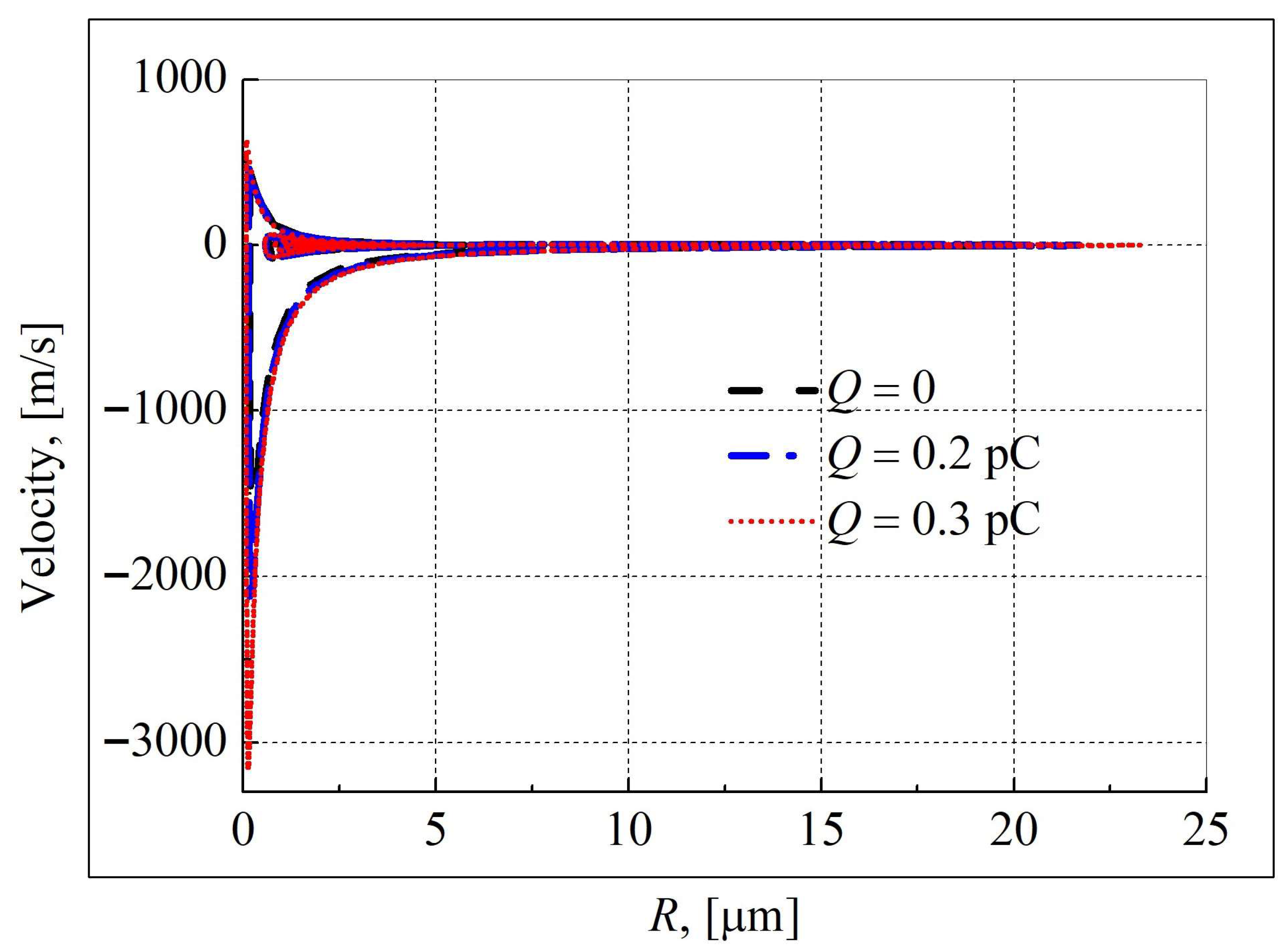
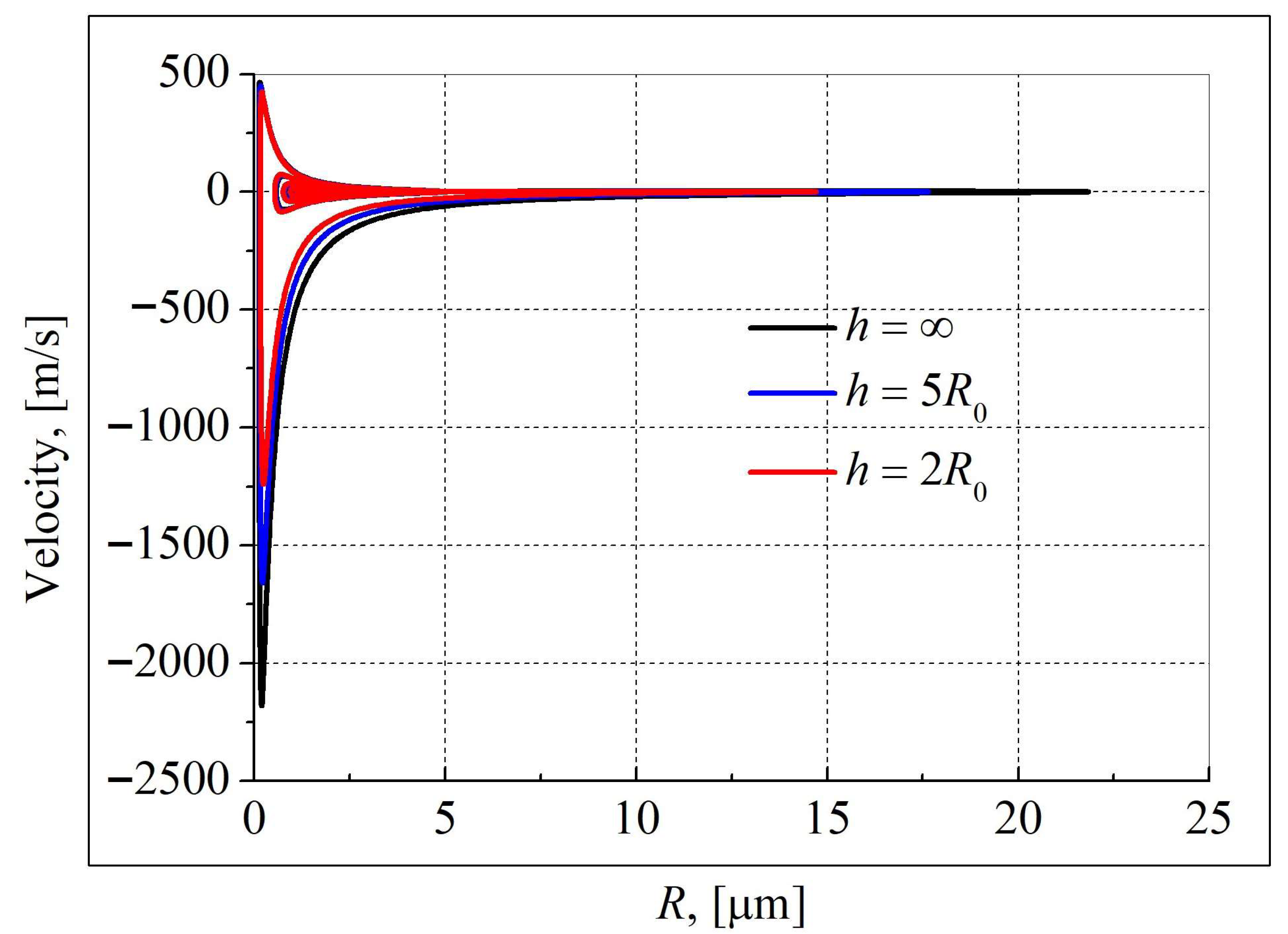
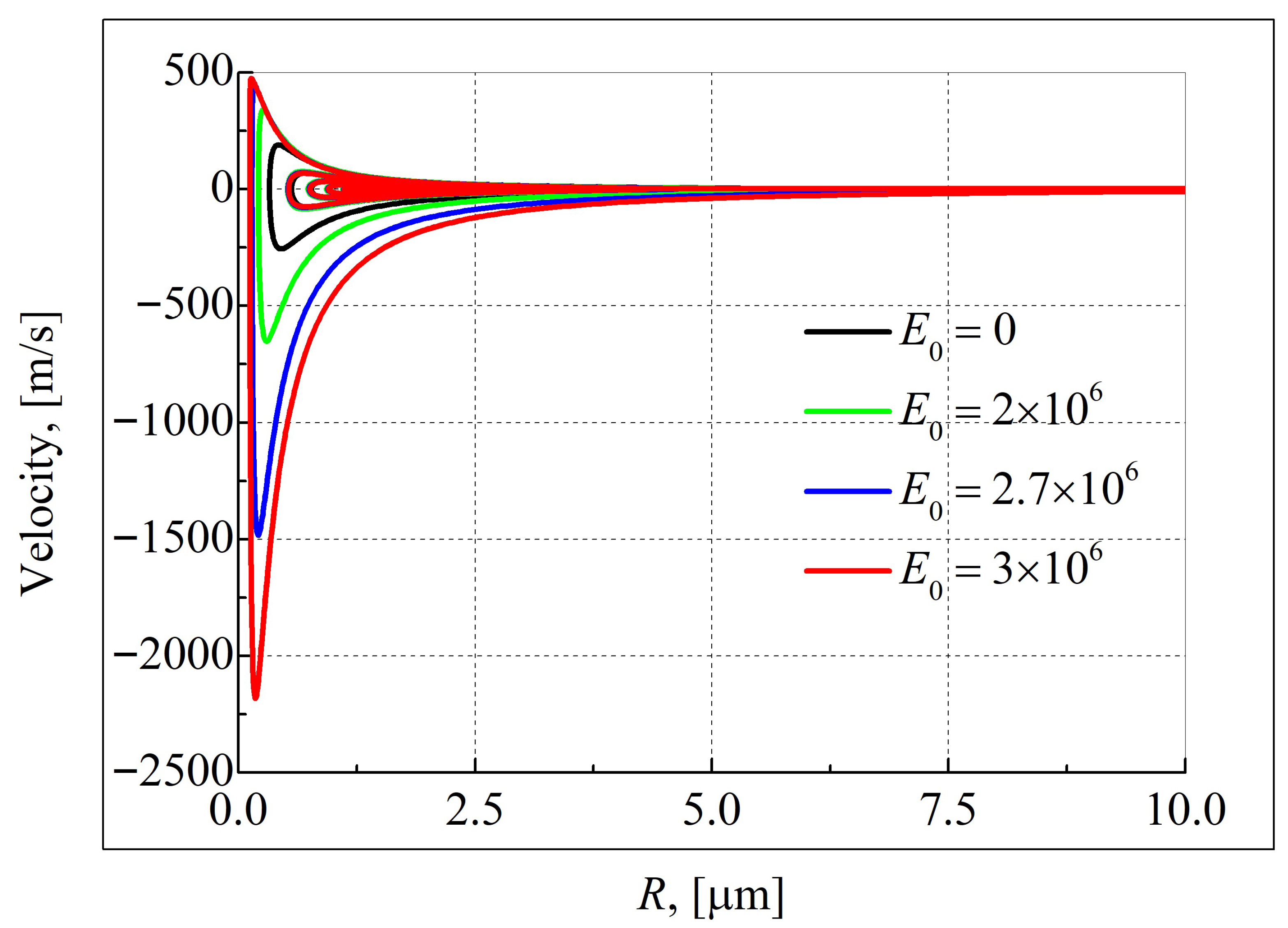
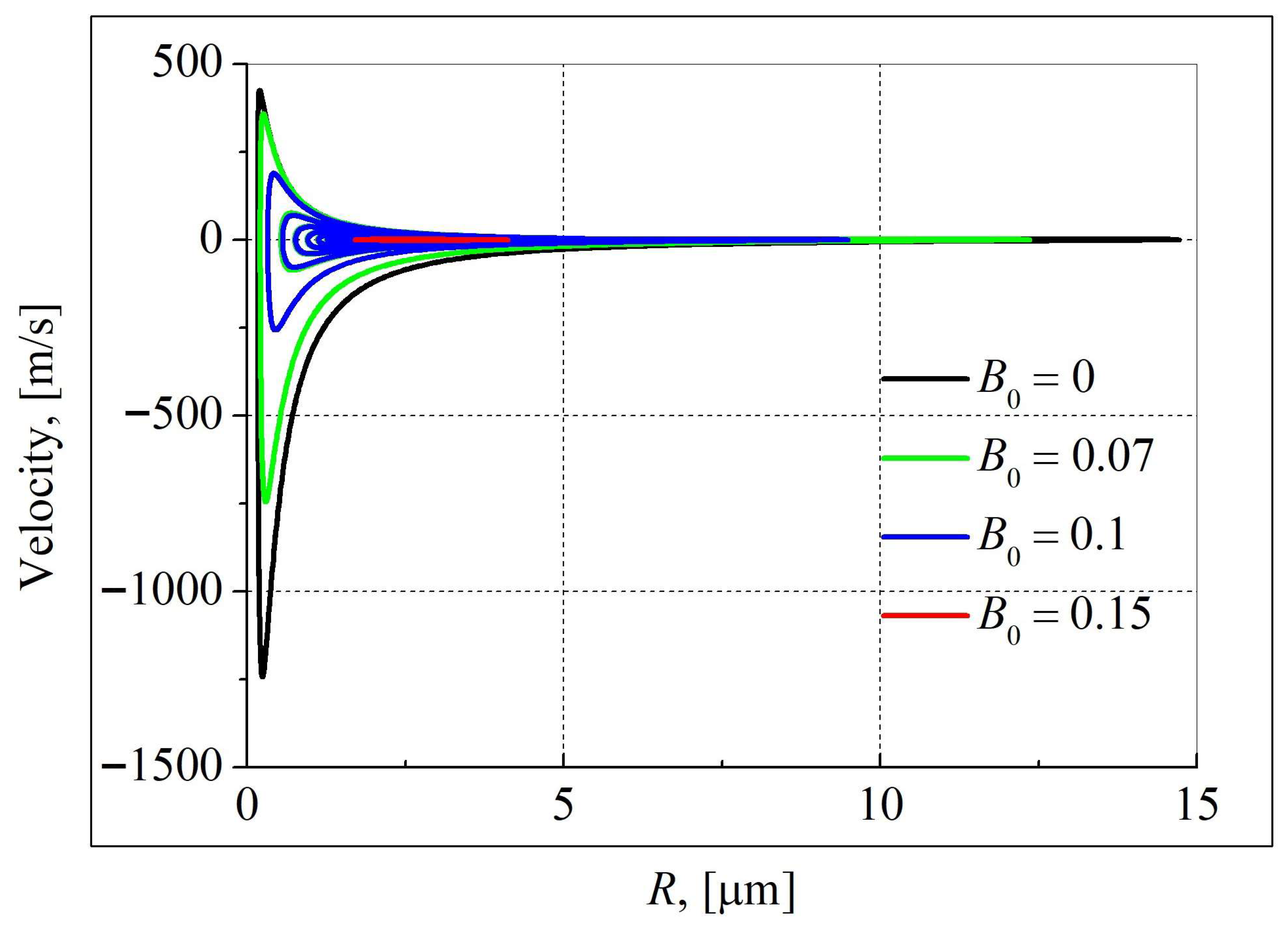
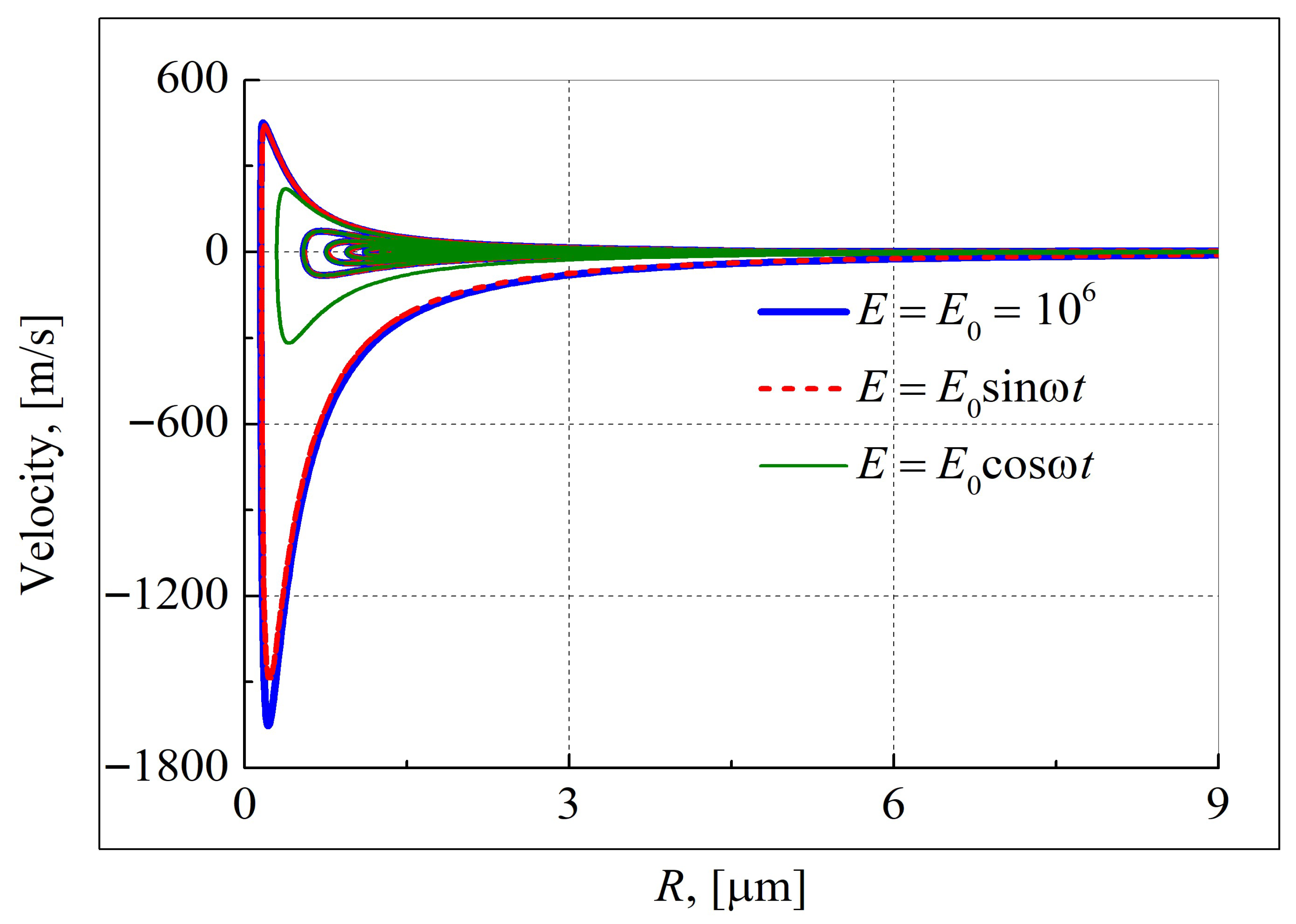
Figure 9, Figure 10, Figure 11 and Figure 12 present the phase portrait representations of the cavitation bubble in terms of the radial velocity–radius R , R ˙ trajectories under variations in surface charge Q , bubble–wall distance h , electric field E 0 , and magnetic field B 0 , respectively. These phase portraits provide deeper insights into the nonlinear structure of the system beyond the temporal radius histories, highlighting the mechanisms governing energy accumulation, dissipation, and collapse intensity. As shown in Figure 9, increasing the surface charge Q leads to a marked enlargement of the phase portrait loops, particularly during the collapse stage where large negative radial velocities are observed. A charged bubble reaches considerably higher collapse velocities compared with a neutral bubble, indicating enhanced inertial focusing of the surrounding liquid. This behavior is consistent with the reduction in the effective surface tension caused by electrostatic pressure and facilitates larger expansion radii and stronger collapses. Similar trends have been reported in the studies on charged bubbles by Hongray et al. [50] and Ashok et al. [44], where the presence of charge was shown to intensify the collapse velocity and internal energy concentration. The modifications of phase portrait trajectories as the bubble approaches a rigid wall are displayed in Figure 10. As the distance h decreases, the velocity–radius loops contract considerably, and the maximum attainable radial velocity is reduced. This contraction reflects the increasing hydrodynamic resistance induced by the wall, which limits the radial motion and suppresses violent collapse. This type of behavior aligns with classical near-wall cavitation theory, where image-induced pressure fields introduce additional inertial loading on the bubble. As shown in Figure 11, applying an external electric field E 0 results in a progressive broadening of the phase trajectories, particularly in the collapse-dominated region of the phase plane. Stronger electric fields yield higher collapse velocities and more elongated loops, reflecting increased energy transfer from the acoustic field into radial motion. This trend agrees well with previous electrohydrodynamic analyses, including those conducted by Zaghdoudi and Lallemand [45], who demonstrated that electric stresses stretch the bubble interface and promote stronger fluid acceleration near collapse. The present results further confirm that electric fields act as an amplification mechanism rather than a dissipative one, enhancing nonlinear cavitation intensity in agreement with previous theoretical results [51,52,53]. In contrast, Figure 12 shows that increasing the magnetic field B 0 leads to a systematic contraction of the velocity–radius loops and a pronounced reduction in peak collapse velocities. This behavior is attributed to the Lorentz force-induced damping term, which acts directly on the radial velocity. The smoothing of phase trajectories and suppression of high-velocity excursions are characteristic of magnetohydrodynamic damping and are consistent with published studies [42,44,45] on electrically conducting fluids subjected to magnetic fields.
Figure 13 shows the velocity–radius phase portraits corresponding to three different temporal representations of the applied electric field: (a) constant field E = E 0 , (b) sinusoidally varying field E = E 0 sin ω t , and (c) cosinusoidally varying field E = E 0   cos ω t . Although the electric field amplitude in all three cases is the same, the corresponding phase–space trajectories exhibit noticeable differences, particularly during the collapse-dominated regime. The phase trajectory in the steady electric field case is the most extended, characterized by larger negative radial velocities during collapse. This behavior reflects the continuous contribution of the electric stress term in the governing equation, which consistently reduces the effective restoring pressure and allows greater energy accumulation during expansion. Consequently, the subsequent collapse becomes more intense, exhibiting higher collapse velocities. In contrast, when the electric field varies sinusoidally with time, the phase portrait loops contract relative to the steady-field case. Sinusoidal and cosinusoidal excitations introduce a time-dependent modulation of the electric pressure term, effectively redistributing the energy over the oscillation cycle. This modulation weakens the cumulative electric forcing during the critical stages of bubble expansion, leading to a reduced collapse intensity and smoother phase trajectories. A subtle distinction between the sinusoidal and cosinusoidal cases is also observed. The sinusoidal field, which reaches its maximum value at the onset of oscillation, produces slightly larger phase loops than the cosinusoidal field. This difference arises from the phase alignment between the applied electric force and acoustic pressure, emphasizing the importance of the relative phase in coupled electroacoustic cavitation dynamics. Therefore, the present results confirm both the physical validity of the electric stress formulation and the sensitivity of cavitation dynamics to the temporal structure of the applied electromagnetic force.

7. Conclusions and Outlook

In this study, a comprehensive mathematical model is developed to investigate the nonlinear dynamics of a cavitation bubble in a conducting liquid under the combined influences of acoustic excitation, electromagnetic fields, and rigid boundary effects. Starting from a modified KM formulation, the model incorporates electric stress, magnetic damping, surface charge effects, and wall-induced interactions within a unified theoretical framework. A linear analysis was first performed to examine the small-amplitude oscillations, yielding explicit expressions for the natural frequency and damping coefficient. The analysis demonstrated how surface charge, electric field strength, magnetic field intensity, and bubble–wall distance systematically modifies the classical Minnaert resonance. These analytical results provide a clear physical interpretation and establish a solid foundation for understanding the subsequent nonlinear behavior. Nonlinear numerical simulations revealed that surface charge and electric fields act primarily as amplification mechanisms, enhancing bubble expansion and intensifying collapse by increasing the effective driving pressure. In contrast, magnetic fields and wall proximity introduce stabilizing effects through additional inertial loading and Lorentz force-induced damping, leading to reduced oscillation amplitudes and smoother collapse dynamics. The velocity–radius phase portraits further clarified these mechanisms by illustrating how each parameter alters the energy accumulation, dissipation, and collapse intensity in the phase space. Numerical convergence and solver-independence were explicitly verified through tolerance refinement and comparison with stiff integrators, further confirming the accuracy and robustness of the proposed model through consistency checks and direct comparisons with previously published theoretical and experimental results. In limiting cases, the model successfully reproduces classical results for uncharged bubbles in unbounded liquids, whereas under electromagnetic forcing conditions, it captures the trends reported in earlier electrohydrodynamic and magnetohydrodynamic investigations. This close agreement confirms the validity of the mathematical formulation and reliability of the numerical implementation. Overall, this study provides a unified and flexible mathematical framework for analyzing cavitation bubbles under coupled acoustic and electromagnetic conditions. The results highlight the potential of electromagnetic fields and boundary conditions as effective control parameters for regulating the cavitation intensity. Additional verification of dimensional consistency and classical limits is presented in Appendix A. The model can be readily extended to include nonspherical deformations, thermal effects, or multibubble interactions, offering a useful foundation for future theoretical investigations and engineering applications. Despite its comprehensive scope, the present formulation remains restricted to a spherically symmetric single-bubble framework and neglects translational motion, jet formation, thermal effects, and strong nonspherical deformations that may arise during violent collapse or in close proximity to rigid boundaries. Moreover, electromagnetic contributions are treated under quasi-static and low magnetic Reynolds number assumptions, which may limit applicability in highly conductive or rapidly varying field regimes.
Future research may extend the analysis to fully nonspherical dynamics, incorporate thermal and phase-change mechanisms, account for bubble translation and jetting phenomena, and pursue detailed numerical or experimental validation under coupled electromagnetic and acoustic forcing conditions.

Author Contributions

Conceptualization, A.K.A.-N. and Y.V.F.; methodology, A.K.A.-N. and Y.V.F.; software, A.K.A.-N. and Y.V.F.; validation, A.K.A.-N. and T.K.; formal analysis, A.K.A.-N. and Y.V.F.; investigation, A.K.A.-N. and Y.V.F.; resources, A.K.A.-N. and Y.V.F.; data curation, A.K.A.-N. and T.K.; writing—original draft preparation, A.K.A.-N. and Y.V.F.; writing—review and editing, A.K.A.-N. and T.K.; visualization, A.K.A.-N. and T.K. All authors have read and agreed to the published version of the manuscript.

Funding

A.K.A.-N. acknowledges funding from the Ministry of Science and Higher Education of the Russian Federation (Agreement No. 075-15-2024-560). The work of Y.V.F. was carried out within the framework of the state assignment of the FRC KazSC RAS. The work of T.K. was partly carried out with the aid of JSPS KAKENHI (Grant No. 22K03898) and the JKA and its promotion funds from KEIRIN RACE.

Data Availability Statement

No new data were created or analyzed in this study. Data sharing is not applicable to this article.

Acknowledgments

The authors thank the reviewers for their valuable comments and suggestions.

Conflicts of Interest

The authors declare no conflicts of interest.

Appendix A. Dimensional Consistency and Classical Limits

To enhance the transparency of the formulation, we verify the dimensional homogeneity of the modified KM equation and demonstrate the recovery of classical limiting cases.

Appendix A.1. Dimensional Consistency

The governing equation represents a balance of normal stresses at the bubble interface. Therefore, each term must have dimensions of pressure Pa . The inertial contribution scales as ρ l R R ¨ , then
ρ l R R ¨ = kg . m - 3 . m . m . s 2 = Pa .
The viscous contribution scales as
μ l R ˙ R = Pa .   s . m . s 1 m = [ Pa ] .
The surface tension term
2 γ R = N . m - 1 m = [ Pa ] .
The wall-induced correction scales as
ρ l R 2 R ¨ + 2 R R ˙ 2 2 h = kg . m - 3   m 3 . s 2 + m 3 . s 2 m = [ Pa ] .
The electric Maxwell stress contribution scales as
ε l E 0 2 = C 2 . N - 1 . m - 2 . kg 2 . m 2 . s 4 . C 2 = [ Pa ]
The electrostatic pressure term
Q 2 8 π ε l R 4 =   C 2 C 2 . N - 1 . m - 2 . m 4 = [ Pa ]
The magnetic contribution scales as
σ B 0 2 R R ˙ =   A 2 . s 3 . T . m . m . s 1 kg . m 3 = [ Pa ]
Hence, all additional wall and electromagnetic terms introduced in the modified formulation are dimensionally consistent with the interfacial normal stress balance.

Appendix A.2. Classical Limits

The consistency of the extended model is further confirmed by examining limiting cases.
(i) In the absence of electromagnetic and wall effects,
E 0 = 0 ,   B 0 = 0 ,   Q = 0 ,   h     .
The governing equation reduces to the classical KM equation.
(ii) In the incompressible limit c , the formulation further reduces to the Rayleigh–Plesset equation. Therefore, the present model constitutes a consistent extension of classical spherical bubble dynamics.

References

  1. Unger, E.C.; Matsunaga, T.O.; McCreery, T.; Schumann, P.; Sweitzer, R.; Quigley, R. Therapeutic Applications of Microbubbles. Eur. J. Radiol. 2002, 42, 160–168. [Google Scholar] [CrossRef]
  2. Coussios, C.C.; Roy, R.A. Applications of Acoustics and Cavitation to Noninvasive Therapy and Drug Delivery. Annu. Rev. Fluid Mech. 2008, 40, 395–420. [Google Scholar] [CrossRef]
  3. Mayer, C.R.; Bekeredjian, R. Ultrasonic Gene and Drug Delivery to the Cardiovascular System. Adv. Drug Deliv. Rev. 2008, 60, 1177–1192. [Google Scholar] [CrossRef]
  4. Ramaswamy, K.; Marx, V.; Laser, D.; Kenny, T.; Chi, T.; Bailey, M.; Sorensen, M.D.; Grubbs, R.H.; Stoller, M.L. Targeted Microbubbles: A Novel Application for the Treatment of Kidney Stones. BJU Int. 2015, 116, 9–16. [Google Scholar] [CrossRef]
  5. Pishchalnikov, Y.A.; Sapozhnikov, O.A.; Bailey, M.R.; Williams, J.C., Jr.; Cleveland, R.O.; Colonius, T.; Crum, L.A.; Evan, A.P.; McAteer, J.A. Cavitation Bubble Cluster Activity in the Breakage of Kidney Stones by Lithotripter Shockwaves. J. Endourol. 2003, 17, 435–446. [Google Scholar] [CrossRef]
  6. Pishchalnikov, Y.A.; Behnke-Parks, W.M.; Schmidmayer, K.; Maeda, K.; Colonius, T.; Kenny, T.W.; Laser, D.J. High-Speed Video Microscopy and Numerical Modeling of Bubble Dynamics near a Surface of Urinary Stone. J. Acoust. Soc. Am. 2019, 146, 516. [Google Scholar] [CrossRef]
  7. Mohamed, K.G.; Mohammadein, S.A.; Abu-Nab, A.K. Effect of Suction Process on the Growth of a Convective Gas Bubble in Diver’s Tissues. Int. J. Biomath. 2022, 16, 2250077. [Google Scholar] [CrossRef]
  8. Zupanc, M.; Kosjek, T.; Petkovšek, M.; Dular, M.; Kompare, B.; Širok, B.; Blažeka, Ž.; Heath, E. Removal of Pharmaceuticals from Wastewater by Biological Processes, Hydrodynamic Cavitation and UV Treatment. Ultrason. Sonochem. 2013, 20, 1104–1112. [Google Scholar] [CrossRef]
  9. Reuter, F.; Mettin, R. Mechanisms of Single Bubble Cleaning. Ultrason. Sonochem. 2016, 29, 550–562. [Google Scholar] [CrossRef]
  10. Zhang, D.; Gökce, B.; Barcikowski, S. Laser Synthesis and Processing of Colloids: Fundamentals and Applications. Chem. Rev. 2017, 117, 3990–4103. [Google Scholar] [CrossRef]
  11. Rayleigh, L., VIII. On the Pressure Developed in a Liquid during the Collapse of a Spherical Cavity. Lond. Edinb. Dublin Philos. Mag. J. Sci. 1917, 34, 94–98. [Google Scholar] [CrossRef]
  12. Plesset, M.S. The Dynamics of Cavitation Bubbles. J. Appl. Mech. 1949, 16, 277–282. [Google Scholar] [CrossRef]
  13. Fuster, D. A Review of Models for Bubble Clusters in Cavitating Flows. Flow Turbul. Combust. 2019, 102, 497–536. [Google Scholar] [CrossRef]
  14. Blake, J.R.; Taib, B.B.; Doherty, G. Transient Cavities near Boundaries. Part 1. Rigid Boundary. J. Fluid Mech. 1986, 170, 479–497. [Google Scholar] [CrossRef]
  15. Chahine, G.L.; Kapahi, A.; Choi, J.-K.; Hsiao, C.-T. Modeling of Surface Cleaning by Cavitation Bubble Dynamics and Collapse. Ultrason. Sonochem. 2016, 29, 528–549. [Google Scholar] [CrossRef] [PubMed]
  16. Supponen, O.; Obreschkow, D.; Tinguely, M.; Kobel, P.; Dorsaz, N.; Farhat, M. Scaling Laws for Jets of Single Cavitation Bubbles. J. Fluid Mech. 2016, 802, 263–293. [Google Scholar] [CrossRef]
  17. Fourest, T.; Deletombe, E.; Faucher, V.; Arrigoni, M.; Dupas, J.; Laurens, J.-M. Comparison of Keller–Miksis Model and Finite Element Bubble Dynamics Simulations in a Confined Medium. Application to the Hydrodynamic Ram. Eur. J. Mech. B Fluids 2018, 68, 66–75. [Google Scholar] [CrossRef]
  18. Keller, J.B.; Miksis, M. Bubble Oscillations of Large Amplitude. J. Acoust. Soc. Am. 1980, 68, 628–633. [Google Scholar] [CrossRef]
  19. Keller, J.B.; Kolodner, I.I. Damping of Underwater Explosion Bubble Oscillations. J. Appl. Phys. 1956, 27, 1152–1161. [Google Scholar] [CrossRef]
  20. Abu-Nab, A.K.; Mohamed, K.G.; Abu-Bakr, A.F. Microcavitation Dynamics in Viscoelastic Tissue during Histotripsy Process. J. Phys. Condens. Matter 2022, 34, 304005. [Google Scholar] [CrossRef]
  21. Petrov, A.G.; Fedorov, Y.V. Steady-State Amplitude of an Encapsulated Gas Bubble Radial Oscillations at Resonance. Appl. Math. Model. 2026, 155, 116719. [Google Scholar] [CrossRef]
  22. Plesset, M.S.; Chapman, R.B. Collapse of an Initially Spherical Vapour Cavity in the Neighbourhood of a Solid Boundary. J. Fluid Mech. 1971, 47, 283–290. [Google Scholar] [CrossRef]
  23. Lauterborn, W.; Bolle, H. Experimental Investigations of Cavitation-Bubble Collapse in the Neighbourhood of a Solid Boundary. J. Fluid Mech. 1975, 72, 391. [Google Scholar] [CrossRef]
  24. Koch, M.; Lechner, C.; Reuter, F.; Köhler, K.; Mettin, R.; Lauterborn, W. Numerical Modeling of Laser Generated Cavitation Bubbles with the Finite Volume and Volume of Fluid Method, Using OpenFOAM. Comput. Fluids 2016, 126, 71–90. [Google Scholar] [CrossRef]
  25. Beig, S.A.; Aboulhasanzadeh, B.; Johnsen, E. Temperatures Produced by Inertially Collapsing Bubbles near Rigid Surfaces. J. Fluid Mech. 2018, 852, 105–125. [Google Scholar] [CrossRef]
  26. Blake, J.R.; Gibson, D.C. Cavitation Bubbles Near Boundaries. Annu. Rev. Fluid Mech. 1987, 19, 99–123. [Google Scholar] [CrossRef]
  27. Zhang, X.-Q.; Zhang, X.-F.; Qiu, X.; Gao, D.; Zhang, Y.-N. Experimental Study of the Dynamics of a Single Cavitation Bubble Excited by a Focused Laser near the Boundary of a Rigid Wall. J. Hydrodyn. 2023, 35, 942–953. [Google Scholar] [CrossRef]
  28. Bußmann, A.; Riahi, F.; Gökce, B.; Adami, S.; Barcikowski, S.; Adams, N.A. Investigation of Cavitation Bubble Dynamics near a Solid Wall by High-Resolution Numerical Simulation. Phys. Fluids 2023, 35, 016115. [Google Scholar] [CrossRef]
  29. Yang, X.; Liu, C.; Wan, D.; Hu, C. Numerical Study of the Shock Wave and Pressure Induced by Single Bubble Collapse near Planar Solid Wall. Phys. Fluids 2021, 33, 073311. [Google Scholar] [CrossRef]
  30. Trummler, T.; Schmidt, S.J.; Adams, N.A. Effect of Stand-off Distance and Spatial Resolution on the Pressure Impact of near-Wall Vapor Bubble Collapses. Int. J. Multiph. Flow 2021, 141, 103618. [Google Scholar] [CrossRef]
  31. Abu-Bakr, A.F.; Kanagawa, T.; Abu-Nab, A.K. Analysis of Doublet Bubble Dynamics near a Rigid Wall in Ferroparticle Nanofluids. Case Stud. Therm. Eng. 2022, 34, 102060. [Google Scholar] [CrossRef]
  32. Gubaidullin, D.A.; Gubaidullina, D.D.; Fedorov, Y.V. Mathematical Modeling of the Wave Dynamics of an Encapsulated Perfluorocarbon Droplet in a Viscoelastic Liquid. Mathematics 2023, 11, 1083. [Google Scholar] [CrossRef]
  33. Saccone, G.; Garivalis, A.I.; Di Marco, P. Electrohydrodynamics and Boiling: Experiments, Numerical Calculation and Modeling of Maxwell Stress Tensor and Electric Force Acting on Bubbles. J. Electrost. 2020, 103, 103413. [Google Scholar] [CrossRef]
  34. Di Marco, P.; Grassi, W.; Memoli, G.; Takamasa, T.; Tomiyama, A.; Hosokawa, S. Influence of Electric Field on Single Gas-Bubble Growth and Detachment in Microgravity. Int. J. Multiph. Flow 2003, 29, 559–578. [Google Scholar] [CrossRef]
  35. Taleghani, M.H.; Khodadadi, S.; Maddahian, R.; Mokhtari-Dizaji, M. Enhancing the Bubble Collapse Energy Using the Electrohydrodynamic Force. Phys. Fluids 2023, 35, 053316. [Google Scholar] [CrossRef]
  36. Mehta, K.; Ahuja, M.; Kumar, P.; Kushawaha, R.K.; Baruah, P.K. Synergistic Influence of External Electric Field on Laser Ablation in Liquid: Correlating Nanoparticle Synthesis and Cavitation Bubble Dynamics. Phys. Scr. 2024, 99, 065948. [Google Scholar] [CrossRef]
  37. Bouzehouane, Y.; Ayela, F.; Budenkova, O. Cavitation under Magnetic Field: Study of an Oscillating Bubble. Magnetohydrodynamics 2025, 61, 77–86. [Google Scholar] [CrossRef]
  38. Corrado, M. Bubble Dynamics in Liquid Metals under External Horizontal Magnetic Field. Phys. Fluids 2024, 36, 124111. [Google Scholar] [CrossRef]
  39. Wang, J.; Huang, H.; Lu, P.; Zhu, G.; Shaheen, S. Numerical Study of Bubble-Induced Heat Transfer in a Liquid Metal Cavity Affected by a Horizontal Magnetic Field. Fusion Eng. Des. 2024, 205, 114570. [Google Scholar] [CrossRef]
  40. Wang, Z.H.; Wang, S.D.; Meng, X.; Ni, M.J. UDV Measurements of Single Bubble Rising in a Liquid Metal Galinstan with a Transverse Magnetic Field. Int. J. Multiph. Flow 2017, 94, 201–208. [Google Scholar] [CrossRef]
  41. Mori, Y.; Hijikata, K.; Kuriyama, I. Experimental Study of Bubble Motion in Mercury with and without a Magnetic Field. J. Heat Transfer 1977, 99, 404–410. [Google Scholar] [CrossRef]
  42. Zhang, C.; Eckert, S.; Gerbeth, G. Experimental Study of Single Bubble Motion in a Liquid Metal Column Exposed to a DC Magnetic Field. Int. J. Multiph. Flow 2005, 31, 824–842. [Google Scholar] [CrossRef]
  43. Abu-Nab, A.K.; Morad, A.M.; Selima, E.S. Impact of Magnetic-Field on the Dynamic of Gas Bubbles in N -Dimensions of Non-Newtonian Hybrid Nanofluid: Analytical Study. Phys. Scr. 2022, 97, 105202. [Google Scholar] [CrossRef]
  44. Ashok, B.; Hongray, T.; Balakrishnan, J. The Charged Bubble Oscillator: Dynamics and Thresholds. Indian Acad. Sci. Conf. Ser. 2017, 1, 109–115. [Google Scholar] [CrossRef]
  45. Zaghdoudi, M.C.; Lallemand, M. Study of the Behaviour of a Bubble in an Electric Field: Steady Shape and Local Fluid Motion. Int. J. Therm. Sci. 2000, 39, 39–52. [Google Scholar] [CrossRef]
  46. Minnaert, M., XVI. On Musical Air-Bubbles and the Sounds of Running Water. Lond. Edinb. Dublin Philos. Mag. J. Sci. 1933, 16, 235–248. [Google Scholar] [CrossRef]
  47. Greene, C.A.; Wilson, P.S. Laboratory Investigation of a Passive Acoustic Method for Measurement of Underwater Gas Seep Ebullition. J. Acoust. Soc. Am. 2012, 131, EL61–EL66. [Google Scholar] [CrossRef] [PubMed]
  48. Behnia, S.; Mobadersani, F.; Yahyavi, M.; Rezavand, A.; Hoesinpour, N.; Ezzat, A. Effect of Magnetic Field on the Radial Pulsations of a Gas Bubble in a Non-Newtonian Fluid. Chaos Solitons Fractals 2015, 78, 194–204. [Google Scholar] [CrossRef]
  49. Aliabadi, A.; Taklifi, A. The Effect of Magnetic Field on Dynamics of Gas Bubbles in Visco-Elastic Fluids. Appl. Math. Model. 2012, 36, 2567–2577. [Google Scholar] [CrossRef]
  50. Hongray, T.; Ashok, B.; Balakrishnan, J. Effect of Charge on the Dynamics of an Acoustically Forced Bubble. Nonlinearity 2014, 27, 1157–1179. [Google Scholar] [CrossRef]
  51. Deng, J.-J.; Yang, R.-F.; Lu, H.-Q. Dynamics of Nonspherical Bubble in Compressible Liquid under the Coupling Effect of Ultrasound and Electrostatic Field. Ultrason. Sonochem. 2021, 71, 105371. [Google Scholar] [CrossRef] [PubMed]
  52. Deng, J.-J.; Yu, M.; Yang, R.-F. Interaction between Double Nonspherical Bubbles in Compressible Liquid under the Coupling Effect of Ultrasound and Electrostatic Field. Acta Acust. 2022, 6, 52. [Google Scholar] [CrossRef]
  53. Abu-Nab, A.K.; Hakami, A.M.; Abu-Bakr, A.F. Charged Cavitation Multibubbles Dynamics Model: Growth Process. Mathematics 2024, 12, 569. [Google Scholar] [CrossRef]
Figure 1. Schematic of the physical configuration considered in the model: (a) A spherical cavitation bubble of instantaneous radius R is located at a fixed distance h from a rigid planar wall; (b) The surrounding liquid is electrically conducting and subjected to a uniform external electric field with amplitude E 0 and a uniform magnetic field of strength B 0 ; (c) The influence of the rigid boundary is modeled using the method of images, whereby a virtual mirror bubble is introduced to account for wall-induced pressure effects.
Mathematics 14 00930 g001
Figure 2. Normalized natural frequency ω 0 / ω M as a function of the equilibrium bubble radius R 0 for different values of surface charge Q , electric field intensity E 0 , and bubble–wall distance h .
Mathematics 14 00930 g002
Figure 3. Time evolution of the cavitation bubble radius R under fixed acoustic excitation conditions, comparing the current results with previous data of Ashok et al. [44] at P a = 1.42   p 0 , f a = 20   kHz , Q = 0.06   pC , B 0 = 0.03   T , E 0 = 4 × 10 5   V / m , and R 0 = 1.45   μ m .
Mathematics 14 00930 g003
Figure 4. Cavitation bubble radius R as a function of time t for different values of the surface charge Q at P a = 1.32     p 0 , f a = 25   kHz , h = , B 0 = 0 , E 0 = 0 , and R 0 = 2   μ m .
Mathematics 14 00930 g004
Figure 5. Effect of the bubble–wall distance h on the cavitation bubble radius R at P a = 1.32   p 0 , f a = 25   kHz , Q = 0.2   pC , B 0 = 0 , E 0 = 0 , and R 0 = 2   μ m .
Mathematics 14 00930 g005
Figure 6. Effect of electric field strength E 0 on the cavitation bubble radius R at P a = 1.32     p 0 , f a = 25   kHz , Q = 0.2     pC , B 0 = 0.1     T , h = 2 R 0 , and R 0 = 2   μ m .
Mathematics 14 00930 g006
Figure 7. Effect of magnetic field strength B 0 on the cavitation bubble radius R at P a = 1.32     p 0 , f a = 25   kHz , Q = 0.2     pC , E 0 = 0 , h = 2 R 0 , and R 0 = 2     μ m .
Mathematics 14 00930 g007
Figure 8. Temporal evolution of the bubble’s radius R for different temporal forms of the applied electric field: constant field E = E 0 , harmonic field E = E 0 sin ω t and phase-shifted harmonic field E = E 0 cos ω t at P a = 1.32     p 0 , f a = 25   kHz , Q = 0.2     pC , B 0 = 0.1     T , h = 2 R 0 , and R 0 = 2   μ m .
Mathematics 14 00930 g008
Figure 9. Phase portraits of the cavitation bubble in the R , R ˙ plane for different surface charges Q at P a = 1.32     p 0 , f a = 25   kHz , B 0 = 0 , E 0 = 0 , h = 2 R 0 , and R 0 = 2     μ m .
Mathematics 14 00930 g009
Figure 10. Phase portraits of the cavitation bubble in the R , R ˙ plane for different bubble–wall distances h at P a = 1.32     p 0 , f a = 25   kHz , Q = 0.2     pC , B 0 = 0 , E 0 = 0 , and R 0 = 2     μ m .
Mathematics 14 00930 g010
Figure 11. Phase portraits of the cavitation bubble in the R , R ˙ plane for different electric field amplitudes E 0 at P a = 1.32     p 0 , f a = 25   kHz , B 0 = 0.1     T , h = 2   R 0 , and R 0 = 2     μ m .
Mathematics 14 00930 g011
Figure 12. Phase portraits of the cavitation bubble in the R , R ˙ plane for different magnetic field amplitudes B 0 at P a = 1.32     p 0 , f a = 25   kHz , E 0 = 0 , h = 2 R 0 , and R 0 = 2     μ m .
Mathematics 14 00930 g012
Figure 13. Phase portraits of the cavitation bubble in the R , R ˙ plane corresponding to different temporal representations of the applied electric field: E = E 0 , E = E 0 sin ω t , and E = E 0 cos ω t at P a = 1.32     p 0 , f a = 25   kHz , and R 0 = 2     μ m .
Mathematics 14 00930 g013
Disclaimer/Publisher’s Note: The statements, opinions and data contained in all publications are solely those of the individual author(s) and contributor(s) and not of MDPI and/or the editor(s). MDPI and/or the editor(s) disclaim responsibility for any injury to people or property resulting from any ideas, methods, instructions or products referred to in the content.