Article

Stabilizer Variables for Measurement Invariance–Induced Heterogeneity: Identification Theory and Testing in Multi-Group Models


1
Department of Health Management, Faculty of Health Sciences, Acibadem Mehmet Ali Aydınlar University, 34752 Istanbul, Türkiye
2
Department of Health Management, Graduate School of Health Sciences, Acibadem Mehmet Ali Aydınlar University, 34752 Istanbul, Türkiye
3
Department of Statistics, Faculty of Science, Yıldız Technical University, 34220 Istanbul, Türkiye
*
Author to whom correspondence should be addressed.
Mathematics 2026, 14(6), 1064; https://doi.org/10.3390/math14061064
Submission received: 9 February 2026 / Revised: 16 March 2026 / Accepted: 19 March 2026 / Published: 21 March 2026

Abstract

When measurement invariance (MI) is violated in multi-group structural equation models, group-specific measurement artifacts inflate the between-group variance of structural parameters beyond their true values. Existing remedies—partial invariance, group-specific estimation, or moderation analysis—address the consequences of inflation but not its mechanism. This article introduces the stabilizer variable, a covariate that absorbs measurement-induced parameter heterogeneity while maintaining structural independence from the focal relationship. Two theoretical results are established: a variance decomposition theorem showing that MI violations inflate dispersion through an identifiable artifactual component, and a purification theorem proving that a stabilizer reduces this dispersion via Frisch–Waugh–Lovell projection. Two stabilization mechanisms are identified: variance purification (Type A) and directional alignment (Type B). We then develop the stabilizer variable test, a dual-criterion procedure combining nonparametric bootstrap testing for stabilization magnitude with binomial testing for directional consistency, incorporating adaptive MI severity scoring with calibrated fit-index weights. Simulations comprising 949,100 replications across varying group counts, sample sizes, and MI severity levels demonstrate 80–99% power with false-positive rates below 2%. Practical guidelines recommend K 10 groups and n 100 per group for conservative applications. The framework generalizes to any multi-group regression context where systematic measurement error induces spurious parameter heterogeneity.

1. Introduction

Multi-group structural models are widely used to evaluate whether relationships among variables generalize across subpopulations [1]. A standard prerequisite for meaningful cross-group comparisons is measurement invariance (MI)—the requirement that the measurement instrument functions equivalently across groups [2,3]. When MI holds, between-group differences in structural parameters can be attributed to genuine population heterogeneity [4]. When MI is violated, however, group-specific measurement artifacts—such as differential item functioning, non-invariant factor loadings, or biased intercepts—propagate into the structural estimates and inflate the observed between-group variance of focal parameters beyond their true values [5,6,7].
Current approaches to MI violations offer researchers a limited set of options: impose partial invariance constraints and accept residual bias [8], estimate fully group-specific parameters and forgo cross-group comparison [9], or introduce interaction terms through moderation analysis [10]. None of these strategies directly address the mechanism by which measurement artifacts contaminate structural estimates. This article proposes an alternative: rather than constraining, partitioning, or interacting, one can absorb the measurement-induced component of parameter heterogeneity through an appropriately chosen covariate.
We formalize this idea through the concept of a stabilizer variable. Consider a structural relationship ξ η estimated across K groups, yielding group-specific coefficients β k . A stabilizer variable Z satisfies two conditions: (i) Z is correlated with the measurement artifacts that induce group-specific bias in β k , and (ii) Z is structurally independent from the focal ξ η relationship—it neither mediates nor moderates this path. When Z is included as a covariate, it absorbs the artifactual component of β k heterogeneity. The resulting adjusted estimates reflect the true structural relationship, purified of measurement-induced dispersion.
To illustrate the mechanism concretely: suppose a predictor X affects an outcome Y , and this relationship is estimated across demographic groups. If the measurement instrument for X functions differently across groups (e.g., certain items are interpreted differently by different age cohorts), the estimated β k values will vary not because the true effect differs, but because the measurement of X introduces group-specific noise. Now suppose a variable Z —say, a physiological or behavioral covariate—captures this measurement-level variation because it correlates with how respondents interpret the scale items. Conditioning on Z removes the artifactual component: the β k estimates converge not because genuine differences are suppressed, but because artificial differences are eliminated. This distinction is critical. The stabilizer does not hide real heterogeneity; it removes artificial heterogeneity that would otherwise be mistaken for real population differences.
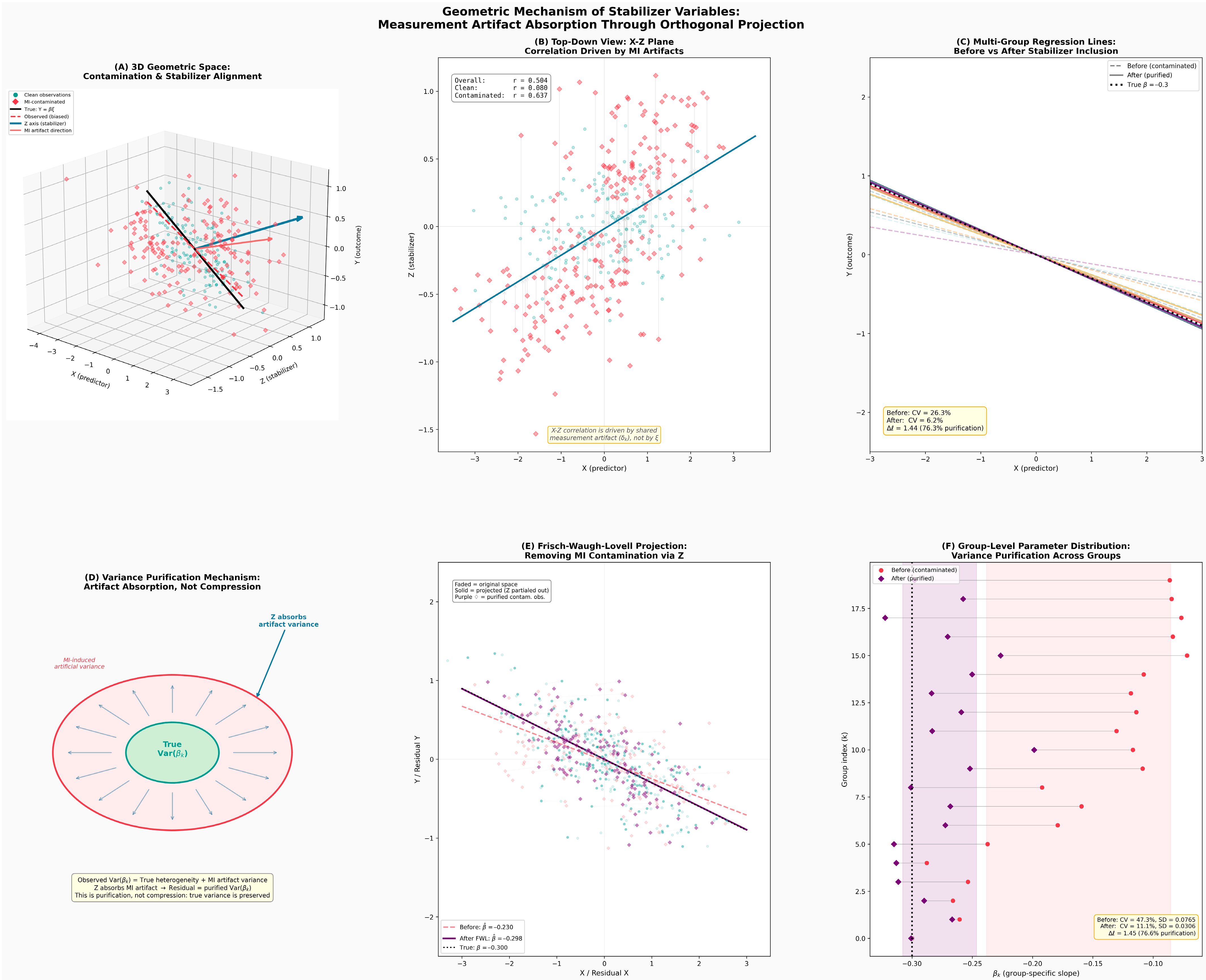
Figure 1 provides a geometric illustration of this mechanism across six panels. Panel (A) displays the three-dimensional space of the predictor X , the stabilizer Z , and the outcome Y , showing how MI-contaminated observations deviate from the true regression surface and how the stabilizer axis aligns with the artifact direction. Panel (B) presents the top-down X Z plane, demonstrating that the X Z correlation is driven by the shared measurement artifact δ k   rather than by the true latent variable ξ —a necessary condition for stabilization. Panel (C) shows multi-group regression lines before and after stabilizer inclusion, with group-specific slopes converging toward the true parameter value. Panel (D) provides a conceptual decomposition of observed parameter variance into true heterogeneity and MI-induced artificial variance, illustrating that Z absorbs only the artifactual component while preserving genuine between-group differences. Panel (E) demonstrates the Frisch–Waugh–Lovell projection [11] underlying the stabilizer mechanism: after partialing out Z from both X and Y , the residualized estimates recover the true β with substantially reduced bias. Panel (F) presents a dot plot of group-level parameter estimates across 20 groups, showing the convergence pattern and quantifying the variance purification effect through the log-ratio metric l .
This mechanism is fundamentally distinct from existing third-variable roles in multivariate analysis. A moderator explains heterogeneity through interaction effects [12]; a mediator transmits the focal effect through a causal chain [10]; a suppressor increases predictive validity by removing irrelevant variance from the predictor [13]. A stabilizer, by contrast, reduces artificial between-group heterogeneity by absorbing measurement-induced confounds while maintaining structural independence from the focal path. We formalize this distinction in Section 3.5.
Empirical Motivation. The stabilizer variable concept originated from an empirical observation in a multi-group structural equation model examining the relationship between chronotype (MEQ) and physical activity through biological rhythm regularity (BRIAN) across demographic subgroups. When path coefficient variability was assessed via the coefficient of variation, a paradoxical pattern emerged: groups violating measurement invariance exhibited lower CV values—greater parameter stability—than groups satisfying invariance. Systematic elimination of suppression effects, moderation, and mediation dynamics ruled out established mechanisms. The residual phenomenon pointed to a previously unrecognized role: a covariate that reduces MI-induced parameter heterogeneity without entering the causal pathway. This empirical puzzle motivated the formal development and Monte Carlo validation presented herein.
This article makes three contributions. First, we introduce the stabilizer variable as a formally defined category of third variables and establish its theoretical properties, including the conditions under which stabilization occurs and the mechanisms through which it operates (variance purification and directional alignment). Second, we develop the stabilizer variable test (SVT), a dual-criterion inference procedure that combines bootstrap hypothesis testing with binomial mechanism classification to detect and characterize stabilization effects. Third, we validate the SVT through comprehensive Monte Carlo simulations comprising over 949,000 generated datasets across varying group counts, sample sizes, MI severity levels, and noise conditions, demonstrating statistical power of 80–99% with false-positive rates below 2%.
The remainder of the paper is organized as follows. Section 2 introduces the notation for multi-group structural models and formalizes the bias mechanism induced by MI violations. Section 3 develops the theoretical framework, including the formal definition of stabilizer variables, the main theorems with proofs, the distinction between stabilization mechanisms, and the comparison with existing third-variable roles. Section 4 presents the SVT inference procedure and the Monte Carlo simulation design. Section 5 reports the results. Section 6 discusses the findings and Section 7 concludes with directions for future research.

2. Preliminaries and Notation

2.1. Multi-Group Structural Equation Models

Consider K distinct groups indexed by k = 1 ,   , K . For individual i in group k , the measurement model relates observed indicators y i k to latent constructs η i k through
y i k = τ k + Λ k η i k + ε i k ,
where τ k R p is the vector of intercepts, Λ k R p × q is the matrix of factor loadings, and ε i k ~ N ( 0 ,   Θ k ) is the measurement error vector, all potentially group-specific. The structural model specifies the relationship among latent variables:
η i k = B k η i k + Γ k ξ i k + ζ i k ,
where B k captures endogenous-to-endogenous effects, Γ k captures exogenous-to-endogenous effects, and ζ i k is the structural disturbance. In the simplest case of a single focal path ξ η , the structural equation reduces to
η i k = β k ξ i k + ζ i k ,
where β k is the group-specific structural coefficient of primary interest.

2.2. Measurement Invariance

Measurement invariance requires that the measurement parameters remain constant across groups. The standard testing hierarchy [14] proceeds through three increasingly restrictive levels:
(a)
Configural invariance: identical factor structure across groups (same pattern of zero/nonzero loadings).
(b)
Metric invariance: equal factor loadings, Λ k = Λ for all k , ensuring that the latent constructs are measured on the same scale.
(c)
Scalar invariance: equal intercepts, τ k = τ for all k , additionally ensuring that observed score differences reflect true latent mean differences.
(d)
Strict invariance: equal residual variances, Θ k = Θ for all k , ensuring that observed variable reliability is constant across groups and that any remaining variance differences are attributable to the latent factors.
When these conditions hold, cross-group comparisons of structural parameters β k are interpretable. When they fail, group-specific measurement parameters introduce systematic bias into the structural estimates.

2.3. Bias Induced by Measurement Non-Invariance

To formalize the propagation of MI violations into structural estimates, define the group-specific measurement deviation as
k = Λ k Λ ¯ ,
where Λ ¯ = 1 K k Λ k is the average loading matrix across groups. Under MI violation, the observed composite score for the predictor in group k can be decomposed as
X i k = w y i k = w ( τ k + Λ k η i k + ε i k ) ,
where w is a scoring weight vector (e.g., unit weights or factor score coefficients). Substituting Λ k = Λ ¯ + k and rearranging yields
X i k = w τ k + w Λ ¯ η i k + w k η i k + w ε i k ,
where w Λ ¯ η i k is the invariant signal component and w k η i k is the group-specific measurement artifact: a systematic bias component that is absent under MI (when k = 0 ) but present and potentially substantial when MI is violated.
The OLS estimator of the structural coefficient in group k is
β ^ k = C o v ( X i k , Y i k ) V a r ( X i k ) ,
where Y i k is the observed outcome, and the covariance and variance are taken with respect to the joint distribution within group k . Substituting the decomposition from Equation (6) and the structural model
Y i k = β k ξ i k + ζ i k ,
(where β k is the true structural coefficient and ζ i k is the disturbance uncorrelated with ξ i k ), the estimator can be written as
β ^ k = β k + b k ,
where the bias component is
b k = C o v ( w k η i k , Y i k ) V a r ( X i k ) .
Expanding via η i k = β k ξ i k + ζ i k , using linearity of covariance and the structural independence condition C o v ξ i k , ζ i k = 0 , gives
C o v w k η i k , Y i k = β k C o v w k ξ i k , ξ i k = β k w k V a r ξ i k .
Therefore,
b k = β k V a r ( ξ i k ) V a r ( X i k ) w k .
This bias term is nonzero whenever k 0 . Crucially, because k is group-specific, the bias varies across groups even when the true structural coefficient β k is constant, creating artificial heterogeneity in the set β ^ 1 , , β ^ K . The cross-group variance of the estimated coefficients can therefore be decomposed as
V a r k β ^ k = V a r k β k + V a r k b k + 2 C o v k ( β k , b k ) ,
where V a r k and E k ( ) denote variance and expectation taken over the group index k . Here, V a r k β k represents genuine structural heterogeneity and V a r k b k represents the artificial component induced by MI violations. The cross-term C o v k ( β k , b k ) reflects the association between true structural effects and measurement deviations across groups. It is this decomposition—and specifically the artificial component V a r k b k —that the stabilizer variable framework targets.

3. Theoretical Framework

3.1. Definition of a Stabilizer Variable

Definition 1 
(Stabilizer Variable). Let  β ^ 1 , , β ^ K  denote the group-specific estimates of a focal structural path  ξ η  in a multi-group model with  K 3  groups. A variable Z is a stabilizer for this path if the following two conditions are satisfied:
(C1) Confound correlation:  Z  is correlated with the group-specific measurement artifacts, i.e.,  C o v ( Z , w k η ) 0  for at least a subset of groups k, where  k = Λ k Λ ¯  denotes the group-specific deviation in factor loadings.
(C2) Structural independence:  Z  does not participate in the focal structural relationship, i.e.,  β / Z = 0  and  2 η / ξ Z = 0 . In particular,  Z  is neither a mediator (no causal chain:  ξ Z η ) nor a moderator (no interaction:  ξ × Z η ) of the focal path.
When both conditions hold, including Z as a covariate in the structural model absorbs the measurement-induced component of β ^ k heterogeneity, yielding adjusted estimates β ^ k ( Z ) with reduced artificial dispersion.
Remark 1. 
Condition C2 requires that  Z  does not alter the structural relationship of interest:  β / Z = 0 . Statistically, this implies approximate orthogonality between  Z  and the focal path—  Z ’s inclusion in the model should not change the direction or magnitude of  X ’s effect on  Y  across groups. C2 is testable but not perfectly verifiable, a property it shares with other foundational structural assumptions such as the exclusion restriction in instrumental variable estimation [15] and the sequential ignorability assumption in mediation analysis [16]. Standard interaction tests evaluate  H 0 : β ξ × Z = 0 , but failure to reject this null does not constitute positive evidence for C2—it may simply reflect insufficient power. We therefore recommend the two one-sided tests (TOST) equivalence testing procedure as a more rigorous diagnostic: TOST evaluates whether  β ξ × Z  falls within a pre-specified equivalence bound (e.g.,  β ξ × Z < 0.1 ), providing affirmative evidence that the interaction is negligibly small rather than merely nonsignificant. Phase 2D of the Monte Carlo study demonstrates that even when C2 is violated at  β ξ × Z = 0.25 —a substantively meaningful interaction—the dual-criterion false positive rate remains between 0.6% and 1.1%, establishing that exact verification of C2 is not required for safe SVT application. Condition C1 requires  C o v ( Z , w Δ k ) 0 , where  k  represents group-specific loading deviations that are not directly observed. Because  k  is latent, C1 cannot be tested directly. However, its consequences produce four testable predictions that provide convergent evidence: (i) MI-complementarity—moderators with larger MI violations should exhibit stronger stabilization (larger  l ) upon  Z ’s inclusion, testable by correlating  S M I  with moderator-specific  l  values; (ii) stratified correlation analysis—the  X Z  correlation should be systematically stronger in groups with larger MI violations; (iii) cross-moderator consistency—a genuine stabilizer should produce  l > 0  across multiple independent grouping variables, not just one; (iv) partial invariance linkage— Z  should correlate specifically with indicators whose measurement parameters are non-invariant. This identification status parallels the exclusion restriction in IV estimation: not directly testable, but assessable through convergent diagnostics and theoretical reasoning.

3.2. Theorem 1: Variance Decomposition and MI-Driven Dispersion

Theorem 1. 
Let  β ^ k  denote the group-specific OLS estimate of the focal path based on the observed composite predictor  X i k ,  and let  b k  denote the MI-induced bias component defined in Equation (10), so that  β ^ k = β k + b k . Then:
(i)
The cross-group variance admits the exact decomposition given in Equation (11).
(ii)
If the loading deviations are heterogeneous across groups (i.e.,  k k  for some  k k  ) and the scaling factor  s k = β k V a r ξ i k / V a r X i k  is not constant and not identically zero across groups, then
V a r k b k > 0 .
(iii)
The squared bias in each group satisfies the upper bound
b k 2 s k 2 w 2 k 2 ,
where  s k = β k V a r ξ i k / V a r X i k , so that larger MI deviations (in norm) imply larger potential bias magnitude and, consequently, larger artificial dispersion in  β ^ k .
Proof. 
  
Part (i). This follows directly from the identity β ^ k = β k + b k and the standard variance decomposition of a sum:
V a r k β ^ k = V a r k β k + b k = V a r k β k + V a r k b k + 2 C o v k β k , b k .
Part (ii). From Equation (10), the bias in group k is
b k = s k w Δ k ,
where s k = β k V a r ξ i k / V a r X i k . The cross-group variance is
V a r k b k = V a r k s k w k .
If s k is constant across groups ( s k = s for all k ), this simplifies to
V a r k b k = s 2 V a r k ( w k ) ,
which is strictly positive whenever w k varies across groups—that is, whenever the loading deviations are heterogeneous in the direction of the scoring weights. More generally, when s k varies across groups, the product s k w k has positive variance provided that at least one of the sequences ( s k ) or ( w k ) is non-constant across groups and neither sequence is identically zero.
Part (iii). From b k = s k w k , we have b k 2 = s k 2 w k 2 . By the Cauchy–Schwarz inequality [17], w k 2 w 2 k 2 . Therefore, b k 2 s k 2 w 2 k 2 . This establishes that the squared bias magnitude is bounded above by a quantity proportional to k 2 , confirming that larger MI deviations produce larger potential bias. □
Remark 2 
(Role of the cross-term). The decomposition in Equation (11) includes the cross-term  2 C o v k ( β k , b k ) , which reflects whether groups with larger true effects also tend to have larger measurement artifacts. Three cases are relevant:
(a)
If  β k  and  k  are independent across groups (e.g., measurement properties are unrelated to the strength of the structural effect), then  C o v k β k , b k = 0 , and  V a r k β ^ k = V a r k ( β k ) + V a r k ( b k ) > V a r k ( β k ) .
(b)
If groups with larger true effects also tend to have larger measurement deviations (a positive association), then  C o v k β k , b k > 0 , and the inflation is amplified.
(c)
If the association is negative, the cross-term partially offsets  V a r k ( b k ) . However, even in this case,  V a r k β ^ k V a r k ( β k ) , and strictly greater when  V a r k ( b k ) > 2 C o v k β k , b k , which holds when MI violations are sufficiently heterogeneous.
In all three cases, the presence of heterogeneous MI violations ( V a r k b k > 0 ) contributes to inflating the observed cross-group dispersion of parameter estimates beyond what genuine structural heterogeneity alone would produce.
Remark 3 
(Lower bound under alignment assumption). If a uniform lower bound on  V a r k β ^ k  is desired, one may impose the additional assumption that the loading deviations are not orthogonal to the scoring weights:  w k c 0 k  for all  k  and some constant  c 0 > 0 . Combined with the independence assumption  C o v k β k , b k = 0 , this yields
V a r k β ^ k V a r k β k + c 0 2 i n f k s k 2 E k k 2 .
This bound is useful for theoretical analysis but requires stronger assumptions than the main result in Theorem 1.

3.3. Theorem 2: Variance Purification via Stabilizer Inclusion

Theorem 2 
.  Let  Z  be a stabilizer variable satisfying conditions (C1) and (C2) of Definition 1. Let  β ^ k ( 0 )  denote the unadjusted group-specific estimator and  β ^ k ( 1 )  denote the adjusted estimator obtained by including  Z  as a covariate. Then
V a r k β ^ k ( 1 ) V a r k β ^ k 0 ,
with strict inequality when  C o r Z , w k 0   for at least two groups. Equivalently, the log-ratio stabilization metric
l = log C V β 0 log C V β 1 > 0 ,
where  C V ( j ) = σ k β ^ k ( j ) μ k β ^ k ( j )   denotes the coefficient of variation in the group-specific estimates.
Proof. 
The proof proceeds via the FWL theorem [11]. By the FWL theorem, β ^ k ( 1 ) in the regression of Y on ( X , Z ) equals the coefficient of X in the regression of M Z Y on M Z X , where M Z = I Z Z Z 1 Z is the residual-maker matrix that projects orthogonally to Z . The residualized predictor is
M Z X i k = X i k γ ^ k Z i k ,
where γ ^ k = C o v X i k , Z i k V a r Z i k . Recall from Equation (6) that:
X i k = w τ k + w Λ ¯ η i k + w k η i k + w ε i k .
By condition (C1), Z is correlated with the artifact term w k η i k . Therefore, the projection absorbs a portion of this artifact, yielding
M Z X i k = w τ k + w Λ ¯ η i k + 1 ρ Z , δ k 2 w k η i k + w M Z ε i k ,
By condition (C2), Z is structurally independent from the focal path, so the projection does not remove the genuine structural component from Y :
M Z Y i k = β k ξ i k + ζ i k + v i k ,
where C o v v i k , ξ i k = 0 . The adjusted estimator’s bias in group k is therefore
b k ( 1 ) = 1 ρ Z , δ k 2 b k ( 0 )
which implies b k ( 1 ) b k ( 0 ) . Consequently,
V a r k b k ( 1 ) = V a r k 1 ρ Z , δ k 2 b k 0 V a r k b k 0 ,
and since the genuine heterogeneity is unchanged,
V a r k β ^ k ( 1 ) = V a r k β k + V a r k b k 1 V a r k β k + V a r k b k 0 = V a r k β ^ k 0 .
The log-ratio metric l > 0 follows directly, since C V ( 1 ) < C V ( 0 ) under structural independence. □
Remark 4 
(Regularity Conditions). The proofs above require: (a)  V a r X i k > 0  and  V a r Z i k > 0  in each group; (b)  β k <  (the true structural coefficient is bounded); and (c) the FWL projection is well-defined, meaning  Z k R n k × p  has full column rank  p  (with each group). These conditions are standard in regression analysis and are satisfied in all practical applications with  K 3  and  n k 30 .
Remark 5 
(Purification, Not Compression). The stabilizer reduces observed heterogeneity by removing its artificial component, not by compressing genuine between-group differences. This is guaranteed by condition (C2): if the true structural coefficients genuinely differ across groups ( V a r k β k > 0 ), these differences are preserved after stabilizer inclusion. Only the MI-induced artifact variance  V a r k b k  is absorbed. This property distinguishes the stabilizer from approaches that reduce heterogeneity by imposing constraints (e.g., equality constraints in partial invariance models), which may inadvertently mask genuine differences.

3.4. Stabilization Mechanism

The variance purification established in Theorem 2 can manifest through two distinct mechanisms, either or both of which may be operative.
Type A: Variance Purification. The cross-group dispersion of coefficients decreases: σ k β ^ k ( 1 ) < σ k β ^ k ( 0 ) . This occurs when Z absorbs group-specific bias terms that inflate the spread of estimates around their mean. The stabilization metric l > 0 captures this mechanism directly.
Type B: Directional Alignment. The group-specific coefficients converge toward a common center after stabilizer inclusion. Formally, for each group k , define the alignment indicator
I k = 1 β ^ k ( 1 ) β ¯ ( 1 ) < β ^ k ( 0 ) β ¯ ( 0 ) ,
where β ¯ ( j ) = μ k β ^ k ( j ) . The orientation consistency ratio is
O C R = 1 K k I k ,
which measures the proportion of groups whose estimates move closer to the grand mean after stabilizer inclusion. A stabilizer with directional alignment yields O C R > 0.5 systematically across moderators.
Type AB: Combined Mechanism. When both variance purification ( l > 0 ) and directional alignment ( O C R > 0.5 ) are simultaneously significant, the stabilizer operates through the combined mechanism. To characterize the dominant mechanism in a given application, we define the orientation share metric
O S = log μ log μ + log σ + ε ,
where log μ = log β ¯ ( 0 ) log β ¯ ( 1 ) and log σ = log σ ( 0 ) log σ ( 1 ) . Values of OS near zero indicate pure variance purification (Type A), values near one indicate pure directional alignment (Type B), and intermediate values indicate a mixed mechanism (Type AB).

3.5. Distinction from Existing Third-Variable Roles

Stabilizer variables constitute a fourth functional category of third variables in multivariate analysis, distinct from the three established categories. Table 1 summarizes the formal distinctions.
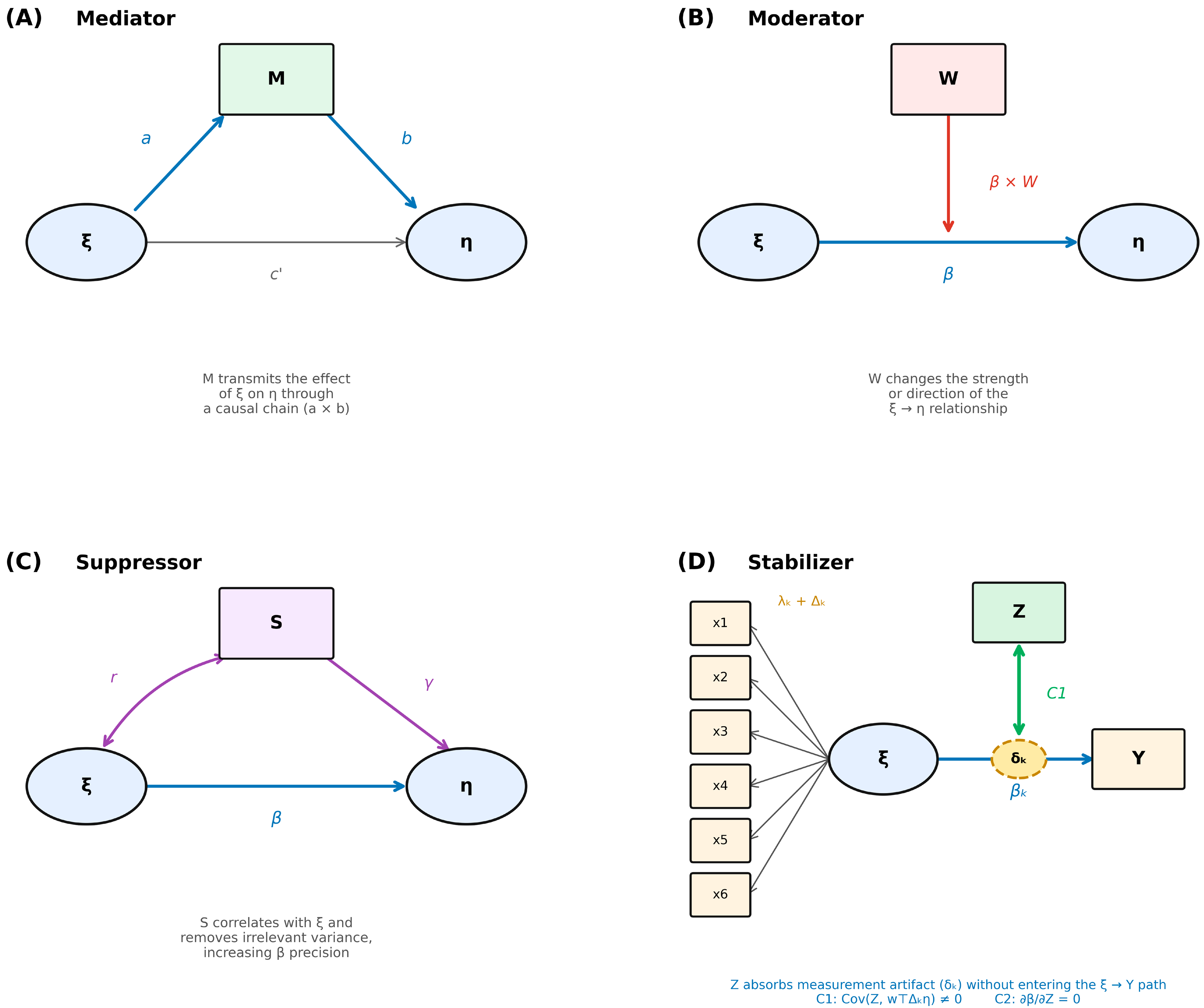
Figure 2 provides corresponding path diagrams illustrating the structural role of each variable type.
A moderator W explains between-group heterogeneity through interaction [18]: the relationship between ξ and η varies as a function of W , so that β k = β 0 + β 1 W k + ε k . The moderator accounts for heterogeneity by modeling its source; it does not reduce it. A mediator M decomposes the focal effect into direct and indirect components ( ξ η and ξ M η ) [10,18], operating within groups rather than across them. Mediation does not address between-group parameter heterogeneity. A suppressor S increases the predictive validity of ξ within a group by removing irrelevant variance from ξ that is uncorrelated with η . Suppression is a within-group, within-model phenomenon that does not target cross-group dispersion [19,20].
A stabilizer Z reduces artificial between-group heterogeneity in β ^ k ( 1 ) by absorbing the measurement-induced bias component. Unlike a moderator, Z does not interact with ξ ( β ξ × W = 0 ) . Unlike a mediator, Z does not transmit the focal effect. Unlike a suppressor, Z operates across groups rather than within them, and its mechanism depends specifically on MI violations. The stabilizer’s unique property is the conjunction of confound correlation (C1) and structural independence (C2): it is connected to the measurement process but disconnected from the structural relationship. This conjunction is depicted in Figure 2D, where Z connects to the measurement artifact δk (dashed ellipse) but has no path to or from the ξ → Y structural relationship.

3.6. Additional Remarks

Remark 6 
(Projection Efficiency). The stabilizer’s effectiveness is bounded by  ρ Z , δ k 2 ,  the squared correlation between  Z  and the group-specific artifact ( C o r 2 ( Z ,   w k η ) ). Perfect stabilization (complete removal of artificial heterogeneity) requires  ρ Z , δ k 2 = 1  for all  k , which is unlikely in practice.
Remark 7 
(Multiple Stabilizers). The framework extends naturally to multiple stabilizer variables  Z 1 ,   ,   Z m , where the combined projection  M Z 1 ,   , Z m absorbs a larger portion of the artifact variance. The conditions generalize straightforwardly: each  Z j  must satisfy (C1) and (C2) independently.
Remark 8 
(Relation to Pfister et al. [21]). Pfister et al. proposed stabilizing variable selection in the context of single-group regression to identify variables with stable predictive relationships across environments [21]. Despite the terminological overlap, their framework addresses a fundamentally different problem: variable selection for causal inference under distributional shift, not the reduction in measurement-induced parameter heterogeneity in multi-group models. Their stability criterion concerns whether a predictor’s coefficient remains constant across environments; our stabilizer criterion concerns whether a covariate can absorb measurement artifacts that inflate between-group coefficient variation. The two concepts are complementary but formally distinct.
Remark 9 
(Generalizability beyond SEM). The stabilization mechanism formalized in Theorems 1 and 2 operates on collections of group-specific regression coefficients β ^ k and does not depend on the estimation framework through which these coefficients are obtained. Theorem 1 establishes that measurement inconsistencies across groups inflate between-group parameter variance; Theorem 2 establishes that a covariate satisfying conditions C1–C2 reduce this variance through FWL projection. This mechanism applies whenever (a) parameters are estimated separately across multiple units (groups, sites, countries, devices, or studies), (b) measurement inconsistencies across units introduce systematic heterogeneity in these estimates, and (c) an observable covariate correlates with the measurement artifact but not with the structural relationship of interest. Multi-site clinical trials with heterogeneous assessment protocols, cross-national educational assessments where translation and cultural adaptation introduce loading deviations [22], multi-country panel econometric models where national statistical offices employ different survey methodologies [23], meta-analytic synthesis where between-study heterogeneity partly reflects measurement differences [24], and multi-device parameter estimation in nonlinear dynamic systems subject to calibration inconsistencies [25,26,27] all involve structurally analogous problems. Whether the stabilizer framework can be productively applied in each of these settings—and what adaptations to the testing procedure would be required—remains an open question that merits dedicated investigation.

4. Materials and Methods

The theoretical framework in Section 3 established that a stabilizer variable Z reduces MI-induced heterogeneity (Theorem 2) through variance purification, directional alignment, or both, and introduced the metrics l , O C R , and O S to quantify these effects (Equations (16), (24) and (25)). This section translates those theoretical constructs into a practical inference procedure—the stabilizer variable test (SVT)—and describes the Monte Carlo simulation design used to evaluate its statistical properties.

4.1. The Stabilizer Variable Test

The SVT is a hypothesis-testing procedure that evaluates whether a candidate variable Z satisfies the stabilizer conditions of Definition 1 in a given multi-group dataset. The procedure integrates three sequential steps: (i) assessment of MI severity, which establishes that meaningful violations exist and stabilization is warranted; (ii) quantification of stabilization magnitude, which measures whether Z reduces between-group dispersion; and (iii) dual-criterion inference, which tests whether the observed reduction is statistically significant and directionally consistent across groups. We describe each step below, beginning with the formal hypothesis.

4.1.1. Hypothesis and Test Logic

Let β ^ k ( 0 ) and β ^ k ( 1 ) denote the group-specific structural coefficient estimates from the baseline and adjusted models, respectively, as defined in Section 3. The SVT evaluates the null hypothesis
H 0 : E ( l 0 , (no stabilization)
against the one-sided alternative
H 1 : E ( l > 0 , (stabilization exists),
where l = log C V β 0 log C V β 1 is the log-ratio stabilization metric defined in Equation (16). Rejection of H 0 requires joint evidence from two complementary criteria: a bootstrap test for the magnitude of dispersion reduction (Criterion 1), and a binomial test for the directional consistency of that reduction across groups (Criterion 2).
The rationale for requiring two criteria rather than one is as follows. A candidate variable might reduce the overall CV by chance—for example, through a single outlier group shifting dramatically—yet fail to produce systematic convergence across groups. Such a variable would pass a magnitude test but should not be classified as a stabilizer, because the observed reduction does not reflect the systematic confound-absorption mechanism formalized in Theorem 2. Conversely, a variable might align most groups toward the mean without producing a statistically significant reduction in aggregate dispersion, particularly when K is small. Requiring both criteria to be satisfied simultaneously ensures that identified stabilizers exhibit genuine, systematic confound absorption rather than statistical artifacts.

4.1.2. Step 1: Adaptive Measurement Invariance Assessment

Stabilizer detection presupposes the existence of MI violations that induce parameter instability; without such violations, the artifactual component V a r k ( b k ) in Equation (11) is negligible and stabilization is unnecessary. The SVT therefore begins by assessing MI severity. This step addresses a practical question: is there enough measurement non-invariance in the data to warrant searching for a stabilizer?
Traditional MI assessment follows a sequential constraint approach [19,20]: beginning with a configural model that establishes equal form across groups, researchers progressively test metric invariance (equal factor loadings), scalar invariance (equal intercepts), and strict invariance (equal residual variances). For each nested comparison, four fit indices are extracted: CFI (comparative fit index), TLI (Tucker–Lewis index), RMSEA (root mean square error of approximation), and SRMR (standardized root mean square residual) [28,29]. Model comparison typically relies on chi-square difference tests ( Δ χ 2 ) or practical fit indices such as C F I . However, chi-square tests are sensitive to sample size, often rejecting invariance even when violations are trivially small [5,30,31]. Practical fit indices address this limitation by evaluating substantive model degradation, quantified as j = I j ,   c o n s t r a i n e d I j , b a s e l i n e for each index j , where negative j values for CFI/TLI and positive j values for RMSEA/SRMR indicate worsening fit. According to Chen [5] and subsequent studies [5,22,32] changes within C F I = 0.01 , T L I = 0.01 , R M S E A = 0.015 , S R M R = 0.03 are generally considered acceptable for metric invariance, whereas a stricter cutoff of S R M R = 0.01 is typically applied for scalar invariance [5,32].
However, the binary approach—comparing each j to a fixed threshold and declaring “invariant” or “non-invariant”—discards potentially valuable information about the degree of violation. Moreover, combining the four fit indices into a single severity measure requires addressing two practical difficulties.
The first difficulty is redundancy. CFI and TLI are both incremental fit indices derived from similar baseline comparisons, and in multi-group models they tend to be highly correlated [29]. Treating them as independent pieces of evidence would overweight one dimension of model fit at the expense of others. The second difficulty is heterogeneous sensitivity. Different fit indices respond differently to MI violations depending on model size, group count, and sample size. An index that fluctuates wildly across grouping variables provides less reliable information than one that responds consistently. Additionally, some indices are better than others at discriminating between conditions where MI holds versus where it fails—RMSEA and SRMR, for example, tend to show only moderate intercorrelation and capture distinct residual-based aspects of model misspecification [28,33,34,35].
To address these difficulties, the SVT computes a calibrated composite score S M I that integrates the four fit indices with adaptive weights. The weights are constructed from three components, each targeting one of the problems identified above. The components are computed over the M available grouping variables (moderators), where each grouping variable m produces one set of values from the sequential MI testing. Throughout the scoring system, a small numerical stability constant ε is added to denominators that could approach zero; the reference implementation uses ε = 10 3 for the variability score and ε = 10 8 for weight normalization (see Supplementary Materials, Section S4.3 for complete implementation details). The complete pseudocode for the adaptive MI scoring procedure is given in Appendix B (Algorithm A1).
Redundancy Penalty ( R P j ). The first component quantifies how much unique information each fit index contributes beyond what is already captured by the other indices. For each index j C F I ,   T L I ,   R M S E A ,   S R M R , compute the mean absolute pairwise correlation with all other indices:
r ¯ j = 1 ( F 1 ) j F \ j C o r ( j , j ) ,
where the correlations are taken across M grouping variables (i.e., each grouping variable m produces one set of values, and the correlation is computed over this set). The redundancy penalty is then
R P j = 1 1 + r ¯ j .
The logic is straightforward: The mapping 1 / ( 1 + r ¯ j ) was chosen over the simpler alternative 1 r ¯ j for a specific reason: it provides a diminishing penalty that never drives the weight to zero, even at perfect correlation. When an index is completely uncorrelated with the others ( r ¯ j = 0 ), R P j = 1 and the index receives full weight. When an index is perfectly correlated with all others ( r ¯ j = 1 ), R P j = 0.5 —the contribution is halved but not eliminated. This is appropriate because even a highly redundant index still carries valid information about MI severity; eliminating it entirely (as 1 r ¯ j would do at r ¯ j = 1 ) would discard genuine diagnostic content. In practice, CFI and TLI typically produce r ¯ values around 0.85–0.95, yielding R P values of approximately 0.51–0.54, while RMSEA and SRMR—which capture distinct residual-based aspects of misspecification [14]—tend to have lower r ¯ values (0.40–0.60) and correspondingly higher R P values (0.63–0.71). This ensures that the composite does not double-count the information shared by CFI and TLI while preserving their individual contributions.
Variability Score ( V S j ). The second component rewards indices that respond consistently across grouping variables—that is, indices whose values do not fluctuate wildly from one moderator to the next. For each index j , compute the coefficient of variation in its values across the M grouping variables:
C o V j = σ m ( ~ j ( m ) ) μ m ~ j ( m ) + ε ,
where ~ j ( m ) denotes the threshold-normalized value of index j for the m -th grouping variable (defined in Equations (34) and (35) below). The variability score is
V S j = 1 1 + C o V j .
The 1 / ( 1 + ) form maps the unbounded C o V 0 , ) to a bounded score V S 0,1 , following the same diminishing-return logic as the redundancy penalty. The rationale for rewarding consistency is intuitive: an index that consistently detects C F I = 0.015 across all grouping variables provides a more reliable signal about MI severity than one that yields R M S E A = + 0.003 for some variables but + 0.025 for others. The V S score captures this distinction—indices with low C o V (stable responses) receive V S values close to 1, while highly variable indices are down-weighted toward 0.5 or lower.
Discriminant Power ( D P j ). The third component measures how well each index separates grouping variables that satisfy MI from those that do not. This is important because an index might be stable and non-redundant yet poor at actually detecting violations—it would receive high RP and VS scores but contribute little diagnostic information.
The discriminant power is computed using a global invariance classification rather than index-specific partitions. A grouping variable m is classified as globally invariant if all four fit indices satisfy their respective Chen [5] thresholds across all tested invariance stages (metric, scalar, and, when available, strict):
I = m : j m , s c j ,     j F ,   s   s ,
V = m : m I ,
where F denotes the set of fit indices and s denotes the set of tested invariance stages.
This global partition—rather than defining separate partitions for each index j —reflects the conjunctive decision logic underlying measurement invariance assessment. In practice, invariance is established only when all fit indices simultaneously satisfy their respective thresholds; conversely, violation of any single index is sufficient to reject invariance. Thus, the classification operates as a logical intersection across indices rather than independent index-specific decisions. The global partition ensures that the discriminant power of each index is evaluated relative to moderators that are truly invariant versus those exhibiting any form of violation.
For each index j , the discriminant power is defined as
D P j = max 0 , μ j ( m ) m V μ j m m I .
where j denotes the threshold-normalized index change.
The truncation operator m a x ( · , 0 ) serves an essential theoretical function. It prevents an index from receiving positive discriminant credit when the non-invariant group exhibits smaller normalized changes than the invariant group, which would contradict the fundamental expectation that measurement invariance violations produce larger fit index deviations. This one-sided formulation enforces directional consistency between theoretical expectation and empirical behavior, ensuring that only indices whose responses align with the expected direction of invariance violations contribute positively to the composite measure.
Finally, if either I or V is empty—that is, if all moderators are classified uniformly as invariant or non-invariant—then D P j = 0 ,     j and the composite measure defaults to zero. This conservative behavior appropriately reflects the absence of discriminative structure in the data.
Combining the Components. The three calibration factors are multiplied together and normalized to produce the final weight for each index:
w j = R P j V S j D P j j F R P j V S j D P j + ε .
where ε prevents division by zero in the degenerate case where all four indices have D P j = 0 (which occurs when all moderators are globally invariant or globally non-invariant). In this case, all weights default to zero and S M I = 0 , correctly indicating that the scoring system cannot discriminate.
The multiplicative combination R P j × V S j × D P j is deliberate rather than additive (e.g., averaging). It enforces a conjunctive logic: an index must score reasonably on all three dimensions—uniqueness, stability, and discriminative ability—to receive substantial weight. Under an additive scheme, a high score on one dimension could compensate for a zero on another; under multiplication, any near-zero factor drives the product to near-zero. An index that is highly discriminating but completely redundant with another ( R P 0.5 ) will be down-weighted regardless of its other properties. Similarly, an index that is unique and stable but cannot distinguish invariant from non-invariant conditions ( D P 0 ) will receive near-zero weight regardless of its other properties. This ensures that only indices contributing genuinely useful, non-redundant, and reliable information influence the composite.
Threshold Scaling and Composite Score. When multiple invariance stages are tested (e.g., metric, scalar, strict), each stage produces its own set of j values. To ensure that the composite reflects the most severe violation detected at any stage—because overall MI assessment is only as secure as its weakest invariance level—the maximum absolute change across stages is retained for each index j and each moderator m :
j ( m ) = max s j ( m , s ) .
where s indexes the invariance stages. This worst-case selection is analogous to the global invariance partition above: if a measurement model passes metric invariance but fails scalar invariance, the scalar-stage violation governs the severity assessment. In the reference implementation, negative values for CFI/TLI are first rectified (i.e., replaced by their absolute values), so that all indices are expressed in a common “violation magnitude” metric before the maximum is taken.
Each j ( m ) value is then scaled relative to its Chen [21] threshold to express it in standardized severity units, and capped at 1:
~ j ( m ) = min j ( m ) c j , 1 .
The capping operator m i n ( · , 1 ) serves a critical normalization function. Specifically, it prevents any single extreme invariance violation from disproportionately dominating the composite score, regardless of its absolute magnitude. Without this cap, an index with j m c j = 5 (i.e., five times the conventional threshold) would contribute five times more than one at the threshold, potentially masking the information from the other three indices. The cap normalizes all scaled values to the 0,1 interval, so that ~ j = 0 indicates no change, ~ j = 0.5 indicates half the conventional threshold, and ~ j = 1 indicates that the threshold has been reached or exceeded. Because the weight w j already reflects how informative index j is (via R P , V S , D P ), the severity information within each index is appropriately bounded—the relative importance of indices is handled by the weights, while the magnitude within each index is standardized by the cap. The overall MI-severity composite is then the weighted sum:
S M I = j F w j ~ j .
By construction, S M I 0 ,   1 : when all indices show no change ( ~ j = 0 for all j ), S M I = 0 ; when all indices reach or exceed their thresholds and receive nonzero weights, S M I approaches 1. Higher values indicate greater non-invariance severity. Importantly, S M I is a continuous measure rather than a binary decision. This preserves information about the degree of violation—a dataset with S M I = 0.85 has substantially more severe violations than one with S M I = 0.4 , and this distinction matters for interpreting the expected magnitude of stabilization. The composite functions as what we term a continuous soft gate: when S M I exceeds substantively meaningful levels, the SVT proceeds to evaluate whether a candidate stabilizer variable reduces this instability in Step 2; when S M I is near zero, stabilization is unlikely to be necessary and the procedure can terminate early without testing candidates.
The Phase 0 validation study (3600 simulations; full results in Supplementary Materials, Section S5.0) confirmed that this adaptive scoring system behaves as intended: S M I remains appropriately quiescent (near zero) when MI violations are negligible, increases monotonically with violation severity (Spearman ρ > 0.94 across all sample sizes), and retains substantially more information than binary Chen-threshold classification.
A weight-sensitivity ablation study using the same 3600 replications compared five weighting variants—full adaptive (RP × VS × DP), discriminant power only, RP × DP, VS × DP, and equal weights (0.25 each)—and found that all variants achieved mean AUC within 0.003 of one another, confirming that the scoring system is robust to weight specification (Supplementary Materials, Section S5.0.7).

4.1.3. Step 2: Stabilization Quantification

Having established the presence of measurement invariance violations (Step 1), the SVT next quantifies whether the candidate variable Z reduces the resulting cross-group instability in the structural parameter of interest. Two multi-group models are estimated. The baseline model, Y i k = α k 0 + β ^ k 0 X i k + e i k 0 , excludes the candidate stabilizer Z , whereas the adjusted model,
Y i k = α k 1 + β ^ k 1 X i k + γ k Z i k + e i k 1 ,
includes Z as a covariate. In both models, intercepts and slopes are freely estimated across groups. This unconstrained specification is essential: constraining slopes to equality would mechanically reduce cross-group dispersion, thereby confounding genuine stabilization with model-imposed homogeneity.
For each model m 0 ,   1 , cross-group dispersion is quantified using the coefficient of variation (CV):
C V ( m ) = σ k ( β ^ k m ) μ k β ^ k m + ε .
where μ k ( ) and σ k ( ) denote the sample-size-weighted mean and standard deviation across the K groups, and ε 1 > 0 is a numerical stability constant (reference implementation: ε 1 = 10 4 ). This protection is necessary because the denominator may approach zero when group-specific effects are symmetrically distributed around zero—a situation reflecting genuine heterogeneity rather than numerical pathology. For interpretability, CV is expressed as a percentage in implementation, although this scaling cancels in subsequent log-ratio comparisons. The overall stabilization magnitude is defined using the log-ratio metric:
l = log C V 0 + ε log C V 1 + ε .
where ε 2 > 0 is a logarithmic safeguard constant preventing undefined values when cross-group dispersion is exactly zero. This safeguard is distinct from ε 1 , as it protects against the theoretical possibility that all group-specific estimates are identical. Positive values of l indicate stabilization (reduced dispersion), l = 0 indicates no change, and negative values indicate destabilization.
In multi-group SEM, standardized coefficients β ^ k , s t d ( m ) = β ^ k ( m ) × σ ( ξ k ) σ ( η k ) are typically used for cross-group comparisons [1,36,37,38]. Conditioning on Z can reduce heterogeneity both in the raw structural coefficients β ^ k and in the group-specific scale ratio σ ξ k / σ ( η k ) , thereby producing a dual stabilization effect. Positive values of l computed from standardized coefficients thus reflect genuine absorption of systematic between-group distortion rather than trivial rescaling effects.
To enable group-level inference in Step 3, we additionally define the group-specific stabilization contribution as
d k = β ^ k ( 0 ) β ¯ ( 0 ) β ^ k ( 1 ) β ¯ ( 1 ) .
where β ¯ ( m ) = μ k β ^ k m . Positive values of d k indicate that the group-specific estimate moved closer to the cross-group mean after conditioning on Z , reflecting local stabilization. Negative values indicate divergence from the mean, inconsistent with stabilizing behavior. Because group-specific estimates differ in precision, we aggregate group-level effects using sample-size weights:
d ¯ w = k = 1 K n k d k k = 1 K n k ,
σ w 2 = k = 1 K n k d k d ¯ w 2 k = 1 K n k .
This weighting scheme aligns with standard meta-analytic principles, where more precise group-level estimates receive greater influence in the aggregate stabilization assessment [39].

4.1.4. Step 3: Dual-Criterion Inference

The third step tests whether the stabilization quantified in Step 2 is statistically significant. Two complementary criteria are evaluated, each targeting a distinct aspect of stabilization. The candidate Z is classified as a stabilizer only when both criteria are simultaneously satisfied.
Criterion 1: Bootstrap test for mean stabilization. The first criterion asks: is the average stabilization effect significantly greater than zero? This directly tests the variance-purification mechanism (Type A) established in Theorem 2.
The sampling distribution of l depends on the unknown joint distribution of group-specific effects, which may be non-normal and heteroscedastic. To avoid distributional assumptions, we employ nonparametric bootstrap inference [34,40,41]. Two standard approaches are available: (a) group-level bootstrap, which resamples K groups with replacement and recomputes the test statistic; and (b) sign-flip permutation, which randomly reverses the sign of centered group-level effects to construct a null distribution. Both preserve the within-group correlation structure inherent in group-level analysis.
The reference implementation adopts the sign-flip approach: for each of B iterations ( b = 1 ,   ,   B ) , the centered stabilization effects δ k = β ^ k ( 1 ) β ^ k 0 d ¯ w are randomly multiplied by either +1 or −1 with equal probability, and the corresponding test statistic l ( b ) is recomputed. This procedure enforces the null hypothesis that the direction of stabilization is exchangeable across groups while preserving the original magnitude structure of the data. The one-tailed p-value is then computed as the proportion of permutation samples whose test statistic equals or exceeds the observed value:
p p e r m = 1 B b = 1 B 1 ( l ( b ) l )
where 1 ( ) denotes the indicator function. For the group-level bootstrap variant (used in the empirical application and recommended for general practice), K groups are resampled with replacement from the original 1 , , K , and the weighted mean d ¯ w ( b ) is recomputed using the corresponding sample sizes. Resampling groups rather than individual observations preserves the within-group correlation structure, which is essential because group membership is the unit of analysis for stabilization effects.
Both approaches yield a resampling distribution from which we obtain
S E b o o t = S D d ¯ w ( 1 ) , ,   d ¯ w ( B ) ,
z = d ¯ w S E b o o t .
Under the null hypothesis of no stabilization, H 0 : d ¯ w 0 , inference is conducted using a one-tailed bootstrap test, reflecting the directional alternative hypothesis that stabilization implies d ¯ w > 0 . The bootstrap p-value is computed as the proportion of bootstrap samples not exceeding the observed statistic. A percentile confidence interval is constructed as
C I = d ¯ w ( α / 2 ) , d ¯ w ( 1 α / 2 ) ,
where d ¯ w ( q ) denotes the empirical q -th quantile of the bootstrap distribution. Although the hypothesis test is one-tailed, the confidence interval is reported as two-sided to provide a non-directional estimate of effect magnitude and precision, consistent with standard meta-analytic practice [39]. To quantify the standardized magnitude of stabilization, Cohen’s effect size is computed as
d C o h e n = d ¯ w σ w ,
where σ w is the weighted standard deviation defined in Equation (41). Values exceeding 0.5 indicate moderate stabilization, and values exceeding 0.8 indicate large stabilization effects [42].
Criterion 2: Binomial test for directional consistency. The second criterion asks a different question: does stabilization occur in most groups, or only in a few? This operationalizes the directional alignment mechanism (Type B) formalized in Theorem 2 and quantified by the O C R metric in Equation (24).
The concern motivating this criterion is outlier-driven significance: a candidate variable might achieve p b o o t < α not because it systematically absorbs measurement artifacts across all groups, but because it produces a very large effect in two or three groups while leaving the rest unaffected or even destabilized. Such a pattern is inconsistent with the stabilizer mechanism in Definition 1, which requires confound correlation C o v ( Z , w k η ) across at least a subset of groups.
Using the alignment indicator I k defined in Equation (23), the total number of stabilized groups is
S = k = 1 K I k .
Under the null hypothesis of no systematic stabilization for all k ( H 0 : Pr I k = 1 = 1 2 , k ), meaning each group is equally likely to move toward or away from the mean by chance—the statistic S follows a B i n o m i a l ( K ,   0.5 ) distribution. The null is rejected when the observed count S o b s is significantly large:
p b i n o m = Pr B i n o m i a l K ,   0.5 S o b s .
The binomial null probability of 0.5 has a clear justification: if Z has no systematic relationship with the measurement artifacts, then conditioning on Z is equally likely to increase or decrease any given group’s deviation from the mean, yielding a coin-flip probability.
Decision rule. A candidate variable Z is classified as a stabilizer if and only if both criteria are simultaneously satisfied:
R e j e c t   H 0 p b o o t < α   p b i n o m < α .
This conjunction yields a conservative decision rule. Because two tests must both achieve significance, the effective Type I error rate under independence is bounded by α 2 (e.g., 0.0025 at α = 0.05 ), which is substantially below the nominal level. While this conservatism reduces power relative to a single-criterion test, it provides strong protection against false discoveries—a property that the Monte Carlo study in Section 5 confirms empirically.
When both criteria are met, the mechanism type is classified using the orientation share O S defined in Equation (25): O S < 0.3 indicates predominantly Type A (variance purification), O S > 0.7 indicates predominantly Type B (directional alignment), and intermediate values indicate Type AB (combined mechanism).
Remark 10 
(Relationship Between Criteria). The two criteria are not redundant. Criterion 1 evaluates the magnitude of aggregate stabilization (how much the overall CV decreases), while Criterion 2 evaluates the consistency of local stabilization (how many groups individually converge). A variable producing large but inconsistent effects—dramatically stabilizing 3 of 10 groups while destabilizing the rest—would pass Criterion 1 but fail Criterion 2. Conversely, a variable producing small but uniform effects—each group converging slightly, but the aggregate effect not reaching significance due to small  K —would pass Criterion 2 but fail Criterion 1. Only variables exhibiting both substantial magnitude and systematic consistency are classified as stabilizers.
Remark 11 
(Multi-Moderator Aggregation). The SVT as formulated in Steps 1–3 operates on a single grouping variable (moderator):  K  groups are defined by one grouping variable, and inference is conducted at the group level within that moderator. In empirical applications, however, multiple grouping variables are typically available—for example, gender, age group, education level, and income category may each define a distinct set of groups for the same sample. When  M > 1  moderators are available, the SVT is applied separately to each moderator m, yielding moderator-specific stabilization statistics  Δ l m ,   S m , d ¯ w , m  for  m = 1 , ,   M . These moderator-level results are then aggregated to assess whether  Z  functions as a general stabilizer—one that reduces MI-induced heterogeneity across diverse grouping structures—rather than one that operates only for a specific moderator.
The aggregation proceeds at the moderator level: the bootstrap test (Criterion 1) resamples from the set of M moderator-specific l values, and the binomial test (Criterion 2) counts how many of the M moderators show positive stabilization ( l m > 0 ) or satisfactory orientation consistency ( O C R m 0.5 ). This moderator-level inference is preferable to pooling group-level d k values across moderators because the same individuals typically appear in multiple grouping structures (e.g., the same participant is simultaneously classified by gender and by age group), violating the independence assumption that group-level pooling requires. Moderator-level aggregation treats each grouping variable as an independent replication of the stabilization test, analogous to a meta-analysis across studies. The reference implementation (Supplementary Materials, Section S4.3) follows this moderator-level approach. The complete SVT decision algorithm integrating all three steps is presented in Appendix C (Algorithm A2).

4.2. Monte Carlo Simulation Design

To evaluate the statistical properties of the SVT under controlled conditions where the true data-generating mechanism is known, we conducted a comprehensive Monte Carlo simulation study comprising 949,100 total replications (details in Table 2).
The simulation was designed to answer three progressively focused questions: (i) does the SVT detect stabilization with adequate power while controlling false positives? (ii) is the test robust to variation in measurement noise, bootstrap configuration, and MI severity? (iii) what are the minimum sample requirements and boundary conditions for reliable inference?

4.2.1. Design Rationale and Scope

The simulation focuses on the stabilization detection mechanism corresponding to SVT Steps 2–3, evaluating the dual-criterion framework under controlled conditions with a single grouping variable per replication (the single-moderator setting of Steps 1–3). This scope reflects a deliberate design choice. The adaptive MI scoring system (Step 1) operates on fit indices from multi-group confirmatory factor analysis, which belongs to the well-established MI-testing literature [1,43]. Rather than confounding the evaluation of our novel contribution—stabilization inference—with the performance of established MI assessment methods, we isolate the two components. Parameter heterogeneity is directly induced through group-specific slope coefficients in a regression-based implementation, analogous to controlling the artifact term w k η i k in the SEM formulation of Section 2. A separate Phase 0 validation (3600 simulations) confirmed that the adaptive MI scoring system behaves as expected; full Phase 0 results are reported in Supplementary Materials, Section S5.0.
This regression-based implementation provides two advantages: First, computational transparency: the data-generating process is fully specified without requiring latent variable estimation, enabling exact identification of the stabilization mechanism in each replication. Second, generalizability: because the stabilizer framework operates through the FWL projection (Theorem 2), the core mechanism is not specific to SEM but applies to any multi-group regression context where measurement-induced heterogeneity is present.
To address the concern that regression-based DGPs may not adequately represent MI violations in multi-indicator SEM, we supplement the core simulation with a CFA-based validation phase (Phase 4). In Phase 4, MI violations originate from group-specific loading and intercept perturbations in a confirmatory factor model with six indicators, and structural parameters are estimated via lavaan SEM with standardized solutions. This design bridges the gap between the regression-based core simulation and applied SEM practice, confirming that the SVT operates effectively when measurement artifacts arise from a latent variable measurement model rather than from direct parameter manipulation.

4.2.2. Data-Generating Processes

For each simulation replication, data are generated for K groups with n observations per group. The data-generating process specifies predictors X i k , candidate stabilizers Z i k , and outcomes Y i k under five scenarios corresponding to the theoretical mechanisms in Section 3.
  • Scenario 1: Type A (Variance Purification).
The stabilizer Z satisfies structural independence ( β / Z = 0 ) but is aligned with systematic measurement bias. Including Z removes a variance-inflating component, compressing the cross-group slope distribution. For each group k and observation i :
U i k ~ N 0,1 ,     X i k = f X U i k , ε i k X ,     Z i k = f Z U i k , ε i k Z ,
Y i k = β k X i k + a k M I Z i k + σ ε ε i k .
where U i k is a latent confound inducing weak correlation between X and Z ( ρ 0.15 ), the group-specific bias parameter a k scales linearly with MI severity ( a k ~ N 0 , M I 0.6 ), and Z is correlated with the bias channel but independent of the structural coefficient β k . The key feature is that Z absorbs variance in β ^ k ( 0 ) attributable to the group-specific bias a k without altering the true structural relationship.
  • Scenario 2: Type B (Directional Alignment).
The stabilizer Z primarily aligns slopes toward a common direction rather than compressing their variance. The correlation between X and Z is stronger ( ρ 0.35 ), and the bias structure emphasizes directional orientation:
Y i k = β k X i k + c M I Z i k + σ ε ε i k .
where c is constant across groups. Because the bias term does not vary in magnitude across groups (no group-specific a k ), the main effect of conditioning on Z is to orient slopes in a common direction rather than to shrink their spread.
  • Scenario 3: Type AB (Combined Mechanism).
Both variance purification and directional alignment operate simultaneously:
Y i k = β k X i k + a k M I + c k M I Z i k + σ ε ε i k .
where a k introduces group-specific variance heterogeneity and c k introduces directional alignment with a 15% sign-flip probability. This scenario approximates empirical situations where measurement invariance violations produce both heterogeneous bias magnitudes and inconsistent bias directions.
  • Scenario 4: Null (No Stabilizer).
The candidate variable Z has no confound structure and is independent of the measurement error channel:
Y i k = β k X i k + σ ε ε i k , Z i k X i k , Y i k β k .
Structural heterogeneity in β k is genuine and remains after conditioning on Z . This scenario verifies Type I error control.
  • Scenario 5: Moderator (Interaction Only).
The candidate Z interacts with X , violating structural independence (C2):
Y i k = β k X i k + δ k X i k Z i k + σ ε ε i k , δ k 0 .
This scenario distinguishes stabilization from classical moderation. Including Z may change β ^ k , but through a true interaction rather than confound absorption.
Full parameter specifications—including bias constants, sign-flip probabilities, correlation structures, and noise levels as functions of MI severity—are provided in Supplementary Materials, Section S4.

4.2.3. Parameter Space and Phase Structure

Table 2 summarizes the simulation design. The 949,100 total replications are distributed across six phases, each targeting a distinct inferential question.
  • Phase 0: MI Scoring Validation (3600 replications). Validates the adaptive MI scoring system (Step 1) through quiescence analysis (does S M I remain near zero when violations are negligible?), dose–response assessment (does S M I increase monotonically with violation severity?), and ROC analysis (does S M I outperform binary classification?). Additionally, a weight-sensitivity ablation (five weighting variants on the same data) assesses robustness of the scoring system to weight specification. Results are reported in Supplementary Materials, Section S5.0; Appendix A provides a summary of key Phase 0 findings.
  • Phase 1: Power and False-Positive Control (800,000 replications). The core evaluation systematically varies all five scenarios across 800 unique parameter configurations. The design crosses K 5 ,   6 ,   7 ,   8 ,   9 ,   10 ,   15 ,   20 group counts, n 50 ,   100 ,   200 ,   500 ,   1000 sample sizes per group, and M I 0.20 , 0.30 , 0.45 , 0.65 severity levels (4 MI levels for all five scenarios), yielding 160 conditions per scenario × 5 scenarios × 1000 replications per condition with B = 200 bootstrap iterations. This factorial design enables assessment of power as a function of each design parameter while controlling the others.
  • Phase 2: Sensitivity Analysis (117,900 replications). Isolates four methodological questions: (2A) bootstrap convergence—whether B = 500 is sufficient or B = 1000/2000 yield materially different inference (3000 replications); (2B) noise robustness—SVT performance under measurement noise σ_ε ranging from 0.20 to 0.70 in increments of 0.05 (3300 replications); (2C) MI-severity trajectory—detection sensitivity across an extended MI range from 0.15 to 0.70 in increments of 0.05 (3600 replications); (2D) near-moderator robustness—Type I error control when the structural independence condition (C2) is approximately rather than exactly satisfied, with interaction strengths β ξ × Z { 0.00 ,   0.02 ,   0.05 ,   0.10 ,   0.15 ,   0.25 } crossed with K { 5 ,   10 ,   15 ,   20 } , n { 50 ,   100 ,   200 } , and M I { 0.15 ,   0.30 ,   0.45 } (108,000 replications).
  • Phase 3: Boundary Conditions (3600 replications). Tests 18 configurations combining minimal groups ( K = 3 ), minimal samples ( n = 20 ), weak violations ( M I = 0.10 ), and extreme violations ( M I = 0.90 ). These rarely encountered conditions establish the method’s limits and inform minimum sample guidelines.
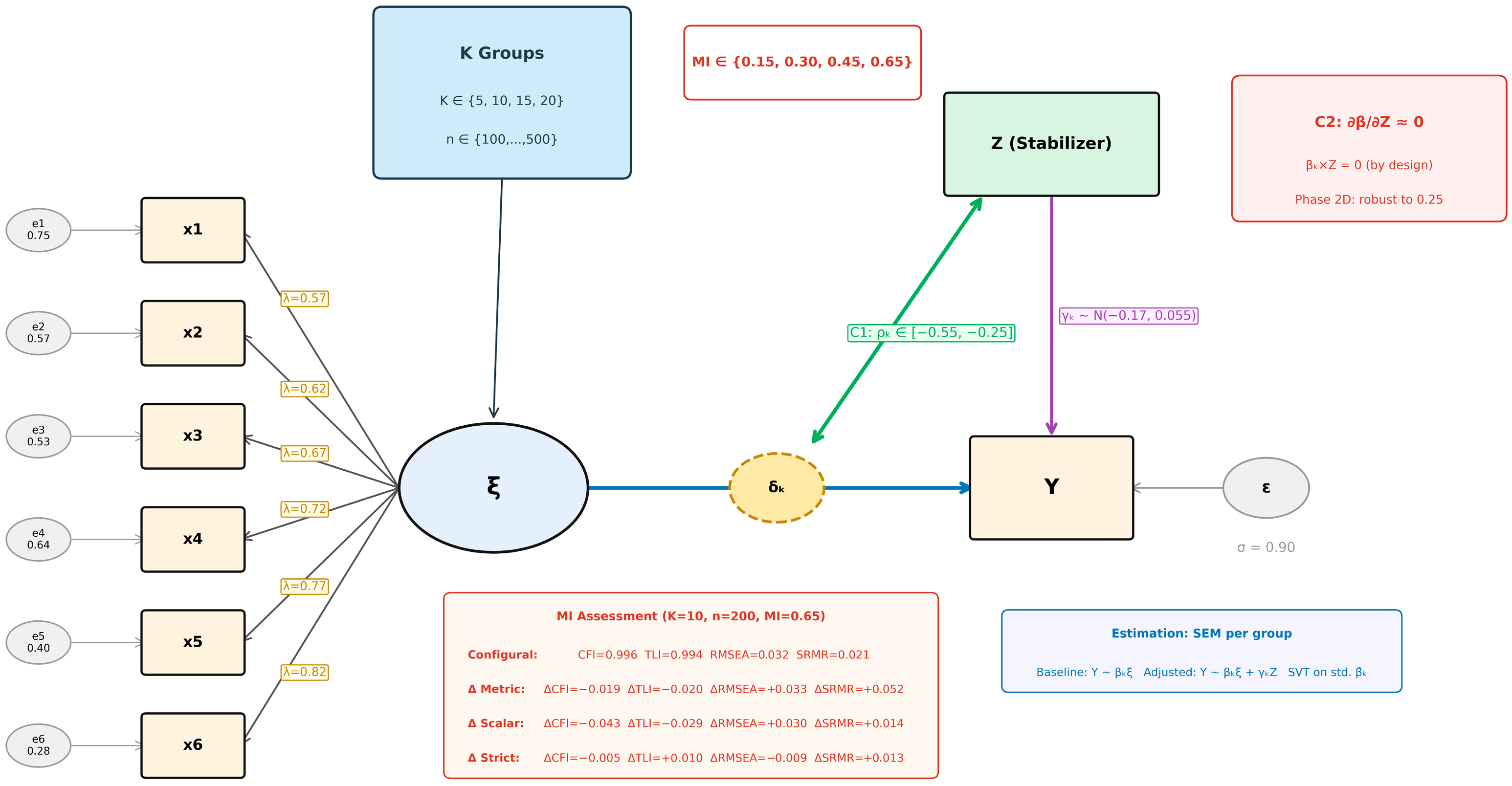
  • Phase 4: CFA-Based SVT Validation (24,000 replications). Validates that the SVT detects stabilization when MI violations originate from a confirmatory factor analytic measurement model rather than regression-based parameter manipulation. For each replication, a latent predictor ξ is measured by six indicators with base loadings λ j [ 0.57 ,   0.82 ] . Group-specific MI violations are introduced through loading perturbations j k   ~   N ( M I · 0.25 · U k ,   M I · 0.12 ) and intercept shifts δ j k ~ N ( M I · 0.35 · U k ,   M I · 0.18 ) , where U k ~ N ( 0 ,   1 ) is a group-level artifact factor. The observed outcome Y and stabilizer Z are generated with group-varying correlation ρ k [ 0.55 ,   0.25 ] and group-varying confound coefficient γ k ~ N ( 0.17 ,   0.055 ) , chosen to reflect realistic parameter ranges observed in applied multi-group SEM research. Structural parameters are estimated via lavaan sem() with standardized solutions, and SVT is applied to the resulting group-specific standardized path coefficients. Three scenarios are evaluated: CFA TypeAB (stabilizer present), CFA Null ( Z independent), and CFA Moderator ( ξ × Z interaction). The design crosses K { 5 ,   10 ,   15 ,   20 } groups, n { 100 ,   200 ,   300 ,   400 ,   500 } per group, and M I { 0.15 ,   0.30 ,   0.45 ,   0.65 } across 100 replications per condition.

4.2.4. Estimation and Classification

Within each replication, baseline slopes β ^ k ( 0 ) are estimated using group-specific regressions of Y on X . Adjusted slopes β ^ k ( 1 ) are obtained via FWL residualization with respect to Z, consistent with the projection mechanism in Theorem 2. The coefficients of variation C V ( 0 ) and C V ( 1 ) are computed as defined in Equation (37), and the stabilization metric Δ l is computed as in Equation (38). The group-level indicators I k and the orientation share OS are calculated as defined in Equations (23) and (25), respectively.
For computational efficiency in the Monte Carlo study, the bootstrap criterion was implemented using the sign-flip permutation variant, which constructs the null distribution by randomly reversing the signs of centered group-level effects; this approach is asymptotically equivalent to the nonparametric bootstrap under the symmetric null hypothesis of no stabilization [44,45]. For inference, the bootstrap test (Criterion 1) and binomial test (Criterion 2) are applied as described in Section 4.1.4 at significance level α = 0.05 . A replication is recorded as a detection (power hit) if both criteria are simultaneously satisfied, and as a false positive if both criteria are satisfied under a Null or Moderator scenario. Detection rates (power) and false-positive rates (FPR) are aggregated across replications within each parameter configuration.
All simulations were conducted in R 4.5.2 using parallel computation backends. Complete R code, simulation datasets, and reproducibility documentation are available in Supplementary Materials, Section S8, and archived at the repository specified in the Data Availability Statement.

5. Results

Phase 1 assessed statistical power and Type I error control across the full parameter space. Phase 2 examined method robustness under varying noise and measurement invariance conditions. Phase 3 explored performance at parameter-space boundaries and worst-case configurations.

5.1. Phase 1: Power and False-Positive Control

Phase 1 evaluated SVT performance across 800,000 simulated datasets spanning 800 unique conditions. We tested five scenarios: Type A (variance purification), Type B (directional alignment), Type AB (both mechanisms), Null (no violations), and Moderator (MI present but no stabilization) (Table 3).
SVT attained high statistical power across all stabilization mechanisms. Type A yielded 90.7% power with mean effect size l = 1.55 , indicating substantial variance purification (83.0% reduction in cross-group parameter heterogeneity). Type B achieved 93.2% power with l = 0.55 , driven primarily by directional alignment rather than variance reduction (9.21%). Type AB exhibited the highest power at 99.4% with the largest effect size ( l = 2.25 ), reflecting simultaneous operation of both mechanisms. All three power rates exceed the conventional 80% benchmark (Table 3) (Detailed disaggregated results by M I severity, K , and n are provided in Tables S5.8–S5.10 in Supplementary Materials).
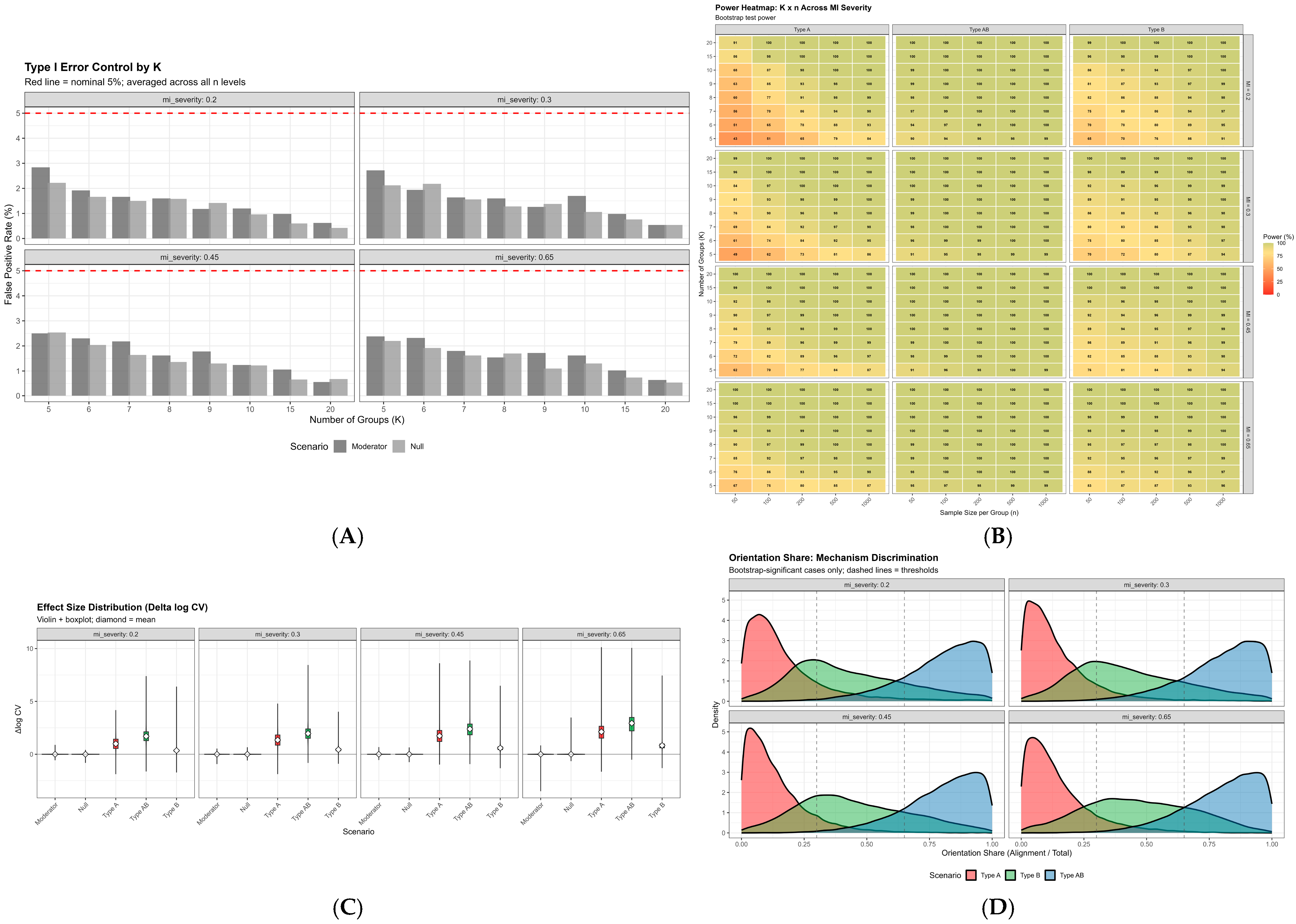
Type I error control remained conservative across null scenarios. The Null scenario yielded a 1.37% false positive rate, while the Moderator scenario produced 1.58%. Both rates fall well below the nominal 5% level, indicating conservative error control under conditions where Z operates solely as a moderator or where no measurement invariance violations exist (Figure 3A).
Power increased systematically with MI severity, revealing clear dose–response relationships. For Type AB, effect size rose from 1.70 at M I = 0.20 to 2.94 at M I = 0.65 , with power increasing from 99.0% to 99.6%. Type A exhibited similar gradients ( l : 0.99 → 2.12; power: 84.7% → 94.7%), as did Type B ( l : 0.35 → 0.83; power: 90.0% → 96.7%). This monotonic relationship indicates that SVT sensitivity increases with violation severity (Figure 3B).
The dual-criterion framework successfully discriminated among stabilization mechanisms. Variance power ranged from 53.3% for Type A to 5.2% for Type B, while alignment power ranged from 98.4% for Type B to 24.0% for Type A. Type AB demonstrated substantial power on both criteria (46.8% variance, 82.9% alignment). Sample size effects followed expected patterns (Figure 3B). Power increased with both K and n , though gains diminished beyond K = 10 and n = 200 . For Type AB, power reached 99.9% at K = 10 regardless of n, and approached 100% when K 15 . Even the minimal configuration ( K = 5 , n = 50 ) yielded detection rates of 55.2% for Type A, 73.8% for Type B, and 91.9% for Type AB. The orientation share metric further distinguished mechanisms (Figure 3D): Type A averaged 0.159 (variance-dominant), Type B averaged 0.781 (alignment-dominant), and Type AB averaged 0.446 (balanced). These patterns indicate that SVT discriminates among stabilization sources in addition to detecting their presence.
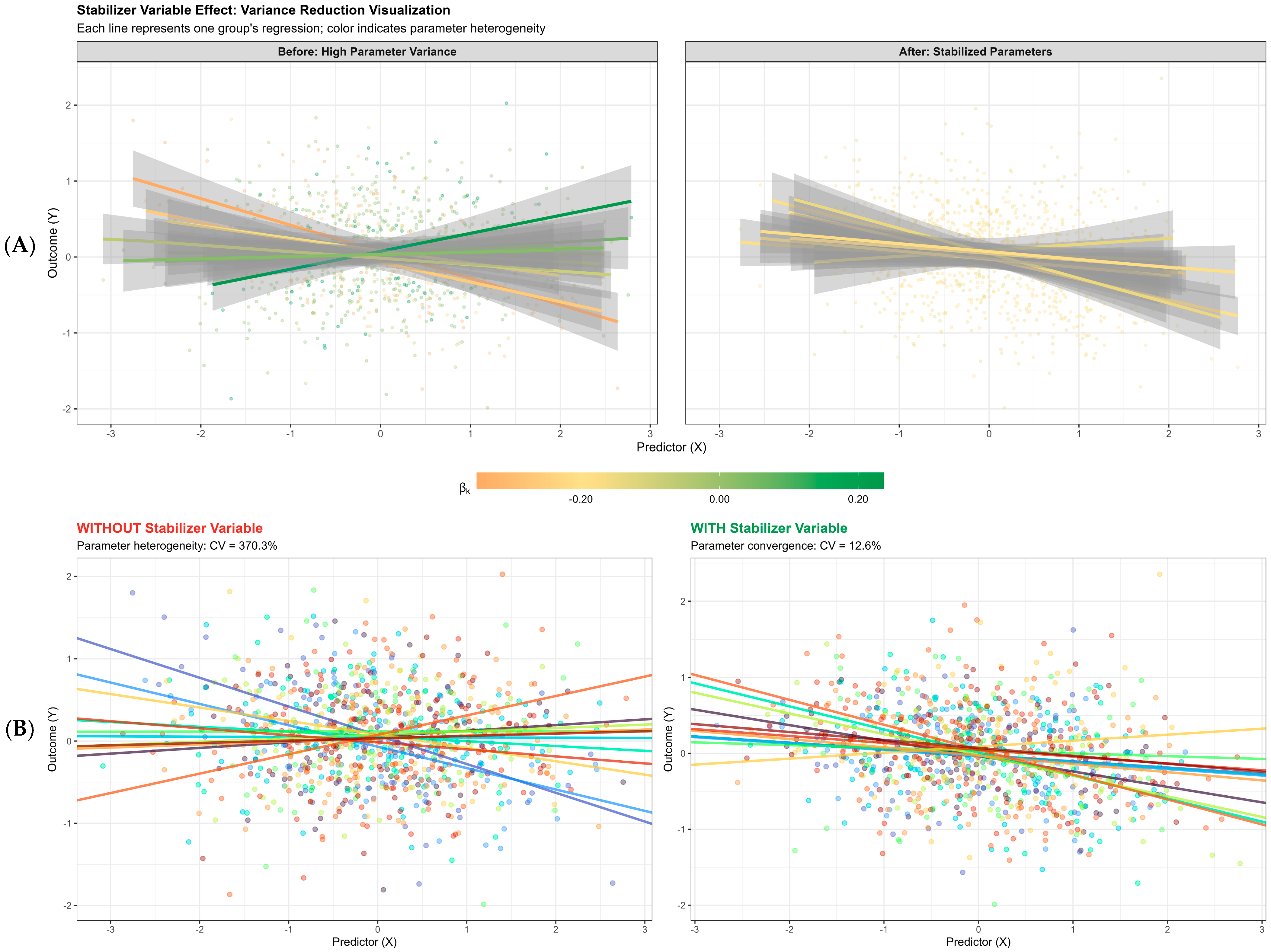
Figure 4 illustrates stabilization effects: the baseline coefficient of variation decreases from 370.3% to 12.6% after stabilizer inclusion, corresponding to a 96.6% reduction (Type AB mechanism), with regression slopes converging toward a common trajectory. Additional visualizations including power trajectories across all parameter dimensions are provided in Supplementary Materials, Figures S6.1–S6.5.

5.2. Phase 2: Sensitivity Analysis

Phase 2 examined SVT robustness through four targeted sensitivity analyses totaling 117,900 simulations. We assessed (a) bootstrap convergence properties, (b) performance under varying noise levels, (c) detection sensitivity across an extended range of MI severity values, and (d) Type I error control under approximate structural independence violations.
Bootstrap convergence analyses confirmed that 1000 resamples provide sufficient stability for SVT inference. For the Null scenario, mean p-values stabilized across bootstrap iterations (500 reps: 0.515; 1000 reps: 0.494; 2000 reps: 0.488), with absolute differences below 0.02 between successive doublings. For Type AB, p-values remained at zero across all bootstrap levels, indicating robust detection regardless of resampling intensity. Confidence interval estimates exhibited similar stability, with differences below 0.02 between 1000 and 2000 bootstrap replicates. These results suggest that 1000 bootstrap resamples provide a sufficient balance between computational cost and inferential precision.
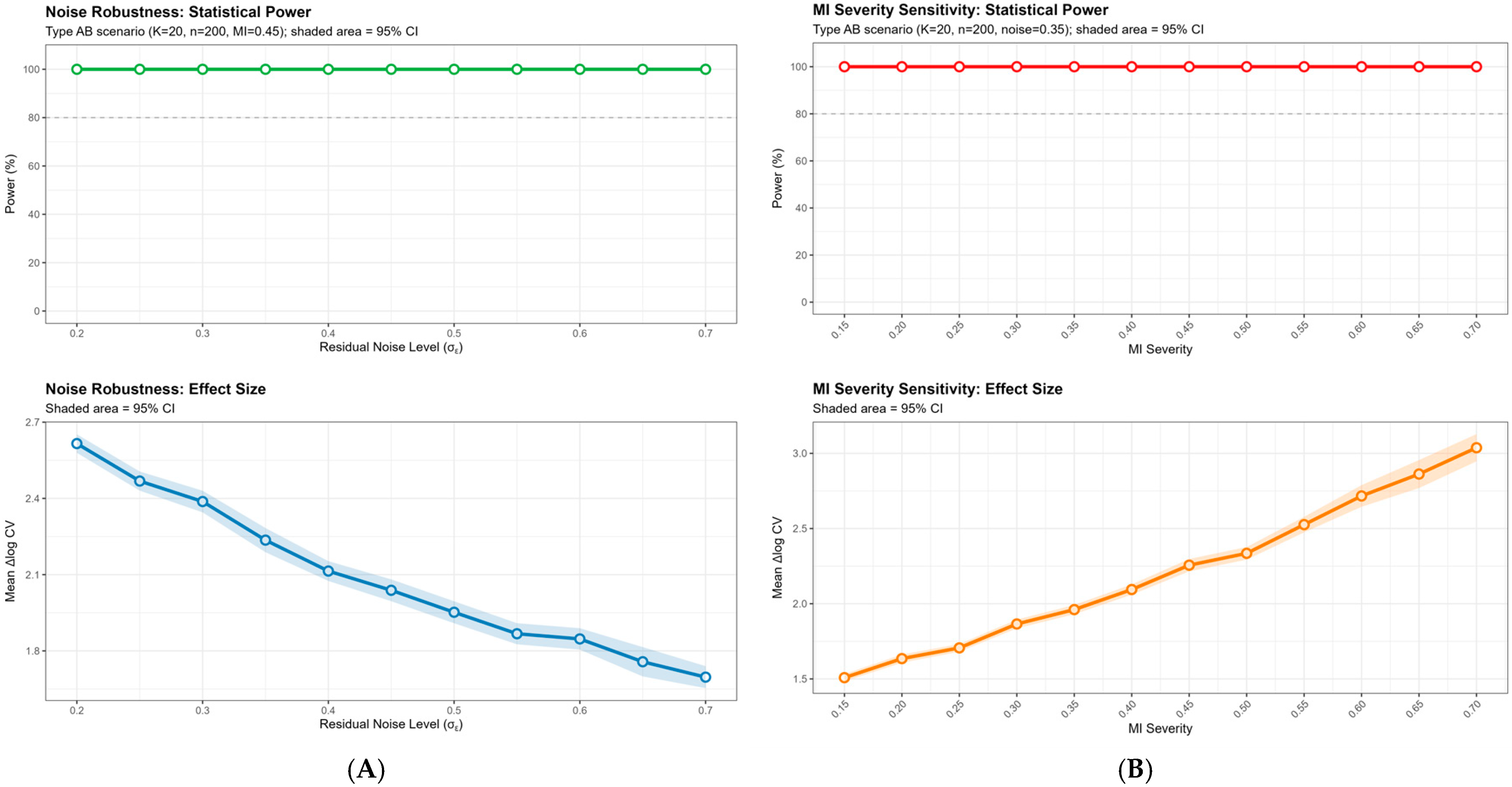
SVT showed consistent robustness to measurement noise. Across noise levels ranging from 0.20 to 0.70 (representing low to extremely high measurement error), power remained constant at 100% for the Type AB scenario. Effect sizes declined systematically as expected ( l : 2.62 at noise = 0.20 to 1.70 at noise = 0.70), reflecting that higher noise attenuates observed stabilization magnitudes. However, detection capability remained uncompromised even under the most severe noise conditions. Detection capability thus remained uncompromised across the noise range examined (Figure 5, left panel).
Extended MI severity analyses revealed consistent detection across a broad range of violations. Testing MI values from 0.15 (very weak) to 0.70 (extreme), SVT maintained 100% power throughout while exhibiting a smooth dose–response relationship. Effect sizes increased linearly from 1.51 at M I = 0.15 to 3.04 at M I = 0.70 , confirming that SVT sensitively tracks violation severity. Even at the lowest violation level ( δ M I = 0.15 ), effect sizes remained large and reliably detectable, indicating that stabilization mechanisms are identifiable across the full range of invariance violations examined (Figure 5, right panel). Extended sensitivity analyses and integrated design guidelines are discussed in Supplementary Materials, Section S7.
Phase 2D assessed whether approximate violations of the structural independence condition (C2) compromise SVT Type I error control. Across 108,000 replications spanning six interaction strengths ( β ξ × Z = 0.00 to 0.25 ), four group counts ( K = 5 to 20 ), three sample sizes ( n = 50 to 200 ), and three MI severity levels ( M I = 0.15 to 0.45 ), the dual-criterion false positive rate remained between 0.6% and 1.1% for all interaction levels. Even at β ξ × Z = 0.25 —equivalent to the full Moderator scenario in Phase 1—no meaningful inflation was observed. Mean l values were indistinguishable from zero across all conditions. This robustness arises from the sign-flip bootstrap’s insensitivity to interaction-driven heterogeneity, which does not produce the systematic variance compression or directional alignment signatures that the SVT detects. Full results are reported in Supplementary Materials, Table S5.16.

5.3. Phase 3: Boundary Conditions

Phase 3 examined SVT performance at parameter-space extremes through 3600 simulations across 18 configurations. The tested configurations include: very few groups ( K = 3 ), very small samples ( n = 30 ), weak violations ( M I = 0.10 ), extreme violations ( M I = 0.90 ), and worst-case combinations thereof. Results establish minimum sample requirements and identify scenarios where SVT may struggle. Complete boundary condition results across all 18 configurations are reported in Supplementary Materials, Table S5.14.
SVT maintained high power at both extremes of group size. Configurations with many groups ( K = 50 ) achieved 100% power regardless of per-group sample size, even when n = 30 . Effect sizes remained stable ( l : 1.94 to 2.60) with low variability (SD: 0.14–0.20), indicating that large K compensates effectively for small n. Conversely, minimal group configurations ( K = 3 ) exhibited reduced but acceptable power: 85% at n = 100, 84% at n = 200, and 91.5% at n = 500 . However, effect size variability increased substantially (SD: 1.15–1.37), suggesting that K = 3 represents a practical lower bound requiring caution in interpretation (Table 4).
Minimal sample sizes ( n = 50 ) yielded adequate power when paired with sufficient groups. Configurations with K 10 and n = 30 maintained 99.5–100% power across MI levels, indicating that group multiplicity effectively compensates for small within-group samples. Even extreme MI violations ( M I = 0.90 ) yielded 98–100% power across most configurations, with effect sizes reaching 3.14–3.54—the largest observed in any phase. SVT thus operates reliably under severe invariance breakdown (Table 4).
The most challenging configuration combined minimal groups, minimal sample, and extreme violation ( K = 3 , n = 30 , M I = 0.90 ), yielding 71% power—the only configuration falling below 80%. This scenario represents a truly worst-case situation unlikely in practice, yet detection remained above chance levels. Sufficient conditions for exceeding 80% power are K 8 and n 100 ; the combination K 5 and n 50 should be avoided unless δ M I 0.30 or K 10 (Table 4).

5.4. Phase 4: CFA-Based Validation

Phases 1–3 employed regression-based data-generating processes in which parameter heterogeneity was directly induced through group-specific slope coefficients. Phase 4 addresses the question of whether the SVT retains its statistical properties when measurement invariance violations originate from a confirmatory factor analytic measurement model—the setting most commonly encountered in applied multi-group SEM research. Across 24,000 replications with six-indicator CFA measurement models, standardized structural path coefficients, and parameters chosen to reflect realistic applied settings, the CFA-based SVT achieved 94.1% dual-criterion power with false-positive rates of 1.3% (Null) and 1.1% (Moderator). Figure 6 illustrates the Phase 4 data-generating process, including the measurement model, MI violation structure, stabilizer conditions, and representative fit indices from a single replication. Table 5 reports power and mean l by number of groups and MI severity.
Three findings emerge. First, statistical power exceeded 80% at K = 5 and reached 96–99% at K 10 , confirming that the K 10 recommendation from Phase 1 generalizes to CFA-based estimation. Second, power was largely invariant to MI severity within the CFA framework: K = 5 yielded 80–83% power across all MI levels, and K 10 yielded 96–99% regardless of violation magnitude. This stability reflects the stabilization mechanism operating through the omitted variable bias channel ( γ k × ρ k ), which is calibrated independently of the MI severity parameter governing loading perturbations. Third, mean l values (range: 1.40–1.74) were lower than regression-based Phase 1 values (mean l 2.25 ), consistent with the natural attenuation that arises when structural parameters are estimated from latent variable models with measurement error rather than from directly observed predictors. Despite this attenuation, effect sizes remained well above the detection threshold, and false-positive control was maintained at 1.1–1.3% across all conditions (Table 5).

6. Discussion

The stabilizer variable framework introduces a fundamentally different strategy for handling measurement invariance violations in multi-group structural models. Rather than treating MI violations as a binary gate—either invariance holds and comparisons proceed, or it fails and comparisons stop—the framework treats MI-induced heterogeneity as a structured quantity that can be partially recovered through projection.
The distinction between genuine and artifactual parameter heterogeneity—central to the stabilizer framework—has a direct parallel in meta-analytic methodology. In random-effects meta-analysis [24,46], the between-study variance component τ 2 captures heterogeneity in effect sizes across studies. When τ 2 > 0 , the fixed-effects assumption of homogeneous effect parameters is violated, and fixed-effects confidence intervals become anticonservative—Hedges and Vevea [46] demonstrated that Type I error rates can reach 12.2% (versus the nominal 5%) when τ 2 equals the within-study variance. In multi-group SEM, the measurement invariance assumption functions analogously to the fixed-effects assumption: group-specific structural parameters are constrained to equality, and violations of this constraint inflate between-group parameter dispersion. The stabilizer variable functions as a mechanism for explaining a portion of τ 2 —specifically, the portion attributable to measurement artifacts rather than genuine structural differences—thereby reducing the between-group variance component and restoring the reliability of cross-group comparisons. This perspective suggests that applied meta-analysts encountering unexplained between-study heterogeneity might examine whether study-level measurement quality indicators (e.g., reliability indices, adaptation quality scores) satisfy conditions C1–C2 and could serve a stabilizing role.
Pesaran’s [23] common correlated effects (CCE) estimator addresses a structurally analogous problem in heterogeneous panel data. In panels where unobserved common factors f t affect both the error term and the regressors through unit-specific loadings γ i , standard estimators produce inconsistent estimates—precisely because the heterogeneous factor loadings create unit-specific measurement contamination. The CCE solution is to augment individual regressions with cross-section averages of the dependent variable and regressors, which serve as observable proxies for the unobserved factors. The stabilizer variable performs a conceptually parallel function: it serves as an observable proxy that, through FWL projection, filters the portion of between-group parameter heterogeneity attributable to unobserved measurement artifacts. A notable property of the CCE estimator is that it does not require knowledge of the number of unobserved factors—consistent estimation is achieved as long as the cross-section averages span the factor space. Similarly, the SVT does not require the researcher to identify the specific source or number of MI violations; the stabilizer absorbs the aggregate measurement artifact regardless of its internal structure, provided conditions C1–C2 are satisfied.
The practical motivation for the stabilizer framework is underscored by accumulating evidence that measurement invariance violations are pervasive rather than exceptional in multi-group research. Rutkowski and Svetina [22] demonstrated through empirical analysis and simulation that conventional fit-index criteria for MI testing (e.g., C F I 0.01 , R M S E A 0.015 )—derived primarily from two-group, moderate-sample scenarios—perform poorly when the number of groups is large. In their simulations with 20 groups, even data generated under complete invariance produced R M S E A = 0.022 , exceeding the conventional threshold and leading to incorrect rejection of the invariance hypothesis. More recently, Sandoval-Hernández et al. [47] applied both MG-CFA and alignment optimization to TALIS 2018 data across 48 education systems and found that only four of 23 teacher scales achieved scalar invariance via traditional testing, and that alignment optimization—a method specifically designed to accommodate approximate invariance—failed the 75% invariance threshold for 22 of 23 teacher scales. These findings have two implications for the stabilizer framework. First, they confirm that the problem the stabilizer framework addresses is not hypothetical but empirically widespread, particularly in the large-scale cross-national contexts where group comparisons are most consequential. Second, the stabilizer framework fills a gap left by alignment optimization: whereas alignment applies to latent mean and variance comparisons and requires that a majority of parameters be approximately invariant, the SVT targets structural path coefficients and operates through active absorption of measurement artifacts rather than passive tolerance of non-invariance.
As noted in Remark 9, the stabilizer principle is not inherently specific to linear structural models. An instructive parallel exists in semi-analytical methods for nonlinear parameter estimation. The variational iteration method (VIM; [26]) and homotopy perturbation method (HPM; [27]) were developed to solve nonlinear differential equations without requiring the traditional assumption of a small perturbation parameter. HPM achieves this by constructing a continuous deformation (homotopy) from a simple solvable problem to the full nonlinear problem, with first-order approximations remaining uniformly valid even under strong nonlinearity (error ≤ 5.8% for the fifth-order Duffing equation). VIM achieves this through iterative correction functionals with optimally determined Lagrange multipliers, yielding even higher precision (error ≤ 0.08% for the same problem). The philosophical parallel to the stabilizer framework is noteworthy: both VIM/HPM and SVT relax a traditionally restrictive precondition (small perturbation parameter in nonlinear analysis; measurement invariance in multi-group SEM) through a mathematical mechanism that permits valid inference even when the precondition is violated. Furthermore, VIM’s insight that the quality of the correction mechanism determines convergence speed mirrors the SVT finding that the strength of confound correlation (C1) directly determines the magnitude of stabilization ( l ). Whether these conceptual parallels can be formalized—specifically, whether the FWL projection framework can be extended to accommodate nonlinear functional forms, enabling stabilizer-type corrections in multi-device non-linear parameter estimation (e.g., MEMS resonators, Duffing oscillators [25])—represents a promising direction for future research [48,49].
Several limitations of the current framework merit discussion. First, the SVT presumes approximate structural independence (C2: β / Z 0 ). Although Phase 2D demonstrated that the dual-criterion procedure maintains 0.6–1.1% false positive rates even when interaction strengths reach β ξ × Z = 0.25 , stronger violations could compromise performance. The TOST equivalence testing procedure recommended in Remark 1 provides a practical diagnostic but cannot conclusively verify C2 in observational data. Secondly, condition C1 depends on the unobserved measurement artifact δ k , creating an identification challenge analogous to the exclusion restriction in instrumental variable estimation. The four-diagnostic protocol described in Remark 1 (MI-complementarity, stratified correlation analysis, cross-moderator consistency, and partial invariance linkage) provides convergent evidence for or against C1 but does not constitute a formal test. Thirdly, the current Monte Carlo validation employs a single grouping variable per replication. Applied studies often involve multiple crossed or nested grouping variables; the multi-moderator extension (Remark 11) describes the aggregation logic, but the operating characteristics of this procedure have not been empirically validated. Finally, the framework addresses measurement-induced heterogeneity specifically; genuine structural heterogeneity (e.g., true moderation effects) requires different analytical strategies.

7. Conclusions

Within classical statistical theory, the disturbance term ε is typically regarded as irreducible random noise. In contrast, insights from measurement science indicate that systematic components can exist within ε , leading to cross-group parameter dispersion. Here we formalize the conditions under which such structured error becomes recoverable within model space. A stabilizer variable Z satisfies two conditions: structural independence and measurement alignment. Formally,
Z = a r g m i n Z : β / Z = 0   V a r k β ^ k 1 Z
When Z aligns with the systematic component of measurement error—rather than its random component—it extracts information instead of introducing noise. For latent measurement X i = ξ + δ i + ϵ i , where δ i represents systematic bias, a stabilizer approximates Z = 1 3 X 1 + X 2 + X 3 ξ , capturing the deterministic orientation of error. Under these conditions, ρ k ( ξ , Z ) 0 and β / Z = 0 , producing β = γ k ρ k ( ξ , Z ) and yielding contraction in V a r ( β k ) . Stabilization occurs when bias becomes geometrically representable.
The stabilizer framework introduces four conceptual departures from classical modeling. First, it explicitly represents group-level systematic measurement error, Y i k = β k X i k + γ k Z i k + ε i k , recognizing that a portion of ε follows a structured, measurement-specific geometry. Second, projection acquires a new role: stabilizers do not merely control for confounds—they cleanse measurement pathways. Third, the inferential target shifts from asking “when does the effect vary?” to “is the effect truly variable, or are the errors variable?” The purpose is not to modify causal effects but to restore their stability. Fourth, stabilization becomes empirically testable through the dual conditions β / Z 0 and ρ ( X , Z ) 0 , evaluated via bootstrap inference and binomial consistency checks within the SVT.
Monte Carlo analyses comprising over 949,000 simulated datasets confirmed that the SVT detects parameter stabilization with 80–99% power and maintains false-positive rates below 2%, even under severe measurement noise, minimal sample sizes, and extreme invariance violations. The framework distinguishes variance purification (Type A) from directional alignment (Type B) mechanisms. For conservative implementation, K 8 groups and n 100 observations per group are recommended; detection remains feasible at K = 5 and n = 50 .
Remaining directions include developing penalized or information-theoretic criteria for automated stabilizer candidate selection, extending the test procedure to longitudinal and multilevel designs where measurement properties may drift over time, examining robustness under non-normal error distributions and incomplete data mechanisms, and formalizing the conceptual bridges to nonlinear parameter estimation methods discussed in Section 6.

Supplementary Materials

The following supporting information can be downloaded at: https://www.mdpi.com/article/10.3390/math14061064/s1, File S1: Supplementary Material. Section S1: Conceptual and Theoretical Foundations; Section S2: Formal Distinctions from Established Third-Variable Roles; Section S3: Proofs of Theorem 1 and Theorem 2; Section S4: Data-Generating Mechanisms; Section S5: Complete Simulation Results; Section S6: Additional Figures; Section S7: Sensitivity and Robustness Discussion; Section S8: Reproducibility and Computational Details; Table S2.1: Comparison Table of Third-Variable Roles in Structural Modeling; Table S4.1: Key MI-Related Bias and Alignment Parameters by Scenario; Table S4.2: Parameters for the Type AB Sign-Flip Mechanism; Table S4.3: Correlation Structures Across Scenarios; Table S4.4: Measurement Noise Levels Across Scenarios as a Function of MI Severity; Table S5.1: Score Distribution Overlap and Quiescence Analysis Across MI Severity and Sample Size; Table S5.2: Dose–Response Analysis by MI Severity and Sample Size; Table S5.3: ROC Analysis by MI Severity and Sample Size; Table S5.4: Minimum MI Severity Required to Meet Discrimination Criteria by Sample Size; Table S5.5: Information Retention: Continuous Adaptive Scoring versus Binary Chen Classification; Table S5.6: AUC Performance: Truncation versus Absolute Value Weighting; Table S5.7: Effect Size (Cohen’s d): Truncation versus Absolute Value Weighting; Table S5.8: AUC by MI Severity and Sample Size Across Weighting Variants; Table S5.9: Cohen’s d by MI Severity and Sample Size Across Weighting Variants; Table S5.10: Phase 1 Power and Effect Size by MI Severity; Table S5.11: Phase 1 Power and Effect Size by Number of Groups (K); Table S5.12: Phase 1 Power and Effect Size by Sample Size (n); Table S5.13: Bootstrap Convergence Analysis (Phase 2A); Table S5.14: Noise Robustness Analysis (Phase 2B); Table S5.15: MI Severity Trajectory (Phase 2C); Table S5.16: Dual-Criterion False Positive Rates by Interaction Strength (Phase 2D); Table S5.17: Phase 3 Boundary Conditions (All 18 Configurations); Table S5.18: Phase 4 CFA-Based SVT Performance (Type AB Scenario); Table S5.19: Phase 4 CFA-Based False Positive Rates by Number of Groups (K) and MI Severity; Figure S5.1: Score Distribution Overlap Across MI Severity; Figure S5.2: MI Score Distributions; Figure S5.3: Dose–Response Relationships: MI Severity versus Discrimination and Effect Size; Figure S5.4: ROC Curves by MI Severity at n = 200; Figure S6.1: Statistical Power by Number of Groups (K); Figure S6.2: Statistical Power by Sample Size (n); Figure S6.3: Statistical Power by MI Severity; Figure S6.4: Type I Error Rates by Number of Groups (K); Figure S6.5: Effect Size Distributions and Power Landscapes (Two-Panel Composite); Figure S6.6: Power Across 18 Boundary Configurations; Figure S6.7: Phase 3 Boundary Condition Visualizations (Three Panels). References [2,3,5,10,11,13,16,20,28,32,50,51,52,53,54,55,56,57,58,59,60] are cited in the supplementary materials.

Author Contributions

Conceptualization, S.Y. and E.C.; methodology, S.Y.; software, S.Y.; validation, S.Y. and E.C.; formal analysis, S.Y.; investigation, S.Y.; resources, S.Y.; data curation, S.Y.; writing—original draft preparation, S.Y.; writing—review and editing, E.C.; visualization, S.Y.; supervision, E.C.; project administration, S.Y.; funding acquisition, S.Y. All authors have read and agreed to the published version of the manuscript.

Funding

This research received no external funding, and the Article Process Charge was funded by Acibadem Mehmet Ali Aydinlar University.

Data Availability Statement

All simulation code for reproducing the Monte Carlo study (949,100 replications across Phases 0–4) is publicly available at: https://github.com/sy142/stabilizer-variable-simulations (accessed on 18 March 2026). Complete simulation results and datasets are archived on Figshare: https://doi.org/10.6084/m9.figshare.30731633 (accessed on 18 March 2026). This study does not use empirical data; all results are based on simulated datasets generated by the code above.

Acknowledgments

The theoretical framework presented in this manuscript was developed as part of a Master of Science thesis submitted to the Department of Statistics at Yıldız Technical University, Istanbul, Türkiye, under the supervision of Erhan Çene.

Conflicts of Interest

The authors declare no conflicts of interest.

Abbreviations

The following abbreviations are used in this manuscript:
CFAConfirmatory Factor Analysis
CFIComparative Fit Index
CIConfidence Interval
CVCoefficient of Variation
DGPData-Generating Process
DPDiscriminant Power
FPRFalse-Positive Rate
FWLFrisch–Waugh–Lovell
MIMeasurement Invariance
OCROrientation Consistency Ratio
OSOrientation Share
RMSEARoot Mean Square Error of Approximation
ROCReceiver Operating Characteristic
RPRedundancy Penalty
SDStandard Deviation
SEStandard Error
SEMStructural Equation Modeling
SRMRStandardized Root Mean Square Residual
SVTStabilizer Variable Test
TLITucker–Lewis Index
VSVariability Score

Appendix A. Phase 0: Adaptive MI Scoring Validation Summary

Phase 0 validates the adaptive MI scoring system (Step 1, Section 4.1.2) prior to its deployment in the main simulation study. The key question is whether the composite score S M I can reliably distinguish moderators that genuinely violate measurement invariance from those that do not, and whether it outperforms binary Chen-threshold classification.
  • Design. Each replication generates data for K = 2 groups and p = 8 indicators with base loadings λ j 0.65,0.85 . Ten moderators are simulated per replication: five with true MI violations (loading shifts N 0 , M I 0.25 intercept shifts N 0 , M I 0.40 ) and five with exact invariance. The design crosses six MI severity levels ( M I 0.10 ,   0.20 ,   0.30 ,   0.45 ,   0.65 ,   0.90 ) with three sample sizes ( n 100 ,   200 ,   500 ) across 200 replications per condition, totaling 3600 simulations (108,000 CFA model fits).
  • Metrics. For each replication, the adaptive weighting algorithm (Equations (28)–(36)) is applied to the ten moderators’ fit-index changes. Two discriminant-power variants are compared: d n o n i n v a r i a n t d i n v a r i a n t (absolute) versus m a x 0 , d n o n i n v a r i a n t d i n v a r i a n t (directional). Classification performance is evaluated via AUC (area under the ROC curve) for the composite S M I , and accuracy, sensitivity, and specificity for the binary Chen thresholds.
  • Results. Chen sensitivity increases monotonically with MI severity (0.483 at M I = 0.10 to 1.000 at M I 0.65 ), but Chen specificity at n = 100 remains around 0.54 regardless of MI level, indicating that binary classification fails to control false positives with small samples. In contrast, the adaptive composite S M I achieves A U C 0.80 at M I 0.30 for n = 100 and M I 0.20 for n 200 , with perfect classification ( A U C = 1.000 ) at M I 0.45 for n 200 . Cohen’s d confirms large effect sizes ( d > 1.50 ) at M I 0.20 with n 200 , demonstrating that the continuous scoring system retains substantially more discriminative information than binary thresholds. These results validate S M I as a reliable input to the SVT pipeline; full diagnostic details are provided in Supplementary Materials Section S5.0.

To assess whether the three-component calibration (RP × VS × DP) provides meaningful improvement over simpler alternatives, a weight-sensitivity ablation was conducted using the same 3600 replications (Section S5.0.7). Five weighting variants were compared: the full adaptive system, three reduced variants (DP only, RP × DP, VS × DP), and equal weights (0.25 per index). All variants achieved overall mean AUC within 0.003 of one another (range: 0.889–0.892), with win/tie/loss ratios near symmetry across all pairwise comparisons. Differences were negligible at MI ≥ 0.30 where all variants exceeded AUC = 0.84, and modest at MI ≤ 0.20 where equal weights showed a marginal advantage. These findings establish that the scoring system is robust to weight specification: practitioners can employ equal weights without meaningful performance loss when the full calibration is impractical. Table A1 summarizes the key Phase 0 findings.
Table A1. Phase 0 validation results by MI severity and sample size.
MInChen Sens.Chen Spec.AUC ( S M I ) Cohen s   d
0.101000.4830.5440.5390.153
0.102000.2410.8360.5830.341
0.105000.1980.9770.7090.864
0.201000.6890.5320.6810.692
0.202000.5920.8580.8261.585
0.205000.6820.9800.9633.476
0.301000.8710.5550.8431.786
0.302000.8580.8420.9553.604
0.305000.9330.9840.9978.489
0.451000.9810.5660.9532.818
0.452000.9860.8410.9986.250
0.455000.9980.9791.00013.722
0.651001.0000.5370.9863.191
0.652001.0000.8341.0006.975
0.655001.0000.9721.00014.945
0.901001.0000.5490.9863.284
0.902001.0000.8441.0007.250
0.905001.0000.9761.00016.351
Chen Sens. = sensitivity of binary Chen thresholds for detecting true non-invariance; Chen Spec. = specificity; AUC = area under the ROC curve for the adaptive composite S M I ; Cohen’s d = standardized mean difference between S M I scores for truly non-invariant vs. invariant moderators. Each cell represents 200 replications. Full results including ROC analysis, activation thresholds, robustness checks, and weight-sensitivity ablation are reported in Supplementary Materials Section S5.0.

Appendix B

Algorithm A1 provides pseudocode for the adaptive MI scoring system described in Section 4.1.2 (Equations (28)–(36)). The algorithm takes as input the fit-index changes across M moderators and S invariance stages, and returns the composite severity score S M I along with calibrated weights.
Algorithm A1. Adaptive MI Severity Scoring
INPUT:
Δ m , s , j —fit-index change for moderator m , stage s , index j  
m = 1 , , M moderators
s m e t r i c ,   s c a l a r ,   s t r i c t  
j C F I ,   T L I ,   R M S E A ,   S R M R  
c j    —Chen thresholds: c C F I = c T L I = 0.010 ,
c R M S E A = 0.015 , c S R M R = 0.030
 ε   —small constant (reference implementation: ε = 10 3 )

OUTPUT:
S M I   —composite MI severity score 0 ,   1  
w j    —calibrated index weights

PROCEDURE:

 ─── Phase 1: Worst-case extraction ───────────────────────
 FOR each moderator m = 1 , , M :
  FOR each index j C F I ,   T L I ,   R M S E A ,   S R M R :
j ( m ) = max s m , s , j Equation (34)
~ j ( m ) = min j ( m ) c j , 1 Equation (35)

 ─── Phase 2: Invariance classification ───────────────────

 FOR each moderator m :
  invariant[m] ← TRUE if ALL of:
    m , s , j c j for every stage s and index j
  ELSE: invariant [ m ] ← FALSE

 ─── Phase 3: Weight calibration ──────────────────────────

 // 3a. Redundancy Penalty (RP)

 R ← correlation matrix of ~ j ( m ) across moderators
 FOR each index j :
   r ¯ j ← mean of R [ j , · ] excluding diagonal
R P j = 1 1 + r ¯ j Equation (29)

 // 3b. Variability Stability (VS)

 FOR each index j :
   C o V j = S D ( ~ j · ) / m e a n ~ j · + ε
V S j = 1 1 + C o V j Equation (31)

 // 3c. Discriminant Power (DP)

I ← {m: invariant[m] = TRUE}
V ← {m: invariant[m] = FALSE}

FOR each index j :
  IF I > 0 AND V > 0 :
D P j = max 0 , m e a n ( ~ j   o v e r   V m e a n ( ~ j o v e r   I ) Equation (32)

 ELSE:
D P j = S D ( ~ j · ) (Fallback)


// 3d. Composite weights

 FOR each index j :
r a w j = R P j × V S j × D P j Equation (33)
w j = r a w j / ( j r a w j + ε ) (normalize)

 ─── Phase 4: Score computation ───────────────────────────

S M I = j w j · ~ j Equation (36)

 RETURN S M I , w j
Implementation notes:
  • When all moderators are classified identically (all invariant or all non-invariant), DP falls back to the standard deviation of normalized deltas, providing a variance-based proxy for informativeness.
  • The multiplicative combination R P × V S × D P enforces conjunctive logic: an index must contribute uniquely, consistently, and discriminatively to receive substantial weight.
  • In the reference implementation, ε = 10 3 is used for VS denominators and ε = 10 8 for weight normalization. See Supplementary Materials Section S4.3 for exact parameter values.

Appendix C. Complete SVT Decision Algorithm

Algorithm A2 integrates the three SVT steps (Section 4.1.2, Section 4.1.3 and Section 4.1.4) into a unified decision procedure. The algorithm takes multi-group data and a candidate stabilizer variable as input, and returns a classification decision with supporting statistics.
Algorithm A2. Stabilizer Variable Test (SVT)
INPUT:
 Data for K groups, candidate stabilizer Z
 Significance level α (default: 0.05)
 Bootstrap iterations B (default: 1000)
 Minimum effect threshold δ m i n   (default: 0.05)

 OUTPUT:
 Decision   { S t a b i l i z e r ,   N o t   a   s t a b i l i z e r }
 Mechanism   { T y p e   A ,   T y p e   B ,   T y p e   A B ,   N o n e }
 Test statistics: l , p b o o t , p b i n o m , d C o h e n , O S

════════════════════════════════════════════════
 STEP 1: Adaptive MI Assessment (Section 4.1.2)
════════════════════════════════════════════════

 1.1 FOR each moderator m = 1 , , M :
    Fit configural, metric, scalar CFA models
    Compute fit-index changes m , s , j

 1.2 Compute adaptive weights w j via Algorithm A1

 1.3 Compute S M I via Equation (36)

 1.4 IF S M I 0 , return
    RETURN “No MI violations detected; stabilization unnecessary”
    EXIT
════════════════════════════════════════════════
 STEP 2: Stabilization Quantification (Section 4.1.3)
════════════════════════════════════════════════
 2.1 Estimate baseline model (without Z ):
     Y i k = α k ( 0 ) + β ^ k ( 0 ) · X i k + e i k ( 0 )

 2.2 Estimate adjusted model (with Z ):
     Y i k = α k ( 1 ) + β ^ k ( 1 ) · X i k + γ k · Z i k + e i k ( 1 )

 2.3 FOR each group k = 1 , , K :
    Compute group-level effect:
d k = β ^ k ( 0 ) β ¯ ( 0 ) β ^ k ( 1 ) β ¯ ( 1 ) Equation (39)

    Compute alignment indicator:
I k = 1 if β ^ k 1 β ¯ 1 < β ^ k 0 β ¯ 0 , else 0Equation (23)

 2.4 Compute weighted mean and SD:
d ¯ w = k = 1 K n k N d k Equation (40)
σ w = k = 1 K ( n k / N ) d k d ¯ w 2 Equation (41)

 2.5 Compute CV reduction:
     C V 0 = σ β ^ k 0 μ β ^ k 0 + ε 1

     C V 1 = σ β ^ k 1 μ β ^ k 1 + ε 1
l = log C V 0 + ε 2 log C V 1 + ε 2 . Equation (38)

════════════════════════════════════════════════
 STEP 3: Dual-Criterion Inference (Section 4.1.4)
════════════════════════════════════════════════

 ─── Criterion 1: Bootstrap / Permutation Test ────────────

 3.1 FOR b = 1 , , B :
    // Group-level bootstrap (recommended):
    Resample K groups with replacement → compute d ¯ w ( b )
    // OR sign-flip permutation (used in Monte Carlo):
    Randomly flip signs of centered δ k → compute l ( b )

 3.2 Compute standard error:
S E = S D l ( 1 ) , ,   l ( B ) Equation (42)
z = l S E Equation (43)

 3.3 Compute inference statistics:
C I = Q ( α 2 ) , Q ( 1 α 2 ) Equation (44)
d C o h e n = d ¯ w σ w Equation (45)

 ─── Criterion 2: Binomial Test ───────────────────────────

 3.4 Compute number of stabilized groups:
S = k I k Equation (46)
p b i n o m = Pr B i n o m i a l K ,   0.5 S o b s Equation (47)

 ─── Decision ──────────────────────────────────────

 3.5 Classification:
IF p b o o t < α AND p b i n o m < α :Equation (48)
    Decision ← “Stabilizer”
   ELSE:
    Decision ← “Not a stabilizer”

 ─── Mechanism Classification ─────────────────────────────

 3.6 O S ← orientation share (Equation (25))
   IF OS < 0.3: Mechanism ← “Type A (Variance Purification)”
   IF OS > 0.7: Mechanism ← “Type B (Directional Alignment)”
   ELSE:    Mechanism ← “Type AB (Combined)”

RETURN Decision, Mechanism, l , p b o o t ,   p b i n o m ,   d C o h e n ,   O S ,   C I
Implementation notes:
  • Step 1 early termination: If S M I 0 , the procedure can terminate without proceeding to Steps 2–3, as negligible MI violations imply that stabilization is unnecessary. The threshold for “negligible” is context-dependent; we suggest S M I < 0.05 as a practical default.
  • Bootstrap vs. permutation: Algorithm A2 presents both resampling approaches. The group-level bootstrap (variant a) is recommended for empirical applications and is implemented in the reference R code for real data analysis. The sign-flip permutation (variant b) was used in the Monte Carlo study for computational efficiency; the two approaches are asymptotically equivalent under the symmetric null hypothesis.
  • Multi-moderator extension (Remark 11): When M > 1 moderators are available, Steps 2–3 are applied separately to each moderator, and inference is aggregated at the moderator level. The bootstrap resamples M moderator-specific l values, and the binomial test counts moderators with l > 0 . This preserves independence, as the same individuals may appear in multiple grouping variables.
  • Effective Type I error: The dual-criterion decision rule yields an effective false-positive rate bounded by α 2 (e.g., 0.0025 at α = 0.05 ) under independence of the two criteria, as confirmed by Monte Carlo results in Section 5.

References

  1. Brown, G.T.L.; Harris, L.R.; O’Quin, C.; Lane, K.E. Using Multi-Group Confirmatory Factor Analysis to Evaluate Cross-Cultural Research: Identifying and Understanding Non-Invariance. Int. J. Res. Method Educ. 2017, 40, 66–90. [Google Scholar] [CrossRef]
  2. Meredith, W. Measurement Invariance, Factor Analysis and Factorial Invariance. Psychometrika 1993, 58, 525–543. [Google Scholar] [CrossRef]
  3. Vandenberg, R.J.; Lance, C.E. A Review and Synthesis of the Measurement Invariance Literature: Suggestions, Practices, and Recommendations for Organizational Research. Organ. Res. Methods 2000, 3, 4–70. [Google Scholar] [CrossRef]
  4. Oberski, D.L. Evaluating Sensitivity of Parameters of Interest to Measurement Invariance in Latent Variable Models. Political Anal. 2014, 22, 45–60. [Google Scholar] [CrossRef]
  5. Chen, F.F. Sensitivity of Goodness of Fit Indexes to Lack of Measurement Invariance. Struct. Equ. Model. 2007, 14, 464–504. [Google Scholar] [CrossRef]
  6. Engelhard, G., Jr.; Wang, J. Invariant Measurement; Routledge: New York, NY, USA, 2024. [Google Scholar]
  7. Millsap, R.E. Statistical Approaches to Measurement Invariance, 1st ed.; Routledge: New York, NY, USA, 2012. [Google Scholar]
  8. Byrne, J.P.; Conway, E.; McDermott, A.M.; Matthews, A.; Prihodova, L.; Costello, R.W.; Humphries, N. How the Organisation of Medical Work Shapes the Everyday Work Experiences Underpinning Doctor Migration Trends: The Case of Irish-Trained Emigrant Doctors in Australia. Health Policy 2021, 125, 467–473. [Google Scholar] [CrossRef]
  9. Asparouhov, T.; Muthén, B. Multiple Group Alignment for Exploratory and Structural Equation Models. Struct. Equ. Model. 2023, 30, 169–191. [Google Scholar] [CrossRef]
  10. Baron, R.M.; Kenny, D.A. The Moderator–Mediator Variable Distinction in Social Psychological Research: Conceptual, Strategic, and Statistical Considerations. J. Pers. Soc. Psychol. 1986, 51, 1173–1182. [Google Scholar] [CrossRef]
  11. Ding, P. The Frisch–Waugh–Lovell Theorem for Standard Errors. Stat. Probab. Lett. 2021, 168, 108945. [Google Scholar] [CrossRef]
  12. Hayes, A.F. Introduction to Mediation, Moderation, and Conditional Process Analysis: A Regression-Based Approach, 2nd ed.; Little, T.D., Ed.; Series: Methodology in the Social Sciences; Guilford Press: New York, NY, USA, 2018. [Google Scholar]
  13. Kim, Y. The Causal Structure of Suppressor Variables. J. Educ. Behav. Stat. 2019, 44, 367–389. [Google Scholar] [CrossRef]
  14. Cheung, G.W.; Rensvold, R.B. Evaluating Goodness-of-Fit Indexes for Testing Measurement Invariance. Struct. Equ. Model. 2002, 9, 233–255. [Google Scholar] [CrossRef]
  15. DeMaris, A. Combating Unmeasured Confounding in Cross-Sectional Studies: Evaluating Instrumental-Variable and Heckman Selection Models. Psychol. Methods 2014, 19, 380–397. [Google Scholar] [CrossRef]
  16. MacKinnon, D.P. Introduction to Statistical Mediation Analysis; Routledge: New York, NY, USA, 2012. [Google Scholar] [CrossRef]
  17. Bhatia, R.; Davis, C. A Cauchy-Schwarz Inequality for Operators with Applications. Linear Algebra Appl. 1995, 223–224, 119–129. [Google Scholar] [CrossRef]
  18. Hayes, A.F. Beyond Baron and Kenny: Statistical Mediation Analysis in the New Millennium. Commun. Monogr. 2009, 76, 408–420. [Google Scholar] [CrossRef]
  19. Wherry, R.J. Test Selection and Suppressor Variables. Psychometrika 1946, 11, 239–247. [Google Scholar] [CrossRef]
  20. Maassen, G.H.; Bakker, A.B. Suppressor Variables in Path Models. Sociol. Methods Res. 2001, 30, 241–270. [Google Scholar] [CrossRef]
  21. Pfister, N.; Williams, E.G.; Peters, J.; Aebersold, R.; Bühlmann, P. Stabilizing Variable Selection and Regression. Ann. Appl. Stat. 2021, 15, 1220–1246. [Google Scholar] [CrossRef]
  22. Rutkowski, L.; Svetina, D. Assessing the Hypothesis of Measurement Invariance in the Context of Large-Scale International Surveys. Educ. Psychol. Meas. 2014, 74, 31–57. [Google Scholar] [CrossRef]
  23. Pesaran, M.H. Estimation and Inference in Large Heterogeneous Panels with a Multifactor Error Structure. Econometrica 2006, 74, 967–1012. [Google Scholar] [CrossRef]
  24. Borenstein, M.; Hedges, L.V.; Higgins, J.P.T.; Rothstein, H.R. Introduction to Meta-Analysis; Wiley: Hoboken, NJ, USA, 2009. [Google Scholar]
  25. He, C.-H.; Tian, D.; Moatimid, G.M.; Salman, H.F.; Zekry, M.H. Hybrid Rayleigh–van Der Pol–Duffing Oscillator: Stability Analysis and Controller. J. Low Freq. Noise Vib. Act. Control 2022, 41, 244–268. [Google Scholar] [CrossRef]
  26. He, J.-H. Variational Iteration Method—A Kind of Non-Linear Analytical Technique: Some Examples. Int. J. Non. Linear. Mech. 1999, 34, 699–708. [Google Scholar] [CrossRef]
  27. He, J.-H. Homotopy Perturbation Method: A New Nonlinear Analytical Technique. Appl. Math. Comput. 2003, 135, 73–79. [Google Scholar] [CrossRef]
  28. Hu, L.; Bentler, P.M. Cutoff Criteria for Fit Indexes in Covariance Structure Analysis: Conventional Criteria versus New Alternatives. Struct. Equ. Model. 1999, 6, 1–55. [Google Scholar] [CrossRef]
  29. Hu, L.; Bentler, P.M. Fit Indices in Covariance Structure Modeling: Sensitivity to Underparameterized Model Misspecification. Psychol. Methods 1998, 3, 424–453. [Google Scholar] [CrossRef]
  30. Byrne, B.M.; van de Vijver, F.J.R. Testing for Measurement and Structural Equivalence in Large-Scale Cross-Cultural Studies: Addressing the Issue of Nonequivalence. Int. J. Test. 2010, 10, 107–132. [Google Scholar] [CrossRef]
  31. Sass, D.A.; Schmitt, T.A.; Marsh, H.W. Evaluating Model Fit With Ordered Categorical Data Within a Measurement Invariance Framework: A Comparison of Estimators. Struct. Equ. Model. 2014, 21, 167–180. [Google Scholar] [CrossRef]
  32. Putnick, D.L.; Bornstein, M.H. Measurement Invariance Conventions and Reporting: The State of the Art and Future Directions for Psychological Research. Dev. Rev. 2016, 41, 71–90. [Google Scholar] [CrossRef]
  33. Becker, J.-M.; Rai, A.; Ringle, C.M.; Völckner, F. Discovering Unobserved Heterogeneity in Structural Equation Models to Avert Validity Threats. MIS Q. 2013, 37, 665–694. [Google Scholar] [CrossRef]
  34. Kravitz, R.L.; Duan, N.; Braslow, J. Evidence-Based Medicine, Heterogeneity of Treatment Effects, and the Trouble with Averages. Milbank Q. 2004, 82, 661–687. [Google Scholar] [CrossRef]
  35. Ke, Z.; Du, H.; Cheung, R.Y.M.; Liang, Y.; Liu, J.; Chen, W. Quantifying and Explaining Heterogeneity in Meta-Analytic Structural Equation Modeling: Methods and Illustrations. Behav. Res. Methods 2025, 57, 131. [Google Scholar] [CrossRef]
  36. Grace, J.B.; Johnson, D.J.; Lefcheck, J.S.; Byrnes, J.E.K. Quantifying Relative Importance: Computing Standardized Effects in Models with Binary Outcomes. Ecosphere 2018, 9, e02283. [Google Scholar] [CrossRef]
  37. Lamb, E.; Shirtliffe, S.; May, W. Structural Equation Modeling in the Plant Sciences: An Example Using Yield Components in Oat. Can. J. Plant Sci. 2011, 91, 603–619. [Google Scholar] [CrossRef]
  38. Klopp, E.; Klößner, S. Scaling Metric Measurement Invariance Models. Methodology 2023, 19, 192–227. [Google Scholar] [CrossRef]
  39. Ringwald, W.R.; Forbes, M.K.; Wright, A.G.C. Meta-Analytic Tests of Measurement Invariance of Internalizing and Externalizing Psychopathology across Common Methodological Characteristics. J. Psychopathol. Clin. Sci. 2022, 131, 847–856. [Google Scholar] [CrossRef]
  40. Leite, W.L.; Bandalos, D.L.; Shen, Z. Simulation Methods in Structural Equation Modeling. In Handbook of Structural Equation Modeling; Hoyle, R.H., Ed.; Guilford: New York, NY, USA, 2022; pp. 110–127. [Google Scholar]
  41. Yuan, K.-H.; Bentler, P.M. Structural Equation Modeling with Robust Covariances. Sociol. Methodol. 1998, 28, 363–396. [Google Scholar] [CrossRef]
  42. Cohen, J. Statistical Power Analysis for the Behavioral Sciences, 2nd ed.; Routledge: New York, NY, USA, 1988. [Google Scholar]
  43. Özkan, B.; Noyan Tekeli, F. The Effects of Information and Communication Technology Engagement Factors on Science Performance between Singapore and Turkey Using Multi-Group Structural Equation Modeling. J. Balt. Sci. Educ. 2021, 20, 639–650. [Google Scholar] [CrossRef]
  44. Dwivedi, A.K.; Mallawaarachchi, I.; Alvarado, L.A. Analysis of Small Sample Size Studies Using Nonparametric Bootstrap Test with Pooled Resampling Method. Stat. Med. 2017, 36, 2187–2205. [Google Scholar] [CrossRef]
  45. Anderson, W.N.; Verbeeck, J. Exact Permutation and Bootstrap Distribution of Generalized Pairwise Comparisons Statistics. Mathematics 2023, 11, 1502. [Google Scholar] [CrossRef]
  46. Hedges, L.V.; Vevea, J.L. Fixed- and Random-Effects Models in Meta-Analysis. Psychol. Methods 1998, 3, 486–504. [Google Scholar] [CrossRef]
  47. Sandoval-Hernández, A.; Carrasco, D.; Eryilmaz, N. A Critical Evaluation of Alignment Optimization for Improving Cross- National Comparability in International Large-Scale Assessments. Stud. Educ. Eval. 2025, 87, 101519. [Google Scholar] [CrossRef]
  48. He, C.-H.; Cui, Y.; He, J.-H.; Buhe, E.; Bai, Q.; Xu, Q.; Ma, J.; Alsolam, A.A.; Gao, M. Nonlinear Dynamics in MEMS Systems: Overcoming Pull-in Challenges and Exploring Innovative Solutions. J. Low Freq. Noise Vib. Act. Control 2026, 45, 296–328. [Google Scholar] [CrossRef]
  49. He, C.-H.; Liu, C. A Modified Frequency–Amplitude Formulation for Fractal Vibration Systems. Fractals 2022, 30, 2250046. [Google Scholar] [CrossRef]
  50. Bollen, K.A. Structural Equations with Latent Variables, 1st ed.; Wiley: Hoboken, NJ, USA, 1989. [Google Scholar] [CrossRef]
  51. Bollen, K.A. Overall fit in covariance structure models: Two types of sample size effects. Psychol. Bull. 1990, 107, 256–259. [Google Scholar] [CrossRef]
  52. Canty, A.; Ripley, B. boot: Bootstrap R (S-Plus) Functions, R package version 1.3-31; R Foundation for Statistical Computing: Vienna, Austria, 2024. [Google Scholar]
  53. Gignac, G.E. Psychometrics and the Measurement of Emotional Intelligence. In Assessing Emotional Intelligence; Springer: Berlin/Heidelberg, Germany, 2009; pp. 9–40. [Google Scholar] [CrossRef]
  54. Guenole, N.; Brown, A. The consequences of ignoring measurement invariance for path coefficients in structural equation models. Front. Psychol. 2014, 5, 980. [Google Scholar] [CrossRef] [PubMed]
  55. Microsoft Corporation; Weston, S. doParallel: Foreach Parallel Adaptor for the “Parallel” Package, R package version 1.0.17; CRAN R-Project; R Foundation for Statistical Computing: Vienna, Austria, 2022. [Google Scholar]
  56. Microsoft Corporation; Weston, S. foreach: Provides Foreach Looping Construct, R package version 1.5.2; CRAN R-Project; R Foundation for Statistical Computing: Vienna, Austria, 2022. [Google Scholar]
  57. Stepniak, C. Coefficient of Variation. In International Encyclopedia of Statistical Science; Springer: Berlin/Heidelberg, Germany, 2025; pp. 487–488. [Google Scholar] [CrossRef]
  58. Venables, W.N.; Ripley, B.D. Modern Applied Statistics with S (MASS Package in R); Springer: New York, NY, USA, 2002. [Google Scholar] [CrossRef]
  59. Wickham, H.; Francois, R.; Henry, L.; Muller, K.; Vaughan, D. dplyr: A Grammar of Data Manipulation, R package version 1.1.4; CRAN R-Project; R Foundation for Statistical Computing: Vienna, Austria, 2023. [Google Scholar]
  60. Yu, B. Stability. Bernoulli 2013, 19, 1484–1500. [Google Scholar] [CrossRef]
Figure 1. Stabilizer variable mechanism. (A) Three-dimensional parameter space with artifact contamination; (B) artifact-driven correlation in the X Z plane; (C) group-specific regression lines before and after adjustment; (D) variance purification via artifact absorption; (E) Frisch–Waugh–Lovell projection; (F) cross-group coefficient distribution. In Panel (D), the red region represents MI-induced artifact variance and the green region represents true structural variance. In Panel (E), dashed line = true β , solid line = before FWL, bold line = after FWL projection. In Panel (F), red points indicate contaminated (before) estimates and purple points indicate purified (after) estimates.
Mathematics 14 01064 g001
Figure 2. Comparative path diagrams for four third-variable roles in structural models. (A) Mediator: transmits the focal effect through a causal chain ( ξ M η ). (B) Moderator: alters the strength or direction of the focal relationship via an interaction term. (C) Suppressor: correlates with ξ and removes irrelevant within-group variance, increasing coefficient magnitude. (D) Stabilizer: absorbs group-specific measurement artifact ( δ k ) via confound correlation (C1) without entering the structural path (C2). Rectangles denote observed variables; ellipses denote latent constructs. The dashed ellipse in Panel (D) represents the unobserved measurement artifact induced by MI violations. Indicators x1–x6 reflect the latent predictor ξ with group-varying loadings, while Z and Y are observed. Solid blue arrows indicate direct structural paths; the green dashed arrow in Panel (D) represents the confound correlation (C1); the red arrow in Panel (B) denotes the interaction effect; and gray arrows in Panel (D) indicate factor loadings from the latent predictor to its indicators.
Mathematics 14 01064 g002
Figure 3. Performance Diagnostics. Comprehensive diagnostic results from Phase 1 simulations (800,000 datasets). Panel (A): Type I error rates by number of groups ( K ) across MI severity levels, demonstrating conservative error control (dashed line indicates nominal 5% level). Panel (B): Power heatmap showing detection rates across the full K × n parameter space for each MI severity level; green indicates >80% power, yellow indicates 60–80%, and red indicates <60%. Panel (C): Effect size distributions ( l o g C V ) across scenarios and MI levels. Box plots show the interquartile range with whiskers extending to 1.5× IQR; diamond markers indicate means, and circles denote outliers. Panel (D): Orientation share density distributions illustrating mechanism discrimination; Type A (variance purification) clusters near 0.15, Type B (directional alignment) near 0.78, and Type AB (dual mechanism) at intermediate values around 0.45.
Mathematics 14 01064 g003
Figure 4. Before and after analysis of parameter stabilization. Multi-group regression without (left) and with (right) stabilizer variable, showing CV reduction from 370.3% to 12.6% (96.6% reduction, Type AB). Panel (A) (top): each line represents one group’s regression; color gradient indicates parameter heterogeneity. Panel (B) (bottom): detailed view of 12 groups showing parameter convergence. Shaded bands = 95% CI. Both panels demonstrate that stabilizer variables compress cross-group parameter distributions while preserving within-group relationships. Data: K = 12 , n = 80 , M I = 0.45 . In Panel (B), each color represents a distinct group’s regression line.
Mathematics 14 01064 g004
Figure 5. Sensitivity to measurement noise and MI severity. Panel (A) (left): noise robustness assessment showing constant 100% power (top) despite declining effect sizes (bottom) as residual noise increases from 0.20 to 0.70. Panel (B) (right): MI severity sensitivity showing constant 100% power (top) with linearly increasing effect sizes (bottom) as measurement invariance violations intensify from 0.15 (very weak) to 0.70 (extreme). Shaded regions represent 95% confidence intervals. Both analyses used Type AB scenario with K = 20 , n = 200 . Results confirm that SVT maintains detection capability under high measurement error while exhibiting systematic dose–response to violation severity.
Mathematics 14 01064 g005
Figure 6. Phase 4 CFA-based data-generating process. The latent predictor ξ is measured by six indicators (x1–x6) with base loadings λ [ 0.57 ,   0.82 ] and indicator-specific error variances (e1–e6). Group-specific MI violations perturb loadings and intercepts across K groups. The stabilizer Z satisfies confound correlation with the measurement artifact δ k (condition C1: ρ k [ 0.55 ,   0.25 ] ) and structural independence from the ξ → Y path (condition C2: β / Z 0 , verified in Phase 2D). Structural parameters are estimated via SEM with standardized solutions per group; the SVT is applied to the resulting group-level standardized coefficients. Solid blue arrows denote structural paths; the green dashed arrow indicates the stabilizer’s confound correlation with the measurement artifact (C1). Colored boxes summarize design parameters (green), MI severity conditions (red), and the structural independence condition C2 (pink). The dashed oval highlights the group-specific measurement artifact δ k . Inset tables report representative MI assessment fit indices and estimation specifications.
Mathematics 14 01064 g006
Table 1. Comparison of third-variable roles in multi-group structural models.
PropertyModeratorMediatorSuppressorStabilizer
Structural roleInteractionCausal chainIrrelevant variableMI-linked covariate
ξ × W η ξ M η Removal/adjustmentMI-linked adjustment
Effect   on   β Explains via interaction termDecomposes into direct + indirect effectsIncreases coefficient magnitude within groups Decomposes   and   stabilizes   coefficient   ( β ) across groups
Target varianceBetween-group varianceWithin-group variance Within-group varianceBetween-group variance
(genuine heterogeneity)(causal decomposition)(error correction)(artificial heterogeneity due to MI)
Independence requirementNoneNoneNone β / Z = 0
Measurement invariance connectionNone requiredNone requiredNone required C o r ( Z , k ) 0
Effect on heterogeneityExplains itIrrelevantIrrelevantReduces it
Proposed in this paper as a new fourth category.
Table 2. Simulation design overview.
PhasePurposeKey ParametersScenariosReplicatesTotal Simulations
1Core performance K = { 5 ,   6 ,   7 ,   8 ,   9 ,   10 ,   15 ,   20 } ;
n = { 50 ,   100 ,   200 ,   500 ,   1000 } ;
M I = { 0.20 ,   0.30 ,   0.45 ,   0.65 }
Type A; Type B; Type AB; Null; Moderator1000800,000
2ABootstrap convergence K = 20 ; n = 200 ; M I = 0.45 ;
B = { 500 ,   1000 ,   2000 }
Type AB; Null5003000
2BNoise robustness K = 20 ; n = 200 ; M I = 0.45 ;
σ ε = { 0.20 , ,   0.70 }
Type AB3003300
2CMI trajectory K = 20 ; n = 200 ; σ ε = 0.35 ;
M I = { 0.15 , ,   0.70 }
Type AB3003600
2DNear-moderator robustness K = { 5 ,   10 ,   15 ,   20 } ; n = { 50 ,   100 ,   200 } ;
M I = { 0.15 ,   0.30 ,   0.45 } ;
β ξ × Z = { 0.00 ,   0.02 ,   0.05 ,   0.10 ,   0.15 ,   0.25 }
Near-Moderator500108,000
3Boundary conditions K = 3 ,   50 ;   n = 30 ,   500 ;  
M I = { 0.10 ,   0.90 }
Type AB2003600
4CFA-based validation K = { 5 ,   10 ,   15 ,   20 } ;
n = { 100 ,   200 ,   300 ,   400 ,   500 } ;
M I = { 0.15 ,   0.30 ,   0.45 ,   0.65 }
CFA Type AB;
CFA Null;
CFA Moderator
10024,000
K = number of groups; n = sample size per group; M I = measurement invariance violation severity; B = bootstrap iterations; σ ε = residual noise standard deviation. Phase 1 systematically varies all core parameters; Phases 2A–2C isolate specific methodological sensitivities; Phase 3 examines extreme parameter combinations. Type A = variance purification; Type B = directional alignment; Type AB = combined mechanisms; Null = no stabilization; Moderator = interaction effects.
Table 3. Monte Carlo results: statistical power and mechanism discrimination.
ScenarioMechanism Type Mean   l Variance Reduction (%)Power (%)Variance Power (%)Alignment Power (%)Orientation Share (Mean)False Positive Rate (%)
Type AVariance Purification1.5583.090.753.324.00.1592.8
Type BDirectional Alignment0.559.2193.25.298.40.7813.1
Type ABCombined Mechanism2.2581.199.446.882.90.4462.6
NullNo Stabilization0.030.01.4 †1.37
ModeratorInteraction Only0.050.01.6 †1.58
Results from 800,000 simulations (160,000 per scenario) spanning 800 configurations. Power = bootstrap test detection rate; variance/alignment power = mechanism-specific binomial tests. † False-positive rates under null scenarios (nominal α = 0.05 ). Mean l = average log-scale reduction in coefficient of variation; orientation share = proportion of stabilization via alignment (0 = pure variance, 1 = pure alignment).
Table 4. SVT performance at parameter-space boundaries.
Configuration K n M I Power (%) Mean   l SDInterpretation
Extreme  K (min.)
Minimal groups31000.4585.02.171.37Marginal; high variability
Minimal groups32000.4584.02.331.15Marginal; requires caution
Minimal groups35000.4591.52.891.18Acceptable with large n
Extreme  K (max.)
Many groups501000.451001.940.20Excellent; very stable
Many groups502000.451002.190.20Excellent; very stable
Many groups505000.451002.600.16Excellent; very stable
Extreme  M I
Weak violation202000.101001.390.21Detects even weak MI
Severe violation202000.901003.541.02Robust to extreme MI
Minimal  n
Small samples10300.4599.51.740.91Adequate with K 10
Small samples20300.451001.720.78Excellent even at n = 30
Worst Case
Triple challenge3300.9071.01.821.25Below threshold; avoid
Based on 200 replications per configuration. Power < 80% indicates insufficient detection capability. Bold rows indicate configuration categories.
Table 5. CFA-based SVT performance by number of groups (K) and MI severity.
K M I = 0.15 M I = 0.30 M I = 0.45 M I = 0.65
Power l Power l Power l Power l
583.0%1.4582.8%1.479.8%1.482.0%1.51
1096.2%1.6396.0%1.796.4%1.6596.4%1.59
1598.6%1.6298.8%1.6599.4%1.798.4%1.63
2099.4%1.6798.8%1.7499.8%1.7299.4%1.69
Power = dual-criterion detection rate (%). ℓ = mean log-ratio stabilization metric. Each cell pools 500 replications (100 reps × 5 sample sizes). CFA Null FPR = 1.3%; CFA Moderator FPR = 1.1%. The dominant mechanism was Type B (directional alignment, 90.8%). Full factorial results disaggregated by n are reported in Supplementary Materials, Table S5.18.
Disclaimer/Publisher’s Note: The statements, opinions and data contained in all publications are solely those of the individual author(s) and contributor(s) and not of MDPI and/or the editor(s). MDPI and/or the editor(s) disclaim responsibility for any injury to people or property resulting from any ideas, methods, instructions or products referred to in the content.