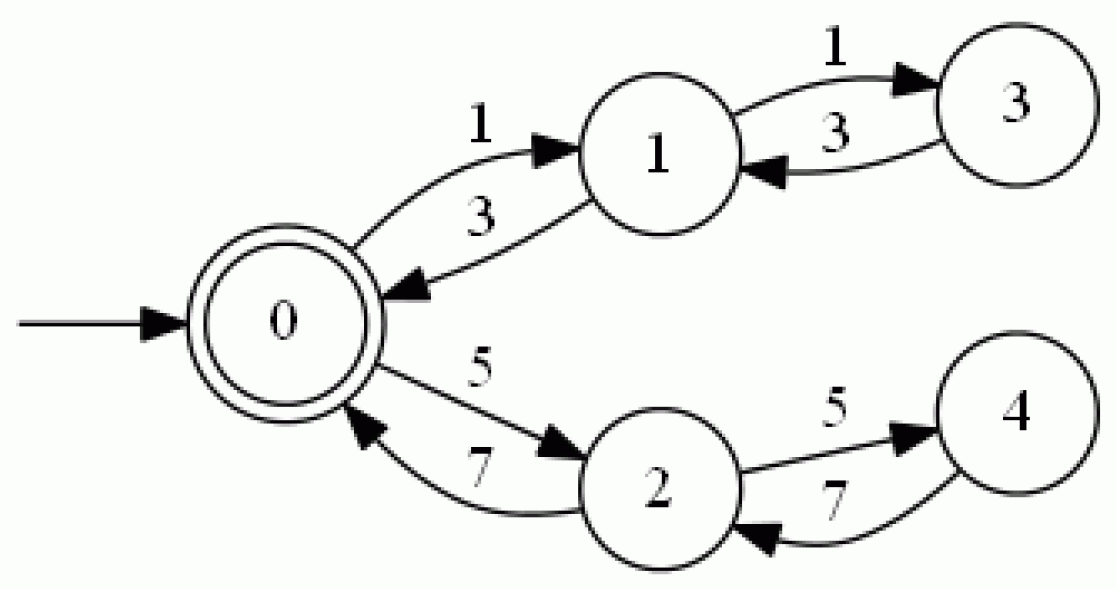
Before presenting the technical details of the observation minimization framework, it is important to clarify the distinction between the proposed approach and classical observability, normality, and relative observability. The classical concepts address a synthesis problem under a fixed observation alphabet: given a plant, a specification, and a predetermined set of observable events , these properties determine whether a supervisor exists, which can achieve the control objective under partial observation. In contrast, our work touches upon a fundamentally different design and optimization problem. We start from an existing supremal supervisor , which is synthesized under full observation, and aim to minimize the observation alphabet while preserving its control behavior. The constraints in our formulation are therefore not derived from abstract language admissibility conditions, but directly from the structural requirements of the given supervisor . Specifically, they arise from the need to distinguish its t-enabled states from its t-disabled states, and from the intrinsic observability requirements imposed by its cyclic behavior. Moreover, our approach is designed to strike an optimal balance between minimizing observation cost by reducing the number of observable events and maintaining control performance by ensuring that the supervisor continues to meet its original control objectives even after reducing the observation alphabet. This shift from analysis to design, and from language properties to supervisor-specific structural constraints, constitutes the core conceptual novelty of our approach.
3.1. Computation of the Events Need to Be Observed
Before introducing the observation design problem, it is necessary to clarify the notion of equivalence between supervisors, which serves as the behavioral criterion throughout this paper. Since the objective is not to synthesize a new supervisor but to simplify the implementation of an existing one under partial observation, we require that the simplified supervisor preserves the control decisions of the original supervisor.
Definition 1 (Control equivalence)
. Let be a plant, and and be two supervisors of G. Supervisors and are said to be control equivalent with respect to G if Control equivalence ensures that the two supervisors impose identical restrictions on the plant behavior and generate the same marked closed-loop language, even though their internal structures, state spaces, or information patterns may differ. This notion is widely adopted in SCT and forms the basis for supervisor reduction and abstraction techniques.
In this paper, control equivalence is used as the fundamental correctness criterion for observation design. To achieve this, we focus on preserving the disabling behavior of controllable events, which leads to the notions of event-enabled and event-disabled states and the associated distinguishability requirements developed in the following sections.
For each event
, we introduce a binary decision variable
, where
indicates that
is included in the observation set, and
otherwise. Then, an objective function can be used to minimize the number of events to be observed, as shown below:
The solution of ’s indicates a partial observation of a supervisor. Let be a projection with . Let and be the supervisor and the minimal observation supervisor of G, respectively. Then, the simplified supervisor can be considered as . For the constraints to ensure the equivalence of the obtained supervisor, we will consider it from the viewpoint of disabling actions. Let s be a string in . If there exists such that and , then should be disabled after s. Meanwhile, for each with and , should not be disabled after . In this case, the supervisor must identify the two strings, i.e., .
Definition 2 (Observation distinguishability). Let be a projection. Two strings are said to be distinguishable under P if .
Observation distinguishability provides the basic mechanism for ensuring that different control decisions remain separable after projection.
Let be a DES and the supervisor of G. At the initial state , once occurs, the system reaches a new state q. If and , t is enabled at state q. Then q is called a t-enabled state. Otherwise, q is called a t-disabled state.
Definition 3 (Event-enabled (disabled) states). Given a plant and a supervisor with , for an event , we define the following:
The set of t-enabled states, denoted by , as ;
The set of t-disabled states (enabled in the plant and disabled by the supervisor), denoted by , as .
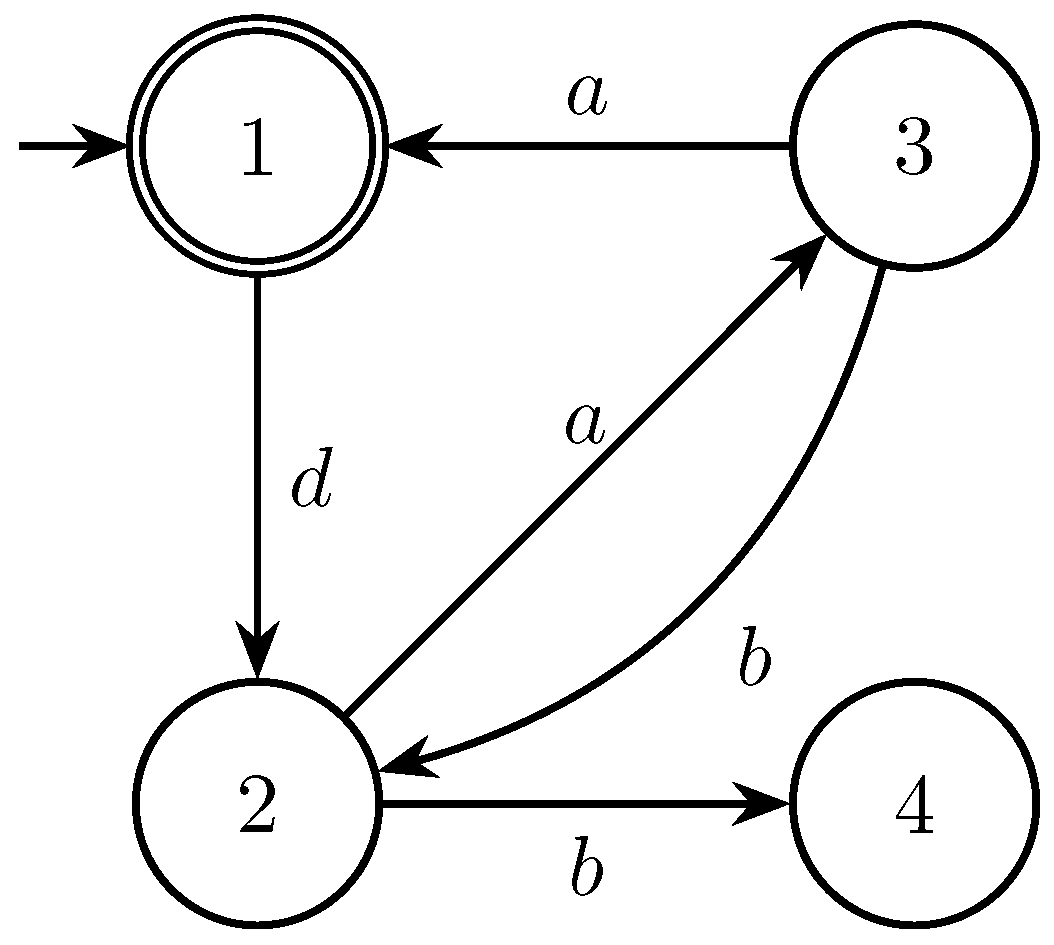
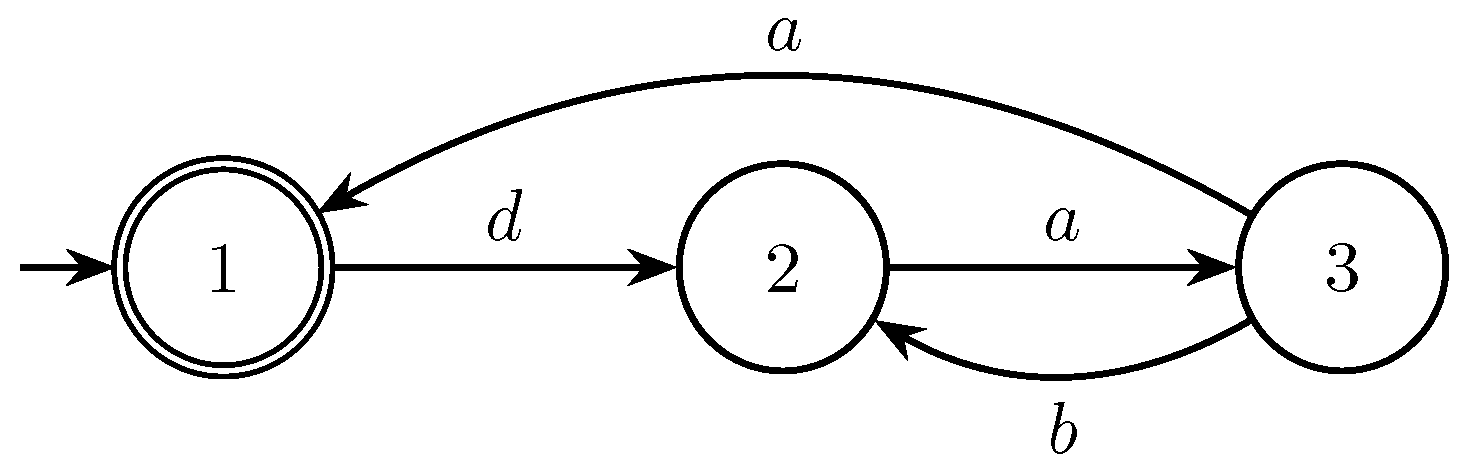
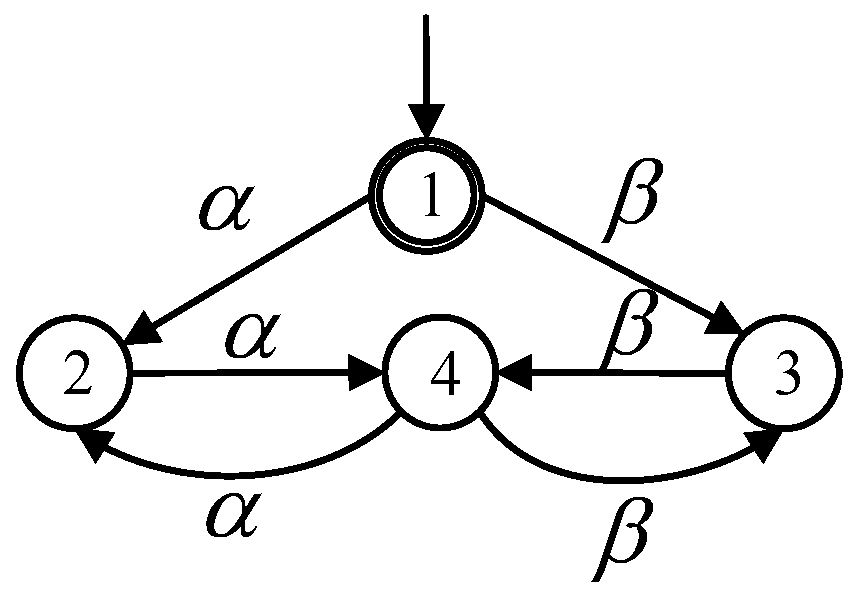
Example 4. Consider the plant and the supervisor introduced above, where disables event b at state 2 of . Let . By Definition 3, event b is enabled at state 3 both in the plant and under the supervisor, while it is enabled in the plant but disabled by the supervisor at state 2. Therefore, the sets of b-enabled and b-disabled states are given by and .
Based on Definition 3, Algorithm 1 provides a computational procedure to enumerate the sets
and
for each controllable event
t.
| Algorithm 1 Computation of the set of t-enabled states and the set of t-disabled states . |
- 1:
Input: A DES , a supervisor , and an event t. - 2:
Output: Set of t-enabled states and the set of t-disabled states . - 3:
; - 4:
; - 5:
for each event do - 6:
if then - 7:
; - 8:
else - 9:
; - 10:
end if - 11:
end for
|
While control equivalence characterizes behavioral equivalence at the language level, it does not directly lend itself to computational verification under partial observation. To bridge this gap, we introduce the notion of decision consistency, which captures an event-wise sufficient condition for preserving control equivalence.
Definition 4 (Decision consistency)
. Let be a supervisor of G and P be a projection. The supervisor is said to be decision-consistent with if for all , for all , The following theorem characterizes a necessary condition implied by Definition 4 in terms of distinguishability between t-enabled and t-disabled states.
Theorem 1. Let , , and . Let be two strings such that and . If is decision-consistent with , then .
Proof. Assume, for contradiction, that . By definition, implies , and implies . Since is decision-consistent with , by Definition 4 we have . This contradicts the assumption , i.e., holds. □
For each state , let be the set of event sequences reaching from the initial state. Each such sequence s is represented by its Parikh vector , whose components count the occurrences of events in along s. Applying the observation projection yields a vector representation associated with , denoted by . Similarly, each state is associated with a vector constructed in the same manner. In other words, and are the concrete realizations of the sets and , representing the actual event-enabled and event-disabled states in the system, respectively.
In addition to pairwise distinguishability between enabled and disabled states, cyclic structures in the supervisor impose intrinsic observability requirements.
Definition 5 (Supervisor circle and Event-enabled circle). Given a supremal supervisor ,
- 1.
A supervisor circle is a tuple , where:
is a nonempty set of supervisor states,
is a set of events,
is a partial transition function such that the directed graph contains at least one directed cycle, i.e., there exist states and events such that and .
- 2.
Let be a supervisor circle. If and for every state , event t is enabled at q in S (i.e., ), then C is called a t-enabled circle, denoted by . The set of all t-enabled circles is denoted by .
Example 5. Consider the supervisor introduced above. With respect to event a, there exist two a-enabled supervisor circles. The first one is given by with , where the cycle is contained in , and event a is enabled at both states. The second one is given by with , where the cycle is contained in , and event a is enabled at all states in . Hence, . With respect to event b, the circle is not b-enabled since b is disabled at state 2, and the circle is not b-enabled since . Therefore, there is no b-enabled circle in , i.e., .
Event-enabled circles capture cyclic behaviors in which different event sequences reach the same supervisor state while differing only by internal loops, thereby imposing intrinsic observability requirements under partial observation.
Given an event t, consider a t-enabled circle defined in Definition 5. By definition, for any state , there exists a string such that , , and for some . Hence, two strings s and reach the same supervisor state but differ by the occurrence of the events along the t-enabled circle.
Theorem 2. Let be a t-enabled circle of and P a projection. If is decision-consistent, then , where .
Proof. The proof relies on the concept of decision consistency (Definition 4) under projection P. The key idea is to ensure that control-decision-inconsistent states are distinguishable under partial observation, which is the core of the event-enabled circles concept.
By Definition 5, we consider two states s and in such that for some , and both states lead to the same supervisor state . If , it implies that the projection , i.e., all events in are erased. This results in a loss of distinguishability, which contradicts the decision consistency requirement of the reduced supervisor.
For decision consistency (Definition 4), the supervisor must distinguish between any state s and , where t is enabled after s but disabled after . The circle structure can introduce ambiguity if subsequent controllable events behave differently along the circle, resulting in indistinguishability of states.
Thus, to ensure that decision consistency is maintained under projection
P, at least one event in
must be observed. This leads to the inequality
which ensures that the necessary observability condition is met to preserve control equivalence. □
To guarantee the equivalence between the original supervisor and the simplified supervisor under partial observation, the two event sequences associated with an enabled and a disabled state must remain distinguishable after projection. To transform this distinguishability requirement into linear constraints, the Parikh vector representation introduced above is combined with the binary observation vector . Specifically, for an event sequence s, the projected representation is given by . Then this condition is equivalent to . In this step, represents the event sequence associated with state . The projection function P is applied to the result of , where maps event sequences to their corresponding observable sequences. This projection ensures that we are working with observable events in the system, which is critical for maintaining decision consistency under partial observation. The resulting is the projected event sequence corresponding to state .
Lemma 1. If , then and are distinguishable by projection, i.e., for some event σ; otherwise, if , they may not be distinguishable by projection.
Proof. If , it means that the frequencies of at least one event in and differ. Since the projection function P is based on these frequencies, the projections of and onto the observation set must differ, which implies that there exists an observable event such that , meaning that and are distinguishable by projection. On the other hand, if , the two sequences have identical event frequencies, but Parikh vectors do not account for the order of events. Therefore, even though the frequencies are the same, and could still differ in their event sequence order and produce the same projection for all observable events. In this case, for all , and thus they may not be distinguishable by projection. □
In a general DES, if the Parikh vectors of two strings are different, the strings must be distinct. Specifically, if , we have , as the Parikh vector captures the frequency of events, and a difference in frequencies implies that the event sequences differ structurally. However, it is important to note that the difference in event sequences does not necessarily indicate that the states reached by the sequences are different. In certain cases, two distinct event sequences can lead to the same control state, particularly in the context of event reduction and projection.
Thus, we present Lemma 1 as a sufficient condition in our projection-based event simplification method. The projection ensures that and can be distinguished, which ultimately maintains control consistency and guarantees control equivalence. This approach allows for the reduction of the event set while preserving the necessary control behavior of the system.
Since
has nonzero components only on the events contained in the circle, the above condition can be expressed as the following linear constraint:
Therefore, at least one event belonging to the
t-enabled circle must be observed in order to preserve the disabling behavior of the supervisor under partial observation.
To preserve the control behavior of the optimal supervisor, the enabling and disabling conditions for each controllable event
must be mutually exclusive. That is, the sets of
-enabled and
-disabled state representations must satisfy
This condition ensures that an event
is never disabled at any state where it should be enabled, and vice versa.
Let
and
be the vector representations of a
-enabled state and a
-disabled state, respectively. The nonintersection condition
is equivalently expressed as the requirement that their projected values under the observation vector
be different, i.e.,
The pair of inequalities enforces
for any
-enabled and
-disabled state representations, thereby guaranteeing that
under the chosen observation pattern. Consequently, the enabling and disabling decisions for event
are preserved after projection.
Theorem 3. Let and be the sets of vectors constructed from and , respectively. Then the projection P preserves the decision consistency of with respect to event t iff for all and .
Proof. The proof is divided into two parts.
- 1.
Assume for all and . Consider any such that and . Let and . Then one has and . By construction, there exist vectors and with and . Since , we have , implying . Thus, satisfies Definition 4 for event t, i.e., it is decision-consistent.
- 2.
Assume that is decision-consistent for event t, but (for contradiction) there exist and such that . Let correspond to e and d, respectively, with and . Then , implying . However, since q is t-enabled and is t-disabled, we have and . By Definition 4, decision consistency requires , which contradicts . Hence, must hold for all such pairs.
□
This theorem establishes that the pairwise distinguishability of t-enabled and t-disabled state representations (encoded by ) is both necessary and sufficient for preserving decision consistency under partial observation.
For condition (
5), we now introduce a pair of inequalities to guarantee that for each
and
, their projections are distinguishable:
To incorporate this disjunctive condition into a linear programming framework, a binary auxiliary variable
is introduced, and the above inequality is reformulated using a standard Big-
Q linearization as
for all
and
, where
is a sufficiently large constant (Big-
Q parameter). The Big-
Q linearization technique is used here to convert the disjunctive condition into a linear form by introducing a binary variable
. The large constant
Q ensures that the disjunction is satisfied when
and enforces the inequality when
, thus maintaining the correct control decision consistency.
Based on the preceding analysis, we now formalize the observation minimization problem as a Mixed-Integer Linear Programming (MILP) problem, which is termed the Minimal-Observation Programming (MOP) problem:
where
is a sufficiently large constant (Big-
Q parameter). The optimal solution
directly defines the minimal observation event set
.
Theorem 4. Let be the event set of a DES. The Minimal-Observation Programming (MOP) problem defined by (
8)–(
13)
always has a feasible solution. Proof. Choose
for all
and any
. Under this choice, the projection
P becomes the identity map. For any
and
, we have
and
. Since
and
are constructed to be disjoint with distinct vector representations,
holds. A sufficiently large constant
Q ensures that the big-
Q constraints (
9)–(
10) are satisfied for a suitable choice of
(e.g.,
when
). Moreover, for any
t-enabled circle
,
, which satisfies (
11). Thus,
satisfies all constraints and is a feasible solution to the MOP problem. □
Thus, the MOP problem is always solvable, providing a sound mathematical foundation for the subsequent computation of the minimal observation event set. The MOP formulation provides a complete mathematical characterization of the observation minimization problem. Its solution yields the minimal set of events that must be observed to preserve the supervisor’s disabling decisions under partial observation.
We now establish that solving the MOP problem indeed guarantees control equivalence between the original supervisor and the projected supervisor obtained from the minimal observation set.
In the MOP framework, the computational complexity is primarily determined by the number of variables and constraints. The main variables are , binary variables for each event in the observation set , leading to variables. Additionally, for each pair of e and d vectors (representing t-enabled and t-disabled states, respectively), a binary variable is introduced, resulting in variables. Therefore, the total number of variables is approximately . The constraints include linear constraints for each variable, i.e., Equations (9) and (10), leading to constraints, and additional decision consistency and structural observability constraints for each t-enabled circle, i.e., Equation (11), add another constraints. As a result, the total number of constraints is .
Since the problem is formulated as an MILP, it is inherently NP-hard. This complexity arises from the combinatorial nature of the decision variables and the constraints involved in selecting the minimal observation set while preserving control equivalence. As the size of the event set grows, both the number of variables and constraints increase quadratically, resulting in exponential growth in computational effort. Consequently, the MOP problem belongs to the NP-hard class, indicating that it cannot be solved optimally in polynomial time in the input size.
Theorem 5. Let be a plant and be a (nonblocking) supervisor of G. Let be an optimal solution to the MOP problem, define the projection with , and let . Assume that for every controllable event , the sets and are constructed such that each t-enabled and t-disabled reachable state of is represented by at least one event sequence. Then is control equivalent to with respect to G.
Proof. We will show that preserves the disabling behavior of for all controllable events, which implies control equivalence. The key step is to clarify the role of representation completeness in ensuring that all reachable states, whether t-enabled or t-disabled, are represented in the corresponding vector sets and , respectively.
Consider any reachable event sequence . If , then both and reject s, and no control decision is involved. Hence, consider and any controllable event such that , we have two cases.
Case 1: If , then t is enabled by after s, and the state reached by s belongs to .
Case 2: If , then the reached state belongs to .
By the assumption stated in the theorem, for every , the sets and are constructed such that each t-enabled and t-disabled reachable state of is represented by at least one event sequence. This ensures representation completeness, meaning that every state is adequately represented by an event sequence in either or .
Hence, for the first case, the event sequence s is represented by some vector , and for the second case, the event sequence s is represented by some vector .
To demonstrate control equivalence, suppose, for contradiction, that makes a different control decision from for event t after some observation. Then there must exist two event sequences that are indistinguishable under P, i.e., , such that t is enabled after but disabled after in .
Let
and
be the corresponding vectors. Since
, we have
, which contradicts condition (
5).
Therefore, no such conflicting pair of event sequences exists, and
issues the same enabling and disabling decisions as
for all controllable events. It follows that
and hence,
is control equivalent to
with respect to
G. □
Based on the MOP formulation, Algorithm 2 provides a systematic procedure for computing the minimal observation event set
that preserves the control behavior of the original supervisor under partial observation.
| Algorithm 2 Computation of the events to be observed . |
- 1:
Input: Set of t-enabled states , the set of t-disabled states , and the set of t-enabled circles ; - 2:
Output: Observation event set . - 3:
; - 4:
; - 5:
for each state do - 6:
; - 7:
; - 8:
if then - 9:
; - 10:
else if then - 11:
; - 12:
end if - 13:
end for - 14:
Formulate MOP and solve it; - 15:
Let be the optimal solution; - 16:
; - 17:
return .
|
Algorithm 2 provides a systematic procedure for computing a minimal observation set that preserves the control behavior of the original supervisor under partial observation. Each reachable supervisor state is first associated with a representative event sequence and encoded by its Parikh vector. After projection, these representations are grouped into the sets and , corresponding to t-enabled and t-disabled states, respectively, thereby capturing all observable information relevant to the control decision for event t. The pairwise separation constraints in the MOP formulation, defined by inequalities (9) and (10), ensure that no t-enabled and t-disabled event sequences become indistinguishable under the chosen projection, which guarantees decision consistency. In addition, circle-induced structural constraints, expressed by inequality (11), incorporate observability requirements imposed by t-enabled circles, ensuring that cyclic behaviors do not eliminate necessary distinctions after projection. Together, these constraints define a MOP formulation whose solution yields the observation set , which is minimal in cardinality and guarantees control equivalence with the original supervisor.
From a computational standpoint, the effort of Algorithm 2 is dominated by the construction of the vector sets and and by the number of linear constraints generated. For a fixed controllable event t, let and denote the cardinalities of the vector sets constructed from t-enabled and t-disabled states, respectively. The number of pairwise separation constraints grows proportionally to , while each t-enabled circle introduces one circle-induced structural constraint. As both and increase, the number of constraints increases quadratically, impacting the overall complexity of the MILP formulation. Since both quantities are derived from the reachable state space of the supervisor, the resulting MOP problem has finite size and polynomial (in the size of the supervisor) many variables and constraints. Consequently, the MOP problem can be solved using standard mixed-integer linear programming (MILP) solvers.
In practical applications, the MOP approach provides substantial benefits by minimizing the number of observable events, which leads to significant savings in observation time and improved system efficiency, particularly for large-scale systems. This optimization of sensing requirements does not come at the cost of control performance; the supervisor retains its ability to achieve the desired control objectives while ensuring behavioral correctness. By efficiently balancing resource usage and control accuracy, the MOP approach offers both computational efficiency and practical effectiveness, making it a highly valuable tool for supervisory control in real-world scenarios.
3.2. Construction of the Event-Minimal Supervisor
This subsection constructs an event-minimal supervisor based on the minimal observation set
obtained in
Section 3.1. The objective is to derive an explicit automaton realization that observes only the events in
while preserving the control behavior of the original supremal supervisor. The construction is achieved by removing non-observed events and merging supervisor states that become indistinguishable after event removal.
Let be the supremal supervisor synthesized under full observation. Given the minimal observation set computed by Algorithm 2, define the set of removed events as . The events in E are not directly observed in the reduced supervisor, while events in remain observable.
To obtain a valid supervisor realization under the reduced observation alphabet, the effect of removing the events in E on the supervisor state structure must be taken into account. For this purpose, we introduce the notion of E-closure.
Definition 6 (
E-closure [
2])
. Given an automaton and a set of events , the E-closure of a state set is defined as In particular, for a single state , The E-closure characterizes the reachability among supervisor states induced solely by the removed events. By aggregating states with identical E-closures and retaining only transitions labeled by events in , a reduced supervisor can be constructed, which preserves the observable behavior of S. The detailed construction is given in Algorithm 3.
In Algorithm 3, several important steps are involved in constructing the event-minimal supervisor. First, the algorithm defines the reduced set of events
as the minimal observation set
, which ensures that only the events necessary to preserve the observable behavior of the original supervisor are retained. The set of states in the reduced supervisor is represented by
. Initially,
is empty, and the algorithm gradually builds it by merging states based on their
E-closure. Specifically,
is used to denote states that might be modified or combined during the construction. When applying the
E-closure operation, which groups mutually reachable states under the event sequences consisting only of removed events, new sets of merged states are formed. These new sets are referred to as
and are added to
, representing the reduced states after merging based on the
E-closure. The transition function
is then defined for the new supervisor, with each transition based on the reduced event set
. This merging process, ensured by the
E-closure, guarantees that the observable control behavior is preserved while reducing the state space.
| Algorithm 3 Construction of the event-minimal supervisor from . |
- 1:
Input: , , minimal observation set . - 2:
Output: . - 3:
, ; - 4:
; - 5:
; - 6:
; - 7:
; - 8:
for each and each do - 9:
; - 10:
; - 11:
; - 12:
end for - 13:
; - 14:
return .
|
Algorithm 3 constructs an event-minimal supervisor by removing all events not contained in the minimal observation set and merging supervisor states via E-closure. Specifically, the reduced event set is fixed to , and the states that are mutually reachable through event sequences consisting only of removed events are grouped into a single state in the constructed automaton. This closure-based merging preserves the observable behavior of the original supremal supervisor under the selected observation structure. Moreover, since is computed by Algorithm 2 to preserve decision consistency (and thus control equivalence) for all controllable events, the merging induced by E-closure does not introduce any conflicting control decisions. Consequently, the supervisor obtained by Algorithm 3 is control equivalent to the original supervisor while observing only the events in .
From a computational perspective, the cost of Algorithm 3 is dominated by the number of reachable
E-closures and the construction of the transition relation over
. In the worst case, computing the
E-closure for each macrostate and each event in
via reachability search yields a complexity of
, where
m is the number of supervisor states and
n is the total number of events. Each state in
corresponds to an
E-closure of a subset of
, and the total number of reachable closures is finite since it is bounded by the reachable state space of the original supervisor. For each constructed state and each event in
, one transition is generated by computing an
E-closure, which can be implemented by a standard reachability search restricted to events in
E. Therefore, the construction complexity is polynomial in the size of the original supervisor (in terms of states and transitions), and it does not require solving any additional optimization problems beyond the MILP used to compute
. This makes the overall framework computationally tractable for practical supervisory control applications. In comparison, the algorithm proposed by Su and Wonham in [
18] computes a reduced supervisor with a complexity of
. This contrasts with our approach, where the computational complexity primarily depends on the number of pairwise separation constraints and the size of the
t-enabled circles, which scales differently and can offer advantages in scalability for large systems.