1. Introduction
In computational algebra, rational reconstruction is used to recover exact rational values after performing computations in modular arithmetic. The method exploits the fact that when attention is restricted to rational numbers with bounded numerators and denominators, sufficiently, many modular images combined uniquely determine each rational number [
1] (Chapter 5, Section 10) [
2]. Further developments and robustness aspects of rational reconstruction have been investigated in the modern literature (see, for instance, [
3,
4,
5]). The absolute Galois group of
is a profinite group, realized as the inverse limit of the Galois groups of finite Galois extensions of
, and provides a natural link between arithmetic over
and finite algebraic data (see [
6] (Chapter I, Sections 1–3, Chapter II, Section 1.1), [
7] (Chapters I, VI, and VIII), and [
8] (Chapters 1–2); see also, for example, the recent literature on structural and cohomological aspects of absolute Galois groups [
9,
10]). This perspective extends to the adelic setting:
embeds diagonally into the adele ring
. For each prime
the corresponding integral structure, is given by the p-adic integers
, which arise as the inverse limits of finite rings
[
11] (Chapters II and IV) (see also, for instance, Ref. [
12] for the role of adeles in the modern theory of Galois representations). In Robinson’s nonstandard analysis, every finite hyperreal has a standard part in
, i.e., it is infinitesimally close to a unique real number [
13] (Chapter I) (see also the survey on infinitesimals and modern approaches to nonstandard analysis [
14]). Taken together, these constructions illustrate an interplay between rational and real numbers and finite algebraic structures. This observation motivates the constructive realization of rational, real, and complex numbers, introduced in this work, based on sequences of elements over finite fields of increasing order.
Background on finite fields can be found in [
15], Chapters 1–2. Compared with previous approaches, the present framework provides an explicit link between finite-cardinality number sets and the classical fields
,
, and
. The starting point of the constructive approach is the observation that the elements of Galois fields
, where
is a prime number, can be interpreted in terms of fractions
with
such that
and
, defining a set
. The basis of such interpretation is provided by the field property stating that any linear equation with a non-zero coefficient admits a unique solution. Therefore, there exists a unique element
of
such that
The following definitions are then introduced:
Definition 1. A pair is called a fractional representation of an element if Equation (1) holds. It is also denoted as .
Definition 2. Two fractional representations, of the same element of are said to be p-equivalent. The notation is used to indicate this relation.
Definition 3. The function is said to be a complete representation of . The function
is obviously surjective, since
is the image of the set of pairs
, with
, and is not injective for any
since the finite set
has more elements than the finite set
. As an illustrative example, the function
is reported in
Table 1.
The following theorem provides a criterion for determining equivalent representations of elements of :
Theorem 1. holds if and only if Theorem 2. The relation is an equivalence relation in .
The proofs of these theorems are straightforward.
Following the study by Louboutin and Murchio [
16], a minimal representation of
is obtained by restricting the complete representation to a suitable subset of
. In
Section 2, a specific subset
of this kind is constructed by means of an induction method and an algorithmic procedure.
By introducing on suitable binary operations of addition and multiplication, denoted by and , it is shown that the restriction to of yields an isomorphism between and . The field is referred to as the field of discrete rational numbers of order . The notation is adopted to avoid confusion with the field of p-adic numbers .
Owing to the isomorphism with
, the field
does not constitute a new algebraic structure but rather a new representation of
. The algorithmic construction ensures that the sequence
is increasing in the sense that for any positive integer
,
, where
is the increasing sequence of prime numbers. In
Section 3, the sequences of discrete rational numbers
, with
, which are constant after a certain index, are introduced as the basic objects for the construction of rational numbers. An equivalence relation
is defined on the set
K of such sequences. Suitable addition
and multiplication
operations are defined in
, such that
is a field isomorphic to the classical field
[
17] (Chapter I). In
Section 4, a set
of convergent sequences of discrete rational numbers is introduced by adopting a suitable definition of convergence. These sequences are the basic objects used to construct the real field
[
17] (Chapter V). An equivalence relation
is defined in
and suitable addition
and multiplication
operations are defined in
, such that
is a field isomorphic to
. In
Section 5, suitable operations of addition and multiplication are defined in
where
is a non-Pythagorean prime, in order to obtain finite fields of
discrete complex numbers . Sequences of elements of
, where
is the increasing sequence of non-Pythagorean primes, together with an appropriate convergence criterion, are used to define a field (
) isomorphic to the complex field
[
17] (Chapter VII). Suitable distance functions are defined in
and
such that the corresponding isomorphisms with
and
are also isometries, with respect to the standard distance
[
18] (Chapter 2, Section 2.1). The isomorphism between
and
preserves the Euclidean distance. A summary and discussion of the results, together with the possible future developments, are presented in
Section 6.
2. The Field : Algorithmic Procedure
Specific bijective functions
are introduced here, as obtained from
by restriction of its domain to a suitable subset
, which is defined by the following induction and algorithmic procedure. As a prerequisite, a bijective function
is defined in the
Table 2.
Using an inductive construction, it is assumed that a bijective function is defined by the restriction of the domain of to a subset , such that if , then also . This property is fulfilled by the function defined above. The following relation on elements of the subset is defined.
Definition 4. The relation between two elements of the set is defined by the condition that the following ordering occurs in : It can be shown that defines a total order relation. However, since is finite, the order is not compatible with the operations of addition and multiplication. Algorithm 1 is used to construct , where is the next prime greater than the prime .
| Algorithm 1 |
Step 1. Set .
Step 2. Iterate a loop in the ascending order (within the relation
among the couples , with , and remove both and from if any of them is s-equivalent to any couple or such that , , and .
Step 3. Find the pair with the largest value of .
Step 4. Perform a double loop in ascending order of n, such that , and in ascending order of m, such that , and check if the couples and are not s-equivalent to any element of In that case, add them to the set If contains s elements, then set and stop. Otherwise, continue the iteration.
Step 5. Perform a double loop in ascending order of m, such that and in ascending order of n, such that , and check if the couples and are not s-equivalent to any element of In that case, add them to the set If contains s elements, then set and stop. Otherwise, continue the iteration.
Step 6. Add to the elements and , where If has s elements, then set and stop. Otherwise, set and continue from Step 4. |
The inductive construction therefore allows one to determine for any prime number ; has been defined and, given for any prime number , Algorithm 1 allows for defining for the next prime greater than . Note that Step 4 and Step 5 may add an even number of additional elements to the initial set , as obtained by Step 2. If no additional elements have been provided by Step 4 and Step 5, then Step 6 will add in any case two elements to . Due to the iteration adopted in Step 6, is thus filled by an increasing odd number of elements until it has elements. Hence, Algorithm 1 terminates after a finite number of steps. Moreover, it provides the set with the required property that the function obtained from by restriction of its domain to is bijective. The following result holds:
Theorem 3. If , where is the maximum integer such that , is injective.
Proof. The couples
and
are not
-equivalent if
. Their equivalence, from Theorem 1, would indeed imply that:
Therefore, by the field properties of
, it follows that
or
. This leads to a contradiction since both
and
are non-zero. Moreover, the two elements
and
, where
, as generated by
Step 6, are not
-equivalent to any element of the current set
if
. If
by Theorem 1, it is indeed
If this is impossible, since and .
If
, Equation (5) and
gives
The largest value of the right-hand side of Equation (6) is:
The first factor in parentheses maximizes , the second factor maximizes , and is defined as , where is the largest integer such that so that .
Therefore, Equation (6) cannot hold, since while the absolute value of the r.h.s. of Equation (6) is larger than . If , where is the maximum integer such that , then the above observations and the tests provided in both Steps 4 and 5 guarantee that is injective. □
In addition, the following theorem has been demonstrated in [
16]:
Theorem 4. If is prime, there exists a pair such that and
Therefore, since all the couples are considered in Algorithm 1 to determine , the following theorem is derived:
Theorem 5. If , where is the maximum integer such that Algorithm 1 determines
such that the restriction of to the domain is surjective.
Therefore, Algorithm 1 terminates with
, providing a bijective restriction
of
to the domain
. Based on Algorithm 1, a numerical implementation of the inductive procedure to determine
for any prime
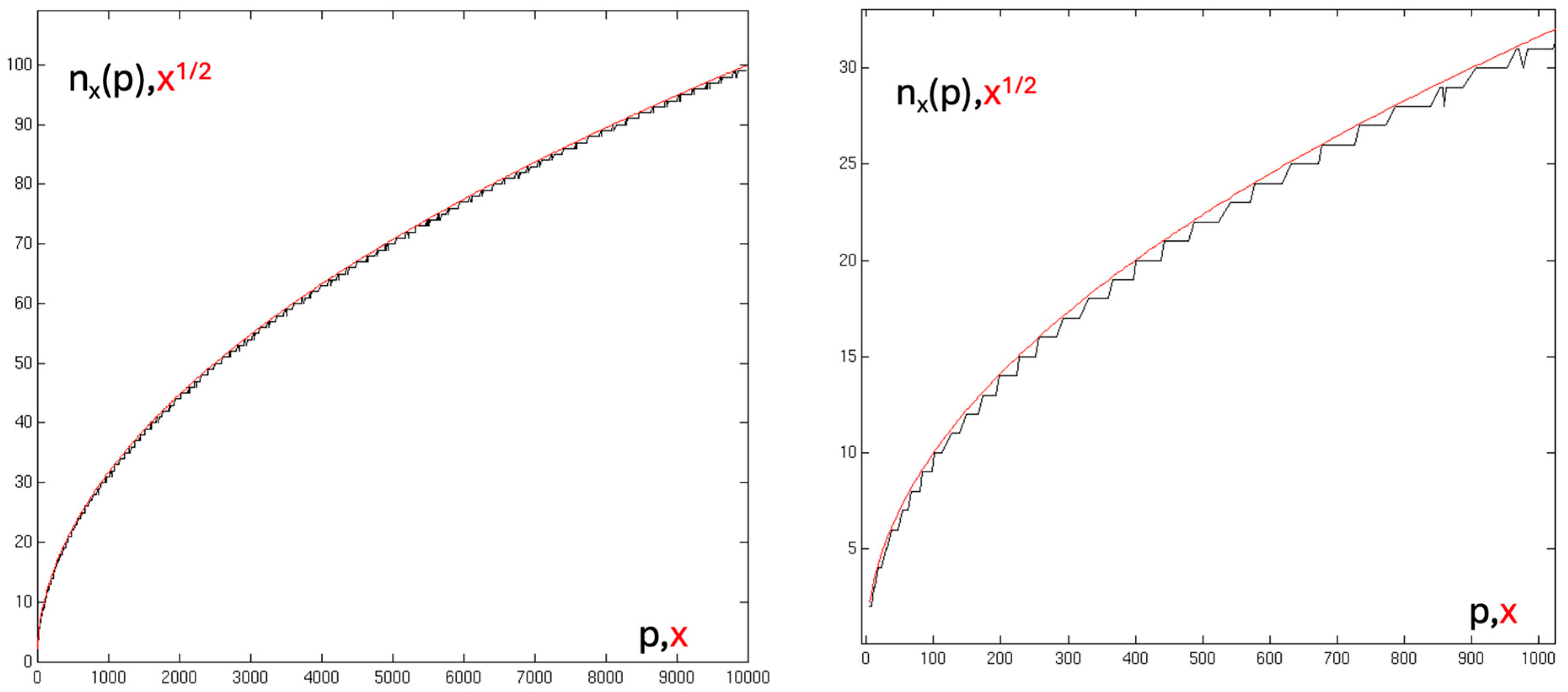
less than an input integer value has been carried out. The values obtained for the maximum integer
such that
are shown in
Figure 1. For comparison, the real function
is also shown as a reference curve. In the left-hand side plot of
Figure 1,
ranges over the prime numbers in the interval [2, 9973], while
varies over [2, 9973]; in the right-hand side plot,
ranges over the primes in [2, 997], and
varies over [2, 997]. The points
and
, where
is the next prime greater than
are joined by straight line segments, thus displaying the graph of
as a broken line for visualization purposes. The numerical results used in
Figure 1 suggest the conjecture that the values
, as determined by Algorithm 1, are close to the limiting value
indicated by Theorem 4. More precisely, they are equal to
or
, as occurs in the interval [2, 9973] explored. It would be interesting to prove this conjecture. The graph of
exhibits an overall increasing behavior, with occasional downward jumps, as shown in
Figure 1, more clearly in the right-hand plot. The downward jumps are a consequence of
Step 2 of Algorithm 1, which may remove
from the set
when the set
is generated, where
is the next prime number greater than the prime
.
As an example, the functions
and
are shown, respectively, in
Table 3 and
Table 4.
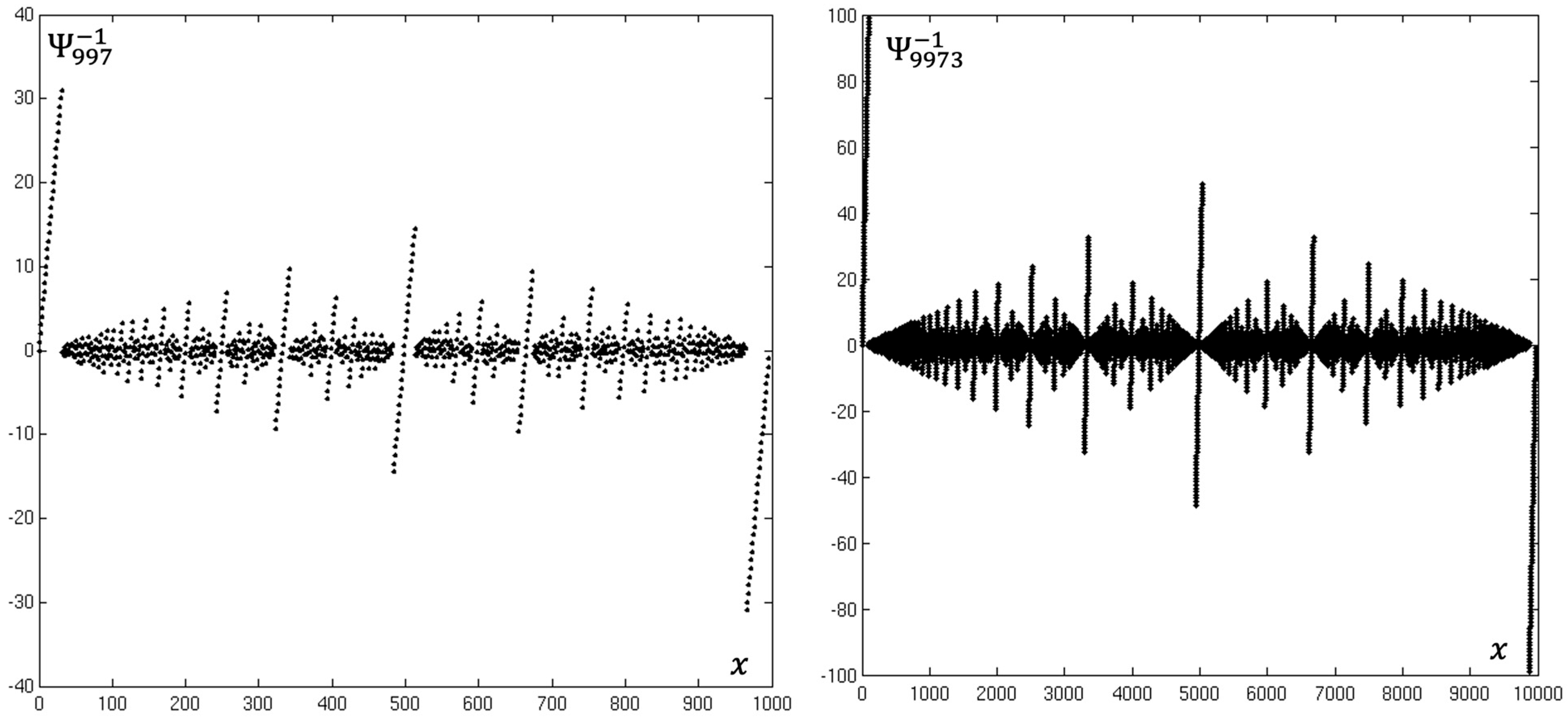
In
Figure 2, the inverse functions
and
are plotted using the representation of the discrete rational numbers
in terms of the fractions
.
Figure 2 illustrates the progressive filling of the set of the fractions. This is due to the
Aufbau principle embedded in Algorithm 1, producing an increasing sequence of sets
. The functions
and
exhibit a similar characteristic pattern. The points of the graphs
and
are denser near the axis of the abscissae. The numerical results shown in
Figure 2 suggest the conjecture that the density of the points is larger near the axis of the abscissae and increases with
. This appears to be a direct consequence of the ordering of Step 4 and Step 5 in Algorithm 1, so that the pairs
with
are selected for the set of discrete rational numbers before selecting the pairs
with
. It would be interesting to confirm this conjecture. Even more interesting would be to calculate in closed form the set
instead of deriving it via an algorithmic procedure, providing the bijective mapping
. A closed-form expression for
might also characterize quantitatively the pattern shown in
Figure 2.
To define the algebra of the sets , the following binary operations of addition and multiplication, denoted by and , respectively, are defined:
Definition 5. For any and , This definition ensures that is an isomorphism, and is a field isomorphic to the Galois field . The following definitions are introduced:
Definition 6. Any element of is defined as a discrete rational number.
Definition 7. is defined as the field of discrete rational numbers of order .
The term discrete rational number is not standard in the mathematical literature; it is used here to convey the idea of the fractional representation of the field provided by .
As observed in the introduction, is not a new field, being merely a different representation of its isomorphic field .
A link with the ordinary operations of addition and multiplication in is provided, respectively, by the following Theorems 7 and 8, which will be used in the next section devoted to the construction of based on the fields . To this end, the equivalence relation, denoted as , is defined between pairs of integer numbers, with :
Definition 8. .
Theorem 6. and it follows that: Proof. and
so that it is also
. Therefore,
The above equalities hold in
, since
and
are divisions with zero remainder and
. It is then obtained from Equation (14), being
:
The last equality holds due to the equivalence
. If the quantity in the curly brackets is indicated as
, one obtains:
Hence, since
has an inverse in
, one obtains:
In conclusion, since
□
Theorem 7. and it is also: Proof. and
so that it is also
. Therefore,
The final equality holds in
only since
and
are divisions with zero remainder. It is then obtained from Equation (14) since
:
The last equality holds due to the equivalence
. If the quantity in the curly brackets is indicated as
, one obtains:
Hence, since
, it has an inverse in
, so that one obtains:
In conclusion, since
, it is:
□
Owing to the properties of Algorithm 1, the following theorem follows (the proof is straightforward):
Theorem 8. If , then and are coprime.
A sufficient condition for is provided by the following theorem:
Theorem 9. If , then .
Proof. If
and
by Theorem 1, there exists
such that Equation (2) is fulfilled and
. This condition follows from the fact that the set of couples with elements less than
in absolute value cannot provide a surjective mapping in
, as its cardinality is less than
. Therefore, Algorithm 1 cannot stop before checking if
so that the above condition must be verified to have that
. Moreover, since all the elements of the couple of integer numbers belonging to
have absolute values less than
, Equation (2) can be fulfilled only if the products
and
have opposite signs and
If , the last equation is impossible since the products and both have absolute values less than . □
The field can be endowed with the following definition of local distance function :
Definition 9. The local distance function is given by The local distance function does not satisfy the triangle inequality so that is not a metric space with respect to it. However, the triangle inequality for holds in subsets of In this sense, is a locally metric space with respect to .
3. Rational Numbers
The basic objects for defining the set are the constant sequences of discrete rational numbers. These are defined by:
Definition 10. A sequence of discrete rational numbers such that where is the increasing sequence of primes, is called a constant sequence if there exists such that for. The constant value is said to be the limit of the sequence , indicated by the symbol
An equivalence relation is introduced on the set of the constant sequences of discrete rational numbers by the following:
Definition 11. Two sequences and are said to be and the relation holds if such that
.
It is straightforward to verify that two sequences of discrete rational numbers are if and only if they have the same limit value.
A set of Galois rational numbers is now introduced:
Definition 12. The quotient set is called the set of Galois rational numbers.
Addition and multiplication, denoted, respectively, by and , are defined on :
Definition 13. Given, let and and define the constant sequences where and denote the addition and multiplication in as provided by Definition 5. The addition and multiplication on
are defined, respectively, as:
where
,
,
, and
.
To show that the operations defined above descend to the quotient, let us define
and
. Here,
is such that
and
The pairs
and
do not depend on the specific elements
and
of the respective classes
and
Concerning the addition, let
and
such that
and
are coprime and
By Theorem 9, such that and , . Due to Theorem 6, it follows that . Therefore, the result of the addition does not depend on the choice of representatives of the classes and used in Definition 13.
Concerning multiplication, define
and
such that
and
are coprime and
Due to Theorem 9, such that and , . Due to Theorem 7, it is then . Therefore, the result of the multiplication does not depend on the choice of representatives of the classes and used in Definition 13. The above-defined addition and multiplication inherit the properties of the addition and multiplication of the fields . The proof that is a field is straightforward. The additive identity is the class denoted as , which contains the sequence , for any . The multiplicative identity is the class denoted as , which contains the sequence , where for any . As noted above, the elements of any equivalence class have the same limit, which is denoted by . The following order is defined on the field :
Definition 14. For , the order holds if said and It can be shown that the order is a total order and compatible with the addition and multiplication. Moreover, it is straightforward to prove that the field is a metric space, endowed with the distance :
Definition 15. For , the distance is defined as , where and .
One readily verifies that the definition of the distance is meaningful, i.e., it descends to the quotient. An ordering between the distances is established by the following:
Definition 16. If and , the order holds if .
To compare the field
with the field of rational numbers
, the latter can be defined as
, where
. The equivalence relation
is defined by:
Given
and any pairs
and
, the binary operations of addition
and multiplication
are defined as:
A detailed definition and discussion of the properties of the rational numbers can be found in classical textbooks, e.g., [
17] (Chapter I). The following theorem is stated:
Theorem 10. The function defined by:is an isomorphism, and is a field isomorphic to the field . Proof. First, observe that the function
is well defined, i.e., it descends to the quotient since all representatives of the class
have an identical constant value above a certain index. The function
is injective. If
and
, then there exist two sequences (
and
) such that there exists an index
and
. The two pairs
and
are thus equivalent with respect to the equivalence relation
. Moreover, by Theorem 9,
and
are coprime, and
and
are coprime. Therefore
, so that
. The function
is surjective. Let
be arbitrary and a representative
such that
and
are coprime. Consider a prime
such that
; hence, by Theorem 9,
for any
larger or equal to
, where
. The class
that has the element
defined by
is such that
.
The function
preserves addition. Let
and two sequences
and
. There exists an index
. Consider the integer numbers
such that
and
are coprime and
Consider the prime number such that , so that for , where . Owing to Theorem 6, for . Hence, . Moreover, and . Consequently, it is also . The classes and are thus identical since they contain, respectively, the elements and which are equivalent with respect to . □
The function
preserves multiplication. Let
and two sequences
and
. There exists an index
. Let us consider the integer numbers
such that
and
are coprime and
Consider the prime number such that , so that for , where . Owing to Theorem 7, for .
Therefore, it follows that . Moreover, , , and . The classes and are thus identical since they contain, respectively, the elements and , which are equivalent with respect to the relation .
It is easy to show that preserves the order and provides an isometry between and the distance defined in as . By abuse of notation, it might be indicated as the pair if the sequence is such that , and the element such that might be indicated as .
4. Real Numbers
The basic objects for defining the set are the convergent sequences of discrete rational numbers. To define them, a preliminary definition is introduced:
Definition 17. Given a sequence of discrete rational numbers such that and , any sequence such that for is said to be to .
Definition 18. A sequence of discrete rational numbers such that , , and is the increasing sequence of primes is said to be a convergent sequence if for any positive discrete rational number, there exists an index such that and The sequences and are, respectively, s-associated and t-associated with . The set of the convergent sequences includes the set . An equivalence relation is introduced on the set of the convergent sequences of discrete rational numbers:
Definition 19. Two sequences are said to be and the relation holds if for any discrete rational number there exists a such that Note that the sequences and are, respectively, s-associated and t-associated with and . The following Lemma 1 and Lemma 2 allow one to prove that, introducing the binary operations of addition and multiplication of convergent sequences, as defined in the following, one obtains a field , which is isomorphic to the field of the real numbers.
Lemma 1. For any convergent sequence , there exists an convergent sequence and such that if , both and are bounded by
Proof. For any convergent sequence
, let
and denote as
the set of the discrete rational numbers
with
less than
. Choose in
the element
such that:
Here,
is a constant sequence of discrete rational numbers such that
for
;
is a constant sequence
with
;
is a constant sequence such that
for
. For any discrete rational number
, let
such that
and
. Since the set
is dense, there exists
such that
. Let
with
and
coprime integer numbers and
such that they are both less than
. Therefore,
and
. Indeed,
Therefore, if , owing to Equation (33). This shows that is a convergent sequence and . □
Lemma 1 leads to the following definition:
Definition 20. For any convergent sequence , any convergent sequence such that , where and are less than for , is said to be a associated with .
Lemma 2. For any convergent sequence , there exists a constant sequence and such that for .
The proof is straightforward. Lemma 2 leads to the following definition:
Definition 21. For any convergent sequence , the limit of a constant sequence such that for is said to be an absolute bound of .
The following definitions allow for the constructive realization of the field of real numbers.
Definition 22. The quotient is said to be the set of Galois real numbers.
Definition 23. For any and , with and , the operations of addition and multiplication are defined, respectively, aswith and . Definition 23 descends to the quotient. Concerning the addition, note that
is a convergent sequence since
Moreover, if
and
, it is true that
since
Concerning the multiplication,
is a convergent sequence since
Here,
and
are, respectively, an absolute bound of
and
. Moreover, if
and
, then
since
Here, and denote, respectively, the absolute bound of and . It is easy to show that both the equivalences and hold, based on the inequalities provided, respectively, by Equations (38) and (39).
The addition and multiplication defined above inherit the properties of the addition and multiplication of the fields
and the proof that
is a field is straightforward. The additive identity is the class denoted as
, which contains the sequence
, where
for any
. The multiplicative identity is the class denoted as
, which contains the sequence
, where
for any
. A comprehensive definition and discussion of the properties of the field
of the real numbers is provided in classical textbooks, e.g., [
17] (Chapter V). A brief summary is now given for a comparison with the field
defined above. First, the following definitions are introduced:
Definition 24. A sequence of rational numbers is said to be a Cauchy sequence if, for any positive , there exists such that
Definition 25. Two Cauchy sequences are said to be equivalent, with the notation , if for any , there exists such that
The field of the real numbers
can be defined as
, where
,
is the set of the Cauchy sequences, and the binary operations of addition and multiplication of two elements
are defined, respectively, as:
where
,
, and
.
The following theorem is stated:
Theorem 11. The function defined by is an isomorphism, and is a field isomorphic to the field . For clarity, it should be noted that the function is defined by the following steps:
- (1)
For , a representative of is chosen as the convergent sequence
- (2)
For each integer consider the sequence , such that for
- (3)
For each integer , is obtained given
- (4)
The sequence is a Cauchy sequence, which is an element of the equivalence class, with respect to the relation , denoted as
- (5)
The function maps to
Proof. It is first proved that
is a Cauchy sequence. For any positive
, there are two positive coprime integer numbers
and a positive integer
such that
are less than
and
. Therefore,
is also a discrete rational number. Since
is a convergent sequence, there exists
such that
for
. The definition of the distance implies that
for
. The definition of the isomorphism
thus implies
for
. It is then proved that
descends to the quotient of its domain. Let
and
. Since
, there exists
such that
for
. The definition of the distance implies that
for
. The definition of the isomorphism
thus implies
for
. Hence,
and
are elements of the same equivalence class
. The function
is surjective. Let us consider a Cauchy sequence
and a positive
such that
with positive integer
. There exists a positive integer number
such that both
and
. Consider the sequence of rational numbers
such that it is
if
. The sequence
is convergent. For any positive discrete rational number
, there exists a positive integer number
such that
and
. Therefore, it is
. The function
maps
to
if
. It can then be verified that
. The function
preserves the addition and multiplication. Let us consider
and, based on Lemma 1, two representative elements
and
as
sequences. This implies that there exists
such that if
and
, being
, the integer numbers
are less than
for
. Hence, within
, by Theorems 6 and 7, for
Indeed,
for
. Therefore, by Theorem 9, they are elements of
. In addition, for
and if
The last inequality follows from the condition
so that
. It ensures, by Theorem 9, that
. In conclusion, for
, it is:
Hence, and . □
The order and the distance function on are defined, respectively, as:
Definition 26. For the order holds if, for and , there exists such that for
Definition 27. The distance function is defined on by: It can be verified that preserves the order and is an isometry between and the distance function defined in by . With respect to these metrics, the fields and are complete.
5. Complex Numbers
In this section, non-Pythagorean primes are used to define the field of discrete complex numbers . The addition and multiplication are defined by algebraic rules analogous to those of the complex numbers, as follows:
Definition 28. For any and , the operations of addition and multiplication are defined, respectively, as: The operations on the right-hand side in Equations (46) and (47) are performed in
. It can be shown that
is a field. The additive and multiplicative identities are
and
, respectively. It is worth noting that the need of non-Pythagorean primes
emerges when considering the solutions of the linear system in the field
, which arises in the computation of the inverse of
with respect to the multiplication defined in
by Equation (47), namely:
This equation can also be written in matrix form:
It has a unique solution provided that , which implies that must be a non-Pythagorean prime to ensure that is a field, since the inverse with respect to the multiplication for any element must exist and be unique. If , the elements are said, respectively, to be the real part and the imaginary part of , indicated as and . It should be emphasized that this is an abuse of notation, as it concerns elements of and not the real and imaginary parts of complex numbers. The discrete complex number is called the imaginary unit of , such that .
Owing to Dirichlet’s theorem [
19] (Chapter 4), the set of non-Pythagorean prime numbers is infinite, so that sequences of discrete complex numbers can be defined. In particular, constant sequences are introduced by the following:
Definition 29. A sequence of discrete complex numbers , such that and is the increasing sequence of non-Pythagorean prime numbers, is said to be a constant sequence if there exists a positive integer number such that for. The constant value is said to be the limit value of the sequence , indicated by the symbol
Moreover, an equivalence relation is introduced in the set of the constant sequences of discrete complex numbers by the following:
Definition 30. Two sequences and are said to be and the relation holds if such that .
One readily verifies that two sequences of discrete complex numbers are if and only if they have the same limit value.
This allows one to introduce a set of Galois r-complex numbers:
Definition 31. The quotient set is said to be the set of Galois r-complex numbers.
Binary operations of addition and multiplication are defined on , denoted, respectively, as and , namely:
Definition 32. Given, let and and define the constant sequences: where and denote, respectively, the addition and multiplication in . The addition and multiplication in are thus defined, respectively, as: where , , and . The operations defined above descend to the quotient. The proof is analogous to that provided concerning the addition and multiplication in . The addition and multiplication defined above inherit the properties of the addition and multiplication of the fields , and the proof that is a field is straightforward.
The additive identity is the class denoted as , which contains the sequence , and for any . The multiplicative identity is the class denoted as , which contains the sequence , with for any . All the elements of an equivalence class have the same limit value, which is denoted as .
It is easy to show that the field is a metric space, endowed with the distance function :
Definition 33. For , , and , the distance function is defined as One readily verifies that the definition of the distance
is meaningful, i.e., it descends to the quotient. From a formal point of view, to avoid any reference to the field
and the relevant notion of limit, one might define identically:
The adoption of this distance [
20] (Chapter 1) is useful in the present context. The Euclidean distance is not suitable since the square root cannot be performed as an internal operation. An ordering between the distances is established by the following:
Definition 34. If and , the order holds if .
The field
is not a new field; rather, it is a different representation of the complex quadratic field
[
21] (Chapter 1). The latter is defined as
with addition and multiplication given by:
Definition 35. For any and , the operations of addition and multiplication are defined, respectively, as: The operations on the right-hand side in Equations (56) and (57) are performed in .
Consider the following function:
It is well defined in the sense that it descends to the quotient. Based on analog proofs performed in previous sections, it is easy to prove that
is an isomorphism, and
is a field isomorphic to
. Moreover, one can define in
the distance function:
It can be shown that is also an isometry, with respect to and .
The basic objects used to obtain a field that is isomorphic to the field of the complex numbers are the convergent sequences of discrete complex numbers. These are introduced by the following definitions:
Definition 36. Given a sequence of discrete complex numbers such that and , any sequence such that for is said to be with .
Definition 37. A sequence of discrete complex numbers such that and is said to be a convergent sequence if for any positive discrete rational number there exists such that and The sequences and are, respectively, s-associated and t-associated with . The set of the convergent sequences includes the set . An equivalence relation is introduced in the set of the convergent sequences of discrete complex numbers:
Definition 38. Two sequences are said to be and the relation holds if for any discrete rational number there exists such that Note that the sequences and are, respectively, s-associated and t-associated with and . The following Lemma 3 and Lemma 4 allow one to prove that, introducing the binary operations of addition and multiplication of convergent sequences, as defined in the following, one obtains a field which is isomorphic to the field
Lemma 3. For any convergent sequence , there exists an convergent sequence and such that letting , where are less than
The proof can be easily obtained by adopting the method used for the proof of Lemma 1. Lemma 3 leads to the following:
Definition 39. For any convergent sequence of discrete complex numbers , any convergent sequence such that , with less than for , is said to be a associated with .
Lemma 4. For any convergent sequence , there exists a constant sequence and such that The proof is straightforward. Lemma 4 leads to the following:
Definition 40. For any convergent sequence , a constant sequence , such thatis said to be a bounding sequence of , and is called an absolute bound of . The following definitions allow for the constructive realization of a field isomorphic to :
Definition 41. The quotient is said to be the set of Galois complex numbers.
Definition 42. For any and , letting and , the operations of addition and multiplication are defined, respectively, as:with and . Definition 42 is meaningful, i.e., it descends to the quotient. The relevant proof can be easily obtained, based on Lemma 4 and Definition 40, by the same method used above to prove that Definition 23 descends to the quotient. The addition and multiplication defined above inherit the properties of the addition and multiplication of the fields
, and the proof that
is a field is straightforward. The additive identity is the class denoted as
, which contains the sequence
. The multiplicative identity is the class denoted as
, which contains the sequence
. The field
is now compared with the field of complex numbers
. A comprehensive definition and discussion of the properties of the field
of the complex numbers is provided in classical textbooks, e.g., [
17] (Chapter VII). Here, a less common definition is adopted, which is based on Cauchy sequences of pairs of rational numbers within the metric
defined above. However, this is equivalent to the standard definition based on pairs of Cauchy sequences of rational numbers, i.e., on pairs of real numbers. As a preliminary step, the following definitions are introduced:
Definition 43. A sequence of elements of is said to be a Cauchy sequence in if, given any , there exists such that
Definition 44. Two Cauchy sequences are said to be equivalent, with the notation , if for any positive there exists such that
The field of the complex numbers
can be defined as
, where
, with
being the set of the Cauchy sequences in
, and the binary operation of addition and multiplication of two elements
are defined, respectively, as:
Here, , , and , and the relevant operations are defined as in .
The following theorem is now stated:
Theorem 12. The function defined by:is an isomorphism, and is a field isomorphic to the field . For clarity, it should be noted that the function is defined by means of the following steps:
- (1)
For , a representative of is chosen as the convergent sequence
- (2)
For each integer consider the sequence , such that for
- (3)
For each integer , is obtained given
- (4)
The sequence is a Cauchy sequence in , which is an element of the equivalence class , with respect to the relation
- (5)
The function maps to
The proof of Theorem 12 can be obtained adopting the same method used to prove Theorem 11. After having established that and are isomorphic via , the Euclidean distance is now introduced:
Definition 45. For , their Euclidean distance is defined as: One readily verifies that
is an isometry between
and the Euclidean distance defined in
:
for
. With respect to these metrics, the fields
and
are complete.
6. Summary and Discussion
An algorithmic procedure (Algorithm 1) has been introduced as the basis for an explicit realization of a finite field
, which is isomorphic to the Galois field
, for any prime number
. Its elements, called
discrete rational numbers, are given as a set
of fractions
, such that
, and
are coprime.
is not a new field, being merely a different representation in terms of fractions of the isomorphic field
. This representation was made possible thanks to the theorem due to Laboutin and Murchio [
1], here reported as Theorem 4, which allows for a
minimal representation of the elements of
in terms of fractions of integer numbers with absolute values less than
. Actually, numerical results, as shown in
Figure 1, suggest that the specific representation obtained by Algorithm 1 is achieved with integer numbers with maximum absolute values equal to
or
. An interesting direction for future work is to confirm this conjecture. Even more interesting would be to calculate the set
and the relevant bijective mapping into
in closed form instead of deriving it via an algorithmic procedure. Discrete rational numbers are used as basic objects to construct fields isomorphic to the classical fields of the rational, real, and complex numbers. Sequences
of discrete rational numbers such that
, where
for
, are introduced, considering the increasing sequence
of the prime numbers. Such
constant sequences, provided with an equivalence relation, naturally based on the equality of the limit values, and with addition and multiplication term by term, define a field
isomorphic to
. The isomorphism established between
and
is also an isometry between the distance functions, defined on
as the limit value of the absolute value of the differences term by term and on
as the absolute value of the difference of rational numbers. The definition of distance on
also allows one to introduce a suitable definition of Cauchy sequences
of discrete rational numbers and the relevant equivalence relation. To this end, the constant sequences
, derived from
by the condition
for
, have been used.
A field
is obtained by defining the addition and multiplication term by term within the equivalence class
of the Cauchy sequences of discrete rational numbers. It is proven that
is isomorphic to
. The isomorphism established in Theorem 11 is also an isometry with respect to the function distance defined in
and in
by the absolute value of the difference
for any given pair
. The fields
and
are complete with respect to such a metric. An analogous method is used to define a field
of pairs of discrete rational numbers, provided with the definitions of addition and multiplication algebraically equivalent to those adopted in
, and then to define a field
, based on constant sequences, which is isomorphic to
. An important point is that the prime numbers involved must be non-Pythagorean. This is required to ensure that any non-zero pair in the set of pairs of discrete rational numbers has a unique inverse with respect to the multiplication. The isomorphism between
and
is also an isometry with respect to distance functions defined on
and
as
and
, respectively. Here,
and
give, respectively, the first and second elements of the pair
. The distance
is then used to define Cauchy sequences of pairs of discrete rational numbers, the relevant equivalence relation, and, adopting addition and multiplication term by term, a field
isomorphic to
. The isomorphism, as defined in Theorem 12, is also an isometry with respect to the Euclidean metric in
and
, which are complete metric spaces with respect to it. In summary, a constructive realization of rational, real, and complex numbers based solely on finite fields has been obtained. The construction provides an explicit link between finite cardinality number sets and the classical fields
,
, and
. The applications of the field
, briefly discussed in the following, represent potential avenues of research rather than a concrete plan of work.
might have applications in the framework of computational physics. Modeling of physical systems can be performed by means of approximations of differential and integral operators in terms of finite differences and sums. By appropriate normalization, the spectrum of values of the physical quantities involved might be limited to a suitably small range, such that the discrete rational numbers are sufficiently dense to capture the essential physical values. In this vein, it should be noted that the mappings
are concentrated around small fractions, as shown in
Figure 2. Therefore, a computation based on
might benefit from modular arithmetic combined with a rich spectral coverage, possibly leading to efficient calculations. However, this requires controlling the effects of aliasing and discretization arising from the adoption of finite fields, in analogy with signal processing based on the discrete Fourier transform (see [
22] (Chapters 2, 4, and 8)). It should be noted that operational definitions of the measure of a physical quantity do not in practice require the use of infinitesimal or infinite numbers. Measurement outcomes are conventionally described by a pair of quantities expressed in a given unit of measure: an expected value and an experimental uncertainty. Both quantities can be represented as elements of discrete subsets of rational numbers. This observation suggests that physical measurements may be consistently modeled within discrete rational numbers, opening the possibility for applications of the fields
in physical theories. In this vein, a finite structure of space–time with coordinates in
might be considered, following the framework of general or special relativity [
23] (Chapters 2 and 8–11). Within this approach, owing to the adoption of finite fields, no global causal structure is allowed. Consequently, the assumptions required to formulate Bell inequalities [
24] cannot be applied globally. This allows for a classical-like formulation of quantized fields that would otherwise be forbidden by Bell’s theorem, based on finite space–time. This possibility has been explored in previous approaches such as causal set theory [
25] and causal dynamical triangulation [
26], which formulate a consistent quantum field theory on discrete or finite space–times.
A further possible application of the fields
and
concerns the approximation of real or complex functions by sequences of functions (see [
18] (Chapter 7)). It is known that every mapping in a finite field can be expressed by a polynomial, as reminded by Paul Moritz Cohn in his preface to [
15]. However, rational functions might be used to extend the spectrum of functions defined in
to approximate analytic functions. This appears to be a promising direction, since Runge’s theorem ensures that any function analytic on a domain can be uniformly approximated on compact subsets by rational functions with poles outside the domain [
27] (Chapter VIII).