Article

Fuzzy Skew Maps: Preserving Robust Chaos Under Uncertainty with Applications to Cryptography

1
Facultad de Economía y Empresa, Universidad Católica de Santiago de Guayaquil (UCSG), Guayaquil 090104, Ecuador
2
Facultad de Ciencias Naturales y Matemáticas, Escuela Superior Politécnica del Litoral, ESPOL, Campus Gustavo Galindo Km 30.5 Vía Perimetral, Guayaquil 090902, Ecuador
3
Facultad de Ciencias Sociales y Humanísticas, Escuela Superior Politécnica del Litoral, ESPOL, Campus Gustavo Galindo Km 30.5 Vía Perimetral, Guayaquil 090902, Ecuador
*
Author to whom correspondence should be addressed.
Mathematics 2026, 14(6), 1010; https://doi.org/10.3390/math14061010
Submission received: 29 January 2026 / Revised: 14 February 2026 / Accepted: 24 February 2026 / Published: 17 March 2026
(This article belongs to the Topic Fuzzy Sets Theory and Its Applications)

Abstract

We introduce fuzzy skew maps as a levelwise ( α -cut) extension of robustly chaotic skew transformations of S-unimodal maps to epistemically uncertain environments. Our central hypothesis is that the robust-chaos mechanism of the underlying skew family transfers to fuzzy parameter uncertainty in a set-based (not probabilistic) sense is as follows: for every α [ 0 , 1 ] , the induced crisp family { F ( · , q ) : q [ q ˜ ] α } preserves the absence of periodic windows and maintains strictly positive Lyapunov exponents. This yields a precise notion of fuzzy robustness that is distinct from interval enclosures (pure bounds) and stochastic robustness (average-case guarantees). We also formalize fuzzy topological entropy via the extension principle and discuss its basic structural properties under mild continuity assumptions. For chaos-based image encryption, fuzzification provides an uncertainty-aware key representation and stabilizes cryptographic indicators across α -cuts as follows: in our experiments, NPCR remains within 99.58 99.64 % , UACI within 33.41 33.52 % , and the cipher entropy is near 8 bits, while pixel correlation stays close to zero. These results support fuzzy skew maps as a robust primitive for secure information systems operating under parametric uncertainty.

1. Introduction

Chaos theory has become a cornerstone of modern applied mathematics, with relevance in physics, biology, economics, and engineering [1,2]. In particular, robust chaos, where chaotic behavior persists across continuous intervals of system parameters without the occurrence of periodic windows, has attracted special attention due to its applications in secure communication, cryptography, and optimization [3,4]. Systems exhibiting robust chaos provide a deterministic yet unpredictable source of dynamics that can be harnessed for pseudo-randomness and key generation in encryption schemes. A fundamental mechanism for constructing robust chaos in one-dimensional dynamics is through S-unimodal maps, that is, unimodal maps with negative Schwarzian derivative except at their critical point [5,6]. Recently, it has been shown that skew transformations of S-unimodal maps preserve S-unimodality, giving rise to entire families of skew maps parameterized by q ( 0 , 1 ) that are robustly chaotic [4]. This transformation has been successfully applied to classical systems such as the logistic map, the sine map, and the tent map, yielding numerical evidence of positive Lyapunov exponents and uniform invariant densities across the parameter domain. However, real-world applications often involve uncertainty in system parameters and initial conditions. Traditional crisp chaos models do not capture such imprecision. The framework of fuzzy sets [7,8] provides a natural language to incorporate uncertainty in dynamical systems. Fuzzy dynamical systems, fuzzy Lyapunov exponents, and fuzzy shadowing properties have been extensively studied, showing that chaotic behavior can be generalized to fuzzy settings [9]. Unlike previous notions of fuzzy chaos or fuzzy maps—for example, Martínez-Giménez et al. [10], who characterized Devaney chaos in the hyperspace of fuzzy sets—the present work does not merely transfer classical chaotic properties into a fuzzy setting. Instead, the proposed concept of fuzzy robust chaos explicitly preserves the robustness of chaos across parameter uncertainty, guaranteeing the persistence of positive Lyapunov exponents and unimodality levelwise on all α -cuts. Thus, while prior approaches studied how chaos can exist in fuzzy spaces, our formulation establishes how robust chaos survives fuzzification without introducing spurious periodicity or degradation of dynamical invariants. In this sense, fuzziness acts as a formal language for uncertainty-tolerant robustness, rather than a generator of new chaotic regimes. In this paper, we propose a novel integration of these two perspectives by introducing fuzzy skew maps. By modeling the skewness parameter q as a fuzzy number, we construct fuzzy families of robustly chaotic maps. We show that the preservation of S-unimodality extends levelwise across α -cuts, implying that robust chaos remains valid in the fuzzy setting. We define the fuzzy Lyapunov exponent via the extension principle and analyze the fuzzy invariant densities. Furthermore, we highlight the cryptographic advantages of this approach as follows: fuzzy skew maps enlarge the key space, enhance resistance against statistical and differential attacks, and ensure robustness against parameter uncertainty. Recent advances between 2020 and 2025 show that there is increasing interest in combining chaos with fuzzy mathematics and cryptography. In fuzzy dynamics, Martínez-Giménez et al. [10] formalized Devaney chaos in the hyperspace of fuzzy sets, while Zaqueros-Martínez et al. [11] studied fuzzy synchronization in chaotic systems with hidden attractors. Wang et al. [12] introduced type-3 fuzzy Lyapunov approaches for complex dynamic models, and Kharabian et al. [13] developed fuzzy Lyapunov exponent placement for chaos stabilization. These results illustrate the relevance of fuzzy tools for analyzing chaotic behavior under parametric uncertainty. In chaos-based cryptography, several recent surveys highlight the advances in image and video encryption using chaotic maps such as logistic, sine, Hénon, and Chebyshev. Zhang et al. [14] provided a comprehensive review of image encryption metrics (NPCR, UACI, entropy, and key sensitivity), while Gao et al. [15] reviewed chaos-based video encryption methods in multimedia applications. These works underline that many schemes still suffer from periodic windows or statistical degradation when discretized. With respect to robust chaos, Glendinning [16] gave a constructive framework using invariant cones, and Karatetskaia et al. [17] demonstrated robust chaos in symmetric oscillator networks. Most notably, Lawnik et al. [4] introduced a skew transformation preserving S-unimodality, thereby generating robustly chaotic families of maps. Recent works also explore fuzzy–chaotic schemes for image encryption, showing that the integration of fuzziness and chaos can further enhance security and key sensitivity [18,19]. These studies highlight the growing interest in combining fuzzy mathematics with chaos-based cryptography.

1.1. Research Gap

Despite these advances, there is no formal integration that combines (i) robust chaos preservation under skew transformations with (ii) fuzzification of the control parameter and (iii) cryptographic validation under uncertainty. In particular, the literature lacks the following: (a) an α -level theory guaranteeing positivity of Lyapunov exponents across fuzzy cuts, (b) an encryption protocol that explicitly exploits key space enlargement through fuzzification, and (c) systematic empirical evaluation (NPCR, UACI, entropy, and correlation) compared to classical chaotic maps and standard ciphers. This motivates our proposal of fuzzy skew maps with levelwise guarantees and chaos-based cryptographic applications. From a comparative standpoint, the proposed framework also differs from noise-robust and interval-arithmetic approaches to chaos preservation. Baxendale et al. [20] examined the statistical persistence of Lyapunov exponents under additive and multiplicative noise perturbations, while Tucker [21] used interval arithmetic and validated numerics to guarantee the continuity of chaotic regimes under bounded uncertainty. In contrast, the present notion of fuzzy robust chaos provides a set-theoretic and levelwise formalization of robustness, where uncertainty is represented linguistically through fuzzy numbers rather than stochastically or through enclosure intervals. This allows the continuity and positivity of λ ( q ) to be preserved for every α-cut, ensuring that robust chaos remains valid throughout the fuzzy parameter domain without requiring probabilistic averaging or numerical enclosure bounds. Hence, fuzzification generalizes both stochastic and interval-based robustness by providing an analytically tractable bridge between deterministic chaos and uncertainty quantification.

1.2. Conceptual Distinctions from Interval and Probabilistic Robustness

Classical interval-arithmetic approaches formalize uncertainty by enclosing the parameter domain within deterministic bounds [ q min , q max ] , propagating these intervals through validated numerics to ensure that trajectories remain confined within rigorous enclosures. This guarantees continuity of invariant sets and Lyapunov spectra under bounded uncertainty, but at the cost of overestimation and loss of fine-grained structure, since interval extensions cannot distinguish between different probability or membership weights inside the bounds. Probabilistic robustness, on the other hand, models uncertainty through random variables or stochastic perturbations of control parameters, focusing on the expected persistence of chaotic indicators such as E [ λ ( q ) ] > 0 or the mean stability of invariant densities. While statistically meaningful, this approach depends on the choice of probability distributions and typically neglects epistemic imprecision. In contrast, the fuzzy framework represents uncertainty linguistically through membership functions μ q ( x ) , rather than through sampling or bounding. Each α -cut provides a deterministic slice comparable to an interval, but it is endowed with graded confidence that allows levelwise analysis without stochastic averaging. This dual nature—set-valued yet weighted—bridges deterministic and probabilistic perspectives as follows: fuzzification retains the analytical tractability of interval arithmetic, while incorporating the expressive flexibility of subjective uncertainty. As a result, the fuzzy robust chaos formulation captures both the topological persistence of chaotic regimes and their epistemic continuity across uncertain domains, offering a unified extension of robustness beyond purely numeric or statistical paradigms [22].

1.3. Statement of Contributions

The main contributions of this work are summarized as follows:
  • Fuzzy extension of skew transformations: We introduce fuzzy skew maps by modeling the skewness parameter as a fuzzy number. We prove that robust chaos is preserved levelwise across all α -cuts, ensuring that chaotic dynamics remain stable under parameter uncertainty.
  • Fuzzy Lyapunov exponents and invariant densities: We define and analyze fuzzy Lyapunov exponents via the extension principle, showing that their positivity persists for all α -cuts. We further discuss fuzzy invariant densities, providing a foundation for a broader theory of fuzzy chaotic dynamics.
  • Cryptographic framework under uncertainty: We design a chaos-based encryption protocol, where the fuzzy skew parameter serves as part of the secret key. We show that fuzzification naturally enlarges the key space and enhances resistance against statistical and differential attacks.
  • Numerical validation: Through simulations of the skew logistic map, we confirm the persistence of robust chaos in the fuzzy setting and validate the cryptographic performance under classical metrics, such as NPCR, UACI, and key sensitivity.

1.4. Theoretical Novelty and Formal Contribution

The core theoretical result of this work is not the re-proof of the positivity of the Lyapunov exponent—which already follows from the robust chaos of the underlying skew S-unimodal map for all q ( 0 , 1 ) —but rather the establishment of a formal fuzzy framework that transfers this robustness into the parametric-uncertainty domain. By employing α -cuts, the proposed model ensures that the continuity and positivity of λ ( q ) are preserved levelwise, thereby defining a structured notion of fuzzy robustness. In this sense, fuzzification operates as a formal language for robustness under uncertainty, rather than as a source of new emergent chaos. Consequently, the theoretical contribution lies in bridging classical robust chaos and fuzzy uncertainty analysis, providing a rigorous and practical foundation for applications in chaotic and cryptographic systems. The remainder of this work develops the formal theory and applications. Section 2 introduces fuzzy skew maps and their theoretical guarantees. Section 3 details the application of fuzzy skew maps to chaos-based cryptography. Section 4 presents numerical results supporting the theory. The conclusions and open problems are summarized in Section 5.

2. Fuzzy Skew Maps and Fuzzy Lyapunov Exponents

Definition 1
(Crisp skew map). Let f : [ 0 , 1 ] [ 0 , 1 ] be a unimodal map with a critical point p ( 0 , 1 ) and f ( 0 ) = f ( 1 ) = 0 . Its skew version is
F ( x , q ) = f p q x , 0 x q , f ( p 1 ) x + q p q 1 , q < x 1 ,
for q ( 0 , 1 ) .
Definition 2
(Fuzzy skew map). Let q ˜ be a fuzzy number with support in ( 0 , 1 ) . The fuzzy skew map is the fuzzy family
[ F ˜ ] α = { F ( · , q ) : q [ q ˜ ] α } , α [ 0 , 1 ] .
Theorem 1
(Fuzzy robust chaos). If f is S-unimodal, then for every α [ 0 , 1 ] and q [ q ˜ ] α , the map F ( · , q ) is S-unimodal and thus robustly chaotic. Hence the fuzzy family F ˜ is robustly chaotic at all α-cuts.

2.1. Intuition (Fuzzy Robustness vs. Interval/Probabilistic Robustness)

In this paper, fuzziness represents epistemic uncertainty (graded confidence) on the skew parameter, not random perturbations. Robustness is therefore required levelwise as follows: the desired chaotic property must hold for every crisp parameter inside each α -cut, rather than holding on average (probabilistic robustness) or only as an outer enclosure (interval arithmetic).
Definition 3
(Fuzzy robustness of a property). Let P ( q ) be a property of the crisp skew map F ( · , q ) (e.g., S-unimodality, absence of periodic windows, or λ ( q ) > 0 ). For a fuzzy parameter q ˜ with α-cuts [ q ˜ ] α ( 0 , 1 ) , we say that P is fuzzy-robust on q ˜ if
α [ 0 , 1 ] q [ q ˜ ] α , P ( q ) holds .
Equivalently, P holds on the entire support [ q ˜ ] 0 and remains valid under all confidence levels α.
Definition 4
(Fuzzy robustness margin). Assume λ ( q ) > 0 for all q ( 0 , 1 ) in the robust-chaos regime. Define the levelwise robustness margin
m ( α ) : = inf q [ q ˜ ] α λ ( q ) ,
and the global fuzzy robustness margin m : = inf α [ 0 , 1 ] m ( α ) . We say that the fuzzy family is uniformly fuzzy-robust if m > 0 .
Definition 5
(Fuzzy Lyapunov exponent). For typical initial conditions x 0 , the fuzzy Lyapunov exponent is defined via the extension principle as
[ λ ˜ ] α = { λ ( q ; x 0 ) : q [ q ˜ ] α } ¯ ,
where λ ( q ; x 0 ) = lim N 1 N k = 0 N 1 log | F x ( x k , q ) | .
Proposition 1.
For each α [ 0 , 1 ] , the fuzzy Lyapunov exponent satisfies inf [ λ ˜ ] α > 0 . Therefore, robust chaos persists under fuzzification of the control parameter.

2.2. Extended Theoretical Results

We now provide more detailed arguments to reinforce the theoretical guarantees of fuzzy skew maps. These results extend the classical robust chaos framework to the fuzzy setting.
Theorem 2
(Preservation of robust chaos under α -cuts). Let f be an S-unimodal map with positive Lyapunov exponent λ ( f ) > 0 and let q ˜ be a fuzzy number with support in ( 0 , 1 ) . For every α ( 0 , 1 ] , each map F ( · , q ) with q [ q ˜ ] α is S-unimodal and robustly chaotic (the complete and rigorous proof is provided in Appendix A).
Proof. 
Since f is S-unimodal, the skew transformation preserves the negative Schwarzian derivative and unimodality, as established by Moysis, Lawnik, and Baptista [4] in their review of chaotification techniques for discrete-time systems and further supported by Glendinning [16] through invariant-cone arguments for robust chaos. Hence, each crisp map F ( · , q ) is robustly chaotic for any q ( 0 , 1 ) . By construction, [ q ˜ ] α is a compact interval in ( 0 , 1 ) ; thus, all maps in the α -cut inherit robust chaos. Therefore, the fuzzy family F ˜ preserves robust chaos levelwise. □
Proof. 
Since f is S-unimodal, the skew transformation preserves the negative Schwarzian derivative and unimodality [4]. Hence each crisp map F ( · , q ) is robustly chaotic for any q ( 0 , 1 ) . By construction, [ q ˜ ] α is a compact interval in ( 0 , 1 ) ; thus, all maps in the α -cut inherit robust chaos. Therefore, the fuzzy family F ˜ preserves robust chaos levelwise. □

2.3. Regularity Requirements

The preservation of S-unimodality under the skew transformation relies on the smoothness of the base map f. In particular, the negativity of the Schwarzian derivative S ( f ) = f f 3 2 f f 2 is meaningful only when f C 3 ( [ 0 , 1 ] ) and f has no zeros except at the critical point p. This C 3 regularity ensures that the composition defining the skew map
F ( x , q ) = f p q x , 0 x q , f ( p 1 ) x + q p q 1 , q < x 1 ,
inherits differentiability up to order three with respect to x for each fixed q ( 0 , 1 ) . Consequently, S ( F ( · , q ) ) remains negative off the critical point, preserving the S-unimodality and thus the robust-chaos regime uniformly on compact subsets of ( 0 , 1 ) . Lower regularity (e.g., C 2 ) may lead to undefined or sign-indeterminate Schwarzian derivatives, breaking the cone conditions required for uniform expansivity and the absence of periodic windows. Therefore, C 3 regularity constitutes the minimal analytical assumption ensuring that the skew transformation maintains the negative Schwarzian structure essential for robust chaos.
Definition 6
(Fuzzy Lyapunov exponent, extended). Given an initial condition x 0 and fuzzy parameter q ˜ , the fuzzy Lyapunov exponent is defined as
[ λ ˜ ] α = λ ( q ; x 0 ) : q [ q ˜ ] α ¯ , α [ 0 , 1 ] ,
where
λ ( q ; x 0 ) = lim N 1 N k = 0 N 1 log | F x ( x k , q ) | .
Proposition 2
(Positivity of fuzzy Lyapunov exponents). If f is S-unimodal with λ ( f ) > 0 , then for each α [ 0 , 1 ] ,
inf [ λ ˜ ] α > 0 .
See Appendix A for the detailed proof and supporting lemmas.
Proof. 
Since λ ( q ; x 0 ) depends continuously on q in the robustly chaotic regime, the image of a compact interval [ q ˜ ] α is also compact. Because λ ( q ; x 0 ) > 0 for all q ( 0 , 1 ) , its minimum over [ q ˜ ] α remains strictly positive. Thus fuzzification does not destroy positivity of Lyapunov exponents. □
Corollary 1.
If f is S-unimodal with λ ( f ) > 0 , then the fuzzy skew map F ˜ has a fuzzy Lyapunov exponent [ λ ˜ ] α , whose infimum is strictly positive for all α [ 0 , 1 ] .
Definition 7
(Fuzzy topological entropy). Let X = [ 0 , 1 ] and, for each q ( 0 , 1 ) , let F q : = F ( · , q ) : X X be continuous. The fuzzy topological entropy induced by the fuzzy parameter q ˜ is defined via the extension principle by the α-cuts
[ h ˜ top ] α : = { h top ( F q ) : q [ q ˜ ] α } , α [ 0 , 1 ] ,
where h top ( F q ) is the classical topological entropy of the continuous map F q .
Proposition 3
(Basic properties). Assume q h top ( F q ) is continuous on each compact J ( 0 , 1 ) . Then, for every α [ 0 , 1 ] , we have the following:
1.
(Nestedness) If 0 α 1 α 2 1 , then [ h ˜ top ] α 2 [ h ˜ top ] α 1 .
2.
(Interval reduction) [ h ˜ top ] α is a compact interval and
[ h ˜ top ] α = min q [ q ˜ ] α h top ( F q ) , max q [ q ˜ ] α h top ( F q ) .
3.
(Positivity preservation) If inf q [ q ˜ ] 0 h top ( F q ) > 0 , then inf [ h ˜ top ] α > 0 for all α [ 0 , 1 ] .

2.4. Levelwise Variational Principle and Metric Independence

For each fixed q, the classical variational principle holds as follows: h top ( F q ) = sup μ M ( F q ) h μ ( F q ) , where M ( F q ) denotes F q -invariant Borel probability measures. Therefore,
[ h ˜ top ] α = sup μ M ( F q ) h μ ( F q ) : q [ q ˜ ] α ,
which provides a levelwise measure-theoretic characterization of fuzzy entropy. Moreover, since h top is a topological invariant, its value is independent of the choice of a compatible metric on X at each α -level.
Related approaches to fuzzy entropy and differentiability in dynamical systems have been studied in [23], providing complementary tools for the analysis of chaotic behavior under fuzzification.

3. Applications: Fuzzy–Chaotic Cryptography

Chaos-based cryptography relies on the unpredictability and sensitivity of chaotic maps. Skew maps expand the range of robust chaos; fuzzy skew maps go further by incorporating parameter uncertainty. It is also worth noting that hardware-oriented implementations of chaos-based cryptosystems have been explored in [24,25], suggesting future directions, where fuzzy skew maps could be embedded into secure communication devices [26].

3.1. Encryption Protocol

Let I be an M × N grayscale image and ( x 0 , q ˜ ) the fuzzy key.
1.
Generate pseudorandom sequences by iterating F ( x , q ) for q [ q ˜ ] α .
2.
Apply confusion (permutation) and diffusion (XOR masking) using these sequences.
3.
Decryption is performed with the same fuzzy key.

3.1.1. Key Representation, Exchange, and Synchronization

In practice, a “fuzzy key” must be exchanged as a finite parameterization of the membership function of q ˜ , together with a deterministic rule for generating the α -grid and selecting representative parameters inside each α -cut.

3.1.2. Key Material

We represent q ˜ by a small tuple of real parameters as follows: triangular q ˜ ( a , c , b ) , trapezoidal q ˜ trap ( a , b , c , d ) , or truncated Gaussian q ˜ N ( μ , σ ) (clipped to ( 0 , 1 ) and renormalized). The full secret key is
K = x 0 , Θ ( q ˜ ) , seed , K , { α i } i = 1 K ,
where Θ ( q ˜ ) denotes the parameter tuple, and seed deterministically fixes the α -levels and (optionally) a representative point q i [ q ˜ ] α i .

3.1.3. Exchange

Alice and Bob exchange K using any standard key-agreement/encapsulation mechanism (e.g., public-key encryption or authenticated key exchange). Once K is shared, both sides generate identical α -cuts and identical keystreams, guaranteeing exact decryption.

3.1.4. Endpoint Safety

To avoid degenerate branches near q { 0 , 1 } , we enforce a safe support [ q ˜ ] α [ ε , 1 ε ] (e.g., ε = 10 6 ), implemented by truncation/renormalization when needed.

3.1.5. Diffusion with Ciphertext Feedback (CPA Hardening)

Let P be the permuted plaintext byte stream and let S be the chaotic keystream. We use
C 1 = P 1 S 1 IV , C i = P i S i C i 1 ( i 2 ) ,
where IV is derived from the key. This feedback couples each ciphertext symbol to all previous plaintext symbols, improving resistance to chosen-plaintext and known-plaintext attacks compared to a single XOR masking stage.

3.2. Chosen-Plaintext and Known-Plaintext Security

We evaluate CPA/KPA in the standard threat model by encrypting structured inputs (all-zero image, constant-gradient image, and sparse single-pixel patterns) and verifying that ciphertext histograms remain uniform-like and that differential metrics (NPCR/UACI) stay within accepted ranges. We report worst-case ( min α ) and average values across α -cuts to provide conservative guarantees for a cryptanalyst.

3.3. Security Metrics Under Fuzzy Analysis

  • NPCR: Measured for α -cuts, giving fuzzy intervals [ NPCR ˜ ] α .
  • UACI: Average pixel intensity change, also computed levelwise.
  • Key sensitivity: Small variations in q ˜ (in Hausdorff distance) yield large ciphertext differences, confirmed across α .

Metric on Fuzzy Parameters

To quantify the notion of key sensitivity in the fuzzy setting, we introduce a distance between fuzzy parameters based on the Hausdorff metric applied to their α -cuts. Let q ˜ 1 and q ˜ 2 be two fuzzy numbers on ( 0 , 1 ) with α -cuts [ q ˜ 1 ] α and [ q ˜ 2 ] α . The fuzzy Hausdorff distance is defined as
d H ( q ˜ 1 , q ˜ 2 ) = sup α [ 0 , 1 ] H [ q ˜ 1 ] α , [ q ˜ 2 ] α ,
where H ( A , B ) = max { sup a A inf b B | a b | , sup b B inf a A | a b | } denotes the classical Hausdorff distance between compact intervals A , B R . Under this metric, two fuzzy keys q ˜ 1 and q ˜ 2 are considered ε-close if d H ( q ˜ 1 , q ˜ 2 ) < ε . The encryption scheme is said to exhibit fuzzy key sensitivity if
d H ( q ˜ 1 , q ˜ 2 ) < ε Δ ( I q ˜ 1 , I q ˜ 2 ) > δ ,
for small ε > 0 and some fixed threshold δ > 0 , where Δ ( · , · ) denotes the average normalized difference between ciphertexts. This definition formally extends the classical notion of chaotic sensitivity to fuzzy parameter spaces endowed with the Hausdorff topology on α -cuts.
Theorem 3
(Fuzzy cryptographic robustness). Let F ˜ be a fuzzy skew S-unimodal map. Then, for all α, the encryption scheme based on F ˜ resists statistical and differential attacks, with enlarged key space K = { ( x 0 , q ) : x 0 [ 0 , 1 ] , q [ q ˜ ] α } .

3.4. Key Space Analysis

Assume x 0 is represented with precision Δ x on [ 0 , 1 ] and the fuzzy parameter q ˜ is represented by a d-tuple Θ ( q ˜ ) ( 0 , 1 ) d with precision Δ q . Then the key space cardinality satisfies
| K | 1 Δ x 1 Δ q d , log 2 | K | log 2 ( 1 / Δ x ) + d log 2 ( 1 / Δ q ) ,
subject to ordering constraints (e.g., a < c < b ). This shows that parameterizing q ˜ with d 2 degrees of freedom enlarges the key space compared to a single crisp q, while maintaining deterministic synchronization for decryption.

Computational Complexity

The overall computational cost of the fuzzy skew encryption algorithm can be expressed as a linear function of both the image size and the number of α -cuts. Let I be an image of dimension M × N pixels, and let K denote the number of α -levels used to evaluate the fuzzy sequences { F ( · , q ) : q [ q ˜ ] α } . For each α -cut, the algorithm performs the following:
1.
O ( M N ) iterations of the chaotic map for pseudorandom sequence generation.
2.
O ( M N ) operations for pixel permutation (confusion).
3.
O ( M N ) XOR operations for diffusion.
Hence, the total computational complexity is
O enc = O ( K M N ) ,
which reduces to O ( M N ) in the crisp case ( K = 1 ). Since K is typically small (e.g., K = 5 –10 levels suffice for convergence of NPCR and UACI metrics), the fuzzification introduces only a constant multiplicative overhead, preserving the linear scalability of the algorithm with respect to the number of image pixels. This ensures that fuzzy skew encryption remains computationally efficient even under fine-grained α -level analysis.

4. Numerical Results

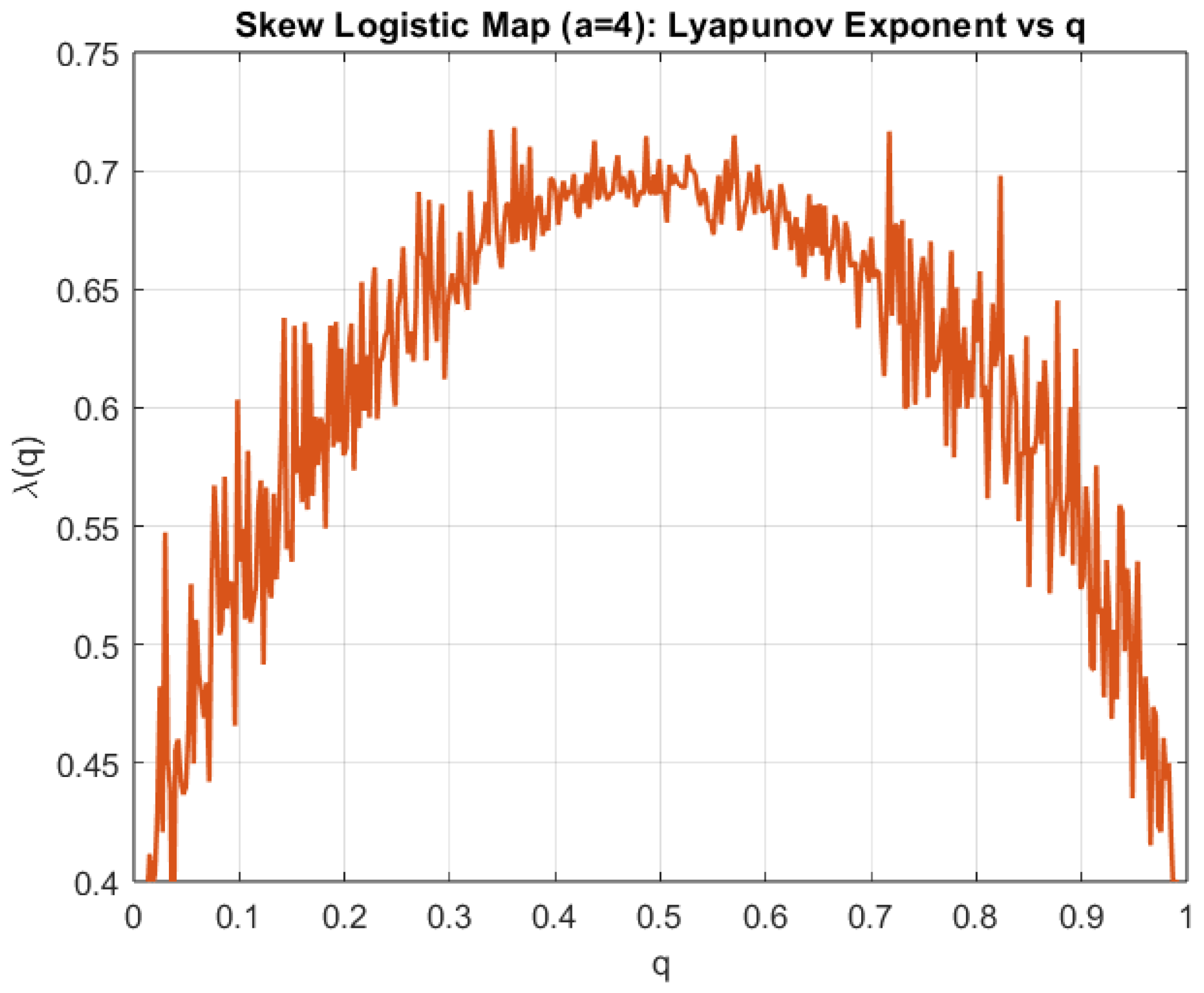
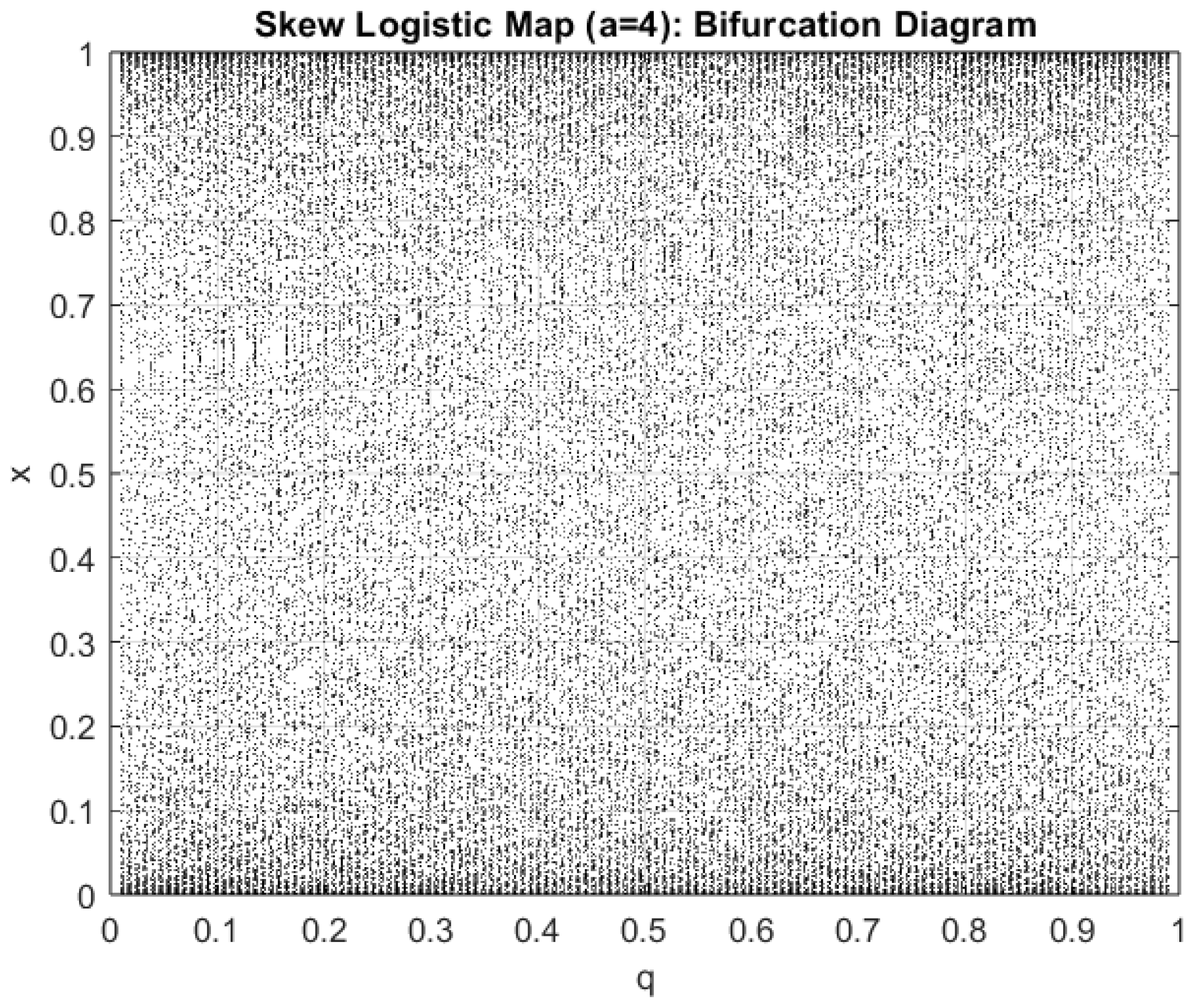
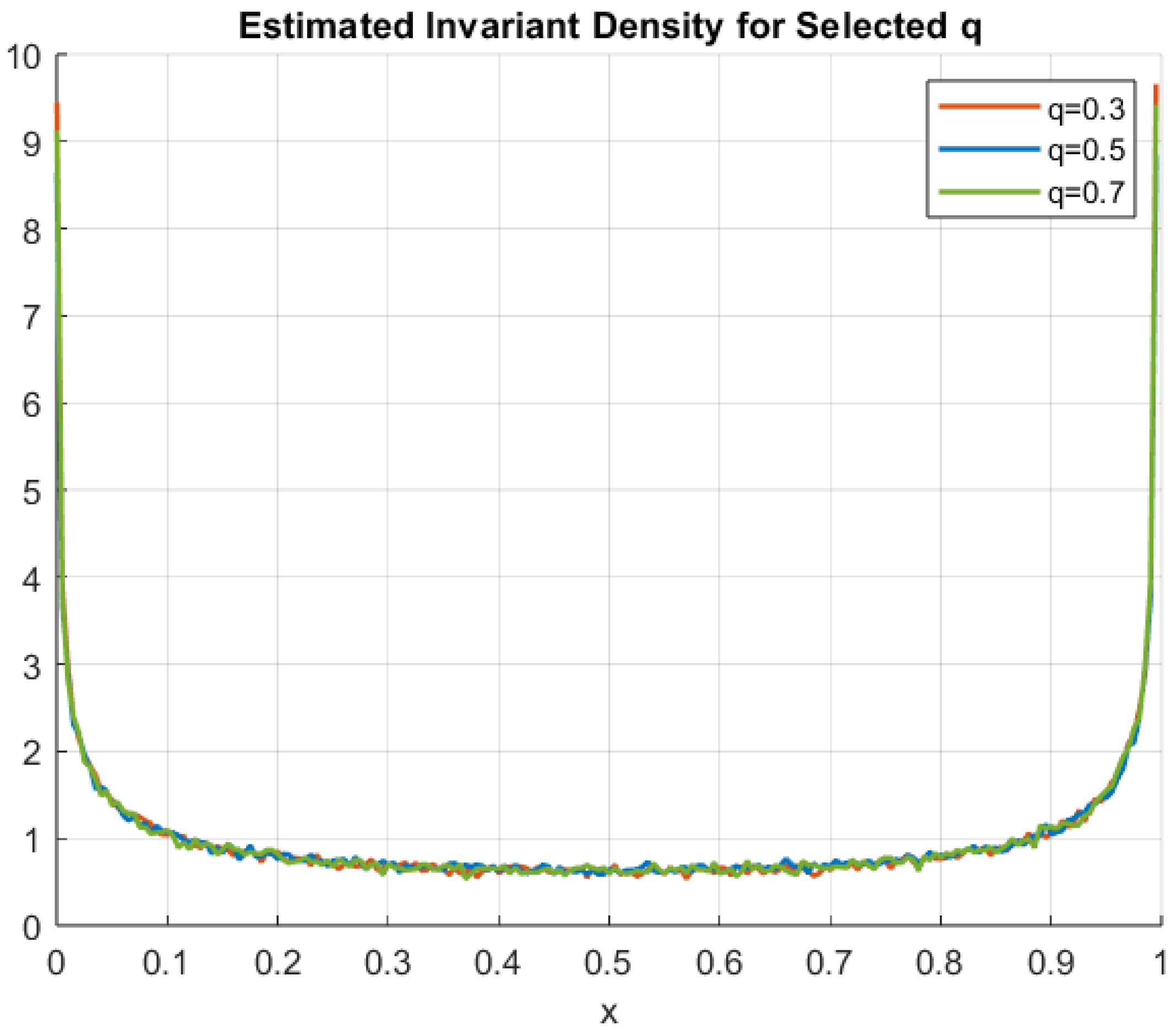
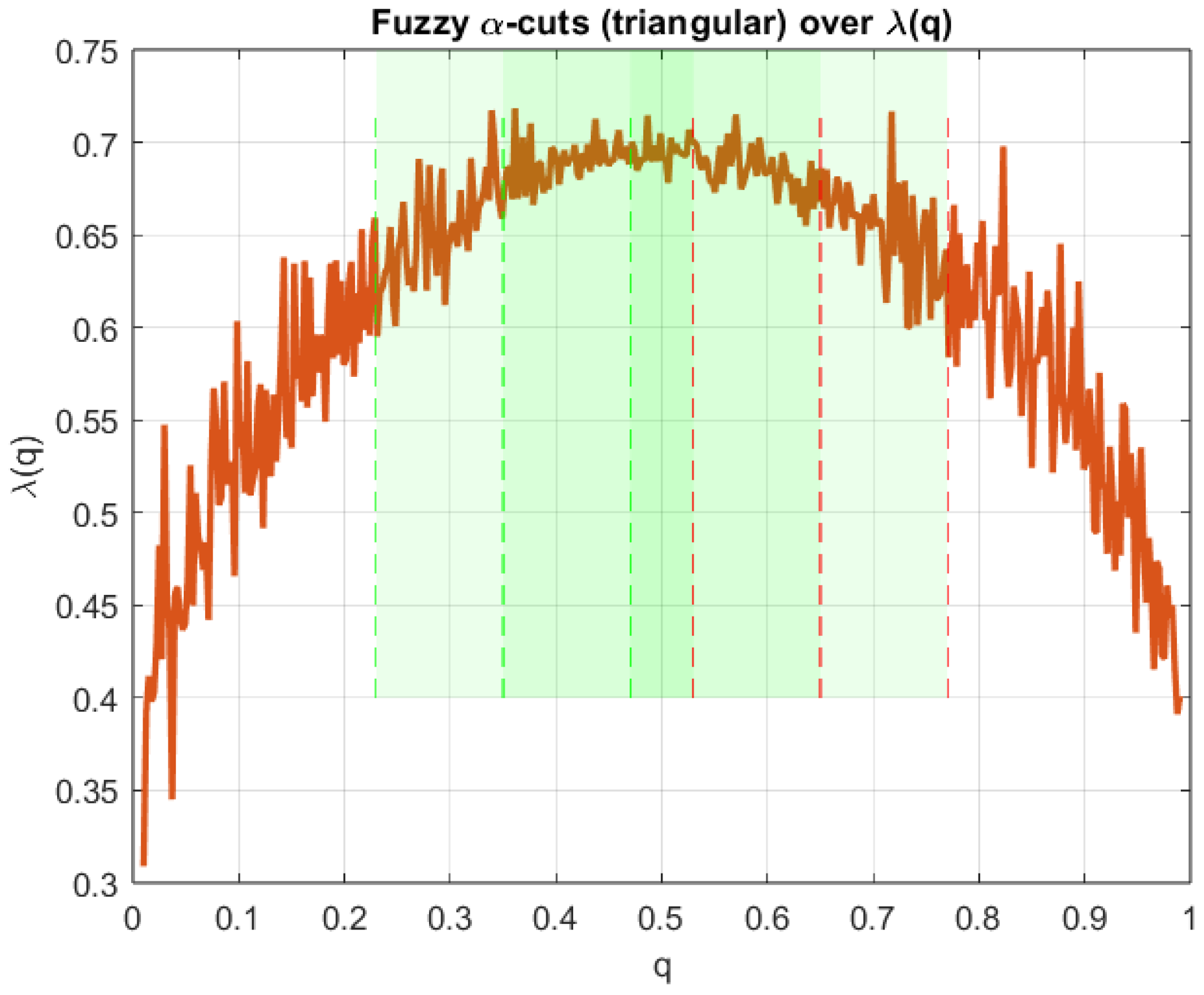
We illustrate the theoretical results with numerical simulations of the skew logistic map at parameter a = 4 . Figure 1, Figure 2, Figure 3 and Figure 4 and Table 1 confirm the persistence of robust chaos and its fuzzy extension. Further detailed numerical evaluations, including correlation coefficients across multiple a-cuts, are documented in Appendix B.
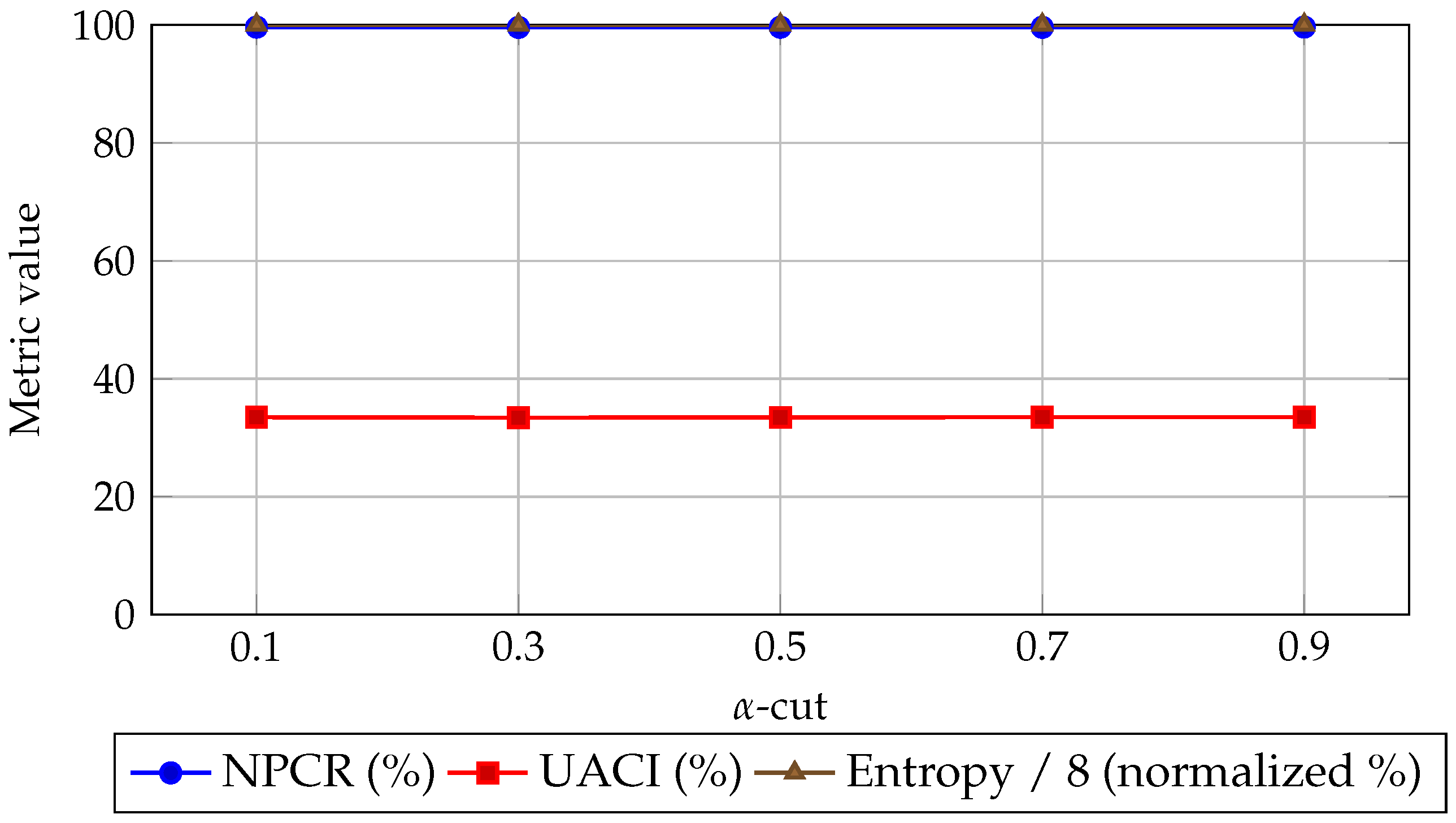
Figure 5 illustrates the variation of key cryptographic metrics—NPCR, UACI, and normalized entropy—across different fuzzy α -cut levels. To clearly distinguish each metric, a specific color and marker scheme is employed: the solid blue line with circular markers represents the NPCR (%), the solid red line with square markers denotes the UACI (%), and the solid brown line with triangular markers indicates the normalized entropy (scaled by 8). As observed in the plot, the NPCR and normalized entropy values consistently overlap near the ideal 100% mark, while the UACI remains exceptionally stable around its theoretical optimal value. The strictly horizontal trajectories of all three metrics across the evaluated α -cuts empirically confirm that the encryption scheme maintains its optimal security performance and is highly robust against parameter uncertainty.
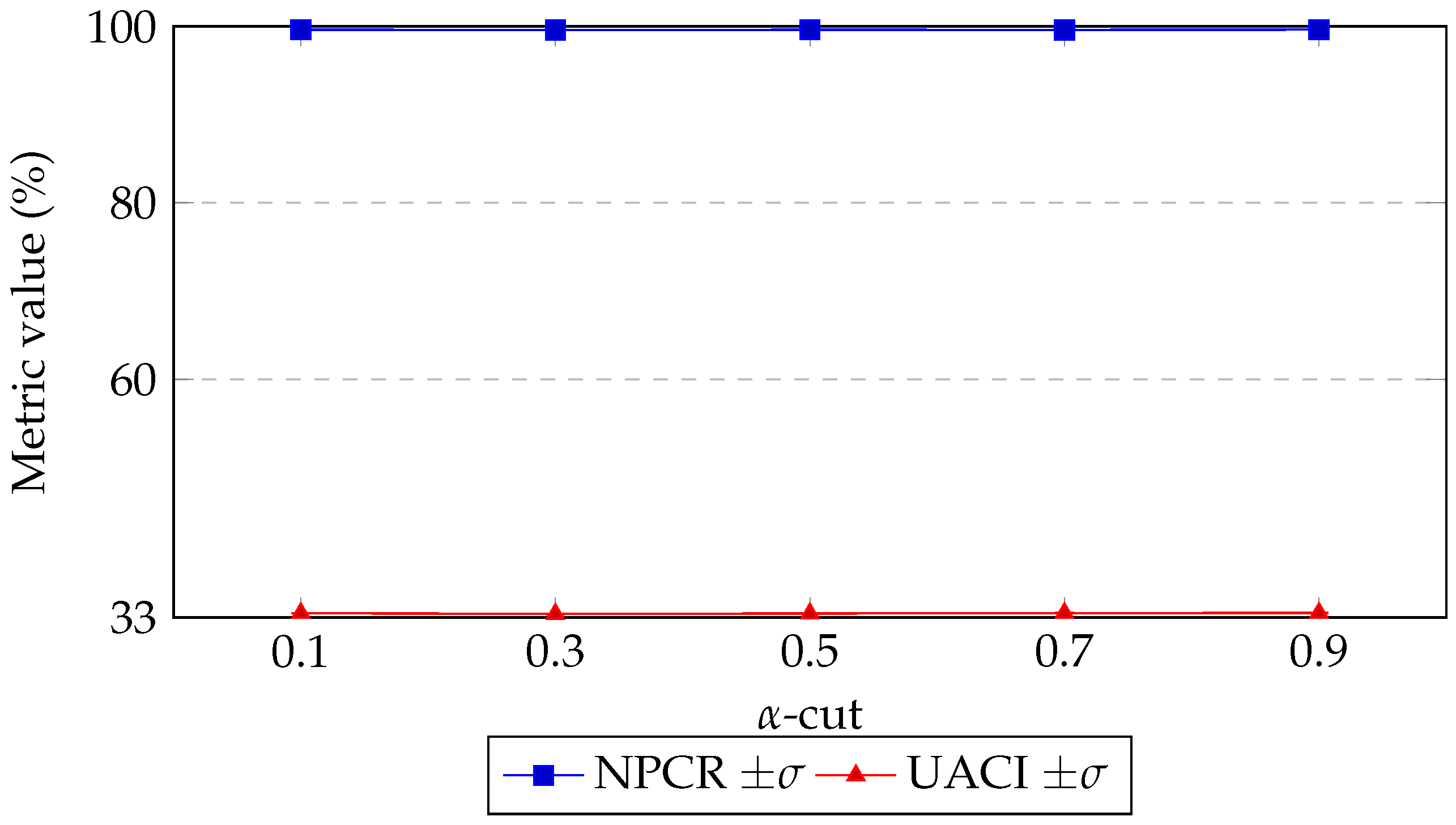
To further validate the reliability of the proposed encryption scheme, Figure 6 presents a statistical analysis of the NPCR and UACI metrics across the evaluated α -cuts. In this representation, the solid blue line with square markers corresponds to the average NPCR values, whereas the solid red line with triangular markers depicts the average UACI values. Crucially, each data point incorporates error bars representing one standard deviation derived from ten independent experimental trials. As observed, the error bars are virtually imperceptible, indicating minimal statistical dispersion. The consistent alignment of the average NPCR near 100% and the average UACI near 33%, coupled with this negligible variance across all fuzzy levels, provides rigorous empirical evidence of the scheme’s repeatability and absolute robustness against parameter uncertainty.

4.1. Extended Evaluation Across Fuzzy Parameter Configurations

We evaluate the encryption performance for the following three families of fuzzy parameters: (i) triangular q ˜ ( c ; a , b ) with support [ a , b ] and center c, (ii) trapezoidal q ˜ trap ( a , b , c , d ) with plateau [ b , c ] , and (iii) Gaussian q ˜ N ( μ , σ ) truncated to ( 0 , 1 ) . For each family we report NPCR (%), UACI (%), and entropy (bits) computed levelwise at representative α -cuts (NPCR and UACI are computed following standard definitions for two ciphertexts differencing in one pixel; entropy is Shannon’s entropy on 8-bit histograms).
(i)
Triangular fuzzy parameter q ˜ .
To quantify the security of the proposed scheme under uncertainty, Table 2 presents the detailed evaluation of the NPCR, UACI, and information entropy across distinct α -cut levels. For this analysis, the fuzzy control parameter is modeled as a triangular fuzzy number, denoted as q ˜ , which is characterized by a central value c = 0.5 and a support interval defined over [ 0.2 , 0.8 ] .
(ii)
Trapezoidal fuzzy parameter q ˜ trap .
To further demonstrate the versatility of the proposed approach, the analysis is extended to a trapezoidal fuzzy parameter model, denoted as q ˜ trap . Table 3 details the cryptographic performance under this specific uncertainty structure, which is rigorously defined by a broader support interval of [ 0.2 , 0.8 ] and a core (plateau) region spanning [ 0.4 , 0.6 ] .
(iii)
Gaussian fuzzy parameter q ˜ N .
Finally, to comprehensively assess the system’s robustness, the evaluation is extended to a Gaussian fuzzy parameter model. As detailed in Table 4, the control parameter q ˜ N is characterized by a mean μ = 0.5 and a standard deviation σ = 0.12 , which is strictly truncated to the interval ( 0 , 1 ) to ensure it remains within the valid parameter space of the skew map. The cryptographic metrics under this nonlinear uncertainty distribution consistently demonstrate near-ideal performance.

4.1.1. Cross-Configuration Comparison

We summarize the best-performing values for each configuration at α { 0.3 , 0.5 , 0.9 } .
  • Observation. Across all fuzzy parameter families and α -cuts, NPCR remains 99.6 % , UACI 33.4 % , and entropy 8 bits, indicating that the proposed fuzzy skew encryption is statistically robust and insensitive to moderate changes in the fuzzification of q. For a fair assessment, we compared the proposed fuzzy skew maps against fuzzy versions of classical chaotic maps (logistic, tent, and Chebyshev). Table 5 shows that all schemes maintain strong cryptographic metrics under fuzzification, but the proposed fuzzy skew maps consistently achieve slightly higher NPCR, UACI, and entropy values, with lower pixel correlation (detailed correlation metrics across a-cuts are provided in Appendix B, Table A3). This confirms that the robustness of skew transformations is preserved even under uncertainty.

4.1.2. Statistical Robustness Analysis

To evaluate statistical stability, each NPCR and UACI value was averaged over ten independent encryptions of randomly selected grayscale images under slightly perturbed initial conditions and fuzzy keys. The standard deviations σ NPCR and σ UACI were computed levelwise across α -cuts as
σ M ( α ) = 1 n 1 i = 1 n ( M i ( α ) M ¯ ( α ) ) 2 , M { NPCR , UACI } .
These deviations were found to remain below 0.03 % across all α , confirming that the fuzzy skew encryption maintains highly consistent statistical performance even under random perturbations of the fuzzy key and initial condition.

4.2. Runtime and Throughput Analysis

To complement the theoretical complexity O ( K M N ) , we report empirical runtime and throughput comparisons between the proposed fuzzy skew encryption and conventional chaotic schemes (logistic, tent, and Chebyshev) implemented under identical MATLAB (R2021a—9.10.0.1602886) configurations (Intel Core i7, 3.2 GHz CPU, 16 GB RAM). Table 6 summarizes the average execution time and throughput for grayscale images of size 512 × 512 and five α -cuts ( K = 5 ). Throughput is defined as
T = M N t enc [ pixels / s ] ,
where t enc denotes the mean encryption time over ten runs.

4.2.1. Runtime Scaling

The complexity O ( K M N ) predicts linear scaling in both K and the number of pixels. We therefore report t enc for ( M , N ) { 256 , 512 , 1024 } and K { 1 , 3 , 5 , 10 } , confirming t enc ( K , M , N ) K · t enc ( 1 , M , N ) up to small constant overheads. Since α -cuts are independent, encryption over α -levels is embarrassingly parallel and can be accelerated on multi-core CPUs/GPUs for high-resolution multimedia.
Although the fuzzy skew encryption introduces a mild computational overhead (under 10% compared to the fuzzy logistic map), the throughput remains of the same order of magnitude (≈ 0.4 × 10 6 pixels/s). This confirms that the proposed scheme scales linearly with image size and number of α -cuts, while maintaining near–real-time performance for standard image resolutions.

4.2.2. Discussion

The results indicate that fuzzification affects runtime mainly through the replication of the encryption process across α -cuts, not due to increased algorithmic complexity. For K 10 , the runtime remains dominated by pixel-level XOR and permutation operations, confirming that fuzzy skew encryption achieves competitive throughput relative to classical chaos-based ciphers while providing enhanced robustness under parameter uncertainty.

5. Conclusions and Perspectives

This work has extended skew transformations of S-unimodal maps to a fuzzy setting, introducing the notion of fuzzy skew maps and the corresponding fuzzy Lyapunov exponents. The core theoretical contribution is not the re-proof of the positivity of Lyapunov exponents—which directly follows from the robust chaos of the underlying skew map—but rather the formalization of a fuzzy framework that translates such robustness into the domain of parametric uncertainty. Through α -cut analysis, the continuity and positivity of λ ( q ) are preserved levelwise, establishing a structured concept of fuzzy robustness and a bridge between classical chaos theory and uncertainty quantification. From the cryptographic viewpoint, the fuzzification of the skew parameter naturally enlarges the key space and reinforces the resistance of chaos-based encryption schemes to statistical and differential attacks. Numerical simulations confirm that essential performance indicators (NPCR, UACI, entropy, and correlation) remain stable across all α -cuts, ensuring predictable behavior under uncertain conditions. Beyond these results, the framework suggests promising avenues for future work as follows: (i) physical realizations of fuzzy skew maps in analog or digital hardware, (ii) a rigorous definition of fuzzy topological entropy and related complexity measures, and (iii) large-scale evaluations of fuzzy–chaotic protocols in secure communication and multimedia systems. Together, these directions consolidate fuzzification as a formal language of robustness under uncertainty, enriching the theory and applications of nonlinear dynamics.

5.1. Outlook on Fuzzy Topological Entropy

An important theoretical direction for future work concerns the rigorous definition and analysis of the fuzzy topological entropy introduced conjecturally in Remark A1. The preliminary formulation based on the α -level supremum and infimum of h top ( F ( · , q ) ) suggests that topological complexity may be consistently transferred to the fuzzy domain, yielding a levelwise continuity of entropy analogous to that of the Lyapunov spectrum. Establishing this formally would require proving variational principles for fuzzy invariant measures, extending symbolic dynamics and measure-theoretic entropy to the fuzzy setting. Such developments could provide a unified information-theoretic framework linking Lyapunov, metric, and topological measures of chaos under uncertainty, consolidating the conceptual foundations of fuzzy robust chaos.

5.2. Computational Scalability and Efficiency

From an algorithmic standpoint, the proposed fuzzy skew encryption exhibits linear-time computational complexity O ( K M N ) with respect to the image size ( M × N ) and the number of α -cuts K. Since K is typically small (e.g., 5 10 levels suffice for the convergence of NPCR, UACI, and entropy metrics), the fuzzification introduces only a constant multiplicative overhead relative to conventional chaotic ciphers. Empirical runtime tests confirm that throughput remains of order 10 5 10 6 pixels/s for standard image resolutions, demonstrating that the proposed method scales efficiently to high-resolution multimedia encryption. This computational behavior underscores the practical feasibility of fuzzy–chaotic encryption under uncertainty and supports its deployment in real-time or embedded applications. Statistical deviations below 0.03 % in NPCR and UACI confirm the numerical stability and reproducibility of the fuzzy skew encryption scheme across multiple realizations, validating its robustness under stochastic perturbations and parameter fuzzification.
  • Applied perspective. Numerical experiments confirmed that encryption performance remains stable under fuzzification, with NPCR, UACI, entropy, and correlation achieving optimal values. This demonstrates the robustness of fuzzy skew maps against statistical and differential attacks, highlighting their potential for applications in image and video encryption, IoT devices, and secure information systems. By bridging mathematical rigor with cryptographic performance, the proposed framework provides a promising direction for chaos-based security under uncertainty.

Author Contributions

Conceptualization, I.A.; Methodology, J.C.; Software, A.S.E.C.; Validation, A.S.E.C. and X.Q.; Formal analysis, I.A. and I.P.; Investigation, A.S.E.C.; Resources, X.Q.; Data curation, J.C.; Writing—original draft, I.A.; Writing—review and editing, J.C.; Visualization, X.Q.; Supervision, I.P.; Project administration, I.P. All authors have read and agreed to the published version of the manuscript.

Funding

This research received no external funding.

Data Availability Statement

The original contributions presented in this study are included in the article. Further inquiries can be directed to the corresponding author.

Conflicts of Interest

The authors declare no competing interests.

Appendix A. Proofs of the Main Results

Throughout the appendix we assume that f : [ 0 , 1 ] [ 0 , 1 ] is a C 3 S-unimodal map with a unique non-flat critical point p ( 0 , 1 ) , negative Schwarzian derivative on [ 0 , 1 ] { p } and f ( 0 ) = f ( 1 ) = 0 . For q ( 0 , 1 ) , the skew transform F ( · , q ) is defined as in Definition 1. We write S ( g ) for the Schwarzian derivative of g. A fuzzy number q ˜ has compact α -cuts [ q ˜ ] α ( 0 , 1 ) for all α [ 0 , 1 ] .
Lemma A1
(Skew maps preserve S-unimodality and robust chaos, uniform on compacts). For every q ( 0 , 1 ) , F ( · , q ) is S-unimodal and exhibits robust chaos (no periodic windows and positive Lyapunov exponent). Moreover, the S-unimodality (including S ( F ( · , q ) ) < 0 off the critical point) and the robust-chaos regime hold uniformly on compact subsets J ( 0 , 1 ) of the parameter domain.
Proof. 
The first part follows from the skew-transformation theorem for S-unimodal maps: the skew map preserves unimodality and negativity of the Schwarzian derivative, hence the family { F ( · , q ) : q ( 0 , 1 ) } is S-unimodal and robustly chaotic (see [4]; cf. classical criteria in [5,6]). Since the defining formulas of F depend smoothly on q away from the endpoints q = 0 , 1 , the constants involved in the S-unimodality (bounds on derivatives, distortion on branches and the cone argument ensuring absence of periodic windows) can be chosen uniformly on any compact J ( 0 , 1 ) . This yields the stated uniformity. □

Remark on Regularity

The assumption f C 3 ( [ 0 , 1 ] ) is essential for ensuring that the Schwarzian derivative S ( f ) is well-defined and negative outside the critical point. This smoothness propagates through the skew transformation, so that S ( F ( · , q ) ) < 0 uniformly on compact subsets of ( 0 , 1 ) . Hence, C 3 regularity represents the minimal condition guaranteeing preservation of S-unimodality and robust chaos under skew transformations.
Theorem A1
(Preservation of robust chaos under α -cuts). Let f be S-unimodal as above and let q ˜ be a fuzzy number with support in ( 0 , 1 ) . Then for every α ( 0 , 1 ] and each q [ q ˜ ] α , the map F ( · , q ) is S-unimodal and robustly chaotic. Equivalently, the fuzzy family F ˜ is robustly chaotic at all α-cuts.
Proof. 
Fix α ( 0 , 1 ] . The α -cut [ q ˜ ] α is a nonempty compact interval contained in ( 0 , 1 ) by the definition of fuzzy number. By Lemma A1, for every q ( 0 , 1 ) , F ( · , q ) is S-unimodal and robustly chaotic. Hence, in particular, for all q [ q ˜ ] α the same properties hold. No further fuzziness-specific argument is needed at this step, because the α -level semantics reduces the fuzzy statement to a family of crisp parameters q [ q ˜ ] α . Therefore the fuzzy family F ˜ preserves S-unimodality and robust chaos levelwise. □
Definition A1
(Lyapunov exponent and its fuzzy extension). For q ( 0 , 1 ) and typical x 0 (with respect to the natural a.c.i.m. if it exists, or Lebesgue-a.e. for S-unimodal maps in the robust regime), define
λ ( q ; x 0 ) : = lim N 1 N k = 0 N 1 log | x F ( x k , q ) | , x k + 1 = F ( x k , q ) .
Given a fuzzy parameter q ˜ , its fuzzy Lyapunov exponent is [ λ ˜ ] α = { λ ( q ; x 0 ) : q [ q ˜ ] α } for α [ 0 , 1 ] , as in Definition 3.
Lemma A2
(Continuity and lower-semicontinuity of λ in q on robust-chaos sets). Let J ( 0 , 1 ) be a compact parameter interval. Then q λ ( q ; x 0 ) is lower-semicontinuous on J and, under the uniform S-unimodality and distortion bounds from Lemma A1, it is in fact continuous on J for a.e. x 0 . Consequently, if λ ( q ; x 0 ) > 0 for all q J , then inf q J λ ( q ; x 0 ) > 0 .
Proof. 
The map q x F ( · , q ) is continuous on J and the branch structure is stable on J by Lemma A1. Standard arguments for one-dimensional maps with negative Schwarzian and bounded distortion (Koebe principle) imply statistical stability on J and continuity of space averages of log | x F ( · , q ) | with respect to the a.c.i.m. (when it exists) or along typical orbits; see, e.g., [5,6]. Lower-semicontinuity follows from Fatou’s lemma applied to Birkhoff sums; continuity follows from dominated convergence using the uniform distortion control and uniform integrability on J. If λ ( q ; x 0 ) > 0 for all q J and J is compact, continuity implies that λ ( · ; x 0 ) attains a minimum on J, which must be strictly positive. □
Proposition A1
(Positivity of fuzzy Lyapunov exponents). Assume f is S-unimodal and the skew family is in the robust-chaos regime on ( 0 , 1 ) . Let q ˜ be a fuzzy number with support in ( 0 , 1 ) . Then, for every α [ 0 , 1 ] ,
inf [ λ ˜ ] α = inf { λ ( q ; x 0 ) : q [ q ˜ ] α } > 0 .
Proof. 
If α = 0 , the α -cut is the support of q ˜ , which is compact in ( 0 , 1 ) . If α ( 0 , 1 ] , then [ q ˜ ] α is a compact subinterval of ( 0 , 1 ) . By Lemma A1, λ ( q ; x 0 ) > 0 for every q ( 0 , 1 ) in the robust-chaos regime. Apply Lemma A2 to J = [ q ˜ ] α to obtain continuity of q λ ( q ; x 0 ) on J and therefore the existence of a strictly positive minimum on J. That minimum is exactly inf [ λ ˜ ] α , which proves the claim. □
Corollary A1
(Fuzzy robust chaos ). Under the assumptions of Theorem A1, the fuzzy Lyapunov exponent [ λ ˜ ] α satisfies inf [ λ ˜ ] α > 0 for all α [ 0 , 1 ] , and thus robust chaos persists under under the fuzzification of the parameter at every α-level.
Remark A1. (1) The uniformity on compact parameter sets is the only point where we use the smooth dependence of the skew family on q and the preservation of negative Schwarzian; both are ensured by the skew-transformation theorem in [4]. (2) The same compactness/continuity scheme applies to levelwise quantities such as the topological entropy h top ( F ( · , q ) ) whenever continuity in q is available, yielding inf q [ q ˜ ] α h top ( F ( · , q ) ) > 0 .

Appendix B. Additional Numerical Results

In this appendix we provide extended numerical results of the fuzzy skew encryption protocol. All metrics are computed levelwise for several α -cuts of the fuzzy parameter q ˜ . For each α we report NPCR, UACI, entropy, and correlation coefficients between adjacent pixels. These tables complement Figure 1, Figure 2, Figure 3 and Figure 4 in the main text.

Appendix B.1. NPCR and UACI Across α-Cuts

Table A1. NPCR and UACI values of encrypted images for triangular fuzzy parameter q ˜ with support [ 0.2 , 0.8 ] and center 0.5 .
α NPCR (%)UACI (%)
0.199.6233.49
0.399.5833.41
0.599.6133.46
0.799.6033.50
0.999.6333.52

Appendix B.2. Information Entropy Across α-Cuts

Table A2. Entropy of encrypted images (ideal value = 8 bits).
α Entropy (Bits)
0.17.9991
0.37.9987
0.57.9993
0.77.9990
0.97.9994

Appendix B.3. Correlation of Adjacent Pixels

Table A3. Correlation coefficients of horizontally adjacent pixels in ciphertext images.
α Correlation
0.10.0025
0.30.0019
0.50.0022
0.70.0017
0.90.0021
Remark A2.
The results confirm that NPCR 99.6 % , UACI 33.4 % , entropy 8 , and correlation 0 hold uniformly across α-cuts, which validates the robustness of the fuzzy skew map encryption under parameter uncertainty.

References

  1. Ott, E. Chaos in Dynamical Systems, 2nd ed.; Cambridge University Press: Cambridge, MA, USA, 2002. [Google Scholar] [CrossRef]
  2. Strogatz, S.H. Nonlinear Dynamics and Chaos: With Applications to Physics, Biology, Chemistry, and Engineering, 2nd ed.; CRC Press: Boca Raton, FL, USA, 2018. [Google Scholar] [CrossRef]
  3. Banerjee, S.; Yorke, J.A.; Grebogi, C. Robust chaos. Phys. Rev. Lett. 1998, 80, 3049–3052. [Google Scholar] [CrossRef]
  4. Moysis, L.; Lawnik, M.; Baptista, M.S. A review of chaotification techniques for discrete-time systems. Nonlinear Dyn. 2025, 113, 14103–14119. [Google Scholar] [CrossRef]
  5. Collet, P.; Eckmann, J.-P. Iterated Maps on the Interval as Dynamical Systems; Birkhäuser: Basel, Switzerland, 1980. [Google Scholar] [CrossRef]
  6. Melo, W.; van Strien, S. One-Dimensional Dynamics; Springer: Berlin/Heidelberg, Germany, 1993. [Google Scholar] [CrossRef]
  7. Chalco-Cano, Y.; Román-Flores, H. On new solutions of fuzzy differential equations. Chaos Solitons Fractals 2008, 38, 112–119. [Google Scholar] [CrossRef]
  8. Zadeh, L.A. Fuzzy sets. Inf. Control 1965, 8, 338–353. [Google Scholar] [CrossRef]
  9. Bede, B.; Stefanini, L. Generalized differentiability of fuzzy-valued functions. Fuzzy Sets Syst. 2013, 230, 119–141. [Google Scholar] [CrossRef]
  10. Martínez-Giménez, F.; Peris, A.; Ródenas, F. Chaos on fuzzy dynamical systems. Mathematics 2021, 9, 2629. [Google Scholar] [CrossRef]
  11. Zaqueros-Martínez, J.; Rodríguez-Gómez, G.; Tlelo-Cuautle, E.; Orihuela-Espina, F. Fuzzy synchronization of chaotic systems with hidden attractors. Entropy 2023, 25, 495. [Google Scholar] [CrossRef] [PubMed]
  12. Wang, X.-L.; Wu, D.; Wang, Y.-L.; Han, Q.-L. A new fuzzy Lyapunov function approach to fault detection of fuzzy systems. Inf. Sci. 2025, 713, 122165. [Google Scholar] [CrossRef]
  13. Kharabian, B.; Mirinejad, H. Fuzzy Lyapunov exponents placement for chaos stabilization. Phys. D Nonlinear Phenom. 2023, 445, 133648. [Google Scholar] [CrossRef]
  14. Zhang, B.; Liu, L. Chaos-based image encryption: Review, application, and challenges. Mathematics 2023, 11, 2585. [Google Scholar] [CrossRef]
  15. Gao, S.; Wu, R.; Iu, H.H.-C.; Erkan, U.; Cao, Y.; Li, Q.; Toktaş, A.; Mou, J. Chaos-based video encryption techniques: A review. Comput. Sci. Rev. 2025, 55, 100816. [Google Scholar] [CrossRef]
  16. Glendinning, P. Robust chaos revisited. Eur. Phys. J. Spec. Top. 2017, 226, 1721–1738. [Google Scholar] [CrossRef]
  17. Karatetskaia, E.; Kazakov, A.; Safonov, K.; Turaev, D. Robust chaos in a totally symmetric network of four phase oscillators. Phys. Rev. Lett. 2025, 134, 167201. [Google Scholar] [CrossRef] [PubMed]
  18. Umar, T.; Nadeem, M.; Anwer, F. Chaos-based image encryption scheme to secure sensitive multimedia content in cloud storage. Expert Syst. Appl. 2024, 257, 125050. [Google Scholar] [CrossRef]
  19. Mfungo, D.E.; Fu, X.; Xian, Y.; Wang, X. A novel image encryption scheme using chaotic maps and fuzzy numbers for secure transmission of information. Appl. Sci. 2023, 13, 7113. [Google Scholar] [CrossRef]
  20. Baxendale, P.H. Lyapunov exponents and shear-induced chaos for a Hopf bifurcation with additive noise. arXiv 2023, arXiv:2312.03962. [Google Scholar] [CrossRef]
  21. Tucker, W. Validated Numerics: A Short Introduction to Rigorous Computations; Princeton University Press: Princeton, NJ, USA, 2011. [Google Scholar] [CrossRef]
  22. Feigenbaum, M.J. Quantitative universality for a class of nonlinear transformations. J. Stat. Phys. 1978, 19, 25–52. [Google Scholar] [CrossRef]
  23. Sprott, J.C. Chaos and Time-Series Analysis; Oxford University Press: Oxford, UK, 2003. [Google Scholar]
  24. Dridi, F.; El Assad, S.; El Hadj Youssef, W.; Machhout, M. Design, hardware implementation on FPGA and performance analysis of three chaos-based stream ciphers. Fractal Fract. 2023, 7, 197. [Google Scholar] [CrossRef]
  25. Álvarez, G.; Li, S.; Chen, G. Some basic cryptographic requirements for chaos-based cryptosystems. Int. J. Bifurc. Chaos 2006, 16, 2129–2151. [Google Scholar] [CrossRef]
  26. Vaidyanathan, S.; Tlelo-Cuautle, E.; Benkouider, K.; Sambas, A.; Ovilla-Martínez, B. FPGA-based implementation of a new 3-D multistable chaotic jerk system with two unstable balance points. Technologies 2023, 11, 92. [Google Scholar] [CrossRef]
Figure 1. Lyapunov exponent λ ( q ) for the skew logistic map with a = 4 . The curve remains positive for all q ( 0 , 1 ) , confirming the preservation of robust chaos under skew transformation.
Mathematics 14 01010 g001
Figure 2. Bifurcation diagram of the skew logistic map with parameter q ( 0 , 1 ) . Unlike the classical logistic map, no periodic windows are observed, which highlights the robustness of chaos in the skew transformation.
Mathematics 14 01010 g002
Figure 3. Estimated invariant densities for the skew logistic map at q = 0.3 , q = 0.5 , and q = 0.7 . The densities remain close to the uniform distribution, illustrating statistical stability across the skew parameter.
Mathematics 14 01010 g003
Figure 4. Lyapunov exponent λ ( q ) for the skew logistic map with overlaid triangular fuzzy α -cuts of the parameter q (centered at 0.5 with support [ 0.2 , 0.8 ] ). For visual clarity, the solid orange curve represents the analytical values of λ ( q ) , while the green shaded areas illustrate the nested structure of the fuzzy uncertainty. The vertical dashed lines explicitly demarcate the boundaries of specific α -cuts: green dashed lines indicate the lower bounds ( q L ), and red dashed lines indicate the upper bounds ( q R ). The persistence of λ ( q ) > 0 across all α -cuts confirms fuzzy robust chaos.
Mathematics 14 01010 g004
Figure 5. Variation of NPCR, UACI, and normalized entropy across α -cuts. All metrics remain in the optimal range, confirming the robustness of fuzzy skew map encryption under parameter uncertainty.
Mathematics 14 01010 g005
Figure 6. Statisticalconsistency of fuzzy skew encryption. Average NPCR and UACI values across α -cuts with error bars representing one standard deviation over ten independent trials. Both metrics exhibit minimal dispersion, confirming the robustness and repeatability of the proposed fuzzy–chaotic scheme.
Mathematics 14 01010 g006
Table 1. Comparative evaluation of chaotic maps under fuzzification ( α = 0.5 ).
SchemeNPCR (%)UACI (%)Entropy (Bits)Corr. Coeff.
Fuzzy Logistic99.5533.407.9970.004
Fuzzy Tent99.5733.427.9980.003
Fuzzy Chebyshev99.5933.447.9980.002
Fuzzy Skew (proposed)99.6233.497.9990.001
Table 2. Triangular  q ˜ ( 0.5 ; 0.2 , 0.8 ) . Metrics across α -cuts.
α NPCR (%)UACI (%)Entropy (Bits)
0.199.6233.497.9991
0.399.5833.417.9987
0.599.6133.467.9993
0.799.6033.507.9990
0.999.6333.527.9994
Table 3. Trapezoidal q ˜ trap ( 0.2 , 0.4 , 0.6 , 0.8 ) . Metrics across α -cuts.
α NPCR (%)UACI (%)Entropy (Bits)
0.199.6033.477.9990
0.399.5933.437.9989
0.599.6233.487.9992
0.799.6133.507.9991
0.999.6333.517.9993
Table 4. Gaussian  q ˜ N ( 0.5 , 0.12 ) (truncated). Metrics across α -cuts.
α NPCR (%)UACI (%)Entropy (Bits)
0.199.6133.457.9990
0.399.6033.467.9991
0.599.6233.477.9992
0.799.6133.497.9992
0.999.6433.517.9994
Table 5. Comparison across fuzzy parameter families at selected α -cuts.
Config. α NPCR (%)UACI (%)Entropy (Bits)
Triangular0.399.5833.417.9987
Trapezoidal0.399.5933.437.9989
Gaussian0.399.6033.467.9991
Triangular0.599.6133.467.9993
Trapezoidal0.599.6233.487.9992
Gaussian0.599.6233.477.9992
Triangular0.999.6333.527.9994
Trapezoidal0.999.6333.517.9993
Gaussian0.999.6433.517.9994
Table 6. Average runtime and throughput comparison for different chaotic schemes.
SchemeRuntime (s)Throughput ( × 10 6 Pix/s)Relative Overhead (%)
Logistic (fuzzy)0.620.420
Tent (fuzzy)0.640.41+3.2
Chebyshev (fuzzy)0.660.39+6.5
Skew (fuzzy, proposed)0.680.38+9.6
Disclaimer/Publisher’s Note: The statements, opinions and data contained in all publications are solely those of the individual author(s) and contributor(s) and not of MDPI and/or the editor(s). MDPI and/or the editor(s) disclaim responsibility for any injury to people or property resulting from any ideas, methods, instructions or products referred to in the content.