Graph Burning: An Overview of Compact Mathematical Programs

 , ,
, ,  and
and 
Abstract
1. Introduction
2. Materials and Methods
2.1. Basic Definitions
- A graph is an ordered pair, where V is the set of vertices and E is the set of edges, a set of 2-element subsets of V [4].
- The distance between vertices u and v in a graph is the length of their shortest path.
- The open neighborhood of a vertex v is its set of adjacent vertices in G.
- The closed neighborhood of a vertex v is .
- The power of a given graph is obtained by adding an edge between each pair of vertices in V at a distance of up to r.
- The open neighborhood of a vertex v is its set of neighbors in .
- The closed neighborhood of a vertex v is .
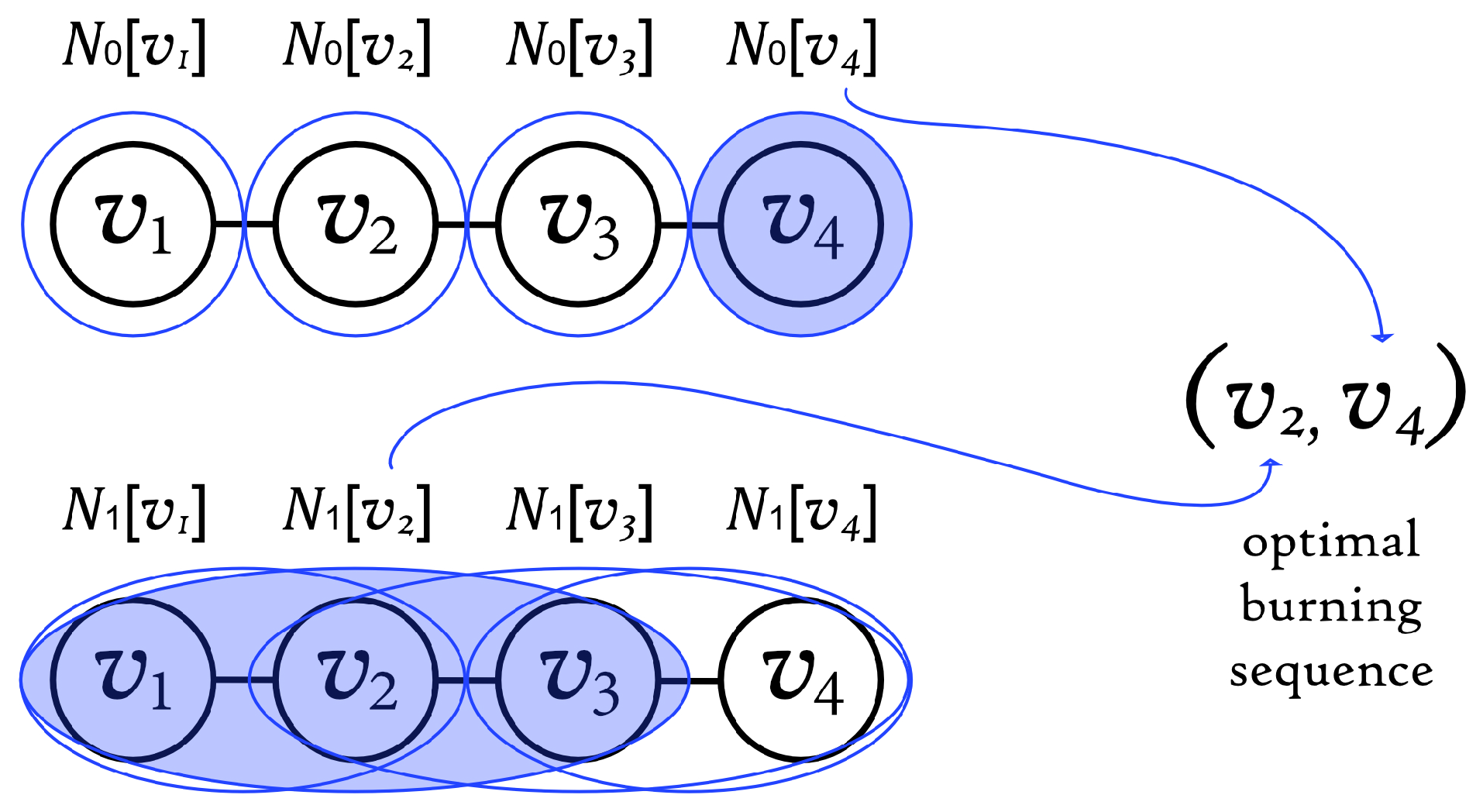
- A burning sequence of a graph is an ordered list such that the distance from every to some vertex is at most . The length of the burning sequence is g.
- Given an input graph, the GBP seeks a burning sequence of minimum length.
- The length of an optimal solution for the GBP is denoted by , which is known as the burning number of the graph.
2.2. The GBP as a Coverage Problem
| Algorithm 1 GBP as a series of CMCPs |
| Require: A graph Ensure: An optimal burning sequence 1: 2: while do 3: 4: 5: if S burns all vertices then 6: 7: else 8: 9: end if 10: end while 11: return the best found burning sequence |
2.3. Mathematical Programs
2.4. QUBO Problems and Quantum Computing
3. Related Work
4. Mathematical Programs for the Graph Burning Problem
4.1. A MILP Based on the Propagation Process: PROP-MILP
4.2. A CSP Based on the CMCP: COV-CSP
4.3. An ILP Based on the CMCP: COV-ILP
4.4. An ILP Based on the CMCP with a Known Upper Bound: GBP-ILP
4.5. A QUBO Problem with Slack Variables: sQUBO
4.6. A QUBO Problem with Unbalanced Penalization: uQUBO
5. Discussion
6. Conclusions
Author Contributions
Funding
Data Availability Statement
Acknowledgments
Conflicts of Interest
Abbreviations
| GBP | Graph Burning Problem |
| MILP | Mixed-Integer Linear Program |
| CSP | Constraint Satisfaction Problem |
| ILP | Integer Linear Program |
| QUBO | Quadratic Unconstrained Binary Optimization |
| CMCP | Clustered Maximum Coverage Problem |
| QAOA | Quantum Approximate Optimization Algorithm |
| NISQ | Noisy Intermediate-Scale Quantum |
Appendix A

| Large Social Networks | ||||||
|---|---|---|---|---|---|---|
| Name | ||||||
| soc-youtube-snap | 1,134,890 | 2,987,624 | 4.639 | 5.265 | 0.172 | 11 |
| soc-pokec | 1,632,803 | 22,301,964 | 1.673 | 27.317 | 0.122 | 8 |
| socfb-B-anon | 2,937,612 | 20,959,854 | 4.858 | 14.270 | 0.209 | 8 |
| socfb-A-anon | 3,097,165 | 23,667,394 | 4.935 | 15.283 | 0.209 | 7 |
| soc-livejournal | 4,033,137 | 27,933,062 | 3.434 | 13.852 | 0.327 | 13 |
| Square Grids | ||||||
|---|---|---|---|---|---|---|
| Name | ||||||
| grid_50×50 | 2500 | 4900 | 1.569 | 3.920 | 0 | 17 |
| grid_60×60 | 3600 | 7080 | 1.093 | 3.933 | 0 | 19 |
| grid_70×70 | 4900 | 9660 | 8.048 | 3.943 | 0 | 21 |
| grid_80×80 | 6400 | 12,640 | 6.173 | 3.950 | 0 | 23 |
| grid_90×90 | 8100 | 16,020 | 4.884 | 3.956 | 0 | 25 |
| Operating system | Ubuntu 25.04 |
| Processor | Intel i9-12900K |
| RAM | DDR5 128 GB |
| Language | C++ |
| Compiler | GNU GCC 14.2.0 |
| Solver | Gurobi 12.0.3 |
| Graph | U | ||||||||||
|---|---|---|---|---|---|---|---|---|---|---|---|
| #cc | #cc | #cc | #cc | ||||||||
| soc-youtube-snap | 2 m | 22 | 3 m | 36 | 3 m | 26 | 23 m | 42 | |||
| soc-pokec | 3 m | 32 | 4 m | 36 | 18 m | 20 | 26 m | 22 | |||
| socfb-B-anon | 5 m | 32 | 7 m | 36 | 5 m | 40 | 13 m | 44 | |||
| socfb-A-anon | 4 m | 35 | 7 m | 64 | 10 m | 54 | – | – | |||
| soc-livejournal | 16 m | 39 | 15 m | 56 | 19 m | 45 | – | – | |||
| grid_50×50 | 3 m | 1275 | 1 m | 936 | 2 m | 1178 | 7 m | 1460 | |||
| grid_60×60 | 14 m | 1938 | 4 m | 1360 | 24 m | 1554 | 18 m | 1716 | |||
| grid_70×70 | 13 m | 2121 | 10 m | 2090 | 1.2 h | 2921 | 14 m | 2448 | |||
| grid_80×80 | 39 m | 2461 | 1.1 h | 2712 | 48 m | 3100 | 1.3 h | 3718 | |||
| grid_90×90 | 2.3 h | 3975 | 1.9 h | 3666 | 2.6 h | 3456 | 1.6 h | 2912 | |||
References
- Alon, N. Transmitting in the n-dimensional cube. Discrete Appl. Math. 1992, 37, 9–11. [Google Scholar] [CrossRef]
- Bonato, A.; Janssen, J.; Roshanbin, E. Burning a graph as a model of social contagion. In Algorithms and Models for the Web-Graph; Springer: Cham, Switzerland, 2014; pp. 13–22. [Google Scholar]
- Bonato, A. A survey of graph burning. Contrib. Discrete Math. 2020, 16, 185–197. [Google Scholar] [CrossRef]
- Diestel, R. Graph Theory, 6th ed.; Springer: Berlin/Heidelberg, Germany, 2024. [Google Scholar] [CrossRef]
- García-Díaz, J.; Cornejo-Acosta, J.A.; Trejo-Sánchez, J.A. A greedy heuristic for graph burning. Computing 2025, 107, 91. [Google Scholar] [CrossRef]
- Chekuri, C.; Kumar, A. Maximum coverage problem with group budget constraints and applications. In Randomization and Approximation Techniques in Computer Science; Springer: Berlin/Heidelberg, Germany, 2004; pp. 72–83. [Google Scholar] [CrossRef]
- Gurobi Optimization, LLC. Gurobi Optimizer Reference Manual; Gurobi Optimization, LLC: Beaverton, OR, USA, 2025; Available online: https://www.gurobi.com (accessed on 13 March 2026).
- IBM ILOG CPLEX Division. IBM ILOG CPLEX Optimization Studio User’s Manual, version 22.1.2; IBM: Armonk, NY, USA, 2025. [Google Scholar]
- Achterberg, T. SCIP: Solving Constraint Integer Programs. Math. Program. Comput. 2009, 1, 1–41. [Google Scholar] [CrossRef]
- Huangfu, Q.; Hall, J.A.J. Parallelizing the dual revised simplex method. Math. Program. Comput. 2018, 10, 119–142. [Google Scholar] [CrossRef]
- Glover, F.; Kochenberger, G.; Hennig, R.; Du, Y. Quantum bridge analytics I: A tutorial on formulating and using QUBO models. Ann. Oper. Res. 2022, 314, 141–183. [Google Scholar] [CrossRef]
- Kochenberger, G.; Hao, J.-K.; Glover, F.; Lewis, M.; Lü, Z.; Wang, H.; Wang, Y. The unconstrained binary quadratic programming problem: A survey. J. Comb. Optim. 2014, 28, 58–81. [Google Scholar] [CrossRef]
- Glover, F.; Kochenberger, G.; Du, Y. A tutorial on formulating and using QUBO models. arXiv 2018, arXiv:1811.11538. [Google Scholar]
- Yang, J.; Wang, D.; Zhao, X.; Zhang, H.; Gao, M.; Yang, L. A Novel Solver for QUBO Problems: Performance Analysis and Comparative Study with State-of-the-Art Algorithms. arXiv 2025, arXiv:2506.04596. [Google Scholar]
- Hua, R. Adiabatic Quantum Computing with QUBO Formulations. Ph.D. Thesis, ResearchSpace@ Auckland, Auckland, New Zealand, 2022. [Google Scholar]
- Farhi, E.; Goldstone, J.; Gutmann, S. A quantum approximate optimization algorithm. arXiv 2014, arXiv:1411.4028. [Google Scholar] [CrossRef]
- De Santis, D.; Tirone, S.; Marmi, S.; Giovannetti, V. Optimized QUBO formulation methods for quantum computing. Quantum Sci. Technol. 2026, 11, 015056. [Google Scholar] [CrossRef]
- Glover, F.; Kochenberger, G.; Ma, M.; Du, Y. Quantum Bridge Analytics II: QUBO-Plus, network optimization and combinatorial chaining for asset exchange. Ann. Oper. Res. 2022, 314, 185–212. [Google Scholar] [CrossRef] [PubMed]
- Bonato, A.; Janssen, J.; Roshanbin, E. How to burn a graph. Internet Math. 2016, 12, 85–100. [Google Scholar] [CrossRef]
- Bonato, A.; Lidbetter, T. Bounds on the burning numbers of spiders and path-forests. Theor. Comput. Sci. 2019, 794, 12–19. [Google Scholar] [CrossRef]
- Hiller, M.; Koster, A.M.C.A.; Triesch, E. On the burning number of p-caterpillars. In Graphs and Combinatorial Optimization: From Theory to Applications; Springer: Cham, Switzerland, 2020; pp. 145–156. [Google Scholar] [CrossRef]
- Liu, H.; Hu, X.; Hu, X. Burning number of caterpillars. Discrete Appl. Math. 2020, 284, 332–340. [Google Scholar] [CrossRef]
- Murakami, Y. The Graph Burning Conjecture is true for trees without degree-2 vertices. arXiv 2023, arXiv:2312.13972. [Google Scholar] [CrossRef]
- Kamali, S.; Miller, A.; Zhang, K. Burning two worlds: Algorithms for burning dense and tree-like graphs. In Current Trends in Theory and Practice of Informatics; Springer: Cham, Switzerland, 2020; pp. 113–124. [Google Scholar] [CrossRef]
- Bonato, A.; Kamali, S. An improved bound on the burning number of graphs. arXiv 2021, arXiv:2110.01087. [Google Scholar] [CrossRef]
- Land, M.R.; Lu, L. An upper bound on the burning number of graphs. In Algorithms and Models for the Web-Graph; Springer: Cham, Switzerland, 2016; pp. 1–8. [Google Scholar] [CrossRef]
- Sim, K.A.; Tan, T.S.; Wong, K.B. On the burning number of generalized Petersen graphs. Bull. Malays. Math. Sci. Soc. 2018, 41, 1657–1670. [Google Scholar] [CrossRef]
- Liu, H.; Zhang, R.; Hu, X. Burning number of theta graphs. Appl. Math. Comput. 2019, 361, 246–257. [Google Scholar] [CrossRef]
- Mitsche, D.; Prałat, P.; Roshanbin, E. Burning graphs: A probabilistic perspective. Graphs Combin. 2017, 33, 449–471. [Google Scholar] [CrossRef]
- Mitsche, D.; Prałat, P.; Roshanbin, E. Burning number of graph products. Theor. Comput. Sci. 2018, 746, 124–135. [Google Scholar] [CrossRef]
- Li, Y.; Wu, J.; Qin, X.; Wei, L. Characterization of Q graph by the burning number. AIMS Math. 2024, 9, 4281–4293. [Google Scholar] [CrossRef]
- Das, S.; Islam, S.S.; Mitra, R.M.; Paul, S. Burning a binary tree and its generalization. arXiv 2023, arXiv:2308.02825. [Google Scholar] [CrossRef]
- Liu, H.; Hu, X.; Hu, X. Burning numbers of path forests and spiders. Bull. Malays. Math. Sci. Soc. 2021, 44, 661–681. [Google Scholar] [CrossRef]
- Gupta, A.T. Burning geometric graphs. arXiv 2020, arXiv:2010.01439. [Google Scholar]
- Burgess, A.C.; Jones, C.W.; Pike, D.A. Extending graph burning to hypergraphs. arXiv 2024, arXiv:2403.01001. [Google Scholar] [CrossRef]
- Enright, J.; Hand, S.D.; Larios-Jones, L.; Meeks, K. Structural parameters for dense temporal graphs. arXiv 2024, arXiv:2404.19453. [Google Scholar] [CrossRef]
- Janssen, R. The burning number of directed graphs: Bounds and computational complexity. arXiv 2020, arXiv:2001.03381. [Google Scholar] [CrossRef]
- Keil, J.M.; Mondal, D.; Moradi, E. Burning number for the points in the plane. arXiv 2022, arXiv:2205.04643. [Google Scholar] [CrossRef]
- Chandarana, J. The Graph Burning and The Firefighter Problems. Master’s Thesis, University of Windsor, Windsor, ON, Canada, 2024. [Google Scholar]
- Moghbel, D. Topics in Graph Burning and Datalog. Ph.D. Thesis, Ryerson University, Toronto, ON, Canada, 2020. [Google Scholar]
- Antony, D.; Das, A.; Gosavi, S.; Jacob, D.; Kulamarva, S. Graph Burning: Bounds and Hardness. arXiv 2024, arXiv:2402.18984. [Google Scholar] [CrossRef]
- Li, Y.; Qin, X.; Li, W. The generalized burning number of graphs. Appl. Math. Comput. 2021, 411, 126306. [Google Scholar] [CrossRef]
- Mondal, D.; Parthiban, N.; Kavitha, V.; Rajasingh, I. APX-hardness and approximation for the k-burning number problem. In Algorithms and Computation; Springer: Cham, Switzerland, 2021; pp. 272–283. [Google Scholar] [CrossRef]
- Iurlano, E.; Raidl, G.; Djukanović, M. The Graph Burning Problem under Constrained Diffusion. In Advances in Optimization and Wildfire—Proceedings of the First Optimization and Wildfire Conference; Springer: Luso, Portugal, 2024; pp. 139–154. [Google Scholar] [CrossRef]
- Chiarelli, N.; Iršič, V.; Jakovac, M.; Kinnersley, W.B.; Mikalački, M. Burning game. arXiv 2024, arXiv:2409.11328. [Google Scholar] [CrossRef]
- Gunderson, K.; Kellough, W.; Nir, J.D.; Punj, H. Adversarial graph burning densities. Discrete Math. 2025, 348, 114253. [Google Scholar] [CrossRef]
- Song, J.; Qi, X.; Cao, Z. An independent cascade model of graph burning. Symmetry 2023, 15, 1527. [Google Scholar] [CrossRef]
- Komala, S.; Mary, U. Burning, edge burning & chromatic burning classification of some graph family. J. Discrete Math. Sci. Cryptogr. 2024, 27, 665–674. [Google Scholar] [CrossRef]
- Bonato, A.; Kamali, S. Approximation algorithms for graph burning. In Theory and Applications of Models of Computation; Springer: Cham, Switzerland, 2019; pp. 74–92. [Google Scholar] [CrossRef]
- Gupta, A.T.; Lokhande, S.A.; Mondal, K. Burning grids and intervals. In Algorithms and Discrete Applied Mathematics; Springer: Cham, Switzerland, 2021; pp. 66–79. [Google Scholar] [CrossRef]
- García-Díaz, J.; Pérez-Sansalvador, J.C.; Rodríguez-Henríquez, L.M.X.; Cornejo-Acosta, J.A. Burning graphs through farthest-first traversal. IEEE Access 2022, 10, 30395–30404. [Google Scholar] [CrossRef]
- Gautam, R.K.; Kare, A.S.; Bhavani, D. Faster heuristics for graph burning. Appl. Intell. 2022, 52, 1351–1361. [Google Scholar] [CrossRef] [PubMed]
- Nazeri, M.; Mollahosseini, A.; Izadi, I. A centrality based genetic algorithm for the graph burning problem. Appl. Soft Comput. 2023, 144, 110493. [Google Scholar] [CrossRef]
- Šimon, M.; Huraj, L.; Dirgová Luptáková, I.; Pospíchal, J. Heuristics for spreading alarm throughout a network. Appl. Sci. 2019, 9, 3269. [Google Scholar] [CrossRef]
- García-Díaz, J.; Rodríguez-Henríquez, L.M.X.; Pérez-Sansalvador, J.C.; Pomares-Hernández, S.E. Graph burning: Mathematical formulations and optimal solutions. Mathematics 2022, 10, 2777. [Google Scholar] [CrossRef]
- Pereira, F.C.; de Rezende, P.J.; Yunes, T.; Morato, L.F.B. A row generation algorithm for finding optimal burning sequences of large graphs. In Proceedings 32nd Annual European Symposium on Algorithms (ESA 2024); LIPIcs, Schloss Dagstuhl: Dagstuhl, Germany, 2024; Volume 308, pp. 94:1–94:17. [Google Scholar] [CrossRef]
- Montañez-Barrera, J.A.; Willsch, D.; Maldonado-Romo, A.; Michielsen, K. Unbalanced penalization: A new approach to encode inequality constraints of combinatorial problems for quantum optimization algorithms. Quantum Sci. Technol. 2025, 9, 025022. [Google Scholar] [CrossRef]
- Dyer, M.E.; Frieze, A.M. A simple heuristic for the p-centre problem. Oper. Res. Lett. 1985, 3, 285–288. [Google Scholar] [CrossRef]
- Gonzalez, T.F. Clustering to minimize the maximum intercluster distance. Theor. Comput. Sci. 1985, 38, 293–306. [Google Scholar] [CrossRef]
- Chubet, O.; Sheehy, D.; Sheth, S. Simple Construction of Greedy Trees and Greedy Permutations. arXiv 2024, arXiv:2412.02554. [Google Scholar] [CrossRef]




| p | n | 9 | 12 | 15 | ||||||||
|---|---|---|---|---|---|---|---|---|---|---|---|---|
| 13% | 100% | 7.05 | 6% | 100% | 9.10 | 2% | 100% | 11.37 | ||||
| 14% | 100% | 5.05 | 2% | 100% | 6.73 | 2% | 100% | 7.92 | ||||
| 48% | 100% | 3.49 | 26% | 100% | 4.39 | 15% | 100% | 5.13 | ||||
| 73% | 100% | 2.38 | 58% | 100% | 2.73 | 42% | 100% | 3.25 | ||||
| 84% | 100% | 1.73 | 79% | 100% | 1.88 | 70% | 100% | 2.20 | ||||
| 95% | 100% | 1.29 | 90% | 100% | 1.45 | 88% | 100% | 1.63 | ||||
| 98% | 100% | 1.13 | 94% | 100% | 1.25 | 90% | 100% | 1.28 | ||||
| 100% | 100% | 1.06 | 99% | 100% | 1.11 | 98% | 100% | 1.16 | ||||
| 100% | 100% | 1.02 | 100% | 100% | 1.07 | 98% | 100% | 1.10 | ||||
| 100% | 100% | 1.01 | 100% | 100% | 1.03 | 100% | 100% | 1.04 | ||||
| r | n | 9 | 12 | 15 | ||||||||
|---|---|---|---|---|---|---|---|---|---|---|---|---|
| 5% | 100% | 5.77 | 3% | 100% | 6.28 | 6% | 100% | 5.96 | ||||
| 26% | 100% | 4.48 | 30% | 100% | 4.18 | 37% | 100% | 3.50 | ||||
| 50% | 100% | 3.39 | 62% | 100% | 2.60 | 69% | 100% | 2.15 | ||||
| 67% | 100% | 2.61 | 78% | 100% | 1.86 | 89% | 100% | 1.51 | ||||
| 83% | 100% | 1.97 | 90% | 100% | 1.45 | 98% | 100% | 1.22 | ||||
| 85% | 100% | 1.63 | 94% | 100% | 1.25 | 97% | 100% | 1.12 | ||||
| 95% | 100% | 1.30 | 99% | 100% | 1.11 | 100% | 100% | 1.04 | ||||
| 98% | 100% | 1.15 | 100% | 100% | 1.07 | 100% | 100% | 1.03 | ||||
| 99% | 100% | 1.08 | 100% | 100% | 1.03 | 100% | 100% | 1.01 | ||||
| 100% | 100% | 1.05 | 100% | 100% | 1.01 | 100% | 100% | 1.00 | ||||
| Program | Variables | Constraints | Binary Search | Pros | Cons |
|---|---|---|---|---|---|
| PROP-MILP | - | Explicit propagation process | Large number of variables and constraints | ||
| COV-CSP | ✓ | Simplest program | Can be infeasible | ||
| COV-ILP | ✓ | Always feasible | Binary search | ||
| GBP-ILP | - | Straightforward | - | ||
| sQUBO | - | ✓ | No penalty tuning | Slack variables | |
| uQUBO | - | ✓ | Few variables | Penalty tuning |
Disclaimer/Publisher’s Note: The statements, opinions and data contained in all publications are solely those of the individual author(s) and contributor(s) and not of MDPI and/or the editor(s). MDPI and/or the editor(s) disclaim responsibility for any injury to people or property resulting from any ideas, methods, instructions or products referred to in the content. |
© 2026 by the authors. Licensee MDPI, Basel, Switzerland. This article is an open access article distributed under the terms and conditions of the Creative Commons Attribution (CC BY) license.
Share and Cite
Cajica-Maceda, L.B.; Chaurra-Gutiérrez, F.A.; Pérez-Sansalvador, J.C.; García-Díaz, J. Graph Burning: An Overview of Compact Mathematical Programs. Mathematics 2026, 14, 1011. https://doi.org/10.3390/math14061011
Cajica-Maceda LB, Chaurra-Gutiérrez FA, Pérez-Sansalvador JC, García-Díaz J. Graph Burning: An Overview of Compact Mathematical Programs. Mathematics. 2026; 14(6):1011. https://doi.org/10.3390/math14061011
Chicago/Turabian StyleCajica-Maceda, Lourdes Beatriz, Freddy Alejandro Chaurra-Gutiérrez, Julio César Pérez-Sansalvador, and Jesús García-Díaz. 2026. "Graph Burning: An Overview of Compact Mathematical Programs" Mathematics 14, no. 6: 1011. https://doi.org/10.3390/math14061011
APA StyleCajica-Maceda, L. B., Chaurra-Gutiérrez, F. A., Pérez-Sansalvador, J. C., & García-Díaz, J. (2026). Graph Burning: An Overview of Compact Mathematical Programs. Mathematics, 14(6), 1011. https://doi.org/10.3390/math14061011