1. Introduction
The emergence of temporal asymmetry in physical systems remains one of the most fundamental problems in mathematical physics. While the microscopic laws governing classical and quantum systems are typically invariant under time reversal—as exemplified by Hamiltonian mechanics and unitary quantum evolution—macroscopic phenomena ubiquitously exhibit irreversible behavior, manifested through dissipation, entropy production, relaxation, and aging. Reconciling microscopic reversibility with macroscopic irreversibility has been a central theme since the foundational works of Boltzmann and Gibbs and continues to motivate modern research in non-equilibrium statistical mechanics and dynamical systems [
1,
2,
3,
4].
Conventional approaches to non-equilibrium dynamics are generally formulated in terms of a single temporal parameter. Irreversibility is incorporated through coarse-graining and projection techniques [
5,
6], stochastic modeling, or the introduction of dissipative operators generating contraction semigroups. In the quantum setting, irreversible evolution is commonly described using quantum dynamical semigroups and Lindblad-type master equations [
7,
8]. While these frameworks are mathematically well established and widely successful, they encode temporal asymmetry at the level of effective evolution equations rather than at the level of the underlying temporal structure. As a result, memory effects and non-Markovian dynamics must typically be introduced phenomenologically, for instance through integro-differential equations or time-dependent generators [
9,
10].
In recent years, there has been renewed interest in the mathematical and physical foundations of memory and non-Markovianity in non-equilibrium systems. It has been shown that memory effects can emerge naturally under coarse-graining even in systems close to equilibrium [
11], while detailed kinetic analyses have revealed nontrivial non-Markovian behavior in barrier-crossing processes and driven systems [
12,
13]. Non-Markovian dynamics have also been investigated in active and viscoelastic media [
14], as well as in quantum systems, where genuinely non-Markovian effects such as the quantum Mpemba effect have been identified [
15]. These developments highlight both the ubiquity of memory effects in non-equilibrium physics and the structural limitations of purely single-time descriptions.
Motivated by these observations, the present work introduces a
dual-time framework in which reversible and irreversible temporal evolution are treated from the outset as independent but coupled temporal directions. Rather than attempting to derive irreversibility within a single temporal dimension, we formulate dynamics on a dual-time manifold on which physical states are defined. Reversible microscopic dynamics and irreversible macroscopic evolution are associated with distinct temporal parameters, coupled through geometric and gauge-theoretic structures. This approach is conceptually related to earlier multi-time and extended phase-space constructions [
16,
17], but differs in that both temporal parameters are treated as fundamental geometric coordinates rather than auxiliary variables or bookkeeping devices.
At a conceptual level, the dual-time geometric framework developed here is inspired by the Duality of Time Theory (DTT) [
18] and the underlying Single Monad Model (SMM) [
19,
20], in which time is described as a genuinely complex temporal object with two hyperbolically orthogonal levels; an inner, “real” generative time governs the discrete re-creation of spatial configurations and matter states, while an outer, “imaginary” time orders these re-creations into the continuous evolution perceived by observers. Space-time geometry and physical fields then emerge dynamically from the inner-time processes, while the outer temporal flow provides the macroscopic arrow of time and the usual relativistic description. The present work does not rely on the specific physical assumptions of DTT or SMM; rather, it abstracts the minimal mathematical structure suggested by these ideas into a purely geometric dual-time manifold equipped with independent temporal connections, focusing on the consequences for non-equilibrium dynamics, memory, and temporal asymmetry rather than on the broader cosmological or quantum-gravity implications discussed in [
21].
The central mathematical idea of the framework is to describe temporal evolution using independent temporal connections and to characterize their interaction through
temporal curvature. Geometric formulations of dynamics based on connections and curvature are well established in classical and quantum mechanics [
22,
23]. Here, these methods are extended to the temporal domain. Nonvanishing temporal curvature induces path dependence in dual-time evolution, providing a mathematically precise geometric origin for memory effects, non-Markovian dynamics, and aging phenomena, without introducing explicit memory kernels or stochastic assumptions at the level of the fundamental dual-time evolution.
An effective single observable time parameter arises through projection from the bi-temporal domain, yielding a macroscopic arrow of time as an emergent feature rather than a fundamental postulate. This perspective is complementary to relational and emergent-time proposals, including the thermal time hypothesis [
24], while remaining compatible with standard dynamical evolution in appropriate integrable or decoupling limits.
A key result of this work is an explicit representation theorem showing that a broad and widely used class of non-Markovian evolution equations with convolution-type memory kernels can be realized as projections of local, first-order dynamics on the dual-time manifold. In this construction, the irreversible temporal coordinate naturally plays the role of a memory or age variable. This correspondence is established rigorously and illustrated through worked classical and quantum examples with exponential memory kernels, thereby demonstrating that the dual-time (bi-temporal) framework is not merely conceptual but provides a constructive geometric realization of non-Markovian dynamics.
In addition to memory and non-Markovianity, the dual-time framework is compatible with the thermodynamic notion of entropy. When the irreversible temporal generator is taken to be a Markov or Lindblad operator satisfying an
H-theorem, standard entropy-production and second-law inequalities emerge naturally along the irreversible temporal direction; see
Section 7.7.
Paper Structure and Main Contributions
This paper is organized as follows.
Section 2 introduces the mathematical preliminaries and conceptual framework.
Section 3 defines the dual-time manifold and the associated state space.
Section 4 develops the temporal connections and coupled evolution equations.
Section 5 analyzes the induced temporal topology and gauge structure.
Section 6 explains the emergence of temporal asymmetry through symmetry breaking and projection.
Section 7 derives memory effects, non-Markovian dynamics, and aging phenomena.
Section 8 discusses the reduction to standard non-equilibrium models, and
Section 9 situates the framework within the broader literature.
Section 10 concludes with a summary and outlook.
The present work makes the following contributions. First, it formulates a dual-time topological geometry for non-equilibrium systems based on a dual-time manifold equipped with independent temporal connections, temporal curvature, and an associated gauge structure, providing a unified setting for coupled reversible and irreversible evolution (
Section 3,
Section 4 and
Section 5). Second, it shows that nonvanishing temporal curvature induces path dependence in temporal evolution and, after projection onto a single observable time, gives rise to memory effects, non-Markovian dynamics, and aging, thereby offering a geometric mechanism for the macroscopic arrow of time (
Section 7). Third, it establishes a representation theorem for Volterra-type evolution equations with convolution kernels of the form
, demonstrating that such non-Markovian single-time equations arise as projections of local dual-time dynamics, and illustrates this correspondence through explicit classical and quantum examples (
Section 7.4,
Section 7.5 and
Section 7.6). Finally, it analyzes integrable and decoupling regimes in which the dual-time structure reduces to standard Hamiltonian, dissipative semigroup, and Markovian master-equation frameworks, showing that the proposed formalism genuinely extends—rather than replaces—conventional single-time descriptions (
Section 8).
2. Mathematical Preliminaries and Conceptual Framework
This section introduces the mathematical and conceptual structures underlying the proposed dual-time formulation. The goal is to clarify the role of temporal parameters in non-equilibrium systems, establish notation, and specify the geometric and functional setting used throughout the paper.
2.1. Time in Mathematical Physics
In many areas of mathematical physics, temporal evolution is described by a single real parameter
, representing physical time. At the microscopic level, the associated dynamics are often time-reversal invariant, as exemplified by Hamiltonian systems in classical mechanics and unitary evolution in quantum theory [
1,
2,
22]. In contrast, macroscopic descriptions of non-equilibrium phenomena exhibit intrinsic temporal asymmetry, manifested through dissipation, entropy production, and relaxation toward attractors or steady states [
3,
4].
From a mathematical perspective, this tension reflects the coexistence of two distinct classes of dynamical behavior:
Reversible evolution, typically generated by skew-adjoint or Hamiltonian operators and associated with group-valued time evolution;
Irreversible evolution, associated with dissipative semigroups, contraction operators, or gradient flows.
The mathematical theory of strongly continuous semigroups provides a rigorous framework for irreversible evolution in both classical and quantum settings [
7,
25], while variational and metric approaches to gradient flows have become central tools in the analysis of dissipative systems [
26]. In conventional single-time formulations, both reversible and irreversible aspects are encoded within the same temporal parameter, often relying on coarse-graining, projection methods, or phenomenological assumptions to account for irreversibility [
5,
6].
While such approaches are successful in many applications, they obscure the structural distinction between reversible and irreversible temporal behavior. In particular, memory effects and non-Markovian dynamics typically arise only after additional assumptions are imposed at the level of effective equations [
9,
10].
The present work adopts a different viewpoint by introducing two distinct temporal parameters:
- 1.
A reversible time parameter, associated with microscopic or generative dynamics;
- 2.
An irreversible time parameter, associated with macroscopic evolution, dissipation, and memory.
These parameters are treated as independent coordinates at the mathematical level, allowing reversible and irreversible processes to be represented simultaneously without reduction to a single effective time from the outset.
2.2. Geometric and Functional Structures
We now introduce the basic geometric and functional framework used in the remainder of the paper.
Let denote the configuration space of the system, assumed to be a smooth manifold, possibly infinite-dimensional depending on the application. Temporal evolution is described on an extended domain obtained by adjoining temporal variables to .
In contrast to conventional formulations, we consider temporal domains equipped with multiple independent parameters. The resulting structure naturally leads to a product manifold
where
is a temporal manifold whose precise structure will be specified in
Section 3.
Physical states are represented as functions or sections over . Depending on context, these may take values in:
A vector space (classical observables);
A Hilbert space (quantum states);
Or a more general fiber, such as density operators or probability measures.
We assume that admissible states belong to function spaces with sufficient regularity to admit differentiation with respect to each temporal parameter. Typical examples include spaces of smooth functions, Sobolev spaces, or Banach spaces supporting strongly continuous semigroups [
25]. Such functional-analytic settings are standard in the rigorous treatment of both reversible and dissipative dynamics.
To describe temporal evolution geometrically, we employ the language of connections and covariant derivatives. Each temporal parameter is associated with its own directional derivative and, more generally, with its own connection on the appropriate bundle over
. This geometric formulation allows reversible and irreversible dynamics to be encoded as parallel transport along distinct temporal directions, extending standard constructions from geometric mechanics and gauge theory [
22,
23].
Throughout the paper, we adopt the following conventions:
Greek indices label temporal coordinates.
Latin indices label spatial or configurational coordinates.
Summation over repeated indices is implied when appropriate.
This framework provides the mathematical foundation for the dual-time construction developed in subsequent sections, where the interaction between distinct temporal structures gives rise to nontrivial topology, memory effects, and emergent temporal asymmetry.
3. Dual-Time Manifold and State Space
In this section, we introduce the dual-time structure that underlies the proposed framework. The key idea is to represent reversible and irreversible temporal evolution by means of two independent temporal parameters, treated on equal mathematical footing. This leads naturally to a dual-time manifold and to state functions defined on an extended domain.
3.1. Bi-Temporal Domain
Let
and
be smooth one-dimensional manifolds representing, respectively, reversible and irreversible temporal parameters. For concreteness, and unless otherwise stated, we assume
where
is equipped with a time-reversal symmetry, while
is oriented and lacks such symmetry. This distinction reflects the mathematical separation between reversible group-valued dynamics and irreversible semigroup evolution commonly used in non-equilibrium theory [
4,
25].
Definition 1 (Dual-Time Manifold)
. The dual-time manifold is defined as the productwith local coordinates . The two temporal coordinates are interpreted as follows:
parametrizes reversible microscopic or generative dynamics, typically associated with Hamiltonian or unitary evolution [
22];
parametrizes irreversible macroscopic evolution, dissipation, and aging, commonly modeled by dissipative semigroups or gradient flows [
4,
26].
At the mathematical level, no a priori relation between
and
is assumed. In particular, neither parameter is required to be a function of the other, and both are treated as independent coordinates on
. This distinguishes the present construction from auxiliary-time or bookkeeping approaches, as well as from two-time correlation formalisms in statistical mechanics [
5,
6].
Let
denote the configuration space of the system, assumed to be a smooth manifold. We define the extended space-time manifold
This construction generalizes the standard space-time manifold
by replacing the single temporal dimension with a bi-temporal structure. The product form ensures that standard local differential-geometric tools remain applicable, while allowing distinct temporal directions to be treated independently [
23].
3.2. Physical States on Bi-Temporal Domains
Physical states are represented as functions or sections defined on the extended manifold . The precise nature of these states depends on the physical context, but the following abstract definition suffices for the present analysis.
Definition 2 (Bi-Temporal State)
. A bi-temporal state is a mappingwhere is a vector space or a Hilbert space encoding the internal degrees of freedom of the system. Typical choices for include:
We assume that
belongs to a function space admitting partial derivatives with respect to both temporal variables. Typical examples include
where
is a Hilbert space associated with the spatial degrees of freedom. Such functional settings are standard in the analysis of evolution equations generated by both unitary groups and dissipative semigroups [
25].
Initial and boundary conditions in the dual-time setting are specified independently for each temporal parameter. In particular:
Reversible evolution may be defined for all ;
Irreversible evolution is typically defined for , reflecting the directed nature of macroscopic time.
The dual-time formulation allows reversible and irreversible processes to coexist within a single mathematical object. Observable physical quantities are obtained by suitable projections or restrictions of , a procedure that will be discussed in later sections. This dual-time state space provides the foundation for introducing independent temporal connections, coupled evolution equations, and nontrivial temporal topology, developed in the following sections.
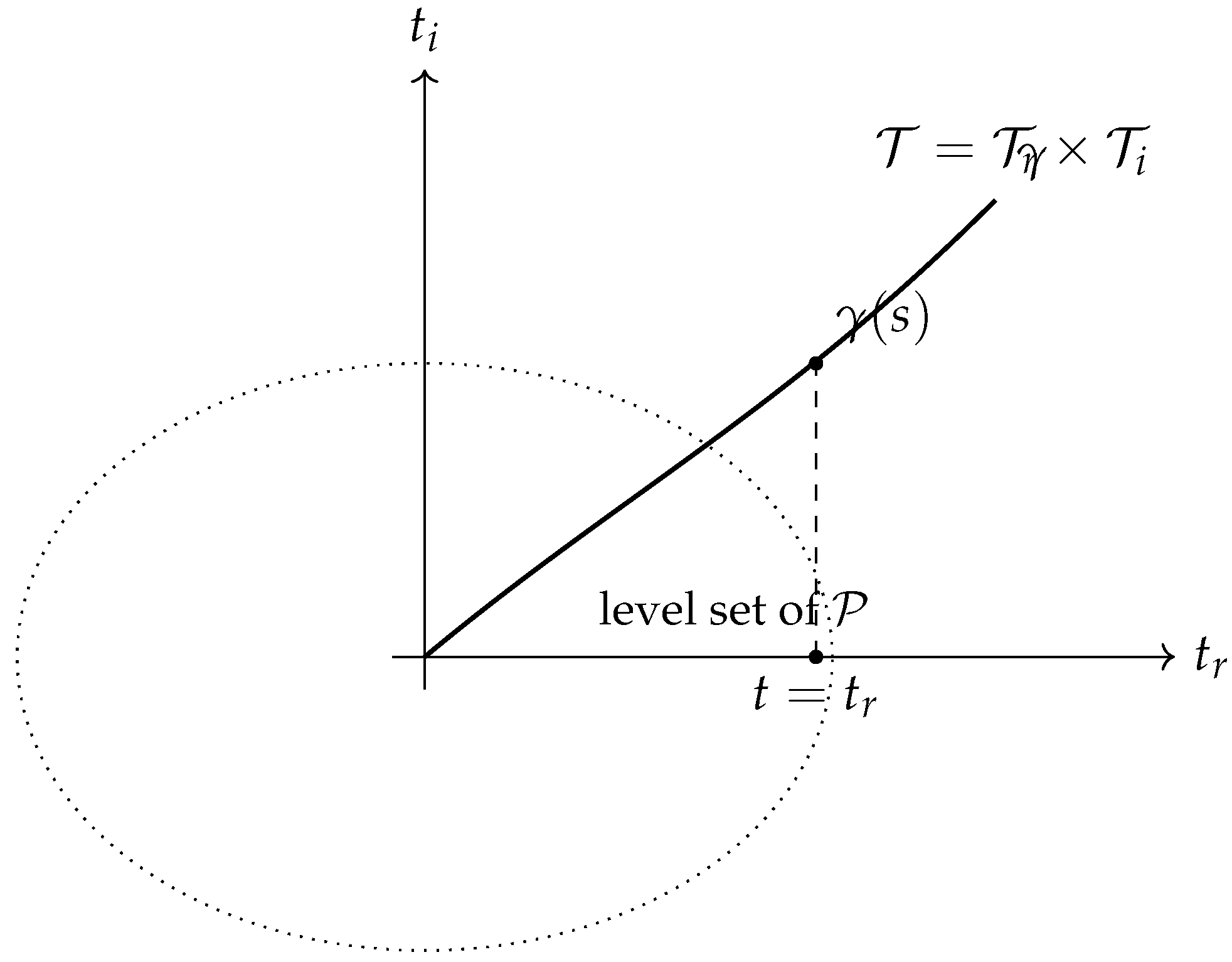
Figure 1 provides a simple schematic representation of the dual-time manifold
and the projection to an observable time parameter. A trajectory
evolves locally in both the reversible coordinate
and the irreversible coordinate
, with temporal curvature inducing path dependence in the
-plane. For the representation theorem in
Section 7.4, we choose the observable time to be identified with the reversible coordinate,
, while the irreversible coordinate is integrated out. The dashed line in the figure indicates the projection of a dual-time point
onto the observable time axis, emphasizing that detailed information about the distribution along
is coarse-grained into an effective single-time description.
6. Emergence of Temporal Asymmetry
In this section, we show how an effective temporal asymmetry emerges dynamically from the dual-time framework. The key mechanisms are symmetry breaking between the reversible and irreversible temporal sectors and the projection of bi-temporal evolution onto a single observable time parameter. These mechanisms provide a structural explanation for the arrow of time that does not rely on phenomenological assumptions or explicit entropy postulates.
6.1. Symmetry Breaking Between Temporal Sectors
At the level of the dual-time manifold , the reversible and irreversible temporal parameters are treated symmetrically as independent coordinates. However, the associated temporal connections generally possess distinct mathematical properties.
In particular, the reversible temporal connection
is typically associated with generators that are skew-adjoint or Hamiltonian, giving rise to group-valued time evolution, while the irreversible temporal connection
is associated with dissipative or contractive generators, leading to semigroup evolution [
4,
25]. This structural distinction implies that the full temporal symmetry group of the dual-time manifold is not preserved by the dynamics.
Definition 5 (Temporal Symmetry)
. A dual-time system is said to be temporally symmetric if the evolution equations are invariant under the exchange In general, such symmetry is explicitly broken by the distinct mathematical properties assigned to the reversible and irreversible temporal sectors and, in addition, by the presence of nonvanishing temporal curvature .
Proposition 2. If the temporal curvature is nonzero and the generators of and belong to inequivalent operator classes (e.g., skew-adjoint versus dissipative), then temporal symmetry is broken.
Proof. The temporal curvature couples the two temporal evolutions. If the generators are structurally inequivalent, no automorphism exists that maps one temporal sector onto the other while preserving the evolution equations. Consequently, invariance under exchange of the two temporal directions is lost, implying symmetry breaking [
4,
25]. □
This symmetry breaking is not imposed externally but arises from the intrinsic mathematical properties of the temporal connections and their coupling. In this sense, temporal asymmetry is a dynamical and geometric phenomenon rather than a kinematic assumption.
6.2. Observation-Induced Time Projection
While the dual-time formulation provides a complete description of system evolution, physical observations typically depend on a single effective time parameter. We formalize this reduction as a projection from the bi-temporal domain to a one-dimensional temporal manifold.
Let
denote a class of admissible observables acting on bi-temporal states. An observation is represented mathematically by a projection operator
where
is an effective bundle over a one-dimensional time manifold
. Such projection procedures are familiar from coarse-graining and reduced-dynamics approaches in non-equilibrium statistical mechanics [
5,
6].
Definition 6 (Observable Time). An observable time is defined as a parameter labeling equivalence classes of points in under the projection .
For the representation theorem developed in
Section 7.4, we consider a specific choice of projection in which the observable time is identified with the reversible coordinate,
, and the irreversible coordinate is integrated out. Concretely, the projection acts by mapping a dual-time state
to the observable component
, with the influence of the irreversible sector entering through the integral over
in Equation (
5a). Other choices of projection (for example,
or
) would lead to different effective single-time dynamics; the physically relevant choice is determined by the observational and modeling context.
Operationally, this projection may correspond to restricting states to a submanifold
or to integrating out one temporal parameter with respect to a suitable measure. In either case, the resulting observable dynamics inherit contributions from both reversible and irreversible temporal evolution.
Proposition 3. If , the projected evolution on is generically non-Markovian.
Proof. Nonvanishing temporal curvature implies path dependence in the dual-time manifold
. The projection
identifies distinct bi-temporal paths with the same observable time parameter, resulting in reduced dynamics that depend on the prior temporal history. This violates the semigroup property and leads to effective non-Markovian behavior [
9,
10]. □
The emergence of a single observable time parameter thus results from the combined effects of temporal symmetry breaking and projection. The arrow of time observed at the macroscopic level is therefore an emergent property of the dual-time structure rather than a fundamental assumption.
This mechanism provides a mathematically consistent explanation for the coexistence of reversible microscopic laws and irreversible macroscopic behavior within a unified temporal framework, and it prepares the ground for the analysis of memory effects and aging phenomena in the following section.
7. Memory Effects and Non-Markovian Dynamics
In this section, we analyze the dynamical consequences of the dual-time framework for memory effects, non-Markovian behavior, and aging phenomena. We show that these features arise naturally from the geometry of the dual-time manifold and the associated temporal curvature, without the introduction of phenomenological memory kernels or ad hoc nonlocal terms at the level of the dual-time evolution. A concrete representation of convolution-type memory within the dual-time framework is given in
Section 7.4.
7.1. Bi-Temporal Origin of Memory
In standard single-time formulations of non-equilibrium dynamics, memory effects are typically introduced through integro-differential equations, nonlocal operators, or explicit memory kernels [
5,
6,
9]. In contrast, within the dual-time framework, memory arises as a geometric consequence of coupled temporal evolution.
Let
be a bi-temporal state evolving according to the coupled evolution equations introduced in
Section 4. Consider two temporal paths
connecting the same initial and final points in the bi-temporal domain.
If the temporal curvature vanishes, the evolution along and yields identical states. However, if , the resulting states generally differ.
Proposition 4. Nonvanishing temporal curvature implies path-dependent dual-time evolution and hence encodes memory of past evolution.
Proof. Path dependence of parallel transport is a direct consequence of nonzero curvature in connection theory [
27,
28]. Since different temporal paths correspond to different histories of reversible and irreversible evolution, the final state retains information about its past trajectory. □
When the bi-temporal state is projected onto an observable single-time description, this path dependence manifests as effective memory. Formally, the reduced dynamics at time
t depend not only on the instantaneous state but also on the prior evolution in the irreversible temporal direction
, leading to temporal nonlocality. This provides a geometric underpinning for memory effects observed in a wide range of non-equilibrium systems [
11,
12].
7.2. Emergence of Non-Markovian Dynamics
Let
denote the effective evolution operator acting on observable states after projection onto the one-dimensional time manifold
. In Markovian dynamics, the semigroup property holds:
In the dual-time framework, this property generally fails due to temporal curvature and projection effects.
Theorem 1. If , the effective evolution does not form a semigroup and the observable dynamics are non-Markovian.
Proof. Nonzero temporal curvature induces path dependence in bi-temporal evolution. Upon projection, different decompositions of
correspond to inequivalent bi-temporal paths, violating the semigroup property that characterizes Markovian dynamics [
9,
25]. □
This result provides a geometric explanation for non-Markovian dynamics: memory effects emerge not from explicit nonlocal terms or stochastic modeling, but from the reduction of higher-dimensional temporal evolution to a single effective time parameter. Recent studies of non-Markovian processes in classical and quantum systems highlight the ubiquity of such behavior in non-equilibrium settings [
10,
13].
7.3. Aging and Long-Time Behavior
Aging phenomena in non-equilibrium systems are characterized by the breakdown of time-translation invariance and by the dependence of system behavior on the time elapsed since preparation [
4]. Such effects are commonly observed in glasses, driven systems, and active matter, and are often modeled phenomenologically.
Within the dual-time framework, aging arises naturally from the distinguished role of the irreversible temporal parameter . Since is typically defined on a half-line and enters the evolution through a dissipative connection, the system retains an intrinsic reference to its “age” as measured by irreversible time.
Proposition 5. If the irreversible temporal evolution is non-stationary in , then the projected dynamics exhibit aging behavior.
Proof. Non-stationarity in
implies that the evolution depends explicitly on the absolute value of
, not only on temporal differences. After projection, this dependence translates into observables that depend on the time elapsed since initialization, thereby breaking time-translation invariance [
4,
11]. □
Thus, aging is not an additional assumption but a direct consequence of the dual-time structure and the asymmetry between reversible and irreversible temporal sectors.
Taken together, these results show that memory, non-Markovianity, and aging are intrinsic features of the dual-time topological framework. They emerge from the geometry and topology of temporal evolution and provide a unified mathematical explanation for a wide range of non-equilibrium phenomena observed in contemporary theoretical and applied studies.
7.4. A Representation Theorem for Convolution-Type Memory
In this subsection, we show that a broad and widely used class of non-Markovian evolution equations with convolution memory kernels admits an explicit dual-time realization on the dual-time manifold
. In particular, we prove that Volterra-type equations with kernels of the form
arise as projections of local evolution equations on
T in which the irreversible time
plays the role of an “age” or memory coordinate.
Throughout this subsection, let X be a Banach space and let be bounded linear operators. We view A as the generator of reversible dynamics in , B as the generator of irreversible relaxation in , and as bounded coupling operators between the observable and memory sectors.
Remark 1. The assumption that are bounded operators is adopted for clarity and to avoid technical complications related to domains of unbounded operators. The proof of Theorem 2 only uses the existence of a strongly continuous semigroup acting on X, together with bounded coupling operators C and D. We expect that analogous dual-time representation results hold when B is an unbounded generator of a -semigroup and are bounded, under suitable domain assumptions, but a systematic treatment of this more general case is left for future work.
Definition 7 (Convolution-Type Memory Equation)
. Let be given byA function is said to solve the convolution-type memory equation ifwith initial condition , and the integral is understood in the Bochner sense. Equations of the form (
4) are classical in the theory of Volterra integral equations and provide standard models of non-Markovian memory in both classical and quantum settings.
We now construct an explicit dual-time realization of (
4) on the bi-temporal domain
, with coordinates
, where
represents the observable (or reversible) time and
represents an irreversible time associated with the “age” of stored memory.
Definition 8 (Dual-Time Memory Field)
. Given a candidate observable trajectory , a dual-time memory field is a functioninterpreted as the contribution at observable time from memory of age . The dual-time dynamics we consider are given by the following first-order system on
T:
with boundary and initial conditions
Equation (5b) is a linear transport equation on
T, with characteristics
, driven by the dissipative operator
B and fed at the boundary
by the current observable state
via (
5c). The observable Equation (
5a) couples
u to the entire memory field
by integrating over all ages
.
The following result shows that this dual-time system is equivalent to the convolution memory Equation (
4).
Theorem 2 (Dual-Time Representation of Convolution Memory)
. Let be bounded operators and let as in (
3)
.- (i)
Suppose solves the convolution Equation (
4)
. Define by Then, the pair satisfies the dual-time system (5).
- (ii)
Conversely, suppose is a pair of continuous functions with , χ continuously differentiable on , satisfying (5)
. Then, u solves the convolution Equation (
4)
with kernel .
In particular, there is a one-to-one correspondence between solutions of the non-Markovian Equation (
4)
and solutions of the local dual-time evolution (5)
on T. Proof. We prove each direction separately.
- (i)
From convolution dynamics to dual-time dynamics.
Let
u solve (
4) and define
by (
6). We first verify that
satisfies (5b)–(5d).
Fix
with
. Differentiating (
6) with respect to
and
yields
Adding these expressions, we obtain
which is precisely (5b) on the interior of the domain.
For the boundary condition at
, we have
which is (
5c). For
and
, we are in the case
in (
6), so
, giving (5d). Thus,
satisfies (5b)–(5d).
We now verify (
5a). For each fixed
, we have
since
for
. Making the change of variables
(so
and
), we obtain
Using this identity in (
4) shows that (
5a) holds for
. The initial condition
is the same in both formulations. Hence,
satisfies the dual-time system (5).
- (ii)
From dual-time dynamics to convolution dynamics.
Conversely, suppose satisfies (5) with the stated regularity. We first solve (5b) along characteristics.
Fix
and
and consider the characteristic curve
passing through
at
. Along this curve, we have
where we used (5b). Thus,
has the unique solution
for any reference point
on the same characteristic.
If
, the characteristic through
intersects the boundary
at
. Taking
and using the boundary condition (
5c) gives
If instead
, the characteristic through
intersects the initial line
at
. Taking
and using (5d) yields
. In summary,
so,
is necessarily of the form (
6).
Substituting this expression into (
5a), we obtain, as in part (i),
which is exactly the convolution Equation (
4). Thus,
u solves (
4) with kernel
. □
Remark 2 (Dual-Time Geometry and Temporal Curvature). The construction above shows that non-Markovian evolution with a convolution kernel can be realized as the projection of a local, first-order dual-time evolution on .
Geometrically, one may regard the pair as a section of a vector bundle and the operators appearing in (5)
as defining temporal covariant derivatives along the reversible and irreversible directions, in the sense of Section 4. The irreversible coordinate enters only on a half-line, encoding the intrinsic directionality of macroscopic time, while the coupling operators C and D inject and read out memory from the -sector. Unless the corresponding temporal connections decouple (for instance, when ), the resulting temporal curvature is nonvanishing, and the effective dynamics in are non-Markovian after projection, consistently with the general discussion in Section 6 and Section 7. 7.5. Worked Example: Exponential Memory Kernel
To make the abstract discussion of
Section 7 more concrete, we now consider a standard scalar model with an exponential memory kernel and exhibit its dual-time realization. Such kernels arise, for example, as simple models of viscoelastic relaxation and as effective descriptions of generalized Langevin dynamics with a single environmental time scale [
5,
9].
7.5.1. Single-Time Formulation
Let
be an observable scalar (or vector-valued) quantity, where for this example we may take
or a finite-dimensional Hilbert space. Consider the non-Markovian evolution equation
with parameters
and coupling strength
. The first term describes instantaneous relaxation with rate
, while the convolution term introduces a decaying memory of the past with characteristic time
. The kernel
is of the form
with
,
,
in the notation of Definition 7. Equation (
7) is a special case of the convolution-type memory Equation (
4) with
7.5.2. Dual-Time Realization
We now realize (
7) as the projection of a local dual-time evolution on
, following the general construction of
Section 7.4. Let
denote the reversible time parameter and
the irreversible “age” parameter. Define the bi-temporal observable and memory field
and consider the dual-time system
with boundary and initial conditions
Equation (9b) describes the irreversible evolution of the memory field along characteristics of slope
in the
-plane, damped at rate
, while the boundary condition (
9c) injects freshly created memory at zero age. The observable evolution (
9a) couples
u to the entire age distribution
via the integral over
.
The following specialization of Theorem 2 shows that the dual-time system (9) is equivalent to the single-time non-Markovian Equation (
7).
Proposition 6 (Dual-time representation of exponential memory)
. Let and , and let u be a solution of (
7)
. Define byThen, satisfies the dual-time system (9)
. Conversely, if satisfies (9)
with and χ continuously differentiable on , then u solves the single-time Equation (
7)
. Proof. The proof is a direct specialization of Theorem 2 to the choice of operators (
8). For completeness, we sketch the main steps.
Assume first that
u solves (
7) and define
by (
10). For
, differentiating with respect to
and
yields
Adding these two equations gives
which is (9b). The boundary and initial conditions (
9c) and (9d) are immediate from (
10). For the observable evolution, we compute
By the change of variables
, this becomes
and substituting into (
9a), we recover (
7). The converse direction proceeds exactly as in the proof of Theorem 2: solving (9b) along characteristics yields (
10), and inserting this expression into (
9a) reproduces the convolution Equation (
7). □
7.5.3. Geometric Interpretation and Temporal Curvature
In the language of
Section 4, the pair
can be viewed as a section of a vector bundle
whose fiber at each
consists of an observable component and an age-resolved memory profile. The dual-time evolution (
9a) and (9b) is generated by temporal covariant derivatives of the form
where the connection components
and
act on the extended state
by combining the reversible generator
with the dissipative generator
and the coupling
that injects and reads out memory from the
-sector. When
and
, the temporal connections do not commute: the associated temporal curvature
is nonvanishing on the memory sector. In particular, evolving first along
and then along
yields a different bi-temporal state from evolving in the opposite order, reflecting the fact that the contribution of older memory
is progressively damped.
Under projection to a single observable time parameter
t, obtained by identifying
and integrating over the irreversible coordinate
, this path dependence appears as the convolution term in (
7). The instantaneous rate of change
depends on the entire history
, with weights determined by the temporal curvature through the damping and coupling parameters
and
. In this way, the simple model (
7) can be seen as a concrete manifestation of the general mechanism discussed in
Section 7: nonvanishing temporal curvature on the dual-time manifold produces memory and non-Markovianity after projection onto a single observable time.
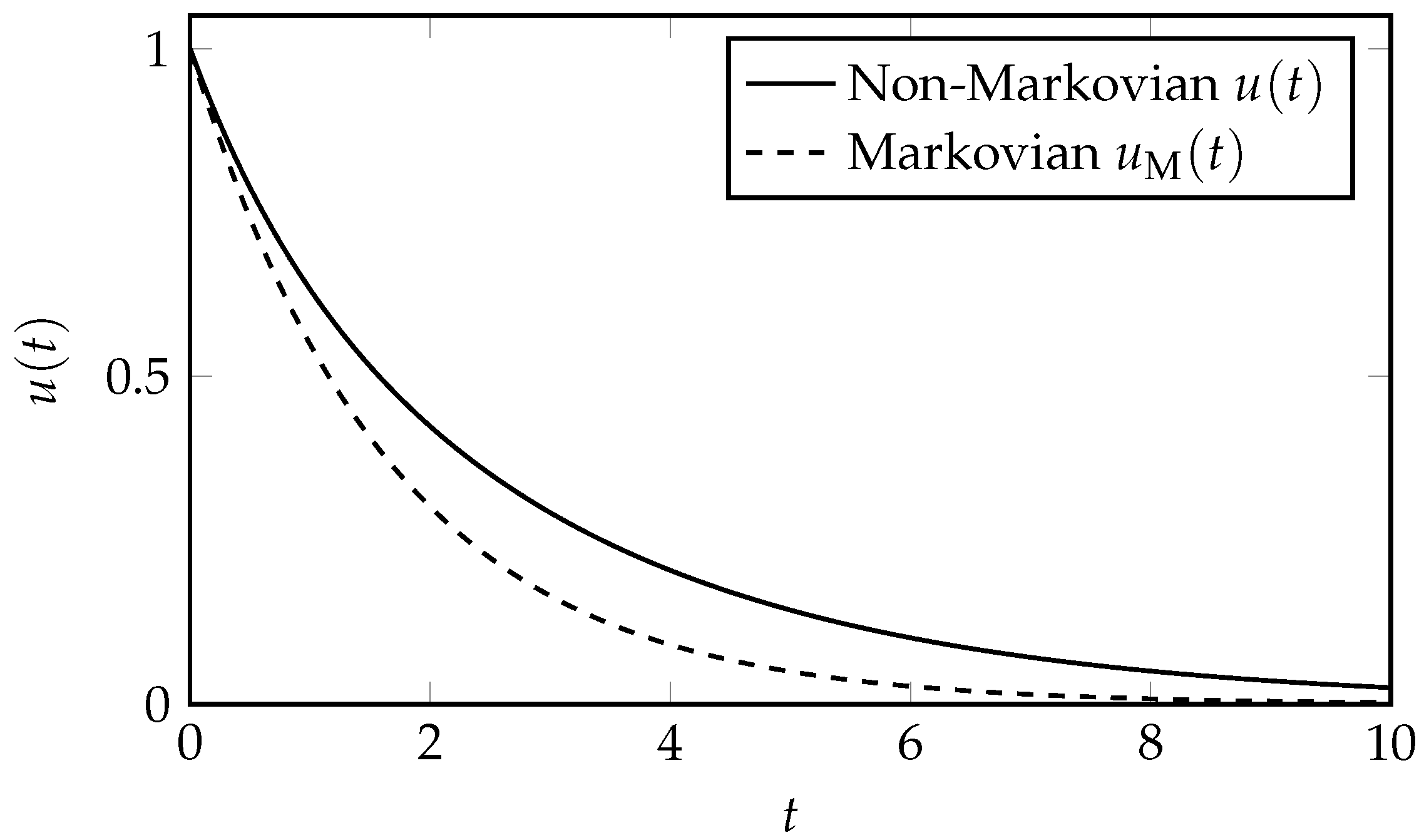
To illustrate the non-Markovian behavior captured by the dual-time representation, we consider the scalar Volterra equation with exponential memory kernel in Equation (
7) for the parameter choice
,
and
, with initial condition
. Using the explicit solution obtained from the representation theorem in
Section 7.4, we evaluate
on a finite interval and compare it with the purely Markovian reference evolution
, which corresponds to the instantaneous relaxation obtained in the limit where the memory kernel collapses to a delta distribution. As shown in
Figure 3, the dual-time solution exhibits a distinctly non-exponential relaxation profile: the initial decay is slower than in the Markovian case, and the effective decay rate changes over time as the memory of past states is gradually attenuated by the kernel. This numerical illustration confirms that the local dual-time dynamics, when projected according to Definition 6, reproduce the non-Markovian evolution generated by the convolution kernel and interpolate smoothly between the Markovian and strongly non-Markovian regimes as
and
are varied.
7.6. Example: Non-Markovian Open Quantum Two-Level System
We now illustrate the dual-time construction in a genuinely quantum setting by considering a two-level system coupled to a structured reservoir. Such systems are standard testbeds for quantum non-Markovianity and memory effects [
9,
10]. In particular, non-exponential relaxation and information backflow can be captured effectively by generalized master equations with convolution memory kernels.
7.6.1. Single-Time Non-Markovian Master Equation
Let
be the system Hilbert space and let
denote the reduced density operator at physical time
. We consider a two-level system with Hamiltonian
where
is the Pauli
z-matrix and
the level splitting. In the Markovian regime, spontaneous emission into a memoryless bath is described by a Gorini–Kossakowski–Sudarshan–Lindblad (GKSL) generator [
7,
8]
where
are the raising and lowering operators and
is the Markovian decay rate.
In a structured environment with a finite correlation time, microscopic derivations (e.g., via the Nakajima–Zwanzig projection operator method) lead instead to a generalized master equation of the form [
9,
10]
where
is a dissipator of GKSL type,
and
is a scalar memory kernel encoding reservoir correlations. A widely used and analytically tractable choice is the exponential kernel
with coupling amplitude
and reservoir correlation rate
. Substituting (
15) into (
13) yields
Equation (
16) is a Volterra-type evolution equation on the Banach space
X of trace-class operators on
, with kernel superoperator
Comparing with Definition 7, we identify
The non-Markovian master Equation (
16) is therefore a special case of the convolution memory Equation (
4) with operator-valued kernel
on
X.
7.6.2. Dual-Time Realization in Liouville Space
We now realize the dynamics (
16) as the projection of a local dual-time evolution on the dual-time manifold
. Let
denote the reversible temporal coordinate and
the irreversible “age” coordinate as in
Section 3. We introduce:
An observable density operator ;
An age-resolved quantum memory field .
And consider the dual-time system
with boundary and initial conditions
where
are given by (
18). Equation (19b) is a linear transport equation in the
-plane on the space of density operators, damped at rate
along characteristics of slope
. The boundary condition (
19c) injects freshly created memory at zero age proportional to the current system state
. The observable evolution (
19a) couples the system to the entire age-distribution
via the integral over
.
As a direct corollary of Theorem 2, we obtain:
Proposition 7 (Dual-time representation of a non-Markovian qubit). Let , , g and γ be as above. Then:
- (i)
If ρ is a solution of the generalized master Equation (
16)
, the memory field defined byyields a pair that satisfies the dual-time system (19)
. - (ii)
Conversely, if satisfies (19)
with and χ continuously differentiable on , then ρ solves the single-time non-Markovian master Equation (
16)
.
In particular, there is a one-to-one correspondence between solutions of the non-Markovian open-system dynamics (
16)
and solutions of the local dual-time evolution (19)
on . Proof. This is an immediate specialization of Theorem 2 to the operator choices (
18). For completeness, we outline the argument.
Assume first that
solves (
16) and define
by (
20). For
, we obtain
so that
which is (19b). The boundary and initial conditions (
19c) and (19d) follow immediately from (
20). Moreover,
With the change of variables
, this becomes
and substitution into (
19a) reproduces the single-time Equation (
16). The converse direction is obtained by solving (19b) along characteristics, which forces
to take the form (
20), and inserting this expression into (
19a), exactly as in the proof of Theorem 2. □
7.6.3. Geometric Interpretation and Temporal Curvature
From the dual-time perspective, the pair
is a section of a vector bundle
whose fiber at each dual-time point
consists of the instantaneous reduced state and an age-resolved memory profile of the open system. The reversible generator
acts along the
-direction, while the irreversible generator
governs relaxation of the memory field along the
characteristics. The superoperator
injects the effect of memory back into the observable sector through (
19a), and the boundary condition (
19c) implements continuous writing of the current system state into the
-sector.
In the notation of
Section 4, one may regard the dual-time dynamics as generated by temporal covariant derivatives
acting on
, where
and
are block operators on the extended Liouville space encoding
A,
B, and the couplings
C,
D. Whenever
and
, these temporal connections do not commute: the corresponding temporal curvature
is nonzero on the memory sector. Geometrically, evolving first in the reversible direction
and then in the irreversible direction
produces a different joint state
than evolving in the opposite order, because intermediate memory of different ages has been damped at different rates.
We emphasize that the noncommutativity of the temporal connections and the resulting nonvanishing temporal curvature do not conflict with the fact that the dual-time Equation (5) and their specializations, such as Equations (9) and (19), are explicitly solvable by the method of characteristics. The term “integrable” used in
Section 7.4 refers to the solvability of these first-order transport equations, not to the geometric condition
discussed in
Section 8. In the present examples, the curvature is constant, and the PDE system remains exactly solvable even though the temporal distribution is not integrable in the Frobenius sense.
This path dependence is precisely the non-Markovian memory encoded in the convolution term of the single-time master Equation (
16).
Upon projection onto a single observable time
, with the irreversible coordinate
integrated out as in (
19a), the temporal curvature manifests as a history-dependent effective generator. The instantaneous rate of change
depends on the entire history
, weighted by the exponentially decaying kernel
. In this way, the non-Markovian open quantum dynamics of a two-level system in a structured reservoir arise as a concrete realization of the general mechanism discussed in
Section 7: nonvanishing temporal curvature on the dual-time manifold leads to non-Markovian behavior after projection to a single observable time.
7.7. Entropy Production and Second-Law Structure
To connect the dual-time framework more directly with thermodynamics, we now briefly indicate how standard entropy functionals and second-law-type inequalities fit into the present formulation.
For concreteness, consider the classical setting in which bi-temporal states represent probability densities
on a phase space
X with reference measure
. Reversible microscopic dynamics along
are generated by a Liouville-type operator
that preserves phase-space volume and an equilibrium density
, while irreversible dynamics along
are generated by a Markov operator
associated with a contraction semigroup on
; see
Section 2.
In dual-time notation this corresponds to
with
skew-adjoint and
dissipative in the sense of semigroup theory.
We introduce the relative entropy (or free-energy functional)
and the associated thermodynamic entropy
Under standard assumptions on
(e.g., detailed balance with respect to
), the relative entropy is a Lyapunov functional for the irreversible semigroup generated by
; see, for example, the classical
H-theorem and its extensions in non-equilibrium statistical mechanics. For fixed reversible time
we obtain
with equality if and only if
. Equivalently,
Thus, the irreversible temporal connection
carries a natural entropy-production structure: along each dual-time line with
fixed, the thermodynamic entropy is non-decreasing in
, providing a dual-time formulation of the second law.
An analogous picture holds in the quantum setting considered in
Section 7.6.
Let
X be the Banach space of trace-class operators and let
B be a Lindblad generator with stationary state
. Defining the quantum relative entropy
Spohn’s inequality implies
so that the corresponding thermodynamic entropy
is non-decreasing along the irreversible temporal direction.
In the representation theorem of
Section 7.4, the operator
B is precisely the generator of irreversible evolution in the dual-time memory sector. When
B is chosen to be a Markov or Lindblad generator with an associated entropy-production functional as above, the dual-time realization of convolution-type memory inherits this second-law structure. The non-Markovian single-time dynamics obtained by projection therefore admit a generalized entropy balance: entropy is produced locally along the irreversible coordinate
, while projection to observable time redistributes this production over the effective temporal history without violating the sign of the entropy production.
These observations show that the dual-time geometry is naturally compatible with the thermodynamic concept of entropy. Irreversibility, encoded geometrically in the temporal curvature and in the semigroup structure of , generates monotone entropy functionals in the sense of the second law, while the observable arrow of time emerges from the combined effects of curvature, symmetry breaking, and projection.
9. Relation to Existing Approaches
In this section, we situate the proposed dual-time topological framework within the broader landscape of non-equilibrium mathematical physics. Rather than providing an exhaustive review, we highlight representative approaches and clarify the conceptual and mathematical distinctions relative to the present work.
9.1. Single-Time Non-Equilibrium Frameworks
Traditional approaches to non-equilibrium systems are formulated in terms of a single temporal parameter and typically rely on one or more of the following strategies:
Coarse-graining or projection from microscopic reversible dynamics;
Introduction of dissipative terms or stochastic forces;
Semigroup formulations encoding irreversibility.
Canonical examples include classical master equations, kinetic theory, and projection-operator methods [
4,
5,
6], as well as quantum dynamical semigroups generated by Lindblad-type operators [
7,
8]. While these frameworks are mathematically well established and have broad applicability, irreversibility is encoded at the level of effective evolution equations rather than at the level of the underlying temporal structure.
As a result, memory effects and non-Markovian behavior typically enter through phenomenological modifications, such as integro-differential equations or time-dependent generators [
9,
10]. In contrast, the dual-time framework introduced here separates reversible and irreversible evolution already at the kinematic level by assigning independent temporal parameters. Irreversibility then emerges from the geometric and topological properties of temporal evolution rather than from additional assumptions imposed on single-time dynamics.
9.2. Extended Phase-Space and Two-Time Formalisms
Various extensions of classical and quantum mechanics introduce additional variables or time-like parameters to account for dissipation, memory, or delayed interactions. These include extended phase-space constructions and auxiliary-variable methods in non-equilibrium thermodynamics [
17], as well as two-time formalisms commonly used in the theory of correlation and response functions.
Such approaches often employ multiple time arguments for observables or correlation functions, while retaining a single underlying physical time governing system evolution. By contrast, the present framework introduces a genuinely dual-time manifold on which states themselves are defined. Both temporal parameters enter symmetrically at the level of geometry and dynamics, and neither is treated as an auxiliary or derived quantity.
9.3. Age-Structured Dynamics and Internal Variable Theories
Mathematically equivalent structures to the present dual-time framework arise in age-structured population dynamics, where the state of a system depends on both chronological time and an age variable. The resulting McKendrick–von Foerster equations describe transport in the age coordinate coupled to birth and death processes, and effective memory in observables appears after integrating out the age variable.
Similarly, internal variable theories in continuum mechanics introduce auxiliary “age” or internal state variables to localize memory effects and hysteresis by promoting them to additional coordinates in an extended state space. The dual-time framework generalizes these approaches by formulating the reversible and irreversible temporal directions as geometric coordinates on a temporal manifold and encoding their interaction through temporal connections and curvature. In this sense, age-structured and internal-variable models can be viewed as special cases of dual-time dynamics with a particular choice of temporal geometry and projection to observable time.
From the multiscale perspective, irreversible mesoscopic dynamics emerge as patterns in microscopic phase portraits, and the geometry of the associated state space is tightly linked to entropy and Lyapunov functionals [
3,
17]. In this sense, the dual-time construction may be viewed as a complementary “multitime” realization of the same idea: instead of enlarging the state space by introducing additional mesoscopic variables, we enlarge the temporal domain and represent coarse-graining and entropy production through an irreversible temporal connection on the state space. When this connection is generated by a Markov or Lindblad operator with an
H-theorem, the resulting dual-time evolution reproduces the usual entropic structure of non-equilibrium thermodynamics, while making explicit its geometric and gauge-theoretic underpinnings.
9.4. Thermal Time and Emergent Time Proposals
The idea that time may be emergent rather than fundamental has been explored in several contexts, including relational approaches to dynamics and the thermal time hypothesis [
24]. In these frameworks, an effective temporal flow is defined in terms of states, entropy, or observables rather than being imposed a priori.
The dual-time framework shares with these approaches the view that the observed arrow of time may be emergent. However, it differs in that emergence arises from the projection of a higher-dimensional temporal structure rather than from state-dependent definitions of time. Moreover, the present formulation remains compatible with standard dynamical evolution equations in appropriate limits, ensuring continuity with established non-equilibrium models.
9.5. Geometric and Gauge-Theoretic Approaches
Geometric formulations of dynamics based on connections, curvature, and gauge symmetries are well established in classical and quantum mechanics [
22,
23]. More recently, geometric methods have been extended to non-equilibrium systems, including geometric formulations of thermodynamics, dissipation, and gradient flows.
The present work contributes to this line of research by extending gauge-theoretic and geometric methods to multiple temporal dimensions. Temporal curvature plays a central role, providing a unified geometric origin for memory effects, non-Markovianity, and temporal asymmetry. This distinguishes the approach from geometric formulations that remain confined to single-time evolution.
9.6. Relation to Other Multi-Time and Non-Equilibrium Frameworks
The dual-time geometric framework may be contrasted with several existing approaches that introduce additional temporal or structural degrees of freedom to address irreversibility and emergent dynamics. In the Page–Wootters mechanism and related quantum-clock formulations, time is promoted to a quantum degree of freedom within a global stationary state, and effective evolution arises conditionally with respect to a chosen clock subsystem [
29]. In contrast, the present approach treats time as a geometric coordinate from the outset, extending the temporal domain itself rather than enlarging the quantum state space, and encodes irreversibility through independent temporal connections and curvature rather than conditionalization in Hilbert space. The GENERIC formalism of non-equilibrium thermodynamics similarly employs a geometric structure, combining reversible (Poisson) and irreversible (dissipative) flows on an extended state manifold governed by energy and entropy functionals [
17]. While GENERIC operates by enriching the state space, the dual-time framework instead enriches the temporal geometry, with irreversible behavior arising from temporal curvature and projection rather than from explicit entropy generators. Finally, Dirac’s multi-time formalism introduces separate time coordinates for different degrees of freedom in relativistic quantum theory, subject to consistency conditions [
30]. The present construction differs in both motivation and structure: it introduces two temporal directions per system, distinguished by their reversible and irreversible character, and uses geometric coupling between these directions to generate memory, non-Markovianity, and temporal asymmetry after projection. In this sense, the dual-time framework may be viewed as complementary to these approaches, providing a distinct geometric realization of irreversibility based on temporal topology and curvature.
9.7. Conceptual Distinctions
The defining features of the dual-time topological framework may be summarized as follows:
Reversible and irreversible dynamics are represented by independent temporal parameters;
Temporal asymmetry emerges from curvature, symmetry breaking, and projection;
Memory and aging arise geometrically rather than phenomenologically;
Standard non-equilibrium models are recovered as special limiting cases.
Taken together, these features position the framework as a unifying and generalizing approach to non-equilibrium mathematical physics. It complements existing methods while offering new structural insights into the emergence of the arrow of time from the geometry and topology of temporal evolution.
10. Conclusions and Outlook
In this work, we have developed a dual-time topological framework for the mathematical description of non-equilibrium systems, aimed at reconciling reversible microscopic dynamics with irreversible macroscopic behavior. By introducing two independent but coupled temporal parameters, the framework provides a unified geometric setting in which reversible and irreversible processes coexist already at the kinematic level, rather than being combined only at the level of effective equations.
The central mathematical structures of the framework are a dual-time manifold, independent temporal connections, and the associated temporal curvature. We have shown that nonvanishing temporal curvature induces path dependence in temporal evolution, leading naturally to memory effects, non-Markovian dynamics, and aging phenomena. Temporal asymmetry emerges dynamically through symmetry breaking between the reversible and irreversible temporal sectors and through projection onto a single observable time parameter, without the need for additional phenomenological assumptions beyond the choice of irreversible generator. In particular, at the level of the dual-time description, no explicit memory kernels or entropy functionals are postulated; such structures appear only after projection to an effective single-time evolution. Rather than taking the second law or a specific entropy functional as a fundamental postulate, these structures arise as consequences of the dual-time geometry when the irreversible temporal generator is chosen from standard Markovian or Lindbladian classes, leading to entropy-production inequalities and second-law-type inequalities, as detailed in
Section 7.7.
A key feature of the framework is its compatibility with established non-equilibrium models. Standard single-time evolution equations, including Hamiltonian dynamics, dissipative semigroup evolution, and Markovian master equations, are recovered in integrable or decoupling limits. We note that the representation theorem in
Section 7.4 is stated for bounded operators acting on a Banach space; extending the construction to unbounded generators of strongly continuous semigroups, as arise, for example, from differential operators, is an important direction for future work.
This demonstrates that the proposed formalism constitutes a genuine generalization rather than an alternative formulation, extending conventional approaches to regimes characterized by coupled reversible and irreversible temporal evolution and nontrivial temporal topology.
Several directions for future work naturally arise from the present analysis. From a mathematical perspective, the classification of temporal topologies and curvature-induced invariants on dual-time manifolds warrants further investigation, particularly in relation to holonomy, gauge structure, and equivalence classes of temporal evolution. Extensions to infinite-dimensional configuration spaces, operator-algebraic formulations, and stochastic evolutions also present promising avenues for further study. From a physical standpoint, applications to quantum non-equilibrium systems, open quantum dynamics, and systems exhibiting strong memory effects and aging are of particular interest.
More broadly, the dual-time framework provides a mathematically consistent approach to the structural origin of the arrow of time in non-equilibrium theoretical physics. By encoding irreversibility in the geometry and topology of temporal evolution, it offers a unified perspective that bridges microscopic reversibility and macroscopic temporal asymmetry within a single coherent formalism, complementing existing non-equilibrium theories while revealing new structural mechanisms underlying temporal asymmetry.
Finally, we note that the dual-time framework developed here is intended as a general mathematical platform rather than as a model tied to a specific physical system. Beyond the non-equilibrium examples treated in
Section 7 and
Section 8, the same geometric structures—dual temporal manifolds, temporal connections, curvature, and projection—can be applied to a broad class of problems in complex-time geometry and fundamental theoretical physics. In particular, variants of the dual-time construction have been used to formulate models of emergent spacetime and dimensional flow, complex-temporal spectral triples, and inner-time gauge theories with discrete or compact temporal sectors, including Yang–Mills-type models exhibiting ultraviolet regularization and spectral gaps; see, for example, [
31,
32].
Related applications include effective quantum kinematics on complex-time geometry, inner-time projection models for fundamental constants, and “quantum relativity” frameworks in which observable spacetime structure emerges from deeper temporal dynamics [
33,
34]. While these constructions lie beyond the scope of the present article, they illustrate how the dual-time formalism may serve as a unifying mathematical language connecting non-equilibrium dynamics, gauge theory, spectral geometry, and emergent spacetime models. Future work will explore these connections in greater detail.
A notable feature of the present framework is that its explanatory power does not depend on adding independent assumptions for irreversibility, memory, or entropy production. Instead, these phenomena arise from a single, unified geometric structure: the dual-time manifold equipped with independent temporal connections and nonvanishing temporal curvature. In this sense, both the geometry of temporal evolution and its effective physical content emerge from a common underlying construction, rather than being imposed separately at different descriptive levels. This structural unity underlies the emergence of temporal asymmetry and suggests that a minimal extension of temporal geometry can account for a broad range of non-equilibrium phenomena within a coherent mathematical framework.
The present dual-time framework may be viewed as part of a broader line of research by the author on complex and generative temporal structures, including the Duality of Time Theory and the Single Monad Model, for which further conceptual developments and applications are discussed in the monographs and preprints cited in the Introduction.