5.1. Comparative Framework
The framework proposed in the literature [
19] utilizes graph theory to extract brain network features from resting-state fMRI data, then uses a recursive feature elimination algorithm to select the most discriminative subset of features, and finally uses a gradient-boosting (GB) classifier for classification.
The Attentional Attribute Enhancement Network (AAEN) proposed in the literature [
32] improves the performance of ADHD classification by combining multimodal characteristics. The model is based on the Convolutional Variational Autoencoder (CVAE) framework, which first extracts potential features of brain functional connectivity, subsequently introduces phenotypic attributes such as age and gender to generate attentional weights, and dynamically weights the potential features to highlight key information. Finally, enhanced features of brain connectivity are fused with original phenotypic data and input into a Support Vector Machine (SVM) to perform classification.
Ref. [
33] proposes a spatiotemporal attention autoencoder (STAAE) to perform spatiotemporal modeling of functional magnetic resonance imaging of the resting state (rs-fMRI) through unsupervised learning to solve the long-distance-dependent modeling problem, and to construct a classification framework based on temporal templates of the resting state (RSTT) to identify patients with ADHD.
The model proposed in [
34] has three modules: data enhancement, feature selection, and classification. Data enhancement connects the network with Gaussian noise, Mixup, and sliding-window processing functions. Feature selection extracts local and global features with the CNN and GAT. Finally, the feature fusion module fuses the two features to generate an effective feature representation for the identification of patients with ADHD.
Shao et al. [
35] extracted 1D functional connectivity and 3D Amplitude of Low-Frequency Fluctuation (ALFF) features from fMRI data. They proposed an enhanced gcForest model that integrates these features via a multi-granularity scanning structure, generating augmented feature vectors for final classification through a cascade forest.
To provide a more intuitive comparison of the differences between the aforementioned five references and this study,
Table 5,
Table 6, and
Table 7 systematically compare whether phenotypic information was incorporated, the static and dynamic functional connectivity features extracted, and the methods used to fuse these two types of features, respectively.
Although the proposed framework achieved competitive mean AUC values across different sites, the corresponding 95% confidence intervals remained relatively wide. This observation indicates that the model performance still exhibits noticeable variability under different data partitions, suggesting that further improvements are possible.
The relatively broad confidence intervals can be attributed to several factors. First, the limited sample size and class imbalance inherent in publicly available ADHD neuroimaging datasets can amplify performance fluctuations across cross-validation folds. Second, inter-site heterogeneity in data acquisition protocols, scanner characteristics, and subject demographics may further increase variability in model predictions. Inter-site heterogeneity may systematically shift both sFC topology and dFC temporal statistics, thereby affecting learned representations and model performance. This motivates future work on domain-adaptive learning to improve cross-site robustness and generalization. In addition, the high dimensionality of functional connectivity features relative to the number of samples may introduce estimation uncertainty.
These results highlight the necessity of future work focusing on larger multi-site datasets, improved feature selection or dimensionality reduction strategies, and more robust domain-adaptive learning frameworks to enhance the generalizability and stability of ADHD classification models.
To validate the effectiveness of each component of the feature extraction framework proposed in this paper, ablation experiments were conducted using data from the PK site. The results are shown in
Table 8. In the static pathway, removal of phenotypic features reduced the precision of the model from 73.91% to 68.18%, confirming that phenotypic information plays a critical additional role in modeling static functional connectivity. In the dynamic pathway, removal of BiLSTM temporal features resulted in a decrease in classification precision from 77.27% to 72.73%, indicating that temporal encoding effectively improves the ability to represent dynamic functional connectivity in time. The joint classification precision of the feature fusion framework reached 86.36%, significantly outperforming the static (73.91%) or dynamic (77.27%) single-feature baselines, and validating the effectiveness of the multimodal feature synergy mechanism. The experimental results indicate the following: (1) Phenotypic data and static functional connectivity features extracted via convolution exhibit complementarity. (2) Temporal modeling enhances the representational granularity of dynamic functional connectivity. (3) The bidirectional feature fusion strategy exhibits a nonlinear gain effect.
During the feature fusion stage, we further compared the classification performance differences between simple feature concatenation, bidirectional attention fusion, and unidirectional attention fusion guided by static features. Experiment E used direct concatenation of static and dynamic functional connectivity features for classification, achieving an accuracy of only 65.22%. This result was significantly lower than those obtained using static (73.91%) or dynamic (77.27%) features alone, indicating that simple concatenation struggles to effectively capture the intrinsic dependencies between the two feature types and may instead introduce redundant information and noise interference. Experiment F introduced a bidirectional attention mechanism to model interactions between static and dynamic features, improving the classification accuracy to 69.57%. Although this represents an improvement over simple concatenation (65.22%), it remains significantly lower than the unidirectional attention fusion strategy employed by our baseline model (86.36%). This result indicates that symmetric bidirectional feature interactions do not yield further performance gains and may instead weaken the global structural constraints provided by static functional connectivity.
The experimental results demonstrate the following: (1) Phenotypic data exhibit complementarity with static functional connectivity features extracted via convolution. (2) Temporal modeling enhances the representational granularity of dynamic functional connectivity. (3) The unidirectional attention mechanism-based feature fusion strategy, where static functional connectivity guides dynamic functional connectivity, yields a nonlinear gain effect.
5.2. Categorized Performance
Table 9 summarizes the classification performance of the proposed framework at the NYU, Peking, and KKI sites, including accuracy, sensitivity, specificity, and area under the curve (AUC). As shown in the table, the proposed model demonstrates high accuracy and AUC values at all three sites. Among them, the KKI site exhibits the best classification performance, with an accuracy of 90.91% and an AUC value of 96.97%. The model also exhibits a good balance of sensitivity and specificity across all sites. In particular, the specificity at both the NYU and KKI sites reaches 100%, indicating that the model achieves extremely high accuracy in identifying negative class samples. In general, the model demonstrates outstanding classification performance at different sites, validating its effectiveness and generalization in the ADHD classification task.
Table 10 shows the results of the classification accuracy comparison between the method proposed in this document and the existing state-of-the-art methods. Our method demonstrates significant advantages in classification performance at all sites, achieving accuracy rates of 85%, 86.96%, and 90.91% at the NYU, PK, and KKI sites, respectively, all of which outperform all comparison methods. Specifically, compared to the static feature extraction method in [
32], our method effectively captures the dynamic characteristics of brain networks through dynamic functional connectivity analysis and BiLSTM temporal modeling, improving precision at the PK site by 8.76%. Compared to the spatiotemporal attention autoencoder (STAAE) in Reference [
33], our method uses a dual-path feature extraction strategy (combining CNN static features with BiLSTM dynamic features), achieving a 14.31% improvement in accuracy at the highest-performing site (KKI). Additionally, compared to [
35], our method achieves accuracy improvements of 11.83% and 22.09% at the NYU and PK sites, respectively, by introducing multi-scale topological feature extraction and phenotypic information fusion.
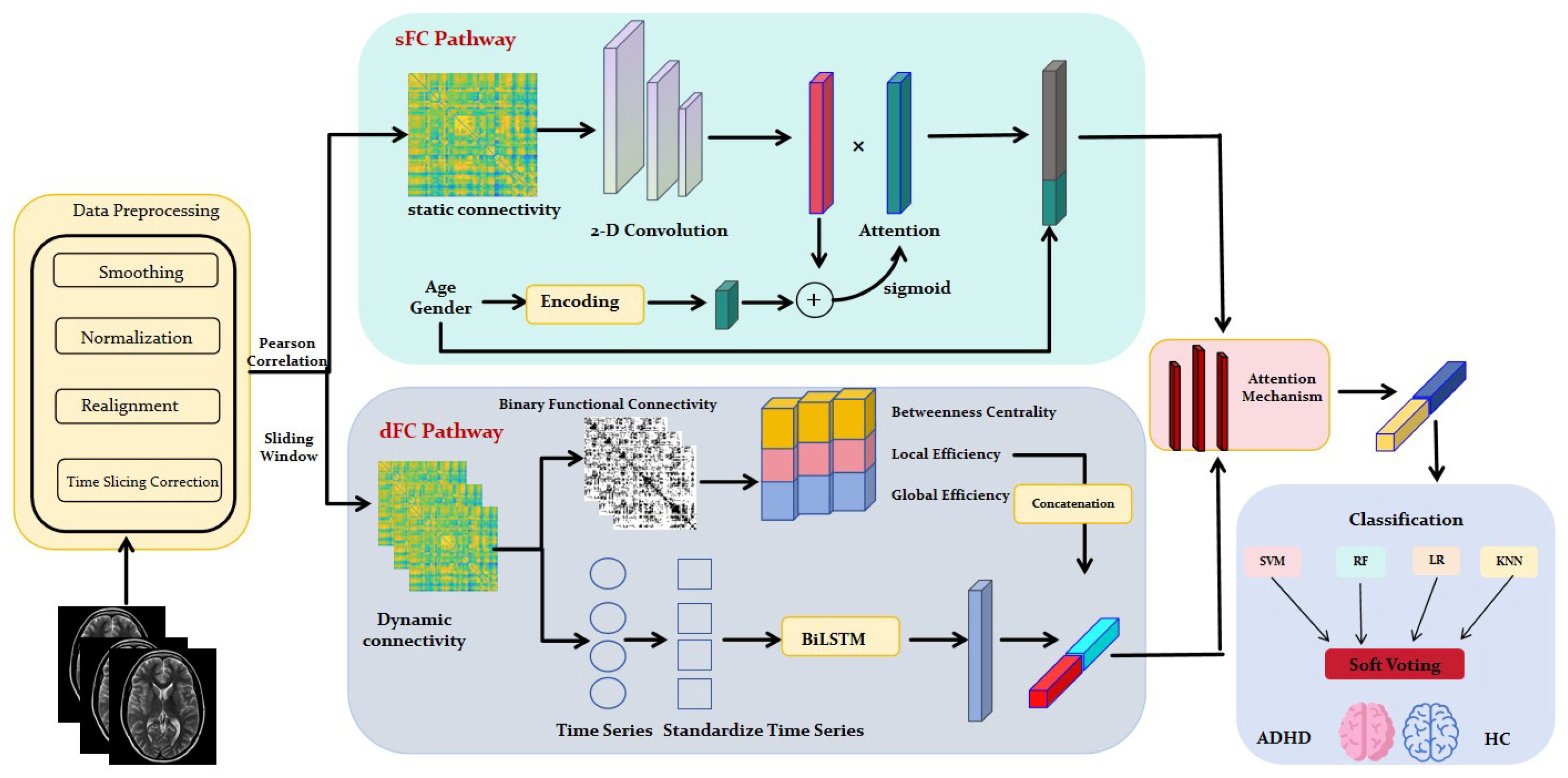
Table 10 summarizes the key differences between existing ADHD classification studies and the proposed D-SFANet, highlighting how our method explicitly models the mutual dependencies between static and dynamic functional connectivity rather than simply stacking separate modules.
To validate the effectiveness of each component of the feature extraction framework proposed in this article, ablation experiments were conducted using data from the PK site The results are shown in
Table 8. In the static pathway, the removal of phenotypic features reduced the accuracy of the model from 73.91% to 68.18% (
= 5.73%), confirming that phenotypic information plays a critical complementary role in modeling static functional connectivity. In the dynamic pathway, removal of BiLSTM temporal features resulted in a decrease in classification precision from 77.27% to 72.73% (
= 4.54%), indicating that temporal encoding effectively enhances the ability to represent dynamic functional connectivity in time. The joint classification precision of the feature fusion framework reached 86.36%, significantly outperforming the static (73.91%) or dynamic (77.27%) single-feature baselines, and validating the effectiveness of the multimodal feature synergy mechanism. The experimental results indicate the following: (1) Phenotypic data and static functional connectivity features extracted via convolution exhibit complementarity. (2) Temporal modeling enhances the representational granularity of dynamic functional connectivity. (3) The bidirectional feature fusion strategy exhibits a nonlinear gain effect.
5.3. Discussion
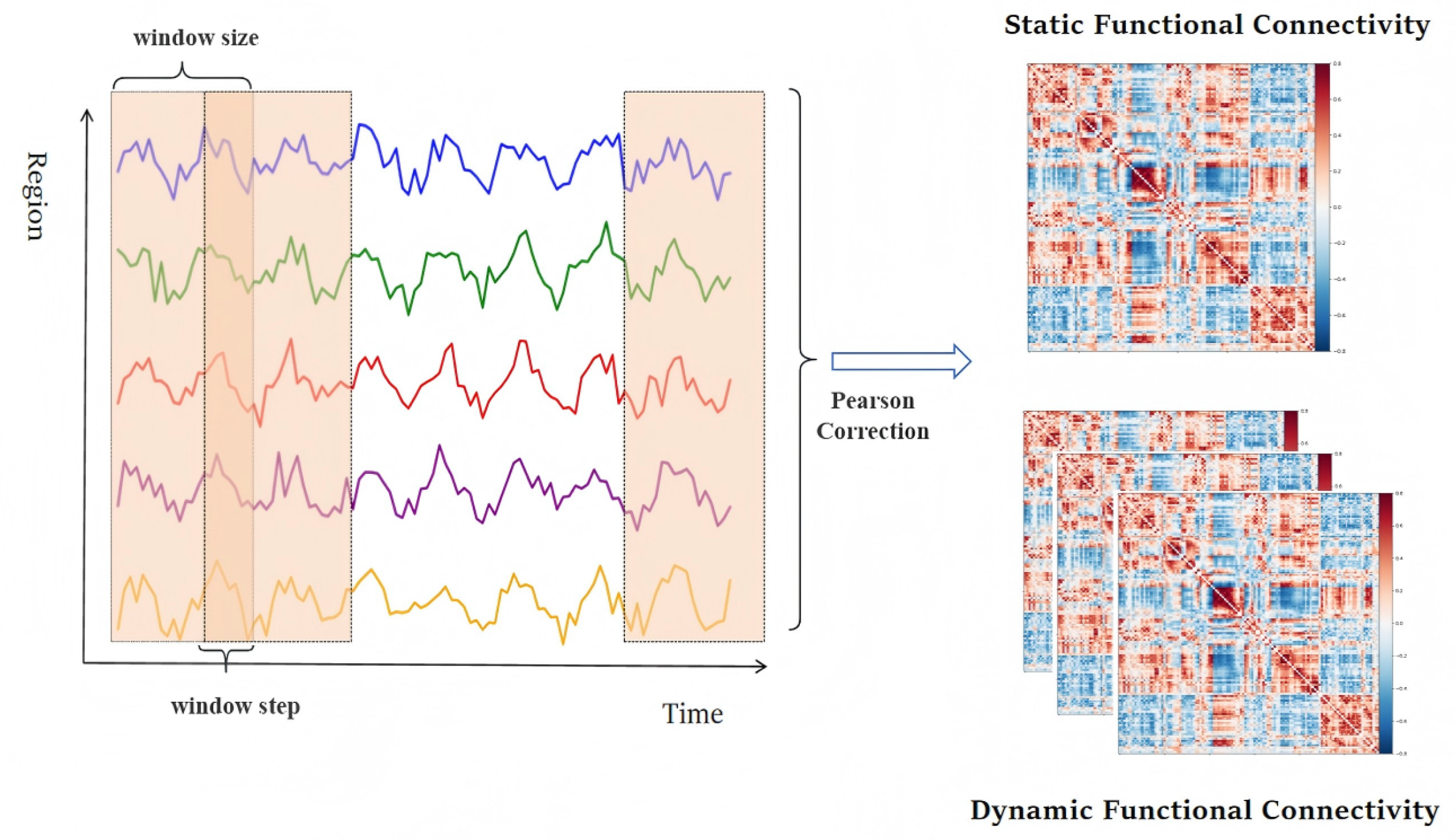
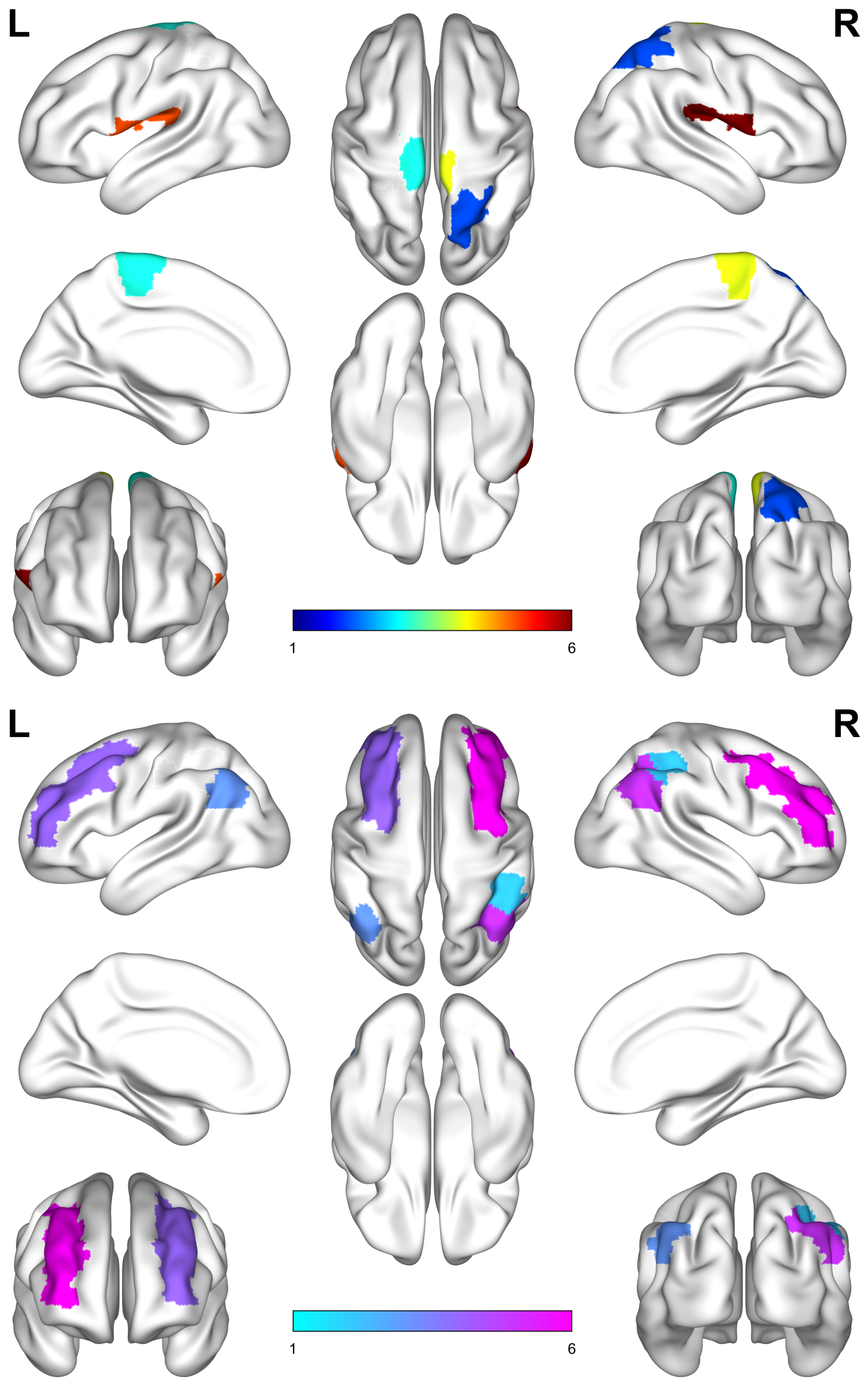
In this study, two independent feature extraction paths were designed by combining the characteristics of static functional connectivity (sFC) and dynamic functional connectivity (dFC), and the extracted features were fused to achieve the classification of ADHD. In the dFC feature extraction path, the topological features of functional connectivity were extracted on the basis of graph theory, and local efficiency was analyzed. Compared to controls, the ADHD group exhibited significantly higher coefficients of variation (CV) of local efficiency in both the attention network module (29 ADHD samples) and the sensorimotor network module (26 ADHD samples), indicating greater temporal variability in these networks.
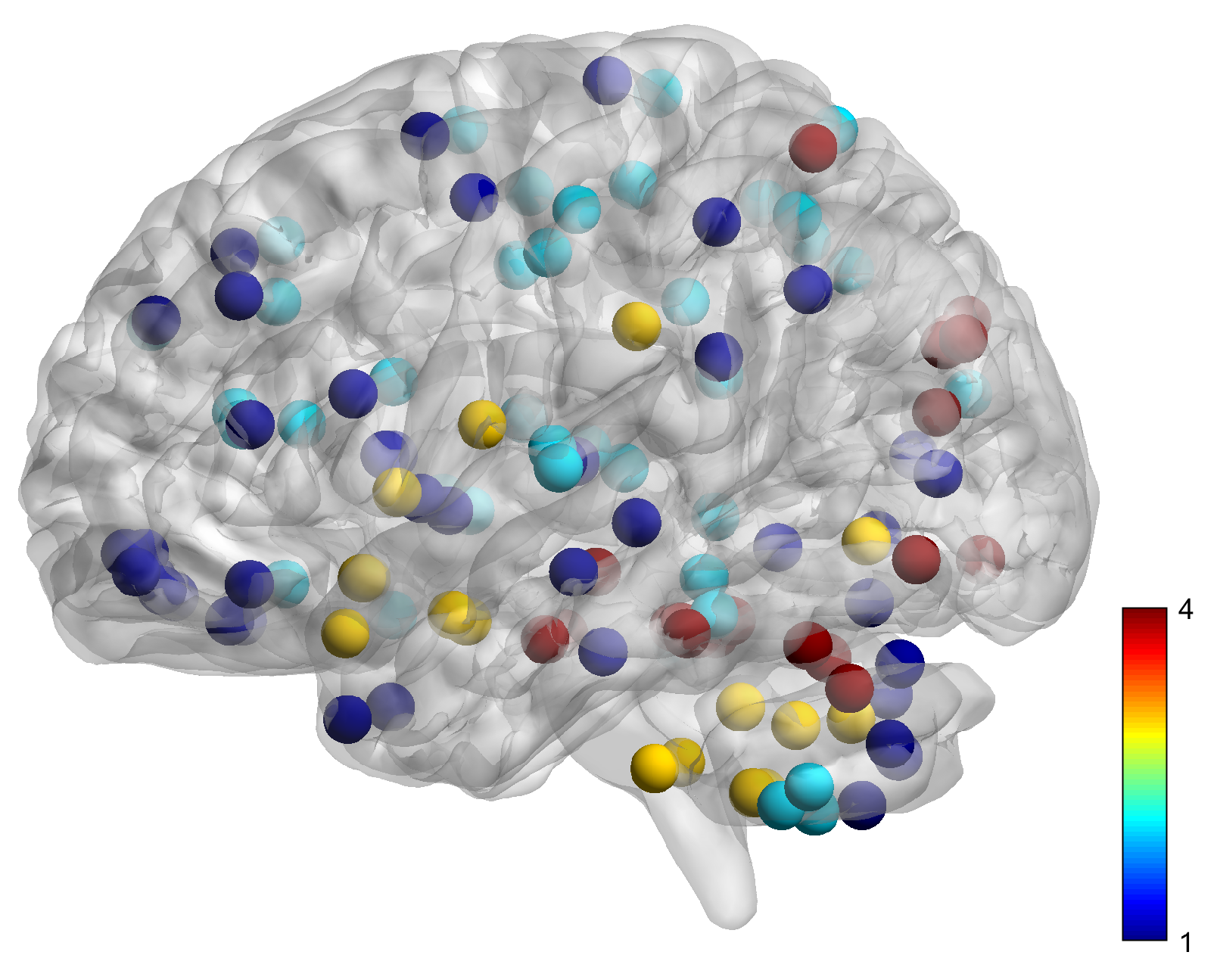
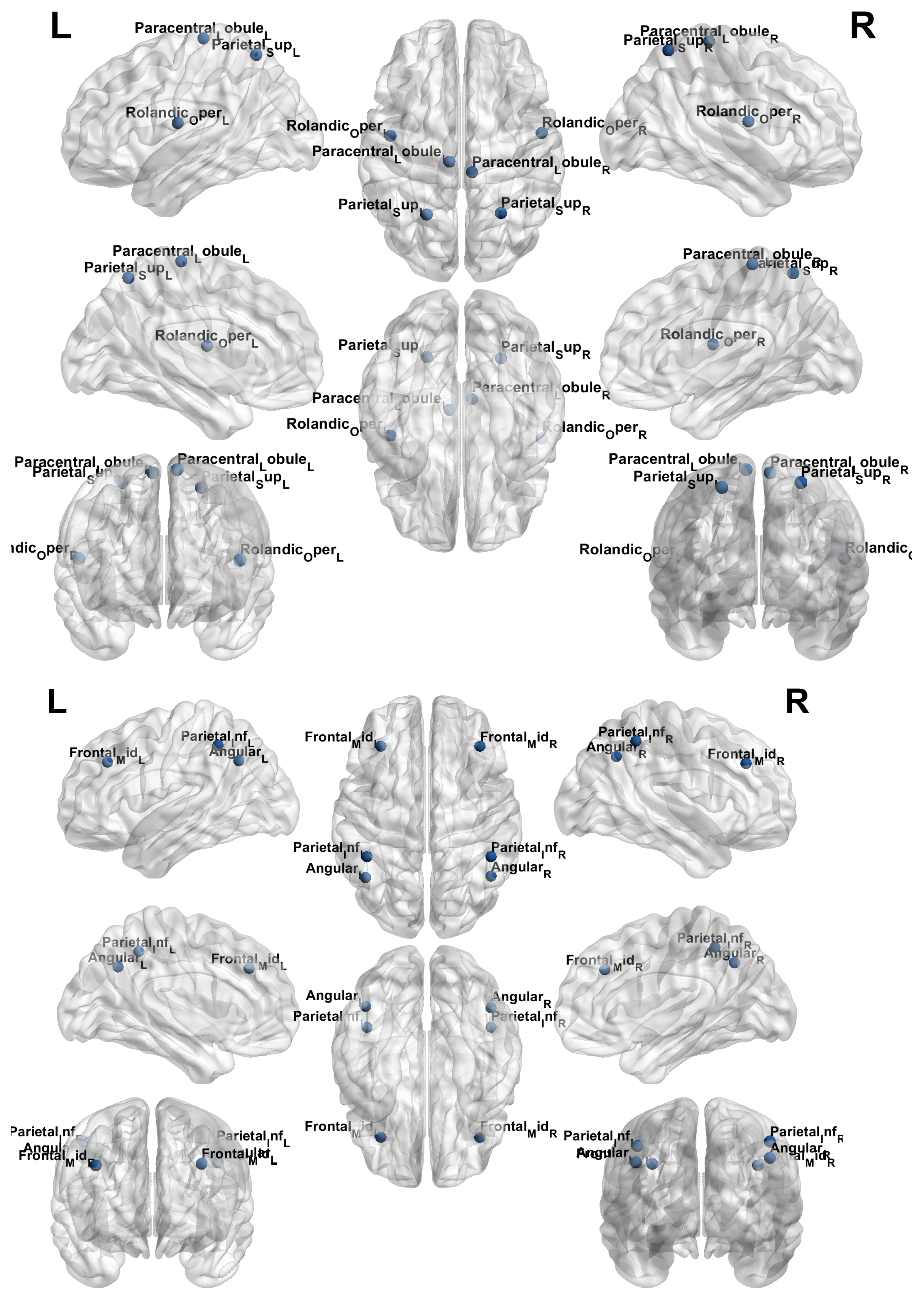
Figure 6 shows some regions of the brain included in the modules of the attention and sensorimotor network, and
Figure 7 lists their corresponding names. The attention network is closely related to maintaining and switching attention, whereas the sensorimotor network is involved in sensory integration and motor coordination. The increased CV of local efficiency in these networks suggests reduced stability of information integration over time, which is consistent with the clinical phenotype of fluctuating attention allocation and impaired sensorimotor coordination in ADHD.
Nevertheless, rs-fMRI-derived connectivity dynamics remains an indirect proxy of neural activity; therefore, mechanistic interpretations should be made with caution. To strengthen the biological basis of our interpretation, we relate the observed temporal instability in graph efficiency derived from dFC to complementary neurophysiological evidence. For example, Ronca et al. used attention-related EEG indices that were originally developed in ADHD research—specifically, the frontal beta/theta ratio (i.e., the inverse theta–beta Ratio)—to track fluctuations in attention processing and cognitive control in different experimental conditions, demonstrating that objective EEG markers can sensitively capture dynamic variations in attentional state [
36]. Although EEG and fMRI probe neural processes at different temporal scales, both modalities support the notion that attention regulation in ADHD is characterized by increased temporal instability, which is conceptually consistent with the elevated CV of local efficiency observed in our modules of the attention and sensorimotor network. These findings reveal a core neural mechanism and significant heterogeneity in ADHD, but the specifics need further validation using larger samples.
We emphasize that rs-fMRI connectivity dynamics provides an indirect measure of neural activity; therefore, the mechanistic interpretation should be made with caution. To improve biological grounding, complementary neurophysiological evidence indicates that attentional dynamics and cognitive control in ADHD can be characterized using objective EEG-derived indices (e.g., attention-related EEG markers). This evidence supports the concept that ADHD is associated with increased temporal instability in attentional regulation, consistent with the elevated variability in network efficiency observed in our dFC-derived features. Future work will integrate neurophysiological attention indices with fMRI connectivity dynamics to establish a more direct cross-modal mechanistic mapping.