Article

A Piecewise Linear SBM Network DEA Model with Undesirable Outputs for Benchmarking and Stage-Priority Analysis of Airports
1
Science & Research Branch, Islamic Azad University, Tehran 1477893855, Iran
2
Polytechnic Institute Australia, West Melbourne, VIC 3003, Australia
*
Author to whom correspondence should be addressed.
Mathematics 2026, 14(5), 811; https://doi.org/10.3390/math14050811
Submission received: 29 January 2026 / Revised: 21 February 2026 / Accepted: 26 February 2026 / Published: 27 February 2026

Abstract

Classical DEA models typically assume a linear valuation approach in performance assessment. However, in practical applications, many DMU inputs and outputs exhibit nonlinear valuation. A linear valuation may fail to accurately capture the variations in value across different DMUs. One critical challenge in efficiency evaluation is the presence of undesirable outputs, which negatively affects DMU performance. To address this, decision-makers aim to incorporate the impact of undesirable factors into efficiency measurements, enabling them to identify high-performing DMUs under comparable conditions and use them as benchmarks for inefficient ones. In response to this issue, this study introduces a novel approach based on the SBM Network DEA model to enhance airport efficiency within a two-stage framework while accounting for undesirable outputs. By applying piecewise linear theory, the model assigns lower weight to excessive quantities of undesirable outputs, effectively distinguishing DMUs that generate fewer undesirable outputs from those producing higher amounts. Furthermore, this research offers a practical benchmarking strategy for inefficient airports, aiming to improve their efficiency while considering the priority of each stage.

1. Introduction

A fundamental requirement for enhancing transportation systems is the continuous assessment of their efficiency using appropriate methodologies. Given the significant role of airports and their extensive impact on economic growth, evaluating their performance at the national level is essential. Additionally, improving airport operations is crucial for increasing revenue and minimizing accident-related casualties [1].
Data Envelopment Analysis (DEA), originally introduced by Farrell, is one of the most effective nonparametric techniques for assessing the performance of decision-making units (DMUs) [2]. This approach was later refined by [3,4]. Ref. [5] extended the DEA framework by introducing Network DEA (NDEA) to account for the internal structures of DMUs [6]. Within the NDEA framework, it is important to acknowledge the presence of undesirable factors when evaluating efficiency [7]. Ignoring these factors in real-world scenarios can compromise the credibility of performance assessments [8]. To address this issue, Ref. [9] developed an NDEA-based model incorporating undesirable outputs, while [10] applied game theory to a similar case study in the presence of undesirable outputs.
Recently, research interest has shifted toward evaluating transportation systems, particularly airports. Ref. [11] employed a two-stage DEA approach to assess airport efficiency while considering the interdependence between the two stages. Ref. [12] introduced a two-stage NDEA model that simultaneously optimized both stages to measure airport efficiency. Ref. [13] analyzed efficiency and inefficiency sources in airports by integrating DEA with the Malmquist index across different time periods. Ref. [14] proposed a hybrid AHP–DEA–AR model for evaluating airport efficiency, incorporating the analytic hierarchy process (AHP) to determine input and output weights within the DEA framework [15]. Similarly, Ref. [16] applied this model to compare the efficiency of Turkish airports in both public and private sectors. Ref. [17] introduced a fuzzy dynamic network DEA model for airport efficiency evaluation, suggesting that their methodology could be extended to other similar systems. Ref. [18] employed two-stage DEA models along with the Malmquist index to compare the efficiency of Brazilian airports in public and private sectors. Later, in 2021 [19], they utilized a two-stage DEA model to address two critical questions: (1) which airports operate efficiently and (2) what factors contribute to their operational efficiency?
Despite the valuable contributions of these studies, none have accounted for the nonlinear nature of variable relationships in efficiency assessment and target setting. Variables often exhibit nonlinear behavior and modeling them as linear can lead to unreliable results [20]. Cook and Zhu proposed a practical model that incorporates variables with nonlinear effects on efficiency by defining weight functions with non-decreasing or non-increasing multipliers for larger factor magnitudes [21]. Within the piecewise linear DEA framework, imposing weight restrictions is crucial. Cook and Zhu introduced the Piecewise Linear model, demonstrating that traditional linear models fail to provide accurate assessments [21]. However, previous studies have not accounted for differences in the valuation of undesirable factors. Even if multiple DMUs are deemed efficient, one may generate fewer undesirable outputs than the others, making it a more valuable benchmark. Therefore, a benchmarking model that incorporates the nonlinear valuation of data is essential for setting appropriate performance targets.
The objective of this study is to develop a model that accommodates an appropriate structure while considering the nonlinear behavior of variables, thereby identifying inefficient DMUs and proposing effective benchmarks for their improvement. Additionally, prior studies have not prioritized different stages of efficiency enhancement within the NDEA framework. Although prior studies, such as Reference [21], have incorporated nonlinear impacts of factors, their model represents a black-box, non-network structure and is therefore not comparable to the proposed SBM-NDEA network model. To date, no study has integrated a nonlinear evaluation approach with stage-wise priority determination for efficiency improvement. Addressing this research gap, this study introduces a novel approach to prioritizing each stage of efficiency improvement. By doing so, managers can allocate fewer resources and less time while still achieving optimal results. Hence, this research presents a methodology for determining stage-wise priority within the NDEA model to enhance efficiency evaluation.
This study makes three main contributions to the DEA and efficiency analysis literature. First, it develops a novel slack-based network DEA (SBM-NDEA) model that incorporates piecewise linear valuation of undesirable outputs, allowing nonlinear behaviors to be captured within a network structure. In real-world airport operations, the impact of undesirable outputs such as delays is inherently nonlinear. Initial delays often trigger system-wide disruptions and operational inefficiencies, while additional delays beyond a critical operational threshold may generate relatively smaller marginal impacts. Therefore, adopting a piecewise linear treatment for undesirable outputs allows the model to better reflect the nonlinear operational reality of airport performance evaluation. It should be noted that this modeling choice does not indicate any tolerance toward severe delays; rather, it provides a more realistic representation of performance under complex and congested operational conditions. Second, the proposed framework introduces a practical benchmarking mechanism that identifies efficient peer units under nonlinear valuation conditions. Third, this study proposes a stage-priority strategy that determines the relative importance of each stage in improving the efficiency of inefficient DMUs, providing actionable managerial guidance. This framework enables managers to allocate resources and time effectively, making the model both practical and decision-oriented. Together, these contributions extend existing NDEA models and offer a more realistic and decision-oriented efficiency evaluation framework. Overall, the proposed model represents a genuine methodological and practical advancement, filling a clear gap in the network DEA literature rather than merely optimizing existing models.

2. Theoretical Foundations of Network DEA

2.1. Network DEA and Slack-Based Measures

Data Envelopment Analysis (DEA) is a widely used methodology for evaluating the relative efficiency of Decision Making Units (DMUs) through linear programming. Its flexibility and proven effectiveness in empirical applications have established DEA as a standard tool in operational and management research [5]. The CCR model, introduced by Charnes et al. (1978) [4], assumes constant returns to scale, whereas the subsequent BCC model by Banker et al. (1984) [3] accommodates variable returns to scale. Beyond these classical frameworks, DEA has been extended to network structures, such as two-stage processes, where intermediate outputs from the first stage serve as inputs to the second stage [5]. These network-oriented models allow for a more detailed assessment of efficiency, capturing the performance of each stage individually as well as the overall system.
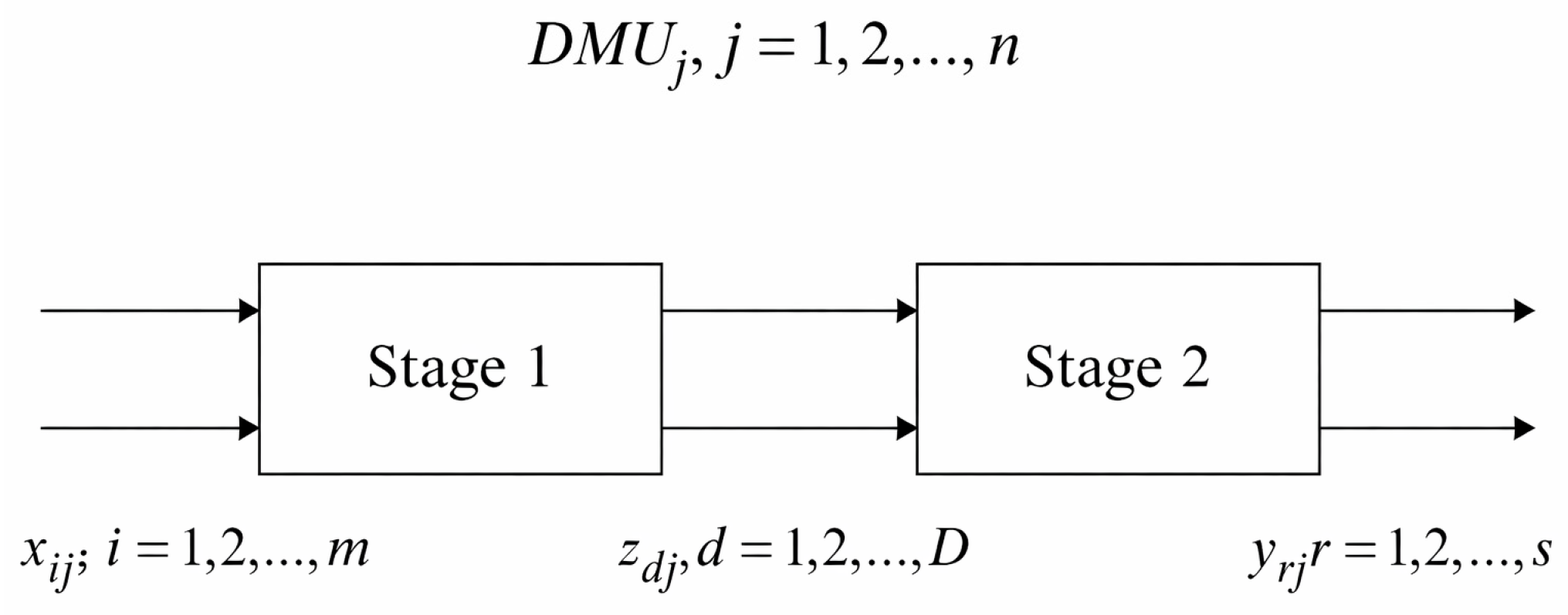
As mentioned above, traditional DEA models, such as the CCR and BCC frameworks, evaluate DMUs as black-box systems and do not explicitly consider the internal structure of multi-stage processes. In systems composed of multiple interconnected processes, traditional DEA models fail to account for the performance of individual sub-processes. To address this limitation, Network DEA (NDEA) was introduced, allowing for the evaluation of DMUs with complex internal structures. NDEA consists of two primary configurations: serial and parallel structures [22,23]. For instance, Figure 1 illustrates a serial structure comprising a two-stage process.
In radial models, efficiency assessment is based on fixed input or output values, which restricts the ability to compute the slack in input or output factors. To overcome this limitation, Tone introduced the Slack-Based Measure (SBM) model, which simultaneously considers the slacks in both input and output elements [24]. By employing the SBM model, the slack in input and output factors can be accurately measured, leading to a more comprehensive efficiency evaluation. This is then developed in various aspects in the DEA field [25].
Ref. [26] formulated an SBM model for efficiency evaluation as follows:
min 1 1 m i = 1 m S i X i O 1 + 1 s r = 1 s S r + Y r O s . t j = 1 n λ j 1 X i j + S i = X i O , i = 1 , , m j = 1 n λ j 1 Z d j j = 1 n λ j 2 Z d j , d = 1 , , D j = 1 n λ j 2 Y r j S r + = Y r O , r = 1 , , s λ j k , S i , S r + 0 , j = 1 , , n , k = 1 , 2 , i = 1 , , m , r = 1 , , s .
In many cases, DMUs exhibit network structures, consisting of at least one stage, with each stage having its own inputs and outputs, as well as intermediate flows between stages. Cook et al. analyzed two-stage network structures using DEA models and established relationships among various approaches, categorizing them based on cooperative game theory or the Stackelberg (leader–follower) framework [27].
Tone et al. introduced a slack-based NDEA model capable of formally handling intermediate products while measuring both individual and network efficiencies [28]. They applied their model to assess the efficiency of vertically integrated electric power companies within a two-stage network structure. Later, Ref. [29] extended their model by incorporating a network structure over multiple periods, introducing a dynamic DEA model within the slack-based measure (SBM) framework.
Lozano et al. developed an NDEA model to evaluate the efficiency of multiproduct supply networks over different time periods [30]. Their results demonstrated that the model effectively identified inefficiencies in the network structure and provided a basis for their elimination using observed data. Ref. [31] introduced a common weight approach in dynamic NDEA using goal programming and applied their model to evaluate the efficiency of 30 non-life insurance companies in Iran. Their findings indicated that the proposed model was a practical tool for efficiency assessment and ranking.
Lozano et al. also proposed an approach to minimize total costs and reduce product losses using past-period data [32]. Their model applied the weighted Tchebycheff method to optimize feasible operating points within an NDEA framework [33]. Chao et al. developed a dynamic NDEA model to decompose shipping service production in a container shipping company (CSC) into two distinct processes [34]. Yousefi et al. introduced a hybrid robust goal programming network DEA model for ranking DMUs, incorporating fuzzy values for goal setting through a possibilistic approach [35].
Yang combined DEA with multi-objective programming to allocate resources in organizations [36]. Badiezadeh et al. applied NDEA to evaluate both optimistic and pessimistic efficiencies of DMUs with undesirable outputs [37], with [38] later presenting dual-role factors in the model. Kao highlighted that NDEA is a relatively new methodology, emerging in the early 2000s [39]. Guo et al. examined two-stage network structures within the NDEA framework and proposed a new model to analyze the relationship between stage efficiencies and overall efficiency [40].
A two-stage network DEA model was investigated, and a novel approach for identifying leader–follower relationships between stages was introduced [41]. Ref. [13] considered a two-stage production process where both stages share resources, with undesirable outputs generated in the second stage. His model provided an optimal allocation of shared resources, showing that undesirable outputs were a primary source of inefficiency in bank branches. Seth et al. proposed an SBM-DEA model for assessing working capital management efficiency in Indian manufacturing firms [42].
The literature review reveals that relatively few studies have focused on evaluating airport efficiency, particularly using the slack-based measure (SBM), which accounts for both input and output slacks simultaneously. While numerous NDEA models have been developed, all assume a linear relationship between inputs and outputs. However, in real-world scenarios, certain variables exhibit nonlinear effects on efficiency, necessitating the consideration of nonlinear behaviors in NDEA models.
The primary advantage of the proposed model over existing models is its ability to incorporate nonlinear variable behaviors in the network DEA framework. Previous models have strictly adhered to linear assumptions, limiting their applicability in complex real-world settings. By removing this constraint, the proposed model offers more practical solutions. Additionally, this study introduces a benchmarking approach for inefficient DMUs, considering undesirable outputs within the piecewise linear theory while prioritizing efficiency improvements at each stage.
Despite extensive research on NDEA applications, the distance between DMUs and their targets has generally been defined in terms of objective function values in either the numerator or denominator. The objective function can thus serve as a tool for setting improvement targets for inefficient DMUs. Ref. [43] highlighted the widespread application of NDEA models in various fields (see [27]). In this study, the NDEA modeling technique and piecewise linear function are applied following the framework proposed by [20].

2.2. Piecewise Linear DEA and Nonlinear Valuation

In the standard DEA model, aggregate input (output) is assumed to be a purely linear function of each input (output) [44]. This assumption implies that if and consume different amounts of inputs but generate the same number of outputs, the linear pricing ( μ r y r j ) function cannot adequately capture the differences in their values. To address this limitation, Ref. [44] introduced the Piecewise Linear Data Envelopment Analysis (PLDEA) approach, which allows for non-linear behavior in efficiency measurement.
They demonstrated that factors exhibiting non-linear behavior should also be incorporated non-linearly into efficiency calculations. To achieve this, they applied piecewise linear programming, dividing the scale of non-linearly behaving variables into k segments, where the variable’s behavior remains linear within each segment [20].
The findings suggest that increasing the number of segments leads to a more accurate approximation of the variable’s non-linear behavior. Consequently, the scale of a variable exhibiting diminishing marginal value (DMV) should be divided into kr distinct ranges: [0,L1], (L1,L2],…, ( L k r 1 , L k r ] . Let u r k , where yrj represents the portion of output yrj falling within the kth range [45].
If y r j ( L k j 1 , L k j ] falls within a specific range, the parameters y r j k are defined as follows:
Y r j k = L K , i f   K = 1 , L K L K 1 , i f   K = 2 , , K j 1 , Y r j L K 1 , i f   K = K j , 0 , i f   K > K j .
The PLDEA model developed by Cook and Zhu (2009) [21] is as follows:
max r R 1 u r y r o + r R 2 k = 1 K r u r k y r o k , s . t . i = 1 m v i x i o = 1 ,   r R 1 u r y r j + r R 2 k = 1 K r u r k y r j k i = 1 m v i x i j 0 , j = 1 , , n ,   u r k + 1 a r k u r k u r k + 1 b r k , k = 1 , , K r , r R 2 , ( a ) u r 1 a r 1 r 2 y r 2 j k = 1 K r 2 u r 2 k y r 2 j k u r 1 b r 1 r 2 y r 2 j ,   j = 1 , , n , r 1 R 1 , r 2 R 2 , ( b ) v i , u r , u r k 0 .
In Model (3), R1 and R2 are employed to define sets of regular and DMV outputs, J = {1,…,n} and r 1 R 1 , r 2 R 2 , respectively. Ref. [8] showed that f ( y r j ) = u r ( j ) y r j was the linear equivalent of the piecewise linear function k = 1 K u r k y r j k , where u r ( j ) is a convex combination of { u r k } k = 1 K [44]. In model (3), a r k and b r k are greater than one. Also, the parameters a r 1 r 2 and b r 1 r 2 are the lower and upper bounds on the ratios of variables. The number and width of ranges on the ratios of pairs of variables are very important. So, analysts should choose them more carefully [20].
Hosseinzadeh Lotfi et al. stated that previous models failed to generate acceptable targets [45]. To address this, they improved the piecewise linear CCR model to facilitate the production of Pareto-efficient targets. They also incorporated non-radial improvements to ensure that lower ranges were filled before upper ones. Need to mention that dealing with undesirables also needs to be cared for in these situations as these are by-products of desirable ones and their production is inevitable [46].
A general modeling approach was proposed by [47] to accommodate outputs and/or inputs determined by nonlinear value functions. They extended the CCR model by incorporating nonlinear virtual inputs and/or outputs in a piecewise linear function, enabling a more precise efficiency evaluation of DMUs. Later, Ref. [48] advanced this approach by integrating the works of Cook and Zhu. They extended piecewise linear programming for value-based DEA using a data transformation variable alteration technique along with assurance region constraints.
Hosseinzadeh Lotfi et al. further emphasized that while standard DEA models provide efficiency scores and targets for inefficient DMUs, the PL-DEA model may fail to deliver acceptable targets. To overcome this, they refined the PL-CCR model, simplifying the process of generating Pareto-efficient targets.
Ji et al. introduced a novel DEA-based classifier to construct a piecewise linear discriminant function [49]. This approach integrated classification information into DEA, thereby modifying the standard non-negativity conditions of DEA models.
Roudabr et al. proposed the PL-NDEA model, highlighting that in many real-world scenarios, inputs and outputs exhibit nonlinear behaviors [20]. They argued that assuming linear valuation for these variables could lead to inaccurate results. They defined values as coefficients of inputs or outputs in modeling, which could represent the price of desirable outputs or the cost of inputs and undesirable outputs.
Although extensive studies have developed network DEA and undesirable-output DEA models, three important limitations remain. First, existing SBM-NDEA models assume linear valuation of inputs and outputs, which may distort efficiency assessment under nonlinear behavior. Second, prior studies rarely provide systematic benchmarking mechanisms under nonlinear valuation. Third, existing NDEA frameworks do not incorporate stage-priority strategies for guiding efficiency improvement. To address these gaps, this study proposes a piecewise linear SBM-NDEA framework with integrated benchmarking and stage-priority analysis.

3. Methodology and Model Formulation

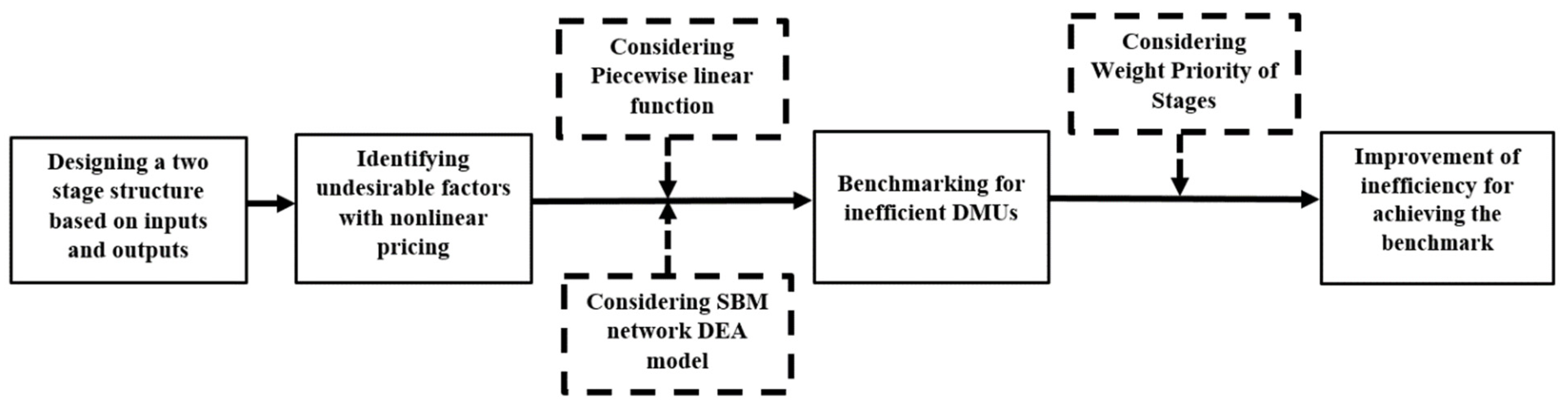
According to Figure 2, the first stage of the proposed method designs a two-stage structure that suits the input and output variables. The undesirable outputs were then identified, and because the values of the various undesirable outputs vary, this important point must be considered in modeling to provide reliable results to decision-makers. Therefore, the new Slack-Based Network DEA (SBM-NDEA) will be proposed, with non-linear valuing for undesirable outputs modeled using piecewise linear techniques.
Following the solution of the model, suitable benchmarks for inefficient DMUs (Decision-Making Units) are proposed. A theory is then presented to obtain the weighted priority of each stage in the network structure of inefficient DMUs. The proposed model will provide decision-makers with more supplemental information to help them devise strategies for improving the efficiency of inefficient DMUs.

3.1. Two-Stage Network Structure

For a better understanding of the proposed method, we consider information from the 17 airports in Spain. We determine the inputs, desirable outputs, and undesirable outputs for each stage [50]. In this study, the two-stage structure is defined based on the operational process perspective of airport systems, as commonly adopted in the airport performance evaluation literature using Network DEA. Rather than employing a data-driven or adaptive segmentation of DMUs, the stage division reflects the internal operational mechanism and the sequential nature of airport service production. Accordingly, the airport is modeled as a network of interconnected operational stages, where each stage represents a distinct part of the airport operational process. This process-oriented decomposition is consistent with the established airport NDEA framework and enables a more realistic assessment of performance by capturing the internal structure of airport operations instead of treating airports as black-box units.
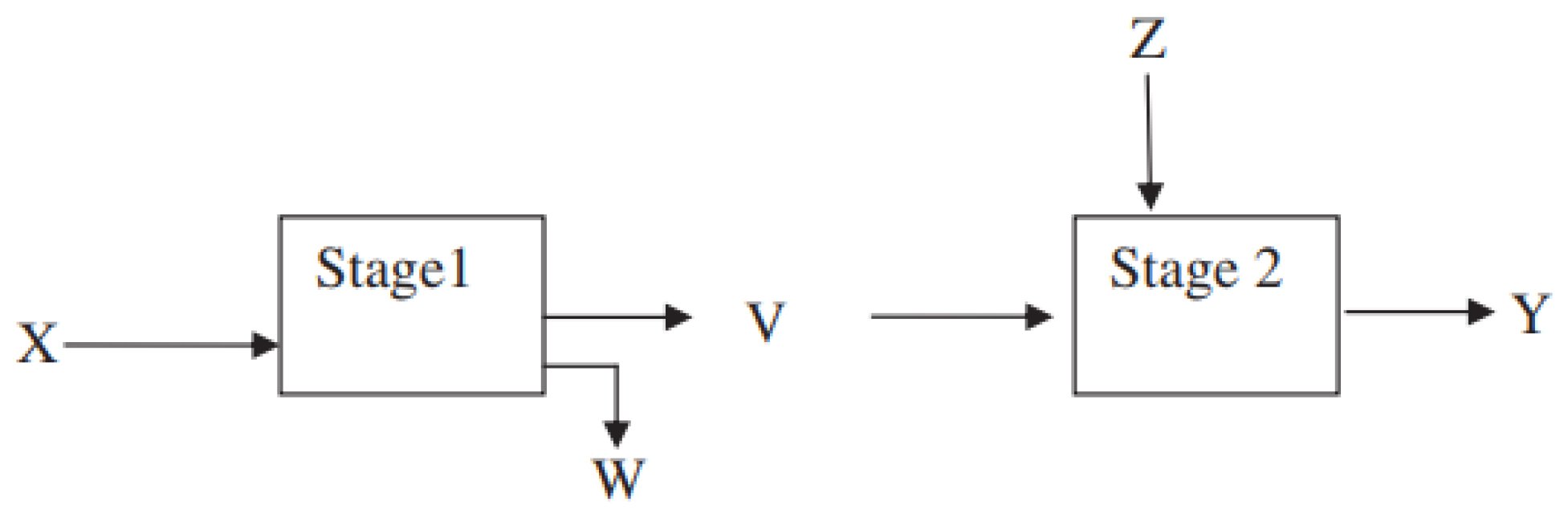
The two-stage network structure includes 17 homogeneous DMUs, all of which consist of two stages and have similar internal structures and internal relations, as shown in Figure 3. The first stage is primarily concerned with operational efficiency, while the second stage involves further processing or other activities that contribute to the overall performance of the airports. The two-stage structure adopted in this study is based on a process-oriented representation of the operational system and is consistent with the established Network DEA literature. This structural specification is also intentionally aligned with prior studies to ensure comparability of results and to enable a clearer evaluation of the methodological contribution of the proposed piecewise linear SBM-NDEA framework. It should be noted that the proposed model is formulated within a general network DEA setting and is not inherently restricted to a two-stage system. The two-stage configuration is used as an application-oriented empirical design for interpretability and consistency with the literature, while the framework can be extended to multi-stage and more complex network structures through appropriate redefinition of stages and internal linkages.
In this structure, inputs are used in the first stage to generate desirable outputs. Undesirable outputs are also tracked at both stages to assess the inefficiency of each DMU. The outputs from the first stage become inputs for the second stage, forming a two-stage process that allows for a more granular evaluation of the airports’ operational and service efficiencies.
Assume that there are n DMUj; j = 1,…,n. According to Figure 3, X = { x 1 , , x i } , i = 1 , , m is set of inputs consumed by Stage 1, whereas V = { v 1 , , v l } , l = 1 , , q is a set of intermediate products consumed by Stage 2 and produced by Stage 1. Furthermore, W = { w 1 , , w p } , p = 1 , , t is set of undesirable outputs produced by Stage 1, whereas Z = { z 1 , , z h } , h = 1 , , f is a set of inputs consumed by Stage 2, and Y = { y 1 , , y r } , r = 1 , , c is set of desirable outputs produced by Stage 2.

3.2. Model Formulation

In this section, the efficiency of network structure systems with undesirable outputs is modeled. For this purpose, the new SBM model is presented by considering the non-linear behavior of undesirable factors and using the linear piecewise function. This approach allows for more accurate modeling of the inefficiencies, as it accounts for the non-linear effects of certain input and output variables, especially the undesirable ones.
The proposed model involves the integration of a piecewise linear function to capture the non-linearities of the undesirable outputs, which are typically subject to diminishing returns or other non-linear relationships. This allows for a more refined assessment of the efficiency of each DMU in the network.
From a modeling perspective, the piecewise linear specification of undesirable outputs is designed to capture nonlinear penalty structures and to avoid excessive distortion of the efficiency frontier caused by extreme undesirable observations. In DEA-based airport performance analysis, very large delay values may disproportionately influence the frontier and reduce discrimination among decision-making units. By assigning segment-wise marginal weights, the proposed approach enhances robustness, stability, and discriminatory power while maintaining consistency with the operational characteristics of multi-stage airport systems.
Once the model is solved, the results will be used to establish practical benchmarks for the inefficient DMUs. These benchmarks will provide a clear reference for decision-makers to identify the target performance levels and set achievable goals for improvement. Additionally, the priority of each stage in the process will be considered to help devise targeted strategies for performance enhancement. The benchmarking process will guide the identification of areas where resources or efforts should be allocated to achieve the most significant improvements in efficiency.
The proposed methodology not only evaluates the efficiency of each stage within the network but also considers the relative importance of each stage, providing decision-makers with a comprehensive strategy for optimizing the entire system. This model aims to provide a more nuanced and accurate approach to improving the performance of inefficient DMUs in network structures, especially in the presence of undesirable outputs.

3.2.1. Benchmarking Based on SBM-NDEA

If W = { w 1 , , w p } when p = 1 , , t is the pth w with a nonlinear value, it is defined as follows:
W p j K = L k i f   k = 1 L k L k 1 i f   k = 2 , , K j 1 W p j L k 1 i f   k = K j 0 i f   k > K j
w ¯ p j k = 0 , i f   k = 1 0 , i f   k = 2 , , K j 1 L k w p j i f   k = k j L k L k 1 i f   k > k j
As a result, the problem modeling will be as follows, considering the nonlinear value of undesirable variables:
  min 1 A { [ 1 1 m i = 1 m ( S i x i o ) ] + [ 1 1 f h = 1 f ( S h z h o ) ] + [ 1 1 q l = 1 q ( S l v l o ) ] } A = n u m b e r   o f   s t a g e s   S . t       j = 1 n λ j x x i j + S i = x i o i = 1 , , m ,   j = 1 n λ j v v l j + S l = v l o l = 1 , , q ,   j = 1 n λ j v v l j S l + = v l o l = 1 , , q ,   j = 1 n λ j w w p j k S p + k = w p o k p = 1 , , t , k = 1 , , K ,   j = 1 n λ j z z h j + S h = z h o h = 1 , , f , j = 1 n λ j y y r j S r + = y r o r = 1 , , s   S p + k w ¯ p o k ( 1 μ k 1 ) , k = 1 , , K p ( a ) μ k ( w ¯ p o k S p + k ) . M , k = 1 , , K p ( b ) ( w ¯ p o k S p + k ) μ k . M , k = 1 , , K p ( c ) v { 0 , 1 } , j = 1 , , n S i , S l , S l + , S h , S r + , S p + k 0 λ j x , λ j v , λ j w , λ j z , λ j y 0
  max 1 A { [ 1 1 q l = 1 q ( S l + v l o ) ] + [ 1 1 t p = 1 t ( S p + k w p o ) ] + [ 1 1 c r = 1 c ( S r + y r o ) ] } A = n u m b e r   o f   s t a g e s   S . t       j = 1 n λ j x x i j + S i = x i o i = 1 , , m ,   j = 1 n λ j v v l j + S l = v l o l = 1 , , q ,   j = 1 n λ j v v l j S l + = v l o l = 1 , , q ,   j = 1 n λ j w w p j k S p + k = w p o k p = 1 , , t , k = 1 , , K ,   j = 1 n λ j z z h j + S h = z h o h = 1 , , f ,   j = 1 n λ j y y r j S r + = y r o r = 1 , , s   S p + k w ¯ p o k ( 1 μ k 1 ) , k = 1 , , K p ( a ) μ k ( w ¯ p o k S p + k ) . M , k = 1 , , K p ( b ) ( w ¯ p o k S p + k ) μ k . M , k = 1 , , K p ( c ) v { 0 , 1 } , j = 1 , , n S i , S l , S l + , S h , S r + , S p + k 0     λ j x , λ j v , λ j w , λ j z , λ j y 0
Using the obtained λ j for each inefficient DMU, benchmarks can be introduced for each of them. In other words, when the λ j pertaining to each inefficient DMU is greater than zero, the DMUj can be considered as a benchmark and use the obtained benchmark and optimal slacks obtained from the models (6) and (7) to improve the efficiency of the inefficient DMUs. The slacks in the objective function represent the distances of the DMU under evaluation from the efficient frontier. As a result, if the above models are solved, the optimal value of the objective function for the DMU under evaluation will be zero, indicating that DMU is on the efficient frontier and thus efficient. Furthermore, if the objective function value is positive, it means that at least one of the slacks is non-zero. As a result, the DMU under evaluation is far from the efficiency frontier, implying that it is inefficient; therefore, improvements equal to the number of slacks in the respective factors must be implemented to achieve an efficient DMU. As a result, it is possible to determine which DMUs are efficient and which are inefficient. In the above models, s i and s r + are the surplus input variable and shortfall output variable. Furthermore, the priorities of stages related to DMUs under evaluation will be introduced to analyze the effect of each stage on unit efficiency evaluation. The following theory is used for this purpose:

3.2.2. Stage Priority Analysis

Theorem. Let efficiencies [ e j , e j + ] be the lower and upper intervals of the efficiencies for DMUs. Assume the λ P , ( 1 λ P ) P = 1 , 2 represents the priority degree assigned to the lower and upper bounds, respectively. Thus, we have the following: λ 1 e j + ( 1 λ 1 ) e j + , λ 2 e j + ( 1 λ 2 ) e j + are unique stage efficiencies for the first and second stages under this scenario.
Therefore, the above theory can be adopted to determine which stage has the greatest effect on the efficiency score obtained from the proposed models for each DMU.

4. Empirical Results and Discussions

After modeling the proposed framework, this section evaluates the efficiency of 17 airports in Spain. All these airports feature a two-stage structure and exhibit similar internal configurations and relationships, as illustrated in Figure 3. Upon identifying the efficient and inefficient DMUs, appropriate benchmarks will be suggested for the DMUs under assessment. The dataset for the airports is sourced from [10].
The key performance indicators are as follows:
Stage 1 Input Variables: Total runway area (x1), apron capacity (x2), and number of boarding gates (x3).
Stage 2 Independent Inputs: Number of baggage belts (z1) and number of check-in counters (z2).
Undesirable Outputs of Stage 1: Number of delayed flights (w1) and accumulated flight delays (w2).
Desirable Intermediate Outputs Exiting Stage 1 and Entering Stage 2: Aircraft traffic movement (v1).
Final Desirable Outputs of Stage 2: Annual passenger movement (y1) and cargo landed (y2).
Table 1 presents the data for the input, intermediate, and output variables of the airports. Although airports differ in operational scale, they are treated as homogeneous DMUs because they perform comparable functions within a unified operational framework. The SBM-based formulation partially controls for scale heterogeneity. Using the indicators provided in Table 1, the efficiency of the airports was assessed by applying the modeling process outlined in the previous section. The data was processed through the proposed model. To facilitate a comparison with other methods in this field, the same dataset was also analyzed using two additional models. These models are Cooperative and Relational, as classified by Chiang Kao in 2018 [51]. The results obtained from GAMS 50.5.0 software are presented in Table 2.
According to the second column of Table 2, DMU 3, DMU 6, DMU 8, DMU 9, DMU 11, DMU 13, DMU 15, and DMU 16 were identified as inefficient units. To analyze the cause of inefficiency, the efficiency of each stage should be assessed separately, and suitable benchmarks should be developed for each of these DMUs. Therefore, the model was executed for each stage of DMU3. The results showed that DMU3’s inefficiency was due to Stage 2. Additionally, the results of running the model on DMU6 indicated that none of the stages of DMU6 were efficient, with efficiency values below 1. The details of the efficiency for each stage of the other inefficient DMUs are also provided in Table 3.
According to Table 3, the results showed that the efficiency of DMU3 was less than one due to Stage 2. Moreover, the results of running the model on DMU6 revealed that none of the stages of DMU6 were efficient, and their efficiency scores were all below 1. The same applies to the other DMUs.
The proposed method is used to present benchmarks for improving the efficiency of inefficient DMUs, as shown in Table 4. Since the sum of the slack variable values resulting from models (6) and (7) for inefficient DMUs was not zero, a benchmark must be introduced for each of them to improve their efficiency. Therefore, the appropriate benchmarks for the inefficient DMUs are presented here.
Table 4 shows that the obtained non-zero λ slack values can be used to select an appropriate benchmark for each inefficient DMU. In other words, the non-zero λ slack values corresponding to each efficient DMU were selected as benchmarks for the inefficient DMUs. For instance, for DMU3, non-zero λ 1 and λ 9 slack values for variables were obtained. Therefore, the DMUs corresponding to those λ slack values, such as DMU1 and DMU7, can be introduced as benchmarks to improve and modify the efficiency of DMU3.
Table 5 presents the required performance adjustments for inefficient DMUs to reach the efficient frontier under the proposed SBM-NDEA framework. It should be noted that the reported values represent adjustment magnitudes for each variable rather than absolute target levels. Specifically, the values associated with inputs and undesirable outputs indicate the necessary reductions to achieve efficiency, whereas the values for desirable outputs represent the required increases. For the intermediate variable, a zero value implies that the internal linkage performance is already consistent with the proposed benchmarking structure, while non-zero values indicate the need for internal alignment within the network system.
The results indicate that, for DMU3, the first undesirable output (w1) needs to be reduced by three units, while the first desirable output (y1) should be increased by 58.77 units to reach the efficient frontier. Additionally, DMU6 requires adjustments in the first input (x1) and third input (x3) levels to align with the efficient frontier, together with a reduction of 1270 units in the first undesirable output (w1). Furthermore, DMU6 needs to increase the first and second desirable outputs (y1 and y2) by 5564.763 and 29,766.861 units, respectively, to become efficient.
In addition to improving the efficiency of the evaluated DMUs through appropriate adjustments in inputs, desirable outputs, and undesirable outputs, it is necessary to determine the priority of correction in the efficiency score of each stage. This allows managers and decision-makers to plan in order of priorities and optimize the costs associated with system improvement. Since the inefficiency of DMU3 is solely due to the inefficiency of Stage 2, the respective managers should focus on improving the efficiency of Stage 2. However, the inefficiency of DMU6 arises from both Stage 1 and Stage 2, prompting the question of which stage has a higher priority for efficiency improvement. Therefore, the proposed model will be employed to prioritize the stages of DMU6 for efficiency improvement.
From a managerial perspective, the results indicate that inefficiency in several Spanish airports is primarily associated with service-stage operations rather than infrastructure capacity. This implies that managerial efforts should prioritize service-process optimization, such as baggage handling efficiency, passenger flow management, and delay mitigation, rather than physical expansion alone. Therefore, the proposed model not only identifies inefficient units but also provides actionable guidance for operational decision-making. Similarly, other DMUs such as DMU8, DMU9, and DMU15 have also been prioritized.
To analyze the effect of each stage on the efficiency of DMU6, changes in λ from 0 to 1 should be calculated in 0.1 intervals, as shown in Table 6. As the value of λ increases, the efficiency of Stage 2 improves, since the degree of priority assigned to Stage 2 is determined by λ. Under these conditions, the proposed model will be able to respond to the degree of external priority assigned to each stage. Consequently, the efficiency of each stage will be uniquely determined.
The single-country dataset was selected to ensure institutional and operational homogeneity, allowing the pure effect of the SBM-NDEA framework on efficiency to be examined. The proposed model has a general structure and can be extended to multi-country datasets and multi-stage systems. Cross-country generalization can be achieved in future studies through the inclusion of regional control variables, clustering of operational environments, or the use of international datasets, without compromising the structure of the proposed model

5. Conclusions

As managers and decision-makers seek ways to enhance the performance of their organizations, comprehensive information regarding the efficiency of firms is crucial. Undesirable output is one of the factors that negatively affect a company’s efficiency. Therefore, managers aim to calculate efficiency while considering these undesirable factors. Additionally, identifying efficient DMUs and using them as benchmarks for inefficient DMUs is essential. This study proposes the SBM Network DEA model to assess the performance of airports with a two-stage structure while accounting for undesirable outputs. A linear value may not adequately reflect the differences in values obtained from one DMU to another. Hence, this paper proposes a new NDEA model based on a piecewise linear function that evaluates the efficiency of DMUs while considering the effects of undesirable outputs and distinguishing the valuation of different levels of undesirable outputs produced by various DMUs. In other words, the piecewise linear theory was applied to assign lower values to higher quantities of undesirable outputs, thereby distinguishing DMUs that produced fewer undesirable outputs from those that produced more. Furthermore, this paper provides practical benchmarking for inefficient DMUs to enhance their performance, considering the priority of each stage in optimizing the production process. The proposed model was applied to improve airport efficiency, and, by solving the model, appropriate benchmarks for inefficient DMUs were established. The proposed piecewise linear framework does not imply tolerance toward high levels of undesirable outputs such as delays. Instead, it is intended to provide a more realistic and robust efficiency assessment by capturing the nonlinear marginal impact of excessive undesirable outputs in complex airport operations. This study is limited to using a single empirical dataset and a two-stage structure. Future research may extend the proposed framework to multi-stage systems and validate the model using data from other sectors such as logistics, healthcare, or energy systems.

Author Contributions

Conceptualization, N.R.; methodology, N.R. and W.A.; validation, W.A.; formal analysis, Z.M.; investigation, N.R., Z.M. and W.A.; resources, S.Z.; data curation, Z.M.; writing—original draft, N.R.; writing—review & editing, S.Z. and W.A.; visualization, S.Z.; supervision, Z.M. and W.A. All authors have read and agreed to the published version of the manuscript.

Funding

This research received no external funding.

Data Availability Statement

The original contributions presented in the study are included in the article; further inquiries can be directed to the corresponding author.

Conflicts of Interest

The authors declare no conflict of interest.

References

  1. Yang, H.H. Measuring the efficiencies of Asia–Pacific international airports: Parametric and non-parametric evidence. Comput. Ind. Eng. 2010, 59, 697–702. [Google Scholar] [CrossRef]
  2. Farrell, M.J. The measurement of productive efficiency. J. R. Stat. Soc. Ser. A 1957, 120, 253–290. [Google Scholar] [CrossRef]
  3. Banker, R.D.; Charnes, A.; Cooper, W.W. Some models for estimating technical and scale inefficiencies in data envelopment analysis. Manag. Sci. 1984, 30, 1078–1092. [Google Scholar] [CrossRef]
  4. Charnes, A.; Cooper, W.W.; Rhodes, E. Measuring the efficiency of decision-making units. Eur. J. Oper. Res. 1978, 2, 429–444. [Google Scholar] [CrossRef]
  5. Kao, C. Network data envelopment analysis: A review. Eur. J. Oper. Res. 2014, 239, 1–16. [Google Scholar] [CrossRef]
  6. Afonso, G.P.; Ferreira, D.C.; Figueira, J.R. A network-DEA model to evaluate the impact of quality and access on hospital performance. Ann. Oper. Res. 2024, 342, 2169–2199. [Google Scholar] [CrossRef]
  7. Ratner, S.V.; Shaposhnikov, A.M.; Lychev, A.V. Network DEA and its applications (2017–2022): A systematic literature review. Mathematics 2023, 11, 2141. [Google Scholar] [CrossRef]
  8. Yang, R.; Zhu, Z.; Li, L.; Wang, Y.; Zhuang, Y. China’s environmental governance efficiency evaluation based on novel cross-efficiency network DEA model. Sci. Rep. 2025, 15, 32800. [Google Scholar] [CrossRef] [PubMed]
  9. Lozano, S.; Gutiérrez, E.; Moreno, P. Network DEA approach to airports performance assessment considering undesirable outputs. Appl. Math. Model. 2013, 37, 1665–1676. [Google Scholar] [CrossRef]
  10. Maghbouli, M.; Amirteimoori, A.; Kordrostami, S. Two-stage network structures with undesirable outputs: A DEA-based approach. Measurement 2014, 48, 109–118. [Google Scholar] [CrossRef]
  11. Chu, Y.C.; Yu, J.; Huang, Y.B. Measuring airport production efficiency based on two-stage correlative DEA. In Proceedings of the IEEE 17th International Conference on Industrial Engineering and Engineering Management, Xiamen, China, 29–31 October 2010. [Google Scholar]
  12. Wanke, P.F. Physical infrastructure and flight consolidation efficiency drivers in Brazilian airports: A two-stage network DEA approach. J. Air Transp. Manag. 2013, 31, 1–5. [Google Scholar] [CrossRef]
  13. Amirteimoori, A. Efficiency analysis in two-stage data envelopment analysis with shared resources and undesirable outputs: An application in the banking sector. Int. Trans. Oper. Res. 2024, 32, 2453–2473. [Google Scholar] [CrossRef]
  14. Lai, P.L.; Potter, A.; Beynon, M.; Beresford, A. Evaluating the efficiency performance of airports using an integrated AHP/DEA-AR technique. Transp. Policy 2015, 42, 75–85. [Google Scholar] [CrossRef]
  15. Nagy, G. Performance measurement and quality assurance in higher education: Application of DEA, AHP, and Bayesian models. Trends High. Educ. 2025, 4, 54. [Google Scholar] [CrossRef]
  16. Keskin, B.; Köksal, C.D. A hybrid AHP/DEA-AR model for measuring and comparing the efficiency of airports. Int. J. Product. Perform. Manag. 2019, 68, 524–541. [Google Scholar] [CrossRef]
  17. Olfat, L.; Amiri, M.; Soufi, J.B.; Pishdar, M. A dynamic network efficiency measurement of airports performance considering sustainable development concept: A fuzzy dynamic network DEA approach. J. Air Transp. Manag. 2016, 57, 272–290. [Google Scholar] [CrossRef]
  18. Pacagnella Junior, A.C.; Hollaender, P.S.; Mazzanati, G.V.; Bortoletto, W.W. Infrastructure and flight consolidation efficiency of public and private Brazilian international airports: A two-stage DEA and Malmquist index approach. J. Adv. Transp. 2020, 2020, 8872314. [Google Scholar] [CrossRef]
  19. Pacagnella, A.; Hollaender, P.S.; Mazzanati, G.V.; Bortoletto, W.W. Efficiency drivers of international airports: A worldwide benchmarking study. J. Air Transp. Manag. 2021, 90, 101941. [Google Scholar] [CrossRef]
  20. Roudabr, N.; Najafi, S.E.; Moghaddas, Z.; Movahedi Sobhani, F. Overall efficiency of four-stage structure with undesirable outputs: A new SBM network DEA model. Complexity 2022, 2022, 4876231. [Google Scholar] [CrossRef]
  21. Cook, W.D.; Zhu, J. Piecewise linear output measures in DEA (third revision). Eur. J. Oper. Res. 2009, 197, 312–319. [Google Scholar] [CrossRef]
  22. Kao, C. Efficiency decomposition in network data envelopment analysis: A relational model. Eur. J. Oper. Res. 2009, 192, 949–962. [Google Scholar] [CrossRef]
  23. Kao, C. Efficiency measurement for parallel production systems. Eur. J. Oper. Res. 2009, 196, 1107–1112. [Google Scholar] [CrossRef]
  24. Tone, K. A slacks-based measure of efficiency in data envelopment analysis. Eur. J. Oper. Res. 2001, 130, 498–509. [Google Scholar] [CrossRef]
  25. He, J.; Lau, W.-Y.; Ng, K.-H. A machine learning–enhanced three-stage SBM-DEA model with undesirable outputs for measuring green total factor productivity on a global scale. Financ. Res. Lett. 2025, 86, 108611. [Google Scholar] [CrossRef]
  26. Yu, M.M. Performance assessment of transport services with the ERM-NDEA model: Evidence from a domestic airline in Taiwan. Transp. Plan. Technol. 2012, 35, 697–714. [Google Scholar] [CrossRef]
  27. Cook, W.D.; Liang, L.; Zhu, J. Measuring performance of two-stage network structures by DEA: A review and future perspective. Omega 2010, 38, 423–430. [Google Scholar] [CrossRef]
  28. Tone, K.; Tsutsui, M. Network DEA: A slacks-based measure approach. Eur. J. Oper. Res. 2009, 197, 243–252. [Google Scholar] [CrossRef]
  29. Tone, K.; Tsutsui, M. Dynamic DEA with network structure: A slacks-based measure approach. Omega 2014, 42, 124–131. [Google Scholar] [CrossRef]
  30. Lozano, S.; Adenso-Díaz, B. Increasing sustainability of logistic networks by reducing product losses: A network DEA approach. Math. Probl. Eng. 2018, 2018, 2158723. [Google Scholar] [CrossRef]
  31. Gharakhani, D.; Toloie Eshlaghy, A.; Fathi Hafshejani, K.; Kiani Mavi, R.; Hosseinzadeh Lotfi, F. Common weights in dynamic network DEA with goal programming approach for performance assessment of insurance companies in Iran. Manag. Res. Rev. 2018, 41, 920–938. [Google Scholar] [CrossRef]
  32. Lozano, S.; Adenso-Díaz, B. Network DEA-based biobjective optimization of product flows in a supply chain. Ann. Oper. Res. 2018, 264, 307–323. [Google Scholar] [CrossRef]
  33. Akbarian, D. Network DEA based on DEA-ratio. Financ. Innov. 2021, 7, 73. [Google Scholar] [CrossRef]
  34. Chao, S.L.; Yu, M.M.; Hsieh, W.F. Evaluating the efficiency of major container shipping companies: A framework of dynamic network DEA with shared inputs. Transp. Res. Part A 2018, 117, 44–57. [Google Scholar] [CrossRef]
  35. Yousefi, S.; Soltani, R.; Saen, R.F.; Pishvaee, M.S. A robust fuzzy possibilistic programming for a new network GP-DEA model to evaluate sustainable supply chains. J. Clean. Prod. 2017, 166, 537–549. [Google Scholar] [CrossRef]
  36. Yang, T.; Wang, P.; Li, F. Centralized resource allocation and target setting based on data envelopment analysis model. Math. Probl. Eng. 2018, 2018, 5834872. [Google Scholar] [CrossRef]
  37. Badiezadeh, T.; Saen, R.F.; Samavati, T. Assessing sustainability of supply chains by double frontier network DEA: A big data approach. Comput. Oper. Res. 2018, 98, 284–290. [Google Scholar] [CrossRef]
  38. Su, Y.; Sun, W. Sustainability evaluation of the supply chain with undesired outputs and dual-role factors based on double frontier network DEA. Soft Comput. 2018, 22, 5525–5533. [Google Scholar] [CrossRef]
  39. Kao, C. Network Data Envelopment Analysis; Springer: New York, NY, USA, 2017; pp. 1–16. [Google Scholar]
  40. Guo, C.; Shureshjani, R.A.; Foroughi, A.A.; Zhu, J. Decomposition weights and overall efficiency in two-stage additive network DEA. Eur. J. Oper. Res. 2017, 257, 896–906. [Google Scholar] [CrossRef]
  41. Li, H.; Chen, C.; Cook, W.D.; Zhang, J.; Zhu, J. Two-stage network DEA: Who is the leader? Omega 2018, 74, 15–19. [Google Scholar] [CrossRef]
  42. Seth, H.; Deepak, D.; Ruparel, N.; Chadha, S.; Agarwal, S. Assessment of working capital management efficiency: A two-stage slack-based measure of data envelopment analysis. Manag. Financ. 2024, 50, 1344–1365. [Google Scholar] [CrossRef]
  43. Färe, R.; Grosskopf, S. Network DEA. Socio-Econ. Plan. Sci. 2000, 34, 35–49. [Google Scholar] [CrossRef]
  44. Cook, W.D.; Yang, F.; Zhu, J. Nonlinear inputs and diminishing marginal value in DEA. J. Oper. Res. Soc. 2009, 60, 1567–1574. [Google Scholar] [CrossRef]
  45. Lotfi, F.H.; Rostamy-Malkhalifeh, M.; Moghaddas, Z. Modified piecewise linear DEA model. Eur. J. Oper. Res. 2010, 205, 729–733. [Google Scholar] [CrossRef]
  46. Moghaddas, Z.; Vaez-Ghasemi, M.; Hosseinzadeh Lotfi, F. A novel DEA approach for evaluating sustainable supply chains with undesirable factors. Econ. Comput. Econ. Cybern. Stud. Res. 2021, 55, 177–192. [Google Scholar] [CrossRef]
  47. Despotis, D.K.; Stamati, L.V.; Smirlis, Y.G. Data envelopment analysis with nonlinear virtual inputs and outputs. Eur. J. Oper. Res. 2010, 202, 604–613. [Google Scholar] [CrossRef]
  48. Despotis, D.K.; Sotiros, D. Value-based data envelopment analysis: A piecewise linear programming approach. Int. J. Multicriteria Decis. Mak. 2014, 4, 47–68. [Google Scholar] [CrossRef]
  49. Ji, A.B.; Ji, Y.; Qiao, Y. DEA-based piecewise linear discriminant analysis. Comput. Econ. 2018, 51, 809–820. [Google Scholar] [CrossRef]
  50. Güner, S.; Antunes, J.J.M.; Codal, K.S.; Wanke, P. Network centrality driven airport efficiency: A weight-restricted network DEA. J. Air Transp. Manag. 2024, 116, 102551. [Google Scholar] [CrossRef]
  51. Kao, C. A classification of slacks-based efficiency measures in network data envelopment analysis with an analysis of the properties possessed. Eur. J. Oper. Res. 2018, 270, 1109–1121. [Google Scholar] [CrossRef]
Figure 1. A two-stage series network of a production process.
Mathematics 14 00811 g001
Figure 2. Steps of methodology for target setting.
Mathematics 14 00811 g002
Figure 3. A two-stage structure of Airports operational service.
Mathematics 14 00811 g003
Table 1. Data set for Spanish airports [10].
Airportsx1x2x3v1w1w2z1z2y1y2
Badajoz171,000124.0331372365.44181.0100
Barcelona475,00012165321.69333,036645,924.61431930,272.084103,996.489
Cordoba62,1002319.60414254.41022.2300
El Hierro37,500324.77527641.651195.425171.717
Gran Canaria139,5005538116.2527463136,380.7861910,212.12333,695.248
Ibiza126,000251257.2336193152,840.14884647.3603928.387
Jerez103,5009550.551117419,292.21331303.81790.428
La Gomera45,000323.39317420.75141.8907.863
La Palma99,0005520.1094238286.01321151.3571277.264
Madrid Barajas927,000263230469.74652,526908,360.04845350,846.494329,186.631
Malaga144,0004330119.82115,548277,663.8851612,813.4724800.271
Melilla64,2605210.9592182979.641314.643386.340
Pamplona99,3157212.97166611,691.841434.47752.942
Reus110,4755526.67694318,240.8831278.074119.848
Salamanca150,0006212.4504276626.14260.1030
Tenerife North153,000161667.800178332,637.03754236.61520,781.674
Valencia144,000351896.7954998102,719.24285779.34313,325.799
Table 2. Comparison of the efficiency scores from the proposed model with other approaches.
DMUEfficiency Scores
Proposed ModelCooperative ModelRelational Model
1111
2111
30.7210.8200.869
4111
5111
60.5750.7430.890
7111
80.8240.9780.996
90.96111
10111
110.93011
12111
130.8540.9011
14111
150.8970.9211
160.91111
17111
Table 3. Efficiency measurement of each stage for inefficient DMUs.
DMUetotale1e2
30.72110.596
60.5750.6670.484
80.8240.9990.752
90.9610.8020.999
110.93010.879
130.8540.6411
150.8970.9100.766
160.91110.988
Table 4. The benchmarks obtained for inefficient DMUs.
DMU λ * > 0 The Benchmarks
3 λ 1 , λ 7 > 0 DMU1, DMU7
6 λ 1 , λ 7 , λ 10 > 0 DMU1, DMU7, DMU10
8 λ 1 , λ 2 , λ 14 > 0 DMU1, DMU2, DMU14
9 λ 2 , λ 7 , λ 12 > 0 DMU2, DMU7, DMU12
11 λ 5 , λ 7 , λ 17 > 0 DMU5, DMU7, DMU17
13 λ 7 , λ 12 , λ 17 > 0 DMU7, DMU12, DMU17
15 λ 1 , λ 10 , λ 12 > 0 DMU1, DMU10, DMU12
16 λ 7 , λ 14 , λ 17 > 0 DMU7, DMU14, DMU17
Table 5. Required performance adjustments of inefficient DMUs to reach the efficient benchmark.
DMUx1x2x3v1w1w2z1z2y1y2
30000300058.770
613.500026012700005564.76329,766.861
881,42683.4617.9339208212781481
967,4225.482.28132683853.3651.16479.69365.15
11144,00033.2122603419.1762,88952.4910.428251.9918,311.92
1394,974.9410.184.3621.94497.537975.610.8401917.472418.8
1575,7806.642.9819.2419.816468.586.890856.61307.3
1666,125.175.27012.28250.423540.284.470403.19373.57
Table 6. Stage-level efficiency for DMU6 with specific priority.
DMU6λ = 0λ = 0.1λ = 0.2λ = 0.3λ = 0.4λ = 0.5
e1e2e1e2e1e2e1e2e1e2e1e2
0.6670.4840.64870.50230.63040.52060.61210.53890.59380.55720.57550.5755
λ = 0.6λ = 0.7λ = 0.8λ = 0.9λ = 1
e1e2e1e2e1e2e1e2e1e2
0.55720.59380.53890.61210.52060.63040.50230.64870.4840.667
Disclaimer/Publisher’s Note: The statements, opinions and data contained in all publications are solely those of the individual author(s) and contributor(s) and not of MDPI and/or the editor(s). MDPI and/or the editor(s) disclaim responsibility for any injury to people or property resulting from any ideas, methods, instructions or products referred to in the content.