Article

Adaptive Asymptotic Tracking Control of MIMO Nonlinear Systems Subject to Asymmetric Full-State Constraints: A Removing Feasibility Condition Approach


1
College of Marine Electrical Engineering, Dalian Maritime University, Dalian 116026, China
2
School of Control Science and Engineering, Dalian University of Technology, Dalian 116024, China
3
School of Information Engineering, Qingdao Institute of Technology, Jiaozhou 266399, China
*
Authors to whom correspondence should be addressed.
Mathematics 2026, 14(5), 806; https://doi.org/10.3390/math14050806
Submission received: 15 January 2026 / Revised: 6 February 2026 / Accepted: 10 February 2026 / Published: 27 February 2026

Abstract

This work develops an adaptive control scheme for MIMO nonlinear non-lower-triangular systems with asymmetric full-state constraints and unknown gain functions. First, in order to maintain the state constraints, a function that depends solely on the states of the system is proposed to replace the traditional Lyapunov barrier function that relies on the error signal. By means of an affine transformation, the original system is reconstructed to the current system that releases prior knowledge of the gain functions and removes the state constraints. Second, a coordinate transformation is introduced and integrated into each step of the adaptive control design procedure, which circumvents the feasibility condition for intermediate input signals. Under the developed control strategy, all system states are bounded and remain within constraint sets at any moment. Simultaneously, the output signals asymptotically track the reference trajectories to zero. Finally, the feasibility of the presented strategy is demonstrated based on simulation examples.

1. Introduction

In recent years, adaptive techniques under the backstepping framework have turned out to be a useful tool for handling uncertain nonlinear systems, and numerous improved schemes have been proposed in [1,2,3]. However, in the adaptive backstepping design procedure, it is commonly assumed that the nonlinearity is known or matches the linearity condition, which is difficult to satisfy in practical application. To overcome this challenge, neural networks (NNs) and fuzzy logic systems (FLSs) were employed to model the unknown nonlinearity, leading to numerous significant results [4,5,6,7,8,9]. In [4], an adaptive fuzzy design scheme was proposed for nonlinear lower-triangular systems subject to unknown nonlinearity and unmeasurable states. In [5], the adaptive control problem was studied for nonlinear lower-triangular systems with unknown time delay, demonstrating excellent tracking performance. Although adaptive backstepping control has been widely studied for nonlinear systems, its practical application is often confined to simplified strict-feedback structures. However, many real-world systems exhibit more complex non-strict-feedback forms, creating a gap between theoretical designs and engineering implementation. Thus, in [10], an adaptive fuzzy design scheme with the variable separation method has been developed to handle non-lower-triangular structures. Such a scheme has become a useful implementation for handling different angle control issues of nonlinear systems subject to non-lower-triangular structures [11]. However, the unknown dynamics in the above articles were assumed to be strictly monotonically increasing. In reality, this is a difficult assumption to satisfy all the time when the system takes into account both unknown parameters and unknown nonlinearities. To overcome this problem, an effective method in [12] was developed by applying the FLSs basis function property 0 < S i T · S i · < 1 . While adaptive intelligent approximation methods have made substantial progress in handling unknown nonlinearities and non-lower-triangular structures, they often overlook a more fundamental and safety-critical aspect of practical control: ensuring that system states remain within predefined safe bounds throughout operation.
Therefore, effectively addressing state constraints in practical engineering has become a prominent research focus. Typical examples include the physical spatial constraints on the trajectory of a robotic arm’s end-effector and the safety-critical constraints on concentration and temperature in dual-reactor systems, such as Continuous Stirred-Tank Reactors, in chemical processes. There are various strategies to deal with state constraints in the existing papers. For example, model predictive [13], reference governors [14], etc. But it is worth emphasizing that thanks to the excellent work of Ngo et al. [15], the barrier Lyapunov function (BLF) was developed as an effective way to address the problem where system variables are constrained. Then, several BLF-based control schemes have been proposed in [16,17,18] to unravel the output constraints or full-state constraints (FSC) problems, which can guarantee that all constrained states are kept in the specified range. In [19], a class of integral barrier Lyapunov functions (IBLF) were introduced to address the state-constraint problem from different perspectives, and the presented methods pledged boundedness of tracking error and that all states remained within constraint sets. However, a critical limitation of the aforementioned BLF/IBLF-based schemes is the prerequisite feasibility condition: extensive off-line calculations are required to select parameters that satisfy it. More critically, for systems requiring operation in a highly restricted region, such parameters may not even exist. Therefore, the cancellation of feasibility conditions for nonlinear systems subject to FSC is a challenging and non-trivial task. This challenge becomes even more pronounced when dealing with complex system structures, such as non-lower-triangular forms or MIMO nonlinear systems, where the coupling between states further complicates constraint handling.
In order to eliminate this feasibility condition, numerous researchers have focused on this problem with fruitful results. For example, in [20], for single-input single-output (SISO) nonlinear systems subject to inherent nonlinearity and unknown time-varying powers, the tracking control scheme without feasibility conditions was proposed, which can ensure good tracking performance and keep the states within the given ranges. In [21], a nonlinear state-dependent function (NSDF) was designed for nonlinear lower-triangular systems with FSC, which removed feasibility conditions imposed on the virtual controller. However, the results of [20,21] required that the unknown nonlinear function must satisfy the linear parameterization conditions. To surmount the aforementioned shortcomings, by combining NNs or FLSs with backstepping techniques, several adaptive intelligent control tactics without feasibility conditions were presented for diverse nonlinear systems with state constraints in [22,23,24]. Despite these advances, a notable limitation is that the existing feasibility condition-free schemes [22,23,24] are predominantly confined to SISO nonlinear systems, leaving the control of MIMO systems under similar constraints largely unexplored. The adaptive tracking control issue has been investigated in [25] for MIMO nonlinear systems subject to asymmetric FSC and uncertain nonlinear functions, which achieves bounded tracking control without violating state constraints. It is well known that asymptotic tracking performance has a potential for comprehensive development in practical engineering applications and is an ideal control target for practical system design. While asymptotic tracking for constrained nonlinear systems has been reported in [26,27], these methods still rely on satisfying stringent feasibility conditions through extensive parameter optimization and, more importantly, are not applicable to MIMO nonlinear systems with FSC.
Motivated by the aforementioned limitations, our work proposes an adaptive NNs asymptotic tracking control scheme for MIMO nonlinear non-lower-triangular systems subject to asymmetric FSC and unknown gain function. The main advantages of our manuscript are listed as follows:
(1) This work develops several adaptive NNs tracking controllers, which can achieve asymptotic tracking performance while guaranteeing the stability of the system. It should be noted that the existing state-constrained control schemes, such as those in [25,28], can only guarantee bounded tracking.
(2) By using an affine transformation based on NSDF, the original system is reconstructed into the current system that relaxes the requirement for prior knowledge of the gain functions and removes the state constraints, such that the issue of keeping the original state constraint is simplified to ensure that the current affine variable is bounded. Besides, by integrating the lower bound of the gain function with the Lyapunov function, the algebraic ring problem in the affine transformation scheme in reference [22] is effectively avoided. Compared with the approaches in [26,27], it provides a more straightforward solution to the state-constraint problem and arrests the conversion of the original state constraint to a fresh conservative condition.
(3) Although some results have been proposed in [23,24] for FSC nonlinear systems without feasibility conditions, these results mainly focused on SISO strict-feedback systems rather than MIMO non-strict-feedback systems, which were more suitable for practical system forms. In addition, in contrast to conventional methods [23,24] which introduce at least one adaptive parameter at each step, the proposed control scheme employs only two update laws throughout the entire n-step backstepping design process, which reduces the computational burden and simplifies parameter tuning.

2. Dynamic Models and Preliminaries

2.1. Dynamic Models

Consider the MIMO non-strict-feedback nonlinear system:
x ˙ i , j = g i , j x i x i , j + 1 + f i , j X , i = 1 , 2 , , m , j = 1 , 2 , , n i 1 , x ˙ i , n i = g i , n i x i u i + f i , n i X , y i = x i , 1 ,
where X = [ x 1 T , , x m T ] T R n 1 + + n m , x i = [ x i , 1 , , x i , n i ] T R n i are the state vectors. g i , j x i and f i , j X represent unknown smooth bounded nonlinear functions, where f i , j 0 = 0 .   y i R and u i R stand for system output and input.
The key aims of our work are to construct an adaptive NNs design strategy for System (1), which can ensure that: (a) the system outputs y i , i = 1 , 2 , , m follow the desired trajectories x d i , i = 1 , 2 , , m and the output tracking errors asymptotically converge to zero; (b) the FSC are not broken without relating feasibility conditions on the virtual control signals; and (c) all system variables are bounded.
Assumption 1.
The reference signals x d i , i = 1 , , m and their n i -order derivatives x d i n i are bounded and continuous. Besides, for i = 1 , , m , j = 1 , , n i , there are constants K ̲ i , 0 > 0 ,   K ¯ i , 0 > 0 , and K i , j > 0 that make the desired trajectories x d i satisfy x d i Ω d i : = { x d i R : K ̲ i , 1 < K ̲ i , 0 x d i K ¯ i , 0 < K ¯ i , 1 } and | x d i ( j ) |   K i , j .
Assumption 2.
Assume that the signs of the control gain functions g i , n i , i = 1 , 2 , , m are known and positive, and there is a constant g L such that 0 < g L g i , n i .
Lemma 1
([29]). Given ω 0 > 0 and ϑ R , we have
0 < | ϑ | ϑ tanh ( ϑ ω 0 ) k ω 0 ,
where k = 0.2785 .
Lemma 2
([30]). For any ( a , b ) R 2 , c > 0 , it holds that
a b c m m | a | m + 1 n c n | b | n ,
where m > 1 , n > 1 , and 1 m + 1 n = 1 .
Lemma 3
([31]). Assume z : [ 0 , ) R , lim t 0 t z 2 σ d σ < , if z ˙ ( t ) , t [ 0 , ) exists and is bounded, then we can get that lim t z t = 0 .
Remark 1.
The interconnected structure of System (1) serves as a generic representation for a broad class of MIMO nonlinear systems. In this framework, each subsystem corresponds to a control channel or key state variable, with the functions f i , j X explicitly capturing the coupling between them. Many practical systems, including robotic manipulators and chemical processes, can be cast into this form via suitable transformation, making (1) a widely applicable model for analysis and control synthesis.
Remark 2.
Assumption 1 is standard in the FSC works [23,25]. It ensures that the desired trajectories themselves lie within the prescribed output constraint ranges, and that their derivatives are bounded. Assumption 2 gives a common lower bound for the control gain functions in the last step of each subsystem. Crucially, in contrast to the works [20,21] which impose assumptions on all gain functions, the proposed approach requires no assumptions on the gain functions associated with the first n 1 steps of each subsystem. This relaxation significantly broadens the applicability of the control scheme.

2.2. Radial Basis Function Neural Networks (RBF NNs)

In the following, RBF NNs will be utilized to estimate the unknown nonlinearity J Z R :
J Z = W T S Z ,
where W R l indicates the weight vector, l > 1 represents the number of NNs nodes, Z Ω Z R q denotes the input vector, and S Z = [ S 1 Z , S 2 Z , , S l Z ] T stands for basis function vector, where S i Z is generally selected as Gaussian functions,
S i Z = exp Z o i T Z o i υ i 2 , i = 1 , 2 , , l ,
where o i = o i 1 , o i 2 , , o i q T denotes the center and υ i symbolizes the width.
For δ ¯ > 0 , W T S Z is utilized to estimate any continuous function J Z , in other words
J Z = W T S Z + δ Z , | δ Z | δ ¯ ,
where δ Z stands for the approximation error. W = [ W 1 , W 2 , , W l ] T is the desired weight vector, where W = arg min W R l { sup Z Ω Z | J ( Z ) W T S ( Z ) | } .
Lemma 4
([32]). Let S ζ ¯ q = [ S 1 ζ ¯ q , S 2 ζ ¯ q , , S q ζ ¯ q ] T denote the basis vector of NNs, where ζ ¯ q = ζ 1 , ζ 2 , , ζ q T is the input vector. Then, for any integers q > 0 and k > 0 satisfying q k , the following inequality holds:
S ζ ¯ q 2 S ζ ¯ k 2 .

3. Systems Transformation

3.1. Nonlinear State-Dependent Function

In order to directly handle asymmetric FSC problem, we introduce the nonlinear state-dependent function:
ξ i , j t = x i , j t K ̲ i , j + x i , j t K ¯ i , j x i , j t , i = 1 , , m , j = 1 , , n i ,
where K ̲ i , j and K ¯ i , j are positive constants such that
x i , j D i , j = { x i , j R : K ̲ i , j < x i , j t < K ¯ i , j } .
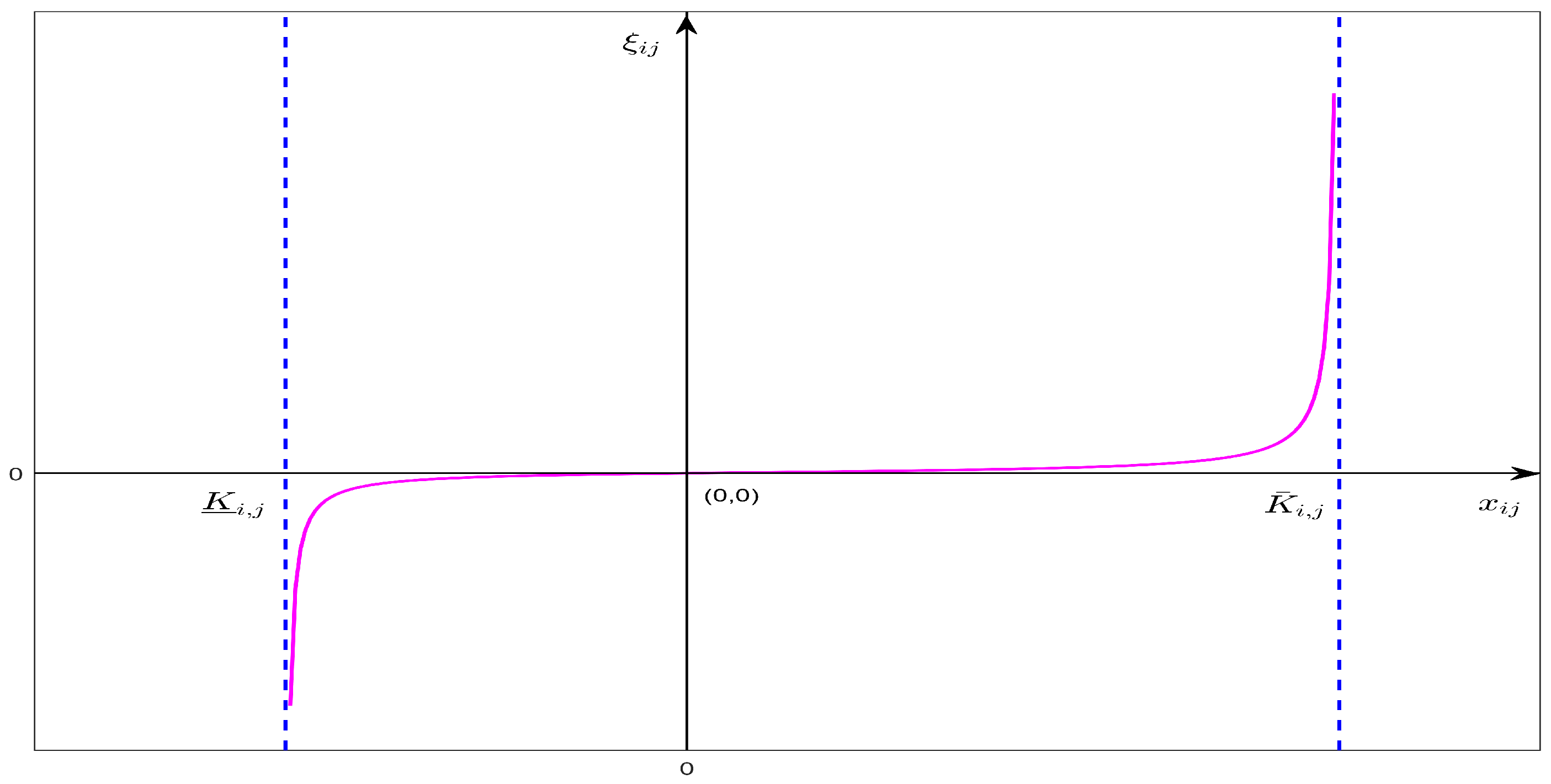
From (7) and (8), it is obvious that if x i , j approximates the boundary of D i , j ,   ξ i , j t tends to infinity. In other words, x i , j D i , j , ξ i , j ( t ) ± only when x i , j K ̲ i , j or x i , j K ¯ i , j as presented in Figure 1. Since ξ i , j t is completely dependent on x i , j t , x i , j t is strictly maintained within the boundary D i , j when ξ i , j t L . Therefore, the FSC problem is attributed to guaranteeing that ξ i , j t is bounded at all times.
Remark 3.
It is important to highlight that the NSDF offers a direct methodology for handling state constraints, in contrast to the indirect approaches adopted in references [33,34,35], where system states are constrained by imposing limits on error signals. Consequently, the proposed method not only eliminates the need for conservative conditions but also streamlines both the control procedure and the stability analysis.
Then, differentiating ξ i , j yields
ξ ˙ i , j = η i , j x ˙ i , j ,
where η i , j = K ̲ i , j K ¯ i , j + x i , j 2 K ̲ i , j + x i , j K ¯ i , j x i , j 2 are bounded and continuous for x i , j D i , j .

3.2. Affine Transformation

By considering (9), the System (1) is converted into
ξ ˙ i , j = η i , j g i , j x i x i , j + 1 + f i , j X , i = 1 , , m , j = 1 , , n i 1 , ξ ˙ i , n i = η i , n i g i , n i x i u i + η i , n i f i , n i X .
For (10), we construct the affine variable as
ξ ˙ i , j = ξ i , j + 1 + J i , j ξ , i = 1 , , m , j = 1 , , n i 1 , ξ ˙ i , n i = η i , n i g i , n i x i u i + η i , n i f i , n i X ,
where ξ = ξ 1 , ξ 2 , , ξ m T , ξ i = ξ i , 1 , , ξ i , n i T , and J i , j ξ = η i , j ( g i , j x i x i , j + 1 + f i , j X ) ξ i , j + 1 .
Remark 4.
By affine transformation, the System (1) is restructured into the System (11), in which the system states x i , j are converted to ξ i , j . Obviously, the System (11) gets rid of the feasibility conditions. Meanwhile, the FSC problem of guaranteeing the original system is reduced to ensuring that the current affine variables are bounded, and the prior knowledge of unknown gain function is also eliminated. In this work, we don’t need to assume that all gain functions have upper and lower bounds, 0 < g i ̲ g i ( · ) g ¯ i < , as in Reference [20], or have only lower bounds, 0 < g i ̲ g i ( · ) < , as in Reference [10], or are between two known functions, g i ̲ ( · ) g i ( · ) < g i ¯ ( · ) , as in Reference [21]. Our method only assumes that there is an upper bound on the gain function in the last step of each subsystem, which considerably releases the conservatism of the design method.

3.3. Main Results

For nonlinear systems with full-state constraints (FSC) that are not in lower-triangular form, control solutions based on BLF or IBF methods [33,34,36] invariably require the virtual controllers to satisfy the following feasibility condition:
K ̲ i , j < α i , j 1 < K ¯ i , j , i = 1 , , m , j = 1 , , n i .
Note that each virtual control signal α i , j 1 is constructed from system states and a set of design parameters. Consequently, prior to implementing such control schemes, extensive off-line computations must be performed to ensure that Condition (12) holds. More critically, when the system states are confined to a restricted region, suitable design parameters satisfying (12) may not even exist.
Subsequently, an adaptive NNs control method for nonlinear non-lower-triangular systems with asymmetric FSC will be designed, where the feasibility Condition (12) is no longer involved.
Firstly, define the variables as
ξ d i = x d i K ̲ i , 1 + x d i K ¯ i , 1 x d i , i = 1 , 2 , , m .
Differentiating ξ d i yields
ξ ˙ d i = η d i x ˙ d i ,
where η d i = K ̲ i , 1 K ¯ i , 1 + x d i 2 K ̲ i , 1 + x d i K ¯ i , 1 x d i 2 is continuous. For i = 1 , 2 , , m , j = 2 , , n i , the new coordinate transformations are introduced as
z i , 1 = ξ i , 1 ξ d i ,       z i , j = ξ i , j α i , j 1 ,
where α i , j 1 denote virtual control signals.
In order to simplify the design steps, the intermediate control laws α i , j 1 , actual control inputs u i and adaptive parameters W ^ ˙ 1 , W ^ ˙ 2 , δ ^ ˙ 1 , and δ ^ ˙ 2 are uniformly constructed as
α i , 1 = k i , 1 z i , 1 tanh ( z i , 1 ω ( t ) ) 1 2 ψ i , 1 S i , 1 Z i , 1 2 W ^ 1 , tanh ( z i , 1 ω ( t ) ) ψ i , 1 tanh ( z i , 1 ω ( t ) ) δ ¯ ^ 1 , i = 1 , 2 , , m ,
α i , j = k i , j z i , j tanh ( z i , j ω ( t ) ) 1 2 ψ i , j S i , j Z i , j 2 W ^ 1 z i , j 1 tanh ( z i , j ω ( t ) ) ψ i , j tanh ( z i , j ω ( t ) ) δ ¯ ^ 1 , i = 1 , , m , j = , 2 , , n i 1 ,
u i = k i , n i z i , n i tanh ( z i , n i ω ( t ) ) 1 2 ψ i , n i S i , n i Z i , n i 2 W ^ 2 tanh ( z i , n i ω ( t ) ) δ ¯ ^ 2 , i = 1 , 2 , , m ,
W ^ ˙ 1 = γ w 1 ( i = 1 m j = 1 n i 1 z i , j tanh ( z i , j ω ( t ) ) 1 2 ψ i , j S i , j Z i , j 2 ω ( t ) W ^ 1 ) , W ^ ˙ 2 = γ w 2 ( i = 1 m z i , n i tanh ( z i , n i ω ( t ) ) 1 2 ψ i , n i S i , n i Z i , n i 2 ω ( t ) W ^ 2 ) , δ ¯ ^ ˙ 1 = γ δ 1 ( i = 1 m j = 1 n i 1 z i , j tanh ( z i , j ω ( t ) ) ω ( t ) δ ¯ ^ 1 ) , δ ¯ ^ ˙ 2 = γ δ 2 ( i = 1 m z i , n i tanh ( z i , n i ω ( t ) ) ω ( t ) δ ¯ ^ 2 ) ,
where k i , j , ψ i , j , γ w 1 , γ w 2 , γ δ 1 , γ δ 2 are positive design parameters; Z i , 1 = [ ξ i , 1 , ξ d i , ξ d i ˙ ] and Z i , j = [ ξ i , 1 , , ξ i , j , ξ d i , , ξ d i ( j ) , W ^ 1 , δ ¯ ^ 1 ] denote signal vectors; and ω ( t ) is selected to meet lim t 0 t ω ( s ) d s ω ¯ < + , where ω ¯ is a constant. Then, to avoid tedious calculations, the following symbols are designed for unknown constants W i , j , δ ¯ i , j :
W 1 = max { W i , 1 , , W i , n i 1 } , δ ¯ 1 = max { δ ¯ i , 1 , , δ ¯ i , n i 1 } , W 2 = max { W 1 , n 1 , , W m , n m } , δ ¯ 2 = max { δ ¯ 1 , n 1 , , δ ¯ m , n m } ,
where W i , j = W i , j 2 and δ ¯ i , j ( i = 1 , 2 , , m , j = 1 , , n i ) are given in each subsequent step. In addition, let δ ¯ ^ q and W ^ q ( q = 1 , 2 ) represent approximations of δ ¯ q and W q , and δ ¯ ˜ q = δ ¯ q δ ¯ ^ q , W ˜ q = W q W ^ q .
Step   i , 1 : From (11) and (15), one has
z ˙ i , 1 = ξ i , 2 + J i , 1 ξ ξ ˙ d i .
Construct the Lyapunov function as:
V i , 1 = 1 2 z i , 1 2 ,
then we have
V ˙ i , 1 = z i , 1 ξ i , 2 + J ^ i , 1 X i , 1 ,
where J ^ i , 1 X i , 1 = J i , 1 ξ ξ ˙ d i , and X i , 1 = ξ , ξ d i , ξ ˙ d i .
The unknown function J ^ i , 1 X i , 1 can be estimated by RBF NNs as
J ^ i , 1 X i , 1 = W i , 1 T S i , 1 X i , 1 + δ i , 1 X i , 1 .
By applying Lemmas 1, 2 and 4, one gets
z i , 1 W i , 1 T S i , 1 X i , 1 | z i , 1 | 1 2 ψ i , 1 S i , 1 X i , 1 2 W i , 1 + | z i , 1 | ψ i , 1 1 2 ψ i , 1 S i , 1 Z i , 1 2 W i , 1 k ω ( t ) + z i , 1 tanh ( z i , 1 ω ( t ) ) ψ i , 1 + z i , 1 tanh ( z i , 1 ω ( t ) ) 1 2 ψ i , 1 S i , 1 Z i , 1 2 W i , 1 + ψ i , 1 k ω ( t ) , z i , 1 δ i , 1 X i , 1 | z i , 1 | δ ¯ i , 1 z i , 1 tanh ( z i , 1 ω ( t ) ) δ ¯ i , 1 + δ ¯ i , 1 k ω ( t ) ,
where W i , 1 = W i , 1 2 and δ ¯ i , 1 δ i , 1 X i , 1 are the unknown constants.
By plugging (16), (24) and (25) into (23), one has
V ˙ i , 1 k i , 1 z i , 1 2 + z i , 2 z i , 1 + z i , 1 tanh ( z i , 1 ω ( t ) ) 1 2 ψ i , 1 S i , 1 Z i , 1 2 W ˜ i , 1 + z i , 1 tanh ( z i , 1 ω ( t ) ) δ ¯ ˜ i , 1 + C i , 1 ω ( t ) ,
where C i , 1 = 1 2 ψ i , 1 S i , 1 Z i , 1 2 W i , 1 + ψ i , 1 + δ ¯ i , 1 k .
Step   i , j ( j = 2 , , n i 1 ) : From (11) and (15), it yields
z ˙ i , j = ξ i , j + 1 + J i , j ξ α ˙ i , j 1 ,
where α ˙ i , j 1 = α i , j 1 W ^ 1 W ^ ˙ 1 + q = 1 j α i , j 1 ξ d i q 1 ξ d i q + q = 1 j 1 α i , j 1 ξ i , q ξ i , q + 1 + J i , q ξ + α 1 , j 1 δ ¯ ^ 1 δ ¯ ^ ˙ 1 .
Then, the Lyapunov function is defined as
V i , j = V i , j 1 + 1 2 z i , j 2 .
Differentiating V i , j yields
V ˙ i , j = V ˙ i , j 1 + z i , j ξ i , j + 1 + z i , j J ^ i , j X i , j ,
where J ^ i , j X i , j = J i , j ξ α ˙ i , j 1 and X i , j = ξ , ξ d i , ξ ˙ d i , , ξ d i ( j ) , W ^ 1 , δ ¯ ^ 1 .
Then, the unknown dynamics J ^ i , j X i , j is estimated by RBF NNs as
J ^ i , j X i , j = W i , j T S i , j X i , j + δ i , j X i , j .
By applying Lemmas 1, 2 and 4, one gets
z i , j W i , j T S i , j X i , j | z i , j | 1 2 ψ i , j S i , j X i , j 2 W i , j + | z i , j | ψ i , j z i , j tanh ( z i , j ω ( t ) ) 1 2 ψ i , j S i , j Z i , j 2 W i , j + z i , j tanh ( z i , j ω ( t ) ) ψ i , j + 1 2 ψ i , j S i , j Z i , j 2 W i , j + ψ i , j k ω ( t ) , z i , j δ i , j X i , j | z i , j | δ ¯ i , j z i , j tanh ( z i , j ω ( t ) ) δ ¯ i , j + δ ¯ i , j k ω ( t ) ,
where W i , j = W i , j 2 and δ ¯ i , j δ i , j X i , j represent unknown constants.
By plugging (17), (26), (30) and (31) into (29), one has
V ˙ i , j q = 1 j k i , q z i , q 2 + z i , j z i , j + 1 + q = 1 j z i , q tanh ( z i , q ω ( t ) ) δ ¯ ˜ i , q + q = 1 j C i , q ω ( t ) + q = 1 j z i , q tanh ( z i , q ω ( t ) ) 1 2 ψ i , q S i , q Z i , q 2 W ˜ i , q ,
where C i , j = 1 2 ψ i , j S i , j Z i , j 2 W i , j + ψ i , j + δ ¯ i , j k .
Step i , n i : From (11) and (15), one has
z ˙ i , n i = η i , n i g i , n i ( x i ) u i + η i , n i f i , n i X α ˙ i , n i 1 ,
where α ˙ i , n i 1 = q = 1 n i 1 α i , n i 1 ξ i , q ξ i , q + 1 + J i , q ξ + α 1 , n i 1 W ^ 1 W ^ ˙ 1 + q = 1 n i α i , n i 1 ξ d i q 1 ξ d i q + α i , n i 1 δ ¯ ^ 1 δ ¯ ^ ˙ 1 .
The Lyapunov function is defined as:
V i , n i = V i , n i 1 + 1 2 z i , n i 2 .
Differentiating V i , n i yields
V ˙ i , n i = V ˙ i , n i 1 + z i , n i η i n i g i , n i x i u i + J ^ i , n i X i , n i z i , n i z i , n i 1 z i , n i tanh ( z i , n i ω ( t ) ) ψ i , n i ,
where J ^ i , n i X i , n i = η i n i f i , n i X α ˙ i , n i 1 + z i , n i 1 + tanh ( z i , n i ω ( t ) ) ψ i , n i and X i , n i = [ X , ξ , ξ d i , ξ ˙ d i , , ξ d i ( n i ) , W ^ 1 , δ ¯ ^ 1 ] .
Then, the unknown dynamics J ^ i , n i X i , n i is modeled by RBF NNs as
J ^ i , n i X i , n i = W i , n i T S i , n i X i , n i + δ i , n i X i , n i .
By applying Lemmas 1, 2 and 4, one gets
z i , n i W i , n i T S i , n i X i , n i | z i , n i | ψ i , n i + | z i , n i | τ 2 ψ i , n i S i , n i X i , n i 2 W i , n i τ 2 ψ i , n i S i , n i Z i , n i 2 W i , n i + ψ i , n i k ω ( t ) + z i , n i tanh ( z i , n i ω ( t ) ) ψ i , n i + z i , n i tanh ( z i , n i ω ( t ) ) τ 2 ψ i , n i S i , n i Z i , n i 2 W i , n i , z i , n i δ i , n i X i , n i | z i , n i | τ δ ¯ i , n i z i , n i tanh ( z i , n i ω ( t ) ) τ δ ¯ i , n i + τ δ ¯ i , n i k ω ( t ) ,
where W i , n i = τ 1 W i , n i 2 , δ ¯ i , n i τ 1 | δ i , n i X i , n i | and τ = g L η ̲ are the unknown constants.
By plugging (18), (32), (36) and (37) into (35), one has
V ˙ i , n i q = 1 n i 1 k i , q z i , q 2 k i , n i τ z i , n i 2 + q = 1 n i 1 z i , q tanh ( z i , q ω ( t ) ) W ˜ i , q 2 ψ i , q S i , q Z i , q 2 + z i , n i tanh ( z i , n i ω ( t ) ) W ˜ i , n i τ 2 ψ i , n i S i , n i Z i , n i 2 + q = 1 n i 1 z i , q tanh ( z i , q ω ( t ) ) δ ¯ ˜ i , q + z i , n i tanh ( z i , n i ω ( t ) ) τ δ ¯ ˜ i , n i + q = 1 n i C i , q ω ( t ) ,
where C i , n i = ( τ 2 ψ i , n i S i , n i X i , n i 2 W i , n i + ψ i , n i + τ δ ¯ i , n i ) k .
Remark 5.
According to the definition of η i , n i , it is convenient to obtain that there is a constant η ̲ such that η i , n i = K ̲ i , n i K ¯ i , n i K ̲ i , n i + x i , n i 2 K ¯ i , n i x i , n i 2 K ̲ i , n i K ¯ i , n i + x i , n i 2 K ̲ i , n i K ¯ i , n i = K ̲ i , n i K ¯ i , n i K ̲ i , n i + x i , n i 2 K ¯ i , n i x i , n i 2 η ̲ > 0   ( i = 1 , 2 , , m ) . However, it is worth emphasizing that the constants g L and η ̲ are only used for process analysis and are not involved in the controller design.
Remark 6.
The proposed method still has certain limitations and challenges: (1) Computational load may increase when the system coupling is strong and the neural network input dimension is high, which can be mitigated by input localization or structured neural network design; (2) the method requires strict satisfaction of initial state constraints, which may necessitate coordination mechanisms or soft-constraint extensions in large-scale systems; (3) The current method primarily addresses slowly varying or time-invariant constraints, and its capability to handle rapidly time-varying constraints requires further investigation. Future work will focus on lightweight network design, soft-constraint integration mechanisms, and robust adaptive laws under time-varying constraints.

4. Stability Analysis

Based on the above adaptive NNs design process, we give the following theorem and stability proof.
Theorem 1.
Consider the MIMO nonlinear non-lower-triangular System (1) subject to asymmetric FSC under Assumptions 1 and 2, if the initial condition satisfies x i , j 0 D i , j , the designed virtual controllers (16) and (17), actual control inputs (18) and adaptive parameters (19) can guarantee that (a) all system variables are bounded; (b) the asymmetric FSC are not broken without involving the feasibility conditions; and (c) the tracking errors ξ i , 1 , i = 1 , 2 , , m asymptotically converge to zero.
Proof. 
Let
V = i = 1 m V i , n i + 1 2 γ w 1 W ˜ 1 2 + τ 2 γ w 2 W ˜ 2 2 + 1 2 γ δ 1 δ ¯ ˜ 1 2 + τ 2 γ δ 2 δ ¯ ˜ 2 2 .
Differentiating V yields
V ˙ = i = 1 m q = 1 n i 1 k i , q z i , q 2 i = 1 m k i , n i τ z i , n i 2 + i = 1 m q = 1 n i 1 z i , q tanh ( z i , q ω ( t ) ) δ ¯ ˜ i , q + i = 1 m q = 1 n i 1 z i , q tanh ( z i , q ω ( t ) ) W ˜ i , q 2 ψ i , q S i , q Z i , q 2 + i = 1 m z i , n i tanh ( z i , n i ω ( t ) ) τ δ ¯ ˜ i , n i + i = 1 m z i , n i tanh ( z i , n i ω ( t ) ) W ˜ i , n i τ 2 ψ i , n i S i , n i Z i , n i 2 + i = 1 m q = 1 n i C i , q ω ( t ) 1 γ w 1 W ˜ W ^ ˙ 1 1 γ δ 1 δ ¯ ˜ 1 δ ¯ ^ ˙ 1 τ γ w 2 W ˜ 2 W ^ ˙ 2 τ γ δ 2 δ ¯ ˜ 2 δ ¯ ^ ˙ 2 .
Substituting (19) into (40), it will be
V ˙ = i = 1 m q = 1 n i 1 k i , q z i , q 2 i = 1 m k i , n i τ z i , n i 2 + i = 1 m q = 1 n i C i , q ω ( t ) + W ˜ 1 ω ( t ) W ^ 1 + δ ¯ ˜ 1 ω ( t ) δ ¯ ^ 1 + τ W ˜ 2 ω ( t ) W ^ 2 + τ δ ¯ ˜ 2 ω ( t ) δ ¯ ^ 2 .
According to Lemma 2, one has
δ ¯ ˜ 1 ω ( t ) δ ¯ ^ 1 ω ( t ) δ ¯ ˜ 1 δ ¯ 1 δ ¯ ˜ 1 1 2 δ ¯ ˜ 1 2 ω ( t ) + 1 2 δ ¯ 1 2 ω ( t ) , τ δ ¯ ˜ 2 ω ( t ) δ ¯ ^ 2 τ ω ( t ) δ ¯ ˜ 2 δ ¯ 2 δ ¯ ˜ 2 τ 2 δ ¯ ˜ 2 2 ω ( t ) + τ 2 δ ¯ 2 2 ω ( t ) , W ˜ 1 ω ( t ) W ^ 1 1 2 W ˜ 1 2 ω ( t ) + 1 2 W 1 2 ω ( t ) , τ W ˜ 2 ω ( t ) W ^ 2 τ 2 W ˜ 2 2 ω ( t ) + τ 2 W 2 2 ω ( t ) .
Then, combing (41) with (42), it gets
V ˙ i = 1 m q = 1 n i 1 k i , q z i , q 2 i = 1 m k i , n i τ z i , n i 2 1 2 δ ¯ ˜ 1 2 ω ( t ) τ 2 δ ¯ ˜ 2 2 ω ( t ) 1 2 W ˜ 1 2 ω ( t ) τ 2 W ˜ 2 2 ω ( t ) + c ω ( t ) ,
where c = i = 1 m q = 1 n i C i , q + 1 2 W 1 2 + 1 2 δ ¯ 1 2 + τ 2 W 2 2 + τ 2 δ ¯ 2 2 .
Integrating (43) over [ t 0 , t ] yields
0 t V ˙ = V ( t ) V ( 0 ) 0 t i = 1 m q = 1 n i 1 k i , q z i , q 2 ( s ) d s 0 t i = 1 m k i , n i τ z i , n i 2 ( s ) d s 0 t 1 2 W ˜ 1 2 ω s d s 0 t τ 2 W ˜ 2 2 ω s d s + 0 t c ω ( s ) d s , 0 t 1 2 δ ¯ ˜ 1 2 ω ( s ) d s 0 t τ 2 δ ¯ ˜ 2 2 ω ( s ) d s V ( 0 ) + c ω ¯ ,
which implies that z i , j , W ^ 1 , W ^ 2 , δ ¯ ^ 1 and δ ¯ ^ 2 are bounded. Since z i , 1 and ξ d i are bounded, it implies that ξ i , 1 is also bounded. In addition, ξ i , 1 is bounded, which means that x i , 1 D i , 1 . By recalling the definition of virtual controllers α i , j 1 and error signals z i , j , it is concluded that ξ i , j remains bounded, that is x i , j D i , j . From (18), it is deduced that the control inputs u i , i = 1 , 2 , , m are bounded. From (44), we have
lim t 0 t i = 1 m q = 1 n i 1 k i , q z i , q 2 ( s ) d s V ( 0 ) + c ω ¯ .
According to the fact that all system signals are bounded and (21), z ˙ i , 1 is also bounded. Therefore, by using (45) and Lemma 3, one has
lim t z i , 1 = 0 .
By recalling (7) and (15), it gets
z i , 1 = ξ i , 1 ξ d i = x i , 1 Ψ 1 x d i Ψ 2 ,
where Ψ 1 = K ̲ i , 1 + x i , 1 K ¯ i , 1 x i , 1 and Ψ 2 = ( K ̲ i , 1 + x d i ) K ¯ i , 1 x d i .
Then, further derivation of (47) can be obtained as
z i , 1 = Ξ Ψ 1 Ψ 2 ,
where Ξ = Ψ 2 x i , 1 Ψ 1 x d i .
Let e i , 1 = x i , 1 x d i be the error signals of System (1); it is concluded that
z i , 1 = K ̲ i , 1 K ¯ i , 1 x d i x i , 1 2 x d i K ̲ i , 1 K ¯ i , 1 x i , 1 + x d i 2 x i , 1 Ψ 1 Ψ 2 = K ̲ i , 1 K ¯ i , 1 x i , 1 x d i x i , 1 x d i x i , 1 x d i Ψ 1 Ψ 2 ,
which is
z i , 1 = K ̲ i , 1 K ¯ i , 1 + x i , 1 x d i e i , 1 .
By definition of ξ i , 1 and Assumption 1, it is clear that
K ̲ i , 1 K ¯ i , 1 + x i , 1 x d i > 0 .
Therefore, we have
lim t z i , 1 = lim t e i , 1 = 0 ,
in other words, the original System (1) implements asymptotic tracking. □

5. Simulation Study

To validate the availability of the developed strategy, two simulation examples are given below.
Example 1.
Consider the MIMO nonlinear system model:
x ˙ i , 1 = g i , 1 x i x i , 2 + f i , 1 X , i = 1 , 2 , x ˙ i , 2 = g i , 2 x i u i + f i , 2 X , y i = x i , 1 ,
where g 1 , 1 = ( 1 + x 1 , 1 x 1 , 1 ) , g 1 , 2 = 2 + c o s ( x 1 , 1 x 1 , 2 ) , g 2 , 1 = 0.4 + 0.1 c o s ( x 2 , 1 x 2 , 2 ) , g 2 , 2 = 1 + x 1 , 1 x 1 , 1 , f 1 , 1 = s i n ( x 1 , 1 x 1 , 2 x 2 , 1 x 2 , 2 ) , f 1 , 2 = s i n ( x 1 , 2 x 1 , 2 x 2 , 1 x 2 , 2 ) , f 2 , 1 = s i n ( x 1 , 1 x 1 , 2 x 2 , 1 ) c o s ( x 2 , 1 x 2 , 2 ) , f 2 , 2 = 0.2 x 1 , 1 x 1 , 2 x 2 , 1 x 2 , 2 , ω ( t ) = e 0.01 t , and the desired trajectories are x d 1 = 0.2 c o s ( t ) , x d 2 = 0.1 s i n ( t ) . Then, the system signals need to meet the following constraint domains:
6 < x 1 , 1 < 0.8 , 0.3 < x 1 , 2 < 0.5 , 0.2 < x 2 , 1 < 0.3 , 0.4 < x 2 , 2 < 0.5 .
From Theorem 1, the input signals and adaptive parameters are selected as
u 1 = k 1 , 2 z 1 , 2 tanh ( z 1 , 2 ω ( t ) ) 1 2 ψ 1 , 2 S 1 , 2 Z 1 , 2 2 W ^ 2 tanh ( z 1 , 2 ω ( t ) ) δ ¯ ^ 2 , u 2 = k 2 , 2 z 2 , 2 tanh ( z 2 , 2 ω ( t ) ) 1 2 ψ 2 , 2 S 2 , 2 Z 2 , 2 2 W ^ 2 tanh ( z 2 , 2 ω ( t ) ) δ ¯ ^ 2 , W ^ ˙ 1 = γ w 1 i = 1 2 j = 1 1 z i , j tanh ( z i , j ω ( t ) ) S i , j Z i , j 2 2 ψ i , j γ w 1 ω ( t ) W ^ 1 , W ^ ˙ 2 = γ w 2 i = 1 2 z i , 2 tanh ( z i , 2 ω ( t ) ) S i , 2 Z i , 2 2 2 ψ i , 2 γ w 2 ω ( t ) W ^ 2 , δ ¯ ^ ˙ 1 = γ δ 1 i = 1 2 j = 1 1 z i , j tanh ( z i , j ω ( t ) ) γ δ 1 ω ( t ) δ ¯ ^ 1 , δ ¯ ^ ˙ 2 = γ δ 2 i = 1 2 z i , 2 tanh ( z i , 2 ω ( t ) ) γ δ 2 ω ( t ) δ ¯ ^ 2 .
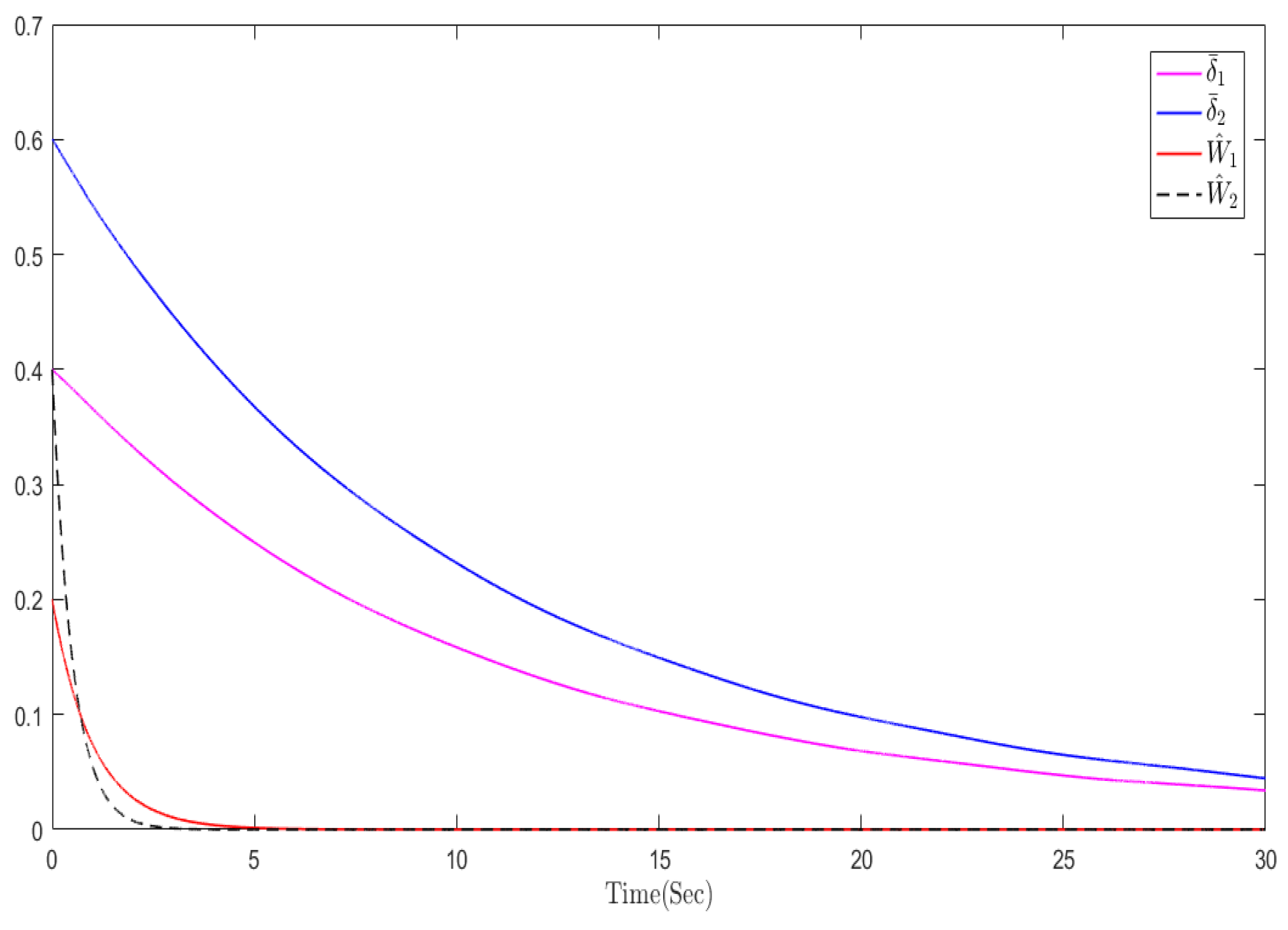
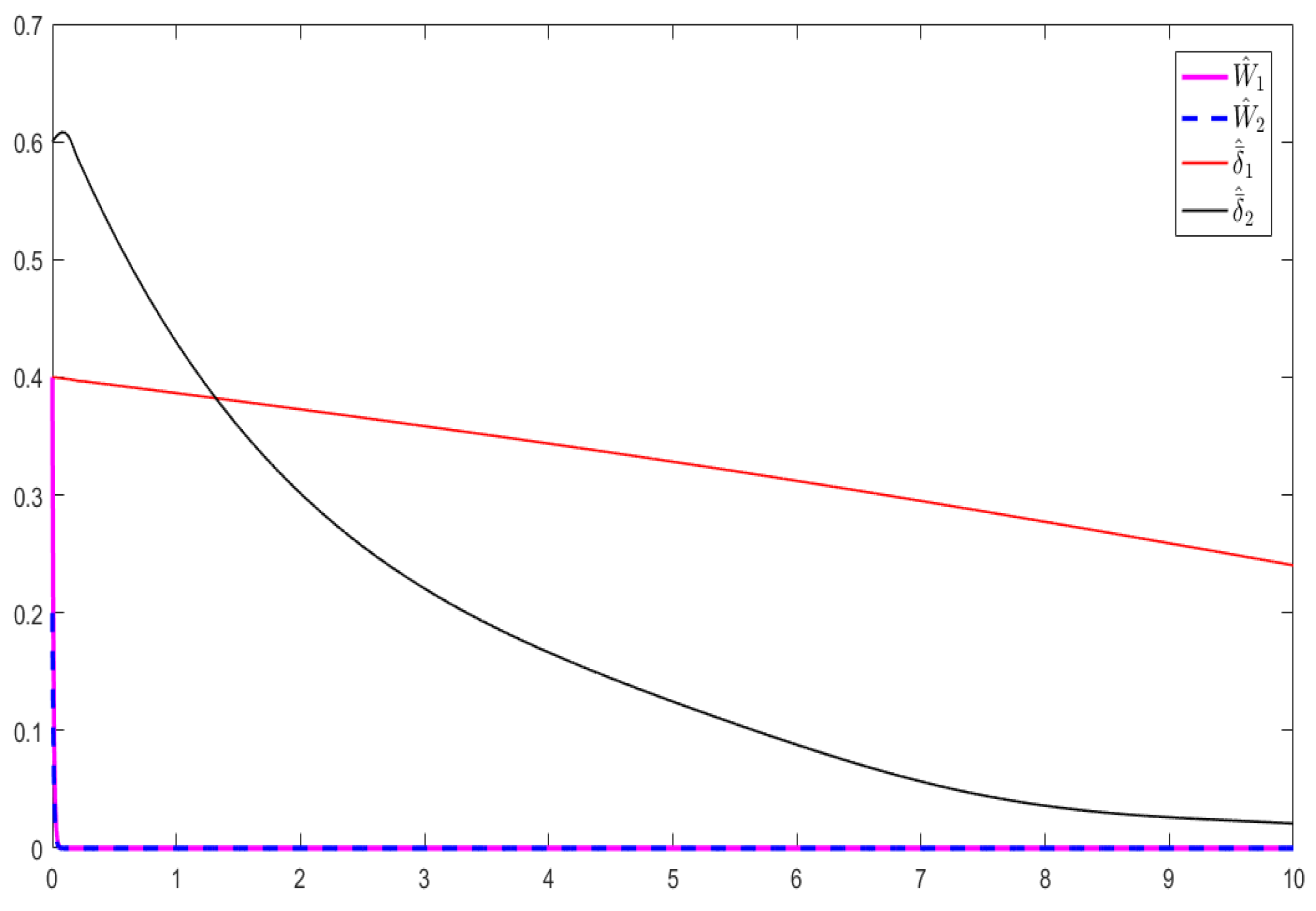
To fulfill the control scheme, the initial conditions and relevant parameters are set as: x 1 ( 0 ) = [ 0.4 , 0.4 ] , x 2 ( 0 ) = [ 0.2 , 0.4 ] , W ^ 1 ( 0 ) = 0.2 , W ^ 2 ( 0 ) = 0.4 , δ ¯ ^ 1 ( 0 ) = 0.4 , and δ ¯ ^ 2 ( 0 ) = 0.6 , k 1 , 1 = 180 ,   k 2 , 1 = 160 , k 1 , 2 = k 2 , 2 = 40 , ψ 1 , 1 = ψ 2 , 1 = 0.1 , ψ 1 , 2 = ψ 2 , 2 = 0.2 , γ δ 1 = γ δ 2 = 0.1 , γ w 1 = 1 , and γ w 2 = 2 .
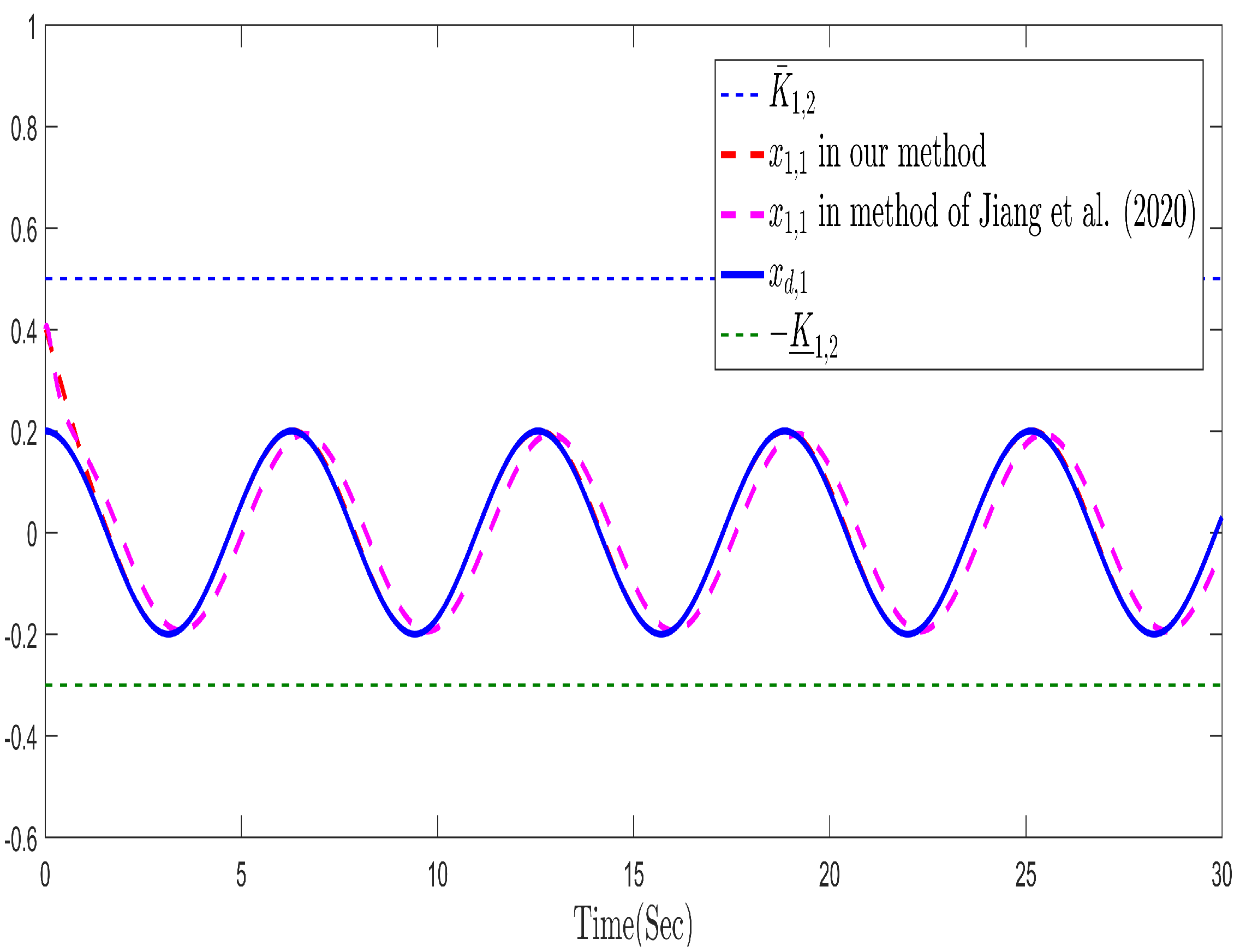
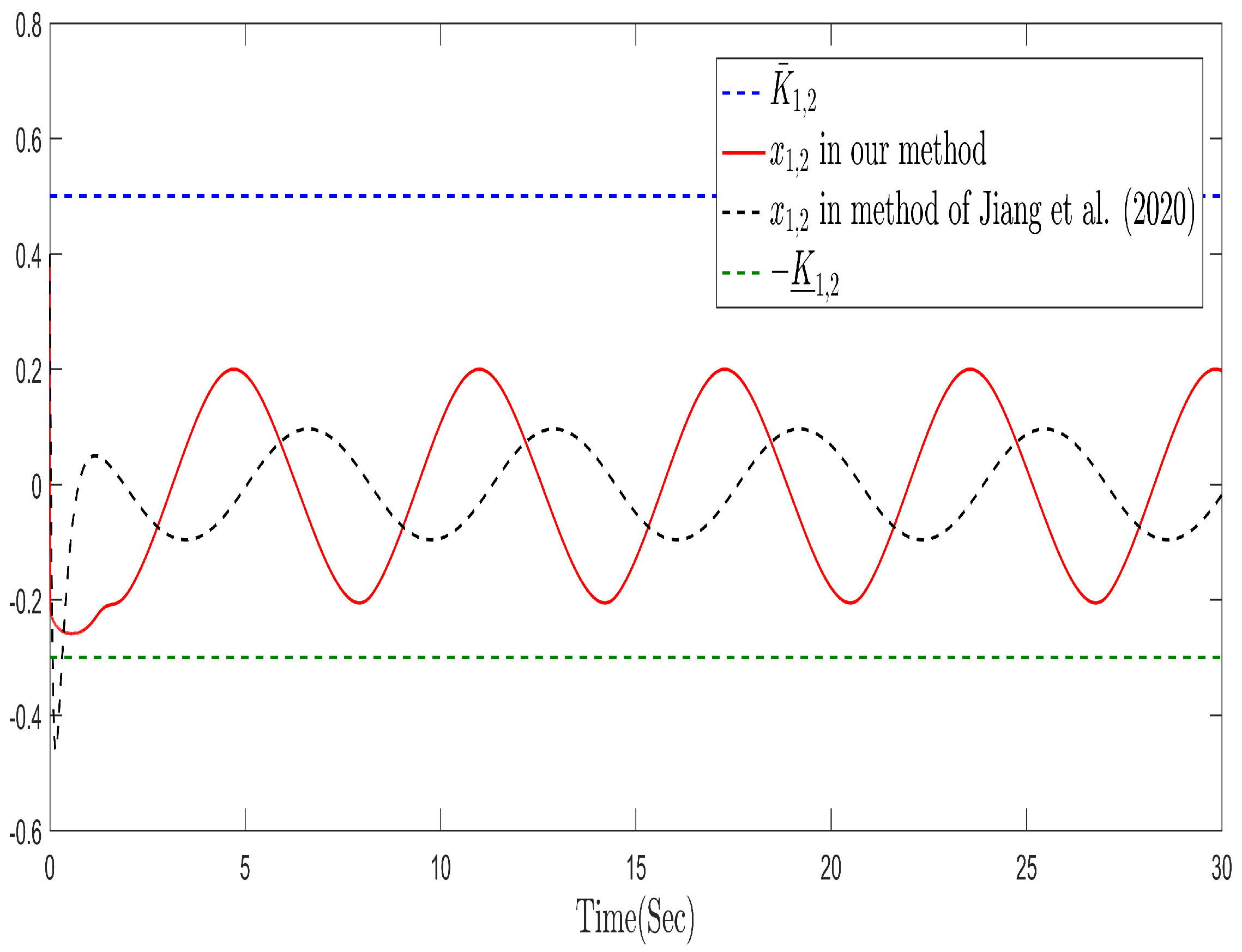
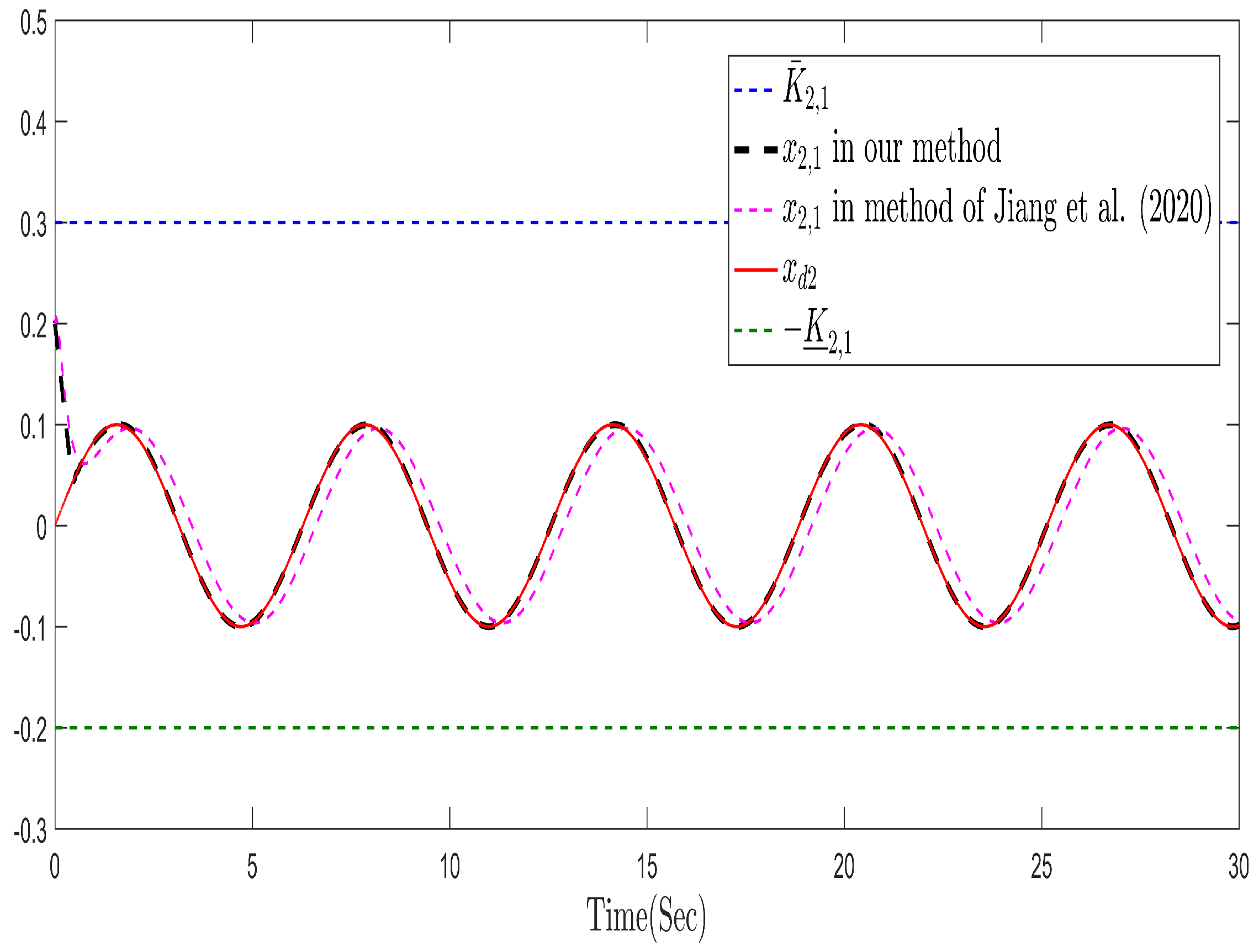
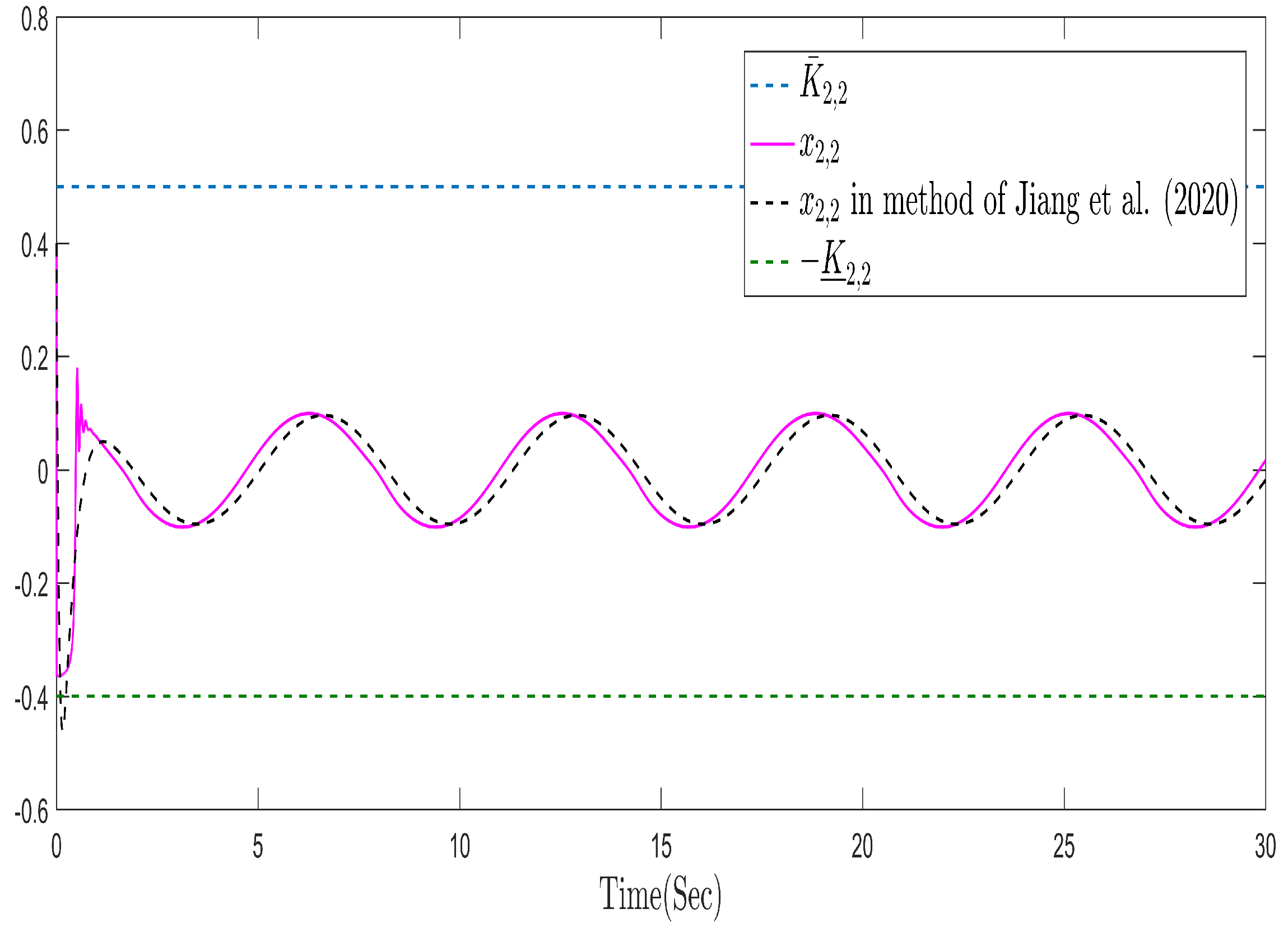
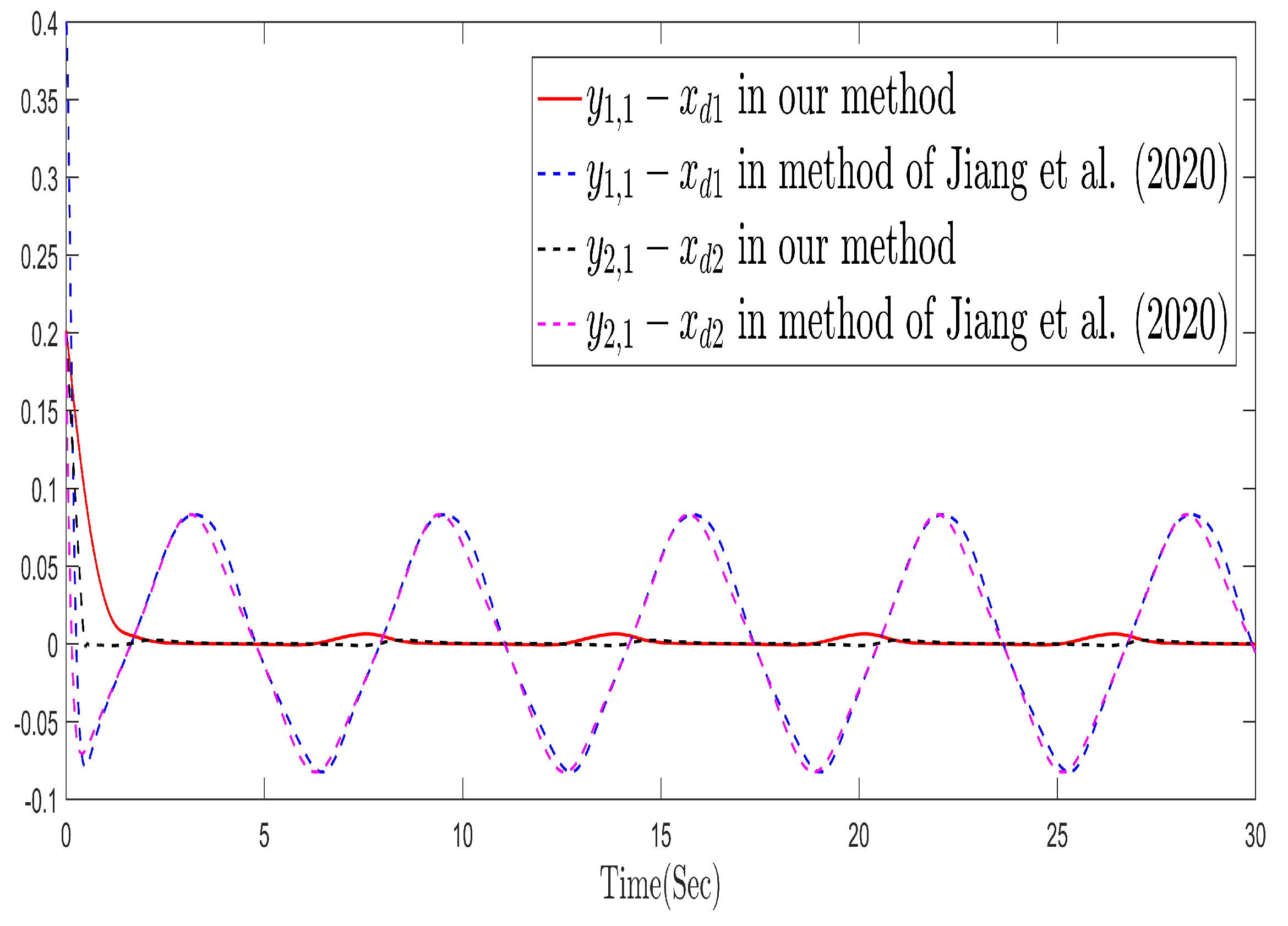
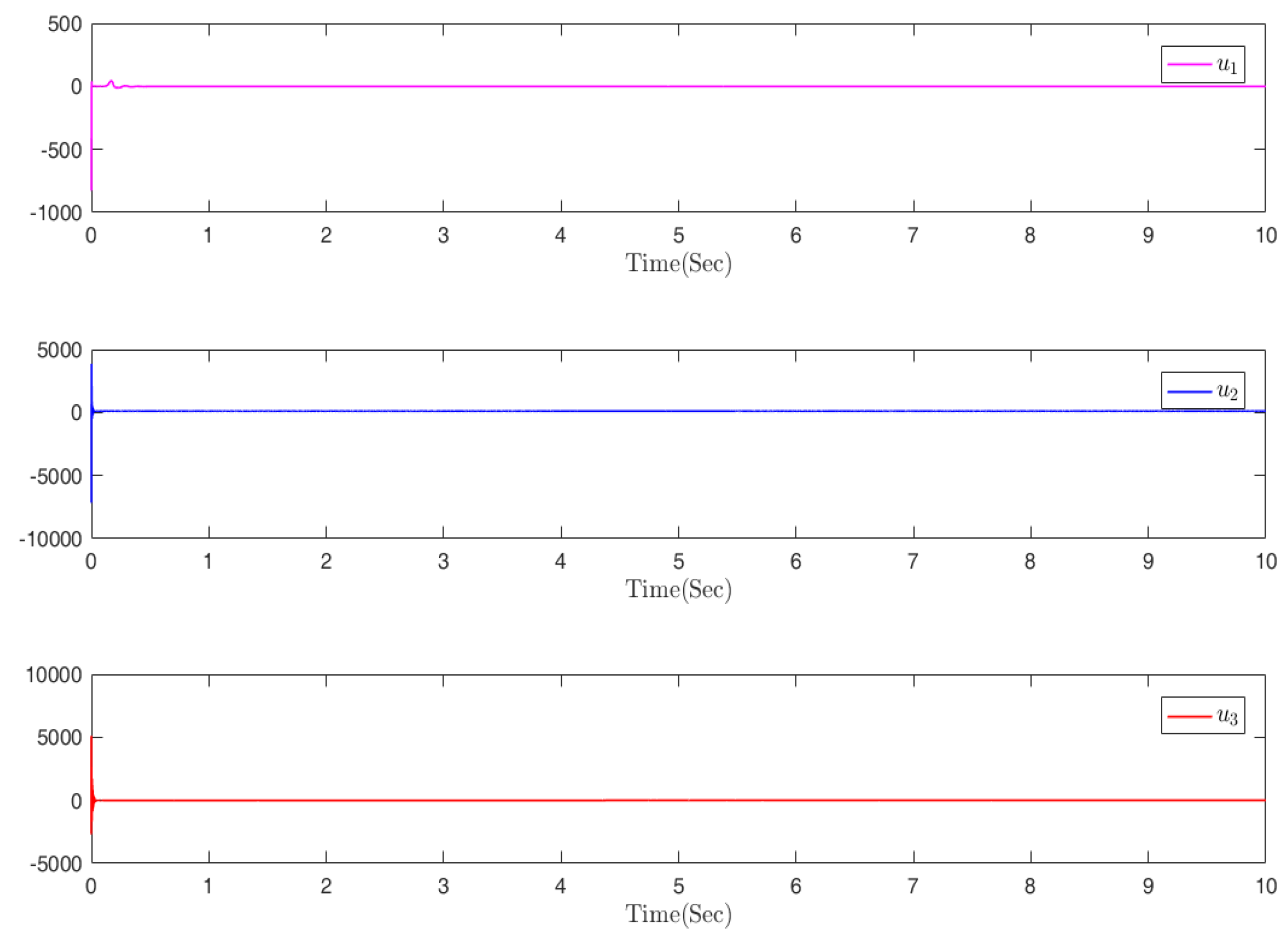
Then, relevant simulation results are presented in Figure 2, Figure 3, Figure 4, Figure 5, Figure 6, Figure 7 and Figure 8. As shown in Figure 2, Figure 3, Figure 4 and Figure 5, all state signals are strictly confined within the prescribed regions D i , j i = 1 , 2 , j = 1 , 2 . In contrast, the state signals from [6], which does not employ a state-constraint function, exhibit boundary violations. Meanwhile, the output signals y 1 and y 2 successfully track their respective desired trajectories x d 1 and x d 2 , respectively. Figure 6 provides the trajectories of the update laws W ^ 1 , W ^ 2 , δ ¯ ^ 1 , and δ ¯ ^ 2 . Figure 7 shows the tracking error responses of the proposed control scheme and the method in [6] under the same initial conditions, desired trajectories and system dynamics. It can be observed that the controller in [6] only achieves bounded tracking, whereas the proposed method accomplishes asymptotic tracking. Therefore, the proposed scheme demonstrates higher practical value and broader applicability. Figure 8 provides the trajectories of the control inputs u 1 and u 2 .
Example 2.
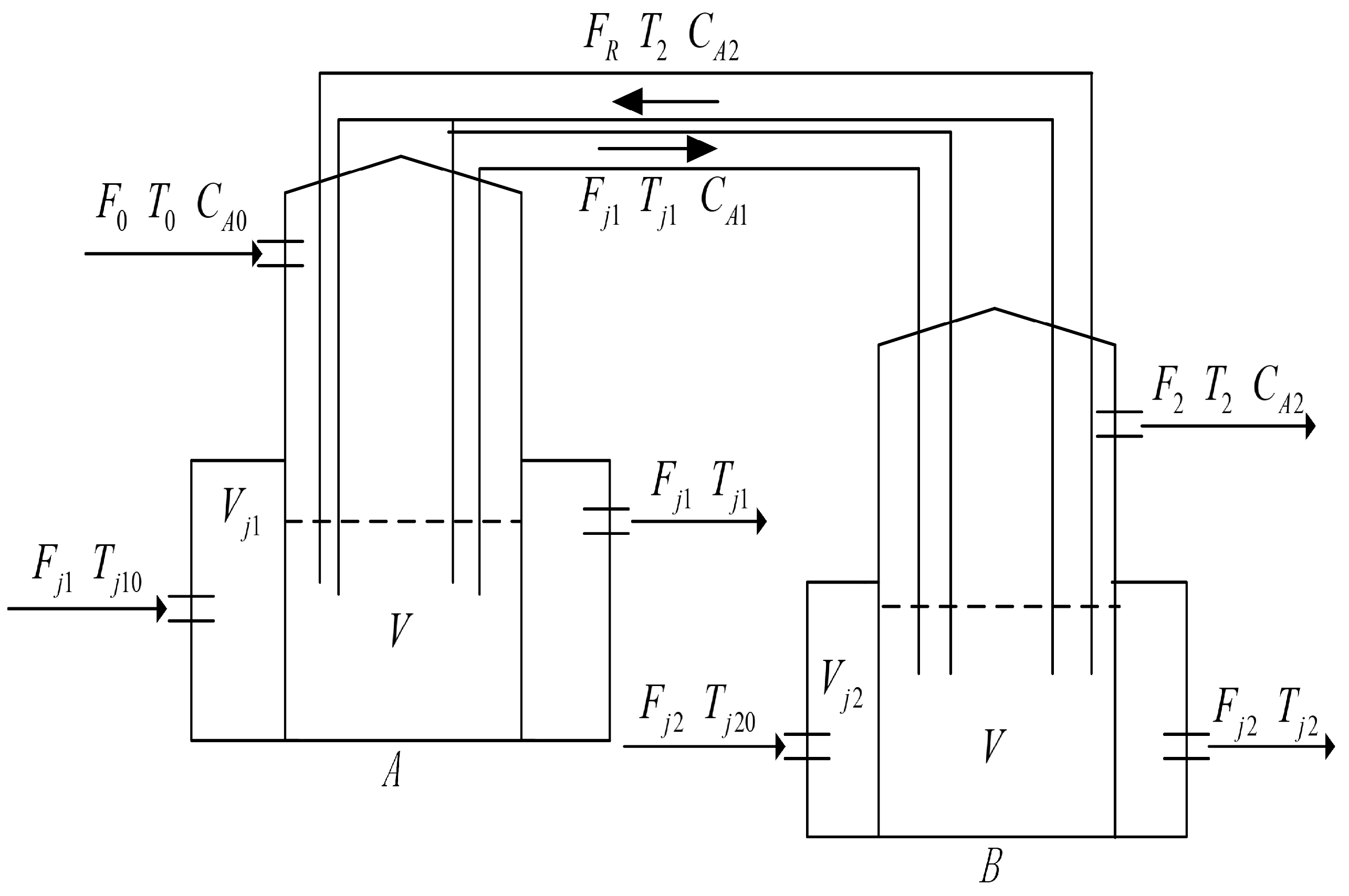
A practical example is considered based on the continuous stirred tank reactor process [6], a visualization of which is depicted in Figure 9. The system dynamics can be characterized as follows:
x ˙ 11 = b 11 x 12 , x ˙ 12 = b 12 u 1 , y 1 = x 11 , x ˙ 21 = b 21 x 22 + ϕ 21 + ϕ x 31 , x ˙ 22 = b 22 u 2 + ϕ 22 , y 2 = x 21 , x ˙ 31 = b 31 x 32 + ϕ 31 + Ψ ω , x ˙ 32 = b 32 u 3 + ϕ 32 , y 3 = x 31 ,
where b 11 = 1 ,   b 12 = 1 ,   b 21 = U A ρ c ρ V ,   b 22 = F j 2 V j ,   b 31 = U A ρ c ρ V ,   b 32 = F j 1 V j ,   Ψ = F 0 V ,   Φ = F + F R V ,   ϕ 21 = F + F R T 1 d V α λ ρ c ρ x 11 + C A 2 d e E R x 21 + T 2 d   ( F + F R ) x 21 + T 2 d V U A ( x 21 + T 2 d T j 2 d ) ρ c ρ V ,   ϕ 22 = F j 2 ( T j 20 d x 22 T j 2 d ) V j + U A x 21 + T 2 d x 22 T j 2 d ρ j c j V j ,   ϕ 31 = F 0 V j T 0 d F + F R V x 31 + T 1 d F R V x 21 + T 2 d   α λ ρ c ρ C A 1 e E R x 31 + T 1 d U A ρ c ρ V x 31 + T 1 d T j 1 d , ϕ 32 = F j 1 ( T j 10 d x 32 T j 1 d ) V j + U A ( x 31 + T 1 d x 32 T j 1 d ) ρ j c j V j , C A 1 = V F + F R ( x 12 + F + F R V ( x 11 + C A 2 d ) ) + α ( x 11 + C A 2 d ) e E R x 21 + T 2 d , and the process parameters are given in Table 1.
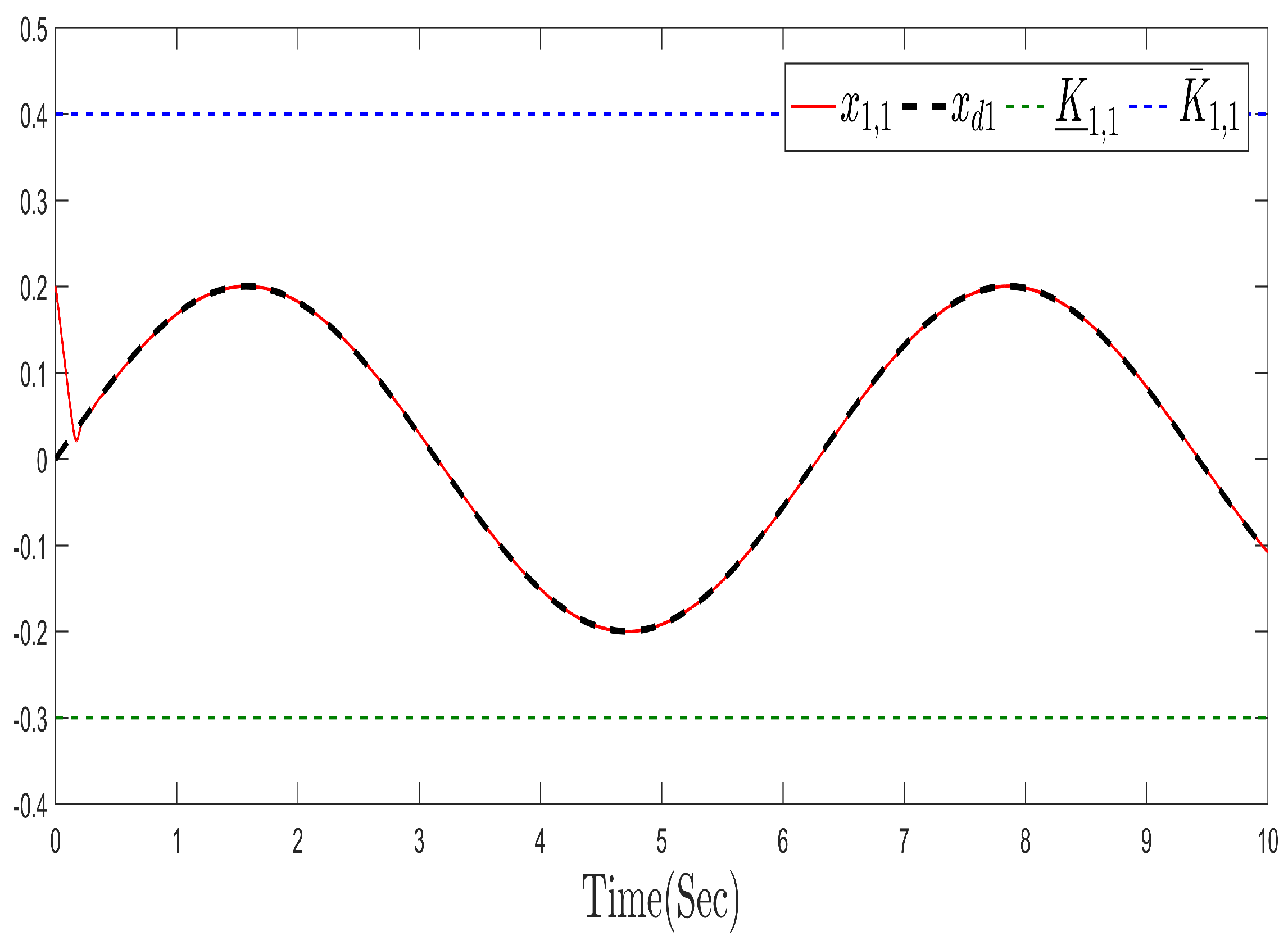
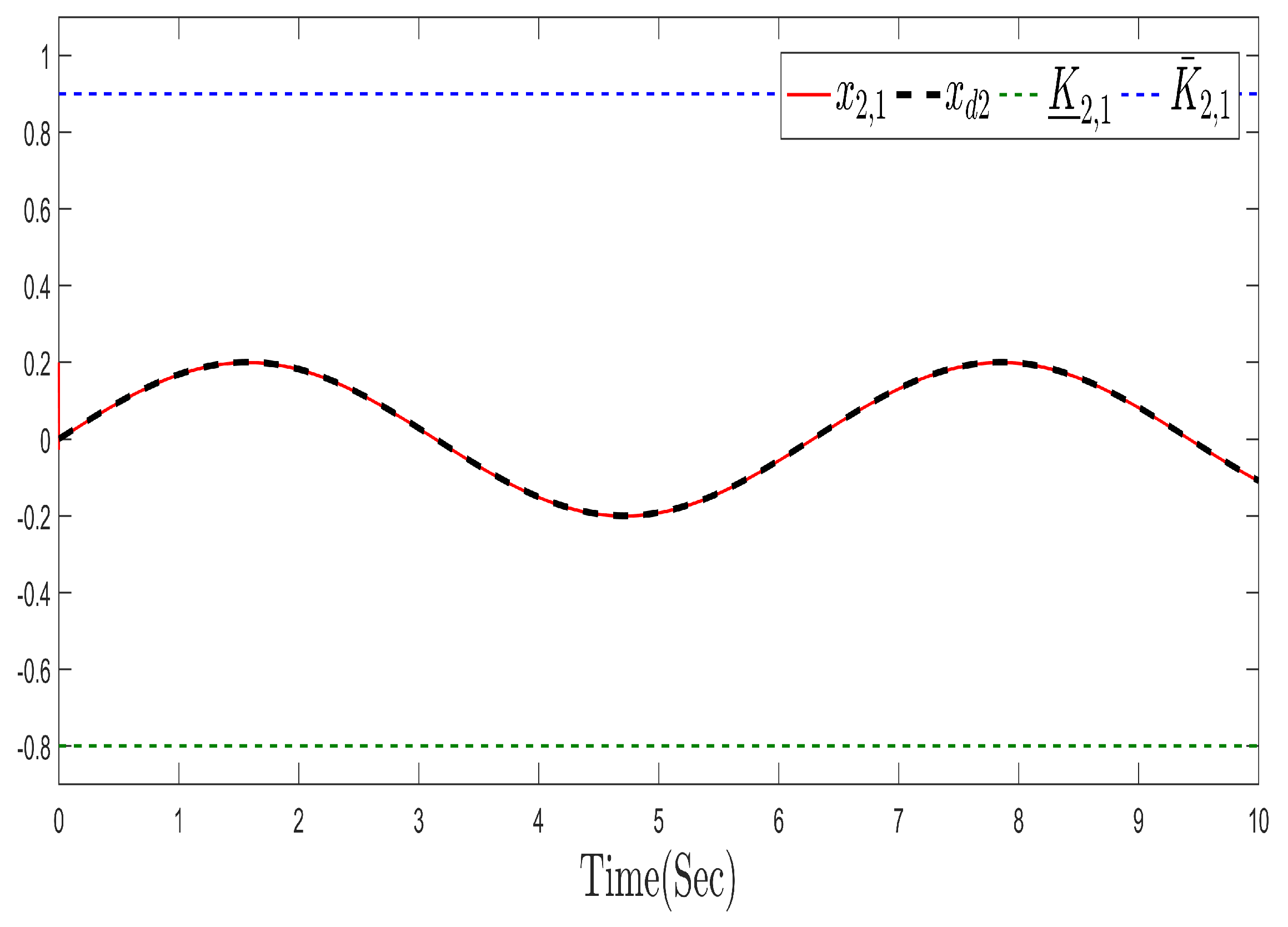
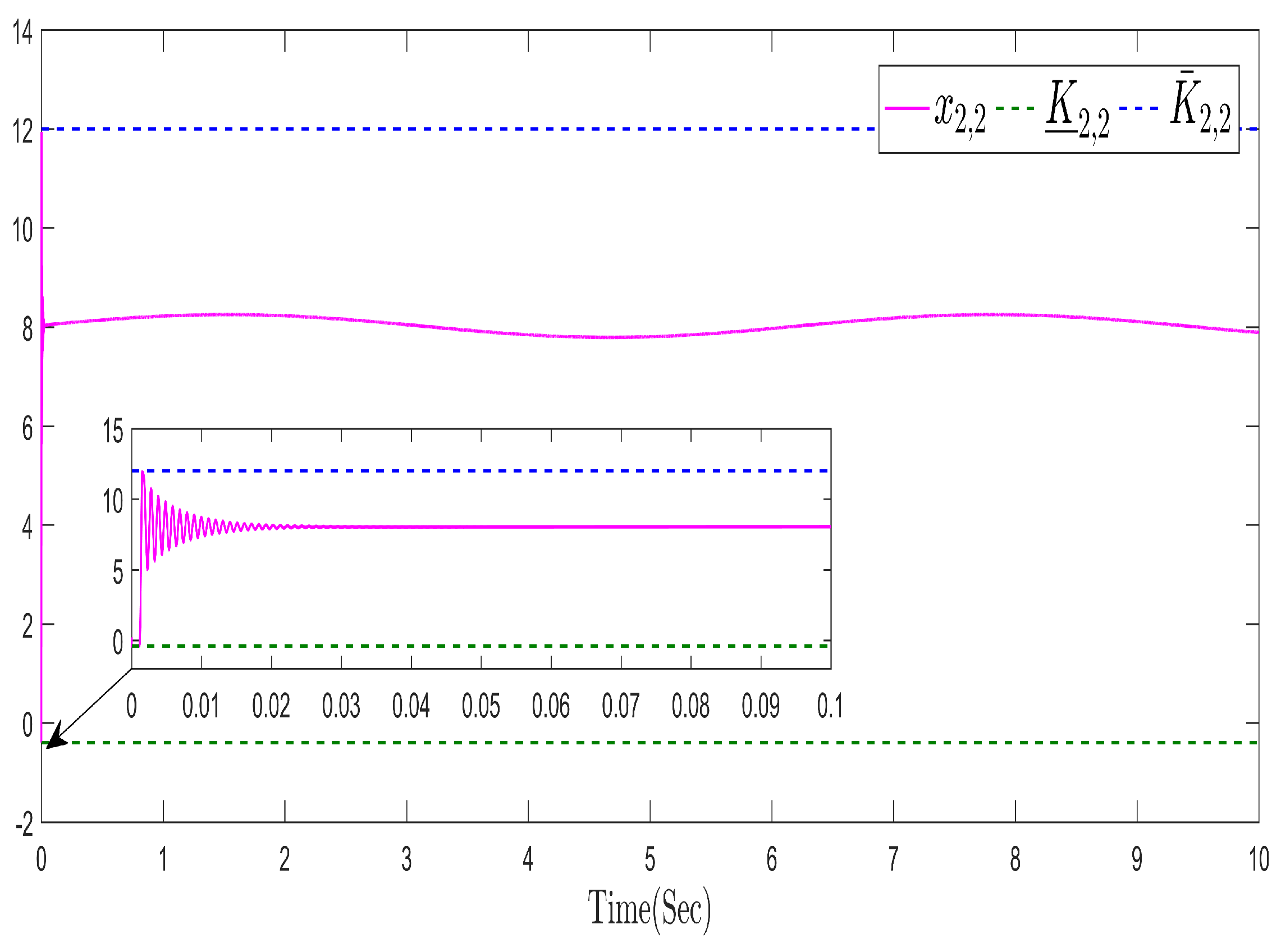
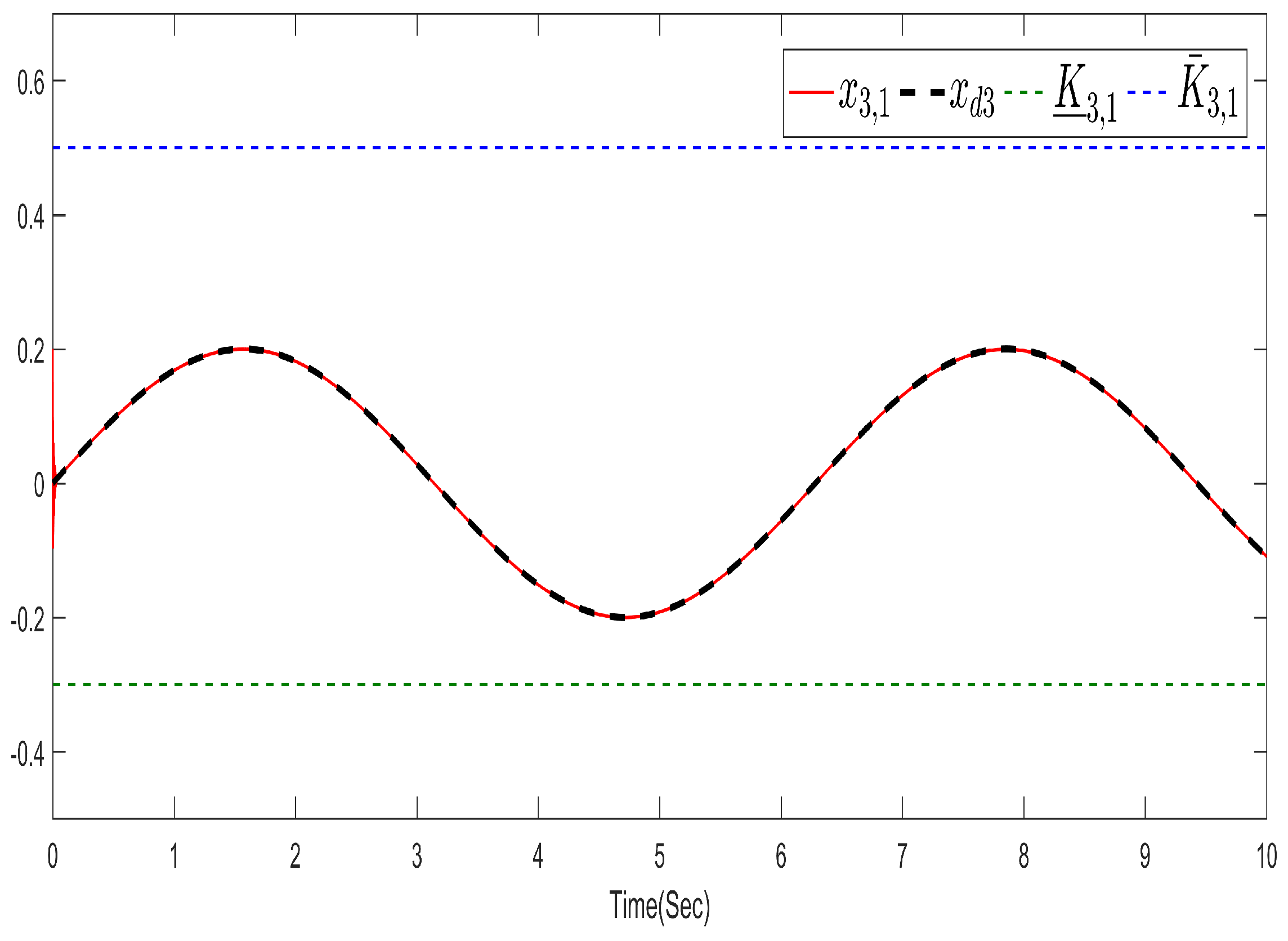
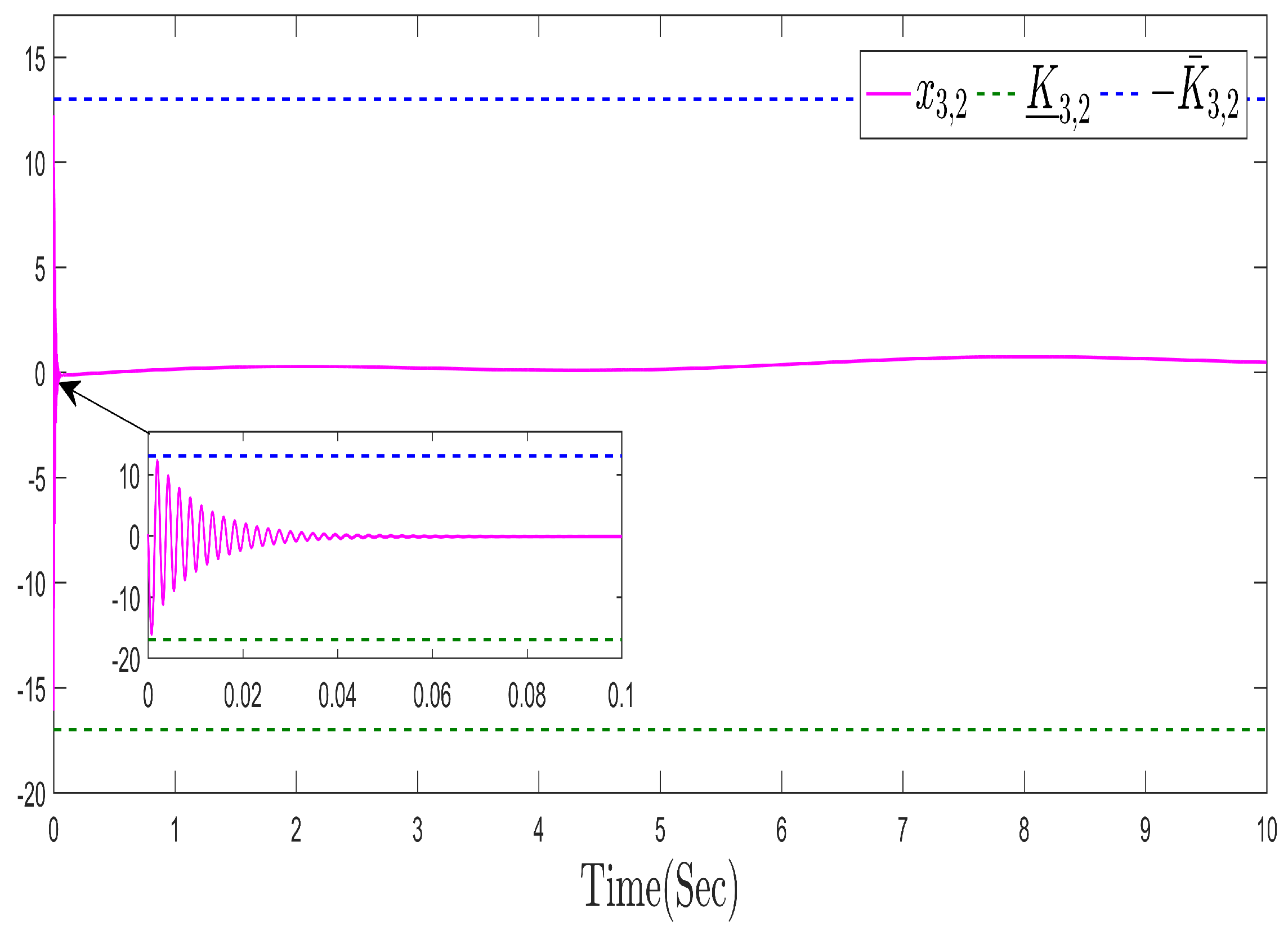
Then, the desired trajectories are selected as x d 1 = x d 2 = x d 3 = 0.2 s i n ( t ) and ω ( t ) = e 0.1 t . The states of System (54) are subject to the following asymmetric constraints, which represent physical limitations:
0.3 < x 1 , 1 < 0.4 , 1.2 < x 1 , 2 < 0.8 , 0.8 < x 2 , 1 < 0.9 , 0.4 < x 2 , 2 < 12 , 0.3 < x 3 , 1 < 0.5 , 17 < x 3 , 2 < 13 .
Following Theorem 1, the control laws (16)–(19) are implemented with the following initial conditions and parameters: x 1 ( 0 ) = [ 0.2 , 0.4 ] , x 2 ( 0 ) = [ 0.2 , 0.2 ] , x 3 ( 0 ) = [ 0.2 , 0.2 ] , W ^ 1 ( 0 ) = 0.4 , W ^ 2 ( 0 ) = 0.2 , δ ¯ ^ 1 ( 0 ) = 0.6 , δ ¯ ^ 2 ( 0 ) = 0.4 , k 1 , 1 = k 1 , 2 = 20 , k 2 , 1 = 500 , k 2 , 2 = 50 ,   k 3 , 1 = 100 , k 3 , 2 = 20 , ψ 1 , 1 = ψ 2 , 1 = 0.1 , ψ 1 , 2 = ψ 2 , 2 = 0.2 , ψ 3 , 1 = 0.1 ,   ψ 3 , 2 = 0.2 , γ δ 1 = 0.4 , γ δ 2 = 0.01 , and γ w 1 = γ w 2 = 100 .
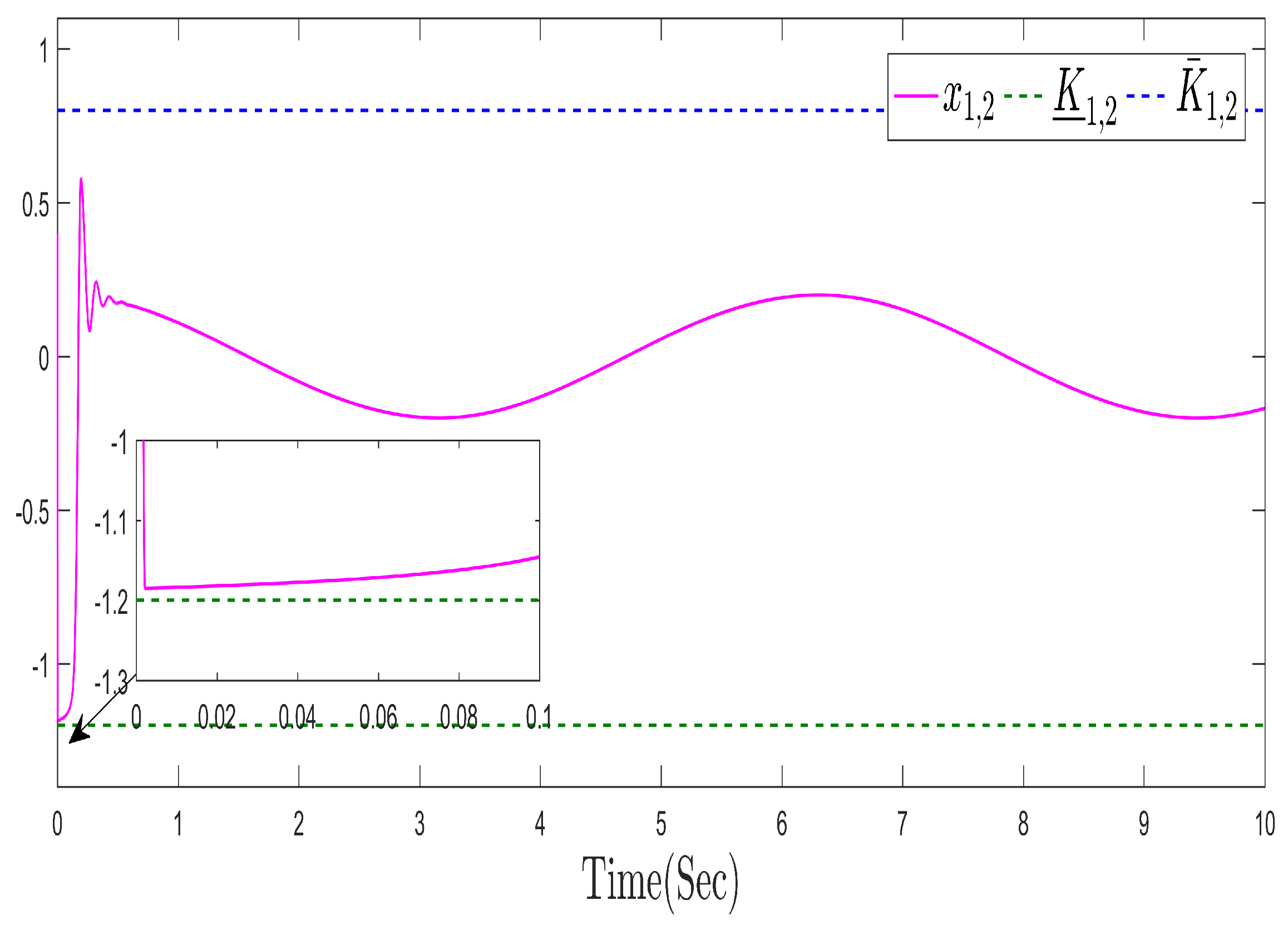
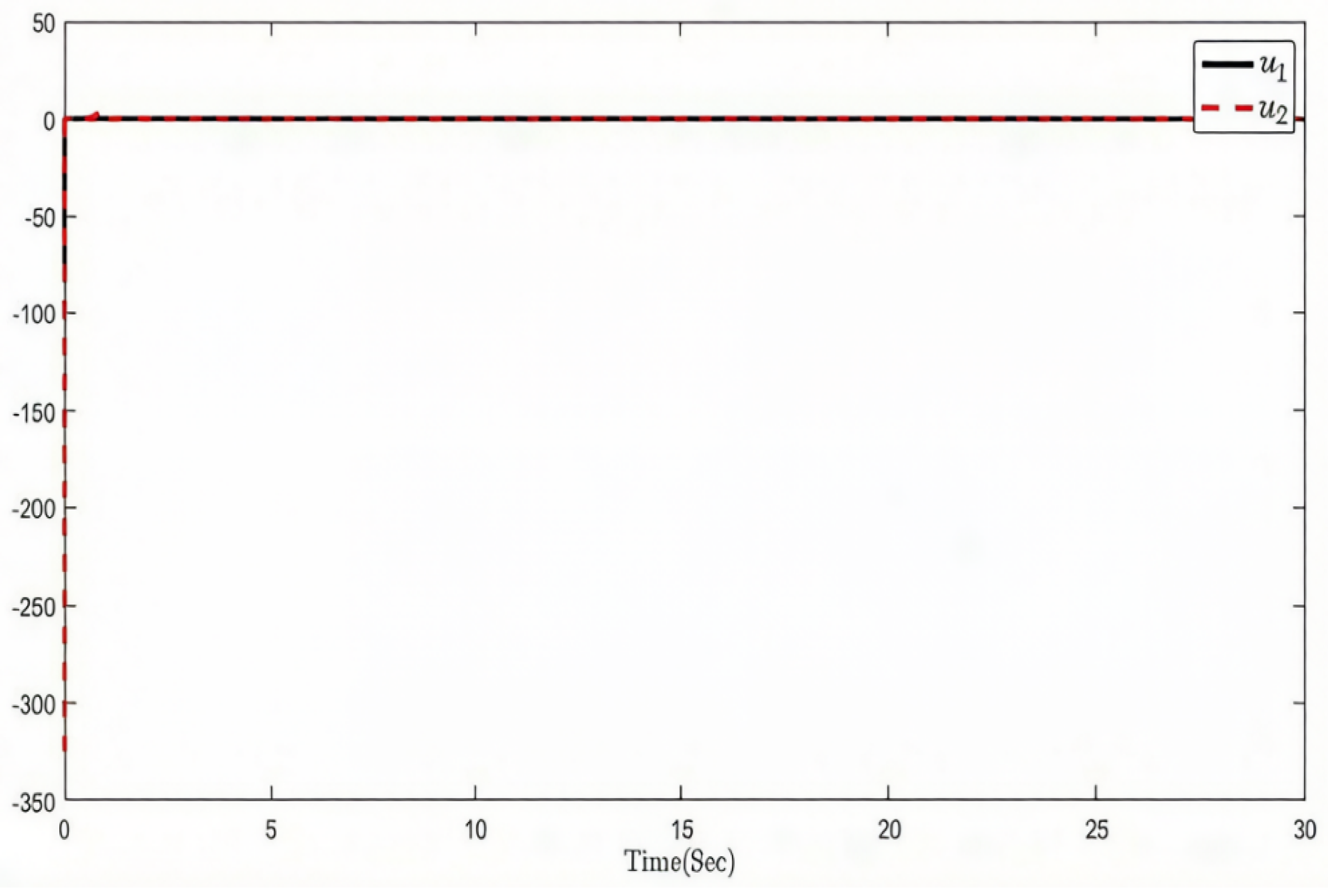
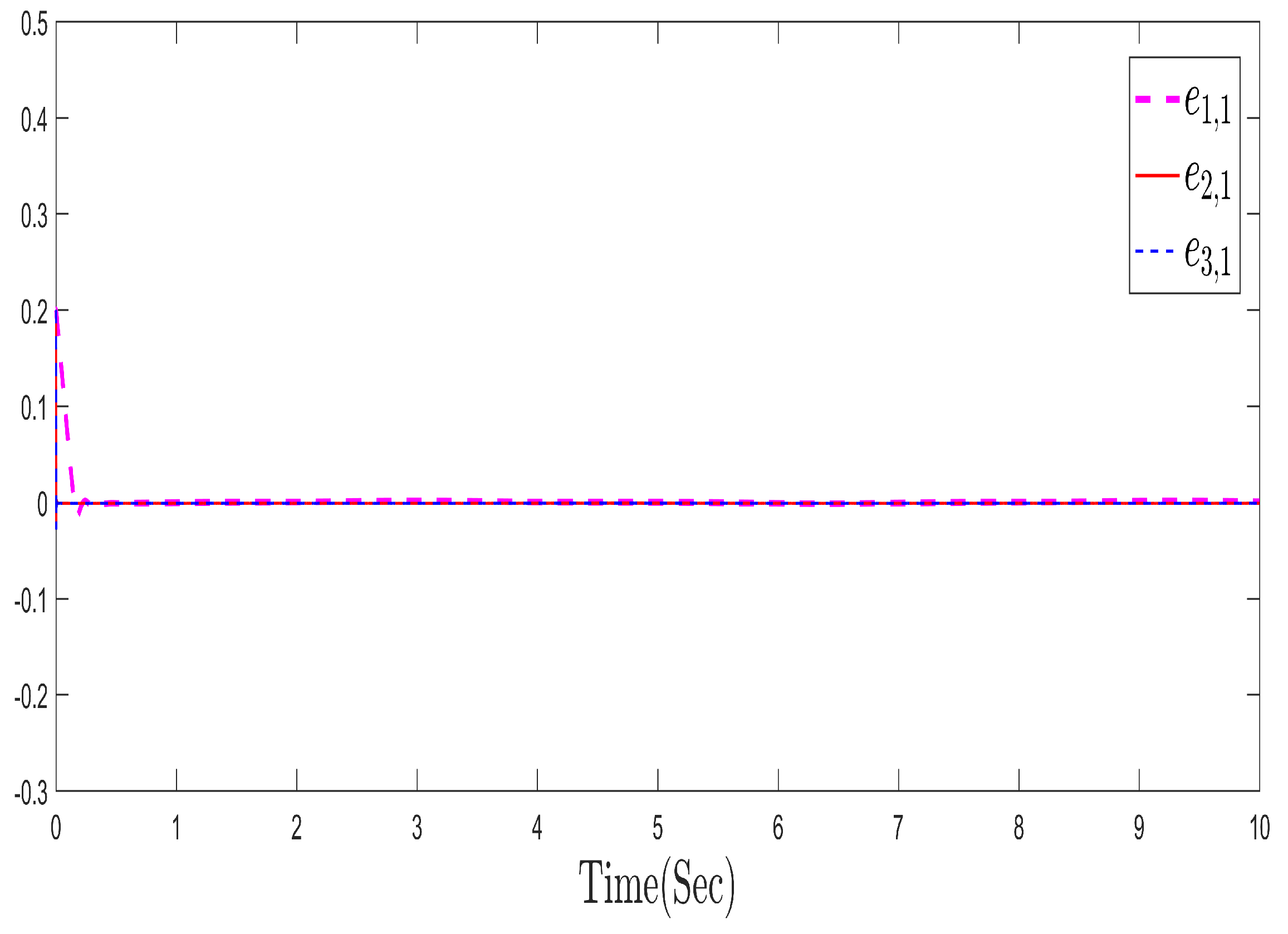
Then, the simulation results are presented in Figure 10, Figure 11, Figure 12, Figure 13, Figure 14, Figure 15, Figure 16, Figure 17 and Figure 18. Figure 10, Figure 11, Figure 12, Figure 13, Figure 14 and Figure 15 show the curves of all system states x i , j , i = 1 , 2 , 3 , j = 1 , 2 , demonstrating that they remain strictly within the prescribed constraint domains. Meanwhile, the outputs x 1 , 1 , x 2 , 1 , and x 3 , 1 successfully track their respective reference signals x d 1 , x d 2 , and x d 3 . Figure 16 depicts the tracking errors e 1 , 1 , e 2 , 1 , and e 3 , 1 , confirming their asymptotic convergence to zero. Figure 17 shows the profiles of adaptive laws W ^ 1 , W ^ 2 , δ ¯ ^ 1 , and δ ¯ ^ 2 . Figure 18 exhibits the curves of control inputs u 1 , u 2 , and u 3 . As shown in Figure 10, Figure 11, Figure 12, Figure 13, Figure 14, Figure 15, Figure 16, Figure 17 and Figure 18, the proposed adaptive NNs control strategy is able to guarantee that the FSC are always unbroken, all system signals are bounded, and the tracking errors asymptotically converge to zero.

6. Conclusions

In this paper, the problem of adaptive NNs tracking control has been studied for MIMO nonlinear non-strict-feedback systems subject to asymmetric FSC and unknown gain functions. The completely unknown nonlinear function and the algebraic loop problems have been processed by NNs. By constructing an NSDF that purely depends on system states, the constrained systems have been transformed into a new system that releases state-constraint conditions and prior knowledge of control gain functions. Combining Lyapunov function theory with the backstepping framework, a NNs-based adaptive tracking control scheme has been presented which ensures that all system variables are bounded and remain within the constrained sets, while the tracking errors converge asymptotically to zero. Meanwhile, the feasibility conditions imposed on traditional BLF(or IBLF) methods have been eliminated. Finally, the validity of the proposed strategy has been demonstrated based on two simulation examples.

Author Contributions

Writing—original draft, M.Z.; Writing—review and editing, K.J., B.L., M.L. and Z.G. All authors have read and agreed to the published version of the manuscript.

Funding

This research received no external funding.

Data Availability Statement

The original contributions presented in this study are included in the article. Further inquiries can be directed to the corresponding author.

Conflicts of Interest

The authors declare no conflicts of interest.

References

  1. Lai, G.; Liu, Z.; Zhang, Y.; Chen, C.P.; Xie, S. Adaptive backstepping-based tracking control of a class of uncertain switched nonlinear systems. Automatica 2018, 91, 301–310. [Google Scholar] [CrossRef]
  2. Wen, C.; Zhou, J.; Liu, Z.; Su, H. Robust adaptive control of uncertain nonlinear systems in the presence of input saturation and external disturbance. IEEE Trans. Autom. Control 2011, 56, 1672–1678. [Google Scholar] [CrossRef]
  3. Li, Y.; Tong, S. Adaptive backstepping control for uncertain nonlinear strict-feedback systems with full state triggering. Automatica 2024, 163, 111574. [Google Scholar] [CrossRef]
  4. Tong, S.; Min, X.; Li, Y. Observer-based adaptive fuzzy tracking control for strict-feedback nonlinear systems with unknown control gain functions. IEEE Trans. Cybern. 2020, 50, 3903–3913. [Google Scholar] [CrossRef] [PubMed]
  5. Choi, Y.H.; Yoo, S.J. Neural-networks-based adaptive quantized feedback tracking of uncertain nonlinear strict-feedback systems with unknown time delays. J. Frankl. Inst. 2020, 357, 10691–10715. [Google Scholar] [CrossRef]
  6. Jiang, K.; Niu, B.; Wang, X.; Xiang, Z.; Li, J.; Duan, P.; Yang, D. Adaptive approximation-based design mechanism for non-strict-feedback nonlinear MIMO systems with application to continuous stirred tank reactor. Isa Trans. 2020, 100, 92–102. [Google Scholar] [CrossRef]
  7. Xu, N.; Liu, X.; Li, Y.; Zong, G.; Zhao, X.; Wang, H. Dynamic event-triggered control for a class of uncertain strict-feedback systems via an improved adaptive neural networks backstepping approach. IEEE Trans. Autom. Sci. Eng. 2024, 22, 2041–2050. [Google Scholar] [CrossRef]
  8. Liu, S.; Wang, H.; Liu, Y.; Xu, N.; Zhao, X. Sliding-mode surface-based adaptive optimal nonzero-sum games for saturated nonlinear multi-player systems with identifier-critic networks. Neurocomputing 2024, 584, 127575. [Google Scholar] [CrossRef]
  9. Han, H.; Ji, W.; Liu, Z.; Sun, H.; Qiao, J. Predefined-time adaptive neural control for nonlinear systems with unknown interconnections. IEEE Trans. Cybern. 2025, 55, 2608–2620. [Google Scholar] [CrossRef]
  10. Chen, B.; Liu, X.P.; Ge, S.S.; Lin, C. Adaptive fuzzy control of a class of nonlinear systems by fuzzy approximation approach. IEEE Trans. Fuzzy Syst. 2012, 20, 1012–1021. [Google Scholar] [CrossRef]
  11. Wang, H.; Liu, X.; Liu, K.; Karimi, H.R. Approximation-based adaptive fuzzy tracking control for a class of nonstrict-feedback stochastic nonlinear time-delay systems. IEEE Trans. Fuzzy Syst. 2014, 23, 1746–1760. [Google Scholar] [CrossRef]
  12. Tong, S.; Li, Y.; Sui, S. Adaptive fuzzy tracking control design for SISO uncertain nonstrict feedback nonlinear systems. IEEE Trans. Fuzzy Syst. 2016, 24, 1441–1454. [Google Scholar] [CrossRef]
  13. Mayne, D.Q.; Rawlings, J.B.; Rao, C.V.; Scokaert, P.O. Constrained model predictive control: Stability and optimality. Automatica 2000, 36, 789–814. [Google Scholar] [CrossRef]
  14. Gilbert, E.; Kolmanovsky, I. Nonlinear tracking control in the presence of state and control constraints: A generalized reference governor. Automatica 2002, 38, 2063–2073. [Google Scholar] [CrossRef]
  15. Ngo, K.B.; Mahony, R.; Jiang, Z.P. Integrator backstepping using barrier functions for systems with multiple state constraints. In Proceedings of the 44th IEEE Conference on Decision and Control; IEEE: Piscataway, NJ, USA, 2005; pp. 8306–8312. [Google Scholar] [CrossRef]
  16. Xu, Z.; Sun, C.; Hu, X.; Liu, Q.; Yao, J. Barrier Lyapunov function-based adaptive output feedback prescribed performance controller for hydraulic systems with uncertainties compensation. IEEE Trans. Ind. Electron. 2023, 70, 12500–12510. [Google Scholar] [CrossRef]
  17. Hosseinnajad, A.; Mohajer, N.; Nahavandi, S. Barrier Lyapunov function-based backstepping controller design for path tracking of autonomous vehicles. J. Intell. Robot. Syst. 2024, 110, 118. [Google Scholar] [CrossRef]
  18. Li, L.; Zhai, H.; Ji, W. Control of transport constraints for shuttle vehicles based on barrier Lyapunov functions. Results Eng. 2023, 20, 101475. [Google Scholar] [CrossRef]
  19. Chen, Y.; Liu, Z.; Chen, C.P.; Zhang, Y. Integral-interval barrier Lyapunov function based control of switched systems with fuzzy saturation-deadzone. Nonlinear Dyn. 2021, 104, 3809–3826. [Google Scholar] [CrossRef]
  20. Xie, X.J.; Guo, C.; Cui, R.H. Removing feasibility conditions on tracking control of full-state constrained nonlinear systems with time-varying powers. IEEE Trans. Syst. Man Cybern. Syst. 2020, 51, 6535–6543. [Google Scholar] [CrossRef]
  21. Zhao, K.; Song, Y. Removing the feasibility conditions imposed on tracking control designs for state-constrained strict-feedback systems. IEEE Trans. Autom. Control 2018, 64, 1265–1272. [Google Scholar] [CrossRef]
  22. Liu, Y.; Zhang, H.; Wang, Y.; Sun, S. Adaptive fuzzy control for nonstrict-feedback systems under asymmetric time-varying full state constraints without feasibility condition. IEEE Trans. Fuzzy Syst. 2020, 29, 976–985. [Google Scholar] [CrossRef]
  23. Li, D.; Liu, L.; Liu, Y.J.; Tong, S.; Chen, C.P. Adaptive NN control without feasibility conditions for nonlinear state constrained stochastic systems with unknown time delays. IEEE Trans. Cybern. 2019, 49, 4485–4494. [Google Scholar] [CrossRef]
  24. Li, D.; Han, H.; Qiao, J. Observer-based adaptive fuzzy control for nonlinear state-constrained systems without involving feasibility conditions. IEEE Trans. Cybern. 2021, 52, 11724–11733. [Google Scholar] [CrossRef]
  25. Feng, Z.; Li, R.B.; Chadli, M.; Zhang, X. Removing the feasibility conditions on adaptive fuzzy decentralized tracking control of large-scale nonlinear systems with full-state constraints. J. Frankl. Inst. 2022, 359, 5125–5147. [Google Scholar] [CrossRef]
  26. Sun, W.; Xia, J.; Zhuang, G.; Huang, X.; Shen, H. Adaptive fuzzy asymptotically tracking control of full state constrained nonlinear system based on a novel Nussbaum-type function. J. Frankl. Inst. 2019, 356, 1810–1827. [Google Scholar] [CrossRef]
  27. Wang, C.; Wang, F.; Yu, J. BLF-based asymptotic tracking control for a class of time-varying full state constrained nonlinear systems. Trans. Inst. Meas. Control 2019, 41, 3043–3052. [Google Scholar] [CrossRef]
  28. Niu, B.; Liu, Y.; Zong, G.; Han, Z.; Fu, J. Command filter-based adaptive neural tracking controller design for uncertain switched nonlinear output-constrained systems. IEEE Trans. Cybern. 2017, 47, 3160–3171. [Google Scholar] [CrossRef] [PubMed]
  29. Polycarpou, M.M.; Weaver, S.E. Stable adaptive neural control of nonlinear systems. In Proceedings of the 1995 American Control Conference-ACC’95; IEEE: Piscataway, NJ, USA, 1995; Volume 1, pp. 847–851. [Google Scholar] [CrossRef]
  30. Wang, H.; Chen, B.; Liu, X.; Liu, K.; Lin, C. Robust adaptive fuzzy tracking control for pure-feedback stochastic nonlinear systems with input constraints. IEEE Trans. Cybern. 2013, 43, 2093–2104. [Google Scholar] [CrossRef]
  31. Khalil, H.K.; Grizzle, J.W. Nonlinear Systems; Prentice Hall: Upper Saddle River, NJ, USA, 2002. [Google Scholar]
  32. Sun, Y.; Chen, B.; Lin, C.; Wang, H.; Zhou, S. Adaptive neural control for a class of stochastic nonlinear systems by backstepping approach. Inf. Sci. 2016, 369, 748–764. [Google Scholar] [CrossRef]
  33. Wang, X.; Pang, N.; Xu, Y.; Huang, T.; Kurths, J. On state-constrained containment control for nonlinear multiagent systems using event-triggered input. IEEE Trans. Syst. Man Cybern. Syst. 2024, 54, 2530–2538. [Google Scholar] [CrossRef]
  34. Phan, V.D.; Truong, H.V.A.; Le, V.C.; Ho, S.P.; Ahn, K.K. Adaptive neural observer-based output feedback anti-actuator fault control of a nonlinear electro-hydraulic system with full state constraints. Sci. Rep. 2025, 15, 3044. [Google Scholar] [CrossRef] [PubMed]
  35. Zhang, W.; Zhao, L. Command filtered backstepping based finite-time adaptive fuzzy event-triggered control for unmanned aerial vehicle with full-state constraints. IEEE Trans. Veh. Technol. 2025, 74, 10162–10174. [Google Scholar] [CrossRef]
  36. Pal, S.; Hota, S. Impact angle control guidance using asymmetric integral barrier lyapunov function with FOV and input constraints. IEEE Control Syst. Lett. 2025, 9, 2663–2668. [Google Scholar] [CrossRef]
Figure 1. The relationship between NSDF ξ i , j and the systems state x i , j .
Mathematics 14 00806 g001
Figure 2. Curves of different output signals using the method of Jiang et al. (2020) (see reference [6]) and the proposed controller.
Mathematics 14 00806 g002
Figure 3. Curves of different state signals using the method of Jiang et al. (2020) (see reference [6]) and the proposed controller.
Mathematics 14 00806 g003
Figure 4. Curves of different output signals using the method of Jiang et al. (2020) (see reference [6]) and the proposed controller.
Mathematics 14 00806 g004
Figure 5. Curves of different state signals using the method of Jiang et al. (2020) (see reference [6]) and the proposed controller.
Mathematics 14 00806 g005
Figure 6. Curves of the update laws.
Mathematics 14 00806 g006
Figure 7. Curves of different tracking errors using the method of Jiang et al. (2020) (see reference [6]) and the proposed controller.
Mathematics 14 00806 g007
Figure 8. Curves of control inputs.
Mathematics 14 00806 g008
Figure 9. Two continuous stirred tank reactors.
Mathematics 14 00806 g009
Figure 10. Responses of x 1 , 1 and x d 1 .
Mathematics 14 00806 g010
Figure 11. Responses of x 1 , 2 .
Mathematics 14 00806 g011
Figure 12. Responses of x 2 , 1 and x d 2 .
Mathematics 14 00806 g012
Figure 13. Responses of x 2 , 2 .
Mathematics 14 00806 g013
Figure 14. Responses of x 3 , 1 and x d 3 .
Mathematics 14 00806 g014
Figure 15. Responses of x 3 , 2 .
Mathematics 14 00806 g015
Figure 16. Responses of e 1 , 1 , e 2 , 1 , and e 3 , 1 .
Mathematics 14 00806 g016
Figure 17. Responses of W ^ 1 , W ^ 2 , δ ¯ ^ 1 , and δ ¯ ^ 2 .
Mathematics 14 00806 g017
Figure 18. Responses of u 1 , u 2 , and u 3 .
Mathematics 14 00806 g018
Table 1. Process parameters.
ρ = 800.9189 kg / m 3 F 0 = 2.8317 m 3 / h V j = 0.1090 m 3
α = 7.08 × 10 10 h 1 C A 0 d = 18.3728 mol / m 3 T j 2 d = 727.6   ° C
λ = 3.1644 × 10 7 J / mol F j 1 = 1.4130 m 3 / h V = 1.3592 m 3
ρ j = 997.9450 kg / m 3 c ρ = 1395.3 J / kg ° C T 2 d = 737.5   ° C
E = 3.1644 × 10 7 J / mol F R = 1.4158 m 3 / h T j 10 d = 629.2   ° C
U = 1.3625 × 10 6 J / hm 2 ° C C A 2 d = 10.4178 mol / m 3 T j 1 d = 740.8   ° C
c j = 1860.3 J / kg ° C F j 2 = 1.4130 m 3 / h T j 20 d = 608.2   ° C
T 0 d = 67.3624   ° C C A 1 d = 12.3061 mol / m 3 A = 23.2 m 3
T 1 d = 750   ° C R = 1679.2 J / mol ° C F 2 = 2.8317 m 3 / h
F = 2.8317 m 3 / h
Disclaimer/Publisher’s Note: The statements, opinions and data contained in all publications are solely those of the individual author(s) and contributor(s) and not of MDPI and/or the editor(s). MDPI and/or the editor(s) disclaim responsibility for any injury to people or property resulting from any ideas, methods, instructions or products referred to in the content.