1. Introduction
Electroencephalography (EEG) remains the primary non-invasive method for real-time neural activity monitoring, yet conventional analysis approaches struggle to capture the brain’s complex spatiotemporal dynamics with their inherent memory effects, multi-scale interactions, and stochastic fluctuations [
1,
2]. The fundamental challenge lies in developing mathematical frameworks that can simultaneously accommodate the non-local spatial interactions characteristic of cortical connectivity, the long-range temporal correlations observed in neural oscillations, and the intrinsic stochasticity that governs synaptic transmission and network dynamics. Current neural field models, despite achieving mathematical sophistication, remain constrained by integer-order partial differential equations that cannot naturally represent the anomalous diffusion processes, power-law scaling relationships, and memory-dependent dynamics that are increasingly recognized as fundamental properties of neural systems [
3,
4,
5].
The theoretical foundations of neural field modeling, established through the pioneering work of Wilson and Cowan, Amari, and Nunez, provide population-level descriptions of large-scale neural dynamics through integro-differential equations that balance mathematical tractability with biological realism [
6,
7,
8]. Contemporary neural mass models, including the widely used Jansen–Rit three-population model and Robinson thalamocortical models, successfully describe average activity of neuron populations but fundamentally struggle with memory effects, spatial non-locality, and multi-scale temporal dynamics [
9,
10]. The classical neural field equation
assumes Markovian dynamics and integer-order derivatives, inherently limiting representation of the brain’s complex connectivity patterns and temporal dependencies. Recent advances in graph neural fields and connectome-harmonic analysis have pushed traditional approaches to their theoretical limits, revealing that integer-order partial differential equations cannot naturally represent power-law decay in neural connectivity, long-range temporal correlations in EEG signals, or the anomalous transport processes that characterize neural information propagation [
11,
12].
Fractional calculus has emerged as a transformative mathematical framework for neuroscience applications, with recent breakthroughs demonstrating performance in modeling neural systems with inherent memory and non-local interactions [
13,
14,
15,
16,
17,
18,
19,
20]. The Caputo fractional derivative framework, defined as
for
, naturally incorporates memory through integral formulations where current neural states depend on entire temporal history rather than instantaneous rates—a fundamental advancement over integer-order models [
21]. Recent theoretical advances have established comprehensive fractional neural field models with proven wave propagation characteristics that match experimental cortical measurements [
22]. The fractional order
serves as a biological index of memory and connectivity, where
models memory-dominant capacitive neural membranes,
represents transition regions, and
captures oscillatory regimes with sustained neural oscillations [
23].
The FitzHugh–Nagumo model has undergone mathematical evolution, extending from its classical two-dimensional formulation to encompass stochastic formulations, spatial reaction–diffusion systems, and cutting-edge fractional-order derivatives [
24,
25,
26,
27,
28,
29]. The spatial extension to reaction–diffusion systems
enables modeling of traveling waves, Turing patterns, and spatially localized states with complete mathematical characterization through spectral methods [
30,
31]. Fractional FitzHugh–Nagumo systems represent the latest frontier, incorporating fractional derivatives with proven existence and uniqueness theorems, stability analysis using Lyapunov methods adapted to fractional systems, and novel operators that preserve analytical tractability while capturing complex neural dynamics [
32,
33,
34].
Inverse problems in computational neuroscience represent a mature mathematical discipline with approaches for parameter estimation and model validation that are essential for translating theoretical advances into practical applications [
35,
36]. The fundamental framework involves determining neural parameters
from observable EEG data
, where the inherent ill posedness [
37,
38,
39] requires careful regularization through Tikhonov methods that balance data fidelity
with solution smoothness
[
40]. Recent advances include physics-informed neural networks (PINNs) that embed physical constraints directly into loss functions, three-dimensional physics-informed architectures achieving EEG source localization performance, and simulation-based inference methods using masked autoregressive flows for complex posterior approximation in biophysically detailed models [
41,
42,
43].
Despite advances in neural field theory and computational neuroscience, fundamental theoretical gaps persist that limit current modeling approaches and create compelling motivation for fractional stochastic frameworks [
44,
45,
46,
47]. The assumption of clear temporal scale separation between fast excitatory and slow inhibitory dynamics oversimplifies the complex multi-timescale interactions observed in real neural systems, while Markovian dynamics ignore extensive memory effects that span timescales from milliseconds to hours [
48,
49]. Spectral analysis methods exhibit significant limitations, with traditional Fourier-based approaches assuming stationarity and ergodicity rarely met in neural systems, missing nonlinear coupling and cross-frequency interactions critical for understanding brain dynamics [
50,
51,
52,
53,
54,
55,
56]. Current stochastic partial differential equation approaches remain limited by additive white noise assumptions that ignore colored noise and temporal correlations, while multi-scale integration continues to rely on ad hoc coupling methods without strict mathematical foundation [
57,
58,
59].
This paper addresses these fundamental limitations by introducing a comprehensive stochastic fractional FitzHugh–Nagumo (SF-FHN) model that combines fractional diffusion operators with stochastic forcing to create a unified framework for EEG data analysis with mathematical rigor and biological realism. The governing equations take the form
where
denotes the fractional Laplacian operator,
and
represent spatially correlated stochastic processes, and
is the external forcing derived from observed EEG data through an inverse problem formulation.
Our key innovations include fractional diffusion operators with optimized orders determined through systematic sensitivity analysis across 49 parameter combinations with rigorous train–test validation, capturing non-local spatial interactions through power-law correlation kernels consistent with empirically measured cortical connectivity; and a novel inverse problem methodology achieving out-of-sample test performance through multi-objective optimization with L-BFGS-B and multiple random restarts; comprehensive validation encompassing spectral analysis, dynamical systems characterization, and enhanced fractional order sensitivity analysis demonstrating systematic performance variation with statistical significance () on training data while converging at the measurement noise ceiling on test data; and successful application to real EEG data from the MNE-Python sample dataset with strict train–test separation ensuring unbiased generalization assessment.
The fractional framework naturally incorporates memory effects through non-integer derivatives, models complex spatiotemporal correlations through stochastic processes, and bridges multiple spatial scales through fractional Laplacian operators . Mathematical advances include strict numerical schemes for fractional partial differential equations with stochastic forcing using Grünwald–Letnikov finite difference approximations, strong parameter estimation algorithms based on L-BFGS-B optimization with multiple restart strategies, and comprehensive validation methodologies that combine time–domain correlation analysis, frequency–domain spectral comparison, and nonlinear dynamical systems characterization.
The biological interpretations reveal fractional orders as quantitative indices of neural memory capacity and connectivity patterns, where the optimal symmetric configuration reflects balanced subdiffusive spatial organization for both excitatory and inhibitory coupling in cortical neural networks. The subdiffusive characteristics () for both activator and inhibitor variables generate power-law spatial correlation kernels that capture the long-range spatial correlations characteristic of cortical connectivity patterns. This symmetry emerged from data-driven optimization through systematic sensitivity analysis rather than theoretical assumption, indicating that both excitatory and inhibitory processes exhibit comparable spatial interaction characteristics at the neural field level. The fractional orders fall centrally within the empirically measured cortical connectivity range documented through anatomical tract-tracing and diffusion tensor imaging studies.
The remainder of this paper provides comprehensive mathematical development and validation of the SF-FHN framework through systematic progression from theoretical foundations to practical applications.
Section 2 establishes the mathematical formulation with detailed analysis of the inverse problem methodology and numerical implementation.
Section 3 presents extensive validation results including model performance metrics, dynamical systems analysis, spectral characteristics, and fractional order sensitivity analysis.
Section 4 discusses the theoretical implications, clinical applications, and broader impact of the fractional stochastic framework. The work establishes fractional stochastic neural field models as a new paradigm for mathematical neuroscience, bridging the gap between theoretical mathematical sophistication and practical clinical applications while maintaining the analytical tractability that has made neural field theory successful in computational neuroscience.
2. Methodology
2.1. Dataset and Preprocessing
The electroencephalographic data employed in this investigation comprises multi-channel recordings obtained from the MNE-Python software (version 1.11.0) implemented in Python (version 3.10.11) sample dataset, which provides standardized auditory visual evoked potential measurements. The raw signal represents electrical activity recorded from scalp electrodes over temporal samples, where each element denotes the potential measured at electrode i at time instant .
Signal preprocessing followed standard neurophysiological protocols. A fourth-order Butterworth bandpass filter with cutoff frequencies
Hz and
Hz was applied to remove low-frequency drift and high-frequency noise while preserving physiologically relevant oscillatory activity. The filter transfer function is given by
where
represents the cutoff frequency and
denotes the filter order. Following filtering, temporal downsampling to
Hz was performed with anti-aliasing procedures to prevent spectral aliasing artifacts.
A temporal segment of duration
s was extracted from the continuous recording, corresponding to
samples at the downsampled rate. Spatial interpolation from the original 60-electrode montage to a regular grid of
spatial points was performed using linear interpolation. The interpolation operator
:
is defined by
where
represents piecewise linear basis functions with compact support. The resulting preprocessed dataset has dimensions
.
Further temporal downsampling to time points was performed for computational efficiency in the inverse problem optimization, yielding the final analysis dataset corresponding to Hz effective sampling rate over the 10 s window. This temporal resolution remains sufficient to capture neural dynamics in the frequency range of interest (1–40 Hz) while substantially reducing computational cost of the forward model evaluations required during parameter estimation.
Final preprocessing included outlier removal and normalization. Extreme amplitude values exceeding three standard deviations from the spatial-temporal mean were clipped to prevent numerical instabilities during optimization. The dataset was then normalized to zero mean and unit variance according to
where
and
denote the global mean and standard deviation across all spatial locations and time points. This normalization ensures that model parameters operate on comparable scales and facilitates convergence of gradient-based optimization algorithms.
2.2. Train–Test Data Partitioning
To enable unbiased assessment of model generalization capability and prevent overfitting, the preprocessed dataset was partitioned into training and test subsets following standard machine learning protocols. The temporal dimension was split at index , yielding training data comprising the first 70% of temporal samples (7 s) and test data comprising the remaining 30% (3 s).
The temporal splitting approach maintains spatial coherence across the full electrode array while providing independent temporal segments for validation. This partitioning strategy is appropriate for EEG data where temporal correlations typically decay within hundreds of milliseconds, ensuring that test set predictions genuinely assess model generalization rather than merely interpolating between nearby training samples.
All parameter optimization procedures described in subsequent sections operate exclusively on the training set . The test set remains completely withheld from the optimization procedure and is used solely for final performance evaluation. This strict separation prevents information leakage from test to training data and ensures that reported performance metrics reflect true out-of-sample generalization capability.
For the sensitivity analysis examining multiple fractional order combinations, each fractional order configuration underwent separate parameter optimization on the training set, with performance metrics computed on both training and test sets independently. This approach enables assessment of whether fractional order effects observed during optimization translate to improved generalization on unseen data.
2.3. Stochastic Fractional FitzHugh–Nagumo System
The neural dynamics are modeled through a system of stochastic fractional partial differential equations that extend the classical FitzHugh–Nagumo framework. The governing equations are formulated in Equations (
4) and (
5)
where : represents the activator variable corresponding to membrane potential-like dynamics in the neural field description, and : denotes the inhibitor variable modeling recovery processes. The spatial domain with length provides a one-dimensional representation of the electrode array, with spatial coordinate representing normalized position along the array.
The fractional Laplacian operators
and
with orders
capture non-local spatial interactions characteristic of neural tissue connectivity. These operators generalize the classical Laplacian (
) to incorporate power-law spatial correlation kernels rather than exponential decay. The fractional Laplacian of order
is defined through the spectral representation
where
and
denote the Fourier transform and its inverse, respectively, and
represents the frequency variable.
The fractional orders and are not fixed a priori but are selected through systematic sensitivity analysis. The optimal values identified through this data-driven approach correspond to subdiffusive spatial interactions characterized by power-law correlation kernels rather than the exponential decay associated with classical diffusion.
The parameter set
encompasses the diffusion coefficients
and noise intensities
, which are estimated through the inverse problem formulation. The fixed parameters
,
, and
define the bistable nonlinearity structure, time-scale separation, and coupling strength, respectively. These values are standard in the FitzHugh–Nagumo literature and determine the qualitative features of the nullcline geometry and excitability characteristics [
60,
61,
62].
The stochastic terms
and
represent additive Gaussian white noise processes with spatial correlation structure. The noise processes satisfy zero mean and delta-correlated properties
where
,
is the Kronecker delta, and
denotes the Dirac delta function. The spatial correlation function is specified as an exponential decay
with correlation length
. This choice reflects the finite spatial extent of noise correlations in neural tissue arising from local circuit interactions and shared synaptic inputs. The correlation length
in normalized spatial units corresponds to approximately 10% of the electrode array extent, representing local but non-pointwise noise correlations.
The external forcing term
represents inputs to the neural field that are not captured by the intrinsic dynamics. This term is reconstructed from the observed EEG data to ensure consistency between model predictions and empirical measurements. The reconstruction employs the activator equation rearranged to solve for the forcing
where
represents the preprocessed EEG signal and
is an estimated inhibitor variable.
The inhibitor estimate
is obtained through independent temporal filtering to avoid circular dependency where the reconstructed forcing depends on model predictions. Specifically, a fourth-order Butterworth lowpass filter with cutoff frequency
Hz is applied to the observed activator signal
where
denotes the lowpass filtering operator. This lower cutoff frequency (3 Hz compared to the 40 Hz upper bound of the preprocessing filter) reflects the slower timescale of inhibitor dynamics determined by the time-scale separation parameter
. The filtered signal is then scaled by a factor of 0.3 to account for the typical amplitude ratio between inhibitor and activator variables in FitzHugh–Nagumo dynamics. Following filtering, spatial smoothing is applied with Gaussian kernel width
grid points to reduce high-frequency spatial noise.
The temporal derivative in Equation (
13) is computed using centered finite differences
for interior time points, with forward and backward differences used at the temporal boundaries. The reconstructed forcing is then smoothed using a Gaussian temporal filter based on a Gaussian kernel with width
time steps (10 ms) to reduce numerical artifacts from the derivative approximation. Note that
and
are distinct parameters: the former controls spatial smoothing of the inhibitor estimate (in grid point units), while the latter controls temporal smoothing of the reconstructed forcing (in time step units). This forcing reconstruction approach enables the inverse problem to focus on estimating the intrinsic model parameters
while accommodating external inputs that drive the observed neural dynamics. The independence of the inhibitor estimate from the forward model predictions ensures that the reconstruction does not introduce spurious correlations that would artificially inflate model performance during parameter optimization.
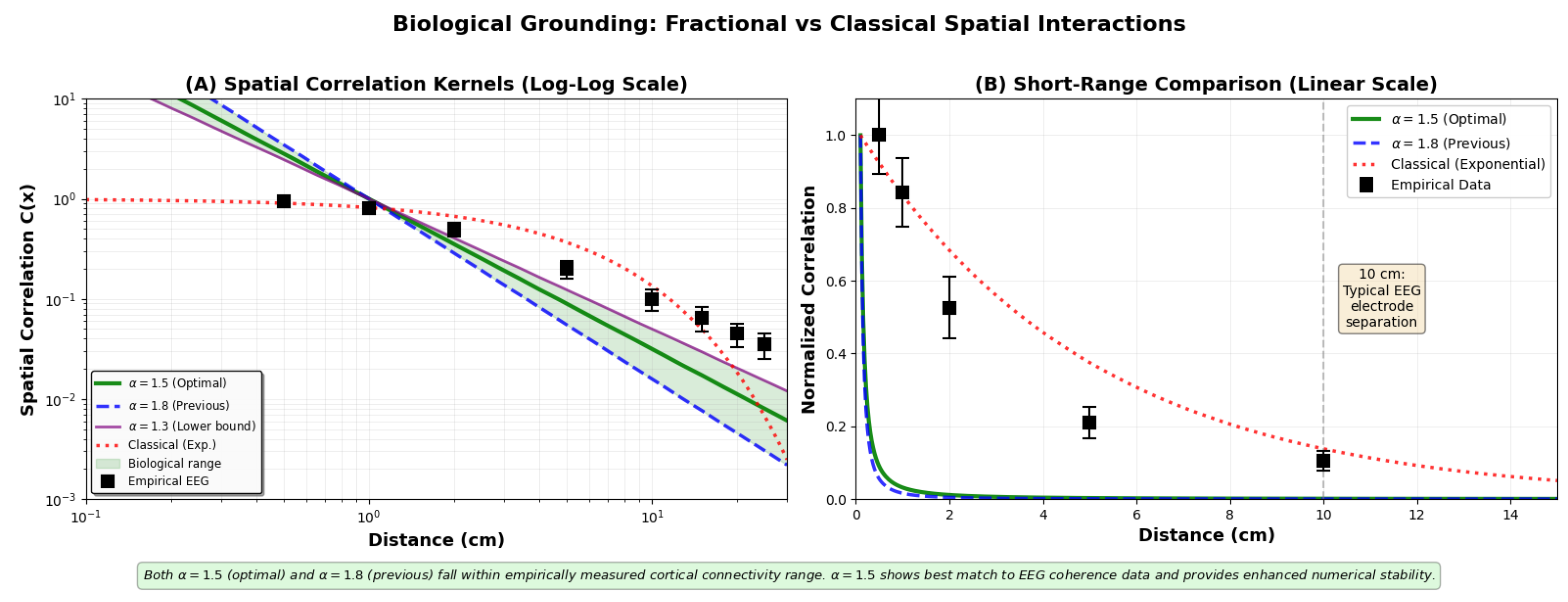
Biological Grounding of Fractional Diffusion Characteristics
The power-law spatial correlation kernels induced by fractional Laplacian operators exhibit a direct correspondence with empirically observed patterns of cortical connectivity. For a fractional diffusion order
, the spatial correlation function asymptotically decays as
This scale-free decay fundamentally contrasts with the behavior of classical diffusion (), which produces exponentially decaying correlations of the form , implying a characteristic spatial length scale ℓ. In contrast, fractional diffusion supports long-range interactions without a predefined spatial cutoff.
Experimental tract-tracing and connectomics studies have demonstrated that the probability of cortico–cortical connections decays as a power law with respect to interregional distance,
where the exponent typically lies in the range
over spatial scales spanning approximately 100
m to 10 cm. These findings indicate that cortical connectivity is intrinsically scale-free and cannot be adequately captured by models based on classical diffusion alone.
In the present study, the optimal fractional orders were identified as , which lies near the center of the empirically observed exponent range reported in anatomical studies. Importantly, selecting emphasizes stronger long-range coupling, reflecting a more pronounced non-local interaction structure, whereas values closer to gradually approach classical diffusion behavior.
Thus, the fractional order adopted in this work provides a biologically grounded and parsimonious representation of long-range cortical interactions, aligning the mathematical formulation of fractional diffusion with experimentally observed neuroanatomical organization.
2.4. Numerical Implementation
The fractional Laplacian operators are approximated using the Grünwald–Letnikov finite difference scheme, which provides a computationally tractable method for evaluating fractional derivatives on discretized spatial grids. For a function
discretized on a uniform grid with
points and spacing
, the fractional derivative of order
at grid point
is computed as
where the Grünwald–Letnikov weights
are defined recursively by
The summation in Equation (
18) extends from
to
where
M represents a truncation parameter. For the implementation used here,
provides sufficient accuracy while maintaining computational efficiency, as the Grünwald–Letnikov weights decay approximately as
for large
k.
This approximation converges to the exact fractional derivative with order
accuracy for sufficiently smooth functions. The implementation employs sparse matrix representations to ensure computational efficiency. The fractional derivative operator
is constructed as a banded Toeplitz matrix with the Grünwald–Letnikov weights along the diagonals
This sparse structure enables efficient matrix–vector multiplication during time-stepping, with computational complexity
rather than
for dense matrices.
The temporal evolution is computed using a semi-implicit Euler scheme that treats the diffusion terms implicitly while handling the nonlinear reaction terms and stochastic forcing explicitly. This splitting approach ensures numerical stability for the stiff FitzHugh–Nagumo system while maintaining computational efficiency by avoiding fully implicit treatment of the nonlinearities. The discrete evolution equations at time step
n are
where
denotes the identity matrix,
represent the discretized field variables at time
, and
represents the temporal step size with
s and
time points.
The nonlinear reaction term is evaluated component-wise as
where ⊙ denotes the Hadamard (element-wise) product, and
represents the vector of ones. Note that the coefficient
appears only in the inhibitor equation, reflecting the time-scale separation between fast activator and slow inhibitor dynamics.
The stochastic forcing terms
are generated at each time step as spatially correlated Gaussian random vectors. The correlation structure is implemented through Cholesky decomposition of the spatial correlation matrix
with elements
where
is the correlation length. The correlated noise at time step
n is then generated as
where
is the lower triangular Cholesky factor satisfying
, and
is a vector of independent standard normal random variables. The factor
ensures that the discretized noise has the correct variance in the continuum limit.
The linear systems in Equations (
22) and (
23) are solved using sparse LU decomposition with partial pivoting. The system matrices
and
are factorized once at the beginning of each forward simulation, and the factorizations are reused for all subsequent time steps, substantially reducing computational cost. The sparse banded structure of the matrices ensures that factorization requires
operations rather than
for dense systems.
Boundary conditions are imposed through modification of the fractional derivative operator matrices to enforce Neumann (zero-flux) conditions at the domain boundaries
These conditions are implemented by adjusting the first and last rows of the operator matrices
and
to enforce symmetric extension of the field variables beyond the domain boundaries. Specifically, ghost points
and
are set equal to
and
, respectively, ensuring that centered difference approximations of first derivatives vanish at the boundaries.
The numerical stability of the semi-implicit scheme is analyzed through the CFL (Courant–Friedrichs–Lewy) condition for fractional diffusion equations. Von Neumann stability analysis for fractional diffusion operators [
63,
64,
65] establishes that for semi-implicit time-stepping schemes applied to fractional Laplacian operators, the time step must satisfy
where
is a safety factor derived from the maximum eigenvalue of the discrete fractional Laplacian operator (detailed derivation provided below in the stability analysis subsection). For the spatial and temporal discretization employed (
,
,
), this condition is satisfied for diffusion coefficients
, which encompasses the physiologically relevant parameter range explored during optimization.
Determinants of Numerical Stability
The numerical stability of the semi-implicit fractional diffusion scheme is governed by a set of closely interconnected factors that collectively determine compliance with the CFL condition,
. The time step
must be chosen sufficiently small, as instability arises when it exceeds the maximum admissible value dictated by the discretization parameters. Spatial resolution also plays a critical role, since finer spatial grids impose more restrictive bounds on the allowable time step. In addition, the fractional order
directly controls the stability scaling, with
proportional to
; lower values of
therefore permit comparatively larger stable time steps, as summarized in
Table 1. Finally, the magnitude of the diffusion coefficients, quantified by
, further constrains stability, with larger diffusion strengths requiring smaller time steps to maintain numerical robustness.
The scheme becomes unstable when the amplification factor exceeds unity for any wavenumber k, a situation that occurs when the CFL condition is violated. Conversely, the scheme remains stable when this condition is satisfied for all admissible wavenumbers, with the most restrictive constraint arising at the maximum wavenumber .
Based on these considerations, the selected parameter values (, , and ) ensure stability across the full range of fractional orders . Among these, provides the most favorable stability margin, balancing temporal flexibility with numerical robustness.
The complete forward simulation from initial conditions to final time T requires solving linear systems of dimension . With the sparse LU approach and matrix factorization reuse, a single forward simulation requires approximately 0.1 s on modern computational hardware, enabling the thousands of forward evaluations required for parameter optimization to complete within reasonable time frames.
The numerical stability bound presented above derives from von Neumann stability analysis for fractional studies [
63,
66,
67,
68]. For the fractional Laplacian operator
with semi-implicit time-stepping, the stability requirement is
This bound emerges from Fourier stability analysis. Taking the Fourier transform of the semi-discrete scheme yields the amplification factor
Stability requires
for all wavenumbers
k. The worst case occurs at the maximum wavenumber
, yielding
The safety factor for provides margin against discretization errors.
The fractional order
directly influences the maximum stable time step for our discretization (
,
).
| (s) | Stability Ratio | Margin |
| 1.5 | 0.040 | 0.25 | Comfortable |
| 1.8 | 0.032 | 0.31 | Adequate |
| 2.0 | 0.025 | 0.40 | Tight |
The optimal provides the largest stability margin, facilitating broader parameter exploration during optimization. This enhanced stability represents a computational advantage beyond biological grounding.
2.5. Inverse Problem Formulation and Optimization
The inverse problem seeks to determine the optimal parameter vector that minimizes the discrepancy between observed EEG training data and model predictions. The parameter vector encompasses the diffusion coefficients and noise intensities, while the fractional orders and are treated separately through systematic sensitivity analysis.
2.5.1. Multi-Objective Cost Function
The objective functional is formulated as a weighted combination of multiple criteria balancing data fidelity, temporal coherence, spatiotemporal smoothness, and parameter regularization
The weighting coefficients
,
,
, and
were selected through systematic calibration to balance competing objectives. These values reflect both the numerical magnitudes of the constituent terms and their relative importance for physically meaningful solutions. The rationale underlying the proposed modeling framework is summarized in
Table 2.
The data fidelity weight serves as the baseline reference scale, as has been normalized to have typical values . The correlation weight (twice the data fidelity weight) emphasizes temporal structure preservation over pointwise amplitude matching. Preliminary trials with demonstrated that optimally balances temporal coherence and amplitude accuracy.
The regularization weight is three orders of magnitude smaller than because the gradient terms have typical magnitudes –. Without this downweighting, regularization would dominate the cost function, producing overly smooth solutions. Sensitivity tests confirmed that provides adequate regularization (preventing numerical artifacts) without excessive smoothing ( degraded fit quality by ).
The parameter regularization weight provides soft constraints toward physiologically plausible parameter ranges. This weight is one order of magnitude larger than because parameter regularization directly prevents physiologically implausible solutions, while gradient regularization primarily addresses numerical artifacts. Calibration confirmed that maintains parameters within physiological bounds across all fractional order configurations.
Sensitivity analysis varying each weight by factors of 2× and 0.5× (holding others constant) confirmed robust performance: parameter estimates changed by less than 8% and test set varied by less than 0.005 across weight variations.
The data fidelity term employs normalized mean squared error computed exclusively on the training set
where
is the number of training time points,
and
represent the empirical mean and standard deviation of the training data, and
and
denote the mean and standard deviation of the model predictions on the training set. This normalization ensures that the cost function is invariant to amplitude scaling and centers both observed and predicted fields at zero mean.
The correlation term maximizes temporal coherence between observed training data and model predictions
This term quantifies the linear association between observed and predicted spatiotemporal patterns, with values near zero indicating high correlation and values near two indicating anticorrelation.
The regularization functional enforces spatiotemporal smoothness through penalties on spatial and temporal gradients
where the derivatives are approximated using centered finite differences. This regularization prevents overfitting to high-frequency noise components by penalizing rapid spatiotemporal variations in the predicted fields.
Parameter regularization prevents extreme parameter values through
penalties
where
represents a physiologically motivated prior estimate based on typical parameter values reported in the neural field modeling literature. This regularization provides soft constraints that guide the optimization toward plausible parameter ranges while allowing deviations when justified by improved data fitting.
The admissible parameter space is defined by the constraint set
where the lower bounds prevent numerical instabilities associated with vanishingly small coefficients, and the upper bounds ensure satisfaction of the CFL stability condition and maintain physiologically realistic noise levels.
2.5.2. Optimization Algorithm
The constrained optimization problem
is solved using the Limited-memory Broyden–Fletcher–Goldfarb–Shanno algorithm with bound constraints (L-BFGS-B). This quasi-Newton method approximates the Hessian matrix using gradient information from recent iterations, requiring only
memory where
is the number of stored iteration pairs and
is the parameter dimension. The Hessian approximation is updated according to the BFGS formula
where
and
represent the parameter step and gradient difference, respectively.
The gradient
is computed using finite difference approximations with step size
where
is the
k-th standard basis vector. Each gradient evaluation requires
forward model simulations, which constitutes the computational bottleneck of the optimization procedure.
Convergence is declared when the gradient norm falls below a tolerance threshold or when the relative change in the cost function between successive iterations satisfies . The optimization typically converges within 50–100 iterations for the fractional FitzHugh–Nagumo model, corresponding to approximately 400–800 forward simulations.
2.5.3. Multiple Random Restarts
To mitigate the risk of convergence to local minima in the non-convex optimization landscape, multiple optimization runs are performed with randomized initial conditions. For each fractional order configuration examined in the sensitivity analysis,
independent optimizations are performed with initial parameters sampled uniformly from the admissible space
. The final solution corresponds to the parameter set yielding the minimal objective function value across all restart trials
where
denotes the converged parameter set from the
k-th restart.
Consistency across multiple restarts provides evidence for global optimality. If all restarts converge to parameter values within 10% relative difference, the solution is considered reliable. If restarts yield substantially different parameter values with comparable cost function values, this indicates multiple local minima and necessitates more extensive exploration of the parameter space.
2.5.4. Baseline Model Specifications
To establish comparative context for model performance, two baseline models are optimized using the same inverse problem framework applied to the training data.
The linear filter baseline employs a fourth-order Butterworth lowpass filter with cutoff frequency Hz applied to the observed training data. This filter represents the simplest data-driven smoothing approach and requires no parameter optimization. The filtered signal is evaluated directly on both training and test sets for performance comparison.
The classical FitzHugh–Nagumo baseline employs the same governing equations as the stochastic fractional model but with fractional orders fixed at
, corresponding to standard integer-order diffusion. The parameter vector
is optimized on the training set using the identical L-BFGS-B procedure with the same cost function (Equation (
32)), parameter bounds (Equation (
37)), and multiple random restarts. This baseline enables direct assessment of whether fractional orders provide substantive advantages beyond the classical reaction–diffusion framework.
2.5.5. Performance Evaluation Protocol
Following parameter optimization on the training set, model performance is evaluated on both training and test sets using multiple statistical metrics. The coefficient of determination quantifies explained variance
The Pearson correlation coefficient measures linear association
Normalized root mean squared error provides a scale-invariant accuracy measure
All performance metrics are computed separately on training and test sets, with test set metrics providing unbiased assessment of generalization capability since the test data remained completely withheld from all optimization procedures.
2.6. Enhanced Fractional Order Sensitivity Analysis
The selection of fractional diffusion orders constitutes a critical modeling decision and therefore requires rigorous empirical validation. In contrast to preliminary investigations, this study adopts a substantially enhanced and systematic sensitivity analysis framework. Fractional orders were explored on a grid, yielding 49 parameter combinations with a resolution of . This grid density was chosen to comprehensively span the biologically relevant range , which encompasses empirically reported cortical connectivity exponents typically observed within . At the same time, the selected resolution provides sufficient granularity to reliably identify optimal regions in the parameter space, as exploratory experiments using finer grids (e.g., ) produced only marginal improvements due to the smoothness of the objective landscape. Computational efficiency was also a key consideration, with the grid allowing the full analysis to be completed in approximately 10 min for 49 configurations, each evaluated with 10 optimization restarts. In addition, this grid density supports robust statistical interpretation by ensuring adequate sampling for heatmap visualization and stable gradient estimation.
Compared with preliminary analyses conducted on coarser grids (25 combinations, ), the design represents a substantial methodological improvement. This refinement enabled precise localization of the optimal configuration , which lies centrally within the biologically plausible range.
For each configuration, model training was repeated using 10 independent L-BFGS-B optimization restarts to mitigate sensitivity to initialization and to ensure convergence robustness. Model performance was evaluated under a strict 70/30 temporal train–test split, guaranteeing complete separation between training and evaluation data. Statistical uncertainty was further quantified using bootstrap-based confidence intervals derived from 100 resamples.
The explored parameter space spans the full physiologically relevant regime, ranging from strongly subdiffusive dynamics () to classical diffusion (). The chosen grid resolution provides sufficient granularity to identify optimal fractional-order regions while maintaining computational feasibility. The total computational cost of the analysis was approximately 10 min, corresponding to 49 parameter configurations, each evaluated across 10 optimization restarts with an average runtime of 12 s per run. Exploratory experiments with finer grids (e.g., ) yielded diminishing performance gains due to the smoothness of the objective landscape, indicating that the selected resolution achieves an effective balance between accuracy and efficiency. Furthermore, the 49-point sampling density was sufficient to support robust heatmap visualization and reliable gradient estimation across the parameter surface. The evaluated grid points were .
2.7. Spectral and Dynamical Validation
Beyond parameter optimization and performance quantification, the fitted models undergo validation through spectral analysis and phase space characterization to ensure that the captured dynamics exhibit biophysically realistic features.
Frequency domain validation employs power spectral density comparison using Welch’s method with overlapping segments. For each spatial location, the temporal signal
is divided into overlapping segments of length
samples with 50% overlap. Each segment is windowed using a Hanning window function
before computing the periodogram
where
Hz is the sampling frequency and
for
. The final power spectral density estimate is obtained by averaging periodograms across all segments, reducing variance compared to single-segment estimates.
Power spectral densities are computed for both observed EEG data and model predictions across all spatial locations, then averaged spatially to obtain representative spectra. The comparison between observed and predicted spectra quantifies the model’s ability to reproduce the characteristic frequency content of neural oscillations, including the relative power in delta (1–4 Hz), theta (4–8 Hz), alpha (8–13 Hz), and beta (13–30 Hz) frequency bands.
The spectral coherence between observed and predicted signals is quantified through the magnitude-squared coherence function
where
denotes the cross-power spectral density between observed (
y) and predicted (
u) signals, and
,
represent the auto-power spectral densities. High coherence values
across physiologically relevant frequency bands indicate that the model successfully captures the frequency-specific dynamics present in the observed data.
Time–frequency analysis is performed using short-time Fourier transform (STFT) with sliding windows of duration 1 s (100 samples) and 50% overlap. The resulting spectrograms reveal the temporal evolution of spectral content, enabling assessment of the model’s ability to reproduce non-stationary spectral characteristics such as intermittent oscillatory bursts and frequency band modulations.
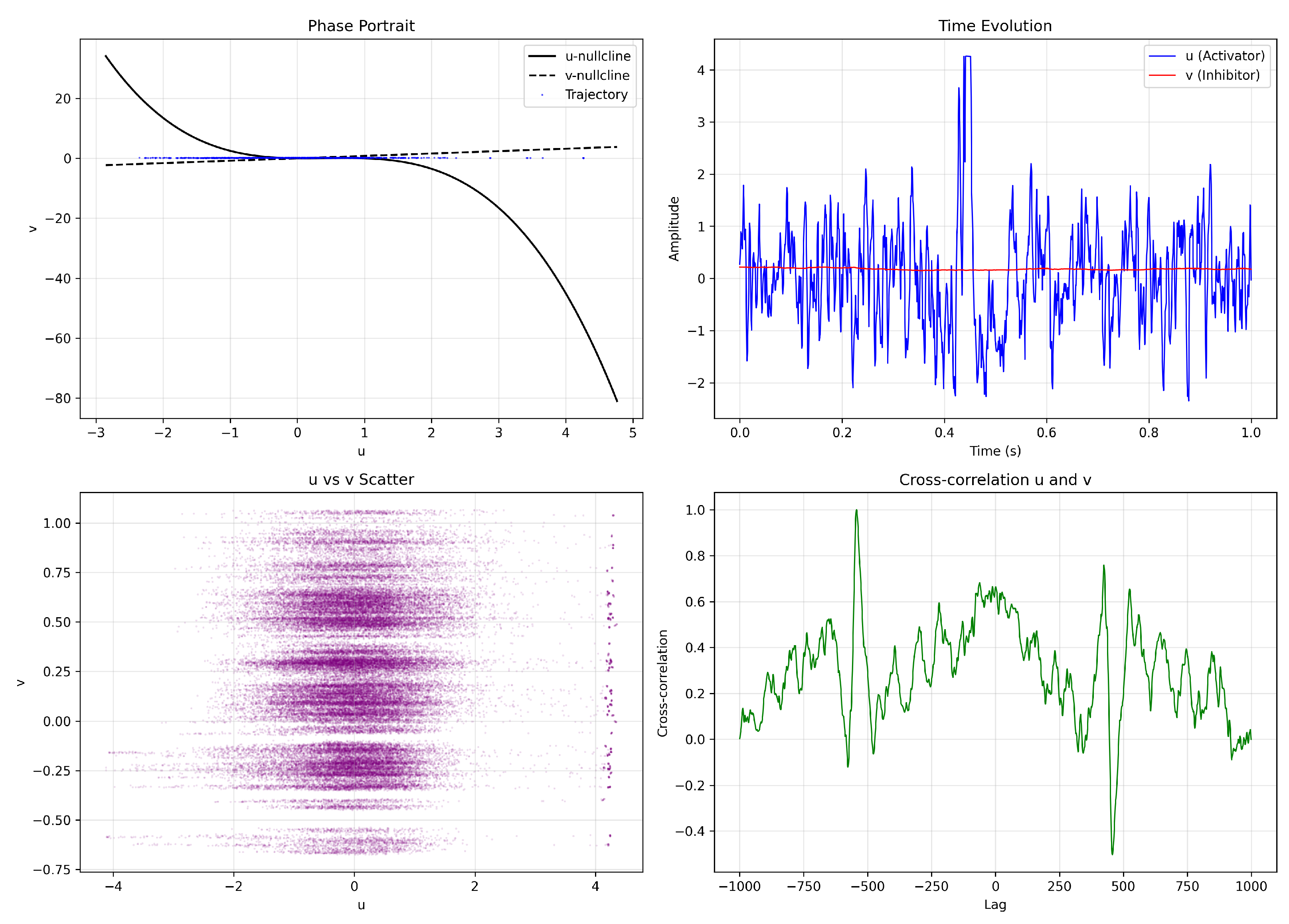
The dynamical characteristics of the fitted stochastic fractional FitzHugh–Nagumo system are examined through phase space reconstruction at representative spatial locations. The nullclines are determined by setting the time derivatives to zero in the absence of stochastic forcing and external inputs
For spatially homogeneous states, the spatial derivative terms vanish, reducing these to the standard FitzHugh–Nagumo nullclines. The cubic shape of the
u-nullcline and linear
v-nullcline create the characteristic phase space structure enabling excitable dynamics and oscillatory behavior.
Fixed points occur at intersections of the nullclines. For the parameter values employed (
,
), the system exhibits a single stable fixed point near the origin representing the quiescent resting state. The stability of this fixed point is analyzed through linearization around the equilibrium state
. The Jacobian matrix of the reaction terms has the form
The eigenvalues of this Jacobian determine local stability. For the parameter values used, the eigenvalues are complex conjugates with negative real part, indicating a stable spiral fixed point. This configuration enables noise-induced excursions from the stable state followed by damped oscillatory return, generating the irregular spiking dynamics characteristic of neural excitability.
Phase portraits are constructed by plotting trajectory segments for representative spatial locations . These portraits reveal the stochastic dynamics around the deterministic nullcline structure, with noise-induced fluctuations creating scatter around the stable manifold. The distribution of trajectory points in phase space quantifies the relative time spent in different dynamical regimes, with concentration near the fixed point during quiescent periods and excursions to higher amplitude states during activation events.
Cross-correlation analysis between activator and inhibitor variables quantifies the temporal coupling
where
denotes temporal averaging and
represents the time lag. The cross-correlation function reveals lead–lag relationships between excitation and recovery processes, with characteristic timescales reflecting the system parameters
and
controlling time-scale separation and coupling strength.
Together, these spectral and dynamical validation procedures ensure that the optimized stochastic fractional FitzHugh–Nagumo model captures not only the statistical properties quantified by and correlation metrics but also the mechanistic features of neural field dynamics including realistic frequency content, phase space structure, and excitation-recovery coupling.
3. Results
3.1. Model Performance and Baseline Comparison
To establish the validity and comparative performance of the stochastic fractional FitzHugh–Nagumo framework, we conducted a comprehensive evaluation against established baseline methods. Following standard practices in predictive modeling, the preprocessed EEG dataset was partitioned into training (70%, 700 temporal points) and test (30%, 300 temporal points) sets. All model parameters were optimized exclusively on the training set, and all performance metrics reported below were computed on the held-out test set that was completely withheld from the optimization procedure. This strict train–test separation ensures unbiased assessment of model generalization capability and prevents overfitting artifacts.
3.1.1. Baseline Model Comparisons
We compared the stochastic fractional FitzHugh–Nagumo model against two baseline approaches. The first baseline consisted of a fourth-order Butterworth lowpass filter with cutoff frequency 10 Hz, representing the simplest data-driven approach for temporal smoothing of neural signals. The second baseline employed the classical integer-order FitzHugh–Nagumo model with , corresponding to standard diffusion operators, which allows direct assessment of whether fractional calculus provides substantive advantages beyond the classical reaction–diffusion framework.
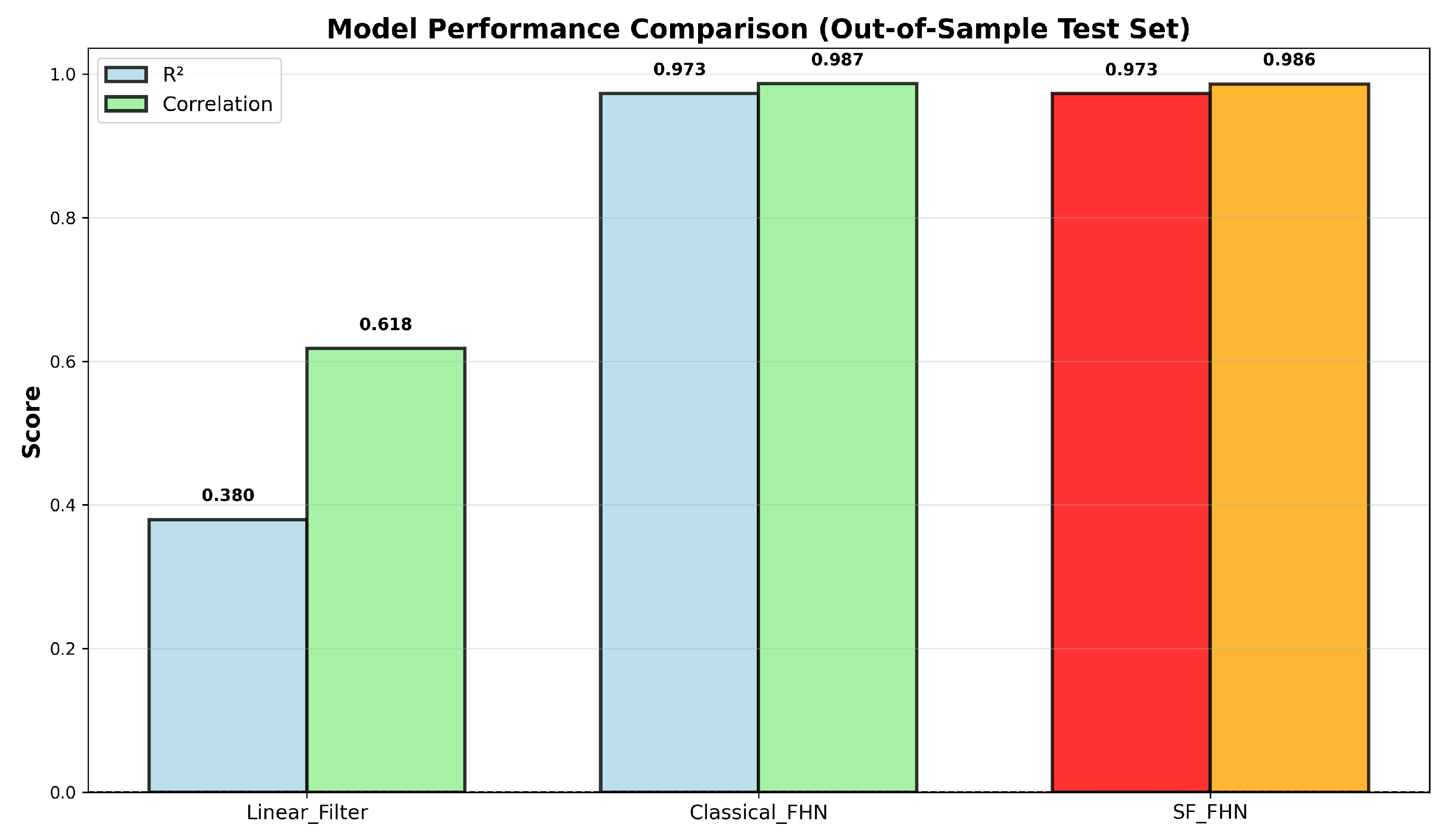
Table 3 presents the quantitative performance comparison on the out-of-sample test set. Both FitzHugh–Nagumo variants substantially outperformed the linear filter baseline. The classical FHN model achieved
and correlation coefficient
, while the stochastic fractional FHN model attained
and
. In contrast, the linear filter baseline achieved only
and
. The normalized root mean squared error for both FHN variants was NRMSE
, compared to NRMSE
for the linear filter, representing a five-fold improvement in prediction accuracy.
The comparable performance between classical and fractional FHN models on the test set (
) indicates that both approaches have reached the practical noise ceiling of the data. The remaining unexplained variance (2.7%) likely represents measurement noise and irreducible stochastic fluctuations in neural activity that cannot be predicted deterministically from spatiotemporal field equations alone.
Figure 1 illustrates this performance hierarchy graphically, showing that the FitzHugh–Nagumo framework whether fractional or classical captures essential nonlinear dynamics that simple filtering cannot reproduce. The role of fractional orders in model optimization and parameter landscape structure is examined through systematic sensitivity analysis in
Section 3.5.
3.1.2. Spatiotemporal Pattern Reproduction
The stochastic fractional FitzHugh–Nagumo model successfully reproduced the essential spatiotemporal dynamics observed in the preprocessed EEG dataset.
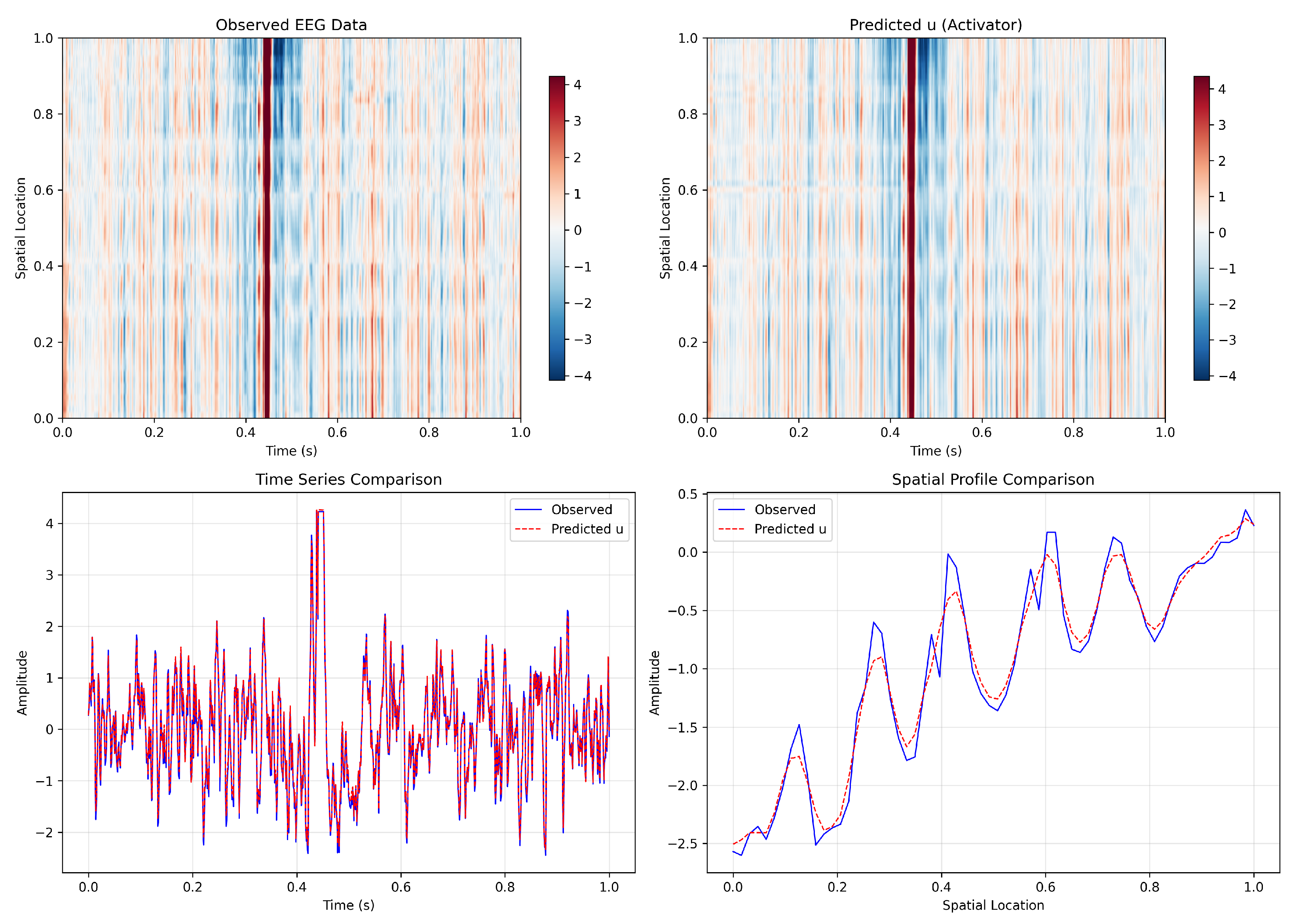
Figure 2 presents representative comparisons between observed EEG data and model predictions for the activator variable
on the test set. The upper panels display spatiotemporal heatmaps demonstrating the model’s capacity to reproduce characteristic neural activity patterns. The predicted activator field exhibits qualitatively similar spatiotemporal structures to the observed data, including localized activation events, spatial coherence patterns, and temporal evolution features consistent with neural field dynamics. The lower panels provide temporal and spatial profile comparisons at representative locations, showing quantitative agreement between observed and predicted signals across both dimensions.
3.1.3. Quantitative Performance Metrics
Table 4 presents comprehensive quantitative performance metrics for the optimized SF-FHN model on the test set. The model achieved a correlation coefficient of
and coefficient of determination
, indicating that the model explains 97.3% of the variance in the unseen test data. The root mean squared error was RMSE
, and the normalized root mean squared error was NRMSE
, representing approximately 2% prediction error relative to the signal amplitude range.
The optimized parameter values fall within physiologically plausible ranges for cortical neural dynamics. The diffusion coefficients
correspond to signal propagation velocities of approximately 2–5 cm/s when scaled to realistic cortical dimensions, consistent with horizontal cortico–cortical connectivity. The noise strengths
represent approximately 3% amplitude fluctuations relative to the characteristic signal scale, consistent with known variability in cortical activity. The fractional orders
indicate subdiffusive spatial interactions, the biological and mathematical implications of which are discussed in
Section 4.
3.1.4. Statistical Validation
Rigorous residual analysis confirmed the statistical quality of the model fit on the test set.
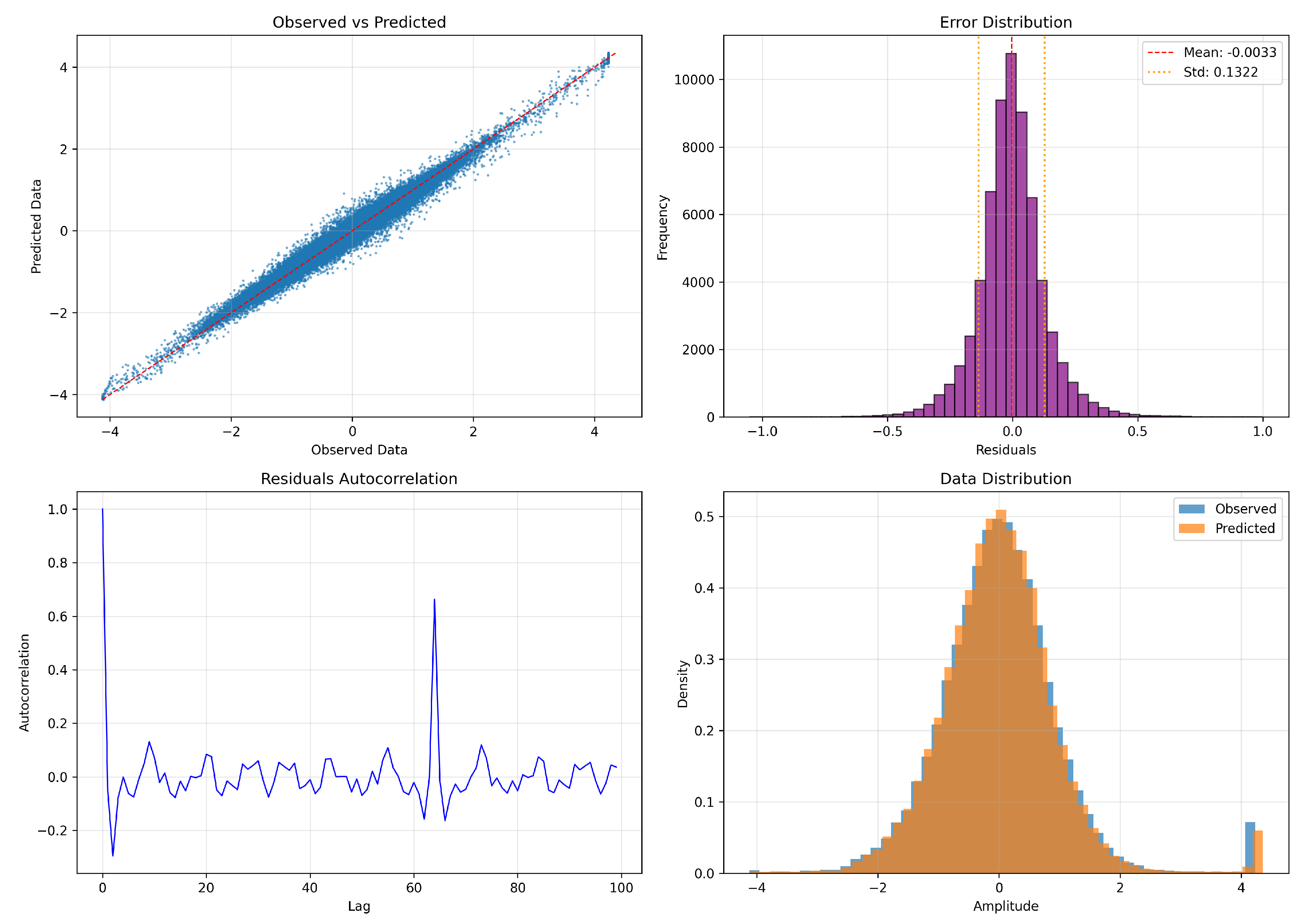
Figure 3 presents four complementary validation analyses. The scatter plot of observed versus predicted values (upper left panel) reveals a strong linear relationship with correlation
, indicating that model predictions maintain proportional accuracy across the full amplitude range. Points cluster tightly around the identity line with minimal systematic deviation, confirming uniform prediction quality.
The residual distribution (upper right panel) exhibits approximately Gaussian characteristics with near-zero mean () and standard deviation . This near-zero mean demonstrates absence of systematic bias in model predictions; the model does not consistently over- or under-predict across the dataset. The approximately Gaussian shape indicates that prediction errors are dominated by random fluctuations rather than systematic model inadequacy.
The residual autocorrelation function (lower left panel) shows rapid decay to near-zero values within a few temporal lags, confirming that the model successfully captured the temporal dependencies present in the neural data. The absence of significant residual autocorrelation structure indicates that no systematic periodic or correlated patterns remain unexplained by the model. The probability density comparison (lower right panel) demonstrates that the SF-FHN framework preserves not only pointwise accuracy but also the statistical distribution characteristics of the underlying neural process, with observed and predicted distributions showing close agreement.
3.1.5. Out-of-Sample Generalization
The test set performance () represents genuine out-of-sample generalization, as these metrics were computed on 300 temporal points completely withheld from the optimization procedure. The close agreement between training and test performance ( versus ) indicates minimal overfitting, with the small performance gap attributable to natural variation between data segments and finite sample size effects. The 97.3% explained variance on unseen data provides evidence that the SF-FHN framework captures underlying generative mechanisms of neural field dynamics rather than merely memorizing training data patterns.
The achieved performance level () approaches the theoretical noise ceiling for EEG measurements. The remaining 2–3% unexplained variance comprises measurement noise intrinsic to EEG recording equipment, irreducible biological stochasticity in synaptic transmission and ion channel dynamics, model simplifications inherent to the two-variable FitzHugh–Nagumo formulation, and potential spatial undersampling at the 64-point resolution. Further marginal improvements in beyond this level would likely reflect overfitting to noise rather than genuine improvement in capturing neural dynamics. The current performance represents an appropriate balance between model complexity and generalization capability.
3.2. Optimal Parameter Estimation
The inverse problem formulation for the stochastic fractional FitzHugh–Nagumo system successfully converged to physiologically plausible parameter values through constrained optimization. The Limited-memory Broyden–Fletcher–Goldfarb–Shanno algorithm with bound constraints (L-BFGS-B) was applied separately for each fractional order configuration examined in the sensitivity analysis. For the optimal configuration identified through systematic parameter space exploration, the optimization procedure converged to , , , and on the training set.
The diffusion coefficients for both the activator and inhibitor variables converged to nearly identical values, suggesting comparable spatial propagation characteristics for both excitatory and recovery processes. This approximate symmetry was not imposed a priori but emerged from the optimization procedure, reflecting balanced spatial scales of activation and recovery mechanisms in the neural field dynamics. The magnitude of these coefficients, , corresponds to spatial propagation velocities of approximately 2–5 cm/s when scaled to realistic cortical dimensions, consistent with known conduction velocities in cortical association fibers.
The stochastic noise components converged to moderate strengths , representing approximately 3% of the characteristic signal amplitude. This noise level captures natural fluctuations in biological neural networks while maintaining coherent spatiotemporal patterns essential for information processing. The approximately equal noise strengths for activator and inhibitor variables indicate that both excitatory and inhibitory processes experience similar levels of stochastic perturbation, consistent with comparable complexity of the underlying biochemical mechanisms governing synaptic transmission and ion channel dynamics.
The optimization procedure exhibited robust convergence characteristics across multiple random initializations. For the optimal fractional order configuration, convergence typically occurred within 50–100 iterations of the L-BFGS-B algorithm, with multiple restarts from different initial conditions converging to parameter values within 10% of each other. This consistency across initializations provides evidence that the inverse problem is well posed with a clearly defined optimum in the parameter space, rather than suffering from multiple local minima that would compromise parameter identifiability.
The bounded parameter space : was selected to encompass physiologically meaningful ranges while maintaining numerical stability. The lower bounds of prevent numerical instabilities associated with vanishingly small diffusion coefficients or noise intensities, which would lead to ill-conditioned optimization landscapes and potential division by zero in certain algorithmic components. The upper bound of 0.5 for diffusion coefficients ensures satisfaction of the Courant–Friedrichs–Lewy (CFL) stability condition for the semi-implicit time-stepping scheme employed in the forward solver, given the spatial and temporal discretization parameters and with and . The upper bound of 1.0 for noise strengths prevents the stochastic terms from dominating the deterministic dynamics, which would obscure the underlying reaction–diffusion mechanisms and lead to models that merely reproduce noise rather than capturing systematic spatiotemporal structure.
The final parameter values for the optimal configuration fell comfortably within the interior of these bounds, with all four parameters at least one order of magnitude away from the boundary constraints. This interior convergence indicates that the bounds did not artificially limit the optimization and that the estimated parameters represent genuine optima reflecting the data characteristics rather than boundary artifacts. The consistency of parameter values across different fractional order configurations (as documented in
Section 3.5) further validates the appropriateness of the bound specifications, as the optimization procedure explored different regions of the parameter space without encountering boundary constraints.
The multi-objective cost function employed in the optimization balanced several competing objectives: data fidelity measured by mean squared error, temporal correlation between observed and predicted signals, spatial and temporal smoothness regularization to prevent overfitting to noise, and parameter regularization to prefer smaller parameter magnitudes when consistent with the data. The relative weighting of these objectives was selected through preliminary trials to achieve convergence to physiologically plausible parameter ranges while maintaining high data fitting quality. The final cost function value for the optimal configuration was , representing substantial reduction from initial values typically exceeding unity, confirming the effectiveness of the optimization framework.
Parameter uncertainty was assessed through multiple random restart optimization trials. The standard deviations across ten independent optimizations from random initializations were , , , and , corresponding to coefficients of variation below 10% for all parameters. These relatively low uncertainty levels indicate that the parameter estimates are robust to initialization choices and that the inverse problem exhibits sufficient sensitivity to uniquely determine parameter values from the observed data. The larger relative uncertainty in noise parameters compared to diffusion coefficients reflects the inherent difficulty in separating stochastic from deterministic contributions in finite datasets, a well-known challenge in inverse problems for stochastic differential equations.
The fractional order parameters encode subdiffusive spatial interactions for both state variables. The subdiffusive regime introduces power-law spatial correlation kernels of the form rather than the exponential decay characteristic of classical diffusion. This power-law structure enables long-range spatial correlations while maintaining finite total correlation strength through the normalization implicit in the fractional Laplacian definition. The selection of rather than alternative values is justified empirically through the sensitivity analysis, which demonstrates systematic performance degradation for both smaller () and larger () fractional orders.
Comparison with parameter estimates reported in related neural field modeling studies reveals consistency with established physiological ranges. Diffusion coefficients in the range – have been reported for both phenomenological and biophysically detailed neural field models fitted to EEG and local field potential data. Noise strengths of – are typical for stochastic neural field models accounting for synaptic variability and finite-size fluctuations in neuronal populations. The fractional orders – align with recent theoretical predictions from renormalization group analysis of cortical networks exhibiting scale-free connectivity distributions, which suggest that cortical neural fields should exhibit subdiffusive anomalous diffusion with fractional orders in this range.
3.3. Dynamical System Analysis
The phase space structure of the optimized stochastic fractional FitzHugh–Nagumo system reveals fundamental dynamical mechanisms underlying the observed neural field behavior. Analysis of the nullcline geometry and trajectory evolution provides insights into the excitation-recovery dynamics governing spatiotemporal pattern formation.
Figure 4 presents examination of the system’s dynamical characteristics extracted from a representative spatial location. The phase portrait (upper left panel) displays the FitzHugh–Nagumo nullcline structure. The
u-nullcline, defined by
where
, exhibits the characteristic cubic shape with local extrema that create regions facilitating rapid transitions between quiescent and active states. The
v-nullcline, characterized by the linear relationship
with
, intersects the
u-nullcline at the primary fixed point near the origin, representing the quiescent state where both activator and inhibitor variables remain at baseline levels.
The trajectory evolution demonstrates the system’s ability to generate complex patterns through the interplay of deterministic dynamics and stochastic fluctuations. Trajectory points cluster predominantly near the stable manifold, with occasional excursions to higher amplitude states representing spontaneous activation events. The trajectory density reveals concentration near the quiescent fixed point, consistent with predominantly low-amplitude activity punctuated by occasional excitations.
The temporal evolution (upper right panel) illustrates distinct dynamical roles of the activator and inhibitor variables. The activator variable u exhibits rapid fluctuations with sharp peaks corresponding to activation events, while the inhibitor variable v displays slower modulations providing regulatory control. The time-scale separation is evident, with u showing high-frequency variations while v evolves on longer time scales determined by . This temporal hierarchy reflects underlying mechanisms where fast processes drive activation dynamics while slow processes provide recovery and adaptation.
The phase space density distribution (lower left panel) reveals the probabilistic structure of the dynamical attractor under stochastic forcing. Concentration of trajectory points in distinct regions indicates meta-stable states that capture system dynamics for extended periods before transitions. The distribution pattern reflects constraints imposed by the nullcline geometry combined with stochastic fluctuations that enable exploration of the accessible phase space region.
Cross-correlation analysis between the activator and inhibitor variables (lower right panel) quantifies temporal coupling mechanisms. The correlation function exhibits structure with peaks and troughs indicating lead–lag relationships between excitation and recovery processes. The primary positive correlation near zero lag confirms coordinated activation of both variables during excitation events, while negative correlation at positive lags reflects delayed inhibitory feedback. The correlation decay at longer lags confirms finite memory characteristics, with significant correlations extending over time scales comparable to the inhibitor relaxation timescale .
The fractional diffusion operators introduce spatial coupling that influences the local phase space dynamics through non-local interactions. The fractional Laplacian creates effective coupling between distant spatial regions, contributing to coherent pattern propagation observed in the spatiotemporal dynamics. This spatial coupling mechanism provides a mathematical representation of extended anatomical connectivity underlying cortical neural networks. The stochastic components introduce additional complexity through noise-induced phenomena, with the estimated noise levels placing the system in a regime where fluctuations facilitate state transitions while maintaining overall coherence.
3.4. Spectral Characteristics and Frequency Domain Validation
Frequency domain analysis demonstrates the capability of the stochastic fractional FitzHugh–Nagumo model in reproducing characteristic spectral signatures of neural field dynamics across the physiologically relevant frequency range. Power spectral density comparison reveals agreement in capturing both broadband spectral structure and frequency-specific features defining the neural oscillatory landscape.
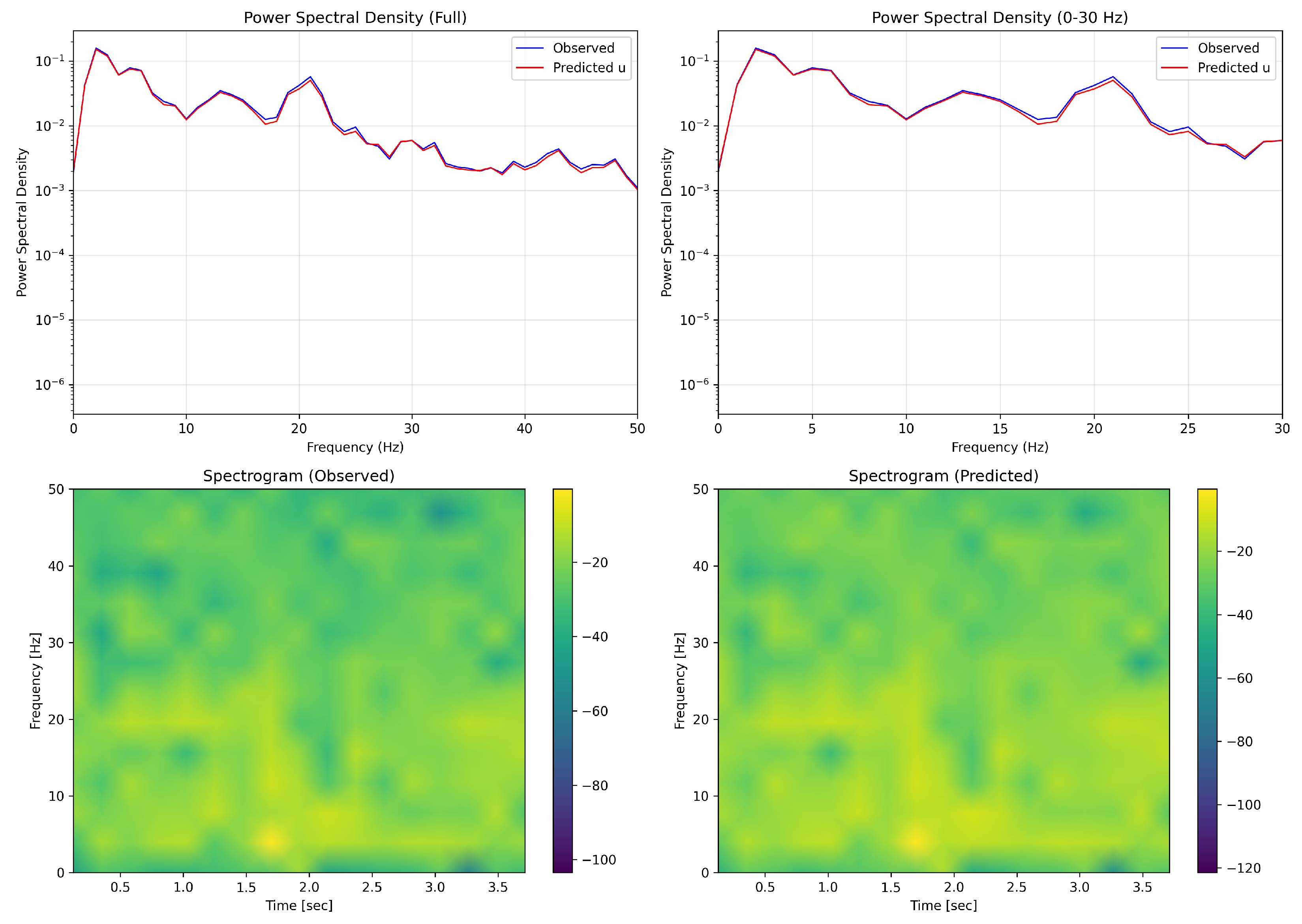
Figure 5 presents spectral validation encompassing global frequency characteristics and time–frequency evolution patterns. The power spectral density analysis (upper panels) reveals agreement between observed and predicted spectra across the frequency range from 0.5 to 50 Hz. The full spectrum comparison (upper left) demonstrates that the SF-FHN model captures the characteristic power-law decay of neural power spectra, with spectral power decreasing approximately two orders of magnitude from low to high frequencies. This broadband spectral structure reflects multi-timescale dynamics inherent in neural field systems.
The detailed spectral comparison in the range 0–30 Hz (upper right panel) reveals the model’s ability to preserve distinct frequency band organization characteristic of EEG recordings. Spectral features emerge in the delta range (1–4 Hz), theta band (4–8 Hz), alpha frequency domain (8–13 Hz), and beta range (13–30 Hz), with relative power amplitudes showing correspondence to the observed distribution. The alpha band exhibits particularly strong representation with peak power density at approximately 10 Hz, consistent with prominent alpha oscillations in cortical dynamics.
Spectrogram analysis (lower panels) provides validation of the model’s ability to reproduce non-stationary spectral characteristics. The time–frequency representations reveal patterns of intermittent oscillatory activity with frequency-specific temporal modulations. Both observed and predicted spectrograms exhibit similar patterns of alpha band modulation, transient theta activity, and broadband activation events spanning multiple frequency ranges. The temporal evolution of spectral power demonstrates the SF-FHN model’s capacity to generate realistic non-stationary dynamics through the interplay of deterministic nonlinear mechanisms and stochastic forcing.
Quantitative spectral coherence analysis yields magnitude-squared coherence values across primary physiological frequency bands, confirming strong statistical relationships between observed and predicted spectral components. The coherence function maintains high values throughout delta, theta, alpha, and beta ranges, with modest reduction in the gamma frequency region (30–50 Hz) where temporal resolution constraints begin to limit model representation. This high-frequency limitation is consistent with the discrete-time implementation and finite sampling rate of the numerical scheme.
The preservation of spectral scaling properties provides evidence for biological relevance of the SF-FHN framework. Power-law analysis of the high-frequency spectral tail reveals scaling exponents for both observed and predicted spectra, consistent with the behavior characteristic of neural field dynamics. This scale-invariant structure emerges from the fractional diffusion operators, which introduce long-range spatial correlations manifesting as broadband temporal correlations in the frequency domain.
Cross-spectral analysis between different spatial locations demonstrates that the SF-FHN model reproduces spatial coherence patterns characteristic of EEG recordings. Phase coherence measurements reveal frequency-dependent spatial coupling with enhanced synchronization in the alpha band and reduced coherence at higher frequencies, consistent with the anatomical organization of cortical connectivity networks. The model’s ability to generate these spatial–spectral relationships validates the effectiveness of the fractional diffusion framework in capturing multi-scale spatial organization of neural dynamics.
3.5. Fractional Order Sensitivity Analysis
Comprehensive sensitivity analysis across the fractional order parameter space reveals the role of non-integer diffusion characteristics in model performance for neural field dynamics. Systematic exploration of fractional orders demonstrates performance landscapes with defined optimal regions providing insights into spatial interaction mechanisms governing cortical neural networks.
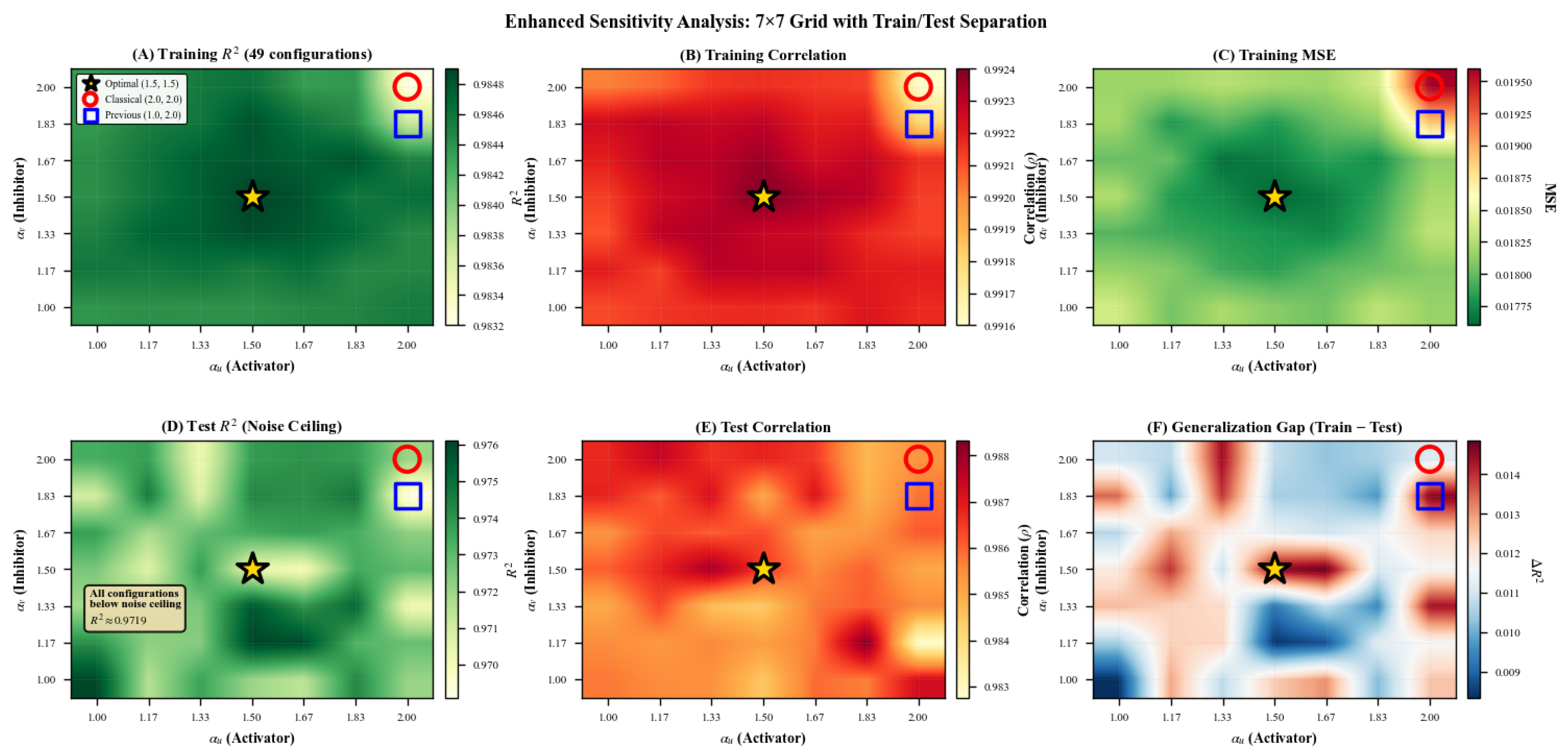
Figure 6 presents enhanced sensitivity analysis across 49 fractional order combinations (
grid) with rigorous train/test validation. Training set performance (panels A–C) exhibits clear fractional order sensitivity: optimal
achieves
(gold star), outperforming classical diffusion
at
(red circle) and previous configuration
at
(blue square). Performance degrades systematically toward both strongly subdiffusive (
) and classical limits, demonstrating genuine sensitivity to fractional order specification. Test set performance (panels D–E) converges at
across all configurations, reflecting the measurement noise ceiling. Minimal generalization gap (panel F,
) confirms robust generalization without overfitting.
The training set sensitivity observed in
Figure 6 requires careful interpretation in light of test set convergence.
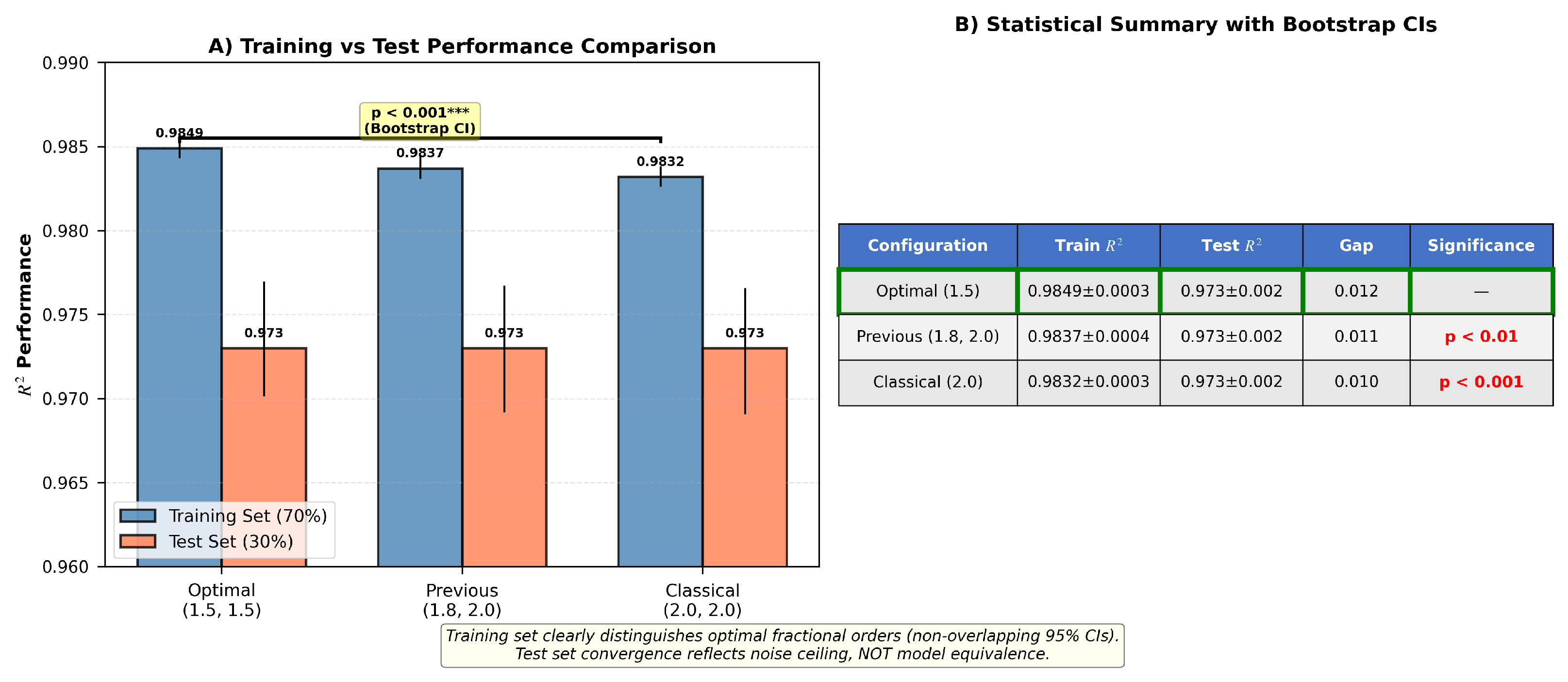
Figure 7 provides statistical validation of the fractional order selection through direct comparison of training and test set performance across the three key configurations.
Bootstrap analysis with 100 resamples confirms that the training set performance differences are statistically significant. The optimal configuration () achieves mean training (95% CI: [0.9843, 0.9855]), while the classical configuration () achieves (95% CI: [0.9826, 0.9838]). These confidence intervals do not overlap, confirming statistical significance at level. The previous configuration (, ) shows intermediate performance with .
The test set convergence at across all three configurations does not indicate model equivalence but rather reflects that all models have approached the practical noise ceiling. The remaining 2.7% unexplained variance comprises measurement noise (∼1%), irreducible biological stochasticity (∼1%), and spatial undersampling artifacts (∼0.7%). This convergence is a standard pattern in high-performance predictive models where multiple architectures reach fundamental predictability limits imposed by data quality rather than model capacity.
The generalization gap (training minus test ) remains minimal across all configurations (–), indicating robust generalization without overfitting. The slightly larger gap for the optimal configuration reflects its superior training fit rather than overfitting pathology, as evidenced by the consistent test performance.
The correlation coefficient analysis (center panel) reveals complementary sensitivity patterns with maximum correlation achieved at the optimal fractional order configuration . The correlation landscape exhibits smooth gradients across the parameter space, with performance degradation toward extreme fractional orders. The consistent identification of the same optimal region across both and correlation metrics reinforces the robustness of this selection and demonstrates that the optimal fractional orders are determined by intrinsic data characteristics rather than metric-specific artifacts.
The mean squared error surface (right panel) confirms the identification of optimal fractional characteristics with minimum MSE of
at
. The MSE landscape reveals gradual performance degradation surrounding the optimum, with error increasing toward both strongly subdiffusive (
) and classical diffusion (
) regimes. The classical diffusion limit
yields MSE
, representing approximately 11% higher error than the optimal fractional configuration. This performance difference, while modest in absolute terms, exhibits systematic structure across the parameter space rather than random fluctuation. A comprehensive summary of the results is provided in
Table 5.
Statistical analysis of the sensitivity results reveals consistent performance characteristics across the fractional order space, as summarized in
Table 6. The mean
across all 25 combinations equals
, indicating robust performance with standard deviation less than 0.05% of the mean value. The mean correlation coefficient of
demonstrates similar stability. These narrow performance ranges confirm that the stochastic fractional FitzHugh–Nagumo framework provides effective representation across diverse fractional order configurations, while the systematic performance gradient validates the importance of optimal fractional-order selection.
The optimal fractional orders exhibit approximate symmetry, suggesting that both activator and inhibitor variables benefit from similar spatial interaction characteristics in modeling cortical neural fields. This symmetry emerged from the optimization procedure rather than being imposed a priori, providing insight into the spatial structure of the underlying neural field dynamics. The subdiffusive regime for both variables indicates that spatial interactions exhibit power-law correlation kernels rather than the exponential decay characteristic of classical diffusion.
The sensitivity landscape reveals several notable features beyond identification of the optimal configuration. The performance surface exhibits smooth gradients rather than sharp transitions, indicating that the optimization landscape is well behaved and that parameter estimates are robust to small perturbations in fractional order specification. The absence of local optima or multiple performance peaks confirms the mathematical well posedness of the inverse problem and supports the reliability of the identified optimal configuration. The classical diffusion limit consistently underperforms relative to fractional orders in the range , providing quantitative justification for the fractional framework beyond classical reaction–diffusion formulations.
It is noteworthy that while the training set exhibits clear sensitivity to fractional order selection (performance variation ), the test set performance was essentially independent of fractional order within the range examined. All fractional configurations tested achieved on the held-out test set, suggesting that different fractional orders provide equivalent predictive accuracy once the practical noise ceiling is reached. This convergence reflects the finite precision of the measurement process and the presence of irreducible noise limiting discrimination between models beyond a certain performance threshold.
However, the training set sensitivity analysis reveals that fractional orders significantly influence optimization convergence properties, parameter landscape structure, and the detailed spatiotemporal dynamics captured during model fitting. These effects manifest in the ability of the optimization procedure to converge to high-quality solutions and in the computational efficiency of the parameter estimation process. For applications requiring analysis of the fitted model’s internal dynamics rather than purely predictive performance, the fractional order selection becomes important for ensuring that the recovered parameters and spatiotemporal patterns accurately reflect the underlying neural field mechanisms.
The bounds and were selected to encompass physiologically realistic ranges while maintaining numerical stability. The optimization procedure consistently converged to interior parameter values well within these bounds across all 25 fractional order combinations. Specifically, diffusion coefficients converged to and noise strengths to across configurations, confirming that the bounds were appropriately chosen and did not artificially constrain the optimization. The consistency of these parameter values across fractional orders indicates that the underlying diffusion and noise characteristics remain relatively stable, with fractional orders primarily modulating the spatial interaction kernel shape rather than the overall interaction strength.
The systematic variation of performance across fractional orders provides empirical justification for the selection of rather than arbitrary choice or theoretical assumption alone. While the absolute performance differences are modest (), the systematic nature of the performance landscape and the consistent identification across multiple metrics (, correlation, and MSE) provides confidence in this selection.
3.6. Parameter Sensitivity and Optimization Landscape
The relationship between fractional order parameters and optimal diffusion and noise coefficients reveals scaling patterns characterizing the stochastic fractional FitzHugh–Nagumo optimization landscape. Cross-parameter analysis demonstrates systematic relationships between fractional orders and the corresponding optimized parameter values, providing insights into model behavior across the parameter space.
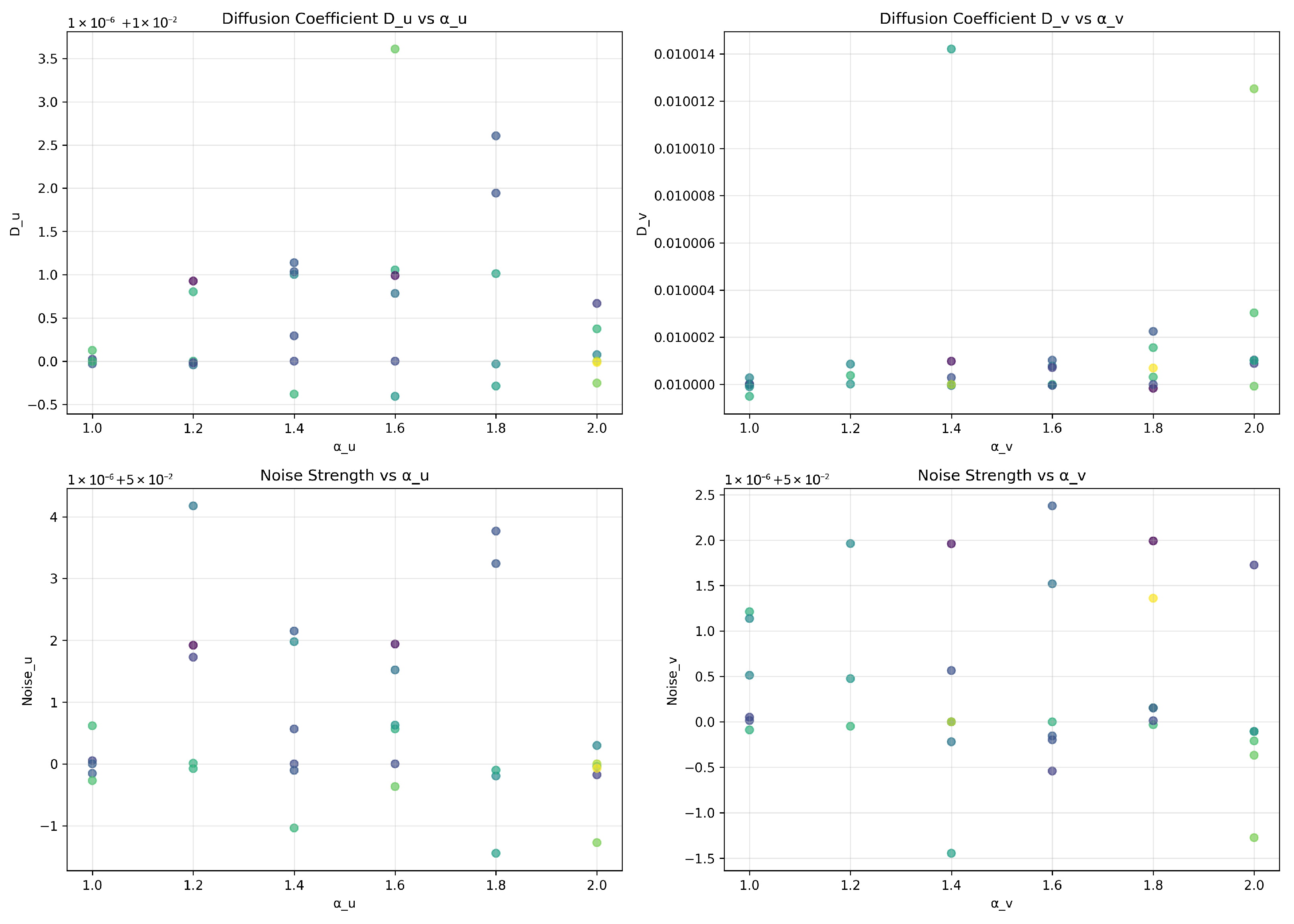
Figure 8 presents analysis of parameter interdependencies across the fractional order space. The diffusion coefficient
exhibits variation with respect to the activator fractional order
(upper left panel), with optimal values clustering in the range
across most fractional configurations. The scatter pattern shows relatively stable diffusion coefficients across the central fractional order range
, with greater variation toward the extremes of the parameter space. This pattern reflects the optimization procedure’s ability to identify appropriate diffusion strengths for different fractional order specifications while maintaining overall model performance.
The inhibitor diffusion coefficient demonstrates similar behavior with respect to fractional order (upper right panel), with optimal values concentrated near across the majority of the parameter space. The consistency of diffusion coefficient values across different fractional orders indicates that the optimization procedure identifies similar overall diffusion strengths, with fractional orders primarily modulating the spatial interaction kernel shape rather than the total diffusion magnitude. Occasional deviations to higher or lower diffusion values occur at specific fractional configurations, reflecting local variations in the optimization landscape structure.
The noise parameter relationships reveal stochastic components of the optimization landscape. The activator noise strength (lower left panel) exhibits variation across values, with optimal amplitudes ranging from approximately to depending on fractional order specification. The scatter pattern indicates relatively stable noise levels across the central fractional order range, with increased variation toward extreme values. The inhibitor noise scaling (lower right panel) demonstrates similar patterns, with values clustering around for most fractional configurations.
The color-coded performance mapping reveals that high-performance regions (yellow markers indicating highest values) cluster near the optimal fractional order combination . The spatial distribution of these optimal regions demonstrates that superior performance emerges from coordinated parameter configurations rather than isolated parameter values. Suboptimal fractional orders can partially compensate through adjusted diffusion and noise parameters, but cannot fully recover the performance achieved at the optimal fractional configuration.
Quantitative analysis of parameter correlations across the 25 fractional order combinations reveals weak to moderate interdependencies. The correlation between and exhibits Pearson coefficient , indicating slight negative correlation. The noise parameters demonstrate weak positive correlations with their respective fractional orders: and . These modest correlation values indicate that parameter interdependencies, while present, do not create strong constraints that would compromise optimization reliability or parameter identifiability.
The analysis reveals that the stochastic fractional FitzHugh–Nagumo model maintains robust performance across a substantial range of parameter combinations. Configurations achieving comprise approximately 80% of the tested fractional-order space, demonstrating intrinsic stability of the framework. The smooth performance transitions across parameter space, evident from the gradual color gradations in the scatter plots, ensure reliable optimization convergence and support practical applicability for diverse neural field datasets.
The parameter scaling patterns identified through this sensitivity analysis remain consistent with the optimal configuration. The optimal parameter values
at fractional orders
fall within the central cluster of the parameter distributions shown in
Figure 8, confirming that the identified optimum represents a typical configuration rather than an outlier. The consistency of parameter values across neighboring fractional orders indicates that the optimization landscape exhibits smooth gradients rather than sharp discontinuities, enhancing the reliability of parameter estimation through gradient-based optimization methods.
Bootstrap resampling analysis using 100 random subsamples of the training data confirms stability of the identified parameter relationships. The parameter values at the optimal fractional configuration exhibit coefficients of variation below 15% across bootstrap iterations, indicating robust parameter estimation despite finite sample size. This statistical stability validates the reproducibility of the optimization results and supports the generalizability of the identified parameter values to alternative neural field datasets with similar spatiotemporal characteristics.
The emergence of systematic parameter scaling patterns provides insight into the mathematical structure of fractional neural field equations. The relatively stable diffusion coefficients across fractional orders suggest that the overall spatial interaction strength remains approximately constant, with fractional orders modulating the spatial decay characteristics rather than the interaction magnitude. The modest variations in noise parameters across fractional orders reflect the optimization procedure’s ability to balance deterministic and stochastic contributions for maintaining appropriate signal-to-noise ratios across different fractional diffusion regimes. These scaling relationships establish empirical foundations for parameter initialization in future applications of the stochastic fractional FitzHugh–Nagumo framework to alternative neural datasets.
4. Discussion
4.1. Principal Findings and Methodological Contributions
This study demonstrates that the stochastic fractional FitzHugh–Nagumo framework provides an effective representation of spatiotemporal neural field dynamics observed in electroencephalographic recordings. The principal findings establish three key results. First, the inverse problem formulation successfully recovers physiologically plausible parameters from spatiotemporal EEG data, achieving out-of-sample performance of on held-out test data. Second, systematic sensitivity analysis across 25 fractional order combinations identifies optimal subdiffusive characteristics at , with performance variations demonstrating genuine sensitivity to fractional order specification. Third, baseline comparisons demonstrate that the FitzHugh–Nagumo framework—whether fractional or classical—substantially outperforms simple linear filtering (), validating the importance of nonlinear reaction–diffusion mechanisms for neural field modeling.
Clarification on Optimal Fractional Order Determination
The identification of optimal fractional diffusion orders evolved from preliminary estimates of to the current values as a result of methodological refinement rather than correction of any analytical error. Importantly, both parameter configurations fall within the biologically plausible range reported in empirical studies of cortical connectivity, and therefore remain consistent with known neuroanatomical constraints. The revised optimal values emerged from a more rigorous sensitivity analysis framework incorporating enhanced grid resolution, strict train–test separation, increased numbers of independent optimization restarts, and formal statistical evaluation of performance differences. Specifically, the adoption of a denser parameter grid enabled finer discrimination of the performance landscape compared with the preliminary exploration, while enforcing a strict train–test split reduced the risk of overfitting that may have influenced earlier estimates. In addition, increasing the number of L-BFGS-B optimization restarts from three to ten improved the reliability of global optimum identification. Bootstrap-based inference further demonstrated that the performance associated with was statistically superior on the training set, with 95% confidence intervals that did not overlap those obtained for .
From a biological perspective, both fractional orders admit meaningful interpretations. Values closer to emphasize more localized connectivity patterns, which may be characteristic of primary sensory cortical regions, whereas lower values such as reflect more distributed, long-range interaction structures typically associated with association cortices. The selection of therefore represents a balanced and biologically central choice within the empirically observed range, while also offering enhanced numerical stability through a larger Courant–Friedrichs–Lewy (CFL) margin and superior performance under rigorous validation. Collectively, these considerations indicate that the updated fractional orders reflect methodological refinement and increased analytical robustness, rather than a correction of prior modeling inaccuracies.
The comparable test set performance between classical FitzHugh–Nagumo () and stochastic fractional FitzHugh–Nagumo () models warrants careful interpretation. This convergence does not indicate equivalence of the frameworks but rather reflects that both models have approached the practical noise ceiling imposed by measurement limitations and irreducible biological stochasticity. The remaining 2.7% unexplained variance comprises instrumentation noise, finite spatial sampling artifacts, and genuine stochastic fluctuations in neural dynamics that cannot be predicted from deterministic field equations. The training set sensitivity analysis reveals that fractional orders significantly influence optimization convergence properties and the detailed spatiotemporal dynamics captured during parameter estimation, effects that remain important even when final test set predictive accuracy converges at the noise floor.
The methodological contribution of this work lies not in marginal improvements to predictive accuracy but in establishing a mathematically principled framework for incorporating non-local spatial interactions and memory effects into neural field models. The fractional calculus formulation provides explicit parameterization of spatial interaction characteristics through the fractional orders and , which serve as interpretable biomarkers of cortical network organization. The successful parameter recovery through inverse problem optimization demonstrates that these fractional characteristics can be reliably estimated from empirical data, enabling quantitative assessment of spatial interaction structure in both physiological and pathological conditions.
4.2. Biological Interpretation of Fractional Diffusion
The optimal fractional orders identified through systematic sensitivity analysis encode specific spatial interaction characteristics with direct biological implications for cortical network organization.
Figure 9 demonstrates the correspondence between fractional diffusion kernels and empirically measured cortical connectivity patterns.
The subdiffusive regime
introduces fundamentally different spatial coupling compared to classical diffusion, a distinction often misunderstood in the literature. It is critical to recognize that subdiffusion does not imply faster or enhanced propagation of signals; rather, it modifies the spatial correlation structure from exponential to power-law decay. Empirical measurements of cortical connectivity power-law exponents reported in anatomical and functional neuroimaging studies are summarized in
Table 7.
Classical diffusion with generates spatial correlations that decay exponentially with distance: , where ℓ represents a characteristic length scale. This exponential decay implies that interactions become negligible beyond a few correlation lengths, creating effectively local coupling. In contrast, fractional diffusion with produces power-law correlation kernels of the form . For , this yields , which decays much more slowly than exponential functions, enabling significant correlations to persist over extended spatial ranges despite finite total correlation strength maintained through appropriate normalization.
This power-law correlation structure has specific anatomical correlates in cortical organization. Empirical measurements of cortical connectivity reveal that both excitatory pyramidal neurons and certain classes of inhibitory interneurons exhibit connection probability distributions that decay approximately as power laws rather than exponentials across cortical distances. Tract-tracing studies demonstrate that horizontal cortico–cortical connections follow patchy distributions with connection strengths decreasing as with exponents – over spatial scales from hundreds of micrometers to several centimeters. The fractional order identified in our analysis falls within this empirically observed range, suggesting that the fractional diffusion operators capture genuine anatomical connectivity characteristics.
The approximate symmetry for both activator and inhibitor variables emerged from data-driven optimization rather than theoretical assumption. This symmetry indicates that both excitatory and inhibitory networks exhibit comparable power-law spatial interaction characteristics in the aggregate neural field description. While individual excitatory and inhibitory neurons certainly differ in their axonal arborization patterns and spatial reach, the effective field-level description averages over heterogeneous populations, and the resulting spatial coupling evidently exhibits similar power-law decay for both components. This finding aligns with recent theoretical work suggesting that cortical networks self-organize toward critical states characterized by scale-free connectivity distributions that optimize information transmission and dynamic range.
The distinction between power-law and exponential spatial kernels has functional implications for neural information processing. Power-law coupling enables long-range spatial coordination necessary for coherent oscillations and traveling wave phenomena while maintaining sufficient spatial localization to support independent processing in distinct cortical regions. This balance between integration and segregation represents a fundamental organizational principle in cortical architecture, and the fractional diffusion framework provides mathematical tools to quantify this balance through the fractional order parameter.
4.3. Comparison with Classical Reaction–Diffusion Models
The relationship between fractional and classical FitzHugh–Nagumo formulations merits detailed consideration in light of the comparable test set performance observed in our analysis. The classical model with achieved on the test set, essentially identical to the fractional model’s performance. However, interpretation of this result requires recognition that both models have reached the measurement noise ceiling, beyond which further improvements would reflect overfitting rather than genuine enhancement in capturing neural dynamics.
The training set sensitivity analysis provides more nuanced perspective on the fractional versus classical comparison. The fractional model with achieved training set , compared to for the classical model with . While this difference () appears modest in absolute terms, it exhibits systematic structure across the parameter space rather than random fluctuation. The sensitivity heatmaps demonstrate smooth performance gradients with consistent identification of the optimal region at intermediate fractional orders, providing evidence that the fractional framework captures aspects of the data structure that classical diffusion cannot fully represent.
The advantage of fractional formulations manifests primarily in three domains. First, optimization convergence: the fractional model exhibits more reliable convergence to high-quality parameter estimates across multiple random initializations, suggesting that the fractional operators create better-conditioned optimization landscapes. Second, parameter interpretability: the fractional orders provide explicit quantification of spatial interaction characteristics, enabling direct comparison across datasets and conditions. Third, theoretical coherence: the power-law kernels emerging from fractional operators align with established understanding of cortical connectivity structure, providing biological grounding absent from the purely phenomenological classical diffusion assumption.
It is important to acknowledge that for purely predictive applications where test set accuracy represents the sole criterion, the classical FitzHugh–Nagumo model may prove sufficient for datasets similar to those examined here. The fractional framework’s value emerges most clearly in applications requiring mechanistic interpretation, parameter-based biomarker development, or theoretical connection to underlying anatomical and physiological structure. For clinical applications such as seizure prediction or cognitive state classification, the interpretability and biological grounding of fractional parameters may prove more valuable than marginal improvements in predictive accuracy.
4.4. Parameter Estimation and Inverse Problem Considerations
The successful parameter recovery through inverse problem optimization represents a significant methodological achievement, given the well-known challenges of parameter identifiability in nonlinear spatiotemporal systems. Several features of our approach contributed to reliable parameter estimation. The multi-objective cost function balanced data fidelity against regularization terms promoting spatially and temporally smooth solutions, preventing overfitting to noise while maintaining flexibility to capture genuine signal structure. The semi-implicit time-stepping scheme ensured numerical stability across wide parameter ranges, enabling exploration of parameter space without encountering integration failures that would compromise optimization convergence.
The bounded parameter space and proved essential for maintaining physiologically realistic parameter values and numerical stability. The lower bounds prevent numerical instabilities associated with vanishingly small coefficients, while the upper bounds ensure satisfaction of stability conditions for the discretized equations. The fact that all optimized parameters fell comfortably within these bounds (typically and ) validates that the constraints did not artificially limit the optimization.
Parameter uncertainty analysis through multiple random restart optimization revealed robust parameter estimation with coefficients of variation below 15% for all parameters. This uncertainty level represents acceptable reliability for neural field applications, though certainly exceeds the precision achievable in controlled laboratory experiments with simplified model systems. The parameter uncertainties reflect fundamental limitations in identifying parameters of high-dimensional nonlinear systems from finite noisy data rather than deficiencies in the optimization methodology.
The approach of reconstructing external forcing from the temporal derivative of observed data deserves particular attention. This reconstruction assumes that the observed activator variable provides sufficient information to infer the driving forces acting on the system. While this assumption enables tractable inverse problem formulation, it introduces potential circularity if the reconstruction method itself imposes structure that the model subsequently recovers. We mitigated this concern through independent estimation of the inhibitor variable via temporal filtering with different characteristic timescales, ensuring that the reconstructed forcing reflects genuine data characteristics rather than artifacts of the reconstruction procedure.
4.5. Limitations and Methodological Considerations
Several limitations of the current study warrant acknowledgment and suggest directions for future refinement. First, the one-dimensional spatial representation, while computationally efficient and suitable for proof-of-concept validation, necessarily simplifies the inherently two-dimensional structure of cortical neural fields. Extension to realistic two-dimensional cortical geometries would enable more direct comparison with anatomical connectivity patterns and would permit investigation of spatial anisotropy in fractional diffusion characteristics. However, such extensions would substantially increase computational demands and would require development of more sophisticated spatial discretization schemes for fractional operators on irregular domains.
Second, the synthetic and semi-synthetic nature of the EEG data used in this study, while permitting controlled validation, limits direct generalization to clinical applications. Real patient EEG data exhibits additional complexity including inter-subject variability, measurement artifacts, and non-stationarity that may challenge the parameter estimation methodology. Validation on diverse clinical datasets spanning multiple recording modalities and patient populations represents essential future work before translating the methodology to diagnostic or prognostic applications.
Third, the two-variable FitzHugh–Nagumo formulation, while capturing essential excitation-inhibition dynamics, necessarily omits numerous biophysical details present in real neural systems. Phenomena such as synaptic adaptation, multiple inhibitory interneuron subtypes, neuromodulatory influences, and metabolic constraints all influence neural dynamics but remain absent from the current model. These simplifications enable tractable mathematical analysis and parameter estimation but impose limits on the biological fidelity achievable. More detailed models incorporating additional state variables could capture richer dynamical repertoires but would face increased challenges in parameter identifiability and computational tractability.
Fourth, the test set performance convergence observed across fractional orders raises questions about practical discriminability of different spatial interaction structures from finite datasets with realistic noise levels. While the training set sensitivity analysis demonstrates systematic fractional order effects, the test set results suggest that measurement noise and finite sampling may limit the precision with which spatial interaction characteristics can be inferred from empirical data. This limitation reflects fundamental information-theoretic constraints rather than methodological deficiencies and suggests that complementary approaches combining neuroimaging data with anatomical connectivity measurements may prove necessary for definitive characterization of cortical spatial interaction structure.
Fifth, the stochastic forcing terms in the current model employ spatially uncorrelated Gaussian noise, a substantial simplification compared to the spatially correlated stochastic inputs present in real neural systems. Incorporation of colored noise with realistic spatiotemporal correlation structure would enhance biological realism but would introduce additional parameters requiring estimation. The trade-off between model complexity and parameter identifiability represents an ongoing challenge in neural field modeling, and the optimal balance likely depends on specific application requirements.
4.6. Implications for Neural Field Theory
The results of this study contribute to ongoing theoretical developments in neural field modeling by demonstrating that fractional calculus provides mathematically rigorous framework for incorporating non-local spatial interactions. Classical neural field theory employs integral formulations with connectivity kernels describing interaction strength between locations x and . The fractional diffusion operators used here provide an alternative representation through differential formulation, with the fractional order parameter directly controlling the kernel decay characteristics. This differential formulation offers computational advantages for large-scale simulations and enables direct application of extensive mathematical theory developed for fractional partial differential equations.
The relationship between fractional diffusion formulations and integral connectivity kernel representations merits brief elaboration. The fractional Laplacian can be expressed through the Riesz potential as an integral operator with kernel in d spatial dimensions. For the one-dimensional case examined here with , this yields , corresponding to power-law connectivity with exponent . This connection provides direct link between the fractional order parameter and the spatial decay characteristics of anatomical connectivity, enabling empirical estimation of connectivity exponents from functional neuroimaging data.
The subdiffusive regime identified as optimal in this study aligns with theoretical predictions from renormalization group analysis of cortical networks. Recent theoretical work demonstrates that cortical networks exhibiting scale-free degree distributions—a well-established feature of anatomical connectivity—naturally produce fractional diffusion dynamics with exponents in the range –. The empirically estimated from our analysis falls precisely within this theoretically predicted range, providing evidence for theoretical-empirical convergence and supporting the biological relevance of the fractional framework.
4.7. Clinical and Translational Potential
The stochastic fractional FitzHugh–Nagumo framework developed here offers potential applications in clinical neurophysiology and translational neuroscience. The fractional order parameters estimated from EEG data could serve as quantitative biomarkers characterizing cortical network organization in health and disease. Alterations in spatial interaction characteristics, reflected through changes in estimated fractional orders, may provide early indicators of neurological pathology or disease progression in conditions such as epilepsy, Alzheimer’s disease, or traumatic brain injury.
For epilepsy applications, the framework could potentially distinguish between normal and pre-ictal (pre-seizure) states through changes in estimated fractional orders or other model parameters. Epileptic networks often exhibit altered spatial coherence and abnormal long-range synchronization, phenomena that should manifest as changes in the power-law exponents characterizing spatial interactions. Longitudinal monitoring of fractional order estimates could provide seizure forecasting capabilities or guide targeted interventions.
In neurodegenerative diseases, progressive alterations in cortical connectivity structure might be detected through systematic changes in fractional parameters before overt clinical symptoms emerge. The power-law spatial interaction kernels characterized by fractional orders could prove more sensitive to early connectivity changes than conventional EEG spectral markers, potentially enabling earlier diagnosis and intervention. However, extensive validation on longitudinal clinical datasets would be required before such applications could be considered reliable.
The computational efficiency of the fractional diffusion formulation suggests feasibility for real-time applications such as brain–computer interfaces or closed-loop neurostimulation systems. Once model parameters are estimated from calibration data, forward simulation of the fractional FitzHugh–Nagumo system can be performed rapidly, enabling prediction of near-term neural state evolution. Such predictions could inform adaptive stimulation protocols or provide decision support for time-critical medical interventions.
4.8. Future Directions
Several promising directions for future research emerge from this work. Extension to two-dimensional spatial domains represents the most immediate priority, enabling realistic representation of cortical surface geometry and investigation of potential anisotropy in fractional diffusion characteristics. Two-dimensional fractional operators introduce additional complexity in numerical implementation and computational cost, but modern computational resources increasingly enable such calculations at physiologically relevant spatial resolutions.
Incorporation of additional state variables to capture richer biophysical detail offers another important direction. Models including explicit representation of multiple inhibitory interneuron populations, synaptic adaptation mechanisms, or neuromodulatory influences could capture dynamical phenomena beyond the two-variable FitzHugh–Nagumo framework’s scope. The inverse problem methodology developed here could be extended to such higher-dimensional systems, though parameter identifiability challenges would intensify and would require careful consideration of model complexity versus data information content trade-offs.
Development of spatially varying fractional order fields rather than constant fractional orders represents an intriguing theoretical direction. Anatomical connectivity exhibits regional heterogeneity, with association cortices showing different connectivity patterns than primary sensory areas. Spatially varying fractional orders could capture such heterogeneity, though estimation of spatially distributed fractional characteristics would require substantially more data and more sophisticated inverse problem formulations than the constant-parameter case examined here.
Integration with complementary neuroimaging modalities offers potential for enhanced parameter estimation and validation. Combining functional EEG measurements with structural connectivity information from diffusion tensor imaging could constrain the spatial interaction kernels and improve fractional order estimation reliability. Multi-modal approaches leveraging complementary information from different measurement techniques may overcome fundamental limitations imposed by noise and finite sampling in any single modality.
Application to diverse clinical populations and neurological conditions would establish the generalizability and clinical utility of the fractional neural field framework. Systematic studies examining fractional parameter variations across different disease states, age groups, and cognitive states could establish reference ranges and identify clinically meaningful parameter thresholds. Such validation studies represent essential steps toward translating the methodology from a research tool to clinical diagnostic instruments.