1. Introduction
Multi-objective optimization problems (MOPs) [
1,
2] are widely encountered in scientific and engineering applications [
3,
4,
5]. In such problems, multiple decision variables often exert interdependent influences on multiple optimization objectives [
6,
7]. Therefore, it is quite difficult to simultaneously obtain ideal solutions for all objectives. In comparison, constrained multi-objective optimization problems (CMOPs) [
8] are more challenging than general MOPs, because in the process of searching for satisfactory solutions, it is necessary to not only optimize multiple objectives but to also satisfy constraints that may arise from the decision space, the objective space, or both. In general, a CMOP can be formally defined as follows [
9]:
Here, denotes an n-dimensional decision variable vector defined in the decision space ; is a vector composed of m mutually conflicting objective functions; represents the i-th inequality constraint, and represents the j-th equality constraint. When the total number of constraints satisfies , the problem is classified as a mCMOP.
In MOPs, the quality of solutions is usually evaluated based on dominance relations [
10]. Specifically, given two solutions
and
,
is said to dominate
, denoted as
, if and only if the following conditions hold [
11]:
If neither
nor
holds, the two solutions are said to be non-dominated [
12] with respect to each other. The set of all mutually non-dominated solutions is called the non-dominated solution set [
13], and its mapping in the objective space is referred to as the Pareto Front (PF) [
14].
For a CMOP, let
denote the decision space,
the objective vector, and
(
),
(
) the constraints. Pareto Set (PS) is defined as the set of all non-dominated solutions in the decision space as follows [
15]:
The UPF is the mapping of the Pareto Set in the objective space without considering constraints as follows [
16]:
The Constrained Pareto Set (CPS) is the subset of the Pareto Set that satisfies all constraints as follows [
17]:
The CPF is the mapping of the Constrained Pareto Set in the objective space as follows [
18]:
This distinction reveals the influence of constraints on the structure and distribution of solutions in both decision and objective spaces.
In CMOPs, the degree of violation of the
j-th constraint by a solution is usually denoted as
. This measure effectively reflects the feasibility deviation of the solution under the given constraints, and its mathematical definition is as follows [
19]:
is a small relaxation factor (typically set to ), introduced to relax the strictness of equality constraints. Since equality constraints are usually more difficult to satisfy than inequality constraints, the introduction of helps to make the solution process more stable.
By calculating the violation degree of each constraint and summing them up, the total constraint violation of a solution, denoted as
, can be obtained. When
, the solution satisfies all constraints and is therefore considered feasible; otherwise, it is regarded as infeasible [
20]
The core objective of CMOPs is to obtain a set of feasible non-dominated solutions; therefore, feasibility is regarded as the primary consideration and must be satisfied first. Constraints represent the main challenge in achieving feasibility [
21,
22,
23,
24]. At the same time, convergence is also an indispensable factor in the solution process. Without effective convergence, the final solutions may fail to maintain non-dominance at the global level. In addition, intrinsic characteristics of MOPs, such as local optima or the growth in the dimensionality of decision variables, can further expand the decision space, thereby increasing the complexity of convergence. Diversity is another critical factor that must be considered in solving CMOPs. A rich set of non-dominated solutions can provide decision-makers with more choices. However, constraints may make it difficult to maintain diversity; for example, infeasible regions may lead to a discretized CPF. Similarly, inherent properties of MOPs, such as premature convergence, may also restrict solution diversity. Therefore, compared with general MOPs, CMOPs not only require additional satisfaction of feasibility requirements, but they also present greater challenges in terms of convergence and diversity.
2. Motivation
Multi-population constrained multi-objective evolutionary algorithms (CMOEAs) typically rely on collaboration among populations to improve the overall solution quality. However, designing a universal collaboration scheme suitable for all CMOPs is extremely challenging, which has attracted widespread attention. Different multi-population CMOEAs adopt varying collaboration strategies, resulting in performance differences across algorithms. The main factors affecting the final performance include the strength, content, and timing of collaboration. In this paper, we present our analysis and insights from these three perspectives.
2.1. Collaboration Strength
This paper first explores the appropriate degree of collaboration among populations. Collaboration strength is a core factor in multi-population optimization. Early methods, such as CTAEA [
25], employed a strong collaboration strategy, where offspring individuals were generated from parents belonging to different populations. In CTAEA, the auxiliary population DA is used to explore regions not covered by the main population CA, including infeasible spaces, to identify potentially feasible solutions. However, when faced with CMOPs where the UPF and CPF are separated, CA simultaneously considers convergence and feasibility, making it difficult to achieve satisfactory results. Strong collaboration between DA and CA in this case exacerbates the problem, leading to difficulties in obtaining high-quality or feasible solutions. To address this, Tian et al. [
26] proposed the weak collaboration principle in CCMO. The main population, Population1, evaluates the CMOP using NSGAII-CDP, while the auxiliary population, Population2, employs fast non-dominated sorting. The two populations collaborate only during the environmental selection phase and remain independent during reproduction. The weak collaboration principle provides a systematic exploration of collaboration strength and has been widely recognized. Currently, state-of-the-art multi-population CMOEAs [
27,
28] mostly adopt weak collaboration or strategies of similar intensity. However, CCMO does not thoroughly investigate the content or timing of collaboration. The fixed and continuous collaboration scheme limits its ability to achieve ideal solutions for CMOPs where the UPF and CPF are far apart. Therefore, further study on the specific content and optimal timing of collaboration is of great significance.
2.2. Collaboration Content
This section focuses on which types of solutions should be selected during collaboration. The information contained in infeasible regions is of significant value for solving CMOPs. Constraint relaxation can alleviate, to some extent, the three major challenges faced by CMOPs. To fully exploit the information in infeasible regions, various approaches have been proposed. In recent years, several multi-population CMOEAs [
29,
30] have adopted the epsilon method, which treats constraints as a whole and relaxes the total constraint violation (
) to effectively explore information in infeasible regions. Advanced CMOEAs currently also employ similar strategies to some extent. For example, in CCMO, the main population fully considers feasibility, while the auxiliary population disregards it. However, the collaboration content is often too singular and fixed, limiting the auxiliary population’s effectiveness when handling CMOPs where the UPF and CPF are separated. EMCMO [
31] systematically investigates collaboration content. Its basic framework is similar to CCMO, using two populations to handle constrained and unconstrained CMOPs, respectively, and employing a weak collaboration strategy. However, EMCMO’s collaboration is no longer solely based on the offspring of the two populations, but it instead selects individuals based on the quality of the other population or its offspring. Similarly, Zou et al. [
32] adopt a dual-population structure in CAEAD, also emphasizing weak collaboration. Specifically, the auxiliary population
dynamically adjusts epsilon to control constraint intensity, thereby exploring infeasible regions; when Pop2 degenerates from the UPF to
, collaboration is reinforced. Through these strategies optimizing collaboration content, such CMOEAs generally achieve higher-quality solutions.
In real-world problems [
33], CMOPs often involve multiple constraints [
34,
35,
36,
37,
38,
39], which significantly increase the difficulty of finding solutions. Existing methods generally relax constraints by treating them as a whole, but they often ignore the interactions among constraints, resulting in insufficient exploitation of inter-constraint information. When the difficulty of individual constraints is the same, the problem’s complexity increases with the number of constraints. Therefore, existing CMOEAs still face considerable challenges when tackling CMOPs with multiple and complex constraints.
A common approach for tackling complex problems is to decompose them into several subproblems. The same idea can be applied to solving multi-constraint CMOPs (mCMOPs). Specifically, each constraint can be evaluated individually. Compared with relaxing all constraints as a whole, evaluating each constraint separately is more conducive to identifying potentially feasible solutions, especially for CMOPs where the UPF and CPF are separated, since many CPFs are formed by constraint boundaries (which will be discussed in detail in the next section). In addition, collaboration among constraints can accelerate the evaluation process and improve solving efficiency.
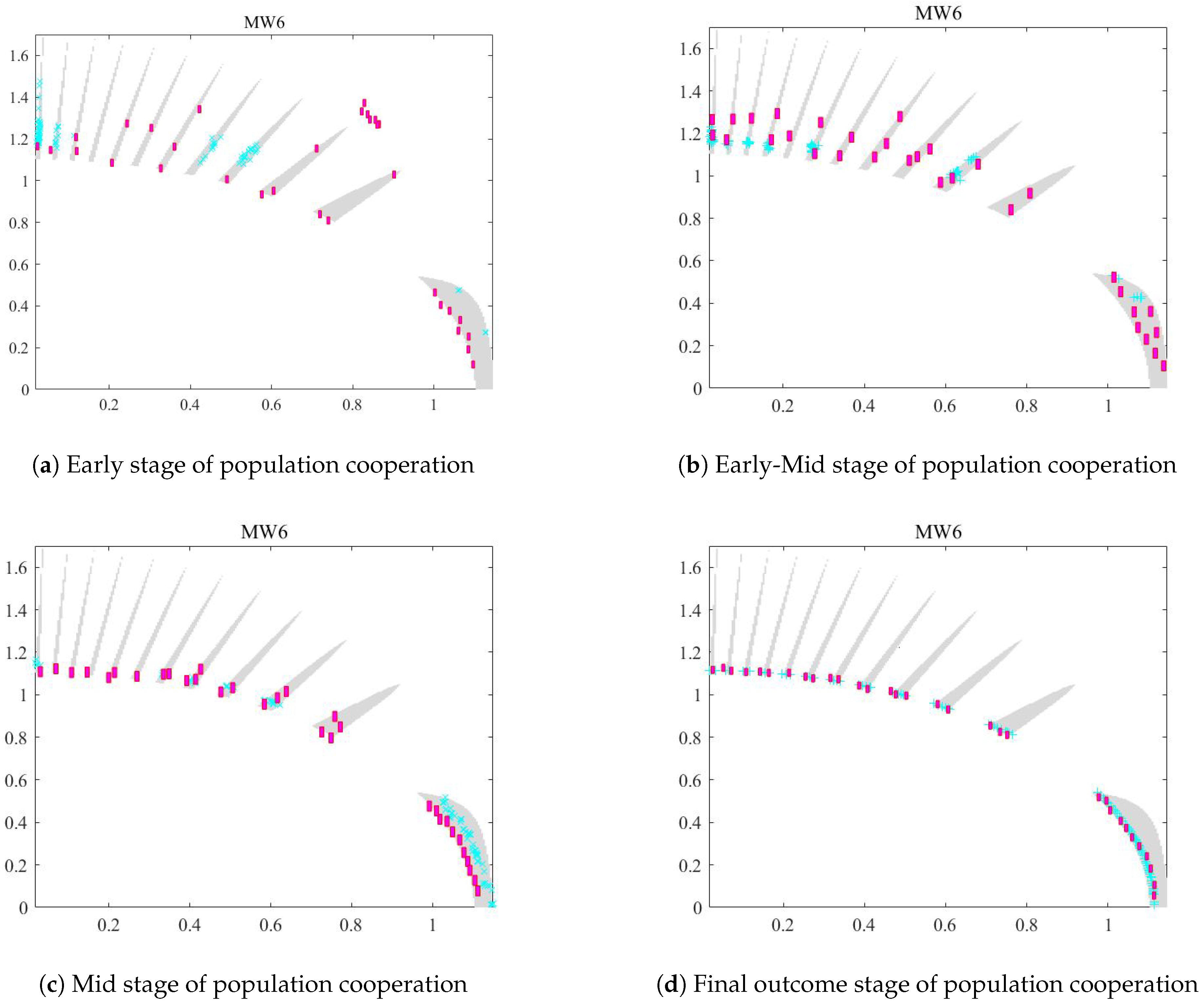
Taking MW6 [
40] as an example, the problem contains multiple infeasible region constraints. As shown in the
Figure 1, the gray areas denote the feasible regions, while the red small matrices and blue crosses represent the evaluations of Constraint 1 and Constraint 2, respectively. The gray area represents the feasible region, while the white area represents the infeasible region. Two populations exchange information through weak cooperation. In the Early stage (
Figure 1a), some solutions related to Constraint 2 are trapped in local optima due to the presence of infeasible regions, while most solutions within the feasible domain of Constraint 1 remain unaffected and can provide valuable information to help Constraint 2 escape stagnation. As the algorithm iterates into the Early-Mid stage (
Figure 1b), with the continuous assistance of solutions provided by Constraint 1, Constraint 2 successfully crosses the infeasible regions and reaches other feasible areas. Meanwhile, Constraint 2 guides Constraint 1 toward feasible regions. By the Mid stage (
Figure 1c), Constraint 1, assisted by Constraint 2, successfully crosses its large infeasible region, although some of its solutions have not yet reached the Pareto front. The cooperation mechanism continues to play a role, with Constraint 2 in turn guiding Constraint 1 toward better regions. Finally, in the Final outcome stage (
Figure 1d), after continuous collaboration, both populations converge to the Pareto front, and infeasible regions no longer hinder progress. This process clearly illustrates how weak cooperation enables different populations to complement each other’s weaknesses and collectively achieve superior optimization results.
As mentioned earlier, solving CMOPs with fewer constraints is generally simpler than solving the original CMOP. Therefore, an unconstrained population can be introduced during the collaboration process to more effectively handle situations where the UPF and CPF partially overlap. At the same time, this strategy can accelerate the evaluation of single-constraint and fully constrained problems, as it helps prevent other populations from being trapped in infeasible regions commonly occurring between individual constraints, which may lead to local optima. The role of the unconstrained population is to enhance the search capability and explore a larger search space.
2.3. Collaboration Timing
This subsection focuses on the following two aspects of the collaboration mechanism: the collaboration among populations has clearly defined initiation and termination timing; in addition, under specific circumstances, the collaboration intensity needs to be properly adjusted. It is worth noting that in multi-constrained CMOPs (mCMOPs), the final feasible region is the intersection of all individual constraint feasible regions.
2.3.1. Initiation and Termination Timing of Collaboration
In multi-constrained MOPs, evaluating all constraints simultaneously increases the overall computational burden of the algorithm [
8,
41,
42,
43,
44,
45,
46]. Moreover, in the early stages of evolution, the solutions of populations corresponding to different constraints are often highly similar. Excessive evaluation of these similar subproblems within the same generation contributes little to the improvement of solution quality. Therefore, it is necessary to put certain populations into dormancy or activation at appropriate times. It should be noted that dormant populations only participate in environmental selection without generating offspring, while activated populations participate in both environmental selection and offspring generation. The arrangement of dormancy and activation should be determined based on the respective responsibilities of the populations. The roles of the populations and, accordingly, their determined specific dormancy and activation schedules are shown in
Table 1.
2.3.2. Whether Collaboration Should Be Strengthened in Specific Situations
When individuals from different populations participate in offspring generation, the offspring may inherit partial genes from various populations. Therefore, in cases where the UPF and CPF partially overlap, it is necessary to enhance the collaboration between and . Such strengthened interaction can effectively help to explore high-quality potential solutions in this context.
Based on the above analysis, we propose a novel Hierarchical Multi-Population Cooperative Evolutionary Approach for Constrained Multi-Objective Optimization (HMP-CE). This mechanism employs populations (where C is the number of constraints) to solve the problem. The primary population, , is responsible for searching for the final feasible solutions and handling the original, highly difficult CMOP. The secondary constrained populations, , partially relax constraints to explore potential feasible solutions for , address moderately difficult CMOPs, and assist in solving the most challenging tasks of . The unconstrained population, , completely relaxes all constraints, deals with the least difficult CMOP, and accelerates the evaluation of both and . At the initial stage of the algorithm, and are activated, while remains dormant. When and can no longer provide further support for a given , that is activated. Once activated, will merge with other populations at appropriate times and, after aligning with the constraints of , it will re-enter dormancy. When reaches the UPF, whether to maintain and strengthen collaboration is determined according to the relationship between the UPF and CPF.
The main contributions of this study can be summarized as follows:
- (1)
This paper proposes a novel HMP-CE algorithm, which introduces auxiliary populations to assist the evolution of the primary population. The populations exchange knowledge through a weak collaboration mechanism, thereby improving the overall efficiency of the evolutionary process and the quality of the solutions.
- (2)
This paper proposes a Population Activation–Dormancy Regulation (PADR) mechanism, which is designed to identify appropriate timing for populations to enter dormancy or become activated, thereby reducing the computational burden of auxiliary populations while maintaining the effectiveness of the final solutions.
- (3)
In HMP-CE, a Constraint Combination Timing Identification (CCTI) mechanism is introduced to combine sub-constraints or single constraints at appropriate times. This mechanism not only helps enhance the effectiveness of knowledge transfer across populations but also further reduces the computational resource consumption of auxiliary populations.
- (4)
Through comparative experiments on 32 test suites, nine scalable mCMOPs, and several real-world engineering problems, the results show that the proposed algorithm demonstrates significant competitiveness in terms of performance.
The remainder of this paper is organized as follows:
Section 3 provides a review of existing constrained multi-objective evolutionary algorithms (CMOEAs);
Section 4 introduces the proposed HMP-CE algorithm and its implementation details;
Section 5 evaluates the performance of HMP-CE on test suites and real-world CMOP problems, and it compares it with existing multi-population CMOEAs; and
Section 6 concludes the paper and discusses directions for future research.
4. Proposed HMP-CE
In this section, we provide a detailed introduction to the framework and execution steps of the HMP-CE, followed by an in-depth analysis and presentation of the proposed innovations, PADR, and CCTI, and concluding with a comprehensive examination of HMP-CE.
4.1. The Framework of HMP-CE
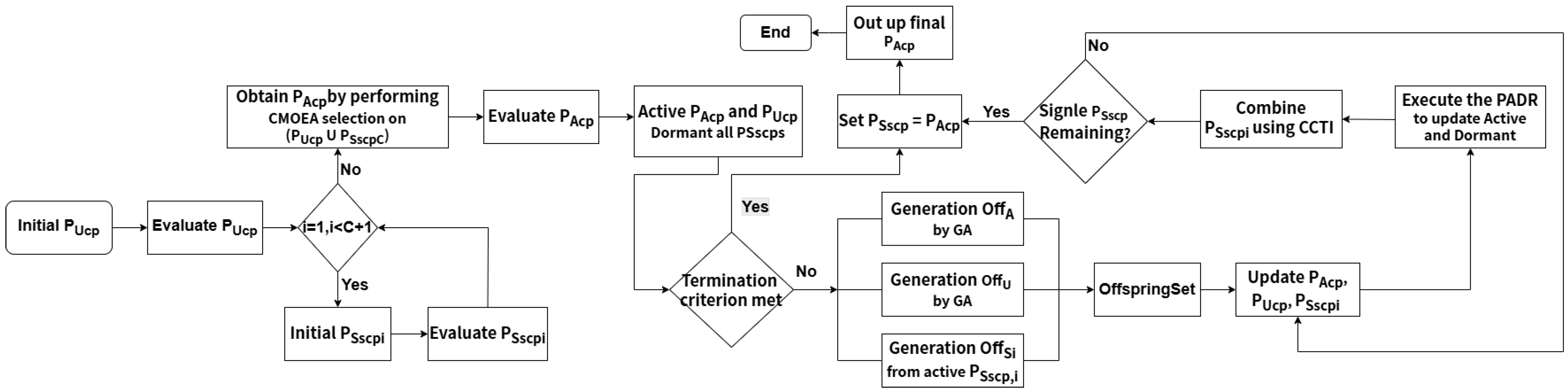
The HMP-CE Algorithm 1 begins by initializing the population size
N and determining the number of constraints
C. A population without constraints (
) is randomly generated and evaluated on the MOP, while for each individual constraint
i, a single-constraint population (
) is randomly initialized and evaluated under that constraint. All populations are then combined, and an active cooperative population (
) is selected via environmental selection across all constraints. Initially,
and
are active, and all
are dormant. During each iteration, offspring are generated from the active populations (
,
, and any active
) and combined. Environmental selection is applied separately to
(all constraints),
(no constraints), and each
(corresponding constraint), and population states are updated according to PADR rules. Single-constraint populations are monitored and merged when beneficial using the CCTI mechanism, and if only one
remains, it becomes
. The algorithm iterates until the termination criterion is met, ultimately returning
as the final optimized population. In
Figure 2, the algorithm flowchart of HMP-CE is illustrated.
The proposed HMP-CE establishes a cooperative multi-population framework consisting of
,
, and
, where
and
remain active at initialization while
are initially dormant to reduce computational cost. Its core innovations lie in the PADR and CCTI mechanisms. PADR (Population Activation–Dormancy Regulation) adaptively controls the activation of
based on the centroid variation between consecutive generations, activating
only when additional selection pressure is required. This mechanism avoids redundant computations during the early fast-convergence stage, prevents premature convergence, and ensures good adaptability to complex constraint structure CMOPs without manual parameter tuning. Meanwhile, CCTI (Constraint Combination Timing Identification) dynamically detects and merges
with overlapping infeasible regions, enabling cooperative optimization across multiple constraints and further reinforcing the coupling between
and
. The integration of these mechanisms allows HMP-CE to achieve superior convergence speed, diversity maintenance, and adaptability compared with conventional single-population approaches, demonstrating enhanced efficiency and robustness.
| Algorithm 1 Framework of HMP-CE |
- 1:
Input: N (population size) - 2:
Output: (final population) - 3:
number of constraints - 4:
RandomInitialization(N) - 5:
Evaluate on MOP without constraints - 6:
for to C do - 7:
RandomInitialization(N) - 8:
Evaluate on MOP with constrainti - 9:
end for - 10:
Environmental_Selection(, All_Constraint) - 11:
Evaluate on MOP with all constraints - 12:
Set and as active; all as dormant - 13:
while termination criterion not met do - 14:
Genetic operator applied to active - 15:
Genetic operator applied to active (jointly with only when UPF is reached) - 16:
for each active do - 17:
offspring from - 18:
end for - 19:
OffspringSet ← [ , , , …, ] - 20:
Environmental_Selection( OffspringSet, All_Constraint) - 21:
Environmental_Selection( OffspringSet, No_Constraint) - 22:
for each do - 23:
Environmental_Selection( OffspringSet, Corresponding_Constraint) - 24:
end for - 25:
Update active/dormant states using PADR - 26:
Detect and combine using CCTI (e.g., + ) - 27:
if number of then - 28:
- 29:
end if - 30:
end while - 31:
return
|
4.1.1. Genetic Operator Application and Offspring Pooling
In this framework, genetic operators, including crossover and mutation, are applied exclusively to active populations. Specifically, these include the active constrained population (), the unconstrained population (), and any active single-constraint populations (). Dormant populations do not generate offspring, thereby avoiding unnecessary computations. All offspring generated from active populations are pooled into a single offspring set at each generation. Environmental selection is then applied separately for each population as follows: selects under all constraints, under no constraints, and each under its corresponding single constraint. This design allows information sharing among populations while maintaining distinct evolutionary dynamics. While the crossover and mutation operators themselves are identical across populations, the source of parental solutions differs depending on the population’s focus (unconstrained, single-constraint, or active constrained), ensuring that each population explores its respective search space effectively.
4.1.2. Design Rationale for Population Collaboration
In HMP-CE, a weak collaboration strategy is adopted between populations rather than a fully adaptive collaboration strength. This choice ensures stability and simplicity, allowing populations to share information without over-constraining each other and reducing the risk of premature convergence. Since the activation and merging of populations are already dynamically controlled by PADR and CCTI, weak collaboration is sufficient to promote information exchange while maintaining distinct evolutionary dynamics. Empirical results further demonstrate that weak collaboration achieves a good balance between exploration and exploitation across all benchmark and real-world CMOPs.
4.2. Population Activation–Dormancy Regulation (PADR) Mechanism
The Population Activation–Dormancy Regulation (PADR Algorithm 2) is designed to dynamically manage subproblem populations (
) in constrained multi-objective optimization. First, most solutions are infeasible and the algorithm exhibits rapid convergence, making it unnecessary to activate all
. Therefore, PADR introduces an early dormancy mechanism where only the universal population (
) and all-constraint population (
) remain active, while most
are kept dormant to reduce computational complexity. During evolution, the activation of
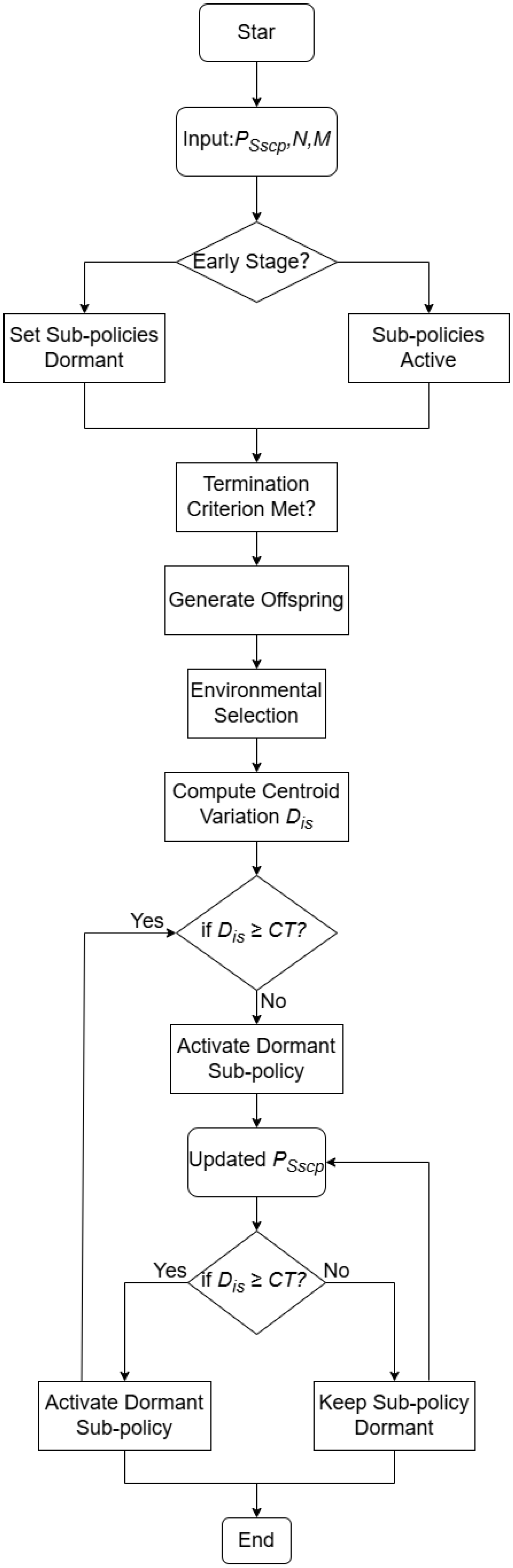
is controlled adaptively based on the centroid variation of the population. When the variation between two consecutive generations exceeds the adaptive threshold, the corresponding
is activated to generate offspring and provide the necessary selection pressure for its associated subproblem. The adaptive threshold is calculated as follows:
where
denotes the value of the
j-th objective function of solution
, and
M and
N represent the number of objectives and the population size, respectively. The absolute operator
indicates that the summation is taken over the absolute values of all objective function values.
| Algorithm 2 Framework of the PADR |
- 1:
Input: , N, M - 2:
Output: Updated active/dormant - 3:
for each do - 4:
Set as dormant if early stage - 5:
end for - 6:
while termination criterion not met do - 7:
for each active do - 8:
Generate offspring - 9:
end for - 10:
OffspringSet ← offspring from all active populations - 11:
EnvironmentalSelection(, OffspringSet) - 12:
for each dormant do - 13:
Distance for computing centroid variation - 14:
if then - 15:
Activate - 16:
end if - 17:
end for - 18:
end while - 19:
return with updated states
|
The innovation show in
Table 2 of PADR lies in its ability to achieve a balance between efficiency, adaptivity, and robustness. By avoiding unnecessary evaluations through early dormancy, PADR reduces the overhead of environmental selection. The centroid-based activation rule ensures that
are only activated when needed, enabling the algorithm to self-adapt to different problem complexities without parameter tuning. Furthermore, activated
enhance the optimization of their sub-CMOPs and assist
/
in escaping local optima, thereby improving both convergence and diversity. The inclusion of the scaling factor
ensures scalability and stability in real-World Problem problems [
33], making PADR a key component that significantly strengthens the performance of HMP-CE.
Figure 3 specifically illustrates the decision-making process of PADR.
PADR adaptively controls the activation of single-constraint populations (
) by monitoring the centroid variation between consecutive generations, activating these populations only when additional selection pressure is required. This design is theoretically justified because the centroid represents the central tendency of the population in the objective space as follows: small centroid variation indicates that the population is approaching convergence, whereas large variation indicates ongoing exploration. As shown in the ablation study in
Section 5.8, the comparison with HMP-CE2, which removes PADR, demonstrates that using centroid variation as the activation criterion can reduce redundant computations from dormant populations while maintaining convergence performance. Populations are activated only when necessary, thereby preventing premature convergence of the algorithm.
4.3. Population Constraint Combination Timing Identification (CCTI) Mechanism
The CCTI Algorithm 3 mechanism begins by examining the number of sub-constrained populations (). If only one exists, it is deleted to save computational resources, as no combination is necessary. When multiple are present, the algorithm first evaluates the relationship between the all-constraint population () and each . If the unconstrained population () has reached the UPF, the non-dominated ranks of and are computed. Any whose maximum non-dominated rank is lower than the minimum rank of is marked as ready for combination. Next, the algorithm examines each for stagnation or redundant information. Additional comparisons between unmarked are performed to identify overlapping or less-helpful populations. All flagged for combination are then merged through environmental selection to form the combined , and the original redundant are deleted. If only one remains and it is identical to , it is also removed to conserve resources. The final is returned for subsequent iterations.
The main innovations of this CCTI Algorithm 3 framework lie in its dynamic and adaptive handling of redundant or stagnated subpopulations. By employing a two-tiered judgment mechanism—
versus
and
versus
—the algorithm efficiently identifies and eliminates low-contribution or repetitive subpopulations, thus reducing unnecessary computations. This approach automatically adapts to the current optimization state without requiring manually tuned thresholds, reallocates computational resources to the
to enhance convergence speed and solution quality, and preserves the necessary diversity of
. Overall, the CCTI mechanism significantly improves the efficiency, robustness, and convergence performance of the HMP-CE algorithm in multi-constraint multi-objective optimization scenarios.
| Algorithm 3 Constraint Combination Timing Identification (CCTI) |
- 1:
Input: , , all - 2:
Output: (combined ) - 3:
if number of then - 4:
if reached UPF then - 5:
Compute non-dominated ranks of and - 6:
for each do - 7:
if ’s min non-dominated rank > ’s max rank then - 8:
Mark as ready to combine - 9:
end if - 10:
end for - 11:
end if - 12:
for each do - 13:
if is stagnated OR duplicated then - 14:
Mark as ready to combine - 15:
end if - 16:
for each unmarked do - 17:
if current ’s min rank > unmarked ’s max rank then - 18:
Mark unmarked to combine - 19:
end if - 20:
end for - 21:
end for - 22:
← Environmental_Selection(all prepared ) - 23:
Delete all prepared - 24:
if only one remains (same as ) then - 25:
Delete it - 26:
end if - 27:
else - 28:
Delete - 29:
end if - 30:
return
|
5. Experimental Studies
All experiments in this study are implemented on the PlatEMO 4.0 platform [
63], which provides a standardized and widely used environment for evolutionary multi-objective optimization research. To systematically evaluate the performance of the proposed algorithm, we describe the experimental settings, benchmark test suites, and performance metrics in the subsequent subsections.
5.1. Experimental Setup
Before presenting the experimental results, the experimental setup is briefly described. The study employs multiple benchmark test suites (MW [
40], LIRCMOP [
64], and DASCMOP [
65]) as well as real-world CMOPs [
33], with seven state-of-the-art CMOEAs selected for comparison. Algorithm performance is evaluated using IGD, HV, and the Wilcoxon rank-sum test [
66], providing a foundation for the subsequent analysis.
5.2. Test Suites
This paper employs the MW, LIRCMOP, DASCMOP, and real-world CMOPs test suites. In the test problems, M represents the number of objectives and D represents the decision variables.
For all algorithms, the maximum number of function evaluations (FEs) is strictly limited to 300,000, including the evaluations consumed during initialization. No additional evaluations beyond this budget are allowed. To assess the statistical significance of performance differences among algorithms, Specifically, a Friedman rank test was first performed to examine whether statistically significant differences exist among all compared algorithms. When significant differences were detected, pairwise post hoc comparisons were conducted using the Wilcoxon signed-rank test with Holm’s multiple-comparison correction at a significance level of
. The symbols “+”, “−”, and “≈” [
67] indicate that the proposed algorithm performs significantly better than, worse than, or statistically similar to the compared algorithm, respectively. In addition, visual analyses of the algorithms on selected test problems are provided to complement the mean ± standard deviation results. Furthermore, the results marked in red in the tables represent the best performance obtained by the corresponding algorithm for each test problem.
5.3. Competing Algorithms
To comprehensively validate the innovative value and overall performance of HMP-CE, this study selects seven state-of-the-art CMOEAs—namely cDPEA [
58], CMOEMT [
23], EMCMO [
31], CCMO [
26], CMOCSO [
64], C3M [
16], and IMTCMO [
14]—for systematic comparative analysis. The core features and technical frameworks of these algorithms are summarized in
Table 3. In terms of experimental design, all comparative algorithms strictly follow the parameter settings and operational configurations reported in their original publications, ensuring that each algorithm operates under its optimal conditions. This zero-adjustment comparison strategy not only guarantees fairness and reproducibility but also objectively highlights the remarkable performance advantages demonstrated by HMP-CE.
5.4. Performance Metrics
Comparative experiments were conducted on the test suite. The performance of the algorithms was evaluated using two metrics: Inverted Generational Distance (IGD) [
68] and Hypervolume (HV) [
69]. IGD assesses how close a solution set
S is to the true Pareto front
, with smaller values indicating better convergence as follows:
where
is typically the Euclidean distance.
HV measures the volume of the objective space dominated by
S, reflecting both diversity and coverage, with larger values indicating superior performance:
Finally, differences between the algorithms were examined using the Wilcoxon rank-sum test [
66] at a 0.05 significance level.
5.5. Experimental Results and Analysis
This section evaluates the performance of the proposed HMP-CE algorithm on various benchmark and real-world CMOPs. The test suite includes MW, to assess overall performance under general constraints; DASCMOP, to examine the balance among feasibility, convergence, and diversity; LIRCMOP, to test algorithm effectiveness in large infeasible regions; and three real-world CMOPs related to process synthesis and control optimization. By comparing HMP-CE with several state-of-the-art CMOEAs, we analyze its performance in terms of convergence, diversity, and feasibility, and we highlight its strengths and limitations across different constraint types and problem complexities.
5.5.1. Analysis of MW
The comparative results in
Table 4 and
Table 5, together with the solution distributions illustrated in
Figure 4, show that HMP-CE performs consistently well on most benchmark problems. Overall, HMP-CE attains favorable IGD results on more than 70% of the MW test instances and achieves relatively high HV values in many cases. These outcomes suggest that the algorithm provides a reasonable balance between convergence to the constrained Pareto front (CPF) and population diversity. Compared with representative methods such as cDPEA, EMCMO, and CMOEMT, HMP-CE reduces the average IGD by approximately 15–35% and improves HV by around 0.5–1.5%, indicating the effectiveness of its multi-population collaboration and regulatory strategies.
For specific problems, such as MW1, MW3, MW5, and MW7, HMP-CE achieves an IGD improvement of approximately 10–35% over the second-best algorithm, with moderate HV gains observed on MW1 and MW4. On problems with complex or disconnected feasible regions (e.g., MW6 and MW10), HMP-CE maintains relatively stable performance, whereas several compared methods, including cDPEA, EMCMO, CCMO, and C3M, exhibit noticeable fluctuations in IGD or HV. Considering average IGD and HV values as well as win–loss–tie statistics, HMP-CE demonstrates robust performance across most test instances. Compared with existing multi-population CMOEAs (e.g., CMOEMT, IMTCMO, and CMOSCO), HMP-CE shows better adaptability under varying constraint difficulties, reflecting the advantages of multi-population collaboration in decomposing constraint-handling tasks.
The detailed results in
Table 4 and
Table 5 further indicate that HMP-CE achieves relatively small IGD and relatively large HV values on most MW problems. These results can be attributed to three main components as follows: (1) the multi-population collaboration strategy that enables parallel searches under different levels of constraint relaxation; (2) the PADR mechanism that adaptively regulates the activation and dormancy of auxiliary populations to maintain search efficiency; and (3) the CCTI mechanism that dynamically identifies suitable timings for constraint combination, enhancing communication and convergence alignment among populations.
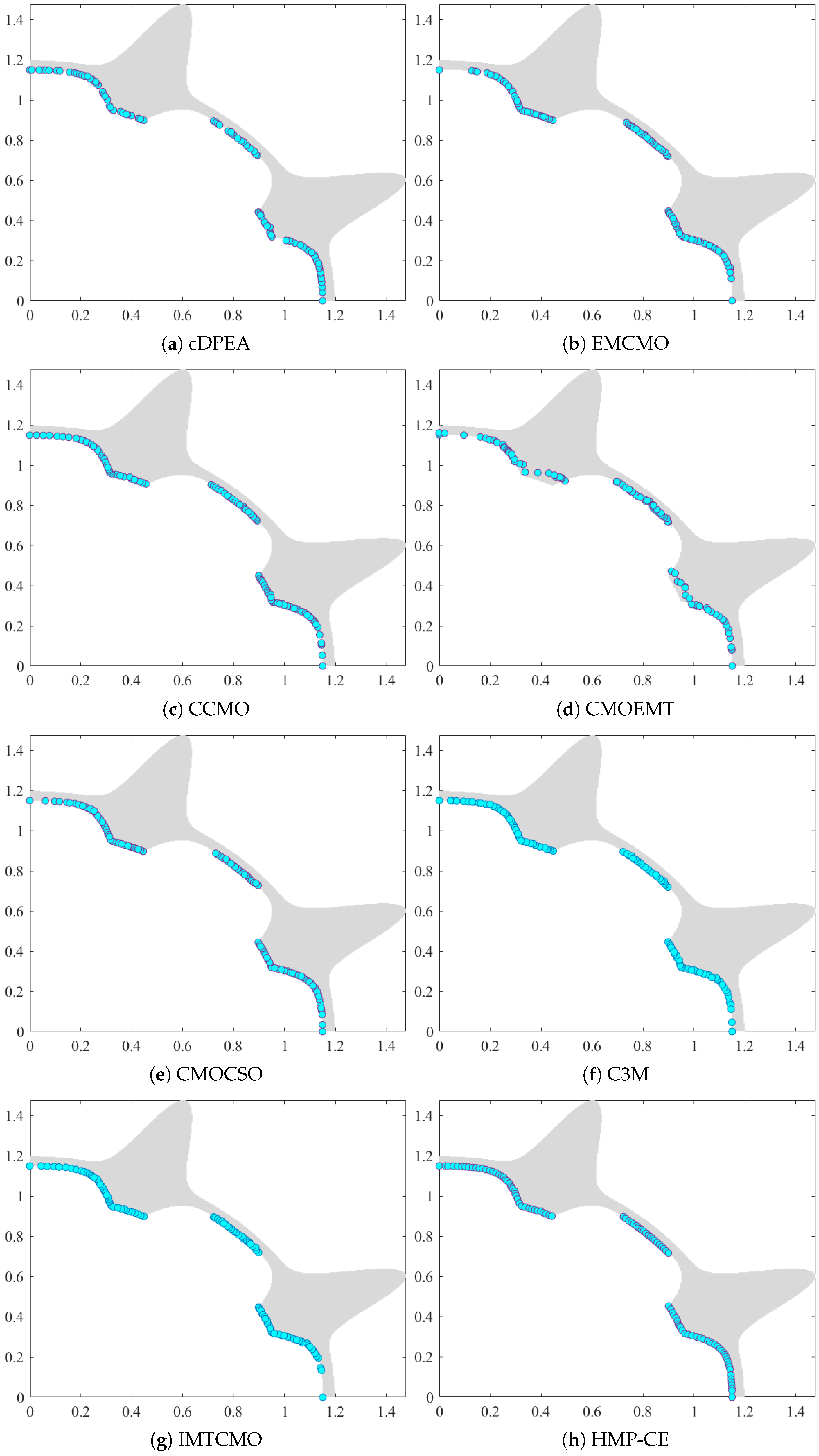
Figure 4 presents the solution distributions on MW7. The gray area denotes the feasible region, the gray curve indicates the CPF,
and cyan dots represent feasible solutions. The solutions generated by HMP-CE (
Figure 4h) are distributed relatively continuously along the feasible boundary. In contrast, some algorithms (e.g., cDPEA, EMCMO, CCMO, and IMTCMO) show gaps or deviations in certain segments. These observations illustrate the differences in constraint-handling behavior among algorithms. Overall, the results in
Table 4 and
Table 5 and
Figure 4 confirm that the integration of multi-population collaboration, PADR control, and the CCTI mechanism enables HMP-CE to maintain reliable performance in terms of convergence, solution distribution, and stability on a variety of constrained multi-objective optimization problems.
5.5.2. Analysis of LIRCMOP
Table 6 and
Table 7 present the IGD and HV statistics of the eight algorithms on the LIRCMOP benchmark problems. Overall, HMP-CE achieves relatively low IGD values and comparatively high HV values in most test instances, indicating that it can reasonably approximate the constrained Pareto front (CPF) while maintaining a fairly balanced solution distribution. For LIRCMOP5–LIRCMOP12, HMP-CE generally outperforms other algorithms in terms of IGD, while its HV values are comparable to or slightly higher than those of the other algorithms. For LIRCMOP13 and LIRCMOP14, its performance remains stable and is similar to that of other multi-population algorithms such as CMOEMT.
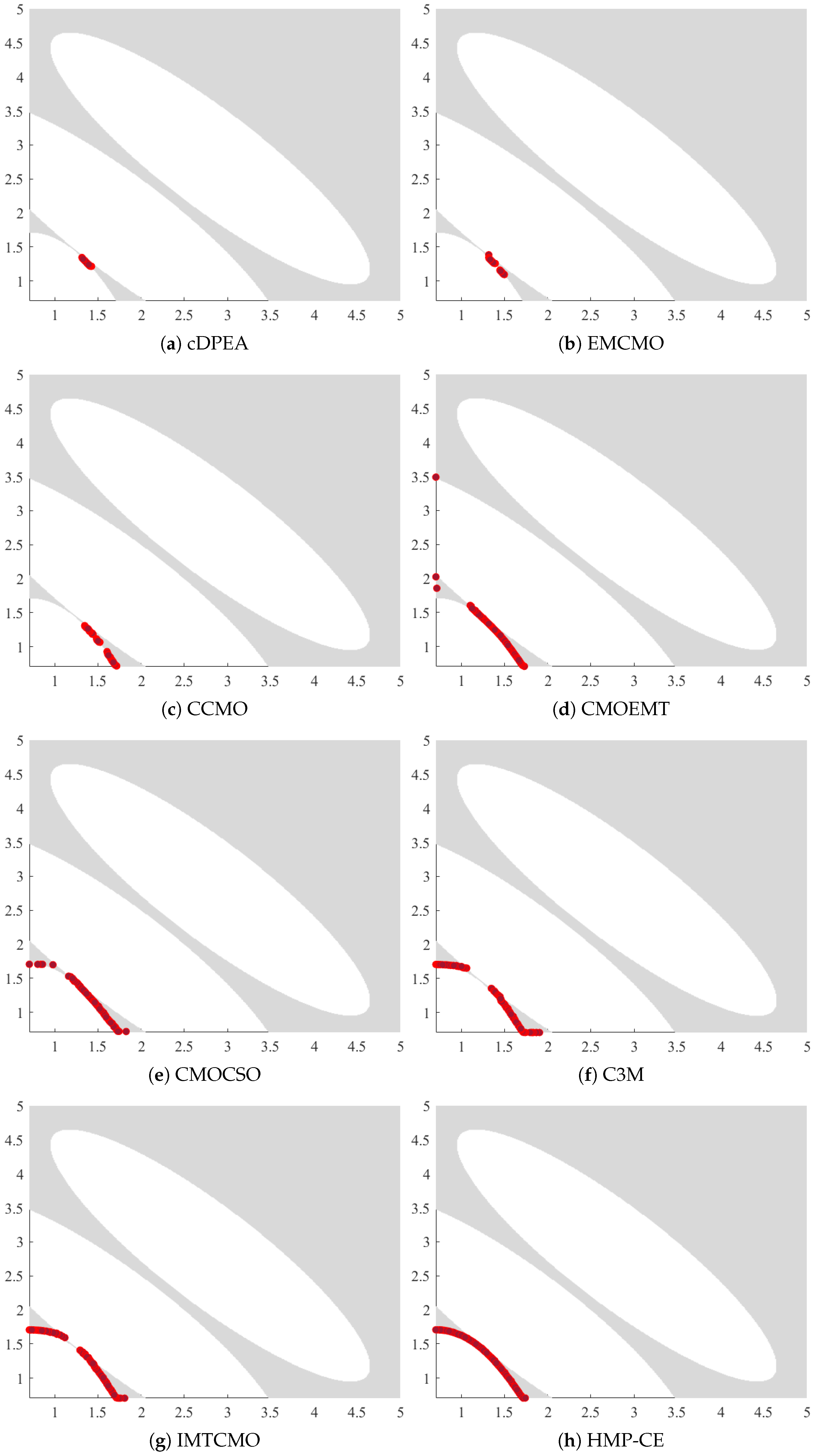
The visualization results in
Figure 5 provide a geometric perspective on the algorithm’s behavior. The gray area represents the feasible region, red dots represent feasible solutions, and the boundary denotes the constrained Pareto front (CPF). The feasible solutions obtained by HMP-CE (
Figure 5h) are distributed relatively continuously along the feasible boundary, without obvious gaps or clustering. In contrast, some of the compared algorithms (C3M, CMOCSO, IMTCMO and CMOEMT) show discontinuities or deviations in certain front segments, particularly in narrow or disconnected feasible regions. This indicates that HMP-CE maintains relatively stable exploration near constraint boundaries and can reasonably balance feasibility with objective optimization, providing fairly complete coverage of the feasible Pareto front.
These observations also reflect the role of the three mechanisms in HMP-CE. The multi-population collaboration mechanism allows different populations to explore under varying levels of constraint relaxation, which helps global search while maintaining feasible solution quality. The Population Activation–Dormancy Regulation (PADR) mechanism adjusts auxiliary populations dynamically based on their contributions, reducing redundant computation and limiting the risk of search stagnation. The Constraint Combination Timing Identification (CCTI) mechanism adaptively determines when to merge constraints across populations, supporting better inter-population coordination. Overall, these mechanisms help HMP-CE maintain stable convergence and solution distribution when addressing complex constrained multi-objective optimization problems.
5.5.3. Analysis of DASCMOP
Table 8 and
Table 9 present the IGD and HV statistics of the eight algorithms on the DASCMOP test problems. Overall, HMP-CE achieves relatively low IGD values in most instances, while maintaining stable HV performance, indicating that it can reasonably approximate the constrained Pareto front (CPF) and preserve a moderately balanced solution set. For DASCMOP1–5, HMP-CE generally performs better in terms of IGD, while its HV values are comparable to or slightly higher than some other algorithms. In the three-objective problems DASCMOP7–9, the HV performance of HMP-CE is relatively consistent and similar to that of other multi-population algorithms such as CMOCSO and IMTCMO.
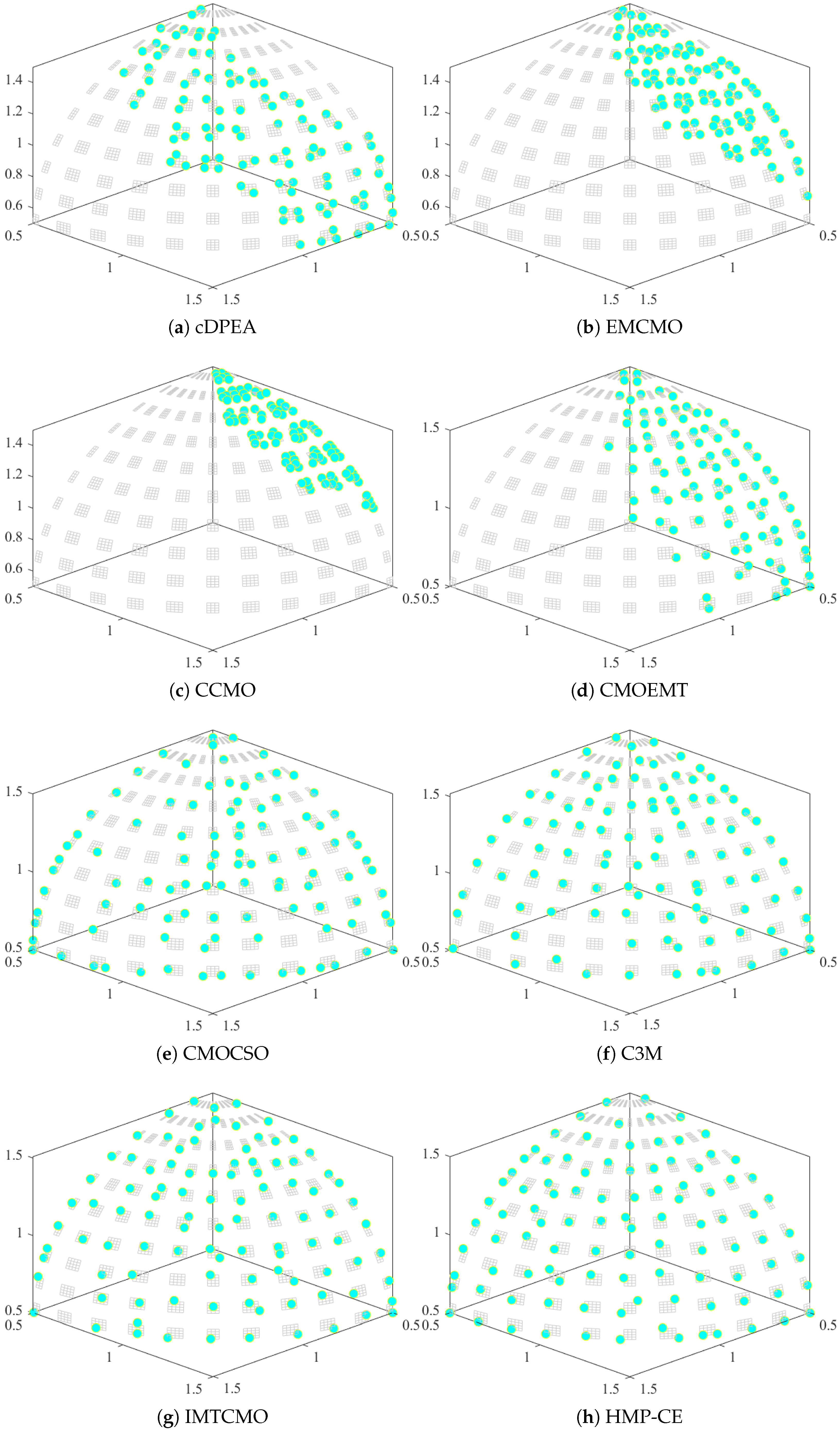
The visualization results in
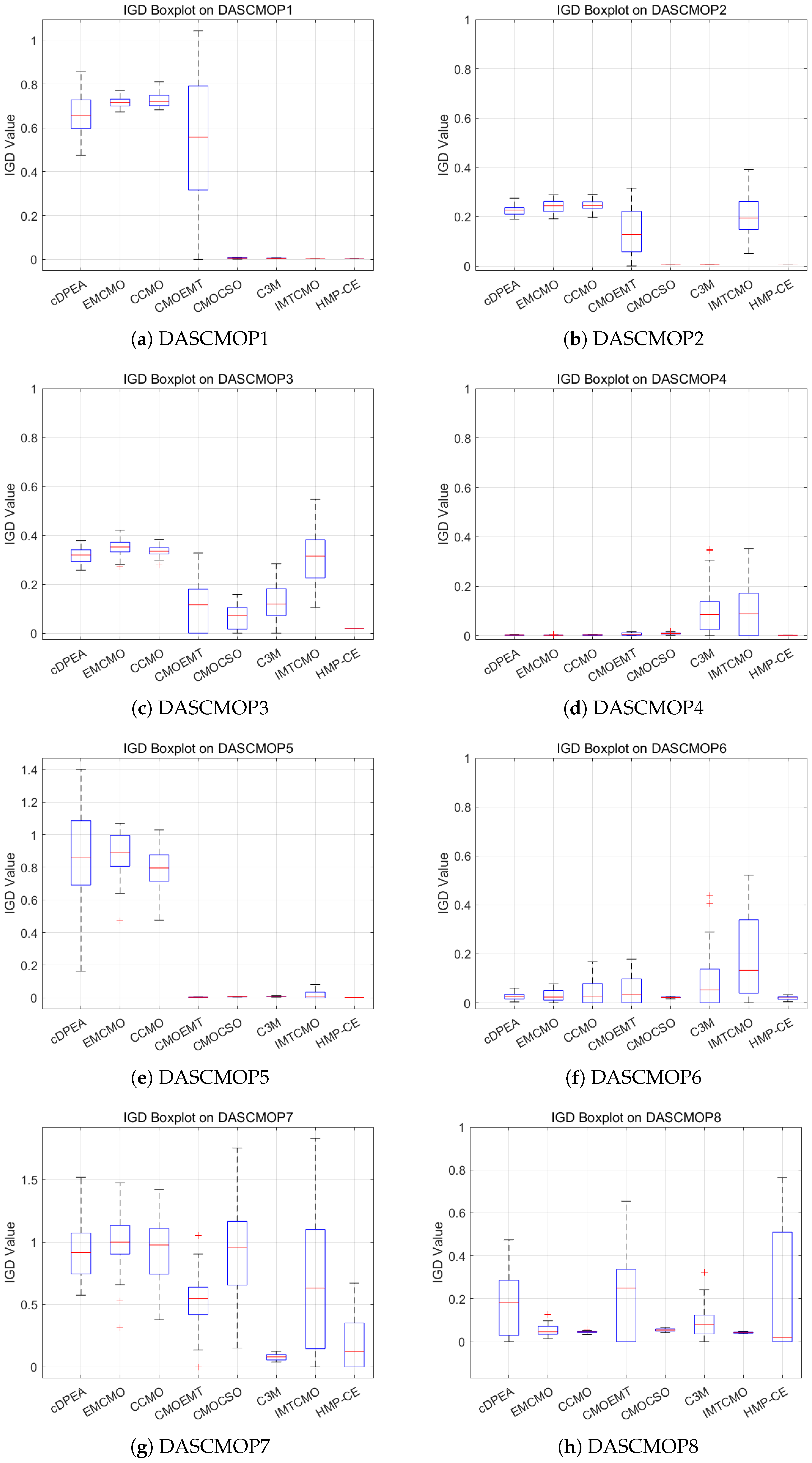
Figure 6 show feasible solutions as green dots, the feasible domain as gray regions, and infeasible areas as blank regions. HMP-CE produces feasible solutions that are relatively uniformly distributed along the feasible boundary and cover a broad area. In comparison, some algorithms (e.g., EMCMO, CCMO, and CMOEMT) exhibit partial clustering or less complete coverage, and C3M, IMTCMO, and CMOCSO show relatively limited coverage. These observations indicate that algorithms differ in constraint-handling behavior, and HMP-CE demonstrates a moderate advantage in solution distribution and boundary exploration, without implying absolute superiority. In addition, to more clearly demonstrate the capability of the HMP-CE algorithm,
Figure 7 presents boxplots of the eight algorithms on the DASCMOP1–8 test problems. It is evident that, in terms of both mean performance and variability, the HMP-CE algorithm outperforms the seven competing algorithms on most of the test problems.
The performance of HMP-CE may be related to its multi-population collaboration mechanism, where populations explore under different levels of constraint relaxation, and the PADR and CCTI mechanisms, which help regulate population activity and constraint combination. Overall, HMP-CE shows stable performance and reasonably balanced solution distribution on the DASCMOP benchmarks, reflecting its applicability to complex constrained multi-objective optimization problems.
5.5.4. Friedman Ranking of CMOEAs
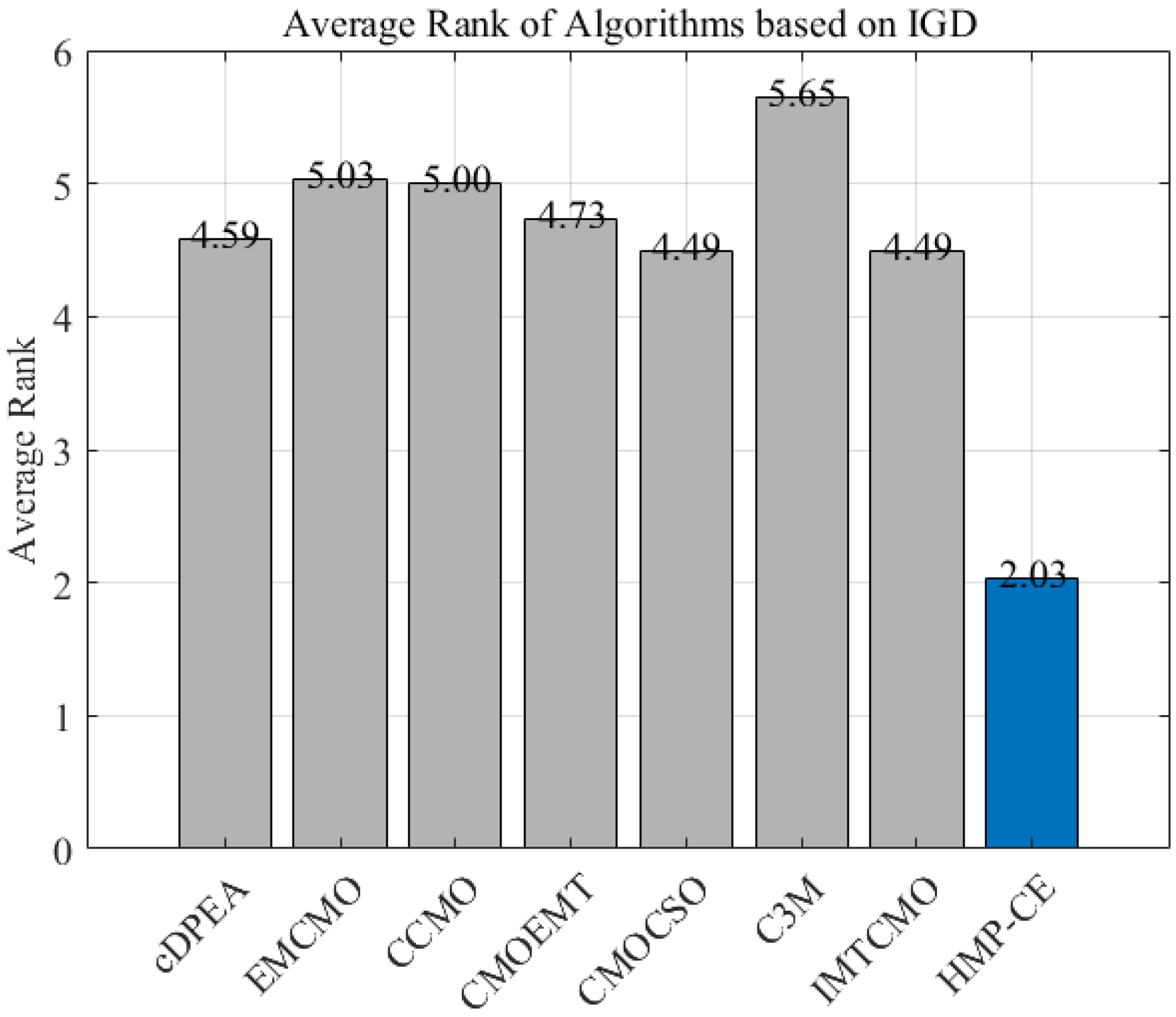
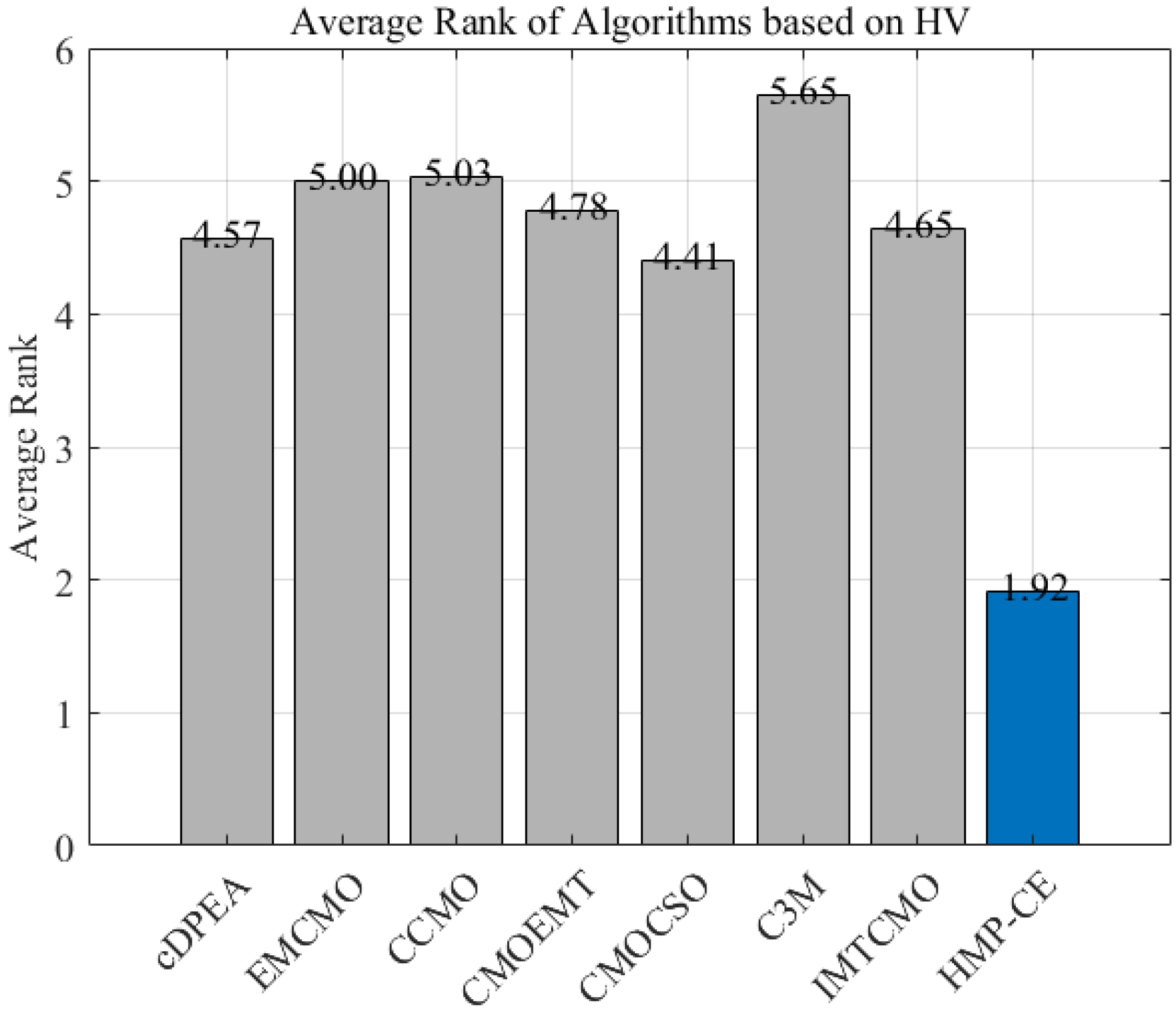
The
Figure 8 and
Figure 9 provided present the Friedman ranking results for multiple algorithms, measured using both IGD and HV metrics. Let us break down the analysis of the results, especially highlighting the innovation and superiority of HMP-CE as follows:
- (1)
Figure 8—Average Friedman Rank (IGD): HMP-CE stands out with the lowest average Friedman rank (
), indicating its strong performance in minimizing IGD. This suggests that HMP-CE excels at providing a solution set that is both diverse and close to the true Pareto front compared to other algorithms. The HMP-CE’s ranking is considerably lower than the others, with the next best algorithms (CMOCSO, CCMO, etc.) ranking from
to
. This demonstrates that HMP-CE is significantly more efficient at exploring the solution space.
- (2)
Figure 9—Average Friedman Rank (HV): HMP-CE’s rank in HV is similarly competitive, coming in first (
). It shows that HMP-CE performs well in maintaining a good balance between convergence and diversity.
- (3)
Mechanism characteristics of HMP-CE: HMP-CE incorporates a multi-population collaboration mechanism, allowing different populations to search in parallel and share information, which can help in exploring complex constrained search spaces. Its relatively low average ranks in both IGD and HV suggest a balanced behavior between exploration and exploitation. Overall, HMP-CE shows stable performance in terms of solution quality (IGD) and coverage (HV) compared with other methods.
Figure 8.
Friedman (IGD) ranking of eight CMOEAs.
Figure 8.
Friedman (IGD) ranking of eight CMOEAs.
Figure 9.
Friedman (HV) Ranking of eight CMOEAs.
Figure 9.
Friedman (HV) Ranking of eight CMOEAs.
Based on the above theoretical analysis, these results indicate that HMP-CE can generate relatively stable solution sets, and its multi-population framework maintains a certain balance between exploration and convergence, without implying absolute superiority over other algorithms in all aspects.
5.6. Analysis of Real-World CMOP
Based on the results in
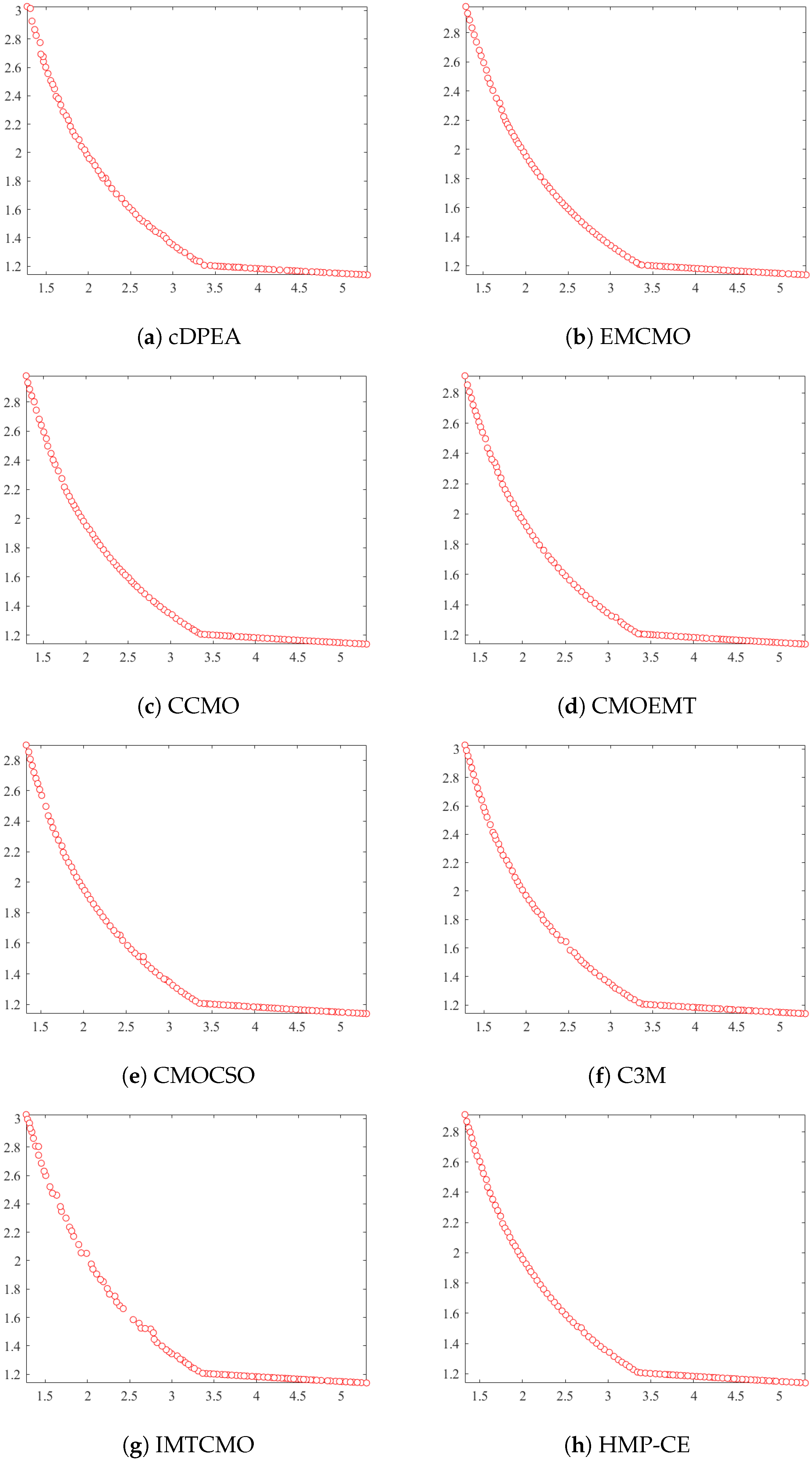
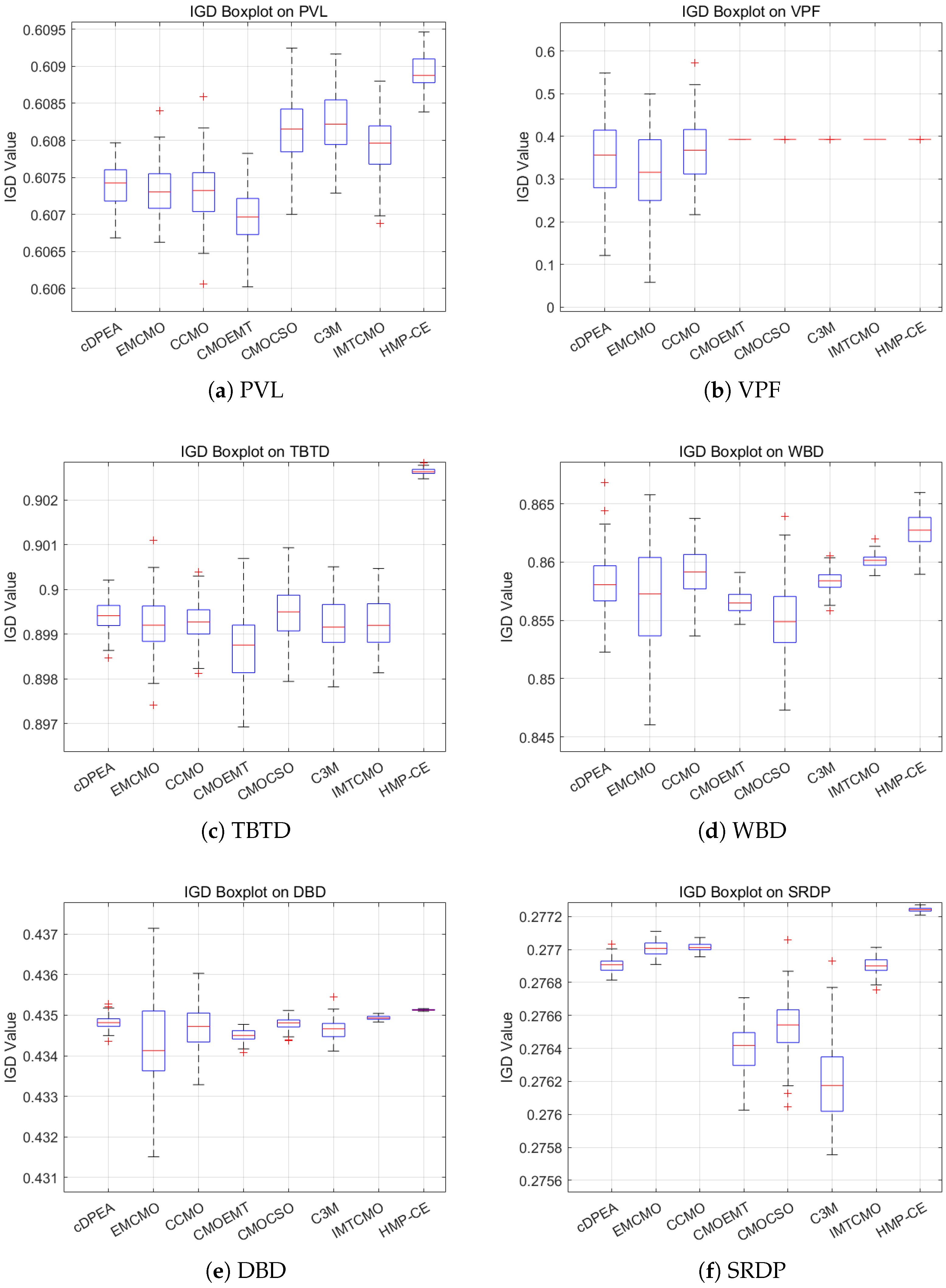
Table 10, the outcomes of the eight algorithms on six real-world engineering problems (PVL, VPF, TBTD, WBD, DBD, and SRDP) can be summarized as follows. Since the true Pareto front is unknown, the HV indicator is typically used to evaluate algorithm performance, with higher HV values indicating broader coverage and better-quality solution sets. Overall, HMP-CE achieves the highest or near-highest HV values in most problems, such as PVL, VPF, TBTD, WBD, DBD, and SRDP. The algorithm generally produces stable and reasonably distributed solution sets, though differences among the algorithms are not substantial. In addition, the visualization analysis of the eight CMOEAs on the DBD real-world problem is shown in
Figure 10. It is evident that, compared with the other seven CMOEAs, HME achieves a more uniform and denser distribution, which demonstrates its strong capability in handling real-world problems.
As illustrated in
Figure 11, for PVL (a), VPF (b), TBTD (c), WBD (d), DBD (e), and SRDP (f), HMP-CE generally achieves the highest or near-highest HV values, with relatively concentrated distributions, indicating that the solutions generated across multiple runs are stable and of good quality. This suggests that HMP-CE performs reliably in exploring the solution space and approximating the Pareto front, while maintaining a balanced performance in practical engineering optimization tasks.
Compared with the other seven algorithms (such as CMOEMT, CMOCSO, C3M, CCMO, EMCMO, cPDEA, and IMTCMO), HMP-CE shows relatively stable performance across the tested problems. Some algorithms exhibit lower HV values or larger fluctuations in certain cases, suggesting limited coverage or less consistent convergence, whereas HMP-CE generally maintains moderate HV values with relatively small standard deviations, indicating more balanced performance. Overall, HMP-CE can generate reasonably reliable Pareto solution sets for different types of real-world constrained multi-objective problems, providing practical guidance for engineering design. In terms of search capability, solution quality, and stability, HMP-CE appears relatively balanced compared with other methods, without implying absolute superiority in all aspects.
5.7. Real-World Engineering Problem Formulation
To improve the clarity and accessibility of this study, we present the following representative real-world constrained multi-objective optimization problem: the welded beam design problem. This problem originates from mechanical engineering, where the goal is to design a steel beam subjected to a static load at its free end. The design aims to simultaneously minimize the total fabrication cost and the end deflection of the beam, while ensuring that the structure satisfies engineering constraints related to stress, buckling, and geometric feasibility.
The problem involves the following four continuous decision variables: the weld thickness , the weld length , the beam height , and the beam thickness , forming a four-dimensional decision vector ().
The first objective is the total fabrication cost, including material and welding expenses, given by the following:
while the second objective is the end deflection of the beam under the applied load as follows:
where the parameters are set as
,
, and
.
The design must satisfy several engineering constraints. The shear stress and normal stress should not exceed their respective allowable limits, and . In addition, geometric feasibility requires that the weld thickness does not exceed the beam thickness (). Finally, the applied load must be lower than the critical buckling load to ensure structural safety. These constraints guarantee that the resulting design is both safe and manufacturable.
The decision variables are bounded as follows: the weld thickness and beam thickness range from 0.125 to 5, while the weld length and beam height range from 0.1 to 10.
For consistency in experiments, the problem has been implemented in PlatEMO4.9. However, the mathematical formulation is fully independent of any specific software platform, allowing researchers from different fields to understand, reproduce, and extend the proposed optimization framework without relying on PlatEMO4.9 or MATLAB R2021a.
5.8. Ablation Study on HMP-CE
In this subsubsection, to assess the contribution of each innovation in HMP-CE, we conduct ablation experiments on the DASCMOP test problems by removing each component and evaluating the resulting variants independently. Specifically, HMP-CE1 removes all subpopulation migration mechanisms, HMP-CE2 removes the PADR mechanism, HMP-CE3 removes the CCTI mechanism, and HMP-CE4 replaces PADR with a standard uniform activation strategy (Uniform/Round-robin Activation), where each sub-policy is activated in a fixed, equal-frequency manner. According to the IGD results in
Table 11 and the HV results in
Table 12, HMP-CE achieves the best performance on seven out of the nine test problems and does not obtain the best results on DASCMOP7 and DASCMOP8. These observations indicate that each component contributes to the overall performance of HMP-CE.
6. Conclusions
This paper presents HMP-CE, a hierarchical multi-population cooperative EA for CMOP. HMP-CE constructs a collaborative framework consisting of a primary constrained population (), an unconstrained population (), and multiple sub-constrained populations (), and it introduces the following two key mechanisms: Population Activation–Dormancy Regulation (PADR) for adaptive control of subpopulation activation, and Constraint Combination Timing Identification (CCTI) for dynamic merging and elimination of overlapping or stagnated subpopulations. This design enables effective decomposition of complex constraints, parallel exploration under different relaxation levels, and cooperative evolution among populations.
Extensive experiments on benchmark mCMOPs, DASCMOPs, and real-world engineering problems demonstrate that HMP-CE consistently outperforms representative algorithms in IGD and HV metrics. The solutions are uniformly distributed along the Pareto front, exhibit strong boundary exploration, maintain high diversity, and remain stable in discontinuous, or highly constrained feasible regions. These results confirm that HMP-CE effectively enhances convergence, solution quality, and adaptability in complex constrained multi-objective scenarios. However, HMP-CE has certain limitations. The computational cost can become significant for very high-dimensional problems or extremely large populations, and its performance may be sensitive to parameter settings. In highly dynamic or uncertain environments, the algorithm’s effectiveness may also be affected.
Future work includes the following: (1) adaptive adjustment of population sizes and collaboration strength to further improve efficiency and robustness; (2) extension to dynamic or uncertain environments with time-varying or uncertain constraints; (3) integration of surrogate models or parallel evaluation techniques to enhance computational efficiency in high-dimensional or large-scale problems; and (4) deeper theoretical analyses of convergence and inter-population knowledge transfer. These directions aim to further strengthen HMP-CE’s scalability, applicability, and performance in solving more complex CMOPs.