1. Introduction
In an efficient market, asset prices are expected to respond immediately to newly available information [
1]. However, a growing body of literature documents systematic deviations from this model, notably pre-announcement drift, in which prices adjust before scheduled information releases. The pre-FOMC drift identified by Lucca and Moench [
2] exemplifies this phenomenon, where U.S. equity markets generate excess returns in the 24 h preceding Federal Open Market Committee announcements. Comparable patterns have been observed in cryptocurrency markets, as Pyo and Lee [
3] report pre-FOMC drifts in Bitcoin prices. These findings indicate that, in macroeconomic contexts with widely anticipated announcements, investors tend to resolve uncertainty ex ante by pricing in expectations before the news release.
The incorporation of newly generated information by markets is essential to the semi-strong form of market efficiency [
4]. However, most empirical research examines situations in which economically significant information is available before a scheduled disclosure but is temporarily withheld [
5]. In contrast, certain industries are characterized not only by delayed disclosure but also by delayed signal creation. In these industries, informative signals about fundamental value arise only after consumers interact with the product. This distinction shifts the analytical focus from information leakage to the endogenous timing of signal formation.
While the pre-announcement drift literature has advanced understanding of expectation formation in macroeconomic and financial contexts, its relevance to firm-level events remains uncertain. Specifically, it is unclear whether ex-ante price discovery occurs in industries where fundamental value signals are inherently ambiguous prior to consumption. This is particularly pertinent in experience-good markets, where product quality cannot be credibly assessed before direct user engagement [
6]. In these contexts, the informational value of pre-release activities may be limited, suggesting that market reactions can be structurally delayed rather than anticipatory.
This structural difference can be formally understood within a Bayesian updating framework. Within this framework, investors form prior beliefs based on information from marketing, franchise reputation, and historical firm performance [
7]. If informative signals about realized product quality are available only after launch, belief updating occurs in discrete steps when post-release performance metrics are observed. Consequently, the timing of signal arrival is a key determinant of return dynamics. The lack of anticipatory price movement may therefore indicate constraints on structural information rather than market inefficiency.
The literature on new product releases generally emphasizes their positive informational content for firm value [
8,
9]. In the context of experience goods such as video games, prior research highlights the importance of post-release quality signals, including user-generated content (UGC) and early revenue ranking. For example, Tirunillai and Tellis [
10] demonstrates that UGC valence and volume significantly influence subsequent stock performance, which implies that the market incorporates quality-related information once it becomes available. Nevertheless, the existing literature provides limited insight into the short-term dynamics around the official release date, particularly regarding the timing of price discovery.
While prior studies focus on macroeconomic announcements, earnings releases, or corporate disclosures, which involve pre-existing but temporarily undisclosed information, comparatively little attention has been devoted to industries where economically significant signals arise only after market interaction. In these contexts, price discovery is driven by endogenous information generation rather than by early information leakage. This distinction highlights a gap in the event-study literature, which has generally overlooked the timing of signal creation.
Notably, the information environment surrounding digital game releases differs from that of macroeconomic announcements. In other words, concrete performance indicators, such as daily aggregated app-store revenue rankings, download charts, and initial UGC, are unavailable ex-ante and only emerge after player interaction [
6]. Because these indicators follow fixed aggregation cycles, such as daily ranking updates, and require observable user interactions, they typically become available with a systematic 12 to 48 h delay after the official launch [
11,
12]. Recent studies support this sector-specific heterogeneity in information processing, including delayed reactions to firm-level news [
13] and staggered price discovery in digital markets [
14]. This structural information lag implies that immediate price discovery is unlikely on the release date and instead occurs on the following trading day or later. Therefore, the video game industry provides an ideal empirical setting to examine how industry-specific information frictions influence event-time return patterns [
15].
The video game industry exhibits unique microstructure characteristics. Digital distribution platforms provide near-real-time, yet discretely updated, performance metrics such as download rankings, user ratings, streaming activity, and early reviews [
16]. These metrics are not directly disclosed by firms; instead, they are endogenously produced through consumer interactions and platform algorithms. Consequently, the set of economically relevant information evolves mechanically during the initial post-launch trading days, resulting in a predictable but brief information lag.
The relationship between discrete information arrivals and stock market volatility has been widely examined in macroeconomic contexts. Fleming et al. [
17] demonstrate that scheduled macroeconomic announcements significantly influence conditional volatility. Likewise, Christie-David et al. [
18] and Nikkinen and Sahlström [
19] find that policy meetings and macroeconomic news releases lead to measurable increases in market uncertainty. Therefore, these studies indicate that volatility dynamics are closely linked to the timing of information disclosure.
This setting differs in a significant respect. Instead of focusing on scheduled macroeconomic announcements, the analysis examines a context where economically meaningful signals emerge only after market interaction. Although the observed volatility response aligns with the broader literature on event-driven uncertainty, the information shock is endogenous to consumer engagement, resulting in a structurally delayed adjustment in volatility.
Building on this context, the present study investigates stock market responses to new product releases in an experience-goods setting, focusing on the Korean video game industry. Three research questions are addressed. First, do stock prices display anticipatory movements before game releases, similar to those observed in macroeconomic announcement contexts? Second, if anticipatory movements are absent, when does price discovery occur after the release? Third, how does market uncertainty change during the initial phase of post-release information disclosure?
To address these questions, the analysis covers 49 major game launches by 13 publicly listed publishers in South Korea from 2001 to 2024. The empirical analysis examines daily returns and volatility around the launch date, employing a panel regression framework with firm fixed effects and event-time indicators. Consistent with the unique information environment of experience-goods markets, the findings reveal no evidence of abnormal returns or increased volatility in the pre-launch period, indicating that high uncertainty regarding game quality constrains ex-ante speculative trading. Furthermore, stock prices exhibit a statistically significant negative return and a sharp spike in volatility on the day following the launch, rather than on the launch day itself. This timing corresponds with the delayed availability of verifiable performance metrics, such as app-store rankings and early UGC, supporting the interpretation that industry-specific information frictions produce a brief but distinct lag in price discovery.
Our study contributes to the literature on market efficiency and event-driven price dynamics in three dimensions. First, it provides empirical evidence that the pre-announcement drifts observed in macroeconomic and cryptocurrency markets may not extend to experience-goods industries, where pre-release expectations are less informed. Second, the results demonstrate that the timing of price discovery is shaped by industry-specific information structures, highlighting substantial variation in information frictions across sectors and offering a broader perspective on market responses to event-driven information. Third, the findings have practical implications, as adverse returns and increased volatility cluster on the day after launch, emphasizing the importance of post-release rather than pre-release risk management.
The remainder of this paper is organized as follows.
Section 2 introduces the dataset and outlines the empirical framework.
Section 3 presents the empirical analysis and discusses the main findings.
Section 4 provides the evidence of findings. Finally,
Section 5 concludes with implications and avenues for future research.
2. Data & Methodology
2.1. Data
We assemble a panel dataset of 13 publicly listed video game publishers on the Korea Exchange (KRX) from January 2001 to December 2024. The sample includes both large-cap incumbents (e.g., Krafton, NCSoft) and mid- to small-sized developers (e.g., Devsisters, Nexus), thereby capturing the heterogeneity of the Korean game industry in terms of scale, product portfolios, and investor composition.
A key challenge in identifying market reactions to game releases lies in distinguishing the first economically meaningful disclosure of product quality from marketing-driven or speculative pre-release activities. To address this, we restrict our sample to official commercial release dates and exclude all non-commercial pre-release events, including closed or open beta tests, early access versions, media showcases, and promotional announcements. While these activities may attract attention, they do not provide verifiable information about the realized performance of the product. This filtering approach ensures that the event date aligns with the earliest time when consumers can fully engage with the product and when objective performance signals can emerge.
After applying these criteria, the dataset includes 49 distinct launch events. Although the number of events is modest, it reflects the infrequency of large-scale commercial releases by publicly listed publishers when non-commercial pre-release activities are excluded. Comparable event-based studies of firm-level innovations or product introductions typically utilize similar sample sizes, emphasizing identification precision over event frequency.
For each firm, we obtain daily adjusted closing prices to account for corporate actions such as stock splits and dividends. We then compute daily logarithmic returns. To control for market-wide movements, each firm is matched to the benchmark index corresponding to its listing venue (KOSPI or KOSDAQ). This index-specific matching is particularly important in the Korean market, given the substantial differences in liquidity, volatility, and investor composition across exchanges.
Table 1 provides an overview of the sample firms, their market classifications, the number of identified launch events, and summary statistics of their daily stock returns. The distribution reveals substantial firm-level heterogeneity in both mean returns and volatility, underscoring the need for a panel framework that controls for time-invariant firm-specific factors.
2.2. Methodology
To examine the market reaction to new game launches, we employ a panel regression framework using an event-window dummy specification. This approach enables us to estimate abnormal returns and volatility around the launch date while controlling for market-wide shocks and firm-specific unobserved heterogeneity [
20]. Compared with traditional cumulative abnormal return (CAR)-based event studies, the regression-based specification offers greater flexibility for modeling daily dynamics and is particularly suitable for settings with repeated, heterogeneous firm-level events.
Given substantial cross-sectional variation in firm characteristics, such as brand equity, development capability, and investor composition, we use a firm-fixed-effects specification as our primary estimator. This approach aligns with prior research that emphasizes the need to control for time-invariant firm attributes when assessing market reactions to innovation or product-release events. For example, Sood and Tellis [
21] used a regression framework to isolate net stock market returns from innovation events, explicitly accounting for firm-specific factors such as R&D capability and brand equity. By exploiting within-firm variation, the fixed effects framework mitigates omitted-variable bias and isolates the net effect of the release event.
Two complementary equations are estimated to capture both the direction and magnitude of market reactions. First, to test for abnormal returns, the following model is specified:
where
is the daily logarithmic return for firm
i on day
t. The key independent variables,
, are dummy variables indicating the event window relative to the official launch date (
), ranging from
K days before to
K days after.
denotes the daily return of the market index corresponding to firm
i, controlling for market-wide shocks.
captures the unobserved firm-specific fixed effects, and
is the error term.
To assess whether the estimated post-release effect is attributable to the specific timing of product launches rather than spurious date selection or structural features of the panel, we implement a Monte Carlo random-date placebo procedure.
Let
denote the estimated
coefficient from the baseline fixed-effects specification:
For each simulation , we randomly assign pseudo event dates within each firm’s trading sample (excluding a -trading-day window around actual launch dates) and re-estimate the model to obtain . This procedure generates an empirical distribution of placebo post-event coefficients.
The empirical two-sided
p-value is computed as:
where
is the indicator function. This non-parametric validation allows us to evaluate whether the observed post-release effect lies in the extreme tail of the distribution generated by random date assignments.
Second, to examine changes in market uncertainty, an analogous specification is estimated using the absolute value of returns as a proxy for realized volatility:
where
serves as a proxy for realized volatility.
In both specifications, standard errors are clustered at the firm level to account for serial correlation and heteroskedasticity within firms. This clustering strategy is appropriate given the panel structure of the data and the repeated observations for each firm across multiple event windows.
A potential concern is that using squared or absolute returns as a proxy for volatility in a linear fixed-effects framework may not adequately capture time-varying heteroskedasticity. Financial return series typically exhibit volatility clustering, implying that the conditional variance evolves dynamically over time. To address this issue, we estimate firm-level GARCH(1,1) models and explicitly model conditional variance dynamics prior to testing for event effects.
For each firm
i, we estimate the following mean and variance equations:
where
denotes the corresponding market return (KOSPI or KOSDAQ), and
represents the information set available at time
. The conditional variance
captures persistent volatility dynamics through the standard GARCH(1,1) structure.
We then construct the logarithm of the estimated conditional variance,
, and use it as the dependent variable in the panel event-study specification:
This two-step procedure allows us to isolate whether product launches are associated with systematic shifts in conditional volatility, beyond the baseline persistence captured by the GARCH dynamics. If the post-release coefficients are positive and statistically significant, this indicates that commercial launches induce an economically meaningful increase in conditional uncertainty.
Standard errors are clustered at the firm level to account for serial correlation within firms. As an additional robustness check, we also compute two-way clustered standard errors by firm and calendar date, allowing for both within-firm dependence and cross-sectional correlation arising from common date-specific shocks.
3. Empirical Results
3.1. Market Reaction: Returns
Table 2 presents the estimation results for Equation (
1), which evaluates daily abnormal returns around new game launches. Standard errors are clustered at the firm level.
Coefficients for the pre-launch window (from to ) are uniformly small and statistically insignificant (), suggesting that investors refrain from speculative positioning prior to the release. This pattern is consistent with the notion that game quality, as an inherently uncertain characteristic of experience goods, cannot be reliably inferred before users engage with the product.
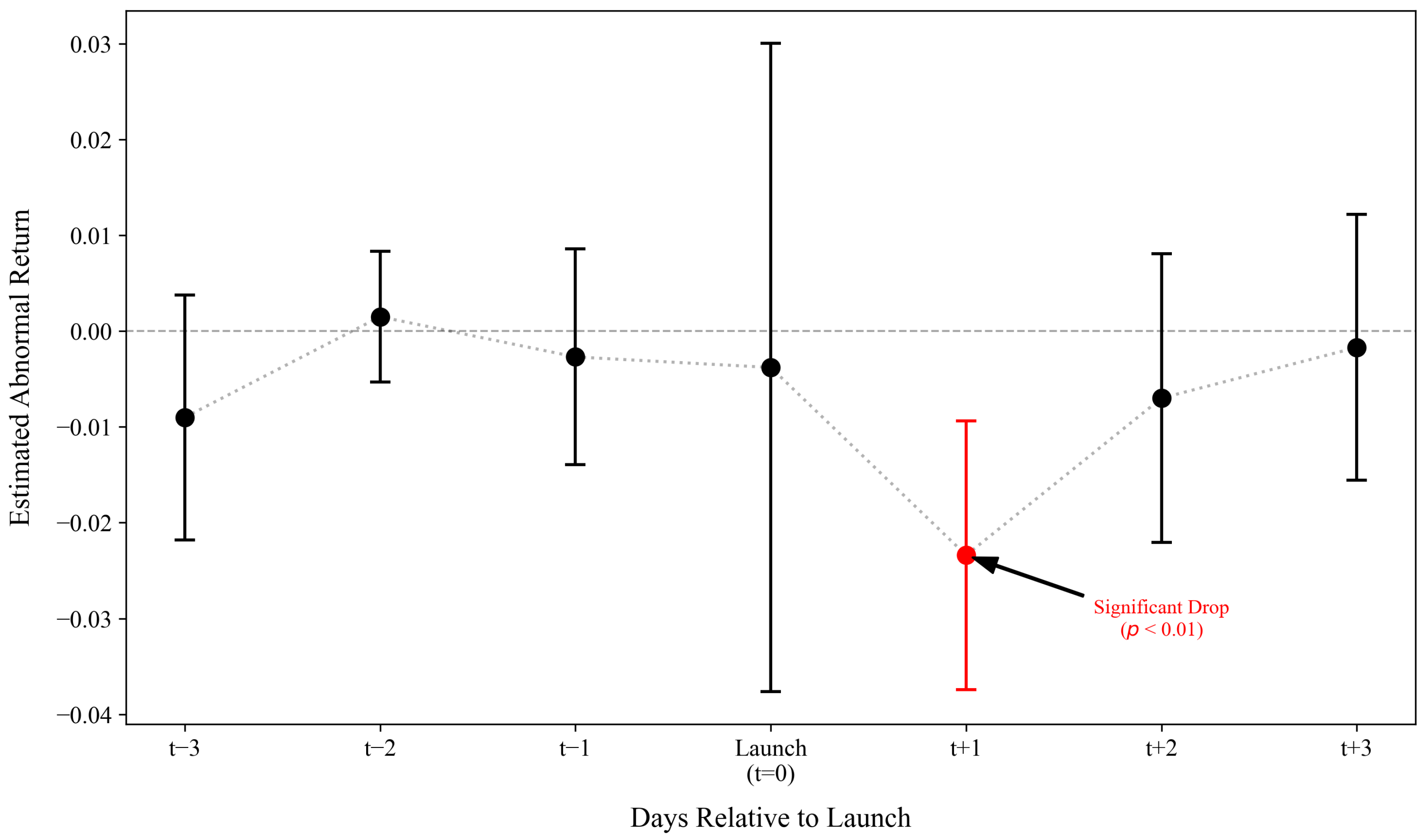
In contrast, the post-launch window demonstrates a clear directional response. The coefficient on is negative and highly significant (), indicating an average decline on the trading day following the official release. Neither the launch day () nor subsequent days (, ) exhibit statistically meaningful return reactions. These results indicate that abnormal price adjustments are temporally concentrated on the trading day immediately after the release, rather than gradually over multiple days.
Also,
Figure 1 shows the estimated coefficients of the event dummy variables (
to
) from the fixed effect regression model, along with their 95% confidence intervals. The figure presents a striking contrast between the pre- and post-launch periods. Throughout the pre-launch window and on launch day (
t), abnormal returns remain statistically indistinguishable from zero, visually confirming the absence of ex ante speculative trading. In contrast, a significant downward movement is observed exclusively at
. This graphical evidence intuitively corroborates the delayed sell-the-news hypothesis, demonstrating that price discovery is structurally deferred until the day following the release.
Given that the F-test for poolability fails to reject the null hypothesis (
), indicating that firm-specific unobserved heterogeneity suggests that results are not sensitive to the inclusion of firm fixed effects, we further validate our findings using a Pooled OLS specification [
22]. This robustness check ensures that the results are not sensitive to the choice of estimator. As reported in
Appendix A, the Pooled OLS estimates remain qualitatively and quantitatively identical to the baseline Fixed Effects results. Specifically, the coefficient on
remains negative and statistically significant, reaffirming that delayed market reaction is a robust feature across model specifications.
Then, we test for pre-trends by jointly testing whether the lead coefficients are insignificant in the pre-launch window.
Table 3 presents the details, and the joint Wald test fails to reject the null that all pre-launch leads are zero (Wald
,
), indicating no evidence of anticipatory abnormal returns prior to launch.
To further assess whether the documented post-release reaction is attributable to the specific timing of commercial launches rather than incidental timing patterns, we implement a Monte Carlo random-date placebo test. For each firm, we randomly assign pseudo event dates within the trading sample while excluding a -trading-day window around actual launch dates to prevent contamination. Using these pseudo events, we re-estimate the baseline specification 1000 times to obtain an empirical distribution of placebo coefficients.
In
Figure 2, the placebo distribution is centered near zero (mean = 0.0004; standard deviation = 0.0044). In contrast, the observed post-release coefficient (
) lies far in the left tail of this distribution. The empirical two-sided
p-value is effectively zero, as none of the 1000 placebo replications produces a coefficient as extreme as the observed estimate.
Overall, these results indicate that although there may be small pre-event changes, the significant negative return at occurs only with real product launches. The delayed reaction after the release is not caused by random dates, calendar effects, or the structure of the data.
Re-estimating the baseline return specification with two-way clustered standard errors by firm and calendar date yields results that are quantitatively similar to those reported in
Appendix B. The post-release return at
remains negative and highly statistically significant (
,
), with a magnitude nearly identical to the baseline firm-clustered estimates. The persistence of the
negative return under two-way clustering indicates that the main findings are not driven by cross-sectional dependence or common date-specific shocks.
3.2. Market Uncertainty: Volatility Analysis
Table 4 presents estimates from Equation (
4) that examine changes in stock price volatility around game releases, using the absolute value of daily returns as a proxy for realized volatility. The F-test strongly rejects the null of poolability (
), indicating the need to include firm fixed effects to control for heterogeneous baseline volatility across publishers.
Consistent with the return-based results, volatility exhibits no significant deviation from normal levels in the pre-launch window. Coefficients for , , and are statistically insignificant, indicating an absence of anticipatory volatility prior to the release.
Following the release, however, volatility increases sharply. The coefficient on the launch day () is positive and statistically significant (), reflecting heightened trading intensity as the market begins processing initial signals. The effect intensifies further on the following day (), when volatility reaches its peak (, ). This pattern aligns with the information lag hypothesis, which posits that investor disagreement expands not at the time of product introduction but when the first credible performance metrics are disclosed.
Volatility remains elevated through and , which implies that the market requires several days to incorporate new information into prices. The persistence of volatility suggests gradual information diffusion and sustained reassessment of expectations regarding game quality and revenue trajectories.
Table 5 reports the conditional volatility results based on firm-level GARCH(1,1) models. Pre-event coefficients are statistically indistinguishable from zero, indicating no anticipatory increase in conditional variance prior to launch. In contrast, post-release coefficients become positive and statistically significant beginning at
and remain elevated for several trading days.
The magnitude of the estimates implies economically meaningful effects. For example, the coefficient at corresponds to an increase of more than 100% in conditional variance relative to its baseline level. These findings confirm that the volatility surge following product release is not an artifact of using squared returns as a proxy but reflects a genuine increase in conditional uncertainty.
Appendix B reports the volatility results based on the absolute return specification with two-way clustered standard errors by firm and calendar date. Pre-event coefficients are statistically indistinguishable from zero, indicating no anticipatory increase in volatility prior to launch. In contrast, volatility rises sharply on the launch day (
,
) and remains strongly elevated at
(
,
). The increase persists for several subsequent trading days, with
and
remaining statistically significant at conventional levels.
The robustness of these results under two-way clustering confirms that the post-release volatility surge is not driven by cross-sectional dependence or common date-specific shocks. Instead, product launches are associated with a concentrated, economically meaningful increase in return dispersion immediately after release.
In summary, the return and volatility results indicate that market reactions to new game launches are not immediate but unfold over a short post-release window. Price adjustments are temporally concentrated, while market uncertainty remains elevated for several days following the release.
4. Discussion
The results indicate that the primary distinction lies in the information structure of experience goods. Unlike macroeconomic announcements, where market participants can form relatively precise expectations based on prior data releases, policy communication, or professional forecasts, the quality of a digital game cannot be reliably assessed before user interaction. Although marketing materials, trailers, and previews may attract attention, they do not provide verifiable performance information. Consequently, investors tend to defer valuation adjustments until observable post-release indicators become available. This interpretation supports the perspective that information frictions are industry-specific and that the timing of price discovery depends on the availability and credibility of signals rather than solely on the occurrence of an event.
The concentration of abnormal returns on the trading day after the release, rather than on the release day itself, underscores the significance of temporal constraints in information dissemination. For game launches, key performance indicators such as app store revenue rankings and early user-generated content are typically aggregated and reported in fixed cycles, most often daily. As a result, although consumer interaction begins on release day, market participants can access and interpret these signals only after the first full day of activity. The observed reaction is thus consistent with a delayed yet systematic price discovery process, where prices adjust promptly once relevant information becomes available.
Another key insight from the analysis is that the delayed reaction is, on average, negative. This outcome suggests that early post-release signals typically resolve uncertainty in a more pessimistic direction compared to pre-release expectations. Notably, this pattern does not necessarily indicate systematic disappointment or irrational overpricing before release. Instead, it reflects a correction of optimistic priors formed under significant information constraints. Once objective indicators become available, investors reassess firm value based on realized performance rather than promotional narratives, resulting in a downward price adjustment. The concurrent increase in volatility on the release day and the subsequent trading day further supports this interpretation, as it indicates heightened disagreement and active revaluation during the initial phase of information assimilation.
While delayed verification explains the concentration of price adjustment after launch, the predominantly negative sign of the coefficient suggests that investor expectations may be systematically optimistic prior to release. This pattern is consistent with models of overconfidence or attention-driven expectations in which pre-release hype inflates valuations, and post-launch signals trigger downward revisions.
From a broader perspective, these findings contribute to the literature on market efficiency by demonstrating that delayed price adjustment should not be automatically interpreted as evidence of inefficiency. In this context, the market appears to respond efficiently given the information available at each point in time. Prices remain unchanged prior to release due to the absence of credible signals, but they adjust rapidly once such signals become available. This conditional efficiency perspective reconciles the observed delay with the efficient market hypothesis and highlights the necessity of considering information frictions when evaluating event-driven price dynamics.
Although our empirical analysis focuses on the Korean video game industry, the underlying mechanism is not industry-specific. Digital experience-good markets share a common feature: performance signals emerge only after consumer interaction. This structural characteristic implies that price discovery dynamics may systematically differ from those observed in macroeconomic announcement settings. Therefore, the findings offer broader insight into how heterogeneous information environments shape asset pricing in modern digital economies.
From an investment perspective, the concentration of negative returns and elevated volatility immediately after launch suggests that risk exposure peaks during the post-release window rather than in the anticipatory phase. Investors relying on conventional “buy-the-rumor” strategies may therefore misjudge the timing of uncertainty resolution in experience-good industries.
In summary, the evidence demonstrates that price discovery for experience goods is characterized by delayed, discontinuous adjustments driven by post-consumption information flows. This pattern contrasts with the anticipatory dynamics observed in macroeconomic announcements and underscores the limits of generalizing pre-announcement drift across industries. By focusing on signal timing and information structure, this study offers a more nuanced understanding of how markets process firm-level events in environments characterized by experiential uncertainty.
5. Conclusions
This study investigates the stock market response to new product launches in the Korean game industry, presenting evidence that diverges from the well-documented pre-announcement drift observed in macroeconomic contexts. Using a panel of 13 major publishers and 49 launch events, we find no evidence of anticipatory price movements prior to release. Instead, the market exhibits a pronounced reaction, characterized by a significant negative return and a heightened volatility on the day following the official launch.
The results suggest that, for experience goods such as games, price discovery is shaped not merely by delayed disclosure but by delayed signal creation. Unlike macroeconomic announcements, where information is available before release but may be partially incorporated ex ante, performance-related signals in digital game markets emerge only after consumer interaction. Consequently, price discovery is driven predominantly by ex-post verification rather than ex-ante speculation. Investors tend to defer meaningful portfolio adjustments until objective performance indicators, most notably daily app-store revenue rankings and early user-generated feedback, become observable. This industry-specific information structure leads to a systematic delay in market adjustment, resulting in a concentrated post-launch response that contrasts with traditional event-driven pricing dynamics.
Our robustness analyses further reinforce the interpretation of the delayed post-release reaction. A joint test of pre-event coefficients indicates no evidence of anticipatory abnormal returns prior to launch. In addition, a Monte Carlo random-date placebo test demonstrates that the observed effect is uniquely associated with actual commercial release dates and cannot be replicated under random timing. The results remain stable under alternative event windows, GARCH-based volatility modeling, and two-way clustered standard errors, confirming that the delayed adjustment is not driven by model specification or cross-sectional dependence. Taken together, these findings indicate that while isolated pre-event fluctuations may occur, systematic price discovery is concentrated immediately after launch. This pattern is consistent with the view that, for experience goods, economically meaningful information is revealed primarily through early consumer feedback and post-release signals rather than through anticipatory market adjustment.
The findings have practical implications for market participants. The concentration of both downside risk and volatility at indicates that conventional strategies, i.e., buy the rumor, sell the news, are not directly applicable to this sector. Consequently, risk management and hedging practices should prioritize the immediate post-release period, when uncertainty resolution is most acute.
Future research could investigate whether similar delayed reactions arise in other digital experience-good markets, such as OTT content releases or serialized webtoon platforms, where performance signals are likewise revealed gradually. Extending the analysis to intraday data or employing alternative proxies for user engagement may further clarify the mechanisms by which information frictions shape asset pricing in creative industries. Furthermore, directly assessing the effect of information lags on price discovery is a critical direction, as this would clarify the relationship between the timing of signal availability and subsequent market responses.
In addition, future studies could incorporate richer multi-factor risk adjustment frameworks, such as Fama–French factor specifications, to further disentangle event-driven price adjustments from systematic risk exposures. Exploring additional sensitivity analyses, such as alternative outlier treatments or distributional adjustments, may further refine the inference. Such extensions would help deepen our understanding of how expectation formation, information delays, and risk pricing interact in markets for creative and digital products.