
Asymptotic Expansions for Products of Weibull Random Variables

Abstract
1. Introduction
2. Known Results
3. Main Results
| Algorithm 1 Computation of coefficients . |
| Require:
N, n Ensure: Coefficients
|
4. Auxiliary Lemmas
- (i)
- For all , as ,where , , , and .
- (ii)
- for all , and
- (iii)
- and g are continuous in a neighborhood of a.
- If , then
- Consequently,
- By adding and , we obtain that
- If , then
5. Proof of Main Theorem
5.1. Case
5.2. Key Step of Induction
6. The Initial Coefficients in the Asymptotic Expansion
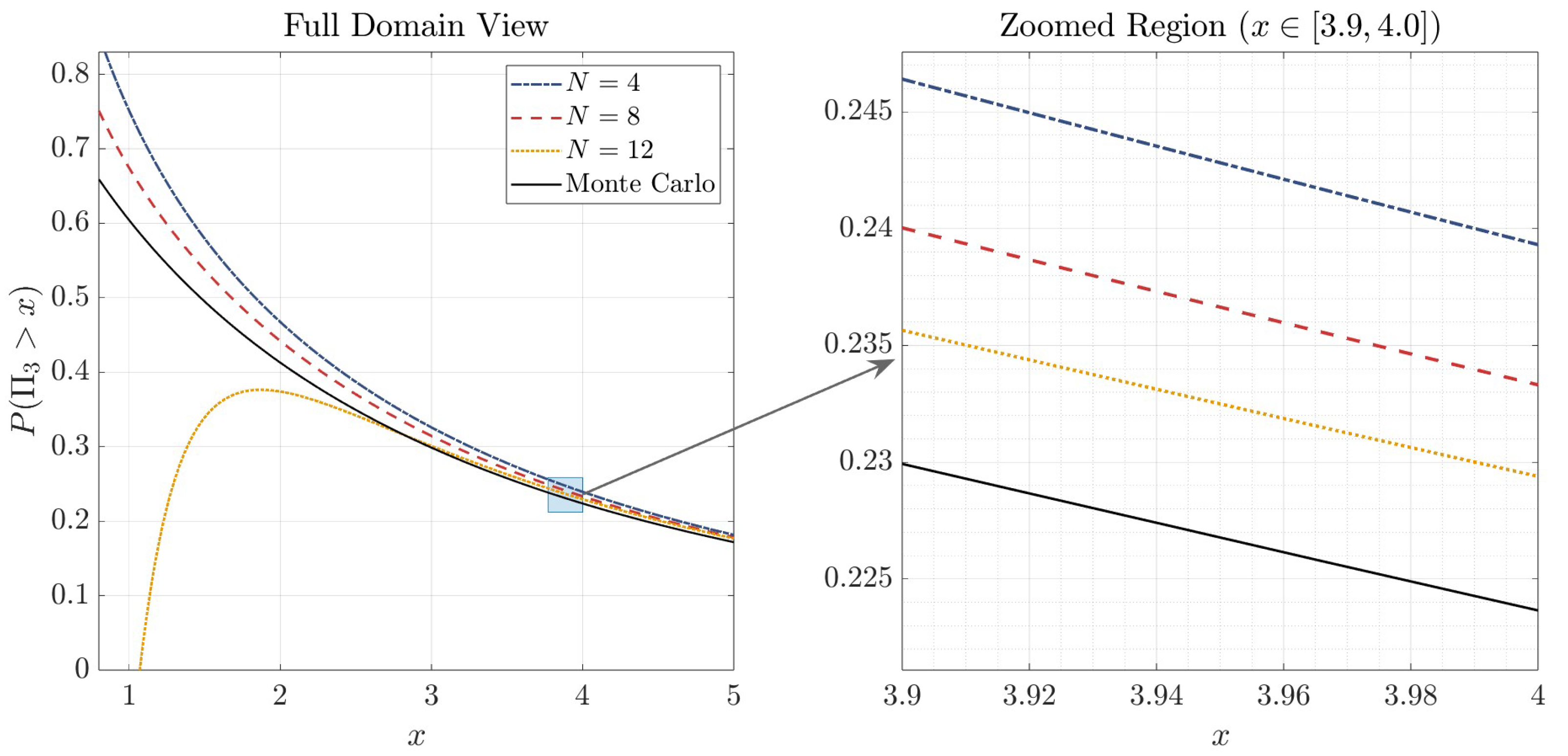
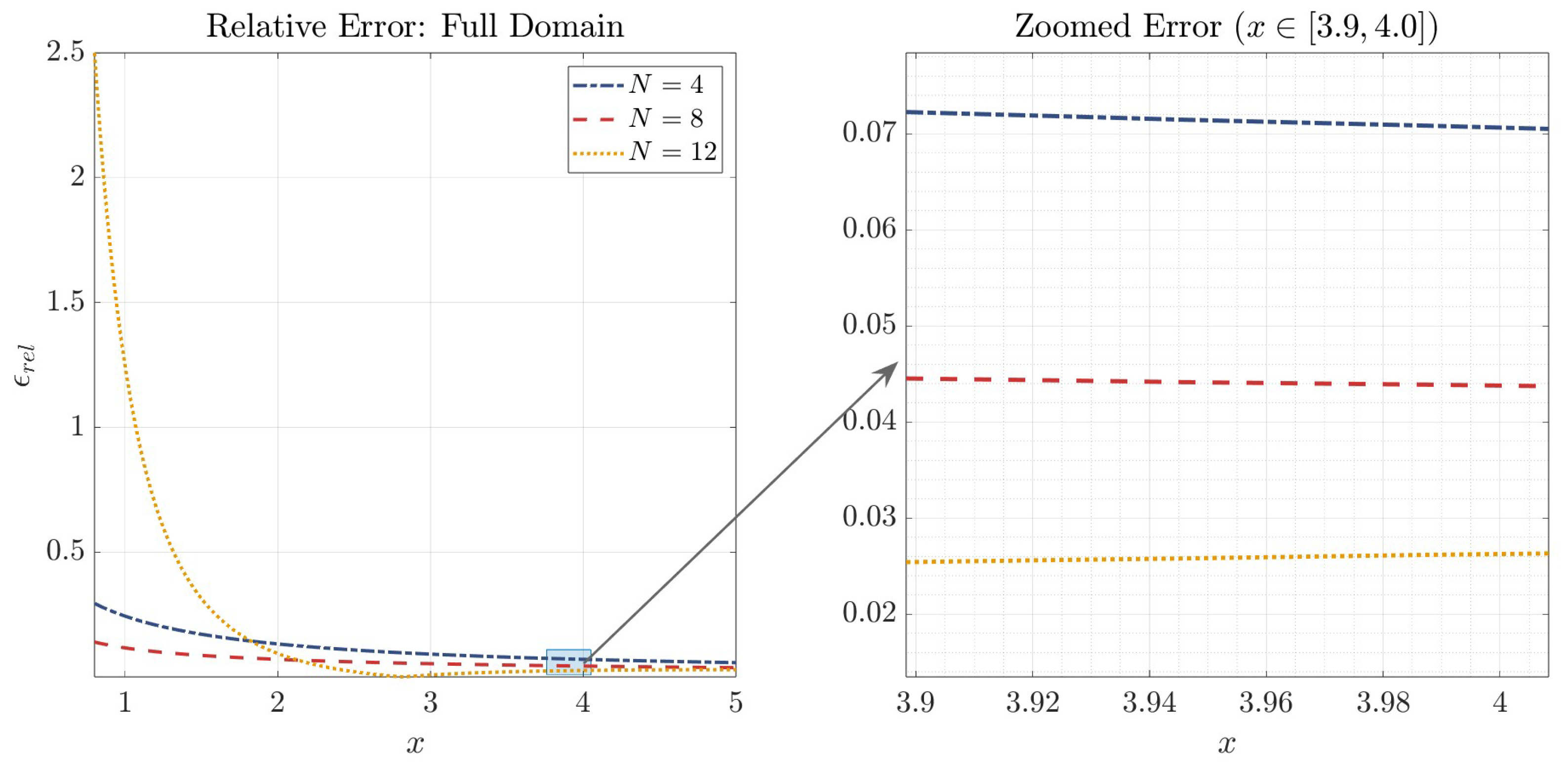
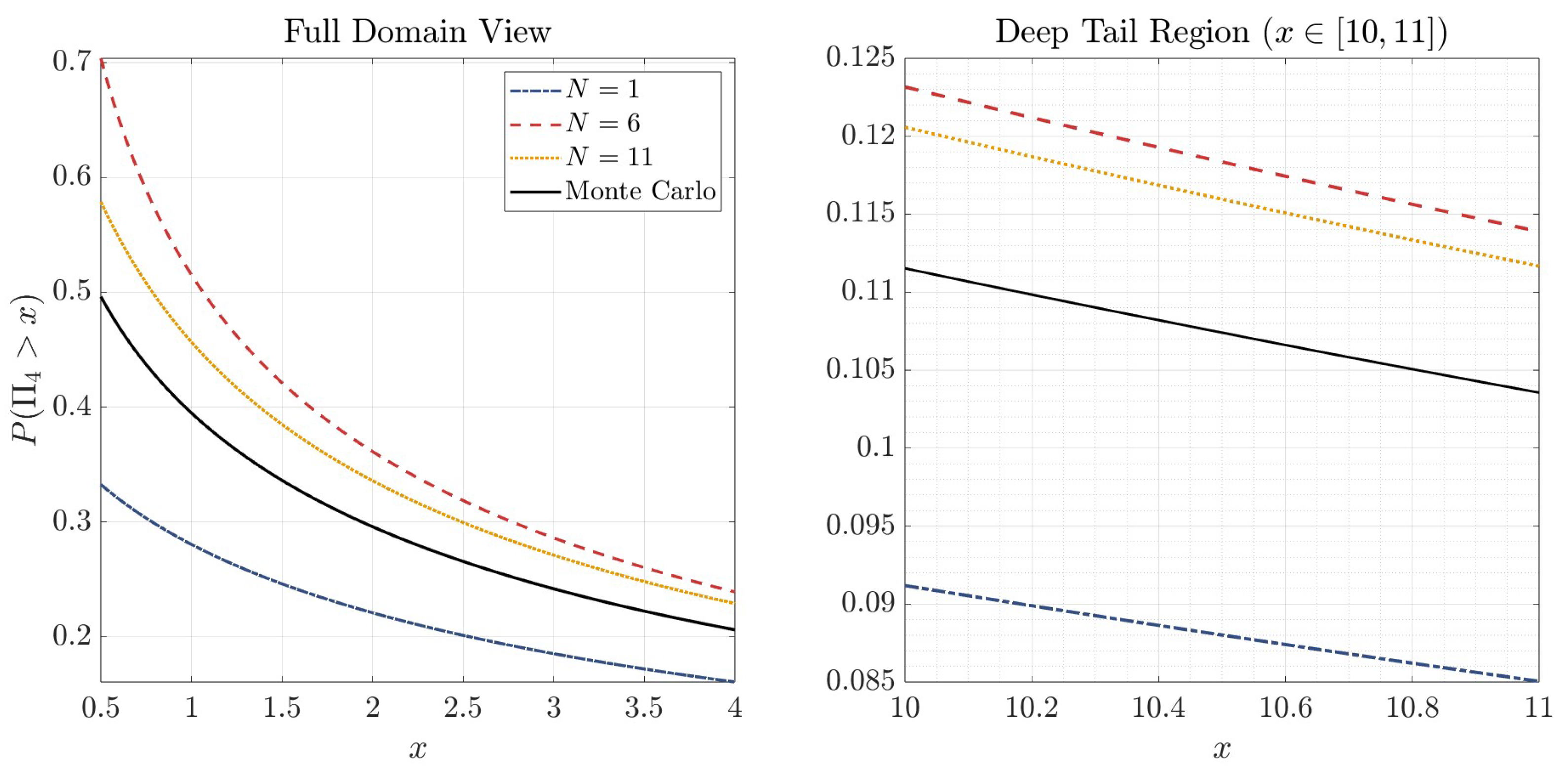
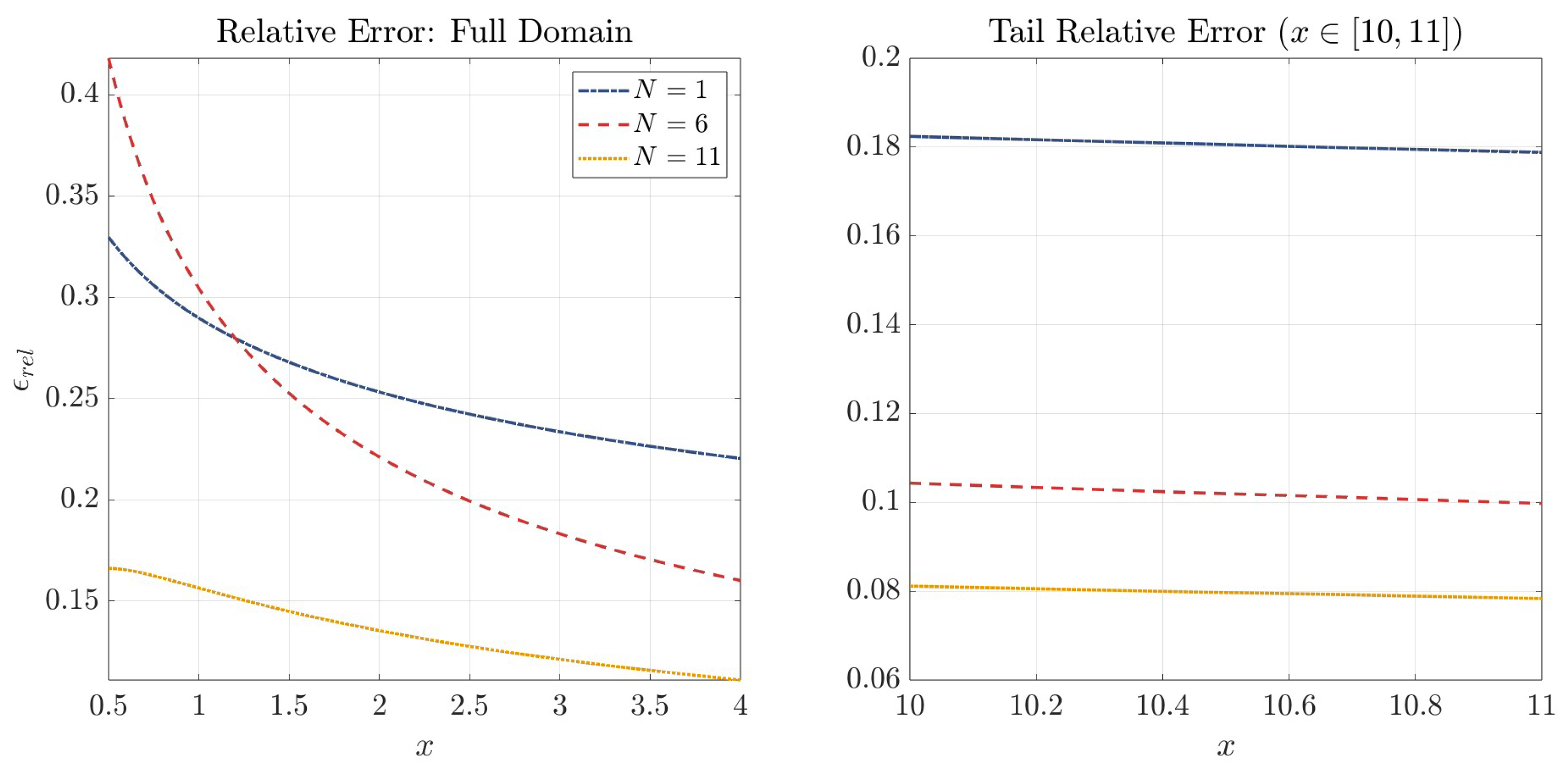
7. Numerical Examples
8. Conclusions
Author Contributions
Funding
Data Availability Statement
Conflicts of Interest
Appendix A. Code for Computation of Coefficients
- The computation of the coefficients is divided into three different
- procedures: The function c_coeff uses Wojdylo’s recursive formula,
- the function c_ikm calculates the coefficients for the individual integrals,
- and the function Coeff_D computes the final coefficients D,
- returning the full matrix of these coefficients.
- function c_coeff = c_coeff(a_raw, b_raw, mu, nu, MAX_S)
- % C_COEFF Computes coefficients via partial Bell polynomials and scaling.
- %
- % This function performs symbolic computation of coefficients based on
- % raw input vectors, using a recursive table for polynomial expansion.
- % Ensure inputs are symbolic for precision
- mu = sym(mu);
- nu = sym(nu);
- % Scaled coefficients: a -> A, b -> B
- a0 = a_raw(1);
- A_vec = sym(a_raw(2:end) / a0);
- B_vec = b_raw / b_raw(1);
- % Initial constant c0
- c0 = b_raw(1) / (mu * a0^(nu / mu));
- % --- Partial Bell Polynomial Table (C_table) ---
- C_table = sym(eye(MAX_S + 1));
- for n = 1:MAX_Sfor kk = 1:n% Range of m for the recursive relationm_range = (kk-1):(n-1);% Update table using dot product of A valuesand existing table entriesC_table(n+1, kk+1) = A_vec(n - m_range)* C_table(m_range + 1, kk);end
- end
- % --- Coefficient Calculation (c_star and c_coeff) ---
- c_coeff = sym(zeros(1, MAX_S + 1));
- % C_IKM Computes the coefficients for the integral expansion.
- %
- % Inputs:
- % ii - Order of the coefficent c_{i} in the integral expansion
- % k - The index of approximated integral
- % m - Number of random variables in the product
- %
- % Dependencies:
- % Requires function c_coeff(a, b, ...) to be in the path.
- function D = Coeff_D(N, n)
- % D_COEFF Computes the coefficient vector based on the theorem.
- % Inputs:
- % N - Determines the row dimension (K) via floor(N/2) + 1
- % n - The number of columns (number of r.v.s)
- % Output:
- % D - Full table of coefficients D_{2k,n}
- %
- % Dependencies:
- % Requires function c_ikm(i, k, n) to be in the path.
References
- Chen, Y.; Karagiannidis, G.K.; Lu, H.; Cao, N. Novel approximations to the statistics of products of independent random variables and their applications in wireless communications. IEEE Trans. Veh. Technol. 2012, 61, 443–454. [Google Scholar] [CrossRef]
- Abo Rahama, Y.; Ismail, M.H.; Hassan, M.S. On the distribution of the product and ratio of products of EGK variates with applications. Telecommun. Syst. 2018, 68, 231–238. [Google Scholar] [CrossRef]
- Du, H.; Zhang, J.; Peppas, K.P.; Zhao, H.; Ai, B.; Zhang, X. On the distribution of the ratio of products of Fisher–Snedecor F random variables and its applications. IEEE Trans. Veh. Technol. 2020, 69, 1855–1866. [Google Scholar] [CrossRef]
- Shekhar, S.; Kalyani, S. Product and ratio of two α-κ-μ shadowed random variables and its application to wireless communication. IEEE Access 2025, 13, 190388–190402. [Google Scholar] [CrossRef]
- Wille, E.C.G. Efficient approximation to Rician and Hoyt product distributions with applications to wireless communication channels. IEEE Wirel. Commun. Lett. 2025, 14, 3254–3258. [Google Scholar] [CrossRef]
- Chen, Y.; Ng, K.W.; Yuen, K.C. The maximum of randomly weighted sums with long tails in insurance and finance. Stoc. Anal. Appl. 2011, 29, 1033–1044. [Google Scholar] [CrossRef][Green Version]
- Asimit, A.V.; Hashorva, E.; Kortschak, D. Aggregation of randomly weighted large risks. IMA J. Manag. Math. 2017, 28, 403–419. [Google Scholar] [CrossRef][Green Version]
- Jaunė, E.; Ragulina, O.; Šiaulys, J. Expectation of the truncated randomly weighted sums with dominatedly varying summands. Lith. Math. J. 2018, 58, 421–440. [Google Scholar] [CrossRef]
- Gong, Y.; Yang, Y.; Liu, J. On the Kesten-type inequality for randomly weighted sums with applications to an operational risk model. Filomat 2021, 35, 1879–1888. [Google Scholar] [CrossRef]
- Konstantinides, D.G.; Passalidis, C.D. Background risk model in presence of heavy tails under dependence. Nonlinear Anal. Model. Control 2025, 30, 982–1010. [Google Scholar] [CrossRef]
- Rekha, A.; Sunder, T.S. Survival function of a component under random strength attenuation. Microelectron. Reliab. 1997, 37, 677–681. [Google Scholar] [CrossRef]
- Nadarajah, S.; Kotz, S. On the product and ratio of gamma and beta random variables. Allg. Stat. Arch. 2005, 89, 435–449. [Google Scholar] [CrossRef]
- Coelho, C.A.; Alberto, R.P. On the distribution of the product of independent beta random variables—Applications. In Advances in Statistics—Theory and Applications. Emerging Topics in Statistics and Biostatistics; Ghosh, I., Balakrishnan, N., Ng, H.K.T., Eds.; Springer: Cham, Switzerland, 2021. [Google Scholar]
- De Carlo, F. Reliability and maintainability in operations management. In Operations Management; Schiraldi, M.M., Ed.; IntechOpen: London, UK, 2013; pp. 81–111. [Google Scholar] [CrossRef]
- Springer, M.D. The Algebra of Random Variables; John Wiley and Sons: Hoboken, NJ, USA, 1979. [Google Scholar]
- Galambos, J.; Simonelli, I. Products of Random Variables: Applications to Problems of Physics and to Arithmetical Functions; Taylor and Francis: Boca Raton, FL, USA, 2004. [Google Scholar]
- Lomnicki, Z.A. On the distribution of products of random variables. J. R. Stat. Soc. Ser. B Stat. Methodol. 1967, 29, 513–524. [Google Scholar] [CrossRef]
- Lawless, J.F. Statistical Models and Methods for Lifetime Data; Wiley: New York, NY, USA, 1982. [Google Scholar]
- Abernethy, R.B. The New Weibull Handbook. Reliability and Statistical Analysis for Predicting Life, Safety, Survivability, Risk, Cost, and Warranty Claims, 5th ed.; Robert B. Abernethy: North Palm Beach, FL, USA, 2004. [Google Scholar]
- Hogg, R.V.; Klugman, S.A. Loss Distributions; Wiley: New York, NY, USA, 1984. [Google Scholar]
- Li, J.; Liu, J. Claims modeling with three-component composite models. Risks 2023, 11, 196. [Google Scholar] [CrossRef]
- Mittnik, S.; Rachev, S.T. Stable distributions for asset returns. Appl. Math. Lett. 1989, 2, 301–304. [Google Scholar] [CrossRef]
- Mittnik, S.; Rachev, S.T. Modelling asset returns with alternative stable distributions. Econom. Rev. 1993, 12, 261–330. [Google Scholar] [CrossRef]
- Bardley, R.F.; McDonald, J.B.; Mantrala, A. Something new, something old: Parametric models for the size distribution of income. J. Income Distrib. 1996, 6, 91–103. [Google Scholar] [CrossRef]
- Stoyan, D.; Zhang, Z.X. A stochastic model leading to various particle mass distributions including the RRSB distribution. Granul. Matter 2023, 25, 67. [Google Scholar] [CrossRef]
- Zhang, Z.T.; Xu, Y.X.; Liao, J.B.; Liu, S.K.; Liu, Z.; Gao, W.H.; Yi, L.W. Study on the particle strength and crushing patterns of coal gangue coarse-grained subgrade fillers. Sustainability 2024, 16, 5155. [Google Scholar] [CrossRef]
- Medhi, J. Stochastic Models in Queueing Theory, 2nd ed.; Academic Press: Cambridge, MA, USA, 2002. [Google Scholar]
- Akbash, K.; Matsak, I.; Zakusylo, O. Some limit theorems for extreme values of Lindley-type processes. Lith. Math. J. 2025, 65, 1–13. [Google Scholar] [CrossRef]
- Johnson, N.L.; Kotz, S.; Balakrishnan, N. Continuous Univariate Distributions, 2nd ed.; Wiley: New York, NY, USA, 1994. [Google Scholar]
- Kotz, S.; Nadarajah, S. Extreme Value Distributions. Theory and Applications; Imperial College Press: London, UK, 2000. [Google Scholar]
- Ianculescu, D.; Anghel, C.G. Innovative explicit relations for Weibull distribution parameters based on K-moments. Mathematics 2025, 13, 3473. [Google Scholar] [CrossRef]
- Tang, Q. From light tails to heavy tails through multiplier. Extremes 2008, 11, 379–391. [Google Scholar] [CrossRef]
- Arendarczyk, M.; Dȩbicki, K. Asymptotics of supremum distribution of a Gaussian process over a Weibullian time. Bernoulli 2011, 17, 194–210. [Google Scholar] [CrossRef]
- Dȩbicki, K.; Farkas, J.; Hashorva, E. Extremes of randomly scaled Gumbel risks. J. Math. Anal. Appl. 2018, 458, 30–42. [Google Scholar] [CrossRef]
- Leipus, R.; Šiaulys, J.; Dirma, M.; Zovė, R. On the distribution-tail behaviour of the product of normal random variables. J. Inequal. Appl. 2023, 2023, 32. [Google Scholar] [CrossRef]
- Kamarauskas, R.; Šiaulys, J. On the distribution-tail of the product of gamma random variables. Nonlinear Anal. Model. Control 2024, 29, 1180–1199. [Google Scholar] [CrossRef]
- Bose, A.; Hazra, R.S.; Saha, K. Product of exponentials and spectral radius of random k-circulants. Ann. L’Institute Henri Poincaré 2012, 48, 424–443. [Google Scholar] [CrossRef]
- Hashorva, E.; Weng, Z. Tail asymptotic of Weibull-type risks. Statistics 2014, 48, 1155–1165. [Google Scholar] [CrossRef]
- Watson, G.N. The harmonic functions associated with the parabolic cylinder. Proc. Lond. Math. Soc. 1918, 2, 116–148. [Google Scholar] [CrossRef]
- Wong, R. Asymptotic Approximations of Integrals; Academic Press: Berlin/Heidelberg, Germany, 1989. [Google Scholar]
- Olver, F.W.J. Asymptotics and Special Functions; A K Peters/CRC Press: Boca Raton, FL, USA, 1997. [Google Scholar]
- Miller, P.D. Applied Asymptotic Analysis; American Mathematical Society: Providence, RI, USA, 2006. [Google Scholar]
- Erdélyi, A. Asymptotic Expansions; Dover Publications: New York, NY, USA, 1956. [Google Scholar]
- De Bruijn, N.G. Asymptotic Methods in Analysis, 2nd ed.; North-Holland: Amsterdam, The Netherlands, 1961. [Google Scholar]
- Copson, E.T. Asymptotic Expansions; Cambridge University Press: Cambridge, UK, 1965. [Google Scholar]
- Bender, C.M.; Orszag, S.A. Advanced Mathematical Methods for Scientists and Engineers: Asymptotic Methods and Perturbation Theory; McGraw–Hill: New York, NY, USA, 1978. [Google Scholar]
- Butler, R.W. Saddlepoint Approximations with Applications; Cambridge University Press: Cambridge, UK, 2007. [Google Scholar]
- Wojdylo, J. On the coefficients that arise from Laplace’s method. J. Comput. Appl. Math. 2006, 196, 241–266. [Google Scholar] [CrossRef]
- Wojdylo, J. Computing the Coefficients in Laplace’s Method. SIAM Rev. 2006, 48, 76–96. [Google Scholar] [CrossRef]


Disclaimer/Publisher’s Note: The statements, opinions and data contained in all publications are solely those of the individual author(s) and contributor(s) and not of MDPI and/or the editor(s). MDPI and/or the editor(s) disclaim responsibility for any injury to people or property resulting from any ideas, methods, instructions or products referred to in the content. |
© 2026 by the authors. Licensee MDPI, Basel, Switzerland. This article is an open access article distributed under the terms and conditions of the Creative Commons Attribution (CC BY) license.
Share and Cite
Kamarauskas, R.; Slabovas, A.; Šiaulys, J. Asymptotic Expansions for Products of Weibull Random Variables. Mathematics 2026, 14, 736. https://doi.org/10.3390/math14040736
Kamarauskas R, Slabovas A, Šiaulys J. Asymptotic Expansions for Products of Weibull Random Variables. Mathematics. 2026; 14(4):736. https://doi.org/10.3390/math14040736
Chicago/Turabian StyleKamarauskas, Ričardas, Aurimas Slabovas, and Jonas Šiaulys. 2026. "Asymptotic Expansions for Products of Weibull Random Variables" Mathematics 14, no. 4: 736. https://doi.org/10.3390/math14040736
APA StyleKamarauskas, R., Slabovas, A., & Šiaulys, J. (2026). Asymptotic Expansions for Products of Weibull Random Variables. Mathematics, 14(4), 736. https://doi.org/10.3390/math14040736