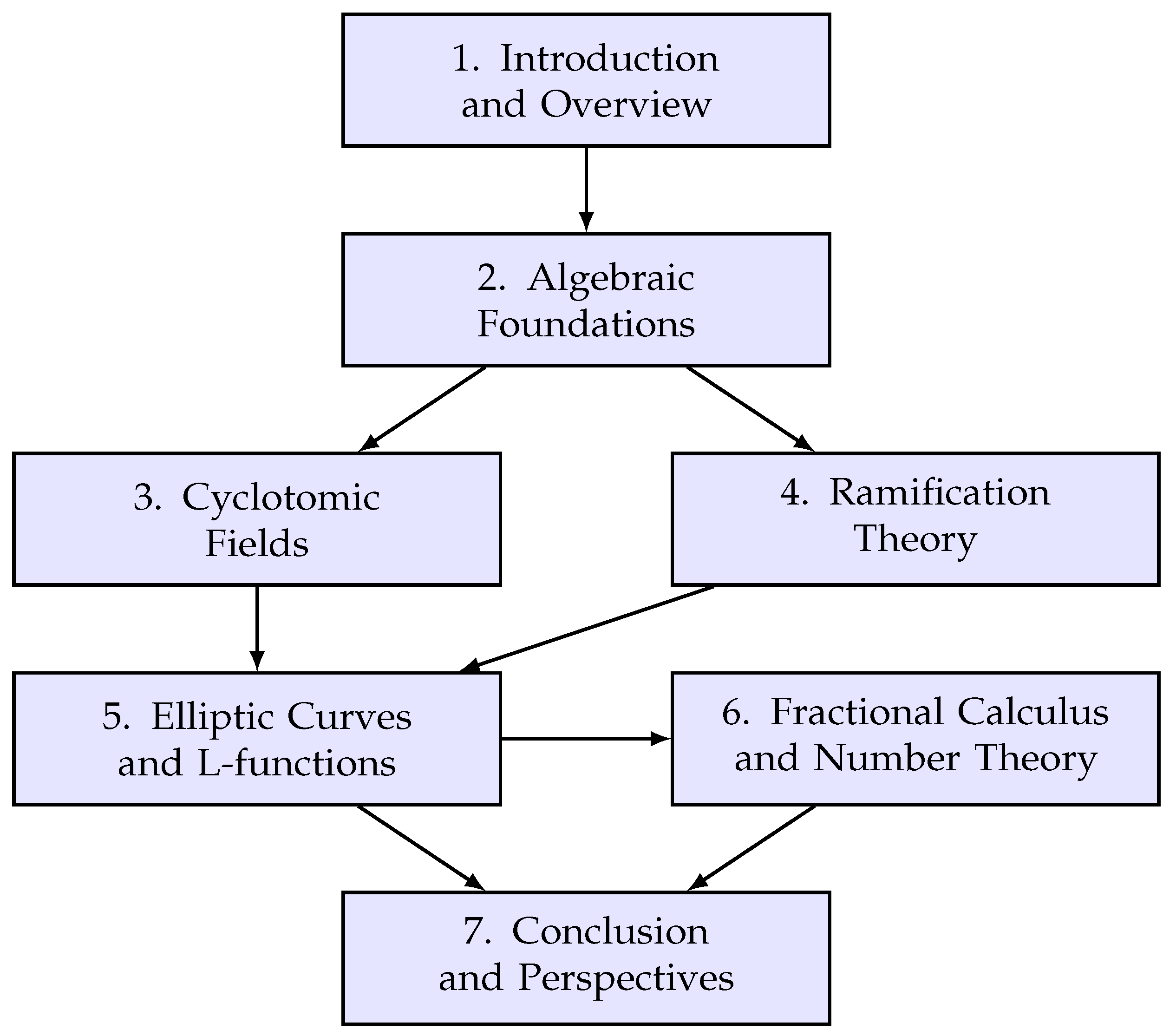
Notes on Number Theory




Abstract
1. Introduction
2. Algebraic Extensions of Fields
2.1. Algebraic Number Fields as Matrix Algebras
2.2. Ring of Algebraic Integers of a Number Field
2.3. Description of the Invariants of a Number Field Through Embeddings
2.4. Kummer’s Theory, Kronecker’s Discrete Valuations, Ideal Class Group
- (1)
- is a Noetherian ring, meaning every ideal of is finitely generated;
- (2)
- is integrally closed in its field of fractions;
- (3)
- Every nonzero prime ideal in is maximal.
- Noetherian: is a free -module of rank n. Every ideal is a -submodule; hence, it is finitely generated as a -module and, thus, also as an -module. Therefore, is Noetherian.
- Integrally closed: is by definition the integral closure of in K. Since integral closures of integrally closed domains remain integrally closed (transitivity), is integrally closed in K.
- Krull dimension 1: Let be a prime ideal. Then for some prime p. The quotient is a finite -algebra and an integral domain (since is prime). A finite integral domain is a field; hence, is maximal.
- (1)
- if and only if, ;
- (2)
- ;
- (3)
- .
- Valuations from prime ideals. Let K be a number field with ring of integers . Each nonzero prime ideal defines a normalized discrete valuation by , the exponent of in the prime-ideal factorization of . Two such valuations and are equivalent if and only if . Thus, the equivalence classes of non-Archimedean places of K are in bijection with the prime ideals of (Theorem 3).
- Localization at a prime ideal. Let . The localization of at isThis is a local ring with unique maximal ideal . Because is Dedekind, is a discrete valuation ring; it coincides with the valuation ring . The residue field is finite.
- First, J is a fractional ideal. Since I is nonzero, pick any nonzero element . For any , we have (because and )); hence, . Thus, . Clearly J is an -submodule of K (if and , then and ). The set is a finitely generated -module: the map sending r to is an -linear isomorphism, and is generated by 1 as an -module. Since is Noetherian, every submodule of a finitely generated -module is finitely generated; consequently, J is a finitely generated -module. Moreover, : because I is a fractional ideal, there exists a nonzero such that , and this d belongs to J. Thus, J is a nonzero finitely generated -submodule of K, i.e., a fractional ideal.
- Now we show that using localization. For each maximal ideal we compare with the set .
- Claim: .
- Given a nonzero prime ideal , define the -adic valuation. For any , consider the principal fractional ideal . Since is a Dedekind domain, it has a unique factorization into prime ideals:where runs over all nonzero prime ideals of , , and only finitely many are nonzero. Definei.e., the exponent of in this factorization. This is a discrete valuation with valuation ring (the localization at ).
- Conversely, given a discrete valuation with valuation ring and maximal ideal , construct a prime ideal. Since is a Dedekind domain, the intersection is a nonzero prime ideal of , and one can show that is precisely the localization .
- The two constructions are inverse to each other:Hence, there is a natural bijection between the set of nonzero prime ideals of and the set of discrete valuations of K.
3. Cyclotomic Fields

- (Field-theoretic) Every finite abelian extension of is contained in a cyclotomic field for some integer n.
- (Representation-theoretic) Every continuous one-dimensional complex representation of the absolute Galois group is induced by a Dirichlet character.
- Notation
- –the absolute Galois group of , equipped with the Krull topology. For the basic properties of this topology, see [2] or [11]. Since is realized as a projective limit of finite groups, it is endowed with the profinite topology. It is a fundamental fact that this topology coincides with the Krull topology—the topology of pointwise convergence on the algebraic closure .
- For each integer , let be a primitive n-th root of unity.
- is the natural restriction map. It is continuous and surjective.
- We identify with via the map sending to the unique such that (see [5]).
- A Dirichlet character modulo n is a group homomorphism . By composing with , we obtain a continuous homomorphism .
- Proof that (1) implies (2).

- Proof that (2) implies (1).
- Conclusion. We have shown the equivalence of the two formulations of the Kronecker–Weber theorem. The key ingredients were as follows:
- Continuous homomorphisms from a profinite group to have finite image (Lemma 1), which relies on the “no small subgroups” property of .
- The Galois correspondence between subfields of and closed subgroups of .
- The fact that every finite abelian group is a direct sum of cyclic groups, and its representation theory (characters separate points).
3.1. Step 1: Reduction to Cyclic Extensions of Prime-Power Degree
3.2. Step 2: Further Reduction to Cyclic Extensions of Prime Degree
3.3. Step 3: Cyclic Extensions of Prime Degree p
3.3.1. Case (Quadratic Extensions)
- .
- because .
- For an odd prime q, the unique quadratic subfield of is with .
3.3.2. Case p Odd
- (a)
- Only the prime p ramifies. Then the discriminant is a power of p. Consider the cyclotomic field . Its Galois group is , which is cyclic of order . Hence, it contains a unique subgroup of index p; let H be the fixed field of this subgroup. Then is cyclic of degree p and is totally ramified at p (and unramified elsewhere).The field is the ray class field of of modulus ; therefore, it is the maximal abelian extension of with conductor dividing . Consequently, any cyclic extension of degree p unramified outside must be contained in . Since H is the unique subfield of of degree p, it follows that K is isomorphic to H and, therefore, . (An elementary argument avoiding class field theory is given in (Chapter 14, [5]).)
- (b)
- Some prime ramifies. Because the extension is cyclic of prime degree, the ramification at q is tame (since ), and the inertia group at q has order p. Hence, p divides the order of the inertia group, but in the tame case, the inertia group injects into the Galois group of the residue field extension, whose order divides . Thus, , i.e., .Now consider the cyclotomic field . Its Galois group is cyclic of order , and since , it contains a unique subgroup of index p. Let be the fixed field of this subgroup; then is cyclic of degree p and ramified only at q (and at infinity).Let S be the set of primes different from p that ramify in K. For each we have the field as above. If p also ramifies in K, let be the unique degree-p subfield of (as in Subcase (a)).The fields are linearly disjoint over . Indeed, any nontrivial intersection (with ) would be a cyclic extension of degree p unramified outside . Because is totally ramified at and is unramified at , their intersection must be unramified at ; the same argument at forces it to be unramified also at ; hence, unramified everywhere. By Minkowski’s theorem, the only everywhere unramified extension of is itself, so . Hence, the compositumhas a Galois group isomorphic to (or if p ramifies). Since is an elementary abelian p-group, its subextensions of degree p over correspond bijectively to one-dimensional -subspaces of its Galois group (via Kummer theory or, equivalently, via class-field theory). Because K is a cyclic extension of degree p ramified exactly at the primes in S (and possibly p), it corresponds to such a subspace and, therefore, embeds into M.Finally, each is contained in , and . Consequently, M is contained in the cyclotomic field with , whence .
3.4. Step 4: Summary
3.5. Remarks
- The proof heavily uses ramification theory and properties of cyclotomic fields. The reduction to a prime degree is standard, and the treatment of the odd prime case can be carried out either via class field theory or, as sketched here, by a direct construction using linearly disjoint cyclic extensions.
- Lemma 2 is the most subtle point; its full proof requires Kummer theory and an analysis of units in cyclotomic fields. See [5] (Chapter 14) for a complete exposition.
- The theorem has numerous generalizations, most notably to local fields (local Kronecker–Weber theorem) and to the theory of complex multiplication (where abelian extensions of imaginary quadratic fields are described using values of modular functions).
4. Ramification Theory in General
4.1. Foundations of Hilbert’s Ramification Theory
4.1.1. The Fundamental Setting
4.1.2. The Three Arithmetic Invariants
4.1.3. The Fundamental Identity
- If d is a quadratic residue modulo p, then p splits: , , .
- If d is a non-residue, then p is inert: , , .
4.1.4. Two Perspectives on the Proof
- The Arithmetic Approach via Norms
- The Algebraic Approach via Module Lengths
- 1.
- The reduction factors in aswhere are distinct monic irreducible polynomials.
- 2.
- The prime ideals of lying above are exactlywhere is any monic polynomial whose reduction modulo is .
- 3.
- For each i, the ramification index is as in the factorization of , and the residue class degree equals
- 4.
- We have the factorization
- Step 1.
- The isomorphism .Set and localise:The hypothesis localises to . The ideal lies in the Jacobson radical of B (every maximal ideal of B contracts to , hence contains ). The quotient is cyclic as a B-module, thus finitely generated as a B-module. Nakayama’s lemma (in the form: if and for a finitely generated R-module M, then ) applied with , and gives: from we have , therefore , i.e., .Because , we have ; consequently .Localisation is exact and (if , then , contradiction). Henceand similarly . From we obtainNow is a field, therefore every acts invertibly on any -module M (multiplication by the class of s is an automorphism). Thus the canonical map is an isomorphism for and . Combining the isomorphisms yields
- Step 2.
- Reduction to the polynomial ring.Since , we havewhere is the residue field. (Recall that residue fields of number fields are finite; hence is a finite field and is a principal ideal domain.)
- Step 3.
- Factorization of and the Chinese Remainder Theorem.Factor in as with monic, irreducible, and pairwise distinct. Since the polynomials are pairwise coprime, the Chinese Remainder Theorem for rings gives
- Step 4.
- Description of the prime ideals .The maximal ideals of are precisely the ideals generated by the . Under the isomorphisms from Steps 1 and 2, these correspond to maximal ideals of . By the correspondence theorem for rings (the standard bijection between ideals of a quotient and ideals of R containing I), these maximal ideals correspond bijectively to prime ideals of containing .Choose monic polynomials such that . The image of in corresponds to in . Hence the ideal generated by modulo is exactly the maximal ideal corresponding to . Therefore,is a prime ideal of lying above .
- Step 5.
- Residue class degrees.The residue field is isomorphic toConsequently, .
- Step 6.
- Ramification indices and the factorization of .Since is a Dedekind domain, the ideal admits a unique factorization into powers of distinct prime ideals. We already know from Step 4 that the only prime ideals of containing are . Hence we can write uniquelywith integers .Because the ideals are pairwise coprime (they are powers of distinct maximal ideals), the Chinese Remainder Theorem for Dedekind domains gives an isomorphism of -algebrasOn the other hand, from Steps 2 and 3 together with Step 1 we haveBoth decompositions express the Artinian ring as a product of local Artinian -algebras. The decomposition of an Artinian ring into a direct product of local rings is unique up to permutation. Hence, after renumbering, the factors correspond; in particular for each i we haveas -algebras.Now compare the lengths of these modules over . For a local Artinian -algebra A with residue field , the length is equal to (the dimension over ). For the two sides we obtainSince the lengths are equal, we deduce .Substituting into the factorisation yieldsThus the exponents appearing in the factorization of are precisely the ramification indices of the primes over .
4.2. Example 1: The Cubic Field
- (a)
- The prime .Reducing modulo 2 gives . By Dedekind’s theorem,because . Thus, , .
- (b)
- The prime .Modulo 3 we have , since in characteristic 3, . Dedekind’s theorem yieldsThe ideal has norm 3, so , .
- (c)
- The prime .The prime 5 is unramified. Modulo 5, has a root , hencebecause . The quadratic factor is irreducible because its discriminant is not a square in (the squares are ). Thereforewith and . We have , , , and .
4.3. Example 2: The Biquadratic Field
- (a)
- The prime .Since , the conductor condition holds. Modulo 7,A direct check shows that has no roots in . Searching for quadratic factors yieldsThe discriminants of the two quadratics are ; since 5 is not a square in (the squares are ), both are irreducible. By Dedekind’s theorem,where and . Both ideals have , .
- (b)
- The prime .Again , so Dedekind’s theorem applies. Modulo 5,The numbers 2 and 3 are non-squares in (squares: ); hence, both quadratics are irreducible. Thereforewith and . Both have , , and .
Toward a Deeper Theory
4.4. Hilbert’s Main Theorem of Ramification
4.4.1. The Galois Action on Primes
4.4.2. Hilbert’s Main Theorem
- 1.
- The decomposition group has order , where e is the ramification index and f is the residue field degree of over .
- 2.
- The inertia group has order e.
- 3.
- The quotient is isomorphic to the Galois group of the residue field extension:In particular, .
4.4.3. Detailed Proof of Hilbert’s Theorem
- Step 1: Transitivity and the order of
- Step 2: The inertia group and the surjectivity map
- is a finite Galois extension.
- There is a natural isomorphism .
- The residue fields are unchanged: and .
- The inertia group for the local extension corresponds to under this isomorphism.
- Step 3: The Order of the Inertia Group
4.4.4. Interpretations and Consequences
4.4.5. An Example: Decomposition and Inertia Groups in a Quadratic Extension
- Split case. If then the nontrivial automorphism exchanges and . Hence, the only element of G fixing is the identity and, therefore, Thus, , and indeed and . Since , the inertia group is trivial:
- Inert case. If is prime, then is the unique prime ideal above p. Consequently, every automorphism in G fixes , and hence In this case, and , so . Since , the inertia group is again trivial:
- Ramified case. If p ramifies in L, equivalently if , then As is the unique prime ideal above p, we again have Here, the ramification index is , and the residue degree is , so the inertia group has order 2. Since , it follows that Equivalently, the nontrivial automorphism acts trivially on the residue field .
4.4.6. Cyclotomic Extensions: A Paradigmatic Example
- The inertia group is isomorphic to , and has order .
- The decomposition group consists of those automorphisms for which is a power of p modulo . More precisely, under the isomorphism , the decomposition group corresponds to the subgroupUnder the natural isomorphism , this subgroup corresponds to , where denotes the cyclic subgroup generated by p in . Its order is .
- The quotient is cyclic of order f, and is isomorphic to , where is the residue field of .
4.4.7. Wild and Tame Ramification
4.4.8. Section Summary
4.5. The Frobenius Element and the Chebotarev Density Theorem
4.5.1. The Arithmetic of Frobenius
4.5.2. The Frobenius Element: Definition and Basic Properties
- 1.
- The Frobenius element has order equal to the residue field degree .
- 2.
- For any , we have . Hence, the conjugacy class of depends only on .
- 3.
- If E is an intermediate field corresponding to a subgroup under the Galois correspondence, then the Frobenius element for in is the image of under the restriction map .
4.5.3. The Chebotarev Density Theorem: Statement and Significance
4.5.4. Sketch of the Proof via Artin L-Functions
- Step 1: Reduction to Cyclic Extensions
For every non-trivial irreducible character χ of G, the Artin L-function is holomorphic for , admits a meromorphic continuation to , and has no zeros on the line .
- Brauer induction. By Brauer’s induction theorem, every irreducible character of G can be written as a finite -linear combinationwhere each is an elementary subgroup, and is a linear character of . Recall that an elementary subgroup is a direct product of a p-group and a cyclic group of order prime to p.
- Artin formalism. Artin’s formalism for L-functions yields the factorizationwhere denotes the Artin L-function associated with the linear character of
- Passage to cyclic extensions. Since is linear, its kernel has a finite index in , and the quotient is a finite cyclic group. LetThen is a finite cyclic extension. By Artin reciprocity, the Artin L-function coincides with the Hecke L-function attached to the corresponding Hecke character of the cyclic extension .
- Analytic reduction. Assume the following analytic statement:For every finite cyclic extension of number fields, and every non-trivial Hecke character φ associated with , the Hecke L-function is holomorphic for , admits a meromorphic ontinuation to , and has no zeros on the line .Under this assumption, each factor with non-trivial satisfies the required analytic properties. The factors corresponding to trivial linear characters give rise to Dedekind zeta functions of intermediate fields; in the Brauer decomposition of a non-trivial irreducible character , their contributions cancel in such a way that no pole at occurs. Consequently, the Artin L-function satisfies the analytic statement above for every non-trivial irreducible character of G.
- Conclusion. Thus, the analytic part of Chebotarev’s density theorem for arbitrary finite Galois extensions reduces to the corresponding analytic statement for Hecke L-functions attached to finite cyclic extensions.
- Step 2: Analytic Properties of Hecke L-Functions for Cyclic Extensions
- 1.
- Meromorphic continuation and functional equation: admits a meromorphic continuation to the entire complex plane. Since ψ is non-trivial, is in fact an entire function. Moreover, it satisfies a functional equation of the form:where is the completed L-function, obtained by multiplying by appropriate Γ-factors and a power of the discriminant, and is a complex number of absolute value 1.
- 2.
- Non-vanishing on the line : For all , we have . Consequently, is holomorphic and non-zero on the closed half-plane .
- Conclusion of the Reduction
- Step 3: Tauberian Argument and Conclusion
- For every non-trivial character , is holomorphic and non-zero on the closed half-plane . Therefore is holomorphic there.
- For the trivial character , we have , the Dedekind zeta function of K, which possesses a simple pole at . Hence has a simple pole at with residue 1.
- It is holomorphic for (by absolute convergence) and has a meromorphic continuation to with a single simple pole at and no other singularities on the line (by the analysis above and the holomorphy of and the for ).
- The coefficients are non-negative.
4.5.5. Consequences and Applications
- Dirichlet’s theorem on primes in arithmetic progressions
- 2.
- Prime splitting in Galois extensions
- The density of primes that split completely (i.e., with ) is .
- The density of primes that remain inert (i.e., with ) is also .
- The set of ramified primes (where the Artin symbol is not defined) is finite and, thus, has density zero.
- 3.
- The Bauer–Neukirch theorem and characterization of extensions
- 4.
- The inverse Galois problem and Frobenius fields
- 5.
- Equidistribution of Frobenius elements and the Sato–Tate conjecture
- 6.
- Heuristics in number theory
- Artin’s primitive root conjecture: The density of primes for which a given integer a (not a perfect square and ) is a primitive root modulo p is given by an explicit product over primes.
- Splitting types of polynomials: Given an irreducible polynomial , the density of primes p for which factors into irreducible factors of specified degrees is equal to the proportion of elements in the Galois group of f with the corresponding cycle type (when the Galois group is viewed as a permutation group on the roots).
- Orders of points on elliptic curves: The density of primes p for which the order of the group is divisible by a given integer m can be expressed via Chebotarev’s theorem applied to the division fields .
4.5.6. Section Summary
5. Elliptic Curves and L Functions
5.1. The Dual Nature of Elliptic Curves
5.1.1. From Abstract Geometry to Concrete Equations
- Smoothness guarantees a well-defined tangent line at every point, which is necessary for the geometric construction of the group law.
- Properness (completeness) ensures the curve is ’complete’, meaning it has no missing points; when , this corresponds to the compactness of the associated complex manifold.
- Genus One is a topological invariant. Over , it means the associated Riemann surface is a torus. Algebraically, it controls the dimensions of spaces of functions with prescribed poles via the Riemann–Roch theorem.
- The Distinguished PointO provides the base point required to identify the curve with its Jacobian variety and serves as the identity element for the group structure.
5.1.2. The Abelian Group Law: Geometry, Algebra, and Analysis
5.1.3. Fundamental Invariants and Classification
5.1.4. Isogenies: Structure-Preserving Morphisms
- Dual isogeny: For any , there exists a unique such that and .
- Frobenius isogeny: If , the absolute Frobenius defines a purely inseparable isogeny of degree p.
- Division polynomials: For m coprime to , the m-torsion points are cut out by explicit division polynomials derived from the Weierstrass equation.
5.1.5. The Endomorphism Ring and Complex Multiplication
5.1.6. Isogeny Classes and Arithmetic Classification
5.1.7. The Mordell–Weil Theorem, Selmer and Tate–Shafarevich Groups
- Weak Mordell–Weil Theorem: The finiteness of the Selmer group implies the finiteness of , as it injects into .
- Height Descent: A height function measures the arithmetic complexity of a point. The associated canonical height is a positive-definite quadratic form satisfying . A key lemma shows that any coset in contains a representative whose canonical height is bounded by a constant depending only on E, K, and m. Consequently, a finite set of such representatives generates modulo torsion, proving finite generation.
5.1.8. Conclusions: Foundations for the Analytic Theory
5.2. Chebyshev -Function
5.3. From Elliptic Curves to L-Functions: The Chebyshev -Function as a Prototype
5.3.1. The Chebyshev -Function and Its Dirichlet Series
- The von Mangoldt function
- Logarithmic Derivative of
5.3.2. The Starting Point: Perron’s Formula
- Perron’s Formula (Basic Version)
- Application to
5.3.3. Analytic Continuation and Poles of the Integrand
- Pole at
- Poles from Zeros of
- Pole at
- Poles from Trivial Zeros
5.3.4. Shifting the Contour of Integration
- Behavior on the horizontal segments
- The vertical integral at
- Passing to the Limit
5.3.5. Summation of Residues
- Pole at
- Poles from nontrivial zeros
- Pole at :
- Poles from trivial zeros ():
- The Explicit Formula
5.3.6. Technical Remarks on Convergence
5.3.7. Implications and the Riemann Hypothesis
5.3.8. Summary
5.4. L-Functions of Elliptic Curves
5.4.1. Elliptic Curves over and Their Reduction
- Types of Reduction
- 1.
- Good reduction if , in which case is an elliptic curve over .
- 2.
- Bad reduction if , further classified as follows:
- Multiplicative reduction if has a node. This is subdivided into:
- –
- Split multiplicative if the slopes of the tangents at the node are defined over .
- –
- Non-split multiplicative otherwise.
- Additive reduction if has a cusp.
- The Coefficients
- The Conductor
5.4.2. Construction of the L-Function
- Local L-Factors
- Global L-function
- If E has good reduction at p, the coefficients satisfy the recurrence
- If E has multiplicative reduction at p, then for all .
- If E has additive reduction at p, then for all .
- Analytic Continuation and Functional Equation
5.4.3. The Weak Birch and Swinnerton-Dyer Conjecture
5.4.4. The Case : Coates–Wiles Theorem
5.4.5. The Case : Heegner Points and the Work of Gross–Zagier and Kolyvagin
- Heegner Points
- By the modularity theorem (proved in full generality by Wiles, Breuil, Conrad, Diamond, and Taylor [27,28]), there exists a modular parametrization . Let K be an imaginary quadratic field satisfying the Heegner condition: every prime dividing splits in K. Then there exists a point , where H is the Hilbert class field of K, corresponding to a cyclic -isogeny between elliptic curves with complex multiplication by . Its image is a Heegner point.
- Kolyvagin’s Euler System
- 1.
- The rank of is 1.
- 2.
- The Shafarevich–Tate group III is finite.
- Origin. Kolyvagin’s system [30] is geometric (Heegner points on modular curves). Rubin [31,32] developed the axiomatic framework and constructed Euler systems from elliptic units for CM elliptic curves. Kato’s system [33] is analytic (Beilinson elements, Siegel units, zeta values) and applies to all modular forms.
- Essence. Families of Galois cohomology classes indexed by integers, linked by norm relations encoding Euler factors. They bridge special L-values and Selmer groups: implicitly in Kolyvagin, explicitly via p-adic L-functions in Kato. Rubin systematized the method and proved the Iwasawa main conjecture for CM fields.
5.4.6. Parity Results and the Rank 0/1 Dichotomy
5.4.7. Explicit Examples and Numerical Evidence
- Example 1: Curve 11a1
- Example 2: Curve 37a1
- Example 3: Curve 14a1
- Example 4: A Curve with Complex Multiplication
- Example 5: Curve 389a1 (Rank 2)
5.4.8. Further Directions and Open Problems
- Prove the weak BSD conjecture for elliptic curves with analytic rank .
- Extend the Gross–Zagier formula to higher derivatives to handle rank cases.
- Understand the behavior of L-functions in families, e.g., quadratic twist families.
- Prove the finiteness of III without assuming analytic rank .
- Develop Euler systems for higher rank, e.g., via Stark–Heegner points or p-adic methods.
6. Number Theory and Fractional Calculus via Integral Transforms
6.1. The Common Framework of Integral Transforms
6.2. Fractional Calculus via Laplace Transforms
6.3. Additive vs. Multiplicative Structures
6.4. Mellin Transforms and Zeta Functions in Number Theory
6.5. The Gamma Function as a Bridge
6.6. Convolution Structures and Dirichlet Series
6.7. Fractional Differential Equations and Distribution of Primes
6.8. Modern Developments and Future Directions
7. Conclusions
Author Contributions
Funding
Institutional Review Board Statement
Informed Consent Statement
Data Availability Statement
Acknowledgments
Conflicts of Interest
Symbols
| Symbol | Description | Remarks/Examples |
| Field of rational numbers | Base field for most extensions | |
| Ring of integers | ||
| Field of complex numbers | Used for embeddings/analytic functions | |
| Algebraic closure of | Codomain of embeddings | |
| Finite field with p elements | Residue field; used in reductions mod p | |
| Finite field with q elements | General finite residue fields | |
| Field of p-adic numbers | Local field; p-adic considerations | |
| Ring of p-adic integers | Valuation ring of | |
| Number fields | Usually finite extensions of | |
| Degree of field extension | Dimension of L as a K-vector space | |
| Ring of integers of number field K | The integral closure of in K | |
| Prime ideals in a Dedekind domain | Often primes of | |
| Prime ideals above | Primes of with | |
| Norm of an ideal | ||
| Discriminant of number field K | Controls ramification/splitting of primes | |
| Galois group of an extension | Automorphisms of L fixing K | |
| Set of -embeddings | Used for trace/norm formulas | |
| Field trace of | ||
| Field norm of | ||
| Discriminant of a basis | ||
| Ideal class group of K | ||
| Class number of K | ||
| Residue field at | ||
| Residue field at | ||
| Completion of K at | Local field w.r.t. -adic topology | |
| Completion of L at | Completion above | |
| Notation for | Shorthand in the local argument | |
| Notation for | Shorthand in the local argument | |
| Extended prime | Prime ideal in | |
| Extended prime | Prime ideal in | |
| Decomposition group of | Subgroup of preserving | |
| Inertia group of | Kernel of the action on residue fields | |
| Frobenius element at | Induces on | |
| Primitive n-th root of unity | ||
| Cyclotomic field of conductor n | Finite abelian extension of | |
| n-th cyclotomic polynomial | Minimal polynomial of over | |
| Euler totient function | ||
| Riemann zeta function | ||
| Hurwitz zeta function | ||
| Dirichlet character | Used in | |
| Dirichlet L-function | For a Dirichlet character | |
| Gamma function | ||
| Chebyshev function | ||
| Theta function | ||
| Möbius function | Dirichlet inverse of 1 (under Dirichlet convolution) | |
| von Mangoldt function | ||
| Laplace transform | ||
| Mellin transform | ||
| Riemann–Liouville fractional integral | ||
| Caputo fractional derivative | , | |
| Mittag–Leffler function | ||
| E | Elliptic curve | Typically over a field |
| Group of K-rational points of E | Abelian group under the chord–tangent law | |
| Number of points on E over | Used to define local data at p | |
| Frobenius trace at p | (good reduction) | |
| Hasse–Weil L-function of E | Euler product with local factors from | |
| Discriminant of an elliptic curve | Controls singular reduction; minimal discriminant | |
| Conductor of an elliptic curve | Encodes primes of bad reduction and exponents | |
| Torsion subgroup of | Finite subgroup of rational torsion points | |
| III | Tate–Shafarevich group | III |
| m-Selmer group | Subgroup of defined by local conditions |
Abbreviations
| Abbreviation | Full Form |
| BSD | Birch and Swinnerton-Dyer (conjecture) |
| CM | Complex Multiplication |
| GRH | Generalized Riemann Hypothesis |
| LHS | Left-Hand Side |
| RHS | Right-Hand Side |
| LMFDB | L-functions and Modular Forms Database |
| iff | If and Only If |
| i.e. | That is (Latin: id est) |
| e.g. | For example (Latin: exempli gratia) |
| cf. | Compare (Latin: confer) |
| et al. | And others (Latin: et alii) |
| mod | Modulo |
| char | Characteristic (of a field) |
| deg | Degree |
| dim | Dimension |
| gcd | Greatest Common Divisor |
| lcm | Least Common Multiple |
| Aut | Automorphism Group |
| End | Endomorphism Ring |
| Hom | Homomorphism Group |
| Gal | Galois Group |
Appendix A. Galois Transitivity Action
- From we have ; in a Dedekind domain this implies that divides the ideal . Taking ideal norms, divides . Since for some integer , we obtain , i.e., .
- For each , the congruence implies . Thus every Galois conjugate of x is congruent to 1 modulo . ThereforeIn particular . Because , we also have .
Appendix B. Proof of Theorem 12
- Step 1. is a homomorphism.
- Step 2. Injectivity of .
- Step 3. Surjectivity of .
Appendix C. Proof of Theorem 14
- Step 1. (Weak Mordell–Weil theorem) For some integer , the quotient is finite.
- Step 2. (Canonical height) There exists a quadratic function with the properties:
- for all ,
- For any , the set is finite.
- Step 3. (Descent) Using steps 1 and 2, one deduces that is finitely generated.
- Step 1. Weak Mordell–Weil theorem. Fix an integer . Consider the exact sequence of -moduleswhere . The associated long exact cohomology sequence gives
- Step 2. Canonical height. Let be a logarithmic height relative to a projective embedding. For an elliptic curve, one typically uses the Weierstrass embedding into . Define
- is a quadratic form: is bilinear; in particular .
- , and if and only if P is torsion.
- (Northcott property) For any , the set is finite.
- Step 3. Descent. Now, assume we have fixed for which Step 1 holds, and let be as in Step 2. Choose a finite set of representatives for .
References
- Silverman, J.H. The Arithmetic of Elliptic Curves, 2nd ed.; Graduate Texts in Mathematics 106; Springer: Berlin/Heidelberg, Germany, 2009.This comprehensive textbook contains a complete proof of the Mordell–Weil theorem (Chapter VIII), a detailed treatment of the Selmer and Tate–Shafarevich groups, and the theory of the canonical height (Chapter VIII, §9).
- Silverman, J.H. Advanced Topics in the Arithmetic of Elliptic Curves; Graduate Texts in Mathematics 151; Springer: Berlin/Heidelberg, Germany, 1994.This sequel provides deeper insights into the Galois-cohomological machinery, including the use of the Kummer theory and class field theory in the proof of the weak Mordell–Weil theorem.
- Serre, J.-P. Lectures on the Mordell–Weil Theorem, 3rd ed.; Aspects of Mathematics; Vieweg: Kranzberg, Germany, 1997.Serre’s notes offer a concise and elegant exposition of the theorem, with emphasis on the cohomological aspects and the role of the Tate–Shafarevich group.
- Mazur, B. Rational points on modular curves. In Modular Functions of One Variable V; (Bonn, 1976), Lecture Notes in Mathematics 601; Springer: Berlin/Heidelberg, Germany, 1977; pp. 107–148.Mazur’s work, while focused on modular curves, provides important context for the study of rational points and the Mordell–Weil theorem in broader geometric settings.
- Weil, A. L’arithmétique sur les courbes algébriques. Acta Math. 1929, 52, 281–315.The original paper in which Weil extended Mordell’s theorem to abelian varieties over number fields, introducing the descent technique that now bears his name.
- Cassels, J.W.S. Lectures on Elliptic Curves; London Mathematical Society Student Texts 24; Cambridge University Press: Cambridge, UK, 1991.A gentle introduction that includes a proof of the Mordell–Weil theorem over , with explicit computations and examples.
Appendix D. Proof of Theorem 15
References
- Silverman, J.H. The Arithmetic of Elliptic Curves, 2nd ed.; Springer: Berlin/Heidelberg, Germany, 2009; (Chapter V, Theorem 1.1).
- Weil, A. Sur les Courbes algéBriques et les Variétés Qui s’en déDuisent; Hermann: Paris, France, 1948.
- Hasse, H. Zur Theorie der abstrakten elliptischen Funktionenkörper. J. Reine Angew. Math. 1936, 175, 55–62.
- Schoof, R. Elliptic curves over finite fields and the computation of square roots mod p. Math. Comp. 1985, 44, 483–494. (Contains algorithmic aspects and applications)
References
- Lang, S. Algebra, 3rd ed.; Springer: New York, NY, USA, 2002. [Google Scholar]
- Neukirch, J. Algebraic Number Theory, 1st ed.; Springer: Berlin/Heidelberg, Germany, 1999. [Google Scholar]
- Fröhlich, A.; Taylor, M.J. Algebraic Number Theory; Cambridge University Press: Cambridge, UK, 1993. [Google Scholar]
- Panchiskin, A.A.; Manin, Y.I. Introduction to Modern Number Theory, 2nd ed.; Springer: Berlin/Heidelberg, Germany, 2005. [Google Scholar]
- Washington, L.C. Introduction to Cyclotomic Fields, 2nd ed.; Springer: New York, NY, USA, 1997. [Google Scholar]
- Iwaniec, H.; Kowalski, E. Analytic Number Theory, 2nd ed.; American Mathematical Society: Providence, RI, USA, 2021. [Google Scholar]
- Silverman, J.H. The Arithmetic of Elliptic Curves; Springer: Berlin/Heidelberg, Germany, 1986. [Google Scholar]
- Silverman, J.H. Advanced Topics in the Arithmetic of Elliptic Curves; Springer: Berlin/Heidelberg, Germany, 1994. [Google Scholar]
- Madamlieva, E.; Konstantinov, M.; Milev, M.; Petkova, M. Integral Representation for the Solutions of Autonomous Linear Neutral Fractional Systems with Distributed Delay. Mathematics 2020, 8, 364. [Google Scholar] [CrossRef]
- Diamond, F.; Shurman, J. A First Course in Modular Forms; Graduate Texts in Mathematics 228; Springer: Berlin/Heidelberg, Germany, 2005. [Google Scholar]
- Milne, J.S. Class Field Theory. 2020. Available online: www.jmilne.org/math/ (accessed on 8 February 2026).
- Serre, J.-P. Lie Algebras and Lie Groups: 1964 Lectures Given at Harvard University, 2nd ed.; Lecture Notes in Mathematics; Springer: Berlin/Heidelberg, Germany, 1992; Volume 1500. [Google Scholar]
- Wilson, J.S. Profinite Groups; Oxford University Press: Oxford, UK, 1998. [Google Scholar]
- Serre, J.-P. Linear Representations of Finite Groups; Springer: Berlin/Heidelberg, Germany, 1977. [Google Scholar]
- Lang, S. Algebraic Number Theory, 2nd ed.; Springer: Berlin/Heidelberg, Germany, 1994. [Google Scholar]
- Faltings, G. Endlichkeitssätze für abelsche Varietäten über Zahlkörpern. Invent. Math. 1983, 73, 349–366. [Google Scholar] [CrossRef]
- Serre, J.-P. Abelian ℓ-Adic Representations and Elliptic Curves; W. A. Benjamin, Inc.: New York, NY, USA; Amsterdam, The Netherlands, 1968. [Google Scholar]
- Mazur, B. Modular curves and the Eisenstein ideal. Publ. Math. IHÉS 1977, 47, 33–186. [Google Scholar] [CrossRef]
- Hasse, H. Zur Theorie der abstrakten elliptischen Funktionenkörper. J. Reine Angew. Math. 1936, 175, 55–62. [Google Scholar] [CrossRef]
- Tate, J. Algorithm for determining the type of a singular fiber in an elliptic pencil. In Modular Functions of One Variable IV; Lecture Notes in Mathematics; Springer: Berlin/Heidelberg, Germany, 1975; Volume 476, pp. 33–52. [Google Scholar]
- Mordell, L.J. On the rational solutions of the indeterminate equations of the third and fourth degrees. Proc. Camb. Philos. Soc. 1922, 21, 179–192. [Google Scholar]
- Weil, A. L’arithmétique sur les courbes algébriques. Acta Math. 1929, 52, 281–315. [Google Scholar] [CrossRef]
- Birch, B.J.; Swinnerton-Dyer, H.P.F. Notes on elliptic curves. I. J. Reine Angew. Math. 1963, 212, 7–25. [Google Scholar] [CrossRef]
- Birch, B.J.; Swinnerton-Dyer, H.P.F. Notes on elliptic curves. II. J. Reine Angew. Math. 1965, 218, 79–108. [Google Scholar] [CrossRef]
- Coates, J.; Wiles, A. On the conjecture of Birch and Swinnerton-Dyer. Invent. Math. 1977, 39, 223–251. [Google Scholar] [CrossRef]
- Iwasawa, K. On some modules in the theory of cyclotomic fields. J. Math. Soc. Jpn. 1964, 16, 42–82. [Google Scholar]
- Breuil, C.; Conrad, B.; Diamond, F.; Taylor, R. On the modularity of elliptic curves over Q: Wild 3-adic exercises. J. Amer. Math. Soc. 2001, 14, 843–939. [Google Scholar] [CrossRef]
- Wiles, A. Modular elliptic curves and Fermat’s Last Theorem. Ann. Math. 1995, 141, 443–551. [Google Scholar] [CrossRef]
- Gross, B.H.; Zagier, O.B. Heegner points and derivatives of L-series. Invent. Math. 1986, 84, 225–320. [Google Scholar] [CrossRef]
- Kolyvagin, V.A. Finiteness of and III for a subclass of Weil curves. Math. USSR-Izv. 1989, 32, 523–541. [Google Scholar] [CrossRef]
- Rubin, K. Euler systems and modular elliptic curves. In Galois Representations in Arithmetic Algebraic Geometry; Scholl, A.J., Taylor, R.L., Eds.; London Mathematical Society Lecture Note Series; Cambridge University Press: Cambridge, UK, 1998; pp. 351–368. [Google Scholar]
- Rubin, K. Euler Systems, Annals of Mathematics Studies 147; Princeton University Press: Princeton, NJ, USA, 2000. [Google Scholar]
- Kato, K. p-adic Hodge theory and values of zeta functions of modular forms. Astérisque 2004, 295, 117–290. [Google Scholar] [CrossRef]
- Waldspurger, J.-L. Sur les valeurs de certaines fonctions L automorphes en leur centre de symétrie. Compos. Math. 1985, 54, 173–242. [Google Scholar]
- The LMFDB Collaboration. The L-Functions and Modular Forms Database. Available online: https://www.lmfdb.org (accessed on 8 February 2026).
- Cohen, H.; Diaz y Diaz, F.; Olivier, M. Advanced Topics in Computational Number Theory; Springer: Berlin/Heidelberg, Germany, 2000. [Google Scholar]
- Bhargava, M.; Shankar, A. Binary quartic forms having bounded invariants, and the boundedness of the average rank of elliptic curves. Ann. Math. 2015, 181, 191–242. [Google Scholar] [CrossRef]
- Zhang, S. Heights of Heegner points on Shimura curves. Ann. of Math. 2001, 153, 27–147. [Google Scholar] [CrossRef]
- Zagier, D. Modular points, modular curves, modular surfaces and modular forms. In Arbeitstagung Bonn 1984; Lecture Notes in Mathematics; Springer: Berlin/Heidelberg, Germany, 1985; Volume 1111, pp. 225–248. [Google Scholar]
- Madamlieva, E.; Konstantinov, M. On the Existence and Uniqueness of Solutions for Neutral-Type Caputo Fractional Differential Equations with Iterated Delays: Hyers-Ulam-Mittag-Leffler Stability. Mathematics 2025, 13, 484. [Google Scholar] [CrossRef]


| Invariant | Symbol | Nature | Role/Property |
|---|---|---|---|
| j-invariant | Element of K | Classifies isomorphisms over | |
| Minimal discriminant | Ideal of | Discriminant of a minimal model; isomorphism invariant | |
| Conductor | Ideal of | Encodes primes/types of bad reduction; isogeny invariant | |
| Algebraic rank | Non-negative integer | Rank of (Mordell–Weil group) | |
| Torsion subgroup | Finite abelian group | Finite part of |
| Concept | Fractional Calculus (Laplace Domain) | Analytic Number Theory (Mellin Domain) |
|---|---|---|
| Fundamental Object | Fractional integral derivative | Zeta function |
| Integral Kernel | (for ) | |
| Transform Action | ||
| Convolution Theorem | Additive convolution: | Multiplicative convolution: |
| where G(s) = ∑bn n−s | ||
| Key Result | Algebraization of operators () | Analytic continuation and functional equation |
| Special Functions | Mittag-Leffler | Gamma , Zeta |
Disclaimer/Publisher’s Note: The statements, opinions and data contained in all publications are solely those of the individual author(s) and contributor(s) and not of MDPI and/or the editor(s). MDPI and/or the editor(s) disclaim responsibility for any injury to people or property resulting from any ideas, methods, instructions or products referred to in the content. |
© 2026 by the authors. Licensee MDPI, Basel, Switzerland. This article is an open access article distributed under the terms and conditions of the Creative Commons Attribution (CC BY) license.
Share and Cite
Stoenchev, M.; Georgiev, S.; Todorov, V. Notes on Number Theory. Mathematics 2026, 14, 697. https://doi.org/10.3390/math14040697
Stoenchev M, Georgiev S, Todorov V. Notes on Number Theory. Mathematics. 2026; 14(4):697. https://doi.org/10.3390/math14040697
Chicago/Turabian StyleStoenchev, Miroslav, Slavi Georgiev, and Venelin Todorov. 2026. "Notes on Number Theory" Mathematics 14, no. 4: 697. https://doi.org/10.3390/math14040697
APA StyleStoenchev, M., Georgiev, S., & Todorov, V. (2026). Notes on Number Theory. Mathematics, 14(4), 697. https://doi.org/10.3390/math14040697