1. Introduction
Throughout this note, all rings are assumed to be associative with identity unless stated otherwise. For a ring R, the polynomial ring in one indeterminate x over R is denoted by . The full matrix ring over R is denoted by , and the upper triangular matrix ring over R is denoted by . The matrix in whose -entry is 1 and all other entries are 0 is denoted by . We denote by the subring of in which all diagonal entries are equal, and by the subring of consisting of those matrices a that satisfy for all and .
For a given ring
R, the Jacobson radical, the prime radical, and the set of all nilpotent elements of
R are denoted by
,
, and
, respectively. Recall that a ring
R is called
semiprime,
semiprimitive,
reduced, and
2-primal if, respectively,
,
,
, and
(see [
1,
2,
3]).
Recall from [
4] that for a commutative ring
R, an
R-module
M, and an endomorphism
of
R, the
Nagata extension of
R by
M and
is the ring
with component-wise addition and multiplication defined by
for all
and
. If
is the identity mapping, the extension is called the
trivial extension of
R by
M, denoted by
. In particular,
.
In [
5], a ring
R is called
reflexive, if
if and only if
for all
. Cohn [
6] introduced a stronger version of reflexivity and called a ring
R reversible if
if and only if
. Reversible rings are also known as
zero-commutative by Habeb [
7], and as rings in which
zero products commute by Anderson [
8]. A ring
R is said to have the
insertion-of-factors property (IFP) if for every
, the condition
implies
. The concept of IFP has appeared under several different names: De Narbonne [
9] called such rings
semicommutative, Shin [
10] used the term
(SI) condition, and Habeb [
7] referred to them as
zero insertive.
In [
11], Kwak et al. proved that the trivial extension
of any division ring
D satisfies the condition
for all
. However, this condition does not hold, in general; for example, it may fail when
D is a commutative ring that is not a division ring. This observation motivated them to introduce the concept of axis-commutativity of rings. A ring
R is said to be
axis-commutative if
for all
.
Although axis-commutativity does not always hold, we have the following example showing that the condition is satisfied under certain additional assumptions.
Example 1. Let be the free algebra generated by the noncommuting indeterminates x and y over a field F. Then S is a domain which is not a division ring. Consider the ring . It is shown in ([11] [Example 1.2]) that R is not axis-commutative. However, if and are elements of R with , then , which implies that either or . In both cases, we obtain . The preceding discussion motivates us to introduce a generalization of axis-commutative rings. We call a ring R axis-reversible if for all whenever .
The main contributions of this paper are as follows: We introduce and systematically study the class of axis-reversible rings as a natural generalization of axis-commutative rings. We investigate their relationships with several well-known classes of rings, including reversible, semicommutative, reduced, semiprime, and 2-primal rings. In particular, we establish nontrivial implications and characterizations involving axis-reversibility and show that this property is independent from semicommutativity through explicit counterexamples. We further study the behavior of axis-reversible rings under various constructions such as trivial extensions, direct products, corners, and Nagata extensions. Finally, we classify minimal noncommutative axis-reversible rings and describe their structure, providing new insight into the role of axis-reversibility in noncommutative ring theory. These results provide a framework for further investigations of axis-related properties in noncommutative ring theory.
2. Definitions and Examples
We begin this section with the following definition.
Definition 1. A ring R (not necessarily with identity) is called axis-reversible if for all , implies .
Clearly, every axis-commutative ring is axis-reversible. However, the converse is not necessarily true, as shown in Example 1. The next theorem gives some examples of axis-reversible rings.
Theorem 1. For any ring R, the following assertions:
- (i)
If is axis-reversible, then R is so.
- (ii)
If R is reduced, then is axis-reversible.
- (iii)
is not axis-reversible, for every integer ;
- (iv)
and are both not axis-reversible, for every integer .
- (v)
If is axis-reversible, for some , then R is so.
- (vi)
If R is reduced, then is axis-reversible for every .
Proof. - (i)
Assume that is axis-reversible, for some ring R. Let for some , and define the elements and in . Then . Hence, , which implies that . Therefore, R is axis-reversible.
- (ii)
Let
and
be nonzero elements of
such that
. Then,
and
. Since
R is reversible by ([
12] [Theorem 2.5]), we have
. Moreover,
, and the reducedness of
R implies
. Similarly,
. Therefore,
, and hence
is axis-reversible.
- (iii)
Consider the elements and in . We have while and . Therefore, is not axis-reversible.
- (iv)
The elements and in (resp. ) satisfy but (resp. ) and (resp. ).
- (v)
It is straightforward as in (i).
- (vi)
It is proved by the same techniques used in proving (ii).
□
The next example shows that the converse of parts (i) and (v) of the previous theorem is not necessarily true.
Example 2. Let be the first Weyl algebra over the real number field, i.e., , and let R be the trivial extension of by . Then, R is axis-reversible by Theorem 1(i). Let S be the trivial extension of R by R. Elements of S can be represented as upper triangular matrices of the formwith multiplication induced by the trivial extension structure. Consider the following elements:in S. A direct computation shows that . For an arbitrary element in S, we have Hence, , where denotes the additive commutator in . Similarly, one can show that . Therefore, , and hence S is not axis-reversible.
The next proposition provides an equivalent condition of axis-reversibility.
Proposition 1. A ring R is axis-reversible if and only if R satisfies the condition:
Proof. Suppose that R is an axis-reversible ring, and let be nonempty subsets such that . Then, for all and , so by the definition of axis-reversibility. It follows that , as required.
Conversely, the statement is clear by taking and for arbitrary with . □
Next, we present results illustrating the relation between axis-commutativity and other ring-theoretic properties. Let us start with the following result.
Proposition 2. Every axis-reversible ring is 2-primal.
Proof. Let R be an axis-reversible and with index n. So, for every and which implies . Now, we have , for every . Hence, . Multiplying the last equation by a from the left, we have . Hence, . Continuing, we obtain that and R is 2-primal. □
Notice that the converse of the previous proposition does not necessarily hold as in the rings of the following example.
Example 3. Let and , and consider the ring . Since B is a commutative local ring with , it follows that is prime and hence B is 2-primal. Indeed, and . Therefore, R is a 2-primal ring. Consider the elements and in R. We have while . Thus, R is not axis-reversible.
It is well known that every reduced (resp. domain) ring R is semiprime (resp. prime). The following theorem shows that the converse holds provided R is axis-semiprime.
Theorem 2. For any ring R, the following statements hold:
- (i)
R is reduced if and only if R is semiprime and axis-reversible.
- (ii)
R is a domain if and only if R is prime and axis-reversible.
Proof. - (i)
(⇒) Suppose for some . For any , we have , and hence by the reducedness of R. In particular, , and repeating the same argument yields . Thus, R is axis-reversible.
(⇐) This follows directly from Proposition 2.
- (ii)
(⇒) This is immediate.
(⇐) Suppose for some nonzero . Since R is axis-reversible, we have . Multiplying on the right by b gives . By the primeness of R, it follows that , and hence because R is reduced by part (i).
□
Remark 1. We consider the following conditions:
- (*)
If for all right (or left) ideals of R, then .
- (**)
If for all (two-sided) ideals of R, then .
Note that
, and thus, a ring
R is reflexive if and only if it satisfies
, if and only if it satisfies
, by ([
13] [Lemma 2.1]). Therefore, every axis-reversible ring is reflexive, but the converse fails by ([
13] [Theorem 2.6(2)]) and Theorem 1(iv). We include an additional counterexample below.
Example 4. Let S be a nonzero reduced ring and n a positive integer. Define to be the upper triangular matrix ring over S, and define the map by . Consider the ring R as the direct limit of the direct system for over . By ([14] [Example 2.3(3)]), R is reflexive. On the other hand, R is semiprime by ([15] [Proposition 3]), but not reduced. Therefore, by Theorem 2, R is not axis-reversible. According to ([
12] [Lemma 1.4]), every reversible ring is semicommutative. However, semicommutativity alone is not sufficient to ensure that a ring is axis-reversible, as illustrated by the two rings in the following examples.
Example 5. Let D be a commutative domain of characteristic zero, and put . Define the exchange automorphism by . Then, the Nagata extension of R by R and σ, denoted N, is semicommutative. However, consider the elements and in N. We have , while and . Thus, , and hence, N is not axis-reversible.
Example 6. For any deuced ring R, the ring is semicommutative, by ([12] [Proposition 1.2]). However, R is not axis-reversible, as shown in Theorem 1. Despite the independence of semicommutativity and axis-reversibility, the two classes of semicommutative rings and axis-reversible rings are neither disjoint nor complementary. Indeed, there exist rings that are both semicommutative and axis-reversible, such as commutative rings, and there are rings that are neither semicommutative nor axis-reversible, such as
for any ring
R. Moreover, the next proposition shows that the intersection of the two classes is precisely the class of reversible rings. First, we give the following lemma, which can be proved directly from ([
13] [Proposition 2.2]).
Lemma 1. A ring R is reversible if and only if, for all , the condition implies .
Proposition 3. A ring R is reversible if and only if R is both semicommutative and axis-reversible.
Proof. For the necessity, assume . Then, by the previous lemma, we have , which means that R is both semicommutative and axis-reversible.
For the sufficiency, suppose R is semicommutative and axis-reversible. If , then by semicommutativity, and by axis-reversibility. Thus as well, and the condition of the previous lemma is satisfied. □
Recall that there exist semiprime rings that are not semicommutative. For example, the prime rings for some integer and prime p with . However, the semiprime property is a sufficient condition to make an axis-reversible ring reversible.
Proposition 4. Let R be a semiprime ring. Then R is reversible if and only if it is axis-reversible.
Proof. The sufficiency follows from Proposition 2. For the necessity, assume that R is axis-reversible and that for some . Then . Multiplying on the right by b yields . For every , we have , and hence since R is semiprime. Thus, , which implies . Therefore, R is reversible. □
Recall from [
16] that a ring
R is called
symmetric if
implies
for all
. A ring
R is called
Armendariz if, whenever
and
in
satisfy
, it follows that
for all
i and
j (see [
17] for details). Using the previous proposition and ([
12] [Lemma 2.7]), we extend ([
18] [Proposition 15]) in the following corollary.
Corollary 1. Let R be a regular ring and suppose that there exists the classical right quotient ring Q of R. Then the following statements are equivalent:
- (i)
R is Armendariz;
- (ii)
R is reduced;
- (iii)
R is symmetric;
- (iv)
R is reversible;
- (v)
R is semicommutative;
- (vi)
R is axis-reversible;
- (vii)
Q is Armendariz;
- (viii)
Q is reduced;
- (ix)
Q is semicommutative;
- (x)
Q is symmetric;
- (xi)
Q is reversible;
- (xii)
Q is axis-reversible.
Proposition 5. Every axis-reversible ring is abelian.
Proof. Let e be an idempotent of an axis-reversible ring R. Since , we have . Multiplying these equalities on the left and right by e, we obtain and , which together imply that e is central. Hence, every idempotent of R is central, and therefore, R is abelian. □
The converse of the previous result is not always true, as in the ring of the next example.
Example 7. Consider the ring for some domain D. R is abelian since it has only trivial idempotents; however, R is not axis-reversible where the elements and satisfy while .
In [
19], a generalization of semicommutative rings was introduced. A ring
R is called
weakly semicommutative if for any
, the condition
implies
.
Proposition 6. Every axis-reversible ring is weakly semicommutative.
Proof. Let R be an axis-reversible ring, and assume for some . Since R is axis-reversible, we have . Now , which shows . Hence, R is weakly semicommutative. □
The converse of the previous proposition does not hold, in general. The ring
N in Example 5 is not axis-reversible. However, if
for some
, then
and
, which means that
N is weakly semicommutative. Also, for every reduced ring
D, the ring
is weakly semicommutative, according to ([
19] [Example 2.1]), while it is not axis-reversible, as shown in Theorem 1.
Recall [
20], a ring is called
duo if every one-sided ideal is two-sided; equivalently,
for every
. The following two examples show the independence of the duo and axis-reversible properties.
Example 8. Let be the free algebra generated by noncommuting indeterminates x and y over and I are the ideal of R generated by , , , , . In the same manner as in ([11] [Example 2.3]) and ([21] [Example 2]), the ring is duo but not axis-reversible. Example 9. Consider the first Weyl algebra, , defined in Example 2. As noted there, is axis-reversible. However, is not a duo ring. is a simple ring and therefore has no nonzero two-sided ideals, but it does possess nontrivial left and right ideals arising from its structure as a differential operator ring. Consequently, some one-sided ideals of are not two-sided, and thus fails to be duo.
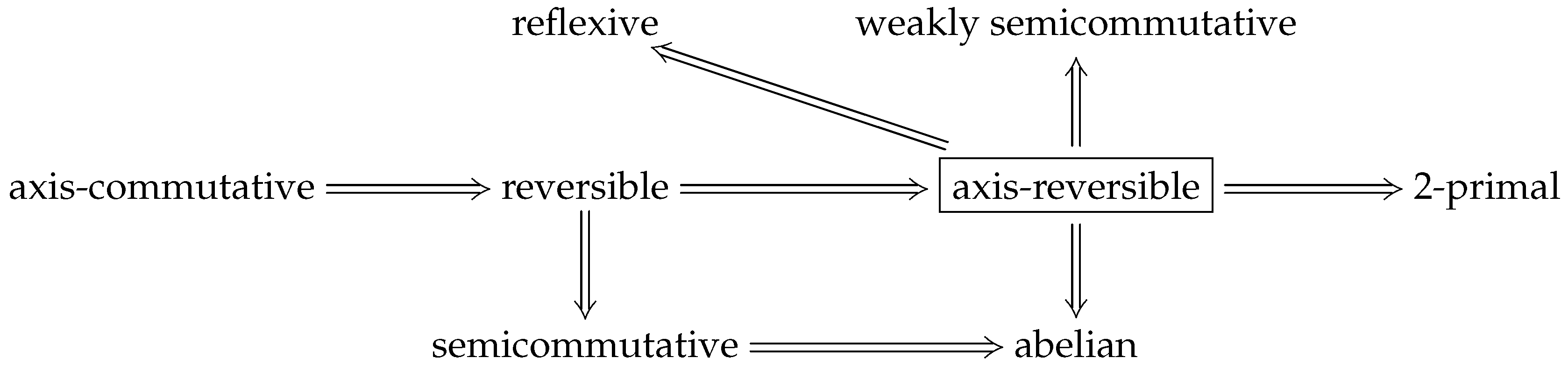
The following diagram summarizes the nontrivial implications between the ring properties studied in this paper. These implications are established by Propositions 2, 3, 5, and 6, together with known results from the literature ([
13] [Lemma 2.1]), ([
11] [Proposition 2.7(1)]), and ([
12] [Lemma 1.4]). Also, the counterexamples, including Examples 4, 3, and 5, with those in ([
12] [Example 1.5]), ([
22] [Example 8]), and ([
23] [Example 1.1]), show that these implications are strict. The following diagram summarizes the nontrivial implications between the ring properties studied in this paper (see
Figure 1).
3. Extending of Axis-Reversibility
In this section, we investigate the behavior of axis-reversibility under several standard ring-theoretic constructions. We first observe that axis-reversibility is not preserved when passing through substructures, in general. In particular, this property is not stable under natural extensions or quotient constructions. The following example shows that the class of axis-reversible rings is not closed under homomorphic images.
Example 10. Consider the ring S in Example 1. Then, S is reduced and hence axis-reversible, since every reduced ring is reversible. Let I be the ideal of S generated by . Then, and , while . Consequently, the factor ring fails to be axis-reversible.
Remark 2. Examples 5 and 10 show that axis-reversibility is not stable under natural algebraic constructions such as Nagata-type extensions and homomorphic images. In particular, axis-reversibility is not a hereditary property, in general.
Proposition 7. Every biideal with an identity of an axis-reversible ring is also axis-reversible.
Proof. Let S be a biideal of an axis-reversible ring R with two-sided identity . Assume that for some . Since R is axis-reversible, we have . Hence, . Similarly, , and therefore, , which means that S is axis-reversible. □
As an immediate consequence we obtain the following.
Corollary 2. Let R be an axis-reversible ring. Then, the corner for every idempotent e of R is also axis-reversible.
The next example shows that even if every corner of a ring R is axis-reversible for all non-identity idempotents e, the ring R itself is not necessarily axis-reversible.
Example 11. Let be the ring of all upper triangular matrices with integer entries. Any nontrivial idempotent e of R takes one of the two forms or , which in both cases satisfies . Clearly, is commutative and, in particular, axis-reversible. However, R itself is not axis-reversible, since while .
Now, we are showing that the class of axis-reversible rings is closed under the direct product.
Proposition 8. Let be a family of rings for some index Λ. Then, is axis-reversible, for every , if and only if the direct product is axis-reversible.
Proof. (⇒) Let and be elements of R satisfying . So in the axis-reversible , for every . Hence, , for all . Therefore, we get , and R is axis-reversible.(⇐) Let , for arbitrary such that . Define the two sequences and in R as and while for every . So that and consequently since R is axis-reversible. Thus , and is axis-reversible. □
From the Peirce Decomposition Theorem [
1] together with Corollary 2, we obtain the following corollary.
Corollary 3. Let R be a ring and let e be a central idempotent of R. Then, R is axis-reversible if and only if both and are axis-reversible.
The next result extends ([
24] [Proposition 6]).
Proposition 9. Let R be a commutative ring and G a finite group. Then the following statements are equivalent:
- (i)
is reversible;
- (ii)
is semicommutative;
- (iii)
is axis-reversible.
Proof. The equivalence (i)⇔(ii) is precisely ([
24] [Proposition 6]). Also, (i)⇒(iii) follows directly from Proposition 3. It remains to show that (iii)⇒(i). Assume
is axis-reversible. Let
with
. By the axis-reversible property, we have
. Now consider the trace map
. For every
, there exists
such that
, since
. Thus, every element of the left ideal
has trace zero, which forces
. Hence,
is reversible. □