Article

Analysis of Noise-Induced Deformations of Population Dynamics with an Allee Effect and Immigration


Institute of Natural Sciences and Mathematics, Ural Federal University, Lenina 51, 620000 Ekaterinburg, Russia
*
Author to whom correspondence should be addressed.
Mathematics 2026, 14(4), 655; https://doi.org/10.3390/math14040655
Submission received: 10 January 2026 / Revised: 6 February 2026 / Accepted: 9 February 2026 / Published: 12 February 2026
(This article belongs to the Section E3: Mathematical Biology)

Abstract

The problem of analyzing the mechanisms of variability in population dynamics caused by the combined influence of the Allee effect, immigration and random fluctuations is addressed. In this study, we explore such a multi-factorial problem based on a Ricker-type population model. For the deterministic version of the model, the transformations of system dynamic regimes caused by changes in parameters of growth rate and intensity of immigration are determined using bifurcation analysis. For the randomly forced population model, the phenomena of stochastic excitement and noise-induced temporal extinction are revealed and investigated. The parametric study of these effects uses statistical data obtained from direct numerical modeling as well as an analytical approach based on the stochastic sensitivity technique and the confidence interval method.

1. Introduction

Among the external factors affecting population systems, immigration is a fairly common phenomenon and, in many cases, plays a significant role in the processes of formation of various dynamic patterns. Mathematical population models with immigration describe how populations change by adding terms for incoming individuals. The study of mathematical population models that incorporate immigration has been initiated in [1,2] and further developed in numerous research papers (see, e.g., [3,4,5,6,7,8,9,10,11]). In these studies, immigration-induced deformations of dynamic regimes were investigated based on different population models. Identifying the mathematical mechanisms of such deformations involves the use of modern bifurcation theory and methods of nonlinear dynamics (see, e.g., [12,13,14,15,16,17,18]).
In population dynamics, one of the most important biological factors is the Allee effect [19,20]. In general, systems exhibiting the Allee effect have a critical population threshold below which the population goes extinct. This threshold represents a boundary that separates zones of persistence and extinction.
At present, mathematical models with the Allee effect are widely explored (see, e.g., [17,21,22,23,24,25,26,27]). These studies have shown how, in models that additionally take into account the Allee effect, parametric bifurcation portraits can change significantly, which entails qualitative changes in possible behavioral scenarios.
In studies of systems with the Allee effect, discrete models [18] are often analyzed using various modifications of the Ricker map [28]. Exploring such fairly simple population models, one can effectively study the main regimes of persistence (regular and chaotic) and determine the conditions of extinction.
Along with deterministic models that take into account various external and internal biological factors, stochastic models are attracting the attention of researchers studying complex population processes. Indeed, any living system is subject to random disturbances. Therefore, studying possible noise-induced effects is one of the most challenging problems in modern population nonlinear dynamics.
In nonlinear systems, random noise can cause a wide diversity of stochastic phenomena, such as stochastic bifurcations [29,30,31], noise-induced transitions [32,33,34,35], stochastic excitement [36,37,38], noise-induced chaos and order [39,40,41,42], stochastic and coherence resonance [43,44,45], etc.
Currently, these stochastic phenomena are found in nonlinear models of population dynamics and are actively studied (see, e.g., [46,47,48,49,50,51,52,53,54] and the bibliography therein).
The present paper examines how the combined influence of the Allee effect, immigration, and random fluctuations might affect population behavior. Studying this previously unexplored multi-factorial problem, we use the Ricker-type population model [28,55]. In Section 2, for the deterministic version of the model, we present bifurcation diagrams that illustrate the transformations of system attractors as the parameters of growth rate and intensity of immigration change. In Section 3, we study a constructive role of random disturbances in the system dynamics. Here, we analyze the underlying mechanisms of stochastic excitement and noise-induced temporal extinction.

2. Deterministic Ricker Model with Allee Effect and Immigration

In this paper, as a deterministic skeleton, we use the following conceptual model combining a Ricker map [28,55] with the Allee effect and immigration:
x t + 1 = x t 2 exp ( μ ( 1 x t ) ) + I .
In this discrete-time system, x stands for the population size, the positive parameter μ characterizes the growth rate, and the parameter I 0 is the intensity of immigration. Let us denote f ( x ) = x 2 exp ( μ ( 1 x ) ) + I . In our study, we consider a case where μ > 1 .
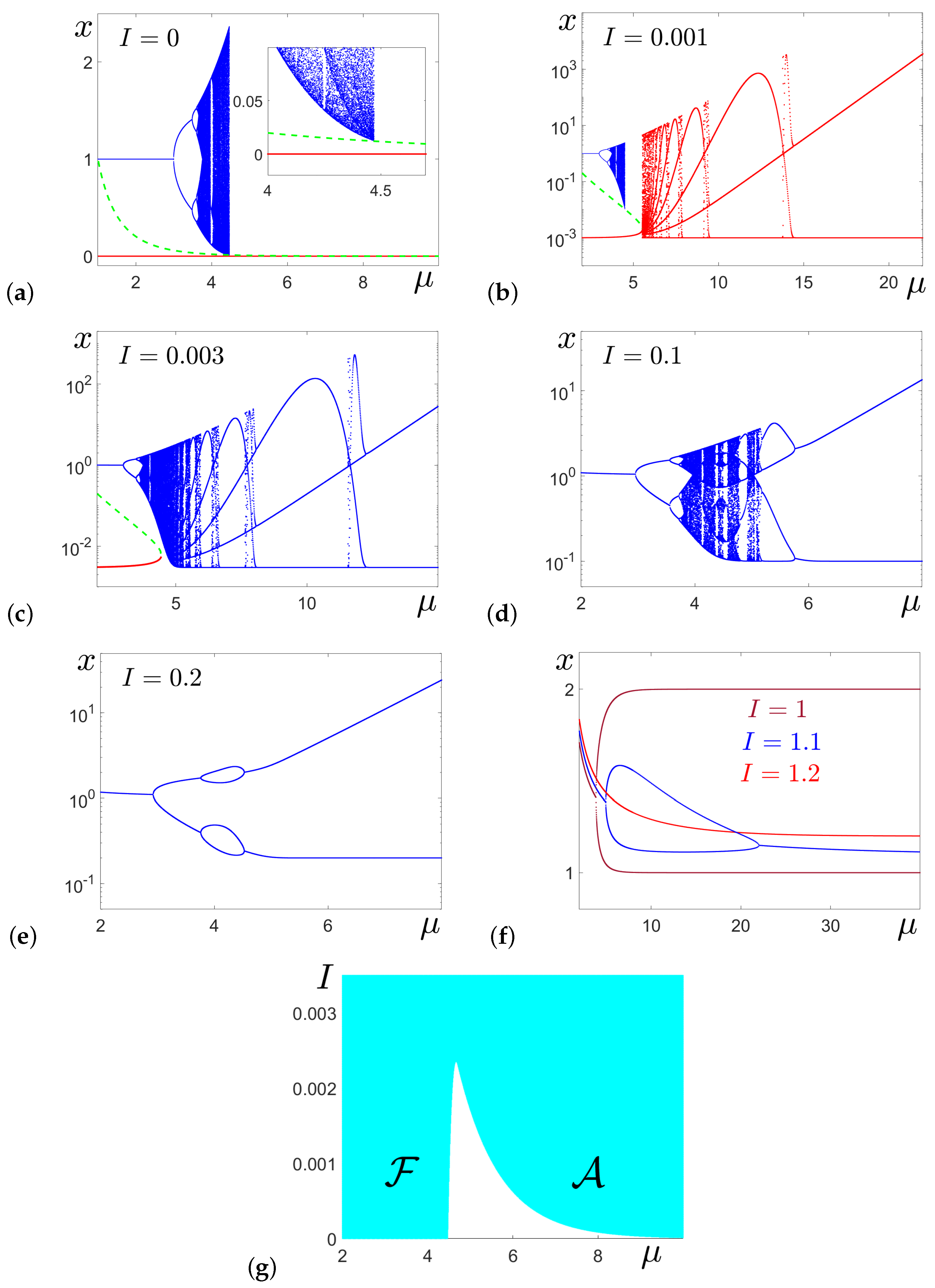
In Figure 1a, we show the bifurcation diagram of system (1) for I = 0 (no immigration) versus parameter μ . In the absence of immigration, the system (1) has three equilibria, x ¯ 0 = 0 , x ¯ 1 , and x ¯ 2 = 1 : x ¯ 0 < x ¯ 1 < x ¯ 2 . For any μ > 1 , the equilibrium x ¯ 0 (red solid line) is stable, and the equilibrium x ¯ 1 (green dashed line) is unstable. Because of the Allee effect, all solutions starting below x ¯ 1 tend to x ¯ 0 ; therefore, the population becomes extinct. Here, the unstable equilibrium x ¯ 1 plays the role of the Allee threshold.
The equilibrium x ¯ 2 is stable until μ = 3 . The derivative f ( x ¯ 2 ) = ( 2 μ x ¯ 2 ) exp ( μ ( 1 x ¯ 2 ) ) takes a value of −1 at μ = 3 , the equilibrium x ¯ 2 loses its stability, and the system (1) undergoes a cascade of period-doubling bifurcations with regular and chaotic attractors. This Feigenbaum tree F , shown in blue, disappears as a result of the crisis bifurcation at μ = μ c = 4.47583 when this tree of non-degenerate attractors touches the curve of the unstable equilibrium x ¯ 1 (see inset in Figure 1a). To determine μ c with high accuracy, we calculate the lower boundary 16 exp 3 μ 4 4 exp ( μ 2 ) / μ / μ 4 of the chaotic attractor and find the intersection point with the curve x 1 ( μ ) . Formally, the family F is a union of attractors over the parameter interval 1 < μ < μ c .
As can be seen, for I = 0 , system (1) has two parameter zones with qualitatively different dynamics. The bi-stability interval 1 < μ < μ c represents a zone where, depending on the initial data, both non-degenerate behavior and extinction are possible. The mono-stability interval μ > μ c is the extinction zone where the population size tends to zero regardless of the initial state. Biologically, the transition of the growth rate parameter μ through the critical value μ c from left to right signifies the transition of the population system from a conditional extinction mode to an unconditional extinction mode.
Consider now what changes in the behavior of a population system can occur under the influence of immigration. First, it should be noted it is obvious that even small I > 0 protects the system (1) from extinction. In Figure 1b–f, it is shown how the system (1) dynamic regimes change under the increase in the immigration parameter I. Let us discuss these changes in detail. How does the relative position of the stable equilibrium x ¯ 0 and unstable equilibrium x ¯ 1 change with increasing μ for I > 0 ? For I = 0 , these equilibria do not intersect for any μ > 1 , but for I > 0 they merge at some value μ s as a result of a saddle-node bifurcation and disappear (see green and red curves in Figure 1b,c).
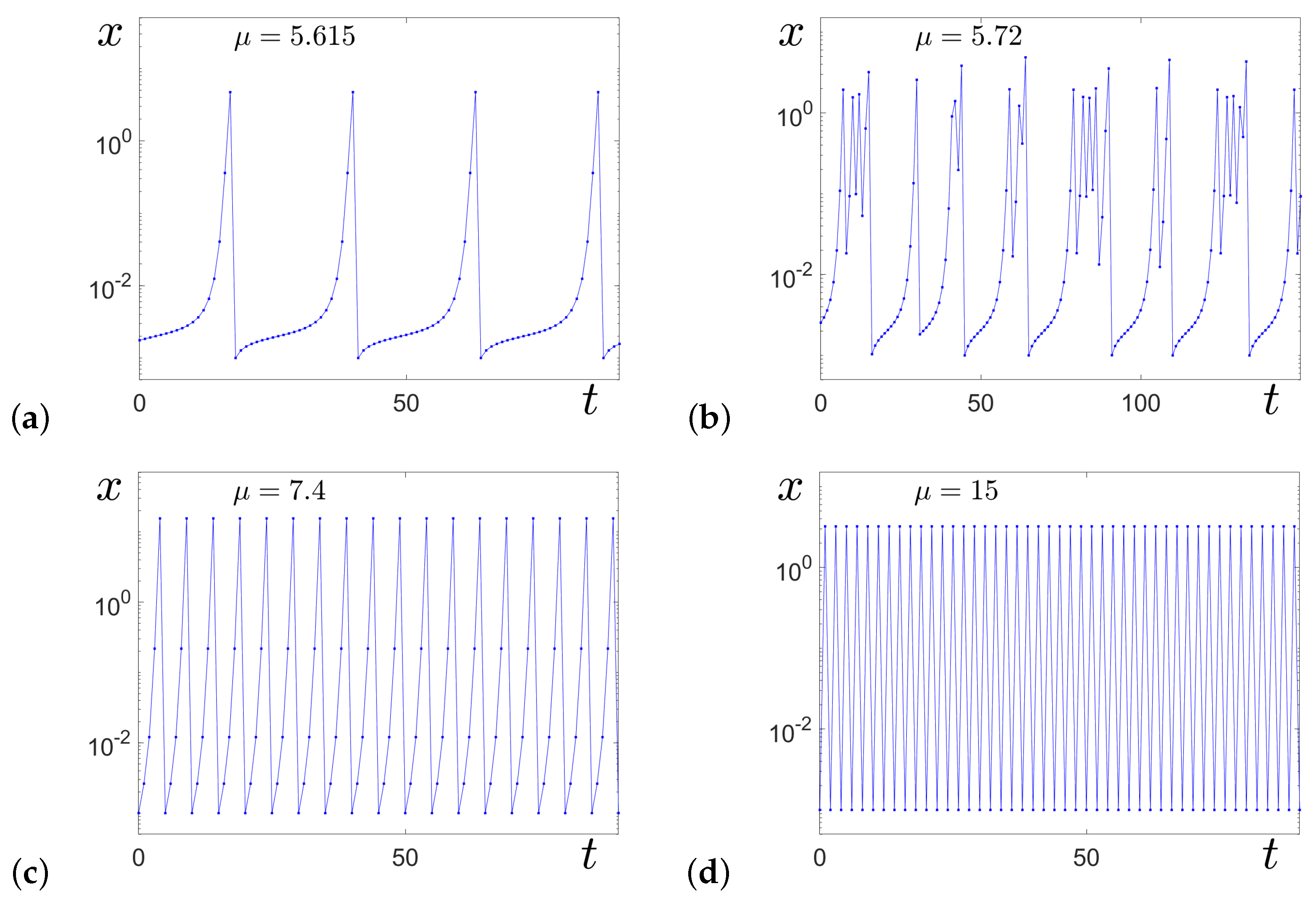
The most significant change occurs in the zone μ > μ s where, instead of the disappeared equilibria x ¯ 0 and x ¯ 1 , a family A of large-amplitude oscillatory attractors appears (see Figure 1b for I = 0.001 ). The family A is a union of oscillatory attractors, regular and chaotic, over the parameter interval μ > μ s . In Figure 2, this variety is presented for I = 0.001 and several values of μ : tonic spiking for μ = 5.615 , chaotic bursting for μ = 5.72 , 5-cycle for μ = 7.4 , and 2-cycle for μ = 15 . It should be noted that this type of oscillatory behavior of the population system under consideration is similar to regimes of neural activity [56]. Thus, as a result of taking immigration into account, the attractor in the form of the stable equilibrium x ¯ 0 is transformed into a qualitatively different oscillatory attractor A .
As a result of such immigration-induced transformations, three zones now appear in the bifurcation diagram (see Figure 1b): (i) bi-stability interval 1 < μ < μ c with coexisting stable equilibrium and family F of attractors in the form of the Feigenbaum tree; (ii) mono-stability interval μ c < μ < μ s where the positive stable equilibrium x ¯ 0 is the single attractor; (iii) mono-stability interval μ > μ s with the family A of the oscillatory attractors.
With increasing values of I, the family A moves to the left and merges with the family F (see Figure 1c for I = 0.003 ). This joint family FA of attractors is shown in blue in Figure 1c. Here, two μ -parameter zones are observed: a bi-stability interval 1 < μ < μ s with coexisting stable equilibrium and this family FA , and a mono-stability interval μ > μ s with the right part of the family FA only. Details of the confluence of families F and A can be seen in Figure 1g. With further increase in I, the structure of the family FA of attractors simplifies (see Figure 1d–f): chaotic attractors disappear, only cycles and equilibria remain.
To summarize, for any μ , the system (1) with immigration exhibits survival in various equilibrium and oscillatory forms, both regular and chaotic.
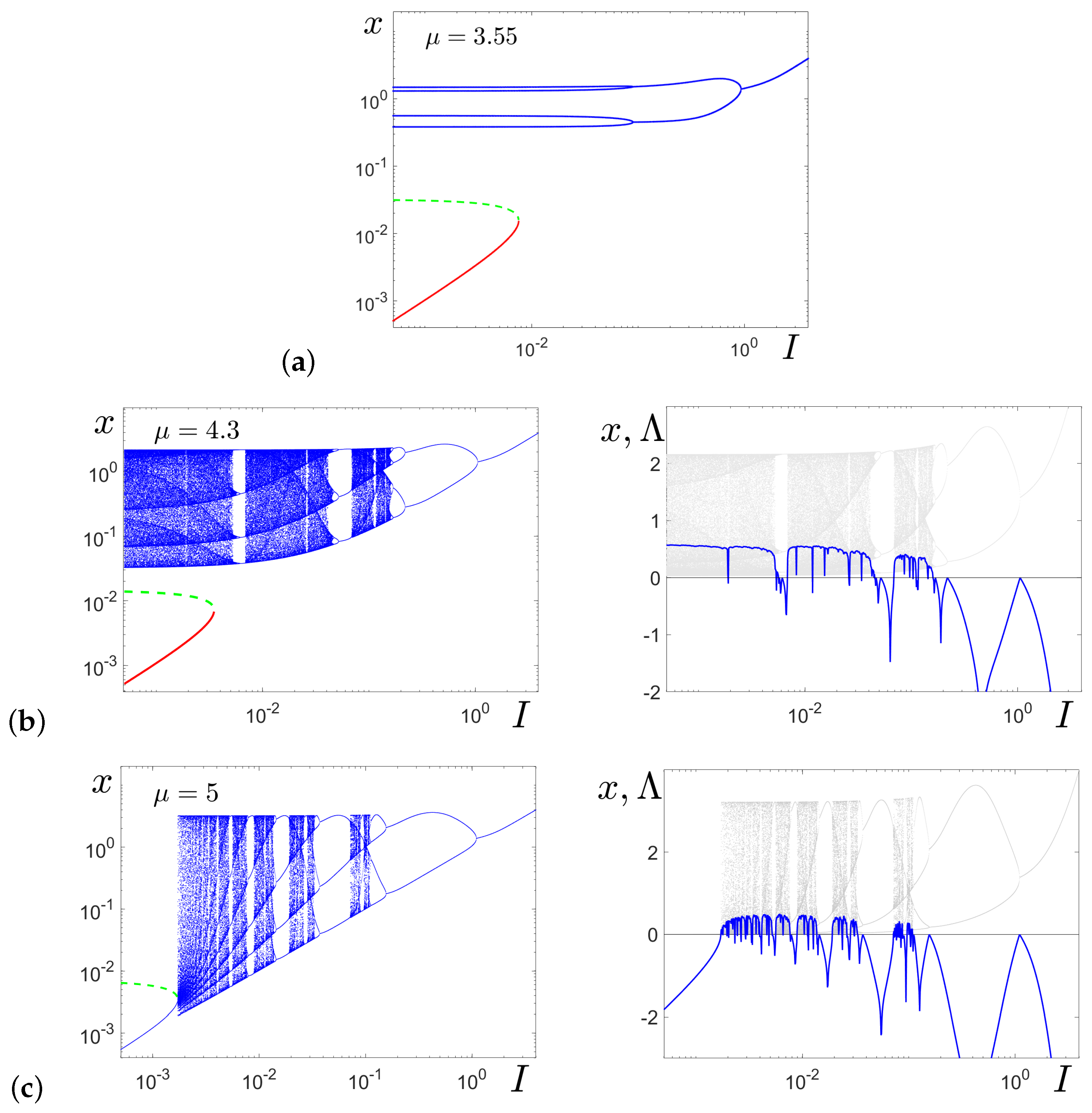
Additional details of variety of deformations in system (1) dynamics caused by gradually increasing immigration can be observed in Figure 3. In Figure 3a,b, immigration-induced changes of attractors are shown for two values of μ lying for I = 0 in the bi-stability zone. For μ = 3.55 (see Figure 3a), 4-cycle transforms into 2-cycle, and further to the stable equilibrium. For μ = 4.3 (see Figure 3b), the original chaotic attractor also transforms into the stable equilibrium through a cascade of backward period-doubling bifurcations. In both cases, the coexisting stable equilibrium x ¯ 0 disappears as a result of the saddle-node bifurcation where x ¯ 0 (red) merges with the unstable equilibrium x ¯ 1 (green). Here, immigration-induced disappearance of bi-stability is seen.
The value μ = 5 presents a case of mono-stability when the system (1) with I = 0 has the trivial equilibrium x ¯ 0 = 0 only (see Figure 1a); the population is extinct. In Figure 3c, it is shown how the equilibrium x ¯ 0 , having become positive for I > 0 , increases, bifurcates into a chaotic attractor, and then, through a chain of backward bifurcations, transforms into the equilibrium again.
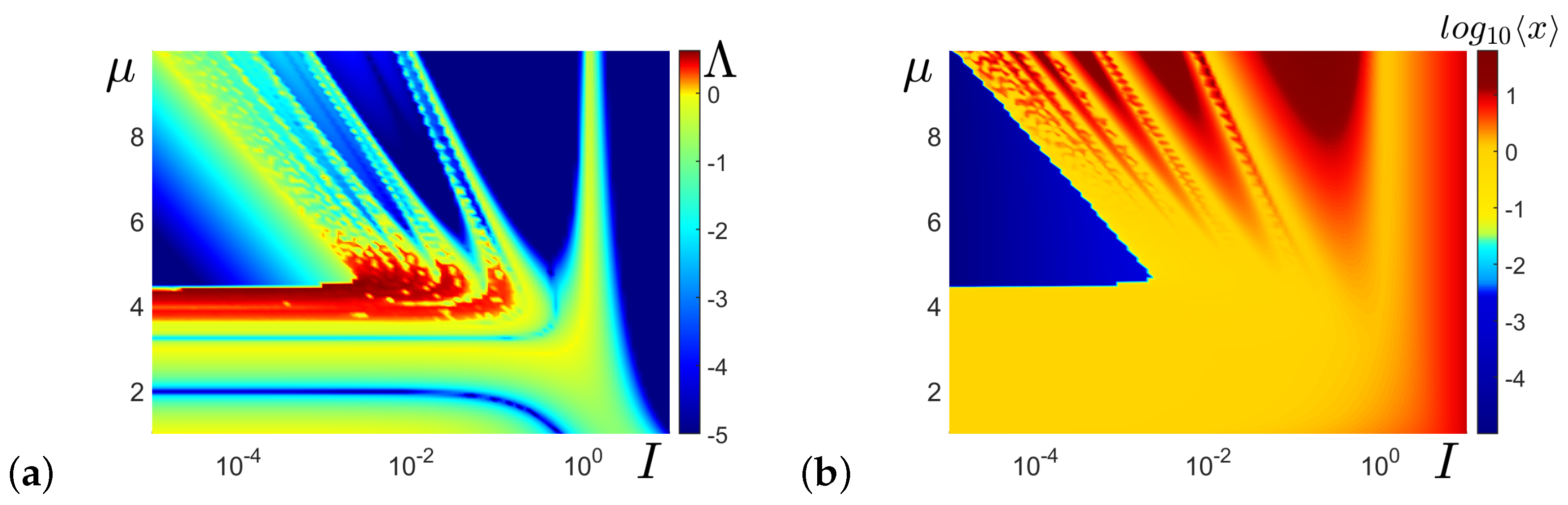
In the right panels of Figure 3b,c, plots of the Lyapunov exponent are shown in blue. The Lyapunov exponent quantifies zones of chaos ( C ) where Λ > 0 and zones of order ( O ) where Λ < 0 . As can be seen in Figure 3b for μ = 4.3 , the dynamics of system (1) with increasing immigration undergo the transformation [ C O ] O . Figure 3c for μ = 5 presents a two-stage transformation O [ C O ] O . Additional details of dependence of the Lyapunov exponent for the gradually changing I and μ can be seen in the two-parameter diagram in Figure 4a.
In the parameter analysis of oscillatory regimes with large differences in values, it is important to know how mean values change. In Figure 4b, mean values of the population size x are shown in the ( I , μ ) -parameter plane. What attracts attention here is the zone μ > μ c , where a sharp jump in the mean values of the population size occurs with an increasing I value. The influence of noise in this zone will be explored in the section Stochastic phenomena.
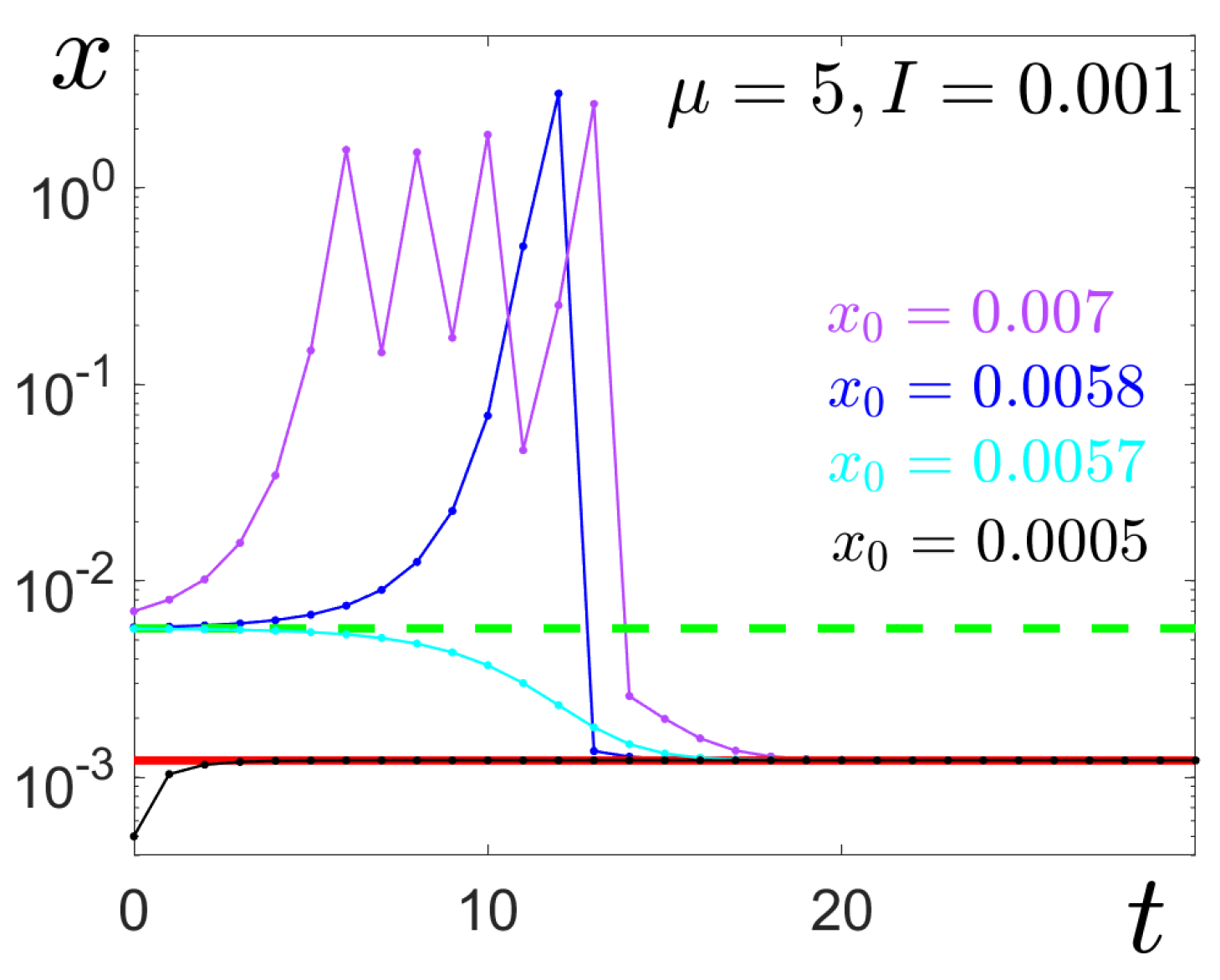
It should be noted that in the case of mono-stability, a character of convergence of system (1) solutions to the equilibrium x ¯ 0 significantly depends on the initial state. This is illustrated in Figure 5 for μ = 5 ,   I = 0.001 . Here, time series of solutions starting at different initial values are plotted, the stable equilibrium x ¯ 0 = 0.001219 is shown in red, and the unstable equilibrium x ¯ 1 = 0.00572 is shown in green. For initial states lying below x ¯ 1 , solutions tend to x ¯ 0 monotonically. Solutions starting slightly above x ¯ 1 exhibit large-amplitude oscillatory transient before convergence to x ¯ 0 . This feature of the deterministic model plays an important role in understanding the mechanisms of stochastic excitement, which will be studied in the next section.

3. Stochastic Phenomena in the Ricker Model with Allee Effect and Immigration

In this section, we consider the following stochastic version of the population model (1):
x t + 1 = x t 2 exp ( μ ( 1 x t ) ) + I + ε ξ t .
Here, immigration has a deterministic part I and a stochastic part ε ξ t , where ξ t is an uncorrelated Gaussian noise of intensity ε .
Let us fix μ = 5 and consider the behavior of the stochastic system (2) for different ε and I. Remember that in the absence of immigration ( I = 0 ) and random disturbances ( ε = 0 ), all solutions tend to the trivial equilibrium x ¯ 0 = 0 , so the population is extinct. However, any, even small, positive I makes the equilibrium x ¯ 0 of the system (1) positive, thereby preventing the extinction of the population.
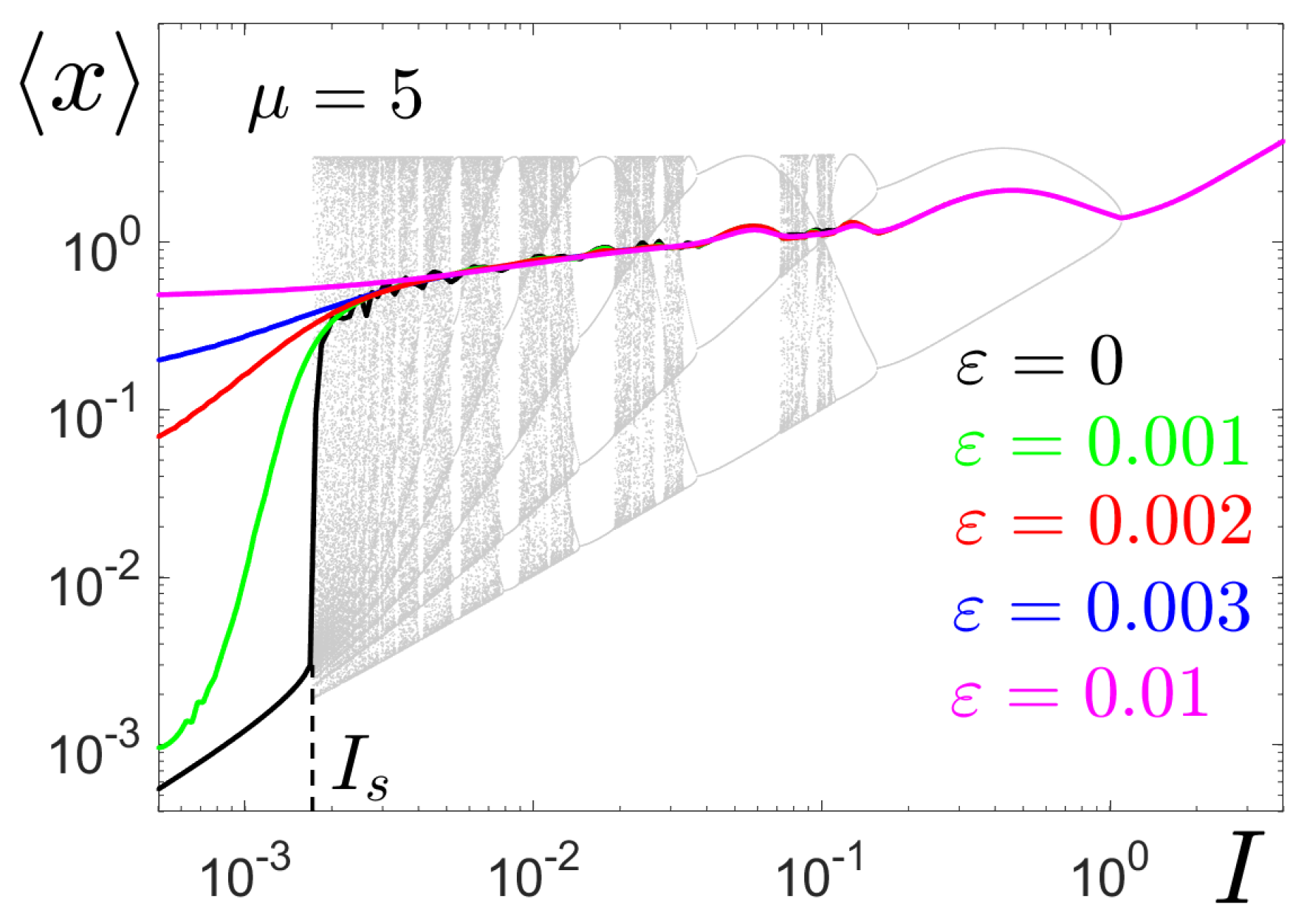
To quantify the reply of the stochastic system (2) to variations in ε and I, we will use mean values x of the population size. In Figure 6, we plot x versus I for system (2) for several values of noise intensity ε . These curves are shown against the background of the deterministic system attractors (gray dots). Here, I s = 0.001714 marks the saddle-node bifurcation: for 0 < I < I s , system (1) has the stable equilibrium x ¯ 0 > 0 while for I > I s system (1) exhibits a family of attractors transitioning from an oscillatory to an equilibrium form.
For ε = 0 , the plot x shown in black exhibits a sharp jump at I = I s . As can be seen in Figure 6, plots of x for ε > 0 differ significantly from the black curve only in the parameter zone I < I s : the larger ε , the larger x . For example, stochastic perturbations with ε = 0.003 increase the mean population size by more than 10 2 times.
A detailed examination of the question regarding the causes of noise-induced population increase in the region where I < I s will be discussed further below.

3.1. Stochastic Excitement

Consider the behavior of the stochastic system (2) with I = 0.001 , μ = 5 . Recall that for these parameters, in the deterministic case, system (1) is mono-stable and possesses the stable equilibrium x ¯ 0 = 0.001219 only.
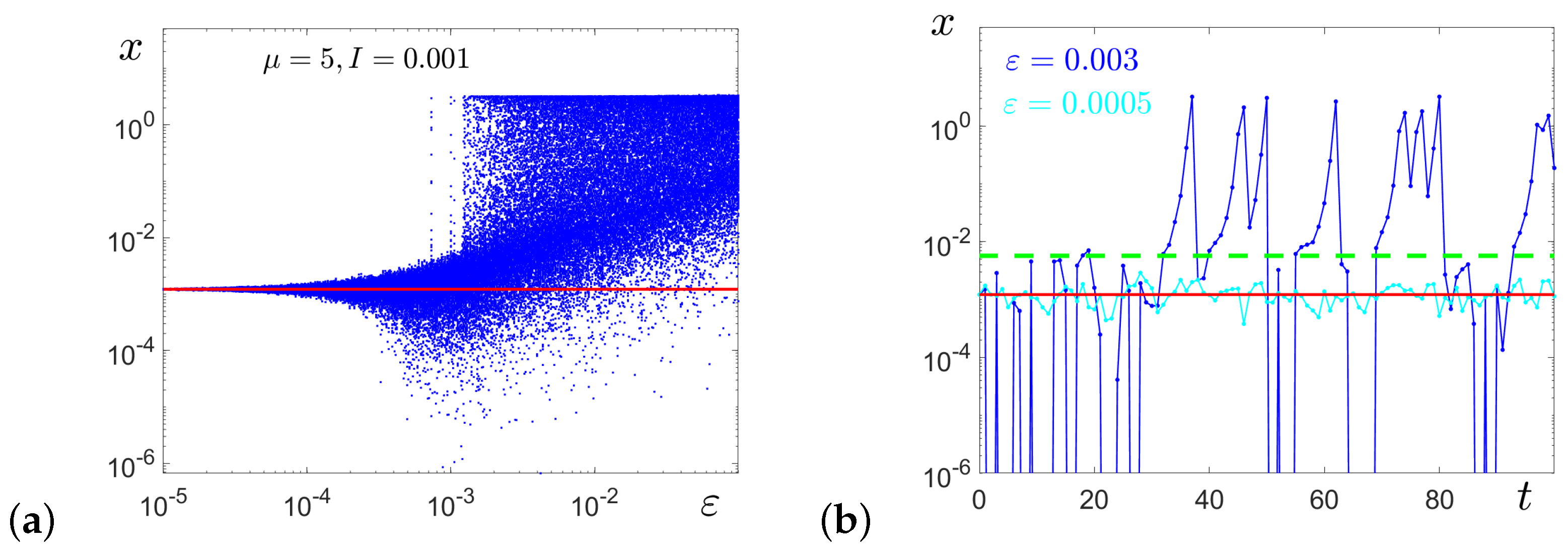
Under stochastic disturbances, a random solution leaves the deterministic equilibrium and forms a certain probabilistic distribution around it. In Figure 7a, random states (blue dots) of system (2) with I = 0.001 , μ = 5 are plotted versus increasing noise intensity ε . For weak noise, these random states are localized near the equilibrium (red line). Under increasing noise, the dispersion of random states increases gradually. However, we see how this seemingly well-established process of gradual increase in dispersion is suddenly interrupted with a sharp jump in the magnitude of dispersion. This qualitative change is illustrated in Figure 7b, where time series of system (2) solutions are plotted for two values of the noise intensity. For weak noise with ε = 0.0005 , the solution is arranged below the unstable equilibrium x ¯ 1 (green dashed line) and localized near the stable equilibrium x ¯ 0 (red). For more strong noise with ε = 0.003 , we see large-amplitude spikes and bursts crossing the unstable equilibrium x ¯ 1 and going sharply upwards.
The appearance of such blow-outs can be explained by presence of large-amplitude transients in the deterministic model for solutions starting above the unstable equilibrium x ¯ 1 (see Figure 5). So, when the stochastic trajectory occurs above x ¯ 1 , the solution exhibits large-amplitude spikes and bursts. Thus, the unstable equilibrium x ¯ 1 separates sub- and super-threshold zones of stochastic excitement.
To analyze transitions from sub- to super-threshold zone parametrically, one can use the method of confidence domains based on the stochastic sensitivity technique [57]. Let us briefly discuss mathematical details of this technique.
Consider a general discrete-time one-dimensional deterministic system
x t + 1 = f ( x t ) ,
which possesses an exponentially stable equilibrium x ¯ . Let this system be forced by additive random disturbances. The corresponding stochastic model is written as
x t + 1 = f ( x t ) + ε ξ t .
Here, ξ t is an uncorrelated Gaussian noise with statistics ξ t = 0 , ξ t 2 = 1 . The positive parameter ε is the noise intensity.
For the asymptotics
y t = lim ε 0 x t ε x ¯ ε
of deviations x t ε x ¯ of the stochastic system solutions x t ε from the deterministic equilibrium x ¯ , the following equation can be written:
y t + 1 = f ( x ¯ ) y t + ξ t .
The second moments M t = y t 2 are governed by the deterministic equation:
M t + 1 = f ( x ¯ ) M t + 1 .
Due to the exponential stability of x ¯ , it holds that | f ( x ¯ ) | < 1 ; therefore, Equation (5) has the stationary solution
M = 1 1 f ( x ¯ ) 2 .
The value M characterizes the stochastic sensitivity of the equilibrium x ¯ . For weak noise, this value allows one to approximate a variance D of random states x t ε : D ε 2 M . Using the stochastic sensitivity M, one can get a confidence interval x ˜ 1 , x ˜ 2 around x ¯ . For the 3 σ -rule, the boundaries of the confidence interval are as follows:
x ˜ 1 , 2 = x ¯ 3 D = x ¯ 3 ε 1 f ( x ¯ ) 2 .
Note that for system (2),
f ( x ) = x 2 exp ( μ ( 1 x ) ) + I , f ( x ) = x exp ( μ ( 1 x ) ) ( 2 μ x ) .
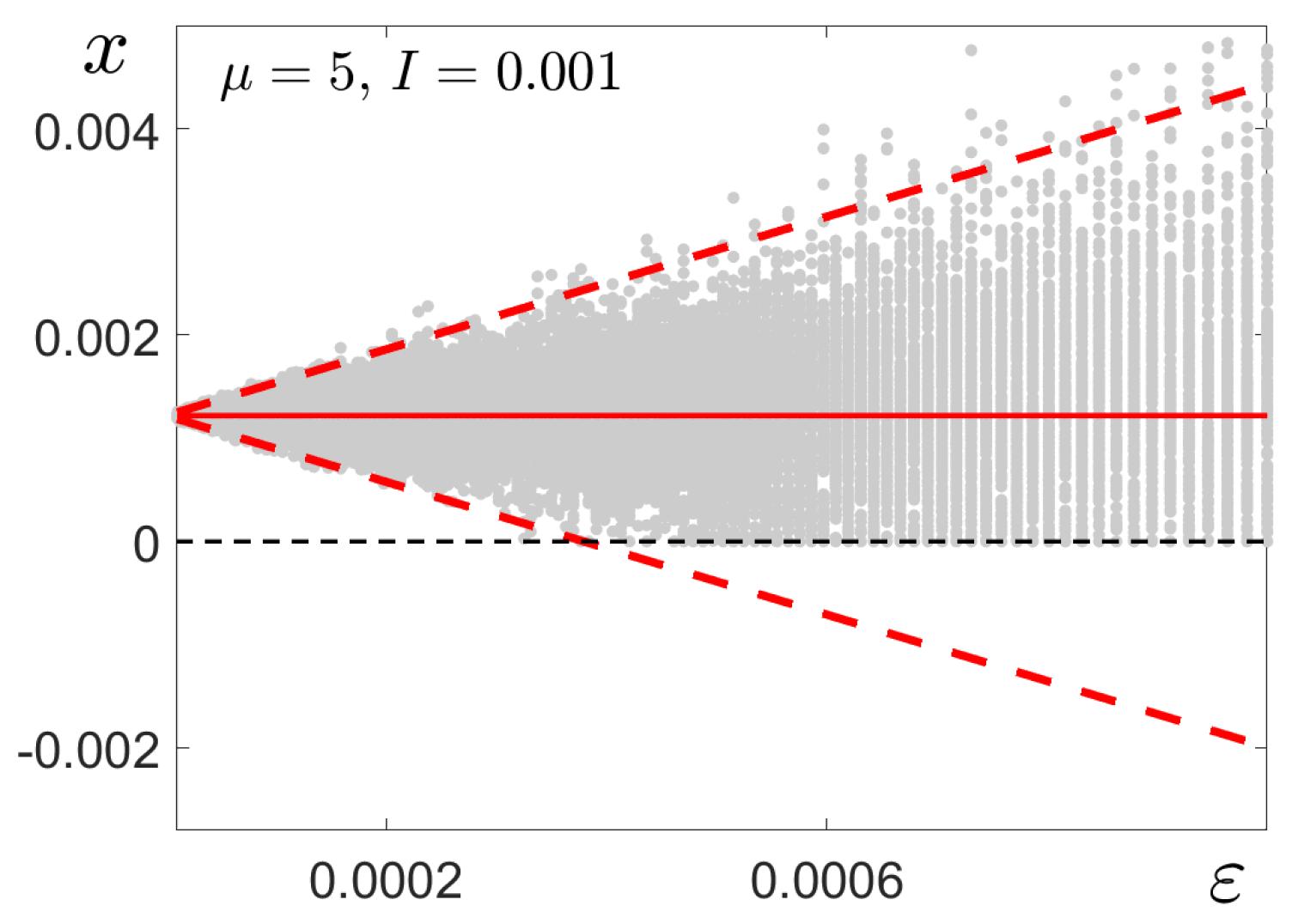
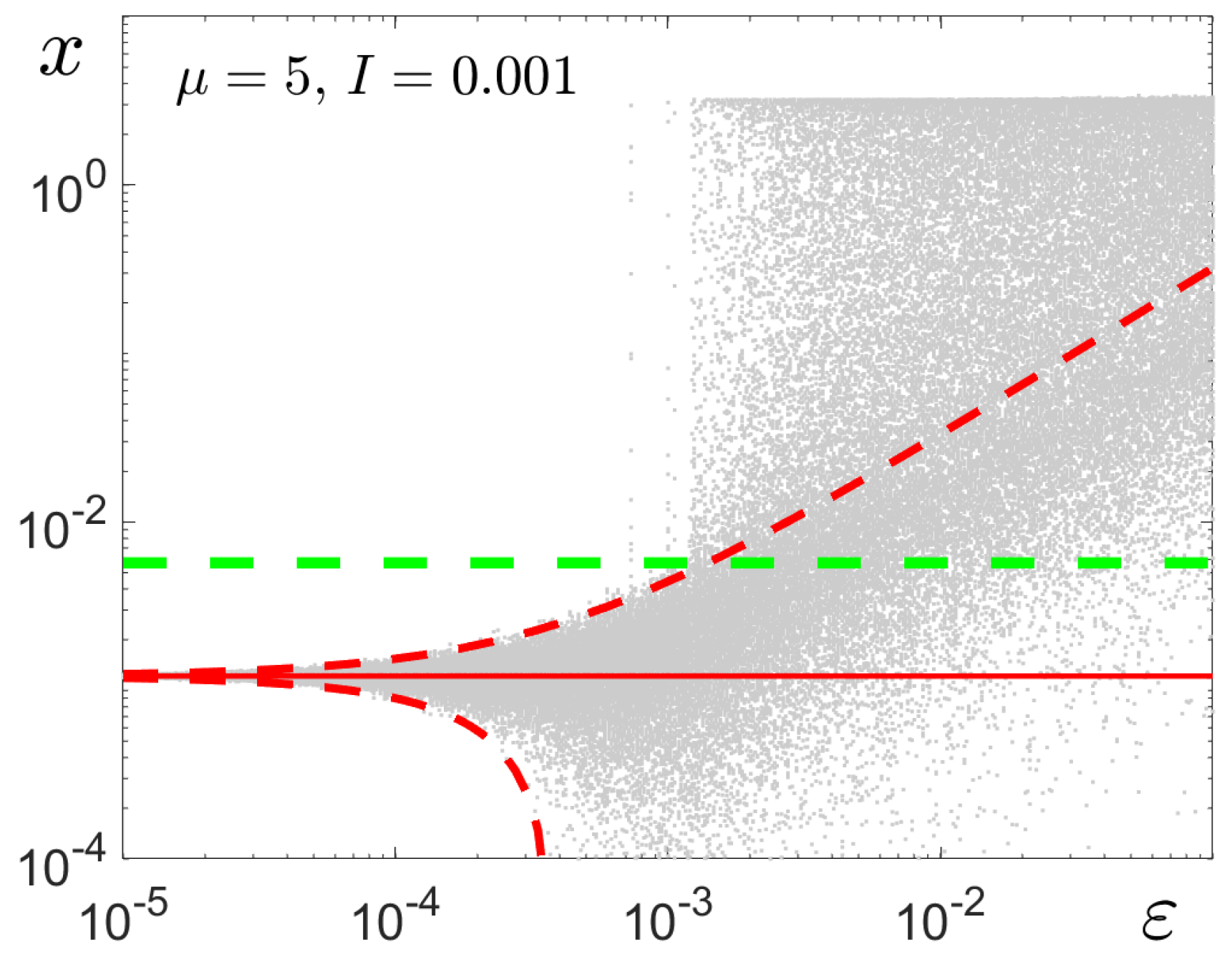
In Figure 8, by red dashed lines, boundaries x ˜ 1 , x ˜ 2 of confidence intervals are shown for I = 0.001 , μ = 5 versus noise intensity ε . An intersection of the upper boundary x ˜ 2 with the unstable equilibrium x ¯ 1 (green) localizes the ε -zone of the onset of excitement. This theoretical prediction is consistent with the location of blow-out of random solutions shown in gray.
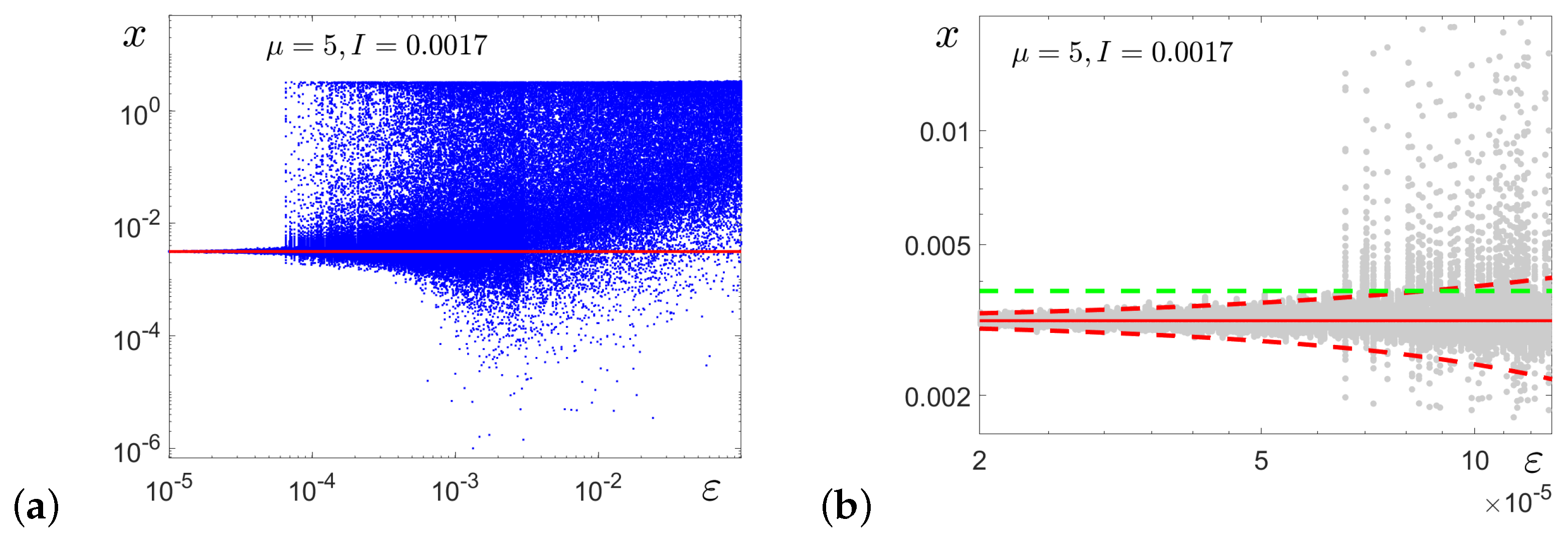
Consider now the phenomenon of noise-induced excitement for I = 0.0017 that is closer to the bifurcation point I s = 0.001714 . In Figure 9a, random states (blue dots) of system (2) with I = 0.0017 , μ = 5 are plotted versus increasing noise intensity ε . As can be seen, stochastic excitement occurs here for significantly smaller noise compared with the case I = 0.001 . The capabilities of the confidence interval method in predicting stochastic excitement for I = 0.0017 are demonstrated in Figure 9b. As can be seen, the point of the intersection of the upper boundary x ˜ 2 with the unstable equilibrium x ¯ 1 gives an adequate estimate of the intensity of the noise causing the excitement.
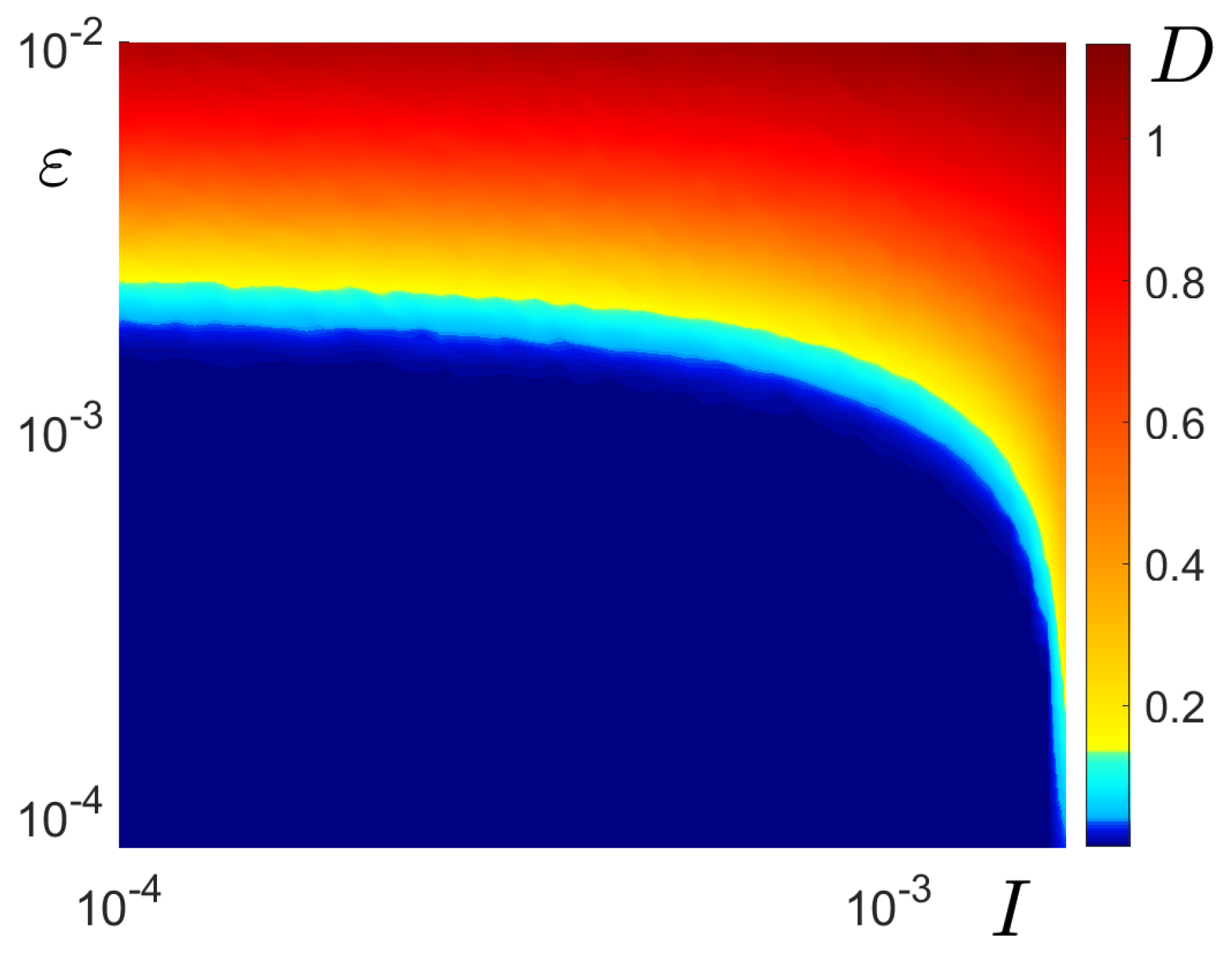
A detailed parametric description of the phenomenon of stochastic excitement in system (2) with μ = 5 is given in Figure 10 depending on the parameters I and ε . Here, in color scale, mean square deviations D of random states from the stable equilibrium x ¯ 0 are shown in ( I , ε ) -plane. A sharp change in color indicates the boundary between non-excited and excited behavior.
The results presented here show that the stochastic excitement process causes an increase in the average population size (see Figure 6); so, noise in this parameter range plays a positive role. One of the manifestations of the negative role of noise is the noise-induced extinction of the population. This phenomenon will be studied in the following.

3.2. Noise-Induced Extinction

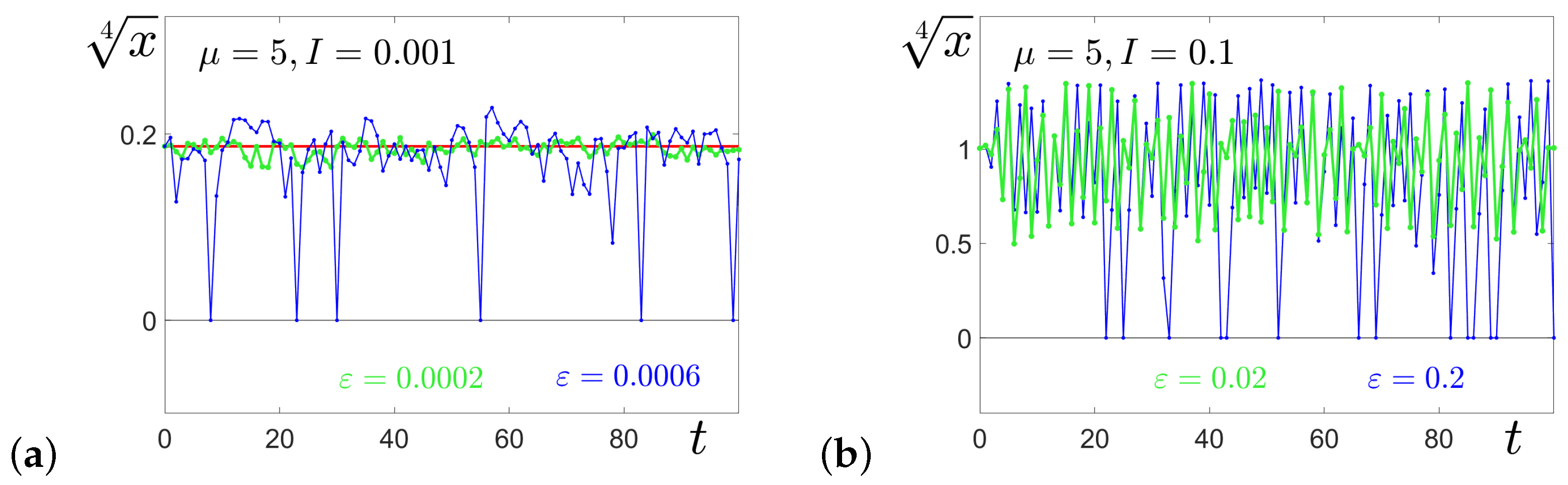
As an example, consider solutions of the stochastic system (2) with μ = 5 . The dependence of deterministic attractors on I is shown in Figure 3c. For I = 0.001 , the deterministic attractor is the stable equilibrium x ¯ 0 while for I = 0.1 the attractor is chaotic ( Λ = 0.25 ). In Figure 11a, for I = 0.001 , time series of random solutions starting at the stable equilibrium x ¯ 0 (red line) are plotted for two values of noise intensity. For ε = 0.0002 , these solutions (green) slightly fluctuate near x ¯ 0 . For larger noise with ε = 0.0006 , the solutions become zero at several values of t. In Figure 11b, for I = 0.1 , time series of random solutions starting at the deterministic chaotic attractor are plotted for ε = 0.02 (green) and ε = 0.2 (blue). It is seen that the solutions have zero values at several t for significantly larger noise.
Thus, in the presence of external perturbations, the population density may attain the zero state at a finite time, which is interpreted as extinction. However, a sustained immigration input drives the population back to a positive state, ensuring continued existence. We shall refer to such a one-time attainment of zero as temporary extinction.
To analyze the phenomenon of noise-induced temporal extinction, one can use the method of confidence intervals. As can be seen in Figure 12 for μ = 5 , I = 0.001 , an intersection of the lower boundary of the confidence intervals (red dashed) with the line x = 0 (black dashed) occurs at ε 0.0004 .
This allows us to conclude that the value ε = 0.0002 is sub-critical, and the value ε = 0.0006 is super-critical. This theoretical prediction, obtained using the confidence intervals method, is in complete agreement with the results of direct numerical modeling (see Figure 11a).
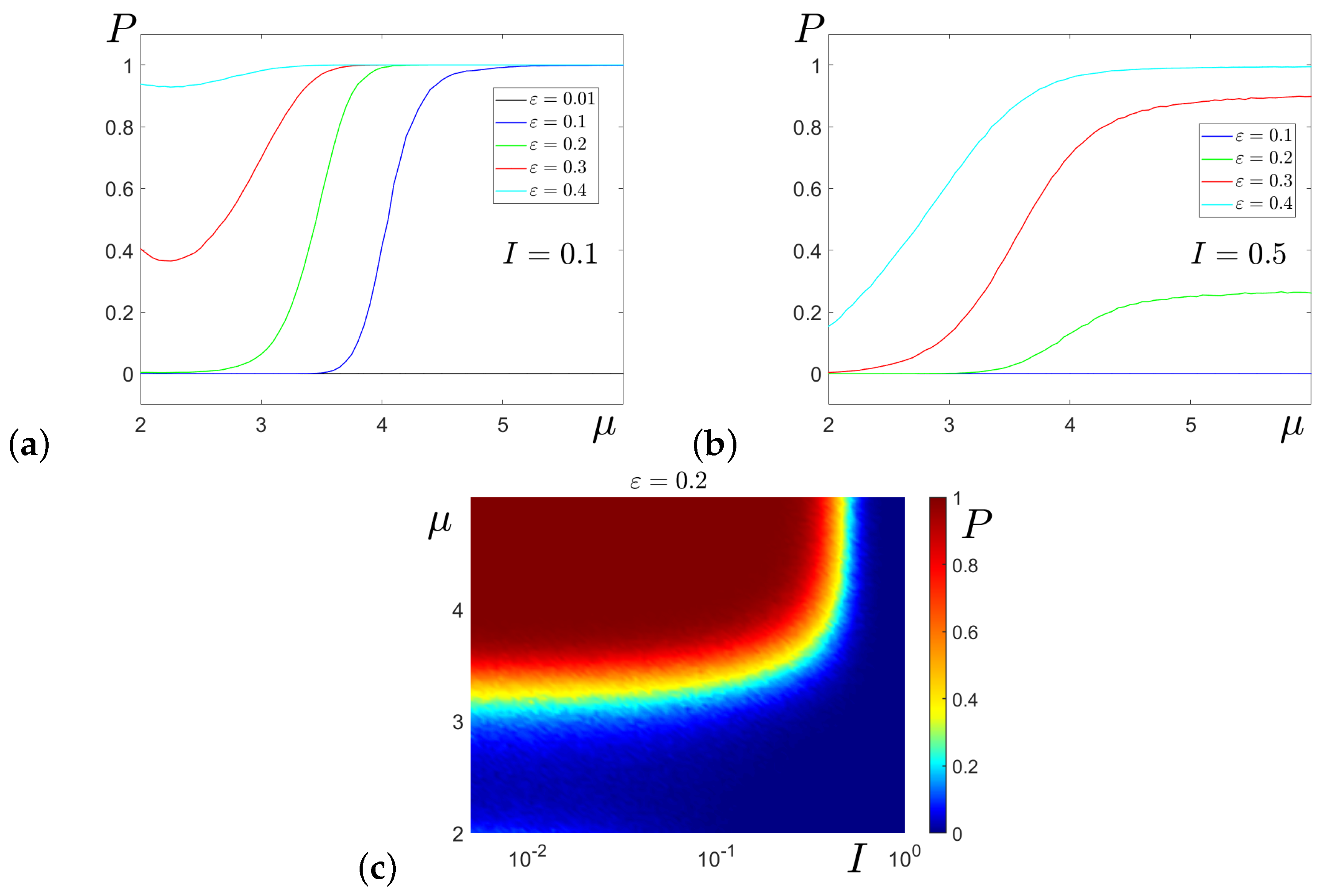
In the statistical analysis of the phenomenon of temporal extinction, we will use the probability P of the solution reaching zero over a certain period of time T. In Figure 13a, plots of the function P ( μ ) are presented for I = 0.1 and several values of the noise intensity ε . In Figure 13b, plots of the function P ( μ ) are presented for I = 0.5 . As can be seen, the larger I, the lower the probability of temporal extinction. Thus, in the presence of stochastic disturbances, immigration plays an important role in reducing the probability of extinction of the population. Additional details of such dependence are presented in the color ( I , μ ) -diagram in Figure 13c.

4. Conclusions

The problem of analyzing the combined influence of the Allee effect, immigration and random disturbances on formation of variety of dynamic regimes of population systems is addressed. This paper examines this problem based on the conceptual population Ricker-type model, accounting for the Allee effect. Even in a deterministic case, immigration gives rise to unexpected effects of generating complex large-amplitude oscillatory regimes in parametric zones, where, in the absence of an external influx of individuals, only extinction is possible. It is shown that with the growth of the immigration intensity the structure of these oscillatory regimes is simplified, and the system enters an equilibrium mode. When studying the stochastic model, we identified and analyzed the underlying mechanisms of two phenomena, namely stochastic excitement and noise-induced temporal extinction. A parameter zone of mono-stability was found where the equilibrium attractor is extremely sensitive to random disturbances. It was shown that in this zone, even small random disturbances generate large-amplitude oscillations of spike and burst shapes. The mechanism of such excitation, associated with the transition of random trajectories into the zone of large-amplitude transients, was identified. This phenomenon of stochastic excitement is accompanied by the significant growth of mean size of the population in several orders of magnitude. So, noise here can play a positive role. The negative role of noise is usually associated with the phenomenon of the noise-induced extinction. Indeed, in the presence of external perturbations, the population density may attain zero state at a finite time, which is interpreted as extinction. However, in the considered population model a sustained immigration input drives the population back to a positive state, ensuring continued existence. Such a regime of temporary extinction, with a one-time attainment of zero, was studied parametrically. In our analysis, we used the probability of attaining zero for a fixed time interval. It was shown that an increase in immigration reduces this probability. When studying both stochastic phenomena, along with the direct numerical simulation, we used a constructive method of confidence intervals based on the stochastic sensitivity analysis. This paper sheds light on the mechanisms of variability of population behavior in presence of combined influence of the Allee effect, immigration and random disturbances. These results were obtained for a one-dimensional model, but the methods and approaches used can be extended to more complex models of population dynamics.
The present study potentially has useful applications in the current problem of population systems control. Indeed, if we consider the value of I to be an artificially generated adjustable influx of individuals, then the internal mechanisms identified in this study could be used to solve problems preventing extinction and subsequently stabilization of the population size at a desired level.

Author Contributions

Conceptualization, I.B. and L.R.; methodology, I.B. and L.R.; software, I.B.; validation, I.B. and L.R.; formal analysis, I.B. and L.R.; investigation, I.B. and L.R.; writing—original draft preparation, I.B. and L.R.; writing—review and editing, I.B. and L.R.; visualization, I.B.; funding acquisition, L.R. All authors have read and agreed to the published version of the manuscript.

Funding

The work was supported by Russian Science Foundation (N 24-11-00097).

Data Availability Statement

The original contributions presented in this study are included in the article. Further inquiries can be directed to the corresponding authors.

Conflicts of Interest

The authors declare no conflicts of interest.

References

  1. Holt, R.D. Immigration and the Dynamics of Peripheral Populations. In Advances in Herpetology and Evolutionary Biology; Rhodin, A., Miyata, K., Eds.; Harvard University Museum of Comparative Zoology: Cambridge, MA, USA, 1983; pp. 680–694. [Google Scholar]
  2. Holt, R.D. Models for Peripheral Populations: The Role of Immigration. In Proceedings of the Population Biology; Freedman, H.I., Strobeck, C., Eds.; Springer: Berlin/Heidelberg, Germany, 1983; pp. 25–32. [Google Scholar]
  3. McCallum, H. Effects of immigration on chaotic population dynamics. J. Theor. Biol. 1992, 154, 277–284. [Google Scholar] [CrossRef]
  4. Stone, L. Period-doubling reversals and chaos in simple ecological models. Nature 1993, 365, 617–620. [Google Scholar] [CrossRef]
  5. Holt, R.D.; Gomulkiewicz, R. How does immigration influence local adaptation? A reexamination of a familiar paradigm. Am. Nat. 1997, 149, 563–572. [Google Scholar] [CrossRef]
  6. Gomulkiewicz, R.; Holt, R.D.; Barfield, M. The effects of density dependence and immigration on local adaptation and niche evolution in a black-hole sink environment. Theor. Popul. Biol. 1999, 55, 283–296. [Google Scholar] [CrossRef]
  7. Stone, L.; Hart, D. Effects of immigration on the dynamics of simple population models. Theor. Popul. Biol. 1999, 55, 227–234. [Google Scholar] [CrossRef]
  8. Holt, R.D.; Knight, T.M.; Barfield, M. Allee effects, immigration, and the evolution of species’ niches. Am. Nat. 2004, 163, 253–262. [Google Scholar] [CrossRef][Green Version]
  9. Assas, L.; Dennis, B.; Elaydi, S.; Kwessi, E.; Livadiotis, G. Hierarchical competition models with the Allee effect II: The case of immigration. J. Biol. Dyn. 2015, 9, 288–316. [Google Scholar] [CrossRef]
  10. Tahara, T.; Gavina, M.K.A.; Kawano, T.; Tubay, J.M.; Rabajante, J.F.; Ito, H.; Morita, S.; Ichinose, G.; Okabe, T.; Togashi, T.; et al. Asymptotic stability of a modified Lotka-Volterra model with small immigrations. Sci. Rep. 2018, 8, 7029. [Google Scholar] [CrossRef]
  11. Mokni, K.; Ch-Chaoui, M. A Darwinian Beverton–Holt model with immigration effect. Math. Comput. Simul. 2024, 217, 244–261. [Google Scholar] [CrossRef]
  12. Guckenheimer, J.; Holmes, P. Nonlinear Oscillations, Dynamical Systems, and Bifurcations of Vector Fields; Springer: New York, NY, USA, 1983; p. 462. [Google Scholar]
  13. Shilnikov, L.P.; Shilnikov, A.L.; Turaev, D.V.; Chua, L.O. Methods of Qualitative Theory in Nonlinear Dynamics; World Scientific: Singapore, 1998; p. 416. [Google Scholar]
  14. Kuznetsov, Y. Elements of Applied Bifurcation Theory; Springer: Berlin/Heidelberg, Germany, 2004. [Google Scholar]
  15. Strogatz, S.H. Nonlinear Dynamics and Chaos; CRC Press: Boca Raton, FL, USA, 2015; p. 532. [Google Scholar]
  16. Mondal, B.; Majumdar, P.; Sarkar, A.; S.S., M. Chaos to stability: The role of memory in tri-trophic food chain dynamics. J. Appl. Math. Comput. 2026, 72, 38. [Google Scholar] [CrossRef]
  17. Schreiber, S.J. Allee effects, extinctions, and chaotic transients in simple population models. Theor. Popul. Biol. 2003, 64, 201–209. [Google Scholar] [CrossRef] [PubMed]
  18. Elaydi, S.N.; Sacker, R.J. Population models with Allee effect: A new model. J. Biol. Dyn. 2010, 4, 397–408. [Google Scholar] [CrossRef] [PubMed]
  19. Allee, W.C. The Social Life of Animals; William Heinemann: London, UK, 1938. [Google Scholar]
  20. Allee, W.C.; Emerson, A.; Park, O.; Park, T.; Schmidt, K. Principles of Animal Ecology; Saunders: Philadelphia, PA, USA, 1949. [Google Scholar]
  21. Li, J.; Song, B.; Wang, X. An extended discrete Ricker population model with Allee effects. J. Differ. Equ. Appl. 2007, 13, 309–321. [Google Scholar] [CrossRef]
  22. Assas, L.; Elaydi, S.; Kwessi, E.; Livadiotis, G.; Ribble, D. Hierarchical competition models with Allee effects. J. Biol. Dyn. 2015, 9, 32–44. [Google Scholar] [CrossRef][Green Version]
  23. Cánovas, J.; Munoz-Guillermo, M. On the dynamics of a linear-hyperbolic population model with Allee effect and almost sure extinction. Appl. Math. Comput. 2025, 486, 129005. [Google Scholar] [CrossRef]
  24. Singh, M.K.; Sharma, A.; Sánchez-Ruiz, L.M. Impact of the Allee effect on the dynamics of a predator–prey model exhibiting group defense. Mathematics 2025, 13, 633. [Google Scholar] [CrossRef]
  25. Duarte, J.; Januário, C.; Martins, N. On chaos, tipping and delayed dynamical t a Hassell-type population model with an Allee effect. Mathematics 2025, 13, 1275. [Google Scholar] [CrossRef]
  26. Mondal, C.; Mondal, R.; Kesh, D.; Mukherjee, D. Dynamics of predator-prey system with the consequences of double Allee effect in prey population. J. Biol. Phys. 2025, 51, 5. [Google Scholar] [CrossRef]
  27. Gong, A.; Walker, E.J.; Gilbert, B. Allee effects, colonization, and extinction: The surprising benefits of demographic stochasticity. Am. Nat. 2025, 206, 31–43. [Google Scholar] [CrossRef]
  28. Ricker, W.E. Stock and recruitment. J. Fish. Res. Board. Can. 1954, 11, 559–623. [Google Scholar] [CrossRef]
  29. Arnold, L. Random Dynamical Systems; Springer: Berlin/Heidelberg, Germany, 1998; p. 600. [Google Scholar]
  30. Jin, C.; Sun, Z.; Xu, W. A novel stochastic bifurcation and its discrimination. Commun. Nonlinear Sci. Numer. Simul. 2022, 110, 106364. [Google Scholar] [CrossRef]
  31. Nkounga, I.T.; Xia, Y.; Yanchuk, S.; Yamapi, R.; Kurths, J. Generalized FitzHugh–Nagumo model with tristable dynamics: Deterministic and stochastic bifurcations. Chaos Solitons Fractals 2023, 175, 114020. [Google Scholar] [CrossRef]
  32. Horsthemke, W.; Lefever, R. Noise-Induced Transitions; Springer: Berlin/Heidelberg, Germany, 1984. [Google Scholar]
  33. Fedotov, S.; Bashkirtseva, I.; Ryashko, L. Stochastic dynamo model for subcritical transition. Phys. Rev. E 2006, 73, 066307–066311. [Google Scholar] [CrossRef] [PubMed]
  34. Anishchenko, V.S.; Astakhov, V.V.; Neiman, A.B.; Vadivasova, T.E.; Schimansky-Geier, L. Nonlinear Dynamics of Chaotic and Stochastic Systems. Tutorial and Modern Development; Springer: Berlin/Heidelberg, Germany, 2007; p. 535. [Google Scholar]
  35. Jhangeer, A.; Imran, M. Stochastic dynamics and control in nonlinear waves with Darboux transformations, quasi-periodic behavior, and noise-induced transitions. Mathematics 2026, 14, 251. [Google Scholar] [CrossRef]
  36. Lindner, B.; Garcia-Ojalvo, J.; Neiman, A.; Schimansky-Geier, L. Effects of noise in excitable systems. Phys. Rep. 2004, 392, 321. [Google Scholar] [CrossRef]
  37. Franović, I.; Yanchuk, S.; Eydam, S.; Bačić, I.; Wolfrum, M. Dynamics of a stochastic excitable system with slowly adapting feedback. Chaos 2020, 30, 083109. [Google Scholar] [CrossRef]
  38. Alexandrov, D.V.; Bashkirtseva, I.A.; Crucifix, M.; Ryashko, L.B. Nonlinear climate dynamics: From deterministic behaviour to stochastic excitability and chaos. Phys. Rep. 2021, 902, 1–60. [Google Scholar] [CrossRef]
  39. Gassmann, F. Noise-induced chaos-order transitions. Phys. Rev. E 1997, 55, 2215–2221. [Google Scholar] [CrossRef]
  40. Gao, J.B.; Hwang, S.K.; Liu, J.M. When can noise induce chaos? Phys. Rev. Lett. 1999, 82, 1132–1135. [Google Scholar] [CrossRef]
  41. Tsvetkov, I.; Bashkirtseva, I.; Ryashko, L. Stochastic transformations of multi-rhythmic dynamics and order–chaos transitions in a discrete 2D model. Chaos 2021, 31, 063121. [Google Scholar] [CrossRef]
  42. Bassols-Cornudella, B.; Lamb, J.S.W. Noise-induced chaos: A conditioned random dynamics perspective. Chaos 2023, 33, 121102. [Google Scholar] [CrossRef]
  43. McDonnell, M.D.; Stocks, N.G.; Pearce, C.E.M.; Abbott, D. Stochastic Resonance: From Suprathreshold Stochastic Resonance to Stochastic Signal Quantization; Cambridge University Press: Cambridge, UK, 2008; p. 446. [Google Scholar]
  44. Hramov, A.E.; Kulagin, N.; Andreev, A.V.; Pisarchik, A.N. Forecasting coherence resonance in a stochastic Fitzhugh–Nagumo neuron model using reservoir computing. Chaos Solitons Fractals 2024, 178, 114354. [Google Scholar] [CrossRef]
  45. Baysal, V.; Calim, A. Stochastic resonance in a single autapse–coupled neuron. Chaos Solitons Fractals 2023, 175, 114059. [Google Scholar] [CrossRef]
  46. Lande, R.; Engen, S.; Saether, B.E. Stochastic Population Dynamics in Ecology and Conservation; Oxford University Press: Oxford, UK, 2003. [Google Scholar]
  47. Greenman, J.V.; Benton, T.G. The impact of environmental fluctuations on structured discrete time population models: Resonance, synchrony and threshold behaviour. Theor. Popul. Biol. 2005, 68, 217–235. [Google Scholar] [CrossRef] [PubMed]
  48. Sieber, M.; Malchow, H.; Schimansky-Geier, L. Constructive effects of environmental noise in an excitable prey–predator plankton system with infected prey. Ecol. Complex. 2007, 4, 223–233. [Google Scholar] [CrossRef]
  49. Allen, L. Stochastic Population and Epidemic Models; Springer: New York, NY, USA, 2015; p. 47. [Google Scholar]
  50. Zou, X.; Zheng, Y.; Zhang, L.; Lv, J. Survivability and stochastic bifurcations for a stochastic Holling type II predator-prey model. Commun. Nonlinear Sci. Numer. Simul. 2020, 83, 105136. [Google Scholar] [CrossRef]
  51. Park, J.I.; Kim, B.J.; Park, H.J. Stochastic resonance of abundance fluctuations and mean time to extinction in an ecological community. Phys. Rev. E 2021, 104, 024133. [Google Scholar] [CrossRef]
  52. Ryashko, L.; Perevalova, T.; Bashkirtseva, I. Stochastic bifurcations and multistage order–chaos transitions in a 4D eco-epidemiological model. Int. J. Bifurc. Chaos 2023, 33, 2350112. [Google Scholar] [CrossRef]
  53. Shaikhet, L.; Korobeinikov, A. Persistence and stochastic extinction in a Lotka–Volterra predator–prey stochastically perturbed model. Mathematics 2024, 12, 1588. [Google Scholar] [CrossRef]
  54. Ryashko, L.; Otman, A.; Bashkirtseva, I. Dynamic diversity in a discrete population model with competition. Mathematics 2025, 13, 857. [Google Scholar] [CrossRef]
  55. Bjorkstedt, E.P. Ricker Model. In Encyclopedia of Theoretical Ecology; University of California Press: Berkeley, CA, USA, 2012; pp. 632–636. [Google Scholar] [CrossRef]
  56. Izhikevich, E.M. Dynamical Systems in Neuroscience: The Geometry of Excitability and Bursting; MIT Press: Cambridge, UK, 2007; p. 521. [Google Scholar]
  57. Bashkirtseva, I.; Ryashko, L. Stochastic sensitivity of regular and multi-band chaotic attractors in discrete systems with parametric noise. Phys. Lett. A 2017, 381, 3203–3210. [Google Scholar] [CrossRef]
Figure 1. Bifurcations in the deterministic model (1) for (a) I = 0 , (b) I = 0.001 , (c) I = 0.003 , (d) I = 0.1 , (e) I = 0.2 , (f) I = 1 ; 1.1 ; 1.2 . In (g), ( μ , I ) -zones of families F and A are shown.
Mathematics 14 00655 g001
Figure 2. Time series of system (1) with I = 0.001 : (a) tonic spiking for μ = 5.615 ; (b) chaotic bursting with Λ = 0.222 for μ = 5.72 ; (c) 5-cycle for μ = 7.4 ; (d) 2-cycle for μ = 15 .
Mathematics 14 00655 g002
Figure 3. Bifurcation diagrams of system (1) versus immigration intensity I: (a) for μ = 3.55 , (b) for μ = 4.3 , (c) for μ = 5 . In (b,c), in the right panel, the Lyapunov exponent is shown in blue.
Mathematics 14 00655 g003
Figure 4. Statistics of system (1) solutions in ( I , μ ) -plane: (a) Lyapunov exponent Λ ; (b) mean values x .
Mathematics 14 00655 g004
Figure 5. Time series for μ = 5 ,   I = 0.001 : monotonic, spiking and bursting transients.
Mathematics 14 00655 g005
Figure 6. Mean values x of the population size versus I for different values of noise intensity ε .
Mathematics 14 00655 g006
Figure 7. System (2) with I = 0.001 , μ = 5 : (a) random states of system (2) solutions starting at the stable equilibrium x ¯ 0 = 0.001219 (red); (b) time series for ε = 0.0005 (light blue) and ε = 0.003 (blue). The unstable equilibrium x ¯ 1 = 0.00572 is shown in green.
Mathematics 14 00655 g007
Figure 8. System (2) with I = 0.001 , μ = 5 : random states (gray dots) of system (2) solutions starting at the stable equilibrium x ¯ 0 = 0.001219 (red) and boundaries of confidence intervals (red dashed). The unstable equilibrium x ¯ 1 = 0.00572 is shown in green.
Mathematics 14 00655 g008
Figure 9. System (2) with I = 0.0017 , μ = 5 : (a) random states of system (2) solutions starting at the stable equilibrium x ¯ 0 = 0.003146 (red); (b) boundaries of confidence intervals (red dashed). The unstable equilibrium x ¯ 1 = 0.00377 is shown in green.
Mathematics 14 00655 g009
Figure 10. Mean square deviations of random states from the stable equilibrium x ¯ 0 in system (2) with μ = 5 .
Mathematics 14 00655 g010
Figure 11. Time series of random solutions of system (2) with μ = 5 for (a) I = 0.001 and ε = 0.0002 (green), ε = 0.0006 (blue); (b) I = 0.1 and ε = 0.02 (green), ε = 0.2 (blue).
Mathematics 14 00655 g011
Figure 12. System (2) with μ = 5 , I = 0.001 : random states (gray dots) of system (2) solutions starting at the stable equilibrium x ¯ 0 = 0.001219 (red) and boundaries of confidence intervals (red dashed). The extinction value x = 0 is shown as a black dashed line.
Mathematics 14 00655 g012
Figure 13. Probability P of extinction over time T = 100 for system (2) with (a) I = 0.1 , (b) I = 0.5 . In (c), the probability is shown in ( I , μ ) -plane.
Mathematics 14 00655 g013
Disclaimer/Publisher’s Note: The statements, opinions and data contained in all publications are solely those of the individual author(s) and contributor(s) and not of MDPI and/or the editor(s). MDPI and/or the editor(s) disclaim responsibility for any injury to people or property resulting from any ideas, methods, instructions or products referred to in the content.