1. Introduction
The modern power system is a key infrastructure for energy transmission and distribution, and its safe and stable operation has a significant impact on a country’s economic and social development [
1]. With the large-scale integration of renewable energy into the grid, the extensive access of flexible loads, and the increasing number of power electronic devices, the system often encounters complex working conditions such as multimodal noise, measurement anomalies, and sudden load changes during operation [
2,
3]. In this environment, high-precision state estimation technology has become an important foundation for achieving power grid situation awareness, optimized control and security defense. By real-time estimation of key state variables such as bus voltage amplitude and phase angle, the reliability of power grid operation can be effectively enhanced, interlocking faults can be prevented, and accurate data support can be provided for economic dispatching [
4].
The state estimation methods of power systems have undergone a development process from static estimation to dynamic estimation [
5,
6]. The traditional weighted least squares (WLS) method constructs the objective function based on the quasi-steady-state assumption and solves the state variables by minimizing the weighted sum of squares of the measurement residuals. Due to its high computational efficiency and simple implementation, it was widely used in early SCADA systems [
7]. However, with the continuous increase in the penetration rate of power electronic devices such as doubly fed fans, photovoltaic inverters, and energy storage converters, the dynamic response speed of the system has reached the millisecond level. The theoretical premise of traditional static estimation methods has become difficult to meet the actual operational requirements, and their update cycles cannot accurately capture state changes at the second level or even faster [
8,
9]. Especially when the system is affected by fluctuations in the output of new energy, random changes in load or fault transients, state quantities may undergo sudden changes, leading to minute level delay errors in static estimation results [
10]. This problem is more prominent in weak power grids with a high proportion of power electronic equipment connected. Therefore, the development of dynamic state estimation methods has become an urgent need [
11].
To overcome the limitations of static estimation in terms of spatiotemporal resolution, dynamic state estimation techniques have gradually become the focus of research. Among them, the extended Kalman filter (EKF) provides a feasible approach for state estimation of nonlinear systems through a local linearization strategy [
12]. The basic idea of EKF is to perform the first-order Taylor expansion on the nonlinear state equation and the measurement equation, and use the Jacobian matrix to achieve the propagation of covariance, thereby achieving a suboptimal estimation effect under weakly nonlinear conditions [
13]. In power systems, Katanic et al. [
14] applied EKF to the data fusion of synchronous phasor measurement units and achieved dynamic tracking of power angles by linearizing the motion equation of generator rotors. To further enhance the adaptability, Zhao et al. [
15] proposed an adaptive iterative EKF algorithm, which dynamically updates the process noise matrix by using the sliding window covariance estimation technique, significantly reducing the power grid frequency estimation error. However, when dealing with strongly nonlinear systems, the first-order Taylor expansion of EKF introduces significant truncation errors, and the analytical or numerical solution of the Jacobian matrix imposes a heavy computational burden, making it difficult to meet the requirements of real-time estimation [
16,
17].
The Unscented Kalman Filter (UKF) effectively overcomes the linearization limitations of EKF through a deterministic sampling strategy and has become one of the mainstream methods for dynamic estimation. UKF selects Sigma point sets based on the Unscented Transform (UT), directly propagates the nonlinear function to approximate the second-order statistics of the state distribution, and does not require explicit calculation of the Jacobian matrix [
18]. This advantage makes it perform exceptionally well in strongly nonlinear scenarios dominated by power electronic devices. Chen et al. [
19] constructed a UKF estimation model for the VSC-HVDC system. During the transient process of converter station lockout, the estimation accuracy of its DC voltage was significantly better than that of EKF. In recent years, researchers have focused on improving the robustness and computational efficiency of UKF. Zhao et al. [
20] integrated generalized maximum likelihood estimation into the UKF framework, suppressing impulse noise in PMU measurements through kernel function weighting, reducing the root mean square error of voltage phase angle estimation by 36% under abnormal data. Ren et al. [
21] proposed a UKF algorithm based on a hybrid minimum quantization error entropy, which adaptively adjusts the noise suppression intensity using a Gaussian–Laplacian hybrid kernel function, demonstrating superior generalization performance in an asymmetric non-Gaussian noise environment. Dang et al. [
22] further introduced the minimum error entropy criterion to achieve online joint identification of the covariance of process noise and measurement noise, effectively alleviating the model mismatch problem. These improvements provide a new technical path for state estimation of complex power systems.
Although existing improved methods have made progress in the dynamic state estimation of power systems, they still face three major challenges when dealing with the complex characteristics of modern power systems:
(1) Traditional state estimation methods are generally built upon integer-order differential equations, assuming that the current system state depends solely on the state at the previous moment. This approach ignores the significant memory characteristics and non-locality introduced by the high penetration of power electronic devices. Such a modeling approach, based on the Markovian assumption, fails to accurately describe the cumulative effects of historical states, thereby severely limiting the tracking accuracy of algorithms during transient processes and complex dynamic changes.
(2) Traditional filtering methods based on the mean square error (MSE) criterion are typically optimal only under the assumption of single-modal Gaussian noise and lack the capability to capture the high-order statistical properties of outliers. When the power grid faces non-Gaussian and multi-modal mixed noise induced by electromagnetic interference or communication packet loss, existing algorithms struggle to effectively suppress the influence of large errors, resulting in significant deviations in estimation results and insufficient robustness.
(3) Existing algorithms usually predetermine fixed covariance matrices for process and measurement noise, lacking a mechanism for online adjustment based on the operating state. Under practical conditions such as sudden load changes, model parameter mismatches, or time-varying environmental noise, fixed noise statistical parameters fail to reflect the true error levels. This can easily lead to inaccurate filtering gains, subsequently causing a degradation in estimation accuracy or even algorithm divergence.
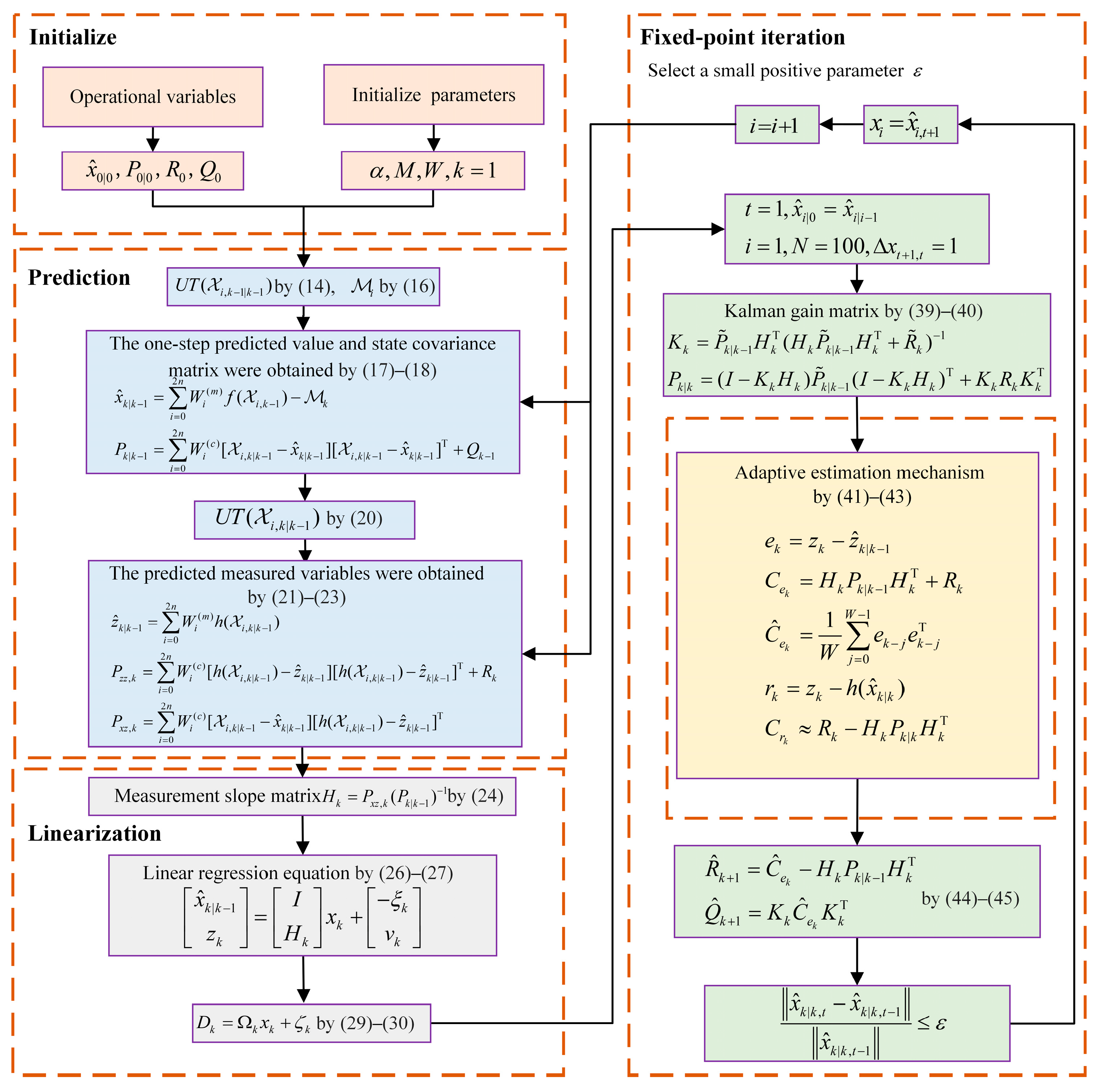
To address the above problems, this paper proposes a fractional-order adaptive generalized cross correlation entropy unscented Kalman filter (FO-AGCCE-UKF). The main innovative contributions are as follows:
(1) This paper introduces fractional calculus theory and utilizes the Grünwald–Letnikov difference definition to reconstruct the discrete-time state-space model of power systems. By incorporating a memory term containing historical state information into the state equation, this method effectively overcomes the memoryless limitation of traditional integer-order models, significantly enhancing the model’s representation accuracy for the long-memory behaviors and transient processes of power systems.
(2) This study adopts the generalized cross correlation entropy (GCCE) criterion to replace the traditional MSE criterion and constructs a novel filtering iterative framework combined with statistical linearization techniques. This method leverages the local characteristics of generalized Gaussian kernel functions to effectively suppress the impact of large errors, substantially enhancing the algorithm’s robustness in non-Gaussian and heavy-tailed noise environments while ensuring computational efficiency.
(3) This paper designs an adaptive update mechanism for noise covariance matrices, constructing an online estimator for noise statistical characteristics based on the innovation sequence. This mechanism enables real-time correction of process and measurement noise parameters according to state prediction errors, endowing the algorithm with stronger adaptability and convergence stability in scenarios involving sudden load changes and model uncertainties.
The remainder of this paper is organized as follows:
Section 2 details the dynamic modeling theory of power systems based on fractional calculus and the basic principles of GCCE;
Section 3 systematically expounds on the FO-AGCCE-UKF algorithm, deriving the fractional-order prediction step containing historical memory terms and the adaptive update flow for noise covariance;
Section 4 verifies the estimation performance of the proposed method under scenarios such as mixed noise interference, outliers, and sudden load changes based on IEEE 14-bus, 30-bus, and 57-bus standard test systems; and
Section 5 summarizes the research conclusions of the full text.
2. Theoretical Background
To describe the dynamic process of the power system and capture its long-memory characteristics, this paper adopts a fractional-order nonlinear state-space model for modeling. The model consists of a fractional-order state transition equation and a nonlinear measurement equation [
23]. The state equation is constructed based on fractional calculus theory to accurately describe the historical dependence of the system, while the measurement equation integrates real-time measurement data such as bus voltage magnitudes, injected power, and line power from the SCADA system.
2.1. Fractional-Order Power System Dynamic Model
The power system is a complex dynamic system characterized by strong nonlinearity, real-time load fluctuations, and multi-variable coupling. Particularly with the extensive integration of energy storage elements and power electronic devices, the state evolution of the system exhibits significant memory effects; that is, the current state depends not only on the previous moment but also on the accumulation of historical states. Traditional integer-order models struggle to accurately describe this non-locality. To address this, this paper introduces fractional calculus theory. Fundamentally, the electromechanical transient process is a continuous-time physical dynamic system described by fractional-order differential equations, where the fractional derivative operator
captures the non-local memory characteristics in the continuous domain. However, for digital state estimation based on sampled data, a transition from the continuous model to a discrete-time model is required. The Grünwald–Letnikov (G-L) definition [
24] provides a direct numerical discretization method that acts as a mathematical bridge between the continuous fractional derivatives and discrete historical state sequences. Based on this, the
-order derivative of a function
can be expressed as
However, in practical digital implementation, utilizing infinite historical data is computationally infeasible due to storage and processing constraints. Furthermore, according to the short memory principle in fractional calculus, the binomial coefficients
decay rapidly as
increases, meaning that distant historical states have a negligible impact on the current dynamics. Therefore, this study adopts a truncated numerical approximation based on a fixed memory length
:
where
is the sampling step,
is fractional-order difference operator,
is the truncated memory length,
is the index of the historical moment,
is the binomial coefficient defined by Grüwald–Letnikov, and its calculation formula is
.
Based on the discrete G-L definition in Equation (2), the continuous-time fractional-order swing equations of the power system can be transformed into the following discrete-time stochastic difference equation. To explicitly demonstrate the memory characteristic of the fractional-order system, we expand the historical state terms as follows:
where
denotes the system state vector at time step
, with dimension
typically corresponding to the generator states;
represents the historical state vector at lag
; and
is the nonlinear state transition function derived from the classical generator swing equations, describing the physical evolution of rotor dynamics. The term
constitutes the fractional-order memory term, which explicitly reflects the cumulative correction effect of the system’s historical trajectory on the current state. Furthermore,
is the measurement vector, and
is the nonlinear measurement function. Finally,
and
represent the process and measurement noise vectors, respectively. They are modeled as independent Gaussian white noises satisfying the following distribution laws and mathematical expectations:
,
and
are the process and measurement noise covariance matrices, and
denotes the mathematical expectation operator.
denotes the initial state vector, which is assumed to follow a Gaussian distribution
.
Theoretically, the Grünwald–Letnikov definition requires an infinite summation of historical states. However, in practical engineering implementation, storing infinite his-tory is infeasible. According to the short memory principle, the binomial coefficients decay algebraically as increases. This means that the influence of states from the distant past on the current behavior diminishes rapidly. Therefore, it is mathematically justifiable to truncate the memory length to a fixed window size . This truncation approximates the fractional-order dynamics with high fidelity while significantly reducing computational and storage requirements.
The measurement function
is a nonlinear function describing the relationship between the state variables and the measurements collected by the SCADA system [
25]. Its specific forms are as follows:
where
and
are the active and reactive power injections at node
, respectively.
and are the voltage amplitudes, and are the conductance and susceptance between nodes in the node admittance matrix, is the phase angle difference between nodes, and are the active and reactive power flows between nodes and , is the shunt susceptance.
In modern power systems, the widespread integration of power electronic devices and the complex heterogeneous topology introduce dynamics that do not strictly follow the Markovian property. Similar to the ‘memory’ and ‘non-locality’ observed in viscoelastic materials or anomalous diffusion processes, the dynamic response of such systems depends on the accumulation of historical states. The fractional order serves as a key physical parameter reflecting this ‘memory intensity.’ It is system-dependent, determined by the proportion of power electronic components and the specific network structure, rather than being a universal constant. A lower implies a stronger dependence on historical trajectories, characterizing the heavy-tailed behavior of the system’s transient response.
2.2. Generalized Cross Correlation Entropy Criterion
The fundamental problem of optimal filtering is to determine the state estimate based on the set of measurements accumulated from the initial time up to the current moment, denoted as . This estimation process is governed by a specific quality criterion. To overcome the limitations of the classical MSE criterion and traditional correntropy methods, this paper adopts the generalized cross correlation entropy (GCCE) criterion as the quality criterion. By incorporating a flexible generalized Gaussian kernel function, this criterion significantly enhances the algorithm’s adaptability to complex non-Gaussian and multimodal noise environments.
Consider two random vectors
and
. The theoretical definition of their generalized cross correlation entropy is
where
represents GCCE cost function,
represent the kernel width and shape parameters respectively.
represents generalized Gaussian kernel function,
represents the joint distribution function of the two random variables, and
is the expectation operator. However, in practical engineering applications, the true joint distribution is usually unknown. Therefore, it is necessary to estimate it using a finite-length sample sequence
. The sample estimator can be expressed as
The core of the GCCE criterion lies in the selection of the kernel function. In this paper, the generalized Gaussian density function is adopted. Let us define the error variable as the difference between the random vectors, i.e.,
. The specific form of the generalized Gaussian kernel function
is defined as follows:
where
is the shape parameter, which determines the decay rate of the probability density function.
is the scale parameter, controlling the width of the function.
Remark 1. In the GCCE criterion, the two hyperparameters play distinct roles in shaping the cost function:
Scale parameter: This parameter determines the effective ‘window’ of the similarity measure. A smaller enforces a stricter rejection of large errors, providing higher robustness but potentially reducing convergence speed under nominal Gaussian noise. Conversely, a very large causes the GCCE to approach the standard MSE criterion, losing its robustness.
Shape parameter: This parameter controls the tail behavior of the kernel function. Adjusting allows the kernel to match the statistical characteristics of the noise. The flexibility of enables the filter to adapt to various non-Gaussian environments effectively.
In the generalized Gaussian kernel, different distribution functions can be obtained based on different shape parameters. When
, it is equivalent to the traditional Gaussian kernel, and when
, it corresponds to the Laplacian kernel. Based on this, the sample estimation of generalized cross correlation entropy can be reformulated as
Based on the defined PDF, the GCCE cost function is constructed to minimize the distance between the error distribution and the zero-error state. The cost function is defined as the difference between the kernel’s peak value and the estimated cross-correlation entropy. The corresponding cost function can be constructed as follows:
where
represents the maximum theoretical value of the kernel function, and
is the
-th error sample. Minimizing
is equivalent to maximizing the probability density of the error samples at the origin.
In filter design, by defining the innovation or estimation error , the aforementioned GCCE criterion can be embedded into the optimization framework to replace the traditional mean square error criterion.
Remark 2. Compared with the traditional mean square error (MSE) and cross correlation entropy (CCE) criteria, the generalized cross correlation entropy (GCCE) criterion exhibits three significant advantages:
Stronger robustness: It maintains a stable performance for noise with any bounded distribution.
Flexible higher-order moment adjustment: The shape parameter allows for fine-tuning the weight distribution of various error moments in the cost function, while the scale parameter provides additional dynamic adjustment capability.
Excellent anti-interference ability: This criterion can effectively retain the multimodal statistical characteristics of the data, and at the same time has a significant suppression effect on outliers and impulse noise.
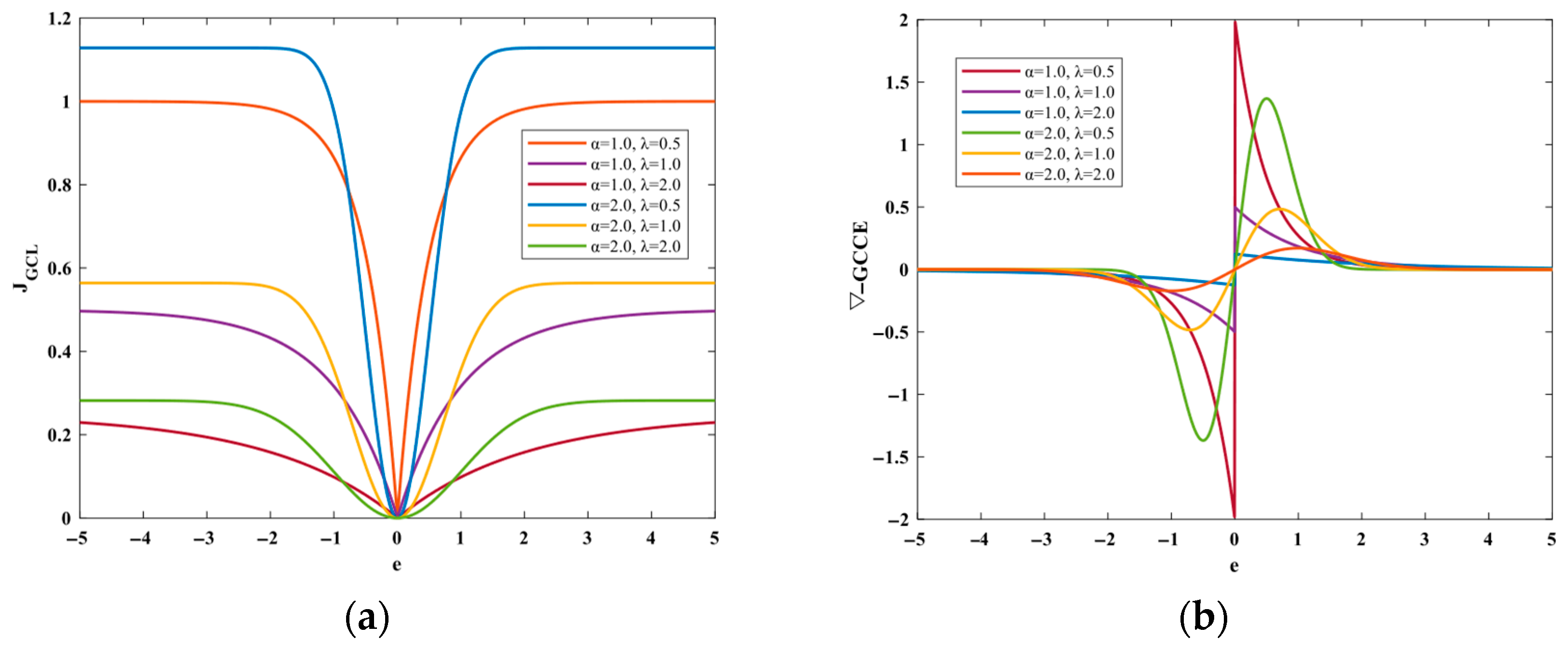
The design of this algorithm fully draws on the above-mentioned characteristics. The design of the algorithm in this study fully incorporates the aforementioned characteristics. By analyzing the curves of the
function and its gradient (denoted as
) under different parameters
, the global convergence characteristics of this cost function can be observed. The parameter curves are shown in
Figure 1.
Every minimum value of the cost function is a global minimum. This means that any optimal weight vector obtained through the convergence of the self-adjusting algorithm will be the globally optimal result. It is particularly noteworthy that when the increases, its gradient shows a decaying trend, and increasing the value of can further suppress the contribution of large errors to the gradient direction. This inherent mechanism ensures that the GCCE-based estimator maintains a robust estimation performance even when facing large error disturbances such as impulse noise.
4. Results and Analysis
4.1. Example Settings
To verify the performance of the proposed FO-AGCCE-UKF algorithm, simulation experiments are conducted in this paper based on the IEEE 14-bus, 30-bus, and 57-bus standard test systems. The dynamic process of the system is simulated through 120 consecutive sampling moments, and time-varying load disturbances and multimodal mixed noise are superimposed on the real state values of each sampling point. To ensure statistical reliability, 100 Monte Carlo simulations were conducted for each working condition, and FO-AGCCE-UKF was compared and analyzed with methods such as UKF, GCCE-UKF, and AGCCE-UKF. To simulate general startup conditions, all filters are initialized using a “Flat Start” strategy. Specifically, the voltage magnitudes of all buses are initialized to 1.0 p.u., and the phase angles to 0 rad. The initial state error covariance matrix is set to , where is the identity matrix.
4.2. Evaluation Metrics
To comprehensively evaluate the filtering performance of the FO-AGCCE-UKF algorithm in power system state estimation, a comprehensive evaluation metric [
26] is introduced, expressed as follows:
where
is the estimated value of the measurement,
is the true value of the measurement,
is the system measurement value under noise interference. The smaller the numerical result of the overall performance index, the higher the accuracy of the estimation.
In addition to the above overall performance indicators, this paper also adopts mean absolute error (MAE) and root mean square error (RMSE) to measure the estimation performance of the algorithm:
where
and
respectively represent the estimated and true values of the amplitude of the voltage node,
and
respectively represent the estimated value and the true value of the voltage phase angle.
MAE and RMSE are widely used to evaluate the accuracy of node voltage amplitude and phase Angle in state estimation. MAE reflects the absolute average level of estimation errors, while RMSE is more sensitive to larger errors and can effectively capture the fluctuation characteristics of the estimation results. Lower values for both types of metrics indicate smaller deviations between the estimated values and the true values, superior stability and accuracy of the algorithm, and better compliance with the requirements for high-precision state estimation in power systems.
4.3. Parameter Initialization Configuration
To systematically test the generalization ability of the FO-AGCCE-UKF algorithm in different test systems, the key parameters in the filtering process were uniformly initialized in this paper, as shown in
Table 2. This setting is designed to provide consistent benchmark conditions for the three standard test systems, ensuring the fairness and reproducibility of algorithm performance comparisons.
4.4. Test Scenario Design
This paper designs five typical test scenarios, including Gaussian mixture noise with random outliers, Laplacian noise with random outliers, abnormal measurement data, sudden load change conditions, and the influence of different parameters on algorithm performance. Furthermore, in order to further verify the superiority of the algorithm in handling uncertainties, we specifically introduced the robust
-UKF in
Section 4.4.6 for a dedicated comparison. It is worth noting that although particle filtering (PF) is also an effective method for dealing with non-Gaussian noise, due to its excessively high computational cost, it is difficult to meet the strict requirements of real-time performance for dynamic state estimation in power systems, and thus was not included in the comparison scope of this paper.
4.4.1. Test Scenario with Gaussian Mixture Noise and Random Outliers
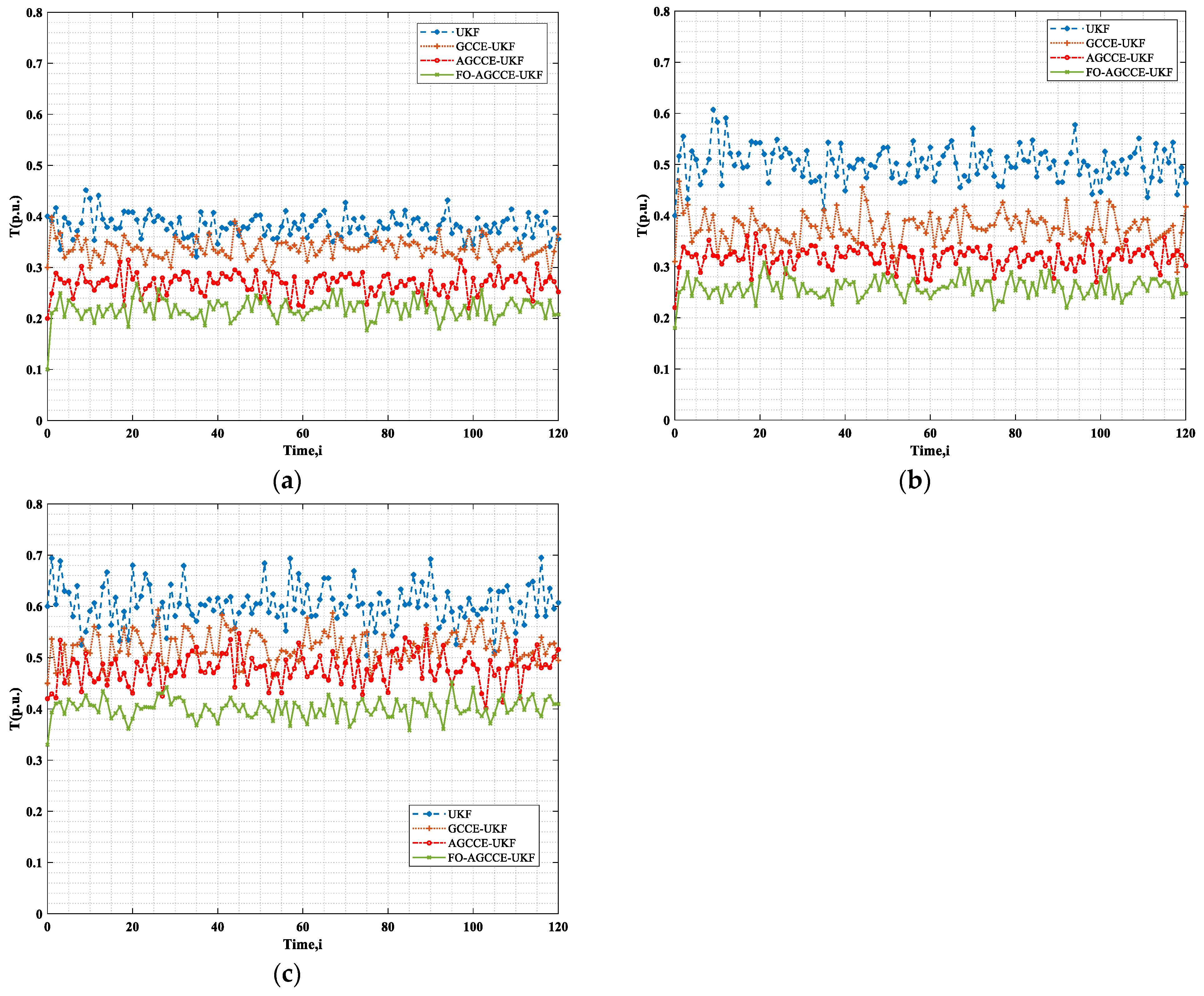
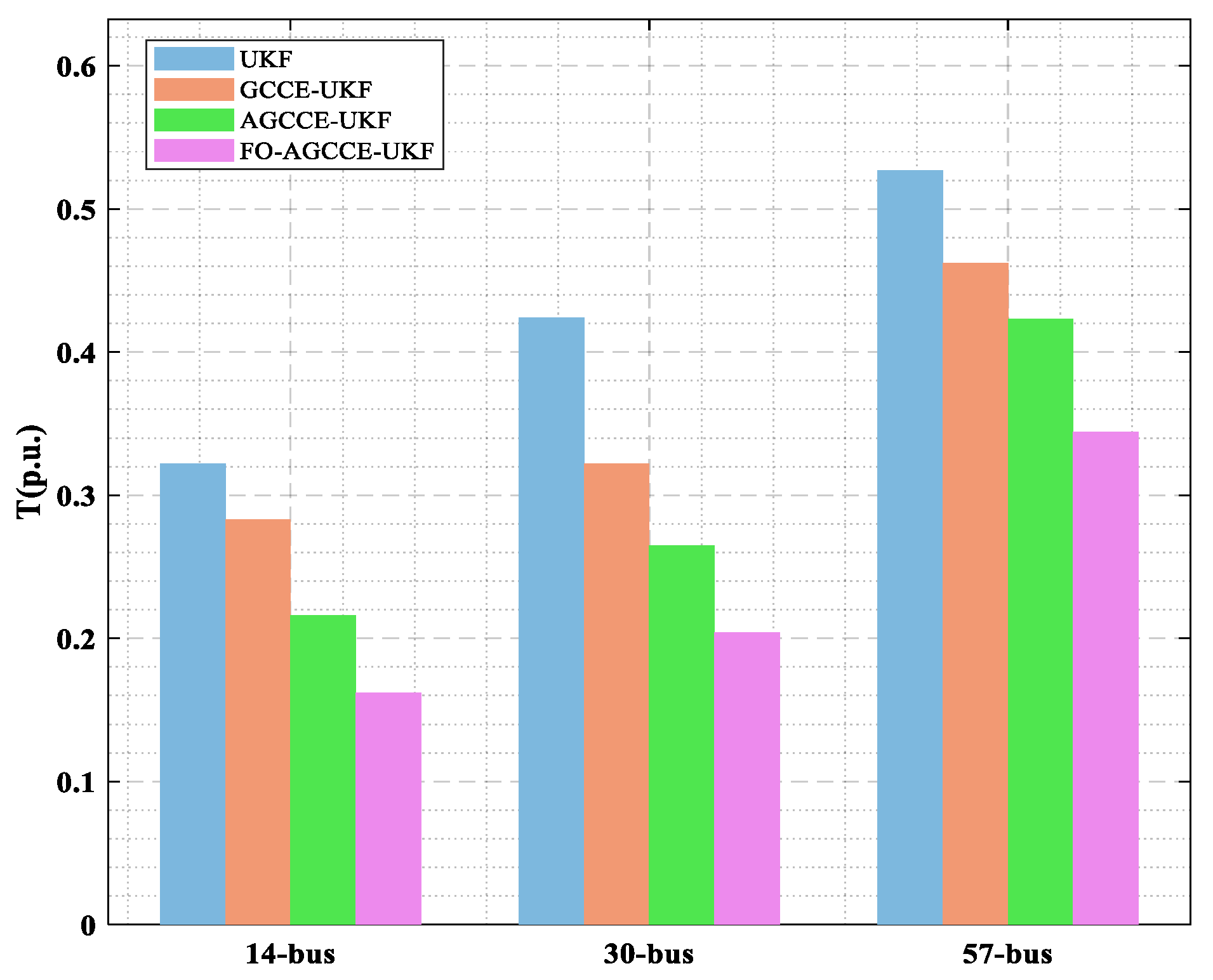
To simulate the common complex noise disturbances in actual power systems, a Gaussian mixture noise environment containing random outliers is constructed in the IEEE 14-bus, 30-bus, and 57-bus standard test systems. This verifies the robustness and estimation accuracy of the FO-AGCCE-UKF algorithm under non-stationary, multi-modal noise conditions. In the experiment, the proposed FO-AGCCE-UKF method was compared with UKF, GCCE-UKF and AGCCE-UKF. By recording the changes in the overall performance indicators of each algorithm over time during the dynamic filtering process, the filtering stability and convergence performance were comprehensively evaluated. The detailed results are shown in
Figure 3.
It can be seen from the results of the three standard test systems in the figure that the traditional UKF is relatively sensitive to outliers, with the estimation error curve exhibiting the most significant fluctuations. Although GCCE-UKF and AGCCE-UKF have improved noise suppression capabilities to a certain extent through the entropy strategy and adaptive mechanism, respectively, they are essentially still integer-order algorithms that ignore the inherent historical memory characteristics of the power system. Consequently, their convergence speed and dynamic tracking accuracy are still inferior to the FO-AGCCE-UKF method proposed in this paper. By deeply integrating the fractional-order memory term, the GCCE criterion, and the adaptive update mechanism, FO-AGCCE-UKF not only effectively overcomes the combined interference of mixed Gaussian noise and random outliers but also accurately captures the fractional-order dynamic behavior of the system. Thus, it demonstrates the most stable estimation performance and the lowest error level throughout the dynamic process, fully verifying its significant advantages in complex noise and dynamic environments.
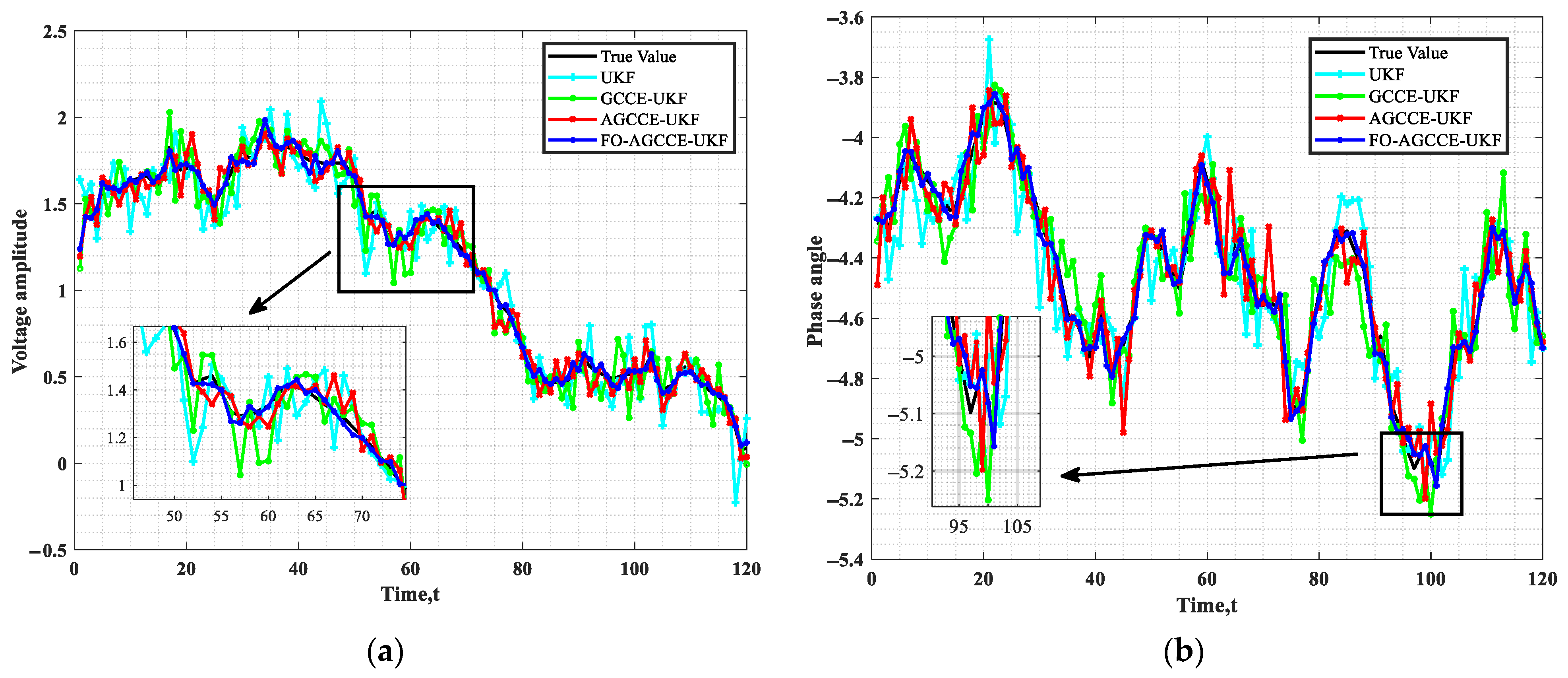
To further examine the dynamic tracking capability of FO-AGCCE-UKF for power system state variables, Bus #6 in the IEEE 57-bus system is analyzed, with a 5% random disturbance applied on the load side.
Figure 4 displays the estimation trajectories of the node voltage amplitude and phase angle by different algorithms against the background of mixed Gaussian noise. It can be observed that the estimation results of FO-AGCCE-UKF are the closest to the true values for both voltage amplitude and phase angle, demonstrating its superior ability to suppress complex noise interference.
To objectively evaluate the algorithm performance from a numerical perspective, based on the simulation data from Bus #6 of the IEEE 57-bus system, the MAE and RMSE are used as evaluation metrics to quantitatively compare the estimation accuracy of each algorithm. The specific results are shown in
Table 3.
The experimental results show that the FO-AGCCE-UKF algorithm is not only effective in suppressing mixed noise and outlier interference, but also highlights its comprehensive advantages in dynamic tracking accuracy and steady-state robustness.
4.4.2. Laplacian Noise with Random Outliers in the Measurement
To test the adaptability of the FO-AGCCE-UKF algorithm in the scenario of Laplacian distribution noise accompanied by random outliers, comparative experiments were conducted in three standard test systems, and the results are shown in
Figure 5.
It can be seen that in all test systems, the overall performance indicators of FO-AGCCE-UKF are consistently lower than those of UKF, GCCE-UKF and AGCCE-UKF, demonstrating its superior estimation consistency in such non-Gaussian heavy-tail noise environments.
Table 4 further presents the overall performance index values of each algorithm. FO-AGCCE-UKF achieved the minimum value in all cases, verifying that it can still maintain a high estimation accuracy and robustness under the coexistence of Laplacian noise and outliers.
4.4.3. Bad Measurement Data
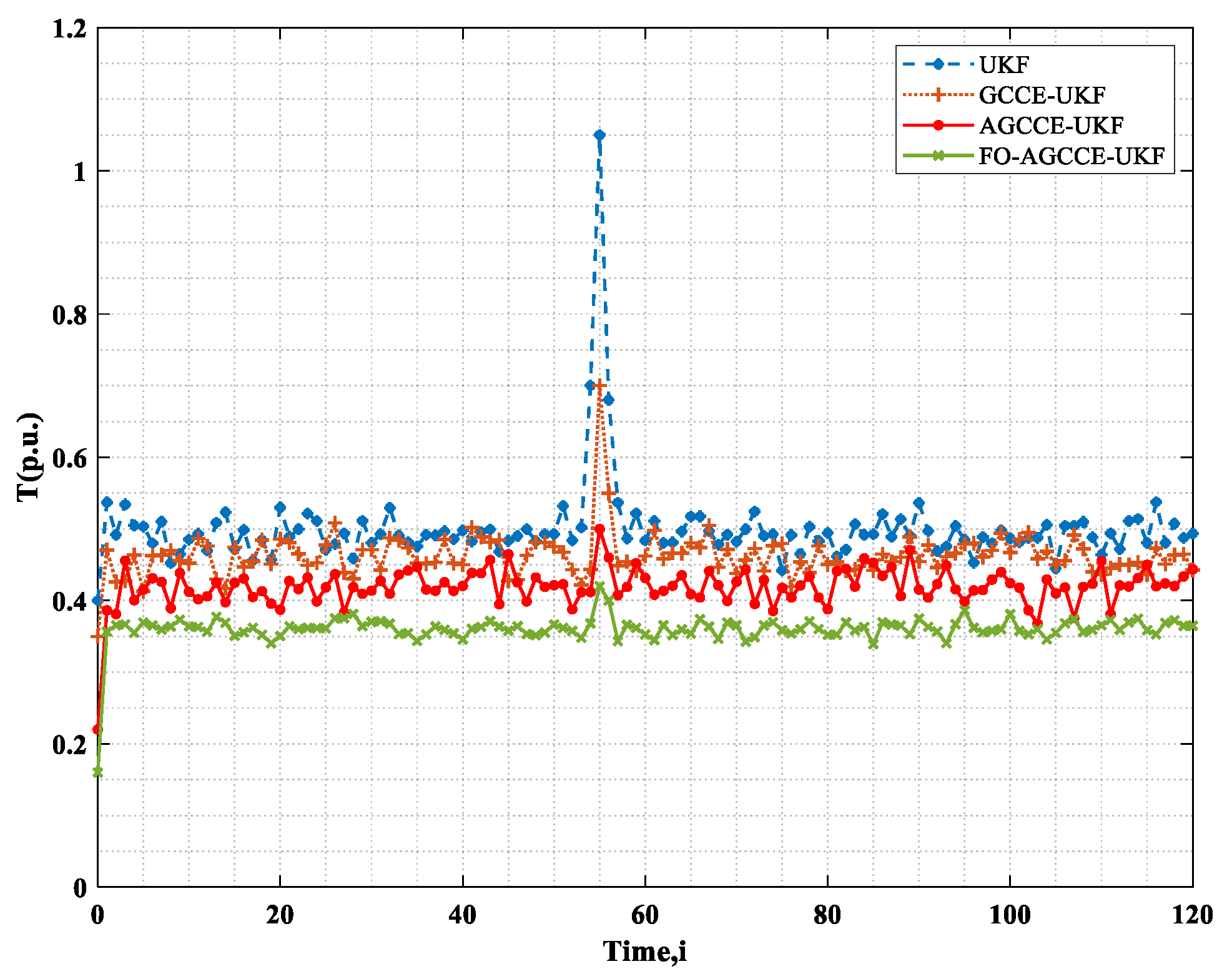
To evaluate the dynamic response and anti-interference capability of FO-AGCCE-UKF in the event of sudden measurement data anomalies, a test was conducted based on the IEEE 30-bus system by injecting measurement outliers at time. The results are shown in
Figure 6.
Near
, the performance metric of UKF shows a significant peak, while GCCE-UKF and AGCCE-UKF are also affected to varying degrees. In contrast, the fluctuation range of the FO-AGCCE-UKF curve is the smallest, indicating its ability to effectively suppress the estimation deviation caused by outliers. The overall performance metric values listed in
Table 5 further demonstrate that FO-AGCCE-UKF possesses better stability and accuracy when dealing with bad measurement data.
4.4.4. Sudden Load Change
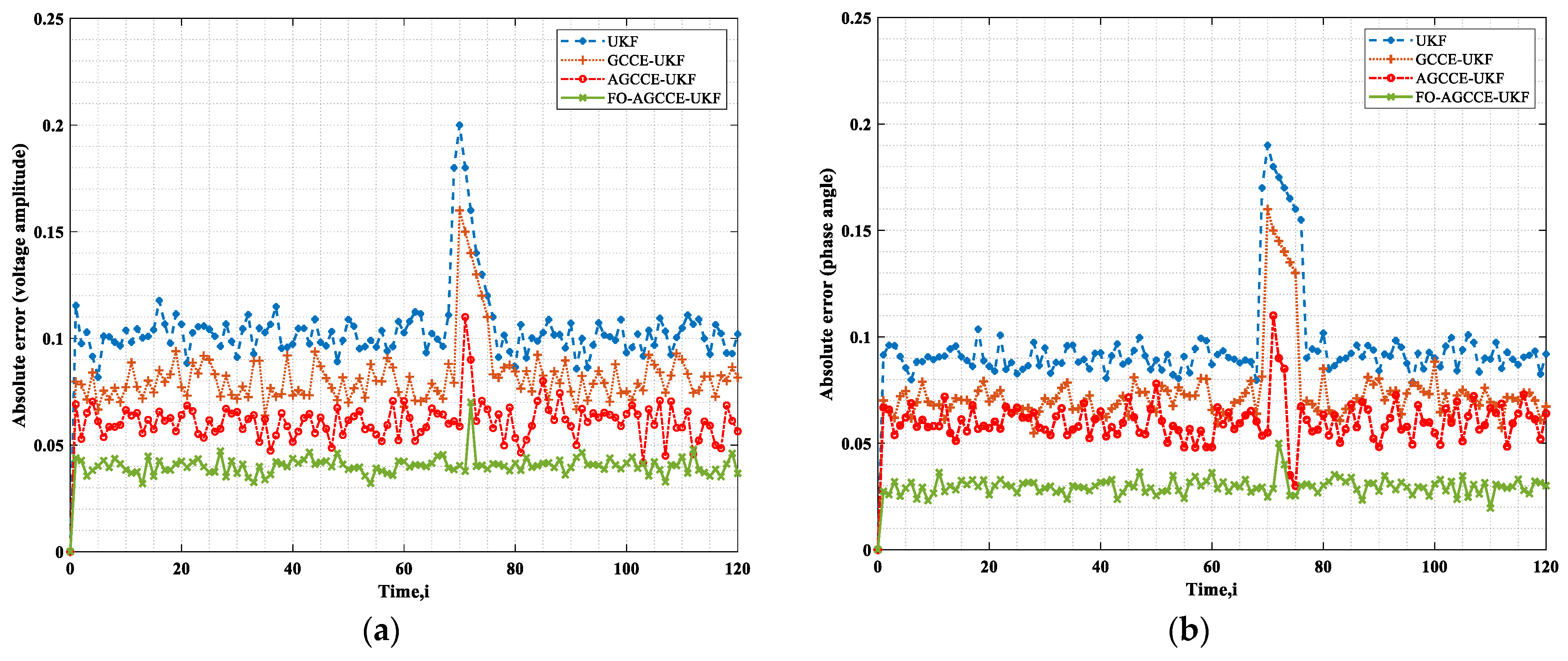
To further verify the tracking performance of the algorithm under system sudden load change, a 25% load step change is introduced at the sampling point
in the IEEE 57-bus system. The absolute error curves for voltage amplitude and phase angle are plotted, as shown in
Figure 7.
Experimental results show that after the sudden load change occurred, the voltage magnitude and phase angle errors of UKF increased sharply. Although GCCE-UKF and AGCCE-UKF mitigated some errors relying on their robust mechanisms, they still exhibited certain lags in tracking transient changes due to the memoryless nature of integer-order models. In contrast, FO-AGCCE-UKF consistently maintained the lowest level of error fluctuation throughout the transient process. This indicates that, thanks to the effective utilization of historical state information by the fractional-order model, the proposed algorithm can more keenly capture the sudden change characteristics of the system’s operating state, thereby significantly enhancing the stability and reliability of dynamic estimation under complex conditions.
From the perspective of practical engineering applications, the capability to track state variables with high precision during sudden load changes holds significant operational value. In the assessment of power system transient stability, the rapid and accurate estimation of voltage magnitude and phase angle serves as a critical basis for determining whether the system is approaching instability. Specifically, the FO-AGCCE-UKF demonstrates superior sensitivity in capturing phase angle mutations, which translates into tangible benefits for system protection and control. For wide-area protection systems, the proposed method provides more reliable fault criteria, effectively preventing maloperation of distance protection relays caused by state estimation latency or errors. Regarding emergency control, the accurate capture of voltage dip trajectories enables automatic voltage control systems to trigger reactive power compensation devices at an earlier stage, thereby preventing potential voltage collapse. Consequently, the proposed algorithm not only reduces the numerical RMSE but also provides essential data support for enhancing the grid’s situational awareness and emergency response capabilities under disturbance conditions.
4.4.5. Parameter Sensitivity Analysis
The performance of FO-AGCCE-UKF is significantly influenced by the system fractional order
and the memory length
. This section tests the sensitivity of these two key parameters based on the IEEE 57-bus system under mixed noise and sudden load change conditions. Since the fractional order
is a parameter intrinsic to the specific physical characteristics of the power system, there is no theoretically universal optimal value. To determine the most appropriate order for the test systems, we adopted a systematic empirical tuning strategy based on sensitivity analysis. The model order
is adjusted within the interval
, and the results are presented in
Table 6.
Experiments indicate that the comprehensive performance metric reaches its minimum at , suggesting that this value best captures the fractional-order dynamics of the simulated system. When , the algorithm degenerates into the integer-order AGCCE-UKF. Due to the neglect of memory characteristics, the metric regresses to 0.435. This confirms that matched fractional-order modeling can further reduce estimation error by approximately 13%.
Furthermore, the memory length determines the window size for utilizing historical information; its impact on accuracy and computational time is shown in
Table 7.
The truncation of memory length
has a direct impact on both estimation accuracy and system stability. As presented in
Table 7, increasing
from 5 to 10 results in a significant reduction in the estimation error. A short memory length induces a large truncation error, discarding recent historical information that is critical for capturing the system’s transient behavior, which can degrade tracking stability.
However, as increases further to 15 or 20, the improvement in accuracy becomes marginal, exhibiting a saturation effect. This confirms the short memory principle: the weights of distant historical states are too small to provide meaningful corrections. Conversely, the computational time increases linearly with . Therefore, selecting achieves the optimal trade-off between model fidelity and computational efficiency, ensuring precise state estimation within a feasible runtime for real-time applications.
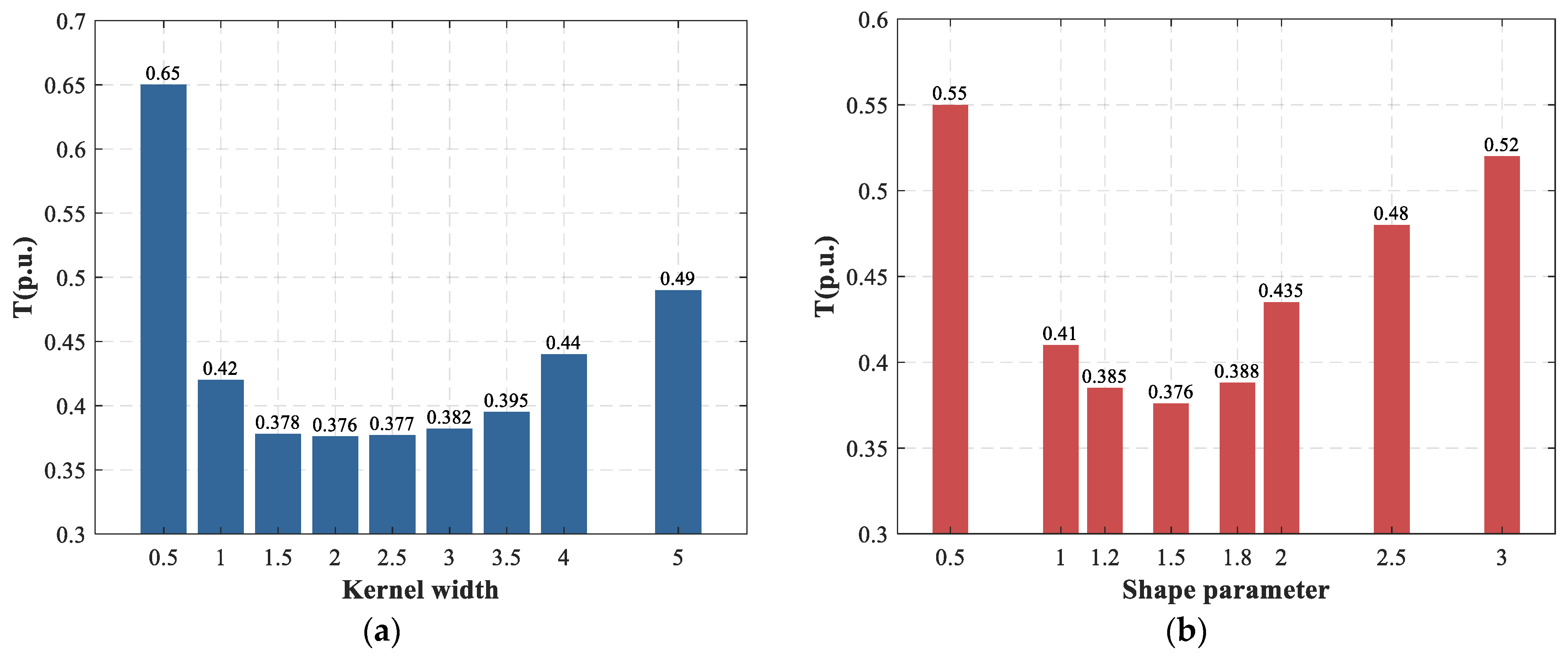
Additionally, unlike the fractional order, which depends on system physics, the GCCE parameters are tuning parameters related to the noise environment. To evaluate the robustness of FO-AGCCE-UKF against parameter mismatch, we tested the overall performance metric under varying and values using the IEEE 57-bus system with mixed noise.
Figure 8a illustrates the impact of the kernel width
. When
is too small, the kernel becomes too narrow, rejecting valid measurements as outliers, which degrades performance. However, in the range of
, the metric
remains consistently low, indicating a broad stable operating region.
Figure 8b shows the impact of the shape parameter
. For the simulated environment involving heavy-tailed impulsive noise, the optimal performance is achieved around
. Deviating from this value to
or
results in a slight increase in error, but the algorithm does not diverge. This demonstrates that while optimal tuning improves accuracy, the method remains robust to slight parameter mismatches.
4.4.6. Comparison with Robust H∞-UKF
Given that the
filtering algorithm is a classic robust method in the control domain for handling model uncertainties and worst-case disturbances, this section conducts a specific comparison between the proposed algorithm and the
-UKF to further evaluate the performance boundaries of FO-AGCCE-UKF. To ensure fairness and conciseness, this comparison is carried out under the challenging scenario of mixed Gaussian noise with random outliers in the IEEE 57-bus system, consistent with the experimental conditions described in
Section 4.4.1. The comparative results are presented in
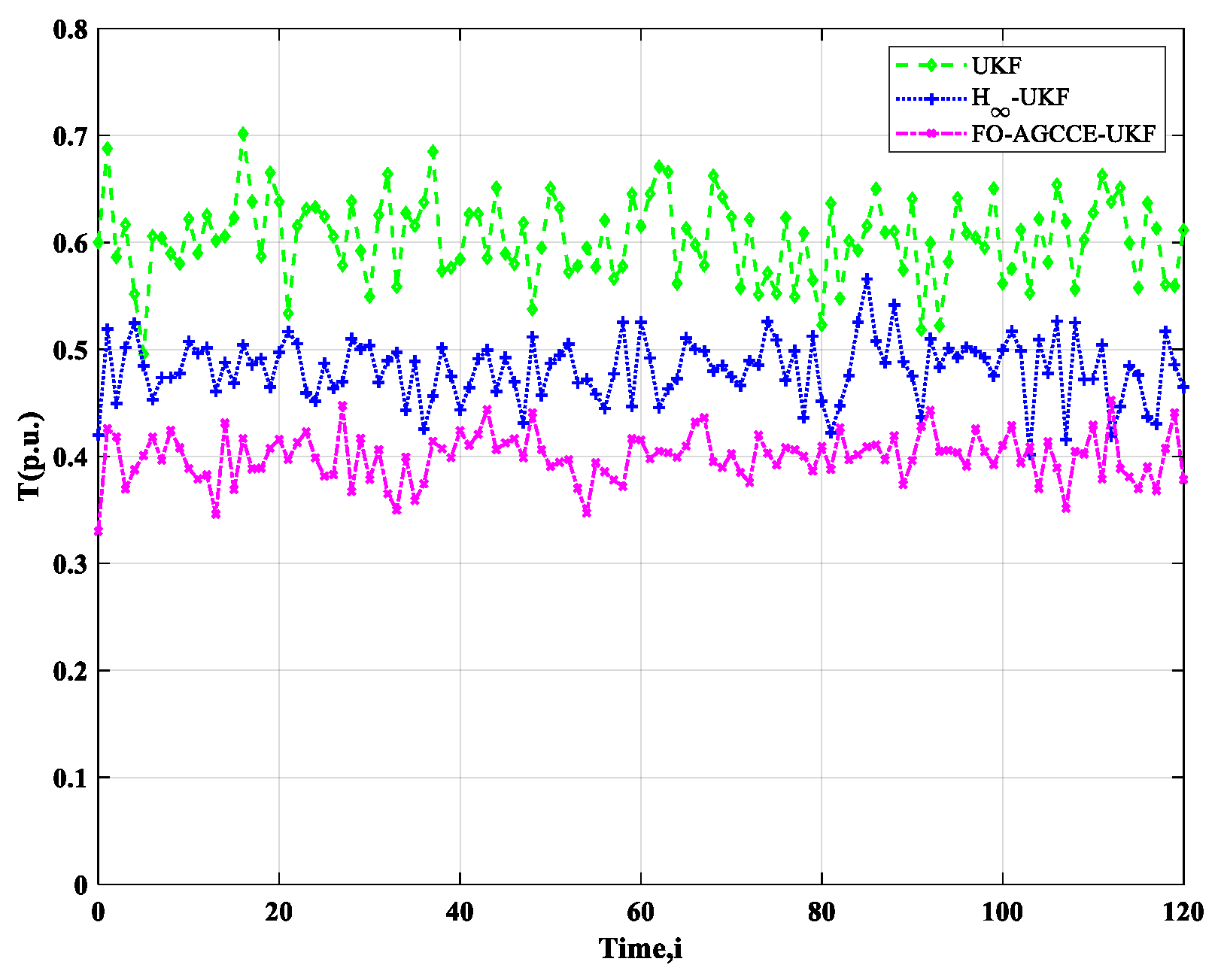
Figure 9.
As observed, the -UKF exhibits significantly stronger robustness than the standard UKF, validating the effectiveness of the criterion in mitigating abnormal disturbances. However, despite its improved stability, the overall performance metric of the -UKF remains inferior to that of the proposed FO-AGCCE-UKF. Specifically, the value of the -UKF is approximately 20% higher than that of our method. This performance gap is primarily attributed to the fundamental differences in their mechanisms: the filter adopts a conservative strategy to guarantee error boundedness, which often sacrifices optimal precision under nominal conditions. In contrast, the FO-AGCCE-UKF adaptively handles non-Gaussian noise through the GCCE criterion and uniquely leverages the ‘long memory’ characteristic of the fractional-order model to correct state predictions. Consequently, the proposed method achieves a superior balance between robustness and tracking precision, demonstrating clear advantages in complex dynamic environments.
4.4.7. Statistical Consistency Analysis
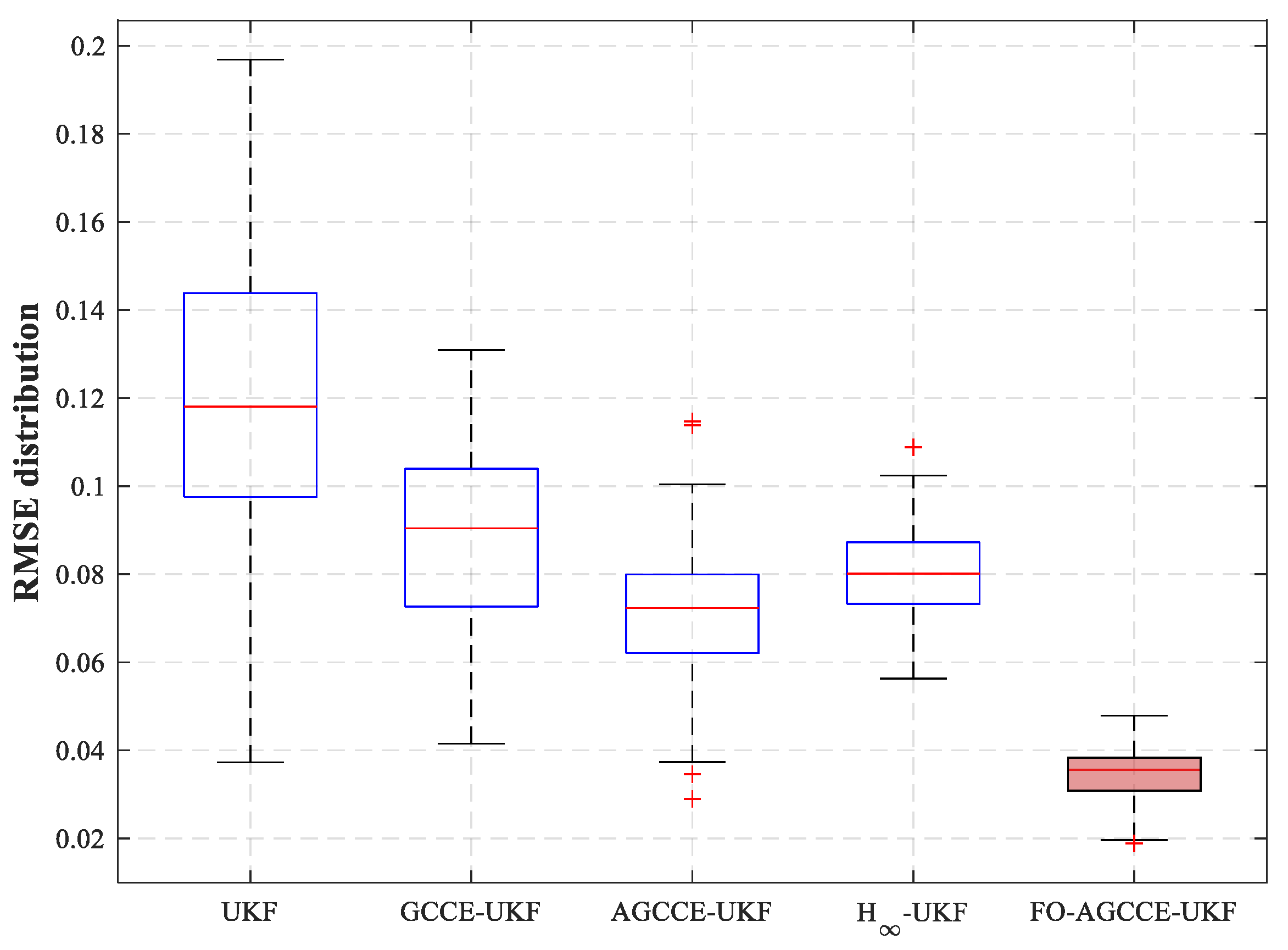
While the average error metrics discussed in previous sections demonstrate the accuracy superiority of the proposed method in specific scenarios, evaluating the stability of the algorithm under random noise environments is equally critical. To this end, a statistical analysis was performed based on 100 independent Monte Carlo simulations on the IEEE 57-bus system. The result is shown in
Figure 10.
The figure shows the box plot of the RMSE distribution of different algorithms over 100 runs. In the plot, the height of the box visually represents the dispersion of the estimation error. It can be clearly observed that the standard UKF and GCCE-UKF exhibit wider boxes with numerous outliers, indicating their sensitivity to specific worst-case noise samples. In contrast, the FO-AGCCE-UKF shows the most compact distribution with the flattest box and shortest whiskers.
Quantitative statistical metrics further confirm this observation. The standard deviation of the RMSE for the proposed FO-AGCCE-UKF is only 0.0052, which is significantly lower than that of the standard UKF. Furthermore, the 95% confidence interval of the mean RMSE for the proposed method is calculated as [0.0337, 0.0360], demonstrating a tight convergence range. These statistical results provide strong evidence that, benefiting from the fractional-order memory and the adaptive noise covariance mechanism, the proposed method achieves superior performance consistency and is robust against extreme random noise variations.
4.5. Computational Complexity and Real-Time Feasibility Analysis
The proposed FO-AGCCE-UKF improves estimation robustness at the cost of increased computational complexity. To evaluate its potential for practical real-time deployment, we analyze its time complexity and execution speed. The standard UKF has a computational complexity of approximately due to matrix decompositions and multiplications, where is the state dimension. The FO-AGCCE-UKF introduces two additional computational loads:
1. Fractional-order memory calculation: The calculation of the memory term requires storing and processing a sliding window of historical states. This adds a linear complexity of . Since the memory length is typically small, the memory overhead is negligible for modern computing hardware.
2. Fixed-point iteration: The GCCE measurement update requires an iterative process to minimize the cost function. If the average number of iterations is , the complexity of the update step increases linearly by a factor of .
To quantify the actual runtime, we compared the average execution time per time step of different algorithms on the IEEE 14-bus, 30-bus, and 57-bus systems. The simulation was performed on a computer. The results are presented in
Table 8.
As observed in
Table 8, the execution time of FO-AGCCE-UKF is approximately 2 to 3 times that of the standard UKF. This increase is primarily attributed to the repeated calculations in the fixed-point iteration loop and the convolution operation of the memory term.
However, even for the IEEE 57-bus system, the average computation time is 15.82 ms. In practical dynamic state estimation applications based on PMUs, the data reporting rate is typically 30 to 60 frames per second, corresponding to intervals of 33.3 ms to 16.6 ms. The proposed algorithm fits within these time constraints. Furthermore, for large-scale systems, the matrix operations in the UKF framework can be further accelerated using parallel computing techniques or GPU acceleration. Therefore, the FO-AGCCE-UKF achieves a favorable trade-off, offering significant robustness improvements with a computational cost that remains feasible for real-time monitoring.